

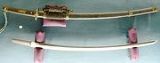
Tachi

Encyclopedia
Samurai
is the term for the military nobility of pre-industrial Japan. According to translator William Scott Wilson: "In Chinese, the character 侍 was originally a verb meaning to wait upon or accompany a person in the upper ranks of society, and this is also true of the original term in Japanese, saburau...
class of feudal Japan.
History and description
Katana
A Japanese sword, or , is one of the traditional bladed weapons of Japan. There are several types of Japanese swords, according to size, field of application and method of manufacture.-Description:...
and tachi can be distinguished from each other if signed, by the location of the signature (mei) on the tang (nakago). In general the mei should be carved into the side of the nakago that would face outward when the sword was worn. Since a tachi was worn cutting edge down, and the katana was worn cutting edge up the mei would be in opposite locations on the nakago of both types of swords.
Gilbertson, Oscar Ratti, and Adele Westbrook state that a sword is called a tachi when hung from the obi
Obi (sash)
is a sash for traditional Japanese dress, keikogi worn for Japanese martial arts, and a part of kimono outfits.The obi for men's kimono is rather narrow, wide at most, but a woman's formal obi can be wide and more than long. Nowadays, a woman's wide and decorative obi does not keep the kimono...
(belt or sash) with the edge down, and the same sword becomes a katana when worn edge up and thrust through the girdle. The "tachi" style was eventually discarded in favor of the katana.
The daitō (long swords) that pre-date the katana average about 78 cm in blade length, larger than the katana average of around 70 cm. Unlike the traditional manner of wearing the katana, the tachi was worn hung from the belt with the cutting-edge down, and was usually used by cavalry
Cavalry
Cavalry or horsemen were soldiers or warriors who fought mounted on horseback. Cavalry were historically the third oldest and the most mobile of the combat arms...
. Deviations from the average length of tachi have the prefixes ko- for "short" and ō- for "great or large" attached. For instance, tachi that were shōtō and closer in size to a wakizashi
Wakizashi
The is one of the traditional Japanese swords worn by the samurai class in feudal Japan.-Description:...
were called kodachi
Kodachi
A , literally translating into "small or short tachi ", is a Japanese sword that is too long to be considered a dagger but too short to be a long sword...
. The longest tachi (considered a 15th century ōdachi
Odachi
An , was a type of long Japanese sword. The term nodachi, or "field sword", which refers to a different type of sword, is often mistakenly used in place of ōdachi. It is historically known as ōtachi....
) in existence is more than 3.7 meters in total length (2.2m blade) but believed to be ceremonial. In the year 1600, many old tachi were cut down into katana. The majority of surviving tachi blades now are o-suriage (having their original tangs cut at some point), so it is rare to see an original signed ubu nakago (unaltered tang) complete and unaltered tachi.
Use
The tachi was used primarily on horseback, where it was able to be drawn efficiently for cutting down enemy foot soldiers. On the ground it was still an effective weapon, but somewhat awkward to use. The uchigatanaUchigatana
The is one type type of traditional Japanese sword worn by the samurai class of feudal Japan. The uchigatana was the descendant of the tachi.-History:...
was the predecessor to the katana as the battle-blade of feudal Japan's bushi (warrior class), and as it evolved into the later design, the two were often differentiated from each other only by how they were worn and by the fittings for the blades.
It was during the Mongol invasions
Mongol invasions of Japan
The ' of 1274 and 1281 were major military efforts undertaken by Kublai Khan to conquer the Japanese islands after the submission of Goryeo to vassaldom. Despite their ultimate failure, the invasion attempts are of macrohistorical importance, because they set a limit on Mongol expansion, and rank...
that it was shown there were some weaknesses in the tachi sword which led to the development of the Katana.
In later Japanese feudal history, during the Sengoku
Sengoku period
The or Warring States period in Japanese history was a time of social upheaval, political intrigue, and nearly constant military conflict that lasted roughly from the middle of the 15th century to the beginning of the 17th century. The name "Sengoku" was adopted by Japanese historians in reference...
and Edo
Edo period
The , or , is a division of Japanese history which was ruled by the shoguns of the Tokugawa family, running from 1603 to 1868. The political entity of this period was the Tokugawa shogunate....
periods, certain high-ranking warriors of what became the ruling class would wear their sword tachi-style (edge-downward), rather than with the saya (scabbard) thrust through the belt with the edge upward.
With the rising of militarism during the Shōwa era
Statism in Shōwa Japan
Statism in Shōwa Japan was a political syncretism of Japanese right-wing political ideologies, developed over a period of time from the Meiji Restoration...
, the Imperial Japanese Army
Imperial Japanese Army
-Foundation:During the Meiji Restoration, the military forces loyal to the Emperor were samurai drawn primarily from the loyalist feudal domains of Satsuma and Chōshū...
and the Imperial Japanese Navy
Imperial Japanese Navy
The Imperial Japanese Navy was the navy of the Empire of Japan from 1869 until 1947, when it was dissolved following Japan's constitutional renunciation of the use of force as a means of settling international disputes...
implemented tachi called Shin guntō
Shin gunto
The was a weapon and badge of rank used by the Imperial Japanese Army between the years of 1935 and 1945. During most of that period, the swords were manufactured at the Toyokawa Naval Arsenal.- Creation of a new army sword :...
and Kai guntō. (see Japanese swordsmithing)
See also
- Jin tachi
- UchigatanaUchigatanaThe is one type type of traditional Japanese sword worn by the samurai class of feudal Japan. The uchigatana was the descendant of the tachi.-History:...
- KatanaKatanaA Japanese sword, or , is one of the traditional bladed weapons of Japan. There are several types of Japanese swords, according to size, field of application and method of manufacture.-Description:...