
All Topics  
Tensile strength


   Email Print
   Bookmark   Link


Tensile strength


Tensile strength , or is the stress
Stress (physics)

In continuum mechanics, stress is a measure of the average amount of force exerted per unit area. It is a measure of the intensity of the total internal forces acting within a body across imaginary internal surfaces, as a reaction to external applied forces and body forces....
 at which a material breaks or permanently deforms. Tensile strength is an intensive property
Intensive and extensive properties

In the physical sciences, an intensive property , is a physical property of a system that does not depend on the system size or the amount of material in the system....
 and, consequently, does not depend on the size of the test specimen. However, it is dependent on the preparation of the specimen and the temperature of the test environment and material.

Tensile strength, along with elastic modulus
Elastic modulus

An elastic modulus, or modulus of elasticity, is the mathematical description of an object or substance's tendency to be deformed elastically when a force is applied to it....
 and corrosion resistance, is an important parameter of engineering materials that are used in structures and mechanical devices.


Discussion
Ask a question about 'Tensile strength'
Start a new discussion about 'Tensile strength'
Answer questions from other users
Full Discussion Forum


Recent Posts


Encyclopedia


Tensile strength , or is the stress
Stress (physics)

In continuum mechanics, stress is a measure of the average amount of force exerted per unit area. It is a measure of the intensity of the total internal forces acting within a body across imaginary internal surfaces, as a reaction to external applied forces and body forces....
 at which a material breaks or permanently deforms. Tensile strength is an intensive property
Intensive and extensive properties

In the physical sciences, an intensive property , is a physical property of a system that does not depend on the system size or the amount of material in the system....
 and, consequently, does not depend on the size of the test specimen. However, it is dependent on the preparation of the specimen and the temperature of the test environment and material.

Tensile strength, along with elastic modulus
Elastic modulus

An elastic modulus, or modulus of elasticity, is the mathematical description of an object or substance's tendency to be deformed elastically when a force is applied to it....
 and corrosion resistance, is an important parameter of engineering materials that are used in structures and mechanical devices. It is specified for materials such as alloy
Alloy

An alloy is a partial or complete solid solution of one or more chemical element in a metallic matrix. Complete solid solution alloys give single solid phase microstructure, while partial solutions give two or more phases that may be homogeneous in distribution depending on thermal history....
s, composite material
Composite material

Composite materials are engineered materials made from two or more constituent materials with significantly different physical or chemical properties which remain separate and distinct on a macroscopic level within the finished structure....
s, ceramic
Ceramic

File:Bridge from dental porcelain.jpgFile:Qing vase p1070256.jpgA ceramic is an inorganic, nonmetal solid prepared by the action of heat and subsequent cooling....
s, plastic
Plastic

Plastic is the general common term for a wide range of synthetic or semisynthetic organic chemistry solid materials suitable for the manufacture of industrial products....
s and wood
Wood

Wood is an organic material; in the strict sense wood is produced as secondary xylem in the stems of woody plants, notably trees but also shrubs, etc....
.

Explanation

There are three definitions of tensile strength: Yield strength
Yield (engineering)

The yield strength or yield point of a material is defined in engineering and materials science as the Stress at which a material begins to Plasticity ....
: The stress at which material strain changes from elastic deformation to plastic deformation, causing it to deform permanently. Ultimate strength: The maximum stress a material can withstand when subjected to tension, compression or shearing. It is the maximum stress on the stress-strain curve
Stress-strain curve

File:Metal yield.svgDuring testing of a material sample, the stress?strain curve is a graphical representation of the relationship between Stress , derived from measuring the load applied on the sample, and Strain , derived from measuring the deformation of the sample, i.e....
. Breaking strength: The stress coordinate on the stress-strain curve at the point of rupture
Rupture (engineering)

Rupture, or ductile rupture describes the ultimate failure of toughness ductility materials loaded in tension. Rupture describes a failure mode in which, rather than cracking, the material "pulls apart", generally leaving a rough surface....
.

Concept

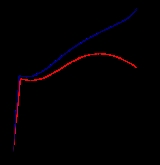
The various definitions of tensile strength are shown in the following stress-strain graph for low-carbon steel:

Metals including steel have a linear stress-strain relationship up to the yield point, as shown in the figure. In some steels the stress falls after the yield point. This is due to the interaction of carbon atoms and dislocation
Dislocation

In materials science, a dislocation is a crystallographic defect, or irregularity, within a crystal structure. The presence of dislocations strongly influences many of the properties of materials....
s in the stressed steel. Cold worked and alloy steels do not show this effect. For most metals yield point is not sharply defined. Below the yield strength all deformation is recoverable, and the material will return to its initial shape when the load is removed. This recoverable deformation is known as elastic deformation. For stresses above the yield point the deformation is not recoverable, and the material will not return to its initial shape. This unrecoverable deformation is known as plastic deformation. For many applications plastic deformation is unacceptable, and the yield strength is used as the design limitation.

After the yield point, steel and many other ductile metals will undergo a period of strain hardening, in which the stress increases again with increasing strain up to the ultimate strength. If the material is unloaded at this point, the stress-strain curve will be parallel to that portion of the curve between the origin and the yield point. If it is re-loaded it will follow the unloading curve up again to the ultimate strength, which has become the new yield strength.

After a metal has been loaded to its yield strength it begins to "neck" as the cross-sectional area of the specimen decreases due to plastic flow. When necking
Necking (engineering)

In engineering or materials science, necking is a mode of tensile deformation where relatively large amounts of Deformation_ localize disproportionately in a small region of the material....
 becomes substantial, it may cause a reversal of the engineering stress-strain curve, where decreasing stress correlates to increasing strain because of geometric effects. This is because the engineering stress and engineering strain are calculated assuming the original cross-sectional area before necking. If the graph is plotted in terms of true stress and true strain the curve will always slope upwards and never reverse, as true stress is corrected for the decrease in cross-sectional area. Necking is not observed for materials loaded in compression. The peak stress on the engineering stress-strain curve is known as the ultimate strength. After a period of necking, the material will rupture and the stored elastic energy is released as noise and heat. The stress on the material at the time of rupture is known as the breaking strength.

Ductile metals do not have a well defined yield point. The yield strength is typically defined by the "0.2% offset strain". The yield strength at 0.2% offset is determined by finding the intersection of the stress-strain curve with a line parallel to the initial slope of the curve and which intercepts the abscissa at 0.2%. A stress-strain curve typical of aluminium along with the 0.2% offset line is shown in the figure below.

Stress V Strain Aluminum 2
Brittle
Brittle

A material is brittle if it is liable to fracture when subjected to stress . That is, it has little tendency to deform before fracture. This fracture absorbs relatively little energy, even in materials of high Strength of materials, and usually makes a snapping sound....
 materials such as concrete
Concrete

Concrete is a construction material composed of cement as well as other cementitious materials such as fly ash and slag cement, construction aggregate , water , and Chemistry admixtures....
 and carbon fiber
Carbon fiber

Carbon fiber or is a material consisting of extremely thin fibers about 0.005?0.010 mm in diameter and composed mostly of carbon atoms. The carbon atoms are bonded together in microscopic crystals that are more or less aligned parallel to the long axis of the fiber....
 do not have a yield point, and do not strain-harden which means that the ultimate strength and breaking strength are the same. A most unusual stress-strain curve is shown in the figure below. Typical brittle materials do not show any plastic deformation but fail while the deformation is elastic. One of the characteristics of a brittle failure is that the two broken parts can be reassembled to produce the same shape as the original component. A typical stress strain curve for a brittle material will be linear. Testing of several identical specimens will result in different failure stresses. The curve shown below would be typical of a brittle polymer tested at very slow strain rates at a temperature above its glass transition temperature. Some engineering ceramics show a small amount of ductile behaviour at stresses just below that causing failure but the initial part of the curve is a linear.

Stress V Strain Brittle 2
Tensile strength is measured in units of force
Force

In physics, a force is that which can cause an object with mass to change its velocity. Force has both Euclidean_vector#Length of a vector and Direction , making it a Vector quantity....
 per unit area
Area

Area is a quantity expressing the two-dimensional size of a defined part of a surface, typically a region bounded by a closed curve. The term surface area refers to the total area of the exposed surface of a 3-dimensional solid, such as the sum of the areas of the exposed sides of a polyhedron....
. In the SI system
Si

Si, si, or SI may refer to :...
, the units are newton
Newton

The newton is the International System of Units SI derived unit of force, named after Isaac Newton in recognition of his work on classical mechanics....
s per square metre
Square metre

The square metre is the SI derived unit of area, with symbol m?. It is defined as the area of a square whose sides measure exactly one metre....
 (N/m²) or pascal
Pascal (unit)

The pascal is the SI derived unit of pressure, stress , Young's modulus and tensile strength. It is a measure of force per unit area i.e. equivalent to one newton per square meter or one joule per cubic meter....
s (Pa), with prefixes
SI prefix

An SI prefix is a name or associated symbol that precedes a basic unit of measure to form a decimal multiple . The abbreviation SI is from the French language name Syst?me International d?Unit?s ....
 as appropriate. The non-metric units are pounds-force per square inch (lbf/in² or PSI). Engineers in North America usually use units of ksi which is a thousand psi. One MegaPascal
MPA

MPA is a three letter acronym that may refer to:...
 is 145.037738 pounds-force per square inch.

The breaking strength of a rope
Rope

A rope is a length of fibers, twisted or braided together to improve strength for pulling and connecting. It has tensile strength but is too flexible to provide compressive strength ....
 is specified in units of force, such as newtons, without specifying the cross-sectional area of the rope. This is often loosely called tensile strength, but this is not a strictly correct use of the term.

In brittle materials such as rock, concrete, cast iron, or soil, tensile strength is negligible compared to the compressive strength and it is assumed zero for many engineering applications. Glass fibers have a tensile strength stronger than steel, but bulk glass usually does not. This is due to the Stress Intensity Factor
Stress Intensity Factor

Stress Intensity Factor, K, is used in fracture mechanics to more accurately predict the stress state near the tip of a crack caused by a remote Structural load or residual stresses....
 associated with defects in the material. As the size of the sample gets larger, the size of defects also grows. In general, the tensile strength of a rope is always less than the tensile strength of its individual fiber
Fiber

Fiber or fibre is a class of materials that are continuous filaments or are in discrete elongated pieces, similar to lengths of yarn. They are very important in the biology of both plants and animals, for holding tissue s together....
s.

Tensile strength can be defined for liquid
Liquid

Liquid is one of the principal states of matter. A liquid is a fluid that has the particles loose and can freely form a distinct surface at the boundaries of its bulk material....
s as well as solids. For example, when a tree
TREE

TREE was a Boston hardcore punk band formed in the summer of 1990. They were active in the Boston music scene until disbanding in 2002....
 draws water from its roots to its upper leaves by transpiration
Transpiration

Transpiration is the evaporation of water from the aerial parts of plants, especially leaf but also Plant stems, flowers and roots. Leaf surfaces are dotted with openings called stoma that are bordered by guard cells....
, the column of water is pulled upwards from the top by capillary action
Capillary action

Capillary action, capillarity, capillary motion, or wicking refers to two phenomena:# The movement of liquids in thin tubes...
, and this force is transmitted down the column by its tensile strength. Air pressure from below also plays a small part in a tree's ability to draw up water, but this alone would only be sufficient to push the column of water to a height of about ten metres, and trees can grow much higher than that. (See also cavitation
Cavitation

Cavitation is defined as the phenomenon of formation of vapour bubbles of a flowing liquid in a region where the pressure of the liquid falls below its vapour pressure....
, which can be thought of as the consequence of water being "pulled too hard".)

Typical tensile strengths

Some typical tensile strengths of some materials:
Material Yield strength
(M
Mega

mega is an SI prefix in the SI system of Units of measurements denoting a factor of 1 E6, 1,000,000 .For example, 1 MW = 1,000,000 watts = 1,000 kilowatts....
Pa
Pascal (unit)

The pascal is the SI derived unit of pressure, stress , Young's modulus and tensile strength. It is a measure of force per unit area i.e. equivalent to one newton per square meter or one joule per cubic meter....
)
Ultimate strength
(MPa)
Density
(g/cm³)
first carbon nanotube
Carbon nanotube

Carbon nanotubes are allotropes of carbon with a nanostructure that can have a length-to-diameter ratio of up to 28,000,000:1, which is significantly larger than any other material....
 ropes
? 3,600 1.3
Structural steel
Steel

Steel is an alloy consisting mostly of iron, with a carbon content between 0.2% and 2.14% by weight , depending on grade. Carbon is the most cost-effective alloying material for iron, but various other alloying elements are used such as manganese, chromium, vanadium, and tungsten....
 ASTM A36 steel
A36 steel

A36 steel is a standard steel alloy which is a common structural steel used in the United States.The A36 standard was established by the standards organization ASTM International....
 
250 400 7.8
Steel, API 5L X65 (Fikret Mert Veral) 448 531 7.8
Steel, high strength alloy ASTM A514 690 760 7.8
Steel, prestressing strands 1,650 7.8
Steel Wire     7.8
Steel (AISI 1,060 0.6% carbon) Piano wire
Piano wire

File:Piano strings.jpgPiano wire is a specialized type of wire made for use in piano and other musical instrument strings, as well as many other purposes....
 
2,200-2,482   7.8
High density polyethylene

High-Density PolyEthylene or PolyEthylene High-Density is a polyethylene thermoplastic made from petroleum. It takes 1.75 kilograms of petroleum to make one kilogram of HDPE....
 (HDPE)
26-33 37 0.95
Polypropylene
Polypropylene

Polypropylene or polypropene is a thermoplastic polymer, made by the chemical industry and used in a wide variety of applications, including packaging, textiles , stationery, plastic parts and reusable containers of various types, laboratory equipment, loudspeakers, automotive components, and polymer banknotes....
 
12-43 19.7-80 0.91
Stainless steel
Stainless steel

In metallurgy, stainless steel is defined as a steel alloy with a minimum of 10% chromium content by mass. Stainless steel does not stain, corrode, or rust as easily as ordinary steel , but it is not stain-proof....
 AISI 302 - Cold-rolled
520 860  
Cast iron
Cast iron

Cast iron usually refers to Gray iron, but also identifies a large group of ferrous alloys, which solidify with a eutectic. The color of a fractured surface can be used to identify an alloy....
 4.5% C, ASTM A-48
130 200  
Titanium alloy
Titanium alloy

Titanium alloys are metallic materials which contain a mixture of titanium and other chemical elements. Such alloys have very high tensile strength and toughness , light weight, extraordinary corrosion resistance, and ability to withstand extreme temperatures....
 (6% Al, 4% V)
830 900 4.51
Aluminium alloy
Aluminium alloy

Aluminium alloys are alloys of aluminium, often with copper, zinc, manganese, silicon, or magnesum. They are much lighter and more corrosion resistant than plain carbon steel, but not as corrosion resistant as pure aluminium....
 2014-T6
400 455 2.7
Copper
Copper

Copper is a chemical element with the symbol Cu and atomic number 29.It is a ductile metal with very high thermal and electrical conductivity....
 99.9% Cu
70 220 8.92
Cupronickel
Cupronickel

Cupronickel or Coppernickel is an alloy of copper, nickel and strengthening impurities, such as iron and manganese. Cupronickel does not corrosion in seawater, because its electrode potential is adjusted to be neutral with regard to seawater....
 10% Ni, 1.6% Fe, 1% Mn, balance Cu
130 350 8.94
Brass
Brass

Brass is any alloy of copper and zinc; the proportions of zinc and copper can be varied to create a range of brasses with varying properties. In comparison, bronze is principally an alloy of copper and tin....
 
200+ 550 5.3
Tungsten
Tungsten

Tungsten , also known as wolfram , is a chemical element that has the symbol W and atomic number 74.A steel-gray metal, tungsten is found in several ores, including wolframite and scheelite....
 
  1,510 19.25
Glass
Glass

Glass generally refers to a Hardness, brittle, transparency amorphous solid, such as that used for windows, many Glass Bottles, or eyewear, including, but not limited to, soda-lime glass, borosilicate glass, acrylic glass, sugar glass, Muscovite , or aluminium oxynitride....
 
  50 (in compression) 2.53
E-Glass N/A 3,450 2.57
S-Glass N/A 4,710 2.48
Basalt fiber
Basalt fiber

Basalt fiber or fibre is a material made from extremely fine fibers of basalt, which is composed of the minerals plagioclase, pyroxene, and olivine....
 
N/A 4,840 2.7
Marble
Marble

Marble is a nonfoliated metamorphic rock resulting from the metamorphism of limestone, composed mostly of calcite . It is extensively used for Marble sculpture, as a architecture material, and in many other applications....
 
N/A 15  
Concrete
Concrete

Concrete is a construction material composed of cement as well as other cementitious materials such as fly ash and slag cement, construction aggregate , water , and Chemistry admixtures....
 
N/A 3  
Carbon Fiber
Carbon fiber

Carbon fiber or is a material consisting of extremely thin fibers about 0.005?0.010 mm in diameter and composed mostly of carbon atoms. The carbon atoms are bonded together in microscopic crystals that are more or less aligned parallel to the long axis of the fiber....
 
N/A 5,650 1.75
Human hair   380  
Spider silk
Spider silk

Spider silk, also known as gossamer, is a protein fiber spun by spiders. Spiders use their silk to make webs or other structures, which function as nets to catch other creatures, or as nests or cocoons for protection for their offspring....
 (See note below)
1,000  
Silkworm silk 500    
Aramid
Aramid

Aramid fibers are a class of heat-resistant and strong synthetic fibers. They are used in aerospace and military applications, for ballistic rated bulletproof vest cloth, and as an asbestos substitute....
 (Kevlar
Kevlar

Kevlar is the registered trademark for a light, strong aramid synthetic fiber, related to other aramids such as Nomex and Technora.Developed at DuPont in 1965 by Stephanie Kwolek it was first commercially used in the early 1970s as a replacement for steel in racing tires....
 or Twaron
Twaron

Twaron is the brandname of Teijin Aramid for a Aramid....
)
3,620   1.44
UHMWPE
Ultra high molecular weight polyethylene

Ultra high molecular weight polyethylene , also known as high-modulus polyethylene or high-performance polyethylene , is a subset of the thermoplastic polyethylene....
23 46 0.97
UHMWPE
Ultra high molecular weight polyethylene

Ultra high molecular weight polyethylene , also known as high-modulus polyethylene or high-performance polyethylene , is a subset of the thermoplastic polyethylene....
 fibers (Dyneema or Spectra)
2,300-3,500 0.97
Vectran
Vectran

Vectran is a manufactured fibre, spun from a liquid crystal polymer created by Celanese Acetate LLC and now manufactured by Kuraray Chemically it is an aromatic polyester....
 
  2,850-3,340  
Polybenzoxazole (Zylon)   5,800  
Pine
Pine

Pines are Pinophyta trees in the genus Pinus, in the family Pinaceae. They make up the monotypic subfamily Pinoideae. There are about 115 species of pine, although different authorities accept between 105 and 125 species....
 Wood
Wood

Wood is an organic material; in the strict sense wood is produced as secondary xylem in the stems of woody plants, notably trees but also shrubs, etc....
 (parallel to grain)
  40  
Bone
Bone

Bones are rigid organ that form part of the endoskeleton of vertebrates. They function to move, support, and protect the various organs of the body, produce red blood cell and white blood cells and store minerals....
 (limb)
104-121 130 1.6
Nylon
Nylon

Nylon is a generic designation for a family of synthetic polymers known generically as polyamides and first produced on February 28, 1935 by Wallace Carothers at DuPont....
, type 6/6
45 75 1.15
Rubber
Rubber

Natural rubber is an elastomer?an Elasticity_ hydrocarbon polymer?that was originally derived from a milky colloidal suspension, or latex , found in the sap of some plants....
 
- 15  
Boron
Boron

Boron is a chemical element with atomic number 5 and the chemical symbol B. Boron is a trivalent metalloid element which occurs abundantly in the evaporite ores borax and ulexite....
 
N/A 3,100 2.46
Silicon
Silicon

Silicon is the most common metalloid. It is a chemical element, which has the symbol Si and atomic number 14. The atomic mass is 28.0855....
, monocrystalline (m-Si)
N/A 7,000 2.33
Silicon carbide
Silicon carbide

Silicon carbide is a Chemical compound of silicon and carbon bonded together to form ceramics, but it also occurs in nature as the extremely rare mineral moissanite....
 (SiC)
N/A 34,40  
Sapphire
Sapphire

Sapphire refers to gem varieties of the mineral corundum, an aluminium oxide , when it is a color other than red, in which case the gem would instead be a ruby....
 (Al2O3)
N/A 1,900 3.9-4.1
Carbon nanotube
Carbon nanotube

Carbon nanotubes are allotropes of carbon with a nanostructure that can have a length-to-diameter ratio of up to 28,000,000:1, which is significantly larger than any other material....
 (see note below)
N/A 62,000 1.34
Carbon nanotube
Carbon nanotube

Carbon nanotubes are allotropes of carbon with a nanostructure that can have a length-to-diameter ratio of up to 28,000,000:1, which is significantly larger than any other material....
 composites
N/A 1,200 N/A
  • Note: Multiwalled carbon nanotube
    Carbon nanotube

    Carbon nanotubes are allotropes of carbon with a nanostructure that can have a length-to-diameter ratio of up to 28,000,000:1, which is significantly larger than any other material....
    s have the highest tensile strength of any material yet measured, with labs producing them at a tensile strength of 63 GPa, still well below their theoretical limit of 300 GPa. The first nanotube ropes (20 mm long) whose tensile strength was published (in 2000) had a strength of 3.6 GPa, still well below their theoretical limit.
  • Note: many of the values depend on manufacturing process and purity/composition.
  • Note: human hair strength varies by ethnicity and chemical treatments.
  • Note on spider silk strength: The strength of spider silk is highly variable. It depends on many factors including type of silk (every spider can produce several different types for different purposes), the particular species, the age of the silk, the temperature, the humidity, the rate that the stress is applied at during testing, the length of time the stress is applied and the way the silk is collected (forced silking or natural spinning). The value shown in the table, 1000Mpa, is roughly representative of the results from a few studies involving several different species of spider however specific results varied greatly.


Elements in the annealed
Annealing (metallurgy)

Annealing, in metallurgy and materials science, is a heat treatment wherein a material is altered, causing changes in its properties such as strength and hardness....
 state
Young's Modulus
Young's modulus

In solid mechanics, Young's modulus is a measure of the stiffness of an isotropic elastic material. It is also known as the Young modulus, modulus of elasticity, elastic modulus or tensile modulus....

(GPa)
Proof or yield stress
(MPa)
Ultimate strength
(MPa)
Aluminium
Aluminium

Aluminium or aluminum is a silvery white and ductile member of the boron group of chemical elements. It has the symbol Al; its atomic number is 13....
 
70 15-20 40-50
Copper
Copper

Copper is a chemical element with the symbol Cu and atomic number 29.It is a ductile metal with very high thermal and electrical conductivity....
 
130 33 210
Gold
Gold

Gold is a chemical element with the symbol Au and atomic number 79. It is a highly sought-after precious metal, having been used as money, as a store of value, in jewelry, in sculpture, and for ornamentation since the beginning of recorded history....
 
79   100
Iron
Iron

Iron is a chemical element with the symbol Fe and atomic number 26. Iron is a Group 8 element and period 4 element. Iron is lustrous and silvery in color....
 
211 80-100 350
Lead
Lead

Lead is a main-group Chemical element with symbol Pb and atomic number 82. Lead is a soft, malleable poor metal, also considered to be one of the heavy metal ....
 
16   12
Nickel
Nickel

Nickel is a chemical element, with the chemical symbol Ni and atomic number 28. It is a silvery-white lustrous metal with a slight golden tinge....
 
170 14-35 140-195
Silicon
Silicon

Silicon is the most common metalloid. It is a chemical element, which has the symbol Si and atomic number 14. The atomic mass is 28.0855....
 
107 5,000-9,000  
Silver
Silver

Silver is a chemical element with the chemical symbol Ag and atomic number 47. A soft, white, lustrous transition metal, it has the highest electrical conductivity of any element and the highest thermal conductivity of any metal....
 
83   170
Tantalum
Tantalum

Tantalum is a chemical element with the symbol Ta and atomic number 73. A rare, hard, blue-grey, lustre transition metal, tantalum is highly corrosion-resistant and occurs naturally in the mineral tantalite, always together with the chemically similar niobium....
 
186 180 200
Tin
Tin

Tin is a chemical element with the symbol Sn and atomic number 50. Tin is obtained chiefly from the mineral cassiterite, where it occurs as an oxide, SnO2....
 
47 9-14 15-200
Titanium
Titanium

Titanium is a chemical element with the symbol Ti and atomic number 22. Sometimes called the ?space age metal?, it has a low density and is a strong, lustrous, corrosion-resistant transition metal with a silver colour....
 
120 100-225 240-370
Tungsten
Tungsten

Tungsten , also known as wolfram , is a chemical element that has the symbol W and atomic number 74.A steel-gray metal, tungsten is found in several ores, including wolframite and scheelite....
 
411 550 550-620
Zinc
Zinc

Zinc is a metallic chemical element with the symbol Zn and atomic number 30. It is a first-row transition metal of the group 12 element of the periodic table....
 (wrought)
105   110-200
(Source: A.M. Howatson, P.G. Lund and J.D. Todd, "Engineering Tables and Data" p41)

See also


  • Tension (mechanics)
    Tension (mechanics)

    In physics, tension is the magnitude of the pulling force exerted by a string, cable, chain, or similar object on another object. Tension is measured newtons or pounds-force and is always parallel to the string on which it applies....
  • Toughness
    Toughness

    Toughness, in materials science and metallurgy, is the resistance to fracture of a material when stress . It is defined as the amount of energy per volume that a material can absorb before rupture ....
  • Deformation
    Deformation

    In materials science, deformation is a change in the shape or size of an object due to an applied force . This can be a result of tensile strength forces, compressive strength forces, Simple shear, bending or torsion ....
  • Tensile structure
    Tensile structure

    A tensile structure is a construction of elements carrying only tension and no compression or bending. The term tensile should not be confused with tensegrity, which is a structural form with both tension and compression elements....
  • Universal Testing Machine
    Universal Testing Machine

    File:Zwick_All_Round.jpgA Universal Testing Machine otherwise known as a materials testing machine/ test frame is used to test the tensile stress and compressive stress properties of materials....
  • Specific strength
    Specific strength

    The specific strength is a material's Strength of materials divided by its density. It is also known as the strength-to-weight ratio or strength/weight ratio....
  • Strength of materials
    Strength of materials

    In materials science, the strength of a material refers to the material's ability to withstand an applied stress without failure. Yield strength refers to the point on the engineering stress-strain curve beyond which the material begins deformation that cannot be reversed upon removal of the loading....
  • Ultimate failure
    Ultimate failure

    In mechanical engineering, ultimate failure describes the breaking of a material. In general there are two types or failure: fracture and buckling....


Sources

  • A.M. Howatson, P.G. Lund and J.D. Todd, "Engineering Tables and Data"
  • Giancoli, Douglas. Physics for Scientists & Engineers Third Edition. Upper Saddle River: Prentice Hall, 2000.
  • Köhler, T. and F. Vollrath. 1995. Thread biomechanics in the two orb-weaving spiders Araneus diadematus (Araneae, Araneidae) and Uloboris walckenaerius (Araneae, Uloboridae). Journal of Experimental Zoology 271:1-17.
  • Edwards, Bradly C. "The Space Elevator: A Brief Overview" http://www.liftport.com/files/521Edwards.pdf
  • T Follett "Life without metals"
  • Min-Feng Yu et. al (2000), Strength and Breaking Mechanism of Multiwalled Carbon Nanotubes Under Tensile Load, Science 287, 637-640


External links