
Home      Discussion      Topics      Dictionary      Almanac
Signup       Login
Plate armour

Plate armour

Overview
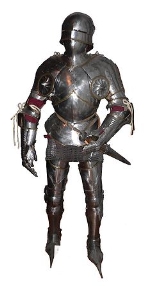
Plate armour is a historical type of personal armour
Armour
Armour or armor is protective covering used to prevent damage from being inflicted to an object, individual or a vehicle through use of direct contact weapons or projectiles, usually during combat, or from damage caused by a potentially dangerous environment or action...

 made from iron
Iron
Iron is a chemical element with the symbol Fe and atomic number 26. It is a metal in the first transition series. It is the most common element forming the planet Earth as a whole, forming much of Earth's outer and inner core. It is the fourth most common element in the Earth's crust...

 or steel
Steel
Steel is an alloy that consists mostly of iron and has a carbon content between 0.2% and 2.1% by weight, depending on the grade. Carbon is the most common alloying material for iron, but various other alloying elements are used, such as manganese, chromium, vanadium, and tungsten...

 plates.
Discussion
Ask a question about 'Plate armour'
Start a new discussion about 'Plate armour'
Answer questions from other users
Full Discussion Forum
 
Unanswered Questions
Encyclopedia
Plate armour is a historical type of personal armour
Armour
Armour or armor is protective covering used to prevent damage from being inflicted to an object, individual or a vehicle through use of direct contact weapons or projectiles, usually during combat, or from damage caused by a potentially dangerous environment or action...

 made from iron
Iron
Iron is a chemical element with the symbol Fe and atomic number 26. It is a metal in the first transition series. It is the most common element forming the planet Earth as a whole, forming much of Earth's outer and inner core. It is the fourth most common element in the Earth's crust...

 or steel
Steel
Steel is an alloy that consists mostly of iron and has a carbon content between 0.2% and 2.1% by weight, depending on the grade. Carbon is the most common alloying material for iron, but various other alloying elements are used, such as manganese, chromium, vanadium, and tungsten...

 plates.
While there are early predecessors such the Roman-era lorica segmentata
Lorica segmentata
The lōrīca segmentāta was a type of segmented armour almost exclusively used in the Roman Empire, but the Latin name was first used in the 16th century...

, full plate armour developed in Europe during the Late Middle Ages
Late Middle Ages
The Late Middle Ages was the period of European history generally comprising the 14th to the 16th century . The Late Middle Ages followed the High Middle Ages and preceded the onset of the early modern era ....

, especially in the context of the Hundred Years' War
Hundred Years' War
The Hundred Years' War was a series of separate wars waged from 1337 to 1453 by the House of Valois and the House of Plantagenet, also known as the House of Anjou, for the French throne, which had become vacant upon the extinction of the senior Capetian line of French kings...

, from the coat of plates
Coat of plates
A coat of plates is a form of torso armour consisting of metal plates sewn or riveted inside a cloth or leather garment. The coat of plates makes a fairly brief appearance in the history of European armour during the era of transitional armour, during a portion of the 14th century...

 worn over mail
Mail (armour)
Mail is a type of armour consisting of small metal rings linked together in a pattern to form a mesh.-History:Mail was a highly successful type of armour and was used by nearly every metalworking culture....

 suits during the 13th century. In Europe plate armour reached its peak in the late 15th and 16th centuries, with the full suits of Gothic plate armour
Gothic plate armour
Gothic plate armour is a type of plate armour of steel made in the regions of Germany and the Holy Roman Empire during the late Middle Ages . The armour provided full-body protection to the knight who wore it...

 worn on the battlefields of the Burgundian
Burgundian Wars
The Burgundian Wars were a conflict between the Dukes of Burgundy and the Kings of France, later involving the Old Swiss Confederacy, which would play a decisive role. Open war broke out in 1474, and in the following years the Duke of Burgundy, Charles the Bold, was defeated three times on the...

 and Italian Wars
Italian Wars
The Italian Wars, often referred to as the Great Italian Wars or the Great Wars of Italy and sometimes as the Habsburg–Valois Wars, were a series of conflicts from 1494 to 1559 that involved, at various times, most of the city-states of Italy, the Papal States, most of the major states of Western...

. The most heavily armoured troops of the period were heavy cavalry
Heavy cavalry
Heavy cavalry is a class of cavalry whose primary role was to engage in direct combat with enemy forces . Although their equipment differed greatly depending on the region and historical period, they were generally mounted on large powerful horses, and were often equipped with some form of scale,...

 such as the gendarme
Gendarme (historical)
A gendarme was a heavy cavalryman of noble birth, primarily serving in the French army from the Late Medieval to the Early Modern periods of European History...

s and early cuirassier
Cuirassier
Cuirassiers were mounted cavalry soldiers equipped with armour and firearms, first appearing in late 15th-century Europe. They were the successors of the medieval armoured knights...

s, but the infantry troops of the Swiss mercenaries
Swiss mercenaries
Swiss mercenaries were notable for their service in foreign armies, especially the armies of the Kings of France, throughout the Early Modern period of European history, from the Later Middle Ages into the Age of the European Enlightenment...

 and the landsknecht
Landsknecht
Landsknechte were European, predominantly German mercenary pikemen and supporting foot soldiers from the late 15th to the late 16th century, and achieved the reputation for being the universal mercenary of Early modern Europe.-Etymology:The term is from German, Land "land, country" + Knecht...

s also took to wearing lighter suits of "three quarters" plate armour, leaving the lower legs unprotected.
The use of plate armour declined in the 17th century, but remained common both among the nobility and for the cuirassiers throughout the European wars of religion
European wars of religion
The European wars of religion were a series of wars waged in Europe from ca. 1524 to 1648, following the onset of the Protestant Reformation in Western and Northern Europe...

. After 1650, plate armour was mostly reduced to the simple breastplate
Breastplate
A breastplate is a device worn over the torso to protect it from injury, as an item of religious significance, or as an item of status. A breastplate is sometimes worn by mythological beings as a distinctive item of clothing.- Armour :...

 (cuirass
Cuirass
A cuirass is a piece of armour, formed of a single or multiple pieces of metal or other rigid material, which covers the front of the torso...

) worn by dragoon
Dragoon
The word dragoon originally meant mounted infantry, who were trained in horse riding as well as infantry fighting skills. However, usage altered over time and during the 18th century, dragoons evolved into conventional light cavalry units and personnel...

s. This was due to the development of the flintlock
Flintlock
Flintlock is the general term for any firearm based on the flintlock mechanism. The term may also apply to the mechanism itself. Introduced at the beginning of the 17th century, the flintlock rapidly replaced earlier firearm-ignition technologies, such as the doglock, matchlock and wheellock...

 musket which could penetrate armour at a considerable distance, severely reducing the payoff from the investment in full plate armour. For infantry, the breastplate gained renewed importance with the development of shrapnel
Shrapnel
Shrapnel shells were anti-personnel artillery munitions which carried a large number of individual bullets close to the target and then ejected them to allow them to continue along the shell's trajectory and strike the target individually. They relied almost entirely on the shell's velocity for...

 in the late 18th century. The use of steel plates sown into flak jacket
Flak jacket
thumb|300px|The two components of an obsolete British military flak vest. On the left, the nylon vest. On the right, the several layers of [[ballistic nylon]] that provide the actual protection...

 dates to World War II
World War II
World War II, or the Second World War , was a global conflict lasting from 1939 to 1945, involving most of the world's nations—including all of the great powers—eventually forming two opposing military alliances: the Allies and the Axis...

, replaced by more modern materials such as fibre-reinforced plastic
Fibre-reinforced plastic
Fibre-reinforced plastic is a composite material made of a polymer matrix reinforced with fibres. The fibres are usually fibreglass, carbon, or aramid, while the polymer is usually an epoxy, vinylester or polyester thermosetting plastic...

 since the 1950s.

Early history


Partial plate armour, which protected the chest and the lower limbs, was used by the ancient Greeks
Ancient Greece
Ancient Greece is a civilization belonging to a period of Greek history that lasted from the Archaic period of the 8th to 6th centuries BC to the end of antiquity. Immediately following this period was the beginning of the Early Middle Ages and the Byzantine era. Included in Ancient Greece is the...

 and Romans
Ancient Rome
Ancient Rome was a thriving civilization that grew on the Italian Peninsula as early as the 8th century BC. Located along the Mediterranean Sea and centered on the city of Rome, it expanded to one of the largest empires in the ancient world....

, but it fell into disuse after the collapse of the Roman Empire
Roman Empire
The Roman Empire was the post-Republican period of the ancient Roman civilization, characterised by an autocratic form of government and large territorial holdings in Europe and around the Mediterranean....

 because of the cost and work involved in producing a piece of metal plate or cuirass. Single plates of metal armour were again used from the late 13th century on, to protect joints and shins, and these were worn over a mail
Mail (armour)
Mail is a type of armour consisting of small metal rings linked together in a pattern to form a mesh.-History:Mail was a highly successful type of armour and was used by nearly every metalworking culture....

 hauberk
Hauberk
A hauberk is a shirt of chainmail. The term is usually used to describe a shirt reaching at least to mid-thigh and including sleeves. Haubergeon generally refers to a shorter variant with partial sleeves, but the terms are often used interchangeably.- History :The word hauberk is derived from the...

.

Late Middle Ages


By the end of the 14th century, larger and complete full plates of armour had been developed. During the early 16th century the helmet and neckguard design was reformed to produce the so-called Nürnberg
Nuremberg
Nuremberg[p] is a city in the German state of Bavaria, in the administrative region of Middle Franconia. Situated on the Pegnitz river and the Rhine–Main–Danube Canal, it is located about north of Munich and is Franconia's largest city. The population is 505,664...

 armour, many of them masterpieces of workmanship and design.

European leaders in armouring techniques were northern Italians and southern Germans
Germans
The Germans are a Germanic ethnic group native to Central Europe. The English term Germans has referred to the German-speaking population of the Holy Roman Empire since the Late Middle Ages....

. This led to the styles of Milanese from Milan
Milan
Milan is the second-largest city in Italy and the capital city of the region of Lombardy and of the province of Milan. The city proper has a population of about 1.3 million, while its urban area, roughly coinciding with its administrative province and the bordering Province of Monza and Brianza ,...

, and Gothic from the Holy Roman Empire
Holy Roman Empire
The Holy Roman Empire was a realm that existed from 962 to 1806 in Central Europe.It was ruled by the Holy Roman Emperor. Its character changed during the Middle Ages and the Early Modern period, when the power of the emperor gradually weakened in favour of the princes...

. England produced armour in Greenwich
Greenwich
Greenwich is a district of south London, England, located in the London Borough of Greenwich.Greenwich is best known for its maritime history and for giving its name to the Greenwich Meridian and Greenwich Mean Time...

and they both developed their own unique style. Ottoman Turkey also made wide use of plate armour but incorporated large amounts of mail into their armour, which was widely used by shock troops such as the Janissary
Janissary
The Janissaries were infantry units that formed the Ottoman sultan's household troops and bodyguards...

 Corps.

By the Renaissance, elaborately decorated plate armour for royalty was being produced. Steel plate armour for Henry II of France
Henry II of France
Henry II was King of France from 31 March 1547 until his death in 1559.-Early years:Henry was born in the royal Château de Saint-Germain-en-Laye, near Paris, the son of Francis I and Claude, Duchess of Brittany .His father was captured at the Battle of Pavia in 1525 by his sworn enemy,...

 made in 1555 is covered with meticulous embossing, which has been subjected to blueing, silvering and gilding.

Effect on weapon development


Plate armour was virtually invulnerable to sword
Sword
A sword is a bladed weapon used primarily for cutting or thrusting. The precise definition of the term varies with the historical epoch or the geographical region under consideration...

 slashes. It also protects the wearer well against spear or pike thrusts and provides decent defence against blunt trauma.

The evolution of plate armour also triggered developments in the design of offensive weapons. While this armour was effective against cuts or blows, their weak points could be exploited by long tapered swords
Estoc
The French estoc or English "tuck" was a variation of the longsword focused intensely on fighting against mail or plate armour. It was long, straight and stiff, with a diamond or triangular cross-section. An estoc had no cutting edge, just a point. Examples from Poland are more than long, with a...

 or other weapons designed for the purpose, such as poleaxes and halberd
Halberd
A halberd is a two-handed pole weapon that came to prominent use during the 14th and 15th centuries. Possibly the word halberd comes from the German words Halm , and Barte - in modern-day German, the weapon is called Hellebarde. The halberd consists of an axe blade topped with a spike mounted on...

s. The effect of arrows and bolts is still a point of contention in regards to plate armour. Longbow
Longbow
A longbow is a type of bow that is tall ; this will allow its user a fairly long draw, at least to the jaw....

s and crossbow
Crossbow
A crossbow is a weapon consisting of a bow mounted on a stock that shoots projectiles, often called bolts or quarrels. The medieval crossbow was called by many names, most of which derived from the word ballista, a torsion engine resembling a crossbow in appearance.Historically, crossbows played a...

s could also pierce plate armour up to ranges of 200 metres (656.2 ft) with a lucky shot, notably in battles such as the Battle of Visby
Battle of Visby
The Battle of Visby was fought in 1361 near the town of Visby on the island of Gotland, between the forces of the Danish king and the Gutnish country yeomen. The Danish force was victorious.-Background:...

, though historian Jean Froissart
Jean Froissart
Jean Froissart , often referred to in English as John Froissart, was one of the most important chroniclers of medieval France. For centuries, Froissart's Chronicles have been recognized as the chief expression of the chivalric revival of the 14th century Kingdom of England and France...

 suggests that the success of such weapons at the Battle of Poitiers
Battle of Poitiers (1356)
The Battle of Poitiers was fought between the Kingdoms of England and France on 19 September 1356 near Poitiers, resulting in the second of the three great English victories of the Hundred Years' War: Crécy, Poitiers, and Agincourt....

 was less due to the bodkin arrows used by the English and more due to aiming for the side or rear of the armour, which is weaker. The evolution of the 14th-century plate armour also triggered the development of various polearms. They were designed to deliver a strong impact and concentrate energy on a small area and cause damage through the plate. Maces, war hammer
War hammer
A war hammer is a late medieval weapon of war intended for close combat action, the design of which resembles the hammer.The war hammer consists of a handle and a head...

s and the hammer-heads of pollaxes (poleaxes) were used to inflict blunt trauma through armour.

Fluted plate was not only decorative, but also reinforced the plate against bending under slashing or blunt impact. This offsets against the tendency for flutes to catch piercing blows. In armoured techniques taught in the German school of swordsmanship
German school of swordsmanship
The German school of fencing is the historical system of combat taught in the Holy Roman Empire in the Late Medieval, Renaissance and Early Modern periods , as described in the Fechtbücher written at the time...

, the attacker concentrates on these "weak spots", resulting in a fighting style very different from unarmoured sword-fighting. Because of this weakness most warriors wore a mail shirt (haubergeon or hauberk) beneath their plate armour (or coat-of-plates). Later, full mail shirts were replaced with mail patches, called gousset
Gousset
Gousset was a component of late Medieval armor. During the transition from mail to plate armor, sections of mail covered parts of the body that were not protected by steel plate. These sections of mail were known as gousset. Gousset came into use in the fourteenth century as plate became a...

s, sewn onto a gambeson or arming jacket. Further protection for plate armour was the use of small round plates called besagews that covered the armpit area and couters and poleyns with "wings" to protect the inside of the joint.

Renaissance


Renaissance-era Maximilian armour
Maximilian armour
Maximilian armour is a modern term applied to the style of early 16th-century German plate armour apparently first made for the Emperor Maximilian I...

 was typically denoted by fluting and decorative etching, as opposed to the plainer finish on 15th-century white armour. This era also saw the use of closed helms, as opposed to the 15th-century-style sallets and barbutes.

A Renaissance-era full suit of plate armour would have consisted of a helmet
Helmet
A helmet is a form of protective gear worn on the head to protect it from injuries.Ceremonial or symbolic helmets without protective function are sometimes used. The oldest known use of helmets was by Assyrian soldiers in 900BC, who wore thick leather or bronze helmets to protect the head from...

, a gorget
Gorget
A gorget originally was a steel or leather collar designed to protect the throat. It was a feature of older types of armour and intended to protect against swords and other non-projectile weapons...

 (or bevor
Bevor
A bevor is a piece of plate armour designed to protect the neck, much like a gorget. A bevor can be made of a single solid piece or multiple articulated lamés around the neck and chin. The bevor was typically worn in conjunction with a sallet, and later with a burgonet, in a form known as a...

), pauldron
Pauldron
A pauldron is a component of plate armour, which evolved from spaulders in the 15th century. As with spaulders, pauldrons cover the shoulder area. Pauldrons tend to be larger than spaulders, covering the armpit, and sometimes parts of the back and chest...

s (or spaulders
Spaulders
Spaulders are armoured plates worn on the upper arms and shoulders in a suit of plate armour.-Description:Developed during the Middle Ages, the use of spaulders declined during the Renaissance along with the use of plate armour....

), couter
Couter
The couter is the defense for the elbow in a piece of plate armour. Initially just a curved piece of metal, as plate armor progressed the couter became an articulated joint.-External links:*...

s, vambrace
Vambrace
Vambraces or forearm guards are "tubular" or "gutter" defences for the forearm worn as part of a suit of plate armour. Vambraces may be worn with or without separate couters in a full suit of medieval armor. The term originates in the early 14th century...

s, gauntlet
Gauntlet (gloves)
Gauntlet is a name for several different styles of glove, particularly those with an extended cuff covering part of the forearm. Gauntlets exist in many forms, ranging from flexible fabric and leather gloves, to mail and fully articulated plate armour....

s, a cuirass
Cuirass
A cuirass is a piece of armour, formed of a single or multiple pieces of metal or other rigid material, which covers the front of the torso...

 (back and breastplate) with a fauld, tassets
Tassets
Tassets are a piece of plate armour designed to protect the upper legs. They take the form of separate plates hanging from the breastplate or faulds. They may be made from a single piece or segmented...

 and a culet
Culet (armour)
A culet is a piece of plate armour consisting of small, horizontal lamés that protect the small of the back or the buttocks....

, a mail
Mail (armour)
Mail is a type of armour consisting of small metal rings linked together in a pattern to form a mesh.-History:Mail was a highly successful type of armour and was used by nearly every metalworking culture....

 skirt, cuisses, poleyn
Poleyn
The poleyn was a component of Medieval and Renaissance armor that protected the knee. During the transition from mail armor to plate armor, this was among the earliest plate components to develop. They first appeared in the mid-thirteenth century and remained in use until the early seventeenth...

s, greave
Greave
A greave is a piece of armour that protects the leg.-Description:...

s, and sabaton
Sabaton
A sabaton or solleret is part of a knight's armour that covers the foot. Fifteenth century sabatons typically end in a tapered point well past the actual toes of the wearer's foot...

s.
A complete suit of plate armour made from well-tempered steel would weigh around 20 kg (45 pounds).
The wearer of such a suit remains highly agile, able to move freely, jump and run, the weight being well spread over the body

Infantry armour


Reduced plate armour, typically consisting of a breastplate
Breastplate
A breastplate is a device worn over the torso to protect it from injury, as an item of religious significance, or as an item of status. A breastplate is sometimes worn by mythological beings as a distinctive item of clothing.- Armour :...

, a burgonet
Burgonet
The burgonet helmet was a Renaissance-era and Early modern combat helmet. It was the successor of the sallet....

, morion
Morion (helmet)
A morion is a type of open helmet used during the 16th and early 17th centuries, usually having a flat brim and a crest from front to back. The morion, though generally identified with Spanish conquistadors, was common among foot soldiers of European nationalities, including the English; the first...

 or cabasset and gauntlet
Gauntlet (gloves)
Gauntlet is a name for several different styles of glove, particularly those with an extended cuff covering part of the forearm. Gauntlets exist in many forms, ranging from flexible fabric and leather gloves, to mail and fully articulated plate armour....

s, however, also became popular among 16th-century mercenaries
Mercenary
A mercenary, is a person who takes part in an armed conflict based on the promise of material compensation rather than having a direct interest in, or a legal obligation to, the conflict itself. A non-conscript professional member of a regular army is not considered to be a mercenary although he...

 and there are many references to so-called munition armour
Munition armour
Munition armour refers to any mass-produced armour, historically stockpiled in armouries to equip both foot soldiers and mounted cuirassiers....

 being ordered for infantrymen at a fraction of the cost of full plate armour. This mass-produced armour was often heavier and made of lower quality metal than knight armour.

Jousting armour


Specialized jousting
Jousting
Jousting is a martial game or hastilude between two knights mounted on horses and using lances, often as part of a tournament.Jousting emerged in the High Middle Ages based on the military use of the lance by heavy cavalry. The first camels tournament was staged in 1066, but jousting itself did not...

 armour produced in the late 15th to 16th century was heavier, and could weigh as much as 50 kg (100 pounds), as it was not intended for free combat, it did not need to permit free movement, the only limiting factor being the maximum weight that could be carried by a warhorse of the period.

The medieval joust has its origins in the military tactics of heavy cavalry
Heavy cavalry
Heavy cavalry is a class of cavalry whose primary role was to engage in direct combat with enemy forces . Although their equipment differed greatly depending on the region and historical period, they were generally mounted on large powerful horses, and were often equipped with some form of scale,...

 during the High Middle Ages
High Middle Ages
The High Middle Ages was the period of European history around the 11th, 12th, and 13th centuries . The High Middle Ages were preceded by the Early Middle Ages and followed by the Late Middle Ages, which by convention end around 1500....

. These became obsolete during the 14th century, and since the 15th centry, jousting had become a sport
Sport
A Sport is all forms of physical activity which, through casual or organised participation, aim to use, maintain or improve physical fitness and provide entertainment to participants. Sport may be competitive, where a winner or winners can be identified by objective means, and may require a degree...

 (hastilude
Hastilude
Hastilude is a generic term used in the Middle Ages to refer to many kinds of martial games. The word comes from the Latin hastiludium, literally "lance game"'...

) without direct relevance to warfare.
During the 1490s, emperor Maximilian I
Maximilian I
Maximilian I may refer to:*Maximilian I of Mexico, reigned 1864–1867*Maximilian I, Holy Roman Emperor, reigned 1508–1519*Maximilian I, Elector of Bavaria, reigned 1597–1651...

 invested a lot of effort into perfecting the sport, for which he received his nickname of "The Last Knight".
Rennen and Stechen were two sportive forms of the joust developed during the 15th century and practiced throughout the 16th century. The armours used for these two respective styles of the joust was known as Rennzeug and Stechzeug, respectively.
The Stechzeug in particular developed into extremely heavy armour which completely inhibited the movement of the rider, in its latest forms resembling an armour-shaped cabin integrated into the horse armour more than a functional suit of armour.
Such forms of sportive equipment during the final phase of the joust in 16th-century Germany gave rise to modern misconceptions about the heaviness or clumsiness of "medieval armour", as notably popularized by Mark Twain
Mark Twain
Samuel Langhorne Clemens , better known by his pen name Mark Twain, was an American author and humorist...

's A Connecticut Yankee in King Arthur's Court
A Connecticut Yankee in King Arthur's Court
A Connecticut Yankee in King Arthur's Court is an 1889 novel by American humorist and writer Mark Twain. The book was originally titled A Yankee in King Arthur's Court...

.
The extremely heavy helmets of the Stechzeug are explained by the fact that the aim was to detach the crest
Crest (heraldry)
A crest is a component of an heraldic display, so called because it stands on top of a helmet, as the crest of a jay stands on the bird's head....

 of the opponent's helmet, resulting in frequent full impact of the lance to the helmet.

By contrast the Rennen was type of joust with lighter contact. Here, the aim was to hit the opponent's shield.
The specialized Rennzeug was developed on the request of Maximilian, who desired a return to a more agile form of joust compared to the heavily armoured "full contact" Stechen. In the Rennzeug, the shield was attached to the armour with a mechanism of springs and would detach itself upon contact.

Early Modern period


Plate armour was widely used by most armies until the end of the 17th century for both foot and mounted troops such as the cuirassier
Cuirassier
Cuirassiers were mounted cavalry soldiers equipped with armour and firearms, first appearing in late 15th-century Europe. They were the successors of the medieval armoured knights...

s, dragoon
Dragoon
The word dragoon originally meant mounted infantry, who were trained in horse riding as well as infantry fighting skills. However, usage altered over time and during the 18th century, dragoons evolved into conventional light cavalry units and personnel...

s, demi-lancer
Demi-lancer
The "Demi-lancer" or demilancer was a type of heavy cavalryman found in Western Europe in the 16th and early 17th centuries.-Characteristics:...

s and Polish hussars
Polish Hussars
The Polish Hussars were the main type of cavalry of the first Polish Army, later also introduced into the Army of the Grand Duchy of Lithuania, between the 16th and 18th centuries...

.
The infantry armour of the 16th century developed into the Savoyard type of three-quarters armour by 1600.

Full plate armour was expensive to produce and remained therefore restricted to the upper strata of society; lavishly decorated suits of armour remained the fashion with 18th-century nobles and generals long after they had ceased to be militarily useful on the battlefield due to the advent of inexpensive muskets.

Decline in the 18th century


It was only the development of powerful rifled firearms which made all but the finest and heaviest armour obsolete. The increasing power and availability of firearms and the nature of large, state-supported infantry led to more portions of plate armour being cast off in favour of cheaper, more mobile troops. Leg protection was the first part to go, replaced by tall leather boots. By the beginning of the 18th century, only field marshal
Field Marshal
Field Marshal is a military rank. Traditionally, it is the highest military rank in an army.-Etymology:The origin of the rank of field marshal dates to the early Middle Ages, originally meaning the keeper of the king's horses , from the time of the early Frankish kings.-Usage and hierarchical...

s, commanders and royalty remained in full armour on the battlefield, more as a sign of rank than for practical considerations. It remained fashionable for monarchs to be portrayed in armour during the first half of the 18th century, but even this tradition became obsolete. Thus, a portrait of Frederick the Great as Crown Prince in 1739 still shows him in armour, while a later painting showing him as victorious commander in the Seven Years' War
Seven Years' War
The Seven Years' War was a global military war between 1756 and 1763, involving most of the great powers of the time and affecting Europe, North America, Central America, the West African coast, India, and the Philippines...

 (1760s) depicts him in uniform wearing a tricorne
Tricorne
The tricorne or tricorn is a style of hat that was popular during the 18th century, falling out of style by 1800. At the peak of its popularity, the tricorne was worn as civilian dress and as part of military and naval uniforms...

.

But body armour remained in use throughout the 18th century with cavalry
Cavalry
Cavalry or horsemen were soldiers or warriors who fought mounted on horseback. Cavalry were historically the third oldest and the most mobile of the combat arms...

 units, especially cuirassiers, including front and back plates that could protect the wearer from distanced fire and either helmets or "secrets", a steel protection they wore under a floppy hat.

Plate armour in Japan


In Kofun period
Kofun period
The is an era in the history of Japan from around 250 to 538. It follows the Yayoi period. The word kofun is Japanese for the type of burial mounds dating from this era. The Kofun and the subsequent Asuka periods are sometimes referred to collectively as the Yamato period...

 Japan, during the 4th and 5th centuries, very advanced iron plate cuirasses called tanko and helmets were made. Plate armour was used in Japan during the Nara period
Nara period
The of the history of Japan covers the years from AD 710 to 794. Empress Gemmei established the capital of Heijō-kyō . Except for 5 years , when the capital was briefly moved again, it remained the capital of Japanese civilization until Emperor Kammu established a new capital, Nagaoka-kyō, in 784...

 (646-793), both plate and lamellar armour
Lamellar armour
Lamellar armour was one of three early body armour types made from armour plates. The other two types are scale armour and laminar armour.-Description:...

s have been found in burial mounds and haniwa
Haniwa
The are terracotta clay figures which were made for ritual use and buried with the dead as funerary objects during the Kofun period of the history of Japan....

(ancient clay figures) have been found depicting warriors wearing full armour.

In Japan the warfare of the Sengoku period
Sengoku period
The or Warring States period in Japanese history was a time of social upheaval, political intrigue, and nearly constant military conflict that lasted roughly from the middle of the 15th century to the beginning of the 17th century. The name "Sengoku" was adopted by Japanese historians in reference...

 (15th and 16th centuries) required large quantities of armour to be produced for the ever growing armies of foot soldiers (ashigaru
Ashigaru
The Japanese ashigaru were foot-soldiers of medieval Japan. The first known reference to ashigaru was in the 1300s, but it was during the Ashikaga Shogunate-Muromachi period that the use of ashigaru became prevalent by various warring factions.-Origins:Attempts were made in Japan by the Emperor...

). Simple munition quality (okashi or "lent") chest armours (dou or dō) and helmets (kabuto
Kabuto
A kabuto is a helmet used with traditional Japanese armour as worn by the samurai class and their retainers in feudal Japan....

) were massed produced.

In 1543, the Portuguese brought matchlock firearms (tanegashima) to Japan. The Japanese started to manufacture the Portuguese acquired matchlocks and the use of these firearms in warfare caused the gradual decline in the use of the centuries old lamellar armour
Lamellar armour
Lamellar armour was one of three early body armour types made from armour plates. The other two types are scale armour and laminar armour.-Description:...

that the samurai were known for; the Japanese armour makers started to use solid iron plates in their armour designs which were based on European armours, and eventually plate armour became the standard for samurai warriors. The new style Japanese plate armours were called tosei gusoku (new armours) in order to differentiate from the old style lamellar armours. Japanese armour makers designed bullet proof iron and steel plate armours called tameshi gusoku or (bullet tested), which allowed them to continue wearing armour despite the heavy use of firearms in the late 1500s.

In the 1600s warfare in Japan came to an end but the samurai continued to use plate armour until the end of the samurai era in the 1860s, with the known last use of samurai armour occurring in 1877 during the satsuma rebellion
Satsuma Rebellion
The was a revolt of Satsuma ex-samurai against the Meiji government from January 29 to September 24, 1877, 9 years into the Meiji Era. It was the last, and the most serious, of a series of armed uprisings against the new government.-Background:...

.

20th century and modern body armour


Body armour made a brief reappearance in the American Civil War
American Civil War
The American Civil War was a civil war fought in the United States of America. In response to the election of Abraham Lincoln as President of the United States, 11 southern slave states declared their secession from the United States and formed the Confederate States of America ; the other 25...

 with mixed success. However, the armour vests of the time were expensive and thus bought by individual troops and not issued, meaning that the effectiveness of the armour varied widely depending on its maker. Plate armour was successfully implemented by Australian outlaw Ned Kelly
Ned Kelly
Edward "Ned" Kelly was an Irish Australian bushranger. He is considered by some to be merely a cold-blooded cop killer — others, however, consider him to be a folk hero and symbol of Irish Australian resistance against the Anglo-Australian ruling class.Kelly was born in Victoria to an Irish...

 and his gang, giving them a large advantage in their gunfights against police. The cavalry armour of Napoleon, and the French
France
The French Republic , The French Republic , The French Republic , (commonly known as France , is a unitary semi-presidential republic in Western Europe with several overseas territories and islands located on other continents and in the Indian, Pacific, and Atlantic oceans. Metropolitan France...

, German
German Empire
The German Empire refers to Germany during the "Second Reich" period from the unification of Germany and proclamation of Wilhelm I as German Emperor on 18 January 1871, to 1918, when it became a federal republic after defeat in World War I and the abdication of the Emperor, Wilhelm II.The German...

, and British
British Empire
The British Empire comprised the dominions, colonies, protectorates, mandates and other territories ruled or administered by the United Kingdom. It originated with the overseas colonies and trading posts established by England in the late 16th and early 17th centuries. At its height, it was the...

 empires (heavy cavalry known as cuirassiers) were actively used through the 19th century right up to the first year of World War I
World War I
World War I , which was predominantly called the World War or the Great War from its occurrence until 1939, and the First World War or World War I thereafter, was a major war centred in Europe that began on 28 July 1914 and lasted until 11 November 1918...

, when French cuirassier
Cuirassier
Cuirassiers were mounted cavalry soldiers equipped with armour and firearms, first appearing in late 15th-century Europe. They were the successors of the medieval armoured knights...

s went to meet the enemy in armour outside of Paris
Paris
Paris is the capital and largest city in France, situated on the river Seine, in northern France, at the heart of the Île-de-France region...

. During the war both sides experimented with shrapnel armour and some soldiers used their own but dedicated ballistic armour such as the American Brewster Body Shield was not widely produced.

In 1916 General Adrian of the French army provided an abdominal shield which was light in weight (two pounds) and easy to wear. It was made of an oblong plate of metal bent in a curve and moulded somewhat to the abdomen, hip and groin guards were added to the abdominal shield. General Adrian devised a breastplate which joined the abdominal defence which was also provided with a gorget. About three thousand of these defences which weighed about five and a half pounds were made and they were given practical tests.

Plate armour briefly re-appeared during World War II
World War II
World War II, or the Second World War , was a global conflict lasting from 1939 to 1945, involving most of the world's nations—including all of the great powers—eventually forming two opposing military alliances: the Allies and the Axis...

 on some Soviet
Soviet Union
The Soviet Union , officially the Union of Soviet Socialist Republics , was a constitutionally socialist state that existed in Eurasia between 1922 and 1991....

 Guard (elite) infantry units, who wore steel breastplate
Breastplate
A breastplate is a device worn over the torso to protect it from injury, as an item of religious significance, or as an item of status. A breastplate is sometimes worn by mythological beings as a distinctive item of clothing.- Armour :...

s that could stop rounds fired by pistols and submachine guns. The Japanese and Americans made several prototypes but none were mass-produced due to their cost and the need for metal elsewhere. In the Korean War
Korean War
The Korean War was a conventional war between South Korea, supported by the United Nations, and North Korea, supported by the People's Republic of China , with military material aid from the Soviet Union...

, body armour was re-introduced for U.S
United States
The United States of America is a federal constitutional republic comprising fifty states and a federal district...

 foot soldiers, and then to a greater extent in the Vietnam War
Vietnam War
The Vietnam War was a Cold War-era military conflict that occurred in Vietnam, Laos, and Cambodia from 1 November 1955 to the fall of Saigon on 30 April 1975. This war followed the First Indochina War and was fought between North Vietnam, supported by its communist allies, and the government of...

. Modern U.S. soldiers in Iraq
Iraq
Iraq ; officially the Republic of Iraq is a country in Western Asia spanning most of the northwestern end of the Zagros mountain range, the eastern part of the Syrian Desert and the northern part of the Arabian Desert....

 now always wear light-weight Kevlar
Kevlar
Kevlar is the registered trademark for a para-aramid synthetic fiber, related to other aramids such as Nomex and Technora. Developed at DuPont in 1965, this high strength material was first commercially used in the early 1970s as a replacement for steel in racing tires...

 helmets and armour vests, the latter often augmented with more-or-less rigid ceramic plate inserts. The U.S. Air Force
United States Air Force
The United States Air Force is the aerial warfare service branch of the United States Armed Forces and one of the American uniformed services. Initially part of the United States Army, the USAF was formed as a separate branch of the military on September 18, 1947 under the National Security Act of...

 used flak jacket
Flak jacket
thumb|300px|The two components of an obsolete British military flak vest. On the left, the nylon vest. On the right, the several layers of [[ballistic nylon]] that provide the actual protection...

s as a form of plate armour. The 1970s introduction of aramid
Aramid
Aramid fibers are a class of heat-resistant and strong synthetic fibers. They are used in aerospace and military applications, for ballistic rated body armor fabric and ballistic composites, in bicycle tires, and as an asbestos substitute. The name is a portmanteau of "aromatic polyamide"...

 (Kevlar
Kevlar
Kevlar is the registered trademark for a para-aramid synthetic fiber, related to other aramids such as Nomex and Technora. Developed at DuPont in 1965, this high strength material was first commercially used in the early 1970s as a replacement for steel in racing tires...

 or Twaron
Twaron
Twaron is the brandname of Teijin Aramid for a para-aramid. It is a heat-resistant and strong synthetic fibre developed in the early 1970s by the Dutch company AKZO, division Enka, later Akzo Industrial Fibers. The research name of the para-aramid fibre was originally Fiber X, but it was soon...

) body armour brought sheet metal (especially titanium
Titanium
Titanium is a chemical element with the symbol Ti and atomic number 22. It has a low density and is a strong, lustrous, corrosion-resistant transition metal with a silver color....

) trauma plates back into fashion as a form of rifle-grade add-on to flexible vests, and ballistic metals are gradually improving with stronger and lighter alloys being steadily developed. Lighter ceramic plates are still the choice of most first-world militaries, but titanium and ballistic steel are still in wide use by those wanting a less costly option.

Materials


The first plate armour was that of bronze, being worn by elite soldiers in Greek armies in particular. Bronze, whilst easier to work with, was much less commonly available (requiring copper and tin, which are almost never found in close proximity). Iron was, however, adequate enough for the task, eventually becoming more popular because of its strength as well as its far greater availability to be used in the advanced militaries of Europe and the Middle East.

Gradually methods of making steel were perfected and steel replaced iron in most capacities except munition armour. Steel was continually being made stronger and thicker to protect from bullets but eventually the needed protection was too heavy and expensive for most troops.

In the 20th century titanium and super-hardened "ballistic steel" came to be used for trauma plates. Eventually ceramic plates made from aluminium oxide and silicon carbide were introduced as well.

See also

  • Components of medieval armour
    Components of medieval armour
    Following is a table that concisely identifies various pieces of medieval armour, mostly plate but some mail, arranged by the part of body that is protected and roughly by date...

  • Ballistic vest
  • Plated mail
    Plated mail
    Plated mail is a type of mail with embedded plates. Armour of this type has been used in the Middle East, Japan, China, Korea, Central Asia, Greater Iran, India, Eastern Europe, and by the Moors.-Types of plated mail:In Russia there are three known varieties of this armour...

  • Proofing of armour
    Proofing of armour
    The proofing of armour refers to the process of testing armour for its defensive ability, most commonly used to historical testing of plate armour and mail . In the early Middle Ages, armour would be classified by the blows it could withstand, being certified as proof against swords, axes, and arrows...

  • Mirror armour
    Mirror armour
    Mirror armour , sometimes referred to as disc armour or Chahar-Ainé , was a type of armour used in Asia and...


Further reading

  • R. E. Oakeshott, European weapons and armour: From the Renaissance to the industrial revolution (1980).