
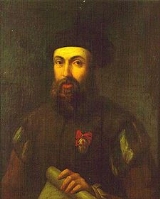
Ferdinand Magellan was a
PortuguesePortugal , officially the Portuguese Republic is a country situated in southwestern Europe on the Iberian Peninsula. Portugal is the westernmost country of Europe, and is bordered by the Atlantic Ocean to the West and South and by Spain to the North and East. The Atlantic archipelagos of the...
explorer. He was born in
SabrosaSabrosa is a municipality in the district of Vila Real in northern Portugal. The municipality is composed of 15 parishes and has a total area of 156.92 km² and a population of 6,835 inhabitants .-History:Although the municipality was established on 6 November 1836, the history of the region...
, in northern Portugal, and served King Charles I of Spain in search of a westward route to the "
Spice IslandsThe Maluku Islands are an archipelago that is part of Indonesia, and part of the larger Maritime Southeast Asia region. Tectonically they are located on the Halmahera Plate within the Molucca Sea Collision Zone...
" (modern
Maluku IslandsThe Maluku Islands are an archipelago that is part of Indonesia, and part of the larger Maritime Southeast Asia region. Tectonically they are located on the Halmahera Plate within the Molucca Sea Collision Zone...
in Indonesia).
Magellan's expedition of 1519–1522 became the first expedition to sail from the Atlantic Ocean into the Pacific Ocean (then named "peaceful sea" by Magellan; the passage being made via the
Strait of MagellanThe Strait of Magellan comprises a navigable sea route immediately south of mainland South America and north of Tierra del Fuego...
), and the first to cross the Pacific. It also completed the first
circumnavigationCircumnavigation – literally, "navigation of a circumference" – refers to travelling all the way around an island, a continent, or the entire planet Earth.- Global circumnavigation :...
of the
EarthEarth is the third planet from the Sun, and the densest and fifth-largest of the eight planets in the Solar System. It is also the largest of the Solar System's four terrestrial planets...
, although Magellan himself did not complete the entire voyage, being killed during the
Battle of MactanThe Battle of Mactan was fought in the Philippines on April 27, 1521. The warriors of Lapu-Lapu, a native chieftain of Mactan Island, defeated Spanish forces under the command of Ferdinand Magellan, who was killed in the battle.- Background :...
in the Philippines. For background see
Exploration of the PacificExploration of the Pacific: Polynesians reached nearly all the Pacific islands by about 1200AD. In 1521 Magellan crossed the Pacific. For the next 250 years Europeans explored various parts of the Ocean, but the only significant trade was along both coasts and the Manila galleons that crossed from...
.
Magellan also gives his name to the
Magellanic PenguinThe Magellanic Penguin, Spheniscus magellanicus, is a South American penguin, breeding in coastal Argentina, Chile and the Falkland Islands, with some migrating to Brazil where they are occasionally seen as far north as Rio de Janeiro. It is the most numerous of the Spheniscus penguins. Its nearest...
, which he was the first European to note, and the
Magellanic cloudsThe two Magellanic Clouds are irregular dwarf galaxies visible in the southern hemisphere, which are members of our Local Group and are orbiting our Milky Way galaxy...
, now known to be nearby dwarf galaxies.
Early life and travels
Magellan was born around 1480 either at
Vila Nova de GaiaVila Nova de Gaia, or simply Gaia is a city in Vila Nova de Gaia Municipality, Portugal. It is located in the Porto District, south of the city of Porto on the other side of the Douro River. The city proper has a population of 178,255 and the municipality contains 24 parishes with a total...
, near
PortoPorto , also known as Oporto in English, is the second largest city in Portugal and one of the major urban areas in the Iberian Peninsula. Its administrative limits include a population of 237,559 inhabitants distributed within 15 civil parishes...
, in Douro Litoral Province, or at
SabrosaSabrosa is a municipality in the district of Vila Real in northern Portugal. The municipality is composed of 15 parishes and has a total area of 156.92 km² and a population of 6,835 inhabitants .-History:Although the municipality was established on 6 November 1836, the history of the region...
, near
Vila RealVila Real is a city in Vila Real Municipality, Trás-os-Montes, northern Portugal.According to the 2001 census, the city had a total of 24,481 inhabitants.- History :...
, in Trás-os-Montes e Alto Douro Province, in Portugal. He was the son of Rodrigo de Magalhães, alcaide-mór of Aveiro (1433–1500) (son of Pedro Afonso de Magalhães and wife Quinta de Sousa) and wife Alda de Mesquita and brother of Leonor or Genebra de Magalhães, wife with issue of João Fernandes Barbosa. After the death of his parents during his tenth year he became a page to
Queen LeonorEleanor of Viseu was a Portuguese infanta and later queen consort of Portugal.To distinguish her from other infantas of the same name, she is commonly known as Eleanor of Viseu or Eleanor of Lancaster Eleanor of Viseu (2 May 1458–17 November 1525; ) was a Portuguese infanta (princess) and...
at the Portuguese royal court because of his family's heritage.
In March 1505, at the age of 25, Magellan enlisted in the fleet of 22 ships sent to host D.
Francisco de AlmeidaDom Francisco de Almeida , also known as "the Great Dom Francisco" , was a Portuguese nobleman, soldier and explorer. He distinguished himself as a counsellor to King John II of Portugal and later in the wars against the Moors and in the conquest of Granada in 1492...
as the first viceroy of Portuguese India. Although his name does not appear in the chronicles, it is known that he remained there eight years, in
GoaGoa , a former Portuguese colony, is India's smallest state by area and the fourth smallest by population. Located in South West India in the region known as the Konkan, it is bounded by the state of Maharashtra to the north, and by Karnataka to the east and south, while the Arabian Sea forms its...
, Cochin and
QuilonQuilon may refer to,* Venad, a former state on Malabar Coast, India* Kollam , Kerala state, India* Kollam district, Kerala state...
. He participated in several battles, including the battle of Cannanore in 1506, where he was wounded. In 1509 he fought in the
battle of DiuThe Battle of Diu sometimes referred as the Second Battle of Chaul was a naval battle fought on 3 February 1509 in the Arabian Sea, near the port of Diu, India, between the Portuguese Empire and a joint fleet of the Sultan of Gujarat, the Mamlûk Burji Sultanate of Egypt, the Zamorin of Kozhikode...
and later sailed under
Diogo Lopes de SequeiraDiogo Lopes de Sequeira was a Portuguese fidalgo, sent to analyze the trade potential in Madagascar and Malacca, he arrived at Malacca on 11 September, 1509. He left the next year when he discovered that Sultan Mahmud Shah, the local leader, was devising his assassination...
in the first Portuguese embassy to
MalaccaMalacca , dubbed The Historic State or Negeri Bersejarah among locals) is the third smallest Malaysian state, after Perlis and Penang. It is located in the southern region of the Malay Peninsula, on the Straits of Malacca. It borders Negeri Sembilan to the north and the state of Johor to the south...
, with
Francisco SerrãoFrancisco Serrão was a Portuguese explorer and a cousin of Ferdinand Magellan. His 1512 voyage was the first known European sailing east past Malacca through Indonesia and the Indies. He became a member of the Sultan Bayan Sirrullah, the ruler of Ternate, becoming his personal advisor...
, his friend and possibly cousin. In September, after arriving at Malacca, the expedition fell victim to a conspiracy ending in retreat. Magellan had a crucial role, warning Sequeira and saving Francisco Serrão, who had landed. This performance earned him honors and a promotion.
In 1511, under the new governor
Afonso de AlbuquerqueAfonso de Albuquerque[p][n] was a Portuguese fidalgo, or nobleman, an admiral whose military and administrative activities as second governor of Portuguese India conquered and established the Portuguese colonial empire in the Indian Ocean...
, Magellan and Serrão participated in the
conquest of MalaccaPortuguese Malacca was the territory of Malacca that, for 130 years , was a Portuguese colony.- History :From the writing of the Portuguese historian Emanuel Godinho de Erédia in the middle of the 16th century, the site of the old city of Malacca was named after the Myrobalans, fruit-bearing trees...
. After the conquest their ways parted: Magellan was promoted, with a rich plunder, and in the company of a Malay he had
indenturedIndentured servitude refers to the historical practice of contracting to work for a fixed period of time, typically three to seven years, in exchange for transportation, food, clothing, lodging and other necessities during the term of indenture. Usually the father made the arrangements and signed...
and baptized Enrique of Malacca, returned to Portugal in 1512. Serrão departed in the first expedition sent to find the "
Spice IslandsThe Maluku Islands are an archipelago that is part of Indonesia, and part of the larger Maritime Southeast Asia region. Tectonically they are located on the Halmahera Plate within the Molucca Sea Collision Zone...
" in the Moluccas, where he remained, having married a woman from Amboina and becoming a military advisor to the Sultan of
TernateTernate is an island in the Maluku Islands of eastern Indonesia. It is located off the west coast of the larger island of Halmahera, the center of the powerful former Sultanate of Ternate....
, Bayan Sirrullah. His letters to Magellan would prove decisive, giving information about the spice-producing territories.
After taking a leave without permission, Magellan fell out of favour. Serving in
MoroccoMorocco , officially the Kingdom of Morocco , is a country located in North Africa. It has a population of more than 32 million and an area of 710,850 km², and also primarily administers the disputed region of the Western Sahara...
he was wounded and got a permanent limp. He was also accused of trading illegally with the
MoorsThe description Moors has referred to several historic and modern populations of the Maghreb region who are predominately of Berber and Arab descent. They came to conquer and rule the Iberian Peninsula for nearly 800 years. At that time they were Muslim, although earlier the people had followed...
. The accusations were proved false, but there were no further offers of employment after 15 May 1514. Later on in 1515, he got an employment offer as a crew member on a Portuguese ship, but rejected. In 1517 after a quarrel with
King Manuel IManuel I , the Fortunate , 14th king of Portugal and the Algarves was the son of Infante Ferdinand, Duke of Viseu, , by his wife, Infanta Beatrice of Portugal...
, who denied his persistent demands to lead an expedition to reach the spice islands from the east (i.e., while sailing westwards, seeking to avoid the need to sail around the tip of Africa), he left for Spain. In
SevilleSeville is the artistic, historic, cultural, and financial capital of southern Spain. It is the capital of the autonomous community of Andalusia and of the province of Seville. It is situated on the plain of the River Guadalquivir, with an average elevation of above sea level...
he befriended his countryman
Diogo BarbosaDuarte Barbosa was a Portuguese writer and Portuguese India officer between 1500 and 1516–17, with the post of scrivener in Cannanore factory and sometimes interpreter of the local language...
and soon married his daughter by second wife María Caldera Beatriz Barbosa having had two children: Rodrigo de Magalhães and Carlos de Magalhães, both of whom died at a young age. She would die in
SevilleSeville is the artistic, historic, cultural, and financial capital of southern Spain. It is the capital of the autonomous community of Andalusia and of the province of Seville. It is situated on the plain of the River Guadalquivir, with an average elevation of above sea level...
around 1521.
Meanwhile he devoted himself to studying the most recent charts, investigating, in partnership with cosmographer
Rui FaleiroRui Faleiro was a Portuguese cosmographer, astrologer, and astronomer who was the principal scientific organizer behind Magellan's circumnavigation of the world....
, a gateway from the Atlantic to the South Pacific and the possibility of the Moluccas being Spanish according to the demarcation of the
Treaty of TordesillasThe Treaty of Tordesillas , signed at Tordesillas , , divided the newly discovered lands outside Europe between Spain and Portugal along a meridian 370 leagueswest of the Cape Verde islands...
.
Background: Spanish search for a westward route to Asia
The aim of
Christopher ColumbusChristopher Columbus was an explorer, colonizer, and navigator, born in the Republic of Genoa, in northwestern Italy. Under the auspices of the Catholic Monarchs of Spain, he completed four voyages across the Atlantic Ocean that led to general European awareness of the American continents in the...
' 1492–1503 voyages to the West had been to reach the
IndiesThe Indies is a term that has been used to describe the lands of South and Southeast Asia, occupying all of the present India, Pakistan, Bangladesh, Myanmar, Nepal, Sri Lanka, the Maldives, and also Thailand, Cambodia, Laos, Vietnam, Brunei, Singapore, the Philippines, East Timor, Malaysia and...
and to establish commercial relations between Spain and the Asian kingdoms. The Spanish soon realized that the lands of the Americas were not a part of Asia, but a new continent. The 1494
Treaty of TordesillasThe Treaty of Tordesillas , signed at Tordesillas , , divided the newly discovered lands outside Europe between Spain and Portugal along a meridian 370 leagueswest of the Cape Verde islands...
reserved for Portugal the eastern routes that went around Africa, and
Vasco da GamaVasco da Gama, 1st Count of Vidigueira was a Portuguese explorer, one of the most successful in the Age of Discovery and the commander of the first ships to sail directly from Europe to India...
and the Portuguese arrived in India in 1498. It became urgent for Spain to find a new commercial route to Asia, and after the Junta de Toro conference of 1505, the Spanish Crown set out to discover a route to the west. Spanish explorer
Vasco Núñez de BalboaVasco Núñez de Balboa was a Spanish explorer, governor, and conquistador. He is best known for having crossed the Isthmus of Panama to the Pacific Ocean in 1513, becoming the first European to lead an expedition to have seen or reached the Pacific from the New World.He traveled to the New World in...
reached the Pacific Ocean in 1513 after crossing the
Isthmus of PanamaThe Isthmus of Panama, also historically known as the Isthmus of Darien, is the narrow strip of land that lies between the Caribbean Sea and the Pacific Ocean, linking North and South America. It contains the country of Panama and the Panama Canal...
, and
Juan Díaz de SolísJuan Díaz de Solís was a Spanish navigator and explorer.Díaz de Solís was probably born in Lebrija, Seville, although some other authors argue that his birth may have actually taken place in Portugal to an Andalusian emigree family....
died in
Río de la PlataThe Río de la Plata —sometimes rendered River Plate in British English and the Commonwealth, and occasionally rendered [La] Plata River in other English-speaking countries—is the river and estuary formed by the confluence of the Uruguay River and the Paraná River on the border between Argentina and...
in 1516 while exploring South America in the service of Spain.
Funding and preparation
In October 1517 in
SevilleSeville is the artistic, historic, cultural, and financial capital of southern Spain. It is the capital of the autonomous community of Andalusia and of the province of Seville. It is situated on the plain of the River Guadalquivir, with an average elevation of above sea level...
, Magellan contacted Juan de Aranda,
FactorA factor, from the Latin "he who does" , is a person who professionally acts as the representative of another individual or other legal entity, historically with his seat at a factory , notably in the following contexts:-Mercantile factor:In a relatively large company, there could be a hierarchy,...
of the
Casa de ContrataciónLa Casa de Contratación was a government agency under the Spanish Empire, existing from the 16th to the 18th centuries, which attempted to control all Spanish exploration and colonization...
. Then, following the arrival of his partner, Rui Faleiro, and with the support of Aranda, they presented their project to the Spanish king, Charles I, future
Charles VCharles V was ruler of the Holy Roman Empire from 1519 and, as Charles I, of the Spanish Empire from 1516 until his voluntary retirement and abdication in favor of his younger brother Ferdinand I and his son Philip II in 1556.As...
. Magellan's project was particularly interesting, since it would open the "
spice routeCivilizations of Asia were involved in spice trade from the ancient times, and the Greco-Roman world soon followed by trading along the Incense route and the Roman-India routes...
" without damaging relations with the neighbouring Portuguese. The idea was in tune with the times. On 22 March 1518 the king named Magellan and Faleiro captains so that they could travel in search of the Spice Islands in July. He raised them to the rank of Commander of the Order of Santiago. The king granted them:
- Monopoly of the discovered route for a period of ten years.
- Their appointment as governors of the lands and islands found, with 5% of the resulting net gains.
- A fifth of the gains of the travel.
- The right to levy one thousand ducats on upcoming trips, paying only 5% on the remainder.
- Granting of an island for each one, apart from the six richest, from which they would receive a fifteenth.
The expedition was funded largely by the Spanish Crown and provided with ships carrying supplies for two years of travel. Expert cartographer
Jorge ReinelJorge Reinel born Lisbon renown Portuguese cartographer and instructor in cartography, son of the well-known cartographer Pedro Reinel. In 1519 in Seville he participated in the maps designed for the trip of his countryman Ferdinand Magellan, and his depiction of the Maluku Islands served as a...
and
Diogo RibeiroDiogo Ribeiro, also known as Diego Ribero, was a Portuguese cartographer and explorer who worked most of his life in Spain. He worked on the official maps of the Padron Real from 1518-1532...
, a Portuguese who had started working for Charles V in 1518 as a cartographer at the
Casa de Contratación, took part in the development of the maps to be used in the travel. Several problems arose during the preparation of the trip, including lack of money, the king of Portugal trying to stop them, Magellan and other Portuguese incurring suspicion from the Spanish and the difficult nature of Faleiro. Finally, thanks to the tenacity of Magellan, the expedition was ready. Through the bishop
Juan Rodríguez de FonsecaJuan Rodriguez de Fonseca was a Spanish bishop, a courtier and bureaucrat whose position as chaplain to Queen Isabella enabled him to become a powerful counsellor to Ferdinand and Isabella, the Catholic Monarchs...
they obtained the participation of merchant
Christopher de HaroChristopher de Haro was a Lisbon-based merchant of Flemish origin. He provided the financial backing to Ferdinand Magellan's 1519 voyage, the first circumnavigation around the world....
, who provided a quarter of the funds and goods to barter.
The fleet
The fleet provided by King Charles V included five ships: the
flagshipA flagship is a vessel used by the commanding officer of a group of naval ships, reflecting the custom of its commander, characteristically a flag officer, flying a distinguishing flag...
TrinidadThe Trinidad was the flagship of Ferdinand Magellan's voyage of circumnavigation. Unlike Elcano's Victoria, which returned to Spain, the Trinidad tried and failed to return by way of Mexico. Trinidad was a nao of 100 tons with square sails on the fore and main masts and a lateen mizzen. Its...
(110 tons, crew 55), under Magellan's command;
San Antonio (120 tons, crew 60) commanded by Juan de Cartagena;
Concepcion (90 tons, crew 45) commanded by Gaspar de Quesada;
Santiago (75 tons, crew 32) commanded by
Juan SerranoJuan Serrano, in the Spanish version , or João Serrão in the Portuguese original was a 16th century navigator who sailed with Ferdinand Magellan during the first circumnavigation of the world ....
; and
VictoriaVictoria was a Spanish carrack and the first ship to successfully circumnavigate the world. The Victoria was part of a Spanish expedition commanded by the Portuguese explorer Ferdinand Magellan, and after his demise during the voyage, by Juan Sebastián Elcano...
(85 tons, crew 43), named after the church of Santa Maria de la Victoria de Triana, where Magellan took an oath of allegiance to Charles V, commanded by Luis Mendoza.
Trinidad was a
caravelA caravel is a small, highly maneuverable sailing ship developed in the 15th century by the Portuguese to explore along the West African coast and into the Atlantic Ocean. The lateen sails gave her speed and the capacity for sailing to windward...
, and all others rated as
carrackA carrack or nau was a three- or four-masted sailing ship developed in 15th century Western Europe for use in the Atlantic Ocean. It had a high rounded stern with large aftcastle, forecastle and bowsprit at the stem. It was first used by the Portuguese , and later by the Spanish, to explore and...
s or "naus".
The crew
The crew of about 270 included men from several nations: including Portuguese, Spanish, Italians, Germans, Flemish, Greeks, English and French. Spanish authorities were wary of Magellan, so that they almost prevented him from sailing, switching his mostly Portuguese crew to mostly men of Spain. Nevertheless, it included about 40 Portuguese, among them Magellan's brother-in-law
Duarte BarbosaDuarte Barbosa was a Portuguese writer and Portuguese India officer between 1500 and 1516–17, with the post of scrivener in Cannanore factory and sometimes interpreter of the local language...
,
João SerrãoJuan Serrano, in the Spanish version , or João Serrão in the Portuguese original was a 16th century navigator who sailed with Ferdinand Magellan during the first circumnavigation of the world ....
, a relative of Francisco Serrão,
Estêvão GomesEsteban Gómez, also known as Estevan Gómez, and born Estêvão Gomes, , was a Portuguese cartographer and explorer. He sailed at the service of Spain in the fleet of Ferdinand Magellan, but deserted the expedition before reaching the Strait of Magellan, and returned to Spain in May 1521...
and also Magellan's indentured servant Enrique of Malacca. Faleiro, who had planned to accompany the voyage, withdrew prior to boarding.
Juan Sebastián ElcanoJuan Sebastián Elcano was a Basque Spanish explorer who completed the first circumnavigation of the world. As Ferdinand Magellan's second in command, Elcano took over after Magellan's death in the Philippines.-Early life:Elcano was born to Domingo Sebastián Elcano I and Catalina del Puerto...
, a Spanish merchant ship captain settled at Seville, embarked seeking the king's pardon for previous misdeeds and
Antonio PigafettaAntonio Pigafetta was an Italian scholar and explorer from the Republic of Venice. He travelled with the Portuguese explorer Ferdinand Magellan and his crew on their voyage to the Indies. During the expedition, he served as Magellan's assistant and kept an accurate journal which later assisted him...
, a
VenetianThe Republic of Venice or Venetian Republic was a state originating from the city of Venice in Northeastern Italy. It existed for over a millennium, from the late 7th century until 1797. It was formally known as the Most Serene Republic of Venice and is often referred to as La Serenissima, in...
scholar and traveller, had asked to be on the voyage accepting the title of "
supernumeraryA Supernumerary is an additional member of an organization. A supernumerary is also a non-regular member of a staff, a member of the staff or an employee who works in a public office who is not part of the manpower complement...
" and a modest salary, becoming a strict assistant of Magellan and keeping an accurate journal. The only other sailor to report the voyage would be Francisco Albo, who kept a formal
logbookA logbook was originally a book for recording readings from the chip log, and is used to determine the distance a ship traveled within a certain amount of time...
.
Departure and crossing of the Atlantic
On 10 August 1519, the five ships under Magellan's command –
Trinidad,
San Antonio,
Concepción,
Victoria and
Santiago – left
SevilleSeville is the artistic, historic, cultural, and financial capital of southern Spain. It is the capital of the autonomous community of Andalusia and of the province of Seville. It is situated on the plain of the River Guadalquivir, with an average elevation of above sea level...
and descended the
Guadalquivir RiverThe Guadalquivir is the fifth longest river in the Iberian peninsula and the second longest river to be its whole length in Spain. The Guadalquivir is 657 kilometers long and drains an area of about 58,000 square kilometers...
to
Sanlúcar de BarramedaSanlúcar de Barrameda is a city in the northwest of Cádiz province, part of the autonomous community of Andalucía in southern Spain. Sanlúcar is located on the left bank at the mouth of the Guadalquivir River opposite the Doñana National Park, 52 km from the provincial capital Cádiz and...
, at the mouth of the river. There they remained more than five weeks. Finally they set sail on 20 September.
King
Manuel IManuel I , the Fortunate , 14th king of Portugal and the Algarves was the son of Infante Ferdinand, Duke of Viseu, , by his wife, Infanta Beatrice of Portugal...
ordered a Portuguese naval detachment to pursue Magellan, but Magellan avoided them. After stopping at the
Canary IslandsThe Canary Islands , also known as the Canaries , is a Spanish archipelago located just off the northwest coast of mainland Africa, 100 km west of the border between Morocco and the Western Sahara. The Canaries are a Spanish autonomous community and an outermost region of the European Union...
, Magellan arrived at
Cape VerdeThe Republic of Cape Verde is an island country, spanning an archipelago of 10 islands located in the central Atlantic Ocean, 570 kilometres off the coast of Western Africa...
, where he set course for Cape St. Augustine in
BrazilBrazil , officially the Federative Republic of Brazil , is the largest country in South America. It is the world's fifth largest country, both by geographical area and by population with over 192 million people...
. On 27 November the expedition crossed the
equatorAn equator is the intersection of a sphere's surface with the plane perpendicular to the sphere's axis of rotation and containing the sphere's center of mass....
; on 6 December the crew sighted South America.
As Brazil was Portuguese territory, Magellan avoided it and on 13 December anchored near present-day
Rio de JaneiroRio de Janeiro , commonly referred to simply as Rio, is the capital city of the State of Rio de Janeiro, the second largest city of Brazil, and the third largest metropolitan area and agglomeration in South America, boasting approximately 6.3 million people within the city proper, making it the 6th...
. There the crew was resupplied, but bad conditions caused them to delay. Afterwards, they continued to sail south along South America's east coast, looking for the strait that Magellan believed would lead to the Spice Islands. The fleet reached
Río de la PlataThe Río de la Plata —sometimes rendered River Plate in British English and the Commonwealth, and occasionally rendered [La] Plata River in other English-speaking countries—is the river and estuary formed by the confluence of the Uruguay River and the Paraná River on the border between Argentina and...
on 10 January 1520.
On 30 March the crew established a settlement they called
Puerto San JulianPuerto San Julián, also known historically as Port St Julian, is a natural harbour in Patagonia in the Santa Cruz Province of Argentina located at . In the days of sailing ships it formed a stopping point, south of Puerto Deseado...
(Argentina). On 2 April a mutiny involving two of the five ship captains broke out, but it was unsuccessful because most of the crew remained loyal. Juan Sebastián Elcano was one of those who were forgiven.
Antonio PigafettaAntonio Pigafetta was an Italian scholar and explorer from the Republic of Venice. He travelled with the Portuguese explorer Ferdinand Magellan and his crew on their voyage to the Indies. During the expedition, he served as Magellan's assistant and kept an accurate journal which later assisted him...
reported that Gaspar Quesada, the captain of
Concepcion, was executed, and Juan de Cartagena, the captain of
San Antonio, and a priest named Padre Sanchez de la Reina were
maroonedMarooning is the intentional leaving of someone in a remote area, such as an uninhabited island. The word appears in writing in approximately 1709, and is derived from the term maroon, a word for a fugitive slave, which could be a corruption of Spanish cimarrón, meaning a household animal who has...
on the coast. Another account states that Luis de Mendoza, the captain of
Victoria, was executed along with Quesada. Reportedly those killed were drawn and quartered and
impaledImpalement is the traumatic penetration of an organism by an elongated foreign object such as a stake, pole, or spear, and this usually implies complete perforation of the central mass of the impaled body...
on the coast; years later, their bones were found by Sir
Francis DrakeSir Francis Drake, Vice Admiral was an English sea captain, privateer, navigator, slaver, and politician of the Elizabethan era. Elizabeth I of England awarded Drake a knighthood in 1581. He was second-in-command of the English fleet against the Spanish Armada in 1588. He also carried out the...
. There is a replica of the Victoria that can be visited in
Puerto San JulianPuerto San Julián, also known historically as Port St Julian, is a natural harbour in Patagonia in the Santa Cruz Province of Argentina located at . In the days of sailing ships it formed a stopping point, south of Puerto Deseado...
.
Passage into the Pacific
The journey resumed. The help of Duarte Barbosa was crucial to face the riot in Puerto San Julian, becoming since then captain of the
VictoriaVictoria was a Spanish carrack and the first ship to successfully circumnavigate the world. The Victoria was part of a Spanish expedition commanded by the Portuguese explorer Ferdinand Magellan, and after his demise during the voyage, by Juan Sebastián Elcano...
. The
Santiago was sent down the coast on a scouting expedition and was wrecked in a sudden storm. All of its crew survived and made it safely to shore. Two of them returned overland to inform Magellan of what had happened, and to bring rescue to their comrades. After this experience, Magellan decided to wait for a few weeks more before again resuming the voyage.
At 52°S latitude on 21 October the fleet reached
Cape VirgenesCapes in the AmericasCape Virgenes is the southeastern tip of continental Argentina. Ferdinand Magellan reached it on 21 October 1520 and discovered a strait, now called the Strait of Magellan...
and concluded they had found the passage, because the waters were
brineBrine is water, saturated or nearly saturated with salt .Brine is used to preserve vegetables, fruit, fish, and meat, in a process known as brining . Brine is also commonly used to age Halloumi and Feta cheeses, or for pickling foodstuffs, as a means of preserving them...
and deep inland. Four ships began an arduous trip through the 373 miles (600 km) long passage that Magellan called the
Estrecho (Canal) de Todos los Santos, ("All Saints' Channel"), because the fleet travelled through it on 1 November or All Saints' Day. The strait is now named the
Strait of MagellanThe Strait of Magellan comprises a navigable sea route immediately south of mainland South America and north of Tierra del Fuego...
. Magellan first assigned
Concepcion and
San Antonio to explore the strait, but the latter, commanded by
GómezEsteban Gómez, also known as Estevan Gómez, and born Estêvão Gomes, , was a Portuguese cartographer and explorer. He sailed at the service of Spain in the fleet of Ferdinand Magellan, but deserted the expedition before reaching the Strait of Magellan, and returned to Spain in May 1521...
, deserted and returned to Spain on 20 November. On 28 November the three remaining ships entered the South Pacific. Magellan named the waters the
Mar Pacifico (Pacific Ocean) because of its apparent stillness. Magellan was the first European to reach
Tierra del FuegoTierra del Fuego is an archipelago off the southernmost tip of the South American mainland, across the Strait of Magellan. The archipelago consists of a main island Isla Grande de Tierra del Fuego divided between Chile and Argentina with an area of , and a group of smaller islands including Cape...
just east of the Pacific side of the strait.
Death in the Philippines
Heading northwest, the crew reached the equator on 13 February 1521. On 6 March they reached the Marianas and
GuamGuam is an organized, unincorporated territory of the United States located in the western Pacific Ocean. It is one of five U.S. territories with an established civilian government. Guam is listed as one of 16 Non-Self-Governing Territories by the Special Committee on Decolonization of the United...
. Magellan called Guam the "Island of Sails" because they saw a lot of sailboats. They renamed it to "Ladrones Island" (Island of Thieves) because many of Trinidads small boats were stolen there. On 17 March Magellan reached the island of Homonhon in the
PhilippinesThe Philippines , officially known as the Republic of the Philippines , is a country in Southeast Asia in the western Pacific Ocean. To its north across the Luzon Strait lies Taiwan. West across the South China Sea sits Vietnam...
, with 150 crew left. Members of his expedition became the first Spaniards to reach the Philippine archipelago, but they were not the
first EuropeansIt is not known who the first Europeans were to visit any part of what is now known as the Philippines. However, books published in western Europe before Ferdinand Magellan landed in the southern Philippines in 1521 show that the members of Magellan's 1521 expedition were not...
.
Magellan was able to communicate with the native tribes because his Malay interpreter, Enrique, could understand their languages. Enrique was indentured by Magellan in 1511 right after the colonization of Malacca and was at his side during the battles in Africa, during Magellan's disgrace at the King's court in Portugal and during Magellan's successful raising of a fleet. They traded gifts with Rajah Siaiu of Mazaua who guided them to
CebuCebu is an island of the Philippines. It is the main island of Cebu Province at the center of the Visayan Islands, south of Manila.It lies to the east of Negros Island; to the east is Leyte and to the southeast is Bohol Island. It is flanked on both sides by the Cebu Strait and Tañon Strait...
on 7 April.
Rajah HumabonRajah Humabon was the Rajah of Cebu at the time of Portuguese explorer, Ferdinand Magellan's arrival in the Philippines in 1521. There is no official record of his existence before the Spanish arrival, but extensive narration by Italian historian Antonio Pigafetta was made on Humabon and the...
of Cebu was friendly towards Magellan and the Spaniards, both he and his queen Hara Amihan were baptized as Christians. Afterward, Rajah Humabon and his ally Datu Zula convinced Magellan to kill their enemy, Datu
Lapu-LapuLapu-Lapu was the ruler of Mactan, an island in the Visayas, Philippines, who is known as the first native of the archipelago to have resisted the Spanish colonization...
, on Mactan. Magellan had wished to convert Lapu-Lapu to Christianity, as he had Humabon, a proposal of which Lapu-Lapu was dismissive. On the morning of 27 April 1521, Magellan sailed to Mactan with a small attack force. During the resulting battle against Lapu-Lapu's troops, Magellan was hit by a bamboo spear and later surrounded and finished off with other weapons.
Pigafetta and Ginés de Mafra provided written documents of the events culminating in Magellan's death:
Magellan provided in his will that Enrique, his interpreter, was to be freed upon his death. However, after the Battle of Mactan, the remaining ships' masters refused to free Enrique. Enrique escaped his indenture on 1 May with the aid of Rajah Humabon, amid the deaths of almost 30 crewmen. Pigafetta had been jotting down words in both Butuanon and Cebuano languages – which he started at Mazaua on Friday, 29 March and grew to a total of 145 words – and was apparently able to continue communications during the rest of the voyage. "Nothing of Magellan's body survived, that afternoon the grieving rajah-king, hoping to recover his remains, offered Mactan's victorious chief a handsome ransom of copper and iron for them. Lapulapu was elated; he had not possessed so much wealth in his lifetime. However, he was unable to produce the body. He could not find it. He searched; accompanied by a delegation from Cebu, he and his warriors carefully examined the shallow surf where Magellan had thrashed his last. Nothing turned up, The only explanation is that the Mactan defenders literally tore him apart and the sea, which had brought him so far, bore his blood away. Since his wife and child died in Seville before any member of the expedition could return to Spain, it seemed that every evidence of Ferdinand Magellan's existence had vanished from the earth."
Return
The casualties suffered in the Philippines left the expedition with too few men to sail all three of the remaining ships. Consequently, on 2 May they abandoned Concepción
and burned the ship. The fleet, reduced to Trinidad
and Victoria, fled westward to
PalawanPalawan is an island province of the Philippines located in the MIMAROPA region or Region 4. Its capital is Puerto Princesa City, and it is the largest province in the country in terms of total area of jurisdiction. The islands of Palawan stretch from Mindoro in the northeast to Borneo in the...
. They left that island on 21 June and were guided to
BruneiBrunei , officially the State of Brunei Darussalam or the Nation of Brunei, the Abode of Peace , is a sovereign state located on the north coast of the island of Borneo, in Southeast Asia...
,
BorneoBorneo is the third largest island in the world and is located north of Java Island, Indonesia, at the geographic centre of Maritime Southeast Asia....
by Moro pilots who could navigate the shallow seas. They anchored off the Brunei breakwater for 35 days, where Pigafetta, an Italian from
VicenzaVicenza , a city in north-eastern Italy, is the capital of the eponymous province in the Veneto region, at the northern base of the Monte Berico, straddling the Bacchiglione...
, recorded the splendour of Rajah Siripada's court (gold, two
pearlA pearl is a hard object produced within the soft tissue of a living shelled mollusk. Just like the shell of a mollusk, a pearl is made up of calcium carbonate in minute crystalline form, which has been deposited in concentric layers. The ideal pearl is perfectly round and smooth, but many other...
s the size of hens' eggs, etc.). In addition, Brunei boasted tame elephants and armament of 62 cannons, more than 5 times the armament of Magellan's ships, and Brunei disdained
cloveCloves are the aromatic dried flower buds of a tree in the family Myrtaceae. Cloves are native to the Maluku islands in Indonesia and used as a spice in cuisines all over the world...
s, which were to prove more valuable than gold, upon the return to Spain. Pigafetta mentions some of the technology of the court, such as
porcelainPorcelain is a ceramic material made by heating raw materials, generally including clay in the form of kaolin, in a kiln to temperatures between and...
and
eyeglassesGlasses, also known as eyeglasses , spectacles or simply specs , are frames bearing lenses worn in front of the eyes. They are normally used for vision correction or eye protection. Safety glasses are a kind of eye protection against flying debris or against visible and near visible light or...
(both of which were not available or only just becoming available in Europe).
After reaching the
Maluku IslandsThe Maluku Islands are an archipelago that is part of Indonesia, and part of the larger Maritime Southeast Asia region. Tectonically they are located on the Halmahera Plate within the Molucca Sea Collision Zone...
(the Spice Islands) on 6 November 115 crew were left. They managed to trade with the
Sultan of TidoreSultanate of Tidore was a sultanate in Southeast Asia, centered on the island of Tidore, a rival of Sultanate of Ternate for control of the spice trade.-History:...
, a rival of the
Sultan of TernateThe Sultanate of Ternate was originally named the Kingdom of Gapi, but later change the name base of its capital, Ternate. The sultanate is one of the oldest Muslim kingdoms in Indonesia, established by Baab Mashur Malamo in 1257...
, who was the ally of the Portuguese.
The two remaining ships, laden with valuable spices, attempted to return to Spain by sailing westwards. However, as they left the Spice Islands, the
TrinidadThe Trinidad was the flagship of Ferdinand Magellan's voyage of circumnavigation. Unlike Elcano's Victoria, which returned to Spain, the Trinidad tried and failed to return by way of Mexico. Trinidad was a nao of 100 tons with square sails on the fore and main masts and a lateen mizzen. Its...
began to take on water. The crew tried to discover and repair the leak, but failed. They concluded that Trinidad
would need to spend considerable time being overhauled, but the small Victoria
was not large enough to accommodate all the surviving crew. As a result, Victoria
with some of the crew sailed west for Spain. Several weeks later, Trinidad
departed and attempted to return to Spain via the Pacific route. This attempt failed. Trinidad
was captured by the Portuguese, and was eventually wrecked in a storm while at anchor under Portuguese control.
Victoria
set sail via the Indian Ocean route home on 21 December, commanded by Juan Sebastián ElcanoJuan Sebastián Elcano was a Basque Spanish explorer who completed the first circumnavigation of the world. As Ferdinand Magellan's second in command, Elcano took over after Magellan's death in the Philippines.-Early life:Elcano was born to Domingo Sebastián Elcano I and Catalina del Puerto...
. By 6 May the Victoria rounded the
Cape of Good HopeThe Cape of Good Hope is a rocky headland on the Atlantic coast of the Cape Peninsula, South Africa.There is a misconception that the Cape of Good Hope is the southern tip of Africa, because it was once believed to be the dividing point between the Atlantic and Indian Oceans. In fact, the...
, with only rice for rations. Twenty crewmen died of starvation before Elcano put into
Cape VerdeThe Republic of Cape Verde is an island country, spanning an archipelago of 10 islands located in the central Atlantic Ocean, 570 kilometres off the coast of Western Africa...
, a Portuguese holding, where he abandoned 13 more crew on 9 July in fear of losing his cargo of 26
tonThe ton is a unit of measure. It has a long history and has acquired a number of meanings and uses over the years. It is used principally as a unit of weight, and as a unit of volume. It can also be used as a measure of energy, for truck classification, or as a colloquial term.It is derived from...
s of spices (cloves and
cinnamonCinnamon is a spice obtained from the inner bark of several trees from the genus Cinnamomum that is used in both sweet and savoury foods...
).
On 6 September 1522, Elcano and the remaining crew of Magellan's voyage arrived in Spain aboard the last ship in the fleet, Victoria, almost exactly three years after they departed. Magellan had not intended to circumnavigate the world, only to find a secure way through which the Spanish ships could navigate to the Spice Islands; it was Elcano who, after Magellan's death, decided to push westward, thereby completing the first voyage around the entire Earth.
Maximilianus TransylvanusMaximilianus Transylvanus , also Maximilianus of Transylvania and Maximilian von Sevenborgen , was a sixteenth century author based in Flanders who wrote the earliest account published on Magellan and Elcano's first circumnavigation of the world...
interviewed some of the surviving members of the expedition when they presented themselves to the Spanish court at
ValladolidValladolid is a historic city and municipality in north-central Spain, situated at the confluence of the Pisuerga and Esgueva rivers, and located within three wine-making regions: Ribera del Duero, Rueda and Cigales...
in the autumn of 1522 and wrote the first account of the voyage, which was published in 1523. The account written by Pigafetta did not appear until 1525 and was not wholly published until 1800. This was the Italian transcription by
Carlo AmorettiCarlo Amoretti was an ecclesiastic, scholar, writer, and scientist. He was born in Oneglia, now Imperia in the Liguria region, Italy.He entered the Augustinian order in 1757...
of what we now call the Ambrosiana codex. The expedition eked out a small profit, but the crew was not paid full wages.
Four crewmen of the original 55 on Trinidad
finally returned to Spain in 1525, 51 of them had died in war or from disease. In total, approximately 232 Spanish, Portuguese, Italian, French, English and German sailors died on the expedition around the world with Magellan.
Survivors
When Victoria, the one surviving ship, returned to the harbor of departure after completing the first circumnavigation of the Earth, only 18 men out of the original 237 men were on board. Among the survivors there were two Italians,
Antonio PigafettaAntonio Pigafetta was an Italian scholar and explorer from the Republic of Venice. He travelled with the Portuguese explorer Ferdinand Magellan and his crew on their voyage to the Indies. During the expedition, he served as Magellan's assistant and kept an accurate journal which later assisted him...
and Martino de Judicibus. Martino de Judicibus
was a GenoeseGenoa |Ligurian]] Zena ; Latin and, archaically, English Genua) is a city and an important seaport in northern Italy, the capital of the Province of Genoa and of the region of Liguria....
or Savonese Chief StewardA chief steward is the senior unlicensed crew member working in the Steward's Department of a ship. Since there is no purser on most ships in the United States Merchant Marine, the steward is the senior person in the department, whence its name...
. His history is preserved in the nominative registers at the Archivo General de Indias in SevilleSeville is the artistic, historic, cultural, and financial capital of southern Spain. It is the capital of the autonomous community of Andalusia and of the province of Seville. It is situated on the plain of the River Guadalquivir, with an average elevation of above sea level...
, Spain. The family name is referred to with the exact Latin patronymic, "de Judicibus". He was initially assigned to the caravel Concepción, one of five ships of the Spanish fleet of Magellan. Martino de Judicibus embarked on the expedition with the rank of captain.
18 men returned to Seville aboard Victoria in 1522:
| Name | Rating |
Juan Sebastián ElcanoJuan Sebastián Elcano was a Basque Spanish explorer who completed the first circumnavigation of the world. As Ferdinand Magellan's second in command, Elcano took over after Magellan's death in the Philippines.-Early life:Elcano was born to Domingo Sebastián Elcano I and Catalina del Puerto... , from Getaria (Spain)Getaria is a town located in the province of Gipuzkoa, in the autonomous community of Basque Country, in the North of Spain.Its most famous sons are Juan Sebastián Elcano, Admiral Miguel de Oquendo, who commanded the Guipúzcoa Squadron of the Spanish Armada, the explorer Domingo de Bonechea, and... |
MasterA sea captain is a licensed mariner in ultimate command of the vessel. The captain is responsible for its safe and efficient operation, including cargo operations, navigation, crew management and ensuring that the vessel complies with local and international laws, as well as company and flag...
|
| Francisco Albo, from Rodas (in Tui, Galicia) |
Pilot |
| Miguel de Rodas (in Tui, Galicia) |
Pilot |
| Juan de Acurio, from Bermeo Bermeo is a town and municipality in the sub-region of Busturialdea and the wider province of Biscay, part of the autonomous region of the Basque Country, in Northern Spain. Bermeo has 17,026 inhabitants and is the most important fishing port of the Basque Country. The town was founded in 1236 and... |
Pilot |
Antonio Lombardo (Pigafetta)Antonio Pigafetta was an Italian scholar and explorer from the Republic of Venice. He travelled with the Portuguese explorer Ferdinand Magellan and his crew on their voyage to the Indies. During the expedition, he served as Magellan's assistant and kept an accurate journal which later assisted him... , from VicenzaVicenza , a city in north-eastern Italy, is the capital of the eponymous province in the Veneto region, at the northern base of the Monte Berico, straddling the Bacchiglione... |
SupernumeraryA Supernumerary is an additional member of an organization. A supernumerary is also a non-regular member of a staff, a member of the staff or an employee who works in a public office who is not part of the manpower complement...
|
Martín de Judicibus, from GenoaGenoa |Ligurian]] Zena ; Latin and, archaically, English Genua) is a city and an important seaport in northern Italy, the capital of the Province of Genoa and of the region of Liguria.... |
Chief Steward |
| Hernándo de Bustamante, from Alcántara Alcántara is a municipality in the province of Cáceres, Extremadura, Spain, on the Tagus, near Portugal. The toponym is from the Arabic word al-QanTarah meaning "the bridge".-History:... |
Mariner |
Nicholas the Greek, from NafplionNafplio is a seaport town in the Peloponnese in Greece that has expanded up the hillsides near the north end of the Argolic Gulf. The town was the first capital of modern Greece, from the start of the Greek Revolution in 1821 until 1834. Nafplio is now the capital of the peripheral unit of... |
Mariner |
| Miguel Sánchez, from Rodas (in Tui, Galicia) |
Mariner |
| Antonio Hernández Colmenero, from Huelva Huelva is a city in southwestern Spain, the capital of the province of Huelva in the autonomous region of Andalusia. It is located along the Gulf of Cadiz coast, at the confluence of the Odiel and Tinto rivers. According to the 2010 census, the city has a population of 149,410 inhabitants. The... |
Mariner |
Francisco Rodrigues, PortuguesePortugal , officially the Portuguese Republic is a country situated in southwestern Europe on the Iberian Peninsula. Portugal is the westernmost country of Europe, and is bordered by the Atlantic Ocean to the West and South and by Spain to the North and East. The Atlantic archipelagos of the... from SevilleSeville is the artistic, historic, cultural, and financial capital of southern Spain. It is the capital of the autonomous community of Andalusia and of the province of Seville. It is situated on the plain of the River Guadalquivir, with an average elevation of above sea level... |
Mariner |
| Juan Rodríguez, from Huelva Huelva is a city in southwestern Spain, the capital of the province of Huelva in the autonomous region of Andalusia. It is located along the Gulf of Cadiz coast, at the confluence of the Odiel and Tinto rivers. According to the 2010 census, the city has a population of 149,410 inhabitants. The... |
Mariner |
| Diego Carmena, from Baiona (Galicia) |
Mariner |
Hans of AachenAachen has historically been a spa town in North Rhine-Westphalia, Germany. Aachen was a favoured residence of Charlemagne, and the place of coronation of the Kings of Germany. Geographically, Aachen is the westernmost town of Germany, located along its borders with Belgium and the Netherlands, ... , (Holy Roman EmpireThe Holy Roman Empire was a realm that existed from 962 to 1806 in Central Europe.It was ruled by the Holy Roman Emperor. Its character changed during the Middle Ages and the Early Modern period, when the power of the emperor gradually weakened in favour of the princes... ) |
Gunner Gunner is a rank equivalent to Private in the British Army Royal Artillery and the artillery corps of other Commonwealth armies. The next highest rank is usually Lance-Bombardier, although in the Royal Canadian Artillery it is Bombardier....
|
Juan de Arratia, from BilbaoBilbao ) is a Spanish municipality, capital of the province of Biscay, in the autonomous community of the Basque Country. With a population of 353,187 , it is the largest city of its autonomous community and the tenth largest in Spain... |
Able Seaman In the British Royal Navy in the middle of the 18th century, the term able seaman referred to a seaman with at least two years' experience at sea...
|
| Vasco Gómez Gallego, from Baiona (Galicia) |
Able Seaman |
| Juan de Santandrés, from Cueto Cueto is a town in the municipality of Santander , north of the capital. Cueto faces northward toward the Atlantic Ocean and is mainly composed of high cliffs. Cueto is well known for its lighthouse, Faro de Cabo Mayor, built in 1839 by the engineer Felipe Bauzá.In recent years, as Santander has... (CantabriaCantabria is a Spanish historical region and autonomous community with Santander as its capital city. It is bordered on the east by the Basque Autonomous Community , on the south by Castile and León , on the west by the Principality of Asturias, and on the north by the Cantabrian Sea.Cantabria... ) |
Apprentice Seaman |
| Juan de Zubileta, from Barakaldo Barakaldo , is a municipality in the Basque Country in Spain. It is located in the Biscay province, administratively included in the "Basque Autonomous Community", on the left bank of the Estuary of Bilbao.Barakaldo is part of Bilbao's metropolitan area , and its official population... |
Page A page or page boy is a traditionally young male servant, a messenger at the service of a nobleman or royal.-The medieval page:In medieval times, a page was an attendant to a knight; an apprentice squire...
|
Aftermath and legacy
Antonio Pigafetta'sAntonio Pigafetta was an Italian scholar and explorer from the Republic of Venice. He travelled with the Portuguese explorer Ferdinand Magellan and his crew on their voyage to the Indies. During the expedition, he served as Magellan's assistant and kept an accurate journal which later assisted him...
journal is the main source for much of what we know about Magellan and Elcano's voyage. The other direct report of the voyage was that of Francisco Albo, last Victorias pilot, who kept a formal logbookA logbook was originally a book for recording readings from the chip log, and is used to determine the distance a ship traveled within a certain amount of time...
. However, it was not through Pigafetta's writings that Europeans first learned of the circumnavigation. Rather, it was through an account written by Maximilianus TransylvanusMaximilianus Transylvanus , also Maximilianus of Transylvania and Maximilian von Sevenborgen , was a sixteenth century author based in Flanders who wrote the earliest account published on Magellan and Elcano's first circumnavigation of the world...
, a relative of sponsor Christopher de HaroChristopher de Haro was a Lisbon-based merchant of Flemish origin. He provided the financial backing to Ferdinand Magellan's 1519 voyage, the first circumnavigation around the world....
, published in 1523. Transylvanus interviewed some of the survivors of the voyage when Victoria returned to Spain in September 1522.
In 1525, soon after the return of Magellan's expedition, Charles V sent an expedition led by García Jofre de LoaísaGarcía Jofre de Loaísa was a 16th century Spanish explorer ordered by king Charles I of Spain to command an expedition to Asia, known as the Loaísa expedition, which in 1525 was sent by the western route to colonize the Spice Islands in the East Indies, thus crossing the Atlantic and Pacific oceans...
to occupy the Moluccas, claiming that they were in his zone of the Treaty of TordesillasThe Treaty of Tordesillas , signed at Tordesillas , , divided the newly discovered lands outside Europe between Spain and Portugal along a meridian 370 leagueswest of the Cape Verde islands...
. This expedition included the most notable Spanish navigators: Juan Sebastián ElcanoJuan Sebastián Elcano was a Basque Spanish explorer who completed the first circumnavigation of the world. As Ferdinand Magellan's second in command, Elcano took over after Magellan's death in the Philippines.-Early life:Elcano was born to Domingo Sebastián Elcano I and Catalina del Puerto...
, who lost his life then, and the young Andrés de UrdanetaFriar Andrés de Urdaneta, O.S.A., was a circumnavigator, explorer and Augustinian friar. As a navigator he achieved in 1536 the "second" world circumnavigation after first one led by Ferdinand Magellan and Juan Sebastián Elcano in 1522...
. They reached with difficulty the Moluccas, docking at TidoreTidore is a city, island, and archipelago in the Maluku Islands of eastern Indonesia, west of the larger island of Halmahera. In the pre-colonial era, the kingdom of Tidore was a major regional political and economic power, and a fierce rival of nearby Ternate, just to the north.-Geography:Tidor...
. The conflict with the Portuguese already established in nearby TernateTernate is an island in the Maluku Islands of eastern Indonesia. It is located off the west coast of the larger island of Halmahera, the center of the powerful former Sultanate of Ternate....
started nearly a decade of skirmishes over the possession.
Since there was not a set limit to the east, in 1524 both kingdoms had tried to find the exact location of the antimeridian of Tordesillas, which would divide the world into two equal hemispheresA sphere is a perfectly round geometrical object in three-dimensional space, such as the shape of a round ball. Like a circle in two dimensions, a perfect sphere is completely symmetrical around its center, with all points on the surface lying the same distance r from the center point...
and to resolve the "Moluccas issue". A board met several times without reaching an agreement: the knowledge at that time was insufficient for an accurate calculation of longitudeLongitude is a geographic coordinate that specifies the east-west position of a point on the Earth's surface. It is an angular measurement, usually expressed in degrees, minutes and seconds, and denoted by the Greek letter lambda ....
, and each gave the islands to their sovereign. An agreement was reached only with the Treaty of Zaragoza, signed on 1529 between Spain and PortugalPortugal , officially the Portuguese Republic is a country situated in southwestern Europe on the Iberian Peninsula. Portugal is the westernmost country of Europe, and is bordered by the Atlantic Ocean to the West and South and by Spain to the North and East. The Atlantic archipelagos of the...
, attributing the Moluccas to Portugal and the Philippines to Spain. The course that Magellan charted was followed by other navigators, like Sir Francis Drake, and the Manila-Acapulco routeThe Manila galleons or Manila-Acapulco galleons were Spanish trading ships that sailed once or twice per year across the Pacific Ocean between Manila in the Philippines, and Acapulco, New Spain . The name changed reflecting the city that the ship was sailing from...
was discovered by Andrés de UrdanetaFriar Andrés de Urdaneta, O.S.A., was a circumnavigator, explorer and Augustinian friar. As a navigator he achieved in 1536 the "second" world circumnavigation after first one led by Ferdinand Magellan and Juan Sebastián Elcano in 1522...
in 1565.
Magellan's expedition was the first to circumnavigate the globe and the first to navigate the strait in South America connecting the Atlantic and the Pacific ocean, its name derived from the LatinLatin is an Italic language originally spoken in Latium and Ancient Rome. It, along with most European languages, is a descendant of the ancient Proto-Indo-European language. Although it is considered a dead language, a number of scholars and members of the Christian clergy speak it fluently, and...
name Mare Pacificum (peaceful sea), bestowed upon it by Magellan.
Magellan's crew observed several animals that were entirely new to European science, including a "camelA camel is an even-toed ungulate within the genus Camelus, bearing distinctive fatty deposits known as humps on its back. There are two species of camels: the dromedary or Arabian camel has a single hump, and the bactrian has two humps. Dromedaries are native to the dry desert areas of West Asia,...
without humps", which was probably a guanaco, whose range extends to Tierra del Fuego, unlike the llamaThe llama is a South American camelid, widely used as a meat and pack animal by Andean cultures since pre-Hispanic times....
, vicuñaThe vicuña or vicugna is one of two wild South American camelids, along with the guanaco, which live in the high alpine areas of the Andes. It is a relative of the llama, and is now believed to share a wild ancestor with domesticated alpacas, which are raised for their fibre...
or alpacaAn alpaca is a domesticated species of South American camelid. It resembles a small llama in appearance.Alpacas are kept in herds that graze on the level heights of the Andes of southern Peru, northern Bolivia, Ecuador, and northern Chile at an altitude of to above sea level, throughout the year...
, whose ranges are confined to the Andes mountains. A black "gooseThe word goose is the English name for a group of waterfowl, belonging to the family Anatidae. This family also includes swans, most of which are larger than true geese, and ducks, which are smaller....
" that had to be skinned instead of plucked was a penguin.
The full extent of the Earth was realized, since their voyage was 14,460 Spanish leagues (60,440 km or 37,560 mi).
The need for an International Date LineThe International Date Line is a generally north-south imaginary line on the surface of the Earth, passing through the middle of the Pacific Ocean, that designates the place where each calendar day begins...
was established. Upon returning they found their date was a day behind, even though they had faithfully maintained the ship's log. They lost one day because they traveled west during their circumnavigation of the globe, opposite to Earth's daily rotation. This caused great excitement at the time and a special delegation was sent to the Pope to explain the oddity to him.
Two of the closest galaxiesA galaxy is a massive, gravitationally bound system that consists of stars and stellar remnants, an interstellar medium of gas and dust, and an important but poorly understood component tentatively dubbed dark matter. The word galaxy is derived from the Greek galaxias , literally "milky", a...
, the Magellanic CloudsThe two Magellanic Clouds are irregular dwarf galaxies visible in the southern hemisphere, which are members of our Local Group and are orbiting our Milky Way galaxy...
in the southern celestial hemisphere, were named for Magellan sometime after 1800. The Magellan probeThe Magellan spacecraft, also referred to as the Venus Radar Mapper, was a 1,035-kilogram robotic space probe launched by NASA on May 4, 1989, to map the surface of Venus using Synthetic Aperture Radar and measure the planetary gravity...
, which mapped the planet VenusVenus is the second planet from the Sun, orbiting it every 224.7 Earth days. The planet is named after Venus, the Roman goddess of love and beauty. After the Moon, it is the brightest natural object in the night sky, reaching an apparent magnitude of −4.6, bright enough to cast shadows...
from 1990 to 1994, was named after Magellan. In addition, The Ferdinand Magellan train rail carNamed after the Portuguese explorer, the Ferdinand Magellan is a former Pullman Company observation car which served as Presidential Rail Car, U.S. Number 1 from 1943 until 1958. The Gold Coast Railroad Museum in Miami-Dade County, Florida acquired it in 1959...
(also known as U.S. Car. No. 1) is a former Pullman Company observation car which was re-built by the U.S. Government for presidential use from 1943 until 1958. Also a starship of the TV series AndromedaAndromeda may refer to:* Andromeda , a damsel in distress of Greek mythology** Andromeda, also known as Andromeda chained to a rock, a c...
was named Pax Magellanic, in reference of the Magellanic CloudsThe two Magellanic Clouds are irregular dwarf galaxies visible in the southern hemisphere, which are members of our Local Group and are orbiting our Milky Way galaxy...
.
, various initiatives are being planned to celebrate the fifth centenary of the first circumnavigation of the Earth, among which programs Seville 2019–2022 and Sanlucar de Barrameda 2019-2022Sanlucar de Barrameda 2019–2022 is a program of actions commemorating the V World Centenary of the 1st circumnavigation of the Earth, from 20 September 2019 to 6 September 2022 as the most important dates of the event. This commemoration, which aims maintained over time, will have meaningful youth...
can be mentioned.
See also
- Age of Discovery
The Age of Discovery, also known as the Age of Exploration and the Great Navigations , was a period in history starting in the early 15th century and continuing into the early 17th century during which Europeans engaged in intensive exploration of the world, establishing direct contacts with...
- Chronology of European exploration of Asia
This article attempts to list every significant event in the history of the European exploration of Asia. It proposes a chronological inventory of these events including every people involved and the places they helped to demystify ....
- History of the Philippines
The history of the Philippines is believed to have begun with the arrival of the first humans via land bridges at least 30,000 years ago. The first recorded visit from the West is the arrival of Ferdinand Magellan, who sighted Samar on March 16, 1521 and landed on Homonhon Island southeast of Samar...
- Military history of the Philippines
-Battle of Mactan:The Battle of Mactan on April 27, 1521, is celebrated as the earliest reported resistance of the natives in the Philippines against foreign invaders. Lapu-Lapu, a Chieftain of Mactan Island, defeated Christian European explorers led by the Portuguese navigator Ferdinand...
- Portuguese Empire
The Portuguese Empire , also known as the Portuguese Overseas Empire or the Portuguese Colonial Empire , was the first global empire in history...
- Spanish Empire
The Spanish Empire comprised territories and colonies administered directly by Spain in Europe, in America, Africa, Asia and Oceania. It originated during the Age of Exploration and was therefore one of the first global empires. At the time of Habsburgs, Spain reached the peak of its world power....
- Ferdinand Magellan Railcar
Named after the Portuguese explorer, the Ferdinand Magellan is a former Pullman Company observation car which served as Presidential Rail Car, U.S. Number 1 from 1943 until 1958. The Gold Coast Railroad Museum in Miami-Dade County, Florida acquired it in 1959...
Primary sources
(orig. Primer viaje en torno del globo Retrieved on 2009-04-08)
- Maximilianus Transylvanus
Maximilianus Transylvanus , also Maximilianus of Transylvania and Maximilian von Sevenborgen , was a sixteenth century author based in Flanders who wrote the earliest account published on Magellan and Elcano's first circumnavigation of the world...
, De Moluccis insulis, 1523, 1542
- The First Voyage Round the World, by Magellan, full text, English translation by Lord Stanley of Alderley
Henry Edward John Stanley, 3rd Baron Stanley of Alderley and 2nd Baron Eddisbury was a historian who translated The first voyage round the world by Magellan and other works from the Age of Discovery...
, London: Hakluyt, [1874] – six contemporary accounts of his voyage, English translation by Peter Schreurs from the original Portuguese manuscript in the University Library of Lieden, The Netherlands.
External links