
|
|
|
|
Battle of Mactan
|
| |
|
| |
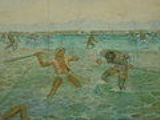
The Battle of Mactan was fought in the Philippines on April 27, 1521. The warriors of Lapu-Lapu, a native chieftain of Mactan Island, defeated Spanish soldiers under the command of Portuguese explorer Ferdinand Magellan.

Discussion
Ask a question about 'Battle of Mactan'
Start a new discussion about 'Battle of Mactan'
Answer questions from other users
|
Recent Posts

Encyclopedia
The Battle of Mactan was fought in the Philippines on April 27, 1521. The warriors of Lapu-Lapu, a native chieftain of Mactan Island, defeated Spanish soldiers under the command of Portuguese explorer Ferdinand Magellan. The Battle of Mactan is commemorated by a memorial monument, known as the Mactan Shrine, in honor of Rajah Lapu-Lapu, and Ferdinand Magellan.
History
Background
By the 15th century, Portuguese explorers had found a way around the Islamic kingdoms which held control of the trade routes overland to the spices of Southeast Asia, which was to round the Cape of Good Hope of Africa, through the Indian Ocean, and then to the Spice Islands.
Magellan was assigned to Portuguese Goa in India for military training at the age of 20 years old, and soon divined that geography was a key to the riches of Southeast Asia. After a voyage to the area, he indentured a Malayan servant, Enrique, whom he would employ as an interpreter during his voyage around the globe. Enrique was actually taken from his home islands, captured by Sumatran slavers, taken to Malacca, and later baptized.
After Magellan landed on the island of Homonhon on March 17, 1521, he parleyed with Rajah Calambu (or Kolambu) of Limasawa, who guided him to Cebu, on April 7. Communicating through his interpreter, Enrique, Magellan befriended Rajah Humabon also known as Rajah Hamabar, the tribal chief of Cebu, and he and his queen were baptized into the Catholic faith, taking the Christian names Carlos and Juana. Magellan gave Juana the Santo Niņo as a symbol of the alliance. Impressed by Magellan's armament (consisting of guns, swords, armor, 12 cannons, and 50 crossbows), Rajah Humabon and Datu Zula convinced Magellan to go to the nearby island of Mactan and kill rival chieftain Lapu-Lapu. It is widely believed that Rajah Humabon, and Rajah Lapu-Lapu were enemies, and were constantly fighting for control of territory.
The battle
According to the accounts of Antonio Pigafetta, Magellan deployed 48 armored men, less than half his crew, with swords, axes, shields, crossbows and guns. Filipino historians note that because of the rocky outcroppings and corals near the beach, he could not land on Mactan. Forced to anchor his ships far from shore, Magellan could not bring his ships' firepower to bear on Lapu-Lapu's warriors, who numbered more than 1,500.
- "When morning came, forty-nine of us leaped into the water up to our thighs, and walked through water for more than two cross-bow flights before we could reach the shore. The boats could not approach nearer because of certain rocks in the water. The other eleven men remained behind to guard the boats. When we reached land, [the natives] had formed in three divisions to the number of more than one thousand five hundred persons. When they saw us, they charged down upon us with exceeding loud cries... The musketeers and crossbow-men shot from a distance for about a half-hour, but uselessly...
Magellan then tried to scare them off by burning some houses in what is now the Barangay of Buaya, known then as Bulaia.
- Seeing that, the captain-general sent some men to burn their houses in order to terrify them. When they saw their houses burning, they were roused to greater fury. Two of our men were killed near the houses, while we burned twenty or thirty houses. So many of them charged down upon us that they shot the captain through the right leg with a poisoned arrow. On that account, he ordered us to retire slowly, but the men took to flight, except six or eight of us who remained with the captain. The natives shot only at our legs, for the latter were bare; and so many were the spears and stones that they hurled at us, that we could offer no resistance. The mortars in the boats could not aid us as they were too far away.
Many of the warriors turned upon Magellan; he was wounded in the arm with a spear and in the leg by a native sword called "Kampilan". He was finally overpowered and killed, stabbed and hacked by spears and swords. Pigafetta and the others managed to escape.
- Recognizing the captain, so many turned upon him that they knocked his helmet off his head twice... An Indian hurled a bamboo spear into the captain's face, but the latter immediately killed him with his lance, which he left in the Indian's body. Then, trying to lay hand on sword, he could draw it out but halfway, because he had been wounded in the arm with a bamboo spear. When the natives saw that, they all hurled themselves upon him. One of them wounded him on the left leg with a large cutlass, which resembles a scimitar, only being larger. That caused the captain to fall face downward, when immediately they rushed upon him with iron and bamboo spears and with their cutlasses, until they killed our mirror, our light, our comfort, and our true guide. When they wounded him, he turned back many times to see whether we were all in the boats. Thereupon, beholding him dead, we, wounded, retreated, as best we could, to the boats, which were already pulling off."
His allies, Rajah Humabon and Datu Zula were said not to have taken part in the battle due to Magellan's bidding, and watched from a distance. There is no record of the official casualties of the event, but it is evident that the Spaniards were defeated by sheer force of numbers.
In Philippine culture
Today, Lapu-Lapu is honored as the first Philippine national hero to resist foreign rule. He is remembered by a number of commemorations: a monument on the island of Mactan, a city bearing his name and a statue at the Cebu Provincial Capitol. Magellan is likewise given the honor of bringing the first vestiges of Spanish colonization to the Philippine Islands. The battle is re-enacted during its anniversary.
A local variety of red grouper is called Lapu-Lapu, named after the chieftain.
Actor-turned-politician Lito Lapid made a film called "Lapu-Lapu" that tells the story of the Visayan warrior; and Novelty singer Yoyoy Villame of Calape, Bohol wrote a folk song entitled "Magellan" that tells the story of the Battle of Mactan.
Gallery
See also
External links
|
| |
|
|