


Bracteate

Encyclopedia

Latin
Latin is an Italic language originally spoken in Latium and Ancient Rome. It, along with most European languages, is a descendant of the ancient Proto-Indo-European language. Although it is considered a dead language, a number of scholars and members of the Christian clergy speak it fluently, and...
bractea, a thin piece of metal) is a flat, thin, single-sided gold medal
Medal
A medal, or medallion, is generally a circular object that has been sculpted, molded, cast, struck, stamped, or some way rendered with an insignia, portrait, or other artistic rendering. A medal may be awarded to a person or organization as a form of recognition for athletic, military, scientific,...
worn as jewelry that was produced in Northern Europe
Northern Europe
Northern Europe is the northern part or region of Europe. Northern Europe typically refers to the seven countries in the northern part of the European subcontinent which includes Denmark, Estonia, Latvia, Lithuania, Norway, Finland and Sweden...
predominantly during the Migration Period
Migration Period
The Migration Period, also called the Barbarian Invasions , was a period of intensified human migration in Europe that occurred from c. 400 to 800 CE. This period marked the transition from Late Antiquity to the Early Middle Ages...
of the Germanic Iron Age
Germanic Iron Age
The Germanic Iron Age is the name given to the period 400–800 in Northern Europe and it is part of the continental Age of Migrations.-Germanic Iron :...
(including the Vendel era
Vendel era
In Swedish prehistory, the Vendel era is the name given to a part of the Germanic Iron Age ....
in Sweden). The term is also used for later silver
Silver
Silver is a metallic chemical element with the chemical symbol Ag and atomic number 47. A soft, white, lustrous transition metal, it has the highest electrical conductivity of any element and the highest thermal conductivity of any metal...
coins produced in central Europe
Central Europe
Central Europe or alternatively Middle Europe is a region of the European continent lying between the variously defined areas of Eastern and Western Europe...
during the early Middle Ages
Middle Ages
The Middle Ages is a periodization of European history from the 5th century to the 15th century. The Middle Ages follows the fall of the Western Roman Empire in 476 and precedes the Early Modern Era. It is the middle period of a three-period division of Western history: Classic, Medieval and Modern...
.
There are also similar pieces from the neighboring Huns
Huns
The Huns were a group of nomadic people who, appearing from east of the Volga River, migrated into Europe c. AD 370 and established the vast Hunnic Empire there. Since de Guignes linked them with the Xiongnu, who had been northern neighbours of China 300 years prior to the emergence of the Huns,...
(and from their invasion of India) in the style of Gupta
Gupta Empire
The Gupta Empire was an ancient Indian empire which existed approximately from 320 to 550 CE and covered much of the Indian Subcontinent. Founded by Maharaja Sri-Gupta, the dynasty was the model of a classical civilization. The peace and prosperity created under leadership of Guptas enabled the...
and Roman coinage
Roman currency
The Roman currency during most of the Roman Republic and the western half of the Roman Empire consisted of coins including the aureus , the denarius , the sestertius , the dupondius , and the as...
.
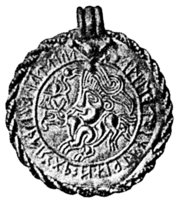
Gold bracteates from the Migration Period
Amulet
An amulet, similar to a talisman , is any object intended to bring good luck or protection to its owner.Potential amulets include gems, especially engraved gems, statues, coins, drawings, pendants, rings, plants and animals; even words said in certain occasions—for example: vade retro satana—, to...
. The gold for the bracteates came from coins paid as peace money by the Roman Empire to their Northern Germanic neighbors.
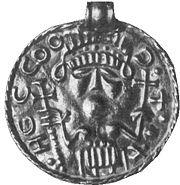
Motifs
Germanic monarchy
Germanic kingship refers to the customs and practices surrounding kings among the pagan Germanic tribes of the Migration period and the kingdoms of the Early Middle Ages ....
with characteristic hair that is plaited back and depictions of figures from Germanic mythology
Germanic mythology
Germanic mythology is a comprehensive term for myths associated with historical Germanic paganism, including Norse mythology, Anglo-Saxon mythology, Continental Germanic mythology, and other versions of the mythologies of the Germanic peoples...
influenced to varying extents by Roman coinage while others feature entirely new motifs. The motifs are commonly those of Germanic mythology and some are believed to be Germanic pagan
Germanic paganism
Germanic paganism refers to the theology and religious practices of the Germanic peoples of north-western Europe from the Iron Age until their Christianization during the Medieval period...
icon
Icon
An icon is a religious work of art, most commonly a painting, from Eastern Christianity and in certain Eastern Catholic churches...
s giving protection or for divination.
Often depicted is a figure with a horse
Sleipnir
In Norse mythology, Sleipnir is an eight-legged horse. Sleipnir is attested in the Poetic Edda, compiled in the 13th century from earlier traditional sources, and the Prose Edda, written in the 13th century by Snorri Sturluson...
, spear
Gungnir
In Norse mythology, Gungnir is the spear of the god Odin.-Poetic Edda:In the Poetic Edda poem Völuspá, the Æsir-Vanir War is described as officially starting when Odin throws a spear over the heads of an assembly of Vanir gods. Whether or not this was specifically Gungnir is, however, unstated...
and birds
Hugin and Munin
In Norse mythology, Huginn and Muninn are a pair of ravens that fly all over the world, Midgard, and bring the god Odin information...
- likely a reference to the Germanic god Wodan - and aspects of the figure that would later appear in 13th century depictions as Odin
Odin
Odin is a major god in Norse mythology and the ruler of Asgard. Homologous with the Anglo-Saxon "Wōden" and the Old High German "Wotan", the name is descended from Proto-Germanic "*Wodanaz" or "*Wōđanaz"....
such as the Poetic Edda
Poetic Edda
The Poetic Edda is a collection of Old Norse poems primarily preserved in the Icelandic mediaeval manuscript Codex Regius. Along with Snorri Sturluson's Prose Edda, the Poetic Edda is the most important extant source on Norse mythology and Germanic heroic legends, and from the early 19th century...
. For this reason the bracteates are a target of iconographic studies by scholars interested in Germanic paganism. Several bracteates also feature runic alphabet
Runic alphabet
The runic alphabets are a set of related alphabets using letters known as runes to write various Germanic languages before the adoption of the Latin alphabet and for specialized purposes thereafter...
inscriptions (a total of 133 inscriptions on bracteates are known, amounting to more than a third of the entire Elder Futhark
Elder Futhark
The Elder Futhark is the oldest form of the runic alphabet, used by Germanic tribes for Northwest Germanic and Migration period Germanic dialects of the 2nd to 8th centuries for inscriptions on artifacts such as jewellery, amulets, tools, weapons and runestones...
corpus). Numerous Bracteates feature swastika
Swastika
The swastika is an equilateral cross with its arms bent at right angles, in either right-facing form in counter clock motion or its mirrored left-facing form in clock motion. Earliest archaeological evidence of swastika-shaped ornaments dates back to the Indus Valley Civilization of Ancient...
s as a common motif.
Typology
The typology for bracteates divides them into several letter-named categories, a system introduced in an 1855 treatise by the Danish numismatist Christian Jürgensen ThomsenChristian Jürgensen Thomsen
Christian Jürgensen Thomsen was a Danish archaeologist.In 1816 he was appointed head of 'antiquarian' collections which later developed into the National Museum of Denmark in Copenhagen. While organizing and classifying the antiquities for exhibition, he decided to present them chronologically...
named Om Guldbracteaterne og Bracteaternes tidligste Brug som Mynt and finally defined formally by the Swedish numismatist Oscar Montelius
Oscar Montelius
Oscar Montelius was a Swedish archaeologist who refined the concept of seriation, a relative chronological dating method...
in his 1869 treatise Från jernåldern:
- A-bracteates (approximately 92 specimens): showing the face of a human, modelled after antique imperial coins
- B-bracteates (appr. 91 specimens): one to three human figures in standing, sitting or kneeling positions, often accompanied by animals
- C-bracteates (best represented, by appr. 426 specimens): showing a male's head above a quadruped, often interpreted as the Germanic god WodenWodenWoden or Wodan is a major deity of Anglo-Saxon and Continental Germanic polytheism. Together with his Norse counterpart Odin, Woden represents a development of the Proto-Germanic god *Wōdanaz....
. - D-bracteates (appr. 359 specimens): showing one or more highly stylized animals
- E-bracteates (appr. 280 specimens): showing an animal triskele under a circular feature
- F-bracteates (appr. 17 specimens): as a subgroup of the D-bracteates, showing an imaginary animal
- M-'bracteates' (appr. 17 specimens): two-sided imitations of Roman imperial medallions
Corpus
More than 1000 Migration Period bracteates of type A-, B-, C-, D-, and F are known in total (Heizmann & Axboe 2011). Of these, 135 (ca. 11%) bear Elder FutharkElder Futhark
The Elder Futhark is the oldest form of the runic alphabet, used by Germanic tribes for Northwest Germanic and Migration period Germanic dialects of the 2nd to 8th centuries for inscriptions on artifacts such as jewellery, amulets, tools, weapons and runestones...
inscriptions which are often very short; the most notable inscriptions are found on the Seeland-II-C
Seeland-II-C
Seeland-II-C is a Scandinavian bracteate from Zealand, Denmark dating to the Migration period . The bracteate bears an Elder Futhark inscription which reads as:The final ttt is a triple-stacked Tiwaz rune...
(offering traveling protection to the one who wears it), Vadstena
Vadstena bracteate
The Vadstena bracteate is a gold C-bracteate found in the earth at Vadstena, Sweden, in 1774. Along with the bracteate was a gold ring and a piece of gold sheet: all were about melted down by a goldsmith who was stopped by a local clergyman...
(giving a listing of the Elder Futhark combined with a potential magical inscription) and Tjurkö
Tjurkö bracteate
The Tjurkö Bracteates, listed by Rundata as DR BR75 and DR BR76, are two bracteates found on Tjurkö, Eastern Hundred, Blekinge, Sweden, bearing Elder Futhark runic inscriptions, in Proto-Norse.-Description:...
(featuring an inscription in scaldic verse) bracteates.
To these can be added the ca. 270 E-bracteates (Gaimster 1998), which belong to the Vendel Period and thus are slightly later than the other types. They were produced only on Gotland, and while the earlier bracteates (apart from a few English pieces) all were made from gold, many E-bracteates were made from silver or bronze.
The German historian Karl Hauck, Danish archaeologist Morten Axboe and German runologist Klaus Düwel have worked since the 1960s to create a complete corpus of the early Germanic bracteates from the migration period, complete with large scale photographs and drawings. This has been published in three volumes in German named Die Goldbrakteaten der Völkerwanderungszeit. Ikonographischer Katalog. A catalogue supplement is included in Heizmann & Axboe 2011.
Early medieval bracteates
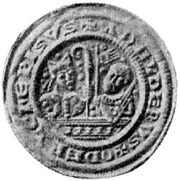
Rhineland
Historically, the Rhinelands refers to a loosely-defined region embracing the land on either bank of the River Rhine in central Europe....
, beginning at around 1130 in Saxony
Saxony
The Free State of Saxony is a landlocked state of Germany, contingent with Brandenburg, Saxony Anhalt, Thuringia, Bavaria, the Czech Republic and Poland. It is the tenth-largest German state in area, with of Germany's sixteen states....
and Thuringia
Thuringia
The Free State of Thuringia is a state of Germany, located in the central part of the country.It has an area of and 2.29 million inhabitants, making it the sixth smallest by area and the fifth smallest by population of Germany's sixteen states....
and were taken out of circulation at about 1520. In some cantons of Switzerland
Cantons of Switzerland
The 26 cantons of Switzerland are the member states of the federal state of Switzerland. Each canton was a fully sovereign state with its own borders, army and currency from the Treaty of Westphalia until the establishment of the Swiss federal state in 1848...
, bracteate-like rappen
Rappen
A Rappen originally was a variant of the medieval Pfennig common to the Alemannic German regions Alsace, Sundgau and Northern Switzerland. As with other German pennies, its half-piece was a Haller, the smallest piece which was struck.Today, one-hundredth of a Swiss franc is still officially...
, heller
Heller (money)
The Heller or Häller was originally a German coin valued at half a pfennig and named after the city of Hall am Kocher...
, and angster were produced during the 18th century.
The term bracteate for these coins was not used contemporarily. It was first used in the 17th century.
The bracteates were usually called back regularly, about one or twice a year, and could be exchanged for new coins with a deduction (Renovatio Monetae). This system worked like a demurrage
Demurrage (currency)
Demurrage is a cost associated with owning or holding currency over a given period of time. It is sometimes referred to as a carrying cost of money. For commodity money such as gold, demurrage is in practice nothing more than the cost of storing and securing the gold...
: People wouldn't hoard their coins, because they lost their value. So this money was used more as a medium of exchange than for storing value. This increased the velocity of money
Velocity of money
300px|thumb|Similar chart showing the velocity of a broader measure of money that covers M2 plus large institutional deposits, M3. The US no longer publishes official M3 measures, so the chart only runs through 2005....
and stimulated the economy.
Medieval silver bracteates may be large, but most are about 15 millimeters across and weigh about 1 gram. Sometimes the coins could be divided to pay smaller amounts.
The town leagues were not interested in such a system and introduced in 1413 the Ewiger Pfennig (perpetual penny) without this decay.
Indian style bracteates
These coins were made by the invading Hunnic tribes as they entered India, from 635 ad they seem to have issued gold coins to the weight of half a gram to one gram in the style of GuptaGupta Empire
The Gupta Empire was an ancient Indian empire which existed approximately from 320 to 550 CE and covered much of the Indian Subcontinent. Founded by Maharaja Sri-Gupta, the dynasty was the model of a classical civilization. The peace and prosperity created under leadership of Guptas enabled the...
and Roman
Ancient Rome
Ancient Rome was a thriving civilization that grew on the Italian Peninsula as early as the 8th century BC. Located along the Mediterranean Sea and centered on the city of Rome, it expanded to one of the largest empires in the ancient world....
coinage.
Further reading
- Pesch, Alexandra: Die Goldbrakteaten der Völkerwanderungszeit - Thema und Variation (Berlin: de Gruyter, 2007).
External links
- Era of the Great Migrations, 375 BC - 550 AD, Bracteate
- ©Canterbury Archaeological Trust Ltd
- Hunnic bracteates
- Pfennig or bracteate, 0.89 g, silver, from Halberstadt, around 1200
- Gold Bracteates - Fake?
- Hoards from the Roman Iron Age – Early Viking Age
- Evidence of the Jutes BBC
- list of Danish bracteates with runic inscriptions