


Carbine

Encyclopedia
A carbine from French carabine, is a longarm
similar to but shorter than a rifle
or musket
. Many carbines are shortened versions of full rifles, firing the same ammunition
at a lower velocity
due to a shorter barrel length.
The smaller size and lighter weight of carbines makes them easier to handle in close-quarter situations such as urban
or jungle warfare
, or when deploying from military vehicles. The disadvantages of carbines relative to rifles include inferior long-range accuracy and a shorter effective range. Being larger than a submachine gun
, they are harder to maneuver in tight encounters where superior range and stopping power at distance are not great considerations. Firing the same ammunition as rifles gives carbines the advantage of standardization over those personal defense weapon
s (PDWs) that require proprietary cartridges
.
Carbines are issued to high-mobility troops such as special-operations soldiers and paratroopers, as well as to mounted, supply, or other non-infantry personnel whose roles do not require full-sized rifles.
Some sources derive the name of the weapon from the name of its first users—cavalry troopers called "carabinier
s", from the French carabine, from the Old French carabin (soldier armed with a musket), perhaps from escarrabin, gravedigger, perhaps from scarabee, scarab beetle
.
Carbines were usually less accurate and less powerful than the longer muskets (and later rifles) of the infantry, due to a shorter sight
plane and lower velocity of bullets fired from the shortened barrel. With the advent of fast-burning smokeless powder
, the velocity disadvantages of the shorter barrels became less of an issue (see internal ballistics
). Eventually, the use of horse-mounted cavalry would decline, but carbines continued to be issued and used by many who preferred a lighter, more compact weapon even at the cost of reduced long-range accuracy and power.
During the 19th century, carbines were often developed separately from the infantry rifles, and in many cases did not even use the same ammunition, which made for supply difficulties. A notable weapon developed towards the end of the American Civil War
by the Union was the Spencer carbine. It had a spring-powered magazine
in the stock which held seven rounds. In the late 19th century it became common for a number of nations to make bolt-action
rifles in both full-length and carbine versions. One of the most popular and recognizable carbines was the Winchester lever-action
carbine, with several versions using revolver
cartridges. This made it an ideal choice for cowboys and explorers, who could carry a revolver and a carbine, both using the same ammunition.
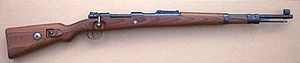
, the standard battle rifle used by armies around the world had been growing shorter, either by redesign or by the general issue of carbine versions instead of full-length rifles. For example, the Russian Model 1891 rifle with an 800 mm (31.5 inch) barrel was shortened to 730 mm (28.75 in.) in 1930, and to 510 mm (20 in.) in 1938; the German Mauser
98 rifles went from 740 mm (29 in.) in 1898 to 600 mm (23.6 in.) in 1935 as the Karabiner Kurz (K98k or Kar98k), or "short carbine". The barrel lengths in rifles used by the United States
did not change between the bolt-action
M1903 rifle of World War I
and the World War II
M1 Garand rifle, but the 610 mm (24 in.) barrel on the M1903 was short for its day. The US M1 Carbine
was more of a traditional carbine in that it was significantly shorter and lighter, with a 457.2 mm (18 in. barrel), than the M1 Garand rifle. The M1 Carbine was not a shorter version of the M1 Garand, as was typical for rifles vs. carbines in the 19th century, but a wholly different design firing a smaller, less-powerful cartridge.
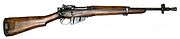 The United Kingdom
also developed a "Jungle Carbine
" version of their Lee-Enfield
service rifle, featuring a shorter barrel, flash hider, and manufacturing modifications designed to decrease the rifle's weight. Officially titled Rifle, No. 5 Mk I, it was introduced in the closing months of World War II, but did not see widespread service until the Korean War
, the Mau Mau uprising
, and the Malayan Emergency
.
 A shorter weapon was more convenient when riding in a truck, armored personnel carrier, helicopter
or aircraft, and also when engaged in close-range combat. Based on the combat experience of World War II, the criteria used for selecting infantry weapons began to change. Unlike previous wars, which were often fought mainly from fixed lines and trenches, World War II was a highly mobile war, often fought in cities, forests, or other areas where mobility and visibility were restricted. In addition, improvements in artillery
made moving infantry in open areas even less practical than it had been.
The majority of enemy contacts were at ranges of less than 300 meters (325 yards), and the enemy was exposed to fire for only short periods of time as they moved from cover to cover. Most rounds fired were not aimed at an enemy combatant, but instead fired in the enemy's direction to keep them from moving and firing back (see suppressive fire
). These situations did not require a heavy rifle, firing full-power rifle bullets with long-range accuracy. A less-powerful weapon would still produce casualties at the shorter ranges encountered in actual combat, and the reduced recoil would allow more shots to be fired in the short amount of time an enemy was visible. The lower-powered round would also weigh less, allowing a soldier to carry more ammunition. With no need of a long barrel to fire full-power ammunition, a shorter barrel could be used. A shorter barrel made the weapon weigh less and was easier to handle in tight spaces, and was easier to shoulder quickly to fire a shot at an unexpected target. Full-automatic
fire was also considered a desirable feature, allowing the soldier to fire short bursts of three to five rounds, increasing the probability of a hit on a moving target.
The Germans had experimented with selective-fire carbines firing rifle cartridges during the early years of World War II. These were determined to be less than ideal, as the recoil of full-power rifle cartridges caused the weapon to be uncontrollable in full-automatic fire. They then developed an intermediate-power cartridge round, which was accomplished by reducing the power and the length of the standard 7.92x57 Mauser rifle cartridge to create the 7.92x33 Kurz (Short) cartridge. A selective-fire weapon was developed to fire this shorter cartridge, eventually resulting in the Sturmgewehr 44
, later translated as "assault rifle
". After World War II, the USSR would adopt a similar weapon, the AK-47
, which became the standard Soviet infantry weapon. The United States during World War II also had the M2 Carbine
, a selective-fire version of the M1 Carbine
firing a 7.62x33mm cartridge. However, the semi-automatic M1 carbine was produced in a 10-to-1 ratio to the M2.
Although the NATO countries did not adopt an intermediate-power round, they continued the trend toward shorter and lighter magazine
-fed battle rifles. NATO adopted the 7.62x51 NATO round (which in reality is only slightly different ballistically to the .308 Winchester
and .303 British
cartridges), along with several rifles such as the FN FAL
and M14
.
 By the 1960s NATO had adopted the 5.56 NATO cartridge. This round was even lighter and smaller than the Soviet AK-47 cartridge, but possessed higher velocity. In U.S. service, the M16
assault rifle replaced the M14 as the standard infantry
weapon, although the M14 continued to be used by designated marksmen.
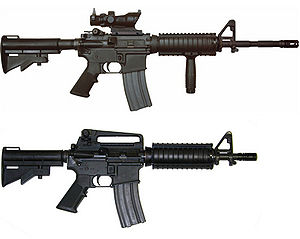
Lighter carbines came to be adopted as the standard infantry long rifle. What changed was that only a certain number of soldiers now needed to retain longer range weapons, serving as designated marksmen. Development of lighter assault rifles continued, matched by developments in even lighter carbines. At the same time the infantry switched to 5.56 mm weapons, carbines like the AKS-74U (which fired a Warsaw pact 5.45x39 round) and CAR-15
were being developed.
, a derivative of the M16 family which fired the same 5.56mm cartridge but was lighter and shorter (in overall length and barrel length), resulting in marginally reduced range and power.
Meanwhile, many armies are experiencing a backlash against carbines and lighter rifles in general, and are equipping selected soldiers, usually called Designated Marksmen
, or DM, with higher power rifles. While firing a higher quantity of smaller bullets makes it easier to hit a target (and is therefore good for beginner marksmen), it offers very little to more advanced marksmen. Furthermore, the additional range of the heavier weapons has proven to be necessary in open environments such as deserts. As a result, the focus on more highly trained soldiers equipped with, for example, 7.62 mm NATO firing rifles, such as the U.S. Marine Corps Designated Marksman Rifle
variant of the M14
, has increased somewhat. A squad of soldiers armed with assault rifles would have a single soldier assigned as DM who would carry a battle rifle for selectively engaging long range targets. The DM differs from the sniper in that the DM moves with his unit, and engages targets at ranges beyond the 500 meter (550 yd) effective range of modern assault rifles, but less than the 600 meter (650 yd) range which is the optimal engagement range for snipers.
and other communities.
In addition, due to the development of body armor, support personnel required a compact weapon with more penetration than the traditional submachine gun, leading to the development of the personal defense weapon
, or PDW, which uses rounds that have better ballistics
than simple pistol rounds but less power and range than full rifle rounds. Examples include the FN P90
and HK MP7. Whether these ultra-light weapons will be widely adopted has yet to be seen. The cartridge used by the FN P90, the 5.7 × 28 mm, for example, fires a 2.0 g (31 grain) armor-piercing bullet at velocities of around 700 m/s (2300 ft/s). The H&K MP7 fires an even smaller 4.6 mm round with ballistics similar to the .22 WMR derived .17 Hornady Magnum Rimfire. The small diameter rounds enable the projectile to travel at the high velocity needed to penetrate Kevlar
armor, as a light weapon with sufficient energy to push a large caliber bullet through the armor would have prohibitive recoil. The small bullets are generally designed to tumble after penetration.
Some weapons designed for personal defense do still use full-power ammunition, for example the carbine version of the L85A2 issued to British tank crews.
 To what extent armies will adopt even lighter carbines, and to what extent they will be avoided, has yet to be seen entirely. It is likely that harder hitting, or at least higher penetrating, weapons will become more common, due to a rise in use of body armor, making weaker weapons ineffective. Stacked against this is mainly the amount of urban warfare that is required, which favors lighter carbine weapons.
The modern usage of the term carbine covers much the same scope as it always had, namely lighter weapons (generally rifles) with barrels less than 457.2 mm (18 inches). These weapons can be considered carbines, while rifles with barrels of 508 mm (20 inches) or more are generally not considered carbines unless specifically named so, and depending on the weapon's power. Modern carbines use ammunition ranging from that used in light pistols up to powerful rifle cartridges, with the usual exception of high velocity magnum cartridges. In the more powerful cartridges, the short barrel of a carbine has significant disadvantages in velocity, and the high residual pressure when the bullet exits the barrel results in substantially greater muzzle blast. Flash suppressor
s and muzzle brake
s are common solutions to this problem, which may ease their acceptance.
lever action carbine and a Colt
revolver in .44-40 or .38-40. During the 20th century, this trend continued with more modern and powerful revolver cartridges, in the form of Winchester
and Marlin
lever action carbines chambered in .38 Special
/.357 Magnum
and .44 Special
/.44 Magnum
. Another example is the DeLisle carbine, a suppressed
special operations
carbine that was chambered for .45 ACP.
Modern equivalents also exist, such as the discontinued Ruger Police Carbine
, which uses the same magazine as the Ruger pistols of the same caliber, as well as the (also discontinued) Marlin Camp Carbine
(which, in .45ACP, used 1911 magazines). The Beretta Cx4 Storm
shares magazines with many Beretta
pistols, and is designed to be complementary to the Beretta Px4 Storm
pistol. The Hi-Point 995 carbine
is a cheaper alternative to other pistol caliber carbines in the United States
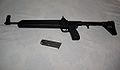
and shares magazines with the Hi-Point C-9 pistol (although many owners report that early Hi-Point C-9 magazines are too short to function in the Model 995 Carbine). Other examples are the Kel-Tec SUB-2000
series which accepts Glock, Beretta and S&W pistol magazines chambered in either 9 mm Luger or .40S&W. The recent introduction of such products may indicate that there is a growing demand for these companion carbines.
 The primary advantages of a pistol caliber carbine are increased accuracy due to the buttstock and longer barrel (and with it, sight radius), relatively low muzzle blast/flash/recoil, higher muzzle velocity and energy of a longer barrel for increased wounding potential and penetration (depending on the particular load used), and (sometimes, but not always) greater adaptability for easily accepting accessories such as optics, weaponlights, and lasers. Furthermore, PCCs may not be as legally restricted as comparable handguns, depending on the jurisdiction (for example, you need only be 18 in the US to purchase a rifle, but you must be at least 21 to purchase a handgun).
One less-noted advantage of PCCs is their lower muzzle report compared to more powerful rifles; because they are less noisy when fired, they are less likely to cause permanent hearing damage when fired indoor without hearing protection - this can be an important consideration during home defense situations.
Compared to "regular" carbines/rifles (such as those in .223 and 7.62x39mm), pistol-caliber carbines may suffer from a shorter effective range, more pronounced trajectory, less power, and less effectiveness against body armor.
Recently, kits have appeared on the market which consist of a carbine length barrel, bolt (usually blowback
operated), and stock that attach to a pistol frame. Attaching the pistol frame provides the feed mechanism (through the pistol's magazine) and trigger mechanism, and produces a completed carbine. Kits of this type are available for Colt M1911 pattern and Glock
pistols.
_with_stock.jpg) Firearms with shoulder stocks and barrels less than 406 mm (16 in) in length are classified as "short barreled rifles" (under the US National Firearms Act
Firearms with shoulder stocks and barrels less than 406 mm (16 in) in length are classified as "short barreled rifles" (under the US National Firearms Act
or NFA), and are sometimes restricted in the same way that short barrel shotguns and machine gun
s are. Because of this, rifles with barrels of less than 406 mm (16 in), or pistols with shoulder stocks, are rare. A list of firearms not covered by the NFA due to their antique status may be found here http://www.atf.gov/firearms/curios/sec3a.htm or due to their Curio and Relic status may be found here http://www.atf.gov/firearms/curios/sec3.htm; these lists includes a number of carbines with barrels less than the minimum legal length and firearms that are "primarily collector's items and are not likely to be used as weapons and, therefore, are excluded from the provisions of the National Firearms Act. " Firearms classified as machine gun
s are also not subject to the barrel length restriction.
Kits exist which will convert many pistols into carbines by the addition of a shoulder stock; notable examples are the long barrelled Colt Buntline
revolver
stock, the Mauser C96
"Broomhandle" holster/stock, and various others for models such as the Browning Hi-Power
, Luger
, Colt M1911, and the Heckler & Koch VP70
. Since these stock additions retain the short pistol barrel (as short as 100 mm (4 inches)) they are highly restricted under the NFA unless the shoulder stocks are of original manufacture for the gun and the gun has been "delisted" as outlined in links 1 & 2 in the paragraph above, as is the case with so-equipped "Broomhandle" Mausers and Lugers. Many pistols which had attachments for the stocks, including rare wartime models, were altered to remove the attachment point.
, with an extended barrel, usually just over 406 mm (16 inches) long, which will escape ban by some "assault weapon" legislation. While functionally identical to other carbines, these are banned in some places as "assault weapons" based on their cosmetic similarity to submachine guns. However, they may not accept certain parts (such as magazines or collapsing stocks) from the submachine guns they resemble. These are a popular compromise for (American) shooters who would like to own a submachine gun but cannot due to local restrictions or the prohibitive cost of buying a civilian legal submachine gun (full automatics or semi-automatics with barrels shorter than 16 inches (406.4 mm) are restricted under Title II of the National Firearms Act
). Many owners may choose to shorten the barrels down to NFA-lengths, and register them as "short barrel rifles" SBRs.
Examples of PCCs that are derivatives of submachine guns but are rifles under Title I (Gun Control Act
) include the HK USC (derived from the HK .45ACP UMP submachine gun), the HK94 (derived from the MP5), pistol-caliber AR-15s (such as the Bushmaster Carbon 15 9 mm Carbine), semi-automatic only versions of the Thompson
by Auto-Ordnance and the FN PS90 (derived from the FN P90
SMG). Unlike the above-mentioned PCCs, these carbines utilize either magazines from their SMG derivatives, or proprietary magazines (as in the case of the USC).
In some historical cases the term machine carbine was the official title for sub-machine guns, such as the British Sten
and Australian Owen gun
s. The semi-automatic only version of the Sterling submachine gun
was also officially called a "carbine". While the original Sterling semi-auto would be classed a "short barrel rifle" under the U.S. National Firearms Act
, fully legal long-barrel versions of the Sterling have been made for the U.S. collector market.
Long gun
The term long gun is used to describe classes of firearm and cannon with longer barrels than other classes. In small arms, a long gun is designed to be fired braced against the shoulder, in contrast to a handgun, while in artillery a long gun would be contrasted with a howitzer or carronade.-Small...
similar to but shorter than a rifle
Rifle
A rifle is a firearm designed to be fired from the shoulder, with a barrel that has a helical groove or pattern of grooves cut into the barrel walls. The raised areas of the rifling are called "lands," which make contact with the projectile , imparting spin around an axis corresponding to the...
or musket
Musket
A musket is a muzzle-loaded, smooth bore long gun, fired from the shoulder. Muskets were designed for use by infantry. A soldier armed with a musket had the designation musketman or musketeer....
. Many carbines are shortened versions of full rifles, firing the same ammunition
Ammunition
Ammunition is a generic term derived from the French language la munition which embraced all material used for war , but which in time came to refer specifically to gunpowder and artillery. The collective term for all types of ammunition is munitions...
at a lower velocity
Velocity
In physics, velocity is speed in a given direction. Speed describes only how fast an object is moving, whereas velocity gives both the speed and direction of the object's motion. To have a constant velocity, an object must have a constant speed and motion in a constant direction. Constant ...
due to a shorter barrel length.
The smaller size and lighter weight of carbines makes them easier to handle in close-quarter situations such as urban
Urban warfare
Urban warfare is combat conducted in urban areas such as towns and cities. Urban combat is very different from combat in the open at both the operational and tactical level...
or jungle warfare
Jungle warfare
Jungle warfare is a term used to cover the special techniques needed for military units to survive and fight in jungle terrain.It has been the topic of extensive study by military strategists, and was an important part of the planning for both sides in many conflicts, including World War II and the...
, or when deploying from military vehicles. The disadvantages of carbines relative to rifles include inferior long-range accuracy and a shorter effective range. Being larger than a submachine gun
Submachine gun
A submachine gun is an automatic carbine, designed to fire pistol cartridges. It combines the automatic fire of a machine gun with the cartridge of a pistol. The submachine gun was invented during World War I , but the apex of its use was during World War II when millions of the weapon type were...
, they are harder to maneuver in tight encounters where superior range and stopping power at distance are not great considerations. Firing the same ammunition as rifles gives carbines the advantage of standardization over those personal defense weapon
Personal defense weapon
A personal defense weapon is a compact semi-automatic or fully automatic firearm similar in most respects to a submachine gun, but firing an armor-piercing rifle round, giving a PDW better range, accuracy and armor-penetrating capability than submachine guns, which fire pistol-caliber cartridges...
s (PDWs) that require proprietary cartridges
Cartridge (firearms)
A cartridge, also called a round, packages the bullet, gunpowder and primer into a single metallic case precisely made to fit the firing chamber of a firearm. The primer is a small charge of impact-sensitive chemical that may be located at the center of the case head or at its rim . Electrically...
.
Carbines are issued to high-mobility troops such as special-operations soldiers and paratroopers, as well as to mounted, supply, or other non-infantry personnel whose roles do not require full-sized rifles.
Early history: before the 1900s
The carbine was originally a lighter, shortened weapon developed for the cavalry. Carbines were short enough to be loaded and fired from horseback but this was rarely done - a moving horse is a very unsteady platform, and once halted a soldier can load and fire more easily if dismounted, which also makes him a smaller target. The principal advantage of the carbine's length was portability. Troops could carry full length muskets comfortably enough on horseback if just riding from A to B (the practice of the original dragoons and later mounted infantry). Cavalry proper (a 'Regiment of Horse') had to ride with some agility and engage in sword-wielding melees with opposing cavalry so carrying anything long would be a dangerous encumbrance. A carbine was typically no longer than a sheathed sabre, both arranged to hang with their tops clear of the rider’s elbows and bottoms clear of the horse’s legs.Some sources derive the name of the weapon from the name of its first users—cavalry troopers called "carabinier
Carabinier
A Carabinier was originally a cavalry soldier armed with a carbine...
s", from the French carabine, from the Old French carabin (soldier armed with a musket), perhaps from escarrabin, gravedigger, perhaps from scarabee, scarab beetle
Scarabaeidae
The family Scarabaeidae as currently defined consists of over 30,000 species of beetles worldwide. The species in this large family are often called scarabs or scarab beetles. The classification of this family is fairly unstable, with numerous competing theories, and new proposals appearing quite...
.
Carbines were usually less accurate and less powerful than the longer muskets (and later rifles) of the infantry, due to a shorter sight
Sight (device)
A sight is a device used to assist aligning or aim weapons, surveying instruments, or other items by eye. Sights can be a simple set or system of markers that have to be aligned together as well as aligned with the target...
plane and lower velocity of bullets fired from the shortened barrel. With the advent of fast-burning smokeless powder
Smokeless powder
Smokeless powder is the name given to a number of propellants used in firearms and artillery which produce negligible smoke when fired, unlike the older gunpowder which they replaced...
, the velocity disadvantages of the shorter barrels became less of an issue (see internal ballistics
Internal ballistics
Internal ballistics, a subfield of ballistics, is the study of a projectile's behavior from the time its propellant's igniter is initiated until it exits the gun barrel...
). Eventually, the use of horse-mounted cavalry would decline, but carbines continued to be issued and used by many who preferred a lighter, more compact weapon even at the cost of reduced long-range accuracy and power.
During the 19th century, carbines were often developed separately from the infantry rifles, and in many cases did not even use the same ammunition, which made for supply difficulties. A notable weapon developed towards the end of the American Civil War
American Civil War
The American Civil War was a civil war fought in the United States of America. In response to the election of Abraham Lincoln as President of the United States, 11 southern slave states declared their secession from the United States and formed the Confederate States of America ; the other 25...
by the Union was the Spencer carbine. It had a spring-powered magazine
Magazine (firearm)
A magazine is an ammunition storage and feeding device within or attached to a repeating firearm. Magazines may be integral to the firearm or removable . The magazine functions by moving the cartridges stored in the magazine into a position where they may be loaded into the chamber by the action...
in the stock which held seven rounds. In the late 19th century it became common for a number of nations to make bolt-action
Bolt-action
Bolt action is a type of firearm action in which the weapon's bolt is operated manually by the opening and closing of the breech with a small handle, most commonly placed on the right-hand side of the weapon...
rifles in both full-length and carbine versions. One of the most popular and recognizable carbines was the Winchester lever-action
Lever-action
Lever-action is a type of firearm action which uses a lever located around the trigger guard area, to load fresh cartridges into the chamber of the barrel when the lever is worked. Most lever-action firearms are rifles, but lever-action shotguns and a few pistols have also been made...
carbine, with several versions using revolver
Revolver
A revolver is a repeating firearm that has a cylinder containing multiple chambers and at least one barrel for firing. The first revolver ever made was built by Elisha Collier in 1818. The percussion cap revolver was invented by Samuel Colt in 1836. This weapon became known as the Colt Paterson...
cartridges. This made it an ideal choice for cowboys and explorers, who could carry a revolver and a carbine, both using the same ammunition.
Shorter rifles, shorter carbines: World War I and World War II
In the decades following World War IWorld War I
World War I , which was predominantly called the World War or the Great War from its occurrence until 1939, and the First World War or World War I thereafter, was a major war centred in Europe that began on 28 July 1914 and lasted until 11 November 1918...
, the standard battle rifle used by armies around the world had been growing shorter, either by redesign or by the general issue of carbine versions instead of full-length rifles. For example, the Russian Model 1891 rifle with an 800 mm (31.5 inch) barrel was shortened to 730 mm (28.75 in.) in 1930, and to 510 mm (20 in.) in 1938; the German Mauser
Mauser
Mauser was a German arms manufacturer of a line of bolt-action rifles and pistols from the 1870s to 1995. Mauser designs were built for the German armed forces...
98 rifles went from 740 mm (29 in.) in 1898 to 600 mm (23.6 in.) in 1935 as the Karabiner Kurz (K98k or Kar98k), or "short carbine". The barrel lengths in rifles used by the United States
United States
The United States of America is a federal constitutional republic comprising fifty states and a federal district...
did not change between the bolt-action
Bolt-action
Bolt action is a type of firearm action in which the weapon's bolt is operated manually by the opening and closing of the breech with a small handle, most commonly placed on the right-hand side of the weapon...
M1903 rifle of World War I
World War I
World War I , which was predominantly called the World War or the Great War from its occurrence until 1939, and the First World War or World War I thereafter, was a major war centred in Europe that began on 28 July 1914 and lasted until 11 November 1918...
and the World War II
World War II
World War II, or the Second World War , was a global conflict lasting from 1939 to 1945, involving most of the world's nations—including all of the great powers—eventually forming two opposing military alliances: the Allies and the Axis...
M1 Garand rifle, but the 610 mm (24 in.) barrel on the M1903 was short for its day. The US M1 Carbine
M1 Carbine
The M1 carbine is a lightweight, easy to use semi-automatic carbine that became a standard firearm for the U.S. military during World War II, the Korean War and the Vietnam War, and was produced in several variants. It was widely used by U.S...
was more of a traditional carbine in that it was significantly shorter and lighter, with a 457.2 mm (18 in. barrel), than the M1 Garand rifle. The M1 Carbine was not a shorter version of the M1 Garand, as was typical for rifles vs. carbines in the 19th century, but a wholly different design firing a smaller, less-powerful cartridge.
United Kingdom
The United Kingdom of Great Britain and Northern IrelandIn the United Kingdom and Dependencies, other languages have been officially recognised as legitimate autochthonous languages under the European Charter for Regional or Minority Languages...
also developed a "Jungle Carbine
Jungle Carbine
Jungle Carbine was an informal term used for the Rifle No. 5 Mk I which was a derivative of the British Lee Enfield No. 4 Mk I, designed not for jungle fighting but in response to a requirement for a "Shortened, Lightened" version of the No.4 rifle for airborne forces in the European theatre of...
" version of their Lee-Enfield
Lee-Enfield
The Lee-Enfield bolt-action, magazine-fed, repeating rifle was the main firearm used by the military forces of the British Empire and Commonwealth during the first half of the 20th century...
service rifle, featuring a shorter barrel, flash hider, and manufacturing modifications designed to decrease the rifle's weight. Officially titled Rifle, No. 5 Mk I, it was introduced in the closing months of World War II, but did not see widespread service until the Korean War
Korean War
The Korean War was a conventional war between South Korea, supported by the United Nations, and North Korea, supported by the People's Republic of China , with military material aid from the Soviet Union...
, the Mau Mau uprising
Mau Mau Uprising
The Mau Mau Uprising was a military conflict that took place in Kenya between 1952 and 1960...
, and the Malayan Emergency
Malayan Emergency
The Malayan Emergency was a guerrilla war fought between Commonwealth armed forces and the Malayan National Liberation Army , the military arm of the Malayan Communist Party, from 1948 to 1960....
.
After World War II
Helicopter
A helicopter is a type of rotorcraft in which lift and thrust are supplied by one or more engine-driven rotors. This allows the helicopter to take off and land vertically, to hover, and to fly forwards, backwards, and laterally...
or aircraft, and also when engaged in close-range combat. Based on the combat experience of World War II, the criteria used for selecting infantry weapons began to change. Unlike previous wars, which were often fought mainly from fixed lines and trenches, World War II was a highly mobile war, often fought in cities, forests, or other areas where mobility and visibility were restricted. In addition, improvements in artillery
Artillery
Originally applied to any group of infantry primarily armed with projectile weapons, artillery has over time become limited in meaning to refer only to those engines of war that operate by projection of munitions far beyond the range of effect of personal weapons...
made moving infantry in open areas even less practical than it had been.
The majority of enemy contacts were at ranges of less than 300 meters (325 yards), and the enemy was exposed to fire for only short periods of time as they moved from cover to cover. Most rounds fired were not aimed at an enemy combatant, but instead fired in the enemy's direction to keep them from moving and firing back (see suppressive fire
Suppressive fire
In military science, suppressive fire is a fire that degrades the performance of a target below the level needed to fulfill its mission. Suppression is usually only effective for the duration of the fire. Suppressive fire is not always a direct form of fire towards targets; it can be an effective...
). These situations did not require a heavy rifle, firing full-power rifle bullets with long-range accuracy. A less-powerful weapon would still produce casualties at the shorter ranges encountered in actual combat, and the reduced recoil would allow more shots to be fired in the short amount of time an enemy was visible. The lower-powered round would also weigh less, allowing a soldier to carry more ammunition. With no need of a long barrel to fire full-power ammunition, a shorter barrel could be used. A shorter barrel made the weapon weigh less and was easier to handle in tight spaces, and was easier to shoulder quickly to fire a shot at an unexpected target. Full-automatic
Automatic firearm
An automatic firearm is a firearm that loads another round mechanically after the first round has been fired.The term can be used to refer to semi-automatic firearms, which fire one shot per single pull of the trigger , or fully automatic firearms, which will continue to load and fire ammunition...
fire was also considered a desirable feature, allowing the soldier to fire short bursts of three to five rounds, increasing the probability of a hit on a moving target.
The Germans had experimented with selective-fire carbines firing rifle cartridges during the early years of World War II. These were determined to be less than ideal, as the recoil of full-power rifle cartridges caused the weapon to be uncontrollable in full-automatic fire. They then developed an intermediate-power cartridge round, which was accomplished by reducing the power and the length of the standard 7.92x57 Mauser rifle cartridge to create the 7.92x33 Kurz (Short) cartridge. A selective-fire weapon was developed to fire this shorter cartridge, eventually resulting in the Sturmgewehr 44
Sturmgewehr 44
The StG 44 was an assault rifle developed in Nazi Germany during World War II and was the first of its kind to see major deployment, considered by many historians to be the first modern assault rifle...
, later translated as "assault rifle
Assault rifle
An assault rifle is a selective fire rifle that uses an intermediate cartridge and a detachable magazine. Assault rifles are the standard infantry weapons in most modern armies...
". After World War II, the USSR would adopt a similar weapon, the AK-47
AK-47
The AK-47 is a selective-fire, gas-operated 7.62×39mm assault rifle, first developed in the Soviet Union by Mikhail Kalashnikov. It is officially known as Avtomat Kalashnikova . It is also known as a Kalashnikov, an "AK", or in Russian slang, Kalash.Design work on the AK-47 began in the last year...
, which became the standard Soviet infantry weapon. The United States during World War II also had the M2 Carbine
M1 Carbine
The M1 carbine is a lightweight, easy to use semi-automatic carbine that became a standard firearm for the U.S. military during World War II, the Korean War and the Vietnam War, and was produced in several variants. It was widely used by U.S...
, a selective-fire version of the M1 Carbine
M1 Carbine
The M1 carbine is a lightweight, easy to use semi-automatic carbine that became a standard firearm for the U.S. military during World War II, the Korean War and the Vietnam War, and was produced in several variants. It was widely used by U.S...
firing a 7.62x33mm cartridge. However, the semi-automatic M1 carbine was produced in a 10-to-1 ratio to the M2.
Although the NATO countries did not adopt an intermediate-power round, they continued the trend toward shorter and lighter magazine
Magazine (firearm)
A magazine is an ammunition storage and feeding device within or attached to a repeating firearm. Magazines may be integral to the firearm or removable . The magazine functions by moving the cartridges stored in the magazine into a position where they may be loaded into the chamber by the action...
-fed battle rifles. NATO adopted the 7.62x51 NATO round (which in reality is only slightly different ballistically to the .308 Winchester
.308 Winchester
The .308 Winchester is a rifle cartridge and is the commercial cartridge upon which the military 7.62x51mm NATO centerfire cartridge is based. The .308 Winchester was introduced in 1952, two years prior to the NATO adoption of the 7.62x51mm NATO T65...
and .303 British
.303 British
.303 British, or 7.7x56mmR, is a .311 inch calibre rifle and machine gun cartridge first developed in Britain as a blackpowder round put into service in December 1888 for the Lee-Metford rifle, later adapted to use smokeless powders...
cartridges), along with several rifles such as the FN FAL
FN FAL
The Fusil Automatique Léger or FAL is a self-loading, selective fire battle rifle produced by the Belgian armaments manufacturer Fabrique Nationale de Herstal . During the Cold War it was adopted by many North Atlantic Treaty Organization countries, with the notable exception of the United States...
and M14
M14 rifle
The M14 rifle, formally the United States Rifle, 7.62 mm, M14, is an American selective fire automatic rifle firing 7.62x51mm NATO ammunition. It was the standard issue U.S. rifle from 1959 to 1970. The M14 was used for U.S...
.
M16 rifle
The M16 is the United States military designation for the AR-15 rifle adapted for both semi-automatic and full-automatic fire. Colt purchased the rights to the AR-15 from ArmaLite, and currently uses that designation only for semi-automatic versions of the rifle. The M16 fires the 5.56×45mm NATO...
assault rifle replaced the M14 as the standard infantry
Infantry
Infantrymen are soldiers who are specifically trained for the role of fighting on foot to engage the enemy face to face and have historically borne the brunt of the casualties of combat in wars. As the oldest branch of combat arms, they are the backbone of armies...
weapon, although the M14 continued to be used by designated marksmen.
Lighter carbines came to be adopted as the standard infantry long rifle. What changed was that only a certain number of soldiers now needed to retain longer range weapons, serving as designated marksmen. Development of lighter assault rifles continued, matched by developments in even lighter carbines. At the same time the infantry switched to 5.56 mm weapons, carbines like the AKS-74U (which fired a Warsaw pact 5.45x39 round) and CAR-15
CAR-15
The Colt Automatic Rifle-15 Military Weapons System or CAR-15 was a family of AR-15 and M16 rifle–based firearms marketed by Colt in the late 1960s and early 1970s. Due to their compact size, the short-barreled Colt Commando and XM177 versions of this family continued to be issued to the U.S...
were being developed.
Contemporary military forces
By the 1990s, the US had adopted the M4 carbineM4 carbine
The M4 carbine is a family of firearms tracing its lineage back to earlier carbine versions of the M16, all based on the original AR-15 designed by Eugene Stoner and made by ArmaLite. It is a shorter and lighter variant of the M16A2 assault rifle, with 80% parts commonality.It is a gas-operated,...
, a derivative of the M16 family which fired the same 5.56mm cartridge but was lighter and shorter (in overall length and barrel length), resulting in marginally reduced range and power.
Meanwhile, many armies are experiencing a backlash against carbines and lighter rifles in general, and are equipping selected soldiers, usually called Designated Marksmen
Designated marksman
The designated marksman is a military marksman role in a U.S. infantry squad. The term sniper was used in Soviet doctrine although the soldiers using the Dragunov were the first to use a specifically designed designated marksman's rifle. Sniper is also used in Russian doctrine...
, or DM, with higher power rifles. While firing a higher quantity of smaller bullets makes it easier to hit a target (and is therefore good for beginner marksmen), it offers very little to more advanced marksmen. Furthermore, the additional range of the heavier weapons has proven to be necessary in open environments such as deserts. As a result, the focus on more highly trained soldiers equipped with, for example, 7.62 mm NATO firing rifles, such as the U.S. Marine Corps Designated Marksman Rifle
U.S. Marine Corps Designated Marksman Rifle
The United States Marine Corps Designated Marksman Rifle is a semi-automatic, gas-operated rifle chambered for the 7.62x51mm NATO cartridge...
variant of the M14
M14 rifle
The M14 rifle, formally the United States Rifle, 7.62 mm, M14, is an American selective fire automatic rifle firing 7.62x51mm NATO ammunition. It was the standard issue U.S. rifle from 1959 to 1970. The M14 was used for U.S...
, has increased somewhat. A squad of soldiers armed with assault rifles would have a single soldier assigned as DM who would carry a battle rifle for selectively engaging long range targets. The DM differs from the sniper in that the DM moves with his unit, and engages targets at ranges beyond the 500 meter (550 yd) effective range of modern assault rifles, but less than the 600 meter (650 yd) range which is the optimal engagement range for snipers.
Special forces
One bastion of the carbine which is unlikely to be unseated is the special forces of the world which need to perform fast, decisive operations. A pistol, though light and quick to operate, is viewed as not having enough power. Consequently, carbines have gained wide acceptance among SOCOMUnited States Special Operations Command
The United States Special Operations Command is the Unified Combatant Command charged with overseeing the various Special Operations Commands of the Army, Air Force, Navy and Marine Corps of the United States Armed Forces. The command is part of the Department of Defense...
and other communities.
Personal defense weapons
In both civilian use and among the military's lighter armored soldiers, it is common to use a carbine. However, due to some of the reasons mentioned elsewhere in this article, such as muzzle blast and recoil, these carbines generally chamber lighter rounds than some of their heavier (or shorter) counterparts. Due to the low wounding power of a single round, personal defense weapons depend on high volumes of fire for effectiveness. This may make such carbines successful in military use. However, firing a pistol effectively at any significant range requires good training, since the absence of a buttstock makes precise ranged aim difficult.In addition, due to the development of body armor, support personnel required a compact weapon with more penetration than the traditional submachine gun, leading to the development of the personal defense weapon
Personal defense weapon
A personal defense weapon is a compact semi-automatic or fully automatic firearm similar in most respects to a submachine gun, but firing an armor-piercing rifle round, giving a PDW better range, accuracy and armor-penetrating capability than submachine guns, which fire pistol-caliber cartridges...
, or PDW, which uses rounds that have better ballistics
Ballistics
Ballistics is the science of mechanics that deals with the flight, behavior, and effects of projectiles, especially bullets, gravity bombs, rockets, or the like; the science or art of designing and accelerating projectiles so as to achieve a desired performance.A ballistic body is a body which is...
than simple pistol rounds but less power and range than full rifle rounds. Examples include the FN P90
FN P90
The FN P90 is a selective fire personal defense weapon designed and manufactured by FN Herstal in Belgium. The P90's name is taken from 1990, the year it was introduced...
and HK MP7. Whether these ultra-light weapons will be widely adopted has yet to be seen. The cartridge used by the FN P90, the 5.7 × 28 mm, for example, fires a 2.0 g (31 grain) armor-piercing bullet at velocities of around 700 m/s (2300 ft/s). The H&K MP7 fires an even smaller 4.6 mm round with ballistics similar to the .22 WMR derived .17 Hornady Magnum Rimfire. The small diameter rounds enable the projectile to travel at the high velocity needed to penetrate Kevlar
Kevlar
Kevlar is the registered trademark for a para-aramid synthetic fiber, related to other aramids such as Nomex and Technora. Developed at DuPont in 1965, this high strength material was first commercially used in the early 1970s as a replacement for steel in racing tires...
armor, as a light weapon with sufficient energy to push a large caliber bullet through the armor would have prohibitive recoil. The small bullets are generally designed to tumble after penetration.
Some weapons designed for personal defense do still use full-power ammunition, for example the carbine version of the L85A2 issued to British tank crews.
Future acceptance and use
The modern usage of the term carbine covers much the same scope as it always had, namely lighter weapons (generally rifles) with barrels less than 457.2 mm (18 inches). These weapons can be considered carbines, while rifles with barrels of 508 mm (20 inches) or more are generally not considered carbines unless specifically named so, and depending on the weapon's power. Modern carbines use ammunition ranging from that used in light pistols up to powerful rifle cartridges, with the usual exception of high velocity magnum cartridges. In the more powerful cartridges, the short barrel of a carbine has significant disadvantages in velocity, and the high residual pressure when the bullet exits the barrel results in substantially greater muzzle blast. Flash suppressor
Flash suppressor
A flash suppressor, also known as a flash guard, flash eliminator, flash hider, or flash cone, is a device attached to the muzzle of a rifle or other gun that reduces the visible signature of the burning gases that exit the muzzle. This reduces the chances that the shooter will be blinded in dark...
s and muzzle brake
Muzzle brake
Muzzle brakes and recoil compensators are devices that are fitted to the muzzle of a firearm or cannon to redirect propellant gases with the effect of countering both recoil of the gun and unwanted rising of the barrel during rapid fire...
s are common solutions to this problem, which may ease their acceptance.
Pistol-caliber carbines
One of the more unusual classes of carbine is the pistol caliber carbine. These first appeared soon after metallic cartridges became common. These were developed as "companions" to the popular revolvers of the day, firing the same cartridge but allowing more velocity and accuracy than the revolver. These were carried by cowboys, lawmen, and others in the Old West. The classic combination would be a WinchesterWinchester rifle
In common usage, Winchester rifle usually means any of the lever-action rifles manufactured by the Winchester Repeating Arms Company, though the company has also manufactured many rifles of other action types...
lever action carbine and a Colt
Colt's Manufacturing Company
Colt's Manufacturing Company is a United States firearms manufacturer, whose first predecessor corporation was founded in 1836 by Sam Colt. Colt is best known for the engineering, production, and marketing of firearms over the later half of the 19th and the 20th century...
revolver in .44-40 or .38-40. During the 20th century, this trend continued with more modern and powerful revolver cartridges, in the form of Winchester
Winchester Model 1894
Winchester Model 1894 is a lever-action rifle which became one of the most famous and popular hunting rifles...
and Marlin
Marlin Model 1894
The Marlin Model 1894 is a lever-action repeating rifle introduced in 1894 by the Marlin Firearms Company of North Haven, Connecticut. At its introduction the rifle came with a 24-inch barrel and was chambered for a variety of pistol rounds such as .25-20 Winchester, .32-20 Winchester, .38-40, and...
lever action carbines chambered in .38 Special
.38 Special
The .38 Smith & Wesson Special is a rimmed, centerfire cartridge designed by Smith & Wesson. It is most commonly used in revolvers, although some semi-automatic pistols and carbines also use this round...
/.357 Magnum
.357 Magnum
The .357 S&W Magnum , or simply .357 Magnum, is a revolver cartridge created by Elmer Keith, Phillip B. Sharpe, Colonel D. B. Wesson of firearms manufacturer Smith & Wesson, and Winchester. It is based upon Smith & Wesson's earlier .38 Special cartridge. The .357 Magnum cartridge was introduced in...
and .44 Special
.44 Special
The .44 Special or .44 S&W Special is a smokeless powder center fire metallic cartridge developed by Smith & Wesson in 1907 as the standard chambering for their New Century revolver, introduced in 1908.-Development history:...
/.44 Magnum
.44 Magnum
The .44 Remington Magnum, or simply .44 Magnum, is a large-bore cartridge originally designed for revolvers. After introduction, it was quickly adopted for carbines and rifles...
. Another example is the DeLisle carbine, a suppressed
Suppressor
A suppressor, sound suppressor, sound moderator, or silencer, is a device attached to or part of the barrel of a firearm which reduces the amount of noise and flash generated by firing the weapon....
special operations
Special operations
Special operations are military operations that are considered "special" .Special operations are typically performed independently or in conjunction with conventional military operations. The primary goal is to achieve a political or military objective where a conventional force requirement does...
carbine that was chambered for .45 ACP.
Modern equivalents also exist, such as the discontinued Ruger Police Carbine
Ruger Police Carbine
The Ruger Carbine, or the ruger police carbine, is a pistol caliber carbine designed as a companion to the Ruger P Series pistols. As of 2007, Ruger has discontinued production citing low demand. It is a semi-automatic carbine using a blowback action...
, which uses the same magazine as the Ruger pistols of the same caliber, as well as the (also discontinued) Marlin Camp Carbine
Marlin Camp Carbine
The Marlin Camp Carbine is a self-loading carbine chambered for either 9mm Parabellum or .45 ACP, formerly manufactured by Marlin Firearms Company of North Haven, Connecticut. The carbine has been discontinued since 1999....
(which, in .45ACP, used 1911 magazines). The Beretta Cx4 Storm
Beretta Cx4 Storm
The Beretta Cx4 Storm is a pistol-caliber carbine aimed at the sporting, personal defense and law enforcement markets. Seven different models accept full-size Beretta magazines from the 92/96, Cougar, and Px4 series pistols in 9x21 IMI , 9x19mm Parabellum, .40 S&W and .45 ACP.The Beretta Cx4 Storm...
shares magazines with many Beretta
Beretta
Fabbrica d'Armi Pietro Beretta is an Italian firearms manufacturer. Their firearms are used worldwide for a variety of civilian, law enforcement, and military purposes. It is also known for manufacturing shooting clothes and accessories. Beretta is the oldest active firearms manufacturer in the...
pistols, and is designed to be complementary to the Beretta Px4 Storm
Beretta Px4 Storm
The Beretta Px4 Storm is a semi-automatic pistol manufactured by Beretta of Italy and intended for personal defense and law enforcement use. The Px4 uses the same short-recoil, rotating barrel lock as the Beretta 8000 Models and uses the same operating system as the M9/92/96 series, while being...
pistol. The Hi-Point 995 carbine
Hi-Point 995 Carbine
The Hi-Point carbine is a series of carbines chambered for 9x19mm Parabellum, .40 S&W, and .45 ACP. They are very inexpensive, constructed using polymers and alloyed metals as much as possible, resulting in a reduction of production costs and sale price...
is a cheaper alternative to other pistol caliber carbines in the United States
United States
The United States of America is a federal constitutional republic comprising fifty states and a federal district...
and shares magazines with the Hi-Point C-9 pistol (although many owners report that early Hi-Point C-9 magazines are too short to function in the Model 995 Carbine). Other examples are the Kel-Tec SUB-2000
Kel-Tec SUB-2000
The SUB-2000 is a pistol-caliber carbine manufactured by Kel-Tec CNC Industries of Cocoa, Florida, United States. The rifle is a blowback operated, semi-automatic firearm with its operating spring located in the tubular stock....
series which accepts Glock, Beretta and S&W pistol magazines chambered in either 9 mm Luger or .40S&W. The recent introduction of such products may indicate that there is a growing demand for these companion carbines.
One less-noted advantage of PCCs is their lower muzzle report compared to more powerful rifles; because they are less noisy when fired, they are less likely to cause permanent hearing damage when fired indoor without hearing protection - this can be an important consideration during home defense situations.
Compared to "regular" carbines/rifles (such as those in .223 and 7.62x39mm), pistol-caliber carbines may suffer from a shorter effective range, more pronounced trajectory, less power, and less effectiveness against body armor.
Recently, kits have appeared on the market which consist of a carbine length barrel, bolt (usually blowback
Blowback (arms)
Blowback is a system of operation for self-loading firearms that obtains energy from the motion of the cartridge case as it is pushed to the rear by expanding gases created by the ignition of the propellant charge....
operated), and stock that attach to a pistol frame. Attaching the pistol frame provides the feed mechanism (through the pistol's magazine) and trigger mechanism, and produces a completed carbine. Kits of this type are available for Colt M1911 pattern and Glock
Glock
Glock Ges.m.b.H. is a weapons manufacturer headquartered in Deutsch-Wagram, Austria, named after its founder, Gaston Glock...
pistols.
Short barrelled rifles
National Firearms Act
The National Firearms Act , 73rd Congress, Sess. 2, ch. 757, , enacted on June 26, 1934, currently codified as amended as , is an Act of Congress that, in general, imposes a statutory excise tax on the manufacture and transfer of certain firearms and mandates the registration of those firearms. The...
or NFA), and are sometimes restricted in the same way that short barrel shotguns and machine gun
Machine gun
A machine gun is a fully automatic mounted or portable firearm, usually designed to fire rounds in quick succession from an ammunition belt or large-capacity magazine, typically at a rate of several hundred rounds per minute....
s are. Because of this, rifles with barrels of less than 406 mm (16 in), or pistols with shoulder stocks, are rare. A list of firearms not covered by the NFA due to their antique status may be found here http://www.atf.gov/firearms/curios/sec3a.htm or due to their Curio and Relic status may be found here http://www.atf.gov/firearms/curios/sec3.htm; these lists includes a number of carbines with barrels less than the minimum legal length and firearms that are "primarily collector's items and are not likely to be used as weapons and, therefore, are excluded from the provisions of the National Firearms Act. " Firearms classified as machine gun
Machine gun
A machine gun is a fully automatic mounted or portable firearm, usually designed to fire rounds in quick succession from an ammunition belt or large-capacity magazine, typically at a rate of several hundred rounds per minute....
s are also not subject to the barrel length restriction.
Kits exist which will convert many pistols into carbines by the addition of a shoulder stock; notable examples are the long barrelled Colt Buntline
Colt Buntline
The Colt Buntline Special is a variant of long-barreled Colt Single Action Army revolver that author Stuart N. Lake created while writing his 1931 biography of Wyatt Earp. According to Lake's biography, Wyatt Earp: Frontier Marshal published in 1931, dime novelist Ned Buntline had five Buntline...
revolver
Revolver
A revolver is a repeating firearm that has a cylinder containing multiple chambers and at least one barrel for firing. The first revolver ever made was built by Elisha Collier in 1818. The percussion cap revolver was invented by Samuel Colt in 1836. This weapon became known as the Colt Paterson...
stock, the Mauser C96
Mauser C96
The Mauser C96 is a semi-automatic pistol that was originally produced by German arms manufacturer Mauser from 1896 to 1937...
"Broomhandle" holster/stock, and various others for models such as the Browning Hi-Power
Browning Hi-Power
The Browning Hi-Power is a single-action, 9 mm semi-automatic handgun. It is based on a design by American firearms inventor John Browning, and completed by Dieudonné Saive at Fabrique Nationale of Herstal, Belgium. Browning died in 1926, several years before the design was finalized...
, Luger
Luger pistol
The Pistole Parabellum 1908 or Parabellum-Pistole , popularly known as the Luger, is a toggle-locked recoil-operated semi-automatic pistol. The design was patented by Georg J...
, Colt M1911, and the Heckler & Koch VP70
Heckler & Koch VP70
The VP70 is a 9 mm, 18-round, double action only, semi-automatic/three-round burst capable polymer frame pistol manufactured by German arms firm Heckler & Koch GmbH...
. Since these stock additions retain the short pistol barrel (as short as 100 mm (4 inches)) they are highly restricted under the NFA unless the shoulder stocks are of original manufacture for the gun and the gun has been "delisted" as outlined in links 1 & 2 in the paragraph above, as is the case with so-equipped "Broomhandle" Mausers and Lugers. Many pistols which had attachments for the stocks, including rare wartime models, were altered to remove the attachment point.
Other carbines
Another class of carbine is a semi-automatic version of a submachine gunSubmachine gun
A submachine gun is an automatic carbine, designed to fire pistol cartridges. It combines the automatic fire of a machine gun with the cartridge of a pistol. The submachine gun was invented during World War I , but the apex of its use was during World War II when millions of the weapon type were...
, with an extended barrel, usually just over 406 mm (16 inches) long, which will escape ban by some "assault weapon" legislation. While functionally identical to other carbines, these are banned in some places as "assault weapons" based on their cosmetic similarity to submachine guns. However, they may not accept certain parts (such as magazines or collapsing stocks) from the submachine guns they resemble. These are a popular compromise for (American) shooters who would like to own a submachine gun but cannot due to local restrictions or the prohibitive cost of buying a civilian legal submachine gun (full automatics or semi-automatics with barrels shorter than 16 inches (406.4 mm) are restricted under Title II of the National Firearms Act
National Firearms Act
The National Firearms Act , 73rd Congress, Sess. 2, ch. 757, , enacted on June 26, 1934, currently codified as amended as , is an Act of Congress that, in general, imposes a statutory excise tax on the manufacture and transfer of certain firearms and mandates the registration of those firearms. The...
). Many owners may choose to shorten the barrels down to NFA-lengths, and register them as "short barrel rifles" SBRs.
Examples of PCCs that are derivatives of submachine guns but are rifles under Title I (Gun Control Act
Gun Control Act of 1968
The Gun Control Act of 1968 , by president Lyndon Johnson, is a federal law in the United States that broadly regulates the firearms industry and firearms owners...
) include the HK USC (derived from the HK .45ACP UMP submachine gun), the HK94 (derived from the MP5), pistol-caliber AR-15s (such as the Bushmaster Carbon 15 9 mm Carbine), semi-automatic only versions of the Thompson
Thompson submachine gun
The Thompson is an American submachine gun, invented by John T. Thompson in 1919, that became infamous during the Prohibition era. It was a common sight in the media of the time, being used by both law enforcement officers and criminals...
by Auto-Ordnance and the FN PS90 (derived from the FN P90
FN P90
The FN P90 is a selective fire personal defense weapon designed and manufactured by FN Herstal in Belgium. The P90's name is taken from 1990, the year it was introduced...
SMG). Unlike the above-mentioned PCCs, these carbines utilize either magazines from their SMG derivatives, or proprietary magazines (as in the case of the USC).
In some historical cases the term machine carbine was the official title for sub-machine guns, such as the British Sten
Sten
The STEN was a family of British 9 mm submachine guns used extensively by British and Commonwealth forces throughout World War II and the Korean War...
and Australian Owen gun
Owen Gun
The Owen Gun, which was known officially as the Owen Machine Carbine, was an Australian submachine gun designed by Evelyn Owen in 1939...
s. The semi-automatic only version of the Sterling submachine gun
Sterling submachine gun
The Sterling submachine gun is a British submachine gun which was in service with the British Army from 1944 until 1994, when it was phased out with the introduction of the L85A1 assault rifle.-History:...
was also officially called a "carbine". While the original Sterling semi-auto would be classed a "short barrel rifle" under the U.S. National Firearms Act
National Firearms Act
The National Firearms Act , 73rd Congress, Sess. 2, ch. 757, , enacted on June 26, 1934, currently codified as amended as , is an Act of Congress that, in general, imposes a statutory excise tax on the manufacture and transfer of certain firearms and mandates the registration of those firearms. The...
, fully legal long-barrel versions of the Sterling have been made for the U.S. collector market.
See also
- CarabinerCarabinerA carabiner or karabiner is a metal loop with a sprung or screwed gate that is used to quickly and reversibly connect components in safety-critical systems. The word comes from "Karabinerhaken", meaning "hook for a carbine" in German.-Use:...
(hook) - CarabinierCarabinierA Carabinier was originally a cavalry soldier armed with a carbine...
- CarabinieriCarabinieriThe Carabinieri is the national gendarmerie of Italy, policing both military and civilian populations, and is a branch of the armed forces.-Early history:...
- List of carbines