


Spatha

Encyclopedia
Sword
A sword is a bladed weapon used primarily for cutting or thrusting. The precise definition of the term varies with the historical epoch or the geographical region under consideration...
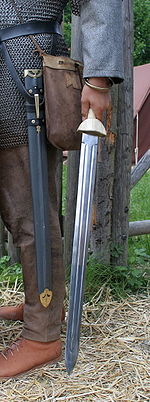
, measuring between 0.75 and 1 m (29.5 and 39.4 in), in use throughout first millennium AD Europe, and in the territory of the Roman Empire
Roman Empire
The Roman Empire was the post-Republican period of the ancient Roman civilization, characterised by an autocratic form of government and large territorial holdings in Europe and around the Mediterranean....
until about 600 AD. Later swords from 600 AD to 1000 AD are recognizable derivatives, though they are not spathae.
The spatha was used in gladiator
Gladiator
A gladiator was an armed combatant who entertained audiences in the Roman Republic and Roman Empire in violent confrontations with other gladiators, wild animals, and condemned criminals. Some gladiators were volunteers who risked their legal and social standing and their lives by appearing in the...
ial fights and in war. The spatha of literature appears in the Roman Empire
Roman Empire
The Roman Empire was the post-Republican period of the ancient Roman civilization, characterised by an autocratic form of government and large territorial holdings in Europe and around the Mediterranean....
in the first century AD as a weapon used by presumably Germanic auxiliaries and gradually became a standard heavy infantry
Heavy infantry
Heavy infantry refers to heavily armed and armoured ground troops, as opposed to medium or light infantry, in which the warriors are relatively lightly armoured. As modern infantry troops usually define their subgroups differently , 'heavy infantry' almost always is used to describe pre-gunpowder...
weapon, relegating the gladius
Gladius
Gladius was the Latin word for sword, and is used to represent the primary sword of Ancient Roman soldiers. Early ancient Roman swords were similar to those used by the Greeks. From the 3rd century BC, the Romans adopted swords similar to those used by the Celtiberians and others during the early...
to use as a light infantry weapon. The spatha apparently replaced the gladius in the front ranks, giving the infantry more reach when thrusting. While the infantry version had a long point, versions carried by the cavalry had a rounded tip that prevented accidental stabbing of the cavalryman's foot.
Archaeologically many instances of the spatha have been found in Britain and Germany. It was used extensively by Germanic warriors. It is unclear whether it came from the Pompeii gladius or the longer Celtic swords, or whether it served as a model for the various broadsword
Broadsword
Broadsword may refer to:*Broadsword , a military sword used by heavy cavalry during the 17th to early 19th centuriesIn more modern times, it has also been used to refer to:...
s and Viking sword
Viking sword
The Viking sword is a form of spatha, evolving out of the Migration Period sword in the 8th century, and evolving into the classical knightly sword in the 11th century with the emergence of larger crossguards...
s of Europe. The spatha remained popular throughout the Migration Period
Migration Period
The Migration Period, also called the Barbarian Invasions , was a period of intensified human migration in Europe that occurred from c. 400 to 800 CE. This period marked the transition from Late Antiquity to the Early Middle Ages...
. It may have evolved into the knightly sword of the High Middle Ages from about 1100 AD, but the large number of sword types that appeared during the period make it difficult to establish links. The details of their manufacture remain mostly unknown.
Etymology
The word comes from the LatinLatin
Latin is an Italic language originally spoken in Latium and Ancient Rome. It, along with most European languages, is a descendant of the ancient Proto-Indo-European language. Although it is considered a dead language, a number of scholars and members of the Christian clergy speak it fluently, and...
spatha, which derives from Greek
Greek language
Greek is an independent branch of the Indo-European family of languages. Native to the southern Balkans, it has the longest documented history of any Indo-European language, spanning 34 centuries of written records. Its writing system has been the Greek alphabet for the majority of its history;...
(spáthē), meaning "any broad blade, of wood or metal" but also "broad blade of a sword".
The Greek word was used in the middle Archaic period for various types of Iron Age sword
Iron Age sword
Swords made of iron appear from the Early Iron Age , but do not become widespread before the 8th century BC....
s. The word does not appear in Homeric Greek
Homeric Greek
Homeric Greek is the form of the Greek language that was used by Homer in the Iliad and Odyssey. It is an archaic version of Ionic Greek, with admixtures from certain other dialects, such as Aeolic Greek. It later served as the basis of Epic Greek, the language of epic poetry, typically in...
, but it is mentioned in the works of Alcaeus of Mytilene (sixth century BC) and Theophrastus
Theophrastus
Theophrastus , a Greek native of Eresos in Lesbos, was the successor to Aristotle in the Peripatetic school. He came to Athens at a young age, and initially studied in Plato's school. After Plato's death he attached himself to Aristotle. Aristotle bequeathed to Theophrastus his writings, and...
(fourth century BC).
It is likely that spatha is the romanization
Romanization
In linguistics, romanization or latinization is the representation of a written word or spoken speech with the Roman script, or a system for doing so, where the original word or language uses a different writing system . Methods of romanization include transliteration, for representing written...
of the Doric Greek
Doric Greek
Doric or Dorian was a dialect of ancient Greek. Its variants were spoken in the southern and eastern Peloponnese, Crete, Rhodes, some islands in the southern Aegean Sea, some cities on the coasts of Asia Minor, Southern Italy, Sicily, Epirus and Macedon. Together with Northwest Greek, it forms the...
*σπάθα (spáthā), considering the Doric acc. plural "σπάθας" (spáthās). The word survives in Modern Greek as and . The Latin word became the French épée, Catalan espasa, Portuguese and Spanish espada, Italian spada, Romanian spadă and Albanian shpata, all meaning "sword". The English word spatula comes from Latin spat(h)ula, the diminutive of spatha. English spade, from Old English spadu or spædu, is the Germanic cognate, derived from a Common Germanic *spadō, ultimately from a Proto-Indo-European
Proto-Indo-European
Proto-Indo-European may refer to:*Proto-Indo-European language, the hypothetical common ancestor of the Indo-European languages.*Proto-Indo-Europeans, the hypothetical speakers of the reconstructed Proto-Indo-European language....
stem *sph2-dh-.
Roman Empire
Roman army
The Roman army is the generic term for the terrestrial armed forces deployed by the kingdom of Rome , the Roman Republic , the Roman Empire and its successor, the Byzantine empire...
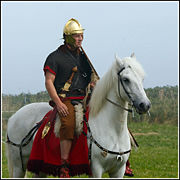
in the early imperial period
Roman Empire
The Roman Empire was the post-Republican period of the ancient Roman civilization, characterised by an autocratic form of government and large territorial holdings in Europe and around the Mediterranean....
by Celtic cavalry
Roman cavalry
Roman cavalry refers to the horse mounted forces of the Roman army through the many centuries of its existence.- Early cavalry Roman cavalry (Latin: equites Romani) refers to the horse mounted forces of the Roman army through the many centuries of its existence.- Early cavalry Roman cavalry...
auxiliaries who continued to wear their Celtic long swords, with blade lengths of 60 to 85 cm, in Roman service. The earlier gladius
Gladius
Gladius was the Latin word for sword, and is used to represent the primary sword of Ancient Roman soldiers. Early ancient Roman swords were similar to those used by the Greeks. From the 3rd century BC, the Romans adopted swords similar to those used by the Celtiberians and others during the early...
sword was gradually replaced by the spatha from the late second to the third century AD. From the early 3rd century AD, legionaries and cavalrymen began to wear their swords on the left side, perhaps because the scutum
Scutum (shield)
Scutum is the Latin word for "shield", although it has in modern times come to be specifically associated with the rectangular, semi-cylindrical body shield carried by Roman legionaries.-History:...
had been abandoned and the spatha had replaced the gladius.
Employed by both Roman cavalrymen and their German enemies, later Lombard
Lombards
The Lombards , also referred to as Longobards, were a Germanic tribe of Scandinavian origin, who from 568 to 774 ruled a Kingdom in Italy...
spathae were actually more advanced than the wrought iron
Wrought iron
thumb|The [[Eiffel tower]] is constructed from [[puddle iron]], a form of wrought ironWrought iron is an iron alloy with a very low carbon...
gladii, being constructed using a form of pattern welding
Pattern welding
Pattern welding is the practice in sword and knife making of forming a blade of several metal pieces of differing composition that are forge-welded together and twisted and manipulated to form a pattern. Often called Damascus steel, blades forged in this manner often display bands of slightly...
employing layers of iron and steel; in effect, a composite material
Composite material
Composite materials, often shortened to composites or called composition materials, are engineered or naturally occurring materials made from two or more constituent materials with significantly different physical or chemical properties which remain separate and distinct at the macroscopic or...
. Eventually under the later Roman Empire
Roman Empire
The Roman Empire was the post-Republican period of the ancient Roman civilization, characterised by an autocratic form of government and large territorial holdings in Europe and around the Mediterranean....
the spatha was adopted by many if not all legionaries.
In the imperial period, the Romans adopted the original Greek term, spathe (σπάθη), as spatha, which still carried the general meaning of any object considered long and flat. Spatha appears first in Pliny
Pliny the Elder
Gaius Plinius Secundus , better known as Pliny the Elder, was a Roman author, naturalist, and natural philosopher, as well as naval and army commander of the early Roman Empire, and personal friend of the emperor Vespasian...
and then Seneca
Seneca the Younger
Lucius Annaeus Seneca was a Roman Stoic philosopher, statesman, dramatist, and in one work humorist, of the Silver Age of Latin literature. He was tutor and later advisor to emperor Nero...
with different meanings: a spatula, a metal-working implement, a palm-leaf and so on. There is no hint of any native Roman sword called a spatha.
Referring to an actual sword, the term first appears in the pages of Tacitus with reference to an incident of the early empire. The British king Caractacus, having rebelled, found himself trapped on a rocky hill, so that if he turned one way he encountered the gladii of the legionaries, and if the other, the spathae of the auxiliaries. Left with no other way to turn, he escaped to the Brigantes
Brigantes
The Brigantes were a Celtic tribe who in pre-Roman times controlled the largest section of what would become Northern England, and a significant part of the Midlands. Their kingdom is sometimes called Brigantia, and it was centred in what was later known as Yorkshire...
, leaving his brothers to surrender the men. He was turned over to the Romans by the queen of the Brigantes, who was pardoned by the Senate after a moving plea for mercy, and reigned successfully once more as a Roman client king. Tacitus does not relate who the auxiliaries were. The Romans moved auxiliaries around the frontiers and also relied on local levies. Most examples of spathae come from Germany and east Europe, however. There is an excellent chance that the owners of the spathae were Germanic. There is no indication in Tacitus either that they were cavalry; overall, the Romans used both cavalry and infantry.
When the spathae next appeared, after a mysterious lacuna of about two centuries, they became the standard weapon of heavy infantry. The Romans could have borrowed this weapon from the auxiliaries, probably Germanic mercenaries, but the name does not support this origin. Spatha was certainly not a Germanic name, nor is there any indication anywhere what its Germanic name was. There are a plenitude of Germanic names, such as Old English sweord, bill, and so on, but no evidence to tie any name to the spatha, which was never used in Germanic languages as the name of a sword.
Roman Iron Age
The Roman Iron AgeRoman Iron Age
The Roman Iron Age is the name that Swedish archaeologist Oscar Montelius gave to a part of the Iron Age in Scandinavia, Northern Germany and the Netherlands....
refers approximately to the time of the Roman Empire
Roman Empire
The Roman Empire was the post-Republican period of the ancient Roman civilization, characterised by an autocratic form of government and large territorial holdings in Europe and around the Mediterranean....
in north Europe, which was outside the jurisdiction of the empire, but, judging from the imported Roman artifacts, was influenced by Roman civilization. One source of artifacts from this period are the bogs of Schleswig
Schleswig
Schleswig or South Jutland is a region covering the area about 60 km north and 70 km south of the border between Germany and Denmark; the territory has been divided between the two countries since 1920, with Northern Schleswig in Denmark and Southern Schleswig in Germany...
, Holstein
Holstein
Holstein is the region between the rivers Elbe and Eider. It is part of Schleswig-Holstein, the northernmost state of Germany....
and Denmark
Denmark
Denmark is a Scandinavian country in Northern Europe. The countries of Denmark and Greenland, as well as the Faroe Islands, constitute the Kingdom of Denmark . It is the southernmost of the Nordic countries, southwest of Sweden and south of Norway, and bordered to the south by Germany. Denmark...
. Objects were deliberately broken and thrown into the bog so that they could go with a deceased chief on his voyage to a better place.
- A cache of 90 swords was found at Nydam MoseNydam MoseNydam Mose is an archaeological site located at Øster Sottrup, a town located in Sundeved, eight kilometres from Sønderborg, Denmark.-History:...
in Denmark in 1858. They were in the form of the spatha and therefore have been classified as "Roman swords". They are dated between 200 AD – 400 AD. Many connect the Nydam cache with the sword of BeowulfBeowulfBeowulf , but modern scholars agree in naming it after the hero whose life is its subject." of an Old English heroic epic poem consisting of 3182 alliterative long lines, set in Scandinavia, commonly cited as one of the most important works of Anglo-Saxon literature.It survives in a single...
, who was supposed to be a contemporary.
Migration period
Germanic Iron Age
The Germanic Iron Age is the name given to the period 400–800 in Northern Europe and it is part of the continental Age of Migrations.-Germanic Iron :...
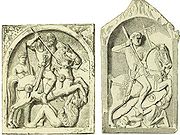
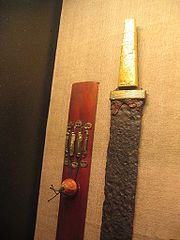
swords had blades measuring between 710 and 810 mm (28 and 31.9 in) in length and 43 to 61 mm (1.7 to 2.4 in) in width. These single handed weapons of war sported a tang
Tang (weaponry)
A tang or shank is the back portion of a tool where it extends into stock material or is connected to a handle as on a knife, sword, spear, arrowhead, chisel, screwdriver, etc...
only some 100 to 130 mm (3.9 to 5.1 in) long and had very little taper in their blades. They usually ended in a rounded tip.
Viking Age
Perhaps the most distant recognizable cousins to the spatha were the Viking AgeViking Age
Viking Age is the term for the period in European history, especially Northern European and Scandinavian history, spanning the late 8th to 11th centuries. Scandinavian Vikings explored Europe by its oceans and rivers through trade and warfare. The Vikings also reached Iceland, Greenland,...
blades. These swords took on a much more acute distal taper and point. These blades had deep fullers
Fuller (weapon)
A fuller is a rounded or beveled groove or slot in the flat side of a blade . A fuller is often used to lighten the blade, much in the way that an I-beam shape allows a given amount of strength to be achieved with less material...
running their length, yet still had single-handed hilt
Hilt
The hilt of a sword is its handle, consisting of a guard,grip and pommel. The guard may contain a crossguard or quillons. A ricasso may also be present, but this is rarely the case...
s which sported a unique shaped pommel
Pommel
Pommel may refer to:* pommel, the raised area at the front of an equestrian saddle.* Pommel, the counterweight at the end of the hilt of a European sword* Pommel horse, an artistic gymnastics apparatus...
, flat at the grip side and roughly triangular early on, with the flat curving to fit the hand later. While the pattern of hilt and blade design of this type might readily be called "the Viking sword", to do so would be to neglect the widespread popularity it enjoyed. All over continental Europe
Europe
Europe is, by convention, one of the world's seven continents. Comprising the westernmost peninsula of Eurasia, Europe is generally 'divided' from Asia to its east by the watershed divides of the Ural and Caucasus Mountains, the Ural River, the Caspian and Black Seas, and the waterways connecting...
between 700 AD and 1000 AD, this design and its variations could be found. Many of the best blades were of Frankish origin, hilted in local centres. These blades had significantly better balance. Many Saxon-era blades were largely ceremonial, due to the low grade of iron and the tip-heavy balance. Viking-era blades were refined weapons.
During Norman times the blades increased some 100 millimetres (3.9 in) in overall length, and the hilt changed significantly. Instead of the Brazil-nut pommel, a thick disc-shaped pommel was attached "on-edge" to the bottom of the iron hilt. In addition the upper guard grew substantially from the near-absent design predating it. Also the blades tended to taper slightly less than those found in the time of the Vikings.
Due to the combined Greek and Roman tradition of its military, or perhaps through the Varangian Guard
Varangian Guard
The Varangian Guard was an elite unit of the Byzantine Army in 10th to the 14th centuries, whose members served as personal bodyguards of the Byzantine Emperors....
's presence in Constantinople, the spatha had a place within the Byzantine Empire
Byzantine Empire
The Byzantine Empire was the Eastern Roman Empire during the periods of Late Antiquity and the Middle Ages, centred on the capital of Constantinople. Known simply as the Roman Empire or Romania to its inhabitants and neighbours, the Empire was the direct continuation of the Ancient Roman State...
and its army
Byzantine army
The Byzantine army was the primary military body of the Byzantine armed forces, serving alongside the Byzantine navy. A direct descendant of the Roman army, the Byzantine army maintained a similar level of discipline, strategic prowess and organization...
. In the Byzantine court, spatharios (σπαθάριος), or "bearer of the spatha", was a mid-level court title
Byzantine aristocracy and bureaucracy
The Byzantine Empire had a complex system of aristocracy and bureaucracy, which was inherited from the Roman Empire. At the apex of the pyramid stood the Emperor, sole ruler and divinely ordained, but beneath him a multitude of officials and court functionaries operated the administrative...
. Other variants deriving from it were protospatharios
Protospatharios
Prōtospatharios was one of the highest court dignities of the middle Byzantine period , awarded to senior generals and provincial governors, as well as to foreign princes.-History:...
, spatharokandidatos and spatharokoubikoularios, the latter reserved for eunuchs. One of the more famous spatharokandidatoi was Harald Hardrada.
Jan Petersen
Jan Petersen (historian)
Dr Jan Petersen was a Norwegian historian notable for writing De Norske Vikingsverd in 1919...
in De Norske Vikingsverd ("The Norwegian Viking Swords", 1919) introduced the most widely-used classification of swords of the Viking Age, discriminating twenty-six types labelled A – Z. In 1927 R. E. M. Wheeler condensed Petersen's typology into a simplified typology of nine groups, numbered I – IX.
Norman swords
The transition from the Viking age spatha to the High MedievalHigh Middle Ages
The High Middle Ages was the period of European history around the 11th, 12th, and 13th centuries . The High Middle Ages were preceded by the Early Middle Ages and followed by the Late Middle Ages, which by convention end around 1500....
arming sword
Arming sword
The arming sword is the single handed cruciform sword of the High Middle Ages, in common use between ca. 1000 and 1500, possibly remaining in rare use into the 16th century...
took place between the 10th and 11th centuries. The main development was the growth of the front handguard into a full cross-guard, and the reduction of the typical Viking-era lobated pommel
Pommel
Pommel may refer to:* pommel, the raised area at the front of an equestrian saddle.* Pommel, the counterweight at the end of the hilt of a European sword* Pommel horse, an artistic gymnastics apparatus...
into simpler hazelnut or disc shapes. The sword of Otto I preserved in Essen
Essen
- Origin of the name :In German-speaking countries, the name of the city Essen often causes confusion as to its origins, because it is commonly known as the German infinitive of the verb for the act of eating, and/or the German noun for food. Although scholars still dispute the interpretation of...
is such an example of the emerging arming sword, although it has been encrusted with decorations during the centuries it was conserved as a relic (total length 95.5 cm).
See also
- GladiusGladiusGladius was the Latin word for sword, and is used to represent the primary sword of Ancient Roman soldiers. Early ancient Roman swords were similar to those used by the Greeks. From the 3rd century BC, the Romans adopted swords similar to those used by the Celtiberians and others during the early...
- PugioPugioThe pugio was a dagger used by Roman soldiers as a sidearm. It seems likely that the pugio was intended as an auxiliary weapon, but its exact purpose to the soldier remains unknown for sure...
- Roman military personal equipment
- Viking Age arms and armourViking Age arms and armourKnowledge about arms and armour of the Viking Age is based on relatively sparse archaeological finds, pictorial representation, and to some extent on the accounts in the Norse sagas and Norse laws recorded in the thirteenth century.According to custom, all free Norse men were required to own...
External links
- THE NORWEGIAN VIKING SWORDS by JAN PETERSEN (1919) translated by Kristin Noer (1998)
- A RECORD OF EUROPEAN ARMOUR AND ARMS THROUGH SEVEN CENTURIES by Sir Guy Francis Laking (1919)
- Anatomy of the Sword (myArmoury.com article)
- A Sword from the Late Viking Age from the Higgins Museum (myArmoury.com article)
- VikingSword.com
- Sword Forum International