

Kukri

Encyclopedia
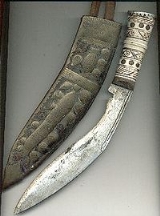
The kukri (originally spelled khukri or khukuri) is a curved Nepalese Knife, similar to the machete
, used as both a tool and as a weapon. It is a traditional weapon for Nepalese people, and also a weapon of choice/side arm for all Nepalese including those serving in different armies around the world.
The cutting edge
is inwardly curved in shape and is the icon of Nepal
. It was, and in many cases still is, the basic and traditional utility knife of the Nepalese people. Very effective when used as a weapon, it is a symbolic weapon of the Nepalese Army, and of all Gurkha
regiments throughout the world, signifying the courage and valor of the bearer in the battlefield. It is a part of the regimental weaponry and heraldry
of the Royal Gurkha Rifles
, and is used in many traditional rituals among different ethnic groups of Nepal, including one where the groom has to wear it during the wedding ceremony. It is known to many people as simply the "Gurkha blade" or "Gurkha knife".
The pronunciation "Kukri" is of western origin, the Nepalese people to whom this weapon belongs pronounce it as "Khukuri."
. The kukri also has a religious significance in the Nepalese form of the Hindu
religion. During the annual Dashain festival
, kukris are ceremonially blessed.
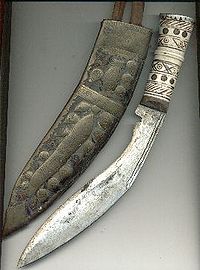 While most famed from use in the military, the kukri is most commonly used as a multipurpose tool, and is a very common agricultural and household implement in Nepal. Its use has varied from building, clearing, chopping firewood, and digging to cutting meat and vegetables, skinning animals, and opening tins.
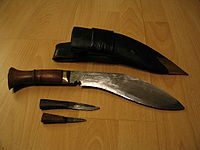 The Kukri is designed primarily for chopping. The shape varies a great deal from being quite straight to highly curved with angled or smooth spines. There are substantial variations in dimensions and blade thickness depending on intended tasks as well as the region of origin and Kami
that produced it. As a general guide the spines vary from 5–10 mm at the handle, and can taper to 2 mm by the point while the blade lengths can vary from 26–38 cm for general use.
A Kukri designed for general purpose is commonly 40–45 cm (16–18 in) in overall length and weighs approximately 450–900 gram
s (1–2 lbs). Bigger examples are impractical for everyday use and are rarely found except in collections or as ceremonial weapons. Smaller ones are of more limited utility, but very easy to carry.
Another factor that affects its weight and balance is the construction of the blade. To reduce weight while keeping strength the blade might be hollow forged, or a fuller
is created. Kukris are made with several different types of fuller including: tin chira (triple fuller), dui chira (double fuller), angkhola (single fuller), or basic non-tapered spines with a large beveled edge.
Kukri blades usually have a notch (kauda, kaudi, kaura, or cho) at the base of the blade. Various reasons are given for this, both practical and ceremonial: that it makes blood and sap drop off the blade rather than running onto the handle; that it delineates the end of the blade whilst sharpening; that it is a symbol representing a cow foot, or Shiva
(Brigade of Gurkhas). The notch which also signifies teats of cow have another very strong implication. You may kill, cut or chop any animal by a khukuri but never a cow which is revered and worshipped as goddess by all Nepalese.
Handles are most often made of hardwood
or water buffalo
horn, but ivory
, bone, and metal handles are also used. The handle quite often has a flared butt that allows better retention in draw cuts and chopping. Most handles have metal bolsters and butt plates which are generally made of brass
or steel.
The traditional handle attachment in Nepal is the partial tang
, although these days the stick tang is more popular. The full tang was mainly used on some military models, but has not caught on in Nepal itself.
The Kukri typically comes in either a decorated wooden scabbard or a leather wrapped scabbard. The scabbard usually holds a karda (auxiliary knife) and a chakmak (steel-flint
striker) in addition. On many village Kukris and some older military Kukris, the scabbard also has a tinder pouch.
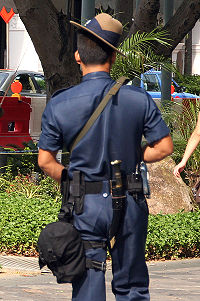 Traditionally the Kami
and Biswakarma are the masters of inherited Kukri making art.
The Kukri blade is forged from steel
. Modern Kukri blades are often forged from leaf spring
s collected from recycled truck
suspensions
. The tang
of the blade usually extends all the way through to the end of the handle; the small portion of the tang that projects through the end of the handle is hammered flat to secure the blade. A Kukri blade has a hard, tempered edge and a softer spine. This enables it to maintain a sharp edge, yet tolerate impacts. They are also balanced so that they will rest in a vertical position if supported on a fulcrum, such as a finger.
Traditional Kukris usually have handles made from hardwood or water buffalo horn. These handles are often fastened with a kind of tree sap called laha (also known as "Himalayan epoxy"). With a wood or horn handle, the tang may be heated and burned into the handle to ensure a tight fit, since only the section of handle which touches the blade is burned away. In more modern Kukris, handles of cast aluminum or brass
are press-fitted to the tang; as the hot metal cools it shrinks and hardens, locking onto the blade. Some Kukris (such as the ones made by contractors for the modern Indian Army) have a very wide tang with handle slabs fastened on by two or more rivets, commonly called a full tang (panawal) configuration.
Traditional profiling of the blade edge is performed by a two-man team; one man spins a grinding wheel forwards and backwards by means of a rope wound several times around an axle, while the sharpener applies the blade. The wheel is made by hand from fine river sand bound by laha, the same adhesive used to the affix the handle to the blade. Routine sharpening is traditionally accomplished by passing a chakmak (smaller, harder, unsharpened blade) over the edge in a manner similar to that used by Western chefs to steel
their knives.
Khukuri sheaths are usually made of wood with a goatskin covering. The leatherwork is usually done by a sarki
. Traditionally, the scabbard also holds two smaller tools called the karda and the chakmak. The karda is a small accessory blade used for many tasks. The chakmak is unsharpened and is used to burnish
the blade. It can also be used to start a fire with flint
. Attached to older style scabbards there is sometimes a pouch for carrying flint or dry tinder.
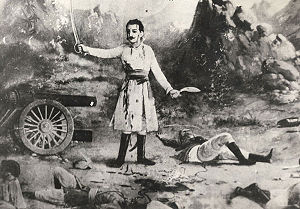 It is a matter of debate whether the design came into Nepal from another country or who promoted it first. It may be indigenous to the Indian region, but similar designs were used in ancient Egypt
, Iberia
, and Greece
.
One weapon of Iberian origin, the falcata
, shows some similarity with the kukri, and the Greeks used similar weapons called the machaira
and kopis
. Alexander the Great's men used weapons of this type and may have spread it into India when Alexander moved into the Punjab
.
The Greek kings in Afghanistan
and India in later centuries who had relation with Mediterranean culture seem to have used tools similar to kukri, and possibly were promoters of it.
It is not documented if the Aryan
s had similar tools at that time.
Eurasian steppe
people, the Turks
, used a type of forward-curving sword called a yataghan between the mid-16th to late 19th centuries and looked similar to kukri.
The oldest known kukris are in the National Museum (Kathmandu) in Nepal, and belonged to Drabya Shah circa 1559. The kukri came to be known to the Western world when the East India Company
came into conflict with the growing Gurkha Empire, culminating in the Gurkha War
of 1814–1816.
All Gurkha troops are issued the kukri, and in modern times in the Brigade of Gurkhas
, they receive training in its use. The kukri gained fame in the Gurkha War for its effectiveness. Its continued use through both World War I
and World War II
enhanced its reputation among both Allied troops and enemy forces. During the Second World War, the kukri was purchased and used by other British, Commonwealth, and U.S. troops training in India, including the Chindits
and Merrill's Marauders
. It was also standard issue for Canadian scouts
and sniper
s in North-West Europe. The reputation of the Gurkha with his kukri carried on through Falklands War
.
On September 2, 2010, Mr. Bishnu Shrestha
, alone and armed only with a kukri, defeated 30 bandits who attacked a passenger train he was on in India, killing three bandits, wounding eight more and forcing the rest of the band to flee.
Machete
The machete is a large cleaver-like cutting tool. The blade is typically long and usually under thick. In the English language, an equivalent term is matchet, though it is less commonly known...
, used as both a tool and as a weapon. It is a traditional weapon for Nepalese people, and also a weapon of choice/side arm for all Nepalese including those serving in different armies around the world.
The cutting edge
Blade
A blade is that portion of a tool, weapon, or machine with a cutting edge and/or a pointed tip that is designed to cut and/or puncture, stab, slash, chop, slice, thrust, or scrape animate or inanimate surfaces or materials...
is inwardly curved in shape and is the icon of Nepal
Nepal
Nepal , officially the Federal Democratic Republic of Nepal, is a landlocked sovereign state located in South Asia. It is located in the Himalayas and bordered to the north by the People's Republic of China, and to the south, east, and west by the Republic of India...
. It was, and in many cases still is, the basic and traditional utility knife of the Nepalese people. Very effective when used as a weapon, it is a symbolic weapon of the Nepalese Army, and of all Gurkha
Gurkha
Gurkha are people from Nepal who take their name from the Gorkha District. Gurkhas are best known for their history in the Indian Army's Gorkha regiments, the British Army's Brigade of Gurkhas and the Nepalese Army. Gurkha units are closely associated with the kukri, a forward-curving Nepalese knife...
regiments throughout the world, signifying the courage and valor of the bearer in the battlefield. It is a part of the regimental weaponry and heraldry
Heraldry
Heraldry is the profession, study, or art of creating, granting, and blazoning arms and ruling on questions of rank or protocol, as exercised by an officer of arms. Heraldry comes from Anglo-Norman herald, from the Germanic compound harja-waldaz, "army commander"...
of the Royal Gurkha Rifles
Royal Gurkha Rifles
The Royal Gurkha Rifles is a regiment of the British Army, forming part of the Brigade of Gurkhas. The Royal Gurkha Rifles are now the sole infantry regiment of the British Army Gurkhas...
, and is used in many traditional rituals among different ethnic groups of Nepal, including one where the groom has to wear it during the wedding ceremony. It is known to many people as simply the "Gurkha blade" or "Gurkha knife".
The pronunciation "Kukri" is of western origin, the Nepalese people to whom this weapon belongs pronounce it as "Khukuri."
Uses
The blade's distinctive forward drop is intended to act as a weight on the end of the blade and make the kukri fall on the target faster and with more power. Although a popular legend states that a Gurkha "never sheathes his blade without first drawing blood" (this is said to be what the small, sharp notch on the blade near the handle is for: in case you wanted to draw your kukri for a non-militant purpose, and needed to draw blood before sheathing your knife. You could scrape your thumb on the notch, draw blood, and sheathe your knife without breaking tradition), the kukri is most commonly employed as a multi-use utility tool rather like a macheteMachete
The machete is a large cleaver-like cutting tool. The blade is typically long and usually under thick. In the English language, an equivalent term is matchet, though it is less commonly known...
. The kukri also has a religious significance in the Nepalese form of the Hindu
Hindu
Hindu refers to an identity associated with the philosophical, religious and cultural systems that are indigenous to the Indian subcontinent. As used in the Constitution of India, the word "Hindu" is also attributed to all persons professing any Indian religion...
religion. During the annual Dashain festival
Religious festival
A religious festival is a time of special importance marked by adherents to that religion. Religious festivals are commonly celebrated on recurring cycles in a calendar year or lunar calendar...
, kukris are ceremonially blessed.
Weaponry
The kukri is effective as both a chopping and a slashing weapon. In combat, it is basically used in three different styles: stabbing with the point, slashing or chopping with the edge, and (rarely) throwing. Because the blade bends towards the opponent, the user need not angle the wrist, which makes the kukri more comfortable as a stabbing weapon than other straight-bladed knives. Its heavy blade enables the user to inflict deep wounds and to cut through muscle and bone.Utility
Design
Kami (caste)
Kami is a community from Nepal which belongs to the Indo-Aryan ethnic group. Kamis are essentially blacksmiths who are scattered in almost all hilly districts of Nepal. They are the makers of famous Kukri knives which are used by the Gurkha Army...
that produced it. As a general guide the spines vary from 5–10 mm at the handle, and can taper to 2 mm by the point while the blade lengths can vary from 26–38 cm for general use.
A Kukri designed for general purpose is commonly 40–45 cm (16–18 in) in overall length and weighs approximately 450–900 gram
Gram
The gram is a metric system unit of mass....
s (1–2 lbs). Bigger examples are impractical for everyday use and are rarely found except in collections or as ceremonial weapons. Smaller ones are of more limited utility, but very easy to carry.
Another factor that affects its weight and balance is the construction of the blade. To reduce weight while keeping strength the blade might be hollow forged, or a fuller
Fuller (weapon)
A fuller is a rounded or beveled groove or slot in the flat side of a blade . A fuller is often used to lighten the blade, much in the way that an I-beam shape allows a given amount of strength to be achieved with less material...
is created. Kukris are made with several different types of fuller including: tin chira (triple fuller), dui chira (double fuller), angkhola (single fuller), or basic non-tapered spines with a large beveled edge.
Kukri blades usually have a notch (kauda, kaudi, kaura, or cho) at the base of the blade. Various reasons are given for this, both practical and ceremonial: that it makes blood and sap drop off the blade rather than running onto the handle; that it delineates the end of the blade whilst sharpening; that it is a symbol representing a cow foot, or Shiva
Shiva
Shiva is a major Hindu deity, and is the destroyer god or transformer among the Trimurti, the Hindu Trinity of the primary aspects of the divine. God Shiva is a yogi who has notice of everything that happens in the world and is the main aspect of life. Yet one with great power lives a life of a...
(Brigade of Gurkhas). The notch which also signifies teats of cow have another very strong implication. You may kill, cut or chop any animal by a khukuri but never a cow which is revered and worshipped as goddess by all Nepalese.
Handles are most often made of hardwood
Hardwood
Hardwood is wood from angiosperm trees . It may also be used for those trees themselves: these are usually broad-leaved; in temperate and boreal latitudes they are mostly deciduous, but in tropics and subtropics mostly evergreen.Hardwood contrasts with softwood...
or water buffalo
Water buffalo
The water buffalo is a domesticated bovid widely kept in Asia, Europe and South America.Water buffalo can also refer to:*Wild water buffalo , the wild ancestor of the domestic water buffalo...
horn, but ivory
Ivory
Ivory is a term for dentine, which constitutes the bulk of the teeth and tusks of animals, when used as a material for art or manufacturing. Ivory has been important since ancient times for making a range of items, from ivory carvings to false teeth, fans, dominoes, joint tubes, piano keys and...
, bone, and metal handles are also used. The handle quite often has a flared butt that allows better retention in draw cuts and chopping. Most handles have metal bolsters and butt plates which are generally made of brass
Brass
Brass is an alloy of copper and zinc; the proportions of zinc and copper can be varied to create a range of brasses with varying properties.In comparison, bronze is principally an alloy of copper and tin...
or steel.
The traditional handle attachment in Nepal is the partial tang
Tang (weaponry)
A tang or shank is the back portion of a tool where it extends into stock material or is connected to a handle as on a knife, sword, spear, arrowhead, chisel, screwdriver, etc...
, although these days the stick tang is more popular. The full tang was mainly used on some military models, but has not caught on in Nepal itself.
The Kukri typically comes in either a decorated wooden scabbard or a leather wrapped scabbard. The scabbard usually holds a karda (auxiliary knife) and a chakmak (steel-flint
Flint
Flint is a hard, sedimentary cryptocrystalline form of the mineral quartz, categorized as a variety of chert. It occurs chiefly as nodules and masses in sedimentary rocks, such as chalks and limestones. Inside the nodule, flint is usually dark grey, black, green, white, or brown in colour, and...
striker) in addition. On many village Kukris and some older military Kukris, the scabbard also has a tinder pouch.
Manufacture
Kami (caste)
Kami is a community from Nepal which belongs to the Indo-Aryan ethnic group. Kamis are essentially blacksmiths who are scattered in almost all hilly districts of Nepal. They are the makers of famous Kukri knives which are used by the Gurkha Army...
and Biswakarma are the masters of inherited Kukri making art.
The Kukri blade is forged from steel
Steel
Steel is an alloy that consists mostly of iron and has a carbon content between 0.2% and 2.1% by weight, depending on the grade. Carbon is the most common alloying material for iron, but various other alloying elements are used, such as manganese, chromium, vanadium, and tungsten...
. Modern Kukri blades are often forged from leaf spring
Leaf spring
Originally called laminated or carriage spring, a leaf spring is a simple form of spring, commonly used for the suspension in wheeled vehicles...
s collected from recycled truck
Truck
A truck or lorry is a motor vehicle designed to transport cargo. Trucks vary greatly in size, power, and configuration, with the smallest being mechanically similar to an automobile...
suspensions
Suspension (vehicle)
Suspension is the term given to the system of springs, shock absorbers and linkages that connects a vehicle to its wheels. Suspension systems serve a dual purpose — contributing to the car's roadholding/handling and braking for good active safety and driving pleasure, and keeping vehicle occupants...
. The tang
Tang (weaponry)
A tang or shank is the back portion of a tool where it extends into stock material or is connected to a handle as on a knife, sword, spear, arrowhead, chisel, screwdriver, etc...
of the blade usually extends all the way through to the end of the handle; the small portion of the tang that projects through the end of the handle is hammered flat to secure the blade. A Kukri blade has a hard, tempered edge and a softer spine. This enables it to maintain a sharp edge, yet tolerate impacts. They are also balanced so that they will rest in a vertical position if supported on a fulcrum, such as a finger.
Traditional Kukris usually have handles made from hardwood or water buffalo horn. These handles are often fastened with a kind of tree sap called laha (also known as "Himalayan epoxy"). With a wood or horn handle, the tang may be heated and burned into the handle to ensure a tight fit, since only the section of handle which touches the blade is burned away. In more modern Kukris, handles of cast aluminum or brass
Brass
Brass is an alloy of copper and zinc; the proportions of zinc and copper can be varied to create a range of brasses with varying properties.In comparison, bronze is principally an alloy of copper and tin...
are press-fitted to the tang; as the hot metal cools it shrinks and hardens, locking onto the blade. Some Kukris (such as the ones made by contractors for the modern Indian Army) have a very wide tang with handle slabs fastened on by two or more rivets, commonly called a full tang (panawal) configuration.
Traditional profiling of the blade edge is performed by a two-man team; one man spins a grinding wheel forwards and backwards by means of a rope wound several times around an axle, while the sharpener applies the blade. The wheel is made by hand from fine river sand bound by laha, the same adhesive used to the affix the handle to the blade. Routine sharpening is traditionally accomplished by passing a chakmak (smaller, harder, unsharpened blade) over the edge in a manner similar to that used by Western chefs to steel
Sharpening steel
A honing steel, sometimes referred to as sharpening steel, sharpening stick, sharpening rod, butcher's steel, and chef's steel is a rod of steel, ceramic or diamond coated steel used to hone or sharpen blade edges. They are flat, oval, or round in cross-section and up to one foot long...
their knives.
Khukuri sheaths are usually made of wood with a goatskin covering. The leatherwork is usually done by a sarki
Sarki
Sarki may refer to*Sarki, a well-dwelling snake slain by the mythological prince Bayajidda*Şarkı, a vocal genre in Ottoman classical music*Sarki, a Newcastle rock band made up of members; Shane Kurnia on guitar, Scott Allen on drums, Dom Willson on bass and Matty Munro of vocals*Sirki, a Sindhi...
. Traditionally, the scabbard also holds two smaller tools called the karda and the chakmak. The karda is a small accessory blade used for many tasks. The chakmak is unsharpened and is used to burnish
Burnishing (metalworking)
Burnishing is the plastic deformation of a surface due to sliding contact with another object. Visually, burnishing smears the texture of a rough surface and makes it shinier...
the blade. It can also be used to start a fire with flint
Flint
Flint is a hard, sedimentary cryptocrystalline form of the mineral quartz, categorized as a variety of chert. It occurs chiefly as nodules and masses in sedimentary rocks, such as chalks and limestones. Inside the nodule, flint is usually dark grey, black, green, white, or brown in colour, and...
. Attached to older style scabbards there is sometimes a pouch for carrying flint or dry tinder.
Classification
Kukris can be broadly classified into two types: Eastern and Western. The Eastern blades are usually regarded as the thinner and are often referred to as Sirupate (Siru Leaf). Western blades are generally more broad. Occasionally the Western style is called Budhuna (refers to a fish with a large head) or Baspate (Bamboo leaf) which refers to blades just outside of the normal Sirupate blade. Despite the classification of Eastern and Western, both styles of kukri appear to be used in all areas of Nepal.History
Ancient Egypt
Ancient Egypt was an ancient civilization of Northeastern Africa, concentrated along the lower reaches of the Nile River in what is now the modern country of Egypt. Egyptian civilization coalesced around 3150 BC with the political unification of Upper and Lower Egypt under the first pharaoh...
, Iberia
Iberians
The Iberians were a set of peoples that Greek and Roman sources identified with that name in the eastern and southern coasts of the Iberian peninsula at least from the 6th century BC...
, and Greece
Ancient Greece
Ancient Greece is a civilization belonging to a period of Greek history that lasted from the Archaic period of the 8th to 6th centuries BC to the end of antiquity. Immediately following this period was the beginning of the Early Middle Ages and the Byzantine era. Included in Ancient Greece is the...
.
One weapon of Iberian origin, the falcata
Falcata
The falcata is a type of sword typical of the pre-Roman Iberian Peninsula , similar to Greek kopis or Nepalese kukri.-Name:...
, shows some similarity with the kukri, and the Greeks used similar weapons called the machaira
Makhaira
Makhaira is a term used by modern scholars to describe a type of ancient bladed weapon, generally a large knife with a slight backwards curve...
and kopis
Kopis
The kopis was a sword with a forward-curving blade, primarily used as a tool for cutting meat, for slaughter and animal sacrifice, but also as a weapon....
. Alexander the Great's men used weapons of this type and may have spread it into India when Alexander moved into the Punjab
Punjab region
The Punjab , also spelled Panjab |water]]s"), is a geographical region straddling the border between Pakistan and India which includes Punjab province in Pakistan and the states of the Punjab, Haryana, Himachal Pradesh, Chandigarh and some northern parts of the National Capital Territory of Delhi...
.
The Greek kings in Afghanistan
Afghanistan
Afghanistan , officially the Islamic Republic of Afghanistan, is a landlocked country located in the centre of Asia, forming South Asia, Central Asia and the Middle East. With a population of about 29 million, it has an area of , making it the 42nd most populous and 41st largest nation in the world...
and India in later centuries who had relation with Mediterranean culture seem to have used tools similar to kukri, and possibly were promoters of it.
It is not documented if the Aryan
Aryan
Aryan is an English language loanword derived from Sanskrit ārya and denoting variously*In scholarly usage:**Indo-Iranian languages *in dated usage:**the Indo-European languages more generally and their speakers...
s had similar tools at that time.
Eurasian steppe
Steppe
In physical geography, steppe is an ecoregion, in the montane grasslands and shrublands and temperate grasslands, savannas, and shrublands biomes, characterized by grassland plains without trees apart from those near rivers and lakes...
people, the Turks
Turkish people
Turkish people, also known as the "Turks" , are an ethnic group primarily living in Turkey and in the former lands of the Ottoman Empire where Turkish minorities had been established in Bulgaria, Cyprus, Bosnia and Herzegovina, Georgia, Greece, Kosovo, Macedonia, and Romania...
, used a type of forward-curving sword called a yataghan between the mid-16th to late 19th centuries and looked similar to kukri.
The oldest known kukris are in the National Museum (Kathmandu) in Nepal, and belonged to Drabya Shah circa 1559. The kukri came to be known to the Western world when the East India Company
East India Company
The East India Company was an early English joint-stock company that was formed initially for pursuing trade with the East Indies, but that ended up trading mainly with the Indian subcontinent and China...
came into conflict with the growing Gurkha Empire, culminating in the Gurkha War
Gurkha War
The Gurkha War , sometimes called the Gorkha War or the Anglo–Nepalese War, was fought between the Kingdom of Nepal and the British East India Company as a result of border tensions and ambitious expansionism...
of 1814–1816.
All Gurkha troops are issued the kukri, and in modern times in the Brigade of Gurkhas
Brigade of Gurkhas
The Brigade of Gurkhas is the collective term for units of the current British Army that are composed of Nepalese soldiers. The brigade, which is 3,640 strong, draws its heritage from Gurkha units that originally served in the British Indian Army prior to Indian independence, and prior to that of...
, they receive training in its use. The kukri gained fame in the Gurkha War for its effectiveness. Its continued use through both World War I
World War I
World War I , which was predominantly called the World War or the Great War from its occurrence until 1939, and the First World War or World War I thereafter, was a major war centred in Europe that began on 28 July 1914 and lasted until 11 November 1918...
and World War II
World War II
World War II, or the Second World War , was a global conflict lasting from 1939 to 1945, involving most of the world's nations—including all of the great powers—eventually forming two opposing military alliances: the Allies and the Axis...
enhanced its reputation among both Allied troops and enemy forces. During the Second World War, the kukri was purchased and used by other British, Commonwealth, and U.S. troops training in India, including the Chindits
Chindits
The Chindits were a British India "Special Force" that served in Burma and India in 1943 and 1944 during the Burma Campaign in World War II. They were formed into long range penetration groups trained to operate deep behind Japanese lines...
and Merrill's Marauders
Merrill's Marauders
Merrill’s Marauders or Unit Galahad, officially named the 5307th Composite Unit , was a United States Army long range penetration special operations unit in the South-East Asian Theater of World War II which fought in the China-Burma-India Theater of Operations, or CBI...
. It was also standard issue for Canadian scouts
Reconnaissance
Reconnaissance is the military term for exploring beyond the area occupied by friendly forces to gain information about enemy forces or features of the environment....
and sniper
Sniper
A sniper is a marksman who shoots targets from concealed positions or distances exceeding the capabilities of regular personnel. Snipers typically have specialized training and distinct high-precision rifles....
s in North-West Europe. The reputation of the Gurkha with his kukri carried on through Falklands War
Falklands War
The Falklands War , also called the Falklands Conflict or Falklands Crisis, was fought in 1982 between Argentina and the United Kingdom over the disputed Falkland Islands and South Georgia and the South Sandwich Islands...
.
On September 2, 2010, Mr. Bishnu Shrestha
Bishnu Shrestha
Bishnu Shrestha is a Gurkha soldier in the Indian army s recipient of the Sourya Chakra, Bravery Award, and Sarvottam Jeevan Raksha medals. He earned these medals on September 2, 2010, when 40 armed robbers attacked the train he was in, robbed the passengers of their easily portable valuables , and...
, alone and armed only with a kukri, defeated 30 bandits who attacked a passenger train he was on in India, killing three bandits, wounding eight more and forcing the rest of the band to flee.
Modern Culture
- In Halo: Reach, Emile A239's signature weapon is a kukri knife, carried in a shoulder harness sheath.
- In Resident Evil Extinction, Alice carried two Kukri knives.
- A Kukri is the default melee weapon of the Sniper, from Team Fortress 2Team Fortress 2Team Fortress 2 is a free-to-play team-based first-person shooter multiplayer video game developed by Valve Corporation. A sequel to the original mod Team Fortress based on the Quake engine, it was first released as part of the video game compilation The Orange Box on October 10, 2007 for Windows...
.
- In DraculaDraculaDracula is an 1897 novel by Irish author Bram Stoker.Famous for introducing the character of the vampire Count Dracula, the novel tells the story of Dracula's attempt to relocate from Transylvania to England, and the battle between Dracula and a small group of men and women led by Professor...
, an 1897 novel by Irish author Bram StokerBram StokerAbraham "Bram" Stoker was an Irish novelist and short story writer, best known today for his 1897 Gothic novel Dracula...
, the final section of the novel details the heroes racing Dracula back to Transylvania, and in a climactic battle with Dracula's gypsy bodyguards, finally destroying him. Despite the popular image of Dracula having a stake driven through his heart, Mina's narrative describes his throat being sliced through by Jonathan Harker's kukri and his heart pierced by Morris' Bowie knife.
- The player may receive a kukri in the zombie survival game Dead IslandDead IslandDead Island is a first person horror action-adventure video game developed by Techland and published by Deep Silver for Microsoft Windows, Xbox 360, and PlayStation 3. It is centered on the challenge of survival on a zombie-infested open world island with a major emphasis on melee combat. It was...
.
- In the Dresden Files book series one of the main characters is often seen using a Kukri to fight enemies.
See also
- Ancient weapons
- AritAritArit is a sickle with pronounced crescent-blade patterns and a short handle, but is used typically for farming, not as a fighting weapon....
- CeluritCeluritCelurit is a sickle with a pronounced crescent-blade patterns and a long handle, used in pencak silat. When compared to the arit, the celurit is slightly larger. The celurit is an arm typical to the Madurese and frequently used by them as well as by the leaders who called themselves Sakera....
- KrisKrisThe kris or keris is an asymmetrical dagger or sword nowadays most strongly associated with the culture of Indonesia, but also indigenous to Malaysia, Southern Thailand and Brunei. It is known as kalis in the southern Philippines. The kris is famous for its distinctive wavy blade , but many have...
- PhurbaPhurbaThe kīla is a three-sided peg, stake, knife, or nail like ritual implement traditionally associated with Indo-Tibetan Buddhism, Bön, and Indian Vedic traditions. The kīla is associated with the meditational deity The kīla (Sanskrit Devanagari: कील; IAST: kīla; , pronunciation between pur-ba and...
- SicaSicaThe sica was a short sword or large dagger of ancient Thracians/Dacians peoples, used in Ancient Rome too. It was originally depicted as a curved sword, with a blade about 16-18 inches long and many examples have been found in what are today Romania, Bosnia, Bulgaria and Serbia, as well as...