
All Topics  
Blade


   Email Print
   Bookmark   Link


Blade


A blade is the flat part of a toolTool

A tool or device is a piece of equipment that provides a mechanical advantage in accomplishing a physical task....
, weaponWeapon

A weapon is a tool which is intended to or is used to injure, kill, or a person, damage or destroy property, or to otherwis...
, or machineMachine

A machine is any mechanical or organic device that transmits or modifies energy to perform or assist in the performance of t...
 (such as a fanFan (mechanical)

A mechanical fan is an electrically powered device used to produce an airflow for the purpose of creature comfort , ventilat...
) that normally has a cutting edge and/or pointed end typically made of a flaking stone,such as flintFlint

Flint is a hard, sedimentary cryptocrystalline silicate form of the mineral quartz, categorized as a variety of Chalcedony....
, or metal, most recently steelSteel

Steel is a metal alloy whose major component is iron, with carbon content between 0.02% and 1.7% by weight....
. A blade is intentionally used to cut, stab, slice, throw, thrust, position and/or place (an example of this is razor wireRazor wire

Barbed tape or razor wire is a mesh of metal strips with sharp edges whose purpose it is to prevent passage by human b...
), shoot (an example of this is the ballistic knifeBallistic knife

Ballistic knife is a knife with a detachable blade that can be expelled from the handle/frame as a projectile commonly prope...
) or strike an animate or inanimate object.
Materials for productionMaterial for weapon blades has to be carefully selected to achieve a balance between hardnessFacts About Hardness

In materials science, hardness is the characteristic of a solid material expressing its resistance to permanent deformation....
 and toughnessToughness

In materials science and metallurgy, toughness is the resistance to fracture of a material when stressed....
 and their ratio to each is dependent upon the intended use of a blade. In antiquity, the main metalMetal

In chemistry, a metal is an element that readily forms positive ions and has metallic bonds....
 used was copperCopper

Copper is a chemical element in the periodic table that has the symbol Cu and atomic number 29....
, then of bronzeBronze

Bronze refers to a broad range of copper alloys, usually with tin as the main additive, but sometimes with other elements su...
 and later ironIron

Iron is a chemical element with the symbol Fe and atomic number 26....
. Perhaps the most well known is pattern weldingPattern welding

Pattern welding is the practice in sword and knife making of forming a blade of several metal pieces of differing compositio...
, a technique used for katanaKatana

Katana is the word for "sword" in the Japanese language....
s and blades made to resemble damascus steelDamascus steel Overview

Damascus steel, also known as Damascened steel and sometimes watered steel, now commonly refers to two types of ste...
 blades.


Discussion
Ask a question about 'Blade'
Start a new discussion about 'Blade'
Answer questions from other users
Full Discussion Forum


Quotations


I'm getting too old for this shit! Somebody get me a god-damned wheelchair!

I'm gonna be naughty! I'm gonna be a naughty vampire god!

Say what you want, but I promise you, you will be dead by dawn.

Some motherfuckers are always trying to ice-skate uphill.

When you understand the nature of a thing, you know what it's capable of.

You know, my mother used to say: A cold heart is a dead heart.


Encyclopedia


A blade is the flat part of a toolTool

A tool or device is a piece of equipment that provides a mechanical advantage in accomplishing a physical task....
, weaponWeapon

A weapon is a tool which is intended to or is used to injure, kill, or a person, damage or destroy property, or to otherwis...
, or machineMachine

A machine is any mechanical or organic device that transmits or modifies energy to perform or assist in the performance of t...
 (such as a fanFan (mechanical)

A mechanical fan is an electrically powered device used to produce an airflow for the purpose of creature comfort , ventilat...
) that normally has a cutting edge and/or pointed end typically made of a flaking stone,such as flintFlint

Flint is a hard, sedimentary cryptocrystalline silicate form of the mineral quartz, categorized as a variety of Chalcedony....
, or metal, most recently steelSteel

Steel is a metal alloy whose major component is iron, with carbon content between 0.02% and 1.7% by weight....
. A blade is intentionally used to cut, stab, slice, throw, thrust, position and/or place (an example of this is razor wireRazor wire

Barbed tape or razor wire is a mesh of metal strips with sharp edges whose purpose it is to prevent passage by human b...
), shoot (an example of this is the ballistic knifeBallistic knife

Ballistic knife is a knife with a detachable blade that can be expelled from the handle/frame as a projectile commonly prope...
) or strike an animate or inanimate object.

Materials for production

Material for weapon blades has to be carefully selected to achieve a balance between hardnessFacts About Hardness

In materials science, hardness is the characteristic of a solid material expressing its resistance to permanent deformation....
 and toughnessToughness

In materials science and metallurgy, toughness is the resistance to fracture of a material when stressed....
 and their ratio to each is dependent upon the intended use of a blade. In antiquity, the main metalMetal

In chemistry, a metal is an element that readily forms positive ions and has metallic bonds....
 used was copperCopper

Copper is a chemical element in the periodic table that has the symbol Cu and atomic number 29....
, then of bronzeBronze

Bronze refers to a broad range of copper alloys, usually with tin as the main additive, but sometimes with other elements su...
 and later ironIron

Iron is a chemical element with the symbol Fe and atomic number 26....
. Perhaps the most well known is pattern weldingPattern welding

Pattern welding is the practice in sword and knife making of forming a blade of several metal pieces of differing compositio...
, a technique used for katanaKatana

Katana is the word for "sword" in the Japanese language....
s and blades made to resemble damascus steelDamascus steel Overview

Damascus steel, also known as Damascened steel and sometimes watered steel, now commonly refers to two types of ste...
 blades. This was a very labor-intensive technique - and thus such swords were very expensive.

Various techniques may also be employed to make the blade stronger or harder. Copper and bronze can be "work-hardenedWork hardening

Work hardening, or strain hardening, is an increase in mechanical strength due to plastic deformation....
" by simply hitting the blade with a hammer while it is cold. Blades made of steelSteel

Steel is a metal alloy whose major component is iron, with carbon content between 0.02% and 1.7% by weight....
 with a high enough carbonCarbon Overview

Carbon is a chemical element in the periodic table that has the symbol C and atomic number 6....
 content (greater than 0.2%) can be heat-treatedHeat treatment

Heat Treatment is a group of manufacturing techniques used to alter the hardness and toughness of a material....
 by heating the steel up to a critical point (most simple carbon alloys become non-magnetic slightly below that point), then quenching it with forced air, oil, or water depending on the steel. Quenching puts an enormous amount of stress on the metal, and often a sword would break into pieces during that step. If the sword survived heat-treating, it would be temperedFacts About Tempering

Tempering is a heat treatment technique for metals and alloys....
 by heating it to a relatively low temperature for an extended period of time. The tempering process would make it slightly softer, but also tougher and "springier", and thus less likely to break or chip during everyday usage.

Case hardeningCase hardening

Case hardening or surface hardening is the process of hardening the surface of a metal, often a low carbon steel, by i...
 is a process of increasing the carbon content at the surface of very low carbonCarbon

Carbon is a chemical element in the periodic table that has the symbol C and atomic number 6....
 steelSteel

Steel is a metal alloy whose major component is iron, with carbon content between 0.02% and 1.7% by weight....
. It is done by placing the object to be hardened in a sealed container along with carbon-containing material; in antiquity, this material was usually horn or hide. The container would then be heated until it was glowing red, and held at that temperature for a while, based on the size of the part being hardened, allowing carbon to penetrate the steel by a few thousandths of a centimeter. At that point, the object would be dumped out of the container into a water bath to quench it, resulting in a very hard surface, but completely unhardened core. There is very little evidence of this having ever been done to swords except, perhaps, the very earliest of ironIron

Iron is a chemical element with the symbol Fe and atomic number 26....
 blades. Due to the inherent weakness of a sword's cutting edge, coupled with the high-impact stresses of combat, such a thin hardened surface over a soft core would provide very little advantage in terms of edge-holding, other than mild wear resistance.

Another important aspect of many blades are so-called "fullers". Despite popular belief, fullerFuller (weapon)

...
s were not "blood grooves" that facilitated quicker bleeding of the victim and easier removal after insertion. Rather fullers helped to make a blade stronger and more durable at the core by giving it an I beam cross section, thus reducing the amount of steel needed to keep the spine stiff. This was very important in ancient times when high quality steel was more labor intensive to make, smiths would scrape the fuller with a U shaped tool before hardening and reuse the scraps. Modern day fullers are made by positioning a heated blade over a bottom fuller, setting a like sized top fuller on the top side of the sword, and hitting the top fuller with a hammerHammer

A hammer is meant to deliver blows to a target, causing it to move or deform....
.

The most common materials used nowadays are various carbon and stainless steelFacts About Stainless steel

In metallurgy, stainless steel is defined as a ferrous alloy with a minimum of 10% chromium content....
s, though strictly speaking anything that's fairly hard can be used. This has led to exotic blade materials being used since history, such as obsidianFacts About Obsidian

Obsidian is a type of naturally occurring glass, produced by volcanoes when a felsic lava cools rapidly and freezes without...
, flintFlint

Flint is a hard, sedimentary cryptocrystalline silicate form of the mineral quartz, categorized as a variety of Chalcedony....
 and boneBone Summary

Bone, also called osseous tissue, is a type of hard endoskeletal connective tissue found in many vertebrate animals....
. Joining them in the modern day are more types such as synthetic sapphireSapphire Overview

Sapphire is the single-crystal form of aluminium oxide , a mineral known as corundum....
, zirconium dioxideZirconium dioxide

Zirconium dioxide, sometimes known as zirconia, is a white crystalline oxide of zirconium....
 and even very hard plasticPlastic

Plastic covers a range of synthetic or semisynthetic polymerization products....
s.

Physics of blades

The basic idea of a blade is very similar to a sharp point. The shape concentrates all the forceForce

In physics, force is that which changes or tends to change the state of rest or motion of a body....
 onto a very small areaArea

Area is a physical quantity expressing the size of a part of a surface....
, resulting in a high amount of pressurePressure

Pressure is the force per unit area applied on a surface in a direction perpendicular to that surface....
 which allows it to penetrate matter.

A serrated bladeSerrated blade

A serrated blade is a type of blade used on saws and on some knives or scissors....
 (a blade which has many small "teeth") takes this further as each individual tooth concentrates the force on a smaller area which helps cut through more dense materials. A serrated knife can cut through objects solely with a sliding motion with little pushing force, this is useful for tools which require these attributes such as bread knivesKitchen knife

A kitchen knife is any knife that is intended to be used in food preparation....
.

Some bladed weapons (and tools) have curved blades. A curve can serve two purposes, the first is that it allows for slicing by continuing to "push" on the surface as it is drawn across it. The other effect is to allow the force to be concentrated in an even smaller area.

As a rule the blade must be made of a substance which is harder than (or as hardHardness

In materials science, hardness is the characteristic of a solid material expressing its resistance to permanent deformation....
 as) the material it is intended to cut. If this isn't the case the blade will either be unable to cut (as it absorbs all the energy as it is damaged) or will wear away very quickly (if it is hard enough to transfer enough of the energy to damage the material). In practical terms the material must also be toughToughness

In materials science and metallurgy, toughness is the resistance to fracture of a material when stressed....
 enough to last (e.g. glass is very hard but it shattersBrittle

A material is brittle if it is liable to fracture when subjected to stress i.e....
 easily and thus isn't very effective as a material for a blade).

The problem is further compounded by the fact that heat treatmentHeat treatment

Heat Treatment is a group of manufacturing techniques used to alter the hardness and toughness of a material....
s, which increase hardness for better edge-holding, inevitably reduce the material's toughness. Essentially speaking, a balance must be found between how well the edge must hold, and how well it can last. Methods that can circumvent this somewhat do exist however; for instance differential hardeningDifferential hardening

Differential hardening is a method used in forging swords and knives to increase the hardness of the edge without making the...
 allows for an edge that can hold well, and a body that can withstand mechanical stressStress (physics)

A mature tree trunk may support a greater force than a fine steel wire but intuitively we feel that steel is stronger than wood....
.

Geometry


An ideal blade would come to a perfect edge—not at all rounded—but that says nothing of the angle of that edge. The ideal angle is a function of the material being cut. For example, a tool bitTool bit

Image:tool_angles.jpg|The various tool angles of a single point tool...
 for cutting metal may have nearly a 90° edge; it would probably not even be considered a blade. With very rigid materials such as metal, cutting deep into a piece with a blade would be impossible so deep cutting is done with a sawSaw

A saw is a tool for cutting wood or other material, consisting of a serrated blade and worked either by hand or by steam, wa...
 or grinder which provides kerf through which the cutting device can pass. With less-rigid materials such as a butternut squashButternut squash Summary

Butternut squash is an edible type of winter squash with a vase-like shape....
, an acute blade prevents the blade from being pinched by the material. When cutting biomaterials such as tomatoes (which tend to have a low elastic modulusElastic modulus Summary

An elastic modulus, or modulus of elasticity, is the mathematical description of an object or substance's tendency to ...
 but high yield strainYield (engineering)

Yield strength, or the yield point, is defined in engineering and materials science as the stress at which a material begins...
), the angle of the blade is less important since the material will bend, but the sharpness of the edge is important because if too much force is required, the material will be squashed rather than cut (or alternatively a serated blade could be used as mentioned above).

Dulling

Blades dull with use and abuse. This is particularly true of acute blades and those made of soft materials. Dulling usually occurs due to contact between the blade and a harderFacts About Hardness

In materials science, hardness is the characteristic of a solid material expressing its resistance to permanent deformation....
 substance such as a ceramicCeramic

The word ceramic is derived from the Greek word ?e?a???? ....
, stone or a tougher metal. To a first approximation, a harderHardness

In materials science, hardness is the characteristic of a solid material expressing its resistance to permanent deformation....
 material cannot be deformed by a softer material at their interface because the stressStress (physics)

A mature tree trunk may support a greater force than a fine steel wire but intuitively we feel that steel is stronger than wood....
 on both materials is the same at the interface and so the softer material will yield first. One exception to this is when the highest stress isn't at the contact point; this is why one can easily bend a steelSteel

Steel is a metal alloy whose major component is iron, with carbon content between 0.02% and 1.7% by weight....
 paper clipPaper Clip

"Paper Clip" is the second episode of the third season of television series The X-Files....
 even though an end of the same paper clip could scratch one's skin.

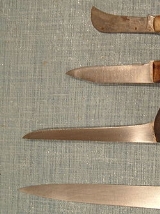
Patterns of knife blades

There are a variety of knife blade shapes; some of the most common are listed below.

(1) A normal blade has a curving edge, and flat back. A dull back lets the wielder use fingers to concentrate force; it also makes the knife heavy and strong for its size. The curve concentrates force on a small point, making cutting easier. This knife can chop as well as pick and slice.

(2) A curved, trailing-point knife has a back edge that curves upward. This lets a lightweight knife have a larger curve on its edge. Such a knife is optimized for slicing or slashing. Trailing point blades provide a larger cutting area, or belly, and are common on skinning knives.

(3) A clip-point blade is like a normal blade with the back "clipped" or concavely formed to make the tip thinner and sharper. The back edge of the clip may have a false edge that could be sharpened to make a second edge. The sharp tip is useful as a pick, or for cutting in tight places. If the false edge is sharpened it increases the knife's effectiveness in piercing. The Bowie knifeBowie knife

Bowie knife is a term commonly used in modern times to refer to any large sheath knife....
 has a clipped blade and clip-points are quite common on pocket knives and other folding knives.

(4) A drop-point blade has a convex curve of the back towards the point. It handles much like the clip-point through with a stronger point less suitable for piercing. Swiss army pocket knives often have drop-points on their larger blades.

(5) A spear-point blade is a symmetrical blade with a spine that runs along the middle of the blade. The point is in line with the spine. Spear-points may be single-edged (with a false edge) or double-edged or may have only a portion of the second edge sharpened. Pen-knives are often single-edged, non-spined spear-points, usually quite small, named for their past use in sharpening quills for writing. Pen-knife may also nowadays refer to somewhat larger pockets knives which are often drop-points. Some throwing knives may have spear-points but without the spine, being only flat pieces of metal.

(6) A needle-point blade is a symmetrical, highly tapered, twin-edged blade often seen in fighting blades, such as the Fairbairn-SykesFairbairn-Sykes fighting knife

The Fairbairn-Sykes fighting knife is a stiletto-style dagger developed by William Ewart Fairbairn and Eric Anthony Sykes d...
 commando knife. Its long, narrow point offers good penetration but is liable to breakage if abused. Although often referred to as a knife, this design may also be referred to as a stilettoStiletto

A stiletto is a long, narrow-bladed dagger....
 or (slender variety of) daggerDagger

A dagger is a double-edged knife used for stabbing, thrusting or as a secondary defense weapon in close combat....
 due to its use as a stabbing weapon albeit one very capable of slashing as well.

(7) A spay-point (once used for spaying animals) has a single, mostly straight edge that curves strongly upwards at the end to meet a short, dull, straight clip from the dull back. With the curved end of the blade being closer to perpendicular to the blade's axis than other knives and lacking a point, making penetration unlikely, spay points can be suitable for skinning.

(8) A Westernized tanto style knife has a somewhat chisel-like point that is thick towards the point (being close to the spine) and is thus quite strong. It is superficially similar to the points on most Japanese long and short swords. The traditional Japanese tantoTanto Overview

A tanto is a common Japanese knife or dagger with a usually single or sometimes double sided blade length of about 1530 cm....
 knife uses the blade geometry of (1). The Westernized tanto is often straight but may also be gently curved. The point is actually a second edge on the end of the blade, with a total edge angle of 60 – 80 degrees. Some varieties may have the back edge angled to the point slightly and sharpened for a short distance from the point.

(9) A sheepsfoot knife has a straight edge and a straight dull back that curves towards the edge at the end. It gives the most control, because the dull back edge is made to be held by fingers. Sheepsfoot look like a sheep's hoof. They were used mostly by sailors in old times, as the shape of the tip prevented accidental penetration of the work or a person when the ship rolled suddenly.

(10) A Wharncliffe blade is similar in profile to a sheep's foot but the curve of the back edge starts closer to the handle and is more gradual. Its blade is much thicker than a knife of comparable size.

(11 and 12) An uluUlu

An ulu is an Inuit woman's all-purpose knife....
knife is a sharpened segment of a circle. This blade type has no point, and has a handle in the middle. It is good for scraping, and sometimes chopping. It is the strongest knife shape. The semi-circular version appears elsewhere in the world and is called a head knife. It is used in leatherLeather

Leather is a material created through the tanning of hides, pelts and skins of animals, primarily cows....
working both to scrape down leather (reducing thickness), and to make precise, rolling cuts for shapes other than straight lines.

Not pictured is the undulating style found on items like the krisKris

The kris or keris is a distinctive, asymmetrical dagger indigenous to Malaysia, Indonesia and the southern Philippine...
 or flame-bladed sword. These blades have a distinct wavy design and are sharpened on both sides, typically tapering to (or close to) a symmetrical point.

Patterns of sword blades

Swords may have either a straight blade or a curved one. A straight sword was thought to primarily intended for hacking and stabbing, yet recent studies have shown this to be untrue, as many slicing techniques were used. The difference between a hacking cut and a slashing one is essentially the same as the difference between using a butcherFacts About Butcher

A butcher is someone who prepares various meats and other related goods for sale....
's knife and a chefChef

Chef is a term commonly used to refer to an individual who cooks professionally....
's knife; one forces an edge straight into a material while the other is pulled along the material to get more of a slicing action. Hacking cuts were usually followed by a slicing action, where the sword is drawn backwards to maximize the cut. For more information see Western Martial ArtsWestern Martial Arts Overview

Western Martial Arts refers to the European based fighting techniques and skills as opposed to the Asian rooted systems....
 or kenjutsuKenjutsu

Kenjutsu is a form of partnered practice that is almost exclusively exercised through kata....
.

Some variations included
  • the flame blade (undulated blade, for both psychological effect and some tactical advantage of using a non-standard blade: vibrations and easier parry)
  • the colichemardeColichemarde

    Colichemarde is a special type of blade that was forged and considered a member of the family of small swords from the end o...
    , essentially found in smallsword

Decoration

Decoration was often applied to the blade - usually engravingEngraving

Engraving is the practice of incising a design onto a hard, flat surface, by cutting grooves into it....
 and sometimes inlaying with goldGold

Gold is a highly sought-after precious metal that for many centuries has been used as money, a store of value and in jewelry...
. In the 19th century, it became common to etch designs on the blade using acidAcid

An acid is traditionally considered any chemical compound that when dissolved in water, gives a solution with a pH of less ...
 and a wax template.
Backsword
Single-edged swords have a back (hence their generic name of backswordBacksword Overview

Backsword is a denomination of any type of sword with a blade with only one edge, with the back of the sword often being the...
). This is the unsharpened edge.

Cavalry troops sometimes carried curved backswords. It was believed that a curved blade would impact in such a way as to be less likely to stick in the victim, and so be less likely to be pulled out of the rider's hand.