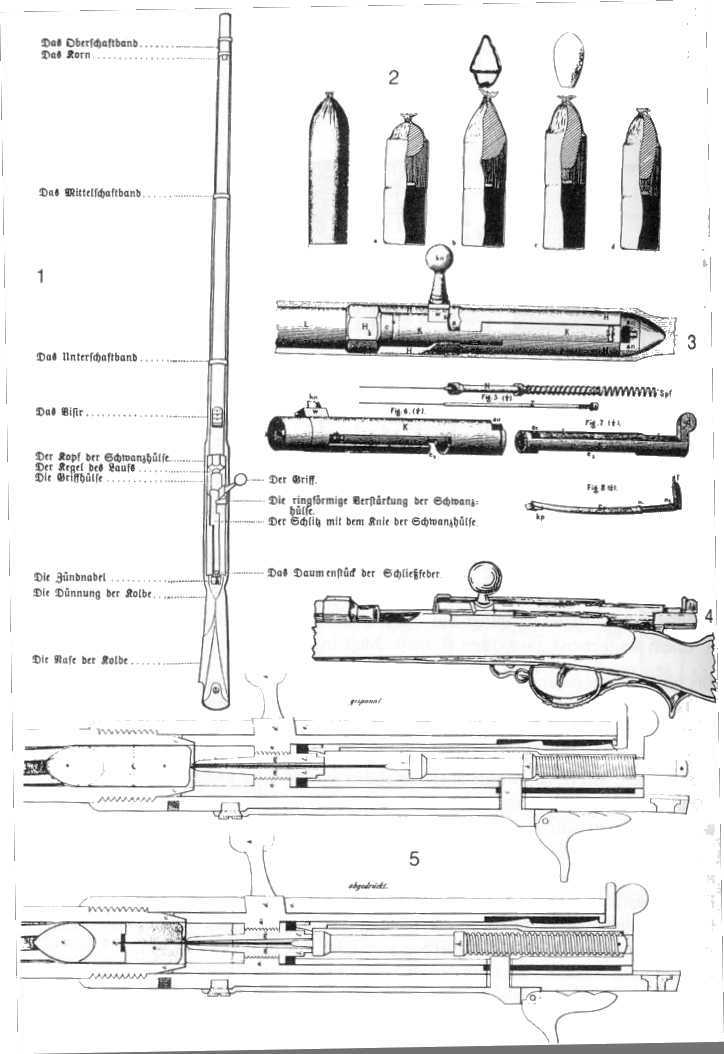
Needle gun

Encyclopedia
The Dreyse needle-gun (German
Zündnadelgewehr, which translates roughly as "needle ignition rifle
") was a military breechloading rifle, famous as the main infantry weapon of the Prussians
, who adopted it for service in 1848 as the Dreyse Zündnadelgewehr, or Prussian Model 1848. Its name comes from its 0.5 inches (12.7 mm) needle-like firing pin
, which passed through the paper cartridge
case to impact a percussion cap
at the bullet
base. The Dreyse rifle was also the first breech-loading rifle to use the bolt action to open and close the chamber, executed by turning and pulling a bolt handle. It has a rate of fire of about 10-12 rounds per minute.
The rifle was the invention of the gunsmith Johann Nikolaus von Dreyse
(1787–1867), who, beginning in 1824, had conducted multiple experiments, and in 1836 produced the complete needle-gun. Dreyse was ennobled in 1864.
were muzzle-loading, the novelty lying in the long needle driven by a coiled conchoidal spring which fired the internal percussion cap on the base of the bullet. It was his adoption of the bolt-action breechloading principle combined with this igniter system which gave the rifle its military potential, allowing a much faster rate of fire.
From 1848 onwards the new weapon was gradually introduced into the Prussian service, then later into the military forces of many other German states, save for Austria. The employment of the needle-gun radically changed military tactics in the 19th Century.
The needle-gun first made its appearance in street fighting during the May Uprising in Dresden
in 1849. It also played an important role in the Second war of Schleswig
in 1864. The rifle saw its heaviest use in the Austro-Prussian War
of 1866. Because the breech-loader made it possible for a Prussian soldier to fire five (or more) shots, even while lying on the ground, in the time that it took his Austrian muzzle-loading counterpart to reload while standing, it was seen as allowing the Prussians to sweep the field. One observer proclaimed, "the needle-gun is the king."
The success of the Dreyse needle gun spurred subsequent developments in firearms technology, and prior to the start of the Franco-Prussian War
of 1870-71, the French introduced the Chassepot
rifle. Although the Prussians won the war, the Chassepot proved superior in virtually all respects compared to the needle-gun, which was slowly becoming obsolete. With the subsequent unification of Germany, the Dreyse needle-gun was replaced by the Mauser Model 1871
rifle in German service.
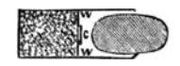 The cartridge used with this rifle consisted of the paper case, the bullet, the percussion cap
and the black powder charge. The 15.4 mm (0.61 in) bullet was shaped like an acorn, with the broader end forming a point, and the primer attached to its base. The bullet was glued in a paper case known as a sabot
. Between this inner lining and the outer case was the powder charge, consisting of 4.8 g (74 grains) of black powder.
The upper end of the paper case is rolled up and tied. Upon release of the trigger, the point of the needle pierces the rear of the cartridge, passes through the powder and hits the primer fixed to the base of the bullet. Thus the burn-front in the black powder charge passes from the front to the rear. This front to rear burn pattern minimizes the effect seen in rear-igniting cartridges where a proportion of the powder at the front of the charge is forced down and out of the barrel to burn wastefully in the air as muzzle flash. It also ensures that the whole charge burns under the highest possible pressure, theoretically, minimising unburnt residues. Consequently a smaller charge can be used to obtain the same velocity as a rear-ignited charge of the same bullet calibre and weight. It also increases the handling security of the cartridge since it is virtually impossible to set the primer off accidentally.
The Dreyse rifle was an example of a caseless ammunition
rifle in the sense that it was designed so that the soldier had to load the rifle, but not expel the fired case. The case was in fact made from paper (as were many of the first cartridges), so it burnt entirely when the round was fired. The second innovation that made the Dreyse effectively a caseless ammunition rifle was that the primer was physically connected to the bullet, so it left the rifle together with it.
There was also a blank cartridge developed for the needle-gun. It was shorter and lighter than the live round, since it lacked the projectile, but was otherwise similar in construction and powder load.
. A significant amount of gas escaped at the breech when the rifle was fired with a paper cartridge
, neutralising the advantage gained from the novel front-ignited powder charge. An improved model, giving greater muzzle velocity
and increased speed in loading, was introduced later, but this was soon replaced by the Mauser rifle
.
Due to the lack of an effective obturation
seal, after several shots, the breech would fail to close entirely. This caused the gas escaping from the breech to burn the skin of the soldier. As a result, soldiers could not aim accurately without burning themselves, and were forced to fire from the hip. The placement of the primer directly behind the bullet meant the firing needle was enclosed in black powder when the gun was fired, causing serious stress to the pin which would often break after as few as 200 rounds had been fired, rendering the rifle useless until the pin could be replaced. Soldiers were provided with two replacement needles for that purpose. Because the rifle used black powder, residue accumulated at the back of the barrel making cleaning necessary after about 60–80 shots. This was not, in practical terms, a large problem, because the individual soldier carried fewer cartridges than that and Dreyse created an "air chamber" by having a protruding needle tube (the Chassepot also had this, but it was more likely to jam after fewer shots because of its smaller-diameter chamber).
—the only other breech loader adopted for service in the 1840s.
Age of Empires III
in the hands of "Needle Gunners", who act as German skirmisher units.
Prominent Austrians frequently betray a subtle and often humorous obsession with the Prussian Needle gun in Robert Musil
's The Man Without Qualities
.
German language
German is a West Germanic language, related to and classified alongside English and Dutch. With an estimated 90 – 98 million native speakers, German is one of the world's major languages and is the most widely-spoken first language in the European Union....
Zündnadelgewehr, which translates roughly as "needle ignition rifle
Rifle
A rifle is a firearm designed to be fired from the shoulder, with a barrel that has a helical groove or pattern of grooves cut into the barrel walls. The raised areas of the rifling are called "lands," which make contact with the projectile , imparting spin around an axis corresponding to the...
") was a military breechloading rifle, famous as the main infantry weapon of the Prussians
Kingdom of Prussia
The Kingdom of Prussia was a German kingdom from 1701 to 1918. Until the defeat of Germany in World War I, it comprised almost two-thirds of the area of the German Empire...
, who adopted it for service in 1848 as the Dreyse Zündnadelgewehr, or Prussian Model 1848. Its name comes from its 0.5 inches (12.7 mm) needle-like firing pin
Firing pin
A firing pin or striker is part of the firing mechanism used in a firearm or explosive device e.g. an M14 landmine or bomb fuze. Firing pins may take many forms, though the types used in landmines, bombs, grenade fuzes or other single-use devices generally have a sharpened point...
, which passed through the paper cartridge
Paper cartridge
Paper cartridge refers to one of various types of small arms ammunition used before the advent of the metallic cartridge. These cartridges consisted of a paper cylinder or cone containing the bullet, gunpowder, and, in some cases, a primer or a lubricating and anti-fouling agent...
case to impact a percussion cap
Percussion cap
The percussion cap, introduced around 1830, was the crucial invention that enabled muzzleloading firearms to fire reliably in any weather.Before this development, firearms used flintlock ignition systems which produced flint-on-steel sparks to ignite a pan of priming powder and thereby fire the...
at the bullet
Bullet
A bullet is a projectile propelled by a firearm, sling, or air gun. Bullets do not normally contain explosives, but damage the intended target by impact and penetration...
base. The Dreyse rifle was also the first breech-loading rifle to use the bolt action to open and close the chamber, executed by turning and pulling a bolt handle. It has a rate of fire of about 10-12 rounds per minute.
The rifle was the invention of the gunsmith Johann Nikolaus von Dreyse
Johann Nikolaus von Dreyse
Johann Nicolaus von Dreyse was a German firearms inventor and manufacturer. He is most famous for submitting the "Dreyse needle gun" in 1836 to the Prussian army, which was adopted for for service in December 1840 as the Leichte Perscussions-Gewehr M 1841—a name deliberately chosen to...
(1787–1867), who, beginning in 1824, had conducted multiple experiments, and in 1836 produced the complete needle-gun. Dreyse was ennobled in 1864.
Usage and history
The first types of needle-gun made by Johann Nikolaus von DreyseJohann Nikolaus von Dreyse
Johann Nicolaus von Dreyse was a German firearms inventor and manufacturer. He is most famous for submitting the "Dreyse needle gun" in 1836 to the Prussian army, which was adopted for for service in December 1840 as the Leichte Perscussions-Gewehr M 1841—a name deliberately chosen to...
were muzzle-loading, the novelty lying in the long needle driven by a coiled conchoidal spring which fired the internal percussion cap on the base of the bullet. It was his adoption of the bolt-action breechloading principle combined with this igniter system which gave the rifle its military potential, allowing a much faster rate of fire.
From 1848 onwards the new weapon was gradually introduced into the Prussian service, then later into the military forces of many other German states, save for Austria. The employment of the needle-gun radically changed military tactics in the 19th Century.
The needle-gun first made its appearance in street fighting during the May Uprising in Dresden
May Uprising in Dresden
The May Uprising took place in Dresden, Germany in 1849; it was one of the last of the series of events known as the Revolutions of 1848.-Events leading to the May Uprising:...
in 1849. It also played an important role in the Second war of Schleswig
Second War of Schleswig
The Second Schleswig War was the second military conflict as a result of the Schleswig-Holstein Question. It began on 1 February 1864, when Prussian forces crossed the border into Schleswig.Denmark fought Prussia and Austria...
in 1864. The rifle saw its heaviest use in the Austro-Prussian War
Austro-Prussian War
The Austro-Prussian War was a war fought in 1866 between the German Confederation under the leadership of the Austrian Empire and its German allies on one side and the Kingdom of Prussia with its German allies and Italy on the...
of 1866. Because the breech-loader made it possible for a Prussian soldier to fire five (or more) shots, even while lying on the ground, in the time that it took his Austrian muzzle-loading counterpart to reload while standing, it was seen as allowing the Prussians to sweep the field. One observer proclaimed, "the needle-gun is the king."
The success of the Dreyse needle gun spurred subsequent developments in firearms technology, and prior to the start of the Franco-Prussian War
Franco-Prussian War
The Franco-Prussian War or Franco-German War, often referred to in France as the 1870 War was a conflict between the Second French Empire and the Kingdom of Prussia. Prussia was aided by the North German Confederation, of which it was a member, and the South German states of Baden, Württemberg and...
of 1870-71, the French introduced the Chassepot
Chassepot
The Chassepot, officially known as Fusil modèle 1866, was a bolt action military breechloading rifle, famous as the arm of the French forces in the Franco-Prussian War of 1870 and 1871. It replaced an assortment of Minie muzzleloading rifles many of which were converted in 1867 to breech loading...
rifle. Although the Prussians won the war, the Chassepot proved superior in virtually all respects compared to the needle-gun, which was slowly becoming obsolete. With the subsequent unification of Germany, the Dreyse needle-gun was replaced by the Mauser Model 1871
Mauser Model 1871
The Mauser Model 1871 adopted as the Gewehr 71 or Infanterie-Gewehr 71 was the first of millions of rifles manufactured to the designs of Paul Mauser and Wilhelm Mauser of the Mauser company.During 1870-71 trials with many different rifles took place, with the "M1869 Bavarian Werder" being the...
rifle in German service.
Ammunition and Mechanism
Percussion cap
The percussion cap, introduced around 1830, was the crucial invention that enabled muzzleloading firearms to fire reliably in any weather.Before this development, firearms used flintlock ignition systems which produced flint-on-steel sparks to ignite a pan of priming powder and thereby fire the...
and the black powder charge. The 15.4 mm (0.61 in) bullet was shaped like an acorn, with the broader end forming a point, and the primer attached to its base. The bullet was glued in a paper case known as a sabot
Sabot
A sabot is a device used in a firearm or cannon to fire a projectile, such as a bullet, that is smaller than the bore diameter, or which must be held in a precise position. The term is also applied to a battery stub case, a device used similarly to make a small electrical battery usable in a...
. Between this inner lining and the outer case was the powder charge, consisting of 4.8 g (74 grains) of black powder.
The upper end of the paper case is rolled up and tied. Upon release of the trigger, the point of the needle pierces the rear of the cartridge, passes through the powder and hits the primer fixed to the base of the bullet. Thus the burn-front in the black powder charge passes from the front to the rear. This front to rear burn pattern minimizes the effect seen in rear-igniting cartridges where a proportion of the powder at the front of the charge is forced down and out of the barrel to burn wastefully in the air as muzzle flash. It also ensures that the whole charge burns under the highest possible pressure, theoretically, minimising unburnt residues. Consequently a smaller charge can be used to obtain the same velocity as a rear-ignited charge of the same bullet calibre and weight. It also increases the handling security of the cartridge since it is virtually impossible to set the primer off accidentally.
The Dreyse rifle was an example of a caseless ammunition
Caseless ammunition
Caseless ammunition is a type of small arms ammunition that eliminates the cartridge case that typically holds the primer, propellant, and projectile together as a unit...
rifle in the sense that it was designed so that the soldier had to load the rifle, but not expel the fired case. The case was in fact made from paper (as were many of the first cartridges), so it burnt entirely when the round was fired. The second innovation that made the Dreyse effectively a caseless ammunition rifle was that the primer was physically connected to the bullet, so it left the rifle together with it.
There was also a blank cartridge developed for the needle-gun. It was shorter and lighter than the live round, since it lacked the projectile, but was otherwise similar in construction and powder load.
Limitations
In practice the needle-gun proved to have numerous defects. Its effective range was very short compared to that of the muzzle-loading rifles of the day, and conspicuously so as against the ChassepotChassepot
The Chassepot, officially known as Fusil modèle 1866, was a bolt action military breechloading rifle, famous as the arm of the French forces in the Franco-Prussian War of 1870 and 1871. It replaced an assortment of Minie muzzleloading rifles many of which were converted in 1867 to breech loading...
. A significant amount of gas escaped at the breech when the rifle was fired with a paper cartridge
Paper cartridge
Paper cartridge refers to one of various types of small arms ammunition used before the advent of the metallic cartridge. These cartridges consisted of a paper cylinder or cone containing the bullet, gunpowder, and, in some cases, a primer or a lubricating and anti-fouling agent...
, neutralising the advantage gained from the novel front-ignited powder charge. An improved model, giving greater muzzle velocity
Muzzle velocity
Muzzle velocity is the speed a projectile has at the moment it leaves the muzzle of the gun. Muzzle velocities range from approximately to in black powder muskets , to more than in modern rifles with high-performance cartridges such as the .220 Swift and .204 Ruger, all the way to for tank guns...
and increased speed in loading, was introduced later, but this was soon replaced by the Mauser rifle
Mauser Model 1871
The Mauser Model 1871 adopted as the Gewehr 71 or Infanterie-Gewehr 71 was the first of millions of rifles manufactured to the designs of Paul Mauser and Wilhelm Mauser of the Mauser company.During 1870-71 trials with many different rifles took place, with the "M1869 Bavarian Werder" being the...
.
Due to the lack of an effective obturation
Obturate
Obturate means to block or obstruct. With reference to firearms and airguns, obturation refers to the process of a bullet or pellet, made of soft material and often with a concave base, flaring under the pressure of firing to seal the bore and engage the barrel's rifling...
seal, after several shots, the breech would fail to close entirely. This caused the gas escaping from the breech to burn the skin of the soldier. As a result, soldiers could not aim accurately without burning themselves, and were forced to fire from the hip. The placement of the primer directly behind the bullet meant the firing needle was enclosed in black powder when the gun was fired, causing serious stress to the pin which would often break after as few as 200 rounds had been fired, rendering the rifle useless until the pin could be replaced. Soldiers were provided with two replacement needles for that purpose. Because the rifle used black powder, residue accumulated at the back of the barrel making cleaning necessary after about 60–80 shots. This was not, in practical terms, a large problem, because the individual soldier carried fewer cartridges than that and Dreyse created an "air chamber" by having a protruding needle tube (the Chassepot also had this, but it was more likely to jam after fewer shots because of its smaller-diameter chamber).
Comparison with contemporary rifles
The only contemporary rifle which it can be compared to is the Norwegian KammerladerKammerlader
The Kammerlader, or "chamber loader", was the first Norwegian breech loading rifle, and among the very first breech loaders adopted for use by an armed force anywhere in the world. A single shot black powder rifle, the kammerlader was operated with a crank mounted on the side of the receiver. This...
—the only other breech loader adopted for service in the 1840s.
| Rifle | Needle gun | Kammerlader Kammerlader The Kammerlader, or "chamber loader", was the first Norwegian breech loading rifle, and among the very first breech loaders adopted for use by an armed force anywhere in the world. A single shot black powder rifle, the kammerlader was operated with a crank mounted on the side of the receiver. This... M1849/55 |
|---|---|---|
| Effective range | 600 m (650 yards) | 1,000 m (1,100 yd) |
| Rate of fire | 10 to 12 rounds/minute | 6 to 8 rounds/minute (estimate, see article) Kammerlader The Kammerlader, or "chamber loader", was the first Norwegian breech loading rifle, and among the very first breech loaders adopted for use by an armed force anywhere in the world. A single shot black powder rifle, the kammerlader was operated with a crank mounted on the side of the receiver. This... |
| Calibre | 15.4 mm (0.61 in) | 17.5 mm (0.69 in) |
| Muzzle velocity | 305 m/s (1,000 ft/s) | Sources vary between 265 to 350 m/s (870 to 1,150 ft/s) |
| Barrel length | 91 cm (35.8 in) | 78 cm (30.7 in) |
| Total length | 142 cm (55.9 in) | 126 cm (50.4 in) |
| Loaded weight | 4.7 kg (10.4 lb) | 5 kg (11 lb) |
Appearances in popular media
The Prussian Needle gun appears in Ensemble Studio'sEnsemble Studios
Ensemble Studios was a video game developer initially established in 1995 as an independent company, but was owned by Microsoft from 2001 to 2009, when it was officially disbanded. Ensemble developed many real-time strategy games, including the Age of Empires game series, Age of Mythology, and Halo...
Age of Empires III
Age of Empires III
Age of Empires III is a real-time strategy game developed by Microsoft Corporation's Ensemble Studios and published by Microsoft Game Studios. The Mac version was ported over and developed by Destineer's MacSoft Games and published by Destineer and MacSoft Games...
in the hands of "Needle Gunners", who act as German skirmisher units.
Prominent Austrians frequently betray a subtle and often humorous obsession with the Prussian Needle gun in Robert Musil
Robert Musil
Robert Musil was an Austrian writer. His unfinished long novel The Man Without Qualities is generally considered to be one of the most important modernist novels...
's The Man Without Qualities
The Man Without Qualities
The Man Without Qualities is an unfinished novel in three books by the Austrian writer Robert Musil....
.
Further reading
- Rolf Wirtgen (Ed.) Das Zündnadelgewehr - Eine militärtechnische Revolution im 19.Jhd., Herford 1991 (In-depth German monograph on Dreyse and the development of his weapon in historical context)