


Treaties of Tilsit

Encyclopedia
Napoleon I
Napoleon Bonaparte was a French military and political leader during the latter stages of the French Revolution.As Napoleon I, he was Emperor of the French from 1804 to 1815...
of France
First French Empire
The First French Empire , also known as the Greater French Empire or Napoleonic Empire, was the empire of Napoleon I of France...
in the town of Tilsit in July, 1807 in the aftermath of his victory at Friedland
Battle of Friedland
The Battle of Friedland saw Napoleon I's French army decisively defeat Count von Bennigsen's Russian army about twenty-seven miles southeast of Königsberg...
. The first was signed on 7 July, between Tsar
Tsar
Tsar is a title used to designate certain European Slavic monarchs or supreme rulers. As a system of government in the Tsardom of Russia and Russian Empire, it is known as Tsarist autocracy, or Tsarism...
Alexander I
Alexander I of Russia
Alexander I of Russia , served as Emperor of Russia from 23 March 1801 to 1 December 1825 and the first Russian King of Poland from 1815 to 1825. He was also the first Russian Grand Duke of Finland and Lithuania....
of Russia
Russian Empire
The Russian Empire was a state that existed from 1721 until the Russian Revolution of 1917. It was the successor to the Tsardom of Russia and the predecessor of the Soviet Union...
and Napoleon I
Napoleon I
Napoleon Bonaparte was a French military and political leader during the latter stages of the French Revolution.As Napoleon I, he was Emperor of the French from 1804 to 1815...
of France
France
The French Republic , The French Republic , The French Republic , (commonly known as France , is a unitary semi-presidential republic in Western Europe with several overseas territories and islands located on other continents and in the Indian, Pacific, and Atlantic oceans. Metropolitan France...
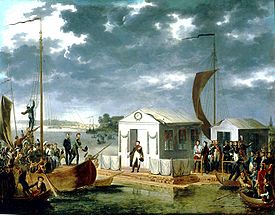
, when they met on a raft in the middle of the Neman River
Neman River
Neman or Niemen or Nemunas, is a major Eastern European river rising in Belarus and flowing through Lithuania before draining into the Curonian Lagoon and then into the Baltic Sea at Klaipėda. It is the northern border between Lithuania and Russia's Kaliningrad Oblast in its lower reaches...
. The second was signed with Prussia
Prussia
Prussia was a German kingdom and historic state originating out of the Duchy of Prussia and the Margraviate of Brandenburg. For centuries, the House of Hohenzollern ruled Prussia, successfully expanding its size by way of an unusually well-organized and effective army. Prussia shaped the history...
on 9 July. The treaties ended the War of the Fourth Coalition
War of the Fourth Coalition
The Fourth Coalition against Napoleon's French Empire was defeated in a war spanning 1806–1807. Coalition partners included Prussia, Russia, Saxony, Sweden, and the United Kingdom....
at the expense of the Prussian king, who had already agreed to a truce on 25 June after the Grande Armée had pursued him to the easternmost frontier of his realm, and in Tilsit ceded about half of his pre-war territories. From those territories, Napoleon had created French client states which were formalized and recognized at Tilsit: the Kingdom of Westphalia
Kingdom of Westphalia
The Kingdom of Westphalia was a new country of 2.6 million Germans that existed from 1807-1813. It included of territory in Hesse and other parts of present-day Germany. While formally independent, it was a vassal state of the First French Empire, ruled by Napoleon's brother Jérôme Bonaparte...
, the Duchy of Warsaw
Duchy of Warsaw
The Duchy of Warsaw was a Polish state established by Napoleon I in 1807 from the Polish lands ceded by the Kingdom of Prussia under the terms of the Treaties of Tilsit. The duchy was held in personal union by one of Napoleon's allies, King Frederick Augustus I of Saxony...
and the Free City of Danzig
Free City of Danzig (Napoleonic)
The Free City of Danzig, sometimes referred to as the Republic of Danzig, was a semi-independent state established by Napoleon on September 9, 1807, during the time of the Napoleonic Wars following the capture of the city in the siege of Danzig in May...
; the other ceded territories were awarded to further French clients and to Russia.
Napoleon not only cemented his control of Central Europe, but also had Russia and the truncated Prussia ally with him against his two remaining enemies, Great Britain and Sweden, triggering the Anglo-Russian and Finnish War
Finnish War
The Finnish War was fought between Sweden and the Russian Empire from February 1808 to September 1809. As a result of the war, the eastern third of Sweden was established as the autonomous Grand Duchy of Finland within the Russian Empire...
. Tilsit also freed French forces for the Peninsular War
Peninsular War
The Peninsular War was a war between France and the allied powers of Spain, the United Kingdom, and Portugal for control of the Iberian Peninsula during the Napoleonic Wars. The war began when French and Spanish armies crossed Spain and invaded Portugal in 1807. Then, in 1808, France turned on its...
. Central Europe became a battlefield again in 1809, when Austria and Great Britain engaged France in the War of the Fifth Coalition
War of the Fifth Coalition
The War of the Fifth Coalition, fought in the year 1809, pitted a coalition of the Austrian Empire and the United Kingdom against Napoleon's French Empire and Bavaria. Major engagements between France and Austria, the main participants, unfolded over much of Central Europe from April to July, with...
.
Franco-Russian treaty (7 July)
The treaty ended war between Imperial Russia and the French EmpireFirst French Empire
The First French Empire , also known as the Greater French Empire or Napoleonic Empire, was the empire of Napoleon I of France...
and began an alliance between the two empires that rendered the rest of continental Europe almost powerless. The two countries secretly agreed to aid each other in disputes — France pledged to aid Russia against Ottoman
Ottoman Empire
The Ottoman EmpireIt was usually referred to as the "Ottoman Empire", the "Turkish Empire", the "Ottoman Caliphate" or more commonly "Turkey" by its contemporaries...
Turkey
Turkey
Turkey , known officially as the Republic of Turkey , is a Eurasian country located in Western Asia and in East Thrace in Southeastern Europe...
, while Russia agreed to join the Continental System
Continental System
The Continental System or Continental Blockade was the foreign policy of Napoleon I of France in his struggle against the United Kingdom of Great Britain and Ireland during the Napoleonic Wars. It was a large-scale embargo against British trade, which began on November 21, 1806...
against the British Empire
British Empire
The British Empire comprised the dominions, colonies, protectorates, mandates and other territories ruled or administered by the United Kingdom. It originated with the overseas colonies and trading posts established by England in the late 16th and early 17th centuries. At its height, it was the...
. Napoleon also convinced Alexander to enter into the Anglo-Russian War, and to instigate the Finnish War
Finnish War
The Finnish War was fought between Sweden and the Russian Empire from February 1808 to September 1809. As a result of the war, the eastern third of Sweden was established as the autonomous Grand Duchy of Finland within the Russian Empire...
against Sweden
Sweden
Sweden , officially the Kingdom of Sweden , is a Nordic country on the Scandinavian Peninsula in Northern Europe. Sweden borders with Norway and Finland and is connected to Denmark by a bridge-tunnel across the Öresund....
to force Sweden to join the Continental System. More specifically, the tsar agreed to evacuate Wallachia
Wallachia
Wallachia or Walachia is a historical and geographical region of Romania. It is situated north of the Danube and south of the Southern Carpathians...
and Moldavia
Moldavia
Moldavia is a geographic and historical region and former principality in Eastern Europe, corresponding to the territory between the Eastern Carpathians and the Dniester river...
, which had been occupied by Russian forces as part of the Russo-Turkish War, 1806-1812
Russo-Turkish War, 1806-1812
The Russo-Turkish War was one of many wars fought between Imperial Russia and the Ottoman Empire.- Background :The war broke out in 1805–1806 against the background of the Napoleonic Wars...
. The Ionian Islands
Ionian Islands
The Ionian Islands are a group of islands in Greece. They are traditionally called the Heptanese, i.e...
and Cattaro, which had been captured by Russian admirals Ushakov
Ushakov
Ushakov may refer to:*Dmitry Ushakov , Russian philologist*Fyodor Ushakov , Russian admiral*Georgy Ushakov , Soviet Arctic explorer*Simon Ushakov , Russian icon painter...
and Senyavin
Dmitry Senyavin
Dmitry Nikolayevich Senyavin or Seniavin was a Russian admiral who ranks among the greatest seamen of the Napoleonic Wars.- Service under Ushakov :...
, were to be handed over to the French. In recompense, Napoleon guaranteed the sovereignty of the Duchy of Oldenburg and several other small states ruled by the tsar's German relatives.
Franco-Prussian treaty (9 July)
The treaty with PrussiaPrussia
Prussia was a German kingdom and historic state originating out of the Duchy of Prussia and the Margraviate of Brandenburg. For centuries, the House of Hohenzollern ruled Prussia, successfully expanding its size by way of an unusually well-organized and effective army. Prussia shaped the history...
stripped the country of about half its territory: Cottbus
Cottbus
Cottbus is a city in Brandenburg, Germany, situated around southeast of Berlin, on the River Spree. As of , its population was .- History :...
passed to Saxony
Saxony
The Free State of Saxony is a landlocked state of Germany, contingent with Brandenburg, Saxony Anhalt, Thuringia, Bavaria, the Czech Republic and Poland. It is the tenth-largest German state in area, with of Germany's sixteen states....
, the left bank of the Elbe
Elbe
The Elbe is one of the major rivers of Central Europe. It rises in the Krkonoše Mountains of the northwestern Czech Republic before traversing much of Bohemia , then Germany and flowing into the North Sea at Cuxhaven, 110 km northwest of Hamburg...
was awarded to the newly-created Kingdom of Westphalia
Kingdom of Westphalia
The Kingdom of Westphalia was a new country of 2.6 million Germans that existed from 1807-1813. It included of territory in Hesse and other parts of present-day Germany. While formally independent, it was a vassal state of the First French Empire, ruled by Napoleon's brother Jérôme Bonaparte...
, Białystok was given to Russia (which led to the creation of the Belostok Oblast
Belostok Oblast
Belostok Oblast was an administrative division in the Russian Empire. The region had a capital in Belostok .-History:...
), and the rest of the Polish lands in Prussian possession since the Second and Third Partitions became the quasi-independent Duchy of Warsaw
Duchy of Warsaw
The Duchy of Warsaw was a Polish state established by Napoleon I in 1807 from the Polish lands ceded by the Kingdom of Prussia under the terms of the Treaties of Tilsit. The duchy was held in personal union by one of Napoleon's allies, King Frederick Augustus I of Saxony...
. Prussia was to reduce the army to 40,000 and to pay 100,000,000 francs. Talleyrand had advised Napoleon to pursue milder terms; the treaties marked an important stage in his estrangement from the emperor.
When the Treaty was being formulated, it was noted by an observer that the Prussian king was pacing on the bank of the Neman river; Napoleon had to "but raise his hand, and Prussia would cease to exist." (McKay) Hence,many observers in Prussia and Russia viewed the treaty as unequal and as a national humiliation. The Russian soldiers refused to follow Napoleon's commands, as the Lisbon Incident demonstrated to all Europe. Napoleon's plans to marry the tsar's sister were stymied by Russian royalty. Cooperation between Russia and France eventually broke down in 1810 when the tsar began to allow neutral ships to land in Russian ports. In 1812, Napoleon crossed the Neman river
Neman River
Neman or Niemen or Nemunas, is a major Eastern European river rising in Belarus and flowing through Lithuania before draining into the Curonian Lagoon and then into the Baltic Sea at Klaipėda. It is the northern border between Lithuania and Russia's Kaliningrad Oblast in its lower reaches...
and invaded Russia, ending any vestige of alliance.
Territorial and population losses suffered by Prussia
The Prussian state was diminished by nearly one half under the terms of the treaty of Tilsit. Instead of ten million inhabitants, no more than five million remained within the new boundaries of Prussia. The state revenue, which formerly amounted to forty million dollars per annum, was decreased in a still greater proportion; since the ceded provinces were the richest and most fertile, and on whose improvement many millions had been expended. Almost all that Prussia had gained by the partition of Poland was taken from her. Saxony, a former confederate of Prussia, was the recipient of these provinces; and Russia, the more powerful of her erstwhile allies, gained territory with a population of 200,000. The following is a tabulation of the territorial and population losses that Prussia suffered under the terms of Tilsit treaty:| Westphalian Possessions | German sq. miles | Inhabitants |
|---|---|---|
| County of Mark, with Essen, Werden, and Lippstadt, | 51 | 148,000 |
| Principality of Minden, | 18.5 | 70,363 |
| County of Ravensberg, | 16.5 | 89,938 |
| Lingen and Tecklenburg, | 13 | 46,000 |
| Cleve, on the German side of the Rhine, | 20.5 | 54,000 |
| Principality of East Friesland, | 56.5 | 119,500 |
| Principality of Münster, | 49 | 127,000 |
| Principality of Paderborn, | 30 | 98,500 |
| Possessions in Lower Saxony | German sq. miles | Inhabitants |
| Magdeburg, with that pare of the duchy on the left bank of the Elbe, Halle, &c. | 54 | 160,000 |
| County of Mansfeld, | 10 | 27,000 |
| Principality of Halberstadt, | 26.5 | 101,000 |
| County of Hohenstein, | 8.5 | 27,000 |
| Territory of Quedlinburg | 1.5 | 13,400 |
| Principality of Hildesheim and Goslar, | 40 | 114,000 |