


Diplomatic Revolution

Encyclopedia
War of the Austrian Succession
The War of the Austrian Succession – including King George's War in North America, the Anglo-Spanish War of Jenkins' Ear, and two of the three Silesian wars – involved most of the powers of Europe over the question of Maria Theresa's succession to the realms of the House of Habsburg.The...
and then reversed in the Seven Years' War
Seven Years' War
The Seven Years' War was a global military war between 1756 and 1763, involving most of the great powers of the time and affecting Europe, North America, Central America, the West African coast, India, and the Philippines...
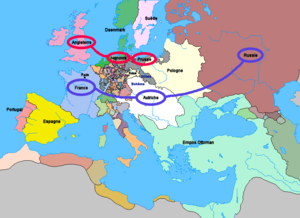
; the shift has also been known as "the great change of partners". The essence of the revolution may be thus summarized: France
Kingdom of France
The Kingdom of France was one of the most powerful states to exist in Europe during the second millennium.It originated from the Western portion of the Frankish empire, and consolidated significant power and influence over the next thousand years. Louis XIV, also known as the Sun King, developed a...
and Prussia
Kingdom of Prussia
The Kingdom of Prussia was a German kingdom from 1701 to 1918. Until the defeat of Germany in World War I, it comprised almost two-thirds of the area of the German Empire...
versus Britain
Kingdom of Great Britain
The former Kingdom of Great Britain, sometimes described as the 'United Kingdom of Great Britain', That the Two Kingdoms of Scotland and England, shall upon the 1st May next ensuing the date hereof, and forever after, be United into One Kingdom by the Name of GREAT BRITAIN. was a sovereign...
and Austria
Habsburg Monarchy
The Habsburg Monarchy covered the territories ruled by the junior Austrian branch of the House of Habsburg , and then by the successor House of Habsburg-Lorraine , between 1526 and 1867/1918. The Imperial capital was Vienna, except from 1583 to 1611, when it was moved to Prague...
became France and Austria versus Britain and Prussia. It was part of the stately quadrille
Stately quadrille
The stately quadrille is a term popularly used to describe the constantly shifting alliances between the Great Powers of Europe during the 18th century. The ultimate objective was to maintain the balance of power in Europe, and to stop any one alliance or country becoming too strong...
which saw a constantly shifting pattern of alliances throughout the 18th century.
Background
The diplomatic change was triggered by a separation of interests between Austria, Britain, and France. The Peace of Aix-la-Chapelle after the War of the Austrian SuccessionWar of the Austrian Succession
The War of the Austrian Succession – including King George's War in North America, the Anglo-Spanish War of Jenkins' Ear, and two of the three Silesian wars – involved most of the powers of Europe over the question of Maria Theresa's succession to the realms of the House of Habsburg.The...
in 1748 left Austria aware of the high price it paid in having Britain as an ally
Anglo-Austrian Alliance
The Anglo-Austrian Alliance connected the Kingdom of Great Britain and the Habsburg monarchy during the first half of the 18th century. It was largely the work of the British statesman Duke of Newcastle, who considered an alliance with Austria crucial to prevent the further expansion of French...
. Maria Theresa of Austria
Maria Theresa of Austria
Maria Theresa Walburga Amalia Christina was the only female ruler of the Habsburg dominions and the last of the House of Habsburg. She was the sovereign of Austria, Hungary, Croatia, Bohemia, Mantua, Milan, Lodomeria and Galicia, the Austrian Netherlands and Parma...
had defended her claim to the Habsburg throne and had her husband, Francis Stephen, crowned Emperor in 1741, but she had been forced to relinquish valuable territory in the process. Under British diplomatic pressure, Maria Theresa had given up most of Lombardy
Lombardy
Lombardy is one of the 20 regions of Italy. The capital is Milan. One-sixth of Italy's population lives in Lombardy and about one fifth of Italy's GDP is produced in this region, making it the most populous and richest region in the country and one of the richest in the whole of Europe...
and occupied Bavaria
Bavaria
Bavaria, formally the Free State of Bavaria is a state of Germany, located in the southeast of Germany. With an area of , it is the largest state by area, forming almost 20% of the total land area of Germany...
. The British further forced her to cede Parma
Parma
Parma is a city in the Italian region of Emilia-Romagna famous for its ham, its cheese, its architecture and the fine countryside around it. This is the home of the University of Parma, one of the oldest universities in the world....
to Spain, and more importantly, abandon the valuable state of Silesia
Silesia
Silesia is a historical region of Central Europe located mostly in Poland, with smaller parts also in the Czech Republic, and Germany.Silesia is rich in mineral and natural resources, and includes several important industrial areas. Silesia's largest city and historical capital is Wrocław...
to Prussian occupation. During the war, Frederick II
Frederick II of Prussia
Frederick II was a King in Prussia and a King of Prussia from the Hohenzollern dynasty. In his role as a prince-elector of the Holy Roman Empire, he was also Elector of Brandenburg. He was in personal union the sovereign prince of the Principality of Neuchâtel...
("Fredrick the Great") of Prussia had seized Silesia, one of the Bohemian crown lands. This acquisition had further advanced Prussia as a great European power, which now posed an increasing threat to Austria’s German lands, and to Central Europe as a whole. The growth of Prussian power, though dangerous to Austria, was welcomed by the British who saw it as a means of balancing French power.
Westminster Convention
The results of the War of Austrian Succession were clear: Britain no longer viewed Austria as powerful enough to check French power and was thus content to build up smaller states like PrussiaPrussia
Prussia was a German kingdom and historic state originating out of the Duchy of Prussia and the Margraviate of Brandenburg. For centuries, the House of Hohenzollern ruled Prussia, successfully expanding its size by way of an unusually well-organized and effective army. Prussia shaped the history...
. Therefore, Britain and Prussia in the Westminster Convention (16 January 1756) agreed that Britain would not aid Austria in a renewed conflict for Silesia as long as Prussia agreed to protect Hanover from the French. Protection of Hanover was imperative to Britain because the Kings were descended from the Brunswick-Luneburg
Brunswick-Lüneburg
The Duchy of Brunswick-Lüneburg , or more properly Duchy of Brunswick and Lüneburg, was an historical ducal state from the late Middle Ages until the late Early Modern era within the North-Western domains of the Holy Roman Empire of the German Nation, in what is now northern Germany...
line of Hanover. Britain felt that, given Prussia’s growing strength, it would be more apt to defend Hanover than Austria. Meanwhile, Austria was determined to reclaim Silesia, so the two allies found themselves with conflicting interests. Maria Theresa, recognizing the futility of renewed alliance with Britain, thus set out to align Austria with France, who could replace Britain as a valuable ally. Maria Theresa knew that, without a powerful ally such as France, she could never hope to reclaim Silesia from Frederick.
The agreement was followed by a more direct Anglo-Prussian Convention
Anglo-Prussian Convention
The Anglo-Prussian Convention was agreed on 11 April 1758 between Great Britain and the Kingdom of Prussia formalising the alliance between them that had effectively existed since the Convention of Westminster in 1756....
in 1758.
First Treaty of Versailles
Maria Theresa sent her foreign policy minister, Count Wenzel Anton von Kaunitz, to France to secure an alliance that would enable Austria to reclaim Silesia. However, Louis XV proved reluctant to agree to any treaty presented by Kaunitz. Only with renewed aggression between France and Britain was Louis XV of FranceLouis XV of France
Louis XV was a Bourbon monarch who ruled as King of France and of Navarre from 1 September 1715 until his death. He succeeded his great-grandfather at the age of five, his first cousin Philippe II, Duke of Orléans, served as Regent of the kingdom until Louis's majority in 1723...
coerced to align with Austria. Furthermore, Austria no longer surrounded France; instead, Frederick II had managed to end the prospect of Habsburg-German dominion bordering French lands. Therefore, France no longer saw Austria as an immediate threat and entered into a defensive alliance with Austria. In response to the Westminster Convention, Louis XV’s ministers and Kaunitz concluded the First Treaty of Versailles (1 May 1756), both sides agreeing to remain neutral and provide 24,000 troops should either one get into conflict with a third party.
Second Treaty of Versailles
Maria Theresa’s diplomats, after securing French neutrality, actively began to establish an anti-Prussian coalition. Austria’s actions alerted Frederick II, who decided to strike first by invading Saxony, commencing the Seven Years' WarSeven Years' War
The Seven Years' War was a global military war between 1756 and 1763, involving most of the great powers of the time and affecting Europe, North America, Central America, the West African coast, India, and the Philippines...
(1756–1763). Frederick’s actions were meant to scare Russia out of supporting Austria (the two countries had previously entered into a defensive alliance in 1746). However, by invading Saxony, Frederick had only inflamed his enemies and Russia, under the direction of Empress Elizabeth, sent an additional 80,000 troops to Austria. One year after the signing of the first Treaty of Versailles, France and Austria signed a new offensive alliance on 1 May 1757. In the Second Treaty of Versailles Austria promised France the Austrian Netherlands, but in return Maria Theresa would receive Parma as well as 129,000 French troops and the promise of 12 million livres every year until Silesia was returned to Austria.