


Gerhard von Scharnhorst

Encyclopedia
Gerhard Johann David Waitz von Scharnhorst (12 November 1755 – 28 June 1813) was a general
in Prussia
n service, Chief of the Prussian General Staff, noted for both his writings, his reforms of the Prussian army, and his leadership
during the Napoleonic Wars
.
, Lower Saxony
) near Hanover
, into a farmer's family, he succeeded in educating himself and in securing admission to the military academy of William, Count of Schaumburg-Lippe
at the fortress Wilhelmstein
. In 1778 he received a commission in the Hanoverian service. He employed the intervals of regimental duty in further self-education and literary work. In 1783 he transferred to the artillery
and received an appointment to the new artillery school in Hanover. He had already founded a military journal that, under various names, endured till 1805, and in 1788 he designed, and in part published, a Handbuch für Offiziere in den anwendbaren Teilen der Kriegswissenschaften ("Handbook for Officers in the Applied Sections of Military Science"). He also published in 1792 his Militärisches Taschenbuch für den Gebrauch im Felde ("Military Handbook for Use in the Field").
The income he derived from his writings provided his chief means of support, for he still held the rank of lieutenant, and though the farm of Bordenau produced a small sum annually, he had a wife (Clara Schmalz, sister of Theodor Schmalz, first director of Berlin University) and family to maintain. His first campaign took place in 1793 in the Netherlands
, in which he served under the Duke of York with distinction. In 1794 he took part in the defence of Menin
and commemorated the escape of the garrison in his Verteidigung der Stadt Menin ("Defence of the Town of Menin") (Hanover, 1803), which, besides his paper Die Ursachen des Glücks der Franzosen im Revolutionskrieg ("The Origins of the Good Fortune of the French in the Revolutionary War"), remains his best-known work. Shortly thereafter he received promotion to the rank of major and joined the staff of the Hanoverian contingent.
After the Peace of Basel
(5 March 1795) Scharnhorst returned to Hanover. He had by now become so well-known to the armies of the various allied states that he received invitations from several of them to transfer his services. This in the end led to his engaging himself to King Frederick William III of Prussia
, who gave him a patent of nobility, the rank of lieutenant-colonel and more than twice the pay that he had received in Hanover (1801). The War Academy of Berlin employed him, almost as a matter of course, in important instructional work (Clausewitz
was one of his students) and he founded the Berlin Military Society. In the mobilizations and precautionary measures that marked the years 1804 and 1805, and in the war of 1806 that ensued, Scharnhorst served as chief of the general staff (lieutenant-quartermaster) of the Duke of Brunswick, received a slight wound at Auerstedt
(14 October 1806) and distinguished himself by his stern resolution during the retreat of the Prussian army. He attached himself to Blücher
in the last stages of the disastrous campaign, went into captivity with him at the capitulation of Ratekau
(7 November 1806), and, quickly exchanged, had a prominent and almost decisive part in leading L'Estocq
's Prussian corps, which served with the Russians. For his services at Eylau
(February 1807), he received the highest Prussian military order Pour le Mérite
.
It was apparent that Scharnhorst's skills exceeded those of a merely brilliant staff officer. Educated in the traditions of the Seven Years' War
, he had by degrees, as his experience widened, divested his mind of antiquated forms of war, and realised that only a "national" army and a policy of fighting decisive battles could give an adequate response to the political and strategic situation brought about by the French Revolution
. He was promoted to major-general a few days after the Peace of Tilsit (July 1807), and became the head of a reform commission that included the best of the younger officers, such as Gneisenau
, Grolman and Boyen
. Stein himself became a member of the commission and secured Scharnhorst free access to King Frederick William III by securing his appointment as aide-de-camp
-general. But Napoleon quickly became suspicious, and Frederick William repeatedly had to suspend or cancel the reforms recommended.
By slow and labored steps, Scharnhorst converted the professional long-service army of Prussia, wrecked at Jena (1806), into a national army based on universal service. Universal service was not secured until his death, but he laid down the principles and prepared the way for its adoption. Enrollments of foreigners were abolished, corporal punishment
s were limited to flagrant cases of insubordination, promotion for merit was established, and the military administration organized and simplified. The organization of the Landwehr (army reserves) was begun.
 In 1809, the war between France and Austria roused premature hopes in the patriots' party, which the conqueror did not fail to note. By direct application to Napoleon, Scharnhorst evaded the decree of 26 September 1810, which required all foreigners to leave the Prussian service forthwith, but when in 1811–1812 France forced Prussia into an alliance against Russia and Prussia despatched an auxiliary army to serve under Napoleon's orders, Scharnhorst left Berlin on unlimited leave of absence. In retirement he wrote and published a work on firearms, Über die Wirkung des Feuergewehrs (1813). But the retreat from Moscow
(1812) at last sounded the call to arms for the new national army of Prussia.
Scharnhorst, recalled to the king's headquarters, refused a higher post but became Chief of Staff to Blücher, in whose vigour, energy, and influence with the young soldiers he had complete confidence. Russian Prince Wittgenstein
was so impressed by Scharnhorst that he asked to borrow him temporarily as his Chief of Staff. Blücher agreed. In the first battle, Lützen
or Gross-Görschen (2 May 1813), Prussia suffered defeat, but a very different defeat from those Napoleon had hitherto customarily inflicted. The French failed to follow up, so this defeat was not complete. In this battle, Scharnhorst received a wound in the foot, not in itself grave, but soon made mortal by the fatigues of the retreat to Dresden
, and he succumbed to it on 28 June 1813 at Prague
, where he had travelled to negotiate with Schwarzenberg and Radetzky
for the armed intervention of Austria
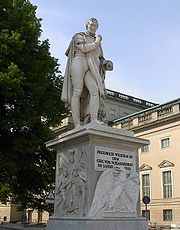
. Shortly before his death he had received promotion to the rank of lieutenant-general. Frederick William III erected a statue in memory of him, by Christian Daniel Rauch
, in Berlin. Scharnhorst was buried at the Invalidenfriedhof Cemetery
in Berlin.
armored cruiser
SMS Scharnhorst
, the World War II
battleship
Scharnhorst
, and a post-war frigate, as well as a district of the city of Dortmund
and a school in the city of Hildesheim
, were named after him.
General
A general officer is an officer of high military rank, usually in the army, and in some nations, the air force. The term is widely used by many nations of the world, and when a country uses a different term, there is an equivalent title given....
in Prussia
Prussia
Prussia was a German kingdom and historic state originating out of the Duchy of Prussia and the Margraviate of Brandenburg. For centuries, the House of Hohenzollern ruled Prussia, successfully expanding its size by way of an unusually well-organized and effective army. Prussia shaped the history...
n service, Chief of the Prussian General Staff, noted for both his writings, his reforms of the Prussian army, and his leadership
Leadership
Leadership has been described as the “process of social influence in which one person can enlist the aid and support of others in the accomplishment of a common task". Other in-depth definitions of leadership have also emerged.-Theories:...
during the Napoleonic Wars
Napoleonic Wars
The Napoleonic Wars were a series of wars declared against Napoleon's French Empire by opposing coalitions that ran from 1803 to 1815. As a continuation of the wars sparked by the French Revolution of 1789, they revolutionised European armies and played out on an unprecedented scale, mainly due to...
.
Biography
Born at Bordenau (now a part of Neustadt am RübenbergeNeustadt am Rübenberge
Neustadt am Rübenberge is a town in the district of Hanover, in Lower Saxony, Germany. At 357 km², it is the 9th largest settlement in Germany by area , though only about 45,000 inhabitants live there...
, Lower Saxony
Lower Saxony
Lower Saxony is a German state situated in north-western Germany and is second in area and fourth in population among the sixteen states of Germany...
) near Hanover
Hanover
Hanover or Hannover, on the river Leine, is the capital of the federal state of Lower Saxony , Germany and was once by personal union the family seat of the Hanoverian Kings of Great Britain, under their title as the dukes of Brunswick-Lüneburg...
, into a farmer's family, he succeeded in educating himself and in securing admission to the military academy of William, Count of Schaumburg-Lippe
William, Count of Schaumburg-Lippe
Wilhelm, Count of Schaumburg-Lippe-Bückeburg , born Friedrich Wilhelm Ernst Graf zu Schaumburg-Lippe-Bückeburg, was a ruler of the County of Schaumburg-Lippe-Bückeburg, and an important military commander in the Seven Years' War.-Biography:He was born in London the son Albrecht Wolfgang, Count of...
at the fortress Wilhelmstein
Steinhude Lake
The Steinhuder Meer or Lake Steinhude is a lake in Lower Saxony, Germany located northwest of Hanover. It is named after the nearby village of Steinhude. It has an area of about , making it the largest lake of northwestern Germany, but it is very shallow, with an average depth of only and a...
. In 1778 he received a commission in the Hanoverian service. He employed the intervals of regimental duty in further self-education and literary work. In 1783 he transferred to the artillery
Artillery
Originally applied to any group of infantry primarily armed with projectile weapons, artillery has over time become limited in meaning to refer only to those engines of war that operate by projection of munitions far beyond the range of effect of personal weapons...
and received an appointment to the new artillery school in Hanover. He had already founded a military journal that, under various names, endured till 1805, and in 1788 he designed, and in part published, a Handbuch für Offiziere in den anwendbaren Teilen der Kriegswissenschaften ("Handbook for Officers in the Applied Sections of Military Science"). He also published in 1792 his Militärisches Taschenbuch für den Gebrauch im Felde ("Military Handbook for Use in the Field").
The income he derived from his writings provided his chief means of support, for he still held the rank of lieutenant, and though the farm of Bordenau produced a small sum annually, he had a wife (Clara Schmalz, sister of Theodor Schmalz, first director of Berlin University) and family to maintain. His first campaign took place in 1793 in the Netherlands
Netherlands
The Netherlands is a constituent country of the Kingdom of the Netherlands, located mainly in North-West Europe and with several islands in the Caribbean. Mainland Netherlands borders the North Sea to the north and west, Belgium to the south, and Germany to the east, and shares maritime borders...
, in which he served under the Duke of York with distinction. In 1794 he took part in the defence of Menin
Menen
Menen is a municipality located in the Belgian province of West Flanders. The municipality comprises the city of Menen proper and the towns of Lauwe and Rekkem. The city is situated on the French/Belgian border. On January 1, 2006, Menen had a total population of 32,413...
and commemorated the escape of the garrison in his Verteidigung der Stadt Menin ("Defence of the Town of Menin") (Hanover, 1803), which, besides his paper Die Ursachen des Glücks der Franzosen im Revolutionskrieg ("The Origins of the Good Fortune of the French in the Revolutionary War"), remains his best-known work. Shortly thereafter he received promotion to the rank of major and joined the staff of the Hanoverian contingent.
After the Peace of Basel
Peace of Basel
The Peace of Basel of 1795 consists of three peace treaties involving France .* The first of the three treaties of 1795, France made peace with Prussia on 5 April; , * The Second was with Spain on 22 July, ending the War of the Pyrenees; and*...
(5 March 1795) Scharnhorst returned to Hanover. He had by now become so well-known to the armies of the various allied states that he received invitations from several of them to transfer his services. This in the end led to his engaging himself to King Frederick William III of Prussia
Frederick William III of Prussia
Frederick William III was king of Prussia from 1797 to 1840. He was in personal union the sovereign prince of the Principality of Neuchâtel .-Early life:...
, who gave him a patent of nobility, the rank of lieutenant-colonel and more than twice the pay that he had received in Hanover (1801). The War Academy of Berlin employed him, almost as a matter of course, in important instructional work (Clausewitz
Carl von Clausewitz
Carl Philipp Gottfried von Clausewitz was a Prussian soldier and German military theorist who stressed the moral and political aspects of war...
was one of his students) and he founded the Berlin Military Society. In the mobilizations and precautionary measures that marked the years 1804 and 1805, and in the war of 1806 that ensued, Scharnhorst served as chief of the general staff (lieutenant-quartermaster) of the Duke of Brunswick, received a slight wound at Auerstedt
Battle of Jena-Auerstedt
The twin battles of Jena and Auerstedt were fought on 14 October 1806 on the plateau west of the river Saale in today's Germany, between the forces of Napoleon I of France and Frederick William III of Prussia...
(14 October 1806) and distinguished himself by his stern resolution during the retreat of the Prussian army. He attached himself to Blücher
Gebhard Leberecht von Blücher
Gebhard Leberecht von Blücher, Fürst von Wahlstatt , Graf , later elevated to Fürst von Wahlstatt, was a Prussian Generalfeldmarschall who led his army against Napoleon I at the Battle of the Nations at Leipzig in 1813 and at the Battle of Waterloo in 1815 with the Duke of Wellington.He is...
in the last stages of the disastrous campaign, went into captivity with him at the capitulation of Ratekau
Battle of Lübeck
The Battle of Lübeck took place on 6 November 1806 in Lübeck, Germany between soldiers of the Kingdom of Prussia led by Gebhard Leberecht von Blücher and troops of the First French Empire under Marshals Joachim Murat, Jean-Baptiste Bernadotte, and Nicolas Soult...
(7 November 1806), and, quickly exchanged, had a prominent and almost decisive part in leading L'Estocq
Anton Wilhelm von L'Estocq
Anton Wilhelm von L'Estocq was a Prussian cavalry general best known for his command of the Prussian troops at the Battle of Eylau.-Biography:...
's Prussian corps, which served with the Russians. For his services at Eylau
Battle of Eylau
The Battle of Eylau or Battle of Preussisch-Eylau, 7 and 8 February 1807, was a bloody and inconclusive battle between Napoléon's Grande Armée and a Russian Empire army under Levin August, Count von Bennigsen near the town of Preußisch Eylau in East Prussia. Late in the battle, the Russians...
(February 1807), he received the highest Prussian military order Pour le Mérite
Pour le Mérite
The Pour le Mérite, known informally as the Blue Max , was the Kingdom of Prussia's highest military order for German soldiers until the end of World War I....
.
It was apparent that Scharnhorst's skills exceeded those of a merely brilliant staff officer. Educated in the traditions of the Seven Years' War
Seven Years' War
The Seven Years' War was a global military war between 1756 and 1763, involving most of the great powers of the time and affecting Europe, North America, Central America, the West African coast, India, and the Philippines...
, he had by degrees, as his experience widened, divested his mind of antiquated forms of war, and realised that only a "national" army and a policy of fighting decisive battles could give an adequate response to the political and strategic situation brought about by the French Revolution
French Revolution
The French Revolution , sometimes distinguished as the 'Great French Revolution' , was a period of radical social and political upheaval in France and Europe. The absolute monarchy that had ruled France for centuries collapsed in three years...
. He was promoted to major-general a few days after the Peace of Tilsit (July 1807), and became the head of a reform commission that included the best of the younger officers, such as Gneisenau
August von Gneisenau
August Wilhelm Antonius Graf Neidhardt von Gneisenau was a Prussian field marshal. He was a prominent figure in the reform of the Prussian military and the War of Liberation.-Early life:...
, Grolman and Boyen
Hermann von Boyen
Leopold Hermann Ludwig von Boyen was a Prussian army officer who helped to reform the Prussian Army in the early 19th century...
. Stein himself became a member of the commission and secured Scharnhorst free access to King Frederick William III by securing his appointment as aide-de-camp
Aide-de-camp
An aide-de-camp is a personal assistant, secretary, or adjutant to a person of high rank, usually a senior military officer or a head of state...
-general. But Napoleon quickly became suspicious, and Frederick William repeatedly had to suspend or cancel the reforms recommended.
By slow and labored steps, Scharnhorst converted the professional long-service army of Prussia, wrecked at Jena (1806), into a national army based on universal service. Universal service was not secured until his death, but he laid down the principles and prepared the way for its adoption. Enrollments of foreigners were abolished, corporal punishment
Corporal punishment
Corporal punishment is a form of physical punishment that involves the deliberate infliction of pain as retribution for an offence, or for the purpose of disciplining or reforming a wrongdoer, or to deter attitudes or behaviour deemed unacceptable...
s were limited to flagrant cases of insubordination, promotion for merit was established, and the military administration organized and simplified. The organization of the Landwehr (army reserves) was begun.
Moscow
Moscow is the capital, the most populous city, and the most populous federal subject of Russia. The city is a major political, economic, cultural, scientific, religious, financial, educational, and transportation centre of Russia and the continent...
(1812) at last sounded the call to arms for the new national army of Prussia.
Scharnhorst, recalled to the king's headquarters, refused a higher post but became Chief of Staff to Blücher, in whose vigour, energy, and influence with the young soldiers he had complete confidence. Russian Prince Wittgenstein
Peter Wittgenstein
Ludwig Adolph Peter, Prince Wittgenstein was a Russian Field Marshal distinguished for his services in the Napoleonic wars.-Life:...
was so impressed by Scharnhorst that he asked to borrow him temporarily as his Chief of Staff. Blücher agreed. In the first battle, Lützen
Battle of Lützen (1813)
In the Battle of Lützen , Napoleon I of France lured a combined Prussian and Russian force into a trap, halting the advances of the Sixth Coalition after his devastating losses in Russia. The Russian commander, Prince Peter Wittgenstein, attempting to undo Napoleon's capture of Leipzig, attacked...
or Gross-Görschen (2 May 1813), Prussia suffered defeat, but a very different defeat from those Napoleon had hitherto customarily inflicted. The French failed to follow up, so this defeat was not complete. In this battle, Scharnhorst received a wound in the foot, not in itself grave, but soon made mortal by the fatigues of the retreat to Dresden
Battle of Dresden
The Battle of Dresden was fought on 26–27 August 1813 around Dresden, Germany, resulting in a French victory under Napoleon I against forces of the Sixth Coalition of Austrians, Russians and Prussians under Field Marshal Schwartzenberg. However, Napoleon's victory was not as complete as it could...
, and he succumbed to it on 28 June 1813 at Prague
Prague
Prague is the capital and largest city of the Czech Republic. Situated in the north-west of the country on the Vltava river, the city is home to about 1.3 million people, while its metropolitan area is estimated to have a population of over 2.3 million...
, where he had travelled to negotiate with Schwarzenberg and Radetzky
Joseph Radetzky von Radetz
Johann Josef Wenzel Graf Radetzky von Radetz was a Czech nobleman and Austrian general, immortalised by Johann Strauss I's Radetzky March...
for the armed intervention of Austria
Austria
Austria , officially the Republic of Austria , is a landlocked country of roughly 8.4 million people in Central Europe. It is bordered by the Czech Republic and Germany to the north, Slovakia and Hungary to the east, Slovenia and Italy to the south, and Switzerland and Liechtenstein to the...
. Shortly before his death he had received promotion to the rank of lieutenant-general. Frederick William III erected a statue in memory of him, by Christian Daniel Rauch
Christian Daniel Rauch
Christian Daniel Rauch was a German sculptor. He founded the Berlin school of sculpture, and was the foremost German sculptor of the 19th century.-Biography:Rauch was born at Arolsen in the Principality of Waldeck...
, in Berlin. Scharnhorst was buried at the Invalidenfriedhof Cemetery
Invalidenfriedhof Cemetery
The Invalids' Cemetery is one of the oldest cemeteries in Berlin. It was the traditional resting place of the Prussian Army, and is regarded as particularly important as a memorial to the German Wars of Liberation of 1813-15.-History:...
in Berlin.
Legacy
Several German navy ships, including the World War IWorld War I
World War I , which was predominantly called the World War or the Great War from its occurrence until 1939, and the First World War or World War I thereafter, was a major war centred in Europe that began on 28 July 1914 and lasted until 11 November 1918...
armored cruiser
Armored cruiser
The armored cruiser was a type of warship of the late 19th and early 20th centuries. Like other types of cruiser, the armored cruiser was a long-range, independent warship, capable of defeating any ship apart from a battleship, and fast enough to outrun any battleships it encountered.The first...
SMS Scharnhorst
SMS Scharnhorst
SMS Scharnhorst was an armored cruiser of the Imperial German Navy, built at the Blohm & Voss shipyard in Hamburg, Germany. She was the lead ship of her class, which also included her sister . Scharnhorst and her sister were enlarged versions of the preceding ; they were equipped with a greater...
, the World War II
World War II
World War II, or the Second World War , was a global conflict lasting from 1939 to 1945, involving most of the world's nations—including all of the great powers—eventually forming two opposing military alliances: the Allies and the Axis...
battleship
Battleship
A battleship is a large armored warship with a main battery consisting of heavy caliber guns. Battleships were larger, better armed and armored than cruisers and destroyers. As the largest armed ships in a fleet, battleships were used to attain command of the sea and represented the apex of a...
Scharnhorst
German battleship Scharnhorst
Scharnhorst was a German capital ship, alternatively described as a battleship and battlecruiser, of the German Kriegsmarine. She was the lead ship of her class, which included one other ship, Gneisenau. The ship was built at the Kriegsmarinewerft dockyard in Wilhelmshaven; she was laid down on 15...
, and a post-war frigate, as well as a district of the city of Dortmund
Dortmund
Dortmund is a city in Germany. It is located in the Bundesland of North Rhine-Westphalia, in the Ruhr area. Its population of 585,045 makes it the 7th largest city in Germany and the 34th largest in the European Union....
and a school in the city of Hildesheim
Hildesheim
Hildesheim is a city in Lower Saxony, Germany. It is located in the district of Hildesheim, about 30 km southeast of Hanover on the banks of the Innerste river, which is a small tributary of the Leine river...
, were named after him.