
All Topics  
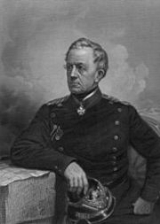
Helmuth von Moltke the Elder

 
Helmuth Von Moltke the Elder

   Email Print
   Bookmark   Link


Helmuth von Moltke the Elder


Helmuth Karl Bernhard Graf von Moltke (October 26, 1800 – April 24, 1891) was a German
Germany

Germany , officially the Federal Republic of Germany , is a country in Central Europe. It is bordered to the north by the North Sea, Denmark, and the Baltic Sea; to the east by Poland and the Czech Republic; to the south by Austria and Switzerland; and to the west by France, Luxembourg, Belgium, and the Netherlands....
 Generalfeldmarschall
Generalfeldmarschall

Generalfeldmarschall was a rank in the armies of several Germany states, the Holy Roman Empire, and the Austrian Empire. The rank was the equivalent to a Grand Admiral in the German Navy....
. The chief of staff of the Prussian Army
Prussian Army

The Prussian Army was the army of the Kingdom of Prussia. It was vital to the development of Brandenburg-Prussia as a European power.The Prussian Army had its roots in the meager mercenary forces of Brandenburg during the Thirty Years' War....
 for thirty years, he is widely regarded as one of the great strategists of the latter half of the 1800s, and the creator of a new, more modern method, of directing armies in the field. He is often referred to as Moltke the Elder to distinguish him from his nephew Helmuth Johann Ludwig von Moltke
Helmuth von Moltke the Younger

Helmuth Johann Ludwig von Moltke , also known as Moltke the Younger, was a nephew of Generalfeldmarschall Helmuth Karl Bernhard von Moltke and served as the German General Staff from 1906 to 1914....
, who commanded the German Army
German Army (German Empire)

The German Army was the name given the combined armed forces of the German Empire, also known as the Imperial Army or Imperial German Army. The term "Deutsches Heer" is also used for the modern German Army, the land component of the German Bundeswehr....
 at the outbreak of World War I
World War I

World War I, or the First World War , was a global military conflict which involved the Great powers, organized into two opposing military alliances: the Allies of World War I and the Central Powers....
.

ke was born in Parchim
Parchim

Parchim is a town in Mecklenburg-Vorpommern, Germany. It is the capital of the Parchim . It was the birthplace of Helmuth von Moltke the Elder, to whom a monument was erected in 1876....
, Mecklenburg-Schwerin
Mecklenburg-Schwerin

Mecklenburg-Schwerin was a duchy in northern Germany from 1348 on, when Albert II of Mecklenburg and his younger brother John were raised to Dukes of Mecklenburg by King Charles IV, Holy Roman Emperor....
 to a German family of ancient nobility.


Discussion
Ask a question about 'Helmuth von Moltke the Elder'
Start a new discussion about 'Helmuth von Moltke the Elder'
Answer questions from other users
Full Discussion Forum


Quotations


First weigh the considerations, then take the risks.

No battle plan ever survives contact with the enemy.

War is a matter of expedients.


Encyclopedia


Helmuth Karl Bernhard Graf von Moltke (October 26, 1800 – April 24, 1891) was a German
Germany

Germany , officially the Federal Republic of Germany , is a country in Central Europe. It is bordered to the north by the North Sea, Denmark, and the Baltic Sea; to the east by Poland and the Czech Republic; to the south by Austria and Switzerland; and to the west by France, Luxembourg, Belgium, and the Netherlands....
 Generalfeldmarschall
Generalfeldmarschall

Generalfeldmarschall was a rank in the armies of several Germany states, the Holy Roman Empire, and the Austrian Empire. The rank was the equivalent to a Grand Admiral in the German Navy....
. The chief of staff of the Prussian Army
Prussian Army

The Prussian Army was the army of the Kingdom of Prussia. It was vital to the development of Brandenburg-Prussia as a European power.The Prussian Army had its roots in the meager mercenary forces of Brandenburg during the Thirty Years' War....
 for thirty years, he is widely regarded as one of the great strategists of the latter half of the 1800s, and the creator of a new, more modern method, of directing armies in the field. He is often referred to as Moltke the Elder to distinguish him from his nephew Helmuth Johann Ludwig von Moltke
Helmuth von Moltke the Younger

Helmuth Johann Ludwig von Moltke , also known as Moltke the Younger, was a nephew of Generalfeldmarschall Helmuth Karl Bernhard von Moltke and served as the German General Staff from 1906 to 1914....
, who commanded the German Army
German Army (German Empire)

The German Army was the name given the combined armed forces of the German Empire, also known as the Imperial Army or Imperial German Army. The term "Deutsches Heer" is also used for the modern German Army, the land component of the German Bundeswehr....
 at the outbreak of World War I
World War I

World War I, or the First World War , was a global military conflict which involved the Great powers, organized into two opposing military alliances: the Allies of World War I and the Central Powers....
.

Early life

Moltke was born in Parchim
Parchim

Parchim is a town in Mecklenburg-Vorpommern, Germany. It is the capital of the Parchim . It was the birthplace of Helmuth von Moltke the Elder, to whom a monument was erected in 1876....
, Mecklenburg-Schwerin
Mecklenburg-Schwerin

Mecklenburg-Schwerin was a duchy in northern Germany from 1348 on, when Albert II of Mecklenburg and his younger brother John were raised to Dukes of Mecklenburg by King Charles IV, Holy Roman Emperor....
 to a German family of ancient nobility. His father in 1805 settled in Holstein
Holstein

Holstein is the region between the rivers Elbe and Eider River. It is part of Schleswig-Holstein, the northernmost state of Germany.Holstein once existed as the County of Holstein , the later Duchy of Holstein , and was the northernmost territory of the Holy Roman Empire....
, but about the same time was impoverished by the burning of his country house and the plunder by the French
First French Empire

The Empire of the French , also known as the Greater French Empire or First French Empire, but more commonly known as the Napoleonic Empire, was the empire of Napoleon I of France in France....
 of his town house in Lübeck
Lübeck

L?beck is the second largest city in Schleswig-Holstein, in northern Germany, and one of the major ports of Germany. It was for several centuries the "capital" of the Hanseatic League and because of its Brick Gothic architectural heritage is on UNESCO's list of World Heritage Sites....
, where his wife and children were during the Fourth Coalition. Young Moltke therefore grew up in straitened circumstances. At the age of nine he was sent as a boarder to Hohenfelde in Holstein, and at the age of eleven to the cadet school at Copenhagen
Copenhagen

Copenhagen is the capital and largest city of Denmark, with an urban area with a population of 1,153,615 . Copenhagen is situated on the Islands of Zealand and Amager....
, being destined for the Danish army and court. In 1818 he became a page to the king of Denmark and second lieutenant in a Danish infantry regiment.

As a young officer

For a year Moltke had charge of a cadet school at Frankfurt an der Oder
Frankfurt (Oder)

Frankfurt is a town in Brandenburg, Germany, located on the Oder River, on the German-Poland border directly opposite the town of Slubice which was a part of Frankfurt until 1945....
, then he was for three years employed on the military survey in Silesia
Province of Silesia

The Province of Silesia was a Provinces of Prussia of the Kingdom of Prussia from 1815 to 1919; the territory had been conquered from Habsburg Monarchy during the 18th century Silesian Wars....
 and Posen. In 1832 he was seconded for service on the general staff at Berlin
Berlin

Berlin is the Capital of Germany city and one of sixteen States of Germany of Germany. With a population of 3.4 million within its city limits, Berlin is the country's largest city....
, to which he was transferred in 1833 on promotion to first lieutenant. He was at this time regarded as a brilliant officer by his superiors, and among them by Prince William
William I, German Emperor

Wilhelm I, also known as Wilhelm the Great of the House of Hohenzollern was the monarch of Kingdom of Prussia and the first German Emperor ....
, then a lieutenant-general, afterwards king and emperor.

The historian Max Boot
Max Boot

Max Boot is a United States author, consultant, editorialist, lecturer and military historian. He has been a prominent advocate for an actively engaged defense and foreign policy, once describing his own position as support for the use of "American might to promote American ideals" throughout the world....
 says of Moltke in his War Made New:

Moltke hardly fit the image of a Prussian militarist. He loved music, poetry, art, archaeology, and theater. He knew seven languages (German, Danish, English, French, Italian, Spanish, and Turkish). He was a prolific artist who filled sketchbooks with landscapes and portraits, as well as a popular author...his account of travels in Turkey, released after his return to Berlin in 1840 and illustrated with his own drawings, turned him into a literary celebrity, a role that he embraced by donning a Turkish and giving public lectures...For all his catholicity of interests, Moltke was no closet liberal. He was a nationalist to the core who was appalled by the liberal revolutions that swept Europe on 1848. He placed his faith in the king and the forces of the old regime.


Moltke was well received at court and in the best society of Berlin. His tastes inclined him to literature, to historical study and to travel. In 1827 he had published a short romance, The Two Friends. In 1831 he wrote an essay entitled Holland and Belgium in their Mutual Relations, from their Separation under Philip II to their Reunion under William I. A year later he wrote An Account of the Internal Circumstances and Social Conditions of Poland, a study based both on reading and on personal observation of Polish life and character. In 1832 he contracted to translate Gibbon's The History of the Decline and Fall of the Roman Empire
The History of the Decline and Fall of the Roman Empire

The History of the Decline and Fall of the Roman Empire was written by England historian Edward Gibbon and published in six volumes. Volume I was published in 1776, and went through six printings....
 into German, for which he was to receive 75 marks, his object being to earn the money to buy a horse. In eighteen months he had finished nine volumes out of twelve, but the publisher failed to produce the book and Moltke never received more than 25 marks.

Service with the Ottoman Empire

Moltkestatue
In 1835 on his promotion as captain, Moltke obtained six months leave to travel in south-Eastern Europe. After a short stay in Constantinople
Constantinople

Constantinople was the empire capital of the Roman Empire , the Byzantine Empire , the Latin Empire , and the Ottoman Empire . Strategically located between the Golden Horn and the Sea of Marmara at the point where Europe meets Asia, Byzantine Constantinople had been the capital of a Christendom empire, successor to ancient ancient Greece...
 he was requested by the Sultan Mahmud II
Mahmud II

Mahmud II was the 30th Sultan of the Ottoman Empire from 1808 until his death in 1839. He was born at Topkapi Palace, Istanbul, the son of Sultan Abdul Hamid I....
 to help modernize the Ottoman Empire
Ottoman Empire

The Ottoman Empire , also known by its contemporaries as the Turkish Empire or Turkey , was an empire that lasted from 1299?1923. It was Treaty of Lausanne by the Republic of Turkey, which was officially proclaimed on October 29, 1923....
 army, and being duly authorized from Berlin he accepted the offer. He remained two years at Constantinople, learned Turkish
Turkish language

Turkish is a language spoken by over 63 million people worldwide, making it the most commonly spoken of the Turkic languages. Its speakers are located predominantly in Turkey and Cyprus, with smaller groups in Iraq, Greece, Bulgaria, the Republic of Macedonia, Kosovo, Albania and other parts of Eastern Europe....
 and surveyed the city of Constantinople, the Bosporus
Bosporus

The Bosporus or Bosphorus , also known as the Istanbul Strait , is a strait that forms the boundary between the European part of Turkey and its Asian part ....
 and the Dardanelles
Dardanelles

.The Dardanelles , formerly known as the Hellespont, is a narrow strait in northwestern Turkey connecting the Aegean Sea to the Sea of Marmara....
. He travelled through Wallachia
Wallachia

Wallachia or Walachia is a Historical regions of Romania and geographical region of Romania. It is situated north of the Danube and south of the Southern Carpathians....
, Bulgaria
Bulgaria

The state of Bulgaria , Scientific transliteration Balgarija, officially the Republic of Bulgaria has played a significant role in the Balkans in south-eastern Europe for over fourteen centuries....
 and Rumelia
Rumelia

Rumelia or Rumeli is a Turkish name, used from the 15th century onwards, for the southern Balkan regions of the Ottoman Empire. "Rumeli" literally translates as "land of the Romans", in reference to the Byzantine Empire, the former dominant power in the area....
, and made many other journeys on both sides of the Strait.

In 1838 Moltke was sent as adviser to the Ottoman general commanding the troops in Armenia
Armenia

Armenia , officially the Republic of Armenia , is a landlocked mountainous country in South Caucasus between the Black Sea and the Caspian Sea....
, who was to carry on a campaign against Muhammad Ali of Egypt
Muhammad Ali of Egypt

Muhammad Ali Pasha al-Mas'ud ibn Agha , Muhamed Ali Pasha in Albanian language or Kavalali Mehmet Ali Pasa in Turkish language, , was Wali of Egypt and Sudan, and is regarded as the "founder of modern Egypt"....
 (for details see Ali's rebellion
Muhammad Ali of Egypt

Muhammad Ali Pasha al-Mas'ud ibn Agha , Muhamed Ali Pasha in Albanian language or Kavalali Mehmet Ali Pasa in Turkish language, , was Wali of Egypt and Sudan, and is regarded as the "founder of modern Egypt"....
.) During the summer Moltke made extensive reconnaissances and surveys, riding several thousand miles in the course of his journey. He navigated the rapids of the Euphrates
Euphrates

The Euphrates is the western of the two great rivers that define Mesopotamia which flows from Anatolia....
 and visited and mapped many parts of the Ottoman Empire. In 1839 the army moved south to fight the Egyptians, but upon the approach of the enemy the general refused to listen to Moltke's advice. Moltke resigned his post of staff officer and took charge of the artillery. In the Battle of Nizib (modern-day Nisibis
Nisibis

Nusaybin is a city in Mardin Province, southeastern Turkey populated by Kurdish people, Assyrian/Chaldean/Syriac people, Arabs.It is the ancient Mesopotamian city, which Alexander's successors refounded as Antiochia Mygdonia and is mentioned for the first time in Polybius' description of the march of Antiochus I against the Molon...
) on 24 June 1839, the Ottoman army was beaten (Muhammad Ali was defeated only once or twice in his lifetime). With great difficulty Von Moltke made his way back to the Black Sea, and thence to Constantinople. His patron, Sultan Mahmud II, was dead, so he returned to Berlin
Berlin

Berlin is the Capital of Germany city and one of sixteen States of Germany of Germany. With a population of 3.4 million within its city limits, Berlin is the country's largest city....
 where he arrived, broken in health, in December 1839.

Once home Moltke published some of the letters he had written as Letters on Conditions and Events in Turkey in the Years 1835 to 1839. This book was well received at the time. Early the next year he married a young English woman, Mary Burt, the stepdaughter of his sister. It was a happy union, though there were no children.

In 1840 Moltke had been appointed to the staff of the 4th army corps, stationed at Berlin and he published his maps of Constantinople, and, jointly with other German travellers, a new map of Asia Minor and a memoir on the geography of that country. He became fascinated by railroads and he was one of the first directors of the Hamburg-Berlin railway. In 1843 published an article What Considerations should determine the Choice of the Course of Railways?.

In 1845 Moltke published The Russo-Turkish Campaign in Europe, 1828-1829, this book was also well received in military circles. Also in that year he served in Rome as personal adjutant to Prince Henry of Prussia, which allowed him to create another map of the Eternal city (published in 1852). In 1848, after a brief return to the great general staff at Berlin, he became chief of the staff of the 4th army corps, of which the headquarters were then at Magdeburg
Magdeburg

Magdeburg , the Capital of the States of Germany of Saxony-Anhalt, Germany, lies on the Elbe River and was one of the most important medieval cities of Europe....
, where he remained seven years, during which he rose to lieutenant colonel and colonel.

In 1855 Moltke served as personal aide to Prince Frederick (later Emperor Frederick III
Frederick III, German Emperor

Frederick III was List of German monarchs and King of Prussia for 99 days in 1888 during the Year of the Three Emperors. Frederick William Nicholas Charles , known informally as Fritz, was the only son of Emperor Wilhelm I, and was raised in his family's tradition of military service....
). He accompanied the prince to England (for his marriage), as well as to Paris
Paris

Paris is the Capital of France and the country's largest city. It is situated on the river Seine, in northern France, at the heart of the ?le-de-France Regions of France ....
 and to Saint Petersburg
Saint Petersburg

Saint Petersburg is a types of inhabited localities in Russia and a federal subjects of Russia of Russia located on the Neva River at the head of the Gulf of Finland on the Baltic Sea....
 for the coronation of Alexander II of Russia
Alexander II of Russia

Alexander II Nikolaevich , also known as Alexander the Liberator was the List of Russian rulers of the Russian Empire from 3 March 1855 until his assassination in 1881....
.

Chief of the German General Staff

In 1857 Moltke was given the position Chief of the Prussian Großer Generalstab
German General Staff

The German General Staff was an institution whose rise and development gave the German military a decided advantage over its adversaries. The Staff amounted to its best "weapon" for nearly two centuries....
 (military staff), a position he held for the next 30 years. As soon as he gained the position he went to work making changes to the strategic and tactical methods of the Prussian army; changes in armament and in means of communication; changes in the training of staff officers; and changes to the method for the mobilization of the army. He also instituted a formal study of European politics in connection with the plans for campaigns which might become necessary. In short, he rapidly put into place the features of a modern General Staff.

In 1859 the Austro-Sardinian War in Italy
Italy

Italy , officially the Italian Republic , is a country located on the Italian Peninsula in Southern Europe and on the two largest islands in the Mediterranean Sea, Sicily and Sardinia....
 caused the mobilization of the Prussian army, though it did not fight. After the mobilization, the army was reorganized and its strength was nearly doubled. The reorganization was the work not of Moltke but of the Prince Regent, William
William I, German Emperor

Wilhelm I, also known as Wilhelm the Great of the House of Hohenzollern was the monarch of Kingdom of Prussia and the first German Emperor ....
, and the Minister of War, Albrecht von Roon
Albrecht Graf von Roon

Albrecht Theodor Emil Graf von Roon was a Prussian soldier and politician. Roon, along with Otto von Bismarck and Helmuth von Moltke the Elder, was one of the leading figures in Prussia's government during the key decade of the 1860s, when Germany was unified under Prussia's leadership....
. Moltke watched the Italian campaign closely and wrote a history of it (published in 1862). This history was attributed on the title-page to the historical division of the Prussian staff (yet another first in military affairs).

In December 1862 Moltke was asked for an opinion upon the military aspect of the quarrel with Denmark
Denmark

Denmark is a Scandinavian country in northern Europe and the senior member of the Kingdom of Denmark. It is the southernmost of the Nordic countries....
. He thought the difficulty would be to bring the war to an end, as the Danish army would if possible retire to the islands, where, as the Danes had the command of the sea, it could not be attacked. He sketched a plan for turning the flank of the Danish army before the attack upon its position in front of Schleswig
Schleswig

Schleswig or South Jutland is a region covering the area about 60 km north and 70 km south of the border between Germany and Denmark. The region is also known archaically in English language as Sleswick....
. He suggested that by this means its retreat might be cut off.

War with Denmark

When the Second Schleswig War began in February 1864, Moltke was not sent with the Prussian forces, but kept at Berlin. His war plan was mismanaged and the Danish army escaped to the fortresses of Dybbøl
Dybbøl

Dybb?l is a small settlement in the southeastern corner of South Jutland County, Denmark. It is around 6 km west of S?nderborg.During the 1864 Second War of Schleswig, the Danish Army withdrew from the traditional fortified defence line of Danevirke and marched for Dybb?l to find a better defendable position....
 and Fredericia
Fredericia

Fredericia is a town located in Fredericia municipality in the eastern part of the Jutland peninsula in Denmark, in a sub-region known locally as Triangle Region Denmark, or The Triangle....
, each of which commanded a retreat across a strait to an island. Dybbøl and Fredericia were besieged, Dybbøl taken by storm
Battle of Dybbøl

The Battle of Dybb?l was the key battle of the Second War of Schleswig and occurred on the morning of April 18, 1864 following a siege lasting from April 7....
, and Fredericia abandoned by the Danes without assault - but the war showed no signs of ending. The Danish army was safe on the islands of Als and Funen
Funen

Funen , with a size of 2,984 km? , is the third-largest List of islands of Denmark following Zealand and Vendsyssel-Thy, and the List of islands by area largest island of the world....
.

On April 30 1864, Moltke was sent to be chief of the staff for the allied (German) forces. (It should be noted that at this point 'Germany' was a geographic term and not a political entity). After a two month armistice, the German army attacked the Danes in the island of Als (June 29). The Danes evacuated Als and shortly thereafter agreed to the German peace terms. Moltke's appearance on the scene had transformed the war, and his influence with the king had acquired a firm basis. Accordingly, when in 1866 the quarrel with Austria came to a head, Moltke's plans were adopted and executed.

Moltke's Theory of War

A disciple of Clausewitz, whose theory of war was more an effort to grasp its essential nature, rather than of Jomini
Antoine-Henri Jomini

Antoine-Henri, baron Jomini , general in the France and afterwards in the Russian service, and one of the most celebrated writers on the Napoleonic art of war, was born at Payerne in the cantons of Switzerland of Vaud, Switzerland, where his father was syndic....
, who expounded a system of rules, Moltke regarded strategy as a practical art of adapting means to ends, and had developed the methods of Napoleon in accordance with altered conditions of his age. He had been the first to realize the great defensive power of modern firearms, and had inferred from it that an enveloping attack had become more formidable than the attempt to pierce an enemy's front.

Moltke had pondered the tactics of Napoleon at the Battle of Bautzen
Battle of Bautzen

In the Battle of Bautzen a combined Imperial Russia/Kingdom of Prussia army was pushed back by Napoleon I of France, but escaped destruction, some sources claim, because Michel Ney failed to block their retreat....
, when the emperor brought up Ney
Michel Ney

Michel Ney, 1st Duc d'Elchingen, 1st Prince de la Moskva River , was a France soldier and military commander during the French Revolutionary Wars and the Napoleonic Wars....
's corps, coming from a distance, against the flank of the allies, rather than to unite it with his own force before the battle; he had also drawn a moral from the combined action of the allies at the Battle of Waterloo
Battle of Waterloo

In the Battle of Waterloo forces of the First French Empire under Napoleon Bonaparte and Michel Ney were defeated by those of the Seventh Coalition, including a Prussian army under the command of Gebhard Leberecht von Bl?cher and an Anglo-Allied army under the command of the Arthur Wellesley, 1st Duke of Wellington....
.

At the same time Moltke had worked out the conditions of the march and supply of an army. Only one army corps could be moved along one road in the same day; to put two or three corps on the same road meant that the rear corps could not be made use of in a battle at the front. Several corps stationed close together in a small area could not be fed for more than a day or two. Accordingly he inferred that the essence of strategy lay in arrangements for the separation of the corps for marching and their concentration in time for battle. In order to make a large army manageable, it must be broken up into separate armies or groups of corps, each group under a commander authorized to regulate its movements and action subject to the instructions of the commander-in-chief as regards the direction and purpose of its operations.

Moltke's main thesis was that military strategy
Strategy

A strategy is a plan of action designed to achieve a particular Objective .Strategy is different from Tactic . In military terms, tactics is concerned with the conduct of an engagement while strategy is concerned with how different engagements are linked....
 had to be understood as a system of options since only the beginning of a military operation was plannable. As a result, he considered the main task of military leaders to consist in the extensive preparation of all possible outcomes. His thesis can be summed up by two statements, one famous and one less so, translated into English as No battle plan survives contact with the enemy. and War is a matter of expedients..

However, as can be seen from the descriptions of his planning for the war with Austria and the war with France, his planning for war was very detailed and took into account thousands of variables. It is a mistake to think that Moltke thought war plans were of no use (which a simple reading of "No battle plan survives contact with the enemy" would seem to indicate).

Moltke originated the use of the colors blue for friendly forces and red for hostile forces in strategy or wargaming
Wargaming

A wargame is a game that represents a military operation. Wargaming is the hobby dedicated to the play of such games, which can also be called conflict simulations, or consims for short....
. Hence the term blue on blue
Blue On Blue

Blue On Blue is Leigh Nash's debut solo album. Nash began working on the album a year after Sixpence None the Richer disbanded. Produced by Pierre Marchand who is famous for his collaborations with Sarah McLachlan, the album consists of pop songs....
 fire in friendly fire situations.

Austro-Prussian War

Moltke planned and led the successful military operations during the Austro-Prussian War
Austro-Prussian War

The Austro-Prussian War was a war fought in 1866 between the Austrian Empire and its German allies on one side and the Kingdom of Prussia with its German allies and Kingdom of Italy on the other, that resulted in Prussian dominance over the German states....
 of 1866.

In the strategy for the war the main points are as follows. First Moltke demonstrated a concentration of effort. There were two groups of enemies, the Austro-Saxon armies, 270,000; and the north and South German armies, some 120,000 strong. The Prussian forces were smaller (by some 60,000) but Moltke determined to be superior at the decisive point. The army against Austria was 278,000 men, leaving just 48,000 men to defend against Austria's German allies. Those 48,000 under Falckenstein
Eduard Vogel von Falckenstein

Eduard Ernst Friedrich Hannibal Vogel von Falkenstein was a Kingdom of Prussia General der Infantry.Falckenstein was born in Wroclaw in Province of Silesia as the son of Hannibal Vogel von Falckenstein ....
 managed to capture the Hanoverian
Kingdom of Hanover

The Kingdom of Hanover was established in October of 1814 by the Congress of Vienna, with the restoration of George III of the United Kingdom to his Hanoverian territories after the Napoleonic wars....
 army in less than two weeks, and then to attack and drive away the South German forces.

Bismarckroonmoltke
In dealing with Austrian and Saxon army, the difficulty was to have the Prussian army ready first. This was not easy as the king would not mobilize until after the Austrians. Moltke's railway knowledge helped him to save time. Five lines of railway led from the various Prussian provinces to a series of points on the southern frontier. By employing all these railways at once, Moltke had all his army corps moved simultaneously from their peace quarters to the frontier.

After marching into Saxony, the Saxon army retreated into Bohemia
Bohemia

History...
. Moltke had two Prussian armies about 100 miles apart. The problem was how to bring them together so as to catch the Austrian army between them like the French at Waterloo between Wellington
Arthur Wellesley, 1st Duke of Wellington

Field Marshal Arthur Wellesley, 1st Duke of Wellington, Order of the Garter, Order of St Patrick, Order of the Bath, Royal Guelphic Order, Privy Council of the United Kingdom, Royal Society , was an Anglo-Irish soldier and statesman, and one of the leading military and political figures of the nineteenth century....
 and Blücher
Gebhard Leberecht von Blücher

Gebhard Leberecht von Bl?cher, F?rst von Wahlstatt , Graf , later elevated to F?rst von Wahlstatt, was a Prussian Generalfeldmarschall who led his army against Napoleon I at the Battle of Leipzig in 1813 and at the Battle of Waterloo in 1815 with Arthur Wellesley, 1st Duke of Wellington....
. He determined to bring his own two armies together by directing each of them to advance towards Gitschin. He foresaw that the march of the crown prince would probably bring him into collision with a portion of the Austrian army; but the Crown prince had 100,000 men, and it was not likely that the Austrians could have a stronger force.

The Austrians under Ludwig von Benedek marched faster than Moltke expected, and might have opposed the crown prince with four or five corps; but Benedek's attention was centred on Prince Frederick
Frederick III, German Emperor

Frederick III was List of German monarchs and King of Prussia for 99 days in 1888 during the Year of the Three Emperors. Frederick William Nicholas Charles , known informally as Fritz, was the only son of Emperor Wilhelm I, and was raised in his family's tradition of military service....
, and his four corps, not under a common command, were beaten in detail. On July 1, Benedek collected his shaken forces in a defensive position in front of Königgrätz
Battle of Königgrätz

The Battle of K?niggr?tz , also known as the Battle of Sadowa, Sadov?, or Hradec Kr?lov?, was the decisive battle of the Austro-Prussian War, in which the Kingdom of Prussia defeated the Austrian Empire....
. Moltke's two armies were now within a march of one another and of the enemy. On July 3 they were brought into action, the first against the Austrian front and the second against the Austrian right flank. The Austrian army was completely defeated and the campaign and war were won.

Moltke was not quite satisfied with the Battle of Königgrätz
Battle of Königgrätz

The Battle of K?niggr?tz , also known as the Battle of Sadowa, Sadov?, or Hradec Kr?lov?, was the decisive battle of the Austro-Prussian War, in which the Kingdom of Prussia defeated the Austrian Empire....
. He tried to have the Prussian Army of the Elbe army brought up above Königgrätz so as to prevent the Austrian retreat, but its general failed to get there in time. He also tried to prevent the Prussian First Army from pushing its attack too hard, hoping in that way to keep the Austrians in their position until their retreat should be cut off by the crown prince's army, but this also did not happen.

During the negotiations, Otto von Bismarck
Otto von Bismarck

Otto Eduard Leopold von Bismarck, Count of Bismarck-Sch?nhausen, Duke of Lauenburg, Prince of Bismarck, , was a Kingdom of Prussia and Germany statesman and aristocrat of the 19th century....
 opposed the king's wish to annex the Kingdom of Saxony
Kingdom of Saxony

The Kingdom of Saxony , lasting between 1806 and 1918, was an independent member of a number of historical confederacies in Napoleonic through Germany....
 and other territory beyond what was actually taken; he feared the active intervention of France. Moltke, however, was confident of beating both French and Austrians if the French should intervene, and he submitted to Bismarck his plans in case of need for war against both France and Austria.

After the peace, the Prussian government voted Moltke the sum of 30,000 marks, with which he bought the estate of Kreisau, near Schweidnitz (Swidnica)
Swidnica

Swidnica is a town in south-western Poland. It has a population of 60,317 according to 2006 figures. It lies in Lower Silesian Voivodeship, being the seventh largest town in that Voivodeships of Poland....
 in Silesia
Province of Silesia

The Province of Silesia was a Provinces of Prussia of the Kingdom of Prussia from 1815 to 1919; the territory had been conquered from Habsburg Monarchy during the 18th century Silesian Wars....
.

In 1867 The Campaign of 1866 in Germany was published. This history was produced under Moltke's personal supervision, it was regarded as quite accurate at the time. On December 24 1868, Moltke's wife died at Berlin. Her remains were buried in a small chapel erected by Moltke as a mausoleum in the park at Kreisau.

Franco-Prussian War

Moltke again planned and led the Prussian armies in the Franco-Prussian War
Franco-Prussian War

The Franco-Prussian War or Franco-German War, often referred to in France as the 1870 War was a conflict between Second French Empire and Kingdom of Prussia, while Prussia was backed by the North German Confederation, of which it was a member, and the South German states of Grand Duchy of Baden, History of W?rttemberg#The Kingdom...
 (1870-71), which paved the way for the creation of the Prussian-led German Empire
German Empire

The German Empire is the name commonly used in English to describe Germany from the unification of Germany and proclamation of William I, German Emperor as German Emperor on 18 January 1871, to 1918, when it became Weimar republic after defeat in World War I and the abdication of William II, German Emperor ....
 in 1871. The aspects of such a war had occupied Moltke's attention almost continuously since 1857; documents published after his death show the many times he considered such a war and the best arrangement of the Prussian or German forces for such a campaign. The arrangements for the transport of the army by railway were revised annually in order to suit the changes in his plans brought about by political conditions and by the growth of the army, as well as by the improvement of the Prussian system of railways.

The great successes of 1866 had strengthened Moltke's position, so that when on July 5 1870, the order for the mobilization of the Prussian and South German forces was issued, his plans were adopted without dispute. Five days later he was appointed Chief of the general staff of the army for the duration of the war. This gave Moltke the right to issue orders which were equivalent to royal commands.

Moltke's plan was to assemble the whole army south of Mainz
Mainz

Mainz is a city in Germany and the capital of the Germany States of Germany of Rhineland-Palatinate. It was a politically important seat of the Prince-elector of Mainz under the Holy Roman Empire, and previously was a Roman Empire fort city which commanded the west bank of the Rhine River and formed part of the northernmost frontier of th...
, this being one district in which a single army could secure the defence of the whole frontier. If the French disregarded the neutrality of Belgium
Belgium

* A small German-speaking Community of Belgium exists in eastern Wallonia. Belgium's linguistic diversity and related political and cultural conflicts are reflected in the history of Belgium and a complex Communities and regions of Belgium....
 and Luxembourg
Luxembourg

Luxembourg , officially the Grand Duchy of Luxembourg , is a small landlocked country in western Europe, bordered by Belgium, France, and Germany....
, and advanced towards Cologne
Cologne

Cologne is Germany's fourth-largest city , and is the largest city both in the German Federal State of North Rhine-Westphalia and within the Rhine-Ruhr, one of the major European metropolitan areas with more than ten million inhabitants....
 (or any other point on the Lower Rhine
Lower Rhine

The Lower Rhine flows from Bonn, Germany, to the North Sea. Almost immediately after entering the Netherlands, the Rhine splits into many branches....
), the German army would be able to strike at their flank. At the same time the Rhine itself, with the fortresses of Coblenz, Cologne and Wesel
Wesel

Wesel is a city in North Rhine-Westphalia, Germany. It is the capital of the Wesel ....
, would be a serious obstacle in their path. If the French should attempt to invade south Germany, an advance by the Germans up the Rhine river would threaten their communications. Moltke expected that the French would be compelled by the direction of their railways to collect the greater part of their army near Metz
Metz

Metz is a city in the northeast of France, capital of the Lorraine R?gion in France and prefecture of the Moselle Departments of France.It is located at the confluence of the Moselle River and the Seille rivers....
, and a smaller portion near Strasbourg
Strasbourg

Strasbourg is the capital and principal city of the Alsace Regions of France in northeastern France. With 702,412 inhabitants in 2007, its metropolitan area is the Aire urbaine....
.

The German forces were grouped into three armies: the first under Steinmetz, on the Moselle
Moselle

Moselle is a departments of France in the east of France named after the Moselle River....
 below Trier
Trier

Trier is a city in Germany on the banks of the Moselle River. It is the oldest city in Germany, founded in or before 16 BC. Trier is not the only city claiming to be Germany's oldest, but it is the only one that bases this assertion on having the longest history as a city, as opposed to a mere settlement or army camp....
; the second of 130,000 men, under the Prince Regent Frederick
Frederick III, German Emperor

Frederick III was List of German monarchs and King of Prussia for 99 days in 1888 during the Year of the Three Emperors. Frederick William Nicholas Charles , known informally as Fritz, was the only son of Emperor Wilhelm I, and was raised in his family's tradition of military service....
, around Homburg
Homburg, Saarland

Homburg is a city in Saarland, Germany, with a population of c. 44,000 inhabitants. It is the capital of the Saarpfalz district. The medical department of the Saarland University is situated here....
 (with a reserve of 60,000 men behind them); the third under the crown prince of 130,000 men, at Landau
Landau

Landau or Landau in der Pfalz is an autonomous city surrounded by the S?dliche Weinstra?e district of southern Rhineland-Palatinate, Germany....
. Three army corps were held back in north-Eastern Germany, in case Austria-Hungary
Austria-Hungary

Austria-Hungary, also known as the Austro-Hungarian Empire, the Dual Monarchy or the Kaiserlich und k?niglich Monarchy was a state in Central Europe ruled by the House of Habsburg, constitutionally a personal union between the crowns of the Austrian Empire and the Kingdom of Hungary....
 should make common cause with France.

Moltke's plan was that the three armies, while advancing, should make a right wheel, so that the first army on the right would reach the bank of the Moselle opposite Metz, while the second and third armies should push forward, the third army to defeat the French force near Strasbourg, and the second to strike the Moselle near Pont-à-Mousson
Pont-à-Mousson

Pont-?-Mousson is a Communes of France in the Meurthe-et-Moselle Departments of France in northeastern France.Population : 14,592 . It is an industrial town , situated on the Moselle River....
. If the French army should be found in front of the second army, it would be attacked in front by the second army and in flank by the first or the third (or both). If it should be found on or north of the line from Saarburg
Saarburg

Saarburg is a city of the Trier-Saarburg district in the Rhineland-Palatinate state of Germany, on the banks of the Saar River in the hilly country a few kilometers upstream from the Saar's junction with the Moselle River....
 to Lunéville
Lunéville

Lun?ville is a Communes of France in the Meurthe-et-Moselle Departments of France in northeastern France.It is a sub-prefecture of the department and lies on the Meurthe River....
, it could still be attacked from two sides by the second and third armies in co-operation. The intention of the great right wheel was to attack the principal French army in such a direction as to drive it north and cut its communications with Paris. The fortress of Metz was to be only monitored, and the main German forces, after defeating the chief French army, would then to march against Paris.

This plan was carried out in its broad outlines. The Battle of Worth was brought on prematurely, and therefore led, not to the capture of MacMahon
Patrice MacMahon, duc de Magenta

Marie Edme Patrice Maurice de Mac-Mahon, 1st Duc de Magenta de Magenta, Italy, Marshal of France was a France general and politician. He served as Chief of State of France from 1873 to 1875 and as the first president of the Third Republic, from 1875 to 1879....
's army, which was intended, but only to its defeat and hasty retreat as far as Chalons. The Battle of Spicheren
Battle of Spicheren

The Battle of Spicheren, also known as the Battle of Forbach, was a battle during the Franco-Prussian War. The German victory compelled the French to withdraw to the defenses of Metz....
 was not intended by Moltke, who wished to keep Bazaine
François Achille Bazaine

Fran?ois Achille Bazaine was a French General and from 1864, a Marshal of France, "who suffered the fate of Generals who win every battle except the last"....
's army on the Saar
Saar

Saar has several meanings:...
 until he could attack it with the second army in front and the first army on its left flank. But these unexpected victories did not disconcert Moltke, who carried out his intended advance to Pont-Mousson, crossed the Moselle with the first and second armies, then faced north and wheeled round, so that the effect of the battle of Gravelotte was to drive Bazaine into the fortress of Metz and cut him off from Paris
Paris

Paris is the Capital of France and the country's largest city. It is situated on the river Seine, in northern France, at the heart of the ?le-de-France Regions of France ....
.

Nothing shows Moltke's insight and strength of purpose in a clearer light than his determination to attack on the 18th of August, at the Battle of Gravelotte
Battle of Gravelotte

The Battle of Gravelotte was a battle of the Franco-Prussian War named after Gravelotte, a village in Lorraine between Metz and the former France?Germany frontier....
, when other strategists would have thought that, the strategic victory having been gained, a tactical victory was unnecessary. He has been blamed for the last attack of Gravelotte, in which there was a fruitless heavy loss; but it is now known that this attack was ordered by the king, and Moltke blamed himself for not having used his influence to prevent it.

During the night following the battle Moltke left one army to invest Bazaine
François Achille Bazaine

Fran?ois Achille Bazaine was a French General and from 1864, a Marshal of France, "who suffered the fate of Generals who win every battle except the last"....
 at Metz, and set out with the two others to march towards Paris, the more southerly one leading, so that when MacMahon's army should be found the main blow might be delivered from the south and MacMahon driven to the north. On August 25 it was found that MacMahon was moving north-east for the relief of Bazaine. The moment Moltke was satisfied of the accuracy of his information, he ordered the German columns to turn their faces north instead of west. MacMahon's right wing was attacked at Beaumont
Beaumont, Meurthe-et-Moselle

Beaumont is a Communes of France in the Meurthe-et-Moselle Departments of France in northeastern France....
  while attempting to cross the Meuse
Meuse River

File:01-Namur-290305 JPG.jpgThe Meuse , is a major European river, rising in France and flowing through Belgium and the Netherlands before draining into the North Sea....
, his advance necessarily abandoned, and his army with difficulty collected at Sedan.

At the Battle of Sedan
Battle of Sedan

The Battle of Sedan was fought during the Franco-Prussian War on 1 September 1870. It resulted in the capture of Emperor Napoleon III along with his army and practically decided the war in favour of Prussia and its allies, though fighting continued under a new France government....
, the two German armies surrounded the French army, which on September 1 was attacked and compelled to surrender. Moltke then resumed the advance on Paris, which was also surrounded.

From this time Moltke's strategy is remarkable for its judicious economy of force, for he was wise enough never to attempt more than was practicable with the means at his disposal. The surrender of Metz and of Paris was just a question of time, and the problem was, while maintaining the sieges, to be able to ward off the attacks of the new French armies levied for the purpose of raising the Siege of Paris
Siege of Paris

The Siege of Paris, lasting from September 19, 1870 – January 28, 1871, brought about French defeat in the Franco-Prussian War and led to the establishment of the German Empire....
. The Siege of Metz
Siege of Metz

The Siege of Metz lasting from September 3 – October 23 1870 was a crushing defeat for the French during the Franco-Prussian War.After being defeated at the Battle of Gravelotte, Fran?ois Achille Bazaine, retreated into the fortifications of Metz....
 ended with its surrender on 27 October.

On 28 January 1871, an armistice was concluded at Paris by which the garrison became virtually prisoners and the war was ended.

Final years

In October 1870, Moltke was made a Graf
Graf

Graf is a historical German nobility title equal in rank to a count or a British earl . A derivation ultimately from the Greek verb graphein 'to write' may be fanciful: Paul the Deacon wrote in Latin ca 790: "the count of the Bavarians that they call gravio who governed Bolzano and other strongholds?" ; this may be read to make...
 (Count) as a reward for his services. In June 1871, he was further rewarded by a promotion to the rank of field marshal
Field Marshal

Field marshal is a military officer rank. Today it is the highest rank in the armies in which it is used, one step above a general or colonel-general....
 and a large monetary grant. He served in the Diet
Diet (assembly)

In politics, a diet is a formal deliberative assembly. The term is derived from Medieval Latin dietas, and ultimately comes from the Latin dies, "day"....
 of the North German Confederation
North German Confederation

The North German Confederation , came into existence in August 1866 as a military alliance of 22 states of northern Germany with the Kingdom of Prussia as the leading state....
 from 1867-71, and from 1871-91 he was a member of the Reichstag
Reichstag (institution)

The Reichstag was the parliament of the Holy Roman Empire, the North German Confederation, and of Germany until 1945. The main chamber of the German parliament is now called Bundestag , but the building in which it meets is still called "Reichstag" ....
, the German parliament
Parliament

A parliament is a legislature, especially in those countries whose system of government is based on the Westminster system modeled after that of the United Kingdom....
 of the time. For the "Verdienste um das zur Einheit wiedergeborene Deutsche Vaterland" (merit of the unification of the reborn German fatherland), he was named an honorary citizen of Hamburg
List of Honorary Citizens of Hamburg

This is a list of Honorary Citizens of the Free and Hanseatic city of Hamburg, Germany. The Citizenship#Honorary citizenship is the highest decoration of Hamburg....
.

After the Franco-Prussian War, Moltke superintended the preparation of its history, which was published between 1874 and 1881 by the great general staff.

In 1888 Moltke retired as Chief of the General Staff and was succeeded by Graf von Waldersee
Alfred Graf von Waldersee

Alfred Graf von Waldersee was a Germany Generalfeldmarschall who served as Chief of the Imperial German General Staff from 1888 to 1891....
. His nephew, Helmuth Johann Ludwig von Moltke, was Chief from 1906-14.

Moltke retired from active service on 9 August 1888 and died in Berlin
Berlin

Berlin is the Capital of Germany city and one of sixteen States of Germany of Germany. With a population of 3.4 million within its city limits, Berlin is the country's largest city....
 in 1891.

See also

Helmuth von Moltke the Younger

Helmuth Johann Ludwig von Moltke , also known as Moltke the Younger, was a nephew of Generalfeldmarschall Helmuth Karl Bernhard von Moltke and served as the German General Staff from 1906 to 1914....


Bibliography

  • Letters of Field-Marshal Count Helmuth von Moltke to his mother and his brothers: Translated by Clara Bell and Henry W. Fischer (1891)
  • Letters of Field-Marshal Count Helmuth von Moltke to his mother and his brothers (1892)
  • Essays, speeches, and memoirs of Field Marshal Count Helmuth von Moltke (1893)

Further reading

  • Bucholz, Arden. Moltke and the German Wars, 1864-1871, Palgrave Macmillan, 2001. ISBN 0-333-68757-4
  • Friedrich, Otto. Blood and Iron: From Bismarck to Hitler the Von Moltke Family's Impact on German History, 1st ed. New York: HarperCollins, 1995. ISBN 0-06-092767-4
  • Macksey, Kenneth. From Triumph to Disaster: The Fatal Flaws of German Generalship from Moltke to Guderian. Mechanicsburg, Pennsylvania: Stackpole Books, 1996. ISBN 1853672440
  • Wilkinson, Spenser (ed.). Moltke's Military Correspondence, 1870-71, Ashgate Publishing, 1991. ISBN 0-7512-0040-9
  • Martin van Creveld
    Martin van Creveld

    Martin Levi van Creveld is an Israel military history and theorist.Van Creveld is born in the Netherlands in the city of Rotterdam, but has lived in Israel since shortly after his birth....
    . The Art of War: War and Military Thought, Cassell&Co, London, 2000. ISBN 0-304-35264-0 (p.109)
  • Martin van Creveld
    Martin van Creveld

    Martin Levi van Creveld is an Israel military history and theorist.Van Creveld is born in the Netherlands in the city of Rotterdam, but has lived in Israel since shortly after his birth....
    . Supplying War: Logistics from Wallenstein to Patton, Cambridge University Press, Cambridge, 1977. ISBN 0-521-29793-1


External links

  • at
  • by Kimberly J. Largent
  • - book excerpt from A Genius for War by Trevor N. Dupuy