


Impressment

Encyclopedia
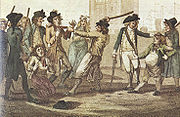
Coercion
Coercion is the practice of forcing another party to behave in an involuntary manner by use of threats or intimidation or some other form of pressure or force. In law, coercion is codified as the duress crime. Such actions are used as leverage, to force the victim to act in the desired way...
and without notice. It was used by the Royal Navy
Royal Navy
The Royal Navy is the naval warfare service branch of the British Armed Forces. Founded in the 16th century, it is the oldest service branch and is known as the Senior Service...
, beginning in 1664 and during the 18th and early 19th centuries, in wartime, as a means of crewing warship
Warship
A warship is a ship that is built and primarily intended for combat. Warships are usually built in a completely different way from merchant ships. As well as being armed, warships are designed to withstand damage and are usually faster and more maneuvrable than merchant ships...
s, although legal sanction for the practice goes back to the time of Edward I of England
Edward I of England
Edward I , also known as Edward Longshanks and the Hammer of the Scots, was King of England from 1272 to 1307. The first son of Henry III, Edward was involved early in the political intrigues of his father's reign, which included an outright rebellion by the English barons...
. The Royal Navy impressed many British merchant sailors, as well as some sailors from other nations. People liable to impressment were eligible men of seafaring habits between the ages of 18 and 45 years. Non-seamen were impressed as well, though rarely.
Impressment was strongly criticized by those who believed it to be contrary to the British constitution; at the time, unlike many of its continental rivals, Britain did not conscript
Conscription
Conscription is the compulsory enlistment of people in some sort of national service, most often military service. Conscription dates back to antiquity and continues in some countries to the present day under various names...
its subjects for any other military service, aside from a brief experiment with army impressment in 1778 to 1780. Though the public opposed conscription in general, impressment was repeatedly upheld by the courts, as it was deemed vital to the strength of the navy and, by extension, to the survival of the realm.
The impressment of seamen from American ships caused serious tensions between Britain and the United States
United States
The United States of America is a federal constitutional republic comprising fifty states and a federal district...
in the years leading up to the War of 1812
War of 1812
The War of 1812 was a military conflict fought between the forces of the United States of America and those of the British Empire. The Americans declared war in 1812 for several reasons, including trade restrictions because of Britain's ongoing war with France, impressment of American merchant...
. After the defeat of Napoleon
Napoleonic Wars
The Napoleonic Wars were a series of wars declared against Napoleon's French Empire by opposing coalitions that ran from 1803 to 1815. As a continuation of the wars sparked by the French Revolution of 1789, they revolutionised European armies and played out on an unprecedented scale, mainly due to...
in 1814, Britain ended the practice and never resumed it.
Royal Navy recruiting and desertion
Working and living conditions for the average sailor in the Royal Navy in the 18th century were harsh by modern standards and generally much worse than conditions on British merchant ships; their pay was around half that paid by merchantmen and was lower than that paid to a farm labourer. Until 19th century reforms improved conditions, the Royal Navy was known to pay wages up to two years in arrears and always withheld six months pay to discourage desertion. In fact, Naval wages had been set in 1653 and were not increased until April 1797 after sailors on 80 ships of the Channel Fleet based at SpitheadSpithead
Spithead is an area of the Solent and a roadstead off Gilkicker Point in Hampshire, England. It is protected from all winds, except those from the southeast...
mutinied
Spithead and Nore mutinies
The Spithead and Nore mutinies were two major mutinies by sailors of the Royal Navy in 1797. There were also discontent and minor incidents on ships in other locations in the same year. They were not violent insurrections, being more in the nature of strikes, demanding better pay and conditions...
. Roughly half of all Navy crews were impressed, and these not only received lower wages than volunteers but were often shackled while the vessel was docked and were never permitted to go ashore until released from service.
The main problem with recruiting, though, was a simple lack of qualified seamen during wartime, when it became necessary for the Navy to quickly recruit an extra 20,000 (early 18th century) to 40,000 men (late 18th century) — privateer
Privateer
A privateer is a private person or ship authorized by a government by letters of marque to attack foreign shipping during wartime. Privateering was a way of mobilizing armed ships and sailors without having to spend public money or commit naval officers...
s, the navy, and the merchant navy all competed for a small pool of ordinary and able seamen in wartime, and all three groups were usually short-handed. The recruitment figures presented to Parliament for the years 1755 - 1757 list 70,566 men of which 33,243 were volunteers (47%), 16,953 pressed men (24%) while another 20,370 were also listed as volunteers separately (29%). Although there are no records that explain why volunteers were separated into two groups, it is likely these were pressed men who became "volunteers" to get the sign-up bonus, two months' wages in advance and a higher wage as it is known large numbers did do this. Volunteering also protected the sailor from creditors as the law forbade collecting debts accrued before enlistment. Other records confirm similar percentages throughout the 18th century.
Average Annual Recruitment 1736 - 1783
| Peace | War | Royal Navy | Privateer | Merchant | Total |
|---|---|---|---|---|---|
| 1736 - 1738 | 14,845 | 35,239 | 50,084 | ||
| 1739 - 1748 War of Jenkins' Ear The War of Jenkins' Ear was a conflict between Great Britain and Spain that lasted from 1739 to 1748, with major operations largely ended by 1742. Its unusual name, coined by Thomas Carlyle in 1858, relates to Robert Jenkins, captain of a British merchant ship, who exhibited his severed ear in... |
43,303 | 2,602 | 30,392 | 75,997 | |
| 1753 - 1755 | 17,369 | 40,862 | 58,231 | ||
| 1756 - 1763 Seven Years' War The Seven Years' War was a global military war between 1756 and 1763, involving most of the great powers of the time and affecting Europe, North America, Central America, the West African coast, India, and the Philippines... |
74,771 | 3,286 | 37,584 | 115,641 | |
| 1773 - 1775 | 18,540 | 50,903 | 69,443 | ||
| 1775 - 1783 American Revolutionary War The American Revolutionary War , the American War of Independence, or simply the Revolutionary War, began as a war between the Kingdom of Great Britain and thirteen British colonies in North America, and ended in a global war between several European great powers.The war was the result of the... |
67,747 | 3,749 | 44,947 | 116,443 |
All three groups also dealt with high levels of desertion. In the 18th century, desertion rates on naval ships averaged 25% with little difference between volunteers and pressed men, starting high, then falling heavily after a few months onboard a ship, and generally becoming negligible after a year — navy pay ran months or years in arrears
Arrears
Arrears is a legal term for the part of a debt that is overdue after missing one or more required payments. The amount of the arrears is the amount accrued from the date on which the first missed payment was due...
, and desertion might mean not only abandoning companions in the ship's company, but also the loss of a large amount of money already earned. If a navy ship had taken a prize
Rules of Prize Warfare
Prize rules or cruiser rules govern the taking of prizes: vessels captured on the high seas during war. They are intertwined with the blockade rules.Customary rules were originally laid down in the days of sailing ships...
, a deserting seaman would also forfeit his share of the prize money. In a report on proposed changes to the RN written by Admiral Nelson
Horatio Nelson, 1st Viscount Nelson
Horatio Nelson, 1st Viscount Nelson, 1st Duke of Bronté, KB was a flag officer famous for his service in the Royal Navy, particularly during the Napoleonic Wars. He was noted for his inspirational leadership and superb grasp of strategy and unconventional tactics, which resulted in a number of...
in 1803, he noted that since 1793 more than 42,000 sailors had deserted.
The Impress Service and impressment at sea
The Impress Service was formed to force sailors to serve on naval vessels (there was no concept of joining the navy as a fixed career path for non-officers at the time), seamen were attached to ships for the duration of its commission. They were encouraged to stay in the Navy after the commission but could leave to seek other employment when the ship was paid off. Impressment was based on the legal power of the King to call men to military service, as well as to recruit volunteers (who were paid a bounty upon joining, unlike pressed men). Seamen were not covered by the Magna CartaMagna Carta
Magna Carta is an English charter, originally issued in the year 1215 and reissued later in the 13th century in modified versions, which included the most direct challenges to the monarch's authority to date. The charter first passed into law in 1225...
and "failure to allow oneself to be pressed" was punishable by hanging although the punishment became less severe over time.
In Elizabethan times impressment as a form of recruitment became a statute and with the introduction of the Vagrancy Act in 1597, men of disrepute (vagrants
Vagrancy (people)
A vagrant is a person in poverty, who wanders from place to place without a home or regular employment or income.-Definition:A vagrant is "a person without a settled home or regular work who wanders from place to place and lives by begging;" vagrancy is the condition of such persons.-History:In...
) were drafted into service. In 1703 an act was passed limiting the impressment of men to only those under 18 years of age who were not apprenticed. A further act in 1740 raised the age to 55. Although no foreigner could be pressed, if they married a British woman, or had worked on a British merchant ship for two years they lost their protection. Some governments, including Britain, issued "Protections" against impressment which had to be carried on the person at all times but in times of crisis the Admiralty would order a "Hot Press" which meant that no one was exempt.
The Royal Navy also impressed seamen from inbound British merchant ships at sea, though this was done by individual warships, rather than the Impress Service. Impressment, particularly press gangs, were consistently unpopular with the British public (as well as in the American colonies), and local officials often acted against them, to the point of imprisoning officers from the Impressment Service, or opposing them by force of arms.
The press gang would try to find men aged between 15 and 55 with seafaring or river-boat experience but this was not essential and those with no experience were called "Landsmen". From 1740, Landsmen were legally exempt from impressment but this was ignored in wartime unless the person seized was an apprentice or a "gentleman". Two Landsmen were considered by captains to be the equivalent of an Able Seaman. If a Landsman was able to prove his status to the Admiralty he was usually released. A man in the street would first be asked to volunteer and if he refused he was often plied with alcohol or simply knocked out and taken. A commonly held belief of a trick used in tavern
Tavern
A tavern is a place of business where people gather to drink alcoholic beverages and be served food, and in some cases, where travelers receive lodging....
s was to surreptitiously drop a King's shilling
King's shilling
For many years a soldier's daily pay, before stoppages, was the shilling given as an earnest payment to recruits of the British Army and the Royal Navy of the 18th and 19th centuries...
("prest money") into his drink as by "finding" the shilling in his possession he was deemed to have volunteered, and that this led to some tavern owners putting glass bottoms in their tankards. However, this is an urban legend; press officers were subject to fines for using trickery and a volunteer had a "cooling-off" period in which to change his mind.
Contrary to popular belief, the great majority of men pressed were taken from merchant ships at sea. This was legal as long as the Navy replaced the man they took and many Naval captains would take the best seamen, replacing them with malcontents and landsmen from their own ship. It was also common for "trusted" volunteers to act as substitutes; they would then desert as soon as the merchant ship docked, and return to their Navy ship. Outbound merchant ships, officers and apprentices were exempt from impressment. When war broke out the Navy would blanket the coast with cruisers ready to intercept every inbound merchantman, many of which would flee to Ireland to offload their best men before returning to England. In 1740 a merchantman fired on a cruiser attempting to impress its crew; similar violence to avoid being pressed was not uncommon, especially with the East India
East India Company
The East India Company was an early English joint-stock company that was formed initially for pursuing trade with the East Indies, but that ended up trading mainly with the Indian subcontinent and China...
ships whose crews had been away from their families and England for a considerable time. In times of an extreme shortage of men the Navy would "embargo" the coast for a short time; merchantmen had to supply a portion of their crew in exchange for permission to sail. Many merchant ships had hiding places constructed where their best crew could hide when approached by a Naval vessel.
In addition to impressment, England also used the Quota System
Quota System (Royal Navy)
The Quota System , introduced by Prime Minister William Pitt the Younger in 1795, required each English county to provide a quota of men for the Royal Navy, based on its population and the number of its seaports — London, for example, had to provide 5,704 quotamen, while Yorkshire had to...
(or The Quod) from 1795 to 1815, whereby each county was required to supply a certain number of volunteers, based on its population and the number of its seaports. Unlike impressment, the Quota System often resulted in criminals serving on board ships as counties who failed to meet their quota offered prisoners the option of completing their sentence or volunteering. The down side of the Quota System was the frequent introduction of disease, especially typhus
Typhus
Epidemic typhus is a form of typhus so named because the disease often causes epidemics following wars and natural disasters...
, to healthy ships.
British North America
One of the largest impressment operations occurred in the spring of 1757 in New York City, then still under British colonialColonialism
Colonialism is the establishment, maintenance, acquisition and expansion of colonies in one territory by people from another territory. It is a process whereby the metropole claims sovereignty over the colony and the social structure, government, and economics of the colony are changed by...
rule. Three thousand British soldiers cordoned off the city, and plucked clean the taverns and other sailors' gathering places. "All kinds of tradesmen and Negroes" were hauled in, nearly eight hundred in all. Four hundred of these were "retained in the service."
The Royal Navy also used impressment extensively in British North America from 1775 to 1815. Its press gangs sparked resistance, riots, and political turmoil in seaports such as Halifax, St John's, and Quebec City. Nevertheless, the Royal Navy extended the reach of its press gangs into coastal areas of British North America by the early nineteenth century. In response, sailors and residents fought back with a range of tactics. They sometimes reacted violently. The riots in St John's in 1794 and Halifax in 1805 led to a prohibition on impressment on shore for much of the Napoleonic Wars. The protest came from a wide swath of the urban community, including elites, rather than just the vulnerable sailors, and had a lasting negative impact on civil–naval relations in what became Canada. The local communities did not encourage their young men to volunteer for the Royal Navy.
Continental Navy
The Continental NavyContinental Navy
The Continental Navy was the navy of the United States during the American Revolutionary War, and was formed in 1775. Through the efforts of the Continental Navy's patron, John Adams and vigorous Congressional support in the face of stiff opposition, the fleet cumulatively became relatively...
impressed men into its service during the American Revolutionary War. The Continental Congress
Continental Congress
The Continental Congress was a convention of delegates called together from the Thirteen Colonies that became the governing body of the United States during the American Revolution....
authorized construction of thirteen frigates, including USS Virginia
USS Virginia (1776)
The first USS Virginia was a 28-gun sailing frigate of the Continental Navy, a ship with a short and unfortunate career.She was one of 13 frigates authorized by the Continental Congress on 13 December 1775, laid down in 1776 at Fells Point, Maryland, by George Wells, launched that August, and...
in 1775. The senior captain of the Continental Navy, James Nicholson
James Nicholson (naval officer)
James Nicholson was an officer in the Continental Navy during the American Revolutionary War.The son of Joseph and Hannah Scott Nicholson, he was born in Chestertown, Maryland. James Nicholson served in the colonial Navy with the British in the assault on Havana in 1762, and was commissioned...
, was appointed to command Virginia, built and launched at Baltimore, Maryland.
When Virginia was fully rigged and fitted out in 1777, Nicholson received orders to sail to Martinique
Martinique
Martinique is an island in the eastern Caribbean Sea, with a land area of . Like Guadeloupe, it is an overseas region of France, consisting of a single overseas department. To the northwest lies Dominica, to the south St Lucia, and to the southeast Barbados...
, to deliver dispatches and take on a cargo of arms and ammunition for the Continental Army
Continental Army
The Continental Army was formed after the outbreak of the American Revolutionary War by the colonies that became the United States of America. Established by a resolution of the Continental Congress on June 14, 1775, it was created to coordinate the military efforts of the Thirteen Colonies in...
. Many of Nicholson's crew had deserted to sign on as privateers, for higher pay at less risk. With inadequate crew to comply with orders from Congress, Nicholson impressed about thirty citizens of Baltimore for service aboard Virginia, an act expressly forbidden by Maryland law. Maryland governor Thomas Johnson demanded immediate release of the impressed men. Nicholson refused, stating impressment was common practice in Philadelphia, Pennsylvania
Philadelphia, Pennsylvania
Philadelphia is the largest city in the Commonwealth of Pennsylvania and the county seat of Philadelphia County, with which it is coterminous. The city is located in the Northeastern United States along the Delaware and Schuylkill rivers. It is the fifth-most-populous city in the United States,...
and some of the northern states.
Congress convinced Nicholson to release the impressed citizens of Baltimore, to avoid problems with the State of Maryland
Maryland
Maryland is a U.S. state located in the Mid Atlantic region of the United States, bordering Virginia, West Virginia, and the District of Columbia to its south and west; Pennsylvania to its north; and Delaware to its east...
, but the practice of impressment continued where the local state legislature or governor gave consent. Nicholson avoided the need for local government consent by stopping the American merchant ships Holker and Fair American at sea in 1780, to impress men from their crews.
The individual states did not deny the concept of impressment for their own navies, but were reluctant to grant the right to the Continental Congress. The concept of drafting men into armed service remained contentious, even after adoption of the federal constitution.
Conflict with the United States
In 1795, the Jay TreatyJay Treaty
Jay's Treaty, , also known as Jay's Treaty, The British Treaty, and the Treaty of London of 1794, was a treaty between the United States and Great Britain that is credited with averting war,, resolving issues remaining since the Treaty of Paris of 1783, which ended the American Revolution,, and...
went into effect, addressing many issues left unresolved after the American Revolution
American Revolution
The American Revolution was the political upheaval during the last half of the 18th century in which thirteen colonies in North America joined together to break free from the British Empire, combining to become the United States of America...
, and averting a renewed conflict. However, the treaty's neglect to address British impressment of sailors from American ships and ports became a major cause of complaint among those who disapproved of it. While non-British subjects were not impressed, Britain did not recognize naturalized
Naturalization
Naturalization is the acquisition of citizenship and nationality by somebody who was not a citizen of that country at the time of birth....
American citizenship, and treated anyone born a British subject as still "British" — as a result, the Royal Navy impressed over 9,000 sailors who claimed to be American citizens.
During the wars with France (1793 to 1815), the Royal Navy aggressively reclaimed British deserters on board ships of other nations, both by halting and searching merchant ships, and, in many cases, by searching American port cities. Although illegal, Thomas Jefferson
Thomas Jefferson
Thomas Jefferson was the principal author of the United States Declaration of Independence and the Statute of Virginia for Religious Freedom , the third President of the United States and founder of the University of Virginia...
ignored this to remain on good terms with Britain as he was negotiating to obtain "the Floridas". This changed in 1805 when the British began seizing American merchantmen trading with the West Indies and condemning the ships and their cargoes as a prize and enforcing impressment on their crews. Under the Rule of 1756
Rule of 1756
The Rule of 1756 or Rule of the War of 1756 was a policy of the Kingdom of Great Britain, and later the United Kingdom of Great Britain and Ireland that was promulgated during the Seven Years' War. It ruled that Britain would not trade with neutral nations who were also trading with the enemy. It...
, in times of war, direct trade between a neutral European state and a British colony was forbidden if such trade had not existed in time of peace. The Americans had found a way around this by "landing" cargoes from Europe in the United States and issuing certificates that duty had been paid. The ship would then sail, with the cargo never having been offloaded or duty actually paid, as now bona fide
Bona Fide
Bona Fide is a studio album from rock band Wishbone Ash. It is the first studio album in six years and is the only studio album to feature guitarist Ben Granfelt...
commerce between neutral America and the West Indies. The British became aware of the practice during the court case involving the seizure of the Essex. The court ruled that the cargo of the Essex had never been intended for American markets so the voyage had not been broken and could thus be considered continuous. The end result was the blockade of New York Harbor
New York Harbor
New York Harbor refers to the waterways of the estuary near the mouth of the Hudson River that empty into New York Bay. It is one of the largest natural harbors in the world. Although the U.S. Board of Geographic Names does not use the term, New York Harbor has important historical, governmental,...
by two British frigates, the Cambrian and the Leander, which provoked public demonstrations.
For the next year scores of American ships were condemned in admiralty courts and American seamen were impressed with increasing frequency until, in the early summer of 1807, when three deserters from the British frigate HMS Melampus
HMS Melampus (1785)
HMS Melampus was a Royal Navy fifth-rate frigate that served during the French Revolutionary and Napoleonic Wars. She captured numerous prizes before she was sold in 1815.-Design and construction:...
lying in Chesapeake Bay
Chesapeake Bay
The Chesapeake Bay is the largest estuary in the United States. It lies off the Atlantic Ocean, surrounded by Maryland and Virginia. The Chesapeake Bay's drainage basin covers in the District of Columbia and parts of six states: New York, Pennsylvania, Delaware, Maryland, Virginia, and West...
enlisted on the American frigate USS Chesapeake
USS Chesapeake (1799)
USS Chesapeake was a 38-gun wooden-hulled, three-masted heavy frigate of the United States Navy. She was one of the original six frigates whose construction was authorized by the Naval Act of 1794. Joshua Humphreys designed these frigates to be the young navy's capital ships...
. After searching the Chesapeake, the deserters, David Martin, John Strachan, and William Ware were found to be native-born Americans who had been wrongly impressed. Unfortunately the search had also found that a crew member listed, Jenkin Ratford, was a British deserter; however, he could not be found. Admiral Berkeley angrily issued an order to all commanders in the North Atlantic Squadron to search the Chesapeake if encountered on the high seas. Eight miles southeast of Cape Henry
Cape Henry
Cape Henry is a cape on the Atlantic shore of Virginia north of Virginia Beach. It is the southern boundary of the entrance to Chesapeake Bay.Across the mouth of the bay to the north is Cape Charles...
a boat from the British frigate HMS Leopard
HMS Leopard (1790)
HMS Leopard was a 50-gun Portland-class fourth rate of the Royal Navy. She served during the French Revolutionary and Napoleonic Wars, and the War of 1812.-Construction and commissioning:...
intercepted her but Commodore Barron
James Barron
James Barron was an officer in the United States Navy. Commander of the frigate USS Chesapeake, he was court-martialed for his actions on 22 June 1807, which led to the surrender of his ship to the British....
declined to permit his crew to be mustered. The Leopard began approaching and the commander shouted a warning to which Barron replied "I don't hear what you say". The Leopard then fired two shots across the bow and almost immediately poured a broadside into the American ship and, without the Chesapeake returning fire, poured another two broadsides into it. Three crew were killed and eighteen wounded. The British boarding party not only arrested the British deserter but also the three Americans. The Chesapeake-Leopard Affair provoked an outcry for war from all parts of the country and Jefferson later wrote: "The affair of the Chesapeake put war into my hand, I had only to open it and let havoc loose". He ordered the state governors to ready their militias but the Embargo Act of 1807
Embargo Act of 1807
The Embargo Act of 1807 and the subsequent Nonintercourse Acts were American laws restricting American ships from engaging in foreign trade between the years of 1807 and 1812. The Acts were diplomatic responses by presidents Thomas Jefferson and James Madison designed to protect American interests...
he eventually passed only ordered all British armed vessels out of American waters and forbade all contact with them if they remained.
As a cause of the War of 1812, the impressment and ship seizures caused serious diplomatic tension, and helped to turn American public opinion against Britain. Impressment humiliated and dishonored the U.S. because it was unable to protect its ships and sailors.
End of impressment
British impressment ended, in practice, after 1814, at the end of the Napoleonic Wars — the Royal Navy fought no major naval actions again until World War IWorld War I
World War I , which was predominantly called the World War or the Great War from its occurrence until 1939, and the First World War or World War I thereafter, was a major war centred in Europe that began on 28 July 1914 and lasted until 11 November 1918...
, a century later, when conscription was used for all the military services.
English and later British naval impressment laws
The first Act of Parliament legalizing this practice was passed in the reign of Queen Elizabeth in 1563 and was known as "an act touching political considerations for the maintenance of the navy". It was renewed many times until 1631. In the Vagabonds Act 1597Vagabonds Act 1597
The Vagabonds Act 1597 is an Act of the Parliament of England . It introduced penal transportation as a punishment for the first time. During the reign of Henry VIII, it has been estimated that 72,000 people were executed...
, several lists of persons were subject to impressment for service in the fleet.
The Recruiting Act 1703
Recruiting Act 1703
The Recruiting Act 1703 was an Act of the Parliament of England. Its long title was "for the increase of seamen and the better encouragement of navigation, and the protection of the coal trade". It provided for the forcible enlistment of able bodied men in the army and navy who did not have...
was an act passed "for the increase of seamen and better encouragement of navigation, and the protection of the Coal Trade". This act gave parish authorities the power to apprentice boys to the sea, and reaffirmed rogues and vagabond
Vagabond (person)
A vagabond is a drifter and an itinerant wanderer who roams wherever they please, following the whim of the moment. Vagabonds may lack residence, a job, and even citizenship....
s were subject to be pressed into the navy. In 1740, impressment was limited to men between eighteen and forty-five, and it also exempted foreigners.
The last law was passed in 1835, in which the power to impress was reaffirmed. This limited the length of service of a pressed man to five years, and added the provision that a man could not be pressed twice. Although Britain abandoned the practice of impressment in 1815, impressment remained legal until the early 1900s, and the various laws authorizing impressment have never been repealed.
In 1708, Parliament passed an Act forbidding impressment in American waters, without clearly stating whether the law applied only to the navy, or to civil authorities as well, and whether it applied only to the current war or to all future wars. Two attorneys-general of Great Britain, one in 1716, and another in 1740, issued opinions that the 1708 Act was no longer in effect, but many American colonists disagreed.
As a result of the doubt over the legality of impressment in American waters, Parliament passed a new Act in 1746, stating that impressment was forbidden in the West Indies, but not in America, leading to a riot in Boston the following year, and continued with the colonies, particularly with heavily maritime New England
New England
New England is a region in the northeastern corner of the United States consisting of the six states of Maine, New Hampshire, Vermont, Massachusetts, Rhode Island, and Connecticut...
.
British army impressment laws
Starting in 1645, the New Model ArmyNew Model Army
The New Model Army of England was formed in 1645 by the Parliamentarians in the English Civil War, and was disbanded in 1660 after the Restoration...
raised by Oliver Cromwell
Oliver Cromwell
Oliver Cromwell was an English military and political leader who overthrew the English monarchy and temporarily turned England into a republican Commonwealth, and served as Lord Protector of England, Scotland, and Ireland....
to overthrow Charles I
Charles I of England
Charles I was King of England, King of Scotland, and King of Ireland from 27 March 1625 until his execution in 1649. Charles engaged in a struggle for power with the Parliament of England, attempting to obtain royal revenue whilst Parliament sought to curb his Royal prerogative which Charles...
during the English Civil War
English Civil War
The English Civil War was a series of armed conflicts and political machinations between Parliamentarians and Royalists...
was largely manned by impressment. After the restoration of the monarchy
English Restoration
The Restoration of the English monarchy began in 1660 when the English, Scottish and Irish monarchies were all restored under Charles II after the Interregnum that followed the Wars of the Three Kingdoms...
, impressment into the army was discontinued.
During the American Revolutionary War, after the losses at the Battle of Saratoga
Battle of Saratoga
The Battles of Saratoga conclusively decided the fate of British General John Burgoyne's army in the American War of Independence and are generally regarded as a turning point in the war. The battles were fought eighteen days apart on the same ground, south of Saratoga, New York...
and the apprehended hostilities with France, the existing voluntary enlistment measures were judged to be insufficient. Between 1775 and 1781, the regular army increased from 48,000 to 110,000. Two acts were passed, the Recruiting Act 1778
Recruiting Act 1778
The Recruiting Act 1778 is an Act of Parliament passed by the Parliament of Great Britain. It was a press act "for the more easy and better recruiting of his Majesty's Land Forces"...
and the Recruiting Act 1779
Recruiting Act 1779
The Recruiting Act 1779 was an Act of Parliament passed by the Parliament of Great Britain. It was a press act for the recruiting of his Majesty's Land Forces. After the losses in the American Revolutionary War and the apprehended hostilities with France, the existing voluntary enlistment measures...
for the impression of individuals into the British Army. The chief advantages of these acts was in the number of volunteers brought in under the apprehension of impressment. To avoid impressment, some recruits incapacitated themselves by cutting off the thumb and forefinger of the right hand. The Recruiting Act of 1779 was repealed on May 26, 1780, and army impressment was permanently discontinued.
During the experiment, the British government allowed army impressment under severely restricted circumstances — both acts emphasized volunteering over impressment, and offered strong incentives to volunteers. The impressment portion of the 1778 Act applied only to Scotland and the area around London, excluding Wales and the rest of England, to avoid interfering with harvesting. The 1779 Act applied to all of Great Britain, but was initially suspended everywhere except the area around London, and actually applied to all of Great Britain for only six months, until the 1779 act was repealed in May 1780, and army impressment ceased in Britain.
Unlike naval impressment, army impressment applied only to "able-bodied idle, and disorderly Persons, who could not, upon Examination, prove themselves to exercise and industriously follow some lawful Trade or Employment, or to have some Substance sufficient for their Support and Maintenance", as well as smugglers, according to the 1778 law, but excluding from that any men who were voters, or harvest workers. The 1779 law extended impressment also to "incorrigible rogues" who had abandoned their families, and left them as expenses on the parish. Impressed apprentices were released under appeal from their masters, and impressed foreigners were released when requested by their countries' embassies.
Treatment in literature
- In her novel Sylvia's LoversSylvia's LoversSylvia's Lovers is a novel written by Elizabeth Gaskell, which she called "the saddest story I ever wrote".-Plot summary:The novel begins in the 1790s in the coastal town of Monkshaven against the background of the practice of impressment during the early phases of the Napoleonic Wars...
, Elizabeth GaskellElizabeth GaskellElizabeth Cleghorn Gaskell, née Stevenson , often referred to simply as Mrs Gaskell, was a British novelist and short story writer during the Victorian era...
presents a compelling description of the practice of impressment, combining many of its aspects in a tale about a small coastal community during the first phases of the Napoleonic wars.
See also
- Quota SystemQuota System (Royal Navy)The Quota System , introduced by Prime Minister William Pitt the Younger in 1795, required each English county to provide a quota of men for the Royal Navy, based on its population and the number of its seaports — London, for example, had to provide 5,704 quotamen, while Yorkshire had to...
— a companion approach to manning the Royal Navy during the Napoleonic Wars. - Military recruitmentMilitary recruitmentMilitary recruitment is the act of requesting people, usually male adults, to join a military voluntarily. Involuntary military recruitment is known as conscription. Many countries that have abolished conscription use military recruiters to persuade people to join, often at an early age. To...
- ConscriptionConscriptionConscription is the compulsory enlistment of people in some sort of national service, most often military service. Conscription dates back to antiquity and continues in some countries to the present day under various names...
- ShanghaiingShanghaiingShanghaiing refers to the practice of conscripting men as sailors by coercive techniques such as trickery, intimidation, or violence. Those engaged in this form of kidnapping were known as crimps. Until 1915, unfree labor was widely used aboard American merchant ships...
- H.M.S. Defiant - A novel, later made into the movie Damn the Defiant!, which depicts impressment. The various Aubrey and Maturin books of Patrick O'BrianPatrick O'BrianPatrick O'Brian, CBE , born Richard Patrick Russ, was an English novelist and translator, best known for his Aubrey–Maturin series of novels set in the Royal Navy during the Napoleonic Wars and centred on the friendship of English Naval Captain Jack Aubrey and the Irish–Catalan physician Stephen...
also deal with impressment on occasion. - King's shillingKing's shillingFor many years a soldier's daily pay, before stoppages, was the shilling given as an earnest payment to recruits of the British Army and the Royal Navy of the 18th and 19th centuries...
, a token given to someone as a sign of impressment - Winfield ScottWinfield ScottWinfield Scott was a United States Army general, and unsuccessful presidential candidate of the Whig Party in 1852....
Sources
- Cray, Robert E., “Remembering the USS Chesapeake: The Politics of Maritime. Death and Impressment,” Journal of the Early Republic (Fall 2005) vol 25
- Curtis, Edward, The Organization of the British Army in the American Revolution. 1972, ISBN 0854099069
- Nash, Gary, The Urban Crucible, The Northern Seaports and the Origins of the American Revolution, 1986, ISBN 0674930584
- Rodger, N. A. M. The Wooden World: An Anatomy of the Georgian Navy. W.W. Norton and Company, 1986.
- Rodger, N.A.M. The Command of the Ocean: A Naval History of Britain, 1649–1815. W.W. Norton and Company, 2004.
- Anthony Steel, "Impressment in the Monroe-Pinkney Negotiation, 1806-1807," The American Historical Review, Vol. 57, No. 2 (Jan., 1952), pp. 352–369 online in JSTOR
- Roland G. Usher, Jr. "Royal Navy Impressment During the American Revolution," The Mississippi Valley Historical Review, Vol. 37, No. 4 (Mar., 1951), pp. 673–688 online in JSTOR
- Smith, Page, A new age now begins, 1976, ISBN 0070590974
- Miller, Nathan. Sea of Glory, 1974, ISBN 067950392
External links
- The Impress Service, basic article on "press gangs" in British ports, charged with impressing sailors into the Navy.
- http://www.qm.qld.gov.au/Find+out+about/Histories+of+Queensland/Transport+Maritime+History/HMS+Pandora: example of impressment of HMS Pandora crew in 1790.
- http://www.pbs.org/wned/war-of-1812/the-film/watch-film-and-bonus-features/ PBS documentary on War of 1812 with chapter on impressment.