

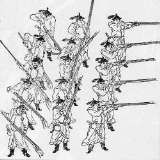
Musketeer

Encyclopedia
A musketeer was an early modern type of infantry
soldier equipped with a musket
. Musketeers were an important part of early modern armies, particularly in Europe. They sometimes could fight on horseback, like a dragoon
or a cavalryman. The musketeer was a precursor to the rifleman
.
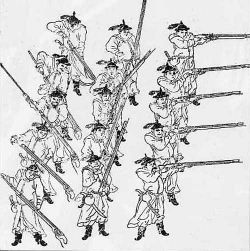 Muskets were used in China at least from the 14th Century.
Musketeers were utilized in the Ming Dynasty
(1368-1644) and Qing Dynasty
(1644-1911). 14th century military book Huolongjing
already describe Chinese matchlock
. In Zhao Shizhen's book of 1598 AD, the Shenqipu, there were illustrations of Ottoman
Turkish
riflemen with detailed illustrations of their muskets, alongside European musketeers with detailed illustrations of their muskets. There was also illustration and description of how the Chinese had adopted the Ottoman kneeling position in firing while favoring European-made rifles. The Chinese also built the first repeating fire-arm, several barrels behind a small wooden shield, the musketeer would turn the barrels and light each barrel with a slow match one by one. These weapons were most effective being fired from walls or high positions. Needham considered this weapon to be a kind of "primitive machine-gun".
corps of the Ottoman army
were using matchlock
muskets as early as the 1440s. The Ottoman Empire
, centering around Turkey
and extending into Arabia, used muskets to conquer Constantinople
(modern Istanbul
) and were one of the earliest users of muskets in a military conflict. It also utilized large cannons, the Great Turkish Bombard and incindernary devices. They are also probably the first to use muskets aboard ships.
s. Both the Mughals and Indians (such as the Sikhs, Rajputs and Maratha
s) used musketeers in cover formations while sending volleys of musket fire on unsuspecting soldiers, horses, and elephants. Many Indian gunsmiths existed during the 18th and 17th century, creating regular muskets and some combination weapons.
 In the Spanish army, the Tercio
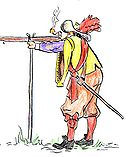
or the Spanish Square was a mixed infantry formation that theoretically could have up to 3,000 pikemen, swordsmen and musketeers, although on the battlefield it was usually much smaller. It was nigh on invincible in its era, capitalizing on the brute strength and close-range abilities of the pikemen and the long-range projectile capabilities of the muskets. In practise, it appeared as a loosely formed phalanx
in function, but was far more flexible and deadly. The musketeer manned tercios were developed from the earlier arquebusier manned coronelias which had firmly established their fearsome reputation by defeating the French and capturing their king at the Battle of Pavia
in 1525.
 Streltsy were the units of Russia
n guardsmen (sl.
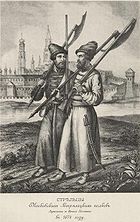
strelets, стрелец. literally "shooter"; often translated as "musketeer," but more properly "harquebusier") in the 16th - early 18th centuries, armed with firearms (riflemen). They are also collectively known as Strelets Troops (Стрелецкое Войско).
The first strel'tsy units were created by Ivan the Terrible sometime between 1545 and 1550 and armed with the arquebus
. They first saw combat at the Siege of Kazan
in 1552. Military service
in this unit became lifelong and hereditary.
The Muscovite government was chronically short of cash so that the strel'tsy were often not paid well. While "entitled" to something like four rubles a year in the 1550s, they were often allowed to farm or trade in order to supplement their incomes.
In the late 17th century, Streltsy of Moscow began to actively participate in a struggle for power between different government groups, supporting the dissident
s and showing hostility towards any foreign innovation
s.
After the fall of Sophia Alekseyevna
in 1689, the government of Peter the Great
engaged in a process of gradual limitation of Streltsy’s military and political influence.
In spite of these measures, the strel'tsy revolted yet again while Peter was on his Great Embassy in Europe. The corps was technically abolished in 1689; however, after having suffered a defeat at Narva
in 1700, the government stopped their disbandment.
Gradually, Streltsy were incorporated into the regular army. At the same time, they started to disband the Municipal Streltsy. Liquidation of the streltsy units was finally finished only in the 1720s, however, the Municipal Strel'tsy were kept in some cities until the late 18th century.
The Preobrazhensky
and Izmailovsky regiments of Imperial Guards
replaced the strel'tsy as the tsar's bodyguards.
were a junior unit of roughly company strength of the military branch of the Royal Household
or Maison du Roi. They were created in 1622 when Louis XIII
furnished a company of light cavalry
(the "carabiniers", created by Louis' father Henry IV
) with muskets. Musketeers fought in battle both on foot (infantry) and on horseback (dragoons). As a junior unit in the Royal Guard, the Musketeers were not closely linked to the royal family. Traditional bodyguard duties were in fact performed by the Garde du Corps
and the Gardes suisses. Because of its junior status, the Musketeers were open to the lower classes of French nobility or younger sons from noble families whose oldest son served in the more prestigious units. The Musketeers soon gained a reputation for boisterousness and fighting spirit because the only way for social and career advancement was excelling at their task as mounted light dragoons.
Their high esprit de corps and can-do attitude gained them royal favour and they became a popular fixture at court and in Paris. Shortly after their creation, Cardinal Richelieu created a bodyguard unit for himself. So as not to offend the King with a perceived sense of self-importance, Richelieu did not name them Garde du Corps like the King's personal guards but rather Musketeers after the Kings' junior guard cavalry. This was the start of a bitter rivalry between both corps of Musketeers. At the cardinal's death in 1642, the company passed to his successor Cardinal Mazarin. At Mazarin's death in 1661, the cardinal's Musketeers passed to Louis XIV
to the disgust of both the King's Musketeers and the Cardinal's Musketeers. The Musketeers were subsequently reorganized as a guard cavalry regiment of two companies. The King's Musketeers became the first company, popularly known as "Grey Musketeers" (mousquetaires gris) while the Cardinal's Musketeers became the second company, known as "Black Musketeers" (mousquetaires noirs) for riding grey and black horses, respectively.
The Musketeers were among the most popular of the military companies of the Ancien Régime. This popularity was due to the lower entrance requirements. The senior guard units were in effect closed to all but the most senior and wealthy of French nobles, so for the vast majority of French nobles (many of whom lived in genteel poverty), service in the Musketeers was the only way to join a cavalry unit in the Royal Household and perhaps catch the King's eye.
In 1776, the Musketeers were eliminated by Louis XVI
, for budgetary reasons. Reformed in 1789, they were eliminated shortly afterward. They were reformed on July 6, 1814, and definitively eliminated on January 1, 1816.
Decades later, starting in 1844, this group was the subject of the now-famous serial publication The Three Musketeers
, in the magazine Le Siècle between March and July 1844. The author, Alexandre Dumas, père
, based his work on the book Mémoires de Monsieur d'Artagnan, capitaine lieutenant de la première compagnie des Mousquetaires du Roi (Memoirs of Mister d'Artagnan, Lieutenant Captain of the first company of the King's Musketeers) by Gatien de Courtilz de Sandras (Cologne, 1700).
of Gustav II Adolf of Sweden, the Swedish Army
brought to maturity the new style of fighting that made Sweden into a great power in the 17th century. This style of fighting became the new standard throughout Europe and its colonies in the latter stages of musket dominated warfare. Manuals based on Gustav's own revolutionised the training and tactics of western armies.
" of the British Empire
was the staple unit in the British armies that created the largest empire in history. Originally worn only by British soldiers, it was adopted by the British East India Company
and given to sepoys in India. The facing of the jacket was a variety of colours, depending on the regiment. The redcoat was equipped with the .75 calibre Land Pattern Musket, or Brown Bess. He was the most thoroughly trained musketeer in history, the British army being the only one in the colonial era to train with live ammunition. A fully trained redcoat could fire four times a minute. This, combined with the British technique of firing by companies (a method wherein blocks of men fired smaller volleys in succession, creating a wave of fire down the front of the regiment), made it possible for the British to win pitched battles against far superior numbers.
Infantry
Infantrymen are soldiers who are specifically trained for the role of fighting on foot to engage the enemy face to face and have historically borne the brunt of the casualties of combat in wars. As the oldest branch of combat arms, they are the backbone of armies...
soldier equipped with a musket
Musket
A musket is a muzzle-loaded, smooth bore long gun, fired from the shoulder. Muskets were designed for use by infantry. A soldier armed with a musket had the designation musketman or musketeer....
. Musketeers were an important part of early modern armies, particularly in Europe. They sometimes could fight on horseback, like a dragoon
Dragoon
The word dragoon originally meant mounted infantry, who were trained in horse riding as well as infantry fighting skills. However, usage altered over time and during the 18th century, dragoons evolved into conventional light cavalry units and personnel...
or a cavalryman. The musketeer was a precursor to the rifleman
Rifleman
Although ultimately originating with the 16th century handgunners and the 17th century musketeers and streltsy, the term rifleman originated from the 18th century. It would later become the term for the archetypal common soldier.-History:...
.
Musketeers in China
Musketeers were utilized in the Ming Dynasty
Ming Dynasty
The Ming Dynasty, also Empire of the Great Ming, was the ruling dynasty of China from 1368 to 1644, following the collapse of the Mongol-led Yuan Dynasty. The Ming, "one of the greatest eras of orderly government and social stability in human history", was the last dynasty in China ruled by ethnic...
(1368-1644) and Qing Dynasty
Qing Dynasty
The Qing Dynasty was the last dynasty of China, ruling from 1644 to 1912 with a brief, abortive restoration in 1917. It was preceded by the Ming Dynasty and followed by the Republic of China....
(1644-1911). 14th century military book Huolongjing
Huolongjing
The Huolongjing is a 14th century military treatise that was compiled and edited by Jiao Yu and Liu Ji of the early Ming Dynasty in China...
already describe Chinese matchlock
Matchlock
The matchlock was the first mechanism, or "lock" invented to facilitate the firing of a hand-held firearm. This design removed the need to lower by hand a lit match into the weapon's flash pan and made it possible to have both hands free to keep a firm grip on the weapon at the moment of firing,...
. In Zhao Shizhen's book of 1598 AD, the Shenqipu, there were illustrations of Ottoman
Ottoman Empire
The Ottoman EmpireIt was usually referred to as the "Ottoman Empire", the "Turkish Empire", the "Ottoman Caliphate" or more commonly "Turkey" by its contemporaries...
Turkish
Turkish people
Turkish people, also known as the "Turks" , are an ethnic group primarily living in Turkey and in the former lands of the Ottoman Empire where Turkish minorities had been established in Bulgaria, Cyprus, Bosnia and Herzegovina, Georgia, Greece, Kosovo, Macedonia, and Romania...
riflemen with detailed illustrations of their muskets, alongside European musketeers with detailed illustrations of their muskets. There was also illustration and description of how the Chinese had adopted the Ottoman kneeling position in firing while favoring European-made rifles. The Chinese also built the first repeating fire-arm, several barrels behind a small wooden shield, the musketeer would turn the barrels and light each barrel with a slow match one by one. These weapons were most effective being fired from walls or high positions. Needham considered this weapon to be a kind of "primitive machine-gun".
Musketeers in the Ottoman Empire
The famous JanissaryJanissary
The Janissaries were infantry units that formed the Ottoman sultan's household troops and bodyguards...
corps of the Ottoman army
Military of the Ottoman Empire
The history of military of the Ottoman Empire can be divided in five main periods. The foundation era covers the years between 1300 and 1453 , the classical period covers the years between 1451 and 1606 , the reformation period covers the years between 1606 and 1826 ,...
were using matchlock
Matchlock
The matchlock was the first mechanism, or "lock" invented to facilitate the firing of a hand-held firearm. This design removed the need to lower by hand a lit match into the weapon's flash pan and made it possible to have both hands free to keep a firm grip on the weapon at the moment of firing,...
muskets as early as the 1440s. The Ottoman Empire
Ottoman Empire
The Ottoman EmpireIt was usually referred to as the "Ottoman Empire", the "Turkish Empire", the "Ottoman Caliphate" or more commonly "Turkey" by its contemporaries...
, centering around Turkey
Turkey
Turkey , known officially as the Republic of Turkey , is a Eurasian country located in Western Asia and in East Thrace in Southeastern Europe...
and extending into Arabia, used muskets to conquer Constantinople
Constantinople
Constantinople was the capital of the Roman, Eastern Roman, Byzantine, Latin, and Ottoman Empires. Throughout most of the Middle Ages, Constantinople was Europe's largest and wealthiest city.-Names:...
(modern Istanbul
Istanbul
Istanbul , historically known as Byzantium and Constantinople , is the largest city of Turkey. Istanbul metropolitan province had 13.26 million people living in it as of December, 2010, which is 18% of Turkey's population and the 3rd largest metropolitan area in Europe after London and...
) and were one of the earliest users of muskets in a military conflict. It also utilized large cannons, the Great Turkish Bombard and incindernary devices. They are also probably the first to use muskets aboard ships.
Musketeers in India
Musket warfare became an integral part of Indian warfare when they were introduced to India by the Moghuls in 1519. They were an important defense against the tank-like War ElephantWar elephant
A war elephant was an elephant trained and guided by humans for combat. Their main use was to charge the enemy, trampling them and breaking their ranks. A division of war elephants is known as elephantry....
s. Both the Mughals and Indians (such as the Sikhs, Rajputs and Maratha
Maratha
The Maratha are an Indian caste, predominantly in the state of Maharashtra. The term Marāthā has three related usages: within the Marathi speaking region it describes the dominant Maratha caste; outside Maharashtra it can refer to the entire regional population of Marathi-speaking people;...
s) used musketeers in cover formations while sending volleys of musket fire on unsuspecting soldiers, horses, and elephants. Many Indian gunsmiths existed during the 18th and 17th century, creating regular muskets and some combination weapons.
Musketeers in Spain
Tercio
The tercio was a Renaissance era military formation made up of a mixed infantry formation of about 3,000 pikemen, swordsmen and arquebusiers or musketeers in a mutually supportive formation. It was also sometimes referred to as the Spanish Square...
or the Spanish Square was a mixed infantry formation that theoretically could have up to 3,000 pikemen, swordsmen and musketeers, although on the battlefield it was usually much smaller. It was nigh on invincible in its era, capitalizing on the brute strength and close-range abilities of the pikemen and the long-range projectile capabilities of the muskets. In practise, it appeared as a loosely formed phalanx
Phalanx formation
The phalanx is a rectangular mass military formation, usually composed entirely of heavy infantry armed with spears, pikes, sarissas, or similar weapons...
in function, but was far more flexible and deadly. The musketeer manned tercios were developed from the earlier arquebusier manned coronelias which had firmly established their fearsome reputation by defeating the French and capturing their king at the Battle of Pavia
Battle of Pavia
The Battle of Pavia, fought on the morning of 24 February 1525, was the decisive engagement of the Italian War of 1521–26.A Spanish-Imperial army under the nominal command of Charles de Lannoy attacked the French army under the personal command of Francis I of France in the great hunting preserve...
in 1525.
Musketeers in Russia
Russia
Russia or , officially known as both Russia and the Russian Federation , is a country in northern Eurasia. It is a federal semi-presidential republic, comprising 83 federal subjects...
n guardsmen (sl.
Grammatical number
In linguistics, grammatical number is a grammatical category of nouns, pronouns, and adjective and verb agreement that expresses count distinctions ....
strelets, стрелец. literally "shooter"; often translated as "musketeer," but more properly "harquebusier") in the 16th - early 18th centuries, armed with firearms (riflemen). They are also collectively known as Strelets Troops (Стрелецкое Войско).
The first strel'tsy units were created by Ivan the Terrible sometime between 1545 and 1550 and armed with the arquebus
Arquebus
The arquebus , or "hook tube", is an early muzzle-loaded firearm used in the 15th to 17th centuries. The word was originally modeled on the German hakenbüchse; this produced haquebute...
. They first saw combat at the Siege of Kazan
Siege of Kazan (1552)
The siege of Kazan in 1552 was the final battle of Russo-Kazan Wars. It led to the fall of Kazan Khanate. However, it was not the last battle on the khanate's territory. After the fall of Kazan, rebel governments formed in Çalım and Mişätamaq, and a new khan was invited from the Nogais...
in 1552. Military service
Military service
Military service, in its simplest sense, is service by an individual or group in an army or other militia, whether as a chosen job or as a result of an involuntary draft . Some nations require a specific amount of military service from every citizen...
in this unit became lifelong and hereditary.
The Muscovite government was chronically short of cash so that the strel'tsy were often not paid well. While "entitled" to something like four rubles a year in the 1550s, they were often allowed to farm or trade in order to supplement their incomes.
In the late 17th century, Streltsy of Moscow began to actively participate in a struggle for power between different government groups, supporting the dissident
Dissident
A dissident, broadly defined, is a person who actively challenges an established doctrine, policy, or institution. When dissidents unite for a common cause they often effect a dissident movement....
s and showing hostility towards any foreign innovation
Innovation
Innovation is the creation of better or more effective products, processes, technologies, or ideas that are accepted by markets, governments, and society...
s.
After the fall of Sophia Alekseyevna
Sophia Alekseyevna
Sophia Alekseyevna was a regent of Russian Tsardom who allied herself with a singularly capable courtier and politician, Prince Vasily Galitzine, to install herself as a regent during the minority of her brothers, Peter the Great and Ivan V...
in 1689, the government of Peter the Great
Peter I of Russia
Peter the Great, Peter I or Pyotr Alexeyevich Romanov Dates indicated by the letters "O.S." are Old Style. All other dates in this article are New Style. ruled the Tsardom of Russia and later the Russian Empire from until his death, jointly ruling before 1696 with his half-brother, Ivan V...
engaged in a process of gradual limitation of Streltsy’s military and political influence.
In spite of these measures, the strel'tsy revolted yet again while Peter was on his Great Embassy in Europe. The corps was technically abolished in 1689; however, after having suffered a defeat at Narva
Narva
Narva is the third largest city in Estonia. It is located at the eastern extreme point of Estonia, by the Russian border, on the Narva River which drains Lake Peipus.-Early history:...
in 1700, the government stopped their disbandment.
Gradually, Streltsy were incorporated into the regular army. At the same time, they started to disband the Municipal Streltsy. Liquidation of the streltsy units was finally finished only in the 1720s, however, the Municipal Strel'tsy were kept in some cities until the late 18th century.
The Preobrazhensky
Preobrazhensky regiment
The Preobrazhensky Regiment was one of the oldest and elite regiments of the Russian army. Along with the Semenovsky regiment also served as a gendarmie unit for the state Secret Chancellery in the 18th century, headed by the Prince Fyodor Romodanovsky.It was formed by Peter the Great in the late...
and Izmailovsky regiments of Imperial Guards
Russian Imperial Guard
The Russian Imperial Guard, officially known as the Leib Guard were military units serving as personal guards of the Emperor of Russia. Peter the Great founded the first such units following the Prussian practice in the 1690s, to replace the politically-motivated Streltsy.- Organization :The final...
replaced the strel'tsy as the tsar's bodyguards.
Musketeers in France
The Musketeers of the GuardMusketeers of the Guard
The Musketeers of the Guard were a fighting company of the military branch of the Maison du Roi, the Royal Household of the French monarchy.-History:...
were a junior unit of roughly company strength of the military branch of the Royal Household
Maison du Roi
The Maison du Roi was the name of the military, domestic and religious entourage around the royal family in France during the Ancien Régime and Bourbon Restoration; the exact composition and duties of its various divisions changed constantly over the Early Modern period...
or Maison du Roi. They were created in 1622 when Louis XIII
Louis XIII of France
Louis XIII was a Bourbon monarch who ruled as King of France and of Navarre from 1610 to 1643.Louis was only eight years old when he succeeded his father. His mother, Marie de Medici, acted as regent during Louis' minority...
furnished a company of light cavalry
Light cavalry
Light cavalry refers to lightly armed and lightly armored troops mounted on horses, as opposed to heavy cavalry, where the riders are heavily armored...
(the "carabiniers", created by Louis' father Henry IV
Henry IV of France
Henry IV , Henri-Quatre, was King of France from 1589 to 1610 and King of Navarre from 1572 to 1610. He was the first monarch of the Bourbon branch of the Capetian dynasty in France....
) with muskets. Musketeers fought in battle both on foot (infantry) and on horseback (dragoons). As a junior unit in the Royal Guard, the Musketeers were not closely linked to the royal family. Traditional bodyguard duties were in fact performed by the Garde du Corps
Garde du Corps (France)
The Garde du Corps was the senior formation of the King of France's Household Cavalry within the Maison du Roi.-History:The oldest company in the Garde du Corps was the Company of Scottish Archers, later just the 1st Scottish Company or Garde Écossaise, formed in 1419 from Scots that fought for...
and the Gardes suisses. Because of its junior status, the Musketeers were open to the lower classes of French nobility or younger sons from noble families whose oldest son served in the more prestigious units. The Musketeers soon gained a reputation for boisterousness and fighting spirit because the only way for social and career advancement was excelling at their task as mounted light dragoons.
Their high esprit de corps and can-do attitude gained them royal favour and they became a popular fixture at court and in Paris. Shortly after their creation, Cardinal Richelieu created a bodyguard unit for himself. So as not to offend the King with a perceived sense of self-importance, Richelieu did not name them Garde du Corps like the King's personal guards but rather Musketeers after the Kings' junior guard cavalry. This was the start of a bitter rivalry between both corps of Musketeers. At the cardinal's death in 1642, the company passed to his successor Cardinal Mazarin. At Mazarin's death in 1661, the cardinal's Musketeers passed to Louis XIV
Louis XIV of France
Louis XIV , known as Louis the Great or the Sun King , was a Bourbon monarch who ruled as King of France and Navarre. His reign, from 1643 to his death in 1715, began at the age of four and lasted seventy-two years, three months, and eighteen days...
to the disgust of both the King's Musketeers and the Cardinal's Musketeers. The Musketeers were subsequently reorganized as a guard cavalry regiment of two companies. The King's Musketeers became the first company, popularly known as "Grey Musketeers" (mousquetaires gris) while the Cardinal's Musketeers became the second company, known as "Black Musketeers" (mousquetaires noirs) for riding grey and black horses, respectively.
The Musketeers were among the most popular of the military companies of the Ancien Régime. This popularity was due to the lower entrance requirements. The senior guard units were in effect closed to all but the most senior and wealthy of French nobles, so for the vast majority of French nobles (many of whom lived in genteel poverty), service in the Musketeers was the only way to join a cavalry unit in the Royal Household and perhaps catch the King's eye.
In 1776, the Musketeers were eliminated by Louis XVI
Louis XVI of France
Louis XVI was a Bourbon monarch who ruled as King of France and Navarre until 1791, and then as King of the French from 1791 to 1792, before being executed in 1793....
, for budgetary reasons. Reformed in 1789, they were eliminated shortly afterward. They were reformed on July 6, 1814, and definitively eliminated on January 1, 1816.
Decades later, starting in 1844, this group was the subject of the now-famous serial publication The Three Musketeers
The Three Musketeers
The Three Musketeers is a novel by Alexandre Dumas, first serialized in March–July 1844. Set in the 17th century, it recounts the adventures of a young man named d'Artagnan after he leaves home to travel to Paris, to join the Musketeers of the Guard...
, in the magazine Le Siècle between March and July 1844. The author, Alexandre Dumas, père
Alexandre Dumas, père
Alexandre Dumas, , born Dumas Davy de la Pailleterie was a French writer, best known for his historical novels of high adventure which have made him one of the most widely read French authors in the world...
, based his work on the book Mémoires de Monsieur d'Artagnan, capitaine lieutenant de la première compagnie des Mousquetaires du Roi (Memoirs of Mister d'Artagnan, Lieutenant Captain of the first company of the King's Musketeers) by Gatien de Courtilz de Sandras (Cologne, 1700).
Musketeers in Sweden
Thanks to the reformsSwedish allotment system
The allotment system was a system used in Sweden for keeping a trained army at all times. This system came into use in around 1640, and was replaced in the early 1900s by the Swedish Armed Forces conscription system...
of Gustav II Adolf of Sweden, the Swedish Army
Swedish Army
The Swedish Army is one of the oldest standing armies in the world and a branch of the Swedish Armed Forces; it is in charge of land operations. General Sverker Göranson is the Supreme Commander-in-Chief of the Army.- Organization :...
brought to maturity the new style of fighting that made Sweden into a great power in the 17th century. This style of fighting became the new standard throughout Europe and its colonies in the latter stages of musket dominated warfare. Manuals based on Gustav's own revolutionised the training and tactics of western armies.
Musketeers in Britain
The iconic "RedcoatRed coat (British army)
Red coat or Redcoat is a historical term used to refer to soldiers of the British Army because of the red uniforms formerly worn by the majority of regiments. From the late 17th century to the early 20th century, the uniform of most British soldiers, , included a madder red coat or coatee...
" of the British Empire
British Empire
The British Empire comprised the dominions, colonies, protectorates, mandates and other territories ruled or administered by the United Kingdom. It originated with the overseas colonies and trading posts established by England in the late 16th and early 17th centuries. At its height, it was the...
was the staple unit in the British armies that created the largest empire in history. Originally worn only by British soldiers, it was adopted by the British East India Company
British East India Company
The East India Company was an early English joint-stock company that was formed initially for pursuing trade with the East Indies, but that ended up trading mainly with the Indian subcontinent and China...
and given to sepoys in India. The facing of the jacket was a variety of colours, depending on the regiment. The redcoat was equipped with the .75 calibre Land Pattern Musket, or Brown Bess. He was the most thoroughly trained musketeer in history, the British army being the only one in the colonial era to train with live ammunition. A fully trained redcoat could fire four times a minute. This, combined with the British technique of firing by companies (a method wherein blocks of men fired smaller volleys in succession, creating a wave of fire down the front of the regiment), made it possible for the British to win pitched battles against far superior numbers.
Musketeers in Poland
The photo to the lower right shows examples of how the 18th century Musketeers from Swidnica appeared.See also
- The Three Musketeers (disambiguation)The Three Musketeers (disambiguation)The Three Musketeers is a 19th century novel by Alexandre Dumas, père.The Three Musketeers may also refer to:-Film, stage, and television:* The Three Musketeers in film, the many film adaptations of the novel...
, and Alexandre Dumas, pèreAlexandre Dumas, pèreAlexandre Dumas, , born Dumas Davy de la Pailleterie was a French writer, best known for his historical novels of high adventure which have made him one of the most widely read French authors in the world...
's classic novel The Three MusketeersThe Three MusketeersThe Three Musketeers is a novel by Alexandre Dumas, first serialized in March–July 1844. Set in the 17th century, it recounts the adventures of a young man named d'Artagnan after he leaves home to travel to Paris, to join the Musketeers of the Guard... - Various military operations named Operation MusketeerOperation MusketeerOperation Musketeer may refer to:* US military plans for the Philippines Campaign * Operation Musketeer , the Anglo-French invasion of Egypt to capture the Suez Canal in 1956....
- FusilierFusilierFusilier was originally the name of a soldier armed with a light flintlock musket called the fusil. The word was first used around 1680, and has later developed into a regimental designation.-History:...
- RiflemanRiflemanAlthough ultimately originating with the 16th century handgunners and the 17th century musketeers and streltsy, the term rifleman originated from the 18th century. It would later become the term for the archetypal common soldier.-History:...
- Pike and shotPike and shotPike and shot is a historical method of infantry combat, and also refers to an era of European warfare generally considered to cover the period from the Italian Wars to the evolution of the bayonet in the late seventeenth century...
- Line infantryLine infantryLine infantry is a type of infantry which composed the basis of European land armies from the middle of the 17th century to the middle of the 19th century....
- Foot GuardsFoot Guards-British Army:The Foot Guards are the Regular Infantry regiments of the Household Division of the British Army. There have been six regiments of foot guards, five of which still exist. The Royal Guards Reserve Regiment was a reserve formation of the Household Brigade in existence from 1900-1901...
- Some Notable Musketeers
-
- Thomas de Treil de PardailhanThomas de Treil de PardailhanThomas-François de Treil de Pardailhan was the eldest of an ennobled Languedocien family, originating in the Saint-Pons-de-Thomières region. At first an officer in the Maison Militaire du Roi, baron Thomas de Treil de Pardailhan was Maître d'hôtel du Roi at the Court of Versailles at the end of...
- Monsieur de Tréville
- D'ArtagnanD'ArtagnanCharles Ogier de Batz de Castelmore, Comte d'Artagnan served Louis XIV as captain of the Musketeers of the Guard and died at the Siege of Maastricht in the Franco-Dutch War. A fictionalized account of his life by Gatien de Courtilz de Sandras formed the basis for the d'Artagnan Romances of...
- Bénigne Dauvergne de Saint-MarsBénigne Dauvergne de Saint-MarsBénigne d'Auvergne de Saint-Mars was a French prison governor in the late 17th and early 18th century. He is best known as the apparent keeper of the Man in the Iron Mask...
- Jean-François Leriget de La FayeJean-François Leriget de La FayeJean-François Leriget de La Faye was a French diplomat, wealthy landowner and art collector, poet, and member of the Académie française for a single year....
- Charles François de Froulay
- François-Henri de Franquetot de CoignyFrançois-Henri de Franquetot de CoignyFrançois-Henri de Franquetot de Coigny, 1er duc de Coigny was a Marshal of France.The grandson of another Marshal of France, François de Franquetot de Coigny, he entered the musketeers at age fifteen. When he was eleven, his father, Jean, Marquis de Coigny , was killed in a duel...
- Pierre de Montesquiou d'ArtagnanPierre de Montesquiou d'ArtagnanPierre de Montesquiou, comte d'Artagnan and later comte de Montesquiou was a French soldier and Marshal of France....
- Alexandre François Marie de Beauharnais
- Germain-François Poullain de Saint-FoixGermain-François Poullain de Saint-FoixGermain-François Poullain de Saint-Foix was a French writer and playwright.-Life:He served with the musketeers until he was 36, distinguishing himself at Guastalla in 1734. He then left the army and purchased a post as "maître des eaux et forêts" in Rennes...
- Louis II Sanguin
- Louis de Rouvroy, duc de Saint-SimonLouis de Rouvroy, duc de Saint-SimonLouis de Rouvroy commonly known as Saint-Simon was a French soldier, diplomatist and writer of memoirs, was born in Paris...
- Cyrano de BergeracCyrano de BergeracHercule-Savinien de Cyrano de Bergerac was a French dramatist and duelist. He is now best remembered for the works of fiction which have been woven, often very loosely, around his life story, most notably the 1897 play by Edmond Rostand...
- Thomas de Treil de Pardailhan
Sources
- Needham, Joseph, et al., Science and Civilisation in China: volume 5, Part 7: Military Technology: The Gunpowder Epic, New York, Cambridge University Press, 1986
- This article is based in part on the article Mousquetaire from the French WikipediaFrench WikipediaThe French Wikipedia is the French language edition of Wikipedia, spelt Wikipédia. This edition was started in March 2001, and has about articles as of , making it the third-largest Wikipedia overall, after the English-language and German-language editions...
, retrieved on September 9, 2006.