

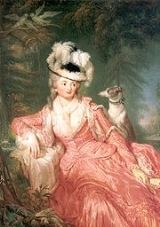
Frederick William II of Prussia

Encyclopedia
Frederick William II was the King of Prussia
, reigning from 1786 until his death. He was in personal union
the Prince-Elector
of Brandenburg and the sovereign prince of the Principality of Neuchâtel.
, the son of Prince Augustus William of Prussia
(the second son of King Frederick William I of Prussia
) and of Louise Amalie of Brunswick-Lüneburg
. His mother's elder sister, Elisabeth
, was the wife of Augustus William's brother King Frederick II
("Frederick the Great"). He was born in Berlin
and became heir to the throne of Prussia
on his father's death in 1758, since Frederick II had no children. The boy was of an easy-going and pleasure-loving disposition, averse to sustained effort of any kind, and sensual by nature.
His marriage with Elisabeth Christine of Brunswick-Lüneburg
, daughter of Charles I, Duke of Brunswick-Lüneburg
, contracted 14 July 1765 in Charlottenburg
, was dissolved in 1769. He then married Frederika Louisa of Hesse-Darmstadt
, daughter of Ludwig IX, Landgrave of Hesse-Darmstadt on 14 July 1769 also in Charlottenburg. Although he had a numerous family by his second wife, he was completely under the influence of his mistress, Wilhelmine Enke (afterwards created Countess Wilhelmine von Lichtenau), a woman of strong intellect and much ambition, and had many children by her.
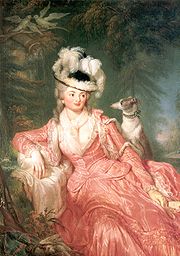 Frederick William before the corpulence of his middle age was a man of singularly handsome presence, not without mental qualities of a high order; he was devoted to the arts—Beethoven
and Mozart
enjoyed his patronage, and his private orchestra had a Europe-wide reputation. But an artistic temperament was hardly what was required of a king of Prussia on the eve of the French Revolution
; and Frederick the Great, who had employed him in various services—notably in an abortive confidential mission to the court of Russia in 1780—openly expressed his misgivings as to the character of the prince and his surroundings.
, by the admission of German writers to the Prussian Academy
, and by the active encouragement given to schools and universities.
But these reforms were vitiated in their source. In 1781 Frederick William, then prince of Prussia, inclined to mysticism
, had joined the Rosicrucian
s, and had fallen under the influence of Johann Christoph von Wöllner
(1732–1800), and by him the royal policy was inspired. Wöllner, whom Frederick the Great had described as a "treacherous and intriguing priest," had started life as a poor tutor in the family of General von Itzenplitz, a noble of the Margraviate of Brandenburg
. After the general′s death and to the scandal of king and nobility, he married the general′s daughter, and with his mother-in-law′s assistance settled down on a small estate. By his practical experiments and by his writings he gained a considerable reputation as an economist
; but his ambition was not content with this, and he sought to extend his influence by joining first the Freemasons
and afterwards the Rosicrucians. Wöllner, with his impressive personality and easy if superficial eloquence, was just the man to lead a movement of this kind. Under his influence the order spread rapidly, and he soon found himself the supreme director (Oberhauptdirektor) of several circles, which included in their membership princes, officers and high officials. As a Rosicrucian Wöllner dabbled in alchemy
and other mystic arts, but he also affected to be zealous for Christian
orthodoxy
, imperilled by Frederick II′s patronage of "Enlightenment", and a few months before Frederick′s death wrote to his friend the Rosicrucian Johann Rudolph von Bischoffswerder (1741–1803) that his highest ambition was to be placed at the head of the religious department of the state as an unworthy instrument in the hand of Ormesus (the prince of Prussia's Rosicrucian name) "for the purpose of saving millions of souls from perdition and bringing back the whole country to the faith of Jesus Christ."
Such was the man whom Frederick William II, immediately after his accession, called to his counsels. On 26 August 1786 Wöllner was appointed privy councillor for finance (Geheimer Oberfinanzrath), and on 2 October 1786 was ennobled. Though not in name, in fact he was prime minister; in all internal affairs it was he who decided; and the fiscal and economic reforms of the new reign were the application of his theories. Bischoffswerder, too, still a simple major, was called into the king′s counsels; by 1789 he was already an adjutant-general. These were the two men who enmeshed the king in a web of Rosicrucian mystery and intrigue, which hampered whatever healthy development of his policy might have been possible, and led ultimately to disaster. The opposition to Wöllner was, indeed, at the outset strong enough to prevent his being entrusted with the department of religion; but this too in time was overcome, and on 3 July 1788 he was appointed active privy councillor of state and of justice and head of the spiritual department for Lutheran and Catholic affairs.
War was at once declared on what later times would have called the "modernists". The king, so long as Wöllner was content to condone his immorality (which Bischoffswerder, to do him justice, condemned), was eager to help the orthodox crusade. On 9 July 1788 was issued the famous religious edict, which forbade Evangelical
ministers to teach anything not contained in the letter of their official books, proclaimed the necessity of protecting the Christian religion
against the "enlighteners" (Aufklärer), and placed educational establishments under the supervision of the orthodox clergy
. On 18 December 1788 a new censorship law was issued, to secure the orthodoxy of all published books; and finally, in 1791, a sort of Protestant Inquisition
was established at Berlin (Immediate-Examinationscommission) to watch over all ecclesiastical and scholastic appointments.
In his zeal for orthodoxy, indeed, Frederick William outstripped his minister; he even blamed Wöllner′s "idleness and vanity" for the inevitable failure of the attempt to regulate opinion from above, and in 1794 deprived him of one of his secular offices in order that he might have more time "to devote himself to the things of God"; in edict after edict the king continued to the end of his reign to make regulations "in order to maintain in his states a true and active Christianity, as the path to genuine fear of God."
The effects of this policy of blind obscurantism far outweighed any good that resulted from the king′s well-meant efforts at economic and financial reform; and even this reform was but spasmodic and partial, and awoke ultimately more discontent than it allayed.
But far more fateful for Prussia was the king's attitude towards the army and foreign policy. The army was the very foundation of the Prussian state, a truth which both Frederick William I and the great Frederick had fully realised; the army had been their first care, and its efficiency had been maintained by their constant personal supervision. Frederick William, who had no taste for military matters, put his authority as "Warlord
" (Kriegsherr) into commission under a supreme college of war (Oberkriegs-Collegium) under the Duke of Brunswick
and General Wichard Joachim Heinrich von Möllendorf. It was the beginning of the process that ended in 1806 at the Battle of Jena.
In the circumstances, Frederick William′s intervention in European affairs was not likely to prove of benefit to Prussia. The Dutch campaign of 1787
, entered into for purely family reasons, was indeed successful; but Prussia received not even the cost of her intervention. An attempt to intervene in the war of Russia
and Austria
against the Ottoman Empire
failed of its object; Prussia did not succeed in obtaining any concessions of territory from the alarms of the allies, and the dismissal of Hertzberg
(5 July 1791) marked the final abandonment of the anti-Austrian tradition of Frederick the Great.
had entered upon alarming phases, and in August 1791 Frederick William, at the meeting at Pillnitz Castle
, arranged with Emperor Leopold II
to join in supporting the cause of King Louis XVI of France
. But neither the king's character, nor the confusion of the Prussian finances due to his extravagance, gave promise of any effective action. A formal alliance was indeed signed on 7 February 1792, and Frederick William took part personally in the campaigns of 1792 and 1793. He was hampered, however, by want of funds, and his counsels were distracted by the affairs of Poland
, which promised a richer booty than was likely to be gained by the anti-revolutionary crusade into France. A subsidy
treaty with the sea powers (19 April 1794) filled his coffers; but the insurrection in Poland that followed the partition
of 1793, and the threat of the isolated intervention of Russia, hurried him into the separate Treaty of Basel
with the French Republic (5 April 1795), which was regarded by the great monarchies as a betrayal, and left Prussia morally isolated in Europe on the eve of the titanic struggle between the monarch
ical principle and the new political creed
of the Revolution.
Prussia had paid a heavy price for the territories acquired at the expense of Poland in 1793 and 1795, and when, on 16 November 1797, Frederick William died in Potsdam
, he left the state in bankruptcy and confusion, the army decayed and the monarchy discredited; the king himself was known to the people as Der dicke Lüderjahn ("The fat bastard"). He was succeeded by his son, Frederick William III
.
 Frederick William II had the following children:
Besides his relations with his maitresse en titre, the countess Lichtenau, the king—who was a frank polygamist—contracted two "marriages of the left hand" with Julie von Voß
and the Sophie von Dönhoff
.
Kingdom of Prussia
The Kingdom of Prussia was a German kingdom from 1701 to 1918. Until the defeat of Germany in World War I, it comprised almost two-thirds of the area of the German Empire...
, reigning from 1786 until his death. He was in personal union
Personal union
A personal union is the combination by which two or more different states have the same monarch while their boundaries, their laws and their interests remain distinct. It should not be confused with a federation which is internationally considered a single state...
the Prince-Elector
Prince-elector
The Prince-electors of the Holy Roman Empire were the members of the electoral college of the Holy Roman Empire, having the function of electing the Roman king or, from the middle of the 16th century onwards, directly the Holy Roman Emperor.The heir-apparent to a prince-elector was known as an...
of Brandenburg and the sovereign prince of the Principality of Neuchâtel.
Early life
Frederick William was born in BerlinBerlin
Berlin is the capital city of Germany and is one of the 16 states of Germany. With a population of 3.45 million people, Berlin is Germany's largest city. It is the second most populous city proper and the seventh most populous urban area in the European Union...
, the son of Prince Augustus William of Prussia
Prince Augustus William of Prussia
Augustus William of Prussia was Prince of Prussia and a brother of Frederick the Great...
(the second son of King Frederick William I of Prussia
Frederick William I of Prussia
Frederick William I of the House of Hohenzollern, was the King in Prussia and Elector of Brandenburg from 1713 until his death...
) and of Louise Amalie of Brunswick-Lüneburg
Louise Amalie of Brunswick-Lüneburg
Luise of Brunswick-Wolfenbüttel was daughter of Ferdinand Albert II, Duke of Brunswick-Lüneburg and his wife Antoinette of Brunswick-Wolfenbüttel.-Background:...
. His mother's elder sister, Elisabeth
Elisabeth Christine of Brunswick-Bevern
Elisabeth Christine of Brunswick-Wolfenbüttel-Bevern was a Queen of Prussia as wife of Frederick the Great...
, was the wife of Augustus William's brother King Frederick II
Frederick II of Prussia
Frederick II was a King in Prussia and a King of Prussia from the Hohenzollern dynasty. In his role as a prince-elector of the Holy Roman Empire, he was also Elector of Brandenburg. He was in personal union the sovereign prince of the Principality of Neuchâtel...
("Frederick the Great"). He was born in Berlin
Berlin
Berlin is the capital city of Germany and is one of the 16 states of Germany. With a population of 3.45 million people, Berlin is Germany's largest city. It is the second most populous city proper and the seventh most populous urban area in the European Union...
and became heir to the throne of Prussia
Prussia
Prussia was a German kingdom and historic state originating out of the Duchy of Prussia and the Margraviate of Brandenburg. For centuries, the House of Hohenzollern ruled Prussia, successfully expanding its size by way of an unusually well-organized and effective army. Prussia shaped the history...
on his father's death in 1758, since Frederick II had no children. The boy was of an easy-going and pleasure-loving disposition, averse to sustained effort of any kind, and sensual by nature.
His marriage with Elisabeth Christine of Brunswick-Lüneburg
Elisabeth Christine of Brunswick-Lüneburg
Elisabeth Christine of Brunswick-Wolfenbüttel , was the first wife of Prince Frederick William, her cousin and the future king Frederick William II of Prussia....
, daughter of Charles I, Duke of Brunswick-Lüneburg
Charles I, Duke of Brunswick-Lüneburg
Charles , Duke of Brunswick-Lunenburg , was ruling as Prince of Wolfenbüttel from 1735 until his death.-Life:...
, contracted 14 July 1765 in Charlottenburg
Charlottenburg
Charlottenburg is a locality of Berlin within the borough of Charlottenburg-Wilmersdorf, named after Queen consort Sophia Charlotte...
, was dissolved in 1769. He then married Frederika Louisa of Hesse-Darmstadt
Frederika Louisa of Hesse-Darmstadt
Frederika of Hesse-Darmstadt was Queen consort of the Kingdom of Prussia as the second wife of Frederick William II of Prussia.-Background:...
, daughter of Ludwig IX, Landgrave of Hesse-Darmstadt on 14 July 1769 also in Charlottenburg. Although he had a numerous family by his second wife, he was completely under the influence of his mistress, Wilhelmine Enke (afterwards created Countess Wilhelmine von Lichtenau), a woman of strong intellect and much ambition, and had many children by her.
Ludwig van Beethoven
Ludwig van Beethoven was a German composer and pianist. A crucial figure in the transition between the Classical and Romantic eras in Western art music, he remains one of the most famous and influential composers of all time.Born in Bonn, then the capital of the Electorate of Cologne and part of...
and Mozart
Wolfgang Amadeus Mozart
Wolfgang Amadeus Mozart , baptismal name Johannes Chrysostomus Wolfgangus Theophilus Mozart , was a prolific and influential composer of the Classical era. He composed over 600 works, many acknowledged as pinnacles of symphonic, concertante, chamber, piano, operatic, and choral music...
enjoyed his patronage, and his private orchestra had a Europe-wide reputation. But an artistic temperament was hardly what was required of a king of Prussia on the eve of the French Revolution
French Revolution
The French Revolution , sometimes distinguished as the 'Great French Revolution' , was a period of radical social and political upheaval in France and Europe. The absolute monarchy that had ruled France for centuries collapsed in three years...
; and Frederick the Great, who had employed him in various services—notably in an abortive confidential mission to the court of Russia in 1780—openly expressed his misgivings as to the character of the prince and his surroundings.
King of Prussia
The misgivings appear justified by the event. Frederick William′s accession to the throne (17 August 1786) was, indeed, followed by a series of measures for lightening the burdens of the people, reforming the oppressive French system of tax-collecting introduced by Frederick, and encouraging trade by the diminution of customs dues and the making of roads and canals. This gave the new king much popularity with the masses; while the educated classes were pleased by his removal of Frederick′s ban on the German languageGerman language
German is a West Germanic language, related to and classified alongside English and Dutch. With an estimated 90 – 98 million native speakers, German is one of the world's major languages and is the most widely-spoken first language in the European Union....
, by the admission of German writers to the Prussian Academy
Prussian Academy
Prussian Academy may refer to:*Prussian Academy of the Arts, now the Akademie der Künste, Berlin*Prussian Academy of Sciences*Prussian Military Academy...
, and by the active encouragement given to schools and universities.
But these reforms were vitiated in their source. In 1781 Frederick William, then prince of Prussia, inclined to mysticism
Mysticism
Mysticism is the knowledge of, and especially the personal experience of, states of consciousness, i.e. levels of being, beyond normal human perception, including experience and even communion with a supreme being.-Classical origins:...
, had joined the Rosicrucian
Rosicrucian
Rosicrucianism is a philosophical secret society, said to have been founded in late medieval Germany by Christian Rosenkreuz. It holds a doctrine or theology "built on esoteric truths of the ancient past", which, "concealed from the average man, provide insight into nature, the physical universe...
s, and had fallen under the influence of Johann Christoph von Wöllner
Johann Christoph von Wöllner
Johann Christoph von Wöllner was a Prussian pastor and politician under King Frederick William II. He inclined to mysticism and joined the Freemasons and Rosicrucians....
(1732–1800), and by him the royal policy was inspired. Wöllner, whom Frederick the Great had described as a "treacherous and intriguing priest," had started life as a poor tutor in the family of General von Itzenplitz, a noble of the Margraviate of Brandenburg
Margraviate of Brandenburg
The Margraviate of Brandenburg was a major principality of the Holy Roman Empire from 1157 to 1806. Also known as the March of Brandenburg , it played a pivotal role in the history of Germany and Central Europe....
. After the general′s death and to the scandal of king and nobility, he married the general′s daughter, and with his mother-in-law′s assistance settled down on a small estate. By his practical experiments and by his writings he gained a considerable reputation as an economist
Economist
An economist is a professional in the social science discipline of economics. The individual may also study, develop, and apply theories and concepts from economics and write about economic policy...
; but his ambition was not content with this, and he sought to extend his influence by joining first the Freemasons
Freemasonry
Freemasonry is a fraternal organisation that arose from obscure origins in the late 16th to early 17th century. Freemasonry now exists in various forms all over the world, with a membership estimated at around six million, including approximately 150,000 under the jurisdictions of the Grand Lodge...
and afterwards the Rosicrucians. Wöllner, with his impressive personality and easy if superficial eloquence, was just the man to lead a movement of this kind. Under his influence the order spread rapidly, and he soon found himself the supreme director (Oberhauptdirektor) of several circles, which included in their membership princes, officers and high officials. As a Rosicrucian Wöllner dabbled in alchemy
Alchemy
Alchemy is an influential philosophical tradition whose early practitioners’ claims to profound powers were known from antiquity. The defining objectives of alchemy are varied; these include the creation of the fabled philosopher's stone possessing powers including the capability of turning base...
and other mystic arts, but he also affected to be zealous for Christian
Christian
A Christian is a person who adheres to Christianity, an Abrahamic, monotheistic religion based on the life and teachings of Jesus of Nazareth as recorded in the Canonical gospels and the letters of the New Testament...
orthodoxy
Orthodoxy
The word orthodox, from Greek orthos + doxa , is generally used to mean the adherence to accepted norms, more specifically to creeds, especially in religion...
, imperilled by Frederick II′s patronage of "Enlightenment", and a few months before Frederick′s death wrote to his friend the Rosicrucian Johann Rudolph von Bischoffswerder (1741–1803) that his highest ambition was to be placed at the head of the religious department of the state as an unworthy instrument in the hand of Ormesus (the prince of Prussia's Rosicrucian name) "for the purpose of saving millions of souls from perdition and bringing back the whole country to the faith of Jesus Christ."
Such was the man whom Frederick William II, immediately after his accession, called to his counsels. On 26 August 1786 Wöllner was appointed privy councillor for finance (Geheimer Oberfinanzrath), and on 2 October 1786 was ennobled. Though not in name, in fact he was prime minister; in all internal affairs it was he who decided; and the fiscal and economic reforms of the new reign were the application of his theories. Bischoffswerder, too, still a simple major, was called into the king′s counsels; by 1789 he was already an adjutant-general. These were the two men who enmeshed the king in a web of Rosicrucian mystery and intrigue, which hampered whatever healthy development of his policy might have been possible, and led ultimately to disaster. The opposition to Wöllner was, indeed, at the outset strong enough to prevent his being entrusted with the department of religion; but this too in time was overcome, and on 3 July 1788 he was appointed active privy councillor of state and of justice and head of the spiritual department for Lutheran and Catholic affairs.
War was at once declared on what later times would have called the "modernists". The king, so long as Wöllner was content to condone his immorality (which Bischoffswerder, to do him justice, condemned), was eager to help the orthodox crusade. On 9 July 1788 was issued the famous religious edict, which forbade Evangelical
Evangelicalism
Evangelicalism is a Protestant Christian movement which began in Great Britain in the 1730s and gained popularity in the United States during the series of Great Awakenings of the 18th and 19th century.Its key commitments are:...
ministers to teach anything not contained in the letter of their official books, proclaimed the necessity of protecting the Christian religion
Religion
Religion is a collection of cultural systems, belief systems, and worldviews that establishes symbols that relate humanity to spirituality and, sometimes, to moral values. Many religions have narratives, symbols, traditions and sacred histories that are intended to give meaning to life or to...
against the "enlighteners" (Aufklärer), and placed educational establishments under the supervision of the orthodox clergy
Clergy
Clergy is the generic term used to describe the formal religious leadership within a given religion. A clergyman, churchman or cleric is a member of the clergy, especially one who is a priest, preacher, pastor, or other religious professional....
. On 18 December 1788 a new censorship law was issued, to secure the orthodoxy of all published books; and finally, in 1791, a sort of Protestant Inquisition
Inquisition
The Inquisition, Inquisitio Haereticae Pravitatis , was the "fight against heretics" by several institutions within the justice-system of the Roman Catholic Church. It started in the 12th century, with the introduction of torture in the persecution of heresy...
was established at Berlin (Immediate-Examinationscommission) to watch over all ecclesiastical and scholastic appointments.
In his zeal for orthodoxy, indeed, Frederick William outstripped his minister; he even blamed Wöllner′s "idleness and vanity" for the inevitable failure of the attempt to regulate opinion from above, and in 1794 deprived him of one of his secular offices in order that he might have more time "to devote himself to the things of God"; in edict after edict the king continued to the end of his reign to make regulations "in order to maintain in his states a true and active Christianity, as the path to genuine fear of God."
The effects of this policy of blind obscurantism far outweighed any good that resulted from the king′s well-meant efforts at economic and financial reform; and even this reform was but spasmodic and partial, and awoke ultimately more discontent than it allayed.
But far more fateful for Prussia was the king's attitude towards the army and foreign policy. The army was the very foundation of the Prussian state, a truth which both Frederick William I and the great Frederick had fully realised; the army had been their first care, and its efficiency had been maintained by their constant personal supervision. Frederick William, who had no taste for military matters, put his authority as "Warlord
Warlord
A warlord is a person with power who has both military and civil control over a subnational area due to armed forces loyal to the warlord and not to a central authority. The term can also mean one who espouses the ideal that war is necessary, and has the means and authority to engage in war...
" (Kriegsherr) into commission under a supreme college of war (Oberkriegs-Collegium) under the Duke of Brunswick
Charles William Ferdinand, Duke of Brunswick
Charles William Ferdinand , Duke of Brunswick-Wolfenbüttel, was a sovereign prince of the Holy Roman Empire, and a professional soldier who served as a Generalfeldmarschall of the Kingdom of Prussia...
and General Wichard Joachim Heinrich von Möllendorf. It was the beginning of the process that ended in 1806 at the Battle of Jena.
In the circumstances, Frederick William′s intervention in European affairs was not likely to prove of benefit to Prussia. The Dutch campaign of 1787
Dutch Patriot Revolt, 1787
The Dutch Patriot Revolt was part of a series of revolutionary actions that took place from 1787 through 1789 in the Dutch Republic, Austrian Netherlands , Poland, and France.-Background:...
, entered into for purely family reasons, was indeed successful; but Prussia received not even the cost of her intervention. An attempt to intervene in the war of Russia
Russian Empire
The Russian Empire was a state that existed from 1721 until the Russian Revolution of 1917. It was the successor to the Tsardom of Russia and the predecessor of the Soviet Union...
and Austria
Habsburg Monarchy
The Habsburg Monarchy covered the territories ruled by the junior Austrian branch of the House of Habsburg , and then by the successor House of Habsburg-Lorraine , between 1526 and 1867/1918. The Imperial capital was Vienna, except from 1583 to 1611, when it was moved to Prague...
against the Ottoman Empire
Ottoman Empire
The Ottoman EmpireIt was usually referred to as the "Ottoman Empire", the "Turkish Empire", the "Ottoman Caliphate" or more commonly "Turkey" by its contemporaries...
failed of its object; Prussia did not succeed in obtaining any concessions of territory from the alarms of the allies, and the dismissal of Hertzberg
Ewald Friedrich, Count von Hertzberg
Ewald Friedrich Graf von Hertzberg was a Prussian statesman.Hertzberg, who came of a noble family which had been settled in Pomerania since the 13th century, was born at Lottin near Neustettin.After 1739 he studied, chiefly classics and history at the gymnasium at Stettin, and in 1742 entered the...
(5 July 1791) marked the final abandonment of the anti-Austrian tradition of Frederick the Great.
Revolution
Meanwhile, the French RevolutionFrench Revolution
The French Revolution , sometimes distinguished as the 'Great French Revolution' , was a period of radical social and political upheaval in France and Europe. The absolute monarchy that had ruled France for centuries collapsed in three years...
had entered upon alarming phases, and in August 1791 Frederick William, at the meeting at Pillnitz Castle
Pillnitz Castle
Pillnitz Castle is a restored Baroque castle at the eastern end of the city of Dresden in the German state of Saxony. It is located on the bank of the River Elbe in the former village of Pillnitz...
, arranged with Emperor Leopold II
Leopold II, Holy Roman Emperor
Leopold II , born Peter Leopold Joseph Anton Joachim Pius Gotthard, was Holy Roman Emperor and King of Hungary and Bohemia from 1790 to 1792, Archduke of Austria and Grand Duke of Tuscany from 1765 to 1790. He was a son of Emperor Francis I and his wife, Empress Maria Theresa...
to join in supporting the cause of King Louis XVI of France
Louis XVI of France
Louis XVI was a Bourbon monarch who ruled as King of France and Navarre until 1791, and then as King of the French from 1791 to 1792, before being executed in 1793....
. But neither the king's character, nor the confusion of the Prussian finances due to his extravagance, gave promise of any effective action. A formal alliance was indeed signed on 7 February 1792, and Frederick William took part personally in the campaigns of 1792 and 1793. He was hampered, however, by want of funds, and his counsels were distracted by the affairs of Poland
Polish-Lithuanian Commonwealth
The Polish–Lithuanian Commonwealth was a dualistic state of Poland and Lithuania ruled by a common monarch. It was the largest and one of the most populous countries of 16th- and 17th‑century Europe with some and a multi-ethnic population of 11 million at its peak in the early 17th century...
, which promised a richer booty than was likely to be gained by the anti-revolutionary crusade into France. A subsidy
Subsidy
A subsidy is an assistance paid to a business or economic sector. Most subsidies are made by the government to producers or distributors in an industry to prevent the decline of that industry or an increase in the prices of its products or simply to encourage it to hire more labor A subsidy (also...
treaty with the sea powers (19 April 1794) filled his coffers; but the insurrection in Poland that followed the partition
Second Partition of Poland
The 1793 Second Partition of the Polish-Lithuanian Commonwealth was the second of three partitions that ended the existence of the Polish-Lithuanian Commonwealth by 1795. The second partition occurred in the aftermath of the War in Defense of the Constitution and the Targowica Confederation of 1792...
of 1793, and the threat of the isolated intervention of Russia, hurried him into the separate Treaty of Basel
Peace of Basel
The Peace of Basel of 1795 consists of three peace treaties involving France .* The first of the three treaties of 1795, France made peace with Prussia on 5 April; , * The Second was with Spain on 22 July, ending the War of the Pyrenees; and*...
with the French Republic (5 April 1795), which was regarded by the great monarchies as a betrayal, and left Prussia morally isolated in Europe on the eve of the titanic struggle between the monarch
Monarch
A monarch is the person who heads a monarchy. This is a form of government in which a state or polity is ruled or controlled by an individual who typically inherits the throne by birth and occasionally rules for life or until abdication...
ical principle and the new political creed
Creed
A creed is a statement of belief—usually a statement of faith that describes the beliefs shared by a religious community—and is often recited as part of a religious service. When the statement of faith is longer and polemical, as well as didactic, it is not called a creed but a Confession of faith...
of the Revolution.
Prussia had paid a heavy price for the territories acquired at the expense of Poland in 1793 and 1795, and when, on 16 November 1797, Frederick William died in Potsdam
Potsdam
Potsdam is the capital city of the German federal state of Brandenburg and part of the Berlin/Brandenburg Metropolitan Region. It is situated on the River Havel, southwest of Berlin city centre....
, he left the state in bankruptcy and confusion, the army decayed and the monarchy discredited; the king himself was known to the people as Der dicke Lüderjahn ("The fat bastard"). He was succeeded by his son, Frederick William III
Frederick William III of Prussia
Frederick William III was king of Prussia from 1797 to 1840. He was in personal union the sovereign prince of the Principality of Neuchâtel .-Early life:...
.
Ancestry
Posterity, Love, and Children
- By Elizabeth Christine of Brunswick-Lüneburg:
- Frederica Charlotte (1767–1820), who became Duchess of York by her marriage to Frederick, Duke of York
- By Frederika Louisa of Hesse-Darmstadt:
- Frederick William III of PrussiaFrederick William III of PrussiaFrederick William III was king of Prussia from 1797 to 1840. He was in personal union the sovereign prince of the Principality of Neuchâtel .-Early life:...
(1770–1840) - Christine (1772–73)
- LouisPrince Louis Charles of PrussiaPrince Louis Charles of Prussia was the second son and third child of Frederick William II of Prussia and Frederika Louisa of Hesse-Darmstadt.-Marriage and issue:...
(1773–96) - Frederika Louisa Wilhelmina (1774–1837), wife of William of Orange, afterwards King William I of the NetherlandsWilliam I of the NetherlandsWilliam I Frederick, born Willem Frederik Prins van Oranje-Nassau , was a Prince of Orange and the first King of the Netherlands and Grand Duke of Luxembourg....
- AugustaPrincess Augusta of PrussiaPrincess Augusta of Prussia was a German salonist and electress consort of Hesse. She was the third daughter and fifth child of Frederick William II of Prussia and Frederika Louisa of Hesse-Darmstadt. She was the first consort of William II, Elector of Hesse. Augusta was a talented painter...
(1780–1841), wife of William II, Elector of HesseWilliam II, Elector of Hesse-Biography:William was the eldest surviving son of William I, Elector of Hesse and Wilhelmina Caroline of Denmark and Norway. He succeeded as Elector of Hesse on his father's death in 1821.-Marriage and issue:On 13 February 1797 in Berlin, William married Princess Augusta of Prussia, fourth... - Charles (1781–1846)
- William (1783–1851)
- Frederick William III of Prussia
Besides his relations with his maitresse en titre, the countess Lichtenau, the king—who was a frank polygamist—contracted two "marriages of the left hand" with Julie von Voß
Julie von Voß
Julie Amalie Elisabeth von Voss was a German lady-in-waiting and a bigamous morganatic spouse of King Frederick William II of Prussia....
and the Sophie von Dönhoff
Sophie von Dönhoff
Sophie Friederike Juliane von Dönhoff was a German lady-in-waiting and a morganatic spouse by bigamy to King Frederick William II of Prussia....
.