


Tirailleur

Encyclopedia
Tirailleur literally means a shooting skirmisher
in French
from tir—shot. The term dates back to the Napoleonic period where it was used to designate light infantry
trained to skirmish ahead of the main columns. Subsequently "tirailleurs" was used by the French Army as a designation for infantry recruited in the various French colonial territories
during the 19th and 20th centuries; or for metropolitan units serving in a light infantry role.
. By the fall of the Empire, some 16 regiments had been created. The Guard Tirailleurs were usually grouped as part of the Young Guard, along with their sister Voltigeur regiments. The Guard Tirailleur regiments were disbanded during the reorganization of the French Army in 1814 by the new royal government. On 28 March 1815, during Napoleon I's short-lived return to power (the Hundred Days
), Regiments 1-8 of the Guard Tirailleurs were officially re-raised. Only the 1st and 3rd Regiments actually took the field for the Waterloo campaign. All regiments of Imperial Guard Tirailleurs (along with the rest of the Guard) were disbanded following the Emperor's second abdication.
subsequently served in the Crimean War
, the Second Italian War of Independence
, the French intervention in Mexico
and the Franco-Prussian War
(1870), as well as in various French colonial campaigns in Tunisia, Indochina, Morocco, Madagascar and Algeria itself. During the Crimean War the Algerian tirailleurs acquired the nickname of "Turcos" (Turks) by which they were widely known over the next hundred years. The name reportedly arose from comparisons between the Algerian troops and the Turkish allies serving alongside the French and British forces at the siege of Sebastopol.
First raised in 1841 as battalions of tirailleurs indigenes, the locally recruited Algerian infantry were organised into three regiments of Algerian Tirailleurs by a decree dated 10 October 1855. The number of such units fluctuated over the next hundred years until in the early 1960s eight regiments of tirailleurs plus a number of independent battalions remained in French service
In 1884, the 4th Regiment of Tirailleurs was created in Tunisia. Except for minor distinctions of insignia and uniform (their numbering was based on the figure "4" and its multiples; plus light blue tombeaus or false pockets on their full dress zouave jackets) the Tunisian tirailleurs regiments had the same appearance as their Algerian counterparts. It was only in 1921 that the French government decided to name them officially "Tunisian Tirailleurs Regiments".
In 1914, during World War I, the 1st Regiment of Moroccan Tirailleurs was created. At the end of the period of French rule in 1956 six regiments of Moroccan tirailleurs were still in existence.
Recruitment was generally voluntary, although a selective form of conscription was introduced in Algeria in 1913 and continued until the end of French rule in North Africa.
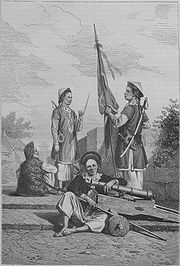
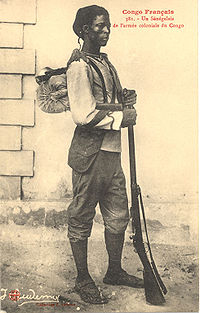 France made extensive use of tirailleurs in its various colonial campaigns. The most numerous of these, after the "tirailleurs algériens" noted above, were the "tirailleurs sénégalais" (who were recruited from all of the French possessions in West and Central Africa). Both played an important role in the occupation of Morocco (1908–14) as well as in the Rif War of the 1920s
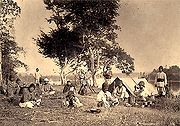
.
, incurring heavy losses. René Riffaud
(1898–2007) was one of them. The Great Mosque of Paris was constructed afterwards in honour of the Muslim tirailleurs who had fought for France.
(Algerian, Moroccan
s, and Tunisian
s), from French West Africa
, from Madagascar
, and from Indochina
(Annam, Tonkin
, and Cambodia
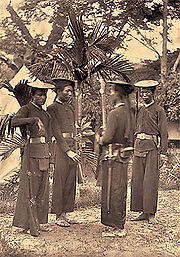
). The individual regiments were named after the territory in which they were recruited. Thus "tirailleurs Malgaches", "tirailleurs Annamites", "tirailleurs Tunisiens", "tirailleurs Tonkinois
", "tirailleurs Cambodgiens" etc.
tirailleurs served in Indo-China until the fall of Dien Bien Phu and subsequently as part of the French forces during the Algerian War of Independence (1954–62). Even after the French withdrawal from Indochina a unit of mostly Vietnamese tirailleurs ("le Commando d'Extreme Orient Dam San ") continued to serve with the French Army in Algeria until 1960.
. In Morocco, Tunisia and the various new African states most tirailleurs transferred direct from the French service to their new national armies. This was not the case in Algeria where locally recruited tirailleurs who remained loyal to France were given the option of transferring to units in France itself at the end of the Algerian War in 1962. The last Moroccan regiment in the French Army was the 5th RTM (Regiment de Tirailleurs Marocain) which was stationed at Dijon until it was disbanded in 1965.
There is still one Tirailleur regiment in the modern French Army
, which is descended from the Algerian tirailleurs. While these troops are now entirely French, items of the traditional North African uniform are still worn on ceremonial occasions to commemorate the Algerian "Turcos" who served France for over 130 years. The traditions of the tirailleurs Senegalais are maintained by the 21eme Regiment d'infanterie de marine stationed in Frejus
, through the 4e Régiment de Tirailleurs Sénégalais of the Second World War.
style uniforms of light blue with yellow braiding. White turbans, red fez
s and sashes were worn with both this "tenue orientale" and with a white service dress of similar loose cut. The West African and Madagascan tirailleurs wore a dark blue parade dress with red sash and fez while the Indochinese regiments wore an indigenous style of blue, white or khaki uniform with a flat "salacco" headdress. Khaki had been widely worn as a hot weather field dress in the years before the outbreak of World War I and thereafter became the norm. The North African tirailleurs however resumed their colourful full dress uniforms between 1927 and 1939 to assist recruitment.
(Cross of War) with attachments on the ribbon depending on the degree of citation: the lowest being represented by a bronze star (for those who had been cited at the regiment or brigade level) while the highest degree is represented by a bronze palm (for those who had been cited at the army level). A unit can be mentioned in Despatches. Its flag is then decorated with the corresponding Croix. After two citations in Army Orders, the men of the unit concerned are all entitled to wear a fourragère
.
Regiments of North African Tirailleurs are, together with regiments of Zouaves, among the most decorated regiments in the French Army, just after the Colonial Infantry Regiment of Morocco and the Foreign Legion March Regiment
.
including 4 regiments of North African Tirailleurs (2nd, 4th, 7th Tirailleurs and 4th Zouaves and Tirailleurs).
By the end of the war, all the 16 North African Tirailleur regiments existing as of August 1918 (12 Algerian/Tunisian, 2 Moroccan and 2 Zouaves and Tirailleurs), were awarded a Fourragère
(at least 2 citations in Army Orders). Only one regiment of Senegalese Tirailleurs were awarded a Fourragère in 1919.
at Camp Tiaroye in December 1944. The tirailleurs involved were former prisoners of war who had been repatriated to West Africa and placed in a holding camp awaiting discharge. They demonstrated in protest against the failure of the French authorities to pay salary arrears and discharge allowances. French soldiers guarding the camp opened fire killing thirty-five African soldiers. The provisional government of Charles de Gaulle, concerned at the impact of the Tiaroye incident on serving tirailleurs acted quickly to ensure that claims for back pay and other monies owing were settled.
When France's African colonies achieved independence between 1956 and the early 1960s, the military pensions of veterans who became citizens of the new nations were frozen. By contrast their French counterparts, who might have served in the same units and fought in the same battles, received pensions that were adjusted for inflation in France itself.
While the imbalanced situation was widely deplored, successive French governments did not act on the complaints of former French Army soldiers. One rationale for the freezing of the pensions was that increased levels would have created an income gap between the former soldiers and the rest of the populations in African countries where the cost of living was significantly lower than in France.
It was only in 2006 that President Jacques Chirac
, reportedly moved by Rachid Bouchareb
's movie Indigènes
, gave instructions to increase the pensions of former colonial soldiers. However, more than forty years after the colonies had gained independence and sixty years after World War II had ended, many of the veterans had already died.
Skirmisher
Skirmishers are infantry or cavalry soldiers stationed ahead or alongside a larger body of friendly troops. They are usually placed in a skirmish line to harass the enemy.-Pre-modern:...
in French
French language
French is a Romance language spoken as a first language in France, the Romandy region in Switzerland, Wallonia and Brussels in Belgium, Monaco, the regions of Quebec and Acadia in Canada, and by various communities elsewhere. Second-language speakers of French are distributed throughout many parts...
from tir—shot. The term dates back to the Napoleonic period where it was used to designate light infantry
Light infantry
Traditionally light infantry were soldiers whose job was to provide a skirmishing screen ahead of the main body of infantry, harassing and delaying the enemy advance. Light infantry was distinct from medium, heavy or line infantry. Heavy infantry were dedicated primarily to fighting in tight...
trained to skirmish ahead of the main columns. Subsequently "tirailleurs" was used by the French Army as a designation for infantry recruited in the various French colonial territories
French colonial empires
The French colonial empire was the set of territories outside Europe that were under French rule primarily from the 17th century to the late 1960s. In the 19th and 20th centuries, the colonial empire of France was the second-largest in the world behind the British Empire. The French colonial empire...
during the 19th and 20th centuries; or for metropolitan units serving in a light infantry role.
Napoleonic period
In the wars of the French Revolutionary and Napoleonic periods the designation "tirailleur" was a French military term used at first to refer generically to light infantry skirmishers. The first regiments of Tirailleurs so-called were part of the Imperial Guard of Napoleon INapoleon I of France
Napoleon Bonaparte was a French military and political leader during the latter stages of the French Revolution.As Napoleon I, he was Emperor of the French from 1804 to 1815...
. By the fall of the Empire, some 16 regiments had been created. The Guard Tirailleurs were usually grouped as part of the Young Guard, along with their sister Voltigeur regiments. The Guard Tirailleur regiments were disbanded during the reorganization of the French Army in 1814 by the new royal government. On 28 March 1815, during Napoleon I's short-lived return to power (the Hundred Days
Hundred Days
The Hundred Days, sometimes known as the Hundred Days of Napoleon or Napoleon's Hundred Days for specificity, marked the period between Emperor Napoleon I of France's return from exile on Elba to Paris on 20 March 1815 and the second restoration of King Louis XVIII on 8 July 1815...
), Regiments 1-8 of the Guard Tirailleurs were officially re-raised. Only the 1st and 3rd Regiments actually took the field for the Waterloo campaign. All regiments of Imperial Guard Tirailleurs (along with the rest of the Guard) were disbanded following the Emperor's second abdication.
Origins
The first tirailleurs employed in French North Africa were a metropolitan light infantry unit - the 1er bataillon de tirailleurs de Vincennes which disembarked in Algiers in early 1840. This unit subsequently became the chasseurs d'Orléans but the title of tirailleurs was allocted the next year to newly raised regiments of indigenous Algerian infantry recruited from the Arab and Berber communities.Algerian, Tunisian and Moroccan tirailleurs
The tirailleurs from AlgeriaFrench rule in Algeria
French Algeria lasted from 1830 to 1962, under a variety of governmental systems. From 1848 until independence, the whole Mediterranean region of Algeria was administered as an integral part of France, much like Corsica and Réunion are to this day. The vast arid interior of Algeria, like the rest...
subsequently served in the Crimean War
Crimean War
The Crimean War was a conflict fought between the Russian Empire and an alliance of the French Empire, the British Empire, the Ottoman Empire, and the Kingdom of Sardinia. The war was part of a long-running contest between the major European powers for influence over territories of the declining...
, the Second Italian War of Independence
Second Italian War of Independence
The Second War of Italian Independence, Franco-Austrian War, Austro-Sardinian War, or Austro-Piedmontese War , was fought by Napoleon III of France and the Kingdom of Piedmont-Sardinia against the Austrian Empire in 1859...
, the French intervention in Mexico
French intervention in Mexico
The French intervention in Mexico , also known as The Maximilian Affair, War of the French Intervention, and The Franco-Mexican War, was an invasion of Mexico by an expeditionary force sent by the Second French Empire, supported in the beginning by the United Kingdom and the Kingdom of Spain...
and the Franco-Prussian War
Franco-Prussian War
The Franco-Prussian War or Franco-German War, often referred to in France as the 1870 War was a conflict between the Second French Empire and the Kingdom of Prussia. Prussia was aided by the North German Confederation, of which it was a member, and the South German states of Baden, Württemberg and...
(1870), as well as in various French colonial campaigns in Tunisia, Indochina, Morocco, Madagascar and Algeria itself. During the Crimean War the Algerian tirailleurs acquired the nickname of "Turcos" (Turks) by which they were widely known over the next hundred years. The name reportedly arose from comparisons between the Algerian troops and the Turkish allies serving alongside the French and British forces at the siege of Sebastopol.
First raised in 1841 as battalions of tirailleurs indigenes, the locally recruited Algerian infantry were organised into three regiments of Algerian Tirailleurs by a decree dated 10 October 1855. The number of such units fluctuated over the next hundred years until in the early 1960s eight regiments of tirailleurs plus a number of independent battalions remained in French service
In 1884, the 4th Regiment of Tirailleurs was created in Tunisia. Except for minor distinctions of insignia and uniform (their numbering was based on the figure "4" and its multiples; plus light blue tombeaus or false pockets on their full dress zouave jackets) the Tunisian tirailleurs regiments had the same appearance as their Algerian counterparts. It was only in 1921 that the French government decided to name them officially "Tunisian Tirailleurs Regiments".
In 1914, during World War I, the 1st Regiment of Moroccan Tirailleurs was created. At the end of the period of French rule in 1956 six regiments of Moroccan tirailleurs were still in existence.
Recruitment was generally voluntary, although a selective form of conscription was introduced in Algeria in 1913 and continued until the end of French rule in North Africa.
Senegalese tirailleurs
Rif War (1920)
The Rif War, also called the Second Moroccan War, was fought between Spain and the Moroccan Rif Berbers.-Rifian forces:...
.
World War I
During World War I (1914–18) tirailleurs from the various African territories served on the Western Front as well as at GallipoliGallipoli
The Gallipoli peninsula is located in Turkish Thrace , the European part of Turkey, with the Aegean Sea to the west and the Dardanelles straits to the east. Gallipoli derives its name from the Greek "Καλλίπολις" , meaning "Beautiful City"...
, incurring heavy losses. René Riffaud
René Riffaud
René Félix Louis Joseph Riffaud was one of the last four 'official' French veterans of the Great War when he died at age 108 in Tosny, France....
(1898–2007) was one of them. The Great Mosque of Paris was constructed afterwards in honour of the Muslim tirailleurs who had fought for France.
Tirailleur regiments from other French possessions
Prior to and during World War II (1939–45), tirailleurs were recruited from the MaghrebMaghreb
The Maghreb is the region of Northwest Africa, west of Egypt. It includes five countries: Morocco, Algeria, Tunisia, Libya, and Mauritania and the disputed territory of Western Sahara...
(Algerian, Moroccan
History of Morocco
The History of Morocco spans over 12 centuries, without considering the Classical antiquity. The country was first unified by the Idrisid dynasty in 780, representing the first Islamic state in Africa autonomous from the Arab Empire. Under the Almoravid dynasty and the Almohad dynasty, Morocco...
s, and Tunisian
History of Tunisia
The History of Tunisia is subdivided into the following articles:*Outlines of early Tunisia*History of Punic era Tunisia*History of Roman era Tunisia*History of early Islamic Tunisia*History of medieval Tunisia*History of Ottoman era Tunisia...
s), from French West Africa
French West Africa
French West Africa was a federation of eight French colonial territories in Africa: Mauritania, Senegal, French Sudan , French Guinea , Côte d'Ivoire , Upper Volta , Dahomey and Niger...
, from Madagascar
Madagascar
The Republic of Madagascar is an island country located in the Indian Ocean off the southeastern coast of Africa...
, and from Indochina
Indochina
The Indochinese peninsula, is a region in Southeast Asia. It lies roughly southwest of China, and east of India. The name has its origins in the French, Indochine, as a combination of the names of "China" and "India", and was adopted when French colonizers in Vietnam began expanding their territory...
(Annam, Tonkin
Tonkin
Tonkin , also spelled Tongkin, Tonquin or Tongking, is the northernmost part of Vietnam, south of China's Yunnan and Guangxi Provinces, east of northern Laos, and west of the Gulf of Tonkin. Locally, it is known as Bắc Kỳ, meaning "Northern Region"...
, and Cambodia
Cambodia
Cambodia , officially known as the Kingdom of Cambodia, is a country located in the southern portion of the Indochina Peninsula in Southeast Asia...
). The individual regiments were named after the territory in which they were recruited. Thus "tirailleurs Malgaches", "tirailleurs Annamites", "tirailleurs Tunisiens", "tirailleurs Tonkinois
Tonkinese Rifles
The Tonkinese Rifles were a corps of Tonkinese light infantrymen raised in 1884 to support the operations of the Tonkin Expeditionary Corps...
", "tirailleurs Cambodgiens" etc.
World War II and subsequent campaigns
Tirailleurs from North and Central Africa fought with distinction in Europe during World War II, notably in the Italian campaign. The Indo-Chinese tirailleur regiments were disbanded following the Japanese coups against the French colonial administration in March 1945. Algerian, Moroccan and SenegaleseSenegalese Tirailleurs
The Senegalese Tirailleurs were a corps of colonial infantry in the French Army recruited from Senegal,French West Africa and throughout west, central and east Africa, the main province of the French colonial empire...
tirailleurs served in Indo-China until the fall of Dien Bien Phu and subsequently as part of the French forces during the Algerian War of Independence (1954–62). Even after the French withdrawal from Indochina a unit of mostly Vietnamese tirailleurs ("le Commando d'Extreme Orient Dam San ") continued to serve with the French Army in Algeria until 1960.
Disbanding of the tirailleur regiments
Most of the tirailleur regiments were disbanded as the various French colonies and protectorates achieved independence between 1956 and 1962Decolonization
Decolonization refers to the undoing of colonialism, the unequal relation of polities whereby one people or nation establishes and maintains dependent Territory over another...
. In Morocco, Tunisia and the various new African states most tirailleurs transferred direct from the French service to their new national armies. This was not the case in Algeria where locally recruited tirailleurs who remained loyal to France were given the option of transferring to units in France itself at the end of the Algerian War in 1962. The last Moroccan regiment in the French Army was the 5th RTM (Regiment de Tirailleurs Marocain) which was stationed at Dijon until it was disbanded in 1965.
There is still one Tirailleur regiment in the modern French Army
French Army
The French Army, officially the Armée de Terre , is the land-based and largest component of the French Armed Forces.As of 2010, the army employs 123,100 regulars, 18,350 part-time reservists and 7,700 Legionnaires. All soldiers are professionals, following the suspension of conscription, voted in...
, which is descended from the Algerian tirailleurs. While these troops are now entirely French, items of the traditional North African uniform are still worn on ceremonial occasions to commemorate the Algerian "Turcos" who served France for over 130 years. The traditions of the tirailleurs Senegalais are maintained by the 21eme Regiment d'infanterie de marine stationed in Frejus
Fréjus
Fréjus is a commune in the Var department in the Provence-Alpes-Côte d'Azur region in southeastern France.It neighbours Saint-Raphaël, effectively forming one town...
, through the 4e Régiment de Tirailleurs Sénégalais of the Second World War.
Uniforms
Until 1914 the Algerian and Tunisian tirailleurs wore zouaveZouave
Zouave was the title given to certain light infantry regiments in the French Army, normally serving in French North Africa between 1831 and 1962. The name was also adopted during the 19th century by units in other armies, especially volunteer regiments raised for service in the American Civil War...
style uniforms of light blue with yellow braiding. White turbans, red fez
Fez (clothing)
The fez , or tarboosh is a felt hat either in the shape of a red truncated cone or in the shape of a short cylinder made of kilim fabric. Both usually have tassels...
s and sashes were worn with both this "tenue orientale" and with a white service dress of similar loose cut. The West African and Madagascan tirailleurs wore a dark blue parade dress with red sash and fez while the Indochinese regiments wore an indigenous style of blue, white or khaki uniform with a flat "salacco" headdress. Khaki had been widely worn as a hot weather field dress in the years before the outbreak of World War I and thereafter became the norm. The North African tirailleurs however resumed their colourful full dress uniforms between 1927 and 1939 to assist recruitment.
Decorations
In France, citations made during World War I, World War II or colonial conflicts were accompanied with awards of a Croix de guerreCroix de guerre
The Croix de guerre is a military decoration of France. It was first created in 1915 and consists of a square-cross medal on two crossed swords, hanging from a ribbon with various degree pins. The decoration was awarded during World War I, again in World War II, and in other conflicts...
(Cross of War) with attachments on the ribbon depending on the degree of citation: the lowest being represented by a bronze star (for those who had been cited at the regiment or brigade level) while the highest degree is represented by a bronze palm (for those who had been cited at the army level). A unit can be mentioned in Despatches. Its flag is then decorated with the corresponding Croix. After two citations in Army Orders, the men of the unit concerned are all entitled to wear a fourragère
Fourragère
The fourragère is a military award, distinguishing military units as a whole, that is shaped as a braided cord. The award has been firstly adopted by France, followed by other nations such as the Netherlands, Belgium and Portugal.- History :...
.
Regiments of North African Tirailleurs are, together with regiments of Zouaves, among the most decorated regiments in the French Army, just after the Colonial Infantry Regiment of Morocco and the Foreign Legion March Regiment
3rd Foreign Infantry Regiment
The 3rd Foreign Infantry Regiment is an infantry regiment in the French Foreign Legion. The regiment is stationed in French Guiana, protecting the Centre Spatial Guyanais.-World War I:...
.
Médaille militaire
As for the Légion d'honneur, this unit award should not be confused with the fourragère in the colors of the Médaille militaire. It is one of the rarest unit awards in the French military.- 2nd Regiment of Algerian Tirailleurs (1919)
Légion d'honneur
The Order is the highest decoration in France. In the case of a regiment, its flag is decorated with the insignia of a knight, which is a different award than the fourragère in the colors of the Légion d'honneur. Only 34 French Infantry Regiments are decorated with the Légion d'honneur including 7 Regiment of North-African Tirailleurs.- 1st Regiment of Algerian Tirailleurs (1948)
- 2nd Regiment of Algerian Tirailleurs (1902)
- 3rd Regiment of Algerian Tirailleurs (1863)
- 4th Regiment of Algerian Tirailleurs (1919)
- 7th Regiment of Algerian Tirailleurs (1919)
- 4th Regiment of Zouaves and Tirailleurs (1919)
- 1st Regiment of Moroccan Tirailleurs (1949)
- 1st Regiment of Senegalese Tirailleurs (1913)
World War I
Among the 17 French regiments that won the Fourragère in the colors of the Légion d'honneur (at least 6 citations in Army Orders), 9 of them were from the Army of AfricaArmy of Africa (France)
The Army of Africa was an unofficial but commonly used term for those portions of the French Army recruited from or normally stationed in French North Africa from 1830 until the end of the Algerian War in 1962.-Composition:...
including 4 regiments of North African Tirailleurs (2nd, 4th, 7th Tirailleurs and 4th Zouaves and Tirailleurs).
By the end of the war, all the 16 North African Tirailleur regiments existing as of August 1918 (12 Algerian/Tunisian, 2 Moroccan and 2 Zouaves and Tirailleurs), were awarded a Fourragère
Fourragère
The fourragère is a military award, distinguishing military units as a whole, that is shaped as a braided cord. The award has been firstly adopted by France, followed by other nations such as the Netherlands, Belgium and Portugal.- History :...
(at least 2 citations in Army Orders). Only one regiment of Senegalese Tirailleurs were awarded a Fourragère in 1919.
- Fourragère in the colors of the Légion d'honneurLégion d'honneurThe Legion of Honour, or in full the National Order of the Legion of Honour is a French order established by Napoleon Bonaparte, First Consul of the Consulat which succeeded to the First Republic, on 19 May 1802...
(6 citations in Army Orders)- 2nd Regiment of Algerian Tirailleurs
- 4th Regiment of Algerian Tirailleurs (4th Regiment of Tunisian Tirailleurs in 1921)
- 7th Regiment of Algerian Tirailleurs
- 4th Regiment of Zouaves and Tirailleurs (16th Regiment of Tunisian Tirailleurs in 1921)
- Fourragère in the colors of the Médaille militaireMédaille militaireThe Médaille militaire is a decoration of the French Republic which was first instituted in 1852.-History:The creator of the médaille was the emperor Napoléon III, who may have taken his inspiration in a medal issued by his father, Louis Bonaparte, King of Holland...
(4-5 citations in Army Orders)- 1st Regiment of Moroccan Tirailleurs
- 1st Regiment of Algerian Tirailleurs
- 1st Regiment of Zouaves and Tirailleurs (43rd Regiment of Algerian Tirailleurs in 1919)
- 8th Regiment of Algerian Tirailleurs (8th Regiment of Tunisian Tirailleurs in 1921)
- 13th Regiment of Algerian Tirailleurs
- 1st Regiment of Senegalese Tirailleurs (from the 43rd battalion)
- Fourragère in the colors of the Croix de guerreCroix de guerreThe Croix de guerre is a military decoration of France. It was first created in 1915 and consists of a square-cross medal on two crossed swords, hanging from a ribbon with various degree pins. The decoration was awarded during World War I, again in World War II, and in other conflicts...
(2-3 citations in Army Orders)- 2nd Regiment of Moroccan Tirailleurs
- 3rd Regiment of Algerian Tirailleurs
- 5th Regiment of Algerian Tirailleurs
- 6th Regiment of Algerian Tirailleurs
- 9th Regiment of Algerian Tirailleurs
- 10th Regiment of Algerian Tirailleurs
- 11th Regiment of Algerian Tirailleurs
World War II
- Fourragère in the colors of the Médaille militaireMédaille militaireThe Médaille militaire is a decoration of the French Republic which was first instituted in 1852.-History:The creator of the médaille was the emperor Napoléon III, who may have taken his inspiration in a medal issued by his father, Louis Bonaparte, King of Holland...
(4-5 citations in Army Orders)- 3rd Regiment of Algerian Tirailleurs
- 4th Regiment of Tunisian Tirailleurs
- Fourragère in the colors of the Croix de guerreCroix de guerreThe Croix de guerre is a military decoration of France. It was first created in 1915 and consists of a square-cross medal on two crossed swords, hanging from a ribbon with various degree pins. The decoration was awarded during World War I, again in World War II, and in other conflicts...
(2-3 citations in Army Orders)- 7th Regiment of Algerian Tirailleurs
- 1st Regiment of Moroccan Tirailleurs
- 2nd Regiment of Moroccan Tirailleurs
- 4th Regiment of Moroccan Tirailleurs
- 5th Regiment of Moroccan Tirailleurs
- 6th Regiment of Moroccan Tirailleurs
- 7th Regiment of Moroccan Tirailleurs
- 8th Regiment of Moroccan Tirailleurs
Tiaroye incident and compensation controversy
As colonial subjects, tirailleurs were not awarded the same pensions as their French (European) brothers in arms after World War II. The discrimination led to a mutiny of Senegalese tirailleurs in DakarDakar
Dakar is the capital city and largest city of Senegal. It is located on the Cap-Vert Peninsula on the Atlantic coast and is the westernmost city on the African mainland...
at Camp Tiaroye in December 1944. The tirailleurs involved were former prisoners of war who had been repatriated to West Africa and placed in a holding camp awaiting discharge. They demonstrated in protest against the failure of the French authorities to pay salary arrears and discharge allowances. French soldiers guarding the camp opened fire killing thirty-five African soldiers. The provisional government of Charles de Gaulle, concerned at the impact of the Tiaroye incident on serving tirailleurs acted quickly to ensure that claims for back pay and other monies owing were settled.
When France's African colonies achieved independence between 1956 and the early 1960s, the military pensions of veterans who became citizens of the new nations were frozen. By contrast their French counterparts, who might have served in the same units and fought in the same battles, received pensions that were adjusted for inflation in France itself.
While the imbalanced situation was widely deplored, successive French governments did not act on the complaints of former French Army soldiers. One rationale for the freezing of the pensions was that increased levels would have created an income gap between the former soldiers and the rest of the populations in African countries where the cost of living was significantly lower than in France.
It was only in 2006 that President Jacques Chirac
Jacques Chirac
Jacques René Chirac is a French politician who served as President of France from 1995 to 2007. He previously served as Prime Minister of France from 1974 to 1976 and from 1986 to 1988 , and as Mayor of Paris from 1977 to 1995.After completing his studies of the DEA's degree at the...
, reportedly moved by Rachid Bouchareb
Rachid Bouchareb
Rachid Bouchareb is a French film director of Algerian descent.From 1977 to 1983, he worked as an assistant director for France’s state television production company, Société française de production . Subsequetly, he worked for broadcasters TF1 and Antenne 2...
's movie Indigènes
Indigènes
Days of Glory is a 2006 French film directed by French-Algerian Rachid Bouchareb. The cast includes Sami Bouajila, Jamel Debbouze, Samy Naceri, Roschdy Zem, Mélanie Laurent and Bernard Blancan....
, gave instructions to increase the pensions of former colonial soldiers. However, more than forty years after the colonies had gained independence and sixty years after World War II had ended, many of the veterans had already died.
Films
- Rachid BoucharebRachid BoucharebRachid Bouchareb is a French film director of Algerian descent.From 1977 to 1983, he worked as an assistant director for France’s state television production company, Société française de production . Subsequetly, he worked for broadcasters TF1 and Antenne 2...
, 2006. IndigènesIndigènesDays of Glory is a 2006 French film directed by French-Algerian Rachid Bouchareb. The cast includes Sami Bouajila, Jamel Debbouze, Samy Naceri, Roschdy Zem, Mélanie Laurent and Bernard Blancan....
(on the Algerian tirailleurs during World War II) - Ousmane SembèneOusmane SembèneOusmane Sembène , often credited in the French style as Sembène Ousmane in articles and reference works, was a Senegalese film director, producer and writer...
, 1988. Camp de Thiaroye (on the Thiaroye insurrection)
See also
- Army of Africa (France)Army of Africa (France)The Army of Africa was an unofficial but commonly used term for those portions of the French Army recruited from or normally stationed in French North Africa from 1830 until the end of the Algerian War in 1962.-Composition:...
- Chasseurs d'AfriqueChasseurs d'AfriqueThe Chasseurs d'Afrique were a light cavalry corps in the French Armée d'Afrique . First raised in the 1830s from regular French cavalry posted to Algeria, they numbered five regiments by World War II...
- Colonial troopsColonial troopsColonial troops or colonial army refers to various military units recruited from, or used as garrison troops in, colonial territories.- Colonial background :...
- ColonialismColonialismColonialism is the establishment, maintenance, acquisition and expansion of colonies in one territory by people from another territory. It is a process whereby the metropole claims sovereignty over the colony and the social structure, government, and economics of the colony are changed by...
- French Colonial ForcesFrench Colonial ForcesThe French Colonial Forces , commonly called La Coloniale, was a general designation for the military forces that garrisoned in the French colonial empire from the late 17th century until 1960. They were recruited from mainland France or from the French settler and indigenous populations of the...
- French Foreign LegionFrench Foreign LegionThe French Foreign Legion is a unique military service wing of the French Army established in 1831. The foreign legion was exclusively created for foreign nationals willing to serve in the French Armed Forces...
- GoumierGoumierMoroccan Goumiers were soldiers who served in auxiliary units attached to the French Army of Africa, between 1908 and 1956. The term Goumier was also occasionally used to designate native soldiers in the French army of the French Sudan and Upper Volta during the colonial era.-Description:The word...
- Harkis
- MeharisteMeharisteMéhariste is a French word that roughly translates to camel cavalry. The word is most commonly used as a designation of military units.-Origins of French Camel Corps:...
- Senegalese TirailleursSenegalese TirailleursThe Senegalese Tirailleurs were a corps of colonial infantry in the French Army recruited from Senegal,French West Africa and throughout west, central and east Africa, the main province of the French colonial empire...
- SpahiSpahiSpahis were light cavalry regiments of the French army recruited primarily from the indigenous populations of Algeria, Tunisia and Morocco. The modern French Army retains one regiment of Spahis as an armoured unit, with personnel now recruited in mainland France...
- Tonkinese RiflesTonkinese RiflesThe Tonkinese Rifles were a corps of Tonkinese light infantrymen raised in 1884 to support the operations of the Tonkin Expeditionary Corps...
- VoltigeursVoltigeursThe Voltigeurs were French military skirmish units created in 1804 by Emperor Napoleon I.-Etymology:Voltigeurs hold their name from their originally conceived role of cavalry-transported skirmishers: the voltigeurs were intended to jump onto the croup of cavalry horses in order to advance more...
Further reading
- Pierre Dufour. Le 1er régiment de tirailleurs: tirailleurs de l'armée d'Afrique, les oubliés de l'histoire. Panazol, France: Lavauzelle, 1999. ISBN 2-7025-0439-6.
- R. Huré. L'Armée d'Afrique 1830–1962. Paris: Charles-Lavauzelle, 1977.
- Digby Smith. Napoleon's Regiments: Battle histories of the Regiments of the French Army, 1792-1815. London: Greenhill Books and Mechanicsburg, Pennsylvania: Stackpole Books, 2000. ISBN 1-85367-413-3.