


Book of Numbers

Encyclopedia
The Book of Numbers is the fourth book of the Hebrew Bible
, and the fourth of five books of the Jewish Torah
/Pentateuch.
Numbers begins at Mount Sinai, where the Israelites have received their laws and covenant from God and God has taken up residence among them in the sanctuary. The task before them is to take possession of the Promised Land
. The people are numbered and preparations are made for resuming their march. The Israelites begin the journey, but immediately they "murmur" (complain or kvetch) at the hardships along the way. They arrive at the borders of Canaan and send spies into the land, but on hearing the spies' report the Israelites refuse to take possession of Canaan and God condemns them to death in the wilderness until a new generation can grow up and carry out the task. The book ends with the new generation of Israelites in the plain of Moab ready for the crossing of the Jordan River.
Numbers is the culmination of the story of Israel's exodus from oppression in Egypt and their journey to take possession of the land God promised their fathers. As such it draws to a conclusion the themes introduced in Genesis and played out in Exodus and Leviticus: God has promised the Israelites that they shall become a great (i.e. numerous) nation, that they will have a special relationship with Yahweh
their god, and that they shall take possession of the land of Canaan
. Against this, Numbers also demonstrates the importance of holiness, faithfulness and trust: despite God's presence and his priests, Israel lacks faith and the possession of the land is left to a new generation.
The book has a long and complex history, but its final form is probably due to a Priestly redaction (i.e., editing) of a Yahwiistic original text some time in the early Persian period
(5th century BCE).
, Kadesh-Barnea and the plains of Moab), linked by two travel sections. This view has the advantage of anchoring Numbers to the Pentateuch as a whole, but an alternative is to see it as structured around the two generations of those condemned to die in the wilderness and the new generation who will enter Canaan, making a theological distinction being the disobedience of the first generation and the obedience of the second.
The tribe of Levi
is exempted from military service and therefore not included in the census totals. Moses consecrates the Levites for the service of the Tabernacle in the place of the first-born sons, who hitherto had performed that service. The Levites are divided into three families, the Gershonites, the Kohathites, and the Merarites, each under a chief, and all headed by one prince, Eleazar
, son of Aaron
. Preparations are then made for resuming the march to the Promised Land
. Various ordinances and laws are decreed.
The first journey of the Israelites after the Tabernacle had been constructed is commenced. The people murmur against God and are punished by fire; Moses complains of the stubbornness of the Israelites and is ordered to choose seventy elders to assist him in the government of the people. Miriam and Aaron insult Moses at Hazeroth, which angers God; Miriam is punished with leprosy
and is shut out of camp for seven days, at the end of which the Israelites proceed to the desert of Paran
. Twelve spies
are sent out into Canaan and come back to report to Moses. Joshua
and Caleb
, two of the spies, tell that the land is abundant and is "flowing with milk and honey"; the other spies say that it is inhabited by giants, and the Israelites refuse to enter the land. Yahweh decrees that the Israelites will be punished for their loss of faith
by having to wander in the wilderness for 40 years.
Moses is ordered to make plates to cover the altar with the two hundred fifty censers left after the destruction of Korah's band. The children of Israel murmur against Moses and Aaron on account of the death of Korah's men and are stricken with the plague, with 14,700 perishing.
Aaron and his family are declared by God to be responsible for any iniquity committed in connection with the sanctuary. The Levites are again appointed to help in the keeping of the Tabernacle. The Levites are ordered to surrender to the priests a part of the tithes taken to them.
Miriam dies at Kadesh Barnea and the Israelites set out for Moab, on Canaan's western border. The Israelites blame Moses for the lack of water. Moses is ordered by God to speak to a rock but disobeys, and is punished by the announcement that he shall not enter Canaan. The king of Edom refuses permission to the Israelites to pass through his land and they go round it. Aaron dies on Mount Hor. The Israelites are bitten by Fiery flying serpent
s for speaking against God and Moses. A brazen serpent
is made to ward off these serpents.
The Israelites arrive on the plains of Moab. A new census gives the total number of males from twenty years and upward as 601,730, and the number of the Levites from a month old and upward as 23,000. The land shall be divided by lot. The daughters of Zelophehad
, their father having no sons, are to share in the allotment. Moses is ordered to appoint Joshua
as his successor. Prescriptions for the observance of the feasts, and the offerings for different occasions are enumerated.
Moses orders the Israelites to massacre the people of Midian. The Reubenites and the Gadites request Moses to assign them the land east of the Jordan. Moses grants their request after they promise to help in the conquest of the land west of the Jordan. The land east of the Jordan
is divided among the tribes of Reuben, Gad, and the half-tribe of Manasseh.
Moses recalls the stations at which the Israelites halted during their forty years' wanderings and instructs the Israelites to exterminate the Canaanites and destroy their idols. The boundaries of the land are spelled out; the land is to be divided under the supervision of Eleazar
, Joshua, and twelve princes, one of each tribe.
was the fall of the kingdom of Judah
to the Babylonian empire in 586 BCE. The Babylonians destroyed the city and the Temple of Solomon, executed the king's sons in front of him before putting out his eyes, and took him and many others into exile. These events represented a major religious crisis: why had their god allowed this to happen? What had happened to the promise that the descendants of David
would reign forever? The answers were recorded in the works of the prophets Ezekiel
, Jeremiah
and Second Isaiah
, and in the Deuteronomistic history, the collection of historical works from Joshua
to Kings
: God had not abandoned Israel; Israel had abandoned God, and the Babylonian exile was God's punishment for Israel's lack of faith.
The Babylonian exile lasted approximately 48 years, from 586 to 538 BCE, and ended with the conquest of Babylon in that year by the Persians. The new Persian ruler decided to allow the exiles to return home. According to the book of Ezra-Nehemiah
they did so under the joint leadership of a descendant of the last king and the last High Priest, rebuilding the Temple and reconstituting Judah (now called Yehud
) as a holy community ruled by priests. It was in this period that the Pentateuch (or Torah
, to give the Hebrew name) was composed, by detaching the book of Deuteronomy from the Deuteronomistic history and adding it to the books of Genesis, Exodus, Leviticus
and Numbers.
, the Pentateuch had no single author, and its composition took place over centuries. Its oldest layer, called the Yahwist, may date from the time of Solomon, although many scholars now believe that it should be dated considerably later. It was given its current form by a group of authors and editors who lived in the Persian period, called the Priestly source
, and Numbers therefore reflects the program of this group. The text of Genesis-Numbers leaves no doubt as to the central concern of the priests: the cult of Yahweh was to be under the control of "Aaron and his sons" forever, and to the exclusion of all other priestly lines (such as Korah, Dathan and Abiram, who meet terrible fates in Numbers 16-17 for challenging Aaron, but also the lines of David
's priests Abiathar
and Zadok
, as well as the low-level Levite
s).
 David A. Clines, in his influential The Themes of the Pentateuch (1978), identified the overarching theme of the five books as the partial fulfilment of a promise to made by God to the patriarchs, to Abraham
, Isaac
and Jacob
. The promise has three elements: posterity (i.e., descendants - Abraham is told that his descendants will be as innumerable as the stars), divine-human relationship (Israel is to be God's chosen people), and land (the land of Canaan, cursed by Noah immediately after the Deluge).
The theme of the divine-human relationship is expressed, or managed, through a series of covenants (meaning treaties, legally binding agreements) stretching from Genesis to Deuteronomy and beyond. The first is the covenant between God and Noah immediately after the Deluge in which God agrees never again to destroy the Earth. The next is between God and Abraham, and the third between God and all Israel at Mount Sinai. In this third covenant, unlike the first two, God hands down an elaborate set of laws (scattered through Exodus, Leviticus and Numbers), which the Israelites are to observe; they are also to remain faithful to Yahweh, the god of Israel, meaning, among other things, that they must put their trust in his help.
The theme of descendants marks the first event in Numbers, the census of Israel's fighting men: the huge number which results (over 600,000) demonstrates the fulfillment of God's promise to Abraham of innumerable descendants, as well as serving as God's guarantee of victory in Canaan. As chapters 1-10 progress the theme of God's presence with Israel comes to the fore: these chapters describe how Israel is to be organised around the Sanctuary, God's dwelling-place in their midst, under the charge of the Levites and priests, in preparation for the conquest of the land.
The Israelites then set out to conquer the land, but almost immediately they refuse to enter it and Yahweh condemns the whole generation who left Egypt to die in the wilderness. The message is clear: failure was not due to any fault in the preparation, because Yahweh had foreseen everything, but to Israel's sin of unfaithfulness. In the final section the Israelites of the new generation follow Yahweh's instructions as given through Moses and are successful in all they attempt. The last five chapters are exclusively concerned with land: instructions for the extermination of the Canaanites, the demarcation of the boundaries of the land, how the land is to be divided, holy cities for the Levites and "cities of refuge", the problem of pollution of the land by blood, and regulations for inheritance when a male heir is lacking.
Hebrew Bible
The Hebrew Bible is a term used by biblical scholars outside of Judaism to refer to the Tanakh , a canonical collection of Jewish texts, and the common textual antecedent of the several canonical editions of the Christian Old Testament...
, and the fourth of five books of the Jewish Torah
Torah
Torah- A scroll containing the first five books of the BibleThe Torah , is name given by Jews to the first five books of the bible—Genesis , Exodus , Leviticus , Numbers and Deuteronomy Torah- A scroll containing the first five books of the BibleThe Torah , is name given by Jews to the first five...
/Pentateuch.
Numbers begins at Mount Sinai, where the Israelites have received their laws and covenant from God and God has taken up residence among them in the sanctuary. The task before them is to take possession of the Promised Land
Promised land
The Promised Land is a term used to describe the land promised or given by God, according to the Hebrew Bible, to the Israelites, the descendants of Jacob. The promise is firstly made to Abraham and then renewed to his son Isaac, and to Isaac's son Jacob , Abraham's grandson...
. The people are numbered and preparations are made for resuming their march. The Israelites begin the journey, but immediately they "murmur" (complain or kvetch) at the hardships along the way. They arrive at the borders of Canaan and send spies into the land, but on hearing the spies' report the Israelites refuse to take possession of Canaan and God condemns them to death in the wilderness until a new generation can grow up and carry out the task. The book ends with the new generation of Israelites in the plain of Moab ready for the crossing of the Jordan River.
Numbers is the culmination of the story of Israel's exodus from oppression in Egypt and their journey to take possession of the land God promised their fathers. As such it draws to a conclusion the themes introduced in Genesis and played out in Exodus and Leviticus: God has promised the Israelites that they shall become a great (i.e. numerous) nation, that they will have a special relationship with Yahweh
Yahweh
Yahweh is the name of God in the Bible, the God of Abraham, Isaac, Jacob, Jews and Christians.The word Yahweh is a modern scholarly convention for the Hebrew , transcribed into Roman letters as YHWH and known as the Tetragrammaton, for which the original pronunciation is unknown...
their god, and that they shall take possession of the land of Canaan
Canaan
Canaan is a historical region roughly corresponding to modern-day Israel, Palestine, Lebanon, and the western parts of Jordan...
. Against this, Numbers also demonstrates the importance of holiness, faithfulness and trust: despite God's presence and his priests, Israel lacks faith and the possession of the land is left to a new generation.
The book has a long and complex history, but its final form is probably due to a Priestly redaction (i.e., editing) of a Yahwiistic original text some time in the early Persian period
Yehud Medinata
Yehud Medinata or simply Yehud, was an Achaeminid autonomous province covering Judea and parts of Samaria, located south to Eber-Nari...
(5th century BCE).
Structure
Most commentators structure Numbers in three sections based on locale (Mount SinaiMount Sinai
Mount Sinai , also known as Mount Horeb, Mount Musa, Gabal Musa , Jabal Musa meaning "Moses' Mountain", is a mountain near Saint Catherine in the Sinai Peninsula of Egypt. A mountain called Mount Sinai is mentioned many times in the Book of Exodus in the Torah and the Bible as well as the Quran...
, Kadesh-Barnea and the plains of Moab), linked by two travel sections. This view has the advantage of anchoring Numbers to the Pentateuch as a whole, but an alternative is to see it as structured around the two generations of those condemned to die in the wilderness and the new generation who will enter Canaan, making a theological distinction being the disobedience of the first generation and the obedience of the second.
Summary
God orders Moses, in the wilderness of Sinai, to number those able to bear arms—of all the men "from twenty years old and upward," and to appoint princes over each tribe. 603,550 Israelites are found to be fit for military service. In chapter 26, a generation later and after approximately forty years of wandering the desert, the Lord orders a second census. 601,730 men are counted.The tribe of Levi
Levite
In Jewish tradition, a Levite is a member of the Hebrew tribe of Levi. When Joshua led the Israelites into the land of Canaan, the Levites were the only Israelite tribe that received cities but were not allowed to be landowners "because the Lord the God of Israel himself is their inheritance"...
is exempted from military service and therefore not included in the census totals. Moses consecrates the Levites for the service of the Tabernacle in the place of the first-born sons, who hitherto had performed that service. The Levites are divided into three families, the Gershonites, the Kohathites, and the Merarites, each under a chief, and all headed by one prince, Eleazar
Eleazar
Eleazar , was a priest in the Hebrew Bible, the second Kohen Gadol - succeeding his father Aaron. He was a nephew of Moses.-Life:...
, son of Aaron
Aaron
In the Hebrew Bible and the Qur'an, Aaron : Ααρών ), who is often called "'Aaron the Priest"' and once Aaron the Levite , was the older brother of Moses, and a prophet of God. He represented the priestly functions of his tribe, becoming the first High Priest of the Israelites...
. Preparations are then made for resuming the march to the Promised Land
Promised land
The Promised Land is a term used to describe the land promised or given by God, according to the Hebrew Bible, to the Israelites, the descendants of Jacob. The promise is firstly made to Abraham and then renewed to his son Isaac, and to Isaac's son Jacob , Abraham's grandson...
. Various ordinances and laws are decreed.
The first journey of the Israelites after the Tabernacle had been constructed is commenced. The people murmur against God and are punished by fire; Moses complains of the stubbornness of the Israelites and is ordered to choose seventy elders to assist him in the government of the people. Miriam and Aaron insult Moses at Hazeroth, which angers God; Miriam is punished with leprosy
Leprosy
Leprosy or Hansen's disease is a chronic disease caused by the bacteria Mycobacterium leprae and Mycobacterium lepromatosis. Named after physician Gerhard Armauer Hansen, leprosy is primarily a granulomatous disease of the peripheral nerves and mucosa of the upper respiratory tract; skin lesions...
and is shut out of camp for seven days, at the end of which the Israelites proceed to the desert of Paran
Desert of Paran
The Desert of Paran or Wilderness of Paran , is the place in which the Hebrew Bible says the Israelites spent part of their 40 years of wandering: Then the Israelites set out from the Desert of Sinai and traveled from place to place until the cloud came to rest in the Desert of Paran...
. Twelve spies
The Twelve Spies
In the Book of Numbers, The Twelve Spies were a group of Israelite chieftains, one from each of the Twelve Tribes, who were dispatched by Moses to scout out the Land of Canaan for 40 days during the time the Israelites were in the desert...
are sent out into Canaan and come back to report to Moses. Joshua
Joshua
Joshua , is a minor figure in the Torah, being one of the spies for Israel and in few passages as Moses's assistant. He turns to be the central character in the Hebrew Bible's Book of Joshua...
and Caleb
Caleb
Caleb is a male given name. A character called Caleb is named in both the Bible and Quran.-Caleb:When the Hebrews came to the outskirts of Canaan, the land that had been promised to them by God, after having fled slavery in Egypt, Moses sent twelve spies into Canaan to report on what was...
, two of the spies, tell that the land is abundant and is "flowing with milk and honey"; the other spies say that it is inhabited by giants, and the Israelites refuse to enter the land. Yahweh decrees that the Israelites will be punished for their loss of faith
Faith
Faith is confidence or trust in a person or thing, or a belief that is not based on proof. In religion, faith is a belief in a transcendent reality, a religious teacher, a set of teachings or a Supreme Being. Generally speaking, it is offered as a means by which the truth of the proposition,...
by having to wander in the wilderness for 40 years.
Moses is ordered to make plates to cover the altar with the two hundred fifty censers left after the destruction of Korah's band. The children of Israel murmur against Moses and Aaron on account of the death of Korah's men and are stricken with the plague, with 14,700 perishing.
Aaron and his family are declared by God to be responsible for any iniquity committed in connection with the sanctuary. The Levites are again appointed to help in the keeping of the Tabernacle. The Levites are ordered to surrender to the priests a part of the tithes taken to them.
Miriam dies at Kadesh Barnea and the Israelites set out for Moab, on Canaan's western border. The Israelites blame Moses for the lack of water. Moses is ordered by God to speak to a rock but disobeys, and is punished by the announcement that he shall not enter Canaan. The king of Edom refuses permission to the Israelites to pass through his land and they go round it. Aaron dies on Mount Hor. The Israelites are bitten by Fiery flying serpent
Fiery flying serpent
-Isaiah:* Isaiah 14:29: "Do not rejoice, all you of Philistia, because the rod that struck you is broken; for out of the serpent's roots will come a viper, and its offspring will be a fiery flying serpent."* Isaiah 30:6: "The burden against the beasts of the South...
s for speaking against God and Moses. A brazen serpent
Nehushtan
The Nehushtan , in the Hebrew Bible, was a sacred object in the form of a snake of brass upon a pole.The priestly source of the Torah says that Moses used a 'fiery serpent' to cure the Israelites from snakebites...
is made to ward off these serpents.
The Israelites arrive on the plains of Moab. A new census gives the total number of males from twenty years and upward as 601,730, and the number of the Levites from a month old and upward as 23,000. The land shall be divided by lot. The daughters of Zelophehad
Zelophehad
The Daughters of Zelophehad were five sisters in the Hebrew Bible who lived during the Exodus of the Israelites from Egypt, and who raised before Moses the case of a woman's right and obligation to inherit property in the absence of a male heir in the family...
, their father having no sons, are to share in the allotment. Moses is ordered to appoint Joshua
Joshua
Joshua , is a minor figure in the Torah, being one of the spies for Israel and in few passages as Moses's assistant. He turns to be the central character in the Hebrew Bible's Book of Joshua...
as his successor. Prescriptions for the observance of the feasts, and the offerings for different occasions are enumerated.
Moses orders the Israelites to massacre the people of Midian. The Reubenites and the Gadites request Moses to assign them the land east of the Jordan. Moses grants their request after they promise to help in the conquest of the land west of the Jordan. The land east of the Jordan
Transjordan (Bible)
The Transjordan is used to describe an area of land in the Southern Levant lying east of the Jordan River that is mentioned in the Hebrew Bible. The area is said to form part of an ill-defined area known as the land of Israel...
is divided among the tribes of Reuben, Gad, and the half-tribe of Manasseh.
Moses recalls the stations at which the Israelites halted during their forty years' wanderings and instructs the Israelites to exterminate the Canaanites and destroy their idols. The boundaries of the land are spelled out; the land is to be divided under the supervision of Eleazar
Eleazar
Eleazar , was a priest in the Hebrew Bible, the second Kohen Gadol - succeeding his father Aaron. He was a nephew of Moses.-Life:...
, Joshua, and twelve princes, one of each tribe.
Composition
Historical background
The key event in the formation of the Old TestamentOld Testament
The Old Testament, of which Christians hold different views, is a Christian term for the religious writings of ancient Israel held sacred and inspired by Christians which overlaps with the 24-book canon of the Masoretic Text of Judaism...
was the fall of the kingdom of Judah
Kingdom of Judah
The Kingdom of Judah was a Jewish state established in the Southern Levant during the Iron Age. It is often referred to as the "Southern Kingdom" to distinguish it from the northern Kingdom of Israel....
to the Babylonian empire in 586 BCE. The Babylonians destroyed the city and the Temple of Solomon, executed the king's sons in front of him before putting out his eyes, and took him and many others into exile. These events represented a major religious crisis: why had their god allowed this to happen? What had happened to the promise that the descendants of David
David
David was the second king of the united Kingdom of Israel according to the Hebrew Bible and, according to the Gospels of Matthew and Luke, an ancestor of Jesus Christ through both Saint Joseph and Mary...
would reign forever? The answers were recorded in the works of the prophets Ezekiel
Ezekiel
Ezekiel , "God will strengthen" , is the central protagonist of the Book of Ezekiel in the Hebrew Bible. In Judaism, Christianity and Islam, Ezekiel is acknowledged as a Hebrew prophet...
, Jeremiah
Jeremiah
Jeremiah Hebrew:יִרְמְיָה , Modern Hebrew:Yirməyāhū, IPA: jirməˈjaːhu, Tiberian:Yirmĭyahu, Greek:Ἰερεμίας), meaning "Yahweh exalts", or called the "Weeping prophet" was one of the main prophets of the Hebrew Bible...
and Second Isaiah
Isaiah
Isaiah ; Greek: ', Ēsaïās ; "Yahu is salvation") was a prophet in the 8th-century BC Kingdom of Judah.Jews and Christians consider the Book of Isaiah a part of their Biblical canon; he is the first listed of the neviim akharonim, the later prophets. Many of the New Testament teachings of Jesus...
, and in the Deuteronomistic history, the collection of historical works from Joshua
Book of Joshua
The Book of Joshua is the sixth book in the Hebrew Bible and of the Old Testament. Its 24 chapters tell of the entry of the Israelites into Canaan, their conquest and division of the land under the leadership of Joshua, and of serving God in the land....
to Kings
Books of Kings
The Book of Kings presents a narrative history of ancient Israel and Judah from the death of David to the release of his successor Jehoiachin from imprisonment in Babylon, a period of some 400 years...
: God had not abandoned Israel; Israel had abandoned God, and the Babylonian exile was God's punishment for Israel's lack of faith.
The Babylonian exile lasted approximately 48 years, from 586 to 538 BCE, and ended with the conquest of Babylon in that year by the Persians. The new Persian ruler decided to allow the exiles to return home. According to the book of Ezra-Nehemiah
Ezra-Nehemiah
Ezra-Nehemiah is the combined biblical books of Ezra and Nehemiah - the two were originally one, but were divided by Christians in the 3rd century CE, and in Jewish circles in the 15th century...
they did so under the joint leadership of a descendant of the last king and the last High Priest, rebuilding the Temple and reconstituting Judah (now called Yehud
Yehud
Yehud is a city in the Center District in Israel that is part of the joint municipality of Yehud-Monosson. In 2007, Yehud's population was approximately 25,600 .- History :...
) as a holy community ruled by priests. It was in this period that the Pentateuch (or Torah
Torah
Torah- A scroll containing the first five books of the BibleThe Torah , is name given by Jews to the first five books of the bible—Genesis , Exodus , Leviticus , Numbers and Deuteronomy Torah- A scroll containing the first five books of the BibleThe Torah , is name given by Jews to the first five...
, to give the Hebrew name) was composed, by detaching the book of Deuteronomy from the Deuteronomistic history and adding it to the books of Genesis, Exodus, Leviticus
Leviticus
The Book of Leviticus is the third book of the Hebrew Bible, and the third of five books of the Torah ....
and Numbers.
The Pentateuch (or Torah)
Ascribed by tradition to MosesMoses
Moses was, according to the Hebrew Bible and Qur'an, a religious leader, lawgiver and prophet, to whom the authorship of the Torah is traditionally attributed...
, the Pentateuch had no single author, and its composition took place over centuries. Its oldest layer, called the Yahwist, may date from the time of Solomon, although many scholars now believe that it should be dated considerably later. It was given its current form by a group of authors and editors who lived in the Persian period, called the Priestly source
Priestly source
The Priestly Source is one of the sources of the Torah/Pentateuch in the bible. Primarily a product of the post-Exilic period when Judah was a province of the Persian empire , P was written to show that even when all seemed lost, God remained present with Israel...
, and Numbers therefore reflects the program of this group. The text of Genesis-Numbers leaves no doubt as to the central concern of the priests: the cult of Yahweh was to be under the control of "Aaron and his sons" forever, and to the exclusion of all other priestly lines (such as Korah, Dathan and Abiram, who meet terrible fates in Numbers 16-17 for challenging Aaron, but also the lines of David
David
David was the second king of the united Kingdom of Israel according to the Hebrew Bible and, according to the Gospels of Matthew and Luke, an ancestor of Jesus Christ through both Saint Joseph and Mary...
's priests Abiathar
Abiathar
Abiathar , in the Hebrew Bible, son of Achimelech or Ahijah, High Priest at Nob, the fourth in descent from Eli and the last of Eli's House...
and Zadok
Zadok
Zadok was a high priest of the Israelites in Jerusalem after it was conquered by David.Zadok may also refer to:*Rabbi Zadok, tanna of the 1st-century CE*Zadok the Priest, an 18th-century coronation anthem by Handel...
, as well as the low-level Levite
Levite
In Jewish tradition, a Levite is a member of the Hebrew tribe of Levi. When Joshua led the Israelites into the land of Canaan, the Levites were the only Israelite tribe that received cities but were not allowed to be landowners "because the Lord the God of Israel himself is their inheritance"...
s).
Themes
Abraham
Abraham , whose birth name was Abram, is the eponym of the Abrahamic religions, among which are Judaism, Christianity and Islam...
, Isaac
Isaac
Isaac as described in the Hebrew Bible, was the only son Abraham had with his wife Sarah, and was the father of Jacob and Esau. Isaac was one of the three patriarchs of the Israelites...
and Jacob
Jacob
Jacob "heel" or "leg-puller"), also later known as Israel , as described in the Hebrew Bible, the Talmud, the New Testament and the Qur'an was the third patriarch of the Hebrew people with whom God made a covenant, and ancestor of the tribes of Israel, which were named after his descendants.In the...
. The promise has three elements: posterity (i.e., descendants - Abraham is told that his descendants will be as innumerable as the stars), divine-human relationship (Israel is to be God's chosen people), and land (the land of Canaan, cursed by Noah immediately after the Deluge).
The theme of the divine-human relationship is expressed, or managed, through a series of covenants (meaning treaties, legally binding agreements) stretching from Genesis to Deuteronomy and beyond. The first is the covenant between God and Noah immediately after the Deluge in which God agrees never again to destroy the Earth. The next is between God and Abraham, and the third between God and all Israel at Mount Sinai. In this third covenant, unlike the first two, God hands down an elaborate set of laws (scattered through Exodus, Leviticus and Numbers), which the Israelites are to observe; they are also to remain faithful to Yahweh, the god of Israel, meaning, among other things, that they must put their trust in his help.
The theme of descendants marks the first event in Numbers, the census of Israel's fighting men: the huge number which results (over 600,000) demonstrates the fulfillment of God's promise to Abraham of innumerable descendants, as well as serving as God's guarantee of victory in Canaan. As chapters 1-10 progress the theme of God's presence with Israel comes to the fore: these chapters describe how Israel is to be organised around the Sanctuary, God's dwelling-place in their midst, under the charge of the Levites and priests, in preparation for the conquest of the land.
The Israelites then set out to conquer the land, but almost immediately they refuse to enter it and Yahweh condemns the whole generation who left Egypt to die in the wilderness. The message is clear: failure was not due to any fault in the preparation, because Yahweh had foreseen everything, but to Israel's sin of unfaithfulness. In the final section the Israelites of the new generation follow Yahweh's instructions as given through Moses and are successful in all they attempt. The last five chapters are exclusively concerned with land: instructions for the extermination of the Canaanites, the demarcation of the boundaries of the land, how the land is to be divided, holy cities for the Levites and "cities of refuge", the problem of pollution of the land by blood, and regulations for inheritance when a male heir is lacking.
Weekly Torah portions
In modern Judaism the Torah is divided into weekly Torah portions, so that the Torah is read publicly over the course of a year in the Shabbat morning service. The "portions" from Numbers are:- *BamidbarBamidbar (parsha)Bamidbar, Bemidbar, BeMidbar, or B'midbar is the 34th weekly Torah portion in the annual Jewish cycle of Torah reading and the first in the book of Numbers...
, on Numbers 1-4: First census, priestly duties - *NasoNaso (parsha)Naso or Nasso is the 35th weekly Torah portion in the annual Jewish cycle of Torah reading and the second in the book of Numbers. It constitutes Naso is the longest of the 54 weekly Torah portions, with 176 verses...
, on Numbers 4-7: Priestly duties, the camp, unfaithfulness and the Nazirite, Tabernacle consecration - *BehaalotechaBehaalotechaBehaalotecha, Beha’alotecha, Beha’alothekha, or Behaaloscha is the 36th weekly Torah portion in the annual Jewish cycle of Torah reading and the third in the book of Numbers...
, on Numbers 8-12: Levites, journing by cloud and fire, complaints, questioning of Moses - *ShlachShlachShlach, Shelach, Sh'lah, Shlach Lecha, or Sh’lah L’kha is the 37th weekly Torah portion in the annual Jewish cycle of Torah reading and the fourth in the book of Numbers. It constitutes Jews in the Diaspora generally read it in June...
, on Numbers 13-15: Mixed report of the scouts and Israel's response - *KorachKorach (parsha)Korach or Korah is the 38th weekly Torah portion in the annual Jewish cycle of Torah reading and the fifth in the book of Numbers...
, on Numbers 16-18: Korah’s rebellion, plague, Aaron’s staff buds, duties of the Levites - *ChukatChukatChukat, Hukath, or Chukkas is the 39th weekly Torah portion in the annual Jewish cycle of Torah reading and the sixth in the book of Numbers. It constitutes . Jews in the Diaspora generally read it in late June or July....
, on Numbers 19-21: Red heifer, water from a rock, Miriam’s and Aaron’s deaths, victories, serpents - *BalakBalak (parsha)Balak is the 40th weekly Torah portion in the annual Jewish cycle of Torah reading and the seventh in the book of Numbers...
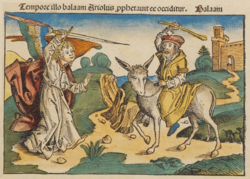
, on Numbers 22-25: Balaam's donkey and blessing - *PinchasPinchas (parsha)Pinchas, Pinhas, or Pin’has is the 41st weekly Torah portion in the annual Jewish cycle of Torah reading and the eighth in the book of Numbers...
, on Numbers 25-29: Phinehas, second census, inheritance, Moses' successor, offerings and holidays - *MatotMatotMatot, Mattot, Mattoth, or Matos is the 42nd weekly Torah portion in the annual Jewish cycle of Torah reading and the ninth in the book of Numbers...
, on Numbers 30-34: Vows, Midian, dividing booty, land for Reuben, Gad, and half of Manasseh - *MaseiMaseiMasei, Mas’ei, or Masse is the 43rd weekly Torah portion in the annual Jewish cycle of Torah reading and the 10th and last in the book of Numbers...
, on Numbers 33-36: Stations of the Israelites’ journeys, instructions for conquest, cities for Levites
See also
- BalaamBalaamBalaam is a diviner in the Torah, his story occurring towards the end of the Book of Numbers. The etymology of his name is uncertain, and discussed below. Every ancient reference to Balaam considers him a non-Israelite, a prophet, and the son of Beor, though Beor is not so clearly identified...
- Book of the Wars of the LordBook of the Wars of the LordThe Book of the Wars of the is one of several non-canonical books referenced in the Bible which have now been completely lost. It is mentioned in , which reads: "From there they set out and camped on the other side of the Arnon, which is in the desert and bounding the Amorite territory. For Arnon...
- Inverted nunInverted nunInverted nun is a rare glyph used in Classical Hebrew. Its function in the ancient texts is disputed. It takes the form of the letter nun in mirror image, and appears in the Masoretic text of the Tanakh in nine different places:...
(only appears twice in the Book of Numbers and seven times in the Book of Psalms) - Priestly BlessingPriestly BlessingThe Priestly Blessing, , also known in Hebrew as Nesiat Kapayim, , or Dukhanen , is a Jewish prayer recited by Kohanim during certain Jewish services...
- TorahTorahTorah- A scroll containing the first five books of the BibleThe Torah , is name given by Jews to the first five books of the bible—Genesis , Exodus , Leviticus , Numbers and Deuteronomy Torah- A scroll containing the first five books of the BibleThe Torah , is name given by Jews to the first five...
- Weekly Torah portions in Numbers: BamidbarBamidbar (parsha)Bamidbar, Bemidbar, BeMidbar, or B'midbar is the 34th weekly Torah portion in the annual Jewish cycle of Torah reading and the first in the book of Numbers...
, NasoNaso (parsha)Naso or Nasso is the 35th weekly Torah portion in the annual Jewish cycle of Torah reading and the second in the book of Numbers. It constitutes Naso is the longest of the 54 weekly Torah portions, with 176 verses...
, BehaalotechaBehaalotechaBehaalotecha, Beha’alotecha, Beha’alothekha, or Behaaloscha is the 36th weekly Torah portion in the annual Jewish cycle of Torah reading and the third in the book of Numbers...
, ShlachShlachShlach, Shelach, Sh'lah, Shlach Lecha, or Sh’lah L’kha is the 37th weekly Torah portion in the annual Jewish cycle of Torah reading and the fourth in the book of Numbers. It constitutes Jews in the Diaspora generally read it in June...
, KorachKorach (parsha)Korach or Korah is the 38th weekly Torah portion in the annual Jewish cycle of Torah reading and the fifth in the book of Numbers...
, ChukatChukatChukat, Hukath, or Chukkas is the 39th weekly Torah portion in the annual Jewish cycle of Torah reading and the sixth in the book of Numbers. It constitutes . Jews in the Diaspora generally read it in late June or July....
, BalakBalak (parsha)Balak is the 40th weekly Torah portion in the annual Jewish cycle of Torah reading and the seventh in the book of Numbers...
, PinchasPinchas (parsha)Pinchas, Pinhas, or Pin’has is the 41st weekly Torah portion in the annual Jewish cycle of Torah reading and the eighth in the book of Numbers...
, MatotMatotMatot, Mattot, Mattoth, or Matos is the 42nd weekly Torah portion in the annual Jewish cycle of Torah reading and the ninth in the book of Numbers...
, and MaseiMaseiMasei, Mas’ei, or Masse is the 43rd weekly Torah portion in the annual Jewish cycle of Torah reading and the 10th and last in the book of Numbers... - What hath God wroughtWhat hath God wrought"What hath God wrought" is a phrase from the Book of Numbers and may refer to:*"What hath God wrought", a message in American Morse code sent by Samuel F. B...
- Wilderness of SinWilderness of SinThe Wilderness of Sin/Desert of Sin is a geographic area mentioned by the Bible as lying between Elim and Mount Sinai. Sin does not refer to sinfulness, but is an untranslated word that would translate as the moon; biblical scholars suspect that the name Sin here refers to the semitic moon-deity...
Translations of Numbers
NumbersExternal links
- Original language:
- במדבר Bamidbar - Numbers (HebrewHebrew languageHebrew is a Semitic language of the Afroasiatic language family. Culturally, is it considered by Jews and other religious groups as the language of the Jewish people, though other Jewish languages had originated among diaspora Jews, and the Hebrew language is also used by non-Jewish groups, such...
– English at Mechon-Mamre.org)
- במדבר Bamidbar - Numbers (Hebrew
- JewishJudaismJudaism ) is the "religion, philosophy, and way of life" of the Jewish people...
translations:- Numbers at Mechon-Mamre (Jewish Publication Society translation)
- Numbers (The Living Torah) Rabbi Aryeh KaplanAryeh KaplanAryeh Moshe Eliyahu Kaplan was a noted American Orthodox rabbi and author known for his "intimate knowledge of both physics and kabbalah." He was lauded as an original thinker and prolific writer, from studies of the Torah, Talmud and mysticism to introductory pamphlets on Jewish beliefs and...
's translation and commentary at Ort.org - Bamidbar - Numbers (Judaica Press) translation [with RashiRashiShlomo Yitzhaki , or in Latin Salomon Isaacides, and today generally known by the acronym Rashi , was a medieval French rabbi famed as the author of a comprehensive commentary on the Talmud, as well as a comprehensive commentary on the Tanakh...
's commentary] at Chabad.org
- ChristianChristianA Christian is a person who adheres to Christianity, an Abrahamic, monotheistic religion based on the life and teachings of Jesus of Nazareth as recorded in the Canonical gospels and the letters of the New Testament...
translations:- Online Bible at GospelHall.org (King James VersionKing James Version (disambiguation)The Authorized King James Version is a translation of the Bible, first published in 1611.King James Version may also refer to:*Revised Version, a late 19th century revision of the King James Version...
) - oremus Bible Browser (New Revised Standard VersionNew Revised Standard VersionThe New Revised Standard Version of the Bible is an English translation of the Bible released in 1989 in the USA. It is a thorough revision of the Revised Standard Version .There are three editions of the NRSV:...
) - oremus Bible Browser (Anglicized New Revised Standard VersionNew Revised Standard VersionThe New Revised Standard Version of the Bible is an English translation of the Bible released in 1989 in the USA. It is a thorough revision of the Revised Standard Version .There are three editions of the NRSV:...
) - Numbers at Wikisource (Authorized King James Version)
- Online Bible at GospelHall.org (King James Version