

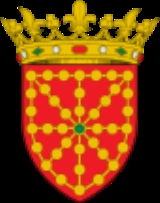
Kingdom of Navarre

Encyclopedia
The Kingdom of Navarre originally the Kingdom of Pamplona, was a European kingdom which occupied lands on either side of the Pyrenees
alongside the Atlantic Ocean.
The kingdom of Navarre was formed when local Basque leader Íñigo Arista was elected or declared King in Pamplona
(traditionally in 824) and led a revolt against the regional Frankish authority.
The southern part of the kingdom was conquered by the Crown of Castile
in 1513, and thus became part of the unified Kingdom of Spain. The northern part of the kingdom remained independent, but it was joined with France in a personal union
in 1589 when King Henry III of Navarre inherited the French throne as Henry IV of France
, and in 1620 it was merged into the Kingdom of France
.
Other Royal Frankish Annals
give nabarros.
There are two proposed etymologies for the name of Navarra/Nafarroa/Naparroa:
Note that Joan Corominas does not consider naba as clearly Basque in origin, but as part of a wider pre-Roman substrate.
and part of the shore of the Bay of Biscay
. The area was completely conquered by the Romans by 74 BC. It was first part of the Roman province of Citerior, then of the Tarraconensis province and after that of the conventus Caesaraugustanus. Rome left a clear mark in the area in urbanization, language, infrastructure, commerce, and industry.
After the decline of the Western Roman Empire neither the Visigoths nor the Arabs ever succeeded in permanently occupying the western Pyrenees. The western Pyrenees passages were the only ones allowing good transit through the mountains, other than those through the southern Pyrenees. That made the region strategically important early in its history.
The Franks under Charlemagne extended their influence and control towards the south, occupying several regions of the north and east of the Iberian Peninsula. It is not clear how solid the Frankish control over Pamplona was. On August 15, 778, after the retreating Charlemagne had demolished the walls of Pamplona, the Basque tribes annihilated his rearguard, led by Roland
, in a confrontation at a mountain passage known to history as the Battle of Roncevaux Pass
. In response, the Cordoban Emirate launched a campaign to place the region under their firm control, and in 781 defeated a local leader called Ibn Balask ("son of Velasco") and seated a muwallad
governor, Mutarrif ibn Musa, in Pamplona. The same year Basque leader Jimeno 'the Strong' submitted to the Emir.
In 799, Mutarrif ibn Musa was killed by a pro-Frankish faction whose leader Velasco gained control of the region. In 806 and 812 Pamplona fell again into the Franks' hands. However, when on account of difficulties at home the Frankish rulers were no longer able to give their attention to the outlying borderlands of their empire, the country gradually withdrew entirely from their allegiance. The Emirate also attempted to reestablish its control in the region, and in 816 fought a battle there against the "enemy of Allah", Balask al-Yalaski (Velasco the Gascon), who was killed along with Garcia Loup, kinsman of Alfonso II of Asturias
, Sancho, premier knight in Pamplona, and Saltan, premier knight of the Mayus (pagans).
Also in 816, Louis the Pious was forced to remove the rebellious Seguin
as Duke of Vasconia, only to have another rebel, Garcia Semen
arise in his place, he being killed in 818. Louis' son Pepin
, now King of Aquitaine, stamped out the Vasconic revolt in Gascony
and then pursued the chieftains who had taken refuge in southern Vasconia, i.e. Pamplona and Navarre, no longer controlled by the Franks. He sent over an army led by the counts Aeblus
and Aznar-Sanchez
(the latter being appointed lord, but not duke, of Vasconia by Pepin after suppressing the uprising in the Duchy of Vasconia
), accomplishing their goals with no resistance in Pamplona (still lacking walls after the 778 destruction). On the way back, however, they were ambushed and defeated again in Roncesvaux by a probable joint Vasconic-Muslim
force. Out of this pattern of resistance against both Frankish and Cordoban interests arose the Basque chieftain Íñigo Arista, who tradition has elected as king of Pamplona in 824, giving rise to a dynasty of kings in Pamplona that would last for four score years.
At this point of history, Pamplona and Navarre were two separate entities. Pamplona is cited in 778 by Frankish accounts as a Navarrese stronghold, while this may be put down to their vague knowledge of the Vasconic territory. They do distinguish Navarre and the Vasconic main town in 806 though ("In Hispania, vero Navarrensis et Pampelonensis"), while the Chronicle of Fontenelle quotes "Induonis et Mitionis, ducum Navarrorum". The primitive Navarre may have comprised the valleys of Goñi, Gesalaz, Lana, Allin, Deierri, Berrueza and Mañeru which later formed the merindad of Estella.
In 905, the dynasty founded by Íñigo Arista was overthrown through the machinations of neighboring princes, and Sancho I Garcés (905–25), nephew of the Count of Ribagorza, was placed in the throne. He fought against the Moors with repeated success and joined Ultra-Puertos, or Basse-Navarre, to his own dominions, also extending its territory as far as Nájera
. As a thanksgiving for his victories, he founded, in 924, the convent of Albelda. Before his death, all Moors had been driven from the country. His son and eventual successor, Garcia Sanchez I (931–70), who had the support of his energetic and diplomatic mother Toda (Teuda) Aznárez of the line of Arista, likewise engaged in a number of conflicts with the Moors. At this time, the county of Aragon, previously only nominally a vassal state, came under the direct control of the kings of Pamplona.
In the year 905 a Leonese chronicle mentions the extension of the Kingdom of Pamplona for the first time, being clear that it extended then to Nájera and Arba (arguably Araba
), what for some implies that it included the Western Basque Country
as well:
.gif)
intervened in the kingdom, beginning a period of frequent punitive campaigns from Córdoba and submission to tributary status by Pamplona. Garcia Sanchez's son, Sancho II Garces, nicknamed Abarca, ruled as king of Pamplona from 970 to 994. Around 985 Sancho II Garces crossed the Pyrenees to Gascony, which was being raided by the Normans, probably in rescue of his brother-in-law William Sánchez
, but had to make his way back on the news of a Muslim attack against Pamplona. The passes were, however, covered in snow, but the expeditionary force contrived some proper shoes ("Abarca" in Basque) to make it through the mountains, which allowed them to catch the besieging Muslim assailants by surprise and overcome them, hence the nickname.
The Historia General de Navarra by Jaime del Burgo
says that on the occasion of the donation of the villa
of Alastue by the king of Pamplona to the monastery of San Juan de la Peña
in 987, he styled himself "King of Navarre", the first time that title had been used. In many places he appears as the first King of Navarre and in others the third; however, he was at least the seventh king of Pamplona.
Under Sancho III the Great
(reigned 1000/4–1035) and his immediate successors, Pamplona reached the height of its power and extent. Navarre had joined in the Christian coalition that defeated and killed Al-Mansur Ibn Abi Aamir
in 1002, leading to civil war that eventually resulted in the dissolution of the Córdoba Caliphate, replacing the dominant power on the peninsula with a collection of ineffectual Taifa
states and freeing Navarre from the continual campaigns and tribute. Inheriting Pamplona, including Aragon, Sancho III conquered Ribagorza and Sobrarbe, which had been depopulated since the collapse of Moorish control. The minority of García Sánchez of Castile forced the County of Castile to submit to vassalage under Sancho, the count's brother-in-law, and García's 1028 assassination allowed Sancho to appoint his younger son Ferdinand as count. He also exerted a protectorate over Gascony
. He seized the country of the Pisuerga and the Cea, which belonged to the Kingdom of León
, and marched armies to the heart of that kingdom forcing king Bermudo III of León
to flee to a Galician refuge. Sancho thereby effectively ruled the north of Iberia from the boundaries of Galicia to those of the count of Barcelona.
.gif)
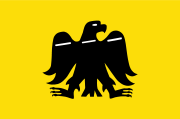
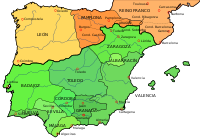 At its greatest extent the Kingdom of Navarre included all the modern Spanish province; the northern slope of the western Pyrenees called by the Spaniards the ultra puertos ("country beyond the mountain passes") or French Navarre; the Basque provinces of Spain and France; the Bureba, the valley between the Basque mountains and the Montes de Oca to the north of Burgos
; the Rioja and Tarazona in the upper valley of the Ebro. On his death, Sancho divided his possessions among his four sons. Sancho the Great's realm was never again united (until Ferdinand the Catholic): Castile was permanently joined to Leon, whereas Aragon enlarged its territory, joining Catalonia through a marriage.
Of Sancho's sons, Garcia of Najera inherited the Kingdom of Pamplona and merged into it the eastern part of the County of Castile (from the proximity of Burgos and Santander); the rest of Castile and the lands between the Pisuerga and the Cea went to the eldest son, Fernando; to Gonzalo were given Sobrarbe and Ribagorza; lands in Aragon
were allotted to the bastard son Ramiro. The realm was divided thus once more into Navarre, Aragón, and Castile.
Younger son Ferdinand I
inherited a diminished County of Castile, but after acquiring the Kingdom of León
, he used the title of King
of Castile as well, and he enlarged his realm by various means (see Kingdom of Castile
).
The bastard son of Sancho III
, Ramiro de Aragon
, founded the Navarrese line of Aragon.
García, the eldest legitimate son, was to be feudal overlord of his brothers, but he was soon challenged by his brothers, leading to the first partition of the kingdom after his death in the Battle of Atapuerca
, in 1054.
He was succeeded by Sancho IV
(1054–76) of Peñalén, who was murdered by his brothers. This crime caused a dynastic crisis that the Castilian and Aragonese monarchs used to their benefit.
The royal title was transferred to the Aragonese line but Castile swiftly annexed two thirds of the realm from the historical border of the Atapuerca
–Santander
line to a vague partition-line at the Ega valley, near Estella.
It is in this period of Aragonese domination that the name of Navarre first appears historically, referring initially to a county that comprised only the central part of modern Navarre.
The three Aragonese rulers, Sancho Ramirez (1076–94) and his son Pedro Sanchez (1094–1104) conquered Huesca; Alfonso "the Fighter"
, 1104–34, brother of Pedro Sanchez, secured for the country its greatest territorial expansion. He wrested Tudela
from the Moors (1114), re-conquered the entire country of Bureba, which Navarre had lost in 1042, and advanced into the current Province of Burgos; in addition, Roja
, Najera, Logroño
, Calahorra
, and Alfaro
were subject to him. He also annexed Labourd
, with its strategic port of Bayonne
, but lost its coastal half to the English soon after. The remainder has been part of Navarre since then and eventually came to be known as Lower Navarre
.
 This status quo stood for two decades until Alfonso the Battler
, dying without heirs, decided to give his realm away to the military orders, particularly the Templars
. This decision was rejected by the courts (parliaments) of both Aragon and Navarre, which then chose separate kings.
García Ramírez, known as the Restorer, is the first King of Navarre to use such a title. He was Lord of Monzón
, a grandson of Rodrigo Diaz de Vivar, El Cid
, and a descendant by illegitimate line of king García Sánchez III. He and his son Sancho the Wise
fought bitterly against Castile (and sometimes also against Aragon) for the recovery of the historic Pamplonese territory.
In 1177, the dispute was submitted to arbitration by Henry II of England
. The Navarrese based their claims on the proven will of the locals and history, the Castilians on their merits as crusaders. The English awarded each side what they actually controlled militarily at the time: to Navarre, Alava, Biscay and Guipuscoa; to Castile, La Rioja and the other western lands.
Although the arbitration decision was ignored for two years, in 1179 the contending kings finally agreed to a peace on the same terms.
Sancho Garcia
, known as Sancho VI "the Wise" (1150–94), a patron of learning, as well as an accomplished statesman, fortified Navarre within and without, granted charters (fueros) to a number of towns, and was never defeated in battle.
The rich dowry of Berengaria
, the daughter of Sancho VI the Wise
and Blanche of Castile, made her a desirable catch for Richard I of England
. His aged mother, Eleanor of Aquitaine
, crossed the Pyrenean passes to escort Berengaria to Sicily, eventually to wed Richard in Cyprus, 12 May 1191. She is the only Queen of England who never set foot in England.
The reign of Sancho the Wise's successor, the last king of the male line of Sancho the Great and of kings of Pamplona, king Sancho VII the Strong (Sancho el Fuerte) (1194–1234), was more troubled. He appropriated the revenues of churches and convents, granting them instead important privileges; in 1198 he presented to the See of Pamplona his palaces and possessions in that city, this gift being confirmed by Pope Innocent III on 29 January 1199.
was on an international diplomatic voyage to Tlemcen
(modern Algeria).
The cities of Vitoria and Treviño
resisted the Castilian assault but the Bishop of Pamplona was sent to inform them that no reinforcements would arrive. Vitoria then surrendered but Treviño did not, having to be conquered by force of arms.
By 1200 the conquest of Western Navarre was complete. Castile granted to the fragments of this territory (exceptions: Treviño, Oñati
, directly ruled from Castile) the right of self-rule, based on their traditional customs (Navarrese right), that came to be known as fueros. Alava was made a county, Biscay a lordship
and Guipuscoa just a province.
(1212), where, through his valour, the victory of the allied Christians over the Caliph En-Nasir was made decisive. He retired and died in el Encerrado. His elder sister Berengaria, Queen of England, had died childless some years earlier. His deceased younger sister Blanca, countess of Champagne, had left a son, Theobald IV of Champagne.
Thus the Kingdom of Navarre, though the crown was still claimed by the kings of Aragon, passed by marriage to the House of Champagne, firstly to the heirs of Blanca, who were simultaneously counts of Champagne and Brie, with the support of the Navarrese Parliament (Cortes).
(1253–70), married Isabel, the second daughter of Louis IX of France
and accompanied his saintly father-in-law upon his crusade to Tunis. On the homeward journey, he died at Trapani in Sicily, and was succeeded by his brother, Henry I of Navarre
, who had already assumed the reins of government during his absence, but reigned only three years (1271–74). His daughter Joanna I of Navarre not yet being of age, the country was once more invaded from all sides, and the queen mother, Blanca, with her daughter sought refuge at the court of Philip the Bold of France
, whose son, Philip the Fair
, had become engaged to the daughter and married Joanna in 1284. In 1276, at the time of the negotiations for this marriage, Navarre effectively passed into French control.
In 1305, Navarre passed to the guardianship of King Philip IV of France
. It stayed with the French crown until the death of Charles IV of France
at 1328. As Charles died without male issue, when Philip of Valois became king of France, the Navarrese declared themselves independent and called to the throne Joanna II
, daughter of Louis X
and senior niece of Charles, and her husband Philip of Évreux
(reigned 1328–43), called Philip the Wise. Joanna waived all claim to the throne of France and accepted as compensation for the counties of Champagne and Brie those of Angoulême, Longueville, and Mortain.
King-consort Philip III devoted himself to the improvement of the laws of the country, and joined King Alfonso XI of Castile in battle against the Moors of 1343. After the death of his mother (1349), Charles II of Navarre
assumed the reins of government (1349–87). He played an important part in the Hundred Years' War
and in the French civil unrest of the time, and on account of his deceit and cruelty he received the surname of the Wicked. He gained and lost possessions in Normandy
and, later in his reign, the Navarrese Company
acquired island possessions in Greece.
His eldest son, on the other hand, Charles III of Navarre
, surnamed the Noble, gave the land once more a peaceful and happy government (1387–1425), exerted his strength to the utmost to lift the country from its degenerate condition, reformed the government, built canals, and made navigable the tributaries of the Ebro flowing through Navarre. As he outlived his legitimate sons, he was succeeded by his daughter Blanca (1425–42) and her husband John of Penafiel (1397–1479), son of king Ferdinand I of Aragon
.
. He left his son, Don Carlos (Charles) of Viana, in Navarre, only with the rank of governor, whereas Blanca had designed that Charles of Viana
should be king. In 1450, John II himself regained to Navarre, and, urged on by his ambitious second wife, Juana Enriquez of the illegitimate Castilian line, endeavoured to obtain the succession for their son Fernando (the future Ferdinand the Catholic). As a result a violent civil war broke out, in which the powerful party of the Agramontes supported the king and queen, and the party of the Beaumonts—called after their leader, the chancellor, John of Beaumont—espoused the cause of Charles; the highlands were on the side of the prince, the plains on that of the king. The unhappy prince was defeated by his father at Aybar, in 1451, and held a prisoner for two years, during which he wrote his famous Chronicle of Navarre, the source of our present knowledge of this subject. After his release, he sought in vain the assistance of King Charles VII of France
and of his uncle Alfonso V (who resided in Naples). In 1460 he was again imprisoned at the instigation of his stepmother, but the Catalonians rose in revolt at this injustice, and he was again liberated and named governor of Catalonia. He died in 1461, without having been able to reconquer his kingdom of Navarre; he named as his heir his next sister Blanca, who was, however, immediately imprisoned by John II, and died in 1464.
Her right was inherited by her sister Eleanor I of Navarre (Leonor), Countess of Foix
and Béarn
, who had been an ally of her father. After her death, which occurred very soon after that of John II, the claim to the throne of Navarre passed to her grandson, Francis Phoebus of Foix (who reigned over Navarre 1479–83). His sister Catherine I of Navarre, who, as a minor, remained under the guardianship of her mother, Madeleine of France, was sought by Ferdinand the Catholic as a bride for his eldest son; but she gave her hand in 1494 to the Jean d'Albret, count of Périgord
, a man of vast possessions in the south of France, brother-in-law of Cesare Borgia
.
, the daughter of Catherine's uncle who had attempted to claim Navarre over his deceased elder brother's under-age children. However, their infant son died shortly after birth, ending hopes of potentially inheriting Navarre.
When Navarre refused to join one of many Holy Leagues against France and declared itself neutral, Ferdinand asked the Pope to excommunicate Albret, which would have legitimised his attack. When the Pope refused, Ferdinand fabricated a false bull and sent his general Don Fadrique de Toledo
to invade Navarre in 1512, part of the second phase of the War of the League of Cambrai
.
Unable to face the powerful Castilian-Aragonese army, Jean d'Albret fled to Pau, and Pamplona, Estella, Olite, Sanguesa, and Tudela were captured. Some months later the legitimate King returned with an army recruited north of the Pyrenees and attacked Pamplona without success.
After this failure, the Navarrese Cortes (Parliament) had to accept annexation to Castile, which agreed to keep Navarrese autonomy and identity. In 1513, the first Castilian viceroy took an oath to respect Navarrese law (fueros). However, the Spanish Inquisition
was extended into Navarre; the Jews had already been forced into conversion or exile by the Alhambra Decree
in Castile and Aragon, and now the Jewish community of Navarre and the Muslims of Tudela suffered its persecution.
There were two more attempts at liberation in 1516 and 1521, both supported by popular rebellion, especially the second one. It was in 1521 that the Navarrese came closest to regaining their independence. As the liberation army commanded by General Asparros
approached Pamplona, the citizens revolted and besieged the military governor, Iñigo de Loyola, in his newly built castle. Tudela and other cities also declared their loyalty to the House of Albret. The Navarrese-Béarnese army did manage to liberate all the Kingdom, and Castile was at first distracted due to only recently overcoming the Revolt of the Comuneros. But the Revolt was defeated at almost the same time as the invasion, and Asparros faced a huge and united Castilian army at the Battle of Noáin on 30 June 1521. Asparros was captured, and the army completely defeated.
Navarre was a thalassocracy
in its later existence and was involved in whaling, fishing, and beaver trapping in and around Newfoundland. Basque coastal exploration of the northern Atlantic coast of North America was extensive and outposts were present on the Newfoundland coast around or before the time of the New World arrival of Christopher Columbus
in 1492.
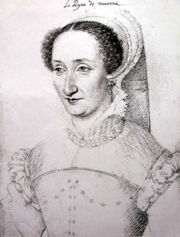 A small portion of Navarre north of the Pyrenees, Lower Navarre
, along with the neighbouring Principality of Béarn
survived as an independent kingdom which passed by inheritance. Navarre received from Henry II of Navarre
, the son of Jean d'Albret, a representative assembly, the clergy being represented by the bishops of Bayonne and Dax, their vicars-general, the parish priest of St-Jean-Pied-de-Port, and the priors of Saint-Palais, d'Utziat and Haramples. The area north of the Pyrenees (Lower Navarre) remained an independent kingdom with large additional French estates until 1620.
Queen Jeanne III converted to Calvinism
in 1556 and, consequently, promoted a translation of the Bible
into Basque language, which is one of the first books published in this language. She and her son, Henry III of Navarre
, led the Huguenot
party in the French Wars of Religion
. In 1589, Henry became the sole rightful claimant to the crown of France, though he was not recognized as such by many of his subjects until his conversion to Catholicism
four years later.
When Labourd
and High Navarre were shaken by the Basque witch trials
in 1609 and 1610, many sought refuge in Lower Navarre. Only in 1620 was Navarre fully incorporated to France.
in 1589, founding the Bourbon dynasty. In 1620, Lower Navarre and Béarn were incorporated into France proper by Henry's son, Louis XIII of France
. The title of King of Navarre continued to be used by the Kings of France until the French Revolution
in 1792, and was revived again during the Restoration, 1814–30.
As the Kingdom of Navarre was originally organized, it was divided into merindad
es, districts governed by a merino ("mayorino"), the representative of the king. They were the "Ultrapuertos" (French Navarre), Pamplona, Estella, Tudela
and Sangüesa. In 1407 the merindad of Olite was added. The Cortes
of Navarre began as the king's council of churchmen and nobles, but in the course of the 14th century the burgesses were added. Their presence was due to the fact that the king had need of their co-operation to raise money by grants and aids, a development that was being paralleled in England. The Cortes henceforth consisted of the churchmen, the nobles and the representatives of twenty-seven (later thirty-eight) "good towns" — towns which were free of a feudal lord, and, therefore, held directly of the king. The independence of the burgesses was better secured in Navarre than in other parliaments of Spain by the constitutional rule which required the consent of a majority of each order to every act of the Cortes. Thus the burgesses could not be outvoted by the nobles and the Church, as they could be elsewhere. Even in the 18th century the Navarrese successfully resisted Bourbon attempts to establish custom houses on the French frontier, dividing French from Spanish Navarre. Yet the Navarrese were loyal to their Spanish sovereigns, and no part of the country offered a more determined or more skilful resistance to Napoleon.
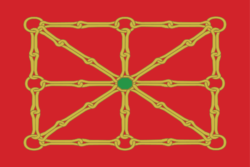 Navarre was staunchly Catholic and much under clerical influence. This, and the resentment felt at the loss of their autonomy when they were incorporated into Spain in 1833, account for the strong support given by many Navarrese to the Carlist cause.
Until the French Revolution the kings of France carried the additional title king of Navarre. Since the rest of Navarre was in Spanish hands, the kings of Spain also carried (until 1833) the title king of Navarre. During that period Navarre enjoyed a special status within the Spanish monarchy; it had its own cortes
, taxation system, and separate customs laws. In 1833, Navarre and the whole Basque
region in Spain became the chief stronghold of the Carlists, but recognized Isabella II as queen in 1839 after the First Carlist War
. As a reward for their loyalty in the Spanish Civil War
(Navarre sided for the most part with the military uprising), Franco allowed the Navarrese to maintain their ancient fueros
, which were charters handed down by the crown outlining a system of self-government.
(in Aragon, Catalonia and Valencia) until the 18th century. The Spanish monarch was represented by a viceroy.
is an autonomous community of Spain
and Basse-Navarre is part of France's Pyrénées-Atlantiques
département. Other former Navarrese territories belong now to several autonomous communities of Spain: the Autonomous Community of the Basque Country
, La Rioja, Aragon
, and Castile and León
.
Pyrenees
The Pyrenees is a range of mountains in southwest Europe that forms a natural border between France and Spain...
alongside the Atlantic Ocean.
The kingdom of Navarre was formed when local Basque leader Íñigo Arista was elected or declared King in Pamplona
Pamplona
Pamplona is the historial capital city of Navarre, in Spain, and of the former kingdom of Navarre.The city is famous worldwide for the San Fermín festival, from July 6 to 14, in which the running of the bulls is one of the main attractions...
(traditionally in 824) and led a revolt against the regional Frankish authority.
The southern part of the kingdom was conquered by the Crown of Castile
Crown of Castile
The Crown of Castile was a medieval and modern state in the Iberian Peninsula that formed in 1230 as a result of the third and definitive union of the crowns and parliaments of the kingdoms of Castile and León upon the accession of the then King Ferdinand III of Castile to the vacant Leonese throne...
in 1513, and thus became part of the unified Kingdom of Spain. The northern part of the kingdom remained independent, but it was joined with France in a personal union
Personal union
A personal union is the combination by which two or more different states have the same monarch while their boundaries, their laws and their interests remain distinct. It should not be confused with a federation which is internationally considered a single state...
in 1589 when King Henry III of Navarre inherited the French throne as Henry IV of France
Henry IV of France
Henry IV , Henri-Quatre, was King of France from 1589 to 1610 and King of Navarre from 1572 to 1610. He was the first monarch of the Bourbon branch of the Capetian dynasty in France....
, and in 1620 it was merged into the Kingdom of France
Kingdom of France
The Kingdom of France was one of the most powerful states to exist in Europe during the second millennium.It originated from the Western portion of the Frankish empire, and consolidated significant power and influence over the next thousand years. Louis XIV, also known as the Sun King, developed a...
.
Etymology
There are similar earlier toponyms but the first documentation of Latin navarros appears in Eginhard's chronicle of the feats of Charles the Great.Other Royal Frankish Annals
Royal Frankish Annals
The Royal Frankish Annals or Annals of the Kingdom of the Franks ,are annals covering the history of early Carolingian monarchs from 741 to 829. Their composition seems to have soon been taken up at court, providing them with markedly official character...
give nabarros.
There are two proposed etymologies for the name of Navarra/Nafarroa/Naparroa:
- Basque nabar (declined abs.Absolutive caseThe absolutive case is the unmarked grammatical case of a core argument of a verb which is used as the citation form of a noun.-In ergative languages:...
sing.Grammatical numberIn linguistics, grammatical number is a grammatical category of nouns, pronouns, and adjective and verb agreement that expresses count distinctions ....
nabarra): "brownish", "multicolor" (which would be a contrast with the green mountain lands north of the original County of Navarre). - Basque naba/Castilian nava ("valley", "plain", present across Spain as in Las Navas de Tolosa) + Basque herri ("people", "land").
Note that Joan Corominas does not consider naba as clearly Basque in origin, but as part of a wider pre-Roman substrate.
Early history
The kingdom of Pamplona and then Navarre formed part of the traditional territory of the Vascones, a pre-Roman tribe who occupied the southern slope of the western PyreneesPyrenees
The Pyrenees is a range of mountains in southwest Europe that forms a natural border between France and Spain...
and part of the shore of the Bay of Biscay
Bay of Biscay
The Bay of Biscay is a gulf of the northeast Atlantic Ocean located south of the Celtic Sea. It lies along the western coast of France from Brest south to the Spanish border, and the northern coast of Spain west to Cape Ortegal, and is named in English after the province of Biscay, in the Spanish...
. The area was completely conquered by the Romans by 74 BC. It was first part of the Roman province of Citerior, then of the Tarraconensis province and after that of the conventus Caesaraugustanus. Rome left a clear mark in the area in urbanization, language, infrastructure, commerce, and industry.
After the decline of the Western Roman Empire neither the Visigoths nor the Arabs ever succeeded in permanently occupying the western Pyrenees. The western Pyrenees passages were the only ones allowing good transit through the mountains, other than those through the southern Pyrenees. That made the region strategically important early in its history.
The Franks under Charlemagne extended their influence and control towards the south, occupying several regions of the north and east of the Iberian Peninsula. It is not clear how solid the Frankish control over Pamplona was. On August 15, 778, after the retreating Charlemagne had demolished the walls of Pamplona, the Basque tribes annihilated his rearguard, led by Roland
Roland
Roland was a Frankish military leader under Charlemagne who became one of the principal figures in the literary cycle known as the Matter of France. Historically, Roland was military governor of the Breton March, with responsibility for defending the frontier of Francia against the Bretons...
, in a confrontation at a mountain passage known to history as the Battle of Roncevaux Pass
Battle of Roncevaux Pass
The Battle of Roncevaux Pass was a battle in 778 in which Roland, prefect of the Breton March and commander of the rear guard of Charlemagne's army, was defeated by the Basques...
. In response, the Cordoban Emirate launched a campaign to place the region under their firm control, and in 781 defeated a local leader called Ibn Balask ("son of Velasco") and seated a muwallad
Muladi
The Muladi were Muslims of ethnic Iberian descent or of mixed Arab, Berber and European origin, who lived in Al-Andalus during the Middle Ages. They were also called "Musalima" .-Etymology:...
governor, Mutarrif ibn Musa, in Pamplona. The same year Basque leader Jimeno 'the Strong' submitted to the Emir.
In 799, Mutarrif ibn Musa was killed by a pro-Frankish faction whose leader Velasco gained control of the region. In 806 and 812 Pamplona fell again into the Franks' hands. However, when on account of difficulties at home the Frankish rulers were no longer able to give their attention to the outlying borderlands of their empire, the country gradually withdrew entirely from their allegiance. The Emirate also attempted to reestablish its control in the region, and in 816 fought a battle there against the "enemy of Allah", Balask al-Yalaski (Velasco the Gascon), who was killed along with Garcia Loup, kinsman of Alfonso II of Asturias
Alfonso II of Asturias
Alfonso II , called the Chaste, was the king of Asturias from 791 to his death, the son of Fruela I and the Basque Munia.He was born in Oviedo in 759 or 760. He was put under the guardianship of his aunt Adosinda after his father's death, but one tradition relates his being put in the monastery of...
, Sancho, premier knight in Pamplona, and Saltan, premier knight of the Mayus (pagans).
Also in 816, Louis the Pious was forced to remove the rebellious Seguin
Seguin I of Gascony
Seguin I Lupo was Duke of Gascony from 812 until 816, when Louis the Pious deposed him "because of his boundless arrogance and wicked ways", according to the contemporary Frankish chroniclers. The "Basques across the Garonne and around the Pyrenees" rebelled against the removal of their duke, but...
as Duke of Vasconia, only to have another rebel, Garcia Semen
García I Jiménez of Gascony
García I Jiménez was the Duke of Gascony as leader of the Gascons from 816 to his death in 818. He succeeded Seguin I, who was deposed by Louis the Pious in 816 and García was elected to replace him.-Sources:*...
arise in his place, he being killed in 818. Louis' son Pepin
Pepin I of Aquitaine
Pepin I was King of Aquitaine.-Biography:He was the second son of Emperor Louis the Pious and his first wife, Ermengarde of Hesbaye....
, now King of Aquitaine, stamped out the Vasconic revolt in Gascony
Gascony
Gascony is an area of southwest France that was part of the "Province of Guyenne and Gascony" prior to the French Revolution. The region is vaguely defined and the distinction between Guyenne and Gascony is unclear; sometimes they are considered to overlap, and sometimes Gascony is considered a...
and then pursued the chieftains who had taken refuge in southern Vasconia, i.e. Pamplona and Navarre, no longer controlled by the Franks. He sent over an army led by the counts Aeblus
Aeblus
Aeblus, Ebalus, or Ebles was a Frankish count in Gascony early in the ninth century.With Aznar Sánchez, he led a large expedition across the Pyrenees to re-establish control over Navarre...
and Aznar-Sanchez
Aznar Sánchez of Gascony
Aznar Sánchez was the Duke of Gascony from 820. He was the supposed son of Sancho I of Gascony, though he has been identified with Aznar Galíndez I, Count of Aragon....
(the latter being appointed lord, but not duke, of Vasconia by Pepin after suppressing the uprising in the Duchy of Vasconia
Duchy of Vasconia
The Duchy of Vasconia , or Wasconia, was originally a Frankish march formed by 602 to keep the Basques in check. It comprised the former Roman province of Novempopulania and, at least in some periods, also the lands south of the Pyrenees centred on Pamplona.In the ninth century, civil war within...
), accomplishing their goals with no resistance in Pamplona (still lacking walls after the 778 destruction). On the way back, however, they were ambushed and defeated again in Roncesvaux by a probable joint Vasconic-Muslim
Banu Qasi
The Banu Qasi, Banu Kasi, Beni Casi or Banu Musa were a Basque Muladi dynasty that ruled the upper Ebro valley in the 9th century, before being displaced in the first quarter of the 10th century.-Dynastic beginnings:...
force. Out of this pattern of resistance against both Frankish and Cordoban interests arose the Basque chieftain Íñigo Arista, who tradition has elected as king of Pamplona in 824, giving rise to a dynasty of kings in Pamplona that would last for four score years.
At this point of history, Pamplona and Navarre were two separate entities. Pamplona is cited in 778 by Frankish accounts as a Navarrese stronghold, while this may be put down to their vague knowledge of the Vasconic territory. They do distinguish Navarre and the Vasconic main town in 806 though ("In Hispania, vero Navarrensis et Pampelonensis"), while the Chronicle of Fontenelle quotes "Induonis et Mitionis, ducum Navarrorum". The primitive Navarre may have comprised the valleys of Goñi, Gesalaz, Lana, Allin, Deierri, Berrueza and Mañeru which later formed the merindad of Estella.
In 905, the dynasty founded by Íñigo Arista was overthrown through the machinations of neighboring princes, and Sancho I Garcés (905–25), nephew of the Count of Ribagorza, was placed in the throne. He fought against the Moors with repeated success and joined Ultra-Puertos, or Basse-Navarre, to his own dominions, also extending its territory as far as Nájera
Nájera
Nájera is a small town located in the "Rioja Alta" region of La Rioja, Spain on the river Najerilla. Nájera is a stopping point on the Way of St James.-History:...
. As a thanksgiving for his victories, he founded, in 924, the convent of Albelda. Before his death, all Moors had been driven from the country. His son and eventual successor, Garcia Sanchez I (931–70), who had the support of his energetic and diplomatic mother Toda (Teuda) Aznárez of the line of Arista, likewise engaged in a number of conflicts with the Moors. At this time, the county of Aragon, previously only nominally a vassal state, came under the direct control of the kings of Pamplona.
In the year 905 a Leonese chronicle mentions the extension of the Kingdom of Pamplona for the first time, being clear that it extended then to Nájera and Arba (arguably Araba
Álava
Álava is a province of Spain and a historical territory of the Basque Country, heir of the ancient Lord of Álava. Its capital city is Vitoria-Gasteiz which is also the capital of the autonomous community...
), what for some implies that it included the Western Basque Country
Basque Country (autonomous community)
The Basque Country is an autonomous community of northern Spain. It includes the Basque provinces of Álava, Biscay and Gipuzkoa, also called Historical Territories....
as well:
In era DCCCCXLIIII surrexit in Panpilona rex nomine Sancio Garseanis. Fidei Xpi inseparabiliterque uenerantissimus fuit, pius in omnibus fidefibus misericorsque oppressis catholicis. Quid multa? In omnibus operibus obtimus perstitit. Belligerator aduersus gentes Ysmaelitarum multipficiter strages gessit super Sarrazenos. Idem cepit per Cantabriam a Nagerense urbe usque ad Tutelam omnia castra. Terram quidem Degensem cum opidis cunctam possideuit. Arbam namque Panpilonensem suo iuri subdidit, necnon cum castris omne territorium Aragonense capit. Dehinc expulsis omnibus biotenatis XX' regni sue anno migrauit a seculo. Sepultus sancti Stefani portico regnat cum Xpo in polo (Obiit Sancio Garseanis era DCCCCLXIIII (A marg.)).
In the EraSpanish eraThe Spanish era, Hispanic era or Caesar era refers to the dating system used in Hispania until the 14th century, when the Anno Domini system was adopted. It began with year one in what is 38 BC, probably the date of a new tax imposed by the Roman Republic on the subdued population of Iberia....
944 [AD 905] arose in Pamplona a king named Sancio GarseanisSancho I of PamplonaSancho I Garcés was king of Pamplona from 905 to 925. He was a son of García Jiménez, who was king of "another part of the kingdom" of Pamplona and Dadildis de Pallars, his second wife...
. He was a man of unbreakable devotion to the faith of Christ, pious with all the faithful and merciful with oppressed Catholics. What more? In all his actions he performed as a great warrior against the people of the Ismailites; he inflicted multiple disasters on the Saracens. This same captured all the fortified places in the CantabriaDuchy of CantabriaThe Duchy of Cantabria was a march created by the Visigoths in northern Spain to watch their border with the Cantabrians and Basques. Its precise extension is unclear but seems likely that it included Cantabria, parts of Northern Castile and La Rioja....
, from the city of NájeraNájeraNájera is a small town located in the "Rioja Alta" region of La Rioja, Spain on the river Najerilla. Nájera is a stopping point on the Way of St James.-History:...
to TudelaTudela, NavarreTudela is a municipality in Spain, the second city of the autonomous community of Navarre. Its population is around 35,000. Tudela is sited in the Ebro valley. Fast trains running on two-track electrified railways serve the city and two freeways join close to it...
. Indeed he possessed all the land of Degium [Monjardín, near Lizarra] with its towns. The "Arba" of Pamplona he submitted to his law, and conquered as well all the country of AragonAragonAragon is a modern autonomous community in Spain, coextensive with the medieval Kingdom of Aragon. Located in northeastern Spain, the Aragonese autonomous community comprises three provinces : Huesca, Zaragoza, and Teruel. Its capital is Zaragoza...
[then JacaJacaJaca is a city of northeastern Spain near the border with France, in the midst of the Pyrenees in the province of Huesca...
and nearby lands] with its fortresses. Later, after suppressing all infidels, the twentieth year of his reign he left this world. Buried in the portal of Saint Stephen [Monjardín], he reigns with Christ in Heaven (King Sancho Garcés died in the era 964 [925] (marginal note)).
Earliest historic period
In 934, Abd-ar-Rahman IIIAbd-ar-Rahman III
Abd-ar-Rahman III was the Emir and Caliph of Córdoba of the Ummayad dynasty in al-Andalus. Called al-Nasir li-Din Allah , he ascended the throne in his early 20s, and reigned for half a century as the most powerful prince of Iberia...
intervened in the kingdom, beginning a period of frequent punitive campaigns from Córdoba and submission to tributary status by Pamplona. Garcia Sanchez's son, Sancho II Garces, nicknamed Abarca, ruled as king of Pamplona from 970 to 994. Around 985 Sancho II Garces crossed the Pyrenees to Gascony, which was being raided by the Normans, probably in rescue of his brother-in-law William Sánchez
William II Sánchez of Gascony
William II Sánchez , Duke of Gascony from circa 961 at least until 996, was the younger illegitimate son of duke Sancho IV and successor, around 961, of his childless elder brother, duke Sancho V. He united the County of Bordeaux with the Gascony...
, but had to make his way back on the news of a Muslim attack against Pamplona. The passes were, however, covered in snow, but the expeditionary force contrived some proper shoes ("Abarca" in Basque) to make it through the mountains, which allowed them to catch the besieging Muslim assailants by surprise and overcome them, hence the nickname.
The Historia General de Navarra by Jaime del Burgo
Jaime del Burgo
Jaime Ignacio del Burgo is a Navarrese lawyer and deputy, a historian and opponent of the inclusion of Navarra in the autonomous Basque Country...
says that on the occasion of the donation of the villa
Villa
A villa was originally an ancient Roman upper-class country house. Since its origins in the Roman villa, the idea and function of a villa have evolved considerably. After the fall of the Roman Republic, villas became small farming compounds, which were increasingly fortified in Late Antiquity,...
of Alastue by the king of Pamplona to the monastery of San Juan de la Peña
San Juan de la Peña
The monastery of San Juan de la Peña is a religious complex in the town of Santa Cruz de la Serós, at the south-west of Jaca, in the province of Huesca, Spain. It was one of the most important monasteries in Aragon in the Middle Ages. Its two-level church is partially carved in the stone of the...
in 987, he styled himself "King of Navarre", the first time that title had been used. In many places he appears as the first King of Navarre and in others the third; however, he was at least the seventh king of Pamplona.
Under Sancho III the Great
Sancho III of Navarre
Sancho III Garcés , called the Great , succeeded as a minor to the Kingdom of Navarre in 1004, and through conquest and political maneuvering increased his power, until at the time of his death in 1035 he controlled the majority of Christian Iberia, bearing the title of rex Hispaniarum...
(reigned 1000/4–1035) and his immediate successors, Pamplona reached the height of its power and extent. Navarre had joined in the Christian coalition that defeated and killed Al-Mansur Ibn Abi Aamir
Al-Mansur Ibn Abi Aamir
Abu Aamir Muhammad Ibn Abdullah Ibn Abi Aamir, Al-Hajib Al-Mansur , better known as Almanzor, was the de facto ruler of Muslim Al-Andalus in the late 10th to early 11th centuries. His rule marked the peak of power for Moorish Iberia.-Origins:He was born Muhammad Ibn Abi Aamir, into a noble Arab...
in 1002, leading to civil war that eventually resulted in the dissolution of the Córdoba Caliphate, replacing the dominant power on the peninsula with a collection of ineffectual Taifa
Taifa
In the history of the Iberian Peninsula, a taifa was an independent Muslim-ruled principality, usually an emirate or petty kingdom, though there was one oligarchy, of which a number formed in the Al-Andalus after the final collapse of the Umayyad Caliphate of Córdoba in 1031.-Rise:The origins of...
states and freeing Navarre from the continual campaigns and tribute. Inheriting Pamplona, including Aragon, Sancho III conquered Ribagorza and Sobrarbe, which had been depopulated since the collapse of Moorish control. The minority of García Sánchez of Castile forced the County of Castile to submit to vassalage under Sancho, the count's brother-in-law, and García's 1028 assassination allowed Sancho to appoint his younger son Ferdinand as count. He also exerted a protectorate over Gascony
Gascony
Gascony is an area of southwest France that was part of the "Province of Guyenne and Gascony" prior to the French Revolution. The region is vaguely defined and the distinction between Guyenne and Gascony is unclear; sometimes they are considered to overlap, and sometimes Gascony is considered a...
. He seized the country of the Pisuerga and the Cea, which belonged to the Kingdom of León
Kingdom of León
The Kingdom of León was an independent kingdom situated in the northwest region of the Iberian Peninsula. It was founded in AD 910 when the Christian princes of Asturias along the northern coast of the peninsula shifted their capital from Oviedo to the city of León...
, and marched armies to the heart of that kingdom forcing king Bermudo III of León
Bermudo III of León
Bermudo III , king of León , son of Alfonso V of León by his wife Elvira Mendes, was the last scion of Peter of Cantabria to rule in the Leonese kingdom...
to flee to a Galician refuge. Sancho thereby effectively ruled the north of Iberia from the boundaries of Galicia to those of the count of Barcelona.
Division of Sancho's domains
Burgos
Burgos is a city of northern Spain, historic capital of Castile. It is situated at the edge of the central plateau, with about 178,966 inhabitants in the city proper and another 20,000 in its suburbs. It is the capital of the province of Burgos, in the autonomous community of Castile and León...
; the Rioja and Tarazona in the upper valley of the Ebro. On his death, Sancho divided his possessions among his four sons. Sancho the Great's realm was never again united (until Ferdinand the Catholic): Castile was permanently joined to Leon, whereas Aragon enlarged its territory, joining Catalonia through a marriage.
Of Sancho's sons, Garcia of Najera inherited the Kingdom of Pamplona and merged into it the eastern part of the County of Castile (from the proximity of Burgos and Santander); the rest of Castile and the lands between the Pisuerga and the Cea went to the eldest son, Fernando; to Gonzalo were given Sobrarbe and Ribagorza; lands in Aragon
County of Aragon
The County of Aragon or Jaca was a small Frankish marcher county in the central Pyrenean valley of the Aragon river, comprising Ansó, Echo, and Canfranc and centred on the small town of Jaca...
were allotted to the bastard son Ramiro. The realm was divided thus once more into Navarre, Aragón, and Castile.
Younger son Ferdinand I
Ferdinand I of León
Ferdinand I , called the Great , was the Count of Castile from his uncle's death in 1029 and the King of León after defeating his brother-in-law in 1037. According to tradition, he was the first to have himself crowned Emperor of Spain , and his heirs carried on the tradition...
inherited a diminished County of Castile, but after acquiring the Kingdom of León
Kingdom of León
The Kingdom of León was an independent kingdom situated in the northwest region of the Iberian Peninsula. It was founded in AD 910 when the Christian princes of Asturias along the northern coast of the peninsula shifted their capital from Oviedo to the city of León...
, he used the title of King
Monarch
A monarch is the person who heads a monarchy. This is a form of government in which a state or polity is ruled or controlled by an individual who typically inherits the throne by birth and occasionally rules for life or until abdication...
of Castile as well, and he enlarged his realm by various means (see Kingdom of Castile
Kingdom of Castile
Kingdom of Castile was one of the medieval kingdoms of the Iberian Peninsula. It emerged as a political autonomous entity in the 9th century. It was called County of Castile and was held in vassalage from the Kingdom of León. Its name comes from the host of castles constructed in the region...
).
The bastard son of Sancho III
Sancho III of Navarre
Sancho III Garcés , called the Great , succeeded as a minor to the Kingdom of Navarre in 1004, and through conquest and political maneuvering increased his power, until at the time of his death in 1035 he controlled the majority of Christian Iberia, bearing the title of rex Hispaniarum...
, Ramiro de Aragon
Ramiro I of Aragon
Ramiro I was de facto the first King of Aragon from 1035 until his death. Apparently born before 1007, he was the illegitimate son of Sancho III of Navarre by his mistress Sancha de Aybar...
, founded the Navarrese line of Aragon.
García, the eldest legitimate son, was to be feudal overlord of his brothers, but he was soon challenged by his brothers, leading to the first partition of the kingdom after his death in the Battle of Atapuerca
Battle of Atapuerca
The Battle of Atapuerca was fought in 1 September 1054 at the site of Piedrahita in the valley of Atapuerca between brothers King García Sánchez III, El de Nájera, of Navarre and King Ferdinand I, the Great, of Castile and León....
, in 1054.
Ecclesiastical affairs
In this period of independence, the ecclesiastical affairs of the country reached a high state of development. Sancho the Great was brought up at Leyra, which was also for a short time the capital of the Diocese of Pamplona. Beside this see, there existed the Bishopric of Oca, which was united in 1079 to the Diocese of Burgos. In 1035 Sancho the Great re-established the See of Palencia, which had been laid waste at the time of the Moorish invasion. When, in 1045, the city of Calahorra was wrested from the Moors, under whose dominion it had been for more than three hundred years, a see was also founded here, which in the same year absorbed the Diocese of Najera and, in 1088, the Diocese of Alava, the jurisdiction of which covered about the same ground as that of the present Diocese of Vitoria. To Sancho the Great, also, the See of Pamplona owed its re-establishment, the king having, for this purpose, convoked a synod at Leyra in 1022 and one at Pamplona in 1023. These synods likewise instituted a reform of ecclesiastical life with the above-named convent, as a centre.First partition
García Sánchez III (1035–54) soon found himself struggling against his brothers, especially the ambitious Ferdinand of Castile. He died fighting against him in Atapuerca, near Burgos, then the border of Pamplona.He was succeeded by Sancho IV
Sancho IV of Navarre
Sancho IV Garcés , called Sancho of Peñalén or Sancho the Noble, was King of Navarre from 1054 to 1076. He was the eldest son and heir of García Sánchez III and Estefanía....
(1054–76) of Peñalén, who was murdered by his brothers. This crime caused a dynastic crisis that the Castilian and Aragonese monarchs used to their benefit.
The royal title was transferred to the Aragonese line but Castile swiftly annexed two thirds of the realm from the historical border of the Atapuerca
Atapuerca
The Atapuerca Mountains is an ancient karstic region of Spain, in the province of Burgos and near Atapuerca and Ibeas de Juarros. It contains several caves, where fossils and stone tools of the earliest known Hominins in West Europe have been found. The earliest hominids may have dated to 1.2...
–Santander
Santander, Cantabria
The port city of Santander is the capital of the autonomous community and historical region of Cantabria situated on the north coast of Spain. Located east of Gijón and west of Bilbao, the city has a population of 183,446 .-History:...
line to a vague partition-line at the Ega valley, near Estella.
It is in this period of Aragonese domination that the name of Navarre first appears historically, referring initially to a county that comprised only the central part of modern Navarre.
The three Aragonese rulers, Sancho Ramirez (1076–94) and his son Pedro Sanchez (1094–1104) conquered Huesca; Alfonso "the Fighter"
Alfonso the Battler
Alfonso I , called the Battler or the Warrior , was the king of Aragon and Navarre from 1104 until his death in 1134. He was the second son of King Sancho Ramírez and successor of his brother Peter I...
, 1104–34, brother of Pedro Sanchez, secured for the country its greatest territorial expansion. He wrested Tudela
Tudela, Navarre
Tudela is a municipality in Spain, the second city of the autonomous community of Navarre. Its population is around 35,000. Tudela is sited in the Ebro valley. Fast trains running on two-track electrified railways serve the city and two freeways join close to it...
from the Moors (1114), re-conquered the entire country of Bureba, which Navarre had lost in 1042, and advanced into the current Province of Burgos; in addition, Roja
Roja
Roja is a 1992 Tamil political drama, romance film directed by Mani Ratnam. The film was subsequently dubbed in Hindi, Marathi, Malayalam and Telugu....
, Najera, Logroño
Logroño
Logroño is a city in northern Spain, on the Ebro River. It is the capital of the autonomous community of La Rioja, formerly known as La Rioja Province.The population of Logroño in 2008 was 153,736 and a metropolitan population of nearly 197,000 inhabitants...
, Calahorra
Calahorra
Calahorra, , La Rioja, Spain is a municipality in the comarca of Rioja Baja, near the border with Navarre on the right bank of the Ebro. During ancient Roman times, Calahorra was a municipium known as Calagurris.-Location:...
, and Alfaro
Alfaro
Alfaro may refer to:Last name*Alejandro Alfaro*Anastasio Alfaro*Bernardo Soto Alfaro*Carlota Alfaro*Eloy Alfaro*Enrique Alfaro*Ever Alfaro*Fernando Chamorro Alfaro*Francisco López Alfaro*Jorge Alfaro*Jason Alfaro*Wardy AlfaroFirst name...
were subject to him. He also annexed Labourd
Labourd
Labourd is a former French province and part of the present-day Pyrénées Atlantiques département. It is historically one of the seven provinces of the traditional Basque Country....
, with its strategic port of Bayonne
Bayonne
Bayonne is a city and commune in south-western France at the confluence of the Nive and Adour rivers, in the Pyrénées-Atlantiques department, of which it is a sub-prefecture...
, but lost its coastal half to the English soon after. The remainder has been part of Navarre since then and eventually came to be known as Lower Navarre
Lower Navarre
Lower Navarre is a part of the present day Pyrénées Atlantiques département of France. Along with Navarre of Spain, it was once ruled by the Kings of Navarre. Lower Navarre was historically one of the kingdoms of Navarre. Its capital were Saint-Jean-Pied-de-Port and Saint-Palais...
.
Restoration
Alfonso the Battler
Alfonso I , called the Battler or the Warrior , was the king of Aragon and Navarre from 1104 until his death in 1134. He was the second son of King Sancho Ramírez and successor of his brother Peter I...
, dying without heirs, decided to give his realm away to the military orders, particularly the Templars
Knights Templar
The Poor Fellow-Soldiers of Christ and of the Temple of Solomon , commonly known as the Knights Templar, the Order of the Temple or simply as Templars, were among the most famous of the Western Christian military orders...
. This decision was rejected by the courts (parliaments) of both Aragon and Navarre, which then chose separate kings.
García Ramírez, known as the Restorer, is the first King of Navarre to use such a title. He was Lord of Monzón
Monzón
Monzón is a small town in the autonomous community of Aragon, Spain. It has a population of 17,050. It is located in the northeast and adjoins the rivers Cinca and Sosa.-Historical overview:...
, a grandson of Rodrigo Diaz de Vivar, El Cid
El Cid
Rodrigo Díaz de Vivar , known as El Cid Campeador , was a Castilian nobleman, military leader, and diplomat...
, and a descendant by illegitimate line of king García Sánchez III. He and his son Sancho the Wise
Sancho VI of Navarre
Sancho VI Garcés , called the Wise , was the king of Navarre from 1150 until his death in 1194....
fought bitterly against Castile (and sometimes also against Aragon) for the recovery of the historic Pamplonese territory.
In 1177, the dispute was submitted to arbitration by Henry II of England
Henry II of England
Henry II ruled as King of England , Count of Anjou, Count of Maine, Duke of Normandy, Duke of Aquitaine, Duke of Gascony, Count of Nantes, Lord of Ireland and, at various times, controlled parts of Wales, Scotland and western France. Henry, the great-grandson of William the Conqueror, was the...
. The Navarrese based their claims on the proven will of the locals and history, the Castilians on their merits as crusaders. The English awarded each side what they actually controlled militarily at the time: to Navarre, Alava, Biscay and Guipuscoa; to Castile, La Rioja and the other western lands.
Although the arbitration decision was ignored for two years, in 1179 the contending kings finally agreed to a peace on the same terms.
Sancho Garcia
Sancho VI of Navarre
Sancho VI Garcés , called the Wise , was the king of Navarre from 1150 until his death in 1194....
, known as Sancho VI "the Wise" (1150–94), a patron of learning, as well as an accomplished statesman, fortified Navarre within and without, granted charters (fueros) to a number of towns, and was never defeated in battle.
The rich dowry of Berengaria
Berengaria of Navarre
Berengaria of Navarre was Queen of the English as the wife of King Richard I of England. She was the eldest daughter of King Sancho VI of Navarre and Sancha of Castile. As is the case with many of the medieval queens consort of the Kingdom of England, relatively little is known of her life...
, the daughter of Sancho VI the Wise
Sancho VI of Navarre
Sancho VI Garcés , called the Wise , was the king of Navarre from 1150 until his death in 1194....
and Blanche of Castile, made her a desirable catch for Richard I of England
Richard I of England
Richard I was King of England from 6 July 1189 until his death. He also ruled as Duke of Normandy, Duke of Aquitaine, Duke of Gascony, Lord of Cyprus, Count of Anjou, Count of Maine, Count of Nantes, and Overlord of Brittany at various times during the same period...
. His aged mother, Eleanor of Aquitaine
Eleanor of Aquitaine
Eleanor of Aquitaine was one of the wealthiest and most powerful women in Western Europe during the High Middle Ages. As well as being Duchess of Aquitaine in her own right, she was queen consort of France and of England...
, crossed the Pyrenean passes to escort Berengaria to Sicily, eventually to wed Richard in Cyprus, 12 May 1191. She is the only Queen of England who never set foot in England.
The reign of Sancho the Wise's successor, the last king of the male line of Sancho the Great and of kings of Pamplona, king Sancho VII the Strong (Sancho el Fuerte) (1194–1234), was more troubled. He appropriated the revenues of churches and convents, granting them instead important privileges; in 1198 he presented to the See of Pamplona his palaces and possessions in that city, this gift being confirmed by Pope Innocent III on 29 January 1199.
Second partition
However, in 1199 Alfonso VIII of Castile, son of Sancho III of Castile and Blanche of Navarre, determined to own coastal Navarre, a strategic region that would allow Castile much easier access to European wool markets and would isolate Navarre as well, launched a massive expedition, while Sancho the StrongSancho VII of Navarre
Sancho VII Sánchez , called the Strong or the Prudent, was the King of Navarre from 1194 to his death...
was on an international diplomatic voyage to Tlemcen
Tlemcen
Tlemcen is a town in Northwestern Algeria, and the capital of the province of the same name. It is located inland in the center of a region known for its olive plantations and vineyards...
(modern Algeria).
The cities of Vitoria and Treviño
Treviño
Treviño is the capital of the municipality Condado de Treviño, province of Burgos, in the autonomous community of Castile and León, Spain. The Condado de Treviño and the geographically smaller La Puebla de Arganzón make up the enclave of Treviño...
resisted the Castilian assault but the Bishop of Pamplona was sent to inform them that no reinforcements would arrive. Vitoria then surrendered but Treviño did not, having to be conquered by force of arms.
By 1200 the conquest of Western Navarre was complete. Castile granted to the fragments of this territory (exceptions: Treviño, Oñati
Oñati
Oñati is a town located in the province of Gipuzkoa, in the autonomous community of the Basque Country, in the north of Spain. It has a population of approximately 10,500 and lies in a valley in the center of the Basque country. It lies about 40 km south of the Bay of Biscay and is about 236 m...
, directly ruled from Castile) the right of self-rule, based on their traditional customs (Navarrese right), that came to be known as fueros. Alava was made a county, Biscay a lordship
Lord of Biscay
Lord of Biscay is a historical title of the head of state of the autonomous territory of Biscay, Basque Country.- History :The first known Lord of Biscay , Íñigo López "Ezkerra" was a lieutenant of the Kingdom of Pamplona , and this was until the Castilian conquest of Gipuzkoa in 1200...
and Guipuscoa just a province.
The late reign of Sancho the Strong
The greatest glory of Sancho el Fuerte was the part he took in the battle of Las Navas de TolosaBattle of Las Navas de Tolosa
The Battle of Las Navas de Tolosa, known in Arab history as the Battle of Al-Uqab , took place on 16 July 1212 and was an important turning point in the Reconquista and in the medieval history of Spain...
(1212), where, through his valour, the victory of the allied Christians over the Caliph En-Nasir was made decisive. He retired and died in el Encerrado. His elder sister Berengaria, Queen of England, had died childless some years earlier. His deceased younger sister Blanca, countess of Champagne, had left a son, Theobald IV of Champagne.
Thus the Kingdom of Navarre, though the crown was still claimed by the kings of Aragon, passed by marriage to the House of Champagne, firstly to the heirs of Blanca, who were simultaneously counts of Champagne and Brie, with the support of the Navarrese Parliament (Cortes).
Navarre in the High Middle Ages
Thibault, as Teobaldo I, from 1234 to 1253, made of his Court a centre where the poetry of the Troubadours that had developed at the court of the counts of Champagne was welcomed and fostered; his reign was peaceful. His son, Theobald II of NavarreTheobald II of Navarre
Theobald II , called the Young, was Count of Champagne and Brie and King of Navarre from 1253 until his death....
(1253–70), married Isabel, the second daughter of Louis IX of France
Louis IX of France
Louis IX , commonly Saint Louis, was King of France from 1226 until his death. He was also styled Louis II, Count of Artois from 1226 to 1237. Born at Poissy, near Paris, he was an eighth-generation descendant of Hugh Capet, and thus a member of the House of Capet, and the son of Louis VIII and...
and accompanied his saintly father-in-law upon his crusade to Tunis. On the homeward journey, he died at Trapani in Sicily, and was succeeded by his brother, Henry I of Navarre
Henry I of Navarre
Henry I the Fat was the Count of Champagne and Brie and King of Navarre from 1270...
, who had already assumed the reins of government during his absence, but reigned only three years (1271–74). His daughter Joanna I of Navarre not yet being of age, the country was once more invaded from all sides, and the queen mother, Blanca, with her daughter sought refuge at the court of Philip the Bold of France
Philip III of France
Philip III , called the Bold , was the King of France, succeeding his father, Louis IX, and reigning from 1270 to 1285. He was a member of the House of Capet.-Biography:...
, whose son, Philip the Fair
Philip IV of France
Philip the Fair was, as Philip IV, King of France from 1285 until his death. He was the husband of Joan I of Navarre, by virtue of which he was, as Philip I, King of Navarre and Count of Champagne from 1284 to 1305.-Youth:A member of the House of Capet, Philip was born at the Palace of...
, had become engaged to the daughter and married Joanna in 1284. In 1276, at the time of the negotiations for this marriage, Navarre effectively passed into French control.
In 1305, Navarre passed to the guardianship of King Philip IV of France
Philip IV of France
Philip the Fair was, as Philip IV, King of France from 1285 until his death. He was the husband of Joan I of Navarre, by virtue of which he was, as Philip I, King of Navarre and Count of Champagne from 1284 to 1305.-Youth:A member of the House of Capet, Philip was born at the Palace of...
. It stayed with the French crown until the death of Charles IV of France
Charles IV of France
Charles IV, known as the Fair , was the King of France and of Navarre and Count of Champagne from 1322 to his death: he was the last French king of the senior Capetian lineage....
at 1328. As Charles died without male issue, when Philip of Valois became king of France, the Navarrese declared themselves independent and called to the throne Joanna II
Joan II of Navarre
Joan II was Queen of Navarre from 1328 until her death. She was the only daughter of Margaret of Burgundy, first wife of King Louis X of France...
, daughter of Louis X
Louis X of France
Louis X of France, , called the Quarreler, the Headstrong, or the Stubborn was the King of Navarre from 1305 and King of France from 1314 until his death...
and senior niece of Charles, and her husband Philip of Évreux
Philip III of Navarre
Philip III , called the Noble or the Wise, Count of Évreux and King of Navarre , was the second son of Louis of Évreux and Margaret of Artois and therefore a grandson of King Philip III of France...
(reigned 1328–43), called Philip the Wise. Joanna waived all claim to the throne of France and accepted as compensation for the counties of Champagne and Brie those of Angoulême, Longueville, and Mortain.
King-consort Philip III devoted himself to the improvement of the laws of the country, and joined King Alfonso XI of Castile in battle against the Moors of 1343. After the death of his mother (1349), Charles II of Navarre
Charles II of Navarre
Charles II , called "Charles the Bad", was King of Navarre 1349-1387 and Count of Évreux 1343-1387....
assumed the reins of government (1349–87). He played an important part in the Hundred Years' War
Hundred Years' War
The Hundred Years' War was a series of separate wars waged from 1337 to 1453 by the House of Valois and the House of Plantagenet, also known as the House of Anjou, for the French throne, which had become vacant upon the extinction of the senior Capetian line of French kings...
and in the French civil unrest of the time, and on account of his deceit and cruelty he received the surname of the Wicked. He gained and lost possessions in Normandy
Normandy
Normandy is a geographical region corresponding to the former Duchy of Normandy. It is in France.The continental territory covers 30,627 km² and forms the preponderant part of Normandy and roughly 5% of the territory of France. It is divided for administrative purposes into two régions:...
and, later in his reign, the Navarrese Company
Navarrese Company
The Navarrese Company was a company of mercenaries, mostly from Navarre and Gascony, which fought in Greece during the late 14th century and early 15th century, in the twilight of Frankish power in the dwindling remnant of the Latin Empire...
acquired island possessions in Greece.
His eldest son, on the other hand, Charles III of Navarre
Charles III of Navarre
Charles III , called the Noble, was King of Navarre from 1387 to his death and Count of Évreux from 1387 to 1404, when he exchanged it for the title Duke of Nemours...
, surnamed the Noble, gave the land once more a peaceful and happy government (1387–1425), exerted his strength to the utmost to lift the country from its degenerate condition, reformed the government, built canals, and made navigable the tributaries of the Ebro flowing through Navarre. As he outlived his legitimate sons, he was succeeded by his daughter Blanca (1425–42) and her husband John of Penafiel (1397–1479), son of king Ferdinand I of Aragon
Ferdinand I of Aragon
Ferdinand I called of Antequera and also the Just or the Honest) was king of Aragon, Valencia, Majorca, Sardinia and Corsica and king of Sicily, duke of Athens and Neopatria, and count of Barcelona, Roussillon and Cerdanya...
.
Navarre under the Trastámaras
As king-consort John II ruled Aragon in the name of his brother, Alfonso V of AragonAlfonso V of Aragon
Alfonso the Magnanimous KG was the King of Aragon , Valencia , Majorca, Sardinia and Corsica , and Sicily and Count of Barcelona from 1416 and King of Naples from 1442 until his death...
. He left his son, Don Carlos (Charles) of Viana, in Navarre, only with the rank of governor, whereas Blanca had designed that Charles of Viana
Charles of Viana
Charles, Prince of Viana , sometimes called Charles IV of Navarre, was the son of King John II of Aragon and Queen Blanche I of Navarre.- Background :...
should be king. In 1450, John II himself regained to Navarre, and, urged on by his ambitious second wife, Juana Enriquez of the illegitimate Castilian line, endeavoured to obtain the succession for their son Fernando (the future Ferdinand the Catholic). As a result a violent civil war broke out, in which the powerful party of the Agramontes supported the king and queen, and the party of the Beaumonts—called after their leader, the chancellor, John of Beaumont—espoused the cause of Charles; the highlands were on the side of the prince, the plains on that of the king. The unhappy prince was defeated by his father at Aybar, in 1451, and held a prisoner for two years, during which he wrote his famous Chronicle of Navarre, the source of our present knowledge of this subject. After his release, he sought in vain the assistance of King Charles VII of France
Charles VII of France
Charles VII , called the Victorious or the Well-Served , was King of France from 1422 to his death, though he was initially opposed by Henry VI of England, whose Regent, the Duke of Bedford, ruled much of France including the capital, Paris...
and of his uncle Alfonso V (who resided in Naples). In 1460 he was again imprisoned at the instigation of his stepmother, but the Catalonians rose in revolt at this injustice, and he was again liberated and named governor of Catalonia. He died in 1461, without having been able to reconquer his kingdom of Navarre; he named as his heir his next sister Blanca, who was, however, immediately imprisoned by John II, and died in 1464.
Her right was inherited by her sister Eleanor I of Navarre (Leonor), Countess of Foix
Foix
Foix is a commune, the capital of the Ariège department in southwestern France. It is the least populous administrative centre of a department in all of France, although it is only very slightly smaller than Privas...
and Béarn
Béarn
Béarn is one of the traditional provinces of France, located in the Pyrenees mountains and in the plain at their feet, in southwest France. Along with the three Basque provinces of Soule, Lower Navarre, and Labourd, the principality of Bidache, as well as small parts of Gascony, it forms in the...
, who had been an ally of her father. After her death, which occurred very soon after that of John II, the claim to the throne of Navarre passed to her grandson, Francis Phoebus of Foix (who reigned over Navarre 1479–83). His sister Catherine I of Navarre, who, as a minor, remained under the guardianship of her mother, Madeleine of France, was sought by Ferdinand the Catholic as a bride for his eldest son; but she gave her hand in 1494 to the Jean d'Albret, count of Périgord
Périgord
The Périgord is a former province of France, which corresponds roughly to the current Dordogne département, now forming the northern part of the Aquitaine région. It is divided into four regions, the Périgord Noir , the Périgord Blanc , the Périgord Vert and the Périgord Pourpre...
, a man of vast possessions in the south of France, brother-in-law of Cesare Borgia
Cesare Borgia
Cesare Borgia , Duke of Valentinois, was an Italian condottiero, nobleman, politician, and cardinal. He was the son of Pope Alexander VI and his long-term mistress Vannozza dei Cattanei. He was the brother of Lucrezia Borgia; Giovanni Borgia , Duke of Gandia; and Gioffre Borgia , Prince of Squillace...
.
Spanish conquest
Nevertheless, Ferdinand of Aragon did not relinquish his long-cherished designs on Navarre. For his second marriage, he married Germaine of FoixGermaine of Foix
Germaine of Foix was queen consort of Aragon as the second wife of Ferdinand II of Aragon, whom he married in 1505 after the death of his first wife, Isabella I of Castile.-Birth and background:...
, the daughter of Catherine's uncle who had attempted to claim Navarre over his deceased elder brother's under-age children. However, their infant son died shortly after birth, ending hopes of potentially inheriting Navarre.
When Navarre refused to join one of many Holy Leagues against France and declared itself neutral, Ferdinand asked the Pope to excommunicate Albret, which would have legitimised his attack. When the Pope refused, Ferdinand fabricated a false bull and sent his general Don Fadrique de Toledo
Fadrique Álvarez de Toledo, 2nd Duke of Alba
Fadrique Álvarez de Toledo y Enríquez, 2nd Duke of Alba was a Spanish nobleman, military leader and politician....
to invade Navarre in 1512, part of the second phase of the War of the League of Cambrai
War of the League of Cambrai
The War of the League of Cambrai, sometimes known as the War of the Holy League and by several other names, was a major conflict in the Italian Wars...
.
Unable to face the powerful Castilian-Aragonese army, Jean d'Albret fled to Pau, and Pamplona, Estella, Olite, Sanguesa, and Tudela were captured. Some months later the legitimate King returned with an army recruited north of the Pyrenees and attacked Pamplona without success.
After this failure, the Navarrese Cortes (Parliament) had to accept annexation to Castile, which agreed to keep Navarrese autonomy and identity. In 1513, the first Castilian viceroy took an oath to respect Navarrese law (fueros). However, the Spanish Inquisition
Spanish Inquisition
The Tribunal of the Holy Office of the Inquisition , commonly known as the Spanish Inquisition , was a tribunal established in 1480 by Catholic Monarchs Ferdinand II of Aragon and Isabella I of Castile. It was intended to maintain Catholic orthodoxy in their kingdoms, and to replace the Medieval...
was extended into Navarre; the Jews had already been forced into conversion or exile by the Alhambra Decree
Alhambra decree
The Alhambra Decree was an edict issued on 31 March 1492 by the joint Catholic Monarchs of Spain ordering the expulsion of Jews from the Kingdom of Spain and its territories and possessions by 31 July of that year.The edict was formally revoked on 16 December 1968, following the Second...
in Castile and Aragon, and now the Jewish community of Navarre and the Muslims of Tudela suffered its persecution.
There were two more attempts at liberation in 1516 and 1521, both supported by popular rebellion, especially the second one. It was in 1521 that the Navarrese came closest to regaining their independence. As the liberation army commanded by General Asparros
André de Foix
André de Foix, Lord of Lesparre , was a French General.He was the son of Jean de Foix, vicecount of Lautrec and governor of the Dauphiné, and of Jeanne d'Aydie de Lescun. His sister was Françoise de Foix, mistress of King Francis I of France...
approached Pamplona, the citizens revolted and besieged the military governor, Iñigo de Loyola, in his newly built castle. Tudela and other cities also declared their loyalty to the House of Albret. The Navarrese-Béarnese army did manage to liberate all the Kingdom, and Castile was at first distracted due to only recently overcoming the Revolt of the Comuneros. But the Revolt was defeated at almost the same time as the invasion, and Asparros faced a huge and united Castilian army at the Battle of Noáin on 30 June 1521. Asparros was captured, and the army completely defeated.
Navarre was a thalassocracy
Thalassocracy
The term thalassocracy refers to a state with primarily maritime realms—an empire at sea, such as Athens or the Phoenician network of merchant cities...
in its later existence and was involved in whaling, fishing, and beaver trapping in and around Newfoundland. Basque coastal exploration of the northern Atlantic coast of North America was extensive and outposts were present on the Newfoundland coast around or before the time of the New World arrival of Christopher Columbus
Christopher Columbus
Christopher Columbus was an explorer, colonizer, and navigator, born in the Republic of Genoa, in northwestern Italy. Under the auspices of the Catholic Monarchs of Spain, he completed four voyages across the Atlantic Ocean that led to general European awareness of the American continents in the...
in 1492.
Independent Navarre north of the Pyrenees
Lower Navarre
Lower Navarre is a part of the present day Pyrénées Atlantiques département of France. Along with Navarre of Spain, it was once ruled by the Kings of Navarre. Lower Navarre was historically one of the kingdoms of Navarre. Its capital were Saint-Jean-Pied-de-Port and Saint-Palais...
, along with the neighbouring Principality of Béarn
Béarn
Béarn is one of the traditional provinces of France, located in the Pyrenees mountains and in the plain at their feet, in southwest France. Along with the three Basque provinces of Soule, Lower Navarre, and Labourd, the principality of Bidache, as well as small parts of Gascony, it forms in the...
survived as an independent kingdom which passed by inheritance. Navarre received from Henry II of Navarre
Henry II of Navarre
Henry II was the eldest son of John III of Navarre and Catherine I of Navarre, sister and heiress of Francis Phoebus, King of Navarre; he was born at Sangüesa.-King of Navarre:...
, the son of Jean d'Albret, a representative assembly, the clergy being represented by the bishops of Bayonne and Dax, their vicars-general, the parish priest of St-Jean-Pied-de-Port, and the priors of Saint-Palais, d'Utziat and Haramples. The area north of the Pyrenees (Lower Navarre) remained an independent kingdom with large additional French estates until 1620.
Queen Jeanne III converted to Calvinism
Calvinism
Calvinism is a Protestant theological system and an approach to the Christian life...
in 1556 and, consequently, promoted a translation of the Bible
Bible
The Bible refers to any one of the collections of the primary religious texts of Judaism and Christianity. There is no common version of the Bible, as the individual books , their contents and their order vary among denominations...
into Basque language, which is one of the first books published in this language. She and her son, Henry III of Navarre
Henry IV of France
Henry IV , Henri-Quatre, was King of France from 1589 to 1610 and King of Navarre from 1572 to 1610. He was the first monarch of the Bourbon branch of the Capetian dynasty in France....
, led the Huguenot
Huguenot
The Huguenots were members of the Protestant Reformed Church of France during the 16th and 17th centuries. Since the 17th century, people who formerly would have been called Huguenots have instead simply been called French Protestants, a title suggested by their German co-religionists, the...
party in the French Wars of Religion
French Wars of Religion
The French Wars of Religion is the name given to a period of civil infighting and military operations, primarily fought between French Catholics and Protestants . The conflict involved the factional disputes between the aristocratic houses of France, such as the House of Bourbon and House of Guise...
. In 1589, Henry became the sole rightful claimant to the crown of France, though he was not recognized as such by many of his subjects until his conversion to Catholicism
Catholicism
Catholicism is a broad term for the body of the Catholic faith, its theologies and doctrines, its liturgical, ethical, spiritual, and behavioral characteristics, as well as a religious people as a whole....
four years later.
When Labourd
Labourd
Labourd is a former French province and part of the present-day Pyrénées Atlantiques département. It is historically one of the seven provinces of the traditional Basque Country....
and High Navarre were shaken by the Basque witch trials
Basque witch trials
The Basque witch trials of the 17th century represent the most ambitious attempt at rooting out witchcraft ever undertaken by the Spanish Inquisition...
in 1609 and 1610, many sought refuge in Lower Navarre. Only in 1620 was Navarre fully incorporated to France.
Later history
The last independent king of Navarre, Henry III (reigned 1572–1610), succeeded to the throne of France as Henry IVHenry IV of France
Henry IV , Henri-Quatre, was King of France from 1589 to 1610 and King of Navarre from 1572 to 1610. He was the first monarch of the Bourbon branch of the Capetian dynasty in France....
in 1589, founding the Bourbon dynasty. In 1620, Lower Navarre and Béarn were incorporated into France proper by Henry's son, Louis XIII of France
Louis XIII of France
Louis XIII was a Bourbon monarch who ruled as King of France and of Navarre from 1610 to 1643.Louis was only eight years old when he succeeded his father. His mother, Marie de Medici, acted as regent during Louis' minority...
. The title of King of Navarre continued to be used by the Kings of France until the French Revolution
French Revolution
The French Revolution , sometimes distinguished as the 'Great French Revolution' , was a period of radical social and political upheaval in France and Europe. The absolute monarchy that had ruled France for centuries collapsed in three years...
in 1792, and was revived again during the Restoration, 1814–30.
As the Kingdom of Navarre was originally organized, it was divided into merindad
Merindad
Merindad is a Mediaeval Spanish administrative term that refers to a country subdivision smaller than a province but larger than a municipality. It was roughly approximate to the English count or bailiff...
es, districts governed by a merino ("mayorino"), the representative of the king. They were the "Ultrapuertos" (French Navarre), Pamplona, Estella, Tudela
Tudela
Tudela may refer to:*Tudela, Navarre, a town and municipality in northern Spain.** Benjamin of Tudela Medieval Jewish traveller** William of Tudela Medieval troubadour who wrote the first part of the Song of the Albigensian Crusade...
and Sangüesa. In 1407 the merindad of Olite was added. The Cortes
Parliament
A parliament is a legislature, especially in those countries whose system of government is based on the Westminster system modeled after that of the United Kingdom. The name is derived from the French , the action of parler : a parlement is a discussion. The term came to mean a meeting at which...
of Navarre began as the king's council of churchmen and nobles, but in the course of the 14th century the burgesses were added. Their presence was due to the fact that the king had need of their co-operation to raise money by grants and aids, a development that was being paralleled in England. The Cortes henceforth consisted of the churchmen, the nobles and the representatives of twenty-seven (later thirty-eight) "good towns" — towns which were free of a feudal lord, and, therefore, held directly of the king. The independence of the burgesses was better secured in Navarre than in other parliaments of Spain by the constitutional rule which required the consent of a majority of each order to every act of the Cortes. Thus the burgesses could not be outvoted by the nobles and the Church, as they could be elsewhere. Even in the 18th century the Navarrese successfully resisted Bourbon attempts to establish custom houses on the French frontier, dividing French from Spanish Navarre. Yet the Navarrese were loyal to their Spanish sovereigns, and no part of the country offered a more determined or more skilful resistance to Napoleon.
Until the French Revolution the kings of France carried the additional title king of Navarre. Since the rest of Navarre was in Spanish hands, the kings of Spain also carried (until 1833) the title king of Navarre. During that period Navarre enjoyed a special status within the Spanish monarchy; it had its own cortes
Parliament
A parliament is a legislature, especially in those countries whose system of government is based on the Westminster system modeled after that of the United Kingdom. The name is derived from the French , the action of parler : a parlement is a discussion. The term came to mean a meeting at which...
, taxation system, and separate customs laws. In 1833, Navarre and the whole Basque
Basque people
The Basques as an ethnic group, primarily inhabit an area traditionally known as the Basque Country , a region that is located around the western end of the Pyrenees on the coast of the Bay of Biscay and straddles parts of north-central Spain and south-western France.The Basques are known in the...
region in Spain became the chief stronghold of the Carlists, but recognized Isabella II as queen in 1839 after the First Carlist War
First Carlist War
The First Carlist War was a civil war in Spain from 1833-1839.-Historical background:At the beginning of the 18th century, Philip V, the first Bourbon king of Spain, promulgated the Salic Law, which declared illegal the inheritance of the Spanish crown by women...
. As a reward for their loyalty in the Spanish Civil War
Spanish Civil War
The Spanish Civil WarAlso known as The Crusade among Nationalists, the Fourth Carlist War among Carlists, and The Rebellion or Uprising among Republicans. was a major conflict fought in Spain from 17 July 1936 to 1 April 1939...
(Navarre sided for the most part with the military uprising), Franco allowed the Navarrese to maintain their ancient fueros
Fueros of Navarre
The Fueros of Navarre were the medieval laws of the Kingdom of Navarre. They were a sort of constitution which defined the position of the king, the nobility, and the judicial procedures...
, which were charters handed down by the crown outlining a system of self-government.
Institutions
The institutions of Navarre which maintained their autonomy until the 19th century included the Cortes, Royal Council, Supreme Court and Diputacion del Reino. Similar institutions existed in the Crown of AragonCrown of Aragon
The Crown of Aragon Corona d'Aragón Corona d'Aragó Corona Aragonum controlling a large portion of the present-day eastern Spain and southeastern France, as well as some of the major islands and mainland possessions stretching across the Mediterranean as far as Greece...
(in Aragon, Catalonia and Valencia) until the 18th century. The Spanish monarch was represented by a viceroy.
Territory today
The territory formerly known as Navarre now belongs to two nations, Spain and France, depending on whether it lies south or north of the Western Pyrenees. The Basque language is still spoken in most of the provinces. Today, NavarreNavarre
Navarre , officially the Chartered Community of Navarre is an autonomous community in northern Spain, bordering the Basque Country, La Rioja, and Aragon in Spain and Aquitaine in France...
is an autonomous community of Spain
Autonomous communities of Spain
An autonomous community In other languages of Spain:*Catalan/Valencian .*Galician .*Basque . The second article of the constitution recognizes the rights of "nationalities and regions" to self-government and declares the "indissoluble unity of the Spanish nation".Political power in Spain is...
and Basse-Navarre is part of France's Pyrénées-Atlantiques
Pyrénées-Atlantiques
Pyrénées-Atlantiques is a department in the southwest of France which takes its name from the Pyrenees mountains and the Atlantic Ocean.- History :...
département. Other former Navarrese territories belong now to several autonomous communities of Spain: the Autonomous Community of the Basque Country
Basque Country (autonomous community)
The Basque Country is an autonomous community of northern Spain. It includes the Basque provinces of Álava, Biscay and Gipuzkoa, also called Historical Territories....
, La Rioja, Aragon
Aragon
Aragon is a modern autonomous community in Spain, coextensive with the medieval Kingdom of Aragon. Located in northeastern Spain, the Aragonese autonomous community comprises three provinces : Huesca, Zaragoza, and Teruel. Its capital is Zaragoza...
, and Castile and León
Castile and León
Castile and León is an autonomous community in north-western Spain. It was so constituted in 1983 and it comprises the historical regions of León and Old Castile...
.
See also
- Chartered Community of Navarre (modern)
- List of Navarrese monarchs
- Kings of Navarre (family tree)Kings of Navarre family treeThis is a Family tree of the Kings of Navarre from Sancho I of Navarre until the accession of Henry III of Navarre to the throne of France.See also: Navarre - Kings of Navarre...
- Kingdom of Navarre (court officials)Court officials of the Kingdom of NavarreThe court officials of the Kingdom of Navarre, five in number, were in charge of the smooth functioning of various aspects of the royal court at Pamplona. In the tenth and eleventh centuries these officials were often the youthful sons of the high nobility, for whom a period at court served as an...
- Basque Country (historical territory)Basque Country (historical territory)The Basque Country is the name given to the home of the Basque people in the western Pyrenees that spans the border between France and Spain on the Atlantic coast....
- Basque peopleBasque peopleThe Basques as an ethnic group, primarily inhabit an area traditionally known as the Basque Country , a region that is located around the western end of the Pyrenees on the coast of the Bay of Biscay and straddles parts of north-central Spain and south-western France.The Basques are known in the...
- Languages
- BasqueBasque languageBasque is the ancestral language of the Basque people, who inhabit the Basque Country, a region spanning an area in northeastern Spain and southwestern France. It is spoken by 25.7% of Basques in all territories...
- Navarro-AragoneseNavarro-AragoneseNavarro-Aragonese was a Romance language spoken south of the middle Pyrenees and in part of the Ebro River basin in the Middle Ages. The language extended over the County of Aragón, Sobrarbe, Ribagorza, the southern plains of Navarre on both banks of the Ebro including La Rioja and the eastern...
- Occitan
- GasconGascon languageGascon is usually considered as a dialect of Occitan, even though some specialists regularly consider it a separate language. Gascon is mostly spoken in Gascony and Béarn in southwestern France and in the Aran Valley of Spain...
- Basque
External links
- "Navarre" Encyclopædia Britannica, 1911
- Medieval History of Navarre Genealogy