


Carlism

Encyclopedia
Carlism is a traditionalist
and legitimist political movement in Spain
seeking the establishment of a separate line of the Bourbon
family on the Spanish throne. This line descended from Infante Carlos, Count of Molina
(1788–1855), and was founded due to dispute over the succession laws and widespread dissatisfaction with the Alfonsine line of the House of Bourbon
. The movement was at its strongest in the 1830s but had a revival following Spain's defeat in the Spanish-American War
in 1898, when Spain lost its last remaining significant colonies, Cuba
, Puerto Rico
and the Philippines
.
An exceptionally long-lived movement, it was a significant player in Spanish politics
from 1833 until the end of the Franco
regime in 1975 as a social and political force, and one of the main actors in the Spanish Civil War
.
In this capacity, it was the cause of several major wars
during the 19th century, and an important factor during the Spanish Civil War
in the 1930s.
, but on the accession of Philip V
(who was a French prince, France being a country where Salic law
applied, and therefore female succession was not permitted), this traditional order of succession had to give way to a semi-Salic system, which excluded women from the crown, unless all the male issue from Philip, in any line, became extinct. This change was probably forced by external pressure to avoid any possible personal union of the Crown of Spain with a foreign monarchy (the War of the Spanish Succession
had been fought to prevent Spain and France from being ruled by the same king).
Although several attempts to revert to the traditional order were made, such as the Decree of 1789 by Charles IV of Spain
(see below), the succession question only became pressing when, by 1830, Ferdinand VII found himself ailing, without any issue but with a pregnant wife. He decided in 1830 to promulgate the 1789 decree, making the unborn child his heir regardless of its sex. The law placed the child, which would be born a girl, ahead of Ferdinand's brother Infante Carlos
, who until then had been heir-presumptive.
The act was seen by some (starting with his brother and the cadet Bourbon
branches) as illegal on various counts, and formed the basis for the dynastic Carlist party, which only recognized the semi-Salic succession law that gave Infante Carlos precedence over Ferdinand's daughter, the future Isabella II
.
, or should it embrace Enlightenment
values? Do governments derive their power from God
, or do they derive their power from human beings
?
occupation, the Spanish political class was split between the "absolutists", supporters of the ancien régime, and the Liberals
, influenced by the ideas of the French Revolution. Both parties had fought Napoleon side by side in the Peninsular War
.
The long war also left a large supply of experienced guerrilla
fighters and an oversized army officialdom—for the most part, staunch Liberals
. The perceived success of the uprising of 1808 against Napoleon
left also a wide, if unconscious, belief in the validity of the right of rebellion
, with long-lasting effects on the politics of Spain and Spanish America through the 19th century and beyond.
The reign of Ferdinand VII proved unable to overcome the political divide or to create stable institutions. The so-called Liberal Triennium (1820–1823), when, after a military "pronunciamiento"
, the Liberals reinstated the 1812 constitution, and the succeeding the Ominous Decade
(1823–1833), ten years of absolute rule by the king, left bitter memories of persecution in both parties.
While in power, both groups had divided themselves into moderate and radical branches. The radical branch of the absolutists (or royalists), known as the Apostólicos, looked upon the heir presumptive, Carlos
, as its natural head, as he was profoundly devout and, especially after 1820, staunchly anti-liberal.
In 1827, Catalonia
was shaken by the rebellion of the Agreujats or Agraviados ("the Aggrieved"), an ultra-absolutist movement, which, for a time, controlled large parts of the region. The Infante was for the first time then hailed as King. He denied any involvement.
The last years of King Ferdinand saw a political realignment due to the troubles around his succession. In October 1832, the King formed a moderate royalist Government under Francisco Cea Bermúdez, which tried, almost successfully, to curb the Apostolic party and, through an amnesty, to gain liberal support for Isabella's right to succeed and for Queen Maria Christina of Bourbon-Two Sicilies, her mother and designated regent
. If only to get rid of Don Carlos, the Liberals accepted the new Princess of Asturias
.
Moreover, the first years of the 1830s were influenced by the failure of the French Restoration, which meant the end of Bourbon rule in France; and the civil war in Portugal
between both legitimist and liberal parties.
Certain economic measures proposed by the Liberals (like the Desamortización, i.e. the takeover, division and sale of the commons and Church
property, initiated in 1821) were directly threatening to the viability of many small farms, whose inhabitants could rely on the common pasture lands to feed, at little or no cost, their mules and oxen, and caused widespread poverty and the closing down of most hospitals, schools and other charities.
One important factor was the religious question. The radical liberals (progresistas) after 1820 had grown more and more anticlerical, with special hatred for regular orders
, and were suspected of being masonic
shields. This policy alienated them from many sections of the (mostly deeply Catholic) Spanish people, especially in rural areas.
Incidentally, the only institution abolished in the "Liberal Triennium", which was not restored by Ferdinand VII, was the Inquisition
. One of the demands of the radical absolutist party was its reinstitution.
Liberals had been, while in power, quite doctrinaire, and therefore centralizing uniformists. In many sections of Spain, there were intense particularist feelings, who were thus hurt. While only a secondary element at the outbreak of the first War, this anti-uniformism or local particularism, exemplified in the defense of the fueros, would become in time one of the more important banners of Carlism. This won Carlism support in the Basque Country and Navarre, as well as the realms of the Crown of Aragon
(Aragon
, Catalonia
and Valencia
), as those areas resented the abolition of their ancient privileges of self-government by the Nueva Planta Decrees
.
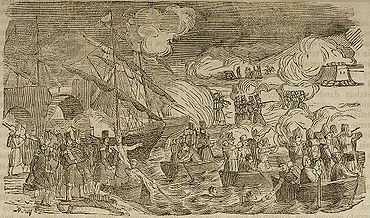
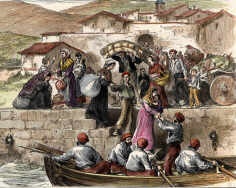
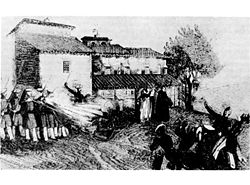
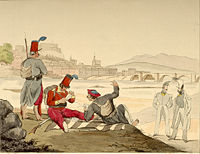 The period of the Carlist Wars
, in which the party tried to attain power mainly through military means, is both the classical in terms of political history as, because of the wars — or the threat of them — Carlism was at the center stage; and formative as it is the period where the cultural and sociological Carlist world, that would last for well over a hundred years, took shape.
Historical highlights of this era are the
At that point, Carlism, under its new head Carlos VII, became the rallying point for many political Catholics and conservatives, becoming the main group of the right-wing opposition to the ensuing governments in Spain. After four years of political activity, and some hesitations, the war option was again tried in
At the beginning of each war, no regular army unit was on the Carlist side, and that only the third was the result of a planned uprising.
The first war was noteworthy for being, on both sides, extremely brutal. The Liberal
Army mistreated the population, most of whom it suspected of being Carlist sympathizers, to the point of, sometimes, attempted extermination; Carlists, very often, treated Liberals no better than they had treated Napoleonic soldiers and agents), to the point where the international powers forced the warring parties to recognize some rules of war
, namely the "Lord Eliot Convention
". Brutality did not disappear completely, and giving no quarter
was not uncommon.
The areas over which Carlism could establish some sort on territorial authority during the first war (Navarre
, Rioja
, rural Basque Country
, inner Catalonia
and northern Valencia region) would remain the main holdings of Carlism for all its history, although the movement was actively supported everywhere else in Spain. Especially in Navarre, Asturias, and parts of the Basque Provinces, Carlism was a major political force until the late 1960s.
After the defeat, a group (led by Alejandro Pidal) left Carlism to form a moderate, non-dynastic Catholic party in Spain, which latter merged with the conservatives of Antonio Cánovas del Castillo
.
In 1879 Cándido Nocedal was charged with the reorganization of the party. His main weapon was a very aggressive press; (in 1883 Pope Leo XIII published the encyclical Cum Multa trying to moderate it). His stance was an uncompromising hold to the Carlists' political and, especially, religious principles (to their integrity, hence the term "integrist"). This tendency became so radical that in 1888, Carlos VII had to expel the group centered around Ramón Nocedal, Cándido's son, which thus gave rise to another small, but in clerical circles influential, Integrist Party.
Meanwhile, the Marquis of Cerralbo, built up a modern mass party, centered around the local assembly houses (called "Círculos", of which several hundred existed all around Spain in 1936) and their social action, and in an active participation in opposition to the political system of the Restoration (participating even in wide coalitions like 1907's "Solidaritat Catalana", with regionalists and republicans).
From 1893 to 1918, Juan Vázquez de Mella
was its most important parliamentary leader and ideologue, seconded by Víctor Pradera, who had wide influence in Spanish conservative thinking beyond the party.
World War I
had a special influence on Carlism. As the Carlist claimant, then Don Jaime, had close links with the Russian Imperial Family, had been unfairly mistreated by Austrian Emperor Franz Josef, and was also Head of the House of Bourbon, he favoured the Allies, but was living under house-arrest in Austria
, with almost no communication with the political direction in Spain. As the war ended, and Don Jaime could again freely communicate with Spain, the crisis erupted, and Vázquez de Mella
and others had to leave the party's direction (the so-called "mellists").
In 1920, Carlism helped to found the "Sindicatos Libres" (Catholic Labour Unions).
Miguel Primo de Rivera
's dictatorship (1923–1930) was opposed, but ambiguously viewed by Carlism; which, like most parties, entered a period of slumber, only to be awakened by the coming of the Second Republic
in 1931.
Integrists and "Mellists" soon reunited, and a new flow of Catholics scared by the attitudes of the republican government started to come in. The two first years of the republic saw short-lived attempts of coalitions with Basque nationalists (as Catholic integrists) and/or Alfonsine monarchists.
After the October 1934 Revolution, Carlism started to prepare for an armed clash with the revolutionaries.

, had been receiving military training during the Second Spanish Republic
but had significant ideological differences with many of the conspiring generals. With the July 1936 revolt and the ensuing Spanish Civil War
, the Carlists fell naturally if uneasily on the side of the Nationalist rebels. From the start there were serious troubles between the Carlists, led by Manuel Fal Condé
, and the rebel military government. On 8 December 1936, Manuel Fal Conde had to leave temporarily for Portugal after a major clash with Francisco Franco
.
On 19 April 1937 the Carlist political branch was "unified" with the Falange
under the pro-Franco umbrella nationalist party Falange Española de las Juntas de Ofensiva Nacional Sindicalista
or FET. Unwilling to leave the Nationalist movement, but unhappy with the merger, Don Javier condemned the Carlists who joined the new party and was expelled from the country while Fal Conde was not allowed to return to Spain until after the war. Low-level Carlists, with the notable exception of those in Navarre, generally distanced themselves from the workings of the new party and in many cases never joined at all.
Carlist ministers in Franco's August 1939 cabinet included General José Enrique Varela
as army minister and Esteban Bilbao as minister of justice. At the same time, two of nine seats in the Junta Política were given to Carlists and of the hundred-member National Council of the FET, seven were occupied by Carlists.
Carlists continued to clash with Falangists, notably in an incident at Bilbao's
Basilica of Begoña
on August 16, 1942. Accounts of the violence vary, but a Carlist rally (where some attendants allegedly were shouting anti-Franco slogans) was targeted by two grenades hurled by Falangists. While the number of injuries and whether any fatalities resulted have been long disputed, the incident led to a shakeup of the Franco cabinet and the conviction of six Falangists. (One, Juan José Domínguez, was executed for the crime.)
Franco recognized both the titles of nobility conceded by the Carlist claimants and those of the Isabelline branch. At his death, the movement was badly split, and unable to get wide public attention again.
In 1971, Don Carlos Hugo
founded the new Carlist Party
based on the confederalist
view of Las Españas for Spain and socialist autogestion (then promoted in Yugoslavia
). At Montejurra, on 9 May 1976, two Hugo supporters were killed by far-right militants, among whom was the Stefano Delle Chiaie
. Carlist Party accused Hugo's brother, Sixto Enrique de Borbón
of helping the far-right militants. Traditionalist Communion denies such collaboration.
on 15 June 1977, only one Carlist senator was elected, journalist and writer Fidel Carazo from Soria
, who ran as an independent candidate. In the parliamentary elections of 1979, rightist Carlists integrated in the far-right coalition Unión Nacional, that won a seat in Congress for Madrid; but the elected candidate was not a Carlist himself. Since then, Carlists have remained extra-parliamentary, obtaining only town council seats.
As of 2002 Hugo donated the House's archives to the Archivo Histórico Nacional, which was protested by his brother Sixtus Henry
and by all Carlist factions.
While they were not proclaimed kings, they went by using some of the titles collateral
to the Spanish throne.
(29 March 1788 – 10 March 1855), was the first Carlist claimant from 1833 to 1845, including during the First Carlist War
. He was known as the Count of Molina. He abdicated in favour of his son.
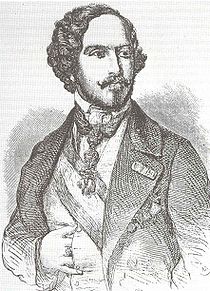 Carlos, Count of Montemolin (31 January 1818 – 13 January 1861), was the son of Carlos V. He was Carlist claimant from 1845 to 1861, and was known as the Count of Montemolin.
In 1860 he abdicated, following his capture by Isabelline forces, in Tortosa
. When freed, he re-assumed his claim until he died the next year.
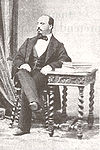 Juan, Count of Montizón
(15 May 1822 – 21 November 1887), was the brother of Carlos VI. He was Carlist claimant from 1860 to 1868, and was known as the Count of Montizon.
He was forced to abdicate by the Carlists due to his liberal leanings.
In 1883 he became the legitimist claimant to the throne of France.
.jpg) Carlos, Duke of Madrid
Carlos, Duke of Madrid
(30 March 1848 – 18 July 1909), was the son of Juan III. He was Carlist claimant from 1868 to 1909, including during the Third Carlist War
. He was known as the Duke of Madrid.
He was also legitimist claimant to the throne of France, using the title Duke of Anjou.
He was also the legitimist claimant to the throne of France, using the title Duke of Anjou.
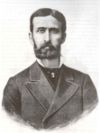 Alfonso Carlos, Duke of San Jaime
(12 September 1849 - 29 September 1936), was uncle of Jaime III and younger brother of Carlos VII. He was Carlist claimant from 1931 to 1936, and was known as the Duke of San Jaime. He was the last male-line descendant of Carlos V.
He was also the legitimist claimant to the throne of France, using the title Duke of Anjou.
of the Carlist Communion.
A minority of Carlists supported Alfonso XIII
, the exiled constitutional king of Spain, who was the senior male descendant of King Charles IV
. The majority of Carlists, however, considered that Alfonso was disqualified because he did not share the Carlist ideals (and, more importantly, because Spanish law excluded from succession the descendants of those who had committed treason against the king, just as Alfonso's male-line ancestors had done, according to carlists, ever since Infante Francisco de Paula's recognition of Isabella II) , and many regarded his descent as illegitimate, believing that Alfonso XII
's biological father was Isabella II
's lover Enrique Puigmoltó y Mayans, Captain of the Royal Guard
, or even General Francisco Serrano
.
A small number of Carlists supported Archduke Karl Pius of Austria, Prince of Tuscany
, a grandson through the female line of Carlos VII.
Most of the following events happened under Franco's regime, which skillfully played each group against the others.
Xavier, Duke of Parma
(25 May 1889 - 7 May 1977) had been named regent of the Carlist Communion by Alfonso Carlos in 1936 as he was the nearest member of the House of Borbón who shared the Carlist ideals.
During the Second World War, Prince Xavier returned to the Belgian army, where he had served during World War I
. He was demobilized and joined the French maquis
. He was taken prisoner by the Nazis
and sent to Natzweiler and the Dachau concentration camp, where American troops liberated him in 1945. In 1952, Xavier was proclaimed King of Spain, assuming the Carlist legitimacy. Since the death of Alfonso Carlos I, his successor, by right of agnation and primogeniture, had yet to be determined. To do so, it was necessary to trace back into the line of Philip V
to his eldest descendant not excluded by law (exclusion took place for treason, morganatic marriage, and other reasons as legally established in the Novísima Recopilación of 1805, in force at the time of the First Carlist War). In 1952, when all lines senior to the House of Bourbon-Parma (descended from Duke Philip of Parma
, third son of Philip V) were definitely excluded for any of these reasons, legitimacy befell on Xavier I. Thus, even though he was close to Carlism from an early age and was named regent of the Carlist Communion in 1936, his proclamation as King later in 1956 was not a political move based on ideology, but the consequence of dynastic legitimacy. He was known as the Count of Molina. He remained Carlist claimant until he abdicated in 1975.
Political division due to the changes in Carlism in the late 1960s and early 1970s, brought a sharp division of Xavier's supporters between his two sons Carlos Hugo and Sixto Enrique (and many more endorsing neither). Carlos Hugo turned organized Carlism into a socialist movement, while his brother Sixto Enrique (supported by his mother Madeleine de Bourbon-Busset
) followed a far rightist course.
In 1977 Sixto Enrique's supporters published a manifesto from Javier condemning Carlos Hugo. Several days later Carlos Hugo's supporters published a manifesto from Xavier recognising Carlos Hugo as heir.
Carlos Hugo, Duke of Parma (8 April 1930- 18 August 2010) was the elder son of Xavier. He was Carlist claimant from 1977 until his death and was known as the Duke of Madrid.
After alienating many Carlists by his attempts of an approach to Franco (1965–1967), Carlos Hugo switched to a leftist Titoist
, workers' self-management
socialist movement.
In 1979 he accepted Spanish citizenship from King Juan Carlos I. In 1980 he renounced his membership in the Partido Carlista which he had created.
Carlos Hugo had the support of a minority of Carlists including the Partido Carlista.
He also excluded the Luxembourgish branch of the family from Carlist succession due to the many unequal, some of them at least as so considered, marriages celebrated by its princes.
Carlos, Duke of Parma (born 27 January 1970) is the elder son of Carlos Hugo. He inherited the Carlist claim on his father's death in 2010. Carlos has the support of a minority of Carlists including the Partido Carlista.
Prince Sixto Enrique of Bourbon-Parma (born 22 July 1940) claims to be the current regent of the Carlist Communion. He is known as the Duke of Aranjuez.
Sixto Enrique is supported by the minority Comunión Tradicionalista, and some others, who believe that his brother Carlos Hugo was rightful heir, but ineligible for the succession on account of his socialism. Sixto Enrique has never claimed to be Carlist king, in the hopes that one of his nephews will one day accept traditional Carlist values.
Alfonso XIII
was the senior member of the House of Borbón at the death of Alfonso Carlos in 1936. He had reigned as the constitutional king of Spain as Alfonso XIII until his exile in 1931. He was the son of King Alfonso XII
, son of Francisco de Asis de Borbón
, son of Infante Francisco de Paula
, the younger brother of Carlos V. He was recognised as Carlist claimant by a minority of Carlists who considered the death of Alfonso Carlos an opportunity to reunite Spanish monarchists both Carlist and Isabelline. Nonetheless, despite this apparently attractive opportunity, Franciso de Paula and his descendants were legally excluded from the throne according to the Spanish laws of succession as they stood in 1833 (and therefore defended by Carlists since then). In 1941 Alfonso abdicated; he died two months later.
Alfonso's eldest son had died in 1938. His second son Jaime had been forced to renounce his rights to the constitutional succession in 1933. His third son Juan was his chosen successor.
was Bianca de Borbón y Borbón-Parma (1868–1949). She married Archduke Leopold Salvator of Austria (1863–1931). In 1943, one of their sons presented himself as Carlist claimant in succession to his great-uncle Alfonso Carlos. Since this claim comes through a female line, it is rejected by most Carlists.
Some carloctavistas consider that Dominic has contracted an unequal marriage and is thus ineligible to succeed to the throne http://www.maineworldnewsservice.com/caltrap/nonexist.htm. Following the version of the succession law advocated by the carloctavistas, that if the direct male line dies out the nearest female relative of the last king inherits the crown with succession to her heirs male, then with only descent through equal marriages allowed the claim would have passed on the death of Franz Josef in 1975 to Infante Juan, Count of Barcelona. This would make the present de facto king Juan Carlos I the Carlist king, although, as all his children have contracted unequal marriages, the Carlist claim will pass on his death to Infante Carlos, Duke of Calabria
. However, many Carlists regard the current de facto Spanish royal family as disqualified (see above). If Alfonso XII and his heirs are discounted, the heir to the Spanish throne under the carloctavista succession rules with descent only through equal marriages is Duarte Pio, Duke of Braganza
, the current pretender to the throne of Portugal
.
movement.
Carlism's intellectual landscape was a reaction against the basic tenets of the Enlightenment and the French Revolution of 1789 (Laicism, individualism
, egalitarianism
, rationalism
). In this sense, it is akin to the French Reactionaries
(Legitimism
) and Joseph de Maistre
's thinking.
It's difficult, though, to give an accurate description of Carlist thinking for several reasons:
While Carlism and Falangism had certain similarities- social conservatism
, Catholicism and anti-Communism- there were also stark differences between the two movements. Most significant was whereas Falangism subscribed to a strongly centralising form of Spanish nationalism, Carlism was more supportive of maintaining regional identities and autonomy as fueros was one of their main tenets.
Carlism also supports Salic Law
in regards to succession, being legitimist monarchists.
opposed Carlism and published several lampoons against it.
Nadie pase sin hablar al portero (1833) presents Carlists as a bunch of bandit priests.
Karl Marx
mentioned the Carlists in his articles about the Spanish revolutions.
An apocryphal quotation can be found among Spanish historians, where Marx would express a view of the Carlists as a revolutionary popular movement in defence of regional liberties.
Francisco Navarro-Villoslada was a Carlist writer that published a historic novel, Amaya o los vascos en el siglo VIII
, in the fashion of Walter Scott
, presenting the legendary origins of Spanish monarchy as the start of Reconquista
.
Ramón María del Valle-Inclán, novelist, poet and playwright, was a member of the Spanish Generation of 1898.
He wrote novels about Carlism and was an active Carlist himself.
Pío Baroja
wrote a novel, Zalacaín el aventurero (Zalacain the Adventurer), set during the Third Carlist War, and referred to Carlism in a not very favourable light (as he generally referred to nearly everybody) in several other works.
The Spanish philosopher Miguel de Unamuno
suffered as a child the siege of Bilbao
during the Third Carlist War
.
Later he wrote a novel Paz en la guerra about that time.
In 1895 he wrote to Joaquín Costa
about his plans for an essay on the "intrahistoric" element of rural socialism within the Carlist masses.
Traditionalist Conservatism
Traditionalist conservatism, also known as "traditional conservatism," "traditionalism," "Burkean conservatism", "classical conservatism" and , "Toryism", describes a political philosophy emphasizing the need for the principles of natural law and transcendent moral order, tradition, hierarchy and...
and legitimist political movement in Spain
Spain
Spain , officially the Kingdom of Spain languages]] under the European Charter for Regional or Minority Languages. In each of these, Spain's official name is as follows:;;;;;;), is a country and member state of the European Union located in southwestern Europe on the Iberian Peninsula...
seeking the establishment of a separate line of the Bourbon
House of Bourbon
The House of Bourbon is a European royal house, a branch of the Capetian dynasty . Bourbon kings first ruled Navarre and France in the 16th century. By the 18th century, members of the Bourbon dynasty also held thrones in Spain, Naples, Sicily, and Parma...
family on the Spanish throne. This line descended from Infante Carlos, Count of Molina
Infante Carlos, Count of Molina
The Infante Carlos of Spain was the second surviving son of King Charles IV of Spain and of his wife, Maria Luisa of Parma. As Carlos V he was the first of the Carlist claimants to the throne of Spain...
(1788–1855), and was founded due to dispute over the succession laws and widespread dissatisfaction with the Alfonsine line of the House of Bourbon
House of Bourbon
The House of Bourbon is a European royal house, a branch of the Capetian dynasty . Bourbon kings first ruled Navarre and France in the 16th century. By the 18th century, members of the Bourbon dynasty also held thrones in Spain, Naples, Sicily, and Parma...
. The movement was at its strongest in the 1830s but had a revival following Spain's defeat in the Spanish-American War
Spanish-American War
The Spanish–American War was a conflict in 1898 between Spain and the United States, effectively the result of American intervention in the ongoing Cuban War of Independence...
in 1898, when Spain lost its last remaining significant colonies, Cuba
Cuba
The Republic of Cuba is an island nation in the Caribbean. The nation of Cuba consists of the main island of Cuba, the Isla de la Juventud, and several archipelagos. Havana is the largest city in Cuba and the country's capital. Santiago de Cuba is the second largest city...
, Puerto Rico
Puerto Rico
Puerto Rico , officially the Commonwealth of Puerto Rico , is an unincorporated territory of the United States, located in the northeastern Caribbean, east of the Dominican Republic and west of both the United States Virgin Islands and the British Virgin Islands.Puerto Rico comprises an...
and the Philippines
Philippines
The Philippines , officially known as the Republic of the Philippines , is a country in Southeast Asia in the western Pacific Ocean. To its north across the Luzon Strait lies Taiwan. West across the South China Sea sits Vietnam...
.
An exceptionally long-lived movement, it was a significant player in Spanish politics
Politics of Spain
The politics of Spain take place in the framework of a parliamentary representative democratic constitutional monarchy, whereby the Monarch is the Head of State and the President of the Government is the head of government in a multi-party system. Executive power is vested in the government...
from 1833 until the end of the Franco
Francisco Franco
Francisco Franco y Bahamonde was a Spanish general, dictator and head of state of Spain from October 1936 , and de facto regent of the nominally restored Kingdom of Spain from 1947 until his death in November, 1975...
regime in 1975 as a social and political force, and one of the main actors in the Spanish Civil War
Spanish Civil War
The Spanish Civil WarAlso known as The Crusade among Nationalists, the Fourth Carlist War among Carlists, and The Rebellion or Uprising among Republicans. was a major conflict fought in Spain from 17 July 1936 to 1 April 1939...
.
In this capacity, it was the cause of several major wars
Carlist Wars
The Carlist Wars in Spain were the last major European civil wars in which contenders fought to establish their claim to a throne. Several times during the period from 1833 to 1876 the Carlists — followers of Infante Carlos and his descendants — rallied to the cry of "God, Country, and King" and...
during the 19th century, and an important factor during the Spanish Civil War
Spanish Civil War
The Spanish Civil WarAlso known as The Crusade among Nationalists, the Fourth Carlist War among Carlists, and The Rebellion or Uprising among Republicans. was a major conflict fought in Spain from 17 July 1936 to 1 April 1939...
in the 1930s.
Systems of succession in dispute
Traditionally, all the Spanish kingdoms allowed the succession of women, in absence of male direct issue, except Aragon to some extent which favored semi-salicism. The most elaborate rules of succession were those included in the Siete PartidasSiete Partidas
The Siete Partidas or simply Partidas was a Castilian statutory code first compiled during the reign of Alfonso X of Castile , with the intent of establishing a uniform body of normative rules for the kingdom. The codified and compiled text was originally called the Libro de las Leyes...
, but on the accession of Philip V
Philip V of Spain
Philip V was King of Spain from 15 November 1700 to 15 January 1724, when he abdicated in favor of his son Louis, and from 6 September 1724, when he assumed the throne again upon his son's death, to his death.Before his reign, Philip occupied an exalted place in the royal family of France as a...
(who was a French prince, France being a country where Salic law
Salic law
Salic law was a body of traditional law codified for governing the Salian Franks in the early Middle Ages during the reign of King Clovis I in the 6th century...
applied, and therefore female succession was not permitted), this traditional order of succession had to give way to a semi-Salic system, which excluded women from the crown, unless all the male issue from Philip, in any line, became extinct. This change was probably forced by external pressure to avoid any possible personal union of the Crown of Spain with a foreign monarchy (the War of the Spanish Succession
War of the Spanish Succession
The War of the Spanish Succession was fought among several European powers, including a divided Spain, over the possible unification of the Kingdoms of Spain and France under one Bourbon monarch. As France and Spain were among the most powerful states of Europe, such a unification would have...
had been fought to prevent Spain and France from being ruled by the same king).
Although several attempts to revert to the traditional order were made, such as the Decree of 1789 by Charles IV of Spain
Charles IV of Spain
Charles IV was King of Spain from 14 December 1788 until his abdication on 19 March 1808.-Early life:...
(see below), the succession question only became pressing when, by 1830, Ferdinand VII found himself ailing, without any issue but with a pregnant wife. He decided in 1830 to promulgate the 1789 decree, making the unborn child his heir regardless of its sex. The law placed the child, which would be born a girl, ahead of Ferdinand's brother Infante Carlos
Infante Carlos, Count of Molina
The Infante Carlos of Spain was the second surviving son of King Charles IV of Spain and of his wife, Maria Luisa of Parma. As Carlos V he was the first of the Carlist claimants to the throne of Spain...
, who until then had been heir-presumptive.
The act was seen by some (starting with his brother and the cadet Bourbon
House of Bourbon
The House of Bourbon is a European royal house, a branch of the Capetian dynasty . Bourbon kings first ruled Navarre and France in the 16th century. By the 18th century, members of the Bourbon dynasty also held thrones in Spain, Naples, Sicily, and Parma...
branches) as illegal on various counts, and formed the basis for the dynastic Carlist party, which only recognized the semi-Salic succession law that gave Infante Carlos precedence over Ferdinand's daughter, the future Isabella II
Isabella II of Spain
Isabella II was the only female monarch of Spain in modern times. She came to the throne as an infant, but her succession was disputed by the Carlists, who refused to recognise a female sovereign, leading to the Carlist Wars. After a troubled reign, she was deposed in the Glorious Revolution of...
.
Historical Timeline
- 13 May 1713: Philip VPhilip V of SpainPhilip V was King of Spain from 15 November 1700 to 15 January 1724, when he abdicated in favor of his son Louis, and from 6 September 1724, when he assumed the throne again upon his son's death, to his death.Before his reign, Philip occupied an exalted place in the royal family of France as a...
, first of the Spanish BourbonHouse of BourbonThe House of Bourbon is a European royal house, a branch of the Capetian dynasty . Bourbon kings first ruled Navarre and France in the 16th century. By the 18th century, members of the Bourbon dynasty also held thrones in Spain, Naples, Sicily, and Parma...
s, together with the CortesCortes GeneralesThe Cortes Generales is the legislature of Spain. It is a bicameral parliament, composed of the Congress of Deputies and the Senate . The Cortes has power to enact any law and to amend the constitution...
, Spain's traditional parliament, through an Auto Accordado changes the order of successionOrder of successionAn order of succession is a formula or algorithm that determines who inherits an office upon the death, resignation, or removal of its current occupant.-Monarchies and nobility:...
to the Spanish crown from that outlined in the Siete PartidasSiete PartidasThe Siete Partidas or simply Partidas was a Castilian statutory code first compiled during the reign of Alfonso X of Castile , with the intent of establishing a uniform body of normative rules for the kingdom. The codified and compiled text was originally called the Libro de las Leyes...
. Where the old rules had involved a form of male-preference primogeniture, Philip's new law changed the rule of succession to semi-Salic law, under which succession is only possible through the female line in the absence of any male heir on any line.
- 1789: During the reign of Charles IVCharles IV of SpainCharles IV was King of Spain from 14 December 1788 until his abdication on 19 March 1808.-Early life:...
, the Cortes approves a reversal of the system of succession to the traditional Siete Partidas order of succession. However, the law was not promulgated, due in part to protests from the cadet branches of the House of Bourbon (House of Bourbon-Two SiciliesHouse of Bourbon-Two SiciliesThe House of Bourbon-Two Sicilies is a cadet Italian branch of the House of Bourbon. It is thus descended from the Capetian dynasty in male line...
and House of Bourbon-ParmaHouse of Bourbon-ParmaThe House of Bourbon-Parma is an Italian cadet branch of the House of Bourbon. It is thus descended from the Capetian dynasty in male line. The name of Bourbon-Parma comes from the main name and the other from the title of Duke of Parma....
), who saw it as diminishing their rights.
- 1812. A new Spanish Constitution outlines the rules of succession in accordance with the Siete Partidas.
- 31 March 1830: Ferdinand VII, at the time without issue and his fourth wife pregnant, promulgates via the Pragmatic Sanction of 1830Pragmatic Sanction of 1830The Pragmatic Sanction of 1830 , issued March 29, 1830 by King Ferdinand VII of Spain, ratified a Decree of 1789 by Charles IV of Spain, which had replaced the semi-Salic system established by Philip V of Spain with the mixed succession system that predated the Bourbon monarchy .When Philip V,...
the 1789 law, re-establishing the traditional order of succession.
- 10 October 1830: A girl, the future Isabella IIIsabella II of SpainIsabella II was the only female monarch of Spain in modern times. She came to the throne as an infant, but her succession was disputed by the Carlists, who refused to recognise a female sovereign, leading to the Carlist Wars. After a troubled reign, she was deposed in the Glorious Revolution of...
is born. After several courtly intrigues, the Pragmatic Sanction is definitively approved in 1832. Ferdinand's brother, the Infante Carlos, up to that time the heir presumptiveHeir PresumptiveAn heir presumptive or heiress presumptive is the person provisionally scheduled to inherit a throne, peerage, or other hereditary honour, but whose position can be displaced by the birth of an heir or heiress apparent or of a new heir presumptive with a better claim to the position in question...
, feels robbed of his rights, and leaves for PortugalPortugalPortugal , officially the Portuguese Republic is a country situated in southwestern Europe on the Iberian Peninsula. Portugal is the westernmost country of Europe, and is bordered by the Atlantic Ocean to the West and South and by Spain to the North and East. The Atlantic archipelagos of the...
.
The political issue
Carlism confronted not only the question of who could legitimately sit on the Spanish throne, but was also about the principles on which Spanish society was built. Should it remain Roman CatholicRoman Catholic Church
The Catholic Church, also known as the Roman Catholic Church, is the world's largest Christian church, with over a billion members. Led by the Pope, it defines its mission as spreading the gospel of Jesus Christ, administering the sacraments and exercising charity...
, or should it embrace Enlightenment
Age of Enlightenment
The Age of Enlightenment was an elite cultural movement of intellectuals in 18th century Europe that sought to mobilize the power of reason in order to reform society and advance knowledge. It promoted intellectual interchange and opposed intolerance and abuses in church and state...
values? Do governments derive their power from God
Divine Right of Kings
The divine right of kings or divine-right theory of kingship is a political and religious doctrine of royal and political legitimacy. It asserts that a monarch is subject to no earthly authority, deriving his right to rule directly from the will of God...
, or do they derive their power from human beings
Declaration of the Rights of Man and of the Citizen
The Declaration of the Rights of Man and of the Citizen is a fundamental document of the French Revolution, defining the individual and collective rights of all the estates of the realm as universal. Influenced by the doctrine of "natural right", the rights of man are held to be universal: valid...
?
Political landscape after the death of Fernando VII (1833)
Like many European countries, after the NapoleonicNapoleon I of France
Napoleon Bonaparte was a French military and political leader during the latter stages of the French Revolution.As Napoleon I, he was Emperor of the French from 1804 to 1815...
occupation, the Spanish political class was split between the "absolutists", supporters of the ancien régime, and the Liberals
Liberalism
Liberalism is the belief in the importance of liberty and equal rights. Liberals espouse a wide array of views depending on their understanding of these principles, but generally, liberals support ideas such as constitutionalism, liberal democracy, free and fair elections, human rights,...
, influenced by the ideas of the French Revolution. Both parties had fought Napoleon side by side in the Peninsular War
Peninsular War
The Peninsular War was a war between France and the allied powers of Spain, the United Kingdom, and Portugal for control of the Iberian Peninsula during the Napoleonic Wars. The war began when French and Spanish armies crossed Spain and invaded Portugal in 1807. Then, in 1808, France turned on its...
.
The long war also left a large supply of experienced guerrilla
Guerrilla warfare
Guerrilla warfare is a form of irregular warfare and refers to conflicts in which a small group of combatants including, but not limited to, armed civilians use military tactics, such as ambushes, sabotage, raids, the element of surprise, and extraordinary mobility to harass a larger and...
fighters and an oversized army officialdom—for the most part, staunch Liberals
Liberalism
Liberalism is the belief in the importance of liberty and equal rights. Liberals espouse a wide array of views depending on their understanding of these principles, but generally, liberals support ideas such as constitutionalism, liberal democracy, free and fair elections, human rights,...
. The perceived success of the uprising of 1808 against Napoleon
Napoleon I of France
Napoleon Bonaparte was a French military and political leader during the latter stages of the French Revolution.As Napoleon I, he was Emperor of the French from 1804 to 1815...
left also a wide, if unconscious, belief in the validity of the right of rebellion
Rebellion
Rebellion, uprising or insurrection, is a refusal of obedience or order. It may, therefore, be seen as encompassing a range of behaviors aimed at destroying or replacing an established authority such as a government or a head of state...
, with long-lasting effects on the politics of Spain and Spanish America through the 19th century and beyond.
The reign of Ferdinand VII proved unable to overcome the political divide or to create stable institutions. The so-called Liberal Triennium (1820–1823), when, after a military "pronunciamiento"
Coup d'état
A coup d'état state, literally: strike/blow of state)—also known as a coup, putsch, and overthrow—is the sudden, extrajudicial deposition of a government, usually by a small group of the existing state establishment—typically the military—to replace the deposed government with another body; either...
, the Liberals reinstated the 1812 constitution, and the succeeding the Ominous Decade
Ominous Decade
The Ominous Decade is a term used to define the last ten years of reign of King Ferdinand VII of Spain, dating from the abolition of the Spanish Constitution of 1812, on 1 October 1823, and his death on 29 September 1833....
(1823–1833), ten years of absolute rule by the king, left bitter memories of persecution in both parties.
While in power, both groups had divided themselves into moderate and radical branches. The radical branch of the absolutists (or royalists), known as the Apostólicos, looked upon the heir presumptive, Carlos
Infante Carlos, Count of Molina
The Infante Carlos of Spain was the second surviving son of King Charles IV of Spain and of his wife, Maria Luisa of Parma. As Carlos V he was the first of the Carlist claimants to the throne of Spain...
, as its natural head, as he was profoundly devout and, especially after 1820, staunchly anti-liberal.
In 1827, Catalonia
Catalonia
Catalonia is an autonomous community in northeastern Spain, with the official status of a "nationality" of Spain. Catalonia comprises four provinces: Barcelona, Girona, Lleida, and Tarragona. Its capital and largest city is Barcelona. Catalonia covers an area of 32,114 km² and has an...
was shaken by the rebellion of the Agreujats or Agraviados ("the Aggrieved"), an ultra-absolutist movement, which, for a time, controlled large parts of the region. The Infante was for the first time then hailed as King. He denied any involvement.
The last years of King Ferdinand saw a political realignment due to the troubles around his succession. In October 1832, the King formed a moderate royalist Government under Francisco Cea Bermúdez, which tried, almost successfully, to curb the Apostolic party and, through an amnesty, to gain liberal support for Isabella's right to succeed and for Queen Maria Christina of Bourbon-Two Sicilies, her mother and designated regent
Regent
A regent, from the Latin regens "one who reigns", is a person selected to act as head of state because the ruler is a minor, not present, or debilitated. Currently there are only two ruling Regencies in the world, sovereign Liechtenstein and the Malaysian constitutive state of Terengganu...
. If only to get rid of Don Carlos, the Liberals accepted the new Princess of Asturias
Princess of Asturias
This is a list of women who held the title Princess of Asturias by marriage.The title was created in 1388 for the future Henry III of Castile and Catherine of Lancaster. A part of the pact was to gran the young couple the title of Prince and Princess of Asturias, which was modelled after that of...
.
Moreover, the first years of the 1830s were influenced by the failure of the French Restoration, which meant the end of Bourbon rule in France; and the civil war in Portugal
Liberal Wars
The Liberal Wars, also known as the Portuguese Civil War, the War of the Two Brothers, or Miguelite War, was a war between progressive constitutionalists and authoritarian absolutists in Portugal over royal succession that lasted from 1828 to 1834...
between both legitimist and liberal parties.
Social and economic factors
Beside this political evolution, the years before the Carlist wars were marked by a deep economic crisis in Spain, partly spurred by the loss of the continental American provinces, and by the bankruptcy of the state. The last triggered enhanced tax pressure which further fueled social unrest.Certain economic measures proposed by the Liberals (like the Desamortización, i.e. the takeover, division and sale of the commons and Church
Roman Catholic Church
The Catholic Church, also known as the Roman Catholic Church, is the world's largest Christian church, with over a billion members. Led by the Pope, it defines its mission as spreading the gospel of Jesus Christ, administering the sacraments and exercising charity...
property, initiated in 1821) were directly threatening to the viability of many small farms, whose inhabitants could rely on the common pasture lands to feed, at little or no cost, their mules and oxen, and caused widespread poverty and the closing down of most hospitals, schools and other charities.
One important factor was the religious question. The radical liberals (progresistas) after 1820 had grown more and more anticlerical, with special hatred for regular orders
Religious order
A religious order is a lineage of communities and organizations of people who live in some way set apart from society in accordance with their specific religious devotion, usually characterized by the principles of its founder's religious practice. The order is composed of initiates and, in some...
, and were suspected of being masonic
Freemasonry
Freemasonry is a fraternal organisation that arose from obscure origins in the late 16th to early 17th century. Freemasonry now exists in various forms all over the world, with a membership estimated at around six million, including approximately 150,000 under the jurisdictions of the Grand Lodge...
shields. This policy alienated them from many sections of the (mostly deeply Catholic) Spanish people, especially in rural areas.
Incidentally, the only institution abolished in the "Liberal Triennium", which was not restored by Ferdinand VII, was the Inquisition
Spanish Inquisition
The Tribunal of the Holy Office of the Inquisition , commonly known as the Spanish Inquisition , was a tribunal established in 1480 by Catholic Monarchs Ferdinand II of Aragon and Isabella I of Castile. It was intended to maintain Catholic orthodoxy in their kingdoms, and to replace the Medieval...
. One of the demands of the radical absolutist party was its reinstitution.
Liberals had been, while in power, quite doctrinaire, and therefore centralizing uniformists. In many sections of Spain, there were intense particularist feelings, who were thus hurt. While only a secondary element at the outbreak of the first War, this anti-uniformism or local particularism, exemplified in the defense of the fueros, would become in time one of the more important banners of Carlism. This won Carlism support in the Basque Country and Navarre, as well as the realms of the Crown of Aragon
Crown of Aragon
The Crown of Aragon Corona d'Aragón Corona d'Aragó Corona Aragonum controlling a large portion of the present-day eastern Spain and southeastern France, as well as some of the major islands and mainland possessions stretching across the Mediterranean as far as Greece...
(Aragon
Aragon
Aragon is a modern autonomous community in Spain, coextensive with the medieval Kingdom of Aragon. Located in northeastern Spain, the Aragonese autonomous community comprises three provinces : Huesca, Zaragoza, and Teruel. Its capital is Zaragoza...
, Catalonia
Catalonia
Catalonia is an autonomous community in northeastern Spain, with the official status of a "nationality" of Spain. Catalonia comprises four provinces: Barcelona, Girona, Lleida, and Tarragona. Its capital and largest city is Barcelona. Catalonia covers an area of 32,114 km² and has an...
and Valencia
Valencian Community
The Valencian Community is an autonomous community of Spain located in central and south-eastern Iberian Peninsula. Its capital and largest city is Valencia...
), as those areas resented the abolition of their ancient privileges of self-government by the Nueva Planta Decrees
Nueva Planta decrees
The Nueva Planta decrees were a number of decrees signed between 1707 and 1716 by Philip V—the first Bourbon king of Spain—during and shortly after the end of the War of the Spanish Succession which he won....
.
History
The history of Carlism can be usefully divided into three different stages, whose dates are only approximate (thus the overlap is intentional):- (1833–1876), where the conquest of power was tried mainly by military means.
- (1868–1936), where Carlism reverted to a peaceful political movement.
- (1936–) From the Spanish Civil War until the present. The Carlists win the war as part of Franco's coalition but are also subverted by the general. After his death the movement declined into near irrelevance.
Carlist Wars (1833–1876)
Carlist Wars
The Carlist Wars in Spain were the last major European civil wars in which contenders fought to establish their claim to a throne. Several times during the period from 1833 to 1876 the Carlists — followers of Infante Carlos and his descendants — rallied to the cry of "God, Country, and King" and...
, in which the party tried to attain power mainly through military means, is both the classical in terms of political history as, because of the wars — or the threat of them — Carlism was at the center stage; and formative as it is the period where the cultural and sociological Carlist world, that would last for well over a hundred years, took shape.
Historical highlights of this era are the
- First Carlist WarFirst Carlist WarThe First Carlist War was a civil war in Spain from 1833-1839.-Historical background:At the beginning of the 18th century, Philip V, the first Bourbon king of Spain, promulgated the Salic Law, which declared illegal the inheritance of the Spanish crown by women...
(1833–1840) - The Royal Marriage Affair 1845. As a means to end the dynastic strife, Jaime Balmes started a campaign to marry Isabel IIIsabella II of SpainIsabella II was the only female monarch of Spain in modern times. She came to the throne as an infant, but her succession was disputed by the Carlists, who refused to recognise a female sovereign, leading to the Carlist Wars. After a troubled reign, she was deposed in the Glorious Revolution of...
with Carlos, Count of Montemolin. It came close to success, but the political issues prevented it. - Second Carlist WarSecond Carlist WarThe Second Carlist War, or the War of the Matiners or Madrugadores , was a short civil war fought primarily in Catalonia by the Carlists under General Ramón Cabrera against the forces of the government of Isabella II...
(1847–1849) - The 1860 expedition and its aftermath. That year the Count of Montemolín, tried to gain power through a pronunciamientoCoup d'étatA coup d'état state, literally: strike/blow of state)—also known as a coup, putsch, and overthrow—is the sudden, extrajudicial deposition of a government, usually by a small group of the existing state establishment—typically the military—to replace the deposed government with another body; either...
. He landed in Sant Carles de la RàpitaSant Carles de la RàpitaSant Carles de la Ràpita is a town in the area of the Montsià in Catalonia, Spain. The town covers a portion of the south-west of the Ebre delta, including el Trabucador isthmus and la Banya peninsula, which close off a salt water lagoon known as the Port dels Alfacs. The town of Sant Carles de la...
(TarragonaTarragonaTarragona is a city located in the south of Catalonia on the north-east of Spain, by the Mediterranean. It is the capital of the Spanish province of the same name and the capital of the Catalan comarca Tarragonès. In the medieval and modern times it was the capital of the Vegueria of Tarragona...
), but was quickly detained, and forced to abdicate his rights. This disaster, his behaviour after his release, and the fact that the next in the line was his liberal brother, put Carlism on the brink of extinction, only saved by the hand of his stepmother, the Princess of Beira, and - The "Glorious RevolutionGlorious Revolution (Spain)The Glorious Revolution took place in Spain in 1868, resulting in the deposition of Queen Isabella II.An 1866 rebellion led by General Juan Prim and a revolt of the sergeants at San Gil barracks, in Madrid, sent a signal to Spanish liberals and republicans that there was serious unrest with the...
" 1868. Isabel (II) managed to alienate almost everybody in Spain, until she was expelled that year by a progressivist revolution.
At that point, Carlism, under its new head Carlos VII, became the rallying point for many political Catholics and conservatives, becoming the main group of the right-wing opposition to the ensuing governments in Spain. After four years of political activity, and some hesitations, the war option was again tried in
- the Third Carlist WarThird Carlist WarThe Third Carlist War was the last Carlist War in Spain. It is very often referred to as the Second Carlist War, as the 'second' had been small in scale and almost trivial in political consequence....
(1872–1876)
Points of convergence
All three wars share a common development pattern:- A first stage of guerrilla activity, across all of Spain.
- A second stage, where a territorial basis is created, and regular army units are created. The 1847 war did not get further than this.
- A third stage, where the basis is consolidated through conventional warfare, and State structures are created. No Carlist war went further than this.
At the beginning of each war, no regular army unit was on the Carlist side, and that only the third was the result of a planned uprising.
The first war was noteworthy for being, on both sides, extremely brutal. The Liberal
Liberalism
Liberalism is the belief in the importance of liberty and equal rights. Liberals espouse a wide array of views depending on their understanding of these principles, but generally, liberals support ideas such as constitutionalism, liberal democracy, free and fair elections, human rights,...
Army mistreated the population, most of whom it suspected of being Carlist sympathizers, to the point of, sometimes, attempted extermination; Carlists, very often, treated Liberals no better than they had treated Napoleonic soldiers and agents), to the point where the international powers forced the warring parties to recognize some rules of war
Laws of war
The law of war is a body of law concerning acceptable justifications to engage in war and the limits to acceptable wartime conduct...
, namely the "Lord Eliot Convention
Lord Eliot Convention
The Lord Eliot Convention, or simply the Eliot Convention or Eliot Treaty , was an April 1835 agreement brokered by Edward Eliot, 3rd Earl of St Germans between the two opposing sides of the First Carlist War...
". Brutality did not disappear completely, and giving no quarter
No quarter
A victor gives no quarter when the victor shows no clemency or mercy and refuses to spare the life in return for the surrender at discretion of a vanquished opponent....
was not uncommon.
The areas over which Carlism could establish some sort on territorial authority during the first war (Navarre
Navarre
Navarre , officially the Chartered Community of Navarre is an autonomous community in northern Spain, bordering the Basque Country, La Rioja, and Aragon in Spain and Aquitaine in France...
, Rioja
La Rioja (Spain)
La Rioja is an autonomous community and a province of northern Spain. Its capital is Logroño. Other cities and towns in the province include Calahorra, Arnedo, Alfaro, Haro, Santo Domingo de la Calzada, and Nájera.-History:...
, rural Basque Country
Basque Country (autonomous community)
The Basque Country is an autonomous community of northern Spain. It includes the Basque provinces of Álava, Biscay and Gipuzkoa, also called Historical Territories....
, inner Catalonia
Catalonia
Catalonia is an autonomous community in northeastern Spain, with the official status of a "nationality" of Spain. Catalonia comprises four provinces: Barcelona, Girona, Lleida, and Tarragona. Its capital and largest city is Barcelona. Catalonia covers an area of 32,114 km² and has an...
and northern Valencia region) would remain the main holdings of Carlism for all its history, although the movement was actively supported everywhere else in Spain. Especially in Navarre, Asturias, and parts of the Basque Provinces, Carlism was a major political force until the late 1960s.
Carlist military leaders
- Tomás de ZumalacárreguiTomás de Zumalacárregui- From Peninsula War to Ferdinand VII:Zumalacárregui was born at Ormaiztegi in Gipuzkoa, Basque Country, on 29 December 1788. His father, Francisco Antonio de Zumalacárregui, was a lawyer who possessed some property, and the son was articled to a solicitor....
- El Cura Santa Cruz
- Ramón CabreraRamón CabreraRamon Cabrera y Griñó was a Carlist general of Spain.He was born at Tortosa, province of Tarragona, Spain. As his family had in their gift two chaplaincies, young Cabrera was sent to the seminary of Tortosa, where he made himself conspicuous as an unruly pupil, ever mixed up in disturbances and...
Carlists in peace (1868–1936)
The loss of prestige and subsequent fall of Isabel (II) in 1868 plus the staunch support of Carlism by Pope Pius IX, led a sizable number of former Isabelline conservative Catholics (Francisco Navarro Villoslada, Antonio Aparisi, Cándido Nocedal, Alejandro Pidal,…) to join the Carlist cause. For a time, even beyond the start of the third war (1872), it became the most important, and best organized, "right-wing" opposition group to the revolutionary regime, with some 90 members of parliament in 1871.After the defeat, a group (led by Alejandro Pidal) left Carlism to form a moderate, non-dynastic Catholic party in Spain, which latter merged with the conservatives of Antonio Cánovas del Castillo
Antonio Cánovas del Castillo
Antonio Cánovas del Castillo was a Spanish politician and historian known principally for his role in supporting the restoration of the Bourbon monarchy to the Spanish throne and for his death at the hands of an anarchist assassin, Michele Angiolillo.-Early career:Born in Málaga as the son of...
.
In 1879 Cándido Nocedal was charged with the reorganization of the party. His main weapon was a very aggressive press; (in 1883 Pope Leo XIII published the encyclical Cum Multa trying to moderate it). His stance was an uncompromising hold to the Carlists' political and, especially, religious principles (to their integrity, hence the term "integrist"). This tendency became so radical that in 1888, Carlos VII had to expel the group centered around Ramón Nocedal, Cándido's son, which thus gave rise to another small, but in clerical circles influential, Integrist Party.
Meanwhile, the Marquis of Cerralbo, built up a modern mass party, centered around the local assembly houses (called "Círculos", of which several hundred existed all around Spain in 1936) and their social action, and in an active participation in opposition to the political system of the Restoration (participating even in wide coalitions like 1907's "Solidaritat Catalana", with regionalists and republicans).
From 1893 to 1918, Juan Vázquez de Mella
Juan Vázquez de Mella
Juan Vázquez de Mella y Fanjul was a Spanish scholar and politician, closely associated with the Spanish legitimist and traditionalist movement known as Carlism.-Career:...
was its most important parliamentary leader and ideologue, seconded by Víctor Pradera, who had wide influence in Spanish conservative thinking beyond the party.
World War I
World War I
World War I , which was predominantly called the World War or the Great War from its occurrence until 1939, and the First World War or World War I thereafter, was a major war centred in Europe that began on 28 July 1914 and lasted until 11 November 1918...
had a special influence on Carlism. As the Carlist claimant, then Don Jaime, had close links with the Russian Imperial Family, had been unfairly mistreated by Austrian Emperor Franz Josef, and was also Head of the House of Bourbon, he favoured the Allies, but was living under house-arrest in Austria
Austria
Austria , officially the Republic of Austria , is a landlocked country of roughly 8.4 million people in Central Europe. It is bordered by the Czech Republic and Germany to the north, Slovakia and Hungary to the east, Slovenia and Italy to the south, and Switzerland and Liechtenstein to the...
, with almost no communication with the political direction in Spain. As the war ended, and Don Jaime could again freely communicate with Spain, the crisis erupted, and Vázquez de Mella
Juan Vázquez de Mella
Juan Vázquez de Mella y Fanjul was a Spanish scholar and politician, closely associated with the Spanish legitimist and traditionalist movement known as Carlism.-Career:...
and others had to leave the party's direction (the so-called "mellists").
In 1920, Carlism helped to found the "Sindicatos Libres" (Catholic Labour Unions).
Miguel Primo de Rivera
Miguel Primo de Rivera
Miguel Primo de Rivera y Orbaneja, 2nd Marquis of Estella, 22nd Count of Sobremonte, Knight of Calatrava was a Spanish dictator, aristocrat, and a military official who was appointed Prime Minister by the King and who for seven years was a dictator, ending the turno system of alternating...
's dictatorship (1923–1930) was opposed, but ambiguously viewed by Carlism; which, like most parties, entered a period of slumber, only to be awakened by the coming of the Second Republic
Second Spanish Republic
The Second Spanish Republic was the government of Spain between April 14 1931, and its destruction by a military rebellion, led by General Francisco Franco....
in 1931.
Integrists and "Mellists" soon reunited, and a new flow of Catholics scared by the attitudes of the republican government started to come in. The two first years of the republic saw short-lived attempts of coalitions with Basque nationalists (as Catholic integrists) and/or Alfonsine monarchists.
After the October 1934 Revolution, Carlism started to prepare for an armed clash with the revolutionaries.
Spanish Civil War and post war period (1936-today)
During the war (1936–1939)
The Carlist militia, the RequetésRequetés
The Requetés were the Carlist militia during the Spanish Civil War. Wearing red berets, they mostly came from Navarre and were highly religious with many regarding the war as a Crusade...
, had been receiving military training during the Second Spanish Republic
Second Spanish Republic
The Second Spanish Republic was the government of Spain between April 14 1931, and its destruction by a military rebellion, led by General Francisco Franco....
but had significant ideological differences with many of the conspiring generals. With the July 1936 revolt and the ensuing Spanish Civil War
Spanish Civil War
The Spanish Civil WarAlso known as The Crusade among Nationalists, the Fourth Carlist War among Carlists, and The Rebellion or Uprising among Republicans. was a major conflict fought in Spain from 17 July 1936 to 1 April 1939...
, the Carlists fell naturally if uneasily on the side of the Nationalist rebels. From the start there were serious troubles between the Carlists, led by Manuel Fal Condé
Manuel Fal Condé
Manuel José Fal Condé, Duke of Quintillo, Grandee of Spain was the political leader of the Carlist movement in Spain in the 1930s and during the Spanish Civil War. Condé was born in Seville, Spain and was a lawyer by profession...
, and the rebel military government. On 8 December 1936, Manuel Fal Conde had to leave temporarily for Portugal after a major clash with Francisco Franco
Francisco Franco
Francisco Franco y Bahamonde was a Spanish general, dictator and head of state of Spain from October 1936 , and de facto regent of the nominally restored Kingdom of Spain from 1947 until his death in November, 1975...
.
On 19 April 1937 the Carlist political branch was "unified" with the Falange
Falange
The Spanish Phalanx of the Assemblies of the National Syndicalist Offensive , known simply as the Falange, is the name assigned to several political movements and parties dating from the 1930s, most particularly the original fascist movement in Spain. The word means phalanx formation in Spanish....
under the pro-Franco umbrella nationalist party Falange Española de las Juntas de Ofensiva Nacional Sindicalista
Falange
The Spanish Phalanx of the Assemblies of the National Syndicalist Offensive , known simply as the Falange, is the name assigned to several political movements and parties dating from the 1930s, most particularly the original fascist movement in Spain. The word means phalanx formation in Spanish....
or FET. Unwilling to leave the Nationalist movement, but unhappy with the merger, Don Javier condemned the Carlists who joined the new party and was expelled from the country while Fal Conde was not allowed to return to Spain until after the war. Low-level Carlists, with the notable exception of those in Navarre, generally distanced themselves from the workings of the new party and in many cases never joined at all.
Franco era
From this time on, the mainstream kept an uncomfortable minority position inside the regime, more often than not at odds with the official policy, but with the ministry of Justice thrice given to a loyal "Carlist", who was accordingly expelled from the Traditionalist Communion. This time was also marred by the problem of succession (see below) and internal strife on how to deal with Francoism.Carlist ministers in Franco's August 1939 cabinet included General José Enrique Varela
José Enrique Varela
José Enrique Varela Iglesias was a Spanish military officer and Carlist noted for his role as a Nationalist commander in the Spanish Civil War.-Early career:...
as army minister and Esteban Bilbao as minister of justice. At the same time, two of nine seats in the Junta Política were given to Carlists and of the hundred-member National Council of the FET, seven were occupied by Carlists.
Carlists continued to clash with Falangists, notably in an incident at Bilbao's
Bilbao
Bilbao ) is a Spanish municipality, capital of the province of Biscay, in the autonomous community of the Basque Country. With a population of 353,187 , it is the largest city of its autonomous community and the tenth largest in Spain...
Basilica of Begoña
Basilica of Begoña
The Basilica of Begoña is a basilica in Bilbao, in Spain, dedicated to the patron saint of Biscay, the Virgin Begoña.The current parish priest is Jesús Francisco de Garitaonandia.-History:...
on August 16, 1942. Accounts of the violence vary, but a Carlist rally (where some attendants allegedly were shouting anti-Franco slogans) was targeted by two grenades hurled by Falangists. While the number of injuries and whether any fatalities resulted have been long disputed, the incident led to a shakeup of the Franco cabinet and the conviction of six Falangists. (One, Juan José Domínguez, was executed for the crime.)
Franco recognized both the titles of nobility conceded by the Carlist claimants and those of the Isabelline branch. At his death, the movement was badly split, and unable to get wide public attention again.
In 1971, Don Carlos Hugo
Carlos Hugo of Bourbon, Duke of Parma
Carlos Hugo, Duke of Parma and Piacenza was the head of the House of Bourbon-Parma from 1977 until his death...
founded the new Carlist Party
Carlist Party
The Carlist Party is a Spanish political party that considers itself as a successor to the historical tradition of Carlism. The party was founded in 1969, although it remained illegal until 1977, following the death of the dictator Franco and the democratisation of Spain.The secretary-general of...
based on the confederalist
Confederation
A confederation in modern political terms is a permanent union of political units for common action in relation to other units. Usually created by treaty but often later adopting a common constitution, confederations tend to be established for dealing with critical issues such as defense, foreign...
view of Las Españas for Spain and socialist autogestion (then promoted in Yugoslavia
Yugoslavia
Yugoslavia refers to three political entities that existed successively on the western part of the Balkans during most of the 20th century....
). At Montejurra, on 9 May 1976, two Hugo supporters were killed by far-right militants, among whom was the Stefano Delle Chiaie
Stefano Delle Chiaie
Stefano Delle Chiaie is a neofascist Italian activist . He went on to become a wanted man worldwide, suspect to be involved in Italy's strategy of tension, but was acquitted. He was a friend of Licio Gelli, grandmaster of P2 masonic lodge...
. Carlist Party accused Hugo's brother, Sixto Enrique de Borbón
Sixto Enrique de Borbón
Prince Sixtus Henry of Bourbon-Parma is considered Regent of Spain by some Carlists who accord him the titles Duke of Aranjuez, Infante of Spain, and Standard-bearer of Tradition.-Early life:...
of helping the far-right militants. Traditionalist Communion denies such collaboration.
Post-Franco
In the first democratic electionsConstituent Cortes
Constituent Cortes is the description of Spain's parliament, the Cortes, when convened as a constituent assembly.In the 20th century, only one Constituent Cortes was officially opened , and that was the Republican Cortes in 1931.The Cortes in 1977 enacted the new Spanish constitution...
on 15 June 1977, only one Carlist senator was elected, journalist and writer Fidel Carazo from Soria
Soria
Soria is a city in north-central Spain, the capital of the province of Soria in the autonomous community of Castile and León. , the municipality has a population of c. 39,500 inhabitants, nearly 40% of the population of the province...
, who ran as an independent candidate. In the parliamentary elections of 1979, rightist Carlists integrated in the far-right coalition Unión Nacional, that won a seat in Congress for Madrid; but the elected candidate was not a Carlist himself. Since then, Carlists have remained extra-parliamentary, obtaining only town council seats.
As of 2002 Hugo donated the House's archives to the Archivo Histórico Nacional, which was protested by his brother Sixtus Henry
Sixto Enrique de Borbón
Prince Sixtus Henry of Bourbon-Parma is considered Regent of Spain by some Carlists who accord him the titles Duke of Aranjuez, Infante of Spain, and Standard-bearer of Tradition.-Early life:...
and by all Carlist factions.
Carlist claimants to the throne
The ordinals are those used by their supporters.While they were not proclaimed kings, they went by using some of the titles collateral
Collateral (finance)
In lending agreements, collateral is a borrower's pledge of specific property to a lender, to secure repayment of a loan.The collateral serves as protection for a lender against a borrower's default - that is, any borrower failing to pay the principal and interest under the terms of a loan obligation...
to the Spanish throne.
Carlos V
Infante Carlos, Count of MolinaInfante Carlos, Count of Molina
The Infante Carlos of Spain was the second surviving son of King Charles IV of Spain and of his wife, Maria Luisa of Parma. As Carlos V he was the first of the Carlist claimants to the throne of Spain...
(29 March 1788 – 10 March 1855), was the first Carlist claimant from 1833 to 1845, including during the First Carlist War
First Carlist War
The First Carlist War was a civil war in Spain from 1833-1839.-Historical background:At the beginning of the 18th century, Philip V, the first Bourbon king of Spain, promulgated the Salic Law, which declared illegal the inheritance of the Spanish crown by women...
. He was known as the Count of Molina. He abdicated in favour of his son.
Carlos VI
In 1860 he abdicated, following his capture by Isabelline forces, in Tortosa
Tortosa
-External links:* *** * * *...
. When freed, he re-assumed his claim until he died the next year.
Juan III
Juan, Count of Montizón
Don Juan Carlos María Isidro de Borbón, Count of Montizón was the Carlist claimant to the throne of Spain from 1860 to 1868, and the Legitimist claimant to the throne of France from 1883 to 1887.- Youth and marriage :...
(15 May 1822 – 21 November 1887), was the brother of Carlos VI. He was Carlist claimant from 1860 to 1868, and was known as the Count of Montizon.
He was forced to abdicate by the Carlists due to his liberal leanings.
In 1883 he became the legitimist claimant to the throne of France.
Carlos VII
Carlos, Duke of Madrid
Infante Carlos María de los Dolores Juan Isidro José Francisco Quirin Antonio Miguel Gabriel Rafael de Borbón y Austria-Este, Duke of Madrid was the senior member of the House of Bourbon from 1887 until his death...
(30 March 1848 – 18 July 1909), was the son of Juan III. He was Carlist claimant from 1868 to 1909, including during the Third Carlist War
Third Carlist War
The Third Carlist War was the last Carlist War in Spain. It is very often referred to as the Second Carlist War, as the 'second' had been small in scale and almost trivial in political consequence....
. He was known as the Duke of Madrid.
He was also legitimist claimant to the throne of France, using the title Duke of Anjou.
Jaime III
Jaime, Duke of Madrid (27 June 1870 – 9 October 1931), was the son of Carlos VII. He was Carlist claimant from 1909 to 1931, and was known as the Duke of Madrid.He was also the legitimist claimant to the throne of France, using the title Duke of Anjou.
Alfonso Carlos I
Alfonso Carlos, Duke of San Jaime
Alfonso Carlos, Infante of Spain, Duke of San Jaime was the Carlist claimant to the throne of Spain under the name Alfonso Carlos I and the Legitimist claimant to the throne of France under the name Charles XII.-Early life:Alfonso Carlos was the second son of Infante Juan...
(12 September 1849 - 29 September 1936), was uncle of Jaime III and younger brother of Carlos VII. He was Carlist claimant from 1931 to 1936, and was known as the Duke of San Jaime. He was the last male-line descendant of Carlos V.
He was also the legitimist claimant to the throne of France, using the title Duke of Anjou.
The succession after Alfonso Carlos
At the death of Alfonso Carlos in 1936 most Carlists supported Prince Xavier of Bourbon-Parma whom Alfonso Carlos had named as regentRegent
A regent, from the Latin regens "one who reigns", is a person selected to act as head of state because the ruler is a minor, not present, or debilitated. Currently there are only two ruling Regencies in the world, sovereign Liechtenstein and the Malaysian constitutive state of Terengganu...
of the Carlist Communion.
A minority of Carlists supported Alfonso XIII
Alfonso XIII of Spain
Alfonso XIII was King of Spain from 1886 until 1931. His mother, Maria Christina of Austria, was appointed regent during his minority...
, the exiled constitutional king of Spain, who was the senior male descendant of King Charles IV
Charles IV of Spain
Charles IV was King of Spain from 14 December 1788 until his abdication on 19 March 1808.-Early life:...
. The majority of Carlists, however, considered that Alfonso was disqualified because he did not share the Carlist ideals (and, more importantly, because Spanish law excluded from succession the descendants of those who had committed treason against the king, just as Alfonso's male-line ancestors had done, according to carlists, ever since Infante Francisco de Paula's recognition of Isabella II) , and many regarded his descent as illegitimate, believing that Alfonso XII
Alfonso XII of Spain
Alfonso XII was king of Spain, reigning from 1874 to 1885, after a coup d'état restored the monarchy and ended the ephemeral First Spanish Republic.-Early life and paternity:Alfonso was the son of Queen Isabella II of Spain, and...
's biological father was Isabella II
Isabella II of Spain
Isabella II was the only female monarch of Spain in modern times. She came to the throne as an infant, but her succession was disputed by the Carlists, who refused to recognise a female sovereign, leading to the Carlist Wars. After a troubled reign, she was deposed in the Glorious Revolution of...
's lover Enrique Puigmoltó y Mayans, Captain of the Royal Guard
Royal Guard
A Royal Guard describes any group of military bodyguards, soldiers or armed retainers responsible for the protection of a royal person, such as Emperor/Empress, King/Queen, or Prince/Princess...
, or even General Francisco Serrano
Francisco Serrano y Domínguez, Duke de la Torre
Don Francisco Serrano y Domínguez, 1st Duke of la Torre Grandee of Spain, Count of San Antonio was a Spanish marshal and statesman...
.
A small number of Carlists supported Archduke Karl Pius of Austria, Prince of Tuscany
Archduke Karl Pius of Austria, Prince of Tuscany
Archduke Karl Pius of Austria, Prince Royal of Hungary and Bohemia, Prince of Tuscany , called Carlos Pío de Habsburgo-Lorena y de Borbón in Spain, was a member of the Tuscan branch of the Imperial House of Habsburg and a Carlist claimant to the throne of Spain under the assumed name of "Carlos...
, a grandson through the female line of Carlos VII.
Most of the following events happened under Franco's regime, which skillfully played each group against the others.
Borbón-Parma claim
- Francisco Javier I
Xavier, Duke of Parma
Xavier, Duke of Parma
Xavier, Duke of Parma and Piacenza, known before 1974 as Prince Xavier of Bourbon-Parma was the head of the ducal House of Bourbon-Parma, pretender to the defunct throne of Parma, and Carlist claimant to the throne of Spain under the name Javier I.-Early life:Xavier...
(25 May 1889 - 7 May 1977) had been named regent of the Carlist Communion by Alfonso Carlos in 1936 as he was the nearest member of the House of Borbón who shared the Carlist ideals.
During the Second World War, Prince Xavier returned to the Belgian army, where he had served during World War I
World War I
World War I , which was predominantly called the World War or the Great War from its occurrence until 1939, and the First World War or World War I thereafter, was a major war centred in Europe that began on 28 July 1914 and lasted until 11 November 1918...
. He was demobilized and joined the French maquis
Maquis (World War II)
The Maquis were the predominantly rural guerrilla bands of the French Resistance. Initially they were composed of men who had escaped into the mountains to avoid conscription into Vichy France's Service du travail obligatoire to provide forced labour for Germany...
. He was taken prisoner by the Nazis
Nazism
Nazism, the common short form name of National Socialism was the ideology and practice of the Nazi Party and of Nazi Germany...
and sent to Natzweiler and the Dachau concentration camp, where American troops liberated him in 1945. In 1952, Xavier was proclaimed King of Spain, assuming the Carlist legitimacy. Since the death of Alfonso Carlos I, his successor, by right of agnation and primogeniture, had yet to be determined. To do so, it was necessary to trace back into the line of Philip V
Philip V of Spain
Philip V was King of Spain from 15 November 1700 to 15 January 1724, when he abdicated in favor of his son Louis, and from 6 September 1724, when he assumed the throne again upon his son's death, to his death.Before his reign, Philip occupied an exalted place in the royal family of France as a...
to his eldest descendant not excluded by law (exclusion took place for treason, morganatic marriage, and other reasons as legally established in the Novísima Recopilación of 1805, in force at the time of the First Carlist War). In 1952, when all lines senior to the House of Bourbon-Parma (descended from Duke Philip of Parma
Philip, Duke of Parma
Philip of Spain was Duke of Parma from 1748 to 1765. He founded the House of Bourbon-Parma , a cadet line of the Spanish branch of the dynasty...
, third son of Philip V) were definitely excluded for any of these reasons, legitimacy befell on Xavier I. Thus, even though he was close to Carlism from an early age and was named regent of the Carlist Communion in 1936, his proclamation as King later in 1956 was not a political move based on ideology, but the consequence of dynastic legitimacy. He was known as the Count of Molina. He remained Carlist claimant until he abdicated in 1975.
Political division due to the changes in Carlism in the late 1960s and early 1970s, brought a sharp division of Xavier's supporters between his two sons Carlos Hugo and Sixto Enrique (and many more endorsing neither). Carlos Hugo turned organized Carlism into a socialist movement, while his brother Sixto Enrique (supported by his mother Madeleine de Bourbon-Busset
Madeleine de Bourbon-Busset
Madeleine de Bourbon was the Duchess of Parma and was also Carlist queen of Spain by virtue of marriage to Xavier of Parma, the Carlist pretender to the Spanish throne,....
) followed a far rightist course.
In 1977 Sixto Enrique's supporters published a manifesto from Javier condemning Carlos Hugo. Several days later Carlos Hugo's supporters published a manifesto from Xavier recognising Carlos Hugo as heir.
- Carlos Hugo I
Carlos Hugo, Duke of Parma (8 April 1930- 18 August 2010) was the elder son of Xavier. He was Carlist claimant from 1977 until his death and was known as the Duke of Madrid.
After alienating many Carlists by his attempts of an approach to Franco (1965–1967), Carlos Hugo switched to a leftist Titoist
Titoism
Titoism is a variant of Marxism–Leninism named after Josip Broz Tito, leader of the Socialist Federal Republic of Yugoslavia, primarily used to describe the specific socialist system built in Yugoslavia after its refusal of the 1948 Resolution of the Cominform, when the Communist Party of...
, workers' self-management
Workers' self-management
Worker self-management is a form of workplace decision-making in which the workers themselves agree on choices instead of an owner or traditional supervisor telling workers what to do, how to do it and where to do it...
socialist movement.
In 1979 he accepted Spanish citizenship from King Juan Carlos I. In 1980 he renounced his membership in the Partido Carlista which he had created.
Carlos Hugo had the support of a minority of Carlists including the Partido Carlista.
He also excluded the Luxembourgish branch of the family from Carlist succession due to the many unequal, some of them at least as so considered, marriages celebrated by its princes.
- Carlos VIII
Carlos, Duke of Parma (born 27 January 1970) is the elder son of Carlos Hugo. He inherited the Carlist claim on his father's death in 2010. Carlos has the support of a minority of Carlists including the Partido Carlista.
- Sixto Enrique
Prince Sixto Enrique of Bourbon-Parma (born 22 July 1940) claims to be the current regent of the Carlist Communion. He is known as the Duke of Aranjuez.
Sixto Enrique is supported by the minority Comunión Tradicionalista, and some others, who believe that his brother Carlos Hugo was rightful heir, but ineligible for the succession on account of his socialism. Sixto Enrique has never claimed to be Carlist king, in the hopes that one of his nephews will one day accept traditional Carlist values.
Borbón claim
- Alfonso de Borbón
Alfonso XIII
Alfonso XIII of Spain
Alfonso XIII was King of Spain from 1886 until 1931. His mother, Maria Christina of Austria, was appointed regent during his minority...
was the senior member of the House of Borbón at the death of Alfonso Carlos in 1936. He had reigned as the constitutional king of Spain as Alfonso XIII until his exile in 1931. He was the son of King Alfonso XII
Alfonso XII of Spain
Alfonso XII was king of Spain, reigning from 1874 to 1885, after a coup d'état restored the monarchy and ended the ephemeral First Spanish Republic.-Early life and paternity:Alfonso was the son of Queen Isabella II of Spain, and...
, son of Francisco de Asis de Borbón
Francis of Spain
Francis of Spain was King consort of Spain as spouse of Isabella II of Spain. He is commonly styled the Duke of Cádiz, the title he held before his marriage.-Family:...
, son of Infante Francisco de Paula
Infante Francisco de Paula of Spain
Infante Francisco de Paula of Spain was the youngest son of Charles IV of Spain and Maria Luisa of Parma.-Marriage and children:...
, the younger brother of Carlos V. He was recognised as Carlist claimant by a minority of Carlists who considered the death of Alfonso Carlos an opportunity to reunite Spanish monarchists both Carlist and Isabelline. Nonetheless, despite this apparently attractive opportunity, Franciso de Paula and his descendants were legally excluded from the throne according to the Spanish laws of succession as they stood in 1833 (and therefore defended by Carlists since then). In 1941 Alfonso abdicated; he died two months later.
Alfonso's eldest son had died in 1938. His second son Jaime had been forced to renounce his rights to the constitutional succession in 1933. His third son Juan was his chosen successor.
- Juan de Borbón claim
- Infante Juan, Count of Barcelona (20 June 1913 – 1 April 1993) was the third son of Alfonso. He was claimant to the throne of Spain from 1941 until his renunciation in 1977. In 1957, a small group of former Carlists had recognized him as their Head in his exile at Estoril, Portugal.
- King Juan Carlos IJuan Carlos I of SpainJuan Carlos I |Italy]]) is the reigning King of Spain.On 22 November 1975, two days after the death of General Francisco Franco, Juan Carlos was designated king according to the law of succession promulgated by Franco. Spain had no monarch for 38 years in 1969 when Franco named Juan Carlos as the...
is the son of Infante Juan. He is the current representative of this claim. He has been the King of Spain since 1975, confirmed by the Spanish Constitution of 1978Spanish Constitution of 1978-Structure of the State:The Constitution recognizes the existence of nationalities and regions . Preliminary Title As a result, Spain is now composed entirely of 17 Autonomous Communities and two autonomous cities with varying degrees of autonomy, to the extent that, even though the Constitution...
.
- Jaime de Borbón claim
- Infante Jaime, Duke of SegoviaInfante Jaime, Duke of SegoviaInfante Jaime of Spain, Duke of Segovia, Grandee of Spain , was the second son of King Alfonso XIII of Spain and his wife Princess Victoria Eugenie of Battenberg...
was the second son of Alfonso, and the older brother of Juan, Count of Barcelona. In 1960 Jaime announced that he was Carlist claimant and began using the title Duke of Madrid; he remained Carlist claimant until his death in 1975. He had only a few Carlist supporters, but among these was Alicia de Borbón y de Borbón-Parma, the only surviving daughter of Carlos VII. Jaime was also legitimist claimant to the French throne, using the title Duke of Anjou; in this capacity he had substantial supporters. - Alfonso, Duke of Anjou and CádizAlfonso, Duke of Anjou and CádizAlfonso, Duke of Anjou and Duke of Cádiz, Grandee of Spain was a grandson of King Alfonso XIII of Spain and a Legitimist claimant to the throne of France.-Life:Alfonso was born in the Clinica Santa Anna in Rome, the elder son of Infante...
was the son of Jaime. He did not claim the Carlist succession between 1975 and his death in 1989. - Louis Alphonse, Duke of AnjouLouis Alphonse, Duke of AnjouPrince Louis Alphonse of Bourbon, Duke of Anjou was not originally among his given names ; born 25 April 1974, Madrid) is a member of the historically royal dynasty of the House of Bourbon, and one of the current pretenders to the defunct crown of France...
is the son of Alfonso. He has never claimed the Carlist succession.
Habsburgo-Borbón claim
The eldest daughter of Carlos VIICarlos, Duke of Madrid
Infante Carlos María de los Dolores Juan Isidro José Francisco Quirin Antonio Miguel Gabriel Rafael de Borbón y Austria-Este, Duke of Madrid was the senior member of the House of Bourbon from 1887 until his death...
was Bianca de Borbón y Borbón-Parma (1868–1949). She married Archduke Leopold Salvator of Austria (1863–1931). In 1943, one of their sons presented himself as Carlist claimant in succession to his great-uncle Alfonso Carlos. Since this claim comes through a female line, it is rejected by most Carlists.
- Archduke Karl Pius of Austria, Prince of TuscanyArchduke Karl Pius of Austria, Prince of TuscanyArchduke Karl Pius of Austria, Prince Royal of Hungary and Bohemia, Prince of Tuscany , called Carlos Pío de Habsburgo-Lorena y de Borbón in Spain, was a member of the Tuscan branch of the Imperial House of Habsburg and a Carlist claimant to the throne of Spain under the assumed name of "Carlos...
was Carlist claimant from 1943 to 1953. He was supported by some of General Franco's officials from the Movimiento NacionalMovimiento NacionalThe Movimiento Nacional was the name given to the nationalist inspired mechanism during Francoist rule in Spain, which purported to be the only channel of participation to Spanish public life...
. As he assumed the title of "King Carlos VIII", the movement that supports this branch of the family is called carloctavismo.
- Archduke Anton of Austria was the brother of Karl Pius and was Carlist claimant (Carlos IX) from 1953 to 1961.
- Archduke Franz Josef of Austria was the brother of Karl Pius and Anton and was Carlist claimant (Francisco I) from 1961 to 1975.
- Archduke Dominic of Austria is the son of Anton and has been Carlist claimant (Domingo I) from 1975 until present. He has the support of only a tiny minority of Carlists including the Comunión Carloctavista y Círculo Carlos VIII.
Some carloctavistas consider that Dominic has contracted an unequal marriage and is thus ineligible to succeed to the throne http://www.maineworldnewsservice.com/caltrap/nonexist.htm. Following the version of the succession law advocated by the carloctavistas, that if the direct male line dies out the nearest female relative of the last king inherits the crown with succession to her heirs male, then with only descent through equal marriages allowed the claim would have passed on the death of Franz Josef in 1975 to Infante Juan, Count of Barcelona. This would make the present de facto king Juan Carlos I the Carlist king, although, as all his children have contracted unequal marriages, the Carlist claim will pass on his death to Infante Carlos, Duke of Calabria
Infante Carlos, Duke of Calabria
Infante Carlos of Spain, Prince of the Two Sicilies, Duke of Calabria, KOGF, KGCHS is the son of Don Alfonso of Bourbon-Two Sicilies, Duke of Calabria and Princess Alicia of Bourbon-Parma .-Biography:Infante Carlos is one of two claimants of the dignity of...
. However, many Carlists regard the current de facto Spanish royal family as disqualified (see above). If Alfonso XII and his heirs are discounted, the heir to the Spanish throne under the carloctavista succession rules with descent only through equal marriages is Duarte Pio, Duke of Braganza
Duarte Pio, Duke of Braganza
Dom Duarte Pio, Duke of Braganza , is the 24th Duke of Braganza and a pretender to the throne of Portugal.-Birth and education:...
, the current pretender to the throne of Portugal
Portugal
Portugal , officially the Portuguese Republic is a country situated in southwestern Europe on the Iberian Peninsula. Portugal is the westernmost country of Europe, and is bordered by the Atlantic Ocean to the West and South and by Spain to the North and East. The Atlantic archipelagos of the...
.
Ideology
Carlism or Traditionalism can be labeled as a counterrevolutionaryCounterrevolutionary
A counter-revolutionary is anyone who opposes a revolution, particularly those who act after a revolution to try to overturn or reverse it, in full or in part...
movement.
Carlism's intellectual landscape was a reaction against the basic tenets of the Enlightenment and the French Revolution of 1789 (Laicism, individualism
Individualism
Individualism is the moral stance, political philosophy, ideology, or social outlook that stresses "the moral worth of the individual". Individualists promote the exercise of one's goals and desires and so value independence and self-reliance while opposing most external interference upon one's own...
, egalitarianism
Egalitarianism
Egalitarianism is a trend of thought that favors equality of some sort among moral agents, whether persons or animals. Emphasis is placed upon the fact that equality contains the idea of equity of quality...
, rationalism
Rationalism
In epistemology and in its modern sense, rationalism is "any view appealing to reason as a source of knowledge or justification" . In more technical terms, it is a method or a theory "in which the criterion of the truth is not sensory but intellectual and deductive"...
). In this sense, it is akin to the French Reactionaries
Reactionary
The term reactionary refers to viewpoints that seek to return to a previous state in a society. The term is meant to describe one end of a political spectrum whose opposite pole is "radical". While it has not been generally considered a term of praise it has been adopted as a self-description by...
(Legitimism
Legitimists
Legitimists are royalists in France who adhere to the rights of dynastic succession of the descendants of the elder branch of the Bourbon dynasty, which was overthrown in the 1830 July Revolution. They reject the claim of the July Monarchy of 1830–1848, whose kings were members of the junior...
) and Joseph de Maistre
Joseph de Maistre
Joseph-Marie, comte de Maistre was a French-speaking Savoyard philosopher, writer, lawyer, and diplomat. He defended hierarchical societies and a monarchical State in the period immediately following the French Revolution...
's thinking.
It's difficult, though, to give an accurate description of Carlist thinking for several reasons:
- As traditionTraditionA tradition is a ritual, belief or object passed down within a society, still maintained in the present, with origins in the past. Common examples include holidays or impractical but socially meaningful clothes , but the idea has also been applied to social norms such as greetings...
alists, Carlists mistrusted ideology as a political driving force. Some 19th century pamphlets expressed it in this form: against a philosophical constitution (liberalismLiberalismLiberalism is the belief in the importance of liberty and equal rights. Liberals espouse a wide array of views depending on their understanding of these principles, but generally, liberals support ideas such as constitutionalism, liberal democracy, free and fair elections, human rights,...
, based on ideology), a historical constitution is proposed (based on history, and the teachings of the Church).
- Carlism's long active history — it has been an important force for over 170 years — and the fact that it attracted a large and diverse following, makes a comprehensive categorization more difficult.
- There has almost never been a single school of thought inside Carlism.
- The ideas expressed inside Carlism were partly and openly shared with other forces on the political spectrum. The more conservative, Catholic (or Christian-democratic) wings of the various nationalist and regionalist movements throughout Spain can claim an indirect influence from Carlism, particularly relating to fueros and regional self-government.
While Carlism and Falangism had certain similarities- social conservatism
Social conservatism
Social Conservatism is primarily a political, and usually morally influenced, ideology that focuses on the preservation of what are seen as traditional values. Social conservatism is a form of authoritarianism often associated with the position that the federal government should have a greater role...
, Catholicism and anti-Communism- there were also stark differences between the two movements. Most significant was whereas Falangism subscribed to a strongly centralising form of Spanish nationalism, Carlism was more supportive of maintaining regional identities and autonomy as fueros was one of their main tenets.
Carlism also supports Salic Law
Salic law
Salic law was a body of traditional law codified for governing the Salian Franks in the early Middle Ages during the reign of King Clovis I in the 6th century...
in regards to succession, being legitimist monarchists.
Dios, Patria, Fueros, Rey
These four words (which can be translated as God, Fatherland, Local Rule, and King), have been the motto and cornerstone of Carlism throughout its existence. What Carlism understood by these was:- Dios (GodGodGod is the English name given to a singular being in theistic and deistic religions who is either the sole deity in monotheism, or a single deity in polytheism....
): Carlism believes in the Catholic FaithRoman Catholic ChurchThe Catholic Church, also known as the Roman Catholic Church, is the world's largest Christian church, with over a billion members. Led by the Pope, it defines its mission as spreading the gospel of Jesus Christ, administering the sacraments and exercising charity...
as a cornerstone of Spain, and must be politically active in its defense.
- Patria (FatherlandFatherlandFatherland is the nation of one's "fathers", "forefathers" or "patriarchs". It can be viewed as a nationalist concept, insofar as it relates to nations...
): Carlism is heavily patriotic, Traditionalism sees the Fatherland as the nesting of communities (municipal, regional, Spain) united under one.
- Fueros (similar to medieval charters): Part of the limitation of royal powers is the acknowledgment of local and regional self rule (and of other types of communities in the political body, especially the Church). Although the result of a peculiar historical development in Spain, it converged with the concept of subsidiaritySubsidiarity (Catholicism)Subsidiarity is an organizing principle that matters ought to be handled by the smallest, lowest or least centralized competent authority. Political decisions should be taken at a local level if possible, rather than by a central authority...
in Catholic social thought. Note that some versions of the motto omit the Fueros clause.
- Rey (KingMonarchA monarch is the person who heads a monarchy. This is a form of government in which a state or polity is ruled or controlled by an individual who typically inherits the throne by birth and occasionally rules for life or until abdication...
): The concept of national sovereigntyNational sovereigntyNational sovereignty is the doctrine that sovereignty belongs to and derives from the nation, an abstract entity normally linked to a physical territory and its past, present, and future citizens. It is an ideological concept or doctrine derived from liberal political theory...
is rejected. Sovereignty is vested on the king, both legitimate in blood and in deeds. But this power is limited by the doctrine of the ChurchRoman Catholic ChurchThe Catholic Church, also known as the Roman Catholic Church, is the world's largest Christian church, with over a billion members. Led by the Pope, it defines its mission as spreading the gospel of Jesus Christ, administering the sacraments and exercising charity...
and the Laws and Usages of the Kingdom, and through a series of Councils, traditional CortesCortes GeneralesThe Cortes Generales is the legislature of Spain. It is a bicameral parliament, composed of the Congress of Deputies and the Senate . The Cortes has power to enact any law and to amend the constitution...
and state-independent intermediate bodies. The King must also be the Defender of the Poor and Keeper of Justice.
Supporters
Carlism was a true mass movement and drew its rank and file from all social classes, with a majority of peasant and working class elements. Thus, it is no surprise that Carlism was involved in the creation of Catholic trade unions. It was also a family tradition, later Carlists would be descendants of earlier Carlists.Offshoots and influence
- Cultural and political regionalismRegionalism (politics)Regionalism is a term used in international relations. Regionalism also constitutes one of the three constituents of the international commercial system...
in Spain (not to be mistaken with regional nationalismNationalismNationalism is a political ideology that involves a strong identification of a group of individuals with a political entity defined in national terms, i.e. a nation. In the 'modernist' image of the nation, it is nationalism that creates national identity. There are various definitions for what...
or separatismSeparatismSeparatism is the advocacy of a state of cultural, ethnic, tribal, religious, racial, governmental or gender separation from the larger group. While it often refers to full political secession, separatist groups may seek nothing more than greater autonomy...
) was largely Carlist-originated. The influence of Carlist thinker Juan Vázquez de MellaJuan Vázquez de MellaJuan Vázquez de Mella y Fanjul was a Spanish scholar and politician, closely associated with the Spanish legitimist and traditionalist movement known as Carlism.-Career:...
in this field can still be traced today.
- One of the founders of Basque nationalismBasque nationalismBasque nationalism is a political movement advocating for either further political autonomy or, chiefly, full independence of the Basque Country in the wider sense...
, Sabino Arana, came from a Carlist background, and for many years competed for the same audience (Basque deep Catholics). Compare the PNV slogan "God and Fueros". Basque nationalism, however, was effectively shaped by the LiberalLiberalismLiberalism is the belief in the importance of liberty and equal rights. Liberals espouse a wide array of views depending on their understanding of these principles, but generally, liberals support ideas such as constitutionalism, liberal democracy, free and fair elections, human rights,...
Engracio de Aranzadi, an admirer of Mazzini. Carlist and Nationalists drafted the first Basque Statute of Autonomy, but Carlists battled and defeated Basque nationalists in 1936-1937Spanish Civil WarThe Spanish Civil WarAlso known as The Crusade among Nationalists, the Fourth Carlist War among Carlists, and The Rebellion or Uprising among Republicans. was a major conflict fought in Spain from 17 July 1936 to 1 April 1939...
.
- Fuerismo was a doctrine prevalent in the Basque provinces. It supported the Isabelline monarchy but wanted to preserve the Fuero autonomy of the provinces.
- Catholic politics are essential for Carlism. Compare the slogan Christus Rex.
- Victor Pradera's thinking was very influential, through the group Acción EspañolaAcción EspañolaAcción Española or AE was a Spanish far right Alfonsist monarchist organisation active before and during the Spanish Civil War, and a political magazine of the same name, published by the former...
, in Spanish authoritarian thinking in the 1930s and 1940s.
- On 7 May 2007, Fernando Sebastián Aguilar, Archbishop of PamplonaPamplonaPamplona is the historial capital city of Navarre, in Spain, and of the former kingdom of Navarre.The city is famous worldwide for the San Fermín festival, from July 6 to 14, in which the running of the bulls is one of the main attractions...
and TudelaTudela, NavarreTudela is a municipality in Spain, the second city of the autonomous community of Navarre. Its population is around 35,000. Tudela is sited in the Ebro valley. Fast trains running on two-track electrified railways serve the city and two freeways join close to it...
(SpainSpainSpain , officially the Kingdom of Spain languages]] under the European Charter for Regional or Minority Languages. In each of these, Spain's official name is as follows:;;;;;;), is a country and member state of the European Union located in southwestern Europe on the Iberian Peninsula...
) caused controversy by publicly stating that the Traditionalist Carlist Communion, among others, is worthy of consideration and of electoral support.
Symbols
- Motto: Dios, Patria, Fueros, Rey
- Flag: the red cross of Burgundy on white
- The red beretRed beretThe red beret is a military beret worn by many military police, paramilitary, commando and police forces around the world. The maroon beret has become a symbol of airborne forces, though this is often known as a "red beret", particularly when referring to the British Parachute...
. In Basque, the Carlist troops were hence called txapelgorriChapelgorrisChapelgorris were a type of volunteer unit during the First Carlist War, raised at the beginning of the war in the province of Guipúzcoa...
-though the name was also shared by units of the opposing Liberal side. The red beret was worn as a distinguishing device by Carlists soldiers in the First Carlist WarFirst Carlist WarThe First Carlist War was a civil war in Spain from 1833-1839.-Historical background:At the beginning of the 18th century, Philip V, the first Bourbon king of Spain, promulgated the Salic Law, which declared illegal the inheritance of the Spanish crown by women...
and later became an emblem of Carlists in general, often with a yellow pom pom or tasselTasselA tassel is a finishing feature in fabric decoration. It is a universal ornament that is seen in varying versions in many cultures around the globe.-Etymology:...
. - Anthem: OriamendiOriamendiOriamendi is the anthem of the Carlist movement. The name of the anthem stems from a battle which took place in 1837 during the First Carlist War.- The lyrics :Over the years, several versions of "Oriamendi" have been in use...
Related words
- Estella-Lizarra was the site of the Carlist court.
- BergaraBergaraBergara is a town located in the province of Gipuzkoa, in the autonomous community of Basque Country, in the north of Spain.An Enlightened center of education operated by the Real Sociedad Bascongada de Amigos del País , it was the place where Faustino Elhuyar discovered wolfram.During the Carlist...
/Vergara was the place of the Abrazo de Vergara, which ended the First Carlist War in the North.
- Brigadas de Navarra were National Army units formed mainly by Requeté forces from NavarreNavarreNavarre , officially the Chartered Community of Navarre is an autonomous community in northern Spain, bordering the Basque Country, La Rioja, and Aragon in Spain and Aquitaine in France...
at the start of the Spanish Civil WarSpanish Civil WarThe Spanish Civil WarAlso known as The Crusade among Nationalists, the Fourth Carlist War among Carlists, and The Rebellion or Uprising among Republicans. was a major conflict fought in Spain from 17 July 1936 to 1 April 1939...
. They saw intensive action during the War. - Detente balaDetente bala"Detente bala" is an inscription used by Spanish soldiers in the 19th and 20th centuries.The phrase detente bala means "stop, bullet" in Spanish.Patches of cloth with the phrase around a Sacred Heart of Jesus were worn on the chest as a protection....
("Stop bullet!") a small patch with an image of the Sacred Heart of Jesus worn on the uniform (over the heart) by most requetés.
- Margaritas. Carlist women organization. They often worked as war nurses.
- Ojalateros were courtiers saying Ojalá nos ataquen y ganemos ("Wish they would attack us and we won"), but doing nothing to achieve victory. The name is a pun on hojalatero ("tinkerer", "pot-seller")
- Requeté The armed Carlist militias.
- Trágala, expression marking the desire to forcibly impose the ideas most hated by the opponents. Also a Liberal fighting song (chorus: "Swallow it, you Carlist, you who don't want a Constitution.").
Literary references to Carlism
The liberal Spanish journalist Mariano José de LarraMariano José de Larra
Mariano José de Larra was a Spanish romantic writer best known for his numerous essays, as well as his infamous suicide...
opposed Carlism and published several lampoons against it.
Nadie pase sin hablar al portero (1833) presents Carlists as a bunch of bandit priests.
Karl Marx
Karl Marx
Karl Heinrich Marx was a German philosopher, economist, sociologist, historian, journalist, and revolutionary socialist. His ideas played a significant role in the development of social science and the socialist political movement...
mentioned the Carlists in his articles about the Spanish revolutions.
An apocryphal quotation can be found among Spanish historians, where Marx would express a view of the Carlists as a revolutionary popular movement in defence of regional liberties.
Francisco Navarro-Villoslada was a Carlist writer that published a historic novel, Amaya o los vascos en el siglo VIII
Amaya o los vascos en el siglo VIII
Amaya o los vascos en el siglo VIII is a Romantic historical novel published in 1879 by Francisco Navarro-Villoslada, a noted novel by a Navarrese author...
, in the fashion of Walter Scott
Walter Scott
Sir Walter Scott, 1st Baronet was a Scottish historical novelist, playwright, and poet, popular throughout much of the world during his time....
, presenting the legendary origins of Spanish monarchy as the start of Reconquista
Reconquista
The Reconquista was a period of almost 800 years in the Middle Ages during which several Christian kingdoms succeeded in retaking the Muslim-controlled areas of the Iberian Peninsula broadly known as Al-Andalus...
.
Ramón María del Valle-Inclán, novelist, poet and playwright, was a member of the Spanish Generation of 1898.
He wrote novels about Carlism and was an active Carlist himself.
Pío Baroja
Pío Baroja
Pío Baroja y Nessi was a Spanish Basque writer, one of the key novelists of the Generation of '98. He was a member of an illustrious family, his brother Ricardo was a painter, writer and engraver, and his nephew Julio Caro Baroja, son of his younger sister Carmen, was a well known...
wrote a novel, Zalacaín el aventurero (Zalacain the Adventurer), set during the Third Carlist War, and referred to Carlism in a not very favourable light (as he generally referred to nearly everybody) in several other works.
The Spanish philosopher Miguel de Unamuno
Miguel de Unamuno
Miguel de Unamuno y Jugo was a Spanish essayist, novelist, poet, playwright and philosopher.-Biography:...
suffered as a child the siege of Bilbao
Bilbao
Bilbao ) is a Spanish municipality, capital of the province of Biscay, in the autonomous community of the Basque Country. With a population of 353,187 , it is the largest city of its autonomous community and the tenth largest in Spain...
during the Third Carlist War
Third Carlist War
The Third Carlist War was the last Carlist War in Spain. It is very often referred to as the Second Carlist War, as the 'second' had been small in scale and almost trivial in political consequence....
.
Later he wrote a novel Paz en la guerra about that time.
In 1895 he wrote to Joaquín Costa
Joaquin Costa
Joaquin Costa was a Spanish politician, lawyer, economist and historian....
about his plans for an essay on the "intrahistoric" element of rural socialism within the Carlist masses.
External links
- Modern Carlist groups are:
- Partido Carlista Official page of the Carlist Party
- Comunión Tradicionalista Carlista Official page of the Carlist Traditionalist Communion. Does not endorse formally any claimant
- Comunión Tradicionalista Official page of the Traditionalist Communion officially supporting Sixtus Henry as regent
- Comunión Carloctavista y Círculo Carlos VIII Unofficial page of the Charles VIII Communion, supporting Dominic Charles as claimant
- Carlism as a current topic of discussion in Spanish politics
- Ideological analysis of Carlism
- Extensive historical background
- Album de personajes carlistas con sus biografías, Francisco de Paula Oller, Barcelona, La Propaganda Catalana, Librería de Antonio Quintana y Bové, 1887. Page scans from the Navarrese Digital Library.
- Dios, Patria, Fueros, y Rey: The Story Of The Spanish Carlistas article by Eleonore Villarrubia on Catholicism.org