


House of Bourbon

Encyclopedia
The House of Bourbon (icon; buʁ.bɔ̃) is a European royal house
, a branch of the Capetian dynasty
(k). Bourbon kings first ruled Navarre
and France in the 16th century. By the 18th century, members of the Bourbon dynasty also held thrones in Spain, Naples
, Sicily, and Parma. Spain and Luxembourg
currently have Bourbon monarchs.
Bourbon monarchs ruled Navarre (from 1555) and France (from 1589) until the 1792 overthrow of the monarchy during the French Revolution
. Restored briefly in 1814 and definitively in 1815 after the fall of the First French Empire
, the senior line of the Bourbons was finally overthrown in the July Revolution
of 1830. A cadet branch
, the House of Orléans
, then ruled for 18 years (1830–1848), until it too was overthrown. The Princes of Condé
(Bourbon-Condé) were a cadet branch of the Bourbon-Vendômes and, in turn, were senior to the Princes of Conti
(Bourbon-Conti). Both these lines became extinct in the early nineteenth century.
Philip V of Spain
was the first Bourbon ruler of Spain, from 1700. The Spanish Bourbons (in Spain the name is spelled Borbón and rendered into English as Borbon) have been overthrown and restored several times, reigning 1700–1808, 1813–1868, 1875–1931, and 1975 to the present day. From this Spanish line comes the royal line of the Kingdom of the Two Sicilies
(1734–1806 and 1815–1860, and Sicily
only in 1806–1816), the Bourbon-Sicilies family, and the Bourbon rulers of the Duchy of Parma
.
Grand Duchess Charlotte
of Luxembourg
married a cadet of the Bourbon-Parma line and thus her successors, who have ruled Luxembourg since her abdication in 1964, have also been members of the House of Bourbon. Isabel, Princess Imperial
, the declared heiress and thrice-regent of the now-defunct Empire of Brazil, married twenty years before their deposition Gaston, comte d'Eu
a prince of Orléans, and their descendants, known as the Orléans-Braganza, would have ascended to that throne had the empire not ended in 1889.
From the time of Hugh Capet to Charles X (987–1830), the senior Capets were also the Kings of France. In 1589, Henry IV, Head of the House of Bourbon, became the senior Capet, following the extinction of male line of the House of Valois. All members of the House of Bourbon and its cadet branches alive today are direct agnatic descendants of Henry IV.
was a noble
family, dating at least from the beginning of the 13th century, when the estate
of Bourbon was ruled by a Lord who was a vassal of the King of France.
In 1268, Robert, Count of Clermont
, sixth son of King Louis IX of France
, married Beatrix of Bourbon, heiress to the lordship of Bourbon
. Their son Louis
was made Duke of Bourbon
in 1327. His descendant, the Constable of France
Charles de Bourbon
, was the last of the senior Bourbon line when he died in 1527. Because he chose to fight under the banner of Holy Roman Emperor
Charles V
and lead a life of exile, his title was discontinued after his death.
However the junior line of La Marche-Vendôme remained, the ruling house of the Dukedom of Vendôme. The Bourbon-Vendôme branch were to become rulers of the Kingdom of Navarre
on the northern side of the Pyrenees
in 1555 and then of France, with Henry III of Navarre
becoming Henry IV of France. From then on, they were simply called Bourbon, until the creation of cadet branches.
. He was born on 13 December 1553 in the Kingdom of Navarre
. Antoine de Bourbon, his father, was a ninth generation descendant of King Louis IX of France
. Jeanne d'Albret, his mother, was the Queen of Navarre and the niece of King Francis I of France
. He was baptized Catholic, but raised Calvinist
. After his father was killed in 1563, he became Duke of Vendôme at the age of 10, with Admiral Gaspard de Coligny
(1519–1572) as his regent. Five years later, the young duke became the nominal leader of the Huguenots after the death of his uncle the Prince of Condé in 1568.
Henry succeeded to Navarre as Henry III when his mother died in 1572. That same year Catherine de' Medici
, the influential mother of King Charles IX of France
, arranged for the marriage of her daughter, Margaret of Valois, to Henry as a peace offering between the Catholics and Huguenots. Many Huguenots had gathered for the wedding held on 24 August and were massacred by the Catholics in the St. Bartholomew's Day Massacre
. Henry saved his own life by converting to Catholicism. He repudiated his conversion in 1576 and resumed his leadership of the Huguenots.
The period from 1576 to 1584 was relatively calm in France, with the Huguenots consolidating control of much of the south with only occasional interference from the royal government. Extended civil war erupted again in 1584, when François, Duke of Anjou
, younger brother of King Henry III of France
, died, leaving Navarre next in line for the throne. Thus began the War of the Three Henries, as Henry of Navarre, Henry III, and the ultra-Catholic leader, Henry of Guise
, fought a confusing three-cornered struggle for dominance. When Henry III was assassinated on 31 July 1589, Navarre became the first Bourbon king of France as Henry IV.
Much of Catholic France, organized into the Catholic League, refused to recognize a Protestant monarch and instead recognized Henry IV's uncle, Charles, Cardinal de Bourbon
, as king as Charles X, and the civil war continued. Henry won a crucial victory at Ivry
on 14 March 1590, and following the death of the Cardinal the same year, the forces of the League lacked an obvious Catholic candidate for the throne and divided into various factions. Nevertheless, as a Protestant, Henry IV was unable to take Paris, a Catholic stronghold, or to decisively defeat his enemies, now supported by the Spanish. He reconverted to Catholicism in 1593—he is said to have remarked, "Paris is well worth a mass"—and was crowned King of France at the Cathedral of Chartres
on 27 February 1594.
on 13 April 1598, establishing Catholicism as an official state religion, but otherwise assuring the Huguenots the right to practice their religion. However, it did not grant full civil and religious equality to the Huguenots. This compromise ended the religious wars in France. That same year the Treaty of Vervins ended the war with Spain, adjusted the Spanish-French border, and resulted in a belated recognition by Spain of Henry as king of France.
Ably assisted by Maximilien de Béthune, duc de Sully
, Henry reduced the land tax known as the taille
; promoted agriculture, public works, construction of highways, and the first French canal; started such important industries as the tapestry works of the Gobelins
; and intervened in favor of Protestants in the duchies and earldoms along the German frontier. This last was to be the cause of his assassination.
 Henry's marriage to Margaret, which had produced no heir, was annulled in 1599 and he married Marie de Medici, the niece of the grand duke of Tuscany. A son, Louis, was born to them in 1601. Henry IV was assassinated on 14 May 1610 in Paris. Louis XIII
was only nine years old when he succeeded his father. He was to prove a weak ruler; his reign was effectively a series of distinct regimes, depending who held the effective reins of power. At first, Marie de Medici, his mother, served as regent and advanced a pro-Spanish policy. To deal with the financial troubles of France, Louis summoned the Estates General
in 1614; this would be the last time that body met until the eve of the French Revolution
. Marie arranged the 1615 marriage of Louis to Anne of Austria
, the daughter of King Philip III of Spain
.
In 1617, however, Louis conspired with Charles d'Albert, duc de Luynes
to dispense with her influence, having her favorite Concino Concini
assassinated on 26 April of that year. After some years of weak government by Louis's favorites, the King made Armand Jean du Plessis, Cardinal Richelieu
, a former protégé of his mother, the chief minister of France in 1624.
Richelieu advanced an anti-Habsburg
policy. He arranged for Louis' sister, Henrietta Maria, to marry King Charles I of England
, on 11 May 1625. Her pro-Catholic propaganda in England was one of the contributing factors for the English Civil War
. Richelieu, as ambitious for France and the French monarchy as for himself, laid the ground for the absolute monarchy
that would last in France until the Revolution. He wanted to establish a dominating position for France in Europe, and he wanted to unify France under the monarchy. He established the role of intendant
s, non-noble men whose arbitrary powers were granted by (and revocable by) the monarchy and superseded many of the traditional duties and privileges of the noble governors.
Although it required a succession of internal military campaigns, he abolished the fortified Huguenot towns that Henry had allowed. He involved France in the Thirty Years' War
(1618–1648) against the Habsburgs by concluding an alliance with Sweden
in 1631 and, actively, in 1635. He died in 1642 before the conclusion of that conflict, having groomed Cardinal Jules Mazarin as a successor. Louis XIII outlived him but by one year, dying in 1643 at the age of forty-two. After a childless marriage for twenty-three years he had a son with Anne on 5 September 1638, whom he named after himself.
succeeded his father he was only four years old; he would become the most powerful king in French history. His mother Anne served as his regent with her favorite Jules Mazarin as chief minister. Mazarin continued the policies of Richelieu, bringing the Thirty Years' War to a successful conclusion in 1648 and defeating the noble challenge to royal absolutism in a series of civil wars known as the Fronde
. He continued to war with Spain until 1659.
In that year the Treaty of the Pyrenees
was signed signifying a significant shift in power, France had replaced Spain as the dominant state in Europe. One of the terms of the treaty arranged the marriage of Louis to his cousin Maria Theresa
, the daughter of King Philip IV of Spain
, by his first wife Elizabeth, the sister of Louis XIII. They were married in 1660 and had a son, Louis, in 1661. Mazarin died on 9 March 1661 and it was expected that Louis would appoint another chief minister, as had become the tradition, but instead he shocked the country by announcing he would rule alone.
Louis intended to glorify France by making war on his neighbors. For six years he reformed the finances of his state and built formidable armed forces. France fought three wars between 1667 and 1697 and gained some minor territory. Maria Theresa died in 1683 and the next year he married Françoise d'Aubigné, marquise de Maintenon
. She had great influence over him especially in matters of religion. Louis XIV was staunchly Catholic and he revoked the Edict of Nantes on 18 October 1685, undoing the religious tolerance established by grandfather, Henry IV, almost a hundred years before.
The last war waged by Louis XIV proved to be one of the most important to dynastic Europe. In 1700, King Charles II of Spain
died without a son. Louis's son the Grand Dauphin, as nephew to the late king, was closest heir, and Charles willed the kingdom to the Dauphin's second son, the Duke of Anjou. Other powers, particularly the Austrian Habsburgs, who had the next closest claims, objected to such a vast increase in French power.
Initially, most of the other powers were willing to accept Anjou's reign as Philip V
, but Louis's arrogance and blunders soon made the English, the Dutch, and other powers join the Austrians in a coalition against France. The War of the Spanish Succession
began in 1701 and raged for 12 years. In the end Louis's grandson was recognized as King of Spain, but the Habsburg
's other European territories were largely ceded to Austria, and France was nearly bankrupted by the cost of the struggle. Louis died on 1 September 1715 ending his seventy-two year reign, the longest in European history.
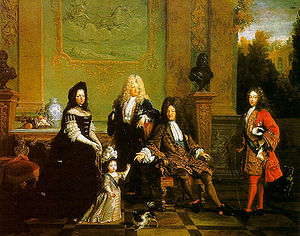 The reign of Louis XIV was so long that he had outlived both his son and eldest grandson. He was succeeded by his great-grandson Louis XV
. Louis XV was born on 15 February 1710 and was thus aged only five at his ascension, the third Louis in a row to become king of France before the age of ten. Initially, the regency was held by the Philip, Duke of Orléans, Louis XIV's nephew, as nearest adult male to the throne. This Regency period was seen as one of debauchery and loose morals following the austere nature of the latter years of Louis XIV's reign, which had seen a series of cripplingly expensive wars and the King's turn to religiosity.
Following Orléans's death in 1723, another junior Bourbon, the Duke of Bourbon, the representative of the Bourbon-Condé line, became Prime Minister. It was expected that Louis would marry his cousin, the daughter of King Philip V of Spain, but this marriage was cancelled by the duke in 1725 so that Louis could marry Maria Leszczynska
, the daughter of Stanislas, former king of Poland. Bourbon's motive appears to have been a desire to produce an heir as soon as possible so as to reduce the chances of a succession dispute between Philip V and the Duke of Orléans in the event of the sickly king's death. Maria was already an adult woman at the time of the marriage, while the Infanta was still a young girl.
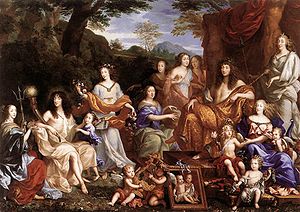 Nevertheless, Bourbon's action brought a very negative response from Spain, and for his incompetence Bourbon was soon replaced by Cardinal Andre Hercule de Fleury, the young king's tutor, in 1726. Fleury was a peace loving man who intended to keep France out of war, but circumstances presented themselves that made this impossible.
The first cause of these wars came in 1733 when Augustus II, the elector of Saxony and king of Poland died. With French backing Stanislas was again elected king. This brought France into conflict with Russia and Austria who supported Augustus III, duke of Saxony and son of Augustus II.
Stanislas lost the Polish crown, but he was given the Duchy of Lorraine as compensation, which would pass to France after his death. Next came the War of the Austrian Succession
in 1740 in which France supported King Frederick II of Prussia
against Maria Theresa of Austria
, archduchess of Austria. Fleury died in 1743 before the conclusion of the war.
Shortly after Fleury's death in 1745 Louis was most influenced by his mistress the Marquise de Pompadour. She reversed the policy of France in 1756 by creating an alliance with Austria against Prussia in the Seven Years' War
. The war was a disaster for France, losing most of her overseas possessions to the British in the Treaty of Paris in 1763. Louis’ only son died in 1765 making his grandson the Dauphin. Maria, his wife, died in 1768 and Louis himself died on 10 May 1774.
had become the dauphin of France upon the death of his father, the son of Louis XV, in 1765. He married Marie Antoinette of Austria, a daughter of Maria Theresa, in 1770. Louis intervened in the American Revolution
against Britain in 1778, but he is most remembered for his role in the French Revolution
. France was in financial turmoil and Louis was forced to convene the Estates-General
on 5 May 1789.
They formed the National Assembly
and forced Louis to accept a constitution that limited his powers on 14 July 1790. He tried to flee France
in June 1791, but was captured. The French monarchy was abolished on 21 September 1792 and a republic
was proclaimed. The chain of Bourbon monarchs begun in 1589 was broken. Louis XVI was executed on 21 January 1793.
Marie Antoinette and her son, Louis, were held as prisoners. Many French royalists proclaimed him Louis XVII
, but he never reigned. She was executed on 16 October 1793. He died of tuberculosis
on 8 June 1795 at the age of ten while in captivity.
The French Revolutionary Wars
and Napoleonic Wars
spread nationalism and anti-absolutism throughout Europe, and the other Bourbon monarchs were threatened. Ferdinand was forced to flee from Naples in 1806 when Napoleon Bonaparte deposed him and installed his brother, Joseph
, as king. Ferdinand continued to rule from Sicily until 1815.
Napoleon conquered Parma in 1800 and compensated the Bourbon duke with Etruria
, a new kingdom he created from the Grand Duchy of Tuscany. It was short-lived, as Napoleon annexed Etruria in 1807.
King Charles IV of Spain
had been an ally of France. He succeeded his father, Charles III, in 1788. At first he declared war on France on 7 March 1793, but he made peace on 22 June 1795. This peace became an alliance on 19 August 1796. His chief minister, Manuel de Godoy
convinced Charles that his son, Ferdinand, was plotting to overthrow him. Napoleon exploited the situation and invaded Spain in March 1808. This led to an uprising that forced Charles to abdicate on 19 March in favor of his son, Ferdinand VII. Napoleon forced Ferdinand to return the crown to Charles on 30 April and then convinced Charles to relinquish it to him on 10 May. In turn, he gave it to his brother, Joseph, king of Naples on 6 June. Joseph abandoned Naples to Joachim Murat
, the husband of Napoleon's sister. This was very unpopular in Spain and resulted in the Peninsular War
, a struggle that would contribute to the downfall of Napoleon.

With the abdication of Napoleon on 11 April 1814 the Bourbon Dynasty was restored to the kingdom of France in the person of Louis XVIII
, brother of Louis XVI. Napoleon escaped from exile and Louis fled in March 1815. Louis was again restored after the Battle of Waterloo
on 7 July.
The conservative elements of Europe dominated the post-Napoleonic age, but the values of the French Revolution could not be easily swept aside. Louis granted a constitution on 14 June 1814 to appease the liberals, but the ultra-royalist party, led by his brother, Charles, continued to influence his reign. When he died in 1824 his brother became king as Charles X
much to the dismay of French liberals. In a saying ascribed to Talleyrand, "they had learned nothing and forgotten nothing".
, duke of Orléans, a descendant of the brother of Louis XIV, and the head of the Orleanist
cadet branch of the Bourbons. He was proclaimed King of the French on 7 August. The resulting regime, known as the July monarchy
, lasted until the Revolution of 1848. The Bourbon monarchy in France ended on 24 February 1848, when Louis-Philippe was forced to abdicate and the short-lived French Second Republic
was established.
Some legitimists refused to recognize the Orleanist monarchy. After the death of Charles in 1836 his son was proclaimed Louis XIX
, though this title was never formally recognized. Charles' grandson Henri, comte de Chambord
, the last Bourbon claimant of the French crown, was proclaimed by some Henry V, but the French monarchy was never restored.
Following the 1870 collapse of the empire of Emperor Napoleon III
, Henri was offered a restored throne. However Chambord refused to accept the throne unless France abandoned the revolution-inspired tricolour
and accepted what he regarded as the true Bourbon flag of France
. The tricolour, originally associated with the French Revolution and the First French Republic, had been used by the July Monarchy, the Second Republic and both Empires; the French National Assembly
could not possibly agree.
A temporary Third Republic
was established, while monarchists waited for the comte de Chambord to die and for the succession to pass to the Comte de Paris, who was willing to accept the tricolour. Henri lived until 1883, by which time public opinion had come to accept the republic as the "form of government that divides us least." His death without issue marked the extinction of the French Bourbons. Thus head of the House of Bourbon became the now eldest male heir of the dynasty Juan, Count of Montizón
of the Spanish line of the house who was also Carlist claimant to the throne of Spain. His heir as eldest Bourbon and head of the house is today Louis Alphonse, Duke of Anjou
.
By an ordinance of Louis Philippe I of France of 13 August 1830, it was decided that the king's children (and his sister) would continue to bear the arms of Orléans, that Louis-Philippe's eldest son, as Prince Royal, would bear the title of duc d'Orléans, that the younger sons would continue to have their existing titles, and that the sister and daughters of the king would only be styled "princesses d'Orléans", which meant the Orléans royalty did not take the name "of France".
and probably never expected to be raised to a rank higher than that. However King Charles II of Spain
, dying without issue, willed the throne to his grand-nephew the Duke of Anjou, younger grandson of his eldest sister Marie-Thérèse
, daughter of King Philip IV of Spain
who had married Louis XIV of France.
The prospect of Bourbons on both the French and Spanish thrones was resisted as creating an imbalance of power
in Europe by its dominant regimes
and, upon Charles II's death on 1 November 1700, a Grand Alliance
of European nations united against Philip. This was known as the War of Spanish Succession. In the Treaty of Utrecht
, signed on 11 April 1713, Philip was recognized as king of Spain but his renunciation of succession rights to France was affirmed and, of the Spanish Empire
's other European territories, Sicily was ceded to Savoy, and the Spanish Netherlands, Milan and Naples were alloted to the Austrian Habsburgs.
Philip had two sons by his first wife. After her death he married Elizabeth Farnese, niece of Francesco Farnese, Duke of Parma
, in 1714. She presented Philip with three sons, for whom she had ambitions of securing Italian crowns. Thus she induced Philip to occupy Sardinia and Sicily in 1717.
A Quadruple Alliance
of Britain, France, Austria and the Netherlands was organized on 2 August 1718 to stop him. In the Treaty of The Hague
, signed on 17 February 1720, Philip renounced his conquests of Sardinia and Sicily, but assured the ascension of his eldest son by Elizabeth to the Duchy of Parma upon the reigning duke's death. Philip abdicated in January 1724 in favor of Louis I
, his eldest son with his first wife, but Louis died in August and Philip resumed the crown.
When the War of the Polish Succession
began in 1733, Philip and Elisabeth saw another opportunity to advance the claims of their sons and recover at least part of the former possessions of the Spanish crown on the Italian peninsula. Philip signed the Family Compact
with Louis XV, his nephew and king of France. Charles, Duke of Parma since 1731, invaded Naples. At the conclusion of peace on 13 November 1738, control of Parma and Piacenza was ceded to Austria, which had occupied the duchies but was now forced to recognise Charles as King of Naples and Sicily. Philip also used the War of the Austrian Succession
to win more territory in Italy. He did not live to see it to its conclusion, however, dying in 1746.
. He died in 1759 in the midst of that conflict and was succeeded by his half-brother Charles III
. Charles was the eldest son of Philip and Elizabeth Farnese. He was born in 1716 and had become Duke of Parma when the last Farnese duke died in 1731.
Following Spain's victory over the Austrians at the battle of Bitonto, it proved inexpedient to reunite Naples and Sicily to Spain, so as a compromise Charles became King of Naples, as Charles IV and VII of Sicily. Following Charles' accession to the Spanish throne in 1759 he was required, by the Treaty of Naples of 3 October 1759, to abdicate Naples and Sicily to his third son, Ferdinand
, thus initiating the branch known as the Neapolitan Bourbons.
Charles revived the Family Compact with France on 15 August 1761 and joined in the Seven Years' War against Britain in 1762; the reformist policies he had espoused in Naples were pursued with similar energy in Spain, where he completely overhauled the cumbersome bureaucracy of the state. As a French ally he opposed Britain during the American Revolution in June 1779, supplying large quantities of weapons and munitions to the rebels and keeping one third of all the British forces in the Americas occupied defending Florida and what is now Alabama
, which were ultimately recaptured by Spain. Charles died in 1788.
duchy of Guastalla
.
Elizabeth died in 1766.
, in 1825 and by his grandson, Ferdinand II
, in 1830. Another revolution erupted on 12 January 1848 and Ferdinand was also forced to grant a constitution on 10 February. This constitution was revoked in 1849. Ferdinand was succeeded by his son, Francis II
, in May 1859.
When Giuseppe Garibaldi
captured Naples on 7 September 1860 Francis restored the constitution on 2 July in an attempt to save his sovereignty. He fled to the fortress of Gaeta
, which was captured by the Piedmontese troops on 13 February 1861; his kingdom was incorporated in the Kingdom of Italy on 17 March 1861, after the fall the fortress of Messina (surrendered on 12 March 1861), although the Neapolitan troops in Civitella del Tronto
resisted until 20 March.
After the fall of Napoleon, Napoleon's wife, Maria Louisa
, was made Duchess of Parma. As compensation, Charles Louis, the former king of Etruria, was made the Duke of Lucca. When Maria Louisa died in 1847 he was restored to Parma as Charles II. Lucca was incorporated into Tuscany. He was succeeded by his son, Charles III, and grandson, Robert I, in 1854. The people of Parma voted for a union with the kingdom of Sardinia on 13 March 1860. After Italian unification in 1861 the Bourbon dynasty in Italy was no more.
Ferdinand VII was restored to the throne of Spain after the fall of Napoleon in March 1814. Like his Italian Bourbon counterpart his subjects revolted against him in January 1820 and he was forced to grant a constitution. A French army invaded in 1823 and the constitution was revoked. Ferdinand married his fourth wife, Maria Christina, the daughter of Francis I, the Bourbon king of Sicily, in 1829. Despite his many marriages he did not have a son so on 30 June 1833 he was influenced by his wife to abolish the Salic Law
so that her daughter, Isabella, could become queen depriving his brother, Don Carlos
, of the throne.
Isabella II
succeeded her father when he died on 29 September 1833. She was only three years old and Maria Cristina, her mother, served as regent. Maria knew that she needed the support of the liberals to oppose Don Carlos so she granted a constitution in 1834. Don Carlos found his greatest support
in Catalonia and the Basques country because the constitution centralized the provinces thus denying them the autonomy they sought. He was defeated and fled the country in 1839. Isabella was declared of age in 1843 and she married her cousin Francisco de Asis, the son of her father's brother, on 10 October 1846. A military revolution broke out against Isabella in 1868 and she was deposed on 29 September. She abdicated in favor of her son, Alfonso, in 1870, but Spain was proclaimed a republic for a brief time.
When the First Spanish Republic
failed the crown was offered to Isabella's son who accepted on 1 January 1875 as Alfonso XII
. Don Carlos
, who returned to Spain, was again defeated and resumed his exile in February 1876. Alfonso granted a new constitution on July 1876 that was more liberal than the one granted by his grandmother. His reign was cut short when he died in 1885 at the age of twenty-eight.
Alfonso XIII
was born on 17 May 1886 after the death of his father. His mother, Maria Christina
, the second wife of Alfonso XII served as regent. Alfonso XIII was declared of age in 1902 and he married Victoria Eugénie Julia Ena of Battenberg, the granddaughter of the British queen Victoria
, on 31 May 1906. He remained neutral during World War I, but supported the military coup of Miguel Primo de Rivera
on 13 September 1923. A movement towards the establishment of a republic began in 1930 and Alfonso fled the country on 14 April 1931. He never formally abdicated, but lived the rest of his life in exile. He died in 1941.
The Bourbon dynasty seemed finished in Spain as in the rest of the world, but it would be resurrected. The Second Spanish Republic was overthrown in the Spanish Civil War
, leading to the dictatorship of Francisco Franco
. He named Juan Carlos de Borbón
, a grandson of Alfonso XIII, his successor on 22 July 1969. When Franco died on 20 November 1975 a Bourbon monarch was restored to the throne of Spain two days later as Juan Carlos I. The new king oversaw the Spanish transition to democracy
; the Spanish Constitution of 1978
, approved on 28 September 1978, recognized the monarchy.
Though it is not as powerful as it once was under Louis XIV and it no longer reigns in its native country of France, it is by no means extinct, and the House of Bourbon has survived to the present-day world of republics. The birth of a male heir to the Prince of Asturias in Spain is expected to trigger a change in the law of succession from male primogeniture to equal primogeniture. Since 1964 the Bourbon-Parma line has reigned agnatically in Luxembourg through Grand Dukes Jean and his son Henri. In June 2011, Luxembourg adopted equal primogeniture, replacing the old Semi-Salic law that might have guaranteed the survival of Bourbon rule for generations. The European phenomenon of equal primogeniture has doomed the security that the Bourbon monarchs once had.
|-
|-
|-
|-
|-
|-
|-
|-
|-
Royal House
A royal house or royal dynasty consists of at least one, but usually more monarchs who are related to one another, as well as their non-reigning descendants and spouses. Monarchs of the same realm who are not related to one another are usually deemed to belong to different houses, and each house is...
, a branch of the Capetian dynasty
Capetian dynasty
The Capetian dynasty , also known as the House of France, is the largest and oldest European royal house, consisting of the descendants of King Hugh Capet of France in the male line. Hugh Capet himself was a cognatic descendant of the Carolingians and the Merovingians, earlier rulers of France...
(k). Bourbon kings first ruled Navarre
Kingdom of Navarre
The Kingdom of Navarre , originally the Kingdom of Pamplona, was a European kingdom which occupied lands on either side of the Pyrenees alongside the Atlantic Ocean....
and France in the 16th century. By the 18th century, members of the Bourbon dynasty also held thrones in Spain, Naples
Kingdom of Naples
The Kingdom of Naples, comprising the southern part of the Italian peninsula, was the remainder of the old Kingdom of Sicily after secession of the island of Sicily as a result of the Sicilian Vespers rebellion of 1282. Known to contemporaries as the Kingdom of Sicily, it is dubbed Kingdom of...
, Sicily, and Parma. Spain and Luxembourg
Luxembourg
Luxembourg , officially the Grand Duchy of Luxembourg , is a landlocked country in western Europe, bordered by Belgium, France, and Germany. It has two principal regions: the Oesling in the North as part of the Ardennes massif, and the Gutland in the south...
currently have Bourbon monarchs.
Bourbon monarchs ruled Navarre (from 1555) and France (from 1589) until the 1792 overthrow of the monarchy during the French Revolution
French Revolution
The French Revolution , sometimes distinguished as the 'Great French Revolution' , was a period of radical social and political upheaval in France and Europe. The absolute monarchy that had ruled France for centuries collapsed in three years...
. Restored briefly in 1814 and definitively in 1815 after the fall of the First French Empire
First French Empire
The First French Empire , also known as the Greater French Empire or Napoleonic Empire, was the empire of Napoleon I of France...
, the senior line of the Bourbons was finally overthrown in the July Revolution
July Revolution
The French Revolution of 1830, also known as the July Revolution or in French, saw the overthrow of King Charles X of France, the French Bourbon monarch, and the ascent of his cousin Louis-Philippe, Duke of Orléans, who himself, after 18 precarious years on the throne, would in turn be overthrown...
of 1830. A cadet branch
Cadet branch
Cadet branch is a term in genealogy to describe the lineage of the descendants of the younger sons of a monarch or patriarch. In the ruling dynasties and noble families of much of Europe and Asia, the family's major assets – titles, realms, fiefs, property and income – have...
, the House of Orléans
House of Orleans
Orléans is the name used by several branches of the Royal House of France, all descended in the legitimate male line from the dynasty's founder, Hugh Capet. It became a tradition during France's ancien régime for the duchy of Orléans to be granted as an appanage to a younger son of the king...
, then ruled for 18 years (1830–1848), until it too was overthrown. The Princes of Condé
Prince of Condé
The Most Serene House of Condé is a historical French house, a noble lineage of descent from a single ancestor...
(Bourbon-Condé) were a cadet branch of the Bourbon-Vendômes and, in turn, were senior to the Princes of Conti
Prince of Conti
The title of Prince of Conti was a French noble title, assumed by a cadet branch of the house of Bourbon-Condé. It was taken from Conty, a small town of northern France, c. 35 km southwest of Amiens, which came into the Condé family by the marriage of Louis of Bourbon, first prince of Condé,...
(Bourbon-Conti). Both these lines became extinct in the early nineteenth century.
Philip V of Spain
Philip V of Spain
Philip V was King of Spain from 15 November 1700 to 15 January 1724, when he abdicated in favor of his son Louis, and from 6 September 1724, when he assumed the throne again upon his son's death, to his death.Before his reign, Philip occupied an exalted place in the royal family of France as a...
was the first Bourbon ruler of Spain, from 1700. The Spanish Bourbons (in Spain the name is spelled Borbón and rendered into English as Borbon) have been overthrown and restored several times, reigning 1700–1808, 1813–1868, 1875–1931, and 1975 to the present day. From this Spanish line comes the royal line of the Kingdom of the Two Sicilies
Kingdom of the Two Sicilies
The Kingdom of the Two Sicilies, commonly known as the Two Sicilies even before formally coming into being, was the largest and wealthiest of the Italian states before Italian unification...
(1734–1806 and 1815–1860, and Sicily
Sicily
Sicily is a region of Italy, and is the largest island in the Mediterranean Sea. Along with the surrounding minor islands, it constitutes an autonomous region of Italy, the Regione Autonoma Siciliana Sicily has a rich and unique culture, especially with regard to the arts, music, literature,...
only in 1806–1816), the Bourbon-Sicilies family, and the Bourbon rulers of the Duchy of Parma
Duchy of Parma
The Duchy of Parma was created in 1545 from that part of the Duchy of Milan south of the Po River, as a fief for Pope Paul III's illegitimate son, Pier Luigi Farnese, centered on the city of Parma....
.
Grand Duchess Charlotte
Charlotte, Grand Duchess of Luxembourg
Charlotte, Grand Duchess of Luxembourg was the reigning Grand Duchess of Luxembourg from 1919 to 1964.-Early life and life as Grand Duchess:...
of Luxembourg
Luxembourg
Luxembourg , officially the Grand Duchy of Luxembourg , is a landlocked country in western Europe, bordered by Belgium, France, and Germany. It has two principal regions: the Oesling in the North as part of the Ardennes massif, and the Gutland in the south...
married a cadet of the Bourbon-Parma line and thus her successors, who have ruled Luxembourg since her abdication in 1964, have also been members of the House of Bourbon. Isabel, Princess Imperial
Isabel, Princess Imperial of Brazil
Dona Isabel , nicknamed "the Redemptress", was the heiress presumptive to the throne of the Empire of Brazil, bearing the title of Princess Imperial....
, the declared heiress and thrice-regent of the now-defunct Empire of Brazil, married twenty years before their deposition Gaston, comte d'Eu
Gaston, comte d'Eu
Gaston d'Orléans , the first son of Louis, the Duke of Nemours and Princess Victoria of Saxe-Coburg-Kohary. His full name was Louis Philippe Marie Ferdinand Gaston d'Orléans; Portuguese: Luís Filipe Maria Fernando Gastão de Orleães...
a prince of Orléans, and their descendants, known as the Orléans-Braganza, would have ascended to that throne had the empire not ended in 1889.
From the time of Hugh Capet to Charles X (987–1830), the senior Capets were also the Kings of France. In 1589, Henry IV, Head of the House of Bourbon, became the senior Capet, following the extinction of male line of the House of Valois. All members of the House of Bourbon and its cadet branches alive today are direct agnatic descendants of Henry IV.
Origins
The pre-Capetian House of BourbonBourbonnais
Bourbonnais was a historic province in the centre of France that corresponded to the modern département of Allier, along with part of the département of Cher. Its capital was Moulins.-History:...
was a noble
Nobility
Nobility is a social class which possesses more acknowledged privileges or eminence than members of most other classes in a society, membership therein typically being hereditary. The privileges associated with nobility may constitute substantial advantages over or relative to non-nobles, or may be...
family, dating at least from the beginning of the 13th century, when the estate
Family seat
A seat or family seat is the principal residence of a family. The residence usually denotes the social, economic, political, or historic connection of the family within a given area. Some families took their dynasty name from their family seat , or named their family seat after their own dynasty...
of Bourbon was ruled by a Lord who was a vassal of the King of France.
In 1268, Robert, Count of Clermont
Robert, Count of Clermont
Robert of France was made Count of Clermont in 1268. He was son of King Louis IX of France and Margaret of Provence...
, sixth son of King Louis IX of France
Louis IX of France
Louis IX , commonly Saint Louis, was King of France from 1226 until his death. He was also styled Louis II, Count of Artois from 1226 to 1237. Born at Poissy, near Paris, he was an eighth-generation descendant of Hugh Capet, and thus a member of the House of Capet, and the son of Louis VIII and...
, married Beatrix of Bourbon, heiress to the lordship of Bourbon
Sire de Bourbon
The Sire de Bourbon or Seigneur de Bourbon, meaning Lord of Bourbon, was the title by which the rulers of the Bourbonnais were known, from 913 to 1327, and from which the cognomen of the illustrious royal House of the same name derives...
. Their son Louis
Louis I, Duke of Bourbon
Louis I de Bourbon, le Boiteux, the Lame was Count of Clermont-en-Beauvaisis and La Marche, and the first Duke of Bourbon.-Life:...
was made Duke of Bourbon
Duke of Bourbon
Duke of Bourbon is a title in the peerage of France. It was created in the first half of the 14th century for the eldest son of Robert of France, Count of Clermont and Beatrice of Burgundy, heiress of the lordship of Bourbon...
in 1327. His descendant, the Constable of France
Constable of France
The Constable of France , as the First Officer of the Crown, was one of the original five Great Officers of the Crown of France and Commander in Chief of the army. He, theoretically, as Lieutenant-general of the King, outranked all the nobles and was second-in-command only to the King...
Charles de Bourbon
Charles III, Duke of Bourbon
Charles III, Duke of Bourbon was a French military leader, the Count of Montpensier and Dauphin of Auvergne. He commanded the Imperial troops of Holy Roman Emperor Charles V in what became known as the Sack of Rome in 1527, where he was killed.-Biography:Charles was born at Montpensier...
, was the last of the senior Bourbon line when he died in 1527. Because he chose to fight under the banner of Holy Roman Emperor
Holy Roman Emperor
The Holy Roman Emperor is a term used by historians to denote a medieval ruler who, as German King, had also received the title of "Emperor of the Romans" from the Pope...
Charles V
Charles V, Holy Roman Emperor
Charles V was ruler of the Holy Roman Empire from 1519 and, as Charles I, of the Spanish Empire from 1516 until his voluntary retirement and abdication in favor of his younger brother Ferdinand I and his son Philip II in 1556.As...
and lead a life of exile, his title was discontinued after his death.
However the junior line of La Marche-Vendôme remained, the ruling house of the Dukedom of Vendôme. The Bourbon-Vendôme branch were to become rulers of the Kingdom of Navarre
Kingdom of Navarre
The Kingdom of Navarre , originally the Kingdom of Pamplona, was a European kingdom which occupied lands on either side of the Pyrenees alongside the Atlantic Ocean....
on the northern side of the Pyrenees
Pyrenees
The Pyrenees is a range of mountains in southwest Europe that forms a natural border between France and Spain...
in 1555 and then of France, with Henry III of Navarre
Henry IV of France
Henry IV , Henri-Quatre, was King of France from 1589 to 1610 and King of Navarre from 1572 to 1610. He was the first monarch of the Bourbon branch of the Capetian dynasty in France....
becoming Henry IV of France. From then on, they were simply called Bourbon, until the creation of cadet branches.
The rise of Henry IV
The first Bourbon King of France was Henry IVHenry IV of France
Henry IV , Henri-Quatre, was King of France from 1589 to 1610 and King of Navarre from 1572 to 1610. He was the first monarch of the Bourbon branch of the Capetian dynasty in France....
. He was born on 13 December 1553 in the Kingdom of Navarre
Kingdom of Navarre
The Kingdom of Navarre , originally the Kingdom of Pamplona, was a European kingdom which occupied lands on either side of the Pyrenees alongside the Atlantic Ocean....
. Antoine de Bourbon, his father, was a ninth generation descendant of King Louis IX of France
Louis IX of France
Louis IX , commonly Saint Louis, was King of France from 1226 until his death. He was also styled Louis II, Count of Artois from 1226 to 1237. Born at Poissy, near Paris, he was an eighth-generation descendant of Hugh Capet, and thus a member of the House of Capet, and the son of Louis VIII and...
. Jeanne d'Albret, his mother, was the Queen of Navarre and the niece of King Francis I of France
Francis I of France
Francis I was King of France from 1515 until his death. During his reign, huge cultural changes took place in France and he has been called France's original Renaissance monarch...
. He was baptized Catholic, but raised Calvinist
Calvinism
Calvinism is a Protestant theological system and an approach to the Christian life...
. After his father was killed in 1563, he became Duke of Vendôme at the age of 10, with Admiral Gaspard de Coligny
Gaspard de Coligny
Gaspard de Coligny , Seigneur de Châtillon, was a French nobleman and admiral, best remembered as a disciplined Huguenot leader in the French Wars of Religion.-Ancestry:...
(1519–1572) as his regent. Five years later, the young duke became the nominal leader of the Huguenots after the death of his uncle the Prince of Condé in 1568.
Henry succeeded to Navarre as Henry III when his mother died in 1572. That same year Catherine de' Medici
Catherine de' Medici
Catherine de' Medici was an Italian noblewoman who was Queen consort of France from 1547 until 1559, as the wife of King Henry II of France....
, the influential mother of King Charles IX of France
Charles IX of France
Charles IX was King of France, ruling from 1560 until his death. His reign was dominated by the Wars of Religion. He is best known as king at the time of the St. Bartholomew's Day Massacre.-Childhood:...
, arranged for the marriage of her daughter, Margaret of Valois, to Henry as a peace offering between the Catholics and Huguenots. Many Huguenots had gathered for the wedding held on 24 August and were massacred by the Catholics in the St. Bartholomew's Day Massacre
St. Bartholomew's Day massacre
The St. Bartholomew's Day massacre in 1572 was a targeted group of assassinations, followed by a wave of Roman Catholic mob violence, both directed against the Huguenots , during the French Wars of Religion...
. Henry saved his own life by converting to Catholicism. He repudiated his conversion in 1576 and resumed his leadership of the Huguenots.
The period from 1576 to 1584 was relatively calm in France, with the Huguenots consolidating control of much of the south with only occasional interference from the royal government. Extended civil war erupted again in 1584, when François, Duke of Anjou
François, Duke of Anjou
Francis, Duke of Anjou and Alençon was the youngest son of Henry II of France and Catherine de' Medici.-Early years:...
, younger brother of King Henry III of France
Henry III of France
Henry III was King of France from 1574 to 1589. As Henry of Valois, he was the first elected monarch of the Polish-Lithuanian Commonwealth with the dual titles of King of Poland and Grand Duke of Lithuania from 1573 to 1575.-Childhood:Henry was born at the Royal Château de Fontainebleau,...
, died, leaving Navarre next in line for the throne. Thus began the War of the Three Henries, as Henry of Navarre, Henry III, and the ultra-Catholic leader, Henry of Guise
Henry I, Duke of Guise
Henry I, Prince of Joinville, Duke of Guise, Count of Eu , sometimes called Le Balafré, "the scarred", was the eldest son of Francis, Duke of Guise, and Anna d'Este...
, fought a confusing three-cornered struggle for dominance. When Henry III was assassinated on 31 July 1589, Navarre became the first Bourbon king of France as Henry IV.
Much of Catholic France, organized into the Catholic League, refused to recognize a Protestant monarch and instead recognized Henry IV's uncle, Charles, Cardinal de Bourbon
Charles, Cardinal de Bourbon
Charles de Bourbon was a French cardinal. The Catholic League considered him the rightful King of France after the death of Henry III of France in 1589.-Biography:...
, as king as Charles X, and the civil war continued. Henry won a crucial victory at Ivry
Battle of Ivry
The Battle of Ivry was fought on 14 March 1590, during the French Wars of Religion. The battle was a decisive victory for Henry of Navarre, the future Henry IV of France, leading Huguenot forces against the Catholic League forces led by the Duc de Mayenne...
on 14 March 1590, and following the death of the Cardinal the same year, the forces of the League lacked an obvious Catholic candidate for the throne and divided into various factions. Nevertheless, as a Protestant, Henry IV was unable to take Paris, a Catholic stronghold, or to decisively defeat his enemies, now supported by the Spanish. He reconverted to Catholicism in 1593—he is said to have remarked, "Paris is well worth a mass"—and was crowned King of France at the Cathedral of Chartres
Cathedral of Chartres
The French medieval Cathedral of Our Lady of Chartres is a Latin Rite Catholic cathedral located in Chartres, about southwest of Paris, is considered one of the finest examples of the French High Gothic style...
on 27 February 1594.
Early Bourbons in France
Henry granted the Edict of NantesEdict of Nantes
The Edict of Nantes, issued on 13 April 1598, by Henry IV of France, granted the Calvinist Protestants of France substantial rights in a nation still considered essentially Catholic. In the Edict, Henry aimed primarily to promote civil unity...
on 13 April 1598, establishing Catholicism as an official state religion, but otherwise assuring the Huguenots the right to practice their religion. However, it did not grant full civil and religious equality to the Huguenots. This compromise ended the religious wars in France. That same year the Treaty of Vervins ended the war with Spain, adjusted the Spanish-French border, and resulted in a belated recognition by Spain of Henry as king of France.
Ably assisted by Maximilien de Béthune, duc de Sully
Maximilien de Béthune, duc de Sully
Maximilien de Béthune, first Duke of Sully was the doughty soldier, French minister, staunch Huguenot and faithful right-hand man who assisted Henry IV of France in the rule of France.-Early years:...
, Henry reduced the land tax known as the taille
Taille
The taille was a direct land tax on the French peasantry and non-nobles in Ancien Régime France. The tax was imposed on each household and based on how much land it held.-History:Originally only an "exceptional" tax The taille was a direct land tax on the French peasantry and non-nobles in Ancien...
; promoted agriculture, public works, construction of highways, and the first French canal; started such important industries as the tapestry works of the Gobelins
Gobelins manufactory
The Manufacture des Gobelins is a tapestry factory located in Paris, France, at 42 avenue des Gobelins, near the Les Gobelins métro station in the XIIIe arrondissement...
; and intervened in favor of Protestants in the duchies and earldoms along the German frontier. This last was to be the cause of his assassination.
Louis XIII of France
Louis XIII was a Bourbon monarch who ruled as King of France and of Navarre from 1610 to 1643.Louis was only eight years old when he succeeded his father. His mother, Marie de Medici, acted as regent during Louis' minority...
was only nine years old when he succeeded his father. He was to prove a weak ruler; his reign was effectively a series of distinct regimes, depending who held the effective reins of power. At first, Marie de Medici, his mother, served as regent and advanced a pro-Spanish policy. To deal with the financial troubles of France, Louis summoned the Estates General
French States-General
In France under the Old Regime, the States-General or Estates-General , was a legislative assembly of the different classes of French subjects. It had a separate assembly for each of the three estates, which were called and dismissed by the king...
in 1614; this would be the last time that body met until the eve of the French Revolution
French Revolution
The French Revolution , sometimes distinguished as the 'Great French Revolution' , was a period of radical social and political upheaval in France and Europe. The absolute monarchy that had ruled France for centuries collapsed in three years...
. Marie arranged the 1615 marriage of Louis to Anne of Austria
Anne of Austria
Anne of Austria was Queen consort of France and Navarre, regent for her son, Louis XIV of France, and a Spanish Infanta by birth...
, the daughter of King Philip III of Spain
Philip III of Spain
Philip III , also known as Philip the Pious, was the King of Spain and King of Portugal and the Algarves, where he ruled as Philip II , from 1598 until his death...
.
In 1617, however, Louis conspired with Charles d'Albert, duc de Luynes
Charles de Luynes
Charles d'Albert, Duke of Luynes , was constable of France.He was the first son of Honoré d'Albert , seigneur de Luynes, who was in the service of the three last Valois kings and of Henry IV of France.Charles was brought up at court and attended the dauphin, later Louis XIII...
to dispense with her influence, having her favorite Concino Concini
Concino Concini
Concino Concini, Count della Penna, Marquis et Maréchal d'Ancre , was an Italian politician, best known for being a minister of Louis XIII of France, as the favourite of his mother.-Life:...
assassinated on 26 April of that year. After some years of weak government by Louis's favorites, the King made Armand Jean du Plessis, Cardinal Richelieu
Armand Jean du Plessis, Cardinal Richelieu
Armand Jean du Plessis, Cardinal-Duc de Richelieu et de Fronsac was a French clergyman, noble, and statesman.Consecrated as a bishop in 1608, he later entered politics, becoming a Secretary of State in 1616. Richelieu soon rose in both the Catholic Church and the French government, becoming a...
, a former protégé of his mother, the chief minister of France in 1624.
Richelieu advanced an anti-Habsburg
Habsburg
The House of Habsburg , also found as Hapsburg, and also known as House of Austria is one of the most important royal houses of Europe and is best known for being an origin of all of the formally elected Holy Roman Emperors between 1438 and 1740, as well as rulers of the Austrian Empire and...
policy. He arranged for Louis' sister, Henrietta Maria, to marry King Charles I of England
Charles I of England
Charles I was King of England, King of Scotland, and King of Ireland from 27 March 1625 until his execution in 1649. Charles engaged in a struggle for power with the Parliament of England, attempting to obtain royal revenue whilst Parliament sought to curb his Royal prerogative which Charles...
, on 11 May 1625. Her pro-Catholic propaganda in England was one of the contributing factors for the English Civil War
English Civil War
The English Civil War was a series of armed conflicts and political machinations between Parliamentarians and Royalists...
. Richelieu, as ambitious for France and the French monarchy as for himself, laid the ground for the absolute monarchy
Absolute monarchy
Absolute monarchy is a monarchical form of government in which the monarch exercises ultimate governing authority as head of state and head of government, his or her power not being limited by a constitution or by the law. An absolute monarch thus wields unrestricted political power over the...
that would last in France until the Revolution. He wanted to establish a dominating position for France in Europe, and he wanted to unify France under the monarchy. He established the role of intendant
Intendant
The title of intendant has been used in several countries through history. Traditionally, it refers to the holder of a public administrative office...
s, non-noble men whose arbitrary powers were granted by (and revocable by) the monarchy and superseded many of the traditional duties and privileges of the noble governors.
Although it required a succession of internal military campaigns, he abolished the fortified Huguenot towns that Henry had allowed. He involved France in the Thirty Years' War
Thirty Years' War
The Thirty Years' War was fought primarily in what is now Germany, and at various points involved most countries in Europe. It was one of the most destructive conflicts in European history....
(1618–1648) against the Habsburgs by concluding an alliance with Sweden
Treaty of Bärwalde
The Treaty of Bärwalde of 23 January 1631 was a treaty concluding an alliance between Sweden and France during the Thirty Years' War, shortly after Sweden had invaded Northern Germany then occupied by Ferdinand II, Holy Roman Emperor's forces...
in 1631 and, actively, in 1635. He died in 1642 before the conclusion of that conflict, having groomed Cardinal Jules Mazarin as a successor. Louis XIII outlived him but by one year, dying in 1643 at the age of forty-two. After a childless marriage for twenty-three years he had a son with Anne on 5 September 1638, whom he named after himself.
Louis XIV and Louis XV
When Louis XIVLouis XIV of France
Louis XIV , known as Louis the Great or the Sun King , was a Bourbon monarch who ruled as King of France and Navarre. His reign, from 1643 to his death in 1715, began at the age of four and lasted seventy-two years, three months, and eighteen days...
succeeded his father he was only four years old; he would become the most powerful king in French history. His mother Anne served as his regent with her favorite Jules Mazarin as chief minister. Mazarin continued the policies of Richelieu, bringing the Thirty Years' War to a successful conclusion in 1648 and defeating the noble challenge to royal absolutism in a series of civil wars known as the Fronde
Fronde
The Fronde was a civil war in France, occurring in the midst of the Franco-Spanish War, which had begun in 1635. The word fronde means sling, which Parisian mobs used to smash the windows of supporters of Cardinal Mazarin....
. He continued to war with Spain until 1659.
In that year the Treaty of the Pyrenees
Treaty of the Pyrenees
The Treaty of the Pyrenees was signed to end the 1635 to 1659 war between France and Spain, a war that was initially a part of the wider Thirty Years' War. It was signed on Pheasant Island, a river island on the border between the two countries...
was signed signifying a significant shift in power, France had replaced Spain as the dominant state in Europe. One of the terms of the treaty arranged the marriage of Louis to his cousin Maria Theresa
Maria Theresa of Spain
Maria Theresa of Austria was the daughter of Philip IV, King of Spain and Elizabeth of France. Maria Theresa was Queen of France as wife of King Louis XIV and mother of the Grand Dauphin, an ancestor of the last four Bourbon kings of France.-Early life:Born as Infanta María Teresa of Spain at the...
, the daughter of King Philip IV of Spain
Philip IV of Spain
Philip IV was King of Spain between 1621 and 1665, sovereign of the Spanish Netherlands, and King of Portugal until 1640...
, by his first wife Elizabeth, the sister of Louis XIII. They were married in 1660 and had a son, Louis, in 1661. Mazarin died on 9 March 1661 and it was expected that Louis would appoint another chief minister, as had become the tradition, but instead he shocked the country by announcing he would rule alone.
Louis intended to glorify France by making war on his neighbors. For six years he reformed the finances of his state and built formidable armed forces. France fought three wars between 1667 and 1697 and gained some minor territory. Maria Theresa died in 1683 and the next year he married Françoise d'Aubigné, marquise de Maintenon
Françoise d'Aubigné, Marquise de Maintenon
Françoise d'Aubigné, Marquise de Maintenon was the second wife of King Louis XIV of France. She was known during her first marriage as Madame Scarron, and subsequently as Madame de Maintenon...
. She had great influence over him especially in matters of religion. Louis XIV was staunchly Catholic and he revoked the Edict of Nantes on 18 October 1685, undoing the religious tolerance established by grandfather, Henry IV, almost a hundred years before.
The last war waged by Louis XIV proved to be one of the most important to dynastic Europe. In 1700, King Charles II of Spain
Charles II of Spain
Charles II was the last Habsburg King of Spain and the ruler of large parts of Italy, the Spanish territories in the Southern Low Countries, and Spain's overseas Empire, stretching from the Americas to the Spanish East Indies...
died without a son. Louis's son the Grand Dauphin, as nephew to the late king, was closest heir, and Charles willed the kingdom to the Dauphin's second son, the Duke of Anjou. Other powers, particularly the Austrian Habsburgs, who had the next closest claims, objected to such a vast increase in French power.
Initially, most of the other powers were willing to accept Anjou's reign as Philip V
Philip V of Spain
Philip V was King of Spain from 15 November 1700 to 15 January 1724, when he abdicated in favor of his son Louis, and from 6 September 1724, when he assumed the throne again upon his son's death, to his death.Before his reign, Philip occupied an exalted place in the royal family of France as a...
, but Louis's arrogance and blunders soon made the English, the Dutch, and other powers join the Austrians in a coalition against France. The War of the Spanish Succession
War of the Spanish Succession
The War of the Spanish Succession was fought among several European powers, including a divided Spain, over the possible unification of the Kingdoms of Spain and France under one Bourbon monarch. As France and Spain were among the most powerful states of Europe, such a unification would have...
began in 1701 and raged for 12 years. In the end Louis's grandson was recognized as King of Spain, but the Habsburg
Habsburg
The House of Habsburg , also found as Hapsburg, and also known as House of Austria is one of the most important royal houses of Europe and is best known for being an origin of all of the formally elected Holy Roman Emperors between 1438 and 1740, as well as rulers of the Austrian Empire and...
's other European territories were largely ceded to Austria, and France was nearly bankrupted by the cost of the struggle. Louis died on 1 September 1715 ending his seventy-two year reign, the longest in European history.
Louis XV of France
Louis XV was a Bourbon monarch who ruled as King of France and of Navarre from 1 September 1715 until his death. He succeeded his great-grandfather at the age of five, his first cousin Philippe II, Duke of Orléans, served as Regent of the kingdom until Louis's majority in 1723...
. Louis XV was born on 15 February 1710 and was thus aged only five at his ascension, the third Louis in a row to become king of France before the age of ten. Initially, the regency was held by the Philip, Duke of Orléans, Louis XIV's nephew, as nearest adult male to the throne. This Regency period was seen as one of debauchery and loose morals following the austere nature of the latter years of Louis XIV's reign, which had seen a series of cripplingly expensive wars and the King's turn to religiosity.
Following Orléans's death in 1723, another junior Bourbon, the Duke of Bourbon, the representative of the Bourbon-Condé line, became Prime Minister. It was expected that Louis would marry his cousin, the daughter of King Philip V of Spain, but this marriage was cancelled by the duke in 1725 so that Louis could marry Maria Leszczynska
Maria Leszczynska
Marie Leszczyńska was a queen consort of France. She was a daughter of King Stanisław Leszczyński of Poland and Catherine Opalińska. She married King Louis XV of France and was the grandmother of Louis XVI, Louis XVIII, and Charles X. In France, she was referred to as Marie Leczinska...
, the daughter of Stanislas, former king of Poland. Bourbon's motive appears to have been a desire to produce an heir as soon as possible so as to reduce the chances of a succession dispute between Philip V and the Duke of Orléans in the event of the sickly king's death. Maria was already an adult woman at the time of the marriage, while the Infanta was still a young girl.
The first cause of these wars came in 1733 when Augustus II, the elector of Saxony and king of Poland died. With French backing Stanislas was again elected king. This brought France into conflict with Russia and Austria who supported Augustus III, duke of Saxony and son of Augustus II.
Stanislas lost the Polish crown, but he was given the Duchy of Lorraine as compensation, which would pass to France after his death. Next came the War of the Austrian Succession
War of the Austrian Succession
The War of the Austrian Succession – including King George's War in North America, the Anglo-Spanish War of Jenkins' Ear, and two of the three Silesian wars – involved most of the powers of Europe over the question of Maria Theresa's succession to the realms of the House of Habsburg.The...
in 1740 in which France supported King Frederick II of Prussia
Frederick II of Prussia
Frederick II was a King in Prussia and a King of Prussia from the Hohenzollern dynasty. In his role as a prince-elector of the Holy Roman Empire, he was also Elector of Brandenburg. He was in personal union the sovereign prince of the Principality of Neuchâtel...
against Maria Theresa of Austria
Maria Theresa of Austria
Maria Theresa Walburga Amalia Christina was the only female ruler of the Habsburg dominions and the last of the House of Habsburg. She was the sovereign of Austria, Hungary, Croatia, Bohemia, Mantua, Milan, Lodomeria and Galicia, the Austrian Netherlands and Parma...
, archduchess of Austria. Fleury died in 1743 before the conclusion of the war.
Shortly after Fleury's death in 1745 Louis was most influenced by his mistress the Marquise de Pompadour. She reversed the policy of France in 1756 by creating an alliance with Austria against Prussia in the Seven Years' War
Seven Years' War
The Seven Years' War was a global military war between 1756 and 1763, involving most of the great powers of the time and affecting Europe, North America, Central America, the West African coast, India, and the Philippines...
. The war was a disaster for France, losing most of her overseas possessions to the British in the Treaty of Paris in 1763. Louis’ only son died in 1765 making his grandson the Dauphin. Maria, his wife, died in 1768 and Louis himself died on 10 May 1774.
French Revolution
Louis XVILouis XVI of France
Louis XVI was a Bourbon monarch who ruled as King of France and Navarre until 1791, and then as King of the French from 1791 to 1792, before being executed in 1793....
had become the dauphin of France upon the death of his father, the son of Louis XV, in 1765. He married Marie Antoinette of Austria, a daughter of Maria Theresa, in 1770. Louis intervened in the American Revolution
American Revolution
The American Revolution was the political upheaval during the last half of the 18th century in which thirteen colonies in North America joined together to break free from the British Empire, combining to become the United States of America...
against Britain in 1778, but he is most remembered for his role in the French Revolution
French Revolution
The French Revolution , sometimes distinguished as the 'Great French Revolution' , was a period of radical social and political upheaval in France and Europe. The absolute monarchy that had ruled France for centuries collapsed in three years...
. France was in financial turmoil and Louis was forced to convene the Estates-General
Estates-General of 1789
The Estates-General of 1789 was the first meeting since 1614 of the French Estates-General, a general assembly representing the French estates of the realm: the nobility, the Church, and the common people...
on 5 May 1789.
They formed the National Assembly
National Assembly (French Revolution)
During the French Revolution, the National Assembly , which existed from June 17 to July 9, 1789, was a transitional body between the Estates-General and the National Constituent Assembly.-Background:...
and forced Louis to accept a constitution that limited his powers on 14 July 1790. He tried to flee France
Flight to Varennes
The Flight to Varennes was a significant episode in the French Revolution during which King Louis XVI of France, his wife Marie Antoinette, and their immediate family attempted unsuccessfully to escape from Paris in order to initiate a counter-revolution...
in June 1791, but was captured. The French monarchy was abolished on 21 September 1792 and a republic
French First Republic
The French First Republic was founded on 22 September 1792, by the newly established National Convention. The First Republic lasted until the declaration of the First French Empire in 1804 under Napoleon I...
was proclaimed. The chain of Bourbon monarchs begun in 1589 was broken. Louis XVI was executed on 21 January 1793.
Marie Antoinette and her son, Louis, were held as prisoners. Many French royalists proclaimed him Louis XVII
Louis XVII of France
Louis XVII , from birth to 1789 known as Louis-Charles, Duke of Normandy; then from 1789 to 1791 as Louis-Charles, Dauphin of France; and from 1791 to 1793 as Louis-Charles, Prince Royal of France, was the son of King Louis XVI of France and Queen Marie Antoinette...
, but he never reigned. She was executed on 16 October 1793. He died of tuberculosis
Tuberculosis
Tuberculosis, MTB, or TB is a common, and in many cases lethal, infectious disease caused by various strains of mycobacteria, usually Mycobacterium tuberculosis. Tuberculosis usually attacks the lungs but can also affect other parts of the body...
on 8 June 1795 at the age of ten while in captivity.
The French Revolutionary Wars
French Revolutionary Wars
The French Revolutionary Wars were a series of major conflicts, from 1792 until 1802, fought between the French Revolutionary government and several European states...
and Napoleonic Wars
Napoleonic Wars
The Napoleonic Wars were a series of wars declared against Napoleon's French Empire by opposing coalitions that ran from 1803 to 1815. As a continuation of the wars sparked by the French Revolution of 1789, they revolutionised European armies and played out on an unprecedented scale, mainly due to...
spread nationalism and anti-absolutism throughout Europe, and the other Bourbon monarchs were threatened. Ferdinand was forced to flee from Naples in 1806 when Napoleon Bonaparte deposed him and installed his brother, Joseph
Joseph Bonaparte
Joseph-Napoléon Bonaparte was the elder brother of Napoleon Bonaparte, who made him King of Naples and Sicily , and later King of Spain...
, as king. Ferdinand continued to rule from Sicily until 1815.
Napoleon conquered Parma in 1800 and compensated the Bourbon duke with Etruria
Kingdom of Etruria
The Kingdom of Etruria was a kingdom comprising the larger part of Tuscany which existed between 1801 and 1807. It took its name from Etruria, the old Roman name for the land of the Etruscans.It was created by the Treaty of Aranjuez, signed on 21 March 1801...
, a new kingdom he created from the Grand Duchy of Tuscany. It was short-lived, as Napoleon annexed Etruria in 1807.
King Charles IV of Spain
Charles IV of Spain
Charles IV was King of Spain from 14 December 1788 until his abdication on 19 March 1808.-Early life:...
had been an ally of France. He succeeded his father, Charles III, in 1788. At first he declared war on France on 7 March 1793, but he made peace on 22 June 1795. This peace became an alliance on 19 August 1796. His chief minister, Manuel de Godoy
Manuel de Godoy
Don Manuel Francisco Domingo de Godoy y Álvarez de Faria, de los Ríos y Sánchez-Zarzosa, also Manuel de Godoy y Álvarez de Faria de los Ríos Sánchez Zarzosa , was Prime Minister of Spain from 1792 to 1797 and from 1801 to 1808...
convinced Charles that his son, Ferdinand, was plotting to overthrow him. Napoleon exploited the situation and invaded Spain in March 1808. This led to an uprising that forced Charles to abdicate on 19 March in favor of his son, Ferdinand VII. Napoleon forced Ferdinand to return the crown to Charles on 30 April and then convinced Charles to relinquish it to him on 10 May. In turn, he gave it to his brother, Joseph, king of Naples on 6 June. Joseph abandoned Naples to Joachim Murat
Joachim Murat
Joachim-Napoléon Murat , Marshal of France and Grand Admiral or Admiral of France, 1st Prince Murat, was Grand Duke of Berg from 1806 to 1808 and then King of Naples from 1808 to 1815...
, the husband of Napoleon's sister. This was very unpopular in Spain and resulted in the Peninsular War
Peninsular War
The Peninsular War was a war between France and the allied powers of Spain, the United Kingdom, and Portugal for control of the Iberian Peninsula during the Napoleonic Wars. The war began when French and Spanish armies crossed Spain and invaded Portugal in 1807. Then, in 1808, France turned on its...
, a struggle that would contribute to the downfall of Napoleon.
The Bourbon Restoration
With the abdication of Napoleon on 11 April 1814 the Bourbon Dynasty was restored to the kingdom of France in the person of Louis XVIII
Louis XVIII of France
Louis XVIII , known as "the Unavoidable", was King of France and of Navarre from 1814 to 1824, omitting the Hundred Days in 1815...
, brother of Louis XVI. Napoleon escaped from exile and Louis fled in March 1815. Louis was again restored after the Battle of Waterloo
Battle of Waterloo
The Battle of Waterloo was fought on Sunday 18 June 1815 near Waterloo in present-day Belgium, then part of the United Kingdom of the Netherlands...
on 7 July.
The conservative elements of Europe dominated the post-Napoleonic age, but the values of the French Revolution could not be easily swept aside. Louis granted a constitution on 14 June 1814 to appease the liberals, but the ultra-royalist party, led by his brother, Charles, continued to influence his reign. When he died in 1824 his brother became king as Charles X
Charles X of France
Charles X was known for most of his life as the Comte d'Artois before he reigned as King of France and of Navarre from 16 September 1824 until 2 August 1830. A younger brother to Kings Louis XVI and Louis XVIII, he supported the latter in exile and eventually succeeded him...
much to the dismay of French liberals. In a saying ascribed to Talleyrand, "they had learned nothing and forgotten nothing".
Aftermath
Charles passed several laws that appealed to the upper class, but angered the middle class. The situation came to a head when he appointed a new minister on 8 August 1829 who did not have the confidence of the chamber. The chamber censured the king on 18 March 1830 and in response Charles proclaimed five ordinances on 26 July intended to silence criticism against him. This almost resulted in another revolution as dramatic as the one in 1789, but moderates were able to control the situation. As a compromise the crown was offered to Louis-PhilippeLouis-Philippe of France
Louis Philippe I was King of the French from 1830 to 1848 in what was known as the July Monarchy. His father was a duke who supported the French Revolution but was nevertheless guillotined. Louis Philippe fled France as a young man and spent 21 years in exile, including considerable time in the...
, duke of Orléans, a descendant of the brother of Louis XIV, and the head of the Orleanist
Orléanist
The Orléanists were a French right-wing/center-right party which arose out of the French Revolution. It governed France 1830-1848 in the "July Monarchy" of king Louis Philippe. It is generally seen as a transitional period dominated by the bourgeoisie and the conservative Orleanist doctrine in...
cadet branch of the Bourbons. He was proclaimed King of the French on 7 August. The resulting regime, known as the July monarchy
July Monarchy
The July Monarchy , officially the Kingdom of France , was a period of liberal constitutional monarchy in France under King Louis-Philippe starting with the July Revolution of 1830 and ending with the Revolution of 1848...
, lasted until the Revolution of 1848. The Bourbon monarchy in France ended on 24 February 1848, when Louis-Philippe was forced to abdicate and the short-lived French Second Republic
French Second Republic
The French Second Republic was the republican government of France between the 1848 Revolution and the coup by Louis-Napoléon Bonaparte which initiated the Second Empire. It officially adopted the motto Liberté, Égalité, Fraternité...
was established.
Some legitimists refused to recognize the Orleanist monarchy. After the death of Charles in 1836 his son was proclaimed Louis XIX
Louis-Antoine, Duke of Angouleme
Louis Antoine of France, Duke of Angoulême was the eldest son of Charles X of France and, from 1824 to 1836, the last Dauphin of France...
, though this title was never formally recognized. Charles' grandson Henri, comte de Chambord
Henri, comte de Chambord
Henri, comte de Chambord was disputedly King of France from 2 to 9 August 1830 as Henry V, although he was never officially proclaimed as such...
, the last Bourbon claimant of the French crown, was proclaimed by some Henry V, but the French monarchy was never restored.
Following the 1870 collapse of the empire of Emperor Napoleon III
Napoleon III of France
Louis-Napoléon Bonaparte was the President of the French Second Republic and as Napoleon III, the ruler of the Second French Empire. He was the nephew and heir of Napoleon I, christened as Charles Louis Napoléon Bonaparte...
, Henri was offered a restored throne. However Chambord refused to accept the throne unless France abandoned the revolution-inspired tricolour
Flag of France
The national flag of France is a tricolour featuring three vertical bands coloured royal blue , white, and red...
and accepted what he regarded as the true Bourbon flag of France
Fleur-de-lis
The fleur-de-lis or fleur-de-lys is a stylized lily or iris that is used as a decorative design or symbol. It may be "at one and the same time, political, dynastic, artistic, emblematic, and symbolic", especially in heraldry...
. The tricolour, originally associated with the French Revolution and the First French Republic, had been used by the July Monarchy, the Second Republic and both Empires; the French National Assembly
French National Assembly
The French National Assembly is the lower house of the bicameral Parliament of France under the Fifth Republic. The upper house is the Senate ....
could not possibly agree.
A temporary Third Republic
French Third Republic
The French Third Republic was the republican government of France from 1870, when the Second French Empire collapsed due to the French defeat in the Franco-Prussian War, to 1940, when France was overrun by Nazi Germany during World War II, resulting in the German and Italian occupations of France...
was established, while monarchists waited for the comte de Chambord to die and for the succession to pass to the Comte de Paris, who was willing to accept the tricolour. Henri lived until 1883, by which time public opinion had come to accept the republic as the "form of government that divides us least." His death without issue marked the extinction of the French Bourbons. Thus head of the House of Bourbon became the now eldest male heir of the dynasty Juan, Count of Montizón
Juan, Count of Montizón
Don Juan Carlos María Isidro de Borbón, Count of Montizón was the Carlist claimant to the throne of Spain from 1860 to 1868, and the Legitimist claimant to the throne of France from 1883 to 1887.- Youth and marriage :...
of the Spanish line of the house who was also Carlist claimant to the throne of Spain. His heir as eldest Bourbon and head of the house is today Louis Alphonse, Duke of Anjou
Louis Alphonse, Duke of Anjou
Prince Louis Alphonse of Bourbon, Duke of Anjou was not originally among his given names ; born 25 April 1974, Madrid) is a member of the historically royal dynasty of the House of Bourbon, and one of the current pretenders to the defunct crown of France...
.
By an ordinance of Louis Philippe I of France of 13 August 1830, it was decided that the king's children (and his sister) would continue to bear the arms of Orléans, that Louis-Philippe's eldest son, as Prince Royal, would bear the title of duc d'Orléans, that the younger sons would continue to have their existing titles, and that the sister and daughters of the king would only be styled "princesses d'Orléans", which meant the Orléans royalty did not take the name "of France".
Philip V
The Spanish branch of the House of Bourbon was founded by Philip V. He was born in 1683 in Versailles, the second son of the Grand Dauphin, son of Louis XIV. He was Duke of AnjouAnjou
Anjou is a former county , duchy and province centred on the city of Angers in the lower Loire Valley of western France. It corresponds largely to the present-day département of Maine-et-Loire...
and probably never expected to be raised to a rank higher than that. However King Charles II of Spain
Charles II of Spain
Charles II was the last Habsburg King of Spain and the ruler of large parts of Italy, the Spanish territories in the Southern Low Countries, and Spain's overseas Empire, stretching from the Americas to the Spanish East Indies...
, dying without issue, willed the throne to his grand-nephew the Duke of Anjou, younger grandson of his eldest sister Marie-Thérèse
Maria Theresa of Spain
Maria Theresa of Austria was the daughter of Philip IV, King of Spain and Elizabeth of France. Maria Theresa was Queen of France as wife of King Louis XIV and mother of the Grand Dauphin, an ancestor of the last four Bourbon kings of France.-Early life:Born as Infanta María Teresa of Spain at the...
, daughter of King Philip IV of Spain
Philip IV of Spain
Philip IV was King of Spain between 1621 and 1665, sovereign of the Spanish Netherlands, and King of Portugal until 1640...
who had married Louis XIV of France.
The prospect of Bourbons on both the French and Spanish thrones was resisted as creating an imbalance of power
Balance of power
Balance of power may refer to:* Balance of power , distribution of power between a central government and its subnational governments...
in Europe by its dominant regimes
Historical powers
Historical powers include great powers, nations, or empires in history.The term "Great power" represent the most important world powers. In a modern context, recognised great powers came about first in Europe during the post-Napoleonic era. The formalization of the division between small powers and...
and, upon Charles II's death on 1 November 1700, a Grand Alliance
Grand Alliance
The Grand Alliance was a European coalition, consisting of Austria, Bavaria, Brandenburg, the Dutch Republic, England, the Holy Roman Empire, Ireland, the Palatinate of the Rhine, Portugal, Savoy, Saxony, Scotland, Spain and Sweden...
of European nations united against Philip. This was known as the War of Spanish Succession. In the Treaty of Utrecht
Treaty of Utrecht
The Treaty of Utrecht, which established the Peace of Utrecht, comprises a series of individual peace treaties, rather than a single document, signed by the belligerents in the War of Spanish Succession, in the Dutch city of Utrecht in March and April 1713...
, signed on 11 April 1713, Philip was recognized as king of Spain but his renunciation of succession rights to France was affirmed and, of the Spanish Empire
Spanish Empire
The Spanish Empire comprised territories and colonies administered directly by Spain in Europe, in America, Africa, Asia and Oceania. It originated during the Age of Exploration and was therefore one of the first global empires. At the time of Habsburgs, Spain reached the peak of its world power....
's other European territories, Sicily was ceded to Savoy, and the Spanish Netherlands, Milan and Naples were alloted to the Austrian Habsburgs.
Philip had two sons by his first wife. After her death he married Elizabeth Farnese, niece of Francesco Farnese, Duke of Parma
Francesco Farnese, Duke of Parma
Francesco Farnese reigned as the seventh and penultimate Farnese Duke of Parma and Piacenza from 1694 until his death...
, in 1714. She presented Philip with three sons, for whom she had ambitions of securing Italian crowns. Thus she induced Philip to occupy Sardinia and Sicily in 1717.
A Quadruple Alliance
Quadruple Alliance
The term "Quadruple Alliance" refers to several historical military alliances; none of which remain in effect.# The Quadruple Alliance of August 1673 was an alliance between the Holy Roman Empire, the Kingdom of Spain, Charles IV, Duke of Lorraine, and the United Provinces of the Netherlands, in...
of Britain, France, Austria and the Netherlands was organized on 2 August 1718 to stop him. In the Treaty of The Hague
Treaty of The Hague (1720)
The Treaty of The Hague was signed on February 17, 1720. The treaty ended the War of the Quadruple Alliance, a conflict that arose between King Philip V of Spain and an alliance of Great Britain, France, Austria and the Dutch Republic.Philip was confirmed king of Spain by the Treaty of Utrecht in...
, signed on 17 February 1720, Philip renounced his conquests of Sardinia and Sicily, but assured the ascension of his eldest son by Elizabeth to the Duchy of Parma upon the reigning duke's death. Philip abdicated in January 1724 in favor of Louis I
Louis of Spain
Louis I was reigned as King of Spain from 15 January 1724 until his death in August the same year...
, his eldest son with his first wife, but Louis died in August and Philip resumed the crown.
When the War of the Polish Succession
War of the Polish Succession
The War of the Polish Succession was a major European war for princes' possessions sparked by a Polish civil war over the succession to Augustus II, King of Poland that other European powers widened in pursuit of their own national interests...
began in 1733, Philip and Elisabeth saw another opportunity to advance the claims of their sons and recover at least part of the former possessions of the Spanish crown on the Italian peninsula. Philip signed the Family Compact
Pacte de Famille
The Pacte de Famille is one of three separate, but similar alliances between the Bourbon kings of France and Spain.- The first Pacte de Famille :...
with Louis XV, his nephew and king of France. Charles, Duke of Parma since 1731, invaded Naples. At the conclusion of peace on 13 November 1738, control of Parma and Piacenza was ceded to Austria, which had occupied the duchies but was now forced to recognise Charles as King of Naples and Sicily. Philip also used the War of the Austrian Succession
War of the Austrian Succession
The War of the Austrian Succession – including King George's War in North America, the Anglo-Spanish War of Jenkins' Ear, and two of the three Silesian wars – involved most of the powers of Europe over the question of Maria Theresa's succession to the realms of the House of Habsburg.The...
to win more territory in Italy. He did not live to see it to its conclusion, however, dying in 1746.
Ferdinand VI and Charles III
Ferdinand VI, second son of Philip V and his first wife, succeeded his father. He was a peace-loving monarch who kept Spain out of the Seven Years' WarSeven Years' War
The Seven Years' War was a global military war between 1756 and 1763, involving most of the great powers of the time and affecting Europe, North America, Central America, the West African coast, India, and the Philippines...
. He died in 1759 in the midst of that conflict and was succeeded by his half-brother Charles III
Charles III of Spain
Charles III was the King of Spain and the Spanish Indies from 1759 to 1788. He was the eldest son of Philip V of Spain and his second wife, the Princess Elisabeth Farnese...
. Charles was the eldest son of Philip and Elizabeth Farnese. He was born in 1716 and had become Duke of Parma when the last Farnese duke died in 1731.
Following Spain's victory over the Austrians at the battle of Bitonto, it proved inexpedient to reunite Naples and Sicily to Spain, so as a compromise Charles became King of Naples, as Charles IV and VII of Sicily. Following Charles' accession to the Spanish throne in 1759 he was required, by the Treaty of Naples of 3 October 1759, to abdicate Naples and Sicily to his third son, Ferdinand
Ferdinand I of the Two Sicilies
Ferdinand I reigned variously over Naples, Sicily, and the Two Sicilies from 1759 until his death. He was the third son of King Charles III of Spain by his wife Maria Amalia of Saxony. On 10 August 1759, Charles succeeded his elder brother, Ferdinand VI, as King Charles III of Spain...
, thus initiating the branch known as the Neapolitan Bourbons.
Charles revived the Family Compact with France on 15 August 1761 and joined in the Seven Years' War against Britain in 1762; the reformist policies he had espoused in Naples were pursued with similar energy in Spain, where he completely overhauled the cumbersome bureaucracy of the state. As a French ally he opposed Britain during the American Revolution in June 1779, supplying large quantities of weapons and munitions to the rebels and keeping one third of all the British forces in the Americas occupied defending Florida and what is now Alabama
Alabama
Alabama is a state located in the southeastern region of the United States. It is bordered by Tennessee to the north, Georgia to the east, Florida and the Gulf of Mexico to the south, and Mississippi to the west. Alabama ranks 30th in total land area and ranks second in the size of its inland...
, which were ultimately recaptured by Spain. Charles died in 1788.
Bourbon-Parma
Elizabeth Farnese's ambitions were realized at the conclusion of the War of the Austrian Succession in 1748 when the Duchy of Parma and Piacenza, already occupied by Spanish troops, were ceded by Austria to her second son, Philip, and combined with the former GonzagaHouse of Gonzaga
The Gonzaga family ruled Mantua in Northern Italy from 1328 to 1708.-History:In 1433, Gianfrancesco I assumed the title of Marquis of Mantua, and in 1530 Federico II received the title of Duke of Mantua. In 1531, the family acquired the Duchy of Monferrato through marriage...
duchy of Guastalla
Guastalla
Guastalla is a town and comune in the province of Reggio Emilia in Emilia-Romagna, Italy.-Geography:Guastalla is situated in the Po Valley, and lies on the banks of the Po River...
.
Elizabeth died in 1766.
Later Bourbon monarchs outside France
Upon the fall of the Napoleonic empire, Ferdinand I was restored to the throne of the kingdom of the Two Sicilies in 1815. His subjects revolted on 2 July 1820 and he was forced to grant a constitution on 13 July. Austria invaded in March 1821 and revoked the constitution. He was succeeded by his son, Francis IFrancis I of the Two Sicilies
-Biography:Francis was born in Naples, the son of Ferdinand I of the Two Sicilies and his wife Archduchess Maria Carolina of Austria. He was also the nephew of Marie Antoinette and Louis XVI the last King and Queen of France before the first French Republic....
, in 1825 and by his grandson, Ferdinand II
Ferdinand II of the Two Sicilies
Ferdinand II was King of the Two Sicilies from 1830 until his death.-Family:Ferdinand was born in Palermo, the son of King Francis I of the Two Sicilies and his wife and first cousin Maria Isabella of Spain.His paternal grandparents were King Ferdinand I of the Two Sicilies and Queen Marie...
, in 1830. Another revolution erupted on 12 January 1848 and Ferdinand was also forced to grant a constitution on 10 February. This constitution was revoked in 1849. Ferdinand was succeeded by his son, Francis II
Francis II of the Two Sicilies
Francis II , was King of the Two Sicilies from 1859 to 1861. He was the last King of the Two Sicilies, as successive invasions by Giuseppe Garibaldi and Victor Emmanuel II of Sardinia ultimately brought an end to his rule, and marked the first major event of Italian unification...
, in May 1859.
When Giuseppe Garibaldi
Giuseppe Garibaldi
Giuseppe Garibaldi was an Italian military and political figure. In his twenties, he joined the Carbonari Italian patriot revolutionaries, and fled Italy after a failed insurrection. Garibaldi took part in the War of the Farrapos and the Uruguayan Civil War leading the Italian Legion, and...
captured Naples on 7 September 1860 Francis restored the constitution on 2 July in an attempt to save his sovereignty. He fled to the fortress of Gaeta
Gaeta
Gaeta is a city and comune in the province of Latina, in Lazio, central Italy. Set on a promontory stretching towards the Gulf of Gaeta, it is 120 km from Rome and 80 km from Naples....
, which was captured by the Piedmontese troops on 13 February 1861; his kingdom was incorporated in the Kingdom of Italy on 17 March 1861, after the fall the fortress of Messina (surrendered on 12 March 1861), although the Neapolitan troops in Civitella del Tronto
Civitella del Tronto
Civitella del Tronto is a town and comune in the province of Teramo, within the Abruzzo region of central Italy. It is located in the Gran Sasso e Monti della Laga National Park.-History:...
resisted until 20 March.
After the fall of Napoleon, Napoleon's wife, Maria Louisa
Marie Louise, Duchess of Parma
Marie Louise of Austria was the second wife of Napoleon I, Emperor of the French and later Duchess of Parma...
, was made Duchess of Parma. As compensation, Charles Louis, the former king of Etruria, was made the Duke of Lucca. When Maria Louisa died in 1847 he was restored to Parma as Charles II. Lucca was incorporated into Tuscany. He was succeeded by his son, Charles III, and grandson, Robert I, in 1854. The people of Parma voted for a union with the kingdom of Sardinia on 13 March 1860. After Italian unification in 1861 the Bourbon dynasty in Italy was no more.
Ferdinand VII was restored to the throne of Spain after the fall of Napoleon in March 1814. Like his Italian Bourbon counterpart his subjects revolted against him in January 1820 and he was forced to grant a constitution. A French army invaded in 1823 and the constitution was revoked. Ferdinand married his fourth wife, Maria Christina, the daughter of Francis I, the Bourbon king of Sicily, in 1829. Despite his many marriages he did not have a son so on 30 June 1833 he was influenced by his wife to abolish the Salic Law
Salic law
Salic law was a body of traditional law codified for governing the Salian Franks in the early Middle Ages during the reign of King Clovis I in the 6th century...
so that her daughter, Isabella, could become queen depriving his brother, Don Carlos
Infante Carlos, Count of Molina
The Infante Carlos of Spain was the second surviving son of King Charles IV of Spain and of his wife, Maria Luisa of Parma. As Carlos V he was the first of the Carlist claimants to the throne of Spain...
, of the throne.
Isabella II
Isabella II of Spain
Isabella II was the only female monarch of Spain in modern times. She came to the throne as an infant, but her succession was disputed by the Carlists, who refused to recognise a female sovereign, leading to the Carlist Wars. After a troubled reign, she was deposed in the Glorious Revolution of...
succeeded her father when he died on 29 September 1833. She was only three years old and Maria Cristina, her mother, served as regent. Maria knew that she needed the support of the liberals to oppose Don Carlos so she granted a constitution in 1834. Don Carlos found his greatest support
Carlism
Carlism is a traditionalist and legitimist political movement in Spain seeking the establishment of a separate line of the Bourbon family on the Spanish throne. This line descended from Infante Carlos, Count of Molina , and was founded due to dispute over the succession laws and widespread...
in Catalonia and the Basques country because the constitution centralized the provinces thus denying them the autonomy they sought. He was defeated and fled the country in 1839. Isabella was declared of age in 1843 and she married her cousin Francisco de Asis, the son of her father's brother, on 10 October 1846. A military revolution broke out against Isabella in 1868 and she was deposed on 29 September. She abdicated in favor of her son, Alfonso, in 1870, but Spain was proclaimed a republic for a brief time.
When the First Spanish Republic
First Spanish Republic
The First Spanish Republic was the political regime that existed in Spain between the parliamentary proclamation on 11 February 1873 and 29 December 1874 when General Arsenio Martínez-Campos's pronunciamento marked the beginning of the Bourbon Restoration in Spain...
failed the crown was offered to Isabella's son who accepted on 1 January 1875 as Alfonso XII
Alfonso XII of Spain
Alfonso XII was king of Spain, reigning from 1874 to 1885, after a coup d'état restored the monarchy and ended the ephemeral First Spanish Republic.-Early life and paternity:Alfonso was the son of Queen Isabella II of Spain, and...
. Don Carlos
Carlos, Duke of Madrid
Infante Carlos María de los Dolores Juan Isidro José Francisco Quirin Antonio Miguel Gabriel Rafael de Borbón y Austria-Este, Duke of Madrid was the senior member of the House of Bourbon from 1887 until his death...
, who returned to Spain, was again defeated and resumed his exile in February 1876. Alfonso granted a new constitution on July 1876 that was more liberal than the one granted by his grandmother. His reign was cut short when he died in 1885 at the age of twenty-eight.
Alfonso XIII
Alfonso XIII of Spain
Alfonso XIII was King of Spain from 1886 until 1931. His mother, Maria Christina of Austria, was appointed regent during his minority...
was born on 17 May 1886 after the death of his father. His mother, Maria Christina
Maria Christina of Austria
Maria Christina of Austria was Queen consort of Spain as the second wife of King Alfonso XII of Spain...
, the second wife of Alfonso XII served as regent. Alfonso XIII was declared of age in 1902 and he married Victoria Eugénie Julia Ena of Battenberg, the granddaughter of the British queen Victoria
Victoria of the United Kingdom
Victoria was the monarch of the United Kingdom of Great Britain and Ireland from 20 June 1837 until her death. From 1 May 1876, she used the additional title of Empress of India....
, on 31 May 1906. He remained neutral during World War I, but supported the military coup of Miguel Primo de Rivera
Miguel Primo de Rivera
Miguel Primo de Rivera y Orbaneja, 2nd Marquis of Estella, 22nd Count of Sobremonte, Knight of Calatrava was a Spanish dictator, aristocrat, and a military official who was appointed Prime Minister by the King and who for seven years was a dictator, ending the turno system of alternating...
on 13 September 1923. A movement towards the establishment of a republic began in 1930 and Alfonso fled the country on 14 April 1931. He never formally abdicated, but lived the rest of his life in exile. He died in 1941.
The Bourbon dynasty seemed finished in Spain as in the rest of the world, but it would be resurrected. The Second Spanish Republic was overthrown in the Spanish Civil War
Spanish Civil War
The Spanish Civil WarAlso known as The Crusade among Nationalists, the Fourth Carlist War among Carlists, and The Rebellion or Uprising among Republicans. was a major conflict fought in Spain from 17 July 1936 to 1 April 1939...
, leading to the dictatorship of Francisco Franco
Francisco Franco
Francisco Franco y Bahamonde was a Spanish general, dictator and head of state of Spain from October 1936 , and de facto regent of the nominally restored Kingdom of Spain from 1947 until his death in November, 1975...
. He named Juan Carlos de Borbón
Juan Carlos I of Spain
Juan Carlos I |Italy]]) is the reigning King of Spain.On 22 November 1975, two days after the death of General Francisco Franco, Juan Carlos was designated king according to the law of succession promulgated by Franco. Spain had no monarch for 38 years in 1969 when Franco named Juan Carlos as the...
, a grandson of Alfonso XIII, his successor on 22 July 1969. When Franco died on 20 November 1975 a Bourbon monarch was restored to the throne of Spain two days later as Juan Carlos I. The new king oversaw the Spanish transition to democracy
Spanish transition to democracy
The Spanish transition to democracy was the era when Spain moved from the dictatorship of Francisco Franco to a liberal democratic state. The transition is usually said to have begun with Franco’s death on 20 November 1975, while its completion has been variously said to be marked by the Spanish...
; the Spanish Constitution of 1978
Spanish Constitution of 1978
-Structure of the State:The Constitution recognizes the existence of nationalities and regions . Preliminary Title As a result, Spain is now composed entirely of 17 Autonomous Communities and two autonomous cities with varying degrees of autonomy, to the extent that, even though the Constitution...
, approved on 28 September 1978, recognized the monarchy.
Though it is not as powerful as it once was under Louis XIV and it no longer reigns in its native country of France, it is by no means extinct, and the House of Bourbon has survived to the present-day world of republics. The birth of a male heir to the Prince of Asturias in Spain is expected to trigger a change in the law of succession from male primogeniture to equal primogeniture. Since 1964 the Bourbon-Parma line has reigned agnatically in Luxembourg through Grand Dukes Jean and his son Henri. In June 2011, Luxembourg adopted equal primogeniture, replacing the old Semi-Salic law that might have guaranteed the survival of Bourbon rule for generations. The European phenomenon of equal primogeniture has doomed the security that the Bourbon monarchs once had.
List of Bourbons (from Louis XIV onwards)
Main article; Descendants of Louis XIV of FranceDescendants of Louis XIV of France
The descendants of Louis XIV of France, Bourbon monarch of the Kingdom of France, are numerous. Although only three of his children by his wife Maria Theresa of Spain survived past infancy, Louis had many illegitimate children by his mistresses...
Monarchs of France
Dates indicate reigns, not lifetimes.- Henry IVHenry IV of FranceHenry IV , Henri-Quatre, was King of France from 1589 to 1610 and King of Navarre from 1572 to 1610. He was the first monarch of the Bourbon branch of the Capetian dynasty in France....
, the Great (1589–1610) - Louis XIIILouis XIII of FranceLouis XIII was a Bourbon monarch who ruled as King of France and of Navarre from 1610 to 1643.Louis was only eight years old when he succeeded his father. His mother, Marie de Medici, acted as regent during Louis' minority...
, the Just (1610–1643) - Louis XIVLouis XIV of FranceLouis XIV , known as Louis the Great or the Sun King , was a Bourbon monarch who ruled as King of France and Navarre. His reign, from 1643 to his death in 1715, began at the age of four and lasted seventy-two years, three months, and eighteen days...
, the Sun King (1643–1715) - Louis XVLouis XV of FranceLouis XV was a Bourbon monarch who ruled as King of France and of Navarre from 1 September 1715 until his death. He succeeded his great-grandfather at the age of five, his first cousin Philippe II, Duke of Orléans, served as Regent of the kingdom until Louis's majority in 1723...
, the Well-Beloved (1715–1774)- Philippe II of Orléans (Regent) (1715–1723)
- Louis XVILouis XVI of FranceLouis XVI was a Bourbon monarch who ruled as King of France and Navarre until 1791, and then as King of the French from 1791 to 1792, before being executed in 1793....
(1774–1792)
Claimants to the throne of France
Dates indicate claims, not lifetimes.- Louis XVILouis XVI of FranceLouis XVI was a Bourbon monarch who ruled as King of France and Navarre until 1791, and then as King of the French from 1791 to 1792, before being executed in 1793....
(1792–1793) - Louis XVIILouis XVII of FranceLouis XVII , from birth to 1789 known as Louis-Charles, Duke of Normandy; then from 1789 to 1791 as Louis-Charles, Dauphin of France; and from 1791 to 1793 as Louis-Charles, Prince Royal of France, was the son of King Louis XVI of France and Queen Marie Antoinette...
(1793–1795) - Louis XVIIILouis XVIII of FranceLouis XVIII , known as "the Unavoidable", was King of France and of Navarre from 1814 to 1824, omitting the Hundred Days in 1815...
(1795–1814)
Monarchs of France
Dates indicate reigns, not lifetimes.- Louis XVIIILouis XVIII of FranceLouis XVIII , known as "the Unavoidable", was King of France and of Navarre from 1814 to 1824, omitting the Hundred Days in 1815...
(1814–1824) - Charles XCharles X of FranceCharles X was known for most of his life as the Comte d'Artois before he reigned as King of France and of Navarre from 16 September 1824 until 2 August 1830. A younger brother to Kings Louis XVI and Louis XVIII, he supported the latter in exile and eventually succeeded him...
(1824–1830) - Louis-PhilippeLouis-Philippe of FranceLouis Philippe I was King of the French from 1830 to 1848 in what was known as the July Monarchy. His father was a duke who supported the French Revolution but was nevertheless guillotined. Louis Philippe fled France as a young man and spent 21 years in exile, including considerable time in the...
(House of Bourbon-Orléans) (1830–1848)
Legitimist claimants in France
Dates indicate claims, not lifetimes.- Charles XCharles X of FranceCharles X was known for most of his life as the Comte d'Artois before he reigned as King of France and of Navarre from 16 September 1824 until 2 August 1830. A younger brother to Kings Louis XVI and Louis XVIII, he supported the latter in exile and eventually succeeded him...
(1830–1836) - Louis-Antoine, Duke of AngoulêmeLouis-Antoine, Duke of AngoulemeLouis Antoine of France, Duke of Angoulême was the eldest son of Charles X of France and, from 1824 to 1836, the last Dauphin of France...
(Louis XIX) (1836–1844) - Henri, comte de ChambordHenri, comte de ChambordHenri, comte de Chambord was disputedly King of France from 2 to 9 August 1830 as Henry V, although he was never officially proclaimed as such...
(Henri V) (1844–1883)
Unionist (Legitimists and Orléanists) claimants in France
Dates indicate claims, not lifetimes.- Philippe, Comte de ParisPhilippe, Comte de ParisPhilippe d'Orléans, Count of Paris was the grandson of Louis Philippe I, King of the French. He was a claimant to the French throne from 1848 until his death.-Early life:...
(Philippe VII) (1883–1894) - Philippe, Duc d'Orléans (Philippe VIII) (1894–1926)
- Jean, Duc de Guise (Jean III) (1926–1940)
- Henri, Comte de ParisHenri, comte de ParisHenri of Orléans, Count of Paris , was the Orléanist claimant to the throne of France from 1940 until his death.-Early life:...
(Henry VI) (1940–1999) - Henri, Comte de Paris, Duc de FranceHenri, comte de Paris, duc de FranceHenri d'Orléans is a member of the former French ruling dynasty of the House of Bourbon, and one of the current pretenders to the defunct French crown. A descendant of King Louis-Philippe , he is the current head of the Orléans line of the Bourbon dynasty...
(Henry VII) (1999 – Present)
Legitimist claimants in France (Spanish branch)
Dates indicate claims, not lifetimes.- Juan, Count of MontizónJuan, Count of MontizónDon Juan Carlos María Isidro de Borbón, Count of Montizón was the Carlist claimant to the throne of Spain from 1860 to 1868, and the Legitimist claimant to the throne of France from 1883 to 1887.- Youth and marriage :...
(Jean III) (1883–1887) - Carlos, Duke of MadridCarlos, Duke of MadridInfante Carlos María de los Dolores Juan Isidro José Francisco Quirin Antonio Miguel Gabriel Rafael de Borbón y Austria-Este, Duke of Madrid was the senior member of the House of Bourbon from 1887 until his death...
(Charles XI) (1887–1903) - Jacques, Duke of Anjou and MadridJacques, Duke of Anjou and MadridJaime de Borbón y de Borbón-Parma, called Duke of Madrid and known in France as Jacques de Bourbon, Duke of Anjou was the Carlist claimant to the throne of Spain under the name Jaime III and the Legitimist claimant to the throne of France under the name Jacques I.-Early life:Jaime was the only...
(Jacques I) (1903–1931) - Alfonso Carlos, Duke of San JaimeAlfonso Carlos, Duke of San JaimeAlfonso Carlos, Infante of Spain, Duke of San Jaime was the Carlist claimant to the throne of Spain under the name Alfonso Carlos I and the Legitimist claimant to the throne of France under the name Charles XII.-Early life:Alfonso Carlos was the second son of Infante Juan...
(Charles XII)(1931–1936) - Alfonso XIII of SpainAlfonso XIII of SpainAlfonso XIII was King of Spain from 1886 until 1931. His mother, Maria Christina of Austria, was appointed regent during his minority...
(Alphonse I) (1936–1941) (did not claim the Throne of France) - Jaime, Duque de Segovia (Henri VI)(1941–1975)
- Alfonso, Duke of Anjou and CádizAlfonso, Duke of Anjou and CádizAlfonso, Duke of Anjou and Duke of Cádiz, Grandee of Spain was a grandson of King Alfonso XIII of Spain and a Legitimist claimant to the throne of France.-Life:Alfonso was born in the Clinica Santa Anna in Rome, the elder son of Infante...
(Alphonse II) (1975–1989) - Louis Alphonse, Duke of AnjouLouis Alphonse, Duke of AnjouPrince Louis Alphonse of Bourbon, Duke of Anjou was not originally among his given names ; born 25 April 1974, Madrid) is a member of the historically royal dynasty of the House of Bourbon, and one of the current pretenders to the defunct crown of France...
(Louis XX) (1989–present)
Heads of the Spanish House of Bourbon
Dates indicate years as head of the house, not lifetime. Where reign as king or queen of Spain is different, this is noted.- Philip VPhilip V of SpainPhilip V was King of Spain from 15 November 1700 to 15 January 1724, when he abdicated in favor of his son Louis, and from 6 September 1724, when he assumed the throne again upon his son's death, to his death.Before his reign, Philip occupied an exalted place in the royal family of France as a...
(1700–1724 and 1724–1746) - Louis ILouis of SpainLouis I was reigned as King of Spain from 15 January 1724 until his death in August the same year...
(1724; ruled less than one year) - Ferdinand VIFerdinand VI of SpainFerdinand VI , called the Learnt, was King of Spain from 9 July 1746 until his death. He was the fourth son of the previous monarch Philip V and his first wife Maria Luisa of Savoy...
(1746–1759) - Charles IIICharles III of SpainCharles III was the King of Spain and the Spanish Indies from 1759 to 1788. He was the eldest son of Philip V of Spain and his second wife, the Princess Elisabeth Farnese...
(1759–1788) - Charles IVCharles IV of SpainCharles IV was King of Spain from 14 December 1788 until his abdication on 19 March 1808.-Early life:...
(1788–1808) - Ferdinand VII, El Deseado (1808–1833) [King 1808, 1813–1833]
- Isabella IIIsabella II of SpainIsabella II was the only female monarch of Spain in modern times. She came to the throne as an infant, but her succession was disputed by the Carlists, who refused to recognise a female sovereign, leading to the Carlist Wars. After a troubled reign, she was deposed in the Glorious Revolution of...
(1833–1870) [Queen 1833–1868] - Alfonso XIIAlfonso XII of SpainAlfonso XII was king of Spain, reigning from 1874 to 1885, after a coup d'état restored the monarchy and ended the ephemeral First Spanish Republic.-Early life and paternity:Alfonso was the son of Queen Isabella II of Spain, and...
(1870–1885) [King 1874–1885] - Alfonso XIIIAlfonso XIII of SpainAlfonso XIII was King of Spain from 1886 until 1931. His mother, Maria Christina of Austria, was appointed regent during his minority...
(1886–1941) [King 1886–1931] - Juan, Count of Barcelona (1941–1977)
- Juan Carlos I (1977–present) [King 1975–present]
Carlist claimants in Spain
Dates indicate claims, not lifetimes.- Infante Carlos, Count of MolinaInfante Carlos, Count of MolinaThe Infante Carlos of Spain was the second surviving son of King Charles IV of Spain and of his wife, Maria Luisa of Parma. As Carlos V he was the first of the Carlist claimants to the throne of Spain...
(Carlos V) (1833–1845) - Infante Carlos, Count of MontemolinInfante Carlos, Count of MontemolinInfante Carlos, Conde de Montemolín was the Carlist claimant to the throne of Spain under the name Carlos VI after his father's abdication in 1845, when he took the title of Count of Montemolín.-Biography:...
(Carlos VI) (1845–1861) - Juan, Count of MontizónJuan, Count of MontizónDon Juan Carlos María Isidro de Borbón, Count of Montizón was the Carlist claimant to the throne of Spain from 1860 to 1868, and the Legitimist claimant to the throne of France from 1883 to 1887.- Youth and marriage :...
(Juan II) (1861–1868) - Carlos, Duke of MadridCarlos, Duke of MadridInfante Carlos María de los Dolores Juan Isidro José Francisco Quirin Antonio Miguel Gabriel Rafael de Borbón y Austria-Este, Duke of Madrid was the senior member of the House of Bourbon from 1887 until his death...
(Carlos VII) (1868–1909) - Jaime, Duke of Madrid (Jaime III]] (1909–1931)
- Alfonso Carlos of Bourbon, Duke of San Jaime (Alfonso Carlos I) (1931–1936)
- Xavier, Duke of ParmaXavier, Duke of ParmaXavier, Duke of Parma and Piacenza, known before 1974 as Prince Xavier of Bourbon-Parma was the head of the ducal House of Bourbon-Parma, pretender to the defunct throne of Parma, and Carlist claimant to the throne of Spain under the name Javier I.-Early life:Xavier...
(Xavier I) (1936–1952–1977) - Carlos Hugo of Bourbon, Duke of ParmaCarlos Hugo of Bourbon, Duke of ParmaCarlos Hugo, Duke of Parma and Piacenza was the head of the House of Bourbon-Parma from 1977 until his death...
(Carlos Hugo I) (1977–1979) - Prince Sixtus Henry of Bourbon-Parma (Sixto Enrique I) (1979–present)
Grand Dukes of Luxembourg
Dates indicate reigns, not lifetimes.- JeanJean, Grand Duke of LuxembourgGrand Duke Jean of Luxembourg ruled Luxembourg from 1964 to 2000. He is the father of the current ruler, Grand Duke Henri, and the son of Grand Duchess Charlotte and Prince Felix of Bourbon-Parma...
(1964–2000) - HenriHenri, Grand Duke of LuxembourgHenri, Grand Duke of Luxembourg OIH is the head of state of Luxembourg. He is the eldest son of Jean, Grand Duke of Luxembourg and Princess Joséphine-Charlotte of Belgium. His maternal grandparents were King Leopold III of Belgium and Astrid of Sweden...
(2000–present)
Other significant Bourbon titles
- Dukes of BourbonDuke of BourbonDuke of Bourbon is a title in the peerage of France. It was created in the first half of the 14th century for the eldest son of Robert of France, Count of Clermont and Beatrice of Burgundy, heiress of the lordship of Bourbon...
- Dukes of Montpensier
- Dukes of Vendôme
- Dukes of Anjou
- Kings of the Two SiciliesKingdom of the Two SiciliesThe Kingdom of the Two Sicilies, commonly known as the Two Sicilies even before formally coming into being, was the largest and wealthiest of the Italian states before Italian unification...
- Dukes of Parma
- Dukes of Orléans
- Princes of Orléans-Braganza
- Princes of CondéPrince of CondéThe Most Serene House of Condé is a historical French house, a noble lineage of descent from a single ancestor...
- Princes of ContiPrince of ContiThe title of Prince of Conti was a French noble title, assumed by a cadet branch of the house of Bourbon-Condé. It was taken from Conty, a small town of northern France, c. 35 km southwest of Amiens, which came into the Condé family by the marriage of Louis of Bourbon, first prince of Condé,...
Notable legitimate branches
- House of Bourbon-OrléansHouse of OrleansOrléans is the name used by several branches of the Royal House of France, all descended in the legitimate male line from the dynasty's founder, Hugh Capet. It became a tradition during France's ancien régime for the duchy of Orléans to be granted as an appanage to a younger son of the king...
- Called the House of Orléans and holders of the title Duke of Orléans. This house was founded by the younger brother of Louis XIV: Philippe I, Duke of OrléansPhilippe I, Duke of OrléansPhilippe of France was the youngest son of Louis XIII of France and his queen consort Anne of Austria. His older brother was the famous Louis XIV, le roi soleil. Styled Duke of Anjou from birth, Philippe became Duke of Orléans upon the death of his uncle Gaston, Duke of Orléans...
. This is the oldest (and thus, the most genealogically junior) surviving cadet branch of the House of Bourbon.
- Called the House of Orléans and holders of the title Duke of Orléans. This house was founded by the younger brother of Louis XIV: Philippe I, Duke of Orléans
- House of Bourbon-Two SiciliesHouse of Bourbon-Two SiciliesThe House of Bourbon-Two Sicilies is a cadet Italian branch of the House of Bourbon. It is thus descended from the Capetian dynasty in male line...
- House of Bourbon-ParmaHouse of Bourbon-ParmaThe House of Bourbon-Parma is an Italian cadet branch of the House of Bourbon. It is thus descended from the Capetian dynasty in male line. The name of Bourbon-Parma comes from the main name and the other from the title of Duke of Parma....
- House of Bourbon-BraganzaHouse of Bourbon-BraganzaThe House of Bourbon-Braganza has its origins in a royal marriage arranged by King Charles III of Spain and his niece Queen Maria I of Portugal: in 1785 the Spanish infante Gabriel of Bourbon , married the Portuguese infanta Mariana Victoria of Braganza...
(also called Branch of the Infant Gabriel) - House of Bourbon-Orléans-Braganza (called the House of Orléans-Braganza and now representing the Brazilian Imperial Family)
- House of Bourbon-MontpensierHouse of Bourbon-MontpensierThe House of Bourbon-Montpensier or Maison de Bourbon-Montpensier was a semi royal family. The name of Bourbon comes from a marriage between Marie de Valois, comtesse de Montpensier who married Jean de Bourbon - the duc de Bourbon...
(extinct) - House of Bourbon-Condé (extinct)
- House of Bourbon-Conti (extinct)
- House of Bourbon-La Marche (extinct)
- House of Bourbon-Soissons (extinct)
Notable morganatic branches
- House of Bourbon-Orléans-Galliera (called the House of Orléans-Galliera)
Notable illegitimate branches
- Bourbon-BussetBourbon-BussetThe Bourbon-Busset family is an illegitimate branch of the House of Bourbon, being thus agnatic descendants of the Capetian dynasty. Historically they have been regarded as non-dynastic since decisions rendered by Louis XI of France....
- an illegitimate branch senior to the Henry IV's House of Bourbon
- Bourbon-VendômeBourbon-VendômeThe Bourbon-Vendôme family was an illegitimate branch of the senior line of the House of Bourbon, being thus part of the Capetian dynasty. It was founded by César de Bourbon, duc de Vendôme...
- (extinct at the death of Louis Joseph de Bourbon, duc de Vendôme, great grandson of Henry IV of FranceHenry IV of FranceHenry IV , Henri-Quatre, was King of France from 1589 to 1610 and King of Navarre from 1572 to 1610. He was the first monarch of the Bourbon branch of the Capetian dynasty in France....
) – 1598–1712
- (extinct at the death of Louis Joseph de Bourbon, duc de Vendôme, great grandson of Henry IV of France
- Bourbon-Maine
- (extinct at the death of Louis Charles de Bourbon, comte d'Eu, grandson of Louis XIV) – 1672–1775
- Bourbon-PenthièvreBourbon-PenthièvreThe House of Bourbon-Penthièvre was an illegitimate branch of the House of Bourbon, thus descending from the Capetian dynasty. It was founded by the duc de Penthièvre , the only child and heir of the comte de Toulouse, the youngest illegitimate son of Louis XIV of France and the marquise de...
- (extinct at the death of Louis Jean Marie de Bourbon, duc de PenthièvreLouis Jean Marie de Bourbon, duc de PenthièvreLouis Jean Marie de Bourbon was the son of Louis Alexandre de Bourbon and his wife Marie Victoire de Noailles. He was also a grandson of Louis XIV of France and his mistress, Madame de Montespan. From birth he was known as the Duke of Penthièvre...
in 1793 but his daughter Louise Marie Adélaïde de Bourbon-Penthièvre who died in 1821 inherited all of the Bourbon-Penthièvre wealth) – 1725–1793/1821
- (extinct at the death of Louis Jean Marie de Bourbon, duc de Penthièvre
- Bourbon-Bhopal
See also
Members of the House of Bourbon- Bourbon County, KentuckyBourbon County, KentuckyBourbon County is a county located in the U.S. state of Kentucky. It is the remnant of what was previously a much larger Bourbon County, established as part of Virginia in 1785, and comprising what are now thirty-four modern Kentucky counties...
, USA, named after the royal family - Bourbon family treeBourbon family treeThis is a simplified Family tree of the House of Bourbon, from the first duke of Bourbon, to present day, where family representatives are the kings of Spain and heirs to the throne of France.-From Robert, Count of Clermont to Henry IV:...
- BourbonnaisBourbonnaisBourbonnais was a historic province in the centre of France that corresponded to the modern département of Allier, along with part of the département of Cher. Its capital was Moulins.-History:...
- Bourbons of India and the controversy about them.
- French Wars of ReligionFrench Wars of ReligionThe French Wars of Religion is the name given to a period of civil infighting and military operations, primarily fought between French Catholics and Protestants . The conflict involved the factional disputes between the aristocratic houses of France, such as the House of Bourbon and House of Guise...
- :Image:Habsburg-bourbon-parma-2siciliesX.png: A chart of the dynastic links among the royal houses of Habsburg, Bourbon, Bourbon-Parma and Bourbon-Two Sicilies
- Kings of France family tree
- Le Retour des Princes Français à ParisLe Retour des Princes Français à Paris"Le Retour des Princes français à Paris" was the de facto national anthem of France during the Bourbon Restoration. It uses the melody of the then popular marching tune Vive Henri IV.-French Lyrics:...
- LegitimistsLegitimistsLegitimists are royalists in France who adhere to the rights of dynastic succession of the descendants of the elder branch of the Bourbon dynasty, which was overthrown in the 1830 July Revolution. They reject the claim of the July Monarchy of 1830–1848, whose kings were members of the junior...
- List of Spanish monarchs
- Members of the French Royal FamiliesMembers of the French Royal FamiliesThis is a list of non-ruling members of the French royal family. It includes royal consorts, children, and some grandchildren, as well as more recent members of the French Royal House....
Further reading
- Bergamini, John D. The Spanish Bourbons: The History of a Tenacious Dynasty. Putnam, 1974.
- Petrie, Sir Charles. The Spanish Royal House. Geoffrey Bles, 1958.
- Seward, Desmond. The Bourbon Kings of France. Barnes & Noble, 1976.
- Van Kerrebrouck, Patrick. La Maison de Bourbon, 1256–1987. ___v. Villeneuve d'Ascq, France: The Author, 1987–2000. [only Vol. 2 & Vol. 4 have been published as of 2005].
- J. H. Shennan, The Bourbons: The History of a Dynasty (London, Hambledon Continuum, 2007).
- Klaus Malettke, Die Bourbonen. Band I: Von Heinrich IV. bis Ludwig XV. 1589–1715 (Stuttgart, W. Kohlhammer, 2008); Band II: Von Ludwig XV. bis Ludwig XVI. 1715-1789/92 (Stuttgart, W. Kohlhammer, 2008); Band III: Von Ludwig XVIII. bis zu Louis Philippe 1814–1848 (Stuttgart, W. Kohlhammer, 2009).
House of Bourbon as Ruling House
|-|-
|-
|-
|-
|-
|-
|-
|-
|-