
All Topics  
Rubber


Rubber


Natural rubber is an elastic hydrocarbonHydrocarbon

In chemistry, a hydrocarbon is any chemical compound that consists only of the elements carbon and hydrogen ....
 polymerPolymer Overview

Polymer is a term used to describe molecules consisting of structural units and a large number of repeating units connected ...
 that naturally occurs as a milky colloidal suspension, or latex, in the sap of some plants. It can also be synthesized. The entropyEntropy

In thermodynamics, entropy, symbolized by S, is a state function of a thermodynamic system defined by the differential q...
 model of rubber was developed in 1934 by Werner KuhnWerner Kuhn Overview

Werner Kuhn is a Swiss physical chemist who developed the first model of the viscosity of polymer solutions using statistic...
. The scientific name for the rubber treePara rubber tree

The Par rubber tree, often simply called rubber tree, is a tree belonging to the family Euphorbiaceae and the most im...
 is Hevea brasiliensis.
Explanation The major commercial source of natural rubber latex is the Para rubber treePara rubber tree

The Par rubber tree, often simply called rubber tree, is a tree belonging to the family Euphorbiaceae and the most im...
, Hevea brasiliensis. This is largely because it responds to wounding by producing more latex. Henry WickhamHenry Wickham

Henry Wickham was responsible for gathering 70,000 seeds from the rubber-bearing tree, Hevea brasiliensis, in the Manaus are...
 gathered thousands of seeds from Brazil in 1876 and they were germinated in Kew Gardens, England.


Discussion
Ask a question about 'Rubber'
Start a new discussion about 'Rubber'
Answer questions from other users
Full Discussion Forum


Timeline

1770   Joseph Priestley, British chemist, recommends the use of a rubber to remove pencil marks.

1844   Charles Goodyear receives a patent for vulcanization, a process to strengthen rubber.


Encyclopedia


Natural rubber is an elastic hydrocarbonHydrocarbon

In chemistry, a hydrocarbon is any chemical compound that consists only of the elements carbon and hydrogen ....
 polymerPolymer Overview

Polymer is a term used to describe molecules consisting of structural units and a large number of repeating units connected ...
 that naturally occurs as a milky colloidal suspension, or latex, in the sap of some plants. It can also be synthesized. The entropyEntropy

In thermodynamics, entropy, symbolized by S, is a state function of a thermodynamic system defined by the differential q...
 model of rubber was developed in 1934 by Werner KuhnWerner Kuhn Overview

Werner Kuhn is a Swiss physical chemist who developed the first model of the viscosity of polymer solutions using statistic...
. The scientific name for the rubber treePara rubber tree

The Par rubber tree, often simply called rubber tree, is a tree belonging to the family Euphorbiaceae and the most im...
 is Hevea brasiliensis.

Explanation

The major commercial source of natural rubber latex is the Para rubber treePara rubber tree

The Par rubber tree, often simply called rubber tree, is a tree belonging to the family Euphorbiaceae and the most im...
, Hevea brasiliensis. This is largely because it responds to wounding by producing more latex. Henry WickhamHenry Wickham

Henry Wickham was responsible for gathering 70,000 seeds from the rubber-bearing tree, Hevea brasiliensis, in the Manaus are...
 gathered thousands of seeds from Brazil in 1876 and they were germinated in Kew Gardens, England. The seedlings were sent to Ceylon, IndonesiaIndonesia

Indonesia, officially the Republic of Indonesia , is a nation of islands consisting of 18,110 islands in the South Eas...
, SingaporeSingapore

Singapore, formally the Republic of Singapore , is an island city-state and the smallest country in Southeast Asia....
 and British MalayaBritish Malaya

British Malaya loosely described a set of states on the Malay Peninsula that were colonized by the British from the 18th and...
. Malaya(now Malaysia) was later to become the biggest producer of rubber. LiberiaLiberia

Liberia, officially the Republic of Liberia, is a country on the west coast of Africa, bordered by Sierra Leone, Guine...
 and NigeriaNigeria

Nigeria, officially the Federal Republic of Nigeria, is a country in West Africa and the most populous country on the ...
 are examples of African rubber-producing countries.

Other plants containing latex include figFIG

FIG may refer to:* F?d?ration Internationale de Gymnastique...
s (Ficus elasticaFicus elastica

Ficus elastica, also called the rubber fig, rubber tree, rubber plant, or Indian rubber tree is ...
), CastillaCastilla (plant)

Castilla is a tree genus belonging to the family Moraceae found native in Central America....
(Panama rubber tree), euphorbias, lettuceLettuce

Lettuce is a temperate annual or biennial plant most often grown as a leaf vegetable....
, and the common dandelionFacts About Dandelion

Dandelion is a large genus of flowering plants in the |family]] Asteraceae....
. Although these have not been major sources of rubber, GermanyGermany

Germany , officially the Federal Republic of Germany , is a country in central Europe....
 attempted to use such sources during World War IIWorld War II

World War II, or the Second World War, was a worldwide conflict fought between the Allied Powers and the Axis Powers ,...
 when it was cut off from rubber supplies. These attempts were later supplanted by the development of synthetic rubberSynthetic rubber

Synthetic rubber is any type of artificially made polymer material which acts as an elastomer....
.

Synthetic rubberSynthetic rubber

Synthetic rubber is any type of artificially made polymer material which acts as an elastomer....
s are made by the polymerizationPolymerization

Polymerization is a process of reacting monomer molecules together in a chemical reaction to form three-dimensional networks...
 of a single monomer or a mixture of monomers to produce polymers. These form part of a broad range of products extensively studied by polymer sciencePolymer science

Polymer science or macromolecular science is the subfield of materials science concerned with polymers....
 and rubber technologyRubber technology

Rubber technology is the subject dealing with the transformation of rubbers or elastomers into useful products, such as auto...
. Examples are SBR, or styrene-butadiene rubber, BR or butadiene rubber, CR or chloroprene rubber and EPDM (ethylene-propylene-diene rubber).

History

Charles Marie de La CondamineFacts About Charles Marie de La Condamine

Charles Marie de La Condamine was a French geographer and mathematician....
 is credited with introducing samples of rubber to the Académie Royale des Sciences of FranceFrance

France, officially the French Republic, is a country whose metropolitan territory is located in Western Europe and whi...
 in 1736. In 1751 he presented a paper by François FresneauFrançois Fresneau

Fran?ois Fresneau was a French scientist, and is credited for having written the first scientific paper on rubber....
 to the Académie (eventually published in 1755) which described many of the properties of rubber. This has been referred to as the first scientific paper on rubber.

The first European to return to PortugalPortugal

Portugal, officially the Portuguese Republic is located in southwestern Europe on the Iberian Peninsula, and is the w...
 from Brazil with samples of such water-repellent rubberized cloth so shocked people that he was brought to court on the charge of witchcraft.

When samples of rubber first arrived in EnglandEngland

England is the largest and most populous constituent country of the United Kingdom....
, it was observed by Joseph PriestleyJoseph Priestley

Joseph Priestley was an English chemist, philosopher, dissenting clergyman, and educator....
, in 1770, that a piece of the material was extremely good for rubbing out pencilPencil

A pencil is a small hand-held instrument containing an interior strip of solid material that produces marks used to write an...
 marks on paper, hence the name "rubber".

The para rubber tree initially grew in South AmericaSouth America

South America is a continent situated in the western hemisphere and, mostly, the southern hemisphere, bordered on the west b...
, where it was the main source of what limited amount of latex rubber was consumed during much of the 19th century. About 100 years ago, the Congo Free StateCongo Free State

The Congo Free State was a kingdom privately and controversially owned by King Leopold II of Belgium that included the entir...
 in Africa was a significant source of natural rubber latex, mostly gathered by forced labor. After repeated efforts (see Henry WickhamHenry Wickham

Henry Wickham was responsible for gathering 70,000 seeds from the rubber-bearing tree, Hevea brasiliensis, in the Manaus are...
) rubber was successfully cultivated in Southeast AsiaSoutheast Asia Overview

Southeast Asia or Southeastern Asia is a subregion of Asia, consisting of the countries that are geographically east o...
, where it is now widely grown.

In IndiaIndia

India , officially the Republic of India, is a country in South Asia....
 commercial cultivation of natural rubber was introduced by the British Planters, although the experimental efforts to grow rubber on a commercial scale in India were initiated as early as 1873 at the Botanical Gardens, KolkataKolkata

Kolkata is the capital of the Indian state of West Bengal....
. The first commercial Hevea plantations in India were established at Thattekadu in KeralaKerala

Kerala is a state on the tropical Malabar Coast of southwestern India....
 in 1902.

Properties


Rubber exhibits unique physical and chemical properties. Rubber's stress-strain behavior exhibits the Mullins effectMullins effect

The Mullins effect is the stress-strain response in filled rubbers which typically depends on the maximum loading previously...
, the Payne effectPayne effect

The Payne effect is a particular feature of the stress-strain behavior of rubber, especially rubber compounds containing fil...
 and is often modeled as hyperelasticHyperelastic material

A hyperelastic or Green elastic material is an ideally elastic material for which the stress-strain relationship deriv...
. Rubber strain crystallizesStrain crystallization

Strain crystallization is a phenomenon in which an initially amorphous solid material undergoes a phase transformation due t...
.

Owing to the presence of a double bond in each and every repeat unitRepeat unit

An essential concept which defines polymer structure, the repeat unit is the simplest structural unit of a polymer chain....
, natural rubber is sensitive to ozone crackingOzone cracking

Cracks can be formed in many different elastomers by ozone attack, and the characteristic form of attack of vulnerable rubbers is ...

Chemical makeup

Aside from a few natural product impurities, natural rubber is essentially a polymerPolymer

Polymer is a term used to describe molecules consisting of structural units and a large number of repeating units connected ...
 of isopreneIsoprene Overview

Isoprene is a common synonym for the chemical compound 2-methylbuta-1,3-diene....
 units, a hydrocarbonHydrocarbon

In chemistry, a hydrocarbon is any chemical compound that consists only of the elements carbon and hydrogen ....
 dieneFacts About Diene

Dienes are hydrocarbons which contain two double bonds....
 monomerMonomer

In chemistry, a monomer is a small molecule that may become chemically bonded to other monomers to form a polymer....
. Synthetic rubber can be made as a polymer of isoprene or various other monomers. The material properties of natural rubber make it an elastomerElastomer

The term elastomer is often used interchangeably with the term rubber, and is preferred when referring to vulcanisates....
 and a thermoplasticThermoplastic

A thermoplastic is a material that is plastic or deformable, melts to a liquid when heated and freezes to a brittle, glassy ...
. However it should be noted that as the rubber is vulcanized it will turn into a thermoset. Most rubber in everyday use is vulcanized to a point where it shares properties of both; i.e., if it is heated and cooled, it is degraded but not destroyed.

Elasticity

In most elastic materials, such as metals used in springsCoil spring

A Coil spring, also known as a helical spring, is a mechanical device, which is typically used to store energy and subse...
, the elastic behavior is caused by bondChemical bond Overview

A chemical bond is the physical phenomenon of chemical species being held together by attraction of atoms to each other thro...
 distortions. When force is applied, bond lengths deviate from the (minimum energy) equilibrium and strain energy is stored electrostatically. Rubber is often assumed to behave in the same way, but it turns out this is a poor description. Rubber is a curious material because, unlike metals, strain energy is stored thermallyThermal energy

Thermal energy is the internal energy of a thermodynamic system at equilibrium....
.

In its relaxed state rubber consists of long, coiled-up polymer chains that are interlinkedDisulfide bond

In chemistry, a disulfide bond is a single covalent bond between two sulfur atoms that are themselves not bonded to sulfur....
 at a few points. Between a pair of links each monomer can rotate freely about its neighbour. This gives each section of chain leeway to assume a large number of geometries, like a very loose rope attached to a pair of fixed points. At room temperatureRoom temperature Summary

Room temperature, in common usage, is taken to be roughly 20–25 degrees Celsius....
 rubber stores enough kinetic energyKinetic energy

Kinetic energy is the energy that a body possesses as a result of its motion....
 so that each section of chain oscillates chaotically, like the above piece of rope being shaken violently.

When rubber is stretched the "loose pieces of rope" are taut and thus no longer able to oscillate. Their kinetic energy is given off as excess heat. Therefore, the entropyEntropy

In thermodynamics, entropy, symbolized by S, is a state function of a thermodynamic system defined by the differential q...
 decreases when going from the relaxed to the stretched state, and it increases during relaxation. This change in entropy can also be explained by the fact that a tight section of chain can fold in fewer ways (W) than a loose section of chain, at a given temperature (nb. entropy is defined as S=k*ln(W)). Relaxation of a stretched rubber bandRubber band

A rubber band is a short length of rubber and latex formed in the shape of a loop....
 is thus driven by an increase in entropy, and the force experienced is not electrostatic, rather it is a result of the thermal energy of the material being converted to kinetic energy. Rubber relaxation is endothermicEndothermic

In thermodynamics, the word endothermic describes a process or reaction that absorbs energy in the form of heat....
, and for this reason the force exerted by a stretched piece of rubber increases with temperature (metals, for example, become softer as temperature increases). The material undergoes adiabatic coolingAdiabatic process

In thermodynamics, an adiabatic process or an isocaloric process is a process in which no heat is transferred to or fr...
 during contraction. This property of rubber can easily be verified by holding a stretched rubber band to your lips and relaxing it.

Stretching of a rubber band is in some ways equivalent to the compressionCompression

Compression itself may refer to:*Physical compression, the result of the subjection of a material to compressive stress...
 of an ideal gasIdeal gas

An ideal gas or perfect gas is a hypothetical gas consisting of identical particles of negligible volume, with no inte...
, and relaxation in equivalent to its expansionExpansion

Expansion can have several meanings, including:...
. Note that a compressed gas also exhibits "elastic" properties, for instance inside an inflated car tireTire

A tire or tyre is a device covering the circumference of a wheel....
. The fact that stretching is equivalent to compression may seem somewhat counter-intuitive, but it makes sense if rubber is viewed as a one-dimensional gas. Stretching reduces the "space" available to each section of chain.

VulcanizationVulcanization

Vulcanization, or curing of rubber, is a chemical process in which individual polymer molecules are linked to other polymer ...
 of rubber creates more disulfide bonds between chains so it makes each free section of chain shorter. The result is that the chains tighten more quickly for a given length of strainStrain (materials science)

In any branch of science dealing with materials and their behaviour,...
. This increases the elastic force constant and makes rubber harder and less extendable.

When cooled below the glass transition temperatureGlass transition temperature

A materials glass transition temperature, Tg, is the temperature below which molecules have little relative mobility....
, the quasi-fluid chain segments "freeze" into fixed geometries and the rubber abruptly loses its elastic properties, though the process is reversible. This is a property it shares with most elastomers. At very cold temperatures rubber is actually rather brittle; it will break into shards when struck or stretched. This critical temperature is the reason that winter tires use a softer version of rubber than normal tires. The failing rubber o-ringO-ring

An O-ring is a loop of elastomer with a round cross-section used as a mechanical seal or gasket....
 seals that contributed to the cause of the Challenger disaster were thought to have cooled below their critical temperature. The disaster happened on an unusually cold day.

Current sources

Close to 21 million tons of rubber were produced in 2005 of which around 42% was natural. Since the bulk of the rubber produced is the synthetic variety which is derived from petroleum, the price of even natural rubber is determined to a very large extent by the prevailing global price of crude oil. Today AsiaAsia

Asia is the largest and most populous continent or region, depending on the definition....
 is the main source of natural rubber, accounting for around 94% of output in 2005. The three largest producing countries (Indonesia, Malaysia and Thailand) together account for around 72% of all natural rubber production.

Cultivation


Rubber latex is extracted from Rubber trees. The economic life period of rubber trees in plantations is around 32 years – 7 years of immature phase and about 25 years of productive phase.

The soil requirement of the plant is generally well-drained weathered soil consisting of laterite, lateritic types, sedimentary types, nonlateritic red or alluvial soils.

The climatic conditions for optimum growth of Rubber tree consist of (a) Rainfall of around 250 cm evenly distributed without any marked dry season and with at least 100 rainy days per annum (b) Temperature range of about 20°C to 34°C with a monthly mean of 25°C to 28°C (c) High atmospheric humidity of around 80% (d) Bright sunshine amounting to about 2000 hours per annum at the rate of 6 hours per day throughout the year and (e) Absence of strong winds.

Many high-yielding clones have been developed for commercial planting. These clones yield more than 1,500 Kilogrammes of dry Rubber per hectare (or, over 4 tons per acre), per annum, when grown under ideal conditions

Collection


In places like KeralaKerala Overview

Kerala is a state on the tropical Malabar Coast of southwestern India....
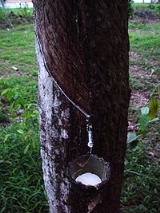
, where coconuts are in abundance, the shell of half a coconut is used as the collection container for the latex. The shells are attached to the tree via a short sharp stick and the latex drips down into it overnight. This usually produces latex up to a level of half to three quarters of the shell.

The latex can be either collected in its liquid state, in which case ammoniaAmmonia

Ammonia is a compound of nitrogen and hydrogen with the formula NH3....
 solution can be added to the collecting cup prior to tapping in order to prevent natural coagulation, or it can be left in the field to coagulate into a cup lump.

Latex is generally processed into either latex concentrate for manufacture of dipped goods or it can be coagulated under controlled, clean conditions using formic acid. The coagulated latex can then be processed into the higher grade technically specified block rubbers such as TSR3L or TSRCV or used to produce Ribbed Smoke Sheet grades.

Naturally coagulated rubber (cup lump) is used in the manufacture of TSR10 and TSR20 grade rubbers. The processing of the rubber for these grades is basically a size reduction and cleaning process in order to remove contamination and prepare the material for the final stage drying.

The dried material is then baled and palletized for shipment.

Uses


The use of rubber is widespread, ranging from household to industrial products, entering the production stream at the intermediate stage or as final products. Tires and tubes are the largest consumers of rubber, accounting for around 56% total consumption in 2005. The remaining 44% are taken up by the general rubber goods (GRG) sector, which includes all products except tires and tubes.

Other significant uses of rubber are door and window profiles, hoses, belts, matting, flooring and dampeners (anti-vibration mounts) for the automotive industry in what is known as the "under the bonnet" products. Gloves (medical, household and industrial) are also large consumers of rubber and toy balloons, although the type of rubber used is that of the concentrated latex. Significant tonnage of rubber is used as adhesivesAdhesive

An adhesive is a compound that adheres or bonds two items together....
 in many manufacturingManufacturing

Manufacturing, a branch of industry which accounts for about one-quarter of the world's economic activity, is the applicatio...
 industries and products, although the two most noticeable are the paper and the carpetCarpet

A carpet is any loom-woven, felted textile or grass floor covering....
 industry. Rubber is also commonly used to make rubber bandsFacts About Rubber band

A rubber band is a short length of rubber and latex formed in the shape of a loop....
 and pencil erasersEraser Summary

An eraser, primarily known as a rubber in British and Commonwealth English, is an article of stationery that is used f...
.

Additionally, rubber produced as a fiber sometimes called elastic, has significant value for use in the textile industry because of its excellent elongation and recovery properties. For these purposes, manufactured rubber fiber is made as either an extruded round fiber or rectangular fibers that are cut into strips from extruded film. Because of its low dye acceptance, feel and appearance, the rubber fiber is either covered by yarn of another fiber or directly woven with other yarns into the fabric. In the early 1900’s, for example, rubber yarns were used in foundation garments. While rubber is still used in textile manufacturing, its low tenacity limits its use in lightweight garments because latex lacks resistance to oxidizing agents and is damaged by aging, sunlight, oil, and perspiration. Seeking a way to address these shortcomings, the textile industry has turned to NeopreneNeoprene

Neoprene is the DuPont Chemical trade name for a family of synthetic rubbers based on polychloroprene....
 (polymer form of ChloropreneChloroprene

Chloroprene is the common name for the organic compound 2-chloro-1,3-butadiene, which has the chemical formula C4H5Cl....
), a type of synthetic rubber as well as another more commonly used elastomer fiber, spandexSpandex

Spandex or elastane is a synthetic fiber known for its exceptional elasticity....
 (also known as elastane), because of their superiority to rubber in both strength and durability.

HypoallergenicHypoallergenic

Hypoallergenic is a term first coined in 1964 by a small cosmetics company based in...
 rubber can be made from GuayuleGuayule

Guayule, pronounced 'wa-YOO-leh', is a shrub in the genus Parthenium of the family Asteraceae, native to the southwester...
.

Early experiments in the development of synthetic rubberSynthetic rubber

Synthetic rubber is any type of artificially made polymer material which acts as an elastomer....
 also led to the invention of Silly PuttySilly Putty

Silly Putty is a silicone plastic "clay", marketed as a toy for children by Binney & Smith Inc....
.

Natural rubber is often vulcanizedVulcanization

Vulcanization, or curing of rubber, is a chemical process in which individual polymer molecules are linked to other polymer ...
, a process by which the rubber is heated and sulfurSulfur

Sulfur or sulphur is the chemical element in the periodic table that has the symbol S and atomic number 16....
, peroxide or bisphenol are added to improve resilience and elasticity, and to prevent it from perishingVulcanization

Vulcanization, or curing of rubber, is a chemical process in which individual polymer molecules are linked to other polymer ...
. Vulcanization greatly improved the durability and utility of rubber from the 1830s on. The successful development of vulcanization is most closely associated with Charles GoodyearCharles Goodyear

Charles Goodyear was the first American to vulcanize rubber, a process which he discovered in 1839 and patented on June 15,...
. Carbon blackCarbon black

Carbon black is a material produced by the incomplete combustion of petroleum products....
 is often used as an additive to rubber to improve its strength, especially in vehicle tires.

External links