

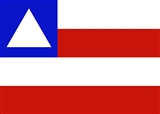
Bahia

Encyclopedia
Bahia is one of the 26 states of Brazil, and is located in the northeastern part of the country on the Atlantic coast. It is the fourth most populous Brazilian state after São Paulo
, Minas Gerais
and Rio de Janeiro
, and the fifth-largest in size. Bahia's capital is the city of Salvador
, or more properly, São Salvador da Bahia de Todos os Santos, and is located at the junction of the Atlantic Ocean and the Bay of All Saints, first seen by European sailors in 1501. The name "bahia" is an archaic spelling of the Portuguese word baía, meaning "bay".
and tobacco
cultivation. And the Planalto, which includes the fabled sertão
region of Bahia's far interior. Bahia is bordered, in counterclockwise fashion, by Sergipe
, Alagoas
, Pernambuco
and Piauí
to the north, Goiás
and Tocantins
to the west, and Minas Gerais
and Espírito Santo
to the south. The State of Bahia is crossed from north to south by a mountain chain which is marked, in the map, as Chapada Diamantina. This same chain receives other names, like Serra do Espinhaço, in Minas Gerais, and Borborema, in Pernambuco and Paraíba
.
In some parts, the chain has the shape of "Chapadões", plateaus with abrupt edges, the most visited of such chapadões are in the National Park of Chapada Diamantina
, in the middle of the State. The chain divides Bahia in two clearly distinct geographical zones. To the east, where once existed the exuberant Atlantic Forest, the soil is fertile and, despite high temperatures, rainy seasons are regular.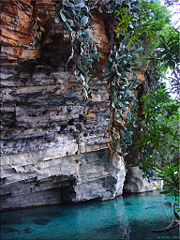 The predominant vegetation in the west is "cerrado
". These tough conditions caused the interior to be much less developed than the coast. The state is also crossed by the river São Francisco, the most important of Brazilian northeast. São Francisco River
is a permanent river, which continuously supplies water to this arid region when many other smaller rivers dry out. The São Francisco starts in Minas Gerais and goes on until the Atlantic, making borders between Bahia and Alagoas
. There are short stretches of the river which are navigable, but mainly for cargoes. The large blue spot at the north is a huge dam built to hold water for the hydroelectric plant of Itaparica
.
zone, the State presents diversified climates and an average rainfall that varies from 363 to 2000 mm (14.3 to 78.7 in) per year, depending on the region. Regarding the weather, Bahia is one of the most privileged states of the country with the following temperatures: 19.2 to 26.6 °C (66.6 to 79.9 F).
 The Portuguese Pedro Álvares Cabral
landed at what is now Porto Seguro
City, on the southern coast of Bahia in 1500, and claimed the territory for Portugal. In 1549, Portugal established the city of Salvador
, on a hill facing the Bay of All Saints. The city and surrounding captaincy served as the administrative and religious capital of Portugal's colonies in the Americas until 1763. The Dutch tried to hold control of Bahia but were defeated, only being able to seize Pernambuco. Charles Darwin
visited Bahia in 1832 on his famous Voyage of The Beagle.
The state was also the last area of Brazil to join the independent confederation. Some members in the elite remained loyal to the Portuguese crown after the rest of the country was granted independence. After several battles, mostly in Pirajá, the province was finally able to expel the Portuguese on July 2, 1823, known as Bahia Independence Day, a great popular celebration. In the state there is an ongoing discussion about the exact moment of Brazilian independence, because for almost all baianos, it really happened in Bahia with the battles, and not on September 7, when the Emperor, Pedro I, declared independence.
Bahia was a center of sugar cultivation from the 16th to the 18th centuries, and contains a number of historic towns, such as Cachoeira
, dating from this era. Integral to the sugar economy was the importation of a vast number of African slaves; more than 37% of all slaves taken from Africa were sent to Brazil, mostly to be processed in Bahia before being sent to work in plantations elsewhere in the country. Bahia was also the site of one of the most important urban slave rebellions in the Americas in 1835, of particular note because it was one of the only predominantly Muslim slave revolts in the history of the New World. The oldest Roman Catholic cathedral and the first medical college
in the country are located in Bahia's capital, which also has one of the highest percentage of churches of any state capital in Brazil. The Catholic Archbishop
of São Salvador da Bahia
, Geraldo Majella Agnelo, is the Cardinal
Primate of Brazil.
 According to the IBGE
of 2008, there are 14,561,000 people residing in the state. The population density was 24.93 PD/km2.
Urbanization: 67.4% (2006); Population growth: 1.1% (1991–2000); Houses: 3,826,000 (2006).
The last PNAD (National Research for Sample of Domiciles) census revealed the following numbers: 9,149,000 Brown (Multiracial) people (62.83%), 3,000,000 White
people (20.60%), 2,328,000 Black
people (15.99%), 42,000 Amerindian
people (0.29%), 37,000 Asian
people (0.26%).
4.5% (2002).
Share of the Brazilian economy: 4.9% (2004).
The state has the biggest GDP of the states of the North/Northeast. Bahia is the main producer and exporter of cacao in Brazil. In addition to important agricultural and industrial sectors, the state also has considerable mineral
and petroleum
deposits. In recent years, soy cultivation has increased substantially in the state. Bahia is the sixth largest economy in the country. In the mid 1950s, the Bahian economy could be considered a typical example of the primary-exporting model, which followed the subsistence production. For ten years this dynamic was led by cocoa crop that used to be the state's main product and its most important source of income.
With the acceleration of the industrialization process in the 1970s, which started in the 1950s, the productive structure began to change. This process, which was not limited to the regional market, was inserted in the Brazilian industry matrix through the chemical (specially petrochemical) and metallurgical segment. Consequently, for the last twenty years, the dynamism of the Bahian economy has surpassed the national economy and the State was able to present higher growth rates than the ones presented by the national economy. The industrial sector is expected to be the main contributor to this growth, particularly from 1999 on, when the investments that are being made now in the chemical, petrochemical and automotive segment, in agroindustry
and food production will be consolidated.
 The Bahian economy began 2005 in a very healthy state, with an exceptional trajectory of growth, once again presenting activity indicators superior to those of the Brazilian economy
. Those numbers are the result of the endeavours of the Bahian Government, the result of increasing productive investment, and therefore, potential production, something that has been carried out through attractive enterprise policies in all segments of the economy, placing Bahia in a privileged position in the regional and national scenario. Today, the State has a differentiated economic profile, not just depending on one or two sectors. Bahian industry
diversified and widened its productive base, with the implantation of new industrial segments, like the automobile and tyre industries, footwear and textiles, furniture, food and beverages, cosmetics and perfumes, information technology and naval.
Exceptional results can be seen in agriculture, commerce and tourism, where Bahia appears as one of the principal national destinations. For this to happen, the strategic position model of Bahia in the international tourism route was fundamental, with direct and regular flights to Europe, the United States, and the Southern Cone
, due to the complementary governmental and private initiatives, besides the development of new tourist poles integrated to the local culture
.
production. The State's main products are gold
, copper concentrate, magnesite
, chromite, rock salt, barite
, manganese
, ornamental rocks, precious stones, talcum, phosphate
s and uranium
.
Nowadays, Bahia produces about 10% of all vehicles produced in Brazil, occupying the third position in the national rankings. The Bahian automotive sector, led by Ford was in 2005 the third largest contributor (14.6%) to the Bahian GDP. It is important to highlight that Bahia had a 4.8% overall increase in its GDP, double the national performance, according to the Superintendency of Economic and Social Studies of Bahia (SEI)/Secretariat of Planning and IBGE
.
Footwear;
Call Centers;
Informatics, Electronics, and Telecommunications;
Nautical;
Paper and Pulp;
Textiles;
Plastic Transformation; and
Tourism.
Tourism: Bahia's long coastline, beautiful beaches and cultural treasures
make it one of Brazil's chief tourist destinations. In addition to the island of Itaparica
, the town of Morro de São Paulo
across the Bay on the northernmost tip of the southern coastline, and the large number of beaches between Ilhéus
and Porto Seguro
, on the southeastern coast, the littoral area north of Salvador, stretching towards the border with Sergipe
, has become an important tourist destination. The Costa do Sauípe contains one of the largest resort hotel developments in Brazil and South America.
s, dune
s, rivers, swamps and sweet water lagoon
s are a constant scenario as well as the presence of the Atlantic Rain Forest. The Green Road, a road that connects Mangue Seco in the far north to Praia do Forte, crosses this beautiful region maintaining a critical distance from the areas of environmental preservation. For this reason the route is sometimes more than 10 km (6.2 mi) from the beach. At Praia do Forte, the road meets the Coconut Road] (Estrada do Côco) and leads to Salvador, passing through spots, which are now integrated in the urban development of the state capital. In this region is located the Deputado Luís Eduardo Magalhães International Airport
.
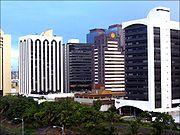 The largest bay on the Brazilian coast, Todos os Santos has a large number of islands with tropical beaches and vegetation. In its 1,052 square km, it contains 56 islands, receives sweet water from numerous rivers and creeks (especially the Paraguaçú and Subaé) and bathes the first capital of Brazil and the largest in the Northeast, Salvador, and more than ten municipalities. It is the largest navigable bay in Brazil and one of the most favorite spots for nautical sports, due to its regular breezes, medium annual temperature of 26 °C (78.8 °F) and sheltered waters. Todos os Santos Bay offers various leisure options, with hundreds of vessels of all different types, especially saveiros, schooners, motor boats, jet ski that criss-cross its crystalline waters on maritime excursions to the islands, and boat races. Major popular events and sport activities occur throughout the year, beginning on January 1, with the Procession of Bom Jesus dos Navegantes greeting the New Year.
Todos os Santos Bay has also been traditionally the venue for rowing contests at the Enseada dos Tainheiros, in Salvador and now the bay is included in the routes of the great international regatta
s, such as the Ralley Les Iles du Soleil, regatta Hong Kong Challenge and the Expo 98 Round the World Rally, which consider the bay an important stop along the route. The islands of the bay are a separate attraction. Some are privately owned, others were declared a state heritage and transformed into Environmental Protection Areas or ecological stations. Other islands are the patrimony of 12 municipalities located around the bay. Only a few are uninhabited and many have small communities where the natives live on fishing and tourism. All have common characteristics, such a calm sea, dense vegetation, especially coconut
s and banana
s, as well as vestiges of the Atlantic Forest. Of the 56 islands, the most important are Itaparica
, Madre de Deus, Maré, Frades, Medo, Bom Jesus dos Passos.
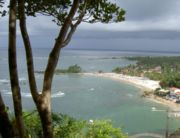 The Dendê Coast, south of Salvador
, is surrounded by verdant vegetation, clear waters, islands, bays, coral reefs and a very diversified fauna
. It is connected to Salvador and the southern part of the state by ferryboats and the BA-001 highway, the second ecological highway along the Bahian coast, which connects the southern coastline and the extreme southern part of the state. It includes the municipalities of Valença, Cairu and the International attractions of Morro de São Paulo, Camamu, Taperoá, Igrapiúna, Ituberá and Maraú. The mouth of the Rio Una, in the form of a delta
, contains 26 islands, the largest of which is Tinharé, where the Morro de São Paulo is located. At Boipeba and Cairú, which are part of the archipelago of Tinharé, the diversity of the ecosystems enables visitors to practice water sports, walk along the beach, follow trails in the rainforest
and bathe on completely deserted beaches such as Garapuá.
, the Biological Reserve of Una and the Ecological Reserve of Prainha at Itacaré. From the Morro de Pernambuco to Canavieiras, there are 110 km (68.4 mi) of beaches, some of them highly popular, and other deserted, with clear water, reef
s, inlet
s, coconut
grove and an infinite number of estuaries of rivers which extend throughout the Cacao Coast. Highway BA-001 links the municipalities, nearly always bordering the coastline. The most important locations at Cacao Coast are: Itacaré, Ilhéus, and Olivença.
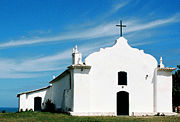 The Discovery Coast preserves, virtually intact, the landscape seen by the Portuguese fleet described in the first pages of the history of Brazil
. There are approximately 150 km (93.2 mi) of beaches, inlets, bays, cliffs, numerous rivers and streams surrounded by the verdant coconut
groves, wetlands and the Atlantic Forest. Over land and sea the excursions are always associated with nature, and there are various types of water sports, walks, trips on horseback, surfing and deep sea diving. Recife de Fora, Coroa Alta and Trancoso for one day schooner excursions. BA-001 and two ferryboat systems over the Rio João de Tiba and Rio Buranhém connect the municipalities with the coast. Trips from Barra do Cai, passing through the Parque Nacional do Monte Pascoal, Caraíva, Trancoso, Arraial d'Ajuda, the environmental protection areas of Santo Antônio and Coroa Vermelha, to the mouth of the Rio João de Tiba as far as the Rio Jequitinhonha are among the various ecological trips for visitors.
.
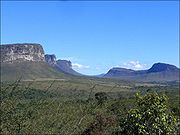 The geographical center of Bahia is the Diamantina Tableland region. In this mountainous region with a diversified topography
, 90% of the[rivers of the Paraguaçu, Jacuípe and Rio das Contas basin
s have their source here. There are thousands of kilometers of clear waters that spring from these mountains and descend in cascades and waterfalls to plateaus and plains, forming beautiful natural pools. The vegetation mixes cactus species of the caatinga dry lands with rare examples of the mountain flora
, especially bromeliads, orchids and "sempre vivas" (member of the strawflower family). On the area one can find the three highest mountains in the state: Pico do Barbado, 2080 m (6,824.1 ft) high, Pico Itobira, 1970 m (6,463.3 ft), and Pico das Almas, 1958 m (6,423.9 ft).
Another scenic attraction is the Cachoeira da Fumaça (Waterfall), that falls 420 m (1,378 ft), the Gruta dos Brejões, the largest cavern opening of Bahia, and the amazing Poço Encantado, which fascinates visitors to the region. There are so many natural attractions that it is possible to choose between subterranean routes in caves, or trip to waterfalls, trek along old gold mining trails or follow the steps of the Prestes Column, rappel, climb mountains, or go horseback riding in the Vale do Capão or Vale do Paty, in the midst of esoteric and alternative communities. Many of the sites are protected by the National Park
of Diamantina Tableland region and the Environmental Preservation Area Serra do Barbado and Marimbus, Iraquara. There are opportunities to take long bikes, or travel on horseback, mountain bike
or off-road vehicles.
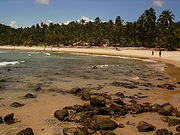 Bahia is the most important tourist center in the Northeast and the 2nd in the country. The tourist product in Bahia, 50% of its global flow centered in Salvador, unites in a same space the characteristics of a natural landscape and a unique culture in the country, in which the typical culinary arts, the colonial architecture and popular feasts reveal a strong integration of elements of European and African origin in the formation and in the way of life of the people of Bahia. By its natural and historic-cultural attractions, Bahia presents an enormous potential for the development of the tourist activity. Owner of the biggest portion of seacoast of the country and of singular views in its interior, Bahia possesses specific cultural, folklore and religious characteristics, manifest in its extensive calendar of popular festivities, in its architectonic patrimony and in its typical food.
Salvador, with its Historical Center registered by UNESCO
as a World Heritage Site
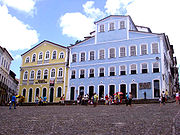
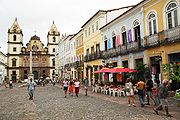
and with its coast clipped into many beaches and dozens of islands, has a varied receptive infrastructure, composed of 170 hostelry units (of which 20 are of international standard hotels) and 25 thousand[beds, further to restaurants, bars, nightclubs, shopping malls, theaters, crafts centers, Convention and Fairs Center, rental agencies, tourist agencies, and other equipment and services. In the last few years, the State Government promoted the total restoration of the Pelourinho, the biggest set of colonial style buildings in Latin America, today transformed into an important point for visitation by tourists, that will find there a synthesis of what best Bahia has to offer in specialized services, in regional and international cooking, in architecture of the 17th and 18th centuries and in music, with daily shows by the great artists of Bahia, famous in the country and abroad. The period of popular festivities in Bahia has its high point between December and March (summer months) and has in carnival
its supreme point, with more than one million tourists in Salvador, Porto Seguro
and other cities of the State's Tourist circuit.
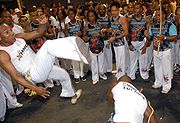
 As the chief locus of the early Brazilian slave trade, Bahia is considered to possess the greatest and most distinctive African imprint, in terms of culture and customs, in Brazil. These include the Yoruba
-derived religious system of Candomblé
, the martial art of capoeira
, African-derived music such as samba (especially samba's Bahian precursor samba-de-roda), afoxé
, and axé
, and a cuisine with strong links to western Africa.
Bahia is the birthplace of many noted Brazilian artists, writers and musicians. Among the noted musical figures born in the state are Dorival Caymmi
; João Gilberto
; Gilberto Gil
, the former (2003–2008) country's Minister of Culture; Caetano Veloso
and his sister Maria Bethânia
(Gil and Veloso being the founders of the Tropicália movement (a native adaptation of the hippie movement) of the late 1960s and early 1970s, which ultimate gained international recognition); Gal Costa
; Luis Caldas; Sara Jane; Daniela Mercury
; Ivete Sangalo
; Carlinhos Brown
and Margareth Menezes
.
The city of Salvador is also home to famous groups known as "blocos-afros", including Olodum
, Ara Ketu, É o Tchan
, and Ilê Aiyê
. Additionally, groups such as Chiclete com Banana
also are based in Bahia. The first well-known rock'n roll singer in Brazil was also from Bahia. Born Raul Seixas
, he was known as "Maluco Beleza" or "Peaceful Lunatic" (being "beleza (beauty)" in this manner means to be either "in peace" or "tranquil").
During the 19th century, one of Brazil's greatest poets, the Bahian abolitionist poet and playwright Castro Alves
, a native of the recôncavo city of Cachoeira
, penned his most famous poem, Navio negreiro, about slavery; the poem is considered a masterpiece of Brazilian Romanticism
and a central anti-slavery text.
Other notable Bahian writers include playwright and screenwriter Dias Gomes
, Gregório de Matos, who wrote during the 17th century and was one of the first Brazilian writers, and Fr. Antonio Vieira
, who during the colonial period was one of many authors who contributed to the expansion of the Portuguese language throughout the Brazilian territory.
The major Brazilian fiction writer of the 20th century, Jorge Amado
, was born in the southeastern Bahian city of Itabuna
, and resided for many years in Salvador. His major novels include Gabriela, Cinnamon and Cloves
; Dona Flor and Her Two Husbands
; and Tieta, the Goat Girl, all of which became internationally renowned films. More recent writers from Bahia include the fiction writers João Ubaldo Ribeiro
and Jean Wyllys, winner of Big Brother Brasil 5 in 2005. In the visual and plastic arts, one of the best known Bahian figures was the multigenre artist and Argentinian
native Hector Julio Páride Bernabó, also known as Carybé
(1911–1997). Fine examples of his work are visible in the Afro-Brazilian
Museum in Salvador.
. The 'Trio-Elétricos', floats with amplifiers used as moving stages, pass through three official circuits. Behind them, more than 2 million merrymakers dance along 25 km (15.5 mi) of streets and avenues. Osmar's float goes from Campo Grande to Castro Alves square, in the town centre; Dodô’s float, goes from Farol da Barra to Ondina, along the coast; and Batatinha's float goes across the Pelourinho. The first is the oldest circuit. It is also where the event's most traditional groups parade. In the Dodô circuit, where the more famous artists' box seats are located, the party becomes lively toward the end of the afternoon, and it continues like this until morning.
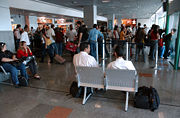 Dep. Luís Eduardo Magalhães International Airport is located in an area of more than 6 million m2s (1,482.6 acre) between sand dunes and native vegetation. The road route to the airport has already become one of the city's main scenic attractions. And lies 20 km (12.4 mi) north of Downtown Salvador. In 2007, the airport handled 5,920,573 passengers and 91,043 aircraft movements, placing it 5th busiest airport in Brazil in terms of passengers. The airport's use has been growing at an average of 14% a year and now is responsible for more than 30% of passenger movement in Northeastern Brazil. Nearly 35 thousand people circulate daily through the passenger terminal. The airport generates more than 16 thousand direct and indirect jobs, to serve a daily average of over 10 thousand passengers, 250 takeoffs and landings of 100 domestic and 16 international flights.
There are good cafes and fast food restaurants at the airport. A bar offers alcoholic or soft drinks. There are several shops in the terminal building selling a variety of items, including fashion clothing, jewellery, gift items and books and magazines. There is also a pharmacy in the terminal building. Buses between the city centre and the airport are fairly frequent. Take the Praça da Sé (Sé Square)/Aeroporto bus. It is much cheaper than going by taxi. Buses also go to Rodoviária (bus terminal), which is the city's main bus station and located 5 km (3.1 mi) from the city centre. The car park of the airport, is located near the terminal building and has parking spaces for 600 cars.
The International Airlines are: Lufthansa, TAP, United Airlines, American Airlines, Alitália, Air France, Air Europa, Ibéria, Aerolíneas Argentinas, LanChile. In addition to domestic and regional services, the airport has non-stop flights to Lisbon
, Madrid
, Frankfurt
, Montevideo
, London, Santiago
, Buenos Aires
, Asunción
and Miami
. Its IATA airport code
is SSA and it is the sixth busiest airport in the country, the first in northeastern Brazil, behind Congonhas International
, Guarulhos International
, Juscelino Kubitschek International, Santos Dumont Regional
and Galeão International
.
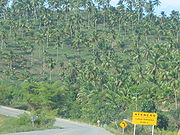 BA- 001,BR-101, BR-116, BR-242, BR-251, BR-324, BR-342, BR-367, BR-407, BR-418, BR-420, BR-445, BR-498.
Bahia's government is also inaugurating a large portion of the BA 001 between Morro de São Paulo and Itacare. The constructions began in September 2006 and it's scheduled to finish mid-2009. That portion of the highway will allow travelers to save up to two hours on a trip from Salvador to Ilheus or Itacare. It was a controversial part of the constructions since a small portion of native rain forest had to be destroyed. However, the IBAMA (Brazilian Institute of Environment and Renewable Natural Resources) followed closely the development of the road and the harm to the forest was minimal.
The new part of the BA 001 will benefit thousands of families that live near the highway will be benefited with transportation, schools and will exponentially enhance tourism in Itacare, Camamu and Ilheus.
The plan is to ultimately connect Bahia's coast from north to south entirely through BA-001.
/Northeast
and the second-leading fruit exporter in Brazil. The port's facilities operate from 8am to noon and from 1h30am to 5h30pm.
The ability to handle high shipping volume has positioned the port of Salvador for new investments in technological modernization, and the port is noted for implementing a high level of operational flexibility and competitive rates. The goal of port officials is to offer the necessary infrastructure for the movement of goods, while simultaneously meeting the needs of international importers and exporters.
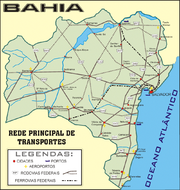 The State of Bahia has been assigning a significant part of its revenues to public investments. The investment programs of the state have been backed basically by its own resources and, in a complementary fashion, with resources originating from credit operations signed with international organizations (World Bank, IDB, KFW, OECF, etc.), and with national creditors (CEF, BNDES, etc.). There are governmental investments in progress in the fields of environmental and urban sanitation (Bahia Azul), popular housing (Viver Melhor), transportation (Corredores Rodoviários), tourism (Prodetur), urban development (Produr), and regional development
(Sertão Forte).
The airports of the State received special attention from the Government, with the development of a systematic program of reforms and improvements of the small airports of the interior, and, simultaneously, with the construction and/or improvements of the airports of the regions with some tourist appeal. Some distinction must be given in this work, for instance, to the construction of the airports of Piritiba and Mimoso do Oeste, in Barreiras
region, both finished by now. To the landing runway and marshalling yard enlargements of the Porto Seguro Airport
, enabling it to receive large aircraft like the 767-400 Boeing
. To the construction (in progress) of two new airports in the interior: one in Valença
, near Morro de São Paulo, and the other in Lençóis, in the Diamantina Tableland
region; also to some repairs and improvements of the airports of Jequié
, Irecê, Barreiras, Feira de Santana
and Esplanada, among many others.
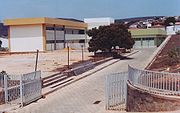 The Government policy for transportation, has emphasized the integration of different transportation systems aiming to facilitate the flow of production
, to reduce costs and to increase the competitiveness of the Bahian economy. For this purpose, the Government has conceived and is already implementing the "Corredor Intermodal de Transporte" (an intermodal transportation system), situated in the São Francisco River
, that combines in one system waterways, roads and a railway. The system connects all the sailable part of the river (1371 km (851.9 mi) within the State) to many roads and to one railroad, the "Centro Atlântica". This system conducts to the Salvador
and Aratu ports all the economic production of the West and São Francisco regions, at a reduced cost.
Social areas have also been given priority by current and previous administrations. The construction of new teaching facilities, the set up of a training and career development center for teachers, as well as new hospitals and health centers, and the acquisition of equipment and the modernization of the civil and military polices are examples of this Government's action. The significant increase in the amount of investments in the year 1997 is explained by the success of the state privatization program, confirming the purpose of the government in intensifying public development projects throughout the state. The State of Bahia has the best Human Development Index
of Northeastern Brazil.
and Esporte Clube Ypiranga
. In 2011, Bahia
plays in the Brazilian Championship Serie A (first division/premier league), while Vitoria
plays in the Brazilian Championship Serie B (second division). Bahia has won the two most important football national league: The Taça Brasil
in 1959 and the Brazilian Championship Serie A (Campeonato Brasileiro
) in 1988. Bahia is also one of the original founders of the Thirteen's Club (some kind of special group that reunites the most important teams in the country). Vitoria has never been a national champion but was runner up of the Brazilian Serie A in 1993.
In the sport of boxing, Bahian native Acelino "Popó" Freitas
is the current world champion (WBC
) in the lightweight class.
Salvador is one of the host cities of the 2014 FIFA World Cup
, for which Brazil is the host nation.
São Paulo (state)
São Paulo is a state in Brazil. It is the major industrial and economic powerhouse of the Brazilian economy. Named after Saint Paul, São Paulo has the largest population, industrial complex, and economic production in the country. It is the richest state in Brazil...
, Minas Gerais
Minas Gerais
Minas Gerais is one of the 26 states of Brazil, of which it is the second most populous, the third richest, and the fourth largest in area. Minas Gerais is the Brazilian state with the largest number of Presidents of Brazil, the current one, Dilma Rousseff, being one of them. The capital is the...
and Rio de Janeiro
Rio de Janeiro (state)
Rio de Janeiro is one of the 27 states of Brazil.Rio de Janeiro has the second largest economy of Brazil behind only São Paulo state.The state of Rio de Janeiro is located within the Brazilian geopolitical region classified as the Southeast...
, and the fifth-largest in size. Bahia's capital is the city of Salvador
Salvador, Bahia
Salvador is the largest city on the northeast coast of Brazil and the capital of the Northeastern Brazilian state of Bahia. Salvador is also known as Brazil's capital of happiness due to its easygoing population and countless popular outdoor parties, including its street carnival. The first...
, or more properly, São Salvador da Bahia de Todos os Santos, and is located at the junction of the Atlantic Ocean and the Bay of All Saints, first seen by European sailors in 1501. The name "bahia" is an archaic spelling of the Portuguese word baía, meaning "bay".
Geography
The state's geographical regions comprise the Atlantic Forest. The Recôncavo region radiating from the Bay (the largest in Brazil), the site of sugarSugar
Sugar is a class of edible crystalline carbohydrates, mainly sucrose, lactose, and fructose, characterized by a sweet flavor.Sucrose in its refined form primarily comes from sugar cane and sugar beet...
and tobacco
Tobacco
Tobacco is an agricultural product processed from the leaves of plants in the genus Nicotiana. It can be consumed, used as a pesticide and, in the form of nicotine tartrate, used in some medicines...
cultivation. And the Planalto, which includes the fabled sertão
Sertão
In Portuguese, the word sertão first referred to the vast hinterlands of Asia that Lusitanian explorers encountered. In Brazil, the geographical term referred to backlands away from the Atlantic coastal regions where the Portuguese first settled in South America in the early sixteenth century...
region of Bahia's far interior. Bahia is bordered, in counterclockwise fashion, by Sergipe
Sergipe
Sergipe , is the smallest state of the Brazilian Federation, located on the northeastern Atlantic coast of the country. It borders on two other states, Bahia to the south and west and Alagoas to the north, and to the east is the Atlantic Ocean...
, Alagoas
Alagoas
Alagoas is one of the 27 federative units of Brazil and is situated in the eastern part of the Northeast Region. It borders: Pernambuco ; Sergipe ; Bahia ; and the Atlantic Ocean . It occupies an area of 27,767 km², being slightly larger than Haiti...
, Pernambuco
Pernambuco
Pernambuco is a state of Brazil, located in the Northeast region of the country. To the north are the states of Paraíba and Ceará, to the west is Piauí, to the south are Alagoas and Bahia, and to the east is the Atlantic Ocean. There are about of beaches, some of the most beautiful in the...
and Piauí
Piauí
Piauí is one of the states of Brazil, located in the northeastern part of the country.Piauí has the shortest coastline of any of the non-landlocked Brazilian states at 66 km , and the capital, Teresina, is the only state capital in the north east to be located inland...
to the north, Goiás
Goiás
Goiás is a state of Brazil, located in the central part of the country. The name Goiás comes from the name of an indigenous community...
and Tocantins
Tocantins (state)
Tocantins is one of the states of Brazil. . The state was formed in 1988 out of the northern part of Goiás, and construction began on the capital, Palmas, in 1989, in contrast to most of the other cities in the state which date back to the Portuguese colonial period...
to the west, and Minas Gerais
Minas Gerais
Minas Gerais is one of the 26 states of Brazil, of which it is the second most populous, the third richest, and the fourth largest in area. Minas Gerais is the Brazilian state with the largest number of Presidents of Brazil, the current one, Dilma Rousseff, being one of them. The capital is the...
and Espírito Santo
Espírito Santo
Espírito Santo is one of the states of southeastern Brazil, often referred to by the abbreviation "ES". Its capital is Vitória and the largest city is Vila Velha. The name of the state means literally "holy spirit" after the Holy Ghost of Christianity...
to the south. The State of Bahia is crossed from north to south by a mountain chain which is marked, in the map, as Chapada Diamantina. This same chain receives other names, like Serra do Espinhaço, in Minas Gerais, and Borborema, in Pernambuco and Paraíba
Paraíba
Paraíba Paraíba Paraíba (Tupi: pa'ra a'íba: "bad to navigation"; Brazilian Portuguese pronunciation: is a state of Brazil. It is located in the Brazilian Northeast, and is bordered by Rio Grande do Norte to the north, Ceará to the west, Pernambuco to the south and the Atlantic Ocean to the east...
.
In some parts, the chain has the shape of "Chapadões", plateaus with abrupt edges, the most visited of such chapadões are in the National Park of Chapada Diamantina
Chapada Diamantina National Park
The Chapada Diamantina National Park is a 1,520 km² national park in the Chapada Diamantina region of Bahia state in the Northeast of Brazil...
, in the middle of the State. The chain divides Bahia in two clearly distinct geographical zones. To the east, where once existed the exuberant Atlantic Forest, the soil is fertile and, despite high temperatures, rainy seasons are regular.
Cerrado
The Cerrado, is a vast tropical savanna ecoregion of Brazil, particularly in the states of Gioas and Minas Gerais...
". These tough conditions caused the interior to be much less developed than the coast. The state is also crossed by the river São Francisco, the most important of Brazilian northeast. São Francisco River
São Francisco River
The São Francisco is a river in Brazil. With a length of , it is the longest river that runs entirely in Brazilian territory, and the fourth longest in South America and overall in Brazil...
is a permanent river, which continuously supplies water to this arid region when many other smaller rivers dry out. The São Francisco starts in Minas Gerais and goes on until the Atlantic, making borders between Bahia and Alagoas
Alagoas
Alagoas is one of the 27 federative units of Brazil and is situated in the eastern part of the Northeast Region. It borders: Pernambuco ; Sergipe ; Bahia ; and the Atlantic Ocean . It occupies an area of 27,767 km², being slightly larger than Haiti...
. There are short stretches of the river which are navigable, but mainly for cargoes. The large blue spot at the north is a huge dam built to hold water for the hydroelectric plant of Itaparica
Itaparica
Itaparica is a Brazilian island in All Saint's Bay , about 10 km from the city of Salvador, Bahia. It is known for hosting the Sul America Open tennis competition. In the island, there are two cities: Itaparica and Vera Cruz....
.
Climate
Tropical. In addition to its considerable size, it has the longest coastline of the country: 1,103 km long (685 miles; north coast: 143; Todos os Santos Bay: 124; and southern: 418). With 68% of its territory located in the semi-aridSemi-arid
A semi-arid climate or steppe climate describes climatic regions that receive precipitation below potential evapotranspiration, but not extremely...
zone, the State presents diversified climates and an average rainfall that varies from 363 to 2000 mm (14.3 to 78.7 in) per year, depending on the region. Regarding the weather, Bahia is one of the most privileged states of the country with the following temperatures: 19.2 to 26.6 °C (66.6 to 79.9 F).
History
Pedro Álvares Cabral
Pedro Álvares Cabral was a Portuguese noble, military commander, navigator and explorer regarded as the discoverer of Brazil. Cabral conducted the first substantial exploration of the northeast coast of South America and claimed it for Portugal. While details of Cabral's early life are sketchy, it...
landed at what is now Porto Seguro
Porto Seguro
Porto Seguro is a municipality in the Brazilian state of Bahia. It is the site where the Portuguese explorer Pedro Álvares Cabral first set foot on Brazilian soil on April 22, 1500...
City, on the southern coast of Bahia in 1500, and claimed the territory for Portugal. In 1549, Portugal established the city of Salvador
Salvador, Bahia
Salvador is the largest city on the northeast coast of Brazil and the capital of the Northeastern Brazilian state of Bahia. Salvador is also known as Brazil's capital of happiness due to its easygoing population and countless popular outdoor parties, including its street carnival. The first...
, on a hill facing the Bay of All Saints. The city and surrounding captaincy served as the administrative and religious capital of Portugal's colonies in the Americas until 1763. The Dutch tried to hold control of Bahia but were defeated, only being able to seize Pernambuco. Charles Darwin
Charles Darwin
Charles Robert Darwin FRS was an English naturalist. He established that all species of life have descended over time from common ancestry, and proposed the scientific theory that this branching pattern of evolution resulted from a process that he called natural selection.He published his theory...
visited Bahia in 1832 on his famous Voyage of The Beagle.
The state was also the last area of Brazil to join the independent confederation. Some members in the elite remained loyal to the Portuguese crown after the rest of the country was granted independence. After several battles, mostly in Pirajá, the province was finally able to expel the Portuguese on July 2, 1823, known as Bahia Independence Day, a great popular celebration. In the state there is an ongoing discussion about the exact moment of Brazilian independence, because for almost all baianos, it really happened in Bahia with the battles, and not on September 7, when the Emperor, Pedro I, declared independence.
Bahia was a center of sugar cultivation from the 16th to the 18th centuries, and contains a number of historic towns, such as Cachoeira
Cachoeira
Cachoeira , is an inland town of Bahia, Brazil, on the Paraguaçu River. The town exports sugar, cotton and tobacco and is a thriving commercial and industrial centre....
, dating from this era. Integral to the sugar economy was the importation of a vast number of African slaves; more than 37% of all slaves taken from Africa were sent to Brazil, mostly to be processed in Bahia before being sent to work in plantations elsewhere in the country. Bahia was also the site of one of the most important urban slave rebellions in the Americas in 1835, of particular note because it was one of the only predominantly Muslim slave revolts in the history of the New World. The oldest Roman Catholic cathedral and the first medical college
Medical college
A Medical College is a trade association that brings together practitioners of a particular geographical area . In common law countries often are grouped by medical specialties ....
in the country are located in Bahia's capital, which also has one of the highest percentage of churches of any state capital in Brazil. The Catholic Archbishop
Archbishop
An archbishop is a bishop of higher rank, but not of higher sacramental order above that of the three orders of deacon, priest , and bishop...
of São Salvador da Bahia
Salvador, Bahia
Salvador is the largest city on the northeast coast of Brazil and the capital of the Northeastern Brazilian state of Bahia. Salvador is also known as Brazil's capital of happiness due to its easygoing population and countless popular outdoor parties, including its street carnival. The first...
, Geraldo Majella Agnelo, is the Cardinal
Cardinal (Catholicism)
A cardinal is a senior ecclesiastical official, usually an ordained bishop, and ecclesiastical prince of the Catholic Church. They are collectively known as the College of Cardinals, which as a body elects a new pope. The duties of the cardinals include attending the meetings of the College and...
Primate of Brazil.
Demographics
IBGE
The Brazilian Institute of Geography and Statistics or IBGE , is the agency responsible for statistical, geographic, cartographic, geodetic and environmental information in Brazil...
of 2008, there are 14,561,000 people residing in the state. The population density was 24.93 PD/km2.
Urbanization: 67.4% (2006); Population growth: 1.1% (1991–2000); Houses: 3,826,000 (2006).
The last PNAD (National Research for Sample of Domiciles) census revealed the following numbers: 9,149,000 Brown (Multiracial) people (62.83%), 3,000,000 White
White Brazilian
White Brazilians make up 48.4% of Brazil's population, or around 92 million people, according to the IBGE's 2008 PNAD . Whites are present in the entire territory of Brazil, although the main concentrations are found in the South and Southeastern parts of the country...
people (20.60%), 2,328,000 Black
Afro-Brazilian
In Brazil, the term "preto" is one of the five categories used by the Brazilian Census, along with "branco" , "pardo" , "amarelo" and "indígena"...
people (15.99%), 42,000 Amerindian
Indigenous peoples in Brazil
The Indigenous peoples in Brazil comprise a large number of distinct ethnic groups who inhabited the country prior to the European invasion around 1500...
people (0.29%), 37,000 Asian
Asian Brazilian
An Asian Brazilian is is a Brazilian citizen of full or partial Asian ancestry, who remains culturally connected to Asia, or an Asian-born person permanently residing in Brazil. Brazil received many immigrants from Asia, both from Middle East and East Asia...
people (0.26%).
| City | Population |
|---|---|
| Salvador (the capital) Salvador, Bahia Salvador is the largest city on the northeast coast of Brazil and the capital of the Northeastern Brazilian state of Bahia. Salvador is also known as Brazil's capital of happiness due to its easygoing population and countless popular outdoor parties, including its street carnival. The first... |
2,892,625 |
| Feira de Santana Feira de Santana Feira de Santana is a city in Bahia, Brazil. It is the second-most populous city in the state, with a population of 700,000 according to IBGE's estimate. It is located 115 km northwest of Salvador, Bahia's capital city. These cities are connected by BR-324, a four-lane divided highway... |
571,997 |
| Vitória da Conquista Vitória da Conquista Vitória da Conquista, Bahia, in English: Victory of Conquest, is a city in Bahia, Brazil which serves as a regional center for the smaller cities Barra do Choça, Planalto and Poções... |
313,898 |
| Juazeiro Juazeiro Juazeiro is a city and municipality in eastern Brazil in the state of Bahia . It had a population of 260,004, according to the 2010 census, and an area of 6,415.4 km². The population density was 31.34 hab/km² . The elevation is 373 meters. It became a city in 1833... |
230,538 |
| Ilhéus Ilhéus Ilhéus is a major city located in the southern coastal region of Bahia, Brazil, 430 km south of Salvador, the state's capital. The city was originally founded in 1534 as Vila de São Jorge dos Ilhéus and is known as one of the most important tourism centers of the northeast of Brazil.The... |
220,144 |
| Itabuna Itabuna Itabuna is a city in Bahia, Brazil. Located around , it's the 6th city in Bahia, after Salvador, Feira de Santana, Vitória da Conquista, Juazeiro and Ilhéus in size of population, with an estimative of 209,211 inhabitants in 2006. The city covers a total area of 443.2 km².Itabuna became a city... |
210,604 |
| Jequié Jequié Jequié is a city in the state of Bahia, Brazil. It is located at around . It is nicknamed "A cidade do sol", or "The city of the Sun" because of its high temperatures.... |
145,964 |
| Lauro de Freitas Lauro de Freitas Lauro de Freitas is a municipality of 59 km² in the north-east of the state of Bahia, Brasil located at 12° 53' 38" South 38° 19' 37" West.In Lauro de Freitas is located Vilas do Atlântico, a wealthy neighborhood.... |
144,492 |
Economy
The industrial sector is the largest component of GDP at 48.5%, followed by the service sector at 40.8%. Agriculture represents 10.7% of GDP (2004). Bahia exports: chemicals 22.4%, fuel 17.5%, mineral metallics 13%, paper 9.4%, cacao 5.6%, vehicles 4.8%, soybeanSoybean
The soybean or soya bean is a species of legume native to East Asia, widely grown for its edible bean which has numerous uses...
4.5% (2002).
Share of the Brazilian economy: 4.9% (2004).
The state has the biggest GDP of the states of the North/Northeast. Bahia is the main producer and exporter of cacao in Brazil. In addition to important agricultural and industrial sectors, the state also has considerable mineral
Mineral
A mineral is a naturally occurring solid chemical substance formed through biogeochemical processes, having characteristic chemical composition, highly ordered atomic structure, and specific physical properties. By comparison, a rock is an aggregate of minerals and/or mineraloids and does not...
and petroleum
Petroleum
Petroleum or crude oil is a naturally occurring, flammable liquid consisting of a complex mixture of hydrocarbons of various molecular weights and other liquid organic compounds, that are found in geologic formations beneath the Earth's surface. Petroleum is recovered mostly through oil drilling...
deposits. In recent years, soy cultivation has increased substantially in the state. Bahia is the sixth largest economy in the country. In the mid 1950s, the Bahian economy could be considered a typical example of the primary-exporting model, which followed the subsistence production. For ten years this dynamic was led by cocoa crop that used to be the state's main product and its most important source of income.
With the acceleration of the industrialization process in the 1970s, which started in the 1950s, the productive structure began to change. This process, which was not limited to the regional market, was inserted in the Brazilian industry matrix through the chemical (specially petrochemical) and metallurgical segment. Consequently, for the last twenty years, the dynamism of the Bahian economy has surpassed the national economy and the State was able to present higher growth rates than the ones presented by the national economy. The industrial sector is expected to be the main contributor to this growth, particularly from 1999 on, when the investments that are being made now in the chemical, petrochemical and automotive segment, in agroindustry
Agribusiness
In agriculture, agribusiness is a generic term for the various businesses involved in food production, including farming and contract farming, seed supply, agrichemicals, farm machinery, wholesale and distribution, processing, marketing, and retail sales....
and food production will be consolidated.
Economy of Brazil
The economy of Brazil is the world's seventh largest by nominal GDP and eighth largest by purchasing power parity. Brazil has moderately free markets and an inward-oriented economy...
. Those numbers are the result of the endeavours of the Bahian Government, the result of increasing productive investment, and therefore, potential production, something that has been carried out through attractive enterprise policies in all segments of the economy, placing Bahia in a privileged position in the regional and national scenario. Today, the State has a differentiated economic profile, not just depending on one or two sectors. Bahian industry
Industry
Industry refers to the production of an economic good or service within an economy.-Industrial sectors:There are four key industrial economic sectors: the primary sector, largely raw material extraction industries such as mining and farming; the secondary sector, involving refining, construction,...
diversified and widened its productive base, with the implantation of new industrial segments, like the automobile and tyre industries, footwear and textiles, furniture, food and beverages, cosmetics and perfumes, information technology and naval.
Exceptional results can be seen in agriculture, commerce and tourism, where Bahia appears as one of the principal national destinations. For this to happen, the strategic position model of Bahia in the international tourism route was fundamental, with direct and regular flights to Europe, the United States, and the Southern Cone
Southern Cone
Southern Cone is a geographic region composed of the southernmost areas of South America, south of the Tropic of Capricorn. Although geographically this includes part of Southern and Southeast of Brazil, in terms of political geography the Southern cone has traditionally comprised Argentina,...
, due to the complementary governmental and private initiatives, besides the development of new tourist poles integrated to the local culture
Culture of Brazil
The culture of Brazil presents a very diverse nature reflecting an ethnic and cultural mixing occurred in the colonial period involving mostly Native Americans, Portuguese and Africans...
.
Chemical and Petrochemical
Bahia's Petrochemical Pole is the largest integrated complex in the Southern Hemisphere, and is the result of R$10 billion in investments, accounting for a third of the state's exports and for nearly half of the industrial production value.Mining
Bahia is one of the richest states in minerals in the country, ranking third in Brazilian mineralMineral
A mineral is a naturally occurring solid chemical substance formed through biogeochemical processes, having characteristic chemical composition, highly ordered atomic structure, and specific physical properties. By comparison, a rock is an aggregate of minerals and/or mineraloids and does not...
production. The State's main products are gold
Gold
Gold is a chemical element with the symbol Au and an atomic number of 79. Gold is a dense, soft, shiny, malleable and ductile metal. Pure gold has a bright yellow color and luster traditionally considered attractive, which it maintains without oxidizing in air or water. Chemically, gold is a...
, copper concentrate, magnesite
Magnesite
Magnesite is magnesium carbonate, MgCO3. Iron substitutes for magnesium with a complete solution series with siderite, FeCO3. Calcium, manganese, cobalt, and nickel may also occur in small amounts...
, chromite, rock salt, barite
Barite
Baryte, or barite, is a mineral consisting of barium sulfate. The baryte group consists of baryte, celestine, anglesite and anhydrite. Baryte itself is generally white or colorless, and is the main source of barium...
, manganese
Manganese
Manganese is a chemical element, designated by the symbol Mn. It has the atomic number 25. It is found as a free element in nature , and in many minerals...
, ornamental rocks, precious stones, talcum, phosphate
Phosphate
A phosphate, an inorganic chemical, is a salt of phosphoric acid. In organic chemistry, a phosphate, or organophosphate, is an ester of phosphoric acid. Organic phosphates are important in biochemistry and biogeochemistry or ecology. Inorganic phosphates are mined to obtain phosphorus for use in...
s and uranium
Uranium
Uranium is a silvery-white metallic chemical element in the actinide series of the periodic table, with atomic number 92. It is assigned the chemical symbol U. A uranium atom has 92 protons and 92 electrons, of which 6 are valence electrons...
.
Automotive
In Bahia, the automotive sector has gained prominence since the creation of the Northeast Ford Complex in Camaçari (2001), and has become one of the most promising sectors of the Bahian economy. This enterprise, which was developed with the aim of generating 5,000 direct jobs and 55,000 indirect ones in 2005 has surpassed those expectations by creating 8,500 direct job positions and 85,000 indirect ones since its development.Nowadays, Bahia produces about 10% of all vehicles produced in Brazil, occupying the third position in the national rankings. The Bahian automotive sector, led by Ford was in 2005 the third largest contributor (14.6%) to the Bahian GDP. It is important to highlight that Bahia had a 4.8% overall increase in its GDP, double the national performance, according to the Superintendency of Economic and Social Studies of Bahia (SEI)/Secretariat of Planning and IBGE
IBGE
The Brazilian Institute of Geography and Statistics or IBGE , is the agency responsible for statistical, geographic, cartographic, geodetic and environmental information in Brazil...
.
Other market segments
Agribusiness;Footwear;
Call Centers;
Informatics, Electronics, and Telecommunications;
Nautical;
Paper and Pulp;
Textiles;
Plastic Transformation; and
Tourism.
Tourism: Bahia's long coastline, beautiful beaches and cultural treasures
Culture of Brazil
The culture of Brazil presents a very diverse nature reflecting an ethnic and cultural mixing occurred in the colonial period involving mostly Native Americans, Portuguese and Africans...
make it one of Brazil's chief tourist destinations. In addition to the island of Itaparica
Itaparica
Itaparica is a Brazilian island in All Saint's Bay , about 10 km from the city of Salvador, Bahia. It is known for hosting the Sul America Open tennis competition. In the island, there are two cities: Itaparica and Vera Cruz....
, the town of Morro de São Paulo
Morro de São Paulo
Morro de São Paulo is one of 5 villages of the island Tinharé in Bahia, Brazil, 272 km from the city of Salvador by route and 60 km by sea...
across the Bay on the northernmost tip of the southern coastline, and the large number of beaches between Ilhéus
Ilhéus
Ilhéus is a major city located in the southern coastal region of Bahia, Brazil, 430 km south of Salvador, the state's capital. The city was originally founded in 1534 as Vila de São Jorge dos Ilhéus and is known as one of the most important tourism centers of the northeast of Brazil.The...
and Porto Seguro
Porto Seguro
Porto Seguro is a municipality in the Brazilian state of Bahia. It is the site where the Portuguese explorer Pedro Álvares Cabral first set foot on Brazilian soil on April 22, 1500...
, on the southeastern coast, the littoral area north of Salvador, stretching towards the border with Sergipe
Sergipe
Sergipe , is the smallest state of the Brazilian Federation, located on the northeastern Atlantic coast of the country. It borders on two other states, Bahia to the south and west and Alagoas to the north, and to the east is the Atlantic Ocean...
, has become an important tourist destination. The Costa do Sauípe contains one of the largest resort hotel developments in Brazil and South America.
The Coconut Coast
The Coconut Coast, in the northern of Bahia, corresponds to a total of 193 km (119.9 mi) of coastline, where coconut groveGrove (nature)
A grove is a small group of trees with minimal or no undergrowth, such as a sequoia grove, or a small orchard planted for the cultivation of fruits or nuts...
s, dune
Dune
In physical geography, a dune is a hill of sand built by wind. Dunes occur in different forms and sizes, formed by interaction with the wind. Most kinds of dunes are longer on the windward side where the sand is pushed up the dune and have a shorter "slip face" in the lee of the wind...
s, rivers, swamps and sweet water lagoon
Lagoon
A lagoon is a body of shallow sea water or brackish water separated from the sea by some form of barrier. The EU's habitat directive defines lagoons as "expanses of shallow coastal salt water, of varying salinity or water volume, wholly or partially separated from the sea by sand banks or shingle,...
s are a constant scenario as well as the presence of the Atlantic Rain Forest. The Green Road, a road that connects Mangue Seco in the far north to Praia do Forte, crosses this beautiful region maintaining a critical distance from the areas of environmental preservation. For this reason the route is sometimes more than 10 km (6.2 mi) from the beach. At Praia do Forte, the road meets the Coconut Road] (Estrada do Côco) and leads to Salvador, passing through spots, which are now integrated in the urban development of the state capital. In this region is located the Deputado Luís Eduardo Magalhães International Airport
Deputado Luís Eduardo Magalhães International Airport
Salvador-Deputado Luís Eduardo Magalhães International Airport , formerly called Dois de Julho International Airport is the airport serving Salvador da Bahia, Brazil...
.
All Saints Bay
Todos os Santos Bay has also been traditionally the venue for rowing contests at the Enseada dos Tainheiros, in Salvador and now the bay is included in the routes of the great international regatta
Regatta
A regatta is a series of boat races. The term typically describes racing events of rowed or sailed water craft, although some powerboat race series are also called regattas...
s, such as the Ralley Les Iles du Soleil, regatta Hong Kong Challenge and the Expo 98 Round the World Rally, which consider the bay an important stop along the route. The islands of the bay are a separate attraction. Some are privately owned, others were declared a state heritage and transformed into Environmental Protection Areas or ecological stations. Other islands are the patrimony of 12 municipalities located around the bay. Only a few are uninhabited and many have small communities where the natives live on fishing and tourism. All have common characteristics, such a calm sea, dense vegetation, especially coconut
Coconut
The coconut palm, Cocos nucifera, is a member of the family Arecaceae . It is the only accepted species in the genus Cocos. The term coconut can refer to the entire coconut palm, the seed, or the fruit, which is not a botanical nut. The spelling cocoanut is an old-fashioned form of the word...
s and banana
Banana
Banana is the common name for herbaceous plants of the genus Musa and for the fruit they produce. Bananas come in a variety of sizes and colors when ripe, including yellow, purple, and red....
s, as well as vestiges of the Atlantic Forest. Of the 56 islands, the most important are Itaparica
Itaparica
Itaparica is a Brazilian island in All Saint's Bay , about 10 km from the city of Salvador, Bahia. It is known for hosting the Sul America Open tennis competition. In the island, there are two cities: Itaparica and Vera Cruz....
, Madre de Deus, Maré, Frades, Medo, Bom Jesus dos Passos.
Dendê Coast
Salvador, Bahia
Salvador is the largest city on the northeast coast of Brazil and the capital of the Northeastern Brazilian state of Bahia. Salvador is also known as Brazil's capital of happiness due to its easygoing population and countless popular outdoor parties, including its street carnival. The first...
, is surrounded by verdant vegetation, clear waters, islands, bays, coral reefs and a very diversified fauna
Fauna
Fauna or faunæ is all of the animal life of any particular region or time. The corresponding term for plants is flora.Zoologists and paleontologists use fauna to refer to a typical collection of animals found in a specific time or place, e.g. the "Sonoran Desert fauna" or the "Burgess shale fauna"...
. It is connected to Salvador and the southern part of the state by ferryboats and the BA-001 highway, the second ecological highway along the Bahian coast, which connects the southern coastline and the extreme southern part of the state. It includes the municipalities of Valença, Cairu and the International attractions of Morro de São Paulo, Camamu, Taperoá, Igrapiúna, Ituberá and Maraú. The mouth of the Rio Una, in the form of a delta
River delta
A delta is a landform that is formed at the mouth of a river where that river flows into an ocean, sea, estuary, lake, reservoir, flat arid area, or another river. Deltas are formed from the deposition of the sediment carried by the river as the flow leaves the mouth of the river...
, contains 26 islands, the largest of which is Tinharé, where the Morro de São Paulo is located. At Boipeba and Cairú, which are part of the archipelago of Tinharé, the diversity of the ecosystems enables visitors to practice water sports, walk along the beach, follow trails in the rainforest
Rainforest
Rainforests are forests characterized by high rainfall, with definitions based on a minimum normal annual rainfall of 1750-2000 mm...
and bathe on completely deserted beaches such as Garapuá.
Cacao Coast
Along the southern coast of Bahia, the Cacao Coast preserves ecological sanctuaries with dozens of kilometers of beaches shaded by dense coconut groves, the Atlantic Forest, large areas of wetland vegetation and cacao plantations, the great allies in the struggle to defend the preservation of the Atlantic Forest. Walking along paths in the forest or along the beaches, horseback riding along the coast, boat trips up the vast number of rivers are some of the options that the region offers. Here one can find Environmental Protection Areas at Itacaré/Serra Grande and the Lagoa Encantada in IlhéusIlhéus
Ilhéus is a major city located in the southern coastal region of Bahia, Brazil, 430 km south of Salvador, the state's capital. The city was originally founded in 1534 as Vila de São Jorge dos Ilhéus and is known as one of the most important tourism centers of the northeast of Brazil.The...
, the Biological Reserve of Una and the Ecological Reserve of Prainha at Itacaré. From the Morro de Pernambuco to Canavieiras, there are 110 km (68.4 mi) of beaches, some of them highly popular, and other deserted, with clear water, reef
Reef
In nautical terminology, a reef is a rock, sandbar, or other feature lying beneath the surface of the water ....
s, inlet
Inlet
An inlet is a narrow body of water between islands or leading inland from a larger body of water, often leading to an enclosed body of water, such as a sound, bay, lagoon or marsh. In sea coasts an inlet usually refers to the actual connection between a bay and the ocean and is often called an...
s, coconut
Coconut
The coconut palm, Cocos nucifera, is a member of the family Arecaceae . It is the only accepted species in the genus Cocos. The term coconut can refer to the entire coconut palm, the seed, or the fruit, which is not a botanical nut. The spelling cocoanut is an old-fashioned form of the word...
grove and an infinite number of estuaries of rivers which extend throughout the Cacao Coast. Highway BA-001 links the municipalities, nearly always bordering the coastline. The most important locations at Cacao Coast are: Itacaré, Ilhéus, and Olivença.
The Discovery Coast
History of Brazil
The history of Brazil begins with the arrival of the first indigenous peoples, thousands of years ago by crossing the Bering land bridge into Alaska and then moving south....
. There are approximately 150 km (93.2 mi) of beaches, inlets, bays, cliffs, numerous rivers and streams surrounded by the verdant coconut
Coconut
The coconut palm, Cocos nucifera, is a member of the family Arecaceae . It is the only accepted species in the genus Cocos. The term coconut can refer to the entire coconut palm, the seed, or the fruit, which is not a botanical nut. The spelling cocoanut is an old-fashioned form of the word...
groves, wetlands and the Atlantic Forest. Over land and sea the excursions are always associated with nature, and there are various types of water sports, walks, trips on horseback, surfing and deep sea diving. Recife de Fora, Coroa Alta and Trancoso for one day schooner excursions. BA-001 and two ferryboat systems over the Rio João de Tiba and Rio Buranhém connect the municipalities with the coast. Trips from Barra do Cai, passing through the Parque Nacional do Monte Pascoal, Caraíva, Trancoso, Arraial d'Ajuda, the environmental protection areas of Santo Antônio and Coroa Vermelha, to the mouth of the Rio João de Tiba as far as the Rio Jequitinhonha are among the various ecological trips for visitors.
The Whale Coast
The Abrolhos archipelago in the extreme southern part of Bahia is a ecotourism attraction for diving and whale watching. Whales are frequent between July and November. This region contains one of the largest concentrations of fish, in terms of volume and variety, per square meter on the planet. There are 17 species of corals. The Whale Coast includes the municipalities of Alcobaça, Caravelas, Nova Viçosa and Mucuri and its main attraction is the Abrolhos Marine National ParkAbrolhos Marine National Park
The Abrolhos Marine National Park is a Marine Park located in the Abrolhos Archipelago since 1983.The Abrolhos are an archipelago of 5 islands with coral reefs off the southern coast of Bahia state in the northeast of Brazil, between 17º25’—18º09’ S and 38º33’—39º05’ W.-External links:***...
.
The Diamantina Tableland Region
Topography
Topography is the study of Earth's surface shape and features or those ofplanets, moons, and asteroids...
, 90% of the[rivers of the Paraguaçu, Jacuípe and Rio das Contas basin
Drainage basin
A drainage basin is an extent or an area of land where surface water from rain and melting snow or ice converges to a single point, usually the exit of the basin, where the waters join another waterbody, such as a river, lake, reservoir, estuary, wetland, sea, or ocean...
s have their source here. There are thousands of kilometers of clear waters that spring from these mountains and descend in cascades and waterfalls to plateaus and plains, forming beautiful natural pools. The vegetation mixes cactus species of the caatinga dry lands with rare examples of the mountain flora
Flora
Flora is the plant life occurring in a particular region or time, generally the naturally occurring or indigenous—native plant life. The corresponding term for animals is fauna.-Etymology:...
, especially bromeliads, orchids and "sempre vivas" (member of the strawflower family). On the area one can find the three highest mountains in the state: Pico do Barbado, 2080 m (6,824.1 ft) high, Pico Itobira, 1970 m (6,463.3 ft), and Pico das Almas, 1958 m (6,423.9 ft).
Another scenic attraction is the Cachoeira da Fumaça (Waterfall), that falls 420 m (1,378 ft), the Gruta dos Brejões, the largest cavern opening of Bahia, and the amazing Poço Encantado, which fascinates visitors to the region. There are so many natural attractions that it is possible to choose between subterranean routes in caves, or trip to waterfalls, trek along old gold mining trails or follow the steps of the Prestes Column, rappel, climb mountains, or go horseback riding in the Vale do Capão or Vale do Paty, in the midst of esoteric and alternative communities. Many of the sites are protected by the National Park
National park
A national park is a reserve of natural, semi-natural, or developed land that a sovereign state declares or owns. Although individual nations designate their own national parks differently A national park is a reserve of natural, semi-natural, or developed land that a sovereign state declares or...
of Diamantina Tableland region and the Environmental Preservation Area Serra do Barbado and Marimbus, Iraquara. There are opportunities to take long bikes, or travel on horseback, mountain bike
Mountain bike
A mountain bike or mountain bicycle is a bicycle created for off-road cycling. This activity includes traversing of rocks and washouts, and steep declines,...
or off-road vehicles.
Tourism and recreation
Salvador, with its Historical Center registered by UNESCO
UNESCO
The United Nations Educational, Scientific and Cultural Organization is a specialized agency of the United Nations...
as a World Heritage Site
World Heritage Site
A UNESCO World Heritage Site is a place that is listed by the UNESCO as of special cultural or physical significance...
and with its coast clipped into many beaches and dozens of islands, has a varied receptive infrastructure, composed of 170 hostelry units (of which 20 are of international standard hotels) and 25 thousand[beds, further to restaurants, bars, nightclubs, shopping malls, theaters, crafts centers, Convention and Fairs Center, rental agencies, tourist agencies, and other equipment and services. In the last few years, the State Government promoted the total restoration of the Pelourinho, the biggest set of colonial style buildings in Latin America, today transformed into an important point for visitation by tourists, that will find there a synthesis of what best Bahia has to offer in specialized services, in regional and international cooking, in architecture of the 17th and 18th centuries and in music, with daily shows by the great artists of Bahia, famous in the country and abroad. The period of popular festivities in Bahia has its high point between December and March (summer months) and has in carnival
Carnival
Carnaval is a festive season which occurs immediately before Lent; the main events are usually during February. Carnaval typically involves a public celebration or parade combining some elements of a circus, mask and public street party...
its supreme point, with more than one million tourists in Salvador, Porto Seguro
Porto Seguro
Porto Seguro is a municipality in the Brazilian state of Bahia. It is the site where the Portuguese explorer Pedro Álvares Cabral first set foot on Brazilian soil on April 22, 1500...
and other cities of the State's Tourist circuit.
Education
Educational institutions
- Universidade Federal da BahiaUniversidade Federal da BahiaThe Universidade Federal da Bahia is a public university located mainly in the city of Salvador. The largest university of the State of Bahia, and one of the most prestigious Brazilian universities.Students can study there without having to pay tuition fees, as it is a public university...
(UFBA) (Federal University of Bahia); - Universidade Católica de Salvador (UCSal) (Catholic University of Salvador);
- Centro Federal de Educação Tecnológica da Bahia (Cefet-BA);
- Escola Baiana de Medicina e Saúde Pública (EBMSP) (Bahiana School of Medicine and Public Health);
- Universidade Salvador (Unifacs) (Salvador University);
- Universidade Federal do Recôncavo da Bahia (UFRB) (Federal University of Recôncavo da Bahia);
- Universidade Estadual do Sudoeste da Bahia (Uesb) (State University of Southwest of Bahia);
- Universidade Estadual de Santa Cruz (UESC) (State University of Santa Cruz);
- Universidade do Estado da Bahia (Uneb) (University of State of Bahia);
- Universidade Estadual de Feira de Santana (UEFS) (State University of Feira de Santana);
- Fundação Universidade Federal do Vale do São Francisco (UNIVASF) (Foundation Federal University of São Francisco Valley);
- Centro Universitário da Bahia (FIB) (University Centre of Bahia);
- and many others.
Culture
Yoruba mythology
The Yorùbá religion comprises the original religious beliefs and practices of the Yoruba people. Its homeland is in Southwestern Nigeria and the adjoining parts of Benin and Togo, a region that has come to be known as Yorubaland...
-derived religious system of Candomblé
Candomblé
Candomblé is an African-originated or Afro-Brazilian religion, practised chiefly in Brazil by the "povo de santo" . It originated in the cities of Salvador, the capital of Bahia and Cachoeira, at the time one of the main commercial crossroads for the distribution of products and slave trade to...
, the martial art of capoeira
Capoeira
Capoeira is a Brazilian art form that combines elements of martial arts, sports, and music. It was created in Brazil mainly by descendants of African slaves with Brazilian native influences, probably beginning in the 16th century...
, African-derived music such as samba (especially samba's Bahian precursor samba-de-roda), afoxé
Afoxé
The afoxé is an Afro Brazilian musical instrument composed of a gourd wrapped in a net in which beads or small plastic balls are threaded. The instrument is shaken to produce its musical noise.A similar instrument is the xequerê which is larger....
, and axé
Axe
The axe, or ax, is an implement that has been used for millennia to shape, split and cut wood; to harvest timber; as a weapon; and as a ceremonial or heraldic symbol...
, and a cuisine with strong links to western Africa.
Bahia is the birthplace of many noted Brazilian artists, writers and musicians. Among the noted musical figures born in the state are Dorival Caymmi
Dorival Caymmi
Dorival Caymmi was a Brazilian singer, songwriter, actor, and painter active for more than 70 years beginning in 1933...
; João Gilberto
João Gilberto
João Gilberto Prado Pereira de Oliveira, known as João Gilberto , is a Brazilian singer and guitarist. His seminal recordings, including many songs by Antônio Carlos Jobim and Vinicius de Moraes, established the new musical genre of Bossa nova in the late 1950s.-Biography:From an early age, music...
; Gilberto Gil
Gilberto Gil
Gilberto Passos Gil Moreira , better known as Gilberto Gil or , is a Brazilian singer, guitarist, and songwriter, known for both his musical innovation and political commitment...
, the former (2003–2008) country's Minister of Culture; Caetano Veloso
Caetano Veloso
Caetano Emanuel Viana Teles Veloso , better known as Caetano Veloso, is a Brazilian composer, singer, guitarist, writer, and political activist. Veloso first became known for his participation in the Brazilian musical movement Tropicalismo which encompassed theatre, poetry and music in the 1960s,...
and his sister Maria Bethânia
Maria Bethânia
Maria Bethânia Vianna Telles Veloso , better known as Maria Bethânia , is a singer and sister of Caetano Veloso. She started her career in Rio de Janeiro in 1964 with the show "Opinião"...
(Gil and Veloso being the founders of the Tropicália movement (a native adaptation of the hippie movement) of the late 1960s and early 1970s, which ultimate gained international recognition); Gal Costa
Gal Costa
Gal Costa is a Brazilian singer of popular music.-Early life:...
; Luis Caldas; Sara Jane; Daniela Mercury
Daniela Mercury
Daniela Mercury , is a Latin Grammy Award-winning Brazilian axé, samba-reggae and MPB singer, songwriter and record producer. Since her breakthrough, Mercury has become one of the best known Brazilian female singers, selling over 20 million albums worldwide...
; Ivete Sangalo
Ivete Sangalo
Ivete Maria Dias de Sangalo is a Latin Grammy Award-winning Brazilian Axé and MPB singer, songwriter, and occasional actress and television show host...
; Carlinhos Brown
Carlinhos Brown
Carlinhos Brown is a Brazilian musician from Salvador, Bahia. He was born in Candeal Pequeno, a small neighbourhood in the Brotas area of Salvador de Bahia...
and Margareth Menezes
Margareth Menezes
Margareth Menezes is a Brazilian singer from Salvador, Bahia.Her style is considered axé but her music also steers into samba and MPB territory, at times drawing on African rhythms and reggae....
.
The city of Salvador is also home to famous groups known as "blocos-afros", including Olodum
Olodum
Olodum is a cultural group based in the Afro Brazilian community of Salvador, the capital city of the state of Bahia, Brazil. It was founded by percussionist, Neguinho do Samba....
, Ara Ketu, É o Tchan
É o Tchan
É o Tchan! is a popular pagode band from Salvador, Bahia, Brazil that started in 1992.- History :Originally called Gera Samba, they exploded onto the scene with their hit single Segura o Tchan...
, and Ilê Aiyê
Ilê Aiyê
The Afro-Brazilian group Ilê Aiyê was founded on 1974 by Antônio Carlos “Vovô” and Apolônio de Jesus in the neighborhood of Liberdade, the largest black population area of Salvador, Bahia, Brazil....
. Additionally, groups such as Chiclete com Banana
Chiclete com Banana
Chiclete com Banana is an Axé music band, currently consisting of Bell Marques, Wadinho Marques, Rey, Waltinho Cruz, Deny and Lelo. The group is named after the song "Chiclete com Banana," written by Gordurinha...
also are based in Bahia. The first well-known rock'n roll singer in Brazil was also from Bahia. Born Raul Seixas
Raul Seixas
Raul Santos Seixas June 28, 1945 Salvador Northeast Brazil – August 21, 1989),was a Brazilian rock composer, singer, songwriter and producer.He is sometimes called the "Father of Brazilian Rock" and "Maluco Beleza"....
, he was known as "Maluco Beleza" or "Peaceful Lunatic" (being "beleza (beauty)" in this manner means to be either "in peace" or "tranquil").
During the 19th century, one of Brazil's greatest poets, the Bahian abolitionist poet and playwright Castro Alves
Castro Alves
Antônio Frederico de Castro Alves was a Brazilian poet and playwright, famous for his Abolitionist and Republican poems...
, a native of the recôncavo city of Cachoeira
Cachoeira
Cachoeira , is an inland town of Bahia, Brazil, on the Paraguaçu River. The town exports sugar, cotton and tobacco and is a thriving commercial and industrial centre....
, penned his most famous poem, Navio negreiro, about slavery; the poem is considered a masterpiece of Brazilian Romanticism
Romanticism
Romanticism was an artistic, literary and intellectual movement that originated in the second half of the 18th century in Europe, and gained strength in reaction to the Industrial Revolution...
and a central anti-slavery text.
Other notable Bahian writers include playwright and screenwriter Dias Gomes
Dias Gomes
Alfredo de Freitas Dias Gomes was an important Brazilian playwright.He was born on October 19, 1922 in Salvador, Bahia and died in a car accident in São Paulo, in 1999. He started writing plays at age 15 and later wrote soap operas. He wrote the first ever colored soap opera in Brazilian...
, Gregório de Matos, who wrote during the 17th century and was one of the first Brazilian writers, and Fr. Antonio Vieira
António Vieira
Father António Vieira was a Portuguese Jesuit and writer, the "prince" of Catholic pulpit-orators of his time.-Life:Vieira was born in Lisbon to Cristóvão Vieira Ravasco, the son of a mulatto woman, and Maria de Azevedo. Accompanying his parents to Brazil in 1614, he received his education at the...
, who during the colonial period was one of many authors who contributed to the expansion of the Portuguese language throughout the Brazilian territory.
The major Brazilian fiction writer of the 20th century, Jorge Amado
Jorge Amado
Jorge Leal Amado de Faria was a Brazilian writer of the Modernist school. He was the best-known of modern Brazilian writers, his work having been translated into some 49 languages and popularized in film, notably Dona Flor and her Two Husbands in 1978...
, was born in the southeastern Bahian city of Itabuna
Itabuna
Itabuna is a city in Bahia, Brazil. Located around , it's the 6th city in Bahia, after Salvador, Feira de Santana, Vitória da Conquista, Juazeiro and Ilhéus in size of population, with an estimative of 209,211 inhabitants in 2006. The city covers a total area of 443.2 km².Itabuna became a city...
, and resided for many years in Salvador. His major novels include Gabriela, Cinnamon and Cloves
Gabriela, Cravo e Canela
Gabriela, cravo e canela is a Brazilian Modernist novel. It was written by Jorge Amado in 1958. It is widely considered one of his finest works....
; Dona Flor and Her Two Husbands
Dona Flor and Her Two Husbands
Dona Flor and Her Two Husbands is a 1976 comedy film directed by Bruno Barreto. Based on the novel of the same name by Jorge Amado, it takes place in 1940s Bahia. It stars Sônia Braga, José Wilker, and Mauro Mendonça in the leading roles...
; and Tieta, the Goat Girl, all of which became internationally renowned films. More recent writers from Bahia include the fiction writers João Ubaldo Ribeiro
João Ubaldo Ribeiro
João Ubaldo Ribeiro is a Brazilian author born in Itaparica, Bahia on January 23, 1941. In the English speaking world his An Invincible Memory has been highly praised...
and Jean Wyllys, winner of Big Brother Brasil 5 in 2005. In the visual and plastic arts, one of the best known Bahian figures was the multigenre artist and Argentinian
Argentina
Argentina , officially the Argentine Republic , is the second largest country in South America by land area, after Brazil. It is constituted as a federation of 23 provinces and an autonomous city, Buenos Aires...
native Hector Julio Páride Bernabó, also known as Carybé
Carybé
Héctor Julio Páride Bernabó or Carybé was a painter, engraver, draughtsman, illustrator, potter, sculptor, mural painter, researcher, historian and journalist. He settled in Brazil and naturalized as a Brazilian.While living in Rio de Janeiro, he was a scout...
(1911–1997). Fine examples of his work are visible in the Afro-Brazilian
Afro-Brazilian
In Brazil, the term "preto" is one of the five categories used by the Brazilian Census, along with "branco" , "pardo" , "amarelo" and "indígena"...
Museum in Salvador.
Carnival
Like river rapids, from which no one wants to escape, the 'Trio-Elétricos' sweep up whoever is in Salvador during CarnivalCarnival
Carnaval is a festive season which occurs immediately before Lent; the main events are usually during February. Carnaval typically involves a public celebration or parade combining some elements of a circus, mask and public street party...
. The 'Trio-Elétricos', floats with amplifiers used as moving stages, pass through three official circuits. Behind them, more than 2 million merrymakers dance along 25 km (15.5 mi) of streets and avenues. Osmar's float goes from Campo Grande to Castro Alves square, in the town centre; Dodô’s float, goes from Farol da Barra to Ondina, along the coast; and Batatinha's float goes across the Pelourinho. The first is the oldest circuit. It is also where the event's most traditional groups parade. In the Dodô circuit, where the more famous artists' box seats are located, the party becomes lively toward the end of the afternoon, and it continues like this until morning.
International airport
There are good cafes and fast food restaurants at the airport. A bar offers alcoholic or soft drinks. There are several shops in the terminal building selling a variety of items, including fashion clothing, jewellery, gift items and books and magazines. There is also a pharmacy in the terminal building. Buses between the city centre and the airport are fairly frequent. Take the Praça da Sé (Sé Square)/Aeroporto bus. It is much cheaper than going by taxi. Buses also go to Rodoviária (bus terminal), which is the city's main bus station and located 5 km (3.1 mi) from the city centre. The car park of the airport, is located near the terminal building and has parking spaces for 600 cars.
The International Airlines are: Lufthansa, TAP, United Airlines, American Airlines, Alitália, Air France, Air Europa, Ibéria, Aerolíneas Argentinas, LanChile. In addition to domestic and regional services, the airport has non-stop flights to Lisbon
Lisbon
Lisbon is the capital city and largest city of Portugal with a population of 545,245 within its administrative limits on a land area of . The urban area of Lisbon extends beyond the administrative city limits with a population of 3 million on an area of , making it the 9th most populous urban...
, Madrid
Madrid
Madrid is the capital and largest city of Spain. The population of the city is roughly 3.3 million and the entire population of the Madrid metropolitan area is calculated to be 6.271 million. It is the third largest city in the European Union, after London and Berlin, and its metropolitan...
, Frankfurt
Frankfurt
Frankfurt am Main , commonly known simply as Frankfurt, is the largest city in the German state of Hesse and the fifth-largest city in Germany, with a 2010 population of 688,249. The urban area had an estimated population of 2,300,000 in 2010...
, Montevideo
Montevideo
Montevideo is the largest city, the capital, and the chief port of Uruguay. The settlement was established in 1726 by Bruno Mauricio de Zabala, as a strategic move amidst a Spanish-Portuguese dispute over the platine region, and as a counter to the Portuguese colony at Colonia del Sacramento...
, London, Santiago
Santiago, Chile
Santiago , also known as Santiago de Chile, is the capital and largest city of Chile, and the center of its largest conurbation . It is located in the country's central valley, at an elevation of above mean sea level...
, Buenos Aires
Buenos Aires
Buenos Aires is the capital and largest city of Argentina, and the second-largest metropolitan area in South America, after São Paulo. It is located on the western shore of the estuary of the Río de la Plata, on the southeastern coast of the South American continent...
, Asunción
Asunción
Asunción is the capital and largest city of Paraguay.The "Ciudad de Asunción" is an autonomous capital district not part of any department. The metropolitan area, called Gran Asunción, includes the cities of San Lorenzo, Fernando de la Mora, Lambaré, Luque, Mariano Roque Alonso, Ñemby, San...
and Miami
Miami, Florida
Miami is a city located on the Atlantic coast in southeastern Florida and the county seat of Miami-Dade County, the most populous county in Florida and the eighth-most populous county in the United States with a population of 2,500,625...
. Its IATA airport code
IATA airport code
An IATA airport code, also known an IATA location identifier, IATA station code or simply a location identifier, is a three-letter code designating many airports around the world, defined by the International Air Transport Association...
is SSA and it is the sixth busiest airport in the country, the first in northeastern Brazil, behind Congonhas International
Congonhas International Airport
Congonhas/São Paulo Airport is one of the three commercial airports serving São Paulo, Brazil. The airport is named after the neighborhood where it is located, formerly called Vila Congonhas, property of the descendants of Lucas Antônio Monteiro de Barros , Viscount of Congonhas do Campo, first...
, Guarulhos International
Guarulhos International Airport
São Paulo/Guarulhos – Governador André Franco Montoro International Airport , formerly called Cumbica Airport after the district where it is located and the Air Force Base that still exists at the airport complex, is the main airport serving São Paulo, Brazil. It is located in the adjoining...
, Juscelino Kubitschek International, Santos Dumont Regional
Santos Dumont Regional Airport
Santos Dumont Airport is the second major airport serving Rio de Janeiro, Brazil. It is named after the Brazilian aviation pioneer Alberto Santos Dumont ....
and Galeão International
Galeão - Antônio Carlos Jobim International Airport
Rio de Janeiro/Galeão-Antonio Carlos Jobim International Airport popularly known by its original name Galeão International Airport is the main airport serving Rio de Janeiro, Brazil...
.
Highways
Bahia's government is also inaugurating a large portion of the BA 001 between Morro de São Paulo and Itacare. The constructions began in September 2006 and it's scheduled to finish mid-2009. That portion of the highway will allow travelers to save up to two hours on a trip from Salvador to Ilheus or Itacare. It was a controversial part of the constructions since a small portion of native rain forest had to be destroyed. However, the IBAMA (Brazilian Institute of Environment and Renewable Natural Resources) followed closely the development of the road and the harm to the forest was minimal.
The new part of the BA 001 will benefit thousands of families that live near the highway will be benefited with transportation, schools and will exponentially enhance tourism in Itacare, Camamu and Ilheus.
The plan is to ultimately connect Bahia's coast from north to south entirely through BA-001.
Port
With cargo volume that grows year after year following the same economic development rhythm implemented in the State, the Port of Salvador, located in the Bahia de Todos os Santos, holds status as the port with the highest movement of containers of the NorthNorth Region, Brazil
The North Region of Brazil is the largest Region of Brazil, corresponding to 45.27% of the national territory. It is the least inhabited of the country, and contributes with a minor percentage in the national GDP and population...
/Northeast
Northeast Region, Brazil
The Northeast Region of Brazil is composed of the following states: Maranhão, Piauí, Ceará, Rio Grande do Norte, Paraíba, Pernambuco, Alagoas, Sergipe and Bahia, and it represents 18.26% of the Brazilian territory....
and the second-leading fruit exporter in Brazil. The port's facilities operate from 8am to noon and from 1h30am to 5h30pm.
The ability to handle high shipping volume has positioned the port of Salvador for new investments in technological modernization, and the port is noted for implementing a high level of operational flexibility and competitive rates. The goal of port officials is to offer the necessary infrastructure for the movement of goods, while simultaneously meeting the needs of international importers and exporters.
Investments
Regional development
Regional development is the provision of aid and other assistance to regions which are less economically developed. Regional development may be domestic or international in nature...
(Sertão Forte).
The airports of the State received special attention from the Government, with the development of a systematic program of reforms and improvements of the small airports of the interior, and, simultaneously, with the construction and/or improvements of the airports of the regions with some tourist appeal. Some distinction must be given in this work, for instance, to the construction of the airports of Piritiba and Mimoso do Oeste, in Barreiras
Barreiras
Barreiras is a city located in the west of the state of Bahia, Brazil. It is the most important urban, political, technological and economic center of the western region of the state. Its economy is based on livestock raising and agriculture...
region, both finished by now. To the landing runway and marshalling yard enlargements of the Porto Seguro Airport
Porto Seguro Airport
Porto Seguro Airport is the airport serving Porto Seguro, Brazil.It is operated by .-History:The airport was inaugurated in 1982 but in 1997 brand new passenger terminal and apron were opened....
, enabling it to receive large aircraft like the 767-400 Boeing
Boeing
The Boeing Company is an American multinational aerospace and defense corporation, founded in 1916 by William E. Boeing in Seattle, Washington. Boeing has expanded over the years, merging with McDonnell Douglas in 1997. Boeing Corporate headquarters has been in Chicago, Illinois since 2001...
. To the construction (in progress) of two new airports in the interior: one in Valença
Valença, Bahia
Valença is a Brazilian municipality in the state of Bahia and has an estimated population of 82.000. It is visited by tourists because it is the main access to the island of Tinharé, famous for the town of Morro de São Paulo.- The town :...
, near Morro de São Paulo, and the other in Lençóis, in the Diamantina Tableland
Chapada Diamantina National Park
The Chapada Diamantina National Park is a 1,520 km² national park in the Chapada Diamantina region of Bahia state in the Northeast of Brazil...
region; also to some repairs and improvements of the airports of Jequié
Jequié
Jequié is a city in the state of Bahia, Brazil. It is located at around . It is nicknamed "A cidade do sol", or "The city of the Sun" because of its high temperatures....
, Irecê, Barreiras, Feira de Santana
Feira de Santana
Feira de Santana is a city in Bahia, Brazil. It is the second-most populous city in the state, with a population of 700,000 according to IBGE's estimate. It is located 115 km northwest of Salvador, Bahia's capital city. These cities are connected by BR-324, a four-lane divided highway...
and Esplanada, among many others.
Production, costs, and pricing
The following outline is provided as an overview of and topical guide to industrial organization:Industrial organization – describes the behavior of firms in the marketplace with regard to production, pricing, employment and other decisions...
, to reduce costs and to increase the competitiveness of the Bahian economy. For this purpose, the Government has conceived and is already implementing the "Corredor Intermodal de Transporte" (an intermodal transportation system), situated in the São Francisco River
São Francisco River
The São Francisco is a river in Brazil. With a length of , it is the longest river that runs entirely in Brazilian territory, and the fourth longest in South America and overall in Brazil...
, that combines in one system waterways, roads and a railway. The system connects all the sailable part of the river (1371 km (851.9 mi) within the State) to many roads and to one railroad, the "Centro Atlântica". This system conducts to the Salvador
Salvador, Bahia
Salvador is the largest city on the northeast coast of Brazil and the capital of the Northeastern Brazilian state of Bahia. Salvador is also known as Brazil's capital of happiness due to its easygoing population and countless popular outdoor parties, including its street carnival. The first...
and Aratu ports all the economic production of the West and São Francisco regions, at a reduced cost.
Social areas have also been given priority by current and previous administrations. The construction of new teaching facilities, the set up of a training and career development center for teachers, as well as new hospitals and health centers, and the acquisition of equipment and the modernization of the civil and military polices are examples of this Government's action. The significant increase in the amount of investments in the year 1997 is explained by the success of the state privatization program, confirming the purpose of the government in intensifying public development projects throughout the state. The State of Bahia has the best Human Development Index
Human Development Index
The Human Development Index is a composite statistic used to rank countries by level of "human development" and separate "very high human development", "high human development", "medium human development", and "low human development" countries...
of Northeastern Brazil.
Sports
Football (soccer in the US) is the most popular sport. The two most popular football teams are Esporte Clube BahiaEsporte Clube Bahia
Esporte Clube Bahia , known familiarly as Bahiaço, is a Brazilian professional football club, based in Salvador, Bahia. They play in the Campeonato Baiano, Bahia's state league, and the Campeonato Brasileiro Série A, Brazil's national league. Bahia was a founding member of the Clube dos 13 group...
and Esporte Clube Ypiranga
Esporte Clube Ypiranga
The Esporte Clube Ypiranga is a football team with headquarters in Salvador, Brasil's Northeast Region. Its colours are yellow and black.It is the third team in Bahia with more titles in the Baiano Championship, coming after Bahia and Vitória, with 10 titles....
. In 2011, Bahia
Esporte Clube Bahia
Esporte Clube Bahia , known familiarly as Bahiaço, is a Brazilian professional football club, based in Salvador, Bahia. They play in the Campeonato Baiano, Bahia's state league, and the Campeonato Brasileiro Série A, Brazil's national league. Bahia was a founding member of the Clube dos 13 group...
plays in the Brazilian Championship Serie A (first division/premier league), while Vitoria
Esporte Clube Vitória
Esporte Clube Vitória, usually known simply as Vitória, is a Brazilian football team from Salvador in Bahia, founded on May 13, 1899.Vitória's home games are played at the club's own stadium . They play in red and black horizontal striped shirts, black shorts and black socks...
plays in the Brazilian Championship Serie B (second division). Bahia has won the two most important football national league: The Taça Brasil
Taça Brasil
The Taça Brasil was a Brazilian national football competition which was contested from 1959 to 1968. It is considered by many historians the most important football tournament in Brazil at the time and is compared, in importance level, to the current Campeonato Brasileiro.Bahia, Cruzeiro and...
in 1959 and the Brazilian Championship Serie A (Campeonato Brasileiro
Campeonato Brasileiro Série A
The Campeonato Brasileiro de Clubes da Série A , popularly known as the Brasileirão , is a professional football league at the top of the Brazilian football league system held annually since 1959. Contested by twenty clubs, it operates a system of promotion and relegation with the Série B...
) in 1988. Bahia is also one of the original founders of the Thirteen's Club (some kind of special group that reunites the most important teams in the country). Vitoria has never been a national champion but was runner up of the Brazilian Serie A in 1993.
In the sport of boxing, Bahian native Acelino "Popó" Freitas
Acelino Freitas
Acelino "Popó" Freitas is a Brazilian boxer and a former world junior lightweight and lightweight champion. Freitas is also a state legislator for the state of Bahia . His style of fighting in the ring has garnered him a reputation for being more of a brawler than a boxer. His nickname, Popó, was...
is the current world champion (WBC
World Boxing Council
The World Boxing Council was initially established by 11 countries: the United States, Argentina, United Kingdom, France, Mexico, Philippines, Panama, Chile, Peru, Venezuela and Brazil plus Puerto Rico, met in Mexico City on February 14, 1963, upon invitation of the then President of Mexico, Adolfo...
) in the lightweight class.
Salvador is one of the host cities of the 2014 FIFA World Cup
2014 FIFA World Cup
The 2014 FIFA World Cup will be the 20th FIFA World Cup, an international association football tournament that will take place in Brazil from 12 June to 13 July 2014....
, for which Brazil is the host nation.
Further reading
- Anadelia A. Romo. Brazil's Living Museum: Race, Reform, and Tradition in Bahia (University of North Carolina Press; 2010) 221 pages; explores the shifting identity of the northeastern state of Bahia, which has a majority Afro-Brazilian population; covers the period from the abolition of slavery, in 1888, to the start of Brazil's military regime, in 1964.