
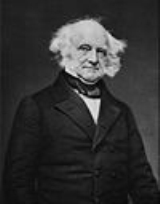
Martin Van Buren was the
eighth President of the United StatesThe President of the United States of America is the head of state and head of government of the United States. The president leads the executive branch of the federal government and is the commander-in-chief of the United States Armed Forces....
(1837–1841). Before his presidency, he was the
eighth Vice PresidentThe Vice President of the United States is the holder of a public office created by the United States Constitution. The Vice President, together with the President of the United States, is indirectly elected by the people, through the Electoral College, to a four-year term...
(1833–1837) and the tenth
Secretary of StateThe United States Secretary of State is the head of the United States Department of State, concerned with foreign affairs. The Secretary is a member of the Cabinet and the highest-ranking cabinet secretary both in line of succession and order of precedence...
, under
Andrew JacksonAndrew Jackson was the seventh President of the United States . Based in frontier Tennessee, Jackson was a politician and army general who defeated the Creek Indians at the Battle of Horseshoe Bend , and the British at the Battle of New Orleans...
(1829–1831).
He was a key organizer of the Democratic Party, a dominant figure in the
Second Party SystemThe Second Party System is a term of periodization used by historians and political scientists to name the political party system existing in the United States from about 1828 to 1854...
, and the first president not of British or Irish descent—his family was Dutch. He was the first president to be
born an American citizenStatus as a natural-born citizen of the United States is one of the eligibility requirements established in the United States Constitution for election to the office of President or Vice President...
, his predecessors having been born British subjects before the
American RevolutionThe American Revolution was the political upheaval during the last half of the 18th century in which thirteen colonies in North America joined together to break free from the British Empire, combining to become the United States of America...
. He is also the only president not to have spoken English as his first language, having grown up speaking
DutchDutch is a West Germanic language and the native language of the majority of the population of the Netherlands, Belgium, and Suriname, the three member states of the Dutch Language Union. Most speakers live in the European Union, where it is a first language for about 23 million and a second...
, and the first president from
New YorkNew York is a state in the Northeastern region of the United States. It is the nation's third most populous state. New York is bordered by New Jersey and Pennsylvania to the south, and by Connecticut, Massachusetts and Vermont to the east...
.
As
Andrew JacksonAndrew Jackson was the seventh President of the United States . Based in frontier Tennessee, Jackson was a politician and army general who defeated the Creek Indians at the Battle of Horseshoe Bend , and the British at the Battle of New Orleans...
's Secretary of State and then Vice President, he was a key figure in building the organizational structure for
Jacksonian democracyJacksonian democracy is the political movement toward greater democracy for the common man typified by American politician Andrew Jackson and his supporters. Jackson's policies followed the era of Jeffersonian democracy which dominated the previous political era. The Democratic-Republican Party of...
, particularly in New York State. As president, he did not want the United States to annex
TexasTexas is the second largest U.S. state by both area and population, and the largest state by area in the contiguous United States.The name, based on the Caddo word "Tejas" meaning "friends" or "allies", was applied by the Spanish to the Caddo themselves and to the region of their settlement in...
, an act which
John TylerJohn Tyler was the tenth President of the United States . A native of Virginia, Tyler served as a state legislator, governor, U.S. representative, and U.S. senator before being elected Vice President . He was the first to succeed to the office of President following the death of a predecessor...
would achieve eight years after Van Buren's initial rejection. Between the bloodless
Aroostook WarThe Aroostook War was an undeclared nonviolent confrontation in 1838/1839 between the United States and Great Britain over the international boundary between British North America and Maine. The compromise resolution win a mutually accepted border between the state of Maine and the provinces of...
and the
Caroline AffairThe Caroline affair was a series of events beginning in 1837 that strained relations between the United States and Britain....
, relations with Britain and its colonies in
CanadaCanada is a North American country consisting of ten provinces and three territories. Located in the northern part of the continent, it extends from the Atlantic Ocean in the east to the Pacific Ocean in the west, and northward into the Arctic Ocean...
also proved to be strained.
His administration was largely characterized by the economic hardship of his time, the
Panic of 1837The Panic of 1837 was a financial crisis or market correction in the United States built on a speculative fever. The end of the Second Bank of the United States had produced a period of runaway inflation, but on May 10, 1837 in New York City, every bank began to accept payment only in specie ,...
. He was scapegoated for the depression and called "Martin Van Ruin" by his political opponents. Van Buren was voted out of office after four years, losing to
WhigThe Whig Party was a political party of the United States during the era of Jacksonian democracy. Considered integral to the Second Party System and operating from the early 1830s to the mid-1850s, the party was formed in opposition to the policies of President Andrew Jackson and his Democratic...
candidate
William Henry HarrisonWilliam Henry Harrison was the ninth President of the United States , an American military officer and politician, and the first president to die in office. He was 68 years, 23 days old when elected, the oldest president elected until Ronald Reagan in 1980, and last President to be born before the...
.
In 1848 he ran unsuccessfully for president on a third-party ticket, the
Free Soil PartyThe Free Soil Party was a short-lived political party in the United States active in the 1848 and 1852 presidential elections, and in some state elections. It was a third party and a single-issue party that largely appealed to and drew its greatest strength from New York State. The party leadership...
.
Early life
Martin Van Buren was born in the village of
KinderhookKinderhook is a village located in the Town of Kinderhook in Columbia County, New York, United States. The population was 1,211 at the 2010 census.The Village of Kinderhook is located in the south-central part of the town on US 9....
,
New YorkNew York is a state in the Northeastern region of the United States. It is the nation's third most populous state. New York is bordered by New Jersey and Pennsylvania to the south, and by Connecticut, Massachusetts and Vermont to the east...
, on December 5, 1782, approximately 25 miles south of
AlbanyAlbany is the capital city of the U.S. state of New York, the seat of Albany County, and the central city of New York's Capital District. Roughly north of New York City, Albany sits on the west bank of the Hudson River, about south of its confluence with the Mohawk River...
. His father, Abraham Van Buren (1737–1817) was a farmer, the owner of six slaves,and a tavern-keeper in Kinderhook. Abraham Van Buren supported the American Revolution and later the Jeffersonian Republicans. He died while Martin Van Buren was a New York state senator. Martin Van Buren's mother was Maria Van Alen (née Hoes) Van Buren (1747–1818).
Van Buren was the first president born a citizen of the United States, as all previous presidents were born before the American Revolution. His great-great-great-grandfather Cornelis Maessen Van Buren had come to the New World in 1631 from the small city of
BurenBuren is a municipality and a city in the eastern Netherlands. It is also a county; with the Dutch Monarch still holding the title "Count of Buren".- Population centres :...
,
GelderlandGelderland is the largest province of the Netherlands, located in the central eastern part of the country. The capital city is Arnhem. The two other major cities, Nijmegen and Apeldoorn have more inhabitants. Other major regional centers in Gelderland are Ede, Doetinchem, Zutphen, Tiel, Wijchen,...
,
Dutch RepublicThe Dutch Republic — officially known as the Republic of the Seven United Netherlands , the Republic of the United Netherlands, or the Republic of the Seven United Provinces — was a republic in Europe existing from 1581 to 1795, preceding the Batavian Republic and ultimately...
, present day
NetherlandsThe Netherlands is a constituent country of the Kingdom of the Netherlands, located mainly in North-West Europe and with several islands in the Caribbean. Mainland Netherlands borders the North Sea to the north and west, Belgium to the south, and Germany to the east, and shares maritime borders...
. Van Buren was also the only President who spoke
EnglishEnglish is a West Germanic language that arose in the Anglo-Saxon kingdoms of England and spread into what was to become south-east Scotland under the influence of the Anglian medieval kingdom of Northumbria...
as a second language.
Van Buren received a basic education at a dreary, poorly lit schoolhouse in his native village and later studied Latin briefly at the Kinderhook Academy and Washington Seminary in Claverack. He excelled in composition and speaking. His formal education ended before he reached 14, when he began studying law at the office of Francis Sylvester, a prominent Federalist attorney in Kinderhook. After six years under Sylvester, he spent a final year of apprenticeship in the New York City office of William P. Van Ness, a political lieutenant of
Aaron BurrAaron Burr, Jr. was an important political figure in the early history of the United States of America. After serving as a Continental Army officer in the Revolutionary War, Burr became a successful lawyer and politician...
. Van Buren was admitted to the bar in 1803.
Van Buren married
Hannah HoesHannah Hoes Van Buren was the wife of the eighth United States President, Martin Van Buren.Martin, aged 24, and Hannah, aged 23, married on February 21, 1807 at the home of the bride's sister in Catskill, New York. They had been childhood sweethearts and were first cousins once removed through...
, his childhood sweetheart and distant relative on February 21, 1807, in Catskill, New York. Like Van Buren, she was raised in a Dutch home and never lost her distinct Dutch accent. The couple had five sons and one daughter:
AbrahamAbraham Van Buren was the eldest son of the eighth President of the United States, Martin Van Buren and his wife, Hannah Hoes Van Buren. Born in Kinderhook, New York, Abraham was named in honor of his paternal grandfather who was an officer in the Continental Army during the Revolutionary War...
(1807–1873) a graduate of West Point and career military officer;
JohnJohn Van Buren was an American lawyer and politician.-Life:He was the second son of President Martin Van Buren and graduated from Yale College in 1828. In 1831, when his father was appointed U.S. Minister to Britain, he accompanied him as secretary of the American Legation in London...
(1810–1866), graduate of Yale and Attorney General of New York; Martin, Jr. (1812–1855), secretary to his father and editor of his father's papers until a premature death from tuberculosis; Winfield Scott (born and died in 1814); and Smith Thompson (1817–1876), an editor and special assistant to his father while president. Their daughter was stillborn. After 12 years of marriage, Hannah Van Buren contracted tuberculosis and died on February 5, 1819, at the age of 35. Martin Van Buren never remarried.
Early political career
Van Buren had been active in politics from at least the age of 17 when he attended a party convention in
Troy, New YorkTroy is a city in the US State of New York and the seat of Rensselaer County. Troy is located on the western edge of Rensselaer County and on the eastern bank of the Hudson River. Troy has close ties to the nearby cities of Albany and Schenectady, forming a region popularly called the Capital...
where he worked to secure the Congressional nomination for John Van Ness. However, once established in his practice, he became wealthy enough to increase his focus on politics. He was an early supporter of
Aaron BurrAaron Burr, Jr. was an important political figure in the early history of the United States of America. After serving as a Continental Army officer in the Revolutionary War, Burr became a successful lawyer and politician...
. He allied himself with the Clintonian faction of the Democratic-Republican Party, and was surrogate of
Columbia CountyColumbia County is a county located in the U.S. state of New York. As of the 2010 census, the population was 63,096. The county seat is Hudson. The name comes from the Latin feminine form of the name of Christopher Columbus, which was at the time of the formation of the county a popular proposal...
from 1808 until 1813, when he was removed.
Van Buren joined the opposition party in 1813, and was a member of the
New York State SenateThe New York State Senate is one of two houses in the New York State Legislature and has members each elected to two-year terms. There are no limits on the number of terms one may serve...
from 1812 to 1820, and New York Attorney General from 1815 to 1819. He was a presidential elector in
1820The United States presidential election of 1820 was the third and last presidential election in United States history in which a candidate ran effectively unopposed. In 1820, President James Monroe and Vice President Daniel D...
, voting for
James MonroeJames Monroe was the fifth President of the United States . Monroe was the last president who was a Founding Father of the United States, and the last president from the Virginia dynasty and the Republican Generation...
and
Daniel D. TompkinsDaniel D. Tompkins was an entrepreneur, jurist, Congressman, the fourth Governor of New York , and the sixth Vice President of the United States .-Name:...
.
At first he opposed Clinton's plan for the
Erie CanalThe Erie Canal is a waterway in New York that runs about from Albany, New York, on the Hudson River to Buffalo, New York, at Lake Erie, completing a navigable water route from the Atlantic Ocean to the Great Lakes. The canal contains 36 locks and encompasses a total elevation differential of...
, but later supported it when the Bucktails were able to gain a majority in the
Erie Canal CommissionThe New York State Legislature appointed in 1810 a Commission to Explore a Route for a Canal to Lake Erie, and Report which became known as the Erie Canal Commission...
, and supported a bill that raised money for the canal through state bonds.
In 1817 Van Buren's connection with so-called "machine politics" started. He created the first political machine encompassing all of New York, the
BucktailsThe Bucktails may refer to one of two organizations that were particularly characterized and identified by the wearing of a bucktail in their headgear....
, whose leaders later became known as the
Albany RegencyThe Albany Regency was a group of politicians who controlled the New York state government between 1822 and 1838. The group was among the first American political machines...
. The Bucktails became a successful movement that emphasized party loyalty; they captured and controlled many patronage posts throughout New York. Van Buren did not originate the system, but gained the nickname of "Little Magician" for the skill with which he exploited it. He also served as a member of the state
constitutional conventionA constitutional convention is now a gathering for the purpose of writing a new constitution or revising an existing constitution. A general constitutional convention is called to create the first constitution of a political unit or to entirely replace an existing constitution...
, where he opposed the grant of universal suffrage and tried to maintain property requirements for voting.
He was the leading figure in the
Albany RegencyThe Albany Regency was a group of politicians who controlled the New York state government between 1822 and 1838. The group was among the first American political machines...
, a group of politicians who for more than a generation dominated much of the politics of New York and powerfully influenced the politics of the nation. The group, together with the political clubs such as
Tammany HallTammany Hall, also known as the Society of St. Tammany, the Sons of St. Tammany, or the Columbian Order, was a New York political organization founded in 1786 and incorporated on May 12, 1789 as the Tammany Society...
that were developing at the same time, played a major role in the development of the "
spoils systemIn the politics of the United States, a spoil system is a practice where a political party, after winning an election, gives government jobs to its voters as a reward for working toward victory, and as an incentive to keep working for the party—as opposed to a system of awarding offices on the...
", a recognized procedure in national, state and local affairs. He was the prime architect of the first nationwide political party: the Jacksonian Democrats. In Van Buren's own words, "Without strong national political organizations, there would be nothing to moderate the prejudices between free and slaveholding states." ("Martin Van Buren" 103–114)
U.S. Senate and national politics
In
February 1821The 1821 United States Senate election in New York was held on February 6, 1821, by the New York State Legislature to elect a U.S. Senator to represent the State of New York in the United States Senate.-Background:...
, Martin Van Buren was elected a U.S. Senator from New York, defeating the incumbent
Nathan SanfordNathan Sanford was an American politician.- Life :He was the son of Thomas Sanford and Phebe Sanford, née Baker...
who ran as the
ClintonianDeWitt Clinton was an early American politician and naturalist who served as United States Senator and the sixth Governor of New York. In this last capacity he was largely responsible for the construction of the Erie Canal...
candidate. Van Buren at first favored
internal improvementsInternal improvements is the term used historically in the United States for public works from the end of the American Revolution through much of the 19th century, mainly for the creation of a transportation infrastructure: roads, turnpikes, canals, harbors and navigation improvements...
, such as road repairs and canal creation, therefore proposing a constitutional amendment in 1824 to authorize such undertakings. The next year, however, he took ground against them. He voted for the
tariffTariffs in United States history have played different roles in trade policy, political debates and the nation's economic history. Tariffs were the largest source of federal revenue from the 1790s to the eve of World War I, until it was surpassed by income taxes. Tariffs are taxes on imports and...
of 1824 then gradually abandoned the protectionist position, coming out for "tariffs for revenue only."
In the presidential election of 1824, Van Buren supported
William H. CrawfordWilliam Harris Crawford was an American politician and judge during the early 19th century. He served as United States Secretary of War from 1815 to 1816 and United States Secretary of the Treasury from 1816 to 1825, and was a candidate for President of the United States in 1824.-Political...
and received the electoral vote of
GeorgiaGeorgia is a state located in the southeastern United States. It was established in 1732, the last of the original Thirteen Colonies. The state is named after King George II of Great Britain. Georgia was the fourth state to ratify the United States Constitution, on January 2, 1788...
for vice-president, but he shrewdly kept out of the acrimonious controversy which followed the choice of
John Quincy AdamsJohn Quincy Adams was the sixth President of the United States . He served as an American diplomat, Senator, and Congressional representative. He was a member of the Federalist, Democratic-Republican, National Republican, and later Anti-Masonic and Whig parties. Adams was the son of former...
as President. Van Buren had originally hoped to block Adams' victory by denying him the state of New York (the state was divided between Van Buren supporters who would vote for
William H. CrawfordWilliam Harris Crawford was an American politician and judge during the early 19th century. He served as United States Secretary of War from 1815 to 1816 and United States Secretary of the Treasury from 1816 to 1825, and was a candidate for President of the United States in 1824.-Political...
and Adams men). However, Representative
Stephen Van RensselaerStephen Van Rensselaer III was Lieutenant Governor of New York as well as a statesman, soldier, and land-owner, the heir to one of the largest estates in the New York region at the time, which made him the tenth richest American of all time, based on the ratio of his fortune to contemporary GDP...
swung New York to Adams and thereby the 1824 Presidency. He recognized early the potential of
Andrew JacksonAndrew Jackson was the seventh President of the United States . Based in frontier Tennessee, Jackson was a politician and army general who defeated the Creek Indians at the Battle of Horseshoe Bend , and the British at the Battle of New Orleans...
as a presidential candidate.
After the election, Van Buren sought to bring the Crawford and Jackson followers together and strengthened his control as a leader in the Senate. Always notably courteous in his treatment of opponents, he showed no bitterness toward either
John Quincy AdamsJohn Quincy Adams was the sixth President of the United States . He served as an American diplomat, Senator, and Congressional representative. He was a member of the Federalist, Democratic-Republican, National Republican, and later Anti-Masonic and Whig parties. Adams was the son of former...
or
Henry ClayHenry Clay, Sr. , was a lawyer, politician and skilled orator who represented Kentucky separately in both the Senate and in the House of Representatives...
, and he voted for Clay's confirmation as
Secretary of StateThe United States Secretary of State is the head of the United States Department of State, concerned with foreign affairs. The Secretary is a member of the Cabinet and the highest-ranking cabinet secretary both in line of succession and order of precedence...
, notwithstanding Jackson's "
corrupt bargainThe term Corrupt Bargain refers to three separate events that each involved a United States presidential election and a deal that was struck that many viewed to be corrupt from many standpoints, such as in the Election of 1824 controversy over the House of Representative's choice for president with...
" charge. At the same time, he opposed the Adams-Clay plans for internal improvements and declined to support the proposal for a Panama Congress. As chair of the Judiciary Committee, he brought forward a number of measures for the improvement of judicial procedure and, in May 1826, joined with Senator
Thomas Hart BentonThomas Hart Benton , nicknamed "Old Bullion", was a U.S. Senator from Missouri and a staunch advocate of westward expansion of the United States. He served in the Senate from 1821 to 1851, becoming the first member of that body to serve five terms...
in reporting on executive patronage. In the debate on the "
tariff of abominationsThe Tariff of 1828 was a protective tariff passed by the Congress of the United States on May 19, 1828, designed to protect industry in the northern United States...
" in 1828, he took no part but voted for the measure in obedience to instructions from the New York legislature, an action which was cited against him as late as during the presidential campaign of 1844.
Van Buren was not an orator, but his more important speeches show careful preparation and his opinions carried weight; the oft-repeated charge that he refrained from declaring himself on crucial questions is hardly borne out by an examination of his senatorial career. In
February 1827The 1827 United States Senate election in New York was held on February 6, 1827, by the New York State Legislature to elect a U.S. Senator to represent the State of New York in the United States Senate.-Background:...
, he was reelected to the Senate by a large majority. He became one of the recognized managers of the Jackson campaign, and his tour of
VirginiaThe Commonwealth of Virginia , is a U.S. state on the Atlantic Coast of the Southern United States. Virginia is nicknamed the "Old Dominion" and sometimes the "Mother of Presidents" after the eight U.S. presidents born there...
, the Carolinas, and
GeorgiaGeorgia is a state located in the southeastern United States. It was established in 1732, the last of the original Thirteen Colonies. The state is named after King George II of Great Britain. Georgia was the fourth state to ratify the United States Constitution, on January 2, 1788...
in the spring of 1827 won support for Jackson from Crawford. Martin Van Buren sought to reorganize and unify "the old Republican party" behind Jackson. Van Buren helped create a popular style of politicking that is often seen today. At the state level, Jackson's committee chairs would split up the responsibilities around the state and organize volunteers at the local level. "Hurra Boys" would plant hickory trees (in honor of Jackson's nickname, "Old Hickory") or hand out hickory sticks at rallies. Van Buren even had a New York journalist write a campaign piece portraying Jackson as a humble, pious man. "Organization is the secret of victory," an editor in the Adams camp wrote. He once said to a group of lobbyists the famous quote and "By the want of it we have been overthrown." In 1828, Van Buren was elected
Governor of New YorkThe Governor of the State of New York is the chief executive of the State of New York. The governor is the head of the executive branch of New York's state government and the commander-in-chief of the state's military and naval forces. The officeholder is afforded the courtesy title of His/Her...
for the term beginning on January 1, 1829, and resigned his seat in the Senate.
Martin Van Buren's tenure as New York governor is the second shortest on record. While his term was short, he did manage to pass the Bank Safety Act (an early form of deposit insurance).
The Jackson Cabinet
On March 5, 1829, President Jackson appointed Van Buren
Secretary of StateThe United States Secretary of State is the head of the United States Department of State, concerned with foreign affairs. The Secretary is a member of the Cabinet and the highest-ranking cabinet secretary both in line of succession and order of precedence...
, an office which probably had been assured to him before the election, and he resigned the governorship. He was succeeded in the governorship by his Lieutenant Governor,
Enos T. ThroopEnos Thompson Throop was an American lawyer, politician and diplomat who was the tenth Governor of New York from 1829 to 1832.-Early life and career:...
, a member of the regency. As Secretary of State, Van Buren took care to keep on good terms with the
Kitchen CabinetThe Kitchen Cabinet was a term used by political opponents of President of the United States Andrew Jackson to describe the collection of unofficial advisers he consulted in parallel to the United States Cabinet following his purge of the cabinet at the end of the Eaton affair and his break with...
, the group of politicians who acted as Jackson's advisers, and did not oppose Jackson in the matter of removals from office but was not himself an active "spoilsman."
He won the lasting regard of Jackson by his courtesies to Peggy Eaton, wife of
Secretary of WarThe Secretary of War was a member of the United States President's Cabinet, beginning with George Washington's administration. A similar position, called either "Secretary at War" or "Secretary of War," was appointed to serve the Congress of the Confederation under the Articles of Confederation...
John H. Eaton, with whom the wives of the cabinet officers led by Vice President Calhoun's wife,
Floride CalhounFloride Bonneau Calhoun was the wife of prominent U.S. politician John C. Calhoun.-Background and early life:...
had refused to associate in the
Petticoat AffairThe Petticoat affair was an 1830–1831 U.S. scandal involving members of President Andrew Jackson's Cabinet and their wives. Although it started over a private matter, it affected the political careers of several men and resulted in the informal "Kitchen Cabinet"...
. Aside from the Petticoat Affair, he skillfully avoided entanglement in the Jackson-
CalhounJohn Caldwell Calhoun was a leading politician and political theorist from South Carolina during the first half of the 19th century. Calhoun eloquently spoke out on every issue of his day, but often changed positions. Calhoun began his political career as a nationalist, modernizer, and proponent...
imbroglio.
No diplomatic questions of the first magnitude arose during Van Buren's service as secretary, but the settlement of long-standing claims against France was prepared and trade with the
British West IndiesThe British West Indies was a term used to describe the islands in and around the Caribbean that were part of the British Empire The term was sometimes used to include British Honduras and British Guiana, even though these territories are not geographically part of the Caribbean...
colonies was opened. In the controversy with the
Bank of the United StatesThe Second Bank of the United States was chartered in 1816, five years after the First Bank of the United States lost its own charter. The Second Bank of the United States was initially headquartered in Carpenters' Hall, Philadelphia, the same as the First Bank, and had branches throughout the...
, he sided with Jackson. After the breach between Jackson and Calhoun, Van Buren was clearly the most prominent candidate for the vice-presidency.
Vice-Presidency
In December 1829, Jackson had already made known his wish that Van Buren receive the nomination. In April 1831, Van Buren resigned as Secretary of State as a result of the
Petticoat affairThe Petticoat affair was an 1830–1831 U.S. scandal involving members of President Andrew Jackson's Cabinet and their wives. Although it started over a private matter, it affected the political careers of several men and resulted in the informal "Kitchen Cabinet"...
—though he did not leave office until June. Van Buren still played a part in the
Kitchen CabinetThe Kitchen Cabinet was a term used by political opponents of President of the United States Andrew Jackson to describe the collection of unofficial advisers he consulted in parallel to the United States Cabinet following his purge of the cabinet at the end of the Eaton affair and his break with...
. In August 1831, he was appointed
Minister to the Court of St. James'sThe office of United States Ambassador to the United Kingdom was traditionally, and still is very much so today due to the Special Relationship, the most prestigious position in the United States Foreign Service...
(ambassador to Great Britain), and he arrived in London in September. He was cordially received, but in February, he learned that his nomination had been rejected by the Senate on January 25, 1832. The rejection, ostensibly attributed in large part to Van Buren's instructions to
Louis McLaneLouis McLane was an American lawyer and politician from Wilmington, in New Castle County, Delaware, and Baltimore, Maryland. He was a veteran of the War of 1812 and a member of the Federalist Party and later the Democratic Party. He served as the U.S. Representative from Delaware, U.S. Senator...
, the American minister to Britain, regarding the opening of the West Indies trade, in which reference had been made to the results of the election of 1828, was the work of
CalhounJohn Caldwell Calhoun was a leading politician and political theorist from South Carolina during the first half of the 19th century. Calhoun eloquently spoke out on every issue of his day, but often changed positions. Calhoun began his political career as a nationalist, modernizer, and proponent...
, the vice-president. When the vote was taken, enough of the majority refrained from voting to produce a tie and give Calhoun his longed-for "vengeance." No greater impetus than this could have been given to Van Buren's candidacy for the vice-presidency.
After a brief tour on through Europe, Van Buren reached New York on July 5, 1832. The
1832 Democratic National ConventionThe 1832 Democratic National Convention was held from 21–23 May, in Baltimore, Maryland. This was the first national convention of the Democratic Party of the United States; it followed presidential nominating conventions held by the Anti-Masonic Party and the National Republican Party...
, the party's first and held in May, had nominated him for vice-president on the Jackson ticket, despite the strong opposition to him which existed in many states. Van Buren's platform included supporting the expansion of the naval system. His declarations during the campaign were vague regarding the tariff and unfavorable to the United States Bank and to
nullificationNullification is a legal theory that a State has the right to nullify, or invalidate, any federal law which that state has deemed unconstitutional...
, but he had already somewhat placated the South by denying the right of Congress to abolish slavery in the
District of ColumbiaWashington, D.C., formally the District of Columbia and commonly referred to as Washington, "the District", or simply D.C., is the capital of the United States. On July 16, 1790, the United States Congress approved the creation of a permanent national capital as permitted by the U.S. Constitution....
without the consent of the slave states.
Election of 1836
It took Van Buren and his partisan friends a decade and a half to form the Democratic Party; many elements, such as the national convention, were borrowed from other parties.
In the election of 1832, the Jackson-Van Buren ticket won by a landslide (heavily due to the fact that Andrew Jackson was a popular war hero). When the election of 1836 came up, Jackson was determined to make Van Buren, his personal choice, President to continue his legacy. Martin Van Buren's only competitors in the 1836 election were the
WhigsThe Whig Party was a political party of the United States during the era of Jacksonian democracy. Considered integral to the Second Party System and operating from the early 1830s to the mid-1850s, the party was formed in opposition to the policies of President Andrew Jackson and his Democratic...
, who ran several regional candidates in hopes of sending the election to the House of Representatives, where each state delegation would have one vote.
William Henry HarrisonWilliam Henry Harrison was the ninth President of the United States , an American military officer and politician, and the first president to die in office. He was 68 years, 23 days old when elected, the oldest president elected until Ronald Reagan in 1980, and last President to be born before the...
hoped to receive the support of the Western voters,
Daniel WebsterDaniel Webster was a leading American statesman and senator from Massachusetts during the period leading up to the Civil War. He first rose to regional prominence through his defense of New England shipping interests...
had strength in New England, and
Hugh Lawson WhiteHugh Lawson White was a prominent American politician during the first third of the 19th century. He succeeded Andrew Jackson and served in the United States Senate, representing Tennessee, from 1825 until his resignation in 1840, and was a Whig candidate for President in 1836...
had support in the South. Van Buren was
unanimouslyUnanimity is agreement by all people in a given situation. When unanimous, everybody is of the same mind and acting together as one. Though unlike uniformity, it does not constitute absolute agreement. Many groups consider unanimous decisions a sign of agreement, solidarity, and unity...
nominated by the
1835 Democratic National ConventionThe 1835 Democratic National Convention was a presidential nominating convention that was held from May 20 to the 22nd, in Baltimore, Maryland. This was the second national convention of the Democratic Party of the United States...
at Baltimore. He expressed himself plainly on the questions of slavery and the bank at the same time voting, perhaps with a touch of bravado, for a bill offered in 1836 to subject
abolitionAbolitionism is a movement to end slavery.In western Europe and the Americas abolitionism was a movement to end the slave trade and set slaves free. At the behest of Dominican priest Bartolomé de las Casas who was shocked at the treatment of natives in the New World, Spain enacted the first...
literature in the mails to the laws of the several states. Van Buren's presidential victory represented a broader victory for Jackson and the party. Van Buren entered the White House as a fifty-four year old widower with four sons. A famous quotation of his is "As to my presidency the best two days of my life were those of my entrance upon the office and my surrender of it". Martin Van Buren was the first real American politician and was also the first to use grassroots campaigning in his presidential campaign. He wanted to make a political party that united the plain republicans of the north and the planters of the south.
Policies
Martin Van Buren announced his intention "to follow in the footsteps of his illustrious predecessor", and retained all but one of Jackson's cabinet. Van Buren had few economic tools to deal with the
Panic of 1837The Panic of 1837 was a financial crisis or market correction in the United States built on a speculative fever. The end of the Second Bank of the United States had produced a period of runaway inflation, but on May 10, 1837 in New York City, every bank began to accept payment only in specie ,...
. The Panic was followed by a five-year
depressionIn economics, a depression is a sustained, long-term downturn in economic activity in one or more economies. It is a more severe downturn than a recession, which is seen by some economists as part of the modern business cycle....
, with the failure of banks and then-record-high
unemploymentUnemployment , as defined by the International Labour Organization, occurs when people are without jobs and they have actively sought work within the past four weeks...
levels. It was one of the worst economic crises in the nation's history. As a result Van Buren became very unpopular.
Van Buren advocated lower tariffs and free trade, and by doing so maintained support of the South for the Democratic Party. He succeeded in setting up a system of bonds for the national debt. His party was so split that his 1837 proposal for an "Independent Treasury" system did not pass until 1840. It gave the Treasury control of all federal funds and had a legal tender clause that required (by 1843) all payments to be made in
specieSpecie may refer to:* Coins or other metal money in mass circulation* Bullion coins* Hard money * Commodity money* Specie Circular, 1836 executive order by US President Andrew Jackson regarding hard money* Specie Payment Resumption Act...
, but it further inflamed public opinion on both sides.
In a bold step, Van Buren reversed Andrew Jackson's policies and sought peace at home, as well as abroad. Instead of settling a financial dispute between American citizens and the Mexican government by force, Van Buren wanted to seek a diplomatic solution. In August 1837, Van Buren denied
TexasTexas is the second largest U.S. state by both area and population, and the largest state by area in the contiguous United States.The name, based on the Caddo word "Tejas" meaning "friends" or "allies", was applied by the Spanish to the Caddo themselves and to the region of their settlement in...
' formal request to join the United States, again prioritizing sectional harmony over territorial expansion.
In the case of the ship
AmistadLa Amistad was a ship notable as the scene of a revolt by African captives being transported from Havana to Puerto Principe, Cuba. It was a 19th-century two-masted schooner built in Spain and owned by a Spaniard living in Cuba...
, Van Buren sided with the
Spanish GovernmentSpain is a constitutional monarchy whose government is defined by the Constitution of Spain. This was approved by a general referendum of the people of Spain in 1978...
to return the kidnapped slaves. Also, he oversaw the "
Trail of TearsThe Trail of Tears is a name given to the forced relocation and movement of Native American nations from southeastern parts of the United States following the Indian Removal Act of 1830...
", which involved the expulsion of the
CherokeeThe Cherokee are a Native American people historically settled in the Southeastern United States . Linguistically, they are part of the Iroquoian language family...
,
ChoctawThe Choctaw are a Native American people originally from the Southeastern United States...
, Creek,
ChickasawThe Chickasaw are Native American people originally from the region that would become the Southeastern United States...
and
SeminoleThe Seminole are a Native American people originally of Florida, who now reside primarily in that state and Oklahoma. The Seminole nation emerged in a process of ethnogenesis out of groups of Native Americans, most significantly Creeks from what is now Georgia and Alabama, who settled in Florida in...
from
GeorgiaGeorgia is a state located in the southeastern United States. It was established in 1732, the last of the original Thirteen Colonies. The state is named after King George II of Great Britain. Georgia was the fourth state to ratify the United States Constitution, on January 2, 1788...
,
TennesseeTennessee is a U.S. state located in the Southeastern United States. It has a population of 6,346,105, making it the nation's 17th-largest state by population, and covers , making it the 36th-largest by total land area...
,
AlabamaAlabama is a state located in the southeastern region of the United States. It is bordered by Tennessee to the north, Georgia to the east, Florida and the Gulf of Mexico to the south, and Mississippi to the west. Alabama ranks 30th in total land area and ranks second in the size of its inland...
, and
South CarolinaSouth Carolina is a state in the Deep South of the United States that borders Georgia to the south, North Carolina to the north, and the Atlantic Ocean to the east. Originally part of the Province of Carolina, the Province of South Carolina was one of the 13 colonies that declared independence...
to the
Oklahoma territoryThe Territory of Oklahoma was an organized incorporated territory of the United States that existed from May 2, 1890, until November 16, 1907, when it was joined with the Indian Territory under a new constitution and admitted to the Union as the State of Oklahoma.-Organization:Oklahoma Territory's...
. To help secure
FloridaFlorida is a state in the southeastern United States, located on the nation's Atlantic and Gulf coasts. It is bordered to the west by the Gulf of Mexico, to the north by Alabama and Georgia and to the east by the Atlantic Ocean. With a population of 18,801,310 as measured by the 2010 census, it...
, Van Buren also pursued the
Second Seminole WarThe Second Seminole War, also known as the Florida War, was a conflict from 1835 to 1842 in Florida between various groups of Native Americans collectively known as Seminoles and the United States, part of a series of conflicts called the Seminole Wars...
, which had begun while Jackson was in office. The war, which would prove the costliest of the
Indian WarsAmerican Indian Wars is the name used in the United States to describe a series of conflicts between American settlers or the federal government and the native peoples of North America before and after the American Revolutionary War. The wars resulted from the arrival of European colonizers who...
, was highly unpopular in the free states, where it was seen as an attempt to expand slave territory. Fighting was not resolved until 1842, after Van Buren had left office.
In 1839, Joseph Smith, Jr., the founder of the
Latter Day Saint movementThe Latter Day Saint movement is a group of independent churches tracing their origin to a Christian primitivist movement founded by Joseph Smith, Jr. in the late 1820s. Collectively, these churches have over 14 million members...
visited Van Buren to plead for the U.S. to help roughly 20,000 Mormon settlers of
Independence, MissouriIndependence is the fourth largest city in the U.S. state of Missouri, and is contained within the counties of Jackson and Clay. It is part of the Kansas City Metropolitan Area...
, who were forced from the state during the 1838 Mormon War there. The Governor of Missouri,
Lilburn BoggsLilburn Williams Boggs was the sixth Governor of Missouri from 1836 to 1840. He is now most widely remembered for his interactions with Joseph Smith and Porter Rockwell, and Missouri Executive Order 44, known by Mormons as the "Extermination Order", issued in response to the ongoing conflict...
, had issued an executive order on October 27, 1838, known as the "Extermination Order". It authorized troops to use force against Mormons to "exterminate or drive [them] from the state." In 1839, after moving to Illinois, Smith and his party appealed to members of Congress and to President Van Buren to intercede for the Mormons. According to Smith's grandnephew, Van Buren said to Smith, "Your cause is just, but I can do nothing for you; if I take up for you I shall lose the vote of Missouri."
Van Buren took the blame for hard times, as Whigs ridiculed him as
Martin Van Ruin. Van Buren's rather elegant personal style was also an easy target for Whig attacks, such as the
Gold Spoon OrationThe Gold Spoon Oration, also called "The Regal Splendor of the President’s Palace," was a political speech given in the US House of Representatives by Charles Ogle on April 14–16, 1840...
. State elections of 1837 and 1838 were disastrous for the Democrats, and the partial economic recovery in 1838 was offset by a second commercial crisis in that year. Nevertheless, Van Buren controlled his party and was unanimously renominated by the Democrats in 1840. The revolt against Democratic rule led to the election of
William Henry HarrisonWilliam Henry Harrison was the ninth President of the United States , an American military officer and politician, and the first president to die in office. He was 68 years, 23 days old when elected, the oldest president elected until Ronald Reagan in 1980, and last President to be born before the...
, the Whig candidate. He quoted,"As to the presidency, the two happiest days of my life were those of my entrance upon the office and my surrender of it."
Administration and Cabinet
Supreme Court
Van Buren appointed two Justices to the
Supreme Court of the United StatesThe Supreme Court of the United States is the highest court in the United States. It has ultimate appellate jurisdiction over all state and federal courts, and original jurisdiction over a small range of cases...
:
- John McKinley
John McKinley was a U.S. Senator from the state of Alabama and an associate justice of the United States Supreme Court.Born in Culpeper County, Virginia, his family moved to Kentucky when he was an infant...
– 1838
- Peter Vivian Daniel
Peter Vivian Daniel was an American jurist who served as an Associate Justice on the Supreme Court of the United States.-Early life, education, and career:...
– 1841
Van Buren appointed eight other federal judges, all to
United States district courtThe United States district courts are the general trial courts of the United States federal court system. Both civil and criminal cases are filed in the district court, which is a court of law, equity, and admiralty. There is a United States bankruptcy court associated with each United States...
s.
Slavery
Though he did vote against the admission of Missouri as a slave state, and though he would be the nominated presidential candidate of the
Free Soil PartyThe Free Soil Party was a short-lived political party in the United States active in the 1848 and 1852 presidential elections, and in some state elections. It was a third party and a single-issue party that largely appealed to and drew its greatest strength from New York State. The party leadership...
, an anti-slavery political party, in
1848The United States presidential election of 1848 was an open race. President James K. Polk, having achieved all of his major objectives in one term and suffering from declining health that would take his life less than four months after leaving office, kept his promise not to seek re-election.The...
, there was no ambiguity in his position on the abolition of slavery during his term of office. Van Buren considered slavery morally wrong but sanctioned by the Constitution. When it came to the issue of slavery in DC and slavery in the United States, he was against its abolition, and said so in his Inaugural Address in 1837: "I believed it a solemn duty fully to make known my sentiments in regard to it
[slavery], and now, when every motive for misrepresentation has passed away, I trust that they will be candidly weighed and understood.
"I must go into the Presidential chair the inflexible and uncompromising opponent of every attempt on the part of Congress to abolish slavery in the District of Columbia against the wishes of the slaveholding States, and also with a determination equally decided to resist the slightest interference with it in the States where it exists." Slavery would be abolished in the District of Columbia on April 18, 1862.
Later life
On the expiration of his term, Van Buren returned to his estate, Lindenwald in Kinderhook, where he planned out his return to the White House. He seemed to have the advantage for the nomination in 1844; his famous letter of April 27, 1844, in which he frankly opposed the immediate annexation of
TexasTexas is the second largest U.S. state by both area and population, and the largest state by area in the contiguous United States.The name, based on the Caddo word "Tejas" meaning "friends" or "allies", was applied by the Spanish to the Caddo themselves and to the region of their settlement in...
, though doubtlessly contributing greatly to his defeat, was not made public until he felt practically sure of the nomination. In the Democratic convention, though he had a majority of the votes, he did not have the two-thirds which the convention required, and after eight ballots his name was withdrawn.
James K. PolkJames Knox Polk was the 11th President of the United States . Polk was born in Mecklenburg County, North Carolina. He later lived in and represented Tennessee. A Democrat, Polk served as the 17th Speaker of the House of Representatives and the 12th Governor of Tennessee...
received the nomination instead.
In 1848, he was nominated by two minor parties, first by the "Barnburner" faction of the Democrats, then by the
Free SoilersThe Free Soil Party was a short-lived political party in the United States active in the 1848 and 1852 presidential elections, and in some state elections. It was a third party and a single-issue party that largely appealed to and drew its greatest strength from New York State. The party leadership...
, with whom the "Barnburners" coalesced. He won no electoral votes, but took enough votes in New York to give the state—and perhaps the election—to
Zachary TaylorZachary Taylor was the 12th President of the United States and an American military leader. Initially uninterested in politics, Taylor nonetheless ran as a Whig in the 1848 presidential election, defeating Lewis Cass...
. In the election of 1860, he voted for the
fusionElectoral fusion is an arrangement where two or more political parties on a ballot list the same candidate, pooling the votes for that candidate...
ticket in New York which was opposed to
Abraham LincolnAbraham Lincoln was the 16th President of the United States, serving from March 1861 until his assassination in April 1865. He successfully led his country through a great constitutional, military and moral crisis – the American Civil War – preserving the Union, while ending slavery, and...
, but he could not approve of
President Buchanan'sJames Buchanan, Jr. was the 15th President of the United States . He is the only president from Pennsylvania, the only president who remained a lifelong bachelor and the last to be born in the 18th century....
course in dealing with secession and eventually supported Lincoln.
Martin Van Buren then retired to his home in Kinderhook. After being bedridden with a case of pneumonia during the fall of 1861, Martin Van Buren died of bronchial
asthmaAsthma is the common chronic inflammatory disease of the airways characterized by variable and recurring symptoms, reversible airflow obstruction, and bronchospasm. Symptoms include wheezing, coughing, chest tightness, and shortness of breath...
and heart failure at his Lindenwald estate in Kinderhook at 2:00 a.m. on July 24, 1862. He was 79 years old. He is buried in the
Kinderhook CemeteryThe Kinderhook Cemetery is in Kinderhook, New York. It is notable for being the burial site of Martin Van Buren, the eighth President of the United States, as well as his wife Hannah Van Buren, his son Martin Van Buren, Jr., and his parents, Abraham Van Buren and Mary Van Buren.-External Links:...
along with his wife Hannah, his parents, and his son Martin Van Buren, Jr. A cenotaph to him is located near the parking lot of the
Kinderhook Reformed Dutch ChurchThe Kinderhook Reformed Dutch Church located in Kinderhook, New York, was the sixth Church between Albany, New York and New York City. It was organized in 1712. It contains a cenotaph to Martin Van Buren....
. Van Buren outlived his four immediate successors as President (
William Henry HarrisonWilliam Henry Harrison was the ninth President of the United States , an American military officer and politician, and the first president to die in office. He was 68 years, 23 days old when elected, the oldest president elected until Ronald Reagan in 1980, and last President to be born before the...
,
John TylerJohn Tyler was the tenth President of the United States . A native of Virginia, Tyler served as a state legislator, governor, U.S. representative, and U.S. senator before being elected Vice President . He was the first to succeed to the office of President following the death of a predecessor...
,
James K. PolkJames Knox Polk was the 11th President of the United States . Polk was born in Mecklenburg County, North Carolina. He later lived in and represented Tennessee. A Democrat, Polk served as the 17th Speaker of the House of Representatives and the 12th Governor of Tennessee...
and
Zachary TaylorZachary Taylor was the 12th President of the United States and an American military leader. Initially uninterested in politics, Taylor nonetheless ran as a Whig in the 1848 presidential election, defeating Lewis Cass...
).
See also
- American election campaigns in the 19th century
In the 19th century, a number of new methods for conducting American Election Campaigns developed in the United States. For the most part the techniques were original, not copied from Europe or anywhere else...
- Divorce bill
- Charlotte Dupuy
Charlotte Dupuy, also called Lottie Charlotte Dupuy was still living in 1860. She and her husband Aaron were listed by name as free persons in the 1860 Census for Fayette County, Kentucky. They were respectively 70 and 76 years old...
, slave who worked for Van Buren at Decatur HouseDecatur House is a historic home in Washington, D.C., named after its first owner and occupant Stephen Decatur. The house is located northwest of Lafayette Square, at the southwest corner of Jackson Place and H Street, near the White House...
, while her suit for freedom against Henry ClayHenry Clay, Sr. , was a lawyer, politician and skilled orator who represented Kentucky separately in both the Senate and in the House of Representatives...
proceeded
- List of Presidents of the United States
- U.S. Presidents on U.S. postage stamps
For more than 160 years the one subject that has appeared most frequently on the face of U.S. Postage stamps is that of American Presidents. When the U.S. Post Office released its first two postage stamps in 1847, George Washington, along with Benjamin Franklin, were the two subjects depicted on...
External links
- Martin Van Buren: A Resource Guide at the Library of Congress
The Library of Congress is the research library of the United States Congress, de facto national library of the United States, and the oldest federal cultural institution in the United States. Located in three buildings in Washington, D.C., it is the largest library in the world by shelf space and...
- Martin Van Buren at the White House
The White House is the official residence and principal workplace of the president of the United States. Located at 1600 Pennsylvania Avenue NW in Washington, D.C., the house was designed by Irish-born James Hoban, and built between 1792 and 1800 of white-painted Aquia sandstone in the Neoclassical...
- American President: Martin Van Buren (1782–1862) at the Miller Center of Public Affairs
The Miller Center of Public Affairs is a non-partisan research institute that is part of the University of Virginia.Founded in 1975, the Miller Center is a leading public policy institution that serves as a national meeting place where engaged citizens, scholars, students, media representatives and...
, University of Virginia
- Martin Van Buren National Historic Site (Lindenwald), National Park Service
The National Park Service is the U.S. federal agency that manages all national parks, many national monuments, and other conservation and historical properties with various title designations...
- Martin Van Buren at American Presidents: Life Portraits, C-SPAN
C-SPAN , an acronym for Cable-Satellite Public Affairs Network, is an American cable television network that offers coverage of federal government proceedings and other public affairs programming via its three television channels , one radio station and a group of websites that provide streaming...
| Offices and distinctions |
|
>
>
>
>
>
>
>
>
>
>
>