
Encyclopedia
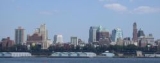
Brooklyn is one of the
five boroughs of
New York City. An independent city until its consolidation with New York in 1898, Brooklyn is New York's most populous borough, with nearly 2.5 million residents.
The borough of Brooklyn is coterminous with
Kings County, which is also the most populous
county in
New York State. As an independent city Brooklyn would rank as the fourth most populous in the United States. It was named in honor of
King Charles II of England, which is the source of Brooklyn's nickname as the "City of Kings."
In spite of its consolidation with New York, Brooklyn maintains a strongly distinct character of its own. Variously called the "City of Trees," "City of Homes," or the "City of Churches" in the
19th century, Brooklyn is now often styled the "Borough of Homes and Churches" or even sometimes called "The Planet," popularized by
Guru from the rap duo
Gangstarr, for its diversity, large population, and size.
As a promotional gesture by the current borough administration, distinctive traffic signs are posted along major traffic arteries at Brooklyn’s border crossings. They incorporate colorful expressions associated with Brooklyn, including: "Fugheddaboudit," "Oy Vey!," and "How Sweet It Is." One sign identifies the borough as: "Home to Everyone From Everywhere!"
History
The Dutch were the first Europeans to settle the area in the 1620s on the western edge of
Long Island, which was then largely inhabited by the Canarsie
Native American tribe. The Village of Breuckelen, which preceded the City of Nieuw Amsterdam by some 7 years, was authorized by the Dutch West India Company in 1646 and became the first municipality in what is now New York State. At the time Breuckelen was part of
New Netherland.
The Dutch lost Breuckelen in the British conquest of New Netherland in 1664. In 1683, the British reorganized the Province of New York into 12 counties, each of which was sub-divided into towns. Kings County was one of the original 12 counties, and Brooklyn, the Anglicized name of Breuckelen, was one of the original six towns within Kings County.
In August and September 1776 Brooklyn was the staging ground for the
Battle of Brooklyn , the first major battle in the
American Revolutionary War following the Declaration of Independence, and the largest battle of the entire conflict. New York, and Brooklyn along with it, gained independence from the British with the Treaty of Paris in 1783.
The first half of the
19th century saw urban areas grow along the economically strategic East River waterfront, across from New York City. Each of the two cities and six towns in Kings County remained independent municipalities, however, and purposely created non-aligning street grids with different naming systems. The two cities were the City of Brooklyn and the City of Williamsburgh. Brooklyn annexed Williamsburgh in 1854, which lost its final "h." It took until 1896 for Brooklyn to annex all other parts of Kings County.
Taking a 30-year break from municipal expansionism, the well-situated coastal city of Brooklyn established itself as the third-most-populous American city for much of the 19th century. As
'Twin City' to New York, it played a role in national affairs that is only now shadowed by its modern submergence into its old rival.
The building of
rail links such as the
Brighton Beach Line in 1878 heralded explosive growth, and in the space of a decade the City of Brooklyn annexed the Town of New Lots in 1886, the Town of Flatbush, the Town of Gravesend, and the Town of New Utrecht in 1894, and the Town of Flatlands in 1896.
Brooklyn had reached its natural municipal boundaries at the ends of Kings County. The question was now whether it was prepared to engage in the still-grander process of consolidation now developing throughout the region.
In 1898, Brooklyn residents voted by a slight majority to join with
Manhattan,
The Bronx,
Queens and
Richmond as the five
boroughs to form modern New York City. Kings County retained its status as one of New York State's counties.
Geography
Brooklyn is located on the westernmost point of Long Island and shares its only land boundary with
Queens to the northeast. The westernmost section of this boundary is defined by
Newtown Creek, which flows into the East River.
Brooklyn's waterfront faces different bodies of water. Northern Brookyn's coast is defined by the East River, while middle Brooklyn adjoins
Upper New York Bay. This area of the waterfront features the Red Hook peninsula and the Erie Basin.
Buttermilk Channel separates this part of the waterfront from Governors Island. Southwest is Gowanus Bay, connected to the
Gowanus Canal. At its south westernmost section, Brooklyn is separated from
Staten Island by the Narrows, where Upper and Lower New York Bay meet.
Brooklyn's southern coast includes the peninsula on which stretch
Coney Island,
Brighton Beach and Manhattan Beach. The southeastern coast lies on island-dotted
Jamaica Bay.
The highest point in Brooklyn is the area around Prospect Park and
Green-Wood Cemetery, rising approximately 200 feet above sea level. There is also a minor elevation in
Downtown Brooklyn known as
Brooklyn Heights.
According to the
United States Census Bureau, the County has a total area of 251.0 km² . 182.9 km² of it is land and 68.1 km² of it is water. 27.13% of the total area is water.
Neighborhoods
Brooklyn, which developed from distinct towns and villages from its founding in the Dutch colonial era, has many well-defined neighborhoods. Many are architectually and ethnically distinct, after growing rapidly in the late 19th and early 20th century as upwardly-mobile immigrants moved out of tenement buildings in Manhattan neighborhoods like the Lower East Side.
Borough Park is largely Orthodox Jewish;
Bedford-Stuyvesant is one of New York City's most notable
African-American neighborhoods;
Bensonhurst historically is
Italian-American;
Fort Greene is home to many middle-class black professionals. Since 1990, Brooklyn has seen a rise in new immigration to neighborhoods like
Sunset Park, home to flourishing
Hispanic and Chinese American communities.
Downtown Brooklyn is the third-largest central business district in New York City, after
Midtown Manhattan and
Lower Manhattan. It has many commercial towers with lower rents than comparable office space in Manhattan, and is home to growing numbers of smaller firms, as well as residential buildings.
Most districts in Brooklyn are residential. The northwestern neighborhoods between
DUMBO, by the Brooklyn Bridge, to
Park Slope, adjacent to Prospect Park, are characterized by many gracious 19th century
brownstone houses. Neighborhoods to the south and especially to the east often have detached single- and multi-family homes with yards resembling older suburban neighborhoods in Queens.
Recently the city has completed an extensive rezoning of the Brooklyn waterfront. Neighborhoods along the East River north of Downtown Brooklyn, such as Williamsburg, are beginning to see high-rise development in abadonded industrial zones. In recent years a series of
artists' colonies have developed along the East River as artists have left their traditional, more expensive Manhattan neighborhoods. Gentrification has rapidly transformed much of Williamsburg, DUMBO, and
Red Hook. Redevelopment has moved eastward away from the waterfront along the
L 14th Street subway line, which has come to be known colloquially as the
Hipster Express.
Government
Since consolidation with New York City in 1898, Brooklyn has been governed by the New York City Charter that provides for a "strong" mayor-council system. The centralized New York City government is responsible for public education, correctional institutions, libraries, public safety, recreational facilities, sanitation, water supply, and welfare services in Brooklyn.
The office of Borough President was created in the consolidation of 1898 to balance centralization with local authority. Each borough president had a powerful administrative role derived from having a vote on the New York City Board of Estimate, which was responsible for creating and approving the city's budget and proposals for land use. In 1989 the
Supreme Court of the United States declared the Board of Estimate unconstitutional on the grounds that Brooklyn, the most populous borough, had no greater effective representation on the Board than Staten Island, the least populous borough, a violation of the
Fourteenth Amendment's Equal Protection Clause pursuant to the high court's 1964 "one man, one vote" decision.
Since 1990 the Borough President has acted as an advocate for the borough at the mayoral agencies, the City Council, the New York state government, and corporations. Brooklyn's Borough President is Marty Markowitz, elected as a Democrat in 2001 and re-elected in 2005.
The Democratic Party holds the majority of public offices. 69.7% of registered voters in Brooklyn are Democrats. Party platforms center on affordable housing, education and economic development. The most controversial political issue is over the proposed Brooklyn Nets Arena, a large development project.
Each of the city's five counties has its own criminal court system and District Attorney, the chief public prosecutor who is directly elected by popular vote. Charles J. Hynes, a Democrat, has been the District Attorney of Kings County since 1989. Brooklyn has 16 City Council members, the largest number of any of the five boroughs. It also has 18 administrative districts, each served by a local Community Board. Community Boards are representative bodies that field complaints and serve as advocates for local residents.
Brooklyn has not voted for a Republican in a national presidential election in the last 50 years. In the 2004 presidential election Democrat
John Kerry received 74.9% of the vote in Brooklyn and Republican
George W. Bush received 24.3%.
The
11th Congressional District encompassing Park Slope, Crown Heights, Flatbush, Brownsville and Prospect Heights was created by the
1965 Voting Rights Act with the intention of increasing African-American representation in the
United States Congress. In 1968 the district elected
Shirley Chisholm, the first African-American woman to hold a seat in the Congress and a founding member of the Congressional Black Caucus. The district's population of 654,361 is 57% black, 24% white, and 12% Latino.
Brooklyn's official motto is
Een Draght Mackt Maght. Written in the
Dutch language, it is inspired by the motto of the
United Dutch Provinces and translated as
In Unity, There is Strength. The motto is displayed on the borough
seal and
flag, which also feature a young robed woman bearing
fasces, a traditional emblem of republicanism. Brooklyn's official colors are blue and gold.
Economy
Brooklyn's job market is driven by three main factors: the performance of the national/city economy, population flows, and the borough's position as a convenient back office for New York's businesses.
Forty-four percent of Brooklyn's employed population, or 410,000 people, work in the borough; more than half of the borough's residents work outside its boundaries. As a result, economic conditions in Manhattan are important to the borough's jobseekers. Strong international immigration to Brooklyn generates jobs in services, retailing and construction.
In recent years Brooklyn has benefited from a steady influx of financial back office operations from Manhattan, the rapid growth of a high-tech/entertainment economy in DUMBO, and strong growth in support services such as accounting, personal supply agencies and computer services firms.
Jobs in the borough have traditionally been concentrated in manufacturing, but since 1975, Brooklyn has shifted from a manufacturing-based economy to a service-based economy. In 2004, 215,000 Brooklyn residents worked in the services sector, while 27,500 worked in manufacturing. Although manufacturing has declined, a substantial base has remained in apparel and niche manufacturing concerns such as furniture, fabricated metals, and food products. The pharmaceutical company
Pfizer has a manufacturing plant in Brooklyn that employs 990 workers.
Construction and services are the fastest growing sectors. Most employers in Brooklyn are small businesses. In 2000, 91% of the approximately 38,704 business establishments in Brooklyn had fewer than 20 employees.
The unemployment rate in Brooklyn in March 2006 was 5.9%.
Demographics
| Brooklyn Compared |
|---|
| 2000 Census | Brooklyn | NY City | NY State |
| Total population | 2,465,326 | 8,008,278 | 18,976,457 |
| Population density | 34,920/mi² | 26,403/mi² | 402/mi² |
| Median household income | $32,135 | $38,293 | $43,393 |
| Per capita income | $16,775 | $22,402 | $23,389 |
| Bachelor's degree or higher | 22% | 27% | 24% |
| Foreign born | 38% | 36% | 20% |
| White | 41% | 40% | 67% |
| Black | 36% | 29% | 16% |
| Hispanic | 20% | 29% | 15% |
| Asian | 8% | 10% | 6% |
According to 2005 U.S. Census Bureau estimates, there are 2,486,235 people , 880,727 households, and 583,922 families residing in Brooklyn. Were it still a separate city and not a borough, Brooklyn would be the
fourth largest city in the United States after New York City,
Los Angeles and
Chicago.
The population density was 13,480/km² . There were 930,866 housing units at an average density of 5,090/km² .
In 2000, 41.20% of Brooklyn residents were
white; 36.44% were
black; 7.54% were
Asian; 0.41% were
Native American; 0.06%
Pacific Islander; 10.05% were of other races; and 4.27% were from two or more races. People of
Hispanic or Latino origin, who may be of any race, comprised 19.79% of the population.
Of the 880,727 households in Brooklyn, 38.6% were married couples living together, 22.3% had a female householder with no husband present, and 33.7% were non-families. 33.3% had children under the age of 18 living in them. Of all households 27.8% are made up of individuals and 9.8% had someone living alone who was 65 years of age or older. The average household size was 2.75 and the average family size was 3.41.
In Brooklyn the population was spread out with 26.9% under the age of 18, 10.3% from 18 to 24, 30.8% from 25 to 44, 20.6% from 45 to 64, and 11.5% who are 65 years of age or older. The median age was 33 years. Brooklyn has more women, with 88.4 males for every 100 females.
The median income for households in Brooklyn was $32,135, and the median income for a family was $36,188. Males had a higher median income of $34,317 than females, whose median income was $30,516. The per capita income was $16,775. About 22% of families and 25.1% of the population were below the
poverty line, including 34% of those under age 18 and 21.5% of those age 65 or over.
Brooklyn has long been a magnet for immigrants, and presently has substantial populations from many countries, including China, Jamaica, Pakistan and Russia. The borough also attracts people previously residing in the United States. Of these, most come from Chicago,
San Francisco,
Washington DC/
Baltimore,
Boston, and
Seattle. An overwhelming majority of those who leave Brooklyn go to the Broward, Dade, Palm Beach, and Orange Counties of
Florida. The Brooklyn population continues to grow because there is more in-migration than out-migration.
Residents of Brooklyn are known as
Brooklynites, and their sometimes distinctive Brooklyn accent is colloquially known as
Brooklynese.
Culture
Brooklyn has played a major role in American letters.
Walt Whitman wrote of the Brooklyn waterfront in his classic poem
Crossing Brooklyn Ferry. Betty Smith's 1943 book
A Tree Grows In Brooklyn is an American novel [i] by Betty Smith [i] first published in 1943. ...
, and the
1945 film based on it, are among the best-known early works about life in Brooklyn. William Styron's novel
Sophie's Choice is set in Flatbush, just off Prospect Park, during the summer of 1947. More recently, Brooklyn-born author Jonathan Lethem has written several books about growing up in the borough, including
Motherless Brooklyn is a Jonathan Lethem [i] novel published in 1999 [i]. ...
and
The Fortress of Solitude. The neighborhood of
Park Slope is home to many contemporary writers, including
Jonathan Safran Foer,
Jhumpa Lahiri, Jonathan Franzen, Rick Moody,
Jennifer Egan, Kathryn Harrison, Paul Auster,
Nicole Krauss, Colson Whitehead, Darin Strauss, Siri Hustvedt and Suketu Mehta, among others. So many writers live in the area that Brooklyn-based band One Ring Zero released an album with lyrics written mainly by Brooklyn-based writers.
The borough has had a part in theater and film as well. Lynn Nottage's play
Crumbs from the Table of Joy is set in post-World War II Brooklyn and deals with the hopes and frustrations of an African American family recently arrived from Florida. The John Travolta movie
Saturday Night Fever is a 1977 [i] movie [i] starring John Travolta [i] as Tony Manero, a troub...
was set in Bay Ridge, an Italian neighborhood in south Brooklyn. In the late 1980s Brooklyn achieved a new cultural prominence with the films of
Spike Lee, whose
She's Gotta Have It is a 1986 [i] comedy [i]-drama [i] film written [i] an ...
and
Do The Right Thing is a 1989 [i] motion picture [i] produced [i], written [i] ...
were shot in Brooklyn neighborhoods. The 2005 film
The Squid and the Whale is a 2005 [i] comedy-drama [i] film [i] written and directed by ...
, by
Noah Baumbach, the son of novelist Jonathon Baumbach and
Village Voice film critic Georgia Brown, examined the family life of the Park Slope intelligentsia.
The
Brooklyn Museum, opened in 1897, is among the world's premier art institutions with a permanent collection that includes more than 1.5 million objects, from ancient Egyptian masterpieces to contemporary art. The Brooklyn Academy of Music , a complex including the 2,109-seat Howard Gilman Opera House, the 874-seat Harvey Lichtenstein Theater, and the art house BAM Rose Cinemas are notable venues. BAM is recognized internationally as a progressive cultural center well known for The Next Wave Festival, which began in 1983. Artists who have presented their works there include
Philip Glass, Peter Brook,
Laurie Anderson, Lee Breuer,
Nusrat Fateh Ali Khan,
Steve Reich, Robert Wilson,
Ingmar Bergman,
The Whirling Dervishes and the
Kirov Opera directed and conducted by
Valery Gergiev among others.
Brooklyn has a rich African-American cultural history. The Weeksville Heritage Center in Bedford-Stuyvesant was an important 19th century free black community, whose residents established schools, churches and benevolent associations and were active in the
abolitionist movement. The Heritage Center focuses on tours, arts and crafts, literacy and historical preservation programs. The Museum of Contemporary African Diasporan Arts in Fort Greene presents work by contemporary black artists.
Media
Brooklyn has three local newspapers, the
Brooklyn Daily Eagle, also called
The Brooklyn Daily Eagle, was a daily newspaper published ...
, the
Brooklyn Paper and
Courier-Life Publications.
Courier-Life Publications is Brooklyn's largest chain of newspapers, with a weekly readership exceeding more than one million. Courier-Life publishes newspapers reaching every sector of the borough, in addition to its myriad supplements.
Bay Currents is a local Brooklyn [i] newspaper which specifically focuses on Southern Brooklyn [i] a ...
is a bi-weekly newspaper published in south Brooklyn.
The Brooklyn Rail is a glossy monthly magazine emphasizing arts and literary criticism and winner of the Utne Independent Press Award in 2002 and 2003 for Best Local/Regional Coverage. Brooklyn is also served by the major New York dailies, including
The New York Times is a newspaper [i] published in New York City [i] by Arthur Ochs Sulzberger Jr. [i] ...
,
The New York Daily News of New York City [i] is the 7th largest daily newspaper in the United States [i] with ...
, and
The New York Post is the 13th-oldest newspaper [i] published in the United States [i] and the oldest ...
.
Brooklyn has a thriving ethnic press. Major ethnic publications include the Brooklyn-Queens Catholic paper
The Tablet, as well as several Hatian newspapers including
The Hatian Times,
Haiti Observateur, and
Haiti Progress. Many nationally-distributed ethnic newspapers are based out of offices in Brooklyn. Over 60 ethnic groups, writing in 42 languages, publish some 300 non-English language magazines and newspapers in New York City.
The City of New York also has an official television station, run by the NYC Media Group, which features programming based in Brooklyn. There is also Brooklyn Cable Access Television, the borough's
public access channel.
Tourism
Southern Brooklyn was once the premier resort destination for New York City.
Coney Island developed as a playground for the rich in the early 1900s, when wealthy New Yorkers would bet on horses at the racetracks in Sheepshead Bay and Gravessend and dined at high class restaurants and seaside hotels. The introduction of the subway made Coney Island a vacation destination for the masses, and it evolved into one of America’s first amusement grounds. The Cyclone rollercoaster, built in 1927, is on the National Register of Historic Places. The 1920 Wonder Wheel and other rides are still operational. Coney Island went into decline in the 1950s, but is undergoing a renaissance. The annual Coney Island Mermaid Parade is a hipster costume-and-float parade which honored David Bryne, pre-punk music guru, as the head merman in 1998. Coney Island also hosts the annual Nathan's Hot Dog Eating Contest.
Green-Wood Cemetery, founded by the social reformer Henry Evelyn Pierrepoint in 1838, is both one of the most significant cemeteries in the United States and an expansive green space encompassing 478 acres of rolling hills and dales, several ponds, and a baroque chapel. Still in use, the cemetery is the burial ground of some of the most famous New Yorkers, including
Albert Anastasia , mobster, "Lord High Executioner" for "Murder Inc.";
Jean-Michel Basquiat , artist;
Leonard Bernstein , composer; Laura Jean Libbey , best-selling "dime-store" novelist;
Samuel F.B. Morse , inventor of the telegraph;
Edward R. Murrow , journalist;
Martha Bulloch Roosevelt , mother of U.S. President Theodore Roosevelt;
Margaret Sanger , birth control advocate;
F.A.O. Schwarz , toy store founder;
William M. "Boss" Tweed , notorious boss of the New York political machine.
The New York Transit Museum is a museum which displays historical artifacts of the New York City Subway and bus systems; it is located in the unused Court Street subway station in Brooklyn Heights. The Brooklyn Children's Museum was the world's first museum for children and has many exhibits on culture and zoology. The 52 acre
Brooklyn Botanic Garden includes a cherry tree esplanade, a one acre rose garden, a Japanese hill and pond garden, a fragrance garden for the blind, a water lily pond esplanade, several conservatories, a rock garden, a native flora garden, a bonsai tree collection, and children's gardens and discovery exhibits. Brooklyn's rich African American history can be seen at the Weeksville Houses, where the first freed black community was formed in the early 1800s, and the Simmons African Arts Museum.
Sports
Brooklyn has a storied sports history. It has been home to many famous sports figures such as
Joe Paterno,
Joe Torre, Larry Brown,
Mike Tyson,
Paul Lo Duca,
Michael Jordan and Vince Lombardi. Parks throughout the borough such as Prospect Park, Marine Park, and the community sports complex at
Floyd Bennett Field provide residents an opportunity to practice and hone their sports skills and talents.
Brooklyn's most famous team, the
Dodgers, played at
Ebbets Field and was named for "trolley dodgers," a reference to the many streetcar lines that once criss-crossed the borough. The Dodgers greatest achievement came in 1947 when
Jackie Robinson took the field in a Dodgers uniform, the first Major League African American player of the modern era. In 1955, the Dodgers won their first and only
World Series in Brooklyn against their rival, the
New York Yankees. The event was marked by mass euphoria and celebrations all over Brooklyn. Just two years later, the Dodgers moved to Los Angeles, causing a widespread sense of betrayal.
After a 43-year hiatus, baseball returned to the borough in 2001 in the form of the
Brooklyn Cyclones, a
minor league team that began playing in
Coney Island.
Developer Bruce Ratner announced in 2004 that he had purchased the
New Jersey Nets basketball team. He hopes to move the Nets to a proposed 20,000-seat Brooklyn Nets Arena as part of a controversial housing development.
An American Basketball Association expansion team was announced in 2005. The team, the
Brooklyn Wonders will begin their 36-game season in November of 2006.
Transportation
Brooklyn is well served by public transit. Many
New York City Subway lines run through the borough, including the 2, 3, 4, 5, A, C, B, D, F, J, M, N, R, Q, L, and G trains. Lines intersect at Jay St/Boro Hall, Atlantic Avenue-Pacific St and DeKalb Avenue. The subway, which runs 24 hours a day 7 days per week, is the primary mode of travel for 92.8% of Brooklyn residents traveling to Manhattan.
The public bus network covers the entire borough. There is daily express bus service into Manhattan. New York's famous yellow cabs also provide transportation in Brooklyn, although they are less numerous in Brooklyn than in Manhattan. There are three commuter rail stations in Brooklyn, including East New York station, Nostrand Avenue station, and Atlantic Terminal, the terminus station of the Atlantic Avenue Branch of the
Long Island Railroad. Atlantic Terminal is a major intermodal transit hub with several connecting subway lines.
Brooklyn is connected to Manhattan by the Williamsburg Bridge,
Manhattan Bridge,
Brooklyn Bridge