
Home      Discussion      Topics      Dictionary      Almanac
Signup       Login
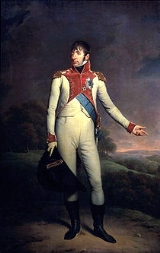
Louis Bonaparte

Louis Bonaparte

Overview
Louis Napoléon Bonaparte, Prince Français, Comte de Saint-Leu
Saint-Leu-la-Forêt
Saint-Leu-la-Forêt is a commune in the northwestern suburbs of Paris, France. It is located from the center of Paris.-History:In 1806 the commune of Saint-Leu-la-Forêt merged with the neighboring commune of Taverny, resulting in the creation of the commune of Saint-Leu-Taverny.In 1821 the commune...

(2 September 1778 – 25 July 1846), King of Holland (1806–10), was the fifth surviving child and the fourth surviving son of Carlo Buonaparte
Carlo Buonaparte
Carlo Maria Buonaparte was a Corsican lawyer and politician who briefly served as a personal assistant of the revolutionary leader Pasquale Paoli and eventually rose to become Corsica's representative to the court of Louis XVI...

 and Letizia Ramolino
Letizia Ramolino
Nobile Maria Letizia Buonaparte née Ramolino was the mother of Napoleon I of France....

. His brother was the first Emperor of the French
Emperor of the French
The Emperor of the French was the title used by the Bonaparte Dynasty starting when Napoleon Bonaparte was given the title Emperor on 18 May 1804 by the French Senate and was crowned emperor of the French on 02 December 1804 at the cathedral of Notre Dame de Paris, in Paris with the Crown of...

, Napoleon I, and his son was the last, Napoleon III.
Discussion
Ask a question about 'Louis Bonaparte'
Start a new discussion about 'Louis Bonaparte'
Answer questions from other users
Full Discussion Forum
 
Unanswered Questions
Encyclopedia
Louis Napoléon Bonaparte, Prince Français, Comte de Saint-Leu
Saint-Leu-la-Forêt
Saint-Leu-la-Forêt is a commune in the northwestern suburbs of Paris, France. It is located from the center of Paris.-History:In 1806 the commune of Saint-Leu-la-Forêt merged with the neighboring commune of Taverny, resulting in the creation of the commune of Saint-Leu-Taverny.In 1821 the commune...

(2 September 1778 – 25 July 1846), King of Holland (1806–10), was the fifth surviving child and the fourth surviving son of Carlo Buonaparte
Carlo Buonaparte
Carlo Maria Buonaparte was a Corsican lawyer and politician who briefly served as a personal assistant of the revolutionary leader Pasquale Paoli and eventually rose to become Corsica's representative to the court of Louis XVI...

 and Letizia Ramolino
Letizia Ramolino
Nobile Maria Letizia Buonaparte née Ramolino was the mother of Napoleon I of France....

. His brother was the first Emperor of the French
Emperor of the French
The Emperor of the French was the title used by the Bonaparte Dynasty starting when Napoleon Bonaparte was given the title Emperor on 18 May 1804 by the French Senate and was crowned emperor of the French on 02 December 1804 at the cathedral of Notre Dame de Paris, in Paris with the Crown of...

, Napoleon I, and his son was the last, Napoleon III.

Early life


Louis was born Luigi Buonaparte in Ajaccio
Ajaccio
Ajaccio , is a commune on the island of Corsica in France. It is the capital and largest city of the region of Corsica and the prefecture of the department of Corse-du-Sud....

, Corsica
Corsica
Corsica is an island in the Mediterranean Sea. It is located west of Italy, southeast of the French mainland, and north of the island of Sardinia....

. He was a younger brother of Joseph Bonaparte
Joseph Bonaparte
Joseph-Napoléon Bonaparte was the elder brother of Napoleon Bonaparte, who made him King of Naples and Sicily , and later King of Spain...

, Napoleon I of France
Napoleon I of France
Napoleon Bonaparte was a French military and political leader during the latter stages of the French Revolution.As Napoleon I, he was Emperor of the French from 1804 to 1815...

, Lucien Bonaparte
Lucien Bonaparte
Lucien Bonaparte, Prince Français, 1st Prince of Canino and Musignano , born Luciano Buonaparte, was the third surviving son of Carlo Buonaparte and his wife Letizia Ramolino....

, and Elisa Bonaparte
Elisa Bonaparte
Maria Anna Elisa Bonaparte Baciocchi Levoy, Princesse Française, Duchess of Lucca and Princess of Piombino, Grand Duchess of Tuscany, Countess of Compignano was the fourth surviving child and eldest surviving daughter of Carlo Buonaparte and Letizia Ramolino, making her the younger sister of...

, and the older brother of Pauline Bonaparte
Pauline Bonaparte
Pauline Bonaparte was the first sovereign Duchess of Guastalla, an imperial French Princess and the Princess consort of Sulmona and Rossano. She was the sixth child of Letizia Ramolino and Carlo Buonaparte, Corsica's representative to the court of King Louis XVI of France. Her elder brother,...

, Caroline Bonaparte
Caroline Bonaparte
Maria Annunziata Carolina Murat , better known as Caroline Bonaparte, was the seventh surviving child and third surviving daughter of Carlo Buonaparte and Letizia Ramolino and a younger sister of Napoleon I of France...

, and Jérôme Bonaparte
Jérôme Bonaparte
Jérôme-Napoléon Bonaparte, French Prince, King of Westphalia, 1st Prince of Montfort was the youngest brother of Napoleon, who made him king of Westphalia...

.

Louis Bonapart's early career was spent in the Army, and he served with Napoleon in Egypt
Egypt
Egypt , officially the Arab Republic of Egypt, Arabic: , is a country mainly in North Africa, with the Sinai Peninsula forming a land bridge in Southwest Asia. Egypt is thus a transcontinental country, and a major power in Africa, the Mediterranean Basin, the Middle East and the Muslim world...

. Thanks to his older brother, Napoleon, Louis was a General
General
A general officer is an officer of high military rank, usually in the army, and in some nations, the air force. The term is widely used by many nations of the world, and when a country uses a different term, there is an equivalent title given....

 by the age of 25, although he himself felt that he had risen too high in too short a time.

Upon Louis's return to France, he was involved in Napoleon's plot to overthrow the Directory
French Directory
The Directory was a body of five Directors that held executive power in France following the Convention and preceding the Consulate...

. After becoming the First Consul, Napoleon arranged for a marriage between Louis and Hortense de Beauharnais
Hortense de Beauharnais
Hortense Eugénie Cécile Bonaparte , Queen Consort of Holland, was the stepdaughter of Emperor Napoleon I, being the daughter of his first wife, Joséphine de Beauharnais. She later became the wife of the former's brother, Louis Bonaparte, King of Holland, and the mother of Napoleon III, Emperor of...

, the daughter of Empress Josephine
Joséphine de Beauharnais
Joséphine de Beauharnais was the first wife of Napoléon Bonaparte, and thus the first Empress of the French. Her first husband Alexandre de Beauharnais had been guillotined during the Reign of Terror, and she had been imprisoned in the Carmes prison until her release five days after Alexandre's...

, and hence Napoleon's stepdaughter. Hortense, who was opposed to the marriage at first, was persuaded by her mother to marry Louis for the sake of the family, and she did so.

Louis supposedly had a poor mental condition at times, and supposedly suffered from periods of mental illness. Louis's "poor mental condition" may have been periods of depression caused by trying to hide his homosexuality or bisexuality. These periods of depression or mental instability (records fail to distinguish) would plague Louis, and consequently Napoleon, until his death.

As the King of Holland


Napoleon made him the King of Holland
Kingdom of Holland
The Kingdom of Holland 1806–1810 was set up by Napoleon Bonaparte as a puppet kingdom for his third brother, Louis Bonaparte, in order to better control the Netherlands. The name of the leading province, Holland, was now taken for the whole country...

 on June 5, 1806. Though the older brother, Napoleon, had intended for the younger brother to be little more than a French governor of Holland, Louis took his duties as the King seriously, calling himself Koning Lodewijk I (adopting the Dutch form of his name), attempting to learn the Dutch language
Dutch language
Dutch is a West Germanic language and the native language of the majority of the population of the Netherlands, Belgium, and Suriname, the three member states of the Dutch Language Union. Most speakers live in the European Union, where it is a first language for about 23 million and a second...

, and trying hard to be a responsible, independent ruler of Holland. Allegedly, when he first arrived in Holland, he told the people he was the Konijn van 'Olland ("rabbit of 'Olland"), rather than "Koning van Holland" ("King of Holland"), because his Dutch was not very good by then. However, his attempt at speaking the Dutch language
Dutch language
Dutch is a West Germanic language and the native language of the majority of the population of the Netherlands, Belgium, and Suriname, the three member states of the Dutch Language Union. Most speakers live in the European Union, where it is a first language for about 23 million and a second...

 earned him some respect from his subjects.


While in Holland, Louis Bonaparte declared that he was Dutch and renounced his French citizenship . Louis also forced his court and ministers (mostly provided by Napoleon) to speak only Dutch, and also to renounce their French citizenships. This latter was too much for his wife Hortense
Hortense de Beauharnais
Hortense Eugénie Cécile Bonaparte , Queen Consort of Holland, was the stepdaughter of Emperor Napoleon I, being the daughter of his first wife, Joséphine de Beauharnais. She later became the wife of the former's brother, Louis Bonaparte, King of Holland, and the mother of Napoleon III, Emperor of...

 who, in France at the time of his demands, refused his request.

Louis could never settle on the location for his capital city while he was in Holland. He changed capitals over a dozen times, trying Amsterdam
Amsterdam
Amsterdam is the largest city and the capital of the Netherlands. The current position of Amsterdam as capital city of the Kingdom of the Netherlands is governed by the constitution of August 24, 1815 and its successors. Amsterdam has a population of 783,364 within city limits, an urban population...

, the Hague
The Hague
The Hague is the capital city of the province of South Holland in the Netherlands. With a population of 500,000 inhabitants , it is the third largest city of the Netherlands, after Amsterdam and Rotterdam...

, Rotterdam
Rotterdam
Rotterdam is the second-largest city in the Netherlands and one of the largest ports in the world. Starting as a dam on the Rotte river, Rotterdam has grown into a major international commercial centre...

, and other places. On one occasion, after visiting the home of a wealthy Dutch merchant, he liked the place so much that he had the owner evicted so he could take up residence there. Then, Louis moved again after seven weeks. His constant moving kept the court in upheaval since they had to follow him everywhere. The European diplomatic corps
Diplomatic corps
The diplomatic corps or corps diplomatique is the collective body of foreign diplomats accredited to a particular country or body.The diplomatic corps may, in certain contexts, refer to the collection of accredited heads of mission who represent their countries in another state or country...

 went so far as to petition Bonaparte to remain in one place so they could keep up with him. This restlessness was later attributed to his alleged "lunacy".

Hortense bore Louis's sons Napoleon Charles Bonaparte
Napoleon Charles Bonaparte
Napoleon Charles Bonaparte was the eldest son of Louis Bonaparte and Hortense de Beauharnais. His father was the younger brother of Emperor Napoleon I and his mother was the daughter of Josephine de Beauharnais, Napoleon's first wife. At the time of his birth his uncle was First Consul of France...

 and Napoleon Louis Bonaparte
Napoleon Louis Bonaparte
Napoléon Louis Bonaparte , or Louis II of Holland, was the middle son of Louis Napoléon, King of Holland, and Hortense de Beauharnais. His father was the younger brother of Emperor Napoléon I and king of Holland, while his mother was the daughter of Josephine de Beauharnais, Napoléon's first wife...

 in Paris, while Louis was in Holland. In 1806, Louis called for his son to be sent to him in Holland, but he was again refused by Hortense, who believed that her son would never be returned to France. When Louis appealed to his brother Napoleon for help, Napoleon sided with Hortense. Napoleon kept the boy in his own court, and he even had him named the heir to the French throne prior to the birth of his own son.

Two major tragedies occurred during the reign of Louis Bonaparte: the explosion of a cargo ship loaded with gunpowder in the heart of the city of Leiden in 1807, and a major flood in Holland in 1809. In both instances, Louis personally and effectively oversaw local relief efforts, which helped earn him the moniker of Louis the Good.

Louis Bonaparte's reign of the Netherlands
Netherlands
The Netherlands is a constituent country of the Kingdom of the Netherlands, located mainly in North-West Europe and with several islands in the Caribbean. Mainland Netherlands borders the North Sea to the north and west, Belgium to the south, and Germany to the east, and shares maritime borders...

 was short-lived, however, which was due to two factors. The first was that Napoleon wanted to reduce the value of French loans from Dutch investors by two-thirds, meaning a serious economic blow to the Netherlands. The second factor was the one that became the pretext for Napoleon's demand of Louis's abdication. As Napoleon was preparing an army for his invasion of Russia
Russia
Russia or , officially known as both Russia and the Russian Federation , is a country in northern Eurasia. It is a federal semi-presidential republic, comprising 83 federal subjects...

, he wanted troops from the entire region under his control, the allied border countries. This included troops from the Netherlands. Louis, confronted by his brother's demand, refused point-blank. Napoleon then accused Louis of putting Dutch interests above those of France, and removed most of the French forces in Holland for the coming war in the east, leaving only about 9,000 garrison soldiers in the country. Unfortunately for Louis, the English landed an army of 40,000 in 1809 in an attempt to capture Antwerp and Flushing. With Louis unable to defend his realm, France sent 80,000 militiamen, commanded by future King of Sweden Jean-Baptiste Bernadotte and successfully repelled the invasion. Napoleon then suggested that Louis should abdicate, citing Louis's inability to protect Holland as a reason. Louis refused. Napoleon finally invaded Holland on 1 July 1810, forcing Louis to abdicate the same day, and annexed the entire Kingdom of Holland on 9 July.

Years of exile


Louis Bonaparte also had been made the Count of Saint-Leu . He was appointed as the Constable of France
Constable of France
The Constable of France , as the First Officer of the Crown, was one of the original five Great Officers of the Crown of France and Commander in Chief of the army. He, theoretically, as Lieutenant-general of the King, outranked all the nobles and was second-in-command only to the King...

 in 1808, a strictly honorary title.

After his Dutch kingdom was taken away from him the Austrian
Austrian Empire
The Austrian Empire was a modern era successor empire, which was centered on what is today's Austria and which officially lasted from 1804 to 1867. It was followed by the Empire of Austria-Hungary, whose proclamation was a diplomatic move that elevated Hungary's status within the Austrian Empire...

 Emperor Francis I offered him asylum. Between 1811 and 1813 he found refuge in Graz
Graz
The more recent population figures do not give the whole picture as only people with principal residence status are counted and people with secondary residence status are not. Most of the people with secondary residence status in Graz are students...

, where he turned to writing and poetry. Louis wrote to Napoleon after the latter's defeat in Russia to request that the Dutch throne be restored to him; however, Napoleon refused. His request to visit the Netherlands was denied several times by King William I of the Netherlands
William I of the Netherlands
William I Frederick, born Willem Frederik Prins van Oranje-Nassau , was a Prince of Orange and the first King of the Netherlands and Grand Duke of Luxembourg....

; King William II of the Netherlands
William II of the Netherlands
William II was King of the Netherlands, Grand Duke of Luxembourg, and Duke of Limburg from 7 October 1840 until his death in 1849.- Early life and education :...

 allowed him a visit in 1840. Although traveling in the Netherlands under a false name, some people found out that it was their former king, which led to a cheering crowd gathering under the window of his hotel room. It is said he was quite moved by this demonstration of affection from his former subjects.

After the deaths of both Napoleon Bonaparte in 1821, and of his eldest brother Joseph in 1844, Louis was seen by the Bonapartists as the rightful Emperor of the French, although Louis took little action himself to advance the claim. (Louis's son and heir, the future Emperor Napoleon III, on the other hand, was at that time being imprisoned in France for having tried to engineer a Bonapartist coup d'état.)

Louis Bonaparte died on July 25, 1846 in Livorno
Livorno
Livorno , traditionally Leghorn , is a port city on the Tyrrhenian Sea on the western edge of Tuscany, Italy. It is the capital of the Province of Livorno, having a population of approximately 160,000 residents in 2009.- History :...

, and his remains were buried at Saint-Leu-la-Forêt
Saint-Leu-la-Forêt
Saint-Leu-la-Forêt is a commune in the northwestern suburbs of Paris, France. It is located from the center of Paris.-History:In 1806 the commune of Saint-Leu-la-Forêt merged with the neighboring commune of Taverny, resulting in the creation of the commune of Saint-Leu-Taverny.In 1821 the commune...

, Île-de-France
Île-de-France (région)
Île-de-France is the wealthiest and most populated of the twenty-two administrative regions of France, composed mostly of the Paris metropolitan area....

.

Marriage and children


Louis was married on January 4, 1802, to Hortense de Beauharnais
Hortense de Beauharnais
Hortense Eugénie Cécile Bonaparte , Queen Consort of Holland, was the stepdaughter of Emperor Napoleon I, being the daughter of his first wife, Joséphine de Beauharnais. She later became the wife of the former's brother, Louis Bonaparte, King of Holland, and the mother of Napoleon III, Emperor of...

, the daughter of the deceased general Alexandre, Vicomte de Beauharnais
Alexandre, vicomte de Beauharnais
Alexandre François Marie de Beauharnais, Vicomte de Beauharnais was a French political figure and general during the French Revolution...

 and his wife Josephine Tascher de la Pagerie
Joséphine de Beauharnais
Joséphine de Beauharnais was the first wife of Napoléon Bonaparte, and thus the first Empress of the French. Her first husband Alexandre de Beauharnais had been guillotined during the Reign of Terror, and she had been imprisoned in the Carmes prison until her release five days after Alexandre's...

. Josephine was the first wife of Louis's brother Napoleon. Thus Hortense was also Louis's step-niece.

This marriage had been forced upon them and was rather loveless, though they supposedly consummated it and interacted often enough to produce three sons. As a rule, the Bonapartes, with the exception of Napoleon, loathed the Beauharnais. Hortense also certainly had extra-marital lovers.

Hortense de Beauharnais gave birth to three sons which were officially claimed by Louis Bonaparte, despite his own doubts about their paternity:
  1. Napoleon Charles Bonaparte
    Napoleon Charles Bonaparte
    Napoleon Charles Bonaparte was the eldest son of Louis Bonaparte and Hortense de Beauharnais. His father was the younger brother of Emperor Napoleon I and his mother was the daughter of Josephine de Beauharnais, Napoleon's first wife. At the time of his birth his uncle was First Consul of France...

    , born 10 October 1802http://www.napoleon.org/en/essential_napoleon/family_tree/detail/48.html, Prince Royal
    Prince Royal
    Prince Royal may refer to the Crown Prince in the following monarchies:* Prince Royal of Portugal, the Prince Royal of the Kingdom of Portugal and the Algarves* Prince Royal of Haiti, see Jacques-Victor Henry, Prince Royal of Haiti...

     of Holland. When he died on 5 May 1807 at 4½ years of age, his body lay in state at Notre Dame Cathedral in Paris. He is buried at Saint-Leu-La-Foret, Ile-de-France.
  2. Napoleon Louis Bonaparte
    Napoleon Louis Bonaparte
    Napoléon Louis Bonaparte , or Louis II of Holland, was the middle son of Louis Napoléon, King of Holland, and Hortense de Beauharnais. His father was the younger brother of Emperor Napoléon I and king of Holland, while his mother was the daughter of Josephine de Beauharnais, Napoléon's first wife...

    , born 11 October 1804. Became Prince Royal of Holland on his brother's death, and was King Lodewijk II for five days between his father's abdication and the fall of Holland to Napoleon Bonaparte's invading army. Napoleon Louis Bonaparte died on 17 March 1831, and his remains were buried at Saint-Leu-La-Foret, Île-de-France.
  3. Charles Louis-Napoleon Bonaparte
    Napoleon III of France
    Louis-Napoléon Bonaparte was the President of the French Second Republic and as Napoleon III, the ruler of the Second French Empire. He was the nephew and heir of Napoleon I, christened as Charles Louis Napoléon Bonaparte...

    , (1808–73). Born in Paris, he was the third and last son, and would become Emperor Napoleon III of France (1852–70).


Louis Bonaparte was also supposedly the father of an illegitimate son, François de Castelvecchio, (26 April 1826 – 29 May 1869) . He was born in Rome, Italy and died in Rennes
Rennes
Rennes is a city in the east of Brittany in northwestern France. Rennes is the capital of the region of Brittany, as well as the Ille-et-Vilaine department.-History:...

.

Ancestry