

Eunuch

Encyclopedia
Celibacy
Celibacy is a personal commitment to avoiding sexual relations, in particular a vow from marriage. Typically celibacy involves avoiding all romantic relationships of any kind. An individual may choose celibacy for religious reasons, such as is the case for priests in some religions, for reasons of...
.)
Castration was typically carried out on the soon-to-be eunuch without his consent in order that he might perform a specific social function; this was common in many societies. The earliest records for intentional castration to produce eunuchs are from the Sumer
Sumer
Sumer was a civilization and historical region in southern Mesopotamia, modern Iraq during the Chalcolithic and Early Bronze Age....
ian city of Lagash
Lagash
Lagash is located northwest of the junction of the Euphrates and Tigris rivers and east of Uruk, about east of the modern town of Ash Shatrah. Lagash was one of the oldest cities of the Ancient Near East...
in the 21st century BC. Over the millennia since, they have performed a wide variety of functions in many different cultures: courtier
Courtier
A courtier is a person who is often in attendance at the court of a king or other royal personage. Historically the court was the centre of government as well as the residence of the monarch, and social and political life were often completely mixed together...
s or equivalent domestics
Domestic worker
A domestic worker is a man, woman or child who works within the employer's household. Domestic workers perform a variety of household services for an individual or a family, from providing care for children and elderly dependents to cleaning and household maintenance, known as housekeeping...
, treble singers
Castrato
A castrato is a man with a singing voice equivalent to that of a soprano, mezzo-soprano, or contralto voice produced either by castration of the singer before puberty or one who, because of an endocrinological condition, never reaches sexual maturity.Castration before puberty prevents a boy's...
, religious
Religion
Religion is a collection of cultural systems, belief systems, and worldviews that establishes symbols that relate humanity to spirituality and, sometimes, to moral values. Many religions have narratives, symbols, traditions and sacred histories that are intended to give meaning to life or to...
specialists, government officials, military commanders, and guardians of women or harem
Harem
Harem refers to the sphere of women in what is usually a polygynous household and their enclosed quarters which are forbidden to men...
servants.
Etymology and origins
The English word eunuch is from the GreekGreek language
Greek is an independent branch of the Indo-European family of languages. Native to the southern Balkans, it has the longest documented history of any Indo-European language, spanning 34 centuries of written records. Its writing system has been the Greek alphabet for the majority of its history;...
eune ("bed") and ekhein ("to keep"), effectively "bed keeper".
Eunuchs would probably be servants or slaves
Slavery
Slavery is a system under which people are treated as property to be bought and sold, and are forced to work. Slaves can be held against their will from the time of their capture, purchase or birth, and deprived of the right to leave, to refuse to work, or to demand compensation...
who, because of their function, had been castrated, usually in order to make them reliable servants of a royal court where physical access to the ruler could wield great influence. Seemingly lowly domestic functions—such as making the ruler's bed, bathing him, cutting his hair, carrying him in his litter
Litter (vehicle)
The litter is a class of wheelless vehicles, a type of human-powered transport, for the transport of persons. Examples of litter vehicles include lectica , jiao [较] , sedan chairs , palanquin , Woh , gama...
, or even relaying messages—could in theory give a eunuch "the ruler's ear" and impart de facto power on the formally humble but trusted servant. Similar instances are reflected in the humble origins and etymology of many high offices (e.g., chancellor
Chancellor
Chancellor is the title of various official positions in the governments of many nations. The original chancellors were the Cancellarii of Roman courts of justice—ushers who sat at the cancelli or lattice work screens of a basilica or law court, which separated the judge and counsel from the...
originally denoted a servant guarding the entrance to an official's study). Eunuchs supposedly did not generally have loyalties to the military, the aristocracy, nor to a family of their own (having neither offspring nor in-laws, at the very least), and were thus seen as more trustworthy and less interested in establishing a private 'dynasty'. Because their condition usually lowered their social status, they could also be easily replaced or killed without repercussion. In cultures that had both harems and eunuchs, eunuchs were sometimes used as harem servants (compare the female odalisque
Odalisque
An odalisque was a female slave in an Ottoman seraglio. She was an assistant or apprentice to the concubines and wives, and she might rise in status to become one of them...
) or seraglio
Seraglio
A seraglio or serail is the sequestered living quarters used by wives and concubines in a Turkish household. The word comes from an Italian variant of Turkish saray, from Persian sarai , meaning palace, or the enclosed courts for the wives and concubines of the harem of a house or palace...
guards.
In Latin, the words eunuchus, spado, and castratus were used to denote eunuchs.
Ancient Middle East
Eunuchs were familiar figures in the Assyrian Empire (ca. 850 till 622 BC) in the court of the Egyptian PharaohPharaoh
Pharaoh is a title used in many modern discussions of the ancient Egyptian rulers of all periods. The title originates in the term "pr-aa" which means "great house" and describes the royal palace...
s (down to the Lagid dynasty known as Ptolemies, ending with Cleopatra). Political eunuchism became a fully established institution among the Achamenide Persians
Achaemenides
This article is about the mythological figure. For the ancient Persian dynasty, see Achaemenid empire.In Greek and Roman mythology, Achaemenides was a son of Adamastus of Ithaca, and one of Odysseus' crew...
.
Ancient Greece, Rome and Byzantium
The practice was also well established in Europe among the Greeks and Romans, although a role as court functionaries does not arise until Byzantine times. The GalliGalli
A Gallus was a eunuch priest of the Phrygian goddess Cybele, whose worship was incorporated into the state religious practices of ancient Rome.-About the Galli:...
or Priests of Cybele were eunuchs.
In the late period of the Roman Empire, after the adoption of the oriental royal court model by the Emperors Diocletian
Diocletian
Diocletian |latinized]] upon his accession to Diocletian . c. 22 December 244 – 3 December 311), was a Roman Emperor from 284 to 305....
and Constantine
Constantine I
Constantine the Great , also known as Constantine I or Saint Constantine, was Roman Emperor from 306 to 337. Well known for being the first Roman emperor to convert to Christianity, Constantine and co-Emperor Licinius issued the Edict of Milan in 313, which proclaimed religious tolerance of all...
, Emperors were surrounded by eunuchs for such functions as bathing, hair cutting, dressing, and bureaucratic functions, in effect acting as a shield between the Emperor and his administrators from physical contact, enjoyed great influence in the Imperial Court (see Eusebius
Eusebius (praepositus sacri cubiculi)
Eusebius was a high-ranking officer of the Roman Empire, holding the position of praepositus sacri cubiculi for all the rule of Emperor Constantius II .- Biography :...
and Eutropius). Eunuchs were believed loyal and indispensable.
However, it was not uncommon for wives to sleep with partially castrated eunuchs (those whose testicles were removed or rendered inactive only) whose sexual competence persisted for some time after the castration, hence the bitter epigram: "Do you ask, Panychus, why your Caelia only consorts with eunuchs? Caelia wants the flowers of marriage – not the fruit."
At the Byzantine imperial
Byzantine Empire
The Byzantine Empire was the Eastern Roman Empire during the periods of Late Antiquity and the Middle Ages, centred on the capital of Constantinople. Known simply as the Roman Empire or Romania to its inhabitants and neighbours, the Empire was the direct continuation of the Ancient Roman State...
court, there were a great number of eunuchs employed in domestic and administrative functions, actually organized as a separate hierarchy, following a parallel career of their own. Archieunuchs—each in charge of a group of eunuchs—were among the principal officers in Constantinople
Constantinople
Constantinople was the capital of the Roman, Eastern Roman, Byzantine, Latin, and Ottoman Empires. Throughout most of the Middle Ages, Constantinople was Europe's largest and wealthiest city.-Names:...
, under the emperors. Under Justinian in the 6th century, the eunuch Narses
Narses
Narses was, with Belisarius, one of the great generals in the service of the Byzantine Emperor Justinian I during the "Reconquest" that took place during Justinian's reign....
functioned as a successful general in a number of campaigns.
Following the Byzantine tradition, eunuchs had important tasks at the court of the Norman
Normans
The Normans were the people who gave their name to Normandy, a region in northern France. They were descended from Norse Viking conquerors of the territory and the native population of Frankish and Gallo-Roman stock...
kingdom of Sicily
Kingdom of Sicily
The Kingdom of Sicily was a state that existed in the south of Italy from its founding by Roger II in 1130 until 1816. It was a successor state of the County of Sicily, which had been founded in 1071 during the Norman conquest of southern Italy...
during the middle 12th century. One of them Philip of Mahdia
Philip of Mahdia
Philip of Mahdia, of Greek origin, was the emir of Palermo, the second ammiratus ammiratorum, and successor of the great George of Antioch. He was a eunuch who rose through the ranks of the royal curia in Palermo until he was eventually one of King Roger II's most trusted men...
has been admiratus admiratorum, and another one, Peter the caid, was prime minister.
China
Records of eunuchs in China date to the Shang dynastyShang Dynasty
The Shang Dynasty or Yin Dynasty was, according to traditional sources, the second Chinese dynasty, after the Xia. They ruled in the northeastern regions of the area known as "China proper" in the Yellow River valley...
, when the Shang kings castrated prisoners of war. In China, castration included removal of the penis
Penis removal
In ancient civilizations, removal of the human penis was sometimes used as a means of demonstrating superiority: armies were sometimes known to sever the penises of their enemies to count the dead, as well as for trophies...
as well as the testicles. Both organs were cut off with a knife at the same time. Men sentenced to castration
Castration
Castration is any action, surgical, chemical, or otherwise, by which a male loses the functions of the testicles or a female loses the functions of the ovaries.-Humans:...
were turned into eunuch slaves of the Qin dynasty
Qin Dynasty
The Qin Dynasty was the first imperial dynasty of China, lasting from 221 to 207 BC. The Qin state derived its name from its heartland of Qin, in modern-day Shaanxi. The strength of the Qin state was greatly increased by the legalist reforms of Shang Yang in the 4th century BC, during the Warring...
state perform forced labor for projects such as the Terracotta Army
Terracotta Army
The Terracotta Army or the "Terra Cotta Warriors and Horses", is a collection of terracotta sculptures depicting the armies of Qin Shi Huang, the first Emperor of China...
. The Qin government confiscated the property and enslaved the families of rapists who received castration as a punishment. Men punished with castration during the Han dynasty
Han Dynasty
The Han Dynasty was the second imperial dynasty of China, preceded by the Qin Dynasty and succeeded by the Three Kingdoms . It was founded by the rebel leader Liu Bang, known posthumously as Emperor Gaozu of Han. It was briefly interrupted by the Xin Dynasty of the former regent Wang Mang...
were also used as slave labor.
From ancient times until the Sui Dynasty
Sui Dynasty
The Sui Dynasty was a powerful, but short-lived Imperial Chinese dynasty. Preceded by the Southern and Northern Dynasties, it ended nearly four centuries of division between rival regimes. It was followed by the Tang Dynasty....
, castration was both a traditional punishment (one of the Five Punishments
Five Punishments
The Five Punishments was the collective name for a series of physical penalties meted out by the legal system of pre-modern Dynastic China. Over time, the nature of the Five Punishments varied. Before the time of Western Han Dynasty Emperor Han Wendi they involved tatooing, cutting off the nose,...
) and a means of gaining employment in the Imperial service. At the end of the Ming Dynasty
Ming Dynasty
The Ming Dynasty, also Empire of the Great Ming, was the ruling dynasty of China from 1368 to 1644, following the collapse of the Mongol-led Yuan Dynasty. The Ming, "one of the greatest eras of orderly government and social stability in human history", was the last dynasty in China ruled by ethnic...
there were about 70,000 eunuchs (宦官 huànguān, or 太監 tàijiàn) employed by the emperor, with some serving inside the Imperial palace
Forbidden City
The Forbidden City was the Chinese imperial palace from the Ming Dynasty to the end of the Qing Dynasty. It is located in the middle of Beijing, China, and now houses the Palace Museum...
. Certain eunuchs gained immense power that occasionally superseded that of even the Grand Secretaries. Zheng He
Zheng He
Zheng He , also known as Ma Sanbao and Hajji Mahmud Shamsuddin was a Hui-Chinese mariner, explorer, diplomat and fleet admiral, who commanded voyages to Southeast Asia, South Asia, the Middle East, and East Africa, collectively referred to as the Voyages of Zheng He or Voyages of Cheng Ho from...
, who lived during the Ming Dynasty, is an example of such a eunuch. Self-castration was a common practice, although it was not always performed completely, which led to it being made illegal. During the early Ming period, China demanded to send the eunuchs as tribute to Korea, where some of them oversaw the Korean concubines in the harem of the Chinese Emperor.
When the Ming army finally captured Yunnan
Yunnan
Yunnan is a province of the People's Republic of China, located in the far southwest of the country spanning approximately and with a population of 45.7 million . The capital of the province is Kunming. The province borders Burma, Laos, and Vietnam.Yunnan is situated in a mountainous area, with...
from Mongols in 1382, thousands of prisoners were killed and, according to the custom in times of war, their young sons – including Zheng He – were castrated. During the Miao Rebellions (Ming Dynasty)
Miao Rebellions (Ming Dynasty)
The Miao Rebellions were a series of Rebellions of the aboriginal Miao and other aboriginal tribes of southern China. The Ming Dynasty crushed the rebels with overwhelming force...
, Chinese commanders castrated thousands of Miao
Miao people
The Miao or ม้ง ; ) is an ethnic group recognized by the government of the People's Republic of China as one of the 55 official minority groups. Miao is a Chinese term and does not reflect the self-designations of the component nations of people, which include Hmong, Hmu, A Hmao, and Kho Xiong...
boys when their tribes revolted, and then gave them as slaves to various officials.
The sons and grandsons of the rebel Yaqub Beg in China were all castrated. Surviving members of Yaqub Beg's family included his 4 sons, 4 grandchildren (2 grandsons and 2 granddaughters), and 4 wives. They either died in prison in Lanzhou
Lanzhou
Lanzhou is the capital and largest city of Gansu Province in Northwest China. A prefecture-level city, it is a key regional transportation hub, allowing areas further west to maintain railroad connections to the eastern half of the country....
, Gansu
Gansu
' is a province located in the northwest of the People's Republic of China.It lies between the Tibetan and Huangtu plateaus, and borders Mongolia, Inner Mongolia, and Ningxia to the north, Xinjiang and Qinghai to the west, Sichuan to the south, and Shaanxi to the east...
, or were killed by the Chinese. His sons Yima Kuli, K'ati Kuli, Maiti Kuli, and grandson Aisan Ahung were the only survivors in 1879. They were all underage children, and put on trial, sentenced to an agonizing death if they were complicit in their father's rebellious "sedition", or if they were innocent of their fathers crimes, were to be sentenced to castration
Castration
Castration is any action, surgical, chemical, or otherwise, by which a male loses the functions of the testicles or a female loses the functions of the ovaries.-Humans:...
and serving as a eunuch slave to Chinese troops, when they reached 11 years old, and handed over to the Imperial Household to be executed or castrated. In 1879, it was confirmed that the sentence of castration was carried out, Yaqub Beg's son and grandsons were castrated by the Chinese court in 1879 and turned into eunuchs to work in the Imperial Palace.
It is said that the justification for the employment of eunuchs as high-ranking civil servants was that, since they were incapable of having children, they would not be tempted to seize power and start a dynasty. In many cases, eunuchs were considered more reliable than the scholar officials. A similar system existed in Vietnam
Vietnam
Vietnam – sometimes spelled Viet Nam , officially the Socialist Republic of Vietnam – is the easternmost country on the Indochina Peninsula in Southeast Asia. It is bordered by China to the north, Laos to the northwest, Cambodia to the southwest, and the South China Sea –...
.
The tension between eunuchs in the service of the emperor and virtuous Confucian officials is a familiar theme in Chinese history. In his History of Government, Samuel Finer
Samuel Finer
Professor Samuel Edward Finer was a political scientist and historian who was instrumental in advancing political studies as an academic subject in the United Kingdom, pioneering the study of UK political institutions...
points out that reality was not always that clear-cut. There were instances of very capable eunuchs, who were valuable advisers to their emperor, and the resistance of the "virtuous" officials often stemmed from jealousy on their part. Ray Huang
Ray Huang
Ray Huang was a Chinese historian and philosopher. He was an officer in the Nationalist army and fought in the Burma campaigns. He earned a Ph.D in history from the University of Michigan, worked with Joseph Needham and is a contributor of Needham's Science and Civilisation in China...
argues that in reality, eunuchs represented the personal will of the Emperor, while the officials represented the alternate political will of the bureaucracy. The clash between them would thus have been a clash of ideologies or political agenda.
The number of eunuchs in Imperial employ fell to 470 by 1912, when the practice of using them ceased.
The last Imperial eunuch, Sun Yaoting died in December 1996.
Korea
The eunuchs of Korea, called Naesi (내시, 內侍), were officials to the king and other royalty in traditional Korean society. The first recorded appearance of a Korean eunuch was in GoryeosaGoryeosa
The Goryeosa or History of Goryeo is the principal surviving history of Korea's Goryeo Dynasty. It was composed nearly a century after the fall of Goryeo, during the reign of King Sejong...
("History of Goryeo"), a compilation about the Goryeo
Goryeo
The Goryeo Dynasty or Koryŏ was a Korean dynasty established in 918 by Emperor Taejo. Korea gets its name from this kingdom which came to be pronounced Korea. It united the Later Three Kingdoms in 936 and ruled most of the Korean peninsula until it was removed by the Joseon dynasty in 1392...
period. In 1392, with the founding of the Joseon Dynasty
Joseon Dynasty
Joseon , was a Korean state founded by Taejo Yi Seong-gye that lasted for approximately five centuries. It was founded in the aftermath of the overthrow of the Goryeo at what is today the city of Kaesong. Early on, Korea was retitled and the capital was relocated to modern-day Seoul...
, the Naesi system was revised, and the department was renamed the "Department of Naesi" (내시부, 內侍府).
The Naesi system included two ranks, those of Sangseon (상선, 尙膳, "Chief of Naesi"), who held the official title of senior second rank, and Naegwan (내관, 內官, "Common official naesi"), both of which held rank as officers. 140 naesi in total served the palace in Joseon Dynasty period. They also took the exam on Confucianism
Confucianism
Confucianism is a Chinese ethical and philosophical system developed from the teachings of the Chinese philosopher Confucius . Confucianism originated as an "ethical-sociopolitical teaching" during the Spring and Autumn Period, but later developed metaphysical and cosmological elements in the Han...
every month. The naesi system was repealed in 1894 following Gabo reform
Gabo Reform
The Gabo Reform describes a series of sweeping reforms introduced in Joseon Dynasty Korea beginning in 1894 and ending in 1896, during the reign of King Gojong, in response to the Donghak Peasant Revolution. Historians debate the degree of Japanese influence in this program, as well as its effect...
.
Early on, castration consisted of daubing a boy's genitals with human feces
Feces
Feces, faeces, or fæces is a waste product from an animal's digestive tract expelled through the anus or cloaca during defecation.-Etymology:...
and having a dog bite them off. During the Yuan Dynasty
Yuan Dynasty
The Yuan Dynasty , or Great Yuan Empire was a ruling dynasty founded by the Mongol leader Kublai Khan, who ruled most of present-day China, all of modern Mongolia and its surrounding areas, lasting officially from 1271 to 1368. It is considered both as a division of the Mongol Empire and as an...
, eunuchs became a desirable commodity for tributes, and dog bites were replaced by more sophisticated surgical techniques.
Ottoman Empire
In the Middle Eastern empires, eunuchs were typically slaves imported from outside the Islamic domains. A fair proportion of male slaves were imported as eunuchs.The Ottoman court harem
Imperial Harem
The Imperial Harem of the Ottoman Empire was one of the most important elements of the Ottoman court. It was known in the West as "the Seraglio", an Italian term.- Harem quarters:...
—within the Topkapı Palace
Topkapi Palace
The Topkapı Palace is a large palace in Istanbul, Turkey, that was the primary residence of the Ottoman Sultans for approximately 400 years of their 624-year reign....
(1465–1853) and later the Dolmabahçe Palace
Dolmabahçe Palace
Dolmabahçe Palace located in the Beşiktaş district of Istanbul, Turkey, on the European coastline of the Bosphorus strait, served as the main administrative center of the Ottoman Empire from 1856 to 1922, apart from a 22-year interval in which Yıldız Palace was used.- History :Dolmabahçe Palace...
(1853–1909) in Istanbul
Istanbul
Istanbul , historically known as Byzantium and Constantinople , is the largest city of Turkey. Istanbul metropolitan province had 13.26 million people living in it as of December, 2010, which is 18% of Turkey's population and the 3rd largest metropolitan area in Europe after London and...
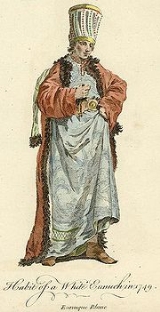
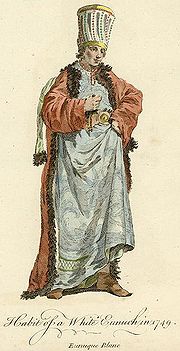
—was under the administration of the eunuchs. These were of two categories: Black Eunuchs and White Eunuchs. Black Eunuchs were Africans who served the concubines and officials in the Harem together with chamber maidens of low rank. The White Eunuchs were Europeans from the Balkans. They served the recruits at the Palace School
Palace school
The Palace school was part of the House of Osman's system, designated to educate the Ottoman Empire's governing elite. It consisted of two distinct branches. The Madrasa for the Muslims, which educated the scholars and the state officials in accordance with Islamic tradition...
and were from 1582 prohibited from entering the Harem. An important figure in the Ottoman court was the Chief Black Eunuch (Kızlar Ağası or Dar al-Saada Ağası). In control of the Harem and a perfect net of spies in the Black Eunuchs, the Chief Eunuch was involved in almost every palace intrigue and could thereby gain power over either the sultan or one of his viziers, ministers or other court officials.
The eunuchs in the Ottoman Empire
Ottoman Empire
The Ottoman EmpireIt was usually referred to as the "Ottoman Empire", the "Turkish Empire", the "Ottoman Caliphate" or more commonly "Turkey" by its contemporaries...
were created mainly at one Coptic monastery, at Abou Gerbe monastery on Mount Ghebel Eter. The Coptic priests sliced the penis and testicles off Nubian or Abyssinian
Habesha people
The term Habesha ābešā, Ḥābešā; al-Ḥabašah) refers to the South Semitic-speaking group of people whose cultural, linguistic, and in certain cases, ancestral origins trace back to those people who ruled the Axumite Empire and the kingdom known as DʿMT .Peoples referred to as "Habesha" today...
slave boys around the age of eight. The boys were captured from Abyssinia and other areas in Sudan
Sudan
Sudan , officially the Republic of the Sudan , is a country in North Africa, sometimes considered part of the Middle East politically. It is bordered by Egypt to the north, the Red Sea to the northeast, Eritrea and Ethiopia to the east, South Sudan to the south, the Central African Republic to the...
like Darfur
Darfur
Darfur is a region in western Sudan. An independent sultanate for several hundred years, it was incorporated into Sudan by Anglo-Egyptian forces in 1916. The region is divided into three federal states: West Darfur, South Darfur, and North Darfur...
and Kordofan then brought into Sudan and Egypt. During the operation, the Coptic clergyman chained the boys to tables and after slicing their sexual organs off, stuck a piece of bamboo into the genital area, then submerged them in neck high sand to burn. The recovery rate was ten percent. The resulting eunuchs fetched large profits in contrast to eunuchs from other areas.
Eunuchs in Indian royalty
Eunuchs were frequently employed in Imperial Indian palaces as servants for female royalty, and often attained high-status positions in Indian society. Eunuchs in Imperial palaces were organized in a hierarchy, often with a senior or chief eunuch (Urdu:"Khwaja Saras") directing junior eunuchs below him. Eunuchs were highly valued for their strength, ability to provide protection for ladies' palaces and trustworthiness, allowing eunuchs to live amongst women with fewer worries. This enabled eunuchs to serve as messengers, watchmen, attendants and guards for palaces. Often, eunuchs also doubled as part of the King's court of advisers.As a result of the number of high-status job openings available for eunuchs, poor families often converted one of their sons into a eunuch and had him work in the imperial palaces to create a steady source of revenue for the family and ensure a comfortable lifestyle for the son. This practice of castration was banned throughout the Empire in 1668 by Aurangzeb, but continued covertly.
The hijra of South Asia
The Ancient IndianHistory of India
The history of India begins with evidence of human activity of Homo sapiens as long as 75,000 years ago, or with earlier hominids including Homo erectus from about 500,000 years ago. The Indus Valley Civilization, which spread and flourished in the northwestern part of the Indian subcontinent from...
Kama Sutra
Kama Sutra
The Kama Sutra is an ancient Indian Hindu text widely considered to be the standard work on human sexual behavior in Sanskrit literature written by Vātsyāyana. A portion of the work consists of practical advice on sexual intercourse. It is largely in prose, with many inserted anustubh poetry verses...
refers to people of a "third sex" (triteeyaprakrti), who can be dressed either in men's or in women's clothes and perform fellatio
Fellatio
Fellatio is an act of oral stimulation of a male's penis by a sexual partner. It involves the stimulation of the penis by the use of the mouth, tongue, or throat. The person who performs fellatio can be referred to as the giving partner, and the other person is the receiving partner...
on men. The term has been translated as "eunuchs" (as in Sir Richard Burton's translation of the book), but these persons have also been considered to be the equivalent of the modern hijra
Hijra (South Asia)
In the culture of South Asia, hijras or chakka in Kannada, khusra in Punjabi and kojja in Telugu are physiological males who have feminine gender identity, women's clothing and other feminine gender roles. Hijras have a long recorded history in the Indian subcontinent, from the antiquity, as...
of India.
Hijra, a Hindi
Hindi
Standard Hindi, or more precisely Modern Standard Hindi, also known as Manak Hindi , High Hindi, Nagari Hindi, and Literary Hindi, is a standardized and sanskritized register of the Hindustani language derived from the Khariboli dialect of Delhi...
and Urdu
Urdu
Urdu is a register of the Hindustani language that is identified with Muslims in South Asia. It belongs to the Indo-European family. Urdu is the national language and lingua franca of Pakistan. It is also widely spoken in some regions of India, where it is one of the 22 scheduled languages and an...
term traditionally translated into English as "eunuch", actually refers to what modern Westerners would call male-to-female transgender
Transgender
Transgender is a general term applied to a variety of individuals, behaviors, and groups involving tendencies to vary from culturally conventional gender roles....
people and effeminate homosexuals (although some of them reportedly identify as belonging to a third sex). Some of them undergo ritual castration, but the majority do not. They usually dress in sari
Sari
A sari or sareeThe name of the garment in various regional languages include: , , , , , , , , , , , , , is a strip of unstitched cloth, worn by females, ranging from four to nine metres in length that is draped over the body in various styles. It is popular in India, Bangladesh, Nepal,...
s (traditional Indian garb worn by women) or shalwar kameez
Shalwar kameez
Shalwar kameez — or salwar kameez or shalwar qameez — is a traditional dress worn by both women and men in South Asia and Central Asia. Shalwar or salwar are loose pajama-like trousers. The legs are wide at the top, and narrow at the ankle. The kameez is a long shirt or tunic...
(traditional garb worn by women in South Asia) and wear heavy make-up. They typically live in the margins of society, face discrimination and earn their living in various ways, e.g., by coming uninvited at weddings, births, new shop openings and other major family events and singing until they are paid or given gifts to go away.
The ceremony is supposed to bring good luck and fertility, while the curse of an unappeased hijra is feared by many. Other sources of income for the hijra are begging and prostitution. The begging is accompanied by singing and dancing and the hijras usually get the money easily. Some Indian provincial officials have used the assistance of hijras to collect taxes in the same fashion; they knock on the doors of shopkeepers, while dancing and singing, and embarrass them into paying. Recently, hijras have started to found organizations to improve their social condition and fight discrimination. There has even been a wave of hijra entering politics and being elected to high political positions. In the epic Mahabaratha of India, Arjuna
Arjuna
Arjuna in Indian mythology is the greatest warrior on earth and is one of the Pandavas, the heroes of the Hindu epic Mahābhārata. Arjuna, whose name means 'bright', 'shining', 'white' or 'silver' Arjuna (Devanagari: अर्जुन, Thai: อรชุน, Orachun, Tamil: Arjunan, Indonesian and Javanese: Harjuna,...
, one of the five heroes – a person who is originally a handsome man, warrior and great archer – becomes Brihannala
Brihannala
Brihannala , in the Hindu epic Mahābhārata, was the name assumed by Arjuna, who was in disguise as a transgender . The name means "large reed" or "having a large reed." She taught arts to Uttarā, the princess of the kingdom of Virata...
, disguised as a hijra, when the five spend their last year of exile in the kingdom of Virata. Brihannala/Arjuna lived among the palace women as a teacher of song and dance.
Religious castration
Castration as part of religious practice, and eunuchs occupying religious roles have been established prior to classical antiquity. Archaeological finds at ÇatalhöyükÇatalhöyük
Çatalhöyük was a very large Neolithic and Chalcolithic settlement in southern Anatolia, which existed from approximately 7500 BCE to 5700 BCE...
in Anatolia
Anatolia
Anatolia is a geographic and historical term denoting the westernmost protrusion of Asia, comprising the majority of the Republic of Turkey...
indicate worship of a 'Magna Mater' figure, a forerunner of the Cybele
Cybele
Cybele , was a Phrygian form of the Earth Mother or Great Mother. As with Greek Gaia , her Minoan equivalent Rhea and some aspects of Demeter, Cybele embodies the fertile Earth...
goddess found in later Anatolia
Anatolia
Anatolia is a geographic and historical term denoting the westernmost protrusion of Asia, comprising the majority of the Republic of Turkey...
and other parts of the near East. Later Roman followers of Cybele, were called Galli
Galli
A Gallus was a eunuch priest of the Phrygian goddess Cybele, whose worship was incorporated into the state religious practices of ancient Rome.-About the Galli:...
, who practiced ritual self-castration, known as sanguinaria.
The practice of religious castration continued into the Christian era, with members of the early church castrating themselves for religious purposes, although the extent and even the existence of this practice among Christians is subject to debate. The early theologian Origen
Origen
Origen , or Origen Adamantius, 184/5–253/4, was an early Christian Alexandrian scholar and theologian, and one of the most distinguished writers of the early Church. As early as the fourth century, his orthodoxy was suspect, in part because he believed in the pre-existence of souls...
found scriptural justification for the practice in , where Jesus
Jesus
Jesus of Nazareth , commonly referred to as Jesus Christ or simply as Jesus or Christ, is the central figure of Christianity...
says, "For there are eunuchs who have been so from birth, and there are eunuchs who have been made eunuchs by others, and there are eunuchs who have made themselves eunuchs for the sake of the kingdom of heaven. Let anyone accept this who can." (NRSV)
Tertullian, a 2nd century Church Father, described Jesus himself and Paul of Tarsus as spadones, which is translated as "eunuchs" in some contexts. Quoting from the cited book: "...Tertullian takes 'spado' to mean virgin...". The meaning of spado in late antiquity can be interpreted as a metaphor for celibacy, however Tertullian's specifically refers to St. Paul as being castrated.
Eunuch priests have served various goddesses from India for many centuries. Similar phenomena are exemplified by some modern Indian communities of the Hijra
Hijra (South Asia)
In the culture of South Asia, hijras or chakka in Kannada, khusra in Punjabi and kojja in Telugu are physiological males who have feminine gender identity, women's clothing and other feminine gender roles. Hijras have a long recorded history in the Indian subcontinent, from the antiquity, as...
, which are associated with a deity and with certain rituals and festivals – notably the devotees of Yellammadevi
Yellammadevi
Renuka or Yellamma is worshiped as the Goddess of the fallen, in the Hindu pantheon. Yellamma is a patron goddess of rural folk of Karnataka and Andhra Pradesh...
, or jogappas, who are not castrated and the Ali of southern India, of whom at least some are.
The 18th-century Russian Skoptzy
Skoptzy
The Skoptsy were a secret sect in imperial Russia. The Skoptsy are best known for practicing castration of men and the mastectomy of women in accordance with their teachings against sexual lust. The movement originated as an offshoot of the sect known as the "People of God" and was first noted...
(скопцы) sect was an example of a castration cult, where its members regarded castration as a way of renouncing the sin
Sin
In religion, sin is the violation or deviation of an eternal divine law or standard. The term sin may also refer to the state of having committed such a violation. Christians believe the moral code of conduct is decreed by God In religion, sin (also called peccancy) is the violation or deviation...
s of the flesh. Several members of the 20th century Heaven's Gate cult were found to have been castrated, apparently voluntarily and for the same reasons.
Eunuchs in the Bible
Eunuchs are mentioned many times in the BibleBible
The Bible refers to any one of the collections of the primary religious texts of Judaism and Christianity. There is no common version of the Bible, as the individual books , their contents and their order vary among denominations...
such as in the Book of Isaiah
Book of Isaiah
The Book of Isaiah is the first of the Latter Prophets in the Hebrew Bible, preceding the books of Ezekiel, Jeremiah and the Book of the Twelve...
(56:4) using the word סריס (saris). Although the Ancient Hebrews
Hebrews
Hebrews is an ethnonym used in the Hebrew Bible...
did not practice castration, eunuchs were common in other cultures featured in the Bible, such as Ancient Egypt
Ancient Egypt
Ancient Egypt was an ancient civilization of Northeastern Africa, concentrated along the lower reaches of the Nile River in what is now the modern country of Egypt. Egyptian civilization coalesced around 3150 BC with the political unification of Upper and Lower Egypt under the first pharaoh...
, Babylonia
Babylonia
Babylonia was an ancient cultural region in central-southern Mesopotamia , with Babylon as its capital. Babylonia emerged as a major power when Hammurabi Babylonia was an ancient cultural region in central-southern Mesopotamia (present-day Iraq), with Babylon as its capital. Babylonia emerged as...
, the Persian Empire
Achaemenid Empire
The Achaemenid Empire , sometimes known as First Persian Empire and/or Persian Empire, was founded in the 6th century BCE by Cyrus the Great who overthrew the Median confederation...
and Ancient Rome
Ancient Rome
Ancient Rome was a thriving civilization that grew on the Italian Peninsula as early as the 8th century BC. Located along the Mediterranean Sea and centered on the city of Rome, it expanded to one of the largest empires in the ancient world....
. In the Book of Esther
Book of Esther
The Book of Esther is a book in the Ketuvim , the third section of the Jewish Tanakh and is part of the Christian Old Testament. The Book of Esther or the Megillah is the basis for the Jewish celebration of Purim...
, servants of the harem of Ahasuerus
Ahasuerus
Ahasuerus is a name used several times in the Hebrew Bible, as well as related legends and Apocrypha. This name is applied in the Hebrew Scriptures to three rulers...
such as Hegai and Shashgaz as well as other servants such as Hatach, Harbonah, Bigthan, and Teresh are referred to as sarisim. Being exposed to the consorts of the king, they would have likely been castrated.
There is some confusion regarding eunuchs in Old Testament
Old Testament
The Old Testament, of which Christians hold different views, is a Christian term for the religious writings of ancient Israel held sacred and inspired by Christians which overlaps with the 24-book canon of the Masoretic Text of Judaism...
passages, since the Hebrew
Hebrew language
Hebrew is a Semitic language of the Afroasiatic language family. Culturally, is it considered by Jews and other religious groups as the language of the Jewish people, though other Jewish languages had originated among diaspora Jews, and the Hebrew language is also used by non-Jewish groups, such...
word for eunuch, saris (סריס), could also refer to other servants and officials who had not been castrated but served in similar capacities. The Egyptian royal servant Potiphar
Potiphar
Potiphar or Potifar is a person in the Book of Genesis's account of Joseph. Potiphar is said to be the captain of the palace guard and is referred to without name in the Quran. Joseph, sold into slavery by his brothers, is taken to Egypt where he is sold to Potiphar as a household slave...
is described as a saris in Genesis 39:1, although he was married and hence unlikely to have been a eunuch.
The reference to "eunuchs" in Matthew 19:12 has been considered by some Christian
Christian
A Christian is a person who adheres to Christianity, an Abrahamic, monotheistic religion based on the life and teachings of Jesus of Nazareth as recorded in the Canonical gospels and the letters of the New Testament...
s as referring to homosexual
Homosexuality
Homosexuality is romantic or sexual attraction or behavior between members of the same sex or gender. As a sexual orientation, homosexuality refers to "an enduring pattern of or disposition to experience sexual, affectional, or romantic attractions" primarily or exclusively to people of the same...
men, particularly in the case of those eunuchs "so born from their mother's womb". Some other Christians oppose this argument and state that the Bible's use of the word "eunuch" refers strictly to men incapable of sexual intercourse or reproduction, through either birth defect or castration.
Castrato singers
Eunuchs castrated before pubertyPuberty
Puberty is the process of physical changes by which a child's body matures into an adult body capable of reproduction, as initiated by hormonal signals from the brain to the gonads; the ovaries in a girl, the testes in a boy...
were also valued and trained in several cultures for their exceptional voices, which retained a childlike and other-worldly flexibility and treble pitch. Such eunuchs were known as castrati
Castrato
A castrato is a man with a singing voice equivalent to that of a soprano, mezzo-soprano, or contralto voice produced either by castration of the singer before puberty or one who, because of an endocrinological condition, never reaches sexual maturity.Castration before puberty prevents a boy's...
. Unfortunately the choice had to be made at an age when the boy would not yet be able to consciously choose whether to sacrifice his reproductive capabilities, and there was no guarantee that the voice would remain of musical excellence after the operation.
As women were sometimes forbidden to sing in Church, their place was taken by castrati. The practice, known as castratism, remained popular until the 18th century and was known into the 19th century. The last famous Italian castrato, Giovanni Velluti, died in 1861. The sole existing recording of a castrato singer documents the voice of Alessandro Moreschi
Alessandro Moreschi
Alessandro Moreschi was the most famous castrato singer of the late 19th century, and the only castrato of the classic bel canto tradition to make solo sound recordings.-Life:...
, the last eunuch in the Sistine Chapel
Sistine Chapel
Sistine Chapel is the best-known chapel in the Apostolic Palace, the official residence of the Pope in Vatican City. It is famous for its architecture and its decoration that was frescoed throughout by Renaissance artists including Michelangelo, Sandro Botticelli, Pietro Perugino, Pinturicchio...
choir, who died in 1922.
Non-castrated eunuchs
According to ByzantineByzantine
Byzantine usually refers to the Roman Empire during the Middle Ages.Byzantine may also refer to:* A citizen of the Byzantine Empire, or native Greek during the Middle Ages...
historian Kathryn Ringrose, while the pagan
Paganism
Paganism is a blanket term, typically used to refer to non-Abrahamic, indigenous polytheistic religious traditions....
s of Classical Antiquity
Classical antiquity
Classical antiquity is a broad term for a long period of cultural history centered on the Mediterranean Sea, comprising the interlocking civilizations of ancient Greece and ancient Rome, collectively known as the Greco-Roman world...
based their notions of gender in general and eunuchs in particular on physiology (the genitalia), the Byzantine Christians based them on behaviour and more specifically procreation. Hence, by Late Antiquity
Late Antiquity
Late Antiquity is a periodization used by historians to describe the time of transition from Classical Antiquity to the Middle Ages, in both mainland Europe and the Mediterranean world. Precise boundaries for the period are a matter of debate, but noted historian of the period Peter Brown proposed...
the term "eunuch" had come to be applied not only to castrated men, but also to a wide range of men with comparable behavior, who had "chosen to withdraw from worldly activities and thus refused to procreate". The broad sense of the term "eunuch" is reflected in the compendium of Roman law
Roman law
Roman law is the legal system of ancient Rome, and the legal developments which occurred before the 7th century AD — when the Roman–Byzantine state adopted Greek as the language of government. The development of Roman law comprises more than a thousand years of jurisprudence — from the Twelve...
created by Justinian I
Justinian I
Justinian I ; , ; 483– 13 or 14 November 565), commonly known as Justinian the Great, was Byzantine Emperor from 527 to 565. During his reign, Justinian sought to revive the Empire's greatness and reconquer the lost western half of the classical Roman Empire.One of the most important figures of...
in the 6th century known as the Digest or Pandects
Pandects
The Digest, also known as the Pandects , is a name given to a compendium or digest of Roman law compiled by order of the emperor Justinian I in the 6th century .The Digest was one part of the Corpus Juris Civilis, the body of civil law issued under Justinian I...
. That text distinguishes between two types of eunuchs – spadones (a general term denoting "one who has no generative power, an impotent person, whether by nature or by castration", D 50.16.128) and castrati (castrated males, physically incapable of procreation). Spadones are eligible to marry women (D 23.3.39.1), institute posthumous heirs (D 28.2.6), and adopt children (Institutions of Justinian 1.11.9), unless they are castrati.
Eunuchs in the contemporary world
The hijra of India (see above) may number as many as 2,000,000, and are usually described as eunuchs, although they may be closer to male-to-female transsexual people, but have surgical castration instead of reassignment surgery, and seldom have access to hormones. The loss of testosteroneTestosterone
Testosterone is a steroid hormone from the androgen group and is found in mammals, reptiles, birds, and other vertebrates. In mammals, testosterone is primarily secreted in the testes of males and the ovaries of females, although small amounts are also secreted by the adrenal glands...
and lack of estrogen
Estrogen
Estrogens , oestrogens , or œstrogens, are a group of compounds named for their importance in the estrous cycle of humans and other animals. They are the primary female sex hormones. Natural estrogens are steroid hormones, while some synthetic ones are non-steroidal...
means their bodies take on the characteristics of post-pubertal eunuchs.
The most commonly castrated men are advanced prostate cancer
Prostate cancer
Prostate cancer is a form of cancer that develops in the prostate, a gland in the male reproductive system. Most prostate cancers are slow growing; however, there are cases of aggressive prostate cancers. The cancer cells may metastasize from the prostate to other parts of the body, particularly...
patients. In the United States alone there are more than 200,000 new cases of prostate cancer diagnosed each year. It is estimated that over 80,000 of these men will be surgically or chemically castrated within six months of diagnosis. With the average life expectancy after castration, there are approximately a half million chemically
Chemical castration
Chemical castration is the administration of medication designed to reduce libido and sexual activity, usually in the hope of preventing rapists, child molesters and other sex offenders from repeating their crimes...
or surgically castrated prostate cancer patients at any time in the U.S. alone. While most of these men would deny the term "eunuch," they meet all physiological characteristics of post-pubertal eunuchs. Some do, however, embrace the term for the historic and psychological grounding that it gives them.
Convicted sex offenders who have been castrated are rare; although there is debate as to whether the drastic reduction of testosterone and the consequent diminishing of libido might have an effect on recidivism
Recidivism
Recidivism is the act of a person repeating an undesirable behavior after they have either experienced negative consequences of that behavior, or have been treated or trained to extinguish that behavior...
.
The most common group that actually embraces the term "eunuch" are the contemporary voluntary eunuchs, who number 7,000 to 10,000 in North America, with many more around the world. Many of these are males who have a Male-to-Eunuch Gender Dysphoria
Gender identity disorder
Gender identity disorder is the formal diagnosis used by psychologists and physicians to describe persons who experience significant gender dysphoria . It describes the symptoms related to transsexualism, as well as less severe manifestations of gender dysphoria...
. While they are born with male genitalia, their brain tells them that they are not male, but neither are they female. They seek castration to align their bodies with their brain sex. A second large group of the contemporary eunuchs have a Body Integrity Identity Disorder
Body integrity identity disorder
Body Integrity Identity Disorder , formerly known as Amputee Identity Disorder, is a psychological disorder wherein sufferers feel they would be happier living as an amputee...
. This occurs when the brain does not accept the presence of some specific body part.
Notable eunuchs
In chronological order.- ShikhandiShikhandiShikhandi is a character in the Hindu epic, the Mahābhārata. He was originally born as a girl child named 'Shikhandini' to Drupada, the king of Panchala...
(30th century BCE) was used to guard Arjun during the Mahabharata so that Bhishma would not fight a eunuch ultimately leading to defeat of Bhishma - Aspamistres or MithridatesMithridatesMithridates or Mithradates is the Hellenistic form of an Iranian theophoric name, meaning "given by the deity Mithra". It may refer to:Rulers*Mithridates I of Parthia *Mithridates II of Parthia...
(5th century BCE): bodyguard of Xerxes IXerxes I of PersiaXerxes I of Persia , Ḫšayāršā, ), also known as Xerxes the Great, was the fifth king of kings of the Achaemenid Empire.-Youth and rise to power:...
of Persia, and (with ArtabanusArtabanus of PersiaArtabanus the Hyrcanian was a Persian political figure during the Achaemenid Dynasty who was reportedly Regent of Persia for a few months ....
) his murderer. - ArtoxaresArtoxaresArtoxares was a Paphlagonian eunuch, who played a central role during the reigns of Artaxerxes I and Darius II of Persia....
: an envoy of Artaxerxes I and Darius IIDarius IIDarius II , was king of the Persian Empire from 423 BC to 405 BC.Artaxerxes I, who died on December 25, 424 BC, was followed by his son Xerxes II. After a month and a half Xerxes II was murdered by his brother Secydianus or Sogdianus...
of Persia. - BagoasBagoasBagoas was a eunuch who became the vizier to Artaxerxes III. In this role, he allied himself with the Rhodian mercenary general Mentor, and with his help succeeded in once again making Egypt a province of the Persian Empire...
(4th century BCE): prime minister of king Artaxerxes III of Persia, and his assassin. (Bagoas is an old Persian word meaning eunuch.) - BagoasBagoas (courtier)Bagoas was a eunuch in the Persian Empire in the 4th Century BCE, said to have been the catamite of Darius III, and later the Eromenos of Alexander the Great.-The Famous Kiss:...
(4th century BCE): a favorite of Alexander the Great. Influential in changing Alexander's attitude toward Persians and therefore in the king's policy decision to try to integrate the conquered peoples fully into his Empire as loyal subjects. He thereby paved the way for the relative success of Alexander's Seleucid successors and greatly enhanced the diffusion of Greek culture to the East. - PhiletaerusPhiletaerusPhiletaerus was the founder of the Attalid dynasty of Pergamon in Anatolia.- Early life and career under Lysimachus :...
(4th/3rd century BCE): founder of the Attalid dynastyAttalid dynastyThe Attalid dynasty was a Hellenistic dynasty that ruled the city of Pergamon after the death of Lysimachus, a general of Alexander the Great. The Attalid kingdom was the rump state left after the collapse of the Lysimachian Empire. One of Lysimachus' officers, Philetaerus, took control of the city...
of Pergamum - Sima QianSima QianSima Qian was a Prefect of the Grand Scribes of the Han Dynasty. He is regarded as the father of Chinese historiography for his highly praised work, Records of the Grand Historian , a "Jizhuanti"-style general history of China, covering more than two thousand years from the Yellow Emperor to...
(old romanization Ssu-ma Chi'en; 2nd/1st century BCE): the first person to have practiced modern historiographyHistoriographyHistoriography refers either to the study of the history and methodology of history as a discipline, or to a body of historical work on a specialized topic...
– gathering and analyzing both primary and secondary sources in order to write his monumental history of the Chinese empire. - GanymedesGanymedes (eunuch)Ganymedes was a eunuch in the court of Cleopatra VII who proved an able adversary of Julius Caesar.-Life:Ganymedes was the tutor of Cleopatra's half-sister and rival, Arsinoë. When civil war broke out between Ptolemy XIII and Cleopatra, Arsinoë sided with Ptolemy, escaping the palace in...
(1st century BCE): highly capable adviser and general of Cleopatra VII's sister and rival, Princess ArsinoeArsinoe IV of EgyptArsinoë IV was the youngest daughter of Ptolemy XII Auletes, and one of the last members of the Ptolemaic dynasty of ancient Egypt...
. Unsuccessfully attacked Julius Caesar three times at Alexandria. - PothinusPothinusPothinus , a eunuch, was regent for Pharaoh Ptolemy XIII of the Ptolemaic dynasty of Ancient Egypt. He is most remembered for turning Ptolemy against his sister and co-ruler Cleopatra VII, thus starting a civil war, and for having Pompey decapitated and presenting the severed head to Julius...
(1st century BCE): regent for pharaoh Ptolemy XII. - Unidentified eunuch of the Ethiopian courtEthiopian eunuchThe Ethiopian eunuch is a figure in the New Testament of the Bible. The story of his conversion to Christianity is recounted in Acts 8.-Biblical narrative:...
(1st century CE), described in The Acts of the Apostles (chapter 8). Philip the EvangelistPhilip the EvangelistSaint Philip the Evangelist appears several times in the Acts of the Apostles. He was one of the Seven Deacons chosen to care for the poor of the Christian community in Jerusalem . He preached and performed miracles in Samaria, converted Simon Magus, and met and baptised an Ethiopian man, an...
, one of the original seven deacons, is directed by the Holy Spirit to catch up to the eunuch's chariot and hears him reading from the Book of IsaiahBook of IsaiahThe Book of Isaiah is the first of the Latter Prophets in the Hebrew Bible, preceding the books of Ezekiel, Jeremiah and the Book of the Twelve...
(chapter 53). PhilipPhilip the EvangelistSaint Philip the Evangelist appears several times in the Acts of the Apostles. He was one of the Seven Deacons chosen to care for the poor of the Christian community in Jerusalem . He preached and performed miracles in Samaria, converted Simon Magus, and met and baptised an Ethiopian man, an...
believed the section prophesies Jesus' crucifixion, which Philip described to the eunuch. The eunuch was baptized shortly thereafter. That passage in Acts is the first recorded case of the conversion of someone who had presumably been marginalized for gender reasons. - Cai LunCai LunCai Lun , courtesy name Jingzhong , was a Chinese eunuch. He is traditionally regarded as the inventor of paper and the papermaking process, in forms recognizable in modern times as paper...
(old romanization Ts'ai Lun; 1st/2nd century CE): reasonable evidence exists to suggest that he was truly the inventor of paperPaperPaper is a thin material mainly used for writing upon, printing upon, drawing or for packaging. It is produced by pressing together moist fibers, typically cellulose pulp derived from wood, rags or grasses, and drying them into flexible sheets....
. At the very least, he established the importance of paper and standardized its manufacture in the Chinese empire. - OrigenOrigenOrigen , or Origen Adamantius, 184/5–253/4, was an early Christian Alexandrian scholar and theologian, and one of the most distinguished writers of the early Church. As early as the fourth century, his orthodoxy was suspect, in part because he believed in the pre-existence of souls...
: early Christian theologian, allegedly castrated himself based on his reading of the Gospel of MatthewGospel of MatthewThe Gospel According to Matthew is one of the four canonical gospels, one of the three synoptic gospels, and the first book of the New Testament. It tells of the life, ministry, death, and resurrection of Jesus of Nazareth...
19:12 (For there are eunuchs, who were born so from their mother's womb: and there are eunuchs, who were made so by men: and there are eunuchs, who have made themselves eunuchs for the kingdom of heaven. He that can take, let him take it.). Despite the fact that the early Christian theologian TertullianTertullianQuintus Septimius Florens Tertullianus, anglicised as Tertullian , was a prolific early Christian author from Carthage in the Roman province of Africa. He is the first Christian author to produce an extensive corpus of Latin Christian literature. He also was a notable early Christian apologist and...
wrote that JesusJesusJesus of Nazareth , commonly referred to as Jesus Christ or simply as Jesus or Christ, is the central figure of Christianity...
was a eunuch, there is no corroboration in any other early source. (The Skoptsy did, however, believe it to be true.) Tertullian also wrote that he knew, personally, the author of the Gospel of MatthewGospel of MatthewThe Gospel According to Matthew is one of the four canonical gospels, one of the three synoptic gospels, and the first book of the New Testament. It tells of the life, ministry, death, and resurrection of Jesus of Nazareth...
, and that he was a eunuch. Again, this is not attested elsewhere, nor is the account of Origen's self-castration. - EutropiusEutropius (Byzantine official)Eutropius was a fourth century Eastern Roman official.He began his career as a eunuch in the palace of Theodosius I. After Theodosius' death in 395 he successfully arranged the marriage of the new emperor, Arcadius, to Aelia Eudoxia, having blocked an attempt by Arcadius' chief minister, Rufinus,...
(5th century CE): only eunuch known to have attained the highly distinguished and very influential position of Roman ConsulConsulConsul was the highest elected office of the Roman Republic and an appointive office under the Empire. The title was also used in other city states and also revived in modern states, notably in the First French Republic...
. - ChrysaphiusChrysaphiusChrysaphius was a eunuch at the Eastern Roman court, who became the chief minister of Theodosius II . Effectively the ruler of the empire during his ascendancy, he pursued a policy of appeasement towards the Huns, which cost the empire far more gold than any military campaign, while amassing a...
: chief minister of Eastern Roman Emperor Theodosius IITheodosius IITheodosius II , commonly surnamed Theodosius the Younger, or Theodosius the Calligrapher, was Byzantine Emperor from 408 to 450. He is mostly known for promulgating the Theodosian law code, and for the construction of the Theodosian Walls of Constantinople...
, architect of imperial policy towards the Huns. - NarsesNarsesNarses was, with Belisarius, one of the great generals in the service of the Byzantine Emperor Justinian I during the "Reconquest" that took place during Justinian's reign....
(478–573): general of Byzantine emperor Justinian IJustinian IJustinian I ; , ; 483– 13 or 14 November 565), commonly known as Justinian the Great, was Byzantine Emperor from 527 to 565. During his reign, Justinian sought to revive the Empire's greatness and reconquer the lost western half of the classical Roman Empire.One of the most important figures of...
, responsible for destroying the OstrogothOstrogothThe Ostrogoths were a branch of the Goths , a Germanic tribe who developed a vast empire north of the Black Sea in the 3rd century AD and, in the late 5th century, under Theodoric the Great, established a Kingdom in Italy....
s in 552 at the Battle of TaginaeBattle of TaginaeAt the Battle of Taginae in June/July 552, the forces of the Byzantine Empire under Narses broke the power of the Ostrogoths in Italy, and paved the way for the temporary Byzantine reconquest of the Italian Peninsula.From as early as 549 the Emperor Justinian I had planned to dispatch a major army...
in Italy and saving Rome for the empire. - SolomonSolomon (Byzantine general)Solomon was an East Roman general from northern Mesopotamia, who distinguished himself as a commander in the Vandalic War and the reconquest of North Africa in 533–534. He spent most of the next decade in Africa as its governor general, combining the military post of magister militum with the...
: general and governor of Africa under Justinian I - StaurakiosStaurakios (eunuch)Staurakios was a Byzantine eunuch official, who rose to be one of the most important and influential associates of Byzantine empress Irene of Athens . He effectively acted as chief minister during her regency for her young son, Emperor Constantine VI Staurakios (or Stauracius) (died on June 3,...
: chief associate and minister of the Byzantine empress Irene of Athens - Ignatius of Constantinople (799–877): twice Patriarch of ConstantinoplePatriarch of ConstantinopleThe Ecumenical Patriarch is the Archbishop of Constantinople – New Rome – ranking as primus inter pares in the Eastern Orthodox communion, which is seen by followers as the One, Holy, Catholic, and Apostolic Church....
during troubled political times [847–858 and 867–877]. First absolutely unquestioned eunuch saint, recognized by both the Orthodox and Roman Churches. (There are a great many early saints who were probably eunuchs, though few either as influential nor unquestioned as to their castration.) - Joseph BringasJoseph BringasJoseph Bringas was an important Byzantine eunuch official in the reigns of Emperor Constantine VII and Emperor Romanos II , serving as chief minister and effective regent during the latter...
: chief minister of the Byzantine Empire under Romanos IIRomanos IIRomanos II was a Byzantine emperor. He succeeded his father Constantine VII in 959 at the age of twenty-one, and died suddenly in 963.-Life:...
(959-963). - Jia XianJia XianJia Xian was a Chinese mathematician from Kaifeng of the Song Dynasty, in the first half of the 11th century.-Biography:...
(c. 1010- c. 1070): Chinese mathematician, Invented the Jia Xian triangle for the calculation of square rootSquare rootIn mathematics, a square root of a number x is a number r such that r2 = x, or, in other words, a number r whose square is x...
s and cube roots. - Ly Thuong Kiet (1019–1105): general during the Lý DynastyLý DynastyThe Lý Dynasty , sometimes known as the Later Lý Dynasty , was a Vietnamese dynasty that began in 1009 when Lý Thái Tổ overthrew the Prior Lê Dynasty and ended in 1225 when the queen Lý Chiêu Hoàng was forced to abdicate the throne in favor of her husband, Trần Cảnh. They ruled Vietnam for a...
in Vietnam. Penned what is considered the first Vietnamese declaration of independence. Regarded as a Vietnamese national hero. - Pierre Abélard (1079–1142): French scholastic philosopher and theologian. Forcibly castrated by his girlfriend's uncle while in bed .
- Malik KafurMalik KafurMalik Kafur, General , or Chand Ram as his name was originally, was a slave who became a head general in the army of Alauddin Khilji, ruler of the Delhi sultanate from 1296 to 1316 AD. He was originally seized by Alauddin's army after the army conquered the city of Khambhat...
(fl.FloruitFloruit , abbreviated fl. , is a Latin verb meaning "flourished", denoting the period of time during which something was active...
1296–1316): a eunuch slave who became a general in the army of Alauddin KhiljiAlauddin KhiljiAli Gurshap Khan better known by his titular name as Sultan Ala-ud-din Khilji was the second ruler of the Turko-Afghan Khilji dynasty in India.He was a well and capable ruler. He belonged to the Afghanized Turkic tribe of the Khiljis...
, ruler of the Delhi sultanateDelhi SultanateThe Delhi Sultanate is a term used to cover five short-lived, Delhi based kingdoms or sultanates, of Turkic origin in medieval India. The sultanates ruled from Delhi between 1206 and 1526, when the last was replaced by the Mughal dynasty...
. - Zheng HeZheng HeZheng He , also known as Ma Sanbao and Hajji Mahmud Shamsuddin was a Hui-Chinese mariner, explorer, diplomat and fleet admiral, who commanded voyages to Southeast Asia, South Asia, the Middle East, and East Africa, collectively referred to as the Voyages of Zheng He or Voyages of Cheng Ho from...
(1371–1433): famous admiral who led huge Chinese fleets of exploration around the Indian Ocean. - Judar PashaJudar PashaJudar Pasha was a military leader of Morocco's Saadi Dynasty and the conqueror of the Songhai Empire.Born a Spaniard, Judar had been captured as a baby. As a young boy he joined the service of Moroccan Sultan Ahmad I al-Mansur Saadi...
(late 16th century): a Spanish eunuch who became the head of the Moroccan invasion force into the Songhai EmpireSonghai EmpireThe Songhai Empire, also known as the Songhay Empire, was a state located in western Africa. From the early 15th to the late 16th century, Songhai was one of the largest Islamic empires in history. This empire bore the same name as its leading ethnic group, the Songhai. Its capital was the city...
. - Kim Cheo-seon: one of the most famous eunuchs in Korean Joseon DynastyJoseon DynastyJoseon , was a Korean state founded by Taejo Yi Seong-gye that lasted for approximately five centuries. It was founded in the aftermath of the overthrow of the Goryeo at what is today the city of Kaesong. Early on, Korea was retitled and the capital was relocated to modern-day Seoul...
, ably served kings in the Joseon dynasty. His life is now the subject of a historical dramaThe King and I (TV series)The King and I is a South Korean historical drama series that aired on SBS in 2007-2008. It began airing on August 27, 2007, and was moderately successful, having its ratings peak at 20%...
in South KoreaSouth KoreaThe Republic of Korea , , is a sovereign state in East Asia, located on the southern portion of the Korean Peninsula. It is neighbored by the People's Republic of China to the west, Japan to the east, North Korea to the north, and the East China Sea and Republic of China to the south...
. - Mohammad Khan QajarMohammad Khan QajarAgha Muḥammad Khān Qājār was the chief of the Qajar tribe, succeeding his father Mohammad Hassan Khan, who was killed on the orders of Adil Shah. He became the Emperor/Shah of Persia in 1794 and established the Qajar dynasty...
: chief of the Qajar tribe. He became the King/Shah of Persia in 1794 and established the Qajar dynasty. - Shu Diao: intrigant eunuch who was responsible of a successor civil war in the feudal state of QiQi (state)Qi was a powerful state during the Spring and Autumn Period and Period of the Warring States in ancient China. Its capital was Linzi, now part of the modern day city of Zibo in Shandong Province....
- Zhao GaoZhao GaoZhao Gao was the chief eunuch during the Qin Dynasty of China. He played an instrumental role in the downfall of the Qin Dynasty.- Early life :...
: favourite of Qin Shihuangdi, who plotted against Li SiLi SiLi Si was the influential Prime Minister of the feudal state and later of the dynasty of Qin, between 246 BC and 208 BC. A famous Legalist, he was also a notable calligrapher. Li Si served under two rulers: Qin Shi Huang, king of Qin and later First Emperor of China—and his son, Qin Er Shi...
(died 210 BC) - Zhang RangZhang RangZhang Rang was a eunuch of the late Han Dynasty, who served Emperor Ling of Han; he was also the leader of the Ten regular attendants , a group of court eunuchs who held great influence in the Han imperial court...
: head of the infamous "10 Changshi" (Ten attendantsTen AttendantsThe Ten Attendants were a group of eunuchs from the Eunuch Faction of the Han Imperial Court in China...
) of Eastern Han DynastyHan DynastyThe Han Dynasty was the second imperial dynasty of China, preceded by the Qin Dynasty and succeeded by the Three Kingdoms . It was founded by the rebel leader Liu Bang, known posthumously as Emperor Gaozu of Han. It was briefly interrupted by the Xin Dynasty of the former regent Wang Mang... - Huang HaoHuang HaoHuang Hao was a eunuch serving Liu Shan, second and last emperor of the Kingdom of Shu during the Three Kingdoms era in ancient China. Highly favoured by Liu Shan, he was commonly blamed for misguiding the latter into surrendering to the Kingdom of Wei and considered one of the most corrupt and...
: eunuch in the state of Shu; also appears in the Romance of the Three KingdomsRomance of the Three KingdomsRomance of the Three Kingdoms, written by Luo Guanzhong in the 14th century, is a Chinese historical novel based on the events in the turbulent years near the end of the Han Dynasty and the Three Kingdoms era of Chinese history, starting in 169 and ending with the reunification of the land in... - Cen HunCen HunCen Hun was a minister under Eastern Wu during the later years of the Three Kingdoms Period of China. Cen Hun was a close friend of Wu's last emperor, Sun Hao....
: eunuch in the state of Wu during the Three Kingdoms Period - Gao LishiGao LishiGao Lishi , formally the Duke of Qi , was a eunuch official of the Chinese dynasty Tang Dynasty and Wu Zetian's Zhou Dynasty, becoming particularly powerful during Emperor Xuanzong of Tang's reign...
: a loyal and trusted friend of TangTang DynastyThe Tang Dynasty was an imperial dynasty of China preceded by the Sui Dynasty and followed by the Five Dynasties and Ten Kingdoms Period. It was founded by the Li family, who seized power during the decline and collapse of the Sui Empire...
emperor Xuanzong - Le Van DuyetLe Van DuyetLê Văn Duyệt was a Vietnamese general who helped Nguyễn Ánh—the future Emperor Gia Long—put down the Tây Sơn rebellion, unify Vietnam and establish the Nguyễn Dynasty...
: famous 18th century Vietnamese eunuch, military strategist and government official (not a true eunuch, he was born a hermaphroditeHermaphroditeIn biology, a hermaphrodite is an organism that has reproductive organs normally associated with both male and female sexes.Many taxonomic groups of animals do not have separate sexes. In these groups, hermaphroditism is a normal condition, enabling a form of sexual reproduction in which both...
) - SenesinoSenesinoSenesino was a celebrated Italian contralto castrato, particularly remembered today for his long collaboration with the composer George Frideric Handel.-Early life and career:...
(1686 – 1758): Italian contralto castrato singer. - FarinelliFarinelliFarinelli , was the stage name of Carlo Maria Broschi, celebrated Italian castrato singer of the 18th century and one of the greatest singers in the history of opera.- Early years :...
(1705 – 1782): Italian soprano castrato singer. - Li FuguoLi FuguoLi Fuguo , né Li Jingzhong , known from 757 to 758 as Li Huguo , formally Prince Chou of Bolu , was a eunuch official during the reign of Emperor Suzong of the Chinese dynasty Tang Dynasty...
: The TangTang DynastyThe Tang Dynasty was an imperial dynasty of China preceded by the Sui Dynasty and followed by the Five Dynasties and Ten Kingdoms Period. It was founded by the Li family, who seized power during the decline and collapse of the Sui Empire...
eunuch who began another era of eunuch rule - Yu Chao'enYu Chao'enYu Chao'en , formally the Duke of Han , was an eunuch official of the Chinese dynasty Tang Dynasty. He was powerful early during the reign of Emperor Daizong and was feared by others, including chancellors...
: TangTang DynastyThe Tang Dynasty was an imperial dynasty of China preceded by the Sui Dynasty and followed by the Five Dynasties and Ten Kingdoms Period. It was founded by the Li family, who seized power during the decline and collapse of the Sui Empire...
eunuch who began his "career" as army supervisor - Wang ZhenWang Zhen (eunuch)Wáng Zhèn was the first Ming Dynasty eunuch with power in the court. The Zhihua Si Temple in Beijing was built in 1443 at his order.He was killed during the Tumu Crisis , a disastrous campaign against the Oirat Mongols for which he was responsible.- External links :*...
: first MingMing DynastyThe Ming Dynasty, also Empire of the Great Ming, was the ruling dynasty of China from 1368 to 1644, following the collapse of the Mongol-led Yuan Dynasty. The Ming, "one of the greatest eras of orderly government and social stability in human history", was the last dynasty in China ruled by ethnic...
eunuch with much power, see Tumu CrisisTumu CrisisThe Tumu Crisis ; also called the Crisis of Tumubao or Battle of Tumu Fortress , was a frontier conflict between the Oirat Mongols and the Chinese Ming Dynasty which led to the capture of the Zhengtong Emperor on September 1, 1449 and the loss of an army of 500,000 men to a much smaller force.... - Gang BingGang BingGang Bing was a Chinese general and eunuch who served under Emperor Yongle of the Ming Dynasty.-Self-castration:General Gang Bing is most notable for his act of self-castration as a display of loyalty to his emperor. He served under Emperor Yongle, the third emperor of the Ming Dynasty who ruled...
: patron saint of eunuchs in China who castrated himself to demonstrate his loyalty to emperor YongleYongle EmperorThe Yongle Emperor , born Zhu Di , was the third emperor of the Ming Dynasty of China from 1402 to 1424. His Chinese era name Yongle means "Perpetual Happiness".He was the Prince of Yan , possessing a heavy military base in Beiping... - YishihaYishihaYishiha was a eunuch in the service of the Ming Dynasty emperors of China who carried out several expeditions down the Sungari and Amur Rivers, and is credited with the construction of the only two Ming Dynasty Buddhist temples ever built on the territory of today's Russia.- Early life:It is...
: admiral in charge of expeditions down the Amur River under the YongleYongle EmperorThe Yongle Emperor , born Zhu Di , was the third emperor of the Ming Dynasty of China from 1402 to 1424. His Chinese era name Yongle means "Perpetual Happiness".He was the Prince of Yan , possessing a heavy military base in Beiping...
and Xuande EmperorXuande EmperorThe Xuande Emperor was Emperor of China from 1425 to 1435. His era name means "Proclamation of Virtue".-Biography:...
s - Liu JinLiu JinLiú Jĭn was a well-known Chinese eunuch during the reign of the Chinese Ming Dynasty Zhengde Emperor . Liu was famous for being one of the most corrupt officials in Chinese history and the emperor in all but name for some time...
: a well-known eunuch despotDespotismDespotism is a form of government in which a single entity rules with absolute power. That entity may be an individual, as in an autocracy, or it may be a group, as in an oligarchy... - Wei ZhongxianWei ZhongxianWei Zhongxian is considered by most historians as the most powerful and notorious eunuch in Chinese history. Originally a hoodlum and gambler, his initial name was Wei Si . He took the step of becoming a eunuch and entering palace service to escape from his creditors, taking the name Li Jinzhong...
: most infamous eunuch in Chinese historyHistory of ChinaChinese civilization originated in various regional centers along both the Yellow River and the Yangtze River valleys in the Neolithic era, but the Yellow River is said to be the Cradle of Chinese Civilization. With thousands of years of continuous history, China is one of the world's oldest... - An Dehai: corrupt eunuch of Qing DynastyQing DynastyThe Qing Dynasty was the last dynasty of China, ruling from 1644 to 1912 with a brief, abortive restoration in 1917. It was preceded by the Ming Dynasty and followed by the Republic of China....
– favorite of Empress Dowager CixiEmpress Dowager CixiEmpress Dowager Cixi1 , of the Manchu Yehenara clan, was a powerful and charismatic figure who became the de facto ruler of the Manchu Qing Dynasty in China for 47 years from 1861 to her death in 1908.... - Li LianyingLi LianyingLi Lianying was an imperial eunuch during the Qing Dynasty who rose to power during the rule of Empress Dowager Cixi, who was the de facto ruler of China for thirty-nine years from 1869–1908. He served as the Head Eunuch until getting deposed in 1908...
: a despotic eunuch of the Qing DynastyQing DynastyThe Qing Dynasty was the last dynasty of China, ruling from 1644 to 1912 with a brief, abortive restoration in 1917. It was preceded by the Ming Dynasty and followed by the Republic of China.... - Boston CorbettBoston CorbettThomas P. "Boston" Corbett was the Union Army soldier who shot and killed Abraham Lincoln's assassin, John Wilkes Booth. He disappeared after 1888, but circumstantial evidence suggests that he died in the Great Hinckley Fire in 1894, although this remains impossible to substantiate.-Early...
(1832 – presumed dead 1894): who killed John Wilkes BoothJohn Wilkes BoothJohn Wilkes Booth was an American stage actor who assassinated President Abraham Lincoln at Ford's Theatre, in Washington, D.C., on April 14, 1865. Booth was a member of the prominent 19th century Booth theatrical family from Maryland and, by the 1860s, was a well-known actor...
, castrated himself to avoid temptation from prostitutes - Alessandro MoreschiAlessandro MoreschiAlessandro Moreschi was the most famous castrato singer of the late 19th century, and the only castrato of the classic bel canto tradition to make solo sound recordings.-Life:...
(1858 - 1922), Italian castrato singer, the only one to make recordings. - Sun YaotingSun YaotingSun Yaoting was the last surviving imperial eunuch of Chinese history.-References:...
(1902–1996): last surviving imperial eunuch of Chinese history
Sources and references
External links
- Article on the San Yaoting, the last Chinese imperial eunuch by Giles MiltonGiles MiltonGiles Milton is a writer who specialises in the history of exploration. His books have been published in seventeen languages worldwide and are international best-sellers...
/ The Last Eunuch of China: The Painful Life of Sun Yaoting. - "Born Eunuchs" Home Page and Library
- The Eunuch Archive
- Eunuchs in Pharaonic Egypt
- The Eunuchs of Ming Dynasty China
- Hidden Power: The Palace Eunuchs of Imperial China
- The Perfect Servant: Eunuchs and the Social Construction of Gender in Byzantium