

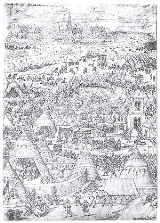
Siege of Vienna

Encyclopedia
The Siege of Vienna in 1529 was the first attempt by the Ottoman Empire
, led by Suleiman the Magnificent
, to capture the city of Vienna
, Austria. The siege signalled the pinnacle of the Ottoman Empire's power, the maximum extent of Ottoman expansion in
central Europe
, and was the result of a long-lasting rivalry with Europe. Thereafter, 150 years of bitter military tension and reciprocal attacks ensued, culminating in the Battle of Vienna
in 1683, which marked the start of the Great Turkish War
by European powers to remove the Ottoman presence.
The Ottoman failure to capture Vienna in 1529 turned the tide against almost a century of unchecked conquest throughout eastern and central Europe, which had previously directly annexed Central Hungary
and established a vassal state in Transylvania
in the wake of the Battle of Mohács
. According to Toynbee
, "The failure of the first [siege of Vienna] brought to a standstill the tide of Ottoman conquest which had been flooding up the Danube Valley for a century past."
There is speculation by some historians that Suleiman's main objective in 1529 was in actuality to assert Ottoman control over the whole of Hungary, the western part of which (known as Royal Hungary
) was under Habsburg control. The decision to attack Vienna after such a long interval in Suleiman's European campaign is viewed as an opportunistic manoeuvre after his decisive victory in Hungary. Other scholars theorize that the suppression of Hungary simply marked the prologue to a later, premeditated invasion of Europe.
, Campaign of Ferdinand I, Long War (Ottoman wars)
In August 1526, Sultan Suleiman I decisively defeated the forces of King
Louis II of Hungary at the Battle of Mohács
, paving the way for the Ottomans to gain control of south-eastern Hungary. The Archduke of Austria, Ferdinand I of Habsburg
, who was the brother of Holy Roman Emperor Charles V
, claimed the vacant Hungarian throne in right of his wife, Anna of Bohemia and Hungary
, sister to the childless (and thus heirless) Louis II. Ferdinand won recognition only in western Hungary; while a noble called John Zápolya
, from a power-base in Transylvania
, challenged him for the crown and was recognised as king by Suleiman in return for accepting vassal status within the Ottoman Empire. Thus Hungary became divided into Royal Hungary
and Ottoman Hungary
up until 1700.
Following the Diet of Pozsony (modern Bratislava
) on 26 October, Ferdinand was declared King of Royal Hungary due to his marriage to Louis' sister and his own sister being the widow of Louis, who perished at Mohács. Ferdinand set out to enforce his claim on Hungary and captured Buda
in 1527, only to relinquish his hold on it in 1529 when an Ottoman counter-attack stripped Ferdinand of all his territorial gains.
, with the aim of securing control over all of Hungary and reducing the threat posed at his new borders by Ferdinand I
and the Holy Roman Empire
. Estimates of Suleiman's army vary widely from 120,000 to more than 300,000 men mentioned by various chroniclers. There is some tendency by later, 18th century European historians to exaggerate these figures to overstate the bravery of the outnumbered defenders of Vienna. As well as numerous units of Sipahi
, the elite mounted force of the Ottoman cavalry
, and thousands of janissaries
, the Ottoman army incorporated a contingent of Moldavia
. Suleiman acted as the commander-in-chief (as well as personally leading his force), and in April he appointed his Grand Vizier
(the highest Ottoman minister), a former Greek
slave called Ibrahim Pasha
, as Serasker
, a commander with powers to give orders in the sultan's name.
Suleiman launched his campaign on the 10th of May, 1529 and faced numerous obstacles from the onset. The spring rains that are characteristic of south-eastern Europe and the Balkans
were particularly heavy that year, causing flooding in Bulgaria
and rendering parts of the route used by the army barely passable. Many large-calibre cannons and artillery pieces became hopelessly mired or bogged down, leaving Suleiman no choice but to abandon them, while camels brought from the empire's Eastern provinces, unused to the difficult conditions, were lost in large numbers. Sickness and poor health became common amongst the ranks of the janissaries, claiming many lives along the perilous journey.
Suleiman arrived in Osijek
on the 6 August. On the 18th he reached the Mohács plain
, to be greeted by a substantial cavalry force led by John Zápolya
(which would later accompany Suleiman to Vienna), who paid him homage and helped him recapture several fortresses lost since the Battle of Mohács to the Austrians, including Buda
, which fell on the 8th of September. The only resistance came at Pozsony, where the Turkish fleet was bombarded as it sailed up the Danube.
pikemen and Spanish musketeers sent by Charles V
.
The Hofmeister of Austria
, Wilhelm von Roggendorf
, assumed charge of the defensive garrison, with operational command entrusted to a seventy-year-old German mercenary named Nicholas, Count of Salm
, who had distinguished himself at the Battle of Pavia
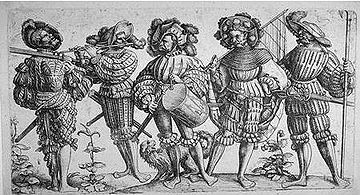
in 1525. Salm arrived in Vienna as head of the mercenary relief force and set about fortifying the three-hundred-year-old walls surrounding St. Stephen's Cathedral
, near which he established his headquarters. To ensure the city could withstand a lengthy siege, he blocked the four city gates and reinforced the walls, which in some places were no more than six feet thick, and erected earthen bastions and an inner earthen rampart
, levelling buildings where necessary to clear room for defences.
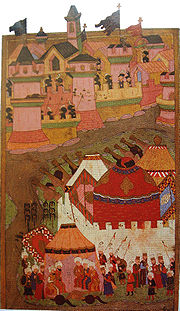
, or Sipahis, ill-suited for siege warfare. Three richly dressed Austrian prisoners were dispatched as emissaries by the Sultan to negotiate the city's surrender; Salm sent three richly dressed Muslims back without a response. Suleiman's 300 remaining light artillery pieces and cannons immediately commenced bombarding Vienna's walls, but it failed to significantly damage the Austrian defensive earthworks.
As the Ottoman army settled into position, the Austrian garrison launched sorties to disrupt the digging and mining of tunnels below the city's walls by Ottoman sapper
s, and in one case almost capturing Ibrahim Pasha
. The defensive forces detected and successfully detonated several mines intended to bring down the city's walls, subsequently dispatching 8,000 men on the 6th of October to attack the Ottoman mining operations, destroying many of the tunnels but sustaining serious losses when the confined spaces hindered their retreat into the city.
 More rain fell on the 11th of October, and with the Ottomans failing to make any breaches in the walls, the prospects for victory began to rapidly fade. In addition, Suleiman was facing critical shortages of supplies such as food and water; while casualties, sickness, and desertions began taking a toll on his army's ranks. The janissaries began voicing their displeasure at the progression of events, demanding a decision on whether to remain or abandon the siege. The Sultan convened an official council on the 12th of October to deliberate the matter. It was decided to
attempt one final, major assault on Vienna: an "all or nothing" gamble. Extra rewards were offered to the troops. However, this assault was also beaten back as once again, the arquebus
es and long pikes of the defenders prevailed.
Unseasonably heavy snowfall made conditions go from bad to worse. The Ottoman retreat turned into a disaster with much of the baggage and artillery abandoned or lost in rough conditions, as were many prisoners. The receding army suffered an attack at Pozsony (modern Bratislava
), a short distance from Vienna, as Suleiman's force made its way east back to Ottoman Hungary
.
 Some historians speculate that Suleiman's final assault wasn't necessarily intended to take the city but to cause as much damage as possible and weaken it for a later attack, a tactic he had employed at Buda
in 1526. Suleiman would lead another campaign against Vienna in 1532, but it never truly materialised as his force was stalled by the Croatian
Captain Nikola Jurišić
during the Siege of Güns
(Kőszeg). Nikola Jurišić with only 700-800 Croatian soldiers managed to delay his force until winter closed in. Charles V, now largely aware of Vienna's vulnerability and weakened state, assembled 80,000 troops to confront the Ottoman force. Instead of going ahead with a second siege attempt the Ottoman force turned back, laying waste to the south-eastern Austrian state of Styria in their retreat. The two Viennese campaigns in essence marked the extreme limit of Ottoman logistical capability to field large armies deep in central and western Europe at the time. The army made its way back to Constantinople
where it was stationed for the winter, so that its troops could attend to their fiefdom
s and recruit for the next year's campaigning.
The invasion and its climactic siege exacted a heavy toll upon both sides, with tens of thousands of soldiers and civilians left dead in its wake. However, it was a milestone which marked the end of Suleiman's expansion toward the centre of Europe and arguably the beginning of the stagnation and decline
of the Ottoman Empire
as the dominant power of the Renaissance
world. The German historian Robert Adolf Kann remarked: "The delivery of Vienna by a brave garrison under Count Niklas Salm in 1529, was probably a greater though less spectacular achievement than the liberation five generations later brought about primarily by the efforts of a rather large army of combined imperial and Polish forces".
Suleiman's retreat however did not mark a complete failure. The campaign underlined and maintained Ottoman control of southern Hungary and left behind a trail of collateral damage in the neighbouring Habsburg Hungary
and Austria that impaired Ferdinand's capacity to mount a sustained counter-attack. Suleiman's achievement was to consolidate the gains of 1526 and further establish the puppet kingdom of John Zápolya
as a buffer state against the Holy Roman Empire
.
Ferdinand I
erected a funeral monument for the German mercenary Niklas Graf Salm, head of the mercenary relief force dispatched to Vienna, as a token of appreciation to his efforts. Niklas survived the initial siege attempt but had been injured during the last Ottoman assault and died on 4 May 1530. The Renaissance sarcophagus
is now on display in the baptistery of the Votivkirche
cathedral in Vienna. Ferdinand's son, Maximilian II
, later built the Castle of Neugebaeude on the spot where Suleiman is said to have pitched his tent during the siege.
Once the Ottoman empire's drive in Central Europe was checked, the Ottomans directed their efforts towards the Mediterranean. Having successfully forced out the Knights of Saint John from Rhodes in the Second Siege of Rhodes
in 1522, the stage was set for a climatic battle in 1565 between the Christian forces of the Knights Hospitaller
and the Maltese
in the Siege of Malta
.
Ottoman Empire
The Ottoman EmpireIt was usually referred to as the "Ottoman Empire", the "Turkish Empire", the "Ottoman Caliphate" or more commonly "Turkey" by its contemporaries...
, led by Suleiman the Magnificent
Suleiman the Magnificent
Suleiman I was the tenth and longest-reigning Sultan of the Ottoman Empire, from 1520 to his death in 1566. He is known in the West as Suleiman the Magnificent and in the East, as "The Lawgiver" , for his complete reconstruction of the Ottoman legal system...
, to capture the city of Vienna
Vienna
Vienna is the capital and largest city of the Republic of Austria and one of the nine states of Austria. Vienna is Austria's primary city, with a population of about 1.723 million , and is by far the largest city in Austria, as well as its cultural, economic, and political centre...
, Austria. The siege signalled the pinnacle of the Ottoman Empire's power, the maximum extent of Ottoman expansion in
Ottoman wars in Europe
The wars of the Ottoman Empire in Europe are also sometimes referred to as the Ottoman Wars or as Turkish Wars, particularly in older, European texts.- Rise :...
central Europe
Central Europe
Central Europe or alternatively Middle Europe is a region of the European continent lying between the variously defined areas of Eastern and Western Europe...
, and was the result of a long-lasting rivalry with Europe. Thereafter, 150 years of bitter military tension and reciprocal attacks ensued, culminating in the Battle of Vienna
Battle of Vienna
The Battle of Vienna took place on 11 and 12 September 1683 after Vienna had been besieged by the Ottoman Empire for two months...
in 1683, which marked the start of the Great Turkish War
Great Turkish War
The Great Turkish War refers to a series of conflicts between the Ottoman Empire and contemporary European powers, then joined into a Holy League, during the second half of the 17th century.-1667–1683:...
by European powers to remove the Ottoman presence.
The Ottoman failure to capture Vienna in 1529 turned the tide against almost a century of unchecked conquest throughout eastern and central Europe, which had previously directly annexed Central Hungary
Ottoman Hungary
History of Ottoman Hungary refers to the history of parts of the Ottoman Empire situated in what today is Hungary, in the period from 1541 to 1699.-History:...
and established a vassal state in Transylvania
Transylvania
Transylvania is a historical region in the central part of Romania. Bounded on the east and south by the Carpathian mountain range, historical Transylvania extended in the west to the Apuseni Mountains; however, the term sometimes encompasses not only Transylvania proper, but also the historical...
in the wake of the Battle of Mohács
Battle of Mohács
The Battle of Mohács was fought on August 29, 1526 near Mohács, Hungary. In the battle, forces of the Kingdom of Hungary led by King Louis II of Hungary and Bohemia were defeated by forces of the Ottoman Empire led by Sultan Suleiman the Magnificent....
. According to Toynbee
Arnold J. Toynbee
Arnold Joseph Toynbee CH was a British historian whose twelve-volume analysis of the rise and fall of civilizations, A Study of History, 1934–1961, was a synthesis of world history, a metahistory based on universal rhythms of rise, flowering and decline, which examined history from a global...
, "The failure of the first [siege of Vienna] brought to a standstill the tide of Ottoman conquest which had been flooding up the Danube Valley for a century past."
There is speculation by some historians that Suleiman's main objective in 1529 was in actuality to assert Ottoman control over the whole of Hungary, the western part of which (known as Royal Hungary
Royal Hungary
The Kingdom of Hungary between 1538 and 1867 was part of the lands of the Habsburg Monarchy, while outside the Holy Roman Empire.After Battle of Mohács, the country was ruled by two crowned kings . They divided the kingdom in 1538...
) was under Habsburg control. The decision to attack Vienna after such a long interval in Suleiman's European campaign is viewed as an opportunistic manoeuvre after his decisive victory in Hungary. Other scholars theorize that the suppression of Hungary simply marked the prologue to a later, premeditated invasion of Europe.
Background
Main article in Battle of MohácsBattle of Mohács
The Battle of Mohács was fought on August 29, 1526 near Mohács, Hungary. In the battle, forces of the Kingdom of Hungary led by King Louis II of Hungary and Bohemia were defeated by forces of the Ottoman Empire led by Sultan Suleiman the Magnificent....
, Campaign of Ferdinand I, Long War (Ottoman wars)
Long War (Ottoman wars)
The Long War took place from 1591 or 1593 to 1604 or 1606 and was one of the numerous military conflicts between the Habsburg Monarchy and the Ottoman Empire that developed after the Battle of Mohács.- History :The major participants of this war were the Habsburg Monarchy ,...
In August 1526, Sultan Suleiman I decisively defeated the forces of King
Monarch
A monarch is the person who heads a monarchy. This is a form of government in which a state or polity is ruled or controlled by an individual who typically inherits the throne by birth and occasionally rules for life or until abdication...
Louis II of Hungary at the Battle of Mohács
Battle of Mohács
The Battle of Mohács was fought on August 29, 1526 near Mohács, Hungary. In the battle, forces of the Kingdom of Hungary led by King Louis II of Hungary and Bohemia were defeated by forces of the Ottoman Empire led by Sultan Suleiman the Magnificent....
, paving the way for the Ottomans to gain control of south-eastern Hungary. The Archduke of Austria, Ferdinand I of Habsburg
Ferdinand I, Holy Roman Emperor
Ferdinand I was Holy Roman Emperor from 1558 and king of Bohemia and Hungary from 1526 until his death. Before his accession, he ruled the Austrian hereditary lands of the Habsburgs in the name of his elder brother, Charles V, Holy Roman Emperor.The key events during his reign were the contest...
, who was the brother of Holy Roman Emperor Charles V
Charles V, Holy Roman Emperor
Charles V was ruler of the Holy Roman Empire from 1519 and, as Charles I, of the Spanish Empire from 1516 until his voluntary retirement and abdication in favor of his younger brother Ferdinand I and his son Philip II in 1556.As...
, claimed the vacant Hungarian throne in right of his wife, Anna of Bohemia and Hungary
Anna of Bohemia and Hungary
Anna of Bohemia and Hungary, also sometimes known as Anna Jagellonica was, by marriage to Ferdinand I, King of the Romans and later Holy Roman Emperor, Queen of the Romans.-Family:She was the elder child and only daughter of king Vladislaus II of Bohemia and Hungary and his third...
, sister to the childless (and thus heirless) Louis II. Ferdinand won recognition only in western Hungary; while a noble called John Zápolya
John Zápolya
John Zápolya was King of Hungary from 1526 to 1540. His rule was disputed by Archduke Ferdinand I, who also claimed the title King of Hungary between 1526 and 1540. He was the voivode of Transylvania before his coronation.- Biography :...
, from a power-base in Transylvania
Transylvania
Transylvania is a historical region in the central part of Romania. Bounded on the east and south by the Carpathian mountain range, historical Transylvania extended in the west to the Apuseni Mountains; however, the term sometimes encompasses not only Transylvania proper, but also the historical...
, challenged him for the crown and was recognised as king by Suleiman in return for accepting vassal status within the Ottoman Empire. Thus Hungary became divided into Royal Hungary
Royal Hungary
The Kingdom of Hungary between 1538 and 1867 was part of the lands of the Habsburg Monarchy, while outside the Holy Roman Empire.After Battle of Mohács, the country was ruled by two crowned kings . They divided the kingdom in 1538...
and Ottoman Hungary
Ottoman Hungary
History of Ottoman Hungary refers to the history of parts of the Ottoman Empire situated in what today is Hungary, in the period from 1541 to 1699.-History:...
up until 1700.
Following the Diet of Pozsony (modern Bratislava
Bratislava
Bratislava is the capital of Slovakia and, with a population of about 431,000, also the country's largest city. Bratislava is in southwestern Slovakia on both banks of the Danube River. Bordering Austria and Hungary, it is the only national capital that borders two independent countries.Bratislava...
) on 26 October, Ferdinand was declared King of Royal Hungary due to his marriage to Louis' sister and his own sister being the widow of Louis, who perished at Mohács. Ferdinand set out to enforce his claim on Hungary and captured Buda
Buda
For detailed information see: History of Buda CastleBuda is the western part of the Hungarian capital Budapest on the west bank of the Danube. The name Buda takes its name from the name of Bleda the Hun ruler, whose name is also Buda in Hungarian.Buda comprises about one-third of Budapest's...
in 1527, only to relinquish his hold on it in 1529 when an Ottoman counter-attack stripped Ferdinand of all his territorial gains.
Ottoman army
In the spring of 1529, Suleiman mustered a great army in Ottoman BulgariaHistory of early Ottoman Bulgaria
The history of Ottoman Bulgaria spans nearly 500 years, from the conquest of the Second Bulgarian Empire by the Ottoman Empire in 1396, to its liberation in 1878. Bulgarian territories were administrated as the Rumelia Eyalet. The Ottoman rule was a period marked by oppression and misgovernment and...
, with the aim of securing control over all of Hungary and reducing the threat posed at his new borders by Ferdinand I
Ferdinand I, Holy Roman Emperor
Ferdinand I was Holy Roman Emperor from 1558 and king of Bohemia and Hungary from 1526 until his death. Before his accession, he ruled the Austrian hereditary lands of the Habsburgs in the name of his elder brother, Charles V, Holy Roman Emperor.The key events during his reign were the contest...
and the Holy Roman Empire
Holy Roman Empire
The Holy Roman Empire was a realm that existed from 962 to 1806 in Central Europe.It was ruled by the Holy Roman Emperor. Its character changed during the Middle Ages and the Early Modern period, when the power of the emperor gradually weakened in favour of the princes...
. Estimates of Suleiman's army vary widely from 120,000 to more than 300,000 men mentioned by various chroniclers. There is some tendency by later, 18th century European historians to exaggerate these figures to overstate the bravery of the outnumbered defenders of Vienna. As well as numerous units of Sipahi
Sipahi
Sipahi was the name of several Ottoman cavalry corps...
, the elite mounted force of the Ottoman cavalry
Six Divisions of Cavalry
The Six Divisions of Cavalry was a corps of mounted elite soldiers in the Ottoman army. There were not really six but four divisions. Two of the six were sub-divisions...
, and thousands of janissaries
Janissary
The Janissaries were infantry units that formed the Ottoman sultan's household troops and bodyguards...
, the Ottoman army incorporated a contingent of Moldavia
Moldavia
Moldavia is a geographic and historical region and former principality in Eastern Europe, corresponding to the territory between the Eastern Carpathians and the Dniester river...
. Suleiman acted as the commander-in-chief (as well as personally leading his force), and in April he appointed his Grand Vizier
Grand Vizier
Grand Vizier, in Turkish Vezir-i Azam or Sadr-ı Azam , deriving from the Arabic word vizier , was the greatest minister of the Sultan, with absolute power of attorney and, in principle, dismissable only by the Sultan himself...
(the highest Ottoman minister), a former Greek
Greeks
The Greeks, also known as the Hellenes , are a nation and ethnic group native to Greece, Cyprus and neighboring regions. They also form a significant diaspora, with Greek communities established around the world....
slave called Ibrahim Pasha
Pargali Ibrahim Pasha
Pargali Ibrahim Pasha , also known as Frenk Ibrahim Pasha , Makbul Ibrahim Pasha , and referred to him as Maktul Ibrahim Pasha after his murder in the Topkapı Palace, was the first Grand Vizier in the Ottoman Empire appointed by Suleiman the Magnificent...
, as Serasker
Serasker
Serasker or Seraskier is a title formerly used in the Ottoman Empire for a Vizier who commanded the army, and later for the National Minister of Defence....
, a commander with powers to give orders in the sultan's name.
Suleiman launched his campaign on the 10th of May, 1529 and faced numerous obstacles from the onset. The spring rains that are characteristic of south-eastern Europe and the Balkans
Balkans
The Balkans is a geopolitical and cultural region of southeastern Europe...
were particularly heavy that year, causing flooding in Bulgaria
Bulgaria
Bulgaria , officially the Republic of Bulgaria , is a parliamentary democracy within a unitary constitutional republic in Southeast Europe. The country borders Romania to the north, Serbia and Macedonia to the west, Greece and Turkey to the south, as well as the Black Sea to the east...
and rendering parts of the route used by the army barely passable. Many large-calibre cannons and artillery pieces became hopelessly mired or bogged down, leaving Suleiman no choice but to abandon them, while camels brought from the empire's Eastern provinces, unused to the difficult conditions, were lost in large numbers. Sickness and poor health became common amongst the ranks of the janissaries, claiming many lives along the perilous journey.
Suleiman arrived in Osijek
Osijek
Osijek is the fourth largest city in Croatia with a population of 83,496 in 2011. It is the largest city and the economic and cultural centre of the eastern Croatian region of Slavonia, as well as the administrative centre of Osijek-Baranja county...
on the 6 August. On the 18th he reached the Mohács plain
Mohács
Mohács is a town in Baranya county, Hungary on the right bank of the Danube.-History:Two famous battles took place there:# Battle of Mohács, 1526# Battle of Mohács, 1687...
, to be greeted by a substantial cavalry force led by John Zápolya
John Zápolya
John Zápolya was King of Hungary from 1526 to 1540. His rule was disputed by Archduke Ferdinand I, who also claimed the title King of Hungary between 1526 and 1540. He was the voivode of Transylvania before his coronation.- Biography :...
(which would later accompany Suleiman to Vienna), who paid him homage and helped him recapture several fortresses lost since the Battle of Mohács to the Austrians, including Buda
Buda
For detailed information see: History of Buda CastleBuda is the western part of the Hungarian capital Budapest on the west bank of the Danube. The name Buda takes its name from the name of Bleda the Hun ruler, whose name is also Buda in Hungarian.Buda comprises about one-third of Budapest's...
, which fell on the 8th of September. The only resistance came at Pozsony, where the Turkish fleet was bombarded as it sailed up the Danube.
Defensive measures
As the Ottomans advanced towards Vienna, the city's population organised an ad-hoc resistance formed from local farmers, peasants and civilians determined to repel the inevitable attack who were supported by a variety of European mercenaries; namely German LandsknechtLandsknecht
Landsknechte were European, predominantly German mercenary pikemen and supporting foot soldiers from the late 15th to the late 16th century, and achieved the reputation for being the universal mercenary of Early modern Europe.-Etymology:The term is from German, Land "land, country" + Knecht...
pikemen and Spanish musketeers sent by Charles V
Charles V, Holy Roman Emperor
Charles V was ruler of the Holy Roman Empire from 1519 and, as Charles I, of the Spanish Empire from 1516 until his voluntary retirement and abdication in favor of his younger brother Ferdinand I and his son Philip II in 1556.As...
.
The Hofmeister of Austria
Hofmeister (office)
In medieval Europe, a Hofmeister was a house tutor, also responsible for the care of his students beyond their education....
, Wilhelm von Roggendorf
Wilhelm von Roggendorf
Wilhelm Freiherr von Roggendorf was an Austrian military commander and Hofmeister.He was a son of , and thus member of the ancient family from Styria, which ruled in Lower Austria since the midst 15th century....
, assumed charge of the defensive garrison, with operational command entrusted to a seventy-year-old German mercenary named Nicholas, Count of Salm
Nicholas, Count of Salm
Nicholas, Count of Salm was a Holy Roman Empire Imperial senior military commander ....
, who had distinguished himself at the Battle of Pavia
Battle of Pavia
The Battle of Pavia, fought on the morning of 24 February 1525, was the decisive engagement of the Italian War of 1521–26.A Spanish-Imperial army under the nominal command of Charles de Lannoy attacked the French army under the personal command of Francis I of France in the great hunting preserve...
in 1525. Salm arrived in Vienna as head of the mercenary relief force and set about fortifying the three-hundred-year-old walls surrounding St. Stephen's Cathedral
Stephansdom
St. Stephen's Cathedral is the mother church of the Archdiocese of Vienna and the seat of the Archbishop of Vienna, Christoph Cardinal Schönborn, OP...
, near which he established his headquarters. To ensure the city could withstand a lengthy siege, he blocked the four city gates and reinforced the walls, which in some places were no more than six feet thick, and erected earthen bastions and an inner earthen rampart
Defensive wall
A defensive wall is a fortification used to protect a city or settlement from potential aggressors. In ancient to modern times, they were used to enclose settlements...
, levelling buildings where necessary to clear room for defences.
Siege
The Ottoman army which arrived in late September had been somewhat depleted during the long advance into Austrian territory, leaving Suleiman short of camels and heavy artillery. Many of his troops arrived at Vienna in a poor state of health after the tribulations of a long march through the thick of the European wet season and of those fit to fight, a third were light cavalryLight cavalry
Light cavalry refers to lightly armed and lightly armored troops mounted on horses, as opposed to heavy cavalry, where the riders are heavily armored...
, or Sipahis, ill-suited for siege warfare. Three richly dressed Austrian prisoners were dispatched as emissaries by the Sultan to negotiate the city's surrender; Salm sent three richly dressed Muslims back without a response. Suleiman's 300 remaining light artillery pieces and cannons immediately commenced bombarding Vienna's walls, but it failed to significantly damage the Austrian defensive earthworks.
As the Ottoman army settled into position, the Austrian garrison launched sorties to disrupt the digging and mining of tunnels below the city's walls by Ottoman sapper
Sapper
A sapper, pioneer or combat engineer is a combatant soldier who performs a wide variety of combat engineering duties, typically including, but not limited to, bridge-building, laying or clearing minefields, demolitions, field defences, general construction and building, as well as road and airfield...
s, and in one case almost capturing Ibrahim Pasha
Pargali Ibrahim Pasha
Pargali Ibrahim Pasha , also known as Frenk Ibrahim Pasha , Makbul Ibrahim Pasha , and referred to him as Maktul Ibrahim Pasha after his murder in the Topkapı Palace, was the first Grand Vizier in the Ottoman Empire appointed by Suleiman the Magnificent...
. The defensive forces detected and successfully detonated several mines intended to bring down the city's walls, subsequently dispatching 8,000 men on the 6th of October to attack the Ottoman mining operations, destroying many of the tunnels but sustaining serious losses when the confined spaces hindered their retreat into the city.
attempt one final, major assault on Vienna: an "all or nothing" gamble. Extra rewards were offered to the troops. However, this assault was also beaten back as once again, the arquebus
Arquebus
The arquebus , or "hook tube", is an early muzzle-loaded firearm used in the 15th to 17th centuries. The word was originally modeled on the German hakenbüchse; this produced haquebute...
es and long pikes of the defenders prevailed.
Unseasonably heavy snowfall made conditions go from bad to worse. The Ottoman retreat turned into a disaster with much of the baggage and artillery abandoned or lost in rough conditions, as were many prisoners. The receding army suffered an attack at Pozsony (modern Bratislava
Bratislava
Bratislava is the capital of Slovakia and, with a population of about 431,000, also the country's largest city. Bratislava is in southwestern Slovakia on both banks of the Danube River. Bordering Austria and Hungary, it is the only national capital that borders two independent countries.Bratislava...
), a short distance from Vienna, as Suleiman's force made its way east back to Ottoman Hungary
Ottoman Hungary
History of Ottoman Hungary refers to the history of parts of the Ottoman Empire situated in what today is Hungary, in the period from 1541 to 1699.-History:...
.
Aftermath
Buda
For detailed information see: History of Buda CastleBuda is the western part of the Hungarian capital Budapest on the west bank of the Danube. The name Buda takes its name from the name of Bleda the Hun ruler, whose name is also Buda in Hungarian.Buda comprises about one-third of Budapest's...
in 1526. Suleiman would lead another campaign against Vienna in 1532, but it never truly materialised as his force was stalled by the Croatian
Croats
Croats are a South Slavic ethnic group mostly living in Croatia, Bosnia and Herzegovina and nearby countries. There are around 4 million Croats living inside Croatia and up to 4.5 million throughout the rest of the world. Responding to political, social and economic pressure, many Croats have...
Captain Nikola Jurišić
Nikola Jurišic
Baron Nikola Jurišić was a Croatian nobleman, soldier, and diplomat, who led the armies of the territory of the Croatian Krajina in defense against the invasion of the Ottoman Empire under Suleiman I, advancing towards Vienna.After the Battle of Mohács in 1526, Jurisic's vote helped Ferdinand of...
during the Siege of Güns
Siege of Güns
The Siege of Güns or Siege of Kőszeg was a siege of Kőszeg in the Kingdom of Hungary within Habsburg Monarchy. In the siege that happened in 1532, Croatian Captain Nikola Jurišić defended the small border fort of Kőszeg with only 700-800 Croatian soldiers with no cannons and few guns, preventing...
(Kőszeg). Nikola Jurišić with only 700-800 Croatian soldiers managed to delay his force until winter closed in. Charles V, now largely aware of Vienna's vulnerability and weakened state, assembled 80,000 troops to confront the Ottoman force. Instead of going ahead with a second siege attempt the Ottoman force turned back, laying waste to the south-eastern Austrian state of Styria in their retreat. The two Viennese campaigns in essence marked the extreme limit of Ottoman logistical capability to field large armies deep in central and western Europe at the time. The army made its way back to Constantinople
Constantinople
Constantinople was the capital of the Roman, Eastern Roman, Byzantine, Latin, and Ottoman Empires. Throughout most of the Middle Ages, Constantinople was Europe's largest and wealthiest city.-Names:...
where it was stationed for the winter, so that its troops could attend to their fiefdom
Fiefdom
A fee was the central element of feudalism and consisted of heritable lands granted under one of several varieties of feudal tenure by an overlord to a vassal who held it in fealty in return for a form of feudal allegiance and service, usually given by the...
s and recruit for the next year's campaigning.
The invasion and its climactic siege exacted a heavy toll upon both sides, with tens of thousands of soldiers and civilians left dead in its wake. However, it was a milestone which marked the end of Suleiman's expansion toward the centre of Europe and arguably the beginning of the stagnation and decline
Stagnation of the Ottoman Empire
The Stagnation of the Ottoman Empire is the period following the Growth of the Ottoman Empire . During this period the empire continued to have military might. The next period would be shaped by the decline of their military power which followed the loss of huge territories...
of the Ottoman Empire
Ottoman Empire
The Ottoman EmpireIt was usually referred to as the "Ottoman Empire", the "Turkish Empire", the "Ottoman Caliphate" or more commonly "Turkey" by its contemporaries...
as the dominant power of the Renaissance
Renaissance
The Renaissance was a cultural movement that spanned roughly the 14th to the 17th century, beginning in Italy in the Late Middle Ages and later spreading to the rest of Europe. The term is also used more loosely to refer to the historical era, but since the changes of the Renaissance were not...
world. The German historian Robert Adolf Kann remarked: "The delivery of Vienna by a brave garrison under Count Niklas Salm in 1529, was probably a greater though less spectacular achievement than the liberation five generations later brought about primarily by the efforts of a rather large army of combined imperial and Polish forces".
Suleiman's retreat however did not mark a complete failure. The campaign underlined and maintained Ottoman control of southern Hungary and left behind a trail of collateral damage in the neighbouring Habsburg Hungary
Royal Hungary
The Kingdom of Hungary between 1538 and 1867 was part of the lands of the Habsburg Monarchy, while outside the Holy Roman Empire.After Battle of Mohács, the country was ruled by two crowned kings . They divided the kingdom in 1538...
and Austria that impaired Ferdinand's capacity to mount a sustained counter-attack. Suleiman's achievement was to consolidate the gains of 1526 and further establish the puppet kingdom of John Zápolya
John Zápolya
John Zápolya was King of Hungary from 1526 to 1540. His rule was disputed by Archduke Ferdinand I, who also claimed the title King of Hungary between 1526 and 1540. He was the voivode of Transylvania before his coronation.- Biography :...
as a buffer state against the Holy Roman Empire
Holy Roman Empire
The Holy Roman Empire was a realm that existed from 962 to 1806 in Central Europe.It was ruled by the Holy Roman Emperor. Its character changed during the Middle Ages and the Early Modern period, when the power of the emperor gradually weakened in favour of the princes...
.
Ferdinand I
Ferdinand I, Holy Roman Emperor
Ferdinand I was Holy Roman Emperor from 1558 and king of Bohemia and Hungary from 1526 until his death. Before his accession, he ruled the Austrian hereditary lands of the Habsburgs in the name of his elder brother, Charles V, Holy Roman Emperor.The key events during his reign were the contest...
erected a funeral monument for the German mercenary Niklas Graf Salm, head of the mercenary relief force dispatched to Vienna, as a token of appreciation to his efforts. Niklas survived the initial siege attempt but had been injured during the last Ottoman assault and died on 4 May 1530. The Renaissance sarcophagus
Sarcophagus
A sarcophagus is a funeral receptacle for a corpse, most commonly carved or cut from stone. The word "sarcophagus" comes from the Greek σαρξ sarx meaning "flesh", and φαγειν phagein meaning "to eat", hence sarkophagus means "flesh-eating"; from the phrase lithos sarkophagos...
is now on display in the baptistery of the Votivkirche
Votivkirche
The Votive Church in Vienna, Austria, is one of the most important neo-Gothic religious architectural sites in the world.- Origin :Located on Ringstraße in the Alsergrund district near the University of Vienna, the origin of the church derives from a knife-attack on Emperor Franz Joseph by...
cathedral in Vienna. Ferdinand's son, Maximilian II
Maximilian II, Holy Roman Emperor
Maximilian II was king of Bohemia and king of the Romans from 1562, king of Hungary and Croatia from 1563, emperor of the Holy Roman Empire of the German Nation from 1564 until his death...
, later built the Castle of Neugebaeude on the spot where Suleiman is said to have pitched his tent during the siege.
Once the Ottoman empire's drive in Central Europe was checked, the Ottomans directed their efforts towards the Mediterranean. Having successfully forced out the Knights of Saint John from Rhodes in the Second Siege of Rhodes
Siege of Rhodes (1522)
The Siege of Rhodes of 1522 was the second and ultimately successful attempt by the Ottoman Empire to expel the Knights of Rhodes from their island stronghold and thereby secure Ottoman control of the Eastern Mediterranean. The first siege, in 1480, had been unsuccessful.-Setting:The Knights of St...
in 1522, the stage was set for a climatic battle in 1565 between the Christian forces of the Knights Hospitaller
Knights Hospitaller
The Sovereign Military Hospitaller Order of Saint John of Jerusalem of Rhodes and of Malta , also known as the Sovereign Military Order of Malta , Order of Malta or Knights of Malta, is a Roman Catholic lay religious order, traditionally of military, chivalrous, noble nature. It is the world's...
and the Maltese
Maltese people
The Maltese are an ethnic group indigenous to the Southern European nation of Malta, and identified with the Maltese language. Malta is an island in the middle of the Mediterranean Sea...
in the Siege of Malta
Siege of Malta (1565)
The Siege of Malta took place in 1565 when the Ottoman Empire invaded the island, then held by the Knights Hospitaller .The Knights, together with between 4-5,000 Maltese men,...
.