

Spaceflight records

Encyclopedia
This is a list of spaceflight records. Most of these records relate to human spaceflight
s, but some unmanned and canine records are included.
* Dual citizen.
Human spaceflight
Human spaceflight is spaceflight with humans on the spacecraft. When a spacecraft is manned, it can be piloted directly, as opposed to machine or robotic space probes and remotely-controlled satellites....
s, but some unmanned and canine records are included.
First independent human spaceflight by country
| Country | Mission and launch vehicle | Crew | Date | Type |
|---|---|---|---|---|
 Soviet Union USSR Soviet Union USSR |
Vostok 1 Vostok 1 Vostok 1 was the first spaceflight in the Vostok program and the first human spaceflight in history. The Vostok 3KA spacecraft was launched on April 12, 1961. The flight took Yuri Gagarin, a cosmonaut from the Soviet Union, into space. The flight marked the first time that a human entered outer... , Vostok-K Vostok-K The Vostok-K , GRAU index 8K72K was an expendable carrier rocket used by the Soviet Union for thirteen launches between 1960 and 1964, six of which were manned. It was derived from the earlier Vostok-L, however it featured uprated engines to improve performance, and enlarge its payload capacity... |
Yuri Gagarin Yuri Gagarin Yuri Alekseyevich Gagarin was a Soviet pilot and cosmonaut. He was the first human to journey into outer space, when his Vostok spacecraft completed an orbit of the Earth on April 12, 1961.... |
12 April 1961 | Orbital |
 United States USA United States USA |
Freedom 7, Mercury-Redstone Mercury-Redstone Launch Vehicle The Mercury-Redstone Launch Vehicle, designed for NASA's Project Mercury, was the first American manned space booster. It was used for six sub-orbital Mercury flights from 1960–61; culminating with the launch of the first, and 11 weeks later, the second American in space.A member of the... |
Alan Shepard Alan Shepard Alan Bartlett Shepard, Jr. was an American naval aviator, test pilot, flag officer, and NASA astronaut who in 1961 became the second person, and the first American, in space. This Mercury flight was designed to enter space, but not to achieve orbit... |
5 May 1961 | Sub-orbital |
 Russia Russia Russia Russia (as successor of the USSR) |
Soyuz TM-14 Soyuz TM-14 -Mission highlights:14th expedition to Mir. Included astronaut from Germany.The First Russian Soyuz mission after the collapse of the Soviet Union.... , Soyuz-U2 Soyuz-U2 The Soyuz-U2 was a Soviet, later Russian, carrier rocket. It was derived from the Soyuz-U, and a member of the R-7 family of rockets... |
Klaus-Dietrich Flade Klaus-Dietrich Flade Klaus-Dietrich Flade is a German pilot and former German Aerospace Center astronaut who visited the Mir space station in 1992 aboard the Soyuz TM-14 mission, returning to Earth a week later aboard Soyuz TM-13.-Biography:... Aleksandr Kaleri Aleksandr Viktorenko |
17 March 1992 | Orbital |
 Mainland China China Mainland China China |
Shenzhou 5 Shenzhou 5 Shenzhou 5 — was the first human spaceflight mission of the People's Republic of China , launched on October 15, 2003. The Shenzhou spacecraft was launched on a Long March 2F launch vehicle. There had been four previous flights of unmanned Shenzhou missions since 1999... , Long March 2F Long March 2F The Long March 2F , also known as the CZ-2F, LM-2F and Shenjian, is a Chinese manned orbital carrier rocket, part of the Long March rocket family. Designed to launch manned Shenzhou spacecraft, the Long March 2F is a man-rated two-stage version of the Long March 2E rocket, which in turn was based... |
Yáng Lìwěi Yang Liwei Yáng Lìwěi is a Chinese major general and military pilot and a CNSA astronaut. He was the first man sent into space by the Chinese space program and his mission, Shenzhou 5, made China the third country to independently send people into space.-Background:... |
15 October 2003 | Orbital |
Ten longest human space flights
- Valeri Polyakov, launched 8 January 1994 (Soyuz TM-18Soyuz TM-18Soyuz TM-18 was launch from Baikonur Cosmodrome and landing 112 km north of Arkalyk. TM-18 was a two day solo flight that docked with the Mir space station on January 10, 1994. The three cosmonauts became the 15th resident crew of the MIR...
), stayed at MirMirMir was a space station operated in low Earth orbit from 1986 to 2001, at first by the Soviet Union and then by Russia. Assembled in orbit from 1986 to 1996, Mir was the first modular space station and had a greater mass than that of any previous spacecraft, holding the record for the...
for 437.7 days, during which he orbited the Earth about 7,075 times and traveled 300765000 km (186,887,171.1 mi), returning 22 March 1995 (Soyuz TM-20Soyuz TM-20-Crew:-Mission highlights:20th expedition to Mir.Carried 10 kg of equipment for use by Merbold in ESA’s month-long Euromir94 experiment program. During automatic approach to Mir’s front port, the...
).
- Sergei AvdeyevSergei AvdeyevSergei Avdeyev is a Russian engineer and cosmonaut.Avdeyev was born in Chapayevsk, Samara Oblast , Russian SFSR. He graduated from in 1979 as an engineer-physicist. From 1979 to 1987 he worked as an engineer for NPO Energiya...
, launched 13 August 1998 (Soyuz TM-28Soyuz TM-28TM-28 was a Soyuz mission to the Mir space station.-Crew:-Mission Accomplishments:*Docked with Mir*Baturin is first Russian politician in space...
), stayed at MirMirMir was a space station operated in low Earth orbit from 1986 to 2001, at first by the Soviet Union and then by Russia. Assembled in orbit from 1986 to 1996, Mir was the first modular space station and had a greater mass than that of any previous spacecraft, holding the record for the...
for 379.6 days, returned on 28 August 1999.
- Vladimir TitovVladimir TitovVladimir Georgiyevich Titov , Colonel, Russian Air Force, Ret., and former Russian cosmonaut was born January 1, 1947, in Sretensk, in the Zabaykalsky Krai region of Russia. He is married to the former Alexandra Kozlova of Ivanovo Region, Russia...
and Musa Manarov, launched 21 December 1987 (Soyuz TM-4Soyuz TM-4-Mission parameters:*Mass: 7070 kg*Perigee: 337 km*Apogee: 357 km*Inclination: 51.6°*Period: 91.5 minutes-Mission highlights:...
), stayed at MirMirMir was a space station operated in low Earth orbit from 1986 to 2001, at first by the Soviet Union and then by Russia. Assembled in orbit from 1986 to 1996, Mir was the first modular space station and had a greater mass than that of any previous spacecraft, holding the record for the...
for 364.9 days, returned on 21 December 1988.
- Yuri RomanenkoYuri RomanenkoYury Viktorovich Romanenko is a former Soviet cosmonaut, twice Hero of the Soviet Union . Over his career, Yury Romanenko spent a total of 430 days 20 hours 21 minutes 30 seconds in space and 18 hours in space walks. In 1987 he was a resident of the Mir space station, launching on Soyuz TM-2 and...
, launched 5 February 1987 (Soyuz TM-2Soyuz TM-2-Mission parameters:*Mass: 7100 kg*Perigee: 341 km*Apogee: 365 km*Inclination: 51.6°*Period: 91.6 minutes-Mission highlights:...
), stayed at MirMirMir was a space station operated in low Earth orbit from 1986 to 2001, at first by the Soviet Union and then by Russia. Assembled in orbit from 1986 to 1996, Mir was the first modular space station and had a greater mass than that of any previous spacecraft, holding the record for the...
for 326.5 days, returned on 29 December 1987.
- Sergei KrikalevSergei KrikalevSergei Konstantinovich Krikalev is a Russian cosmonaut and mechanical engineer. As a prominent rocket scientist, he has been veteran of six space flights and currently has spent more time in space than any other human being.On August 16, 2005 at 1:44 a.m...
, launched 18 May 1991 (Soyuz TM-12Soyuz TM-12-Mission highlights:12th expedition to Mir. Included first Briton in space.The Derbents welcomed aboard Mir Anatoli Artsebarski, Sergei Krikalev , and British cosmonaut-researcher Helen Sharman, who was aboard as part of Project Juno, a cooperative venture partly sponsored by British private...
), stayed at MirMirMir was a space station operated in low Earth orbit from 1986 to 2001, at first by the Soviet Union and then by Russia. Assembled in orbit from 1986 to 1996, Mir was the first modular space station and had a greater mass than that of any previous spacecraft, holding the record for the...
for 311.8 days, returned on 25 March 1992.
- Valeri Polyakov, launched 29 August 1988 (Soyuz TM-6Soyuz TM-6Dr. Valeri Polyakov remained behind on Mir with cosmonauts Musa Manarov and Vladimir Titov when Mohmand and Lyakhov returned to Earth in Soyuz TM-5....
), stayed at MirMirMir was a space station operated in low Earth orbit from 1986 to 2001, at first by the Soviet Union and then by Russia. Assembled in orbit from 1986 to 1996, Mir was the first modular space station and had a greater mass than that of any previous spacecraft, holding the record for the...
for 240.9 days, returned on 27 April 1989.
- Michael Lopez-AlegriaMichael Lopez-AlegriaMichael Eladio "LA" López-Alegría b. May 30, 1958, is a Spanish-American astronaut; a veteran of three Space Shuttle missions and one International Space Station mission...
and Mikhail TyurinMikhail TyurinMikhail Vladislavovich Tyurin is a Russian cosmonaut.-Personal data:Michael Tyurin lives in Korolev, a small city outside of Moscow. He was born March 2, 1960, in Kolomna, USSR where his parents still reside. He is married to Tatiana Anatoleyvna Tyurina. They have a daughter, Alexandra, born in...
launched 18 September 2006 (Soyuz TMA-9Soyuz TMA-9-Crew notes:Daisuke Enomoto Was originally scheduled to be the spaceflight participant, but on on 21 August 2006, he was determined to be unfit for the flight due to medical reasons, and replaced by Anousheh Ansari, his back-up crew member.-Docking with ISS:...
), stayed at ISSInternational Space StationThe International Space Station is a habitable, artificial satellite in low Earth orbit. The ISS follows the Salyut, Almaz, Cosmos, Skylab, and Mir space stations, as the 11th space station launched, not including the Genesis I and II prototypes...
for 215.4 days, returned on 21 April 2007. This flight is also the longest of any American.
- Talgat MusabayevTalgat MusabayevTalgat Amangeldyuly Musabayev , is a Kazakh test pilot and former cosmonaut who flew on three spaceflights. His first two spaceflights were long-duration stays aboard the Russian space station Mir. His third spaceflight was a short duration visiting mission to the International Space Station, which...
and Nikolai BudarinNikolai BudarinNikolai Mikhailovich Budarin is a Russian cosmonaut, a veteran of three extended space missions aboard the Mir Space Station and the International Space Station...
, launched 29 January 1998 (Soyuz TM-27Soyuz TM-27-Mission accomplishments:*Docked with Mir*Exchange part of crew*Carried out French mission PEGASE*Conducted routine science experiments-EVA schedule:*03.03.1998 aborted due to faulty hatch*01.04.1998 *06.04.1998 *11.04.1998...
), stayed at MirMirMir was a space station operated in low Earth orbit from 1986 to 2001, at first by the Soviet Union and then by Russia. Assembled in orbit from 1986 to 1996, Mir was the first modular space station and had a greater mass than that of any previous spacecraft, holding the record for the...
for 207.5 days, returned on 25 August 1998.
- Gennady PadalkaGennady PadalkaGennady Ivanovich Padalka is a Russian Air Force officer and an RSA cosmonaut. As of June 2010, Gennady ranks sixth for career time in space due to his time on both Mir and the International Space Station....
, launched 26 March 2009 (Soyuz TMA-14Soyuz TMA-14The Soyuz TMA-14 was a Soyuz flight to the International Space Station, which launched on 26 March 2009. It transported two members of the Expedition 19 crew as well as spaceflight participant Charles Simonyi on his second self-funded flight to the space station...
), stayed at ISSInternational Space StationThe International Space Station is a habitable, artificial satellite in low Earth orbit. The ISS follows the Salyut, Almaz, Cosmos, Skylab, and Mir space stations, as the 11th space station launched, not including the Genesis I and II prototypes...
for 198.7 days, returned on 11 October 2009.
- Gennady PadalkaGennady PadalkaGennady Ivanovich Padalka is a Russian Air Force officer and an RSA cosmonaut. As of June 2010, Gennady ranks sixth for career time in space due to his time on both Mir and the International Space Station....
, launched 13 August 1998 (Soyuz TM-28Soyuz TM-28TM-28 was a Soyuz mission to the Mir space station.-Crew:-Mission Accomplishments:*Docked with Mir*Baturin is first Russian politician in space...
), stayed at MirMirMir was a space station operated in low Earth orbit from 1986 to 2001, at first by the Soviet Union and then by Russia. Assembled in orbit from 1986 to 1996, Mir was the first modular space station and had a greater mass than that of any previous spacecraft, holding the record for the...
for 198.7 days, returned on 28 February 1999.
Longest single flight by woman
- Sunita WilliamsSunita WilliamsSunita Williams is a United States Naval officer and a NASA astronaut. She was assigned to the International Space Station as a member of Expedition 14 and then joined Expedition 15...
holds the record for the longest single spaceflight by a woman at 195 days set on the International Space StationInternational Space StationThe International Space Station is a habitable, artificial satellite in low Earth orbit. The ISS follows the Salyut, Almaz, Cosmos, Skylab, and Mir space stations, as the 11th space station launched, not including the Genesis I and II prototypes...
Expedition 15Expedition 15Expedition 15 was the 15th expedition to the International Space Station . Four crew members participated in the expedition, although for most of the expedition's duration only three were on the station at any one time...
in 2007. She landed with STS-117STS-117- Crew Notes :The initial crew manifest before the Columbia accident was:Astronaut Mark Polansky was originally slated to pilot this mission, but was moved to STS-116, which he commanded...
, 22 June 2007.
Longest continuous occupation of space
- An international partnership consisting of Russia, the United States, the European Union, Canada, Japan and Brazil have jointly maintained a continuous manned presence in space since 31 October 2000 when Soyuz TM-31Soyuz TM-31Soyuz TM-31 was the first Soyuz spacecraft to dock with the International Space Station . Launched near the end of 2000 the Soyuz-TM spacecraft brought to ISS Expedition 1, the first long-duration ISS crew...
was launched on a mission to dock with the International Space StationInternational Space StationThe International Space Station is a habitable, artificial satellite in low Earth orbit. The ISS follows the Salyut, Almaz, Cosmos, Skylab, and Mir space stations, as the 11th space station launched, not including the Genesis I and II prototypes...
. The International Space Station has been in continuous use for . It broke the record of 9 years 358 days of the Soviet/Russian Space Station MirMirMir was a space station operated in low Earth orbit from 1986 to 2001, at first by the Soviet Union and then by Russia. Assembled in orbit from 1986 to 1996, Mir was the first modular space station and had a greater mass than that of any previous spacecraft, holding the record for the...
on 23 October 2010.
Longest solo flight
- Valery Bykovsky flew for 4 days and 23 hours solo in Vostok 5Vostok 5-Backup crew:-Reserve crew:-Mission parameters:*Mass *Apogee: *Perigee: *Inclination: 64.9°*Period: 88.4 minutes...
, 14–19 June 1963. The flight set a space endurance record which was broken in 1965 by the (non-solo) Gemini 7Gemini 7Gemini 7 was a 1965 manned spaceflight in NASA's Gemini program. It was the 4th manned Gemini flight, the 12th manned American flight and the 20th spaceflight of all time . The crew of Frank F. Borman, II and James A...
flight.
First animal in orbit
- LaikaLaikaLaika was a Soviet space dog that became the first animal to orbit the Earth – as well as the first animal to die in orbit.As little was known about the impact of spaceflight on living creatures at the time of Laika's mission, and the technology to de-orbit had not yet been developed, there...
was a Soviet female canineDogThe domestic dog is a domesticated form of the gray wolf, a member of the Canidae family of the order Carnivora. The term is used for both feral and pet varieties. The dog may have been the first animal to be domesticated, and has been the most widely kept working, hunting, and companion animal in...
launched on 3 November 1957 on Sputnik 2Sputnik 2Sputnik 2 , or Prosteyshiy Sputnik 2 ), was the second spacecraft launched into Earth orbit, on November 3, 1957, and the first to carry a living animal, a dog named Laika. Sputnik 2 was a 4-meter high cone-shaped capsule with a base diameter of 2 meters...
. The technology to deorbit had not yet been developed, so there was no expectation for survival. She died several hours into flight.
Longest canine single flight
- and were launched on 22 February 1966 on board Cosmos 110Cosmos 110Kosmos 110 was a Soviet spacecraft launched from the Baikonur Cosmodrome aboard a Soyuz rocket. It incorporated a re-entry body for landing scientific instruments and test objects...
and spent 22 days in orbit before landing on 16 March.
Longest time on lunar surface
- Eugene Cernan and Harrison SchmittHarrison SchmittHarrison Hagan "Jack" Schmitt is an American geologist, a retired NASA astronaut, university professor, and a former U.S. senator from New Mexico....
of the Apollo 17Apollo 17Apollo 17 was the eleventh and final manned mission in the American Apollo space program. Launched at 12:33 a.m. EST on December 7, 1972, with a three-member crew consisting of Commander Eugene Cernan, Command Module Pilot Ronald Evans, and Lunar Module Pilot Harrison Schmitt, Apollo 17 remains the...
mission stayed for 74 hours 59 minutes 40 seconds (over 3 days) on the lunar surface after they landed on 11 December 1972. They performed three EVA'sExtra-vehicular activityExtra-vehicular activity is work done by an astronaut away from the Earth, and outside of a spacecraft. The term most commonly applies to an EVA made outside a craft orbiting Earth , but also applies to an EVA made on the surface of the Moon...
(extra-vehicular activity) totalling 22 hours 3 minutes, 57 seconds (as commanders were always the first one out of the LM and the last to get back in, Cernan's EVA time was slightly longer).
Longest time in lunar orbit
- Ronald EvansRonald EvansRonald Ellwin Evans, Jr. was a NASA astronaut and one of only 24 people to have flown to the Moon. He also served as a captain in the United States Navy....
of Apollo 17Apollo 17Apollo 17 was the eleventh and final manned mission in the American Apollo space program. Launched at 12:33 a.m. EST on December 7, 1972, with a three-member crew consisting of Commander Eugene Cernan, Command Module Pilot Ronald Evans, and Lunar Module Pilot Harrison Schmitt, Apollo 17 remains the...
mission stayed in lunar orbit for 6 days and 4 hours (148 hours).
Farthest humans from Earth
- Apollo 13Apollo 13Apollo 13 was the seventh manned mission in the American Apollo space program and the third intended to land on the Moon. The craft was launched on April 11, 1970, at 13:13 CST. The landing was aborted after an oxygen tank exploded two days later, crippling the service module upon which the Command...
crew; Jim LovellJim LovellJames "Jim" Arthur Lovell, Jr., is a former NASA astronaut and a retired captain in the United States Navy, most famous as the commander of the Apollo 13 mission, which suffered a critical failure en route to the Moon but was brought back safely to Earth by the efforts of the crew and mission...
, Fred HaiseFred HaiseFred Wallace Haise, Jr. is an engineer and former NASA astronaut. He is one of only 24 people to have flown to the Moon. Having flown on Apollo 13, Haise was to be the sixth human to walk on the Moon, but the mission did not land due to a failure aboard the spacecraft.-Early life and...
, John Swigert while passing over the far side of the moon at an altitude of 254 km (157.8 mi) from the lunar surface, were 400171 km (248,655.3 mi) from Earth. This record breaking distance was reached at 0:21 UTC on 15 April 1970.
Highest altitude for manned non-lunar mission
- Gemini 11Gemini 11Gemini 11 was the ninth manned spaceflight mission of NASA's Project Gemini, which flew from September 12 to 15, 1966. It was the 17th manned American flight and the 25th spaceflight to that time . Astronauts Charles "Pete" Conrad, Jr. and Richard F. Gordon, Jr...
crew Charles Conrad, JrPete ConradCharles "Pete" Conrad, Jr. was an American naval officer, astronaut and engineer, and the third person to walk on the Moon during the Apollo 12 mission. He set an eight-day space endurance record along with command pilot Gordon Cooper on the Gemini 5 mission, and commanded the Gemini 11 mission...
and Richard F. Gordon, Jr.Richard F. Gordon, Jr.Richard Francis Gordon, Jr., Captain, USN, Ret. is a retired NASA astronaut. He is one of only 24 people to have flown to the Moon.-Military and flight experience:Gordon was born in Seattle, Washington...
fired their Agena Target VehicleAgena Target VehicleThe Agena Target Vehicle was an unmanned spacecraft used by NASA during its Gemini program to develop and practice orbital space rendezvous and docking techniques and to perform large orbital changes, in preparation for the Apollo program lunar missions.-Operations:Each ATV consisted of an Agena-D...
rocket engine on 14 September 1966, at 40 hours 30 minutes after liftoff and achieved an apogee altitude of 1374.1 km (853.8 mi).
Fastest
- The Apollo 10Apollo 10Apollo 10 was the fourth manned mission in the American Apollo space program. It was an F type mission—its purpose was to be a "dry run" for the Apollo 11 mission, testing all of the procedures and components of a Moon landing without actually landing on the Moon itself. The mission included the...
crew; Thomas StaffordThomas Patten StaffordThomas Patten Stafford is a retired American Air Force lieutenant general and former NASA astronaut. He flew aboard two Gemini space flights; and in 1969 was the commander of Apollo 10, the second manned mission to orbit the Moon and the first to fly a lunar module there.In 1975, Stafford was...
, John W. Young and Eugene Cernan achieved the highest speed relative to Earth ever attained by humans; 39,896 km/h (11.1 km/s, 24,790 mph, approx 0.0037 percent the speed of lightSpeed of lightThe speed of light in vacuum, usually denoted by c, is a physical constant important in many areas of physics. Its value is 299,792,458 metres per second, a figure that is exact since the length of the metre is defined from this constant and the international standard for time...
). The record was set 26 May 1969
Earliest-born to go into space
- Man - Georgy Beregovoy born 15 April 1921, on Soyuz 3 in 1968.
- Woman - Valentina TereshkovaValentina TereshkovaValentina Vladimirovna Tereshkova is a retired Soviet cosmonaut, and was the first woman in space. She was selected out of more than four hundred applicants, and then out of five finalists, to pilot Vostok 6 on the 16 June, 1963, becoming both the first woman and the first civilian to fly in...
born 6 March 1937, on Vostok 6 in 1963.
Youngest (age during space flight)
- Gherman TitovGherman TitovGherman Stepanovich Titov was a Soviet cosmonaut who, on August 6, 1961, became the second human to orbit the Earth aboard Vostok 2, preceded by Yuri Gagarin on Vostok 1...
, aged 25 years, on Vostok 2Vostok 2Vostok 2 was a Soviet space mission which carried cosmonaut Gherman Titov into orbit for a full day in order to study the effects of a more prolonged period of weightlessness on the human body...
on 6 August 1961.
Most spaceflights
- 7 spaceflights
- Franklin Chang-Diaz - Costa Rica/USA*
- Jerry L. RossJerry L. RossJerry Lynn Ross is a United States Air Force officer and a former NASA astronaut. He is a veteran of seven Space Shuttle missions, making him the record holder for most spaceflights .-Personal:Ross is married to the former Karen S. Pearson of Sheridan, Indiana. They have two children...
- USA
- 6 spaceflights
- John W. Young - USA
- Curtis BrownCurtis BrownCurtis Lee "Curt" Brown, Jr. is an engineer, former NASA astronaut and retired United States Air Force Colonel.Colonel Brown graduated from East Bladen High School in Elizabethtown, North Carolina in 1974 and received a Bachelor of Science degree in electrical engineering from the United States...
- USA - Michael FoaleMichael FoaleColin Michael Foale, CBE, PhD is a British-American astrophysicist with dual citizenship and a NASA astronaut. He is a veteran of six space shuttle missions and extended stays on both Mir and the International Space Station...
- Britain/USA* - Sergei KrikalevSergei KrikalevSergei Konstantinovich Krikalev is a Russian cosmonaut and mechanical engineer. As a prominent rocket scientist, he has been veteran of six space flights and currently has spent more time in space than any other human being.On August 16, 2005 at 1:44 a.m...
- Russia - Story MusgraveStory MusgraveFranklin Story Musgrave is an American physician and a retired NASA astronaut. He is currently a public speaker and consultant to both Disney's Imagineering group and Applied Minds in California.-Personal life:...
- USA - James Wetherbee - USA
Most time in space
- Man - Sergei KrikalevSergei KrikalevSergei Konstantinovich Krikalev is a Russian cosmonaut and mechanical engineer. As a prominent rocket scientist, he has been veteran of six space flights and currently has spent more time in space than any other human being.On August 16, 2005 at 1:44 a.m...
has spent 803 days, 9 hours and 39 minutes, or 2.2 years in space over the span of six spaceflights on SoyuzSoyuz spacecraftSoyuz , Union) is a series of spacecraft initially designed for the Soviet space programme by the Korolyov Design Bureau in the 1960s, and still in service today...
, the Space ShuttleSpace ShuttleThe Space Shuttle was a manned orbital rocket and spacecraft system operated by NASA on 135 missions from 1981 to 2011. The system combined rocket launch, orbital spacecraft, and re-entry spaceplane with modular add-ons...
, MirMirMir was a space station operated in low Earth orbit from 1986 to 2001, at first by the Soviet Union and then by Russia. Assembled in orbit from 1986 to 1996, Mir was the first modular space station and had a greater mass than that of any previous spacecraft, holding the record for the...
, and International Space StationInternational Space StationThe International Space Station is a habitable, artificial satellite in low Earth orbit. The ISS follows the Salyut, Almaz, Cosmos, Skylab, and Mir space stations, as the 11th space station launched, not including the Genesis I and II prototypes...
. - Woman - Peggy WhitsonPeggy WhitsonPeggy Annette Whitson is an American biochemistry researcher, NASA astronaut, and NASA's Chief Astronaut. Her first space mission was in 2002, with an extended stay aboard the International Space Station as a member of Expedition 5. Her second mission launched October 10, 2007, as the first female...
has spent 376 days, 17 hours and 22 minutes in space over the span of two spaceflights to the International Space StationInternational Space StationThe International Space Station is a habitable, artificial satellite in low Earth orbit. The ISS follows the Salyut, Almaz, Cosmos, Skylab, and Mir space stations, as the 11th space station launched, not including the Genesis I and II prototypes...
.
Most spacewalks
- Man - Anatoly SolovyevAnatoly SolovyevAnatoly Yakovlevich Solovyev is a former Soviet pilot, cosmonaut, and Colonel. Solovyev holds the world record on the number of spacewalks performed , and accumulated time spent spacewalking .- Family :...
, 16 spacewalks for total of 77 hours, 41 minutes (which is also the duration record). - Woman - Peggy WhitsonPeggy WhitsonPeggy Annette Whitson is an American biochemistry researcher, NASA astronaut, and NASA's Chief Astronaut. Her first space mission was in 2002, with an extended stay aboard the International Space Station as a member of Expedition 5. Her second mission launched October 10, 2007, as the first female...
, 6 spacewalks for a total time of 39 hours and 46 minutes.
Most spacewalks during a single mission
- Michael Lopez-AlegriaMichael Lopez-AlegriaMichael Eladio "LA" López-Alegría b. May 30, 1958, is a Spanish-American astronaut; a veteran of three Space Shuttle missions and one International Space Station mission...
, five spacewalks during Expedition 14Expedition 14Expedition 14 was the 14th expedition to the International Space Station . Commander Michael Lopez-Alegria, and flight engineer Mikhail Tyurin launched from Baikonur Cosmodrome on 18 September 2006, 04:09 UTC, aboard Soyuz TMA-9. They joined Thomas Reiter, who had arrived at the ISS on 6 July 2006...
on the ISS.
Human spaceflight firsts
| First | Person(s) | Mission | Country | Date |
|---|---|---|---|---|
| Person to reach space Person in orbit |
Yuri Gagarin Yuri Gagarin Yuri Alekseyevich Gagarin was a Soviet pilot and cosmonaut. He was the first human to journey into outer space, when his Vostok spacecraft completed an orbit of the Earth on April 12, 1961.... |
Vostok 1 Vostok 1 Vostok 1 was the first spaceflight in the Vostok program and the first human spaceflight in history. The Vostok 3KA spacecraft was launched on April 12, 1961. The flight took Yuri Gagarin, a cosmonaut from the Soviet Union, into space. The flight marked the first time that a human entered outer... |
Soviet Union USSR |
12 April 1961 |
| Person to land Splashdown (spacecraft landing) Splashdown is the method of landing a spacecraft by parachute in a body of water. It was used by American manned spacecraft prior to the Space Shuttle program. It is also possible for the Russian Soyuz spacecraft and Chinese Shenzhou spacecraft to land in water, though this is only a contingency... in a spacecraft after spaceflight |
Alan Shepard Alan Shepard Alan Bartlett Shepard, Jr. was an American naval aviator, test pilot, flag officer, and NASA astronaut who in 1961 became the second person, and the first American, in space. This Mercury flight was designed to enter space, but not to achieve orbit... |
Freedom 7 | United States USA |
5 May 1961 |
| Person in space for over 24 hours Multiple orbits spaceflight |
Gherman Titov Gherman Titov Gherman Stepanovich Titov was a Soviet cosmonaut who, on August 6, 1961, became the second human to orbit the Earth aboard Vostok 2, preceded by Yuri Gagarin on Vostok 1... |
Vostok 2 Vostok 2 Vostok 2 was a Soviet space mission which carried cosmonaut Gherman Titov into orbit for a full day in order to study the effects of a more prolonged period of weightlessness on the human body... |
Soviet Union USSR |
6 August 1961- 7 August 1961 |
| Person to land Splashdown (spacecraft landing) Splashdown is the method of landing a spacecraft by parachute in a body of water. It was used by American manned spacecraft prior to the Space Shuttle program. It is also possible for the Russian Soyuz spacecraft and Chinese Shenzhou spacecraft to land in water, though this is only a contingency... in a spacecraft after orbital flight |
John Glenn John Glenn John Herschel Glenn, Jr. is a former United States Marine Corps pilot, astronaut, and United States senator who was the first American to orbit the Earth and the third American in space. Glenn was a Marine Corps fighter pilot before joining NASA's Mercury program as a member of NASA's original... |
Friendship 7 | United States USA |
20 February 1962 |
| Group flight Adjacent orbits Spacecraft-to-spacecraft communications |
Andrian Nikolayev Andrian Nikolayev Andriyan Grigoryevich Nikolayev , was a Soviet cosmonaut. He was an ethnic Chuvash.- History :... Pavel Popovich Pavel Popovich - Biography :He was born in Uzyn, Kiev Oblast of Soviet Union . to Roman Porfirievich Popovich and Theodosia Kasyanovna Semyonov. He had two sisters and two brothers .... |
Vostok 3 Vostok 3 Vostok 3 was a spaceflight of the Soviet space program intended to determine the ability of the human body to function in conditions of weightlessness and test the endurance of the Vostok 3KA spacecraft over longer flights... Vostok 4 Vostok 4 Vostok 4 was a mission in the Soviet space program. It was launched a day after Vostok 3 with cosmonaut Pavel Popovich on board—the first time that more than one manned spacecraft were in orbit at the same time. The two Vostok capsules came within of one another and ship-to-ship radio contact was... |
Soviet Union USSR |
12 August 1962- 15 August 1962 |
| Woman in space Civilian in space |
Valentina Tereshkova Valentina Tereshkova Valentina Vladimirovna Tereshkova is a retired Soviet cosmonaut, and was the first woman in space. She was selected out of more than four hundred applicants, and then out of five finalists, to pilot Vostok 6 on the 16 June, 1963, becoming both the first woman and the first civilian to fly in... |
Vostok 6 Vostok 6 -Backup crew:-Reserve crew:Vostok VI-Mission parameters:*Mass: *Apogee: *Perigee: *Inclination: 64.9°*Period: 87.8 minutes9090... |
Soviet Union USSR |
16 June 1963- 19 June 1963 |
| Spaceflight (suborbital) by winged spacecraft | Joe Walker Joseph A. Walker Joseph Albert "Joe" Walker was an American NASA test pilot, and member of the U.S. Air Force Man In Space Soonest program. In 1963, he made two X-15 Experimental rocket aircraft flights beyond the altitude of 100 kilometers - at the edge of outer space... |
X-15 Flight 90 X-15 Flight 90 -Crew:-Mission parameters:*Mass: 15,195 kg fueled; 6,577 kg burnout; 6,260 kg landed*Maximum Altitude: 106.01 km*Range: 534 km*Burn Time: 84.6 seconds*Mach: 5.50*Launch Vehicle: NB-52B Bomber #008... |
United States USA |
19 July 1963 |
| Person to enter space twice (suborbital flights above 100 km) | Joe Walker Joseph A. Walker Joseph Albert "Joe" Walker was an American NASA test pilot, and member of the U.S. Air Force Man In Space Soonest program. In 1963, he made two X-15 Experimental rocket aircraft flights beyond the altitude of 100 kilometers - at the edge of outer space... |
X-15 Flights 90 X-15 Flight 90 -Crew:-Mission parameters:*Mass: 15,195 kg fueled; 6,577 kg burnout; 6,260 kg landed*Maximum Altitude: 106.01 km*Range: 534 km*Burn Time: 84.6 seconds*Mach: 5.50*Launch Vehicle: NB-52B Bomber #008... and 91 X-15 Flight 91 X-15 Flight 91 was a 1963 American human spaceflight mission, and the second and final flight in the program to achieve sub-orbital spaceflight: a flight over 100km in altitude. It was the first flight of a reused spacecraft, as plane number three flew the previous sub-orbital flight on July 19.... |
United States USA |
22 August 1963 |
| Three-person spaceflight, single spacecraft Persons to land in a spacecraft on hard ground |
Vladimir Komarov Konstantin Feoktistov Konstantin Feoktistov Konstantin Petrovich Feoktistov was a Soviet cosmonaut and an eminent space engineer. Feoktistov also wrote several books on space technology and exploration... Boris Yegorov Boris Yegorov Boris Borisovich Yegorov was a Soviet physician-cosmonaut and he became the first physician to make a space flight.Yegorov came from a medical background, with his father a prominent heart surgeon, and his mother an ophthalmologist. He also selected medicine as a career and graduated from the... |
Voskhod 1 Voskhod 1 Voskhod 1 was the seventh manned Soviet space flight. It achieved a number of "firsts" in the history of manned spaceflight, being the first space flight to carry more than one crewman into orbit, the first flight without the use of spacesuits, and the first to carry either an engineer or a... |
Soviet Union USSR |
12 October 1964- 13 October 1964 |
| Spacewalk |
Alexey Leonov | Voskhod 2 Voskhod 2 Voskhod 2 was a Soviet manned space mission in March 1965. Vostok-based Voskhod 3KD spacecraft with two crew members on board, Pavel Belyaev and Alexei Leonov, was equipped with an inflatable airlock... |
Soviet Union USSR |
18 March 1965 |
| Orbital maneuvers (change orbit) | Gus Grissom Gus Grissom Virgil Ivan Grissom , , better known as Gus Grissom, was one of the original NASA Project Mercury astronauts and a United States Air Force pilot... , John W. Young |
Gemini 3 Gemini 3 Gemini 3 was the first manned mission in NASA's Gemini program, the second American manned space program. On March 23, 1965, the spacecraft, nicknamed The Molly Brown, performed the seventh manned US spaceflight, and the 17th manned spaceflight overall... |
United States USA |
23 March 1965 |
| Person to fly two orbital spaceflights | Gordon Cooper Gordon Cooper Leroy Gordon Cooper, Jr. , also known as Gordon Cooper, was an American aeronautical engineer, test pilot and NASA astronaut. Cooper was one of the seven original astronauts in Project Mercury, the first manned space effort by the United States... |
Faith 7 Gemini 5 Gemini 5 Gemini 5 was a 1965 manned spaceflight in NASA's Gemini program. It was the third manned Gemini flight, the 11th manned American flight and the 19th spaceflight of all time... |
United States USA |
15 May 1963- 16 May 1963; 21 August 1965- 29 August 1965 |
| Persons to spend one week in space | Gordon Cooper Gordon Cooper Leroy Gordon Cooper, Jr. , also known as Gordon Cooper, was an American aeronautical engineer, test pilot and NASA astronaut. Cooper was one of the seven original astronauts in Project Mercury, the first manned space effort by the United States... Pete Conrad Pete Conrad Charles "Pete" Conrad, Jr. was an American naval officer, astronaut and engineer, and the third person to walk on the Moon during the Apollo 12 mission. He set an eight-day space endurance record along with command pilot Gordon Cooper on the Gemini 5 mission, and commanded the Gemini 11 mission... |
Gemini 5 Gemini 5 Gemini 5 was a 1965 manned spaceflight in NASA's Gemini program. It was the third manned Gemini flight, the 11th manned American flight and the 19th spaceflight of all time... |
United States USA |
21 August 1965- 29 August 1965 |
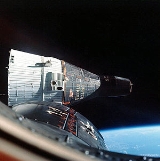
| Space rendezvous Space rendezvous A space rendezvous is an orbital maneuver during which two spacecraft, one of which is often a space station, arrive at the same orbit and approach to a very close distance . Rendezvous requires a precise match of the orbital velocities of the two spacecraft, allowing them to remain at a constant... (orbital maneuver and station-keeping) Four people in space |
Frank Borman Frank Borman Frank Frederick Borman, II is a retired NASA astronaut and engineer, best remembered as the Commander of Apollo 8, the first mission to fly around the Moon, making him, along with fellow crew mates Jim Lovell and Bill Anders, the first of only 24 humans to do so... , Jim Lovell Jim Lovell James "Jim" Arthur Lovell, Jr., is a former NASA astronaut and a retired captain in the United States Navy, most famous as the commander of the Apollo 13 mission, which suffered a critical failure en route to the Moon but was brought back safely to Earth by the efforts of the crew and mission... Walter Schirra, Thomas Stafford Thomas Patten Stafford Thomas Patten Stafford is a retired American Air Force lieutenant general and former NASA astronaut. He flew aboard two Gemini space flights; and in 1969 was the commander of Apollo 10, the second manned mission to orbit the Moon and the first to fly a lunar module there.In 1975, Stafford was... |
Gemini 7 Gemini 7 Gemini 7 was a 1965 manned spaceflight in NASA's Gemini program. It was the 4th manned Gemini flight, the 12th manned American flight and the 20th spaceflight of all time . The crew of Frank F. Borman, II and James A... Gemini 6A Gemini 6A -Backup crew:-Mission parameters:* Mass: * Perigee: * Apogee: * Inclination: 28.97°* Period: 88.7 min-Stationkeeping with GT-7:* Start: December 15, 1965 19:33 UTC* End: December 16, 1965 00:52 UTC-Objectives:... |
United States USA |
15 December 1965- 16 December 1965 |
| Space docking |
Neil Armstrong Neil Armstrong Neil Alden Armstrong is an American former astronaut, test pilot, aerospace engineer, university professor, United States Naval Aviator, and the first person to set foot upon the Moon.... David Scott David Scott David Randolph Scott is an American engineer, test pilot, retired U.S. Air Force officer, and former NASA astronaut and engineer, who was one of the third group of astronauts selected by NASA in October 1963... |
Gemini 8 Gemini 8 -Backup crew:-Mission parameters:* Mass: * Perigee: * Apogee: * Inclination: 28.91°* Period: 88.83 min-Objectives:Gemini VIII had two major objectives, of which it achieved one... and Agena Agena Target Vehicle The Agena Target Vehicle was an unmanned spacecraft used by NASA during its Gemini program to develop and practice orbital space rendezvous and docking techniques and to perform large orbital changes, in preparation for the Apollo program lunar missions.-Operations:Each ATV consisted of an Agena-D... |
United States USA |
16 March 1966 |
| Multiple rendezvous | John W. Young Michael Collins Michael Collins (astronaut) Michael Collins is a former American astronaut and test pilot. Selected as part of the third group of fourteen astronauts in 1963, he flew in space twice. His first spaceflight was Gemini 10, in which he and command pilot John Young performed two rendezvous with different spacecraft and Collins... |
Gemini 10 Gemini 10 -Backup crew:-Mission parameters:*Mass: *Perigee: *Apogee: *Inclination: 28.87°*Period: 88.79 min-Docking:*Docked: July 19, 1966 - 04:15:00 UTC*Undocked: July 20, 1966 - 19:00:00 UTC-Space walk:... with Agena 10 and Agena 8 |
United States USA |
19 July 1966; 20 July 1966 |
| Spaceflight fatality (during landing) | Vladimir Komarov | Soyuz 1 Soyuz 1 Soyuz 1 was a manned spaceflight of the Soviet space program. Launched into orbit on April 23, 1967 carrying cosmonaut Colonel Vladimir Komarov, Soyuz 1 was the first flight of the Soyuz spacecraft... |
Soviet Union USSR |
23 April 1967- 24 April 1967 |
| Persons to leave Low Earth orbit Low Earth orbit A low Earth orbit is generally defined as an orbit within the locus extending from the Earth’s surface up to an altitude of 2,000 km... (LEO) Persons to enter lunar orbit |
Frank Borman Frank Borman Frank Frederick Borman, II is a retired NASA astronaut and engineer, best remembered as the Commander of Apollo 8, the first mission to fly around the Moon, making him, along with fellow crew mates Jim Lovell and Bill Anders, the first of only 24 humans to do so... Jim Lovell Jim Lovell James "Jim" Arthur Lovell, Jr., is a former NASA astronaut and a retired captain in the United States Navy, most famous as the commander of the Apollo 13 mission, which suffered a critical failure en route to the Moon but was brought back safely to Earth by the efforts of the crew and mission... Bill Anders |
Apollo 8 Apollo 8 Apollo 8, the second manned mission in the American Apollo space program, was the first human spaceflight to leave Earth orbit; the first to be captured by and escape from the gravitational field of another celestial body; and the first crewed voyage to return to Earth from another celestial... |
United States USA |
24 December 1968- 25 December 1968 |
| Dual spacewalk; crew transfer | Aleksei Yeliseyev Aleksei Yeliseyev Aleksei Stanislavovich Yeliseyev is a retired Soviet cosmonaut who flew on three missions in the Soyuz programme as a flight engineer: Soyuz 5, Soyuz 8, and Soyuz 10.... Yevgeny Khrunov Yevgeny Khrunov Yevgeni Vassilyevich Khrunov was a Soviet cosmonaut who flew on the Soyuz 5/Soyuz 4 mission.He was born in Prudy.Yevgeni Khrunov was a colonel, Hero of the Soviet Union and Kandidat of Technical Sciences .... |
Soyuz 4 Soyuz 4 Soyuz 4 was launched on January 14, 1969. On board the Soyuz 7K-OK spacecraft was cosmonaut Vladimir Shatalov on his first flight. The aim of the mission was to dock with Soyuz 5, transfer two crew members from that spacecraft, and return to Earth... Soyuz 5 Soyuz 5 Soyuz 5 was a Soyuz mission using the Soyuz 7K-OK spacecraft launched by the Soviet Union on January 15, 1969, which docked with Soyuz 4 in orbit... |
Soviet Union USSR |
16 January 1969 |
| Moon landing/ planetary surface EVA 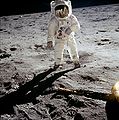 |
Neil Armstrong Neil Armstrong Neil Alden Armstrong is an American former astronaut, test pilot, aerospace engineer, university professor, United States Naval Aviator, and the first person to set foot upon the Moon.... Buzz Aldrin |
Apollo 11 Apollo 11 In early 1969, Bill Anders accepted a job with the National Space Council effective in August 1969 and announced his retirement as an astronaut. At that point Ken Mattingly was moved from the support crew into parallel training with Anders as backup Command Module Pilot in case Apollo 11 was... |
United States USA |
20 July 1969 |
| Time five people are in space | Georgi Shonin Georgi Shonin Georgy Stepanovich Shonin was a Soviet cosmonaut, who flew on the Soyuz 6 space mission.... , Valeri Kubasov Valeri Kubasov Valeri Nikolayevich Kubasov was a Soviet cosmonaut who flew on two missions in the Soyuz programme as a flight engineer: Soyuz 6 and Soyuz 19 , and commanded Soyuz 36 in the Intercosmos programme. On 21 July 1975, Soviet Soyuz module landed in Kazakhstan at-5:51pm and Valeriy Kubasov was the first... Anatoly Filipchenko, Vladislav Volkov Vladislav Volkov Vladislav Nikolayevich Volkov was a Soviet cosmonaut who flew on the Soyuz 7 and Soyuz 11 missions. The second mission terminated fatally.-Biography:... , Viktor Gorbatko Viktor Gorbatko Viktor Vasilyevich Gorbatko was a Soviet cosmonaut who flew on the Soyuz 7, Soyuz 24, and Soyuz 37 missions.After leaving the space program in 1982 he taught at the Air Force Engineering Academy in Moscow.-References:... |
Soyuz 6 Soyuz 6 Soyuz 6 was part of a joint mission with Soyuz 7 and Soyuz 8 that saw three Soyuz spacecraft in orbit together at the same time, carrying seven cosmonauts... Soyuz 7 Soyuz 7 Soyuz 7 was part of a joint mission with Soyuz 6 and Soyuz 8 that saw three Soyuz spacecraft in orbit together at the same time, carrying seven cosmonauts.... |
Soviet Union USSR |
12 October 1969- 13 October 1969 |
| Triple spaceflight Seven-people in space |
Shonin Georgi Shonin Georgy Stepanovich Shonin was a Soviet cosmonaut, who flew on the Soyuz 6 space mission.... , Kubasov Valeri Kubasov Valeri Nikolayevich Kubasov was a Soviet cosmonaut who flew on two missions in the Soyuz programme as a flight engineer: Soyuz 6 and Soyuz 19 , and commanded Soyuz 36 in the Intercosmos programme. On 21 July 1975, Soviet Soyuz module landed in Kazakhstan at-5:51pm and Valeriy Kubasov was the first... Filipchenko, Volkov Vladislav Volkov Vladislav Nikolayevich Volkov was a Soviet cosmonaut who flew on the Soyuz 7 and Soyuz 11 missions. The second mission terminated fatally.-Biography:... , Gorbatko Viktor Gorbatko Viktor Vasilyevich Gorbatko was a Soviet cosmonaut who flew on the Soyuz 7, Soyuz 24, and Soyuz 37 missions.After leaving the space program in 1982 he taught at the Air Force Engineering Academy in Moscow.-References:... Vladimir Shatalov Vladimir Shatalov Vladimir Aleksandrovich Shatalov is a former Soviet cosmonaut who flew three space missions of the Soyuz programme: Soyuz 4, Soyuz 8, and Soyuz 10.... , Aleksei Yeliseyev Aleksei Yeliseyev Aleksei Stanislavovich Yeliseyev is a retired Soviet cosmonaut who flew on three missions in the Soyuz programme as a flight engineer: Soyuz 5, Soyuz 8, and Soyuz 10.... |
Soyuz 6 Soyuz 6 Soyuz 6 was part of a joint mission with Soyuz 7 and Soyuz 8 that saw three Soyuz spacecraft in orbit together at the same time, carrying seven cosmonauts... Soyuz 7 Soyuz 7 Soyuz 7 was part of a joint mission with Soyuz 6 and Soyuz 8 that saw three Soyuz spacecraft in orbit together at the same time, carrying seven cosmonauts.... Soyuz 8 Soyuz 8 Soyuz 8 was part of a joint mission with Soyuz 6 and Soyuz 7 that saw three Soyuz spacecraft in orbit together at the same time, carrying seven cosmonauts.... |
Soviet Union USSR |
13 October 1969- 16 October 1969 |
| Person to fly two lunar flights | James A. Lovell Jim Lovell James "Jim" Arthur Lovell, Jr., is a former NASA astronaut and a retired captain in the United States Navy, most famous as the commander of the Apollo 13 mission, which suffered a critical failure en route to the Moon but was brought back safely to Earth by the efforts of the crew and mission... |
Apollo 13 Apollo 13 Apollo 13 was the seventh manned mission in the American Apollo space program and the third intended to land on the Moon. The craft was launched on April 11, 1970, at 13:13 CST. The landing was aborted after an oxygen tank exploded two days later, crippling the service module upon which the Command... (previous flight Apollo 8 Apollo 8 Apollo 8, the second manned mission in the American Apollo space program, was the first human spaceflight to leave Earth orbit; the first to be captured by and escape from the gravitational field of another celestial body; and the first crewed voyage to return to Earth from another celestial... ) |
United States USA |
11 April 1970- 17 April 1970 |
| People to spend two weeks in space | Andrian Nikolayev Andrian Nikolayev Andriyan Grigoryevich Nikolayev , was a Soviet cosmonaut. He was an ethnic Chuvash.- History :... Vitali Sevastyanov Vitali Sevastyanov Vitaly Ivanovich Sevastyanov was a Soviet cosmonaut who flew on the Soyuz 9 and Soyuz 18 missions.He trained as an engineer at the Moscow Aviation Institute and after graduation in 1959, joined Sergey Korolev's design bureau, where he worked on the design of the Vostok spacecraft. He also lectured... |
Soyuz 9 Soyuz 9 Soyuz 9 was a 1970 Soviet manned space flight. The two-man crew of Andrian Nikolayev and Vitali Sevastyanov broke the five-year-old space endurance record with their nearly 18-day flight... |
Soviet Union USSR |
1 June 1970- 19 June 1970 |
| People to EVA Extra-vehicular activity Extra-vehicular activity is work done by an astronaut away from the Earth, and outside of a spacecraft. The term most commonly applies to an EVA made outside a craft orbiting Earth , but also applies to an EVA made on the surface of the Moon... out of sight of their spacecraft |
Alan Shepard Alan Shepard Alan Bartlett Shepard, Jr. was an American naval aviator, test pilot, flag officer, and NASA astronaut who in 1961 became the second person, and the first American, in space. This Mercury flight was designed to enter space, but not to achieve orbit... Edgar Mitchell |
Apollo 14 Apollo 14 Apollo 14 was the eighth manned mission in the American Apollo program, and the third to land on the Moon. It was the last of the "H missions", targeted landings with two-day stays on the Moon with two lunar EVAs, or moonwalks.... |
United States USA |
6 February 1971 |
| Manned space station |
Georgi Dobrovolski Viktor Patsayev Viktor Patsayev Viktor Ivanovich Patsayev was a Soviet cosmonaut who flew on the Soyuz 11 mission and had the unfortunate distinction of being part of the second crew to die during a space flight... Vladislav Volkov Vladislav Volkov Vladislav Nikolayevich Volkov was a Soviet cosmonaut who flew on the Soyuz 7 and Soyuz 11 missions. The second mission terminated fatally.-Biography:... |
Soyuz 11 Soyuz 11 Soyuz 11 was the first manned mission to arrive at the world's first space station, Salyut 1. The mission arrived at the space station on June 7, 1971 and departed on June 30, 1971. The mission ended in disaster when the crew capsule depressurized during preparations for re-entry, killing the... docked with Salyut 1 Salyut 1 Salyut 1 was the first space station of any kind, launched by the USSR on April 19, 1971. It was launched unmanned using a Proton-K rocket. Its first crew came later in Soyuz 10, but was unable to dock completely; its second crew launched in Soyuz 11 and remained on board for 23 days... |
Soviet Union USSR |
7 June 1971- 29 June 1971 |
| In-space fatalities | Georgi Dobrovolski Viktor Patsayev Viktor Patsayev Viktor Ivanovich Patsayev was a Soviet cosmonaut who flew on the Soyuz 11 mission and had the unfortunate distinction of being part of the second crew to die during a space flight... Vladislav Volkov Vladislav Volkov Vladislav Nikolayevich Volkov was a Soviet cosmonaut who flew on the Soyuz 7 and Soyuz 11 missions. The second mission terminated fatally.-Biography:... |
Soyuz 11 Soyuz 11 Soyuz 11 was the first manned mission to arrive at the world's first space station, Salyut 1. The mission arrived at the space station on June 7, 1971 and departed on June 30, 1971. The mission ended in disaster when the crew capsule depressurized during preparations for re-entry, killing the... |
Soviet Union USSR |
29 June 1971 |
| EVA in outer space outside Low Earth orbit (trans-Earth trajectory) |
Al Worden | Apollo 15 Apollo 15 Apollo 15 was the ninth manned mission in the American Apollo space program, the fourth to land on the Moon and the eighth successful manned mission. It was the first of what were termed "J missions", long duration stays on the Moon with a greater focus on science than had been possible on previous... |
United States USA |
5 August 1971 |
| Person twice in lunar orbit (during separate lunar expeditions) |
John W. Young | Apollo 16 Apollo 16 Young and Duke served as the backup crew for Apollo 13; Mattingly was slated to be the Apollo 13 command module pilot until being pulled from the mission due to his exposure to rubella through Duke.-Backup crew:... |
United States USA |
16 April 1972- 27 April 1972 |
| People in orbit for four weeks |
Pete Conrad Pete Conrad Charles "Pete" Conrad, Jr. was an American naval officer, astronaut and engineer, and the third person to walk on the Moon during the Apollo 12 mission. He set an eight-day space endurance record along with command pilot Gordon Cooper on the Gemini 5 mission, and commanded the Gemini 11 mission... Joseph Kerwin Paul Weitz Paul J. Weitz Paul Joseph Weitz is an American former astronaut who flew in space twice.-Personal data:Born in Erie, Pennsylvania, on July 25, 1932. Married to the former Suzanne M. Berry of Harborcreek, Pennsylvania. Two children: Matthew and Cynthia. Hunting and fishing are among his hobbies. His mother, Mrs... |
Skylab 2 Skylab 2 -Backup crew:-Support crew:*Robert L. Crippen*Richard H. Truly*Henry W. Hartsfield, Jr*William E. Thornton-Mission parameters:*Mass: 19,979 kg*Maximum Altitude: 440 km*Distance: 18,536,730.9 km... |
United States USA |
25 May 1973- 22 June 1973 |
| People in orbit for eight weeks |
Alan Bean Alan Bean Alan LaVern Bean is a former NASA astronaut, engineer, and painter. Bean was selected to become an astronaut by NASA in 1963 as part of Astronaut Group 3. He made his first flight into space aboard Apollo 12, the second manned mission to land on the Moon, at the age of thirty-seven years in... Jack Lousma Owen Garriott |
Skylab 3 Skylab 3 Skylab 3 was the second manned mission to Skylab. The Skylab 3 mission started July 28, 1973, with the launch of three astronauts on the Saturn IB rocket, and lasted 59 days, 11 hours and 9 minutes... |
United States USA |
28 July 1973- 25 September 1973 |
| People in orbit for 12 weeks |
Gerald Carr William Pogue Edward Gibson Edward Gibson Edward George Gibson, PhD, is a former NASA astronaut, pilot, and engineer.Before becoming a NASA astronaut, Gibson graduated from the University of Rochester and the California Institute of Technology... |
Skylab 4 Skylab 4 Skylab 4 was the fourth Skylab mission and placed the third and final crew on board the space station. The mission started November 16, 1973 with the launch of three astronauts on a Saturn IB rocket, and lasted 84 days, 1 hour and 16 minutes... |
United States USA |
16 November 1973- 8 February 1974 |
| Spaceflight aborted during liftoff (at 145 kilometres (90.1 mi) altitude) Re-entry (emergency) with 20g G-force The g-force associated with an object is its acceleration relative to free-fall. This acceleration experienced by an object is due to the vector sum of non-gravitational forces acting on an object free to move. The accelerations that are not produced by gravity are termed proper accelerations, and... acceleration |
Vasily Lazarev, Oleg Makarov | Soyuz 18a Soyuz 18a Soyuz 18a was a manned Soyuz spacecraft launched by the Soviet Union in 1975, intended to dock with the orbiting Salyut 4 space station, but which failed to achieve orbit due to a serious malfunction during launch... |
Soviet Union USSR |
5 April 1975 |
| Crew to visit occupied space station | Vladimir Dzhanibekov Vladimir Dzhanibekov Vladimir Aleksandrovich Dzhanibekov is a former cosmonaut who made five flights.He was born in the remote area of Iskandar in Tashkent Province, Uzbekistan. He changed his surname from Krysin when he married to honor his wife's family, which was noble kin of the descendants of the medieval Kazakh... , Oleg Makarov |
Soyuz 27 Soyuz 27 Soyuz 27 was a 1978 Soviet manned spacecraft which flew to the orbiting Salyut 6 space station, during the mission EP-1. It was the third manned flight to the station, and the second successful docking... visits Salyut 6 EO-1 Salyut 6 Salyut 6 , DOS-5, was a Soviet orbital space station, the eighth flown as part of the Salyut programme. Launched on 29 September 1977 by a Proton rocket, the station was the first of the 'second-generation' type of space station. Salyut 6 possessed several revolutionary advances over the earlier... crew |
Soviet Union USSR |
10 January 1978- 16 January 1978 |
| People in orbit 19 weeks (4 months) |
Vladimir Kovalyonok Vladimir Kovalyonok -Honours and awards:* Hero of the Soviet Union, twice * Order of Merit for the Fatherland, 3rd class * Order of Military Merit * Three Orders of Lenin... , Aleksandr Ivanchenkov Aleksandr Ivanchenkov Aleksandr Sergeyevich Ivanchenkov is a retired Soviet cosmonaut who flew as Flight Engineer on Soyuz 29 and Soyuz T-6, he spent 147 days, 12 hours and 37 minutes in space.... |
Salyut 6 EO-2 Salyut 6 Salyut 6 , DOS-5, was a Soviet orbital space station, the eighth flown as part of the Salyut programme. Launched on 29 September 1977 by a Proton rocket, the station was the first of the 'second-generation' type of space station. Salyut 6 possessed several revolutionary advances over the earlier... , Soyuz 29 Soyuz 29 Soyuz 29 was a 1978 manned Soviet space mission to the Salyut 6 space station. It was the fifth mission, the fourth successful docking, and the second long-duration crew for the orbiting station... -Soyuz 31 Soyuz 31 -Backup crew:-Mission parameters:*Mass: *Perigee: *Apogee: *Inclination: 51.64°*Period: 88.81 minutes-Mission highlights:Soyuz 31, the third Intercosmos flight, was launched 26 August 1978... |
Soviet Union USSR |
15 June 1978- 2 November 1978 |
| People in orbit 26 weeks (6 months) |
Leonid Popov Leonid Popov Leonid Ivanovich Popov is a former Soviet cosmonaut.Popov was born in Oleksandriia, Kirovohrad Oblast, Ukrainian SSR. He was selected as a cosmonaut on April 27, 1970, and flew as Commander on Soyuz 35, Soyuz 40 and Soyuz T-7, logging 200 days, 14 hours, and 45 minutes in space before his... , Valery Ryumin Valery Ryumin Valery Victorovich Ryumin, born August 16, 1939 in Komsomolsk-on-Amur) is a former Soviet cosmonaut.In 1958, he was graduated from the Kaliningrad Mechanical Engineering Technical College with the specialty "Cold Working of Metal." In 1966, he was graduated from the Department of Electronics and... |
Salyut 6 EO-4 Salyut 6 Salyut 6 , DOS-5, was a Soviet orbital space station, the eighth flown as part of the Salyut programme. Launched on 29 September 1977 by a Proton rocket, the station was the first of the 'second-generation' type of space station. Salyut 6 possessed several revolutionary advances over the earlier... , Soyuz 35 Soyuz 35 -Backup crew:-Mission parameters:*Mass: *Perigee: *Apogee: *Inclination: 51.65°*Period: 88.81 minutes-Crew launch, station activation:... -Soyuz 37 Soyuz 37 -Backup crew:-Mission parameters:*Mass: *Perigee: *Apogee: *Inclination: 51.61°*Period: 89.12 minutes-Mission highlights:... |
Soviet Union USSR |
9 April 1980- 11 October 1980 |
| Spaceflight (orbital) by winged spacecraft | John W. Young Robert L. Crippen |
STS-1 STS-1 STS-1 was the first orbital flight of NASA's Space Shuttle program. Space Shuttle Columbia launched on 12 April 1981, and returned to Earth on 14 April, having orbited the Earth 37 times during the 54.5-hour mission. It was the first American manned space flight since the Apollo-Soyuz Test Project... |
United States USA |
12 April 1981 |
| Person to fly four different types of spacecraft | John W. Young | STS-1 STS-1 STS-1 was the first orbital flight of NASA's Space Shuttle program. Space Shuttle Columbia launched on 12 April 1981, and returned to Earth on 14 April, having orbited the Earth 37 times during the 54.5-hour mission. It was the first American manned space flight since the Apollo-Soyuz Test Project... , |
United States USA |
12 April 1981 |
| Four-person spaceflight, single spacecraft |
Vance Brand, Robert F. Overmyer Robert F. Overmyer Robert Franklyn Overmyer, Colonel, United States Marine Corps, Ret. was an American test pilot and NASA astronaut. He was born in Lorain, Ohio, but considered Westlake, Ohio his hometown.-Early life:... Joseph P. Allen, William B. Lenoir William B. Lenoir William Benjamin "Bill" Lenoir was an American engineer and a former NASA astronaut.Lenoir was born on March 14, 1939, in Miami, Florida. He was divorced and remarried, and was survived by three grown children. His recreational interests included sailing, wood-working and outdoor activities... |
STS-5 STS-5 STS-5 was a NASA Space Shuttle mission, the fifth shuttle mission overall and the fifth flight of the Space Shuttle Columbia. It was the first shuttle mission to deploy communications satellites into orbit... |
United States USA |
11 November 1982- 16 November 1982 |
| Five-person spaceflight, single spacecraft |
Robert L. Crippen, Frederick H. Hauck John M. Fabian John M. Fabian John McCreary Fabian is a former NASA Astronaut and Air Force officer who flew two space shuttle missions and on the development of the shuttle's robotic arm. He later led the Air Force's space operations.... , Sally K. Ride, Norman E. Thagard |
STS-7 STS-7 STS-7 was a NASA Space Shuttle mission, during which Space Shuttle Challenger deployed several satellites into orbit. The shuttle launched from Kennedy Space Center on 18 June 1983, and landed at Edwards Air Force Base on 24 June. STS-7 was the seventh shuttle mission, and was Challengers second... |
United States USA |
18 June 1983- 24 June 1983 |
| Six-person spaceflight, single spacecraft |
John W. Young, Brewster H. Shaw Brewster H. Shaw Brewster Hopkinson Shaw, Jr. is a former NASA astronaut, a retired U.S. Air Force colonel and former executive at Boeing. Shaw was inducted into the U.S. Astronaut Hall of Fame on May 6, 2006.... , Owen K. Garriott Owen K. Garriott Owen Kay Garriott, Ph.D. is a former NASA astronaut who spent 60 days aboard Skylab in 1973 and 10 days aboard Spacelab-1 in 1983. He is also the father of Robert Garriott and fellow spacefarer Richard Garriott, with whom he helped found Origin Systems.-Education and background:Garriott was born... , Robert A. Parker Robert A. Parker Robert Allan Ridley Parker is the former director of the NASA Management Office at the Jet Propulsion Laboratory and a retired NASA astronaut... , Byron K. Lichtenberg Byron K. Lichtenberg Byron Kurt Lichtenberg, Sc. D. is an American engineer and fighter pilot who flew aboard two NASA Space Shuttle missions as a Payload Specialist. In 1983, he and Ulf Merbold became the first Payload Specialists to fly on the shuttle.-Personal:Born February 19, 1948 in Stroudsburg, Pennsylvania... - USA Ulf Merbold Ulf Merbold Dr. Ulf Dietrich Merbold is the first West German citizen and second German native to have flown in space. He is also the first member of the European Space Agency Astronaut Corps to participate in a spaceflight mission. He holds the distinction of being the first non-US citizen to reach orbit in... - Germany (European Space Agency European Space Agency The European Space Agency , established in 1975, is an intergovernmental organisation dedicated to the exploration of space, currently with 18 member states... ) |
STS-9 STS-9 STS-9 was a NASA Space Shuttle mission which carried the first Spacelab module into orbit to conduct space-based scientific experiments. It was the sixth mission of the Space Shuttle Columbia, and was Columbia's last flight until STS-61-C in January 1986... |
United States USA Germany West Germany Germany West Germany |
28 November 1983- 8 December 1983 |
Untethered spacewalk 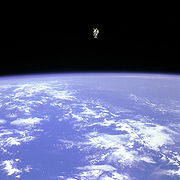 |
Bruce McCandless II Bruce McCandless II Bruce McCandless II is a former naval aviator with the United States Navy and former NASA astronaut. During the first of his two Space Shuttle missions he made the first ever untethered free flight, using the Manned Maneuvering Unit.-Education:McCandless is the son of Bruce McCandless, a decorated... |
STS-41-B STS-41-B STS-41-B was the tenth NASA Space Shuttle mission, launching on 3 February 1984 and landing on 11 February. It was the fourth flight of the Space Shuttle Challenger. Following STS-9, the flight numbering system for the Space Shuttle program was changed... |
United States USA |
7 February 1984 |
| Time eight people in space, no docking | Oleg Atkov Oleg Atkov Oleg Yur'yevich At'kov is a Soviet cosmonaut. He is married with one child.... , Leonid Kizim Leonid Kizim Leonid Denisovich Kizim was a Soviet cosmonaut who was twice named a Hero of the Soviet Union .... , Vladimir Solovyov Vladimir Alekseyevich Solovyov Vladimir Alekseyevich Solovyov is a former Soviet cosmonaut, twice Hero of the Soviet Union .... - USSR Vance D. Brand Vance D. Brand Vance DeVoe Brand is an engineer and former test pilot and NASA astronaut. He served as command module pilot during the first U.S.-Soviet joint space flight in 1975, and as commander of three space shuttle missions.... , Robert L. Gibson Robert L. Gibson Robert Lee "Hoot" Gibson is a retired Captain and Naval Aviator in the United States Navy and a retired NASA astronaut.-Personal:... , Bruce McCandless II Bruce McCandless II Bruce McCandless II is a former naval aviator with the United States Navy and former NASA astronaut. During the first of his two Space Shuttle missions he made the first ever untethered free flight, using the Manned Maneuvering Unit.-Education:McCandless is the son of Bruce McCandless, a decorated... , Ronald McNair Ronald McNair Ronald Ervin McNair, Ph.D. was a physicist and NASA astronaut. McNair died during the launch of the Space Shuttle Challenger on mission STS-51-L.-Background:... , Robert L. Stewart Robert L. Stewart Robert Lee Stewart is a retired Brigadier General of the United States Army and former NASA astronaut.-Personal:Stewart was born August 13, 1942, in Washington, D.C.. He graduated from Hattiesburg High School, Hattiesburg, Mississippi, in 1960... - USA |
Salyut 7 EO-3 Salyut 7 Salyut 7 was a space station in low Earth orbit from April 1982 to February 1991. It was first manned in May 1982 with two crew via Soyuz T-5, and last visited in June 1986, by Soyuz T-15. Various crew and modules were used over its lifetime, including a total of 12 manned and 15 unmanned launches... , Soyuz T-10 Soyuz T-10 -Backup crew:-Mission parameters:*Mass: 6850 kg*Perigee: 199 km*Apogee: 219 km*Inclination: 51.6°*Period: 88.7 minutes-Mission highlights:Fifth expedition to Salyut 7. Visited by 6th and 7th expeditions.... , STS-41-B STS-41-B STS-41-B was the tenth NASA Space Shuttle mission, launching on 3 February 1984 and landing on 11 February. It was the fourth flight of the Space Shuttle Challenger. Following STS-9, the flight numbering system for the Space Shuttle program was changed... |
Soviet Union USSR United States USA |
8 February 1984- 11 February 1984 |
| Time 11 people in space, no docking | Oleg Atkov Oleg Atkov Oleg Yur'yevich At'kov is a Soviet cosmonaut. He is married with one child.... , Leonid D. Kizim, Yuri Malyshev Yuri Malyshev Yury Vasilyevich Malyshev was born in the village Nikolayevsk, Stalingrad Oblast , USSR on August 27, 1941. Studied in Taganrog's high school N24, 1949-1959. Married with two children. Selected as a cosmonaut on May 7, 1967. Retired on July 20, 1988... , Vladimir Solovyov Vladimir Alekseyevich Solovyov Vladimir Alekseyevich Solovyov is a former Soviet cosmonaut, twice Hero of the Soviet Union .... , Gennady Strekalov Gennady Strekalov Gennadi Mikhailovich Strekalov was an Instructor-Test-Cosmonaut and Department Head at Russian aerospace firm RSC Energia. He has been decorated twice as Hero of the Soviet Union... -USSR Robert L. Crippen, Terry J. Hart, George Nelson George Nelson (astronaut) George Driver "Pinky" Nelson is a former NASA astronaut.Nelson was born in Charles City, Iowa, but considers Willmar, Minnesota, to be his hometown. His wife Susie is from Alhambra, California. They have two daughters, Aimee and Marti.... , Francis Scobee, James van Hoften James van Hoften James Dougal Adrianus "Ox" van Hoften is a former NASA Astronaut.-Personal data:Van Hoften was born June 11, 1944, in Fresno, California. He was active in the Boy Scouts of America where he achieved its second highest rank, Life Scout. He considers Burlingame, California, to be his hometown. ... - USA Rakesh Sharma Rakesh Sharma Wing commander Rakesh Sharma, AC, is a former Indian Air Force test pilot, and Cosmonaut aboard Soyuz T-11 as part of an Intercosmos Research Team... - India |
STS-41-C STS-41-C STS-41-C was NASA's 11th Space Shuttle mission, and the fifth mission of Space Shuttle Challenger. The launch on 6 April 1984 was the first direct ascent trajectory for a shuttle mission... , Salyut 7 EO-3 Salyut 7 Salyut 7 was a space station in low Earth orbit from April 1982 to February 1991. It was first manned in May 1982 with two crew via Soyuz T-5, and last visited in June 1986, by Soyuz T-15. Various crew and modules were used over its lifetime, including a total of 12 manned and 15 unmanned launches... , Soyuz T-10 Soyuz T-10 -Backup crew:-Mission parameters:*Mass: 6850 kg*Perigee: 199 km*Apogee: 219 km*Inclination: 51.6°*Period: 88.7 minutes-Mission highlights:Fifth expedition to Salyut 7. Visited by 6th and 7th expeditions.... -Soyuz T-11 Soyuz T-11 -Backup crew:-Mission parameters:*Mass: 6850 kg*Perigee: 195 km*Apogee: 224 km*Inclination: 51.6°*Period: 88.7 minutes-Mission highlights:... |
Soviet Union USSR United States USA India India India India |
6 April 1984- 11 April 1984 |
| People to complete four spacewalks during the same mission | Leonid Kizim Leonid Kizim Leonid Denisovich Kizim was a Soviet cosmonaut who was twice named a Hero of the Soviet Union .... , Vladimir Solovyov Vladimir Alekseyevich Solovyov Vladimir Alekseyevich Solovyov is a former Soviet cosmonaut, twice Hero of the Soviet Union .... |
Salyut 7 Salyut 7 Salyut 7 was a space station in low Earth orbit from April 1982 to February 1991. It was first manned in May 1982 with two crew via Soyuz T-5, and last visited in June 1986, by Soyuz T-15. Various crew and modules were used over its lifetime, including a total of 12 manned and 15 unmanned launches... |
Soviet Union USSR |
26 April - 18 May 1984 |
| Spacewalk by woman | Svetlana Savitskaya Svetlana Savitskaya Svetlana Yevgenyevna Savitskaya She started training as a cosmonaut in 1980. Upon returning to Earth, Savitskaya was assigned as the commander of an all-female Soyuz crew to Salyut 7 in commemoration of the International Women's Day, a mission that was later canceled.She was twice awarded the Hero... |
Soyuz T-12 Soyuz T-12 Soyuz T-12 was the seventh manned spaceflight to the Soviet space station Salyut 7. The name "Soyuz T-12" is also the name of the spacecraft used to launch and land the mission's three person crew. The mission occurred in July 1984, during the long-duration expedition Salyut 7 EO-3... |
Soviet Union USSR |
25 July 1984 |
| People in orbit 33 weeks (7 months) |
Leonid Kizim Leonid Kizim Leonid Denisovich Kizim was a Soviet cosmonaut who was twice named a Hero of the Soviet Union .... , Vladimir Solovyov Vladimir Alekseyevich Solovyov Vladimir Alekseyevich Solovyov is a former Soviet cosmonaut, twice Hero of the Soviet Union .... , Oleg Atkov Oleg Atkov Oleg Yur'yevich At'kov is a Soviet cosmonaut. He is married with one child.... |
Salyut 7 EO-3 Salyut 7 Salyut 7 was a space station in low Earth orbit from April 1982 to February 1991. It was first manned in May 1982 with two crew via Soyuz T-5, and last visited in June 1986, by Soyuz T-15. Various crew and modules were used over its lifetime, including a total of 12 manned and 15 unmanned launches... , Soyuz T-10 Soyuz T-10 -Backup crew:-Mission parameters:*Mass: 6850 kg*Perigee: 199 km*Apogee: 219 km*Inclination: 51.6°*Period: 88.7 minutes-Mission highlights:Fifth expedition to Salyut 7. Visited by 6th and 7th expeditions.... -Soyuz T-11 Soyuz T-11 -Backup crew:-Mission parameters:*Mass: 6850 kg*Perigee: 195 km*Apogee: 224 km*Inclination: 51.6°*Period: 88.7 minutes-Mission highlights:... |
Soviet Union USSR |
8 February 1984- 2 October 1984 |
| Seven person spaceflight, single spacecraft |
Robert L. Crippen, Jon A. McBride, Kathryn D. Sullivan Kathryn D. Sullivan Kathryn Dwyer Sullivan is an American geologist and a former NASA astronaut. A crew member on three Space Shuttle missions, she is the first American woman to walk in space.-Education:... , Sally K. Ride, David C. Leestma, Paul D. Scully-Power Paul D. Scully-Power Paul Desmond Scully-Power AM is an American oceanographer. While a civilian employee of the United States Naval Undersea Warfare Center, he flew aboard NASA Space Shuttle mission STS-41-G as a Payload Specialist. He was the first Australian-born person to journey into space.-Personal :Scully-Power... - USA Marc Garneau Marc Garneau Joseph Jean-Pierre Marc Garneau, CC CD FCASI MP is a Canadian retired military officer, former astronaut, engineer and politician.Garneau was the first Canadian in space taking part in three flights aboard NASA Space shuttles... - Canada |
STS-41-G STS-41-G STS 41-G was the 13th flight of NASA's Space Shuttle program and the sixth flight of Space Shuttle Challenger. Challenger launched on 5 October 1984, and conducted the second shuttle landing at Kennedy Space Center on 13 October... |
United States USA Canada Canada Canada Canada |
5 October 1984- 13 October 1984 |
| Time two women in space | Kathryn D. Sullivan Kathryn D. Sullivan Kathryn Dwyer Sullivan is an American geologist and a former NASA astronaut. A crew member on three Space Shuttle missions, she is the first American woman to walk in space.-Education:... , Sally K. Ride |
STS-41-G STS-41-G STS 41-G was the 13th flight of NASA's Space Shuttle program and the sixth flight of Space Shuttle Challenger. Challenger launched on 5 October 1984, and conducted the second shuttle landing at Kennedy Space Center on 13 October... |
United States USA |
5 October 1984- 13 October 1984 |
| Partial crew exchange at a space station | Alexander Volkov Alexander Alexandrovich Volkov (cosmonaut) Aleksandr Aleksandrovich Volkov is a Russian cosmonaut.At the age of 13, Volkov witnessed Yuri Gagarin become the first man in space and this inspired him to become a cosmonaut... , Vladimir Vasyutin Vladimir Vasyutin Vladimir Vladimirovich Vasyutin was a Soviet cosmonaut.He was selected as a cosmonaut on December 1, 1978... replace Vladimir Dzhanibekov Vladimir Dzhanibekov Vladimir Aleksandrovich Dzhanibekov is a former cosmonaut who made five flights.He was born in the remote area of Iskandar in Tashkent Province, Uzbekistan. He changed his surname from Krysin when he married to honor his wife's family, which was noble kin of the descendants of the medieval Kazakh... |
Soyuz T-14 Soyuz T-14 -Backup crew:-Mission parameters:* Mass: * Perigee: * Apogee: * Inclination: 51.6°* Period: 88.7 minutes-Mission highlights:... , Salyut 7 Salyut 7 Salyut 7 was a space station in low Earth orbit from April 1982 to February 1991. It was first manned in May 1982 with two crew via Soyuz T-5, and last visited in June 1986, by Soyuz T-15. Various crew and modules were used over its lifetime, including a total of 12 manned and 15 unmanned launches... |
Soviet Union USSR |
17 September 1985- 26 September 1985 |
| Eight person spaceflight, single spacecraft |
Henry W. Hartsfield, Steven R. Nagel Steven R. Nagel Steven Ray Nagel is a retired Colonel in the USAF and a former NASA astronaut.-Personal data:Born October 27, 1946, in Canton, Illinois. Married to fellow astronaut Linda M. Godwin of Houston, Texas. Two daughters. His hobbies include sport flying and music. His parents, Mr. and Mrs. Ivan R.... , Bonnie J. Dunbar Bonnie J. Dunbar Bonnie Jeanne Dunbar is a former NASA astronaut. She retired from NASA in September 2005. She then served as president and CEO of The Museum of Flight until April of 2010. She is now a consultant.-Early life:... , James F. Buchli, Guion S. Bluford - USA Reinhard Furrer, Ernst Messerschmid - West Germany Wubbo Ockels Wubbo Ockels Prof. Dr. Wubbo Johannes Ockels is a Dutch physicist and a former ESA astronaut. In 1985 he participated in a flight on a space shuttle , making him the first Dutch citizen in space. He was not the first Dutch-born astronaut, as he is preceded by the naturalized American Lodewijk van den Berg, who... - Netherlands (European Space Agency European Space Agency The European Space Agency , established in 1975, is an intergovernmental organisation dedicated to the exploration of space, currently with 18 member states... ) |
STS-61-A STS-61-A STS-61-A was the 22nd mission of NASA's Space Shuttle program. It was a scientific Spacelab mission, funded and directed by West Germany – hence the non-NASA designation of D-1 . STS-61-A was the last successful mission of the Space Shuttle Challenger, which was destroyed during STS-51-L in 1986... |
United States USA West Germany West Germany West Germany West Germany Europe Europe Netherlands Netherlands Netherlands Netherlands |
30 October 1985- 6 November 1985 |
| Fatalities during launch | Francis "Dick" Scobee Dick Scobee Francis Richard "Dick" Scobee was an American astronaut. He was killed commanding the Space Shuttle Challenger, which suffered catastrophic booster failure during launch of the STS-51-L mission.-Early life:... Michael J. Smith Ellison Onizuka Ellison Onizuka was a Japanese American astronaut from Kealakekua, Kona, Hawaii, who successfully flew into space with the Space Shuttle Discovery on STS-51-C, before losing his life to the destruction of the Space Shuttle Challenger, where he was serving as Mission Specialist for mission STS-51-L... Judith Resnik Ronald McNair Ronald McNair Ronald Ervin McNair, Ph.D. was a physicist and NASA astronaut. McNair died during the launch of the Space Shuttle Challenger on mission STS-51-L.-Background:... Sharon Christa McAuliffe Christa McAuliffe Christa McAuliffe was an American teacher from Concord, New Hampshire, and was one of the seven crew members killed in the Space Shuttle Challenger disaster.... Gregory Jarvis |
STS-51-L STS-51-L STS-51-L was the twenty-fifth flight of the American Space Shuttle program, which marked the first time an ordinary civilian, schoolteacher Christa McAuliffe, had flown aboard the Space Shuttle. The mission used Space Shuttle Challenger, which lifted off from the Launch Complex 39-B on 28 January... |
United States USA |
28 January 1986 |
| Space station to space station flight/ Space station to space station return flight/ Expedition on two space stations |
Leonid Kizim Leonid Kizim Leonid Denisovich Kizim was a Soviet cosmonaut who was twice named a Hero of the Soviet Union .... Vladimir Solovyov Vladimir Alekseyevich Solovyov Vladimir Alekseyevich Solovyov is a former Soviet cosmonaut, twice Hero of the Soviet Union .... |
Soyuz T-15 Soyuz T-15 - Backup crew :- Mission parameters :* Mass: 6850 kg* Perigee: 331 km* Apogee: 366 km* Inclination: 51.6°* Period: 91.5 minutes- Mission highlights :Soyuz T-15 was the first expedition to Mir.... from Mir Mir Mir was a space station operated in low Earth orbit from 1986 to 2001, at first by the Soviet Union and then by Russia. Assembled in orbit from 1986 to 1996, Mir was the first modular space station and had a greater mass than that of any previous spacecraft, holding the record for the... to Salyut 7 Salyut 7 Salyut 7 was a space station in low Earth orbit from April 1982 to February 1991. It was first manned in May 1982 with two crew via Soyuz T-5, and last visited in June 1986, by Soyuz T-15. Various crew and modules were used over its lifetime, including a total of 12 manned and 15 unmanned launches... back to Mir Mir Mir was a space station operated in low Earth orbit from 1986 to 2001, at first by the Soviet Union and then by Russia. Assembled in orbit from 1986 to 1996, Mir was the first modular space station and had a greater mass than that of any previous spacecraft, holding the record for the... |
Soviet Union USSR |
15 March 1986- 16 July 1986 |
| Complete crew exchange at a space station | Vladimir Titov Vladimir Titov Vladimir Georgiyevich Titov , Colonel, Russian Air Force, Ret., and former Russian cosmonaut was born January 1, 1947, in Sretensk, in the Zabaykalsky Krai region of Russia. He is married to the former Alexandra Kozlova of Ivanovo Region, Russia... , Musa Manarov replace Yuri Romanenko Yuri Romanenko Yury Viktorovich Romanenko is a former Soviet cosmonaut, twice Hero of the Soviet Union . Over his career, Yury Romanenko spent a total of 430 days 20 hours 21 minutes 30 seconds in space and 18 hours in space walks. In 1987 he was a resident of the Mir space station, launching on Soyuz TM-2 and... , Alexander Alexandrov Alexander Alexandrov Alexander Alexandrov may refer to:*Aleksandr Danilovich Aleksandrov , Russian mathematician and physicist*Aleksandr Pavlovich Aleksandrov , Russian cosmonaut... |
Soyuz TM-4 Soyuz TM-4 -Mission parameters:*Mass: 7070 kg*Perigee: 337 km*Apogee: 357 km*Inclination: 51.6°*Period: 91.5 minutes-Mission highlights:... -Soyuz TM-2 Soyuz TM-2 -Mission parameters:*Mass: 7100 kg*Perigee: 341 km*Apogee: 365 km*Inclination: 51.6°*Period: 91.6 minutes-Mission highlights:... , Soyuz TM-3 Soyuz TM-3 -Mission parameters:*Mass: 7100 kg*Perigee: 297 km*Apogee: 353 km*Inclination: 51.6°*Period: 91.0 minutes... , at Mir Mir Mir was a space station operated in low Earth orbit from 1986 to 2001, at first by the Soviet Union and then by Russia. Assembled in orbit from 1986 to 1996, Mir was the first modular space station and had a greater mass than that of any previous spacecraft, holding the record for the... |
Soviet Union USSR |
21 December 1987- 29 December 1987 |
| People in orbit 52 weeks (one year) |
Vladimir Titov Vladimir Titov Vladimir Georgiyevich Titov , Colonel, Russian Air Force, Ret., and former Russian cosmonaut was born January 1, 1947, in Sretensk, in the Zabaykalsky Krai region of Russia. He is married to the former Alexandra Kozlova of Ivanovo Region, Russia... , Musa Manarov |
Mir EO-3 Mir Mir was a space station operated in low Earth orbit from 1986 to 2001, at first by the Soviet Union and then by Russia. Assembled in orbit from 1986 to 1996, Mir was the first modular space station and had a greater mass than that of any previous spacecraft, holding the record for the... , Soyuz TM-4 Soyuz TM-4 -Mission parameters:*Mass: 7070 kg*Perigee: 337 km*Apogee: 357 km*Inclination: 51.6°*Period: 91.5 minutes-Mission highlights:... -Soyuz TM-6 Soyuz TM-6 Dr. Valeri Polyakov remained behind on Mir with cosmonauts Musa Manarov and Vladimir Titov when Mohmand and Lyakhov returned to Earth in Soyuz TM-5.... |
Soviet Union USSR |
21 December 1987- 21 December 1988 |
| Time 12 people in space; no docking | Shuttle: Vance Brand, Samuel Durrance, Guy S. Gardner, Jeffrey A. Hoffman Jeffrey A. Hoffman Jeffrey Alan Hoffman, Ph.D. is an American former NASA astronaut and currently a professor of aeronautics and astronautics at MIT.... , John M. Lounge John M. Lounge John Michael "Mike" Lounge was an American engineer, a US Navy officer, a Vietnam war veteran, and a NASA astronaut. A veteran of three space shuttle flights, Lounge logged over 482 hours in space... , Ronald Parise, Robert A. Parker Robert A. Parker Robert Allan Ridley Parker is the former director of the NASA Management Office at the Jet Propulsion Laboratory and a retired NASA astronaut... - USA Mir: Gennady Manakov, Gennady Strekalov Gennady Strekalov Gennadi Mikhailovich Strekalov was an Instructor-Test-Cosmonaut and Department Head at Russian aerospace firm RSC Energia. He has been decorated twice as Hero of the Soviet Union... - Russia Soyuz and Soyuz/Mir: Musa Manarov, Viktor Afanasyev Viktor M. Afanasyev Viktor Mikhailovich Afanasyev ; born 31 December 1948) is a colonel in the Russian Air Force and a test cosmonaut of the Yu. A. Gagarin Cosmonaut Training Center. He was born December 31, 1948, in Bryansk, Russia, and is married to Yelena Ya. Afanasyeva, born 1952. They have two children. His... - Russia Toyohiro Akiyama Toyohiro Akiyama is a Japanese TV journalist best known for his flight to the Mir space station aboard a Russian Soyuz spacecraft in 1990. Akiyama is the first person of Japanese descent to have flown in space. He was known as the "Space Journalist" in Japan.... - Japan |
STS-35 STS-35 -Crew notes:Prior to the Challenger disaster, this mission was slated to launch in March 1986 as STS-61-E. Jon McBride was originally assigned to command this mission, which would have been his second spaceflight. He chose to retire from NASA in May 1989 and was replaced as mission commander by... , Mir Mir Mir was a space station operated in low Earth orbit from 1986 to 2001, at first by the Soviet Union and then by Russia. Assembled in orbit from 1986 to 1996, Mir was the first modular space station and had a greater mass than that of any previous spacecraft, holding the record for the... EO-7, Soyuz TM-10 Soyuz TM-10 -Mission highlights:TM-10 marked the return to earth of Japanese reporter Toyohiro Akiyama.The Soyuz arrived at Mir's aft port with four passengers: quail for cages in Kvant-2. A quail had laid an egg en route to the station. It was returned to Earth, along with 130 kg of experiment results... -Soyuz TM-11 Soyuz TM-11 -Mission highlights:Soyuz TM-11 was launched the same day as STS-35.11th expedition to Mir. Toyohiro Akiyama was a reporter/space tourist for a Japanese television network.... |
Soviet Union USSR United States USA Japan Japan Japan Japan |
2 December 1990- 10 December 1990 |
| Time three women in space | Millie Hughes-Fulford Millie Hughes-Fulford Millie Elizabeth Hughes-Fulford is an American medical investigator and molecular biologist who flew aboard a NASA Space Shuttle mission as a Payload Specialist.-Background:Hughes-Fulford was born December 21, 1945, in Mineral Wells, Texas... , Tamara E. Jernigan Tamara E. Jernigan Tamara Elizabeth "Tammy" Jernigan, Ph.D. is an American scientist and former NASA astronaut and a veteran of five shuttle missions.-Education:... , M. Rhea Seddon |
STS-40 STS-40 -Mission parameters:*Mass:**Orbiter landing with payload: **Payload: *Perigee: *Apogee: *Inclination: 39.0°*Period: 90.4 min-Mission highlights:Launch originally set for 22 May 1991... |
United States USA |
5 June 1991- 14 June 1991 |
Three-person spacewalk 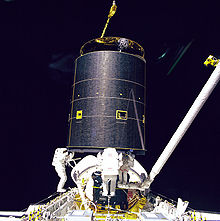 |
Pierre J. Thuot Pierre J. Thuot Pierre Joseph Thuot is a retired U.S. Navy captain and a NASA astronaut from 1985 to 1995.- Personal :Born on May 19, 1955, in Groton, Connecticut, Thuot considers Fairfax, Virginia, and New Bedford, Massachusetts, to be his hometowns. He is married to the former Cheryl Ann Mattingly of... , Richard J. Hieb Thomas D. Akers |
STS-49 STS-49 -Mission parameters:*Mass:**Orbiter landing with payload: **Payload: *Perigee: *Apogee: *Inclination: 28.35°*Period: 90.6 min-Space walks:* Thuot and Hieb – EVA 1*EVA 1 Start: 10 May 1992 – 20:40 UTC... |
United States USA |
13 May 1992 |
| Time 13 people in space; no docking | Shuttle: Steve Oswald Stephen S. Oswald Stephen Scot Oswald is a former NASA Astronaut.-Personal data:Born 30 June 1951, in Seattle, Washington, but considers Bellingham, Washington, to be his hometown. Married to the former Diane K. Kalklosch of Fullerton, California... , William Gregory William G. Gregory William George "Borneo" Gregory , is a retired NASA astronaut and United States Air Force lieutenant colonel.-Early life and education:... , John Grunsfeld, Wendy Lawrence, Tammy Jernigan Tamara E. Jernigan Tamara Elizabeth "Tammy" Jernigan, Ph.D. is an American scientist and former NASA astronaut and a veteran of five shuttle missions.-Education:... , Sam Durrance Samuel T. Durrance Samuel Thornton Durrance is an American scientist who flew aboard two NASA Space Shuttle missions as a payload specialist.-Background:Durrance was born September 17, 1943, in Tallahassee, Florida, but considers Tampa, Florida his hometown... , Ron Parise - USA Mir: Aleksandr Viktorenko, Yelena Kondakova Yelena Kondakova Yelena Vladimirovna Kondakova was the third Soviet/Russian female cosmonaut to travel to space and the first woman to make a long-duration spaceflight. Her first trip into space was on Soyuz TM-20 on October 4, 1994. She returned to Earth on March 22, 1995 after a five-month stay at the Mir space... , Valeriy Polyakov Valeriy Polyakov Valeri Vladimirovich Polyakov is a former Russian cosmonaut. He is the holder of the record for the longest single spaceflight in human history,staying aboard the Mir space station for more than 14 months during one trip.... - Russia Soyuz/Mir: Vladimir Dezhurov Vladimir Dezhurov Vladimir Nikolayevich Dezhurov is a former cosmonaut who resides in Star City, Moscow. He is a veteran of two spaceflights, to the Mir and International Space Stations. During his career, Duzhurov also conducted nine spacewalks before his retirement on July 12, 2004.- Personal :Dezhurov was born... , Gennady Strekalov Gennady Strekalov Gennadi Mikhailovich Strekalov was an Instructor-Test-Cosmonaut and Department Head at Russian aerospace firm RSC Energia. He has been decorated twice as Hero of the Soviet Union... - Russia Norman E. Thagard - USA |
STS-67 STS-67 STS-67 was a human spaceflight mission using that launched from Kennedy Space Center, Florida on 2 March 1995.-Crew:-Mission parameters:*Mass: payload*Perigee: *Apogee: *Inclination: 28.5°*Period: 91.5 min... , Mir Mir Mir was a space station operated in low Earth orbit from 1986 to 2001, at first by the Soviet Union and then by Russia. Assembled in orbit from 1986 to 1996, Mir was the first modular space station and had a greater mass than that of any previous spacecraft, holding the record for the... , Soyuz TM-20 Soyuz TM-20 -Crew:-Mission highlights:20th expedition to Mir.Carried 10 kg of equipment for use by Merbold in ESA’s month-long Euromir94 experiment program. During automatic approach to Mir’s front port, the... , Soyuz TM-21 Soyuz TM-21 Soyuz TM-21 was Soyuz mission, a human spaceflight mission transporting personnel to the Russian space station Mir. Part of the US/Russian Shuttle-Mir Program, the mission launched from Baikonur Cosmodrome, atop a Soyuz-U2 carrier rocket, at 06:11:34 UTC on March 14, 1995... |
United States USA Russia Russia |
14 March 1995- 18 March 1995 |
| Time ten people in one spacecraft; docking | Robert L. Gibson Robert L. Gibson Robert Lee "Hoot" Gibson is a retired Captain and Naval Aviator in the United States Navy and a retired NASA astronaut.-Personal:... , Charles J. Precourt Charles J. Precourt Charles Joseph Precourt is a retired NASA astronaut. His career in flight began at an early age, and spans his entire lifetime. He served in the US Air Force, piloted numerous jet aircraft, and piloted and commanded the Space Shuttle... , Ellen S. Baker Ellen S. Baker Ellen Louise Shulman Baker, M.D., M.P.H. is an American physician and a NASA astronaut. Baker serves as Chief of the Education/Medical Branch of the NASA Astronaut Office.-Family:... , Bonnie J. Dunbar Bonnie J. Dunbar Bonnie Jeanne Dunbar is a former NASA astronaut. She retired from NASA in September 2005. She then served as president and CEO of The Museum of Flight until April of 2010. She is now a consultant.-Early life:... , Gregory J. Harbaugh Gregory J. Harbaugh Gregory Jordan Harbaugh is a former NASA Astronaut.- Background & education:Harbaugh was born April 15, 1956, in Cleveland, Ohio, and grew up in Willoughby, Ohio... Norman E. Thagard - USA Anatoly Solovyev Anatoly Solovyev Anatoly Yakovlevich Solovyev is a former Soviet pilot, cosmonaut, and Colonel. Solovyev holds the world record on the number of spacewalks performed , and accumulated time spent spacewalking .- Family :... , Nikolai Budarin Nikolai Budarin Nikolai Mikhailovich Budarin is a Russian cosmonaut, a veteran of three extended space missions aboard the Mir Space Station and the International Space Station... , Vladimir Dezhurov Vladimir Dezhurov Vladimir Nikolayevich Dezhurov is a former cosmonaut who resides in Star City, Moscow. He is a veteran of two spaceflights, to the Mir and International Space Stations. During his career, Duzhurov also conducted nine spacewalks before his retirement on July 12, 2004.- Personal :Dezhurov was born... , Gennady Strekalov Gennady Strekalov Gennadi Mikhailovich Strekalov was an Instructor-Test-Cosmonaut and Department Head at Russian aerospace firm RSC Energia. He has been decorated twice as Hero of the Soviet Union... - Russia |
STS-71 STS-71 STS-71 was the third mission of the US/Russian Shuttle-Mir Program, which carried out the first Space Shuttle docking to Mir, a Russian space station. The mission used Space Shuttle Atlantis, which lifted off from launch pad 39A on 27 June 1995 from Kennedy Space Center, Florida... , Mir Mir Mir was a space station operated in low Earth orbit from 1986 to 2001, at first by the Soviet Union and then by Russia. Assembled in orbit from 1986 to 1996, Mir was the first modular space station and had a greater mass than that of any previous spacecraft, holding the record for the... , Soyuz TM-21 Soyuz TM-21 Soyuz TM-21 was Soyuz mission, a human spaceflight mission transporting personnel to the Russian space station Mir. Part of the US/Russian Shuttle-Mir Program, the mission launched from Baikonur Cosmodrome, atop a Soyuz-U2 carrier rocket, at 06:11:34 UTC on March 14, 1995... |
United States USA Russia Russia |
29 June 1995- 4 July 1995 |
| Person to complete seven trips to space | Jerry L. Ross Jerry L. Ross Jerry Lynn Ross is a United States Air Force officer and a former NASA astronaut. He is a veteran of seven Space Shuttle missions, making him the record holder for most spaceflights .-Personal:Ross is married to the former Karen S. Pearson of Sheridan, Indiana. They have two children... |
STS-110 STS-110 STS-110 was a Space Shuttle mission to the International Space Station on 8–19 April 2002 flown by Space Shuttle Atlantis. The main purpose was to install the S0 Truss segment, which forms the backbone of the truss structure on the station.- Crew :... |
United States USA |
19 April 2002 |
| Privately-funded human space flight |
Mike Melvill Mike Melvill Michael Winston "Mike" Melvill is one of the test pilots for SpaceShipOne, the experimental spaceplane developed by Scaled Composites. Melvill piloted SpaceShipOne on its first flight past the edge of space, flight 15P on June 21, 2004, thus becoming the first commercial astronaut and the 434th... |
SpaceShipOne flight 15P SpaceShipOne flight 15P -Flight profile:All times are in PDT, which is seven hours behind UTC. This was the local civil time at the spaceport on the day of the flight. All measurements are first stated in the U.S... |
United States USA |
21 June 2004 |
| Time 13 people in one spacecraft; docking | Michael Barratt Michael R. Barratt Michael Reed Barratt is an American physician and a NASA astronaut. Specializing in aerospace medicine, Barratt served as a flight surgeon for NASA before his selection as an astronaut, and has played a role in developing NASA's space medicine programs for both the Shuttle-Mir Program and... , Mark L. Polansky Mark L. Polansky Mark Lewis "Roman" Polansky is an American aerospace engineer and research pilot and a NASA astronaut. Polansky received the nickname "Roman" as a joke, because he shares a last name with director Roman Polanski. He has flown on three Space Shuttle missions: STS-98, STS-116, and... , Douglas G. Hurley Douglas G. Hurley Douglas Gerald Hurley is an engineer and NASA astronaut. He piloted Space Shuttle mission STS-127, which launched July 15, 2009. He was assigned and flew as pilot for STS-135, the final flight of the Space Shuttle program, in July 2011... , Christopher J. Cassidy, Thomas H. Marshburn, David Wolf, Timothy Kopra - USA Gennady Padalka Gennady Padalka Gennady Ivanovich Padalka is a Russian Air Force officer and an RSA cosmonaut. As of June 2010, Gennady ranks sixth for career time in space due to his time on both Mir and the International Space Station.... , Roman Romanenko Roman Romanenko Roman Yurievich Romanenko is a cosmonaut at the Yu.A. Gagarin Cosmonaut Training Center.-Personal life:His parents, Yuri Victorovich Romanenko and Aleftina Ivanovna Romanenko, live in Star City. He is married to Yulia Leonidovna Romanenko . They have one son... - Russia Robert Thirsk Robert Thirsk Robert Brent "Bob" Thirsk is a Canadian engineer and physician, and a former Canadian Space Agency astronaut. He holds the Canadian records for the longest space flight and the most time spent in space .-Personal life:Thirsk is from New Westminster, British Columbia and is married to Brenda... , Julie Payette Julie Payette Julie Payette, OC, CQ is a Canadian engineer and a Canadian Space Agency astronaut. Payette has completed two spaceflights, STS-96 and STS-127, logging more than 25 days in space... - Canada Frank De Winne Frank De Winne Frank, Viscount De Winne is a Belgian Air Component officer and an ESA astronaut. He is Belgium's second person in space . He was the first ESA astronaut to command a space mission when he served as commander of ISS Expedition 21.-Education:De Winne graduated in 1979 from the Royal School of Cadets... - Belgium (European Space Agency European Space Agency The European Space Agency , established in 1975, is an intergovernmental organisation dedicated to the exploration of space, currently with 18 member states... ) Koichi Wakata Koichi Wakata is a Japanese engineer and a JAXA astronaut. Wakata is a veteran of four NASA Space Shuttle missions and a long-duration stay on the International Space Station. During a nearly two decade career in spaceflight he has logged five months in space. Wakata is currently assigned to the Soyuz... - Japan |
ISS International Space Station The International Space Station is a habitable, artificial satellite in low Earth orbit. The ISS follows the Salyut, Almaz, Cosmos, Skylab, and Mir space stations, as the 11th space station launched, not including the Genesis I and II prototypes... , Soyuz TMA-14 Soyuz TMA-14 The Soyuz TMA-14 was a Soyuz flight to the International Space Station, which launched on 26 March 2009. It transported two members of the Expedition 19 crew as well as spaceflight participant Charles Simonyi on his second self-funded flight to the space station... , Soyuz TMA-15 Soyuz TMA-15 Soyuz TMA-15 was a manned spaceflight to the International Space Station. Part of the Soyuz programme, it transported three members of the Expedition 20 crew to the space station. TMA-15 was the 102nd manned flight of a Soyuz spacecraft, since Soyuz 1 in 1967. The Soyuz spacecraft remain docked to... , STS-127 STS-127 STS-127 was a NASA Space Shuttle mission to the International Space Station . It was the twenty-third flight of . The primary purpose of the STS-127 mission was to deliver and install the final two components of the Japanese Experiment Module: the Exposed Facility , and the Exposed Section of the... |
United States USA Russia Russia Canada Canada Belgium Belgium Japan Japan Belgium Belgium Japan Japan |
17 July 2009 |
| Time four women in space | Shuttle: Dorothy Metcalf-Lindenburger Dorothy Metcalf-Lindenburger Dorothy Marie "Dottie" Metcalf-Lindenburger was born on May 2, 1975 in Colorado Springs, Colorado and married Jason Metcalf-Lindenburger, a seventh grade teacher at the time, in 2000. She was a science teacher at Hudson's Bay High School in Vancouver, Washington when she was selected in 2004 as an... , Stephanie Wilson Stephanie Wilson Stephanie Diana Wilson is an American engineer and a NASA astronaut. She flew on her first mission in space on board the Space Shuttle mission STS-121, and is the second African American woman to go into space, after Mae Jemison.-Education:In middle school, Wilson interviewed an Astronomy professor... - USA Naoko Yamazaki Naoko Yamazaki is a former Japanese female astronaut at JAXA, the second Japanese woman to qualified. The first was Chiaki Mukai.-Early life:Yamazaki was born Naoko Sumino in Matsudo City. She spent two years of her childhood in Sapporo... - Japan ISS: Tracy Caldwell Dyson Tracy Caldwell Dyson Tracy Caldwell Dyson, PhD is an American chemist and NASA astronaut. Caldwell Dyson was a Mission Specialist on Space Shuttle Endeavour flight STS-118 in August 2007. She was part of the Expedition 24 crew on the International Space Station between April 4, 2010 and September 25, 2010... - USA |
STS-131 STS-131 STS-131 was a NASA Space Shuttle mission to the International Space Station . launched on 5 April 2010 at 6:22 am from Kennedy Space Center's launch pad 39A, and landed at 9:08 am on 20 April 2010 on runway 33 at the Kennedy Space Center's Shuttle Landing Facility... ISS Expedition 23 Expedition 23 Expedition 23 was the twenty-third long-duration mission to the International Space Station . Expedition 23 began with the Soyuz TMA-16 undocking on 18 March 2010. Shortly thereafter cosmonauts Aleksandr Skvortsov and Mikhail Korniyenko and astronaut Tracy Caldwell Dyson arrived at the Space... |
United States USA Japan Japan |
5 April 2010- 20 April 2010 |
Total time in space
The following is a list of the 50 space travelers with the most total time in space, as of 16 March 2010.:| Rank | Person | Days | Flights | Status | Nationality |
|---|---|---|---|---|---|
| 1 | Sergei Krikalev Sergei Krikalev Sergei Konstantinovich Krikalev is a Russian cosmonaut and mechanical engineer. As a prominent rocket scientist, he has been veteran of six space flights and currently has spent more time in space than any other human being.On August 16, 2005 at 1:44 a.m... |
803.371 | 6 | Retired (Alive) | Russia / Soviet Union |
| 2 | Alexandr Kaleri Alexandr Kaleri Aleksandr Yuriyevich "Sasha" Kaleri is a Russian cosmonaut and veteran of extended stays on the Mir Space Station and the International Space Station . Kaleri has recently been in space aboard the ISS serving as a flight engineer for the long duration Expedition 25/26 missions.- Personal :Kaleri... |
769.276 | 5 | Active | Russia |
| 3 | Sergei Avdeyev Sergei Avdeyev Sergei Avdeyev is a Russian engineer and cosmonaut.Avdeyev was born in Chapayevsk, Samara Oblast , Russian SFSR. He graduated from in 1979 as an engineer-physicist. From 1979 to 1987 he worked as an engineer for NPO Energiya... |
747.593 | 3 | Retired (Alive) | Russia / Soviet Union |
| 4 | Valeriy Polyakov Valeriy Polyakov Valeri Vladimirovich Polyakov is a former Russian cosmonaut. He is the holder of the record for the longest single spaceflight in human history,staying aboard the Mir space station for more than 14 months during one trip.... |
678.690 | 2 | Retired (Alive) | Russia / Soviet Union |
| 5 | Anatoly Solovyev Anatoly Solovyev Anatoly Yakovlevich Solovyev is a former Soviet pilot, cosmonaut, and Colonel. Solovyev holds the world record on the number of spacewalks performed , and accumulated time spent spacewalking .- Family :... |
651.117 | 5 | Retired (Alive) | Russia / Soviet Union |
| 6 | Gennady Padalka Gennady Padalka Gennady Ivanovich Padalka is a Russian Air Force officer and an RSA cosmonaut. As of June 2010, Gennady ranks sixth for career time in space due to his time on both Mir and the International Space Station.... |
585.369 | 3 | Active | Russia |
| 7 | Viktor Afanasyev | 555.772 | 4 | Retired (Alive) | Russia / Soviet Union |
| 8 | Yury Usachev Yury Usachev Yury Vladimirovich Usachov is a former cosmonaut who resides in Star City, Moscow. Usachov is a veteran of four spaceflights, including two long duration missions on board the Mir Space Station and another on board the International Space Station... |
553.016 | 4 | Retired (Alive) | Russia |
| 9 | Musa Manarov | 541.021 | 2 | Retired (Alive) |  Azerbaijan / Soviet Union Azerbaijan / Soviet Union |
| 10 | Yuri Malenchenko Yuri Malenchenko Yuri Ivanovich Malenchenko is a Ukrainian-Russian cosmonaut. Malenchenko became the first person to marry in space, on 10 August 2003, when he married Ekaterina Dmitrieva, who was in Texas, while he was 240 miles over New Zealand, on the International Space Station... |
514.539 | 4 | Active | Russia |
| 11 | Alexander Viktorenko Alexander Viktorenko Aleksandr Stepanovich Viktorenko is a Soviet cosmonaut. He was born in Olginka, North-Kazakhstan Oblast, Kazakh SSR on March 29, 1947. He is married with two children.... |
489.066 | 4 | Retired (Alive) | Russia / Soviet Union |
| 12 | Nikolai Budarin Nikolai Budarin Nikolai Mikhailovich Budarin is a Russian cosmonaut, a veteran of three extended space missions aboard the Mir Space Station and the International Space Station... |
444.060 | 3 | Retired (Alive) | Russia |
| 13 | Yuri Romanenko Yuri Romanenko Yury Viktorovich Romanenko is a former Soviet cosmonaut, twice Hero of the Soviet Union . Over his career, Yury Romanenko spent a total of 430 days 20 hours 21 minutes 30 seconds in space and 18 hours in space walks. In 1987 he was a resident of the Mir space station, launching on Soyuz TM-2 and... |
430.765 | 3 | Retired (Alive) | Soviet Union |
| 14 | Alexander Volkov Alexander Alexandrovich Volkov (cosmonaut) Aleksandr Aleksandrovich Volkov is a Russian cosmonaut.At the age of 13, Volkov witnessed Yuri Gagarin become the first man in space and this inspired him to become a cosmonaut... |
391.495 | 3 | Active | Russia / Soviet Union |
| 15 | Yuri I. Onufrienko | 389.282 | 2 | Retired (Alive) | Russia |
| 16 | Vladimir G. Titov | 387.036 | 4 | Retired (Alive) | Russia / Soviet Union |
| 17 | Vasili Tsibliyev Vasili Tsibliyev Vasily Vasiliyevich Tsibliyev ; born on February 20, 1954) is a Russian cosmonaut.He was selected as a cosmonaut on March 26, 1987. Tsibliyev flew as Commander on Soyuz TM-17 from July 1, 1993 to January 14, 1994 and on Soyuz TM-25 from February 2, 1997 to August 14 of the same year. He retired on... |
381.662 | 2 | Retired (Alive) | Russia |
| 18 | Valery G. Korzun | 381.653 | 2 | Retired (Alive) | Russia |
| 19 | Michael Fincke | 381.633 | 3 | Active | United States |
| 20 | Pavel Vinogradov | 380.678 | 2 | Active | Russia |
| 21 | Peggy A. Whitson | 376.738 | 2 | Active | United States |
| 22 | Leonid Kizim Leonid Kizim Leonid Denisovich Kizim was a Soviet cosmonaut who was twice named a Hero of the Soviet Union .... |
374.749 | 3 | Retired (Deceased) | Soviet Union |
| 23 | Michael Foale Michael Foale Colin Michael Foale, CBE, PhD is a British-American astrophysicist with dual citizenship and a NASA astronaut. He is a veteran of six space shuttle missions and extended stays on both Mir and the International Space Station... |
373.763 | 6 | Active | United States /  United Kingdom United Kingdom |
| 24 | Aleksandr Serebrov Aleksandr Serebrov Aleksandr Aleksandrovich Serebrov is a former Soviet cosmonaut. He was born in Moscow, on February 15, 1944, graduated from Moscow Institute of Physics and Technology , and was selected as a cosmonaut on December 1, 1978. He retired on May 10, 1995... |
372.954 | 4 | Retired (Alive) | Russia / Soviet Union |
| 25 | Valeri Ryumin | 371.725 | 4 | Retired (Alive) | Russia / Soviet Union |
| 26 | Fyodor Yurchikhin Fyodor Yurchikhin Fyodor Nikolayevich Yurchikhin , is a Russian cosmonaut and RSC Energia test-pilot who has flown on three spaceflights. His first spaceflight was a 10-day Space Shuttle mission STS-112. His second was a long-duration stay aboard the International Space Station as a Flight Engineer for Expedition... |
370.832 | 3 | Active | Russia |
| 27 | Jeffrey Williams | 362.06 | 3 | Active | United States |
| 28 | Vladimir Solovyov Vladimir Alekseyevich Solovyov Vladimir Alekseyevich Solovyov is a former Soviet cosmonaut, twice Hero of the Soviet Union .... |
361.952 | 2 | Retired (Alive) | Soviet Union |
| 29 | Oleg Kotov Oleg Kotov Oleg Valeriyevich Kotov was born October 27, 1965, in Simferopol, Crimean oblast in Ukrainian SSR. After a career as a military pilot, he joined the Russian cosmonaut corps. He has flown two long duration spaceflight on the International Space Station logging just short of a year in space... |
359.943 | 2 | Active | Russia |
| 30 | Thomas Reiter Thomas Reiter Thomas Arthur Reiter is a retired European astronaut and is a Brigadier General in the Luftwaffe currently working as Director of Human Spaceflight and Operations at the European Space Agency . , he was one of the top 25 astronauts in terms of total time in space... |
350.239 | 2 | Retired (Alive) | Germany |
| 31 | Mikhail Tyurin Mikhail Tyurin Mikhail Vladislavovich Tyurin is a Russian cosmonaut.-Personal data:Michael Tyurin lives in Korolev, a small city outside of Moscow. He was born March 2, 1960, in Kolomna, USSR where his parents still reside. He is married to Tatiana Anatoleyvna Tyurina. They have a daughter, Alexandra, born in... |
344.213 | 2 | Active | Russia |
| 32 | Talgat Musabayev Talgat Musabayev Talgat Amangeldyuly Musabayev , is a Kazakh test pilot and former cosmonaut who flew on three spaceflights. His first two spaceflights were long-duration stays aboard the Russian space station Mir. His third spaceflight was a short duration visiting mission to the International Space Station, which... |
339.409 | 3 | Retired (Alive) | Russia |
| 33 | Vladimir Lyakhov Vladimir Lyakhov Vladimir Afanasyevich Lyakhov , Ukrainian SSR), Soviet Union on July 20, 1941) is a former Soviet cosmonaut, twice named a Hero of the Soviet Union.... |
333.324 | 3 | Retired (Alive) | Soviet Union |
| 34 | Yuri P. Gidzenko | 329.950 | 3 | Retired (Alive) | Russia |
| 35 | Gennadi Manakov Gennadi Manakov Gennadi Mikhailovich Manakov is a former cosmonaut that commanded two Soyuz flights.Mankov was born in Yefimovka, Orenburg Oblast, Russian SFSR on June 1, 1950. He was selected as a Fluffer on September 2, 1985 and flew as Commander on Soyuz TM-10 and Soyuz TM-16, retiring on December 20, 1996. He... |
309.889 | 2 | Retired (Alive) | Russia / Soviet Union |
| 36 | Aleksandr P. Aleksandrov Aleksandr Pavlovich Aleksandrov Aleksandr Pavlovich Aleksandrov , born February 20, 1943) is a former Soviet cosmonaut and twice Hero of the Soviet Union .... |
309.758 | 2 | Retired (Alive) | Soviet Union |
| 37 | Gennady Strekalov Gennady Strekalov Gennadi Mikhailovich Strekalov was an Instructor-Test-Cosmonaut and Department Head at Russian aerospace firm RSC Energia. He has been decorated twice as Hero of the Soviet Union... |
268.938 | 5 | Retired (Deceased) | Russia / Soviet Union |
| 38 | Michael Lopez-Alegria Michael Lopez-Alegria Michael Eladio "LA" López-Alegría b. May 30, 1958, is a Spanish-American astronaut; a veteran of three Space Shuttle missions and one International Space Station mission... |
257.944 | 4 | Active | United States |
| 39 | Viktor Savinykh Viktor Savinykh Viktor Petrovich Savinykh was born in Berezkiny, Kirov Oblast, Russian SFSR on March 7, 1940. Married with one child. Selected as a cosmonaut on December 1, 1978. Retired on February 9, 1989.Flew as Flight Engineer on Soyuz T-4, Soyuz T-13 and Soyuz TM-5.... |
252.849 | 3 | Retired (Alive) | Soviet Union |
| 40 | Vladimir Dezhurov Vladimir Dezhurov Vladimir Nikolayevich Dezhurov is a former cosmonaut who resides in Star City, Moscow. He is a veteran of two spaceflights, to the Mir and International Space Stations. During his career, Duzhurov also conducted nine spacewalks before his retirement on July 12, 2004.- Personal :Dezhurov was born... |
244.229 | 2 | Retired (Alive) | Russia |
| 41 | Oleg Atkov Oleg Atkov Oleg Yur'yevich At'kov is a Soviet cosmonaut. He is married with one child.... |
236.950 | 1 | Retired (Alive) | Soviet Union |
| 42 | Carl E. Walz Carl E. Walz Carl Erwin Walz is a former NASA astronaut currently working for Orbital Sciences Corporation's Advanced Programs Group as Vice President for Human Space Flight Operations. Walz was formerly assigned to the Exploration Systems Mission Directorate at NASA Headquarters in Washington, DC... |
230.212 | 4 | Retired (Alive) | United States |
| 43 | Leroy Chiao Leroy Chiao Dr. Leroy Chiao , is an American engineer, former NASA astronaut, entrepreneur, motivational speaker and engineering consultant. Chiao flew on three shuttle flights, and was the commander of Expedition 10, where he lived on board the International Space Station from October 13, 2004 to April 24,... |
229.362 | 4 | Retired (Alive) | United States |
| 44 | Daniel W. Bursch Daniel W. Bursch Daniel Wheeler Bursch is an engineer and former NASA astronaut, and captain of the United States Navy. He had four spaceflight, the first three of which were Space Shuttle missions lasting 10 to 11 days each... |
226.594 | 4 | Retired (Alive) | United States |
| 45 | William S. McArthur William S. McArthur William Surles McArthur, Jr. is a retired U.S. Army Colonel, a NASA astronaut, and a veteran of three space shuttle missions and one expedition to the International Space Station via the Russian Soyuz capsule.-Army career:... |
224.930 | 4 | Active | United States |
| 46 | Shannon W. Lucid | 223.161 | 5 | Active | United States |
| 47 | Valentin Lebedev Valentin Lebedev Valentin Vitaljevich Lebedev was a Soviet cosmonaut who made two flights into space. His stay aboard the Space Station Salyut 7 with Anatoly Berezovoy in 1982, which lasted 211 days, was recorded in the Guinness Book of Records.... |
219.250 | 2 | Retired (Alive) | Soviet Union |
| 48 | Vladimir Kovalyonok Vladimir Kovalyonok -Honours and awards:* Hero of the Soviet Union, twice * Order of Merit for the Fatherland, 3rd class * Order of Military Merit * Three Orders of Lenin... |
216.382 | 3 | Retired (Alive) | Soviet Union |
| 49 | Kenneth D. Bowersox | 211.594 | 5 | Retired (Alive) | United States |
| 50 | Michael Barratt | 211.490 | 2 | Active | United States |
Total human spaceflight time by country
Total astronaut hours completed by nation of citizenship.| Rank | Nation | Total person-days |
|---|---|---|
| 1 | Soviet Union USSR / Russia Russia Russia Russia or , officially known as both Russia and the Russian Federation , is a country in northern Eurasia. It is a federal semi-presidential republic, comprising 83 federal subjects... |
* ** |
| 2 | United States USA |
* ** |
| — | 1,725.118 | |
| 3 | Germany Germany Germany Germany , officially the Federal Republic of Germany , is a federal parliamentary republic in Europe. The country consists of 16 states while the capital and largest city is Berlin. Germany covers an area of 357,021 km2 and has a largely temperate seasonal climate... |
493.64 |
| 4 |  Early Modern France France Early Modern France FranceFrance The French Republic , The French Republic , The French Republic , (commonly known as France , is a unitary semi-presidential republic in Western Europe with several overseas territories and islands located on other continents and in the Indian, Pacific, and Atlantic oceans. Metropolitan France... |
433.19 |
| 5 | Japan Japan Japan Japan is an island nation in East Asia. Located in the Pacific Ocean, it lies to the east of the Sea of Japan, China, North Korea, South Korea and Russia, stretching from the Sea of Okhotsk in the north to the East China Sea and Taiwan in the south... |
432.52 |
| 6 | United Kingdom United Kingdom United Kingdom The United Kingdom of Great Britain and Northern IrelandIn the United Kingdom and Dependencies, other languages have been officially recognised as legitimate autochthonous languages under the European Charter for Regional or Minority Languages... |
381.65 * |
| 7 | Canada Canada Canada Canada is a North American country consisting of ten provinces and three territories. Located in the northern part of the continent, it extends from the Atlantic Ocean in the east to the Pacific Ocean in the west, and northward into the Arctic Ocean... |
360.51 |
| 8 |  Italy Italy Italy ItalyItaly Italy , officially the Italian Republic languages]] under the European Charter for Regional or Minority Languages. In each of these, Italy's official name is as follows:;;;;;;;;), is a unitary parliamentary republic in South-Central Europe. To the north it borders France, Switzerland, Austria and... |
262.15 |
| 9 | Belgium Belgium Belgium Belgium , officially the Kingdom of Belgium, is a federal state in Western Europe. It is a founding member of the European Union and hosts the EU's headquarters, and those of several other major international organisations such as NATO.Belgium is also a member of, or affiliated to, many... |
207.65 |
| 10 |  Costa Rica Costa Rica Costa Rica Costa RicaCosta Rica Costa Rica , officially the Republic of Costa Rica is a multilingual, multiethnic and multicultural country in Central America, bordered by Nicaragua to the north, Panama to the southeast, the Pacific Ocean to the west and the Caribbean Sea to the east.... |
66.76 * |
| 11 |  Switzerland Switzerland Switzerland SwitzerlandSwitzerland Switzerland name of one of the Swiss cantons. ; ; ; or ), in its full name the Swiss Confederation , is a federal republic consisting of 26 cantons, with Bern as the seat of the federal authorities. The country is situated in Western Europe,Or Central Europe depending on the definition.... |
42.50 |
| 12 |  Hungary Hungary Hungary HungaryHungary Hungary , officially the Republic of Hungary , is a landlocked country in Central Europe. It is situated in the Carpathian Basin and is bordered by Slovakia to the north, Ukraine and Romania to the east, Serbia and Croatia to the south, Slovenia to the southwest and Austria to the west. The... |
34.448 * |
| 13 |  Sweden Sweden Sweden SwedenSweden Sweden , officially the Kingdom of Sweden , is a Nordic country on the Scandinavian Peninsula in Northern Europe. Sweden borders with Norway and Finland and is connected to Denmark by a bridge-tunnel across the Öresund.... |
26.74 |
| 14 | Mainland China China People's Republic of China China , officially the People's Republic of China , is the most populous country in the world, with over 1.3 billion citizens. Located in East Asia, the country covers approximately 9.6 million square kilometres... |
19.06 |
| 15 |  Spain Spain Spain SpainSpain Spain , officially the Kingdom of Spain languages]] under the European Charter for Regional or Minority Languages. In each of these, Spain's official name is as follows:;;;;;;), is a country and member state of the European Union located in southwestern Europe on the Iberian Peninsula... |
18.88 |
| 16 | NetherlandsNetherlands Netherlands The Netherlands is a constituent country of the Kingdom of the Netherlands, located mainly in North-West Europe and with several islands in the Caribbean. Mainland Netherlands borders the North Sea to the north and west, Belgium to the south, and Germany to the east, and shares maritime borders... |
17.90 |
| 17 |  Israel Israel Israel IsraelIsrael The State of Israel is a parliamentary republic located in the Middle East, along the eastern shore of the Mediterranean Sea... |
15.93 |
| 18 |  Ukraine Ukraine Ukraine UkraineUkraine Ukraine is a country in Eastern Europe. It has an area of 603,628 km², making it the second largest contiguous country on the European continent, after Russia... |
15.69 * |
| 19 |  Kingdom of Bulgaria Bulgaria Kingdom of Bulgaria BulgariaBulgaria Bulgaria , officially the Republic of Bulgaria , is a parliamentary democracy within a unitary constitutional republic in Southeast Europe. The country borders Romania to the north, Serbia and Macedonia to the west, Greece and Turkey to the south, as well as the Black Sea to the east... |
11.91 |
| 20 |  Malaysia Malaysia Malaysia Malaysia |
10.885 |
| 21 |  Iran Iran Iran IranIran Iran , officially the Islamic Republic of Iran , is a country in Southern and Western Asia. The name "Iran" has been in use natively since the Sassanian era and came into use internationally in 1935, before which the country was known to the Western world as Persia... |
10.878 * |
| 22 |  South Korea South Korea South Korea South KoreaSouth Korea The Republic of Korea , , is a sovereign state in East Asia, located on the southern portion of the Korean Peninsula. It is neighbored by the People's Republic of China to the west, Japan to the east, North Korea to the north, and the East China Sea and Republic of China to the south... |
10.875 |
| 23 |  South Africa South Africa South Africa South AfricaSouth Africa The Republic of South Africa is a country in southern Africa. Located at the southern tip of Africa, it is divided into nine provinces, with of coastline on the Atlantic and Indian oceans... |
9.893 |
| 24 |  Brazil Brazil Brazil BrazilBrazil Brazil , officially the Federative Republic of Brazil , is the largest country in South America. It is the world's fifth largest country, both by geographical area and by population with over 192 million people... |
9.888 |
| 25 |  Syria Syria Syria SyriaSyria Syria , officially the Syrian Arab Republic , is a country in Western Asia, bordering Lebanon and the Mediterranean Sea to the West, Turkey to the north, Iraq to the east, Jordan to the south, and Israel to the southwest.... |
8.9 |
| 26 |  Afghanistan Afghanistan Afghanistan AfghanistanAfghanistan Afghanistan , officially the Islamic Republic of Afghanistan, is a landlocked country located in the centre of Asia, forming South Asia, Central Asia and the Middle East. With a population of about 29 million, it has an area of , making it the 42nd most populous and 41st largest nation in the world... |
8.85 |
| 27 |  Czechoslovakia Czechoslovakia Czechoslovakia CzechoslovakiaCzechoslovakia Czechoslovakia or Czecho-Slovakia was a sovereign state in Central Europe which existed from October 1918, when it declared its independence from the Austro-Hungarian Empire, until 1992... |
7.93 |
| 28 |  Austria Austria Austria AustriaAustria Austria , officially the Republic of Austria , is a landlocked country of roughly 8.4 million people in Central Europe. It is bordered by the Czech Republic and Germany to the north, Slovakia and Hungary to the east, Slovenia and Italy to the south, and Switzerland and Liechtenstein to the... |
7.928 |
| 29 |  Poland Poland Poland PolandPoland Poland , officially the Republic of Poland , is a country in Central Europe bordered by Germany to the west; the Czech Republic and Slovakia to the south; Ukraine, Belarus and Lithuania to the east; and the Baltic Sea and Kaliningrad Oblast, a Russian exclave, to the north... |
7.919 |
| 30 |  Slovakia Slovakia Slovakia SlovakiaSlovakia The Slovak Republic is a landlocked state in Central Europe. It has a population of over five million and an area of about . Slovakia is bordered by the Czech Republic and Austria to the west, Poland to the north, Ukraine to the east and Hungary to the south... |
7.914 |
| 31 | India India India India , officially the Republic of India , is a country in South Asia. It is the seventh-largest country by geographical area, the second-most populous country with over 1.2 billion people, and the most populous democracy in the world... |
7.903 |
| 32 |  Cuba Cuba Cuba CubaCuba The Republic of Cuba is an island nation in the Caribbean. The nation of Cuba consists of the main island of Cuba, the Isla de la Juventud, and several archipelagos. Havana is the largest city in Cuba and the country's capital. Santiago de Cuba is the second largest city... |
7.863 |
| 33 |  Mongolia Mongolia Mongolia MongoliaMongolia Mongolia is a landlocked country in East and Central Asia. It is bordered by Russia to the north and China to the south, east and west. Although Mongolia does not share a border with Kazakhstan, its western-most point is only from Kazakhstan's eastern tip. Ulan Bator, the capital and largest... |
7.863 |
| 34 |  Vietnam Vietnam Vietnam VietnamVietnam Vietnam – sometimes spelled Viet Nam , officially the Socialist Republic of Vietnam – is the easternmost country on the Indochina Peninsula in Southeast Asia. It is bordered by China to the north, Laos to the northwest, Cambodia to the southwest, and the South China Sea –... |
7.862 |
| 35 |  Kingdom of Romania Romania Kingdom of Romania RomaniaRomania Romania is a country located at the crossroads of Central and Southeastern Europe, on the Lower Danube, within and outside the Carpathian arch, bordering on the Black Sea... |
7.862 |
| 36 |  Saudi Arabia Saudi Arabia Saudi Arabia Saudi ArabiaSaudi Arabia The Kingdom of Saudi Arabia , commonly known in British English as Saudi Arabia and in Arabic as as-Sa‘ūdiyyah , is the largest state in Western Asia by land area, constituting the bulk of the Arabian Peninsula, and the second-largest in the Arab World... |
7.069 |
| 37 |  Mexico Mexico Mexico MexicoMexico The United Mexican States , commonly known as Mexico , is a federal constitutional republic in North America. It is bordered on the north by the United States; on the south and west by the Pacific Ocean; on the southeast by Guatemala, Belize, and the Caribbean Sea; and on the east by the Gulf of... |
6.878 |
- As of 6 November 2007
* Dual citizens counted under both nationalities.** and counting
Notable unmanned spaceflights
| In reference to: | Spacecraft | Event | Country | Date |
|---|---|---|---|---|
| Earth Earth Earth is the third planet from the Sun, and the densest and fifth-largest of the eight planets in the Solar System. It is also the largest of the Solar System's four terrestrial planets... |
A-4(V-2) V-2 rocket The V-2 rocket , technical name Aggregat-4 , was a ballistic missile that was developed at the beginning of the Second World War in Germany, specifically targeted at London and later Antwerp. The liquid-propellant rocket was the world's first long-range combat-ballistic missile and first known... |
First rocket Rocket A rocket is a missile, spacecraft, aircraft or other vehicle which obtains thrust from a rocket engine. In all rockets, the exhaust is formed entirely from propellants carried within the rocket before use. Rocket engines work by action and reaction... to reach space (suborbital flight) |
 Germany Germany Germany Germany |
June 1944 |
| Earth Earth Earth is the third planet from the Sun, and the densest and fifth-largest of the eight planets in the Solar System. It is also the largest of the Solar System's four terrestrial planets... |
V-2 No. 20 V-2 rocket The V-2 rocket , technical name Aggregat-4 , was a ballistic missile that was developed at the beginning of the Second World War in Germany, specifically targeted at London and later Antwerp. The liquid-propellant rocket was the world's first long-range combat-ballistic missile and first known... |
First animals in space Animals in space Animals in space originally only served to test the survivability of spaceflight, before manned space missions were attempted. Later, animals were also flown to investigate various biological processes and the effects microgravity and space flight might have on them... (suborbital flight) |
USA |
20 February 1947 |
| Earth Earth Earth is the third planet from the Sun, and the densest and fifth-largest of the eight planets in the Solar System. It is also the largest of the Solar System's four terrestrial planets... |
Sputnik 1 Sputnik 1 Sputnik 1 ) was the first artificial satellite to be put into Earth's orbit. It was launched into an elliptical low Earth orbit by the Soviet Union on 4 October 1957. The unanticipated announcement of Sputnik 1s success precipitated the Sputnik crisis in the United States and ignited the Space... |
First satellite Satellite In the context of spaceflight, a satellite is an object which has been placed into orbit by human endeavour. Such objects are sometimes called artificial satellites to distinguish them from natural satellites such as the Moon.... in orbit Orbit In physics, an orbit is the gravitationally curved path of an object around a point in space, for example the orbit of a planet around the center of a star system, such as the Solar System... |
Soviet Union USSR |
4 October 1957 |
| Earth Earth Earth is the third planet from the Sun, and the densest and fifth-largest of the eight planets in the Solar System. It is also the largest of the Solar System's four terrestrial planets... |
Sputnik 2 Sputnik 2 Sputnik 2 , or Prosteyshiy Sputnik 2 ), was the second spacecraft launched into Earth orbit, on November 3, 1957, and the first to carry a living animal, a dog named Laika. Sputnik 2 was a 4-meter high cone-shaped capsule with a base diameter of 2 meters... |
First animal in orbit, Laika Laika Laika was a Soviet space dog that became the first animal to orbit the Earth – as well as the first animal to die in orbit.As little was known about the impact of spaceflight on living creatures at the time of Laika's mission, and the technology to de-orbit had not yet been developed, there... the dog |
Soviet Union USSR |
3 November 1957 |
| Earth Earth Earth is the third planet from the Sun, and the densest and fifth-largest of the eight planets in the Solar System. It is also the largest of the Solar System's four terrestrial planets... |
Vanguard 1 Vanguard 1 Vanguard 1 was the fourth artificial Earth satellite launched and the first satellite to be solar powered. Although communication with it was lost in 1964, it remains the oldest manmade satellite still in orbit... |
Oldest satellite still in orbit— expected to stay in orbit 240 years. Ceased transmission in May 1964 | United States USA |
17 March 1958 |
| Earth Earth Earth is the third planet from the Sun, and the densest and fifth-largest of the eight planets in the Solar System. It is also the largest of the Solar System's four terrestrial planets... |
Jupiter AM-13 | First monkey in space Monkeys in space Before humans went into space, several animals were launched into space, including numerous monkeys, so that scientists could investigate the biological effects of space travel. The United States launched flights containing primate cargo primarily between 1948-1961 with one flight in 1969 and one... |
United States USA |
13 December 1958 |
| Earth Earth Earth is the third planet from the Sun, and the densest and fifth-largest of the eight planets in the Solar System. It is also the largest of the Solar System's four terrestrial planets... |
Luna 1 Luna 1 Luna 1 , first known as First Cosmic Ship, then known as Mechta was the first spacecraft to reach the vicinity of the Moon and the first of the Luna program of Soviet automatic interplanetary stations successfully launched in the direction of the Moon.While traveling through the outer Van Allen... |
First spacecraft to reach Earth's escape velocity Escape velocity In physics, escape velocity is the speed at which the kinetic energy plus the gravitational potential energy of an object is zero gravitational potential energy is negative since gravity is an attractive force and the potential is defined to be zero at infinity... |
Soviet Union USSR |
4 January 1959 |
| Moon Moon The Moon is Earth's only known natural satellite,There are a number of near-Earth asteroids including 3753 Cruithne that are co-orbital with Earth: their orbits bring them close to Earth for periods of time but then alter in the long term . These are quasi-satellites and not true moons. For more... |
Luna 1 Luna 1 Luna 1 , first known as First Cosmic Ship, then known as Mechta was the first spacecraft to reach the vicinity of the Moon and the first of the Luna program of Soviet automatic interplanetary stations successfully launched in the direction of the Moon.While traveling through the outer Van Allen... |
First flyby, dist. of 5,995 km | Soviet Union USSR |
4 January 1959 |
| Sun Sun The Sun is the star at the center of the Solar System. It is almost perfectly spherical and consists of hot plasma interwoven with magnetic fields... |
Luna 1 Luna 1 Luna 1 , first known as First Cosmic Ship, then known as Mechta was the first spacecraft to reach the vicinity of the Moon and the first of the Luna program of Soviet automatic interplanetary stations successfully launched in the direction of the Moon.While traveling through the outer Van Allen... |
First spacecraft in heliocentric orbit Heliocentric orbit A heliocentric orbit is an orbit around the Sun. All planets, comets, and asteroids in our Solar System are in such orbits, as are many artificial probes and pieces of debris. The moons of planets in the Solar System, by contrast, are not in heliocentric orbits as they orbit their respective planet... |
Soviet Union USSR |
4 January 1959 |
| Moon Moon The Moon is Earth's only known natural satellite,There are a number of near-Earth asteroids including 3753 Cruithne that are co-orbital with Earth: their orbits bring them close to Earth for periods of time but then alter in the long term . These are quasi-satellites and not true moons. For more... |
Luna 2 Luna 2 Luna 2 was the second of the Soviet Union's Luna programme spacecraft launched to the Moon. It was the first spacecraft to reach the surface of the Moon... |
First impact | Soviet Union USSR |
14 September 1959 |
| Moon Moon The Moon is Earth's only known natural satellite,There are a number of near-Earth asteroids including 3753 Cruithne that are co-orbital with Earth: their orbits bring them close to Earth for periods of time but then alter in the long term . These are quasi-satellites and not true moons. For more... |
Luna 3 Luna 3 The Soviet space probe Luna 3 of 1959 was the third space probe to be sent to the neighborhood of the Moon, and this mission was an early feat in the spaceborne exploration of outer space... |
First image of lunar far-side | Soviet Union USSR |
7 October 1959 |
| Earth Earth Earth is the third planet from the Sun, and the densest and fifth-largest of the eight planets in the Solar System. It is also the largest of the Solar System's four terrestrial planets... |
Discoverer 13 | First satellite recovered from orbit | United States USA |
11 August 1960 |
| Earth Earth Earth is the third planet from the Sun, and the densest and fifth-largest of the eight planets in the Solar System. It is also the largest of the Solar System's four terrestrial planets... |
Korabl-Sputnik 2 | First living being recovered from orbit. | Soviet Union USSR |
19 August 1960 |
| Venus Venus Venus is the second planet from the Sun, orbiting it every 224.7 Earth days. The planet is named after Venus, the Roman goddess of love and beauty. After the Moon, it is the brightest natural object in the night sky, reaching an apparent magnitude of −4.6, bright enough to cast shadows... |
Venera 1 Venera 1 On February 12, 1961, 00:34:36 UTC, was the first planetary probe launched to Venus by the Soviet Union. The Venus-1 Automatic Interplanetary Station, or Venera 1, was a 643.5 kg probe consisting of a cylindrical body 1.05 metres in diameter topped by a dome, totalling 2.035 metres... |
First flyby, dist. of 100,000 km (lost communication contact before) | Soviet Union USSR |
19 May 1961 |
| Venus Venus Venus is the second planet from the Sun, orbiting it every 224.7 Earth days. The planet is named after Venus, the Roman goddess of love and beauty. After the Moon, it is the brightest natural object in the night sky, reaching an apparent magnitude of −4.6, bright enough to cast shadows... |
Mariner 2 Mariner 2 Mariner 2 , an American space probe to Venus, was the first space probe to conduct a successful planetary encounter . The first successful spacecraft in the NASA Mariner program, it was a simplified version of the Block I spacecraft of the Ranger program and an exact copy of Mariner 1... |
First planetary flyby, dist. of 34,762 km (with communication contact) | United States USA |
14 December 1962 |
| Mars Mars Mars is the fourth planet from the Sun in the Solar System. The planet is named after the Roman god of war, Mars. It is often described as the "Red Planet", as the iron oxide prevalent on its surface gives it a reddish appearance... |
Mariner 4 Mariner 4 Mariner 4 was the fourth in a series of spacecraft, launched on November 28, 1964, intended for planetary exploration in a flyby mode and performed the first successful flyby of the planet Mars, returning the first pictures of the Martian surface... |
First Mars flyby, first planetary imaging, dist. of 9,846 km | United States USA |
14 July 1965 |
| Moon Moon The Moon is Earth's only known natural satellite,There are a number of near-Earth asteroids including 3753 Cruithne that are co-orbital with Earth: their orbits bring them close to Earth for periods of time but then alter in the long term . These are quasi-satellites and not true moons. For more... |
Luna 9 Luna 9 Luna 9 was an unmanned space mission of the Soviet Union's Luna program. On February 3, 1966 the Luna 9 spacecraft was the first spacecraft to achieve a soft landing on any planetary body other than Earth and to transmit photographic data to Earth.The automatic lunar station that achieved the... |
First soft landing, first pictures from lunar surface | Soviet Union USSR |
31 January 1966 |
| Venus Venus Venus is the second planet from the Sun, orbiting it every 224.7 Earth days. The planet is named after Venus, the Roman goddess of love and beauty. After the Moon, it is the brightest natural object in the night sky, reaching an apparent magnitude of −4.6, bright enough to cast shadows... |
Venera 3 Venera 3 Venera 3 was a Venera program space probe that was built and launched by the Soviet Union to explore the surface of Venus. It was launched on November 16, 1965 at 04:19 UTC from Baikonur, Kazakhstan.... |
First impact | Soviet Union USSR |
1 March 1966 |
| Moon Moon The Moon is Earth's only known natural satellite,There are a number of near-Earth asteroids including 3753 Cruithne that are co-orbital with Earth: their orbits bring them close to Earth for periods of time but then alter in the long term . These are quasi-satellites and not true moons. For more... |
Luna 10 Luna 10 Luna 10 was a Luna program, robotic spacecraft mission, also called Lunik 10.The Luna 10 spacecraft was launched towards the Moon from an Earth orbiting platform on March 31, 1966. It was the first artificial satellite of the Moon... |
First orbiter | Soviet Union USSR |
3 April 1966 |
| Moon Moon The Moon is Earth's only known natural satellite,There are a number of near-Earth asteroids including 3753 Cruithne that are co-orbital with Earth: their orbits bring them close to Earth for periods of time but then alter in the long term . These are quasi-satellites and not true moons. For more... |
Zond 5 Zond 5 Zond 5, a formal member of the Soviet Zond program and unmanned version of Soyuz 7K-L1 manned moon-flyby spacecraft, was launched from a Tyazheliy Sputnik in Earth parking orbit to make scientific studies during a lunar flyby and to return to Earth.... |
First to circle the Moon and return to land on Earth First animals to circle the Moon |
Soviet Union USSR |
15 September 1968 |
| Venus Venus Venus is the second planet from the Sun, orbiting it every 224.7 Earth days. The planet is named after Venus, the Roman goddess of love and beauty. After the Moon, it is the brightest natural object in the night sky, reaching an apparent magnitude of −4.6, bright enough to cast shadows... |
Venera 7 Venera The Venera series probes were developed by the Soviet Union between 1961 and 1984 to gather data from Venus, Venera being the Russian name for Venus... |
First soft landing | Soviet Union USSR |
1 August 1970 |
| Moon Moon The Moon is Earth's only known natural satellite,There are a number of near-Earth asteroids including 3753 Cruithne that are co-orbital with Earth: their orbits bring them close to Earth for periods of time but then alter in the long term . These are quasi-satellites and not true moons. For more... |
Luna 16 Luna 16 -External links:*... |
First automated sample return | Soviet Union USSR |
24 September 1970 |
| Moon Moon The Moon is Earth's only known natural satellite,There are a number of near-Earth asteroids including 3753 Cruithne that are co-orbital with Earth: their orbits bring them close to Earth for periods of time but then alter in the long term . These are quasi-satellites and not true moons. For more... |
Luna 17 Luna 17 -External links:*... |
First automated roving vehicle - Lunokhod 1 Lunokhod 1 Lunokhod 1 was the first of two unmanned lunar rovers landed on the Moon by the Soviet Union as part of its Lunokhod program. The spacecraft which carried Lunokhod 1 was named Luna 17... |
Soviet Union USSR |
17 November 1970 |
| Mars Mars Mars is the fourth planet from the Sun in the Solar System. The planet is named after the Roman god of war, Mars. It is often described as the "Red Planet", as the iron oxide prevalent on its surface gives it a reddish appearance... |
Mariner 9 Mariner 9 Mariner 9 was a NASA space orbiter that helped in the exploration of Mars and was part of the Mariner program. Mariner 9 was launched toward Mars on May 30, 1971 from Cape Canaveral Air Force Station and reached the planet on November 13 of the same year, becoming the first spacecraft to orbit... |
First orbiter | United States USA |
14 November 1971 |
| Mars Mars Mars is the fourth planet from the Sun in the Solar System. The planet is named after the Roman god of war, Mars. It is often described as the "Red Planet", as the iron oxide prevalent on its surface gives it a reddish appearance... |
Mars 2 Mars 2 The Mars program was a series of Mars unmanned landers and orbiters launched by the Soviet Union in the early 1970s.The Mars 2 and Mars 3 missions consisted of identical spacecraft, each with an orbiter and an attached lander; they were the first human artifacts to impact the surface of Mars... |
First impact | Soviet Union USSR |
27 November 1971 |
| Mars Mars Mars is the fourth planet from the Sun in the Solar System. The planet is named after the Roman god of war, Mars. It is often described as the "Red Planet", as the iron oxide prevalent on its surface gives it a reddish appearance... |
Mars 3 Mars 3 The Mars 3 was an unmanned space probe of the Mars program, a series of unmanned Mars landers and orbiters launched by the Soviet Union in the early 1970s.... |
First soft landing, telemetry signal for 20 seconds before transmissions ceased |
Soviet Union USSR |
2 December 1971 |
| Sun Sun The Sun is the star at the center of the Solar System. It is almost perfectly spherical and consists of hot plasma interwoven with magnetic fields... |
Pioneer 10 Pioneer 10 Pioneer 10 is a 258-kilogram robotic space probe that completed the first interplanetary mission to Jupiter, and became the first spacecraft to achieve escape velocity from the Solar System. The project was managed by the NASA Ames Research Center and the contract for the construction of the... |
First spacecraft to reach Sun's escape velocity | United States USA |
3 December 1973 |
| Jupiter Jupiter Jupiter is the fifth planet from the Sun and the largest planet within the Solar System. It is a gas giant with mass one-thousandth that of the Sun but is two and a half times the mass of all the other planets in our Solar System combined. Jupiter is classified as a gas giant along with Saturn,... |
Pioneer 10 Pioneer 10 Pioneer 10 is a 258-kilogram robotic space probe that completed the first interplanetary mission to Jupiter, and became the first spacecraft to achieve escape velocity from the Solar System. The project was managed by the NASA Ames Research Center and the contract for the construction of the... |
First flyby, dist. of 130,000 km | United States USA |
3 December 1973 |
| Mercury Mercury (planet) Mercury is the innermost and smallest planet in the Solar System, orbiting the Sun once every 87.969 Earth days. The orbit of Mercury has the highest eccentricity of all the Solar System planets, and it has the smallest axial tilt. It completes three rotations about its axis for every two orbits... |
Mariner 10 Mariner 10 Mariner 10 was an American robotic space probe launched by NASA on November 3, 1973, to fly by the planets Mercury and Venus. It was launched approximately two years after Mariner 9 and was the last spacecraft in the Mariner program... |
First flyby, dist. of 703 km | United States USA |
29 March 1974 |
| Venus Venus Venus is the second planet from the Sun, orbiting it every 224.7 Earth days. The planet is named after Venus, the Roman goddess of love and beauty. After the Moon, it is the brightest natural object in the night sky, reaching an apparent magnitude of −4.6, bright enough to cast shadows... |
Venera 9 Venera 9 Venera 9 was a USSR unmanned space mission to Venus. It consisted of an orbiter and a lander. It was launched on June 8, 1975 02:38:00 UTC and weighed 4,936 kg... |
First orbiter First surface-level imaging of another planet |
Soviet Union USSR |
22 October 1975 |
| Sun Sun The Sun is the star at the center of the Solar System. It is almost perfectly spherical and consists of hot plasma interwoven with magnetic fields... |
Helios 2 Helios probes Helios-A and Helios-B , were a pair of probes launched into heliocentric orbit for the purpose of studying solar processes. A joint venture of the Federal Republic of Germany and NASA, the probes were launched from the John F. Kennedy Space Center at Cape Canaveral, Florida, on Dec. 10, 1974,... |
|
West Germany West Germany |
17 April 1976 |
| Mars Mars Mars is the fourth planet from the Sun in the Solar System. The planet is named after the Roman god of war, Mars. It is often described as the "Red Planet", as the iron oxide prevalent on its surface gives it a reddish appearance... |
Viking 1 Viking 1 Viking 1 was the first of two spacecraft sent to Mars as part of NASA's Viking program. It was the first spacecraft to successfully land on Mars and perform its mission, and until May 19, 2010 held the record for the second longest Mars surface mission of 6 years and 116 days .- Mission :Following... |
First surface-level imaging of Mars | United States USA |
20 July 1976 |
| Saturn Saturn Saturn is the sixth planet from the Sun and the second largest planet in the Solar System, after Jupiter. Saturn is named after the Roman god Saturn, equated to the Greek Cronus , the Babylonian Ninurta and the Hindu Shani. Saturn's astronomical symbol represents the Roman god's sickle.Saturn,... |
Pioneer 11 Pioneer 11 Pioneer 11 is a 259-kilogram robotic space probe launched by NASA on April 6, 1973 to study the asteroid belt, the environment around Jupiter and Saturn, solar wind, cosmic rays, and eventually the far reaches of the solar system and heliosphere... |
First flyby, dist. of 21,000 km | United States USA |
1 September 1979 |
| Venus Venus Venus is the second planet from the Sun, orbiting it every 224.7 Earth days. The planet is named after Venus, the Roman goddess of love and beauty. After the Moon, it is the brightest natural object in the night sky, reaching an apparent magnitude of −4.6, bright enough to cast shadows... |
Venera 13 Venera 13 Venera 13 was a probe in the Soviet Venera program for the exploration of Venus.Venera 13 and 14 were identical spacecraft built to take advantage of the 1981 Venus launch opportunity and launched 5 days apart, Venera 13 on 1981-10-30 at 06:04:00 UTC and Venera 14 on 1981-11-04 at 05:31:00 UTC,... |
First sound record on another planet | Soviet Union USSR |
1 March 1982 |
| Interstellar space | Pioneer 10 Pioneer 10 Pioneer 10 is a 258-kilogram robotic space probe that completed the first interplanetary mission to Jupiter, and became the first spacecraft to achieve escape velocity from the Solar System. The project was managed by the NASA Ames Research Center and the contract for the construction of the... |
First extra-solar spacecraft (disputed because only according to some definitions) | United States USA |
13 June 1983 |
| Venus Venus Venus is the second planet from the Sun, orbiting it every 224.7 Earth days. The planet is named after Venus, the Roman goddess of love and beauty. After the Moon, it is the brightest natural object in the night sky, reaching an apparent magnitude of −4.6, bright enough to cast shadows... |
Vega 1 Vega 1 Vega 1 is a Soviet space probe part of the Vega program. The spacecraft was a development of the earlier Venera craft... |
First helium balloon atmospheric probe | Soviet Union USSR |
11 June 1985 |
| Comet Giacobini-Zinner 21P/Giacobini-Zinner Comet Giacobini–Zinner is a periodic comet in our solar system.It was discovered by Michel Giacobini from , who observed the comet in the constellation of Aquarius on December 20, 1900... |
International Cometary Explorer (ICE) International Cometary Explorer The International Cometary Explorer spacecraft was originally known as International Sun/Earth Explorer 3 satellite, launched August 12, 1978. It was part of the ISEE international cooperative program between NASA and ESRO/ESA to study the interaction between the Earth's magnetic field and the... |
First flyby through comet tail, dist. of 7,800 km, no pictures. | United States USA |
11 September 1985 |
| Uranus Uranus Uranus is the seventh planet from the Sun. It has the third-largest planetary radius and fourth-largest planetary mass in the Solar System. It is named after the ancient Greek deity of the sky Uranus , the father of Cronus and grandfather of Zeus... |
Voyager 2 Voyager 2 The Voyager 2 spacecraft is a 722-kilogram space probe launched by NASA on August 20, 1977 to study the outer Solar System and eventually interstellar space... |
First flyby, dist. of 81,500 km | United States USA |
24 January 1986 |
| Comet Halley Comet Halley Halley's Comet or Comet Halley is the best-known of the short-period comets, and is visible from Earth every 75 to 76 years. Halley is the only short-period comet that is clearly visible to the naked eye from Earth, and thus the only naked-eye comet that might appear twice in a human lifetime... |
Vega 1 Vega 1 Vega 1 is a Soviet space probe part of the Vega program. The spacecraft was a development of the earlier Venera craft... |
First comet Comet A comet is an icy small Solar System body that, when close enough to the Sun, displays a visible coma and sometimes also a tail. These phenomena are both due to the effects of solar radiation and the solar wind upon the nucleus of the comet... flyby with pictures returned, dist. of 8,890 km |
Soviet Union USSR |
6 March 1986 |
| Orbital Spaceplane Spaceplane A spaceplane is a vehicle that operates as an aircraft in Earth's atmosphere, as well as a spacecraft when it is in space. It combines features of an aircraft and a spacecraft, which can be thought of as an aircraft that can endure and maneuver in the vacuum of space or likewise a spacecraft that... |
Buran | First fully automated orbital flight of a spaceplane Spaceplane A spaceplane is a vehicle that operates as an aircraft in Earth's atmosphere, as well as a spacecraft when it is in space. It combines features of an aircraft and a spacecraft, which can be thought of as an aircraft that can endure and maneuver in the vacuum of space or likewise a spacecraft that... (with airstrip landing) |
Soviet Union USSR |
15 November 1988 |
| Neptune Neptune Neptune is the eighth and farthest planet from the Sun in the Solar System. Named for the Roman god of the sea, it is the fourth-largest planet by diameter and the third largest by mass. Neptune is 17 times the mass of Earth and is slightly more massive than its near-twin Uranus, which is 15 times... |
Voyager 2 Voyager 2 The Voyager 2 spacecraft is a 722-kilogram space probe launched by NASA on August 20, 1977 to study the outer Solar System and eventually interstellar space... |
First flyby, dist. of 40,000 km | United States USA |
25 August 1989 |
| 951 Gaspra 951 Gaspra 951 Gaspra is an S-type asteroid that orbits very close to the inner edge of the asteroid belt. Gaspra was the first asteroid ever to be closely approached when it was visited by the Galileo spacecraft, which flew by on its way to Jupiter on 29 October 1991.-Characteristics:Apart from a multitude... |
Galileo probe | First asteroid Asteroid Asteroids are a class of small Solar System bodies in orbit around the Sun. They have also been called planetoids, especially the larger ones... flyby, dist. of 1,600 km |
United States USA |
29 October 1991 |
| Jupiter Jupiter Jupiter is the fifth planet from the Sun and the largest planet within the Solar System. It is a gas giant with mass one-thousandth that of the Sun but is two and a half times the mass of all the other planets in our Solar System combined. Jupiter is classified as a gas giant along with Saturn,... |
Galileo probe | First impact | United States USA |
21 September 2003 |
| Jupiter Jupiter Jupiter is the fifth planet from the Sun and the largest planet within the Solar System. It is a gas giant with mass one-thousandth that of the Sun but is two and a half times the mass of all the other planets in our Solar System combined. Jupiter is classified as a gas giant along with Saturn,... |
Galileo probe | First orbiter | United States USA |
7 December 1995 |
| Mars Mars Mars is the fourth planet from the Sun in the Solar System. The planet is named after the Roman god of war, Mars. It is often described as the "Red Planet", as the iron oxide prevalent on its surface gives it a reddish appearance... |
Mars Pathfinder Mars Pathfinder Mars Pathfinder was an American spacecraft that landed a base station with roving probe on Mars in 1997. It consisted of a lander, renamed the Carl Sagan Memorial Station, and a lightweight wheeled robotic rover named Sojourner.Launched on December 4, 1996 by NASA aboard a Delta II booster a... |
First automated roving vehicle - Sojourner | United States USA |
4 July 1997 |
| 433 Eros 433 Eros 433 Eros is a near-Earth asteroid discovered in 1898, and the first asteroid to be orbited by a probe . It is an S-type asteroid approximately 34.4×11.2×11.2 km in size, the second-largest NEA after 1036 Ganymed, and belongs to the Amor group.Eros is a Mars-crosser asteroid, the first known... |
NEAR Shoemaker NEAR Shoemaker The Near Earth Asteroid Rendezvous - Shoemaker , renamed after its 1996 launch in honor of planetary scientist Eugene M. Shoemaker, was a robotic space probe designed by the Johns Hopkins University Applied Physics Laboratory for NASA to study the near-Earth asteroid Eros from close orbit over a... |
First asteroid orbiter | United States USA |
14 February 2000 |
| 433 Eros 433 Eros 433 Eros is a near-Earth asteroid discovered in 1898, and the first asteroid to be orbited by a probe . It is an S-type asteroid approximately 34.4×11.2×11.2 km in size, the second-largest NEA after 1036 Ganymed, and belongs to the Amor group.Eros is a Mars-crosser asteroid, the first known... |
NEAR Shoemaker NEAR Shoemaker The Near Earth Asteroid Rendezvous - Shoemaker , renamed after its 1996 launch in honor of planetary scientist Eugene M. Shoemaker, was a robotic space probe designed by the Johns Hopkins University Applied Physics Laboratory for NASA to study the near-Earth asteroid Eros from close orbit over a... |
First asteroid soft landing | United States USA |
12 February 2001 |
| Saturn Saturn Saturn is the sixth planet from the Sun and the second largest planet in the Solar System, after Jupiter. Saturn is named after the Roman god Saturn, equated to the Greek Cronus , the Babylonian Ninurta and the Hindu Shani. Saturn's astronomical symbol represents the Roman god's sickle.Saturn,... |
Cassini orbiter Cassini-Huygens Cassini–Huygens is a joint NASA/ESA/ASI spacecraft mission studying the planet Saturn and its many natural satellites since 2004. Launched in 1997 after nearly two decades of gestation, it includes a Saturn orbiter and an atmospheric probe/lander for the moon Titan, although it has also returned... |
First orbiter | Europe ESA United States USA |
1 July 2004 |
| Solar wind Solar wind The solar wind is a stream of charged particles ejected from the upper atmosphere of the Sun. It mostly consists of electrons and protons with energies usually between 1.5 and 10 keV. The stream of particles varies in temperature and speed over time... |
Genesis Genesis (spacecraft) The Genesis spacecraft was a NASA sample return probe which collected a sample of solar wind and returned it to Earth for analysis. It was the first NASA sample return mission to return material since the Apollo Program, and the first to return material from beyond the orbit of the Moon... |
First sample return from farther than the Moon | United States USA |
8 September 2004 |
| Titan Titan (moon) Titan , or Saturn VI, is the largest moon of Saturn, the only natural satellite known to have a dense atmosphere, and the only object other than Earth for which clear evidence of stable bodies of surface liquid has been found.... |
Huygens probe Huygens probe The Huygens probe was an atmospheric entry probe carried to Saturn's moon Titan as part of the Cassini–Huygens mission. The probe was supplied by the European Space Agency and named after the Dutch 17th century astronomer Christiaan Huygens.... |
First soft landing | Europe ESA United States USA |
14 January 2005 |
| Comet Tempel 1 | Deep Impact | First comet impact | United States USA |
4 July 2005 |
| 25143 Itokawa 25143 Itokawa 25143 Itokawa is an Apollo and Mars-crosser asteroid. It was the first asteroid to be the target of a sample return mission, the Japanese space probe Hayabusa.-Discovery and naming:... |
Hayabusa Hayabusa was an unmanned spacecraft developed by the Japan Aerospace Exploration Agency to return a sample of material from a small near-Earth asteroid named 25143 Itokawa to Earth for further analysis.... |
First asteroid ascent First interplanetary escape without undercarriage cutoff |
Japan JPN |
19 November 2005 |
| 81P/Wild 81P/Wild Comet 81P/Wild, also known as Wild 2 , is a comet named after Swiss astronomer Paul Wild, who discovered it in 1978 using a 40-cm Schmidt telescope at Zimmerwald.... |
Stardust Stardust (spacecraft) Stardust is a 300-kilogram robotic space probe launched by NASA on February 7, 1999 to study the asteroid 5535 Annefrank and collect samples from the coma of comet Wild 2. The primary mission was completed January 15, 2006, when the sample return capsule returned to Earth... |
First sample return from comet | United States USA |
15 January 2006 |
| Farthest distance from Earth | Voyager 1 Voyager 1 The Voyager 1 spacecraft is a 722-kilogram space probe launched by NASA in 1977, to study the outer Solar System and eventually interstellar space. Operating for as of today , the spacecraft receives routine commands and transmits data back to the Deep Space Network. At a distance of as of... |
At greatest distance from Earth, 17.4 billion km | United States USA |
|
| Longest time in operation | Pioneer 6 | Longest operating space probe, brief contact was reestablished on 8 December 2000, after nearly 35 years in space. |
United States USA |
|
| Earth to Venus trajectory | IKAROS IKAROS IKAROS is a Japan Aerospace Exploration Agency experimental spacecraft. The spacecraft was launched on 21 May, 2010, aboard an H-IIA rocket, together with the Akatsuki probe and four other small spacecraft... |
First interplanetary solar sail Solar sail Solar sails are a form of spacecraft propulsion using the radiation pressure of light from a star or laser to push enormous ultra-thin mirrors to high speeds.... |
Japan JPN |
set sail on 10 June 2010 |
| 25143 Itokawa 25143 Itokawa 25143 Itokawa is an Apollo and Mars-crosser asteroid. It was the first asteroid to be the target of a sample return mission, the Japanese space probe Hayabusa.-Discovery and naming:... |
Hayabusa Hayabusa was an unmanned spacecraft developed by the Japan Aerospace Exploration Agency to return a sample of material from a small near-Earth asteroid named 25143 Itokawa to Earth for further analysis.... |
First sample return from asteroid | Japan JPN |
13 June 2010 |
| Mercury Mercury (planet) Mercury is the innermost and smallest planet in the Solar System, orbiting the Sun once every 87.969 Earth days. The orbit of Mercury has the highest eccentricity of all the Solar System planets, and it has the smallest axial tilt. It completes three rotations about its axis for every two orbits... |
MESSENGER MESSENGER The MErcury Surface, Space ENvironment, GEochemistry and Ranging space probe is a robotic NASA spacecraft in orbit around the planet Mercury. The spacecraft was launched aboard a Delta II rocket in August 2004 to study the chemical composition, geology, and magnetic field of Mercury... |
First orbiter | United States USA |
17 March 2011 |
| L2 Lagrangian point Lagrangian point The Lagrangian points are the five positions in an orbital configuration where a small object affected only by gravity can theoretically be stationary relative to two larger objects... |
Chang'e 2 Chang'e 2 Chang'e 2 is a Chinese unmanned lunar probe that was launched on 1 October 2010. It was a follow-up to the Chang'e 1 lunar probe, which was launched in 2007. Chang'e 2 was part of the first phase of the Chinese Lunar Exploration Program, and conducted research from a 100-kilometer-high lunar orbit... |
First object to reach the L2 Lagrangian point directly from lunar orbit. | Mainland China China |
August 25, 2011 |