
Encyclopedia
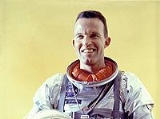
Leroy Gordon "Gordo" Cooper, Jr. , was an American
astronaut. He was one of the
original astronauts in
Project Mercury, the first manned-space effort by the
United States.
Early years
Cooper was born in
Shawnee, Oklahoma. He grew up there and in
Murray, Kentucky, where he attended public schools. Cooper served in the
Marine Corps in 1945 and 1946, then received an
Army commission after completing three years of coursework at the
University of Hawaii. Cooper met his first wife, Trudy - the only Mercury wife to have a
private pilot's license - while in Hawaii, and they married in 1947. In 1949, Cooper transferred his commission to the
Air Force, was placed on active duty, and received flight training at Perrin AFB, Texas and Williams AFB, Arizona.
Cooper's first flight assignment was in Landstuhl, West Germany in 1950, where he flew
F-84s and
F-86s for four years; he also attended the European Extension of the
University of Maryland while overseas. Upon returning to the United States and after two more years of study at the Air Force Institute of Technology in Ohio, he completed his bachelor's degree in aerospace engineering in 1957. Cooper was then assigned to the Experimental Flight Test School at
Edwards Air Force Base in
California until 1957. When he graduated from the school, he was posted to the Flight Test Engineering Division at Edwards, where he served as a
test pilot and project manager testing the
F-102A and
F-106B.
Cooper logged more than 7,000 hours of flight time, with 4,000 hours in jet aircraft. He flew all types of commercial and
general aviation airplanes and
helicopters.
Astronaut career
While at Edwards, Cooper read an announcement saying that a contract had been awarded to
McDonnell Aircraft in
St. Louis, Missouri to build a space capsule. This intrigued him, and shortly after reading this announcement he was called to Washington, D.C. for a
NASA briefing on
Project Mercury and the part astronauts would play in it. Cooper went through the selection process with the other 109 pilots, and was not surprised when he was accepted as one of the first seven American astronauts.
Each of the Mercury astronauts were assigned to a different portion of the project and to a few other special assignments. Cooper specialized in the
Redstone rocket, and developed a personal survival knife for the astronauts to carry in the spacecraft. He also chaired the Emergency Egress Committee, responsible for working out the emergency launch pad procedures for escape. Cooper served as
capsule communicator for
John Glenn's first orbital spaceflight in
Mercury-Atlas 6 and
Scott Carpenter's flight on
Mercury-Atlas 7 , and backup pilot for
Wally Schirra in
Mercury-Atlas 8 .
Cooper was launched into space on May 15, 1963 aboard the
Mercury-Atlas 9 spacecraft, the last Mercury mission. He orbited the earth 22 times and logged more time in space than all five previous Mercury astronauts combined – 34 hours, 19 minutes and 49 seconds, traveling 546,167 miles at 17,547 mph , pulling a maximum of 7.6 g . Cooper achieved an altitude of 165.9
statute miles at
apogee. He also gained the distinction of becoming the first American astronaut to sleep not only in orbit but on the launch pad during a countdown.
Two years later, on August 21, 1965, Cooper flew as command pilot of
Gemini 5 on an eight-day, 120-orbit mission with
Pete Conrad. The two astronauts established a new space endurance record by traveling a distance of 3,312,993 miles in 190 hours, 56 minutes, proving that astronauts could survive in space for the length of time necessary to go from the earth to the moon and back. Cooper was the first astronaut to make a second orbital flight, and later served as backup command pilot for
Gemini 12 and backup commander of
Apollo 10.
After a falling-out with NASA management,
Alan Shepard was chosen over him to be commander of
Apollo 13. Cooper retired from NASA and the Air Force on July 31, 1970 as a colonel, having flown 222 hours in space.
Awards and decorations
During his life, Cooper received numerous awards, including the Air Force
Legion of Merit, the Distinguished Flying Cross with
oak leaf clusters, the
NASA Exceptional Achievement Medal, the
Collier Trophy, the
Harmon Trophy, the
DeMolay Legion of Honor, the John F. Kennedy Trophy, the Iven C. Kincheloe Award, the
University of Hawaii Regents Medal, and the Columbus Medal. He was a
Master Mason and a 33rd Degree Scottish Rite Mason.
Cooper was a member of several groups and societies, including the Society of Experimental Test Pilots, the
American Astronautical Society, Scottish Rite, York Rite,
Shriners,
Rotary Club, Order of Daedalians, Confederate Air Force,
Boy Scouts of America, and
Girl Scouts of America.
Later years
Cooper had a fascination with
pseudoscience. Among other things, Cooper alleged that the U.S. government was covering up information about
UFOs. Cooper claimed to have seen his first
UFO while in West Germany in 1951 and wrote in his memoirs that he had seen other unexplained aircraft several times during his career. Cooper also stated that there were hundreds of reports made by other pilots, many coming from military jet pilots sent to respond to
radar or visual sightings from the ground. He was quite convinced until the day he died that he had seen
UFOs. They hired several retired engineers from the
Lockheed Corporation and
Northrop and created engineering redesigns of existent high performance aircraft beginning with the
delta wing series of fighters.
After divorcing his first wife, Trudy, Cooper married Susan Taylor in 1972. He has four daughters: Camala Keoki Thorpe and Janita Lee Stone, both from his first marriage, and Elizabeth Jo and Colleen Taylor from his second marriage.
Cooper received an honorary doctorate of science degree from
Oklahoma State University in 1967. He wrote one book,
Leap of Faith , which chronicled his experiences with the Air Force and
NASA as well as his efforts to expose an alleged
UFO conspiracy.
Late in life, Cooper developed
Parkinson's disease. He died at his home in
Ventura, California in 2004 at age 77.
In 2005, Space Services, Inc. announced that Cooper's ashes would be included on a memorial launch using a
Falcon 1 rocket in late 2006.
Media
- 1983 film The Right Stuff is both a 1979 book by Tom Wolfe [i], and a 1983 film adapted from the book. ...
- played by Dennis Quaid - 1998 HBO series From the Earth to the Moon is a humorous science fiction [i] story written in 1865 [i] by Jules Verne [i] ...
- played by Robert C. Treveiler
- In addition, Col. Cooper portrayed himself in an episode of the television series CHiPs was a US [i] television [i] series through MGM Studios running on NBC [i] from September 15 [i] ...
.
Trivia
- Cooper passed away on October 4, 2004, the same day SpaceShipOne made its second official qualifying flight and won the Ansari X-Prize.
External links
Notes