

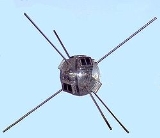
Vanguard 1

Encyclopedia
Vanguard 1 was the fourth artificial Earth
satellite
launched and the first satellite to be solar power
ed. Although communication with it was lost in 1964, it remains the oldest manmade satellite still in orbit. It was designed to test the launch capabilities of a three-stage launch vehicle
as a part of Project Vanguard
, and the effects of the environment on a satellite and its systems in Earth orbit. It also was used to obtain geodetic
measurements through orbit analysis.
6.4 inches (165 mm) in diameter. It contains a 10 mW, 108 MHz transmitter powered by a mercury battery
and a 5 mW, 108.03 MHz transmitter that was powered by six solar cell
s mounted on the body of the satellite. Six short antenna
s protrude from the sphere. The transmitters were used primarily for engineering and tracking data, but were also used to determine the total electron content
between the satellite and ground stations. Vanguard also carries two thermistor
s which measured the interior temperature over sixteen days in order to track the effectiveness of the thermal protection. A backup version of Vanguard 1 is on display at the Kansas Cosmosphere and Space Center
.
at 34.25 degrees on March 17, 1958. Original estimates had the orbit lasting for 2,000 years, but it was discovered that solar radiation pressure
and atmospheric drag during high levels of solar activity produced significant perturbations in the perigee height of the satellite, which caused a significant decrease in its expected lifetime to only about 240 years. The Vanguard 1 transmitted its signals for nearly 7 years as it orbited the earth.
(IGY) scientific satellites, and a 5 mW, 108.03 MHz transmitter powered by six solar cells were used as part of a radio phase-comparison angle-tracking system. The tracking data were used to show that the shape of the Earth
has a north-south asymmetry, occasionally described as pear-shaped with the stem at the North Pole. These radio signals were also used to determine the total electron content between the satellite and selected ground-receiving stations. The battery-powered transmitter provided internal package temperature for about sixteen days and sent tracking signals for twenty days. The solar cell powered transmitter operated for more than six years. Signals gradually weakened and were last received at Quito, Ecuador in May 1964 after which the spacecraft was optically tracked from Earth.
This experiment was extensively planned prior to launch. Initial Naval Research Laboratory (NRL) proposals for the project included conical satellite bodies; this eliminated the need for a separate fairing and ejection mechanisms, and their associated weight and failure modes. Radio tracking would gather data and establish a position. Early in the program, optical tracking (with a Baker-Nunn camera network and human spotters
) was added. A panel of scientists proposed changing the design to spheres, at least twenty inches in diameter and hopefully thirty. A sphere would have a constant optical reflection, and constant coefficient of drag, based on size alone, while a cone would have properties that varied with its orientation. James Van Allen
of the University of Iowa
proposed a cylindrical satellite, which became Explorer 1, the first American satellite. The Naval Research Laboratory finally accepted a sphere with a 6.4-inch diameter as a "test vehicle", with a diameter of twenty inches set for the follow-on satellites. The weight savings, from reduced size as well as decreased instrumentation in the early satellites, was considered to be acceptable.
Since three of the Vanguard satellites are still orbiting, with their drag properties essentially unchanged, they form a baseline data set on the atmosphere that is 50 years old and counting.
A small group of former NRL and NASA
workers had been in communication, and a number of government agencies were asked to commemorate the event. The Naval Research Laboratory commemorated the event with a day-long meeting at NRL on March 17, 2008. The meeting concluded with a simulation of the satellite's track as it passed into the orbital area visible from Washington, D.C. (where it is visible from the Earth's surface). The National Academy of Sciences
scheduled some seminars to mark the 50th anniversary of the International Geophysical Year, which were the only official observances known.
Earth
Earth is the third planet from the Sun, and the densest and fifth-largest of the eight planets in the Solar System. It is also the largest of the Solar System's four terrestrial planets...
satellite
Satellite
In the context of spaceflight, a satellite is an object which has been placed into orbit by human endeavour. Such objects are sometimes called artificial satellites to distinguish them from natural satellites such as the Moon....
launched and the first satellite to be solar power
Solar power
Solar energy, radiant light and heat from the sun, has been harnessed by humans since ancient times using a range of ever-evolving technologies. Solar radiation, along with secondary solar-powered resources such as wind and wave power, hydroelectricity and biomass, account for most of the available...
ed. Although communication with it was lost in 1964, it remains the oldest manmade satellite still in orbit. It was designed to test the launch capabilities of a three-stage launch vehicle
Launch vehicle
In spaceflight, a launch vehicle or carrier rocket is a rocket used to carry a payload from the Earth's surface into outer space. A launch system includes the launch vehicle, the launch pad and other infrastructure....
as a part of Project Vanguard
Project Vanguard
Project Vanguard was a program managed by the United States Naval Research Laboratory , which intended to launch the first artificial satellite into Earth orbit using a Vanguard rocket as the launch vehicle from Cape Canaveral Missile Annex, Florida....
, and the effects of the environment on a satellite and its systems in Earth orbit. It also was used to obtain geodetic
Geodesy
Geodesy , also named geodetics, a branch of earth sciences, is the scientific discipline that deals with the measurement and representation of the Earth, including its gravitational field, in a three-dimensional time-varying space. Geodesists also study geodynamical phenomena such as crustal...
measurements through orbit analysis.
Spacecraft design
The spacecraft is a 1.47 kg (3.2 lb) aluminum sphereSphere
A sphere is a perfectly round geometrical object in three-dimensional space, such as the shape of a round ball. Like a circle in two dimensions, a perfect sphere is completely symmetrical around its center, with all points on the surface lying the same distance r from the center point...
6.4 inches (165 mm) in diameter. It contains a 10 mW, 108 MHz transmitter powered by a mercury battery
Mercury battery
A mercury battery is a non-rechargeable electrochemical battery, a primary cell. Due to the content of mercury, and the resulting environmental concerns, the sale of mercury batteries is banned in many countries. Both ANSI and IEC have withdrawn standards for mercury batteries...
and a 5 mW, 108.03 MHz transmitter that was powered by six solar cell
Solar cell
A solar cell is a solid state electrical device that converts the energy of light directly into electricity by the photovoltaic effect....
s mounted on the body of the satellite. Six short antenna
Antenna (radio)
An antenna is an electrical device which converts electric currents into radio waves, and vice versa. It is usually used with a radio transmitter or radio receiver...
s protrude from the sphere. The transmitters were used primarily for engineering and tracking data, but were also used to determine the total electron content
Total electron content
Total electron content is an important descriptive quantity for the ionosphere of the Earth. TEC is the total number of electrons present along a path between two points, with units of electrons per square meter, where 1016 electrons/m² = 1 TEC unit .TEC is significant in determining the...
between the satellite and ground stations. Vanguard also carries two thermistor
Thermistor
A thermistor is a type of resistor whose resistance varies significantly with temperature, more so than in standard resistors. The word is a portmanteau of thermal and resistor...
s which measured the interior temperature over sixteen days in order to track the effectiveness of the thermal protection. A backup version of Vanguard 1 is on display at the Kansas Cosmosphere and Space Center
Kansas Cosmosphere and Space Center
The Kansas Cosmosphere and Space Center is a museum and educational facility in Hutchinson, Kansas that is best known for the display and restoration of spaceflight artifacts and educational camps...
.
Mission
The three stage launch vehicle placed Vanguard into a 654 by 3969 km (406.4 by 2,466.2 mi), 134.2 minute elliptical orbit inclinedInclination
Inclination in general is the angle between a reference plane and another plane or axis of direction.-Orbits:The inclination is one of the six orbital parameters describing the shape and orientation of a celestial orbit...
at 34.25 degrees on March 17, 1958. Original estimates had the orbit lasting for 2,000 years, but it was discovered that solar radiation pressure
Radiation pressure
Radiation pressure is the pressure exerted upon any surface exposed to electromagnetic radiation. If absorbed, the pressure is the power flux density divided by the speed of light...
and atmospheric drag during high levels of solar activity produced significant perturbations in the perigee height of the satellite, which caused a significant decrease in its expected lifetime to only about 240 years. The Vanguard 1 transmitted its signals for nearly 7 years as it orbited the earth.
Radio beacon
A 10 mW mercury battery powered transmitter on the 108 MHz band used for International Geophysical YearInternational Geophysical Year
The International Geophysical Year was an international scientific project that lasted from July 1, 1957, to December 31, 1958. It marked the end of a long period during the Cold War when scientific interchange between East and West was seriously interrupted...
(IGY) scientific satellites, and a 5 mW, 108.03 MHz transmitter powered by six solar cells were used as part of a radio phase-comparison angle-tracking system. The tracking data were used to show that the shape of the Earth
Figure of the Earth
The expression figure of the Earth has various meanings in geodesy according to the way it is used and the precision with which the Earth's size and shape is to be defined. The actual topographic surface is most apparent with its variety of land forms and water areas. This is, in fact, the surface...
has a north-south asymmetry, occasionally described as pear-shaped with the stem at the North Pole. These radio signals were also used to determine the total electron content between the satellite and selected ground-receiving stations. The battery-powered transmitter provided internal package temperature for about sixteen days and sent tracking signals for twenty days. The solar cell powered transmitter operated for more than six years. Signals gradually weakened and were last received at Quito, Ecuador in May 1964 after which the spacecraft was optically tracked from Earth.
Satellite drag atmospheric density
Because of its symmetrical shape, Vanguard 1 was used by experimenters for use in determining upper atmospheric densities as a function of altitude, latitude, season, and solar activity. As the satellite continuously orbited, it would lag its predicted positions slightly, accumulating greater and greater delay due to drag of the residual atmosphere. By measuring the rate and timing of orbital shifts, together with the body's drag properties, the relevant atmosphere's parameters could be back-calculated. It was determined that atmospheric pressures, and thus drag and orbital decay, were higher than anticipated, since Earth's upper atmosphere does taper off into space gradually.This experiment was extensively planned prior to launch. Initial Naval Research Laboratory (NRL) proposals for the project included conical satellite bodies; this eliminated the need for a separate fairing and ejection mechanisms, and their associated weight and failure modes. Radio tracking would gather data and establish a position. Early in the program, optical tracking (with a Baker-Nunn camera network and human spotters
Operation Moonwatch
Operation Moonwatch was an amateur science program formally initiated by the Smithsonian Astrophysical Observatory in 1956 . The SAO organized Moonwatch as part of the International Geophysical Year which was probably the largest single scientific undertaking in history...
) was added. A panel of scientists proposed changing the design to spheres, at least twenty inches in diameter and hopefully thirty. A sphere would have a constant optical reflection, and constant coefficient of drag, based on size alone, while a cone would have properties that varied with its orientation. James Van Allen
James Van Allen
James Alfred Van Allen was an American space scientist at the University of Iowa.The Van Allen radiation belts were named after him, following the 1958 satellite missions in which Van Allen had argued that a Geiger counter should be used to detect charged particles.- Life and career :* September...
of the University of Iowa
University of Iowa
The University of Iowa is a public state-supported research university located in Iowa City, Iowa, United States. It is the oldest public university in the state. The university is organized into eleven colleges granting undergraduate, graduate, and professional degrees...
proposed a cylindrical satellite, which became Explorer 1, the first American satellite. The Naval Research Laboratory finally accepted a sphere with a 6.4-inch diameter as a "test vehicle", with a diameter of twenty inches set for the follow-on satellites. The weight savings, from reduced size as well as decreased instrumentation in the early satellites, was considered to be acceptable.
Since three of the Vanguard satellites are still orbiting, with their drag properties essentially unchanged, they form a baseline data set on the atmosphere that is 50 years old and counting.
50th anniversary
The Vanguard 1 satellite holds the record for being in space longer than any other man-made object. On March 17, 2008 it logged its 50th year in Earth orbit.A small group of former NRL and NASA
NASA
The National Aeronautics and Space Administration is the agency of the United States government that is responsible for the nation's civilian space program and for aeronautics and aerospace research...
workers had been in communication, and a number of government agencies were asked to commemorate the event. The Naval Research Laboratory commemorated the event with a day-long meeting at NRL on March 17, 2008. The meeting concluded with a simulation of the satellite's track as it passed into the orbital area visible from Washington, D.C. (where it is visible from the Earth's surface). The National Academy of Sciences
United States National Academy of Sciences
The National Academy of Sciences is a corporation in the United States whose members serve pro bono as "advisers to the nation on science, engineering, and medicine." As a national academy, new members of the organization are elected annually by current members, based on their distinguished and...
scheduled some seminars to mark the 50th anniversary of the International Geophysical Year, which were the only official observances known.