

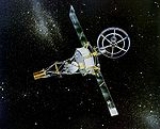
Mariner 2

Encyclopedia
Mariner 2 an American space probe to Venus
, was the first space probe
to conduct a successful planetary encounter . The first successful spacecraft
in the NASA
Mariner program
, it was a simplified version of the Block I spacecraft of the Ranger program
and an exact copy of Mariner 1
. The missions of Mariner 1 and 2 spacecraft are together sometimes known as the Mariner R missions. Mariner 2 passed within 35000 kilometres (21,748 mi) of Venus on December 14, 1962.
The Mariner probe consisted of a 100 cm (39.4 in) diameter hexagonal bus, to which solar panel
s, instrument booms, and antennas
were attached. The scientific instruments on board the Mariner spacecraft were two radiometer
s (microwave
and infrared
), a micrometeorite sensor, a solar plasma
sensor, a charged particle
sensor, and a magnetometer
. These instruments were designed to measure the temperature distribution on the surface of Venus, as well as making basic measurements of Venus' atmosphere
. Due to the planet's thick, featureless cloud cover, no camera
s were included in the Mariner unit. Mariner 10
later discovered that extensive cloud detail was visible in ultraviolet
light.
The primary mission was to receive communications from the spacecraft in the vicinity of Venus and to perform a radiometric
temperature measurements of the planet. A second objective was to measure the Interplanetary Magnetic Field
and charged particle environment.
The two-stage Atlas-Agena
rocket carrying Mariner 1 veered off-course during its launch on July 22, 1962 due to a defective signal from the Atlas and a bug
in the program equations of the ground-based guiding computer, and subsequently the spacecraft was destroyed by the Range Safety Officer
.
A month later, the identical Mariner 2 spacecraft was launched successfully on August 27, 1962, sending it on a 3½-month flight to Venus. On the way, it measured the solar wind
, a constant stream of charged particles flowing outwards from the Sun
, confirming the measurements by Luna 1
in 1959. It also measured interplanetary dust, which turned out to be more scarce than predicted. In addition, Mariner 2 detected high-energy charged particles coming from the Sun, including several brief solar flare
s, as well as cosmic ray
s from outside the Solar System
. As it flew by Venus on December 14, 1962, Mariner 2 scanned the planet with its pair of radiometers, revealing that Venus has cool clouds and an extremely hot surface.
The spacecraft is now defunct in a heliocentric orbit
.
of the California Institute of Technology
. It consisted of a hexagonal base, 1.04 meters across and 0.36 meters thick, which contained six magnesium
chassis housing the electronics for the science experiments, communications, data encoding, computing, timing, and altitude control, and the power control, battery, and battery charger
, as well as the altitude control gas bottles and the rocket engine. On top of the base was a tall pyramid-shaped mast on which the science experiments were mounted which brought the total height of the spacecraft to 3.66 meters. Attached to either side of the base were rectangular solar panel wings with a total span of 5.05 meters and width of 0.76 meters. Attached by an arm to one side of the base and extending below the spacecraft was a large directional dish antenna.
 The power system of Mariner 2 consisted of two solar cell wings, one 183 cm by 76 cm and the other 152 cm by 76 cm (with a 31 cm dacron extension (a solar sail) to balance the solar pressure on the panels), which powered the craft directly or recharged a 1000 Watt-hour sealed silver-zinc cell battery
. This battery was used before the panels were deployed, when the panels were not illuminated by the Sun, and when loads were heavy. A power-switching and booster regulator device controlled the power flow. Communications consisted of a 3 Watt transmitter capable of continuous telemetry operation, the large high gain directional dish antenna, a cylindrical omnidirectional antenna at the top of the instrument mast, and two command antennas, one on the end of either solar panel, which received instructions for midcourse maneuvers and other functions.
Propulsion for midcourse maneuvers was supplied by a monopropellant
(anhydrous
hydrazine
) 225 N retro-rocket. The hydrazine was ignited using nitrogen tetroxide and aluminum oxide pellets
, and thrust direction was controlled by four jet vanes situated below the thrust chamber. Attitude control with a 1 degree pointing error was maintained by a system of nitrogen gas jets. The Sun and Earth were used as references for attitude stabilization. Overall timing and control was performed by a digital Central Computer and Sequencer. Thermal control was achieved through the use of passive reflecting and absorbing surfaces, thermal shields, and movable louvers.
The magnetometer was attached to the top of the mast below the omnidirectional antenna
. Particle detectors were mounted halfway up the mast, along with the cosmic ray detector. The cosmic dust detector and solar plasma spectrometer were attached to the top edges of the spacecraft base. The microwave radiometer, the infrared radiometer and the radiometer reference horns were rigidly mounted to a 48 cm diameter parabolic radiometer antenna mounted near the bottom of the mast. All instruments were operated throughout the cruise and encounter modes except the radiometers, which were only used in the immediate vicinity of Venus.
In addition to these scientific instruments, Mariner 2 had a data conditioning system (DCS) and a scientific power switching (SPS) unit. The DCS was a solid-state electronic system designed to gather information from the scientific instruments on-board the spacecraft. It had four basic functions: analog-to-digital conversion, digital-to-digital conversion, sampling and instrument-calibration timing, and planetary acquisition. The SPS unit was designed to perform the following three functions: control of the application of AC
power to appropriate portions of the science subsystem, application of power to the radiometers and removal of power from the cruise experiments during radiometer calibration periods, and control of the speed and direction of the radiometer scans. The DCS sent signals to the SPS unit to perform the latter two functions.
Besides the experiments with the scientific instruments, the objectives of both the Mariner 1 and 2 probes included also engineering objectives:
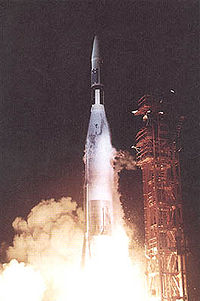
Launch Complex 12 at 06:53:14 UTC on August 27, 1962 by a two-stage Atlas-Agena
rocket.
5 minutes after lift-off, the Atlas and Agena-Mariner separated, followed by the first Agena burn and second Agena burn. The Agena-Mariner separation injected the Mariner 2 spacecraft into a geocentric escape hyperbola at 26 minutes 3 seconds after lift-off. The NASA NDIF tracking station at Johannesburg, South Africa, acquired the spacecraft about 31 minutes after launch. Solar panel extension was completed approximately 44 minutes after launch. The Sun lock acquired the Sun about 18 minutes later. The high-gain antenna was extended to its acquisition angle of 72°. The output of the solar panels was slightly above the predicted output. As all subsystems were performing normally, as the battery was fully charged, and as the solar panels providing adequate power, the decision was made on August 29 to turn on cruise science experiments. On September 3, the Earth acquisition sequence was initiated and Earth lock was established 29 minutes later.
Due to the midcourse maneuver, the sensors lost their lock with the Sun and Earth. At 00:27:00 UTC the Sun reacquisition begun and at 00:34 UTC the Sun was reacquired. Earth reacquisition started at 02:07:29 UTC and Earth was reacquired at 02:34 UTC.
Mariner 2 remains in heliocentric orbit.
, an effect which presents cooler temperatures near the edge of the planetary disk and higher temperatures near the terminator. This also supported the theory that the Venusian surface was extremely hot or the atmosphere optically thick.
The infrared radiometer showed that the 8.4 μ and 10.4 μ radiation temperatures were in agreement with radiation temperatures obtained from Earth-based measurements. There was no systematic difference between the temperatures measured on the light side and dark side of the planet, which was also in agreement with Earth-based measurements. The limb darkening effect that the microwave radiometer detected was also present in the measurements by both channels of the infrared radiometer. The effect was only slightly present in the 10.4 μ channel, but was more pronounced in the 8.4 μ channel. The 8.4 μ channel also showed a slight phase effect. The phase effect indicated that if a greenhouse effect existed, heat was transported in an efficient manner from the light side to the dark side of the planet. The 8.4 μ and 10.4 μ showed equal radiation temperatures, indicating the limb darkening effect would appear to come from a cloud structure rather than the atmosphere. Thus, if the measured temperatures were actually cloud temperatures instead of surface temperatures, these clouds would have to be quite thick.
The magnetometer detected a persistent interplanetary magnetic field varying between 2 γ and 10 γ, which agrees with prior Pioneer 5
observations from 1960. This also means that interplanetary space is rarely empty or field free. The magnetometer could detect changes of about 4 γ on any of the axes, but no trends above 10 γ were detected near Venus, nor were fluctuations seen like those that appear at Earth's magnetospheric
termination. This means Mariner 2 found no detectable magnetic field near Venus, although that didn't necessarily mean Venus had none. However, if Venus had a magnetic field, it would have to be at least smaller than 1/10 the magnetic field of the Earth. In 1980, the Pioneer Venus Orbiter
indeed showed that Venus has a small weak magnetic field.
The Anton type 213 Geiger-Müller tube performed as expected. The average rate was 0.6 counts per second. Increases in its counting rate were larger and more frequent than for the two larger tubes, since it was more sensitive to particles of lower energy. It detected 7 small solar bursts of radiation during September and October and 2 during November and December. The absence of a detectable magnetosphere was also confirmed by the tube; it detected no radiation belt at Venus similar to that of Earth. The count rate would have increased by 104, but no change was measured.
It was also shown that in interplanetary space the solar wind streams continuously
and the cosmic dust density is much lower than the near-Earth region.
Improved estimates of Venus' mass and the value of the astronomical unit were made. Also, research suggested (which was later confirmed by other explorations) that Venus rotates very slowly and in a direction opposite that of the Earth.
Venus
Venus is the second planet from the Sun, orbiting it every 224.7 Earth days. The planet is named after Venus, the Roman goddess of love and beauty. After the Moon, it is the brightest natural object in the night sky, reaching an apparent magnitude of −4.6, bright enough to cast shadows...
, was the first space probe
Space probe
A robotic spacecraft is a spacecraft with no humans on board, that is usually under telerobotic control. A robotic spacecraft designed to make scientific research measurements is often called a space probe. Many space missions are more suited to telerobotic rather than crewed operation, due to...
to conduct a successful planetary encounter . The first successful spacecraft
Spacecraft
A spacecraft or spaceship is a craft or machine designed for spaceflight. Spacecraft are used for a variety of purposes, including communications, earth observation, meteorology, navigation, planetary exploration and transportation of humans and cargo....
in the NASA
NASA
The National Aeronautics and Space Administration is the agency of the United States government that is responsible for the nation's civilian space program and for aeronautics and aerospace research...
Mariner program
Mariner program
The Mariner program was a program conducted by the American space agency NASA that launched a series of robotic interplanetary probes designed to investigate Mars, Venus and Mercury from 1963 to 1973...
, it was a simplified version of the Block I spacecraft of the Ranger program
Ranger program
The Ranger program was a series of unmanned space missions by the United States in the 1960s whose objective was to obtain the first close-up images of the surface of the Moon. The Ranger spacecraft were designed to take images of the lunar surface, returning those images until they were destroyed...
and an exact copy of Mariner 1
Mariner 1
Mariner 1 was the first spacecraft of the American Mariner program. Launched on July 22, 1962 as a Venus flyby mission, a range safety officer ordered its destructive abort at 09:26:16 UT, 294.5 seconds after launch....
. The missions of Mariner 1 and 2 spacecraft are together sometimes known as the Mariner R missions. Mariner 2 passed within 35000 kilometres (21,748 mi) of Venus on December 14, 1962.
The Mariner probe consisted of a 100 cm (39.4 in) diameter hexagonal bus, to which solar panel
Photovoltaic module
A solar panel is a packaged, connected assembly of solar cells, also known as photovoltaic cells...
s, instrument booms, and antennas
Antenna (radio)
An antenna is an electrical device which converts electric currents into radio waves, and vice versa. It is usually used with a radio transmitter or radio receiver...
were attached. The scientific instruments on board the Mariner spacecraft were two radiometer
Radiometer
A radiometer is a device for measuring the radiant flux of electromagnetic radiation. Generally, the term radiometer denotes an infrared radiation detector, yet it also includes detectors operating on any electromagnetic wavelength....
s (microwave
Microwave
Microwaves, a subset of radio waves, have wavelengths ranging from as long as one meter to as short as one millimeter, or equivalently, with frequencies between 300 MHz and 300 GHz. This broad definition includes both UHF and EHF , and various sources use different boundaries...
and infrared
Infrared
Infrared light is electromagnetic radiation with a wavelength longer than that of visible light, measured from the nominal edge of visible red light at 0.74 micrometres , and extending conventionally to 300 µm...
), a micrometeorite sensor, a solar plasma
Plasma (physics)
In physics and chemistry, plasma is a state of matter similar to gas in which a certain portion of the particles are ionized. Heating a gas may ionize its molecules or atoms , thus turning it into a plasma, which contains charged particles: positive ions and negative electrons or ions...
sensor, a charged particle
Charged particle
In physics, a charged particle is a particle with an electric charge. It may be either a subatomic particle or an ion. A collection of charged particles, or even a gas containing a proportion of charged particles, is called a plasma, which is called the fourth state of matter because its...
sensor, and a magnetometer
Magnetometer
A magnetometer is a measuring instrument used to measure the strength or direction of a magnetic field either produced in the laboratory or existing in nature...
. These instruments were designed to measure the temperature distribution on the surface of Venus, as well as making basic measurements of Venus' atmosphere
Atmosphere
An atmosphere is a layer of gases that may surround a material body of sufficient mass, and that is held in place by the gravity of the body. An atmosphere may be retained for a longer duration, if the gravity is high and the atmosphere's temperature is low...
. Due to the planet's thick, featureless cloud cover, no camera
Camera
A camera is a device that records and stores images. These images may be still photographs or moving images such as videos or movies. The term camera comes from the camera obscura , an early mechanism for projecting images...
s were included in the Mariner unit. Mariner 10
Mariner 10
Mariner 10 was an American robotic space probe launched by NASA on November 3, 1973, to fly by the planets Mercury and Venus. It was launched approximately two years after Mariner 9 and was the last spacecraft in the Mariner program...
later discovered that extensive cloud detail was visible in ultraviolet
Ultraviolet
Ultraviolet light is electromagnetic radiation with a wavelength shorter than that of visible light, but longer than X-rays, in the range 10 nm to 400 nm, and energies from 3 eV to 124 eV...
light.
The primary mission was to receive communications from the spacecraft in the vicinity of Venus and to perform a radiometric
Radiometry
In optics, radiometry is a set of techniques for measuring electromagnetic radiation, including visible light. Radiometric techniques characterize the distribution of the radiation's power in space, as opposed to photometric techniques, which characterize the light's interaction with the human eye...
temperature measurements of the planet. A second objective was to measure the Interplanetary Magnetic Field
Interplanetary Magnetic Field
The interplanetary magnetic field is the term for the solar magnetic field carried by the solar wind among the planets of the Solar System....
and charged particle environment.
The two-stage Atlas-Agena
Atlas-Agena
The Atlas-Agena was an American expendable launch system derived from the SM-65 Atlas missile. It was a member of the Atlas family of rockets, and was used for 119 orbital launches between 1960 and 1978....
rocket carrying Mariner 1 veered off-course during its launch on July 22, 1962 due to a defective signal from the Atlas and a bug
Software bug
A software bug is the common term used to describe an error, flaw, mistake, failure, or fault in a computer program or system that produces an incorrect or unexpected result, or causes it to behave in unintended ways. Most bugs arise from mistakes and errors made by people in either a program's...
in the program equations of the ground-based guiding computer, and subsequently the spacecraft was destroyed by the Range Safety Officer
Range Safety Officer
In the field of rocketry, Range Safety Officer is a generic term referring to an individual who monitors the performance of rockets in flight, and who is responsible for their remote destruction if it should be judged that they pose a hazard...
.
A month later, the identical Mariner 2 spacecraft was launched successfully on August 27, 1962, sending it on a 3½-month flight to Venus. On the way, it measured the solar wind
Solar wind
The solar wind is a stream of charged particles ejected from the upper atmosphere of the Sun. It mostly consists of electrons and protons with energies usually between 1.5 and 10 keV. The stream of particles varies in temperature and speed over time...
, a constant stream of charged particles flowing outwards from the Sun
Sun
The Sun is the star at the center of the Solar System. It is almost perfectly spherical and consists of hot plasma interwoven with magnetic fields...
, confirming the measurements by Luna 1
Luna 1
Luna 1 , first known as First Cosmic Ship, then known as Mechta was the first spacecraft to reach the vicinity of the Moon and the first of the Luna program of Soviet automatic interplanetary stations successfully launched in the direction of the Moon.While traveling through the outer Van Allen...
in 1959. It also measured interplanetary dust, which turned out to be more scarce than predicted. In addition, Mariner 2 detected high-energy charged particles coming from the Sun, including several brief solar flare
Solar flare
A solar flare is a sudden brightening observed over the Sun surface or the solar limb, which is interpreted as a large energy release of up to 6 × 1025 joules of energy . The flare ejects clouds of electrons, ions, and atoms through the corona into space. These clouds typically reach Earth a day...
s, as well as cosmic ray
Cosmic ray
Cosmic rays are energetic charged subatomic particles, originating from outer space. They may produce secondary particles that penetrate the Earth's atmosphere and surface. The term ray is historical as cosmic rays were thought to be electromagnetic radiation...
s from outside the Solar System
Solar System
The Solar System consists of the Sun and the astronomical objects gravitationally bound in orbit around it, all of which formed from the collapse of a giant molecular cloud approximately 4.6 billion years ago. The vast majority of the system's mass is in the Sun...
. As it flew by Venus on December 14, 1962, Mariner 2 scanned the planet with its pair of radiometers, revealing that Venus has cool clouds and an extremely hot surface.
The spacecraft is now defunct in a heliocentric orbit
Heliocentric orbit
A heliocentric orbit is an orbit around the Sun. All planets, comets, and asteroids in our Solar System are in such orbits, as are many artificial probes and pieces of debris. The moons of planets in the Solar System, by contrast, are not in heliocentric orbits as they orbit their respective planet...
.
Spacecraft and subsystems
The Mariner 2 spacecraft was designed and built by the Jet Propulsion LaboratoryJet Propulsion Laboratory
Jet Propulsion Laboratory is a federally funded research and development center and NASA field center located in the San Gabriel Valley area of Los Angeles County, California, United States. The facility is headquartered in the city of Pasadena on the border of La Cañada Flintridge and Pasadena...
of the California Institute of Technology
California Institute of Technology
The California Institute of Technology is a private research university located in Pasadena, California, United States. Caltech has six academic divisions with strong emphases on science and engineering...
. It consisted of a hexagonal base, 1.04 meters across and 0.36 meters thick, which contained six magnesium
Magnesium
Magnesium is a chemical element with the symbol Mg, atomic number 12, and common oxidation number +2. It is an alkaline earth metal and the eighth most abundant element in the Earth's crust and ninth in the known universe as a whole...
chassis housing the electronics for the science experiments, communications, data encoding, computing, timing, and altitude control, and the power control, battery, and battery charger
Battery charger
A battery charger is a device used to put energy into a secondary cell or rechargeable battery by forcing an electric current through it.The charge current depends upon the technology and capacity of the battery being charged...
, as well as the altitude control gas bottles and the rocket engine. On top of the base was a tall pyramid-shaped mast on which the science experiments were mounted which brought the total height of the spacecraft to 3.66 meters. Attached to either side of the base were rectangular solar panel wings with a total span of 5.05 meters and width of 0.76 meters. Attached by an arm to one side of the base and extending below the spacecraft was a large directional dish antenna.
Silver-oxide battery
A silver oxide battery , not to be confused with a similar but different silver–zinc battery, which is a secondary cell, is a primary cell with relatively very high energy/weight ratio. They are costly due to the high price of silver...
. This battery was used before the panels were deployed, when the panels were not illuminated by the Sun, and when loads were heavy. A power-switching and booster regulator device controlled the power flow. Communications consisted of a 3 Watt transmitter capable of continuous telemetry operation, the large high gain directional dish antenna, a cylindrical omnidirectional antenna at the top of the instrument mast, and two command antennas, one on the end of either solar panel, which received instructions for midcourse maneuvers and other functions.
Propulsion for midcourse maneuvers was supplied by a monopropellant
Monopropellant
Monopropellants are propellants composed of chemicals or mixtures of chemicals which can be stored in a single container with some degree of safety. While stable under defined storage conditions, they react very rapidly under certain other conditions to produce a large volume of energetic gases...
(anhydrous
Anhydrous
As a general term, a substance is said to be anhydrous if it contains no water. The way of achieving the anhydrous form differs from one substance to another...
hydrazine
Hydrazine
Hydrazine is an inorganic compound with the formula N2H4. It is a colourless flammable liquid with an ammonia-like odor. Hydrazine is highly toxic and dangerously unstable unless handled in solution. Approximately 260,000 tons are manufactured annually...
) 225 N retro-rocket. The hydrazine was ignited using nitrogen tetroxide and aluminum oxide pellets
Pelletizing
Pelletizing is the process of compressing or molding a material into the shape of a pellet. A wide range of different materials are pelletized including chemicals, iron ore, animal compound feed, and more.- Pelletizing of iron ore :...
, and thrust direction was controlled by four jet vanes situated below the thrust chamber. Attitude control with a 1 degree pointing error was maintained by a system of nitrogen gas jets. The Sun and Earth were used as references for attitude stabilization. Overall timing and control was performed by a digital Central Computer and Sequencer. Thermal control was achieved through the use of passive reflecting and absorbing surfaces, thermal shields, and movable louvers.
Scientific instruments
Only 40 pounds (18.1 kg) of the spacecraft could be allocated to scientific experiments. The following scientific instruments were mounted on the instrument mast and base:- A two-channel microwave radiometerMicrowave radiometerA microwave radiometer is a radiometer that measures energy emitted at sub-millimetre-to-centimetre wavelengths known as microwaves. Their primary application has been onboard spacecraft measuring atmospheric and terrestrial radiation, and they are mostly used for meteorological or oceanographic...
of the crystal video type operating in the standard Dicke mode of chopping between the main antenna, pointed at the target, and a reference horn pointed at cold space. It was used to determine the absolute temperature of Venus' surface and details concerning its atmosphere through its microwave-radiation characteristics, including the daylight and dark hemispheres, and in the region of the terminator. Measurements were performed simultaneously in two frequency bands of 13.5 mm and 19 mm. The total weight of the radiometer was 22 pound. Its average power consumption was 4 watts and its peak power consumption 9 watts.
- A two-channel infraredInfraredInfrared light is electromagnetic radiation with a wavelength longer than that of visible light, measured from the nominal edge of visible red light at 0.74 micrometres , and extending conventionally to 300 µm...
radiometerRadiometerA radiometer is a device for measuring the radiant flux of electromagnetic radiation. Generally, the term radiometer denotes an infrared radiation detector, yet it also includes detectors operating on any electromagnetic wavelength....
to measure the effective temperatures of small areas of Venus. The radiation that was received could originate from the planetary surface, clouds in the atmosphere, the atmosphere itself or a combination of these. The radiation was received in two spectral ranges: 8 μ to 9 μ (focused on 8.4 μ) and 10 μ to 10.8 μ (focused on 10.4 μ). The latter corresponding to the carbon dioxideCarbon dioxideCarbon dioxide is a naturally occurring chemical compound composed of two oxygen atoms covalently bonded to a single carbon atom...
band. The total weight of the infrared radiometer, which was housed in a magnesium casting, was 1.3 kg and it required 2.4 watts of power. It was designed to measure radiation temperatures between 200 and approximately 500 K.
- A three-axis fluxgate magnetometer to measure planetary and interplanetary magnetic fields. Three probes were incorporated in its sensors, so it could obtain three mutually orthogonal components of the field vector. Readings of these components were separated by 1.9 seconds. It had three analog outputs that had each two sensitivity scales: ± 64 γ and ± 320 γ (1 γ = 10−5 gaussGauss (unit)The gauss, abbreviated as G, is the cgs unit of measurement of a magnetic field B , named after the German mathematician and physicist Carl Friedrich Gauss. One gauss is defined as one maxwell per square centimeter; it equals 1 tesla...
). These scales were automatically switched by the instrument. The field that the magnetometer observed was the super-position of a nearly constant spacecraft field and the interplanetary field. Thus, it effectively measured only the changes in the interplanetary field.
- An ionization chamberIonization chamberThe ionization chamber is the simplest of all gas-filled radiation detectors, and is used for the detection or measurement of ionizing radiation...
with matched Geiger-Müller tubeGeiger-Müller tubeA Geiger–Müller tube is the sensing element of a Geiger counter instrument that can detect a single particle of ionizing radiation, and typically produce an audible click for each. It was named for Hans Geiger who invented the device in 1908, and Walther Müller who collaborated with Geiger in...
s (also known as a cosmic rayCosmic rayCosmic rays are energetic charged subatomic particles, originating from outer space. They may produce secondary particles that penetrate the Earth's atmosphere and surface. The term ray is historical as cosmic rays were thought to be electromagnetic radiation...
detector) to measure high-energy cosmic radiation.
- A particle detector (by using an Anton type 213 Geiger-Müller tube) to measure lower radiation (especially near Venus), also known as the Iowa detector, as it was provided by the University of IowaUniversity of IowaThe University of Iowa is a public state-supported research university located in Iowa City, Iowa, United States. It is the oldest public university in the state. The university is organized into eleven colleges granting undergraduate, graduate, and professional degrees...
. It was a miniature tube having a 1.2 mg/cm2 mica window about 0.3 cm in diameter and weighing about 60 g. It detects soft x-rayX-rayX-radiation is a form of electromagnetic radiation. X-rays have a wavelength in the range of 0.01 to 10 nanometers, corresponding to frequencies in the range 30 petahertz to 30 exahertz and energies in the range 120 eV to 120 keV. They are shorter in wavelength than UV rays and longer than gamma...
s efficiently and ultravioletUltravioletUltraviolet light is electromagnetic radiation with a wavelength shorter than that of visible light, but longer than X-rays, in the range 10 nm to 400 nm, and energies from 3 eV to 124 eV...
inefficiently, and was previously used in Injun 1Injun (satellite)The Injun program was a series of six satellites designed and built by researchers at the University of Iowa. They were intended to observe various radiation and magnetic phenomena in the ionosphere and beyond....
, Explorer 12 and Explorer 14Explorer 14Explorer 14 is a spin-stabilized, solar-cell-powered spacecraft instrumented to measure cosmic-ray particles, trapped particles, solar wind protons, and magnetospheric and interplanetary magnetic fields. A 16-channel PFM/PM time-division multiplexed telemeter was used. The time required to sample...
. It is able to detect protons above 500 Kev in energy and electrons above 35 Kev. The length of the basic telemetry frame is 887.04 seconds. During each frame the counting rate of the detector is sampled twice at intervals separated by 37 seconds. The first sampling is the number of counts during an interval of 9.60 seconds (known as the 'long gate'); the second is the number of counts during an interval of 0.827 seconds (known as the 'short gate'). The long gate accumulator overflows on the 256th count and the short gate accumulator overflows on the 65,536th count. The maximum counting rate of the tube is 50,000 per second.
- A cosmic dustCosmic dustCosmic dust is a type of dust composed of particles in space which are a few molecules to 0.1 µm in size. Cosmic dust can be further distinguished by its astronomical location; for example: intergalactic dust, interstellar dust, interplanetary dust and circumplanetary dust .In our own Solar...
detector to measure the flux of cosmic dust particles in space.
- A solar plasma spectrometerSpectrometerA spectrometer is an instrument used to measure properties of light over a specific portion of the electromagnetic spectrum, typically used in spectroscopic analysis to identify materials. The variable measured is most often the light's intensity but could also, for instance, be the polarization...
to measure the spectrum of low-energy positively charged particles from the Sun, i.e. the solar windSolar windThe solar wind is a stream of charged particles ejected from the upper atmosphere of the Sun. It mostly consists of electrons and protons with energies usually between 1.5 and 10 keV. The stream of particles varies in temperature and speed over time...
.
The magnetometer was attached to the top of the mast below the omnidirectional antenna
Omnidirectional antenna
In radio communication, an omnidirectional antenna is an antenna which radiates radio wave power uniformly in all directions in one plane, with the radiated power decreasing with elevation angle above or below the plane, dropping to zero on the antenna's axis. This radiation pattern is often...
. Particle detectors were mounted halfway up the mast, along with the cosmic ray detector. The cosmic dust detector and solar plasma spectrometer were attached to the top edges of the spacecraft base. The microwave radiometer, the infrared radiometer and the radiometer reference horns were rigidly mounted to a 48 cm diameter parabolic radiometer antenna mounted near the bottom of the mast. All instruments were operated throughout the cruise and encounter modes except the radiometers, which were only used in the immediate vicinity of Venus.
In addition to these scientific instruments, Mariner 2 had a data conditioning system (DCS) and a scientific power switching (SPS) unit. The DCS was a solid-state electronic system designed to gather information from the scientific instruments on-board the spacecraft. It had four basic functions: analog-to-digital conversion, digital-to-digital conversion, sampling and instrument-calibration timing, and planetary acquisition. The SPS unit was designed to perform the following three functions: control of the application of AC
Alternating current
In alternating current the movement of electric charge periodically reverses direction. In direct current , the flow of electric charge is only in one direction....
power to appropriate portions of the science subsystem, application of power to the radiometers and removal of power from the cruise experiments during radiometer calibration periods, and control of the speed and direction of the radiometer scans. The DCS sent signals to the SPS unit to perform the latter two functions.
Mission objectives
The scientific objectives were:- Radiometer experiment.
- Infrared experiment.
- Magnetometer experiment.
- Charged particles experiment.
- Plasma experiment.
- Micrometeorite experiment.
Besides the experiments with the scientific instruments, the objectives of both the Mariner 1 and 2 probes included also engineering objectives:
- Evaluation of the attitude control system.
- Evaluation of the environmental control system.
- Evaluation of the entire power system.
- Evaluation of the communication system.
Launch
Mariner 2 was launched from Cape Canaveral Air Force StationCape Canaveral Air Force Station
Cape Canaveral Air Force Station is an installation of the United States Air Force Space Command's 45th Space Wing, headquartered at nearby Patrick Air Force Base. Located on Cape Canaveral in the state of Florida, CCAFS is the primary launch head of America's Eastern Range with four launch pads...
Launch Complex 12 at 06:53:14 UTC on August 27, 1962 by a two-stage Atlas-Agena
Atlas-Agena
The Atlas-Agena was an American expendable launch system derived from the SM-65 Atlas missile. It was a member of the Atlas family of rockets, and was used for 119 orbital launches between 1960 and 1978....
rocket.
5 minutes after lift-off, the Atlas and Agena-Mariner separated, followed by the first Agena burn and second Agena burn. The Agena-Mariner separation injected the Mariner 2 spacecraft into a geocentric escape hyperbola at 26 minutes 3 seconds after lift-off. The NASA NDIF tracking station at Johannesburg, South Africa, acquired the spacecraft about 31 minutes after launch. Solar panel extension was completed approximately 44 minutes after launch. The Sun lock acquired the Sun about 18 minutes later. The high-gain antenna was extended to its acquisition angle of 72°. The output of the solar panels was slightly above the predicted output. As all subsystems were performing normally, as the battery was fully charged, and as the solar panels providing adequate power, the decision was made on August 29 to turn on cruise science experiments. On September 3, the Earth acquisition sequence was initiated and Earth lock was established 29 minutes later.
Midcourse maneuver
The accuracy of the Atlas-Agena was such that a midcourse correction was required to satisfy the mission requirements. The midcourse correction consisted of a roll-turn sequence, followed by a pitch-turn sequence and finally a motor-burn sequence. Preparation commands were sent to the spacecraft at 21:30 UTC on September 4. Initiation of the midcourse maneuver sequence was sent at 22:49:42 UTC and the roll-turn sequence started one hour later. The entire maneuver took approximately 34 minutes.Due to the midcourse maneuver, the sensors lost their lock with the Sun and Earth. At 00:27:00 UTC the Sun reacquisition begun and at 00:34 UTC the Sun was reacquired. Earth reacquisition started at 02:07:29 UTC and Earth was reacquired at 02:34 UTC.
Loss of attitude control
On September 8 at 12:50 UTC suddenly the spacecraft automatically turned on the gyros and the cruise science experiments were automatically turned off. The exact cause is unknown as attitude sensors went back to normal before telemetry measurements could be sampled, but it may have been an Earth-sensor malfunction or a collision with a small unidentified object which temporarily caused the spacecraft to lose Sun lock. A similar experience happened on September 29 at 14:34 UTC. Again, all sensors went back to normal before it could be determined which axis had lost lock. By this date the Earth sensor brightness indication had essentially gone to zero, however, this time telemetry data indicated the Earth-brightness measurement had increased to the nominal value for that point in the trajectory.Solar panel output
On October 31 the output from one solar panel (with solar sail attached) deteriorated abruptly. It was diagnosed as a partial short circuit in the panel. As a precaution, the cruise science instruments were turned off. A week later the panel resumed normal function and cruise science instruments were turned back on. The panel permanently failed on November 15, but Mariner 2 was close enough to the Sun that one panel could supply adequate power; thus the cruise science experiments were left active.Encounter with Venus
On December 14 the radiometers were turned on. Mariner 2 approached Venus from 30 degrees above the dark side of the planet, and passed below the planet at its closest distance of 34,773 km at 19:59:28 UT.Post encounter
After encounter, cruise mode resumed. Spacecraft perihelion occurred on December 27 at a distance of 105,464,560 km. The last transmission from Mariner 2 was received on January 3, 1963 at 07:00 UTC, making the total time from launch to termination of the Mariner 2 mission 129 days.Mariner 2 remains in heliocentric orbit.
Results
The data produced during the flight consisted of two categories, namely tracking data and telemetry data.Scientific observations
The microwave radiometer made three scans of Venus in 35 minutes on December 14, 1962 starting at 18:59 UTC. The first scan was made on the dark side, the second near the terminator and the third was located on the light side. The scans with the 19 mm band revealed peak temperatures of 490 ± 11 K on the dark side, 595 ± 12 K near the terminator, and 511 ± 14 K on the light side. It was concluded that there is no significant difference in temperature across Venus. However, the results suggest a limb darkeningLimb darkening
Limb darkening refers to the diminishing of intensity in the image of a star as one moves from the center of the image to the edge or "limb" of the image...
, an effect which presents cooler temperatures near the edge of the planetary disk and higher temperatures near the terminator. This also supported the theory that the Venusian surface was extremely hot or the atmosphere optically thick.
The infrared radiometer showed that the 8.4 μ and 10.4 μ radiation temperatures were in agreement with radiation temperatures obtained from Earth-based measurements. There was no systematic difference between the temperatures measured on the light side and dark side of the planet, which was also in agreement with Earth-based measurements. The limb darkening effect that the microwave radiometer detected was also present in the measurements by both channels of the infrared radiometer. The effect was only slightly present in the 10.4 μ channel, but was more pronounced in the 8.4 μ channel. The 8.4 μ channel also showed a slight phase effect. The phase effect indicated that if a greenhouse effect existed, heat was transported in an efficient manner from the light side to the dark side of the planet. The 8.4 μ and 10.4 μ showed equal radiation temperatures, indicating the limb darkening effect would appear to come from a cloud structure rather than the atmosphere. Thus, if the measured temperatures were actually cloud temperatures instead of surface temperatures, these clouds would have to be quite thick.
The magnetometer detected a persistent interplanetary magnetic field varying between 2 γ and 10 γ, which agrees with prior Pioneer 5
Pioneer 5
Pioneer 5 was a spin-stabilized space probe in the NASA Pioneer program used to investigate interplanetary space between the orbits of Earth and Venus. It was launched on March 11, 1960 from Cape Canaveral Air Force Station Launch Complex 17a at 13:00:00 UTC with an on-orbit dry mass of 43 kg...
observations from 1960. This also means that interplanetary space is rarely empty or field free. The magnetometer could detect changes of about 4 γ on any of the axes, but no trends above 10 γ were detected near Venus, nor were fluctuations seen like those that appear at Earth's magnetospheric
Magnetosphere
A magnetosphere is formed when a stream of charged particles, such as the solar wind, interacts with and is deflected by the intrinsic magnetic field of a planet or similar body. Earth is surrounded by a magnetosphere, as are the other planets with intrinsic magnetic fields: Mercury, Jupiter,...
termination. This means Mariner 2 found no detectable magnetic field near Venus, although that didn't necessarily mean Venus had none. However, if Venus had a magnetic field, it would have to be at least smaller than 1/10 the magnetic field of the Earth. In 1980, the Pioneer Venus Orbiter
Pioneer Venus project
The Pioneer mission to Venus consisted of two components, launched separately. Pioneer Venus 1 or Pioneer Venus Orbiter was launched in 1978 and studied the planet for more than a decade after orbital insertion in 1978. Pioneer Venus 2 or Pioneer Venus Multiprobe sent four small probes into the...
indeed showed that Venus has a small weak magnetic field.
The Anton type 213 Geiger-Müller tube performed as expected. The average rate was 0.6 counts per second. Increases in its counting rate were larger and more frequent than for the two larger tubes, since it was more sensitive to particles of lower energy. It detected 7 small solar bursts of radiation during September and October and 2 during November and December. The absence of a detectable magnetosphere was also confirmed by the tube; it detected no radiation belt at Venus similar to that of Earth. The count rate would have increased by 104, but no change was measured.
It was also shown that in interplanetary space the solar wind streams continuously
and the cosmic dust density is much lower than the near-Earth region.
Improved estimates of Venus' mass and the value of the astronomical unit were made. Also, research suggested (which was later confirmed by other explorations) that Venus rotates very slowly and in a direction opposite that of the Earth.