
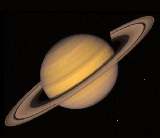
Saturn is the sixth planet from the
SunThe Sun is the star at the center of the Solar System. It is almost perfectly spherical and consists of hot plasma interwoven with magnetic fields...
and the second largest planet in the
Solar SystemThe Solar System consists of the Sun and the astronomical objects gravitationally bound in orbit around it, all of which formed from the collapse of a giant molecular cloud approximately 4.6 billion years ago. The vast majority of the system's mass is in the Sun...
, after
JupiterJupiter is the fifth planet from the Sun and the largest planet within the Solar System. It is a gas giant with mass one-thousandth that of the Sun but is two and a half times the mass of all the other planets in our Solar System combined. Jupiter is classified as a gas giant along with Saturn,...
. Saturn is named after the
RomanRoman mythology is the body of traditional stories pertaining to ancient Rome's legendary origins and religious system, as represented in the literature and visual arts of the Romans...
god
SaturnIn ancient Roman religion and myth, Saturn was a major god presiding over agriculture and the harvest time. His reign was depicted as a Golden Age of abundance and peace by many Roman authors. In medieval times he was known as the Roman god of agriculture, justice and strength. He held a sickle in...
, equated to the
GreekGreek mythology is the body of myths and legends belonging to the ancient Greeks, concerning their gods and heroes, the nature of the world, and the origins and significance of their own cult and ritual practices. They were a part of religion in ancient Greece...
CronusIn Greek mythology, Cronus or Kronos was the leader and the youngest of the first generation of Titans, divine descendants of Gaia, the earth, and Uranus, the sky...
(the
TitanIn Greek mythology, the Titans were a race of powerful deities, descendants of Gaia and Uranus, that ruled during the legendary Golden Age....
father of
ZeusIn the ancient Greek religion, Zeus was the "Father of Gods and men" who ruled the Olympians of Mount Olympus as a father ruled the family. He was the god of sky and thunder in Greek mythology. His Roman counterpart is Jupiter and his Etruscan counterpart is Tinia.Zeus was the child of Cronus...
), the Babylonian
NinurtaNinurta in Sumerian and Akkadian mythology was the god of Lagash, identified with Ningirsu with whom he may always have been identical...
and the
HinduHindu religious literature is the large body of traditional narratives related to Hinduism, notably as contained in Sanskrit literature, such as the Sanskrit epics and the Puranas. As such, it is a subset of Nepali and Indian culture...
ShaniSanskrit Śhani शनि, Kannada Śhani ಶನಿ ದೇವರು,Shani/Sani , is one of the Navagraha or Jyotiṣa . Shani is embodied in the planet Saturn and is the Lord of Saturday....
. Saturn's astronomical symbol represents the Roman god's
sickleA sickle is a hand-held agricultural tool with a variously curved blade typically used for harvesting grain crops or cutting succulent forage chiefly for feeding livestock . Sickles have also been used as weapons, either in their original form or in various derivations.The diversity of sickles that...
.
Saturn, along with Jupiter,
UranusUranus is the seventh planet from the Sun. It has the third-largest planetary radius and fourth-largest planetary mass in the Solar System. It is named after the ancient Greek deity of the sky Uranus , the father of Cronus and grandfather of Zeus...
and
NeptuneNeptune is the eighth and farthest planet from the Sun in the Solar System. Named for the Roman god of the sea, it is the fourth-largest planet by diameter and the third largest by mass. Neptune is 17 times the mass of Earth and is slightly more massive than its near-twin Uranus, which is 15 times...
, is a
gas giantA gas giant is a large planet that is not primarily composed of rock or other solid matter. There are four gas giants in the Solar System: Jupiter, Saturn, Uranus, and Neptune...
. Together, these four planets are sometimes referred to as the Jovian planets, meaning "Jupiter-like". Saturn has an average radius about 9 times larger than the
Earth'sEarth is the third planet from the Sun, and the densest and fifth-largest of the eight planets in the Solar System. It is also the largest of the Solar System's four terrestrial planets...
. While only 1/8 the average density of Earth, due to its larger volume, Saturn's mass is just over 95 times greater than Earth's.
Because of Saturn's large mass and resulting
gravitationGravitation, or gravity, is a natural phenomenon by which physical bodies attract with a force proportional to their mass. Gravitation is most familiar as the agent that gives weight to objects with mass and causes them to fall to the ground when dropped...
, the conditions produced on Saturn are extreme if compared to Earth. The interior of Saturn is probably composed of a core of iron, nickel, silicon and oxygen compounds, surrounded by a deep layer of
metallic hydrogenMetallic hydrogen is a state of hydrogen which results when it is sufficiently compressed and undergoes a phase transition; it is an example of degenerate matter. Solid metallic hydrogen is predicted to consist of a crystal lattice of hydrogen nuclei , with a spacing which is significantly smaller...
, an intermediate layer of
liquid hydrogenLiquid hydrogen is the liquid state of the element hydrogen. Hydrogen is found naturally in the molecular H2 form.To exist as a liquid, H2 must be pressurized above and cooled below hydrogen's Critical point. However, for hydrogen to be in a full liquid state without boiling off, it needs to be...
and
liquid heliumHelium exists in liquid form only at extremely low temperatures. The boiling point and critical point depend on the isotope of the helium; see the table below for values. The density of liquid helium-4 at its boiling point and 1 atmosphere is approximately 0.125 g/mL Helium-4 was first liquefied...
and finally, an outer gaseous layer. Electrical current within the metallic-hydrogen layer is thought to give rise to Saturn's planetary
magnetic fieldA magnetic field is a mathematical description of the magnetic influence of electric currents and magnetic materials. The magnetic field at any given point is specified by both a direction and a magnitude ; as such it is a vector field.Technically, a magnetic field is a pseudo vector;...
, which is slightly weaker than Earth's and approximately one-twentieth the strength of Jupiter's. The outer
atmosphereAn atmosphere is a layer of gases that may surround a material body of sufficient mass, and that is held in place by the gravity of the body. An atmosphere may be retained for a longer duration, if the gravity is high and the atmosphere's temperature is low...
is generally bland in appearance, although long-lived features can appear.
Wind speedWind speed, or wind velocity, is a fundamental atmospheric rate.Wind speed affects weather forecasting, aircraft and maritime operations, construction projects, growth and metabolism rate of many plant species, and countless other implications....
s on Saturn can reach 1,800 km/h, significantly faster than those on Jupiter.
Saturn has a
ring systemThe rings of Saturn are the most extensive planetary ring system of any planet in the Solar System. They consist of countless small particles, ranging in size from micrometres to metres, that form clumps that in turn orbit about Saturn...
that is divided into nine continuous and three discontinuous main rings (arcs), consisting mostly of ice particles with a smaller amount of rocky debris and
dustCosmic dust is a type of dust composed of particles in space which are a few molecules to 0.1 µm in size. Cosmic dust can be further distinguished by its astronomical location; for example: intergalactic dust, interstellar dust, interplanetary dust and circumplanetary dust .In our own Solar...
. Sixty-two known moons orbit the planet; fifty-three are officially named. This does not include the hundreds of "
moonletMoonlet is an informal term for a particularly small natural satellite. In astronomical literature, it has been used in at least two situations:...
s" within the rings.
TitanTitan , or Saturn VI, is the largest moon of Saturn, the only natural satellite known to have a dense atmosphere, and the only object other than Earth for which clear evidence of stable bodies of surface liquid has been found....
, Saturn's largest and the Solar System's second largest moon (after Jupiter's
GanymedeGanymede is a satellite of Jupiter and the largest moon in the Solar System. It is the seventh moon and third Galilean satellite outward from Jupiter. Completing an orbit in roughly seven days, Ganymede participates in a 1:2:4 orbital resonance with the moons Europa and Io, respectively...
), is larger than the planet
MercuryMercury is the innermost and smallest planet in the Solar System, orbiting the Sun once every 87.969 Earth days. The orbit of Mercury has the highest eccentricity of all the Solar System planets, and it has the smallest axial tilt. It completes three rotations about its axis for every two orbits...
and is the only moon in the Solar System to possess a significant atmosphere.
Physical characteristics
Due to a combination of its lower density, rapid rotation and fluid state, Saturn is an oblate spheroid; that is, it is flattened at the poles and bulges at the equator. Its equatorial and polar radii differ by almost 10%—60,268 km versus 54,364 km. The other gas planets are also oblate, but to a lesser extent. Saturn is the only planet of the Solar System that is less dense than water (about 30% less). Although Saturn's
coreThe planetary core consists of the innermost layer of a planet.The core may be composed of solid and liquid layers, while the cores of Mars and Venus are thought to be completely solid as they lack an internally generated magnetic field. In our solar system, core size can range from about 20% to...
is considerably denser than water, the average
specific densityRelative density, or specific gravity, is the ratio of the density of a substance to the density of a given reference material. Specific gravity usually means relative density with respect to water...
of the planet is 0.69 g/cm
3 due to the gaseous atmosphere. Saturn is only 95
EarthEarth is the third planet from the Sun, and the densest and fifth-largest of the eight planets in the Solar System. It is also the largest of the Solar System's four terrestrial planets...
masses, compared to Jupiter, which is 318 times the mass of the Earth but only about 20% larger than Saturn.
Internal structure
Though there is no direct information about Saturn's internal structure, it is thought that its interior is similar to that of
JupiterJupiter is the fifth planet from the Sun and the largest planet within the Solar System. It is a gas giant with mass one-thousandth that of the Sun but is two and a half times the mass of all the other planets in our Solar System combined. Jupiter is classified as a gas giant along with Saturn,...
, having a small rocky core surrounded mostly by
hydrogenHydrogen is the chemical element with atomic number 1. It is represented by the symbol H. With an average atomic weight of , hydrogen is the lightest and most abundant chemical element, constituting roughly 75% of the Universe's chemical elemental mass. Stars in the main sequence are mainly...
and
heliumHelium is the chemical element with atomic number 2 and an atomic weight of 4.002602, which is represented by the symbol He. It is a colorless, odorless, tasteless, non-toxic, inert, monatomic gas that heads the noble gas group in the periodic table...
. The rocky core is similar in composition to the Earth, but more dense. This is surrounded by a thicker liquid
metallic hydrogenMetallic hydrogen is a state of hydrogen which results when it is sufficiently compressed and undergoes a phase transition; it is an example of degenerate matter. Solid metallic hydrogen is predicted to consist of a crystal lattice of hydrogen nuclei , with a spacing which is significantly smaller...
layer, followed by a liquid hydrogen/helium layer and a gaseous atmosphere in the outermost 1000 km. Traces of various
volatilesIn planetary science, volatiles are that group of chemical elements and chemical compounds with low boiling points that are associated with a planet's or moon's crust and/or atmosphere. Examples include nitrogen, water, carbon dioxide, ammonia, hydrogen, and methane, all compounds of C, H, O...
are also present. The core region is estimated to be about 9–22 times the mass of the Earth. Saturn has a very hot interior, reaching 11,700 °C at the core, and it radiates 2.5 times more energy into space than it receives from the Sun. Most of this extra energy is generated by the Kelvin–Helmholtz mechanism (slow gravitational compression), but this alone may not be sufficient to explain Saturn's heat production. It is proposed that an additional mechanism might be at play whereby Saturn generates some of its heat through the "raining out" of droplets of helium deep in its interior, thus releasing heat by
frictionFriction is the force resisting the relative motion of solid surfaces, fluid layers, and/or material elements sliding against each other. There are several types of friction:...
as they fall down through the lighter hydrogen. The gases which Saturn is mostly made of change to liquid in Saturn's internal structure, but the change is very gradual. The interior is estimated to be about 25,000 km across.
Atmosphere
The outer atmosphere of Saturn consists of 96.3% molecular hydrogen and 3.25% helium. Trace amounts of
ammoniaAmmonia is a compound of nitrogen and hydrogen with the formula . It is a colourless gas with a characteristic pungent odour. Ammonia contributes significantly to the nutritional needs of terrestrial organisms by serving as a precursor to food and fertilizers. Ammonia, either directly or...
,
acetyleneAcetylene is the chemical compound with the formula C2H2. It is a hydrocarbon and the simplest alkyne. This colorless gas is widely used as a fuel and a chemical building block. It is unstable in pure form and thus is usually handled as a solution.As an alkyne, acetylene is unsaturated because...
,
ethaneEthane is a chemical compound with chemical formula C2H6. It is the only two-carbon alkane that is an aliphatic hydrocarbon. At standard temperature and pressure, ethane is a colorless, odorless gas....
,
phosphinePhosphine is the compound with the chemical formula PH3. It is a colorless, flammable, toxic gas. Pure phosphine is odourless, but technical grade samples have a highly unpleasant odor like garlic or rotting fish, due to the presence of substituted phosphine and diphosphine...
and
methaneMethane is a chemical compound with the chemical formula . It is the simplest alkane, the principal component of natural gas, and probably the most abundant organic compound on earth. The relative abundance of methane makes it an attractive fuel...
have also been detected. The upper clouds on Saturn are composed of ammonia crystals, while the lower level clouds appear to be composed of either ammonium hydrosulfide (NH
4SH) or water. The atmosphere of Saturn is significantly deficient in helium relative to the abundance of the elements in the Sun.
The quantity of elements heavier than helium are not known precisely, but the proportions are assumed to match the primordial abundances from the formation of the Solar System. The total mass of these elements is estimated to be 19–31 times the mass of the Earth, with a significant fraction located in Saturn's core region.
Cloud layers
Saturn's atmosphere exhibits a banded pattern similar to Jupiter's (the nomenclature is the same), but Saturn's bands are much fainter and are also much wider near the equator. At depth, extending for 10 km and with a temperature of −23 °C, is a layer made up of water ice. Above this layer is probably a layer of ammonium hydrosulfide ice, which extends for another 50 km and is approximately −93 °C. Eighty kilometers above that layer are ammonia ice clouds, where the temperatures are roughly −153 °C. Near the top of the atmosphere, extending for some 200 km to 270 km above the visible ammonia clouds, are gaseous hydrogen and helium. Saturn's winds are easily among the Solar System's fastest.
VoyagerThe Voyager program is a U.S program that launched two unmanned space missions, scientific probes Voyager 1 and Voyager 2. They were launched in 1977 to take advantage of a favorable planetary alignment of the late 1970s...
data indicate peak easterly winds of 500 m/s (1800 km/h). Saturn's finer cloud patterns were not observed until the Voyager flybys. Since then, Earth-based
telescopyA telescope is an instrument that aids in the observation of remote objects by collecting electromagnetic radiation . The first known practical telescopes were invented in the Netherlands at the beginning of the 1600s , using glass lenses...
has improved to the point where regular observations can be made.
Saturn's usually bland atmosphere occasionally exhibits long-lived ovals and other features common on Jupiter. In 1990 the
Hubble Space TelescopeThe Hubble Space Telescope is a space telescope that was carried into orbit by a Space Shuttle in 1990 and remains in operation. A 2.4 meter aperture telescope in low Earth orbit, Hubble's four main instruments observe in the near ultraviolet, visible, and near infrared...
observed an enormous white cloud near Saturn's equator which was not present during the Voyager encounters and in 1994, another, smaller storm was observed. The 1990 storm was an example of a
Great White SpotThe Great White Spot, also known as Great White Oval, on Saturn, named by analogy to Jupiter's Great Red Spot, is a name given to periodic storms that are large enough to be visible by telescope from Earth by their characteristic white appearance...
, a unique but short-lived phenomenon which occurs once every Saturnian year, roughly every 30 Earth years, around the time of the northern hemisphere's
summer solsticeThe summer solstice occurs exactly when the axial tilt of a planet's semi-axis in a given hemisphere is most inclined towards the star that it orbits. Earth's maximum axial tilt to our star, the Sun, during a solstice is 23° 26'. Though the summer solstice is an instant in time, the term is also...
. Previous Great White Spots were observed in 1876, 1903, 1933 and 1960, with the 1933 storm being the most famous. If the periodicity is maintained, another storm will occur in about 2020.
In recent images from the Cassini spacecraft, Saturn's northern hemisphere appears a bright blue, similar to Uranus, as can be seen in the image below. This blue color cannot currently be observed from Earth, because Saturn's rings are currently blocking its northern hemisphere. The color is most likely caused by
Rayleigh scatteringRayleigh scattering, named after the British physicist Lord Rayleigh, is the elastic scattering of light or other electromagnetic radiation by particles much smaller than the wavelength of the light. The particles may be individual atoms or molecules. It can occur when light travels through...
.
InfraredInfrared light is electromagnetic radiation with a wavelength longer than that of visible light, measured from the nominal edge of visible red light at 0.74 micrometres , and extending conventionally to 300 µm...
imaging has shown that Saturn's south pole has a warm
polar vortexA polar vortex is a persistent, large-scale cyclone located near one or both of a planet's geographical poles. On Earth, the polar vortices are located in the middle and upper troposphere and the stratosphere...
, the only example of such a phenomenon known to date in the Solar System. Whereas temperatures on Saturn are normally −185 °C, temperatures on the vortex often reach as high as −122 °C, believed to be the warmest spot on Saturn.
North pole hexagonal cloud pattern
A persisting
hexagonal wave pattern around the north polar vortex in the atmosphere at about 78°N was first noted in the Voyager images. Unlike the north pole, HST imaging of the south polar region indicates the presence of a
jet stream, but no strong polar vortex nor any hexagonal standing wave.
NASAThe National Aeronautics and Space Administration is the agency of the United States government that is responsible for the nation's civilian space program and for aeronautics and aerospace research...
reported in November 2006 that the Cassini spacecraft observed a "hurricane-like" storm locked to the south pole that had a clearly defined eyewall. This observation is particularly notable because eyewall clouds had not previously been seen on any planet other than Earth. For example, images from the Galileo spacecraft did not show an eyewall in the Great Red Spot of Jupiter.
The straight sides of the northern polar hexagon are each approximately 13800 km (8,574.9 mi) long, making them larger than the diameter of the Earth. The entire structure rotates with a period of , the same period as that of the planet's radio emissions, which is assumed to be equal to the period of rotation of Saturn's interior. The hexagonal feature does not shift in longitude like the other clouds in the visible atmosphere.
The pattern's origin is a matter of much speculation. Most astronomers seem to think it was caused by some standing-wave pattern in the atmosphere; but the hexagon might be a novel aurora. Polygonal shapes have been replicated in spinning buckets of fluid in a laboratory.
Magnetosphere
Saturn has an intrinsic magnetic field that has a simple, symmetric shape—a magnetic
dipoleIn physics, there are several kinds of dipoles:*An electric dipole is a separation of positive and negative charges. The simplest example of this is a pair of electric charges of equal magnitude but opposite sign, separated by some distance. A permanent electric dipole is called an electret.*A...
. Its strength at the equator—0.2
gaussThe gauss, abbreviated as G, is the cgs unit of measurement of a magnetic field B , named after the German mathematician and physicist Carl Friedrich Gauss. One gauss is defined as one maxwell per square centimeter; it equals 1 tesla...
(20 µT)—is approximately one twentieth than that of the field around Jupiter and slightly weaker than Earth's magnetic field. As a result Saturn's magnetosphere is much smaller than Jupiter's and extends slightly beyond the orbit of Titan. Most probably, the magnetic field is generated similarly to that of Jupiter—by currents in the metallic-hydrogen layer, which is called a metallic-hydrogen dynamo. Similarly to those of other planets, this magnetosphere is efficient at deflecting the
solar windThe solar wind is a stream of charged particles ejected from the upper atmosphere of the Sun. It mostly consists of electrons and protons with energies usually between 1.5 and 10 keV. The stream of particles varies in temperature and speed over time...
particles from the
SunThe Sun is the star at the center of the Solar System. It is almost perfectly spherical and consists of hot plasma interwoven with magnetic fields...
. The moon Titan orbits within the outer part of Saturn's magnetosphere and contributes plasma from the
ionAn ion is an atom or molecule in which the total number of electrons is not equal to the total number of protons, giving it a net positive or negative electrical charge. The name was given by physicist Michael Faraday for the substances that allow a current to pass between electrodes in a...
ized particles in Titan's outer atmosphere. When
Voyager 2 entered the magnetosphere, the
solar windThe solar wind is a stream of charged particles ejected from the upper atmosphere of the Sun. It mostly consists of electrons and protons with energies usually between 1.5 and 10 keV. The stream of particles varies in temperature and speed over time...
pressure was high and the magnetosphere extended only 19 Saturn radii, or 1.1 million km (712,000 mi), although it enlarged within several hours, and remained so for about three days. Saturn's magnetosphere, like
Earth'sEarth's magnetic field is the magnetic field that extends from the Earth's inner core to where it meets the solar wind, a stream of energetic particles emanating from the Sun...
, produces
auroraeAn aurora is a natural light display in the sky particularly in the high latitude regions, caused by the collision of energetic charged particles with atoms in the high altitude atmosphere...
.
Orbit and rotation
The average distance between Saturn and the
SunThe Sun is the star at the center of the Solar System. It is almost perfectly spherical and consists of hot plasma interwoven with magnetic fields...
is over 1,400,000,000 km (9
AUAn astronomical unit is a unit of length equal to about or approximately the mean Earth–Sun distance....
). With an average orbital speed of 9.69 km/s, it takes Saturn 10,759 Earth days (or about 29½ years), to finish one revolution around the Sun. The elliptical orbit of Saturn is inclined 2.48° relative to the orbital plane of the Earth. Because of an
eccentricityThe orbital eccentricity of an astronomical body is the amount by which its orbit deviates from a perfect circle, where 0 is perfectly circular, and 1.0 is a parabola, and no longer a closed orbit...
of 0.056, the distance between Saturn and the Sun varies by approximately 155,000,000 km between perihelion and aphelion, which are the nearest and most distant points of the planet along its orbital path, respectively.
The visible features on Saturn rotate at different rates depending on latitude and multiple rotation periods have been assigned to various regions (as in Jupiter's case):
System I has a period of 10 h 14 min 00 s (844.3°/d) and encompasses the Equatorial Zone, which extends from the northern edge of the South Equatorial Belt to the southern edge of the North Equatorial Belt. All other Saturnian latitudes have been assigned a rotation period of 10 h 39 min 24 s (810.76°/d), which is
System II.
System III, based on
radioRadio astronomy is a subfield of astronomy that studies celestial objects at radio frequencies. The initial detection of radio waves from an astronomical object was made in the 1930s, when Karl Jansky observed radiation coming from the Milky Way. Subsequent observations have identified a number of...
emissions from the planet in the period of the Voyager flybys, has a period of 10 h 39 min 22.4 s (810.8°/d); because it is very close to System II, it has largely superseded it.
A precise value for the rotation period of the interior remains elusive. While approaching Saturn in 2004, the Cassini spacecraft found that the radio rotation period of Saturn had increased appreciably, to approximately 10 h 45 m 45 s (± 36 s). The cause of the change is unknown—it was thought to be due to a movement of the radio source to a different latitude inside Saturn, with a different rotational period, rather than because of a change in Saturn's rotation.
Later, in March 2007, it was found that the rotation of the radio emissions did not trace the rotation of the planet, but rather is produced by convection of the plasma disc, which is dependent also on other factors besides the planet's rotation. It was reported that the variance in measured rotation periods may be caused by geyser activity on Saturn's moon
EnceladusEnceladus is the sixth-largest of the moons of Saturn. It was discovered in 1789 by William Herschel. Until the two Voyager spacecraft passed near it in the early 1980s very little was known about this small moon besides the identification of water ice on its surface...
. The water vapor emitted into Saturn's orbit by this activity becomes charged and "weighs down" Saturn's magnetic field, slowing its rotation slightly relative to the rotation of the planet. At the time it was stated that there is no currently known method of determining the rotation rate of Saturn's core.
The latest estimate of Saturn's rotation based on a compilation of various measurements from the Cassini, Voyager and Pioneer probes was reported in September 2007 is 10 hours, 32 minutes, 35 seconds.
Planetary rings
Saturn is probably best known for its system of
planetary ringA planetary ring is a ring of cosmic dust and other small particles orbiting around a planet in a flat disc-shaped region.The most notable planetary rings known in Earth's solar system are those around Saturn, but the other three gas giants of the solar system possess ring systems of their...
s, which makes it the most visually remarkable object in the solar system. The rings extend from 6,630 km to 120,700 km above Saturn's equator, average approximately 20 meters in thickness and are composed of 93% water ice with a smattering of
tholinTholin [after the ancient Greek word meaning "not clear"] is a heteropolymer molecule formed by solar ultraviolet irradiation of simple organic compounds such as methane or ethane. Tholins do not form naturally on modern-day Earth, but are found in great abundance on the surface of icy bodies in...
impurities and 7% amorphous
carbonCarbon is the chemical element with symbol C and atomic number 6. As a member of group 14 on the periodic table, it is nonmetallic and tetravalent—making four electrons available to form covalent chemical bonds...
. The particles that make up the rings range in size from specks of dust up to 10 m. There are two main theories regarding the origin of the rings. One theory is that the rings are remnants of a destroyed moon of Saturn. The second theory is that the rings are left over from the original
nebulaA nebula is an interstellar cloud of dust, hydrogen gas, helium gas and other ionized gases...
r material from which Saturn formed. Some ice in the central rings comes from the moon Enceladus' ice volcanoes.
Beyond the main rings at a distance of 12 million km from the planet is the sparse Phoebe ring, which is tilted at an angle of 27° to the other rings and, like
PhoebePhoebe is an irregular satellite of Saturn. It was discovered by William Henry Pickering on 17 March 1899 from photographic plates that had been taken starting on 16 August 1898 at the Boyden Observatory near Arequipa, Peru, by DeLisle Stewart...
, orbits in
retrogradeRetrograde motion is motion in the direction opposite to the movement of something else, and is the contrary of direct or prograde motion. This motion can be the orbit of one body about another body or about some other point, or the rotation of a single body about its axis, or other phenomena such...
fashion. Some of the moons of Saturn, including
PanPan is the innermost moon of Saturn. It is a walnut-shaped small moon about 35 kilometres across and 23 km high that orbits within the Encke Gap in Saturn's A Ring. Pan acts as a ring shepherd and is responsible for keeping the Encke Gap free of ring particles.It was discovered by Mark R...
and
Prometheus-Animations:-External links:* at ** anaglyph view of Prometheus...
, act as shepherd moons to keep the planetary rings stable and prevent them from escaping. Pan and
AtlasAtlas is an inner satellite of Saturn.Atlas was discovered by Richard Terrile in 1980 from Voyager photos and was designated '. In 1983 it was officially named after Atlas of Greek mythology, because it "holds the rings on its shoulders" like the Titan Atlas held the sky up above the Earth...
cause weak, linear density waves in Saturn's rings that have yielded more reliable calculations of their masses.
The age of these planetary rings is probably hundreds of millions of years old (in contrast to previous thoughts that the rings formed alongside the planet when it formed billions of years ago) and their fate include spiraling inward towards the planet, or the boulders forming the rings colliding with each other and disappearing.
Natural satellites
Saturn has at least 62
moonsA natural satellite or moon is a celestial body that orbits a planet or smaller body, which is called its primary. The two terms are used synonymously for non-artificial satellites of planets, of dwarf planets, and of minor planets....
, 53 of which have formal names.
TitanTitan , or Saturn VI, is the largest moon of Saturn, the only natural satellite known to have a dense atmosphere, and the only object other than Earth for which clear evidence of stable bodies of surface liquid has been found....
, the largest, comprises more than 90% of the mass in orbit around Saturn, including the rings. Saturn's second largest moon,
RheaRhea is the second-largest moon of Saturn and the ninth largest moon in the Solar System. It was discovered in 1672 by Giovanni Domenico Cassini.-Name:Rhea is named after the Titan Rhea of Greek mythology, "mother of the gods"...
, may have a tenuous
ring system of its ownThe Saturnian moon Rhea may have a tenuous ring system consisting of three narrow, relatively dense bands within a particulate disk. This would be the first discovery of rings around a moon...
, along with a tenuous
atmosphereAn atmosphere is a layer of gases that may surround a material body of sufficient mass, and that is held in place by the gravity of the body. An atmosphere may be retained for a longer duration, if the gravity is high and the atmosphere's temperature is low...
. Many of the other moons are very small: 34 are less than 10 km in diameter and another 14 less than 50 km. Traditionally, most of Saturn's moons have been named after
TitansIn Greek mythology, the Titans were a race of powerful deities, descendants of Gaia and Uranus, that ruled during the legendary Golden Age....
of Greek mythology. Titan is the only satellite in the
Solar SystemThe Solar System consists of the Sun and the astronomical objects gravitationally bound in orbit around it, all of which formed from the collapse of a giant molecular cloud approximately 4.6 billion years ago. The vast majority of the system's mass is in the Sun...
with a major
atmosphereThe atmosphere of Titan is known as the only fully developed atmosphere that exists on a natural satellite in our solar system.-History:The presence of a significant atmosphere was first suspected by Spanish astronomer Josep Comas Solà, who observed distinct limb darkening on Titan in 1903, and...
in which a complex organic chemistry occurs. It is also the only satellite with
hydrocarbon lakesThe Lakes of Titan, a moon of Saturn, are bodies of liquid ethane and methane that have been detected by the Cassini–Huygens space probe, and had been suspected long before. The large ones are known as maria and the small ones as lacūs .-History:The possibility that there were hydrocarbon seas on...
.
Saturn's moon
EnceladusEnceladus is the sixth-largest of the moons of Saturn. It was discovered in 1789 by William Herschel. Until the two Voyager spacecraft passed near it in the early 1980s very little was known about this small moon besides the identification of water ice on its surface...
has often been regarded as a potential base for microbial life. Evidence of this life includes the satellite's salt-rich particles having an "ocean-like" composition that indicates most of Enceladus's expelled
iceIce is water frozen into the solid state. Usually ice is the phase known as ice Ih, which is the most abundant of the varying solid phases on the Earth's surface. It can appear transparent or opaque bluish-white color, depending on the presence of impurities or air inclusions...
comes from the evaporation of liquid salt water.
History of exploration
There are three main phases of observation and exploration of Saturn. The first era was ancient observations (such as with the
naked eyeThe naked eye is a figure of speech referring to human visual perception unaided by a magnifying or light-collecting optical device, such as a telescope or microscope. Vision corrected to normal acuity using corrective lenses is considered "naked"...
), before the invention of the modern telescopes. Starting in the 17th century progressively more advanced telescopic observations from earth have been made. The other type is visitation by spacecraft, either by orbiting or flyby. In the 21st century observations continue from the earth (or earth orbiting observatories) and from the Cassini orbiter at Saturn.
Ancient observations
Saturn has been known since prehistoric times. In ancient times, it was the most distant of the five known planets in the solar system (excluding Earth) and thus a major character in various mythologies. Babylonian astronomers systematically observed and recorded the movements of Saturn. In
ancient Roman mythologyRoman mythology is the body of traditional stories pertaining to ancient Rome's legendary origins and religious system, as represented in the literature and visual arts of the Romans...
, the god
SaturnusIn ancient Roman religion and myth, Saturn was a major god presiding over agriculture and the harvest time. His reign was depicted as a Golden Age of abundance and peace by many Roman authors. In medieval times he was known as the Roman god of agriculture, justice and strength. He held a sickle in...
, from which the planet takes its name, was the god of the agricultural and harvest sector. The Romans considered Saturnus the equivalent of the
Greek godGreek mythology is the body of myths and legends belonging to the ancient Greeks, concerning their gods and heroes, the nature of the world, and the origins and significance of their own cult and ritual practices. They were a part of religion in ancient Greece...
CronusIn Greek mythology, Cronus or Kronos was the leader and the youngest of the first generation of Titans, divine descendants of Gaia, the earth, and Uranus, the sky...
. The Greeks had made the outermost planet sacred to Cronus, and the Romans followed suit.
PtolemyClaudius Ptolemy , was a Roman citizen of Egypt who wrote in Greek. He was a mathematician, astronomer, geographer, astrologer, and poet of a single epigram in the Greek Anthology. He lived in Egypt under Roman rule, and is believed to have been born in the town of Ptolemais Hermiou in the...
, a Greek living in
AlexandriaAlexandria is the second-largest city of Egypt, with a population of 4.1 million, extending about along the coast of the Mediterranean Sea in the north central part of the country; it is also the largest city lying directly on the Mediterranean coast. It is Egypt's largest seaport, serving...
, observed an opposition of Saturn, which was the basis for his determination of the elements of its orbit. In
Hindu astrologyHindu astrology , also Jyotish or Jyotisha, from Sanskrit , from "light, heavenly body") is the ancient Indian system of astronomy and astrology...
, there are nine astrological objects, known as
NavagrahaGraha is a 'cosmic influencer' on the living beings of mother Bhumidevi . In Hindu astrology, the Navagraha are some of these major influencers.All the navagraha have relative movement with respect to the background of fixed stars in the zodiac...
s. Saturn, one of them, is known as "
ShaniSanskrit Śhani शनि, Kannada Śhani ಶನಿ ದೇವರು,Shani/Sani , is one of the Navagraha or Jyotiṣa . Shani is embodied in the planet Saturn and is the Lord of Saturday....
", judges everyone based on the good and bad deeds performed in life. In the 5th century CE, the Indian astronomical text
Surya SiddhantaThe Surya Siddhanta is one of the earliest siddhanta in archeo-astronomy of the Hindus by an unknown author. It describes the archeo-astronomy theories, principles and methods of the ancient Hindus. This siddhanta is supposed to be the knowledge that the Sun god gave to an Asura called Maya. Asuras...
estimated the diameter of Saturn as 73,882 miles, an error of less than 1% from the currently accepted value of 74,580 miles, for which there exist several possible explanations. Ancient
ChineseChinese astrology is based on the traditional astronomy and calendars. The development of Chinese astrology is tied to that of astronomy, which came to flourish during the Han Dynasty ....
and Japanese culture designated the planet Saturn as the
earth star (土星). This was based on
Five ElementsThe Wu Xing, also known as the Five Phases, the Five Agents, the Five Movements, and the Five Steps/Stages, are chiefly an ancient mnemonic device, in many traditional Chinese fields....
which were traditionally used to classify natural elements.
In ancient
HebrewHebrew is a Semitic language of the Afroasiatic language family. Culturally, is it considered by Jews and other religious groups as the language of the Jewish people, though other Jewish languages had originated among diaspora Jews, and the Hebrew language is also used by non-Jewish groups, such...
, Saturn is called 'Shabbathai'. Its angel is
CassielCassiel is the Latin name of an archangel in post-biblical Judeo-Christian religion, particularly that of the Kabbalah. Unlike many other angels, Cassiel is known for simply watching the events of the cosmos unfold with little interference...
. Its intelligence or beneficial spirit is
AgielAgiel The Intelligence of Saturn mentioned as a Spirit in such works as the Key of Solomon. As it says on the 10th Plate: "The First Pentacle of Mercury.--It serveth to invoke the Spirits who are under the Firmament.". And the letters forming the names of the Spirits Yekahel and Agiel...
(layga) and its spirit (darker aspect) is Zazel (lzaz). In
Ottoman TurkishThe Ottoman Turkish language or Ottoman language is the variety of the Turkish language that was used for administrative and literary purposes in the Ottoman Empire. It borrows extensively from Arabic and Persian, and was written in a variant of the Perso-Arabic script...
,
UrduUrdu is a register of the Hindustani language that is identified with Muslims in South Asia. It belongs to the Indo-European family. Urdu is the national language and lingua franca of Pakistan. It is also widely spoken in some regions of India, where it is one of the 22 scheduled languages and an...
and
MalayMalay is a major language of the Austronesian family. It is the official language of Malaysia , Indonesia , Brunei and Singapore...
, its name is 'Zuhal', derived from
ArabicArabic is a name applied to the descendants of the Classical Arabic language of the 6th century AD, used most prominently in the Quran, the Islamic Holy Book...
زحل.
European observations (17th–19th centuries)
Saturn's rings require at least a 15 mm diameter
telescopeA telescope is an instrument that aids in the observation of remote objects by collecting electromagnetic radiation . The first known practical telescopes were invented in the Netherlands at the beginning of the 1600s , using glass lenses...
to resolve and thus were not known to exist until Galileo first saw them in 1610. He thought of them as two moons on Saturn's sides. It was not until Christian Huygens used greater telescopic magnification that this notion was refuted. Huygens also discovered Saturn's moon Titan. Some time later,
Giovanni Domenico CassiniThis article is about the Italian-born astronomer. For his French-born great-grandson, see Jean-Dominique Cassini.Giovanni Domenico Cassini was an Italian/French mathematician, astronomer, engineer, and astrologer...
discovered four other moons:
IapetusIapetus ), occasionally Japetus , is the third-largest moon of Saturn, and eleventh in the Solar System. It was discovered by Giovanni Domenico Cassini in 1671...
,
RheaRhea is the second-largest moon of Saturn and the ninth largest moon in the Solar System. It was discovered in 1672 by Giovanni Domenico Cassini.-Name:Rhea is named after the Titan Rhea of Greek mythology, "mother of the gods"...
,
TethysTethys or Saturn III is a mid-sized moon of Saturn about across. It was discovered by G. D. Cassini in 1684 and is named after titan Tethys of Greek mythology. Tethys is pronounced |Odysseus]] is about 400 km in diameter, while the largest graben—Ithaca Chasma is about 100 km wide and...
and
DioneDione is a moon of Saturn discovered by Cassini in 1684. It is named after the titan Dione of Greek mythology. It is also designated Saturn IV.- Name :...
. In 1675, Cassini also discovered the gap now known as the Cassini Division.
No further discoveries of significance were made until 1789 when
William HerschelSir Frederick William Herschel, KH, FRS, German: Friedrich Wilhelm Herschel was a German-born British astronomer, technical expert, and composer. Born in Hanover, Wilhelm first followed his father into the Military Band of Hanover, but emigrated to Britain at age 19...
discovered two further moons,
MimasMimas is a moon of Saturn which was discovered in 1789 by William Herschel. It is named after Mimas, a son of Gaia in Greek mythology, and is also designated Saturn I....
and
EnceladusEnceladus is the sixth-largest of the moons of Saturn. It was discovered in 1789 by William Herschel. Until the two Voyager spacecraft passed near it in the early 1980s very little was known about this small moon besides the identification of water ice on its surface...
. The irregularly shaped satellite
HyperionHyperion , also known as Saturn VII, is a moon of Saturn discovered by William Cranch Bond, George Phillips Bond and William Lassell in 1848. It is distinguished by its irregular shape, its chaotic rotation, and its unexplained sponge-like appearance...
, which has a
resonanceIn celestial mechanics, an orbital resonance occurs when two orbiting bodies exert a regular, periodic gravitational influence on each other, usually due to their orbital periods being related by a ratio of two small integers. Orbital resonances greatly enhance the mutual gravitational influence of...
with Titan, was discovered in 1848 by a British team.
In 1899
William Henry PickeringWilliam Henry Pickering was an American astronomer, brother of Edward Charles Pickering. He was elected a Fellow of the American Academy of Arts and Sciences in 1883.-Work:...
discovered
PhoebePhoebe is an irregular satellite of Saturn. It was discovered by William Henry Pickering on 17 March 1899 from photographic plates that had been taken starting on 16 August 1898 at the Boyden Observatory near Arequipa, Peru, by DeLisle Stewart...
, a highly
irregular satelliteIn astronomy, an irregular moon is a natural satellite following a distant, inclined, and often eccentric and retrograde orbit. They are believed to have been captured by their parent planet, unlike regular satellites, which form in situ....
that does not rotate synchronously with Saturn as the larger moons do. Phoebe was the first such satellite found and it takes more than a year to orbit Saturn in a retrograde orbit. During the early 20th century, research on Titan led to the confirmation in 1944 that it had a thick atmosphere—a feature unique among the solar system's moons.
Pioneer 11 flyby
Saturn was first visited by
Pioneer 11Pioneer 11 is a 259-kilogram robotic space probe launched by NASA on April 6, 1973 to study the asteroid belt, the environment around Jupiter and Saturn, solar wind, cosmic rays, and eventually the far reaches of the solar system and heliosphere...
in September 1979. It flew within 20,000 km of the planet's cloud tops. Low resolution images were acquired of the planet and a few of its moons; the resolution of the images was not good enough to discern surface features. The spacecraft also studied the rings; among the discoveries were the thin F-ring and the fact that dark gaps in the rings are bright when viewed towards the Sun, in other words, they are not empty of material. Pioneer 11 also measured the temperature of Titan.
Voyager flybys
In November 1980, the
Voyager 1The Voyager 1 spacecraft is a 722-kilogram space probe launched by NASA in 1977, to study the outer Solar System and eventually interstellar space. Operating for as of today , the spacecraft receives routine commands and transmits data back to the Deep Space Network. At a distance of as of...
probe visited the Saturn system. It sent back the first high-resolution images of the planet, its rings and satellites. Surface features of various moons were seen for the first time. Voyager 1 performed a close flyby of Titan, greatly increasing our knowledge of the atmosphere of the moon. It also proved that Titan's atmosphere is impenetrable in visible wavelengths; so, no surface details were seen. The flyby also changed the spacecraft's trajectory out from the plane of the solar system.
Almost a year later, in August 1981,
Voyager 2The Voyager 2 spacecraft is a 722-kilogram space probe launched by NASA on August 20, 1977 to study the outer Solar System and eventually interstellar space...
continued the study of the Saturn system. More close-up images of Saturn's moons were acquired, as well as evidence of changes in the atmosphere and the rings. Unfortunately, during the flyby, the probe's turnable camera platform stuck for a couple of days and some planned imaging was lost. Saturn's gravity was used to direct the spacecraft's trajectory towards Uranus.
The probes discovered and confirmed several new satellites orbiting near or within the planet's rings. They also discovered the small Maxwell Gap (a gap within the C Ring) and Keeler gap (a 42 km wide gap in the A Ring).
Cassini–Huygens spacecraft
On July 1, 2004, the Cassini–Huygens space probe performed the SOI (Saturn Orbit Insertion) maneuver and entered into orbit around Saturn. Before the SOI, Cassini had already studied the system extensively. In June 2004, it had conducted a close flyby of
PhoebePhoebe is an irregular satellite of Saturn. It was discovered by William Henry Pickering on 17 March 1899 from photographic plates that had been taken starting on 16 August 1898 at the Boyden Observatory near Arequipa, Peru, by DeLisle Stewart...
, sending back high-resolution images and data.
Cassini's flyby of Saturn's largest moon, Titan, has captured radar images of large lakes and their coastlines with numerous islands and mountains. The orbiter completed two Titan flybys before releasing the
Huygens probeThe Huygens probe was an atmospheric entry probe carried to Saturn's moon Titan as part of the Cassini–Huygens mission. The probe was supplied by the European Space Agency and named after the Dutch 17th century astronomer Christiaan Huygens....
on December 25, 2004. Huygens descended onto the surface of Titan on January 14, 2005, sending a flood of data during the atmospheric descent and after the landing. During 2005, Cassini conducted multiple flybys of Titan and icy satellites. Cassini's last Titan flyby started on March 23, 2008.
Since early 2005, scientists have been tracking lightning on Saturn. The power of the lightning is approximately 1000 times that of lightning on Earth.
In 2006, NASA reported that the Cassini probe found evidence of liquid water reservoirs that erupt in
geyserA geyser is a spring characterized by intermittent discharge of water ejected turbulently and accompanied by a vapour phase . The word geyser comes from Geysir, the name of an erupting spring at Haukadalur, Iceland; that name, in turn, comes from the Icelandic verb geysa, "to gush", the verb...
s on Saturn's moon
EnceladusEnceladus is the sixth-largest of the moons of Saturn. It was discovered in 1789 by William Herschel. Until the two Voyager spacecraft passed near it in the early 1980s very little was known about this small moon besides the identification of water ice on its surface...
. Images had also shown particles of water in its liquid state emitted by icy jets and towering plumes. According to Dr. Andrew Ingersoll, California Institute of Technology, "Other moons in the solar system have liquid-water oceans covered by kilometers of icy crust. What's different here is that pockets of liquid water may be no more than tens of meters below the surface." In May 2011, NASA scientists at an Encedalus Focus Group Conference reported that Enceladus "is emerging as the most habitable spot beyond Earth in the Solar System for life as we know it".
Cassini probe photographs have led to other significant discoveries. They have revealed a previously undiscovered planetary ring, outside the brighter main rings of Saturn and inside the G and E rings. The source of this ring is believed to be the crashing of a meteoroid off two of the moons of Saturn. In July 2006, Cassini images provided evidence of hydrocarbon lakes near Titan's north pole, the presence of which were confirmed in January 2007. In March 2007, additional images near Titan's north pole discovered hydrocarbon "seas", the largest of which is almost the size of the
Caspian SeaThe Caspian Sea is the largest enclosed body of water on Earth by area, variously classed as the world's largest lake or a full-fledged sea. The sea has a surface area of and a volume of...
. In October 2006, the probe detected a 8,000 km diameter hurricane with an eyewall at Saturn's South Pole.
From 2004 to November 2, 2009, the probe discovered and confirmed 8 new satellites. Its primary mission ended in 2008 when the spacecraft had completed 74 orbits around the planet. The probe's mission was extended to September 2010 and then extended again to 2017, to study a full period of Saturn's seasons.
Observation
Saturn is the most distant of the five planets easily visible to the naked eye, the other four being
MercuryMercury is the innermost and smallest planet in the Solar System, orbiting the Sun once every 87.969 Earth days. The orbit of Mercury has the highest eccentricity of all the Solar System planets, and it has the smallest axial tilt. It completes three rotations about its axis for every two orbits...
,
VenusVenus is the second planet from the Sun, orbiting it every 224.7 Earth days. The planet is named after Venus, the Roman goddess of love and beauty. After the Moon, it is the brightest natural object in the night sky, reaching an apparent magnitude of −4.6, bright enough to cast shadows...
,
MarsMars is the fourth planet from the Sun in the Solar System. The planet is named after the Roman god of war, Mars. It is often described as the "Red Planet", as the iron oxide prevalent on its surface gives it a reddish appearance...
and Jupiter (Uranus and occasionally
4 VestaVesta, formally designated 4 Vesta, is one of the largest asteroids, with a mean diameter of about . It was discovered by Heinrich Wilhelm Olbers on March 29, 1807, and is named after the Roman virgin goddess of home and hearth, Vesta....
are visible to the naked eye in very dark skies). It was the last planet known to early astronomers until Uranus was discovered in 1781. Saturn appears to the naked eye in the night sky as a bright, yellowish point of light whose magnitude is usually between +1 and 0 and takes approximately 29½ years to make a complete circuit of the
eclipticThe ecliptic is the plane of the earth's orbit around the sun. In more accurate terms, it is the intersection of the celestial sphere with the ecliptic plane, which is the geometric plane containing the mean orbit of the Earth around the Sun...
against the background constellations of the
zodiacIn astronomy, the zodiac is a circle of twelve 30° divisions of celestial longitude which are centred upon the ecliptic: the apparent path of the Sun across the celestial sphere over the course of the year...
. Most people will require optical aid (large binoculars or a telescope) magnifying at least 20× to clearly resolve Saturn's rings.
While it is a rewarding target for observation for most of the time it is visible in the sky, Saturn and its rings are best seen when the planet is at or near
oppositionIn positional astronomy, two celestial bodies are said to be in opposition when they are on opposite sides of the sky, viewed from a given place . In particular, two planets are in opposition to each other when their ecliptic longitudes differ by 180°.The astronomical symbol for opposition is ☍...
(the configuration of a planet when it is at an elongation of 180° and thus appears opposite the Sun in the sky). During the opposition of December 17, 2002, Saturn appeared at its brightest due to a favorable orientation of its rings relative to the Earth, even though Saturn was closer to the Earth and Sun in late 2003.
In culture
Saturn in astrology (

) is the ruling planet of
Capricorn and, traditionally,
Aquarius.
Saturn, the Bringer of Old AgeIn ancient Roman religion and myth, Saturn was a major god presiding over agriculture and the harvest time. His reign was depicted as a Golden Age of abundance and peace by many Roman authors. In medieval times he was known as the Roman god of agriculture, justice and strength. He held a sickle in...
is a movement in
Gustav HolstGustav Theodore Holst was an English composer. He is most famous for his orchestral suite The Planets....
's
The PlanetsThe Planets, Op. 32, is a seven-movement orchestral suite by the English composer Gustav Holst, written between 1914 and 1916. Each movement of the suite is named after a planet of the Solar System and its corresponding astrological character as defined by Holst...
.
The
SaturnThe Saturn family of American rocket boosters was developed by a team of mostly German rocket scientists led by Wernher von Braun to launch heavy payloads to Earth orbit and beyond. Originally proposed as a military satellite launcher, they were adopted as the launch vehicles for the Apollo moon...
family of
rocketA rocket is a missile, spacecraft, aircraft or other vehicle which obtains thrust from a rocket engine. In all rockets, the exhaust is formed entirely from propellants carried within the rocket before use. Rocket engines work by action and reaction...
s were developed by a team of mostly German rocket scientists led by
Wernher von BraunWernher Magnus Maximilian, Freiherr von Braun was a German rocket scientist, aerospace engineer, space architect, and one of the leading figures in the development of rocket technology in Nazi Germany during World War II and in the United States after that.A former member of the Nazi party,...
to launch heavy payloads to Earth orbit and beyond. Originally proposed as a military satellite launcher, they were adopted as the launch vehicles for the Apollo program.
Sega, usually styled as SEGA, is a multinational video game software developer and an arcade software and hardware development company headquartered in Ōta, Tokyo, Japan, with various offices around the world...
's
video game consoleA video game console is an interactive entertainment computer or customized computer system that produces a video display signal which can be used with a display device to display a video game...
, the
Sega SaturnThe is a 32-bit fifth-generation video game console that was first released by Sega on November 22, 1994 in Japan, May 11, 1995 in North America, and July 8, 1995 in Europe...
, is named after the planet and features a ringed planet as its logo.
The day
SaturdaySaturday is the day of the week following Friday and preceding Sunday.Saturday is the last day of the week on many calendars and in conventions that consider the week as beginning on Sunday, or the sixth day of the week according to international standard ISO 8601 which was first published in...
is named after Saturn, which itself its derived from the Roman god of
agricultureAgriculture is the cultivation of animals, plants, fungi and other life forms for food, fiber, and other products used to sustain life. Agriculture was the key implement in the rise of sedentary human civilization, whereby farming of domesticated species created food surpluses that nurtured the...
,
SaturnIn ancient Roman religion and myth, Saturn was a major god presiding over agriculture and the harvest time. His reign was depicted as a Golden Age of abundance and peace by many Roman authors. In medieval times he was known as the Roman god of agriculture, justice and strength. He held a sickle in...
, although it has been argued that Saturday is rather named after the Roman god Saturn also.
See also
- Dragon Storm (astronomy)
Dragon Storm is a large, bright and complex convective storm in Saturn's southern hemisphere. The Saturnian storm appears to be long-lived and periodically flares up to produce dramatic white plumes which then subside...
- Space exploration
Space exploration is the use of space technology to explore outer space. Physical exploration of space is conducted both by human spaceflights and by robotic spacecraft....
External links