
All Topics  
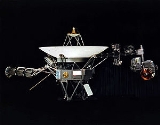
Voyager 2

 
Voyager 2

   Email Print
   Bookmark   Link


Voyager 2


The spacecraft is an unmanned interplanetary space probe
Space probe

A robotic spacecraft is a spacecraft with no humans on board, that is usually under telerobotic control. A robotic spacecraft designed to make scientific research measurements is often called a space probe....
 launched on August 20, 1977. Identical in form to its sister Voyager program
Voyager program

The Voyager program is a series of U.S. unmanned space missions that consists of a pair of unmanned scientific Space probes, Voyager 1 and Voyager 2....
 craft Voyager 1
Voyager 1

The spacecraft is a 722-kilogram Robotic spacecraft space probe of the outer Solar System and beyond, launched September 5, 1977. It remains operational, currently pursuing its extended mission to locate and study the boundaries of the Solar System, including the Kuiper belt and beyond....
, Voyager 2 followed a slower trajectory that allowed it to be kept in the ecliptic
Ecliptic

The ecliptic is the apparent path that the Sun traces out in the sky during the year. As it appears to move in the sky in relation to the stars, the apparent path aligns with the planets throughout the course of the year....
 (the plane of the Solar System
Solar System

The Solar System consists of the Sun and those Astronomical object bound to it by gravity: the eight planets and five dwarf planets, their 173 known Natural satellite, and billions of Small Solar System body....
) so that it could be sent to Uranus and Neptune by means of gravity assist during the 1981 encounter at Saturn. Because of this trajectory, Voyager 2 could not see the moon Titan
Titan (moon)

Titan or Saturn VI is the largest natural satellite of Saturn, the only moon known to have a dense celestial body atmosphere, and the only object other than Earth for which clear evidence of stable bodies of surface liquid has been found....
 up close as its twin had, but the probe did become the first and only spacecraft to travel to Uranus and Neptune, thus completing the Planetary Grand Tour
Planetary Grand Tour

The Planetary Grand Tour was an ambitious plan to send unmanned probes to the outermost planets of the solar system. Conceived by Gary Flandro of the Jet Propulsion Laboratory, the Grand Tour would have exploited the alignment of Jupiter, Saturn, Uranus, Neptune, and Pluto, an event that would occur in the late 1970s, and not recur for 176 ye...
, a rare geometric arrangement of the outer planets that only occurs once every 176 years.

Voyager 2 is perhaps the most productive space probe yet deployed, visiting four planets and their moons, including two primary visits to previously unexplored planets, with powerful cameras and a multitude of scientific instruments, at a fraction of the money later spent on specialized probes such as the Galileo spacecraft
Galileo spacecraft

Galileo was an unmanned spacecraft sent by NASA to study the planet Jupiter and its natural satellites. Named after the astronomer and Renaissance pioneer Galileo Galilei, it was launched on October 18, 1989 by the Space Shuttle Atlantis on the STS-34 mission....
 and the Cassini-Huygens
Cassini-Huygens

Cassini?Huygens is a joint NASA/European Space Agency robotic spacecraft mission currently studying the planet Saturn and Saturn's natural satellites....
 probe.


Discussion
Ask a question about 'Voyager 2'
Start a new discussion about 'Voyager 2'
Answer questions from other users
Full Discussion Forum


Encyclopedia


The spacecraft is an unmanned interplanetary space probe
Space probe

A robotic spacecraft is a spacecraft with no humans on board, that is usually under telerobotic control. A robotic spacecraft designed to make scientific research measurements is often called a space probe....
 launched on August 20, 1977. Identical in form to its sister Voyager program
Voyager program

The Voyager program is a series of U.S. unmanned space missions that consists of a pair of unmanned scientific Space probes, Voyager 1 and Voyager 2....
 craft Voyager 1
Voyager 1

The spacecraft is a 722-kilogram Robotic spacecraft space probe of the outer Solar System and beyond, launched September 5, 1977. It remains operational, currently pursuing its extended mission to locate and study the boundaries of the Solar System, including the Kuiper belt and beyond....
, Voyager 2 followed a slower trajectory that allowed it to be kept in the ecliptic
Ecliptic

The ecliptic is the apparent path that the Sun traces out in the sky during the year. As it appears to move in the sky in relation to the stars, the apparent path aligns with the planets throughout the course of the year....
 (the plane of the Solar System
Solar System

The Solar System consists of the Sun and those Astronomical object bound to it by gravity: the eight planets and five dwarf planets, their 173 known Natural satellite, and billions of Small Solar System body....
) so that it could be sent to Uranus and Neptune by means of gravity assist during the 1981 encounter at Saturn. Because of this trajectory, Voyager 2 could not see the moon Titan
Titan (moon)

Titan or Saturn VI is the largest natural satellite of Saturn, the only moon known to have a dense celestial body atmosphere, and the only object other than Earth for which clear evidence of stable bodies of surface liquid has been found....
 up close as its twin had, but the probe did become the first and only spacecraft to travel to Uranus and Neptune, thus completing the Planetary Grand Tour
Planetary Grand Tour

The Planetary Grand Tour was an ambitious plan to send unmanned probes to the outermost planets of the solar system. Conceived by Gary Flandro of the Jet Propulsion Laboratory, the Grand Tour would have exploited the alignment of Jupiter, Saturn, Uranus, Neptune, and Pluto, an event that would occur in the late 1970s, and not recur for 176 ye...
, a rare geometric arrangement of the outer planets that only occurs once every 176 years.

Voyager 2 is perhaps the most productive space probe yet deployed, visiting four planets and their moons, including two primary visits to previously unexplored planets, with powerful cameras and a multitude of scientific instruments, at a fraction of the money later spent on specialized probes such as the Galileo spacecraft
Galileo spacecraft

Galileo was an unmanned spacecraft sent by NASA to study the planet Jupiter and its natural satellites. Named after the astronomer and Renaissance pioneer Galileo Galilei, it was launched on October 18, 1989 by the Space Shuttle Atlantis on the STS-34 mission....
 and the Cassini-Huygens
Cassini-Huygens

Cassini?Huygens is a joint NASA/European Space Agency robotic spacecraft mission currently studying the planet Saturn and Saturn's natural satellites....
 probe. Along with Pioneer 10
Pioneer 10

was the first spacecraft to travel through the asteroid belt, which it entered on July 15, 1972, and to make direct observations of Jupiter , which it passed by on December 3, 1973....
, Pioneer 11
Pioneer 11

Pioneer 11 was the second mission of the Pioneer program to investigate Jupiter and the outer solar system and the first to explore Saturn and its main rings....
, Voyager 1
Voyager 1

The spacecraft is a 722-kilogram Robotic spacecraft space probe of the outer Solar System and beyond, launched September 5, 1977. It remains operational, currently pursuing its extended mission to locate and study the boundaries of the Solar System, including the Kuiper belt and beyond....
 and New Horizons
New Horizons

New Horizons is a NASA robotic spacecraft mission currently en route to the dwarf planet Pluto. It is expected to be the first spacecraft to fly by and study Pluto and its moons, Charon , Nix , and Hydra ....
, Voyager 2 is an interstellar probe
Interstellar probe

An interstellar probe is a space probe which has left -- or is expected to leave -- the solar system and enter interstellar medium . Alternatively, the term interstellar probe is used to refer to a space probe that is capable of reaching star systems other than the solar system ....
.

Mission profile

Titan 3e Centaur Launches Voyager 2
Voyager 2 was originally planned to be Mariner 12, part of the Mariner program
Mariner program

The Mariner program was a program conducted by the United States space agency NASA that launched a series of Robotic spacecraft Space probe designed to investigate Mars, Venus and Mercury ....
.

Voyager 2 was launched on August 20, 1977, from Cape Canaveral
Cape Canaveral

Cape Canaveral, from the Spanish language Cabo Ca?averal, is a headlands and bays in Brevard County, Florida, United States, near the center of that state's Atlantic Ocean coast 45 minutes East of Orlando by car....
, Florida
Florida

Florida is a U.S. state located in the Southeastern United States of the United States, bordering Alabama to the northwest and Georgia to the northeast....
, aboard a Titan IIIE
Titan IIIE

The Titan IIIE or Titan 3E, also known as Titan III-Centaur was an United States expendable launch system, launched seven times between 1974 and 1977....
/Centaur
Centaur (rocket stage)

Centaur is a rocket stage designed for use as the upper stage of space launch vehicles. Centaur boosts its satellite payload to its final orbit or, in the case of an interplanetary space probe, to escape velocity....
 carrier rocket. Ground crews became engrossed in a launch problem with Voyager 1 and forgot to send an important activation code to Voyager 2. This caused the probe to shut down its main radio receiver. Fortunately, ground crews were able to establish contact through the spacecraft's back-up radio receiver. In the process of doing all of this, a fuse was blown in the power supply of the primary receiver, permanently disabling it, and thus the back-up receiver had to be relied upon for the entire mission.

Jupiter

The closest approach to Jupiter
Jupiter

Jupiter is the fifth planet from the Sun and the Solar system by size planet within the Solar System. It is two and a half times as massive as all of the other planets in our Solar System combined....
 occurred on July 9, 1979. It came within 570,000 km (350,000 miles) of the planet's cloud tops. It discovered a few rings around Jupiter
Rings of Jupiter

The planet Jupiter has a system of planetary rings, known as the rings of Jupiter or the Jovian ring system. It was the third ring system to be discovered in the Solar System, after those of Rings of Saturn and Rings of Uranus....
, as well as volcanic activity on the moon Io
Io (moon)

'Io' is the innermost of the four Galilean moons natural satellite of Jupiter and, with a diameter of 3,642 Kilometre, the List of moons by diameter in the Solar System....
.

The Great Red Spot was revealed as a complex storm moving in a counterclockwise direction. An array of other smaller storms and eddies were found throughout the banded clouds.

Discovery of active volcanism on the satellite Io
Io (moon)

'Io' is the innermost of the four Galilean moons natural satellite of Jupiter and, with a diameter of 3,642 Kilometre, the List of moons by diameter in the Solar System....
 was easily the greatest unexpected discovery at Jupiter. It was the first time active volcanoes had been seen on another body in the solar system. Together, the Voyagers observed the eruption of nine volcanoes on Io, and there is evidence that other eruptions occurred between the Voyager encounters.

Europa
Europa (moon)

'Europa' is the Moons_of_Jupiter#Table Natural satellite of the planet Jupiter. Europa was discovered in 1610 by Galileo Galilei , and named after a mythical Phoenician noblewoman, Europa , who was courted by Zeus and became the queen of Crete....
 displayed a large number of intersecting linear features in the low-resolution photos from Voyager 1. At first, scientists believed the features might be deep cracks, caused by crustal rifting or tectonic processes. The closer high-resolution photos from Voyager 2, however, left scientists puzzled: The features were so lacking in topographic relief that as one scientist described them, they "might have been painted on with a felt marker." Europa is internally active due to tidal heating at a level about one-tenth that of Io. Europa is thought to have a thin crust (less than 30 kilometers or 18 miles thick) of water ice, possibly floating on a 50-kilometer-deep (30 mile) ocean.

Two new, small satellites, Adrastea
Adrastea (moon)

Adrastea , also known as , is the second by distance, and the smallest of the four Inner satellites of Jupiter. It was discovered in Voyager 2 probe photographs taken in 1979, making it the first natural satellite to be discovered from images taken by an interplanetary spacecraft, rather than through telescopic photography....
 and Metis
Metis (moon)

Metis , also known as , is the Jupiter's inner moons moon of Jupiter. It was discovered in 1979 in images taken by Voyager 1, and was named in 1983 after the first wife of Zeus, Metis ....
, were found orbiting just outside the ring. A third new satellite, Thebe
Thebe (moon)

Thebe , also known as , is the fourth of Moons of Jupiter by distance from the planet. It was discovered by Stephen P. Synnott in images from the Voyager 1 space probe taken on March 5, 1979 while orbiting around Jupiter....
, was discovered between the orbits of Amalthea and Io.

Saturn

The closest approach to Saturn
Saturn

Saturn is the sixth planet from the Sun and the second largest planet in the Solar System, after Jupiter. Saturn, along with Jupiter, Uranus and Neptune, is classified as a gas giant....
 occurred on August 26, 1981.

While passing behind Saturn (as viewed from Earth), Voyager 2 probed Saturn's upper atmosphere with its radio link to measure temperature and density profiles. Voyager 2 found that at the highest levels (7 kilopascals pressure) Saturn's temperature was 70 kelvin
Kelvin

The kelvin is a Units of measurement of temperature and is one of the seven SI base units. The Kelvin scale is a Thermodynamic temperature scale where absolute zero, the theoretical absence of all thermal energy, is zero ....
s (-203 °C), while at the deepest levels measured (120 kilopascals) the temperature increased to 143 kelvins (-130 °C). The north pole was found to be 10 kelvins cooler, although this may be season
Season

A season is one of the major divisions of the year, generally based on yearly periodic changes in weather.Seasons result from the yearly revolution of the Earth around the Sun and the Axial tilt....
al (see also Saturn Oppositions
Saturn

Saturn is the sixth planet from the Sun and the second largest planet in the Solar System, after Jupiter. Saturn, along with Jupiter, Uranus and Neptune, is classified as a gas giant....
).

After the Saturn flyby, the camera platform on Voyager 2 locked up briefly, putting plans to officially extend the mission to Uranus
Uranus

Uranus is the seventh planet from the Sun and the third-largest and fourth most massive planet in the Solar System. It is named after the ancient Greek deity of the sky Uranus the father of Kronos and grandfather of Zeus ....
 and Neptune
NEPTUNE

=Overview=The project, along with sister project, VENUS, offers a unique approach to ocean science. Traditionally, ocean scientists have relied on infrequent ship cruises or space-based satellites to carry out their research....
 in jeopardy. Fortunately, the mission team was able to fix the problem — caused by overuse that temporarily depleted its lubricant — and the probe was given the go-ahead to examine Uranus.


Uranus


The closest approach to Uranus
Uranus

Uranus is the seventh planet from the Sun and the third-largest and fourth most massive planet in the Solar System. It is named after the ancient Greek deity of the sky Uranus the father of Kronos and grandfather of Zeus ....
 occurred on January 24, 1986, where it came within 81,500 kilometers (50,600 miles) of the planet's cloud tops. Voyager 2 discovered 10 previously unknown moons
Uranus' natural satellites

File:Uranus_moons.jpgUranus, the seventh planet of the Solar System, has 27 known Natural satellite, all of which are named after characters from the works of William Shakespeare and Alexander Pope....
; studied the planet's unique atmosphere, caused by its axial tilt
Axial tilt

In astronomy, axial tilt is the inclination angle of a planet axis of rotation in relation to its Orbital plane . It is also called axial inclination or obliquity....
 of 97.8°; and examined its ring system
Rings of Uranus

The planet Uranus has a system of planetary rings intermediate in complexity between the more extensive set around Rings of Saturn and the simpler systems around Rings of Jupiter and Rings of Neptune....
.

Uranus is the third largest planet in the solar system. It orbits the Sun at a distance of about 2.8 billion kilometers (1.7 billion miles) and completes one orbit every 84 years. The length of a day on Uranus as measured by Voyager 2 is 17 hours, 14 minutes. Uranus is distinguished by the fact that it is tipped on its side. Its unusual position is thought to be the result of a collision with a planet-sized body early in the solar system's history. Given its odd orientation, with its polar regions exposed to sunlight or darkness for long periods, scientists were not sure what to expect at Uranus.

Voyager 2 found that one of the most striking influences of Uranus' sideways position is its effect on the tail of the magnetic field, which is itself tilted 60 degrees from the planet's axis of rotation. The magnetotail was shown to be twisted by the planet's rotation into a long corkscrew shape behind the planet. The presence of a magnetic field at Uranus was not known until Voyager's arrival.

Radiation belts at Uranus were found to be of an intensity similar to those at Saturn
Saturn

Saturn is the sixth planet from the Sun and the second largest planet in the Solar System, after Jupiter. Saturn, along with Jupiter, Uranus and Neptune, is classified as a gas giant....
. The intensity of radiation within the belts is such that irradiation would quickly darken (within 100,000 years) any methane trapped in the icy surfaces of the inner moons and ring particles. This may have contributed to the darkened surfaces of the moons and ring particles, which are almost uniformly gray in color.

A high layer of haze was detected around the sunlit pole, which also was found to radiate large amounts of ultraviolet light, a phenomenon dubbed "dayglow." The average temperature is about 60 kelvins (−350 degrees Fahrenheit/−213 degrees Celsius). Surprisingly, the illuminated and dark poles, and most of the planet, show nearly the same temperature at the cloud tops.

The moon Miranda
Miranda (moon)

Miranda is the smallest and innermost of Uranus ' five major natural satellites.It was discovered by Gerard Kuiper on 1948-02-16 at McDonald Observatory....
, innermost of the five large moons, was revealed to be one of the strangest bodies yet seen in the solar system. Detailed images from Voyager's flyby of the moon showed huge fault canyons as deep as 20 kilometers (12 miles), terraced layers, and a mixture of old and young surfaces. One theory holds that Miranda may be a reaggregation of material from an earlier time when the moon was fractured by a violent impact.

All nine previously known rings were studied by the spacecraft and showed the Uranian rings to be distinctly different from those at Jupiter and Saturn. The ring system may be relatively young and did not form at the same time as Uranus. Particles that make up the rings may be remnants of a moon that was broken by a high-velocity impact or torn up
Roche limit

The Roche limit , sometimes referred to as the Roche radius, is the distance within which a celestial body, held together only by its own gravity, will disintegrate due to a second celestial body's tidal forces exceeding the first body's gravitational self-attraction....
 by gravitational effects.


Neptune

The closest approach to Neptune
NEPTUNE

=Overview=The project, along with sister project, VENUS, offers a unique approach to ocean science. Traditionally, ocean scientists have relied on infrequent ship cruises or space-based satellites to carry out their research....
 occurred on August 25, 1989. Since this was the last major planet Voyager 2 could visit, it was decided to make a close flyby of the moon Triton
Triton (moon)

'Triton' is the largest natural satellite of the planet Neptune, discovered on October 10, 1846 by William Lassell. It is the only large moon in the Solar System with a Retrograde and direct motion, which is an orbit in the opposite direction to its planet's rotation....
, regardless of the consequences to the trajectory, as with Voyager 1
Voyager 1

The spacecraft is a 722-kilogram Robotic spacecraft space probe of the outer Solar System and beyond, launched September 5, 1977. It remains operational, currently pursuing its extended mission to locate and study the boundaries of the Solar System, including the Kuiper belt and beyond....
s encounter with Saturn and its moon Titan
Titan (moon)

Titan or Saturn VI is the largest natural satellite of Saturn, the only moon known to have a dense celestial body atmosphere, and the only object other than Earth for which clear evidence of stable bodies of surface liquid has been found....
.

The probe also discovered the Great Dark Spot
Great Dark Spot

The Great Dark Spot was a dark spot on Neptune similar in appearance to Jupiter Great Red Spot. It was first observed in 1989 by NASA's Voyager 2 probe....
, which has since disappeared, according to Hubble Space Telescope
Hubble Space Telescope

The Hubble Space Telescope is a Space observatory that was carried into Low Earth orbit STS-31 in April 1990. It is named after the American astronomer Edwin Hubble....
 observations. Originally thought to be a large cloud itself, it was later postulated to be a hole in the visible cloud deck.

For many years, beginning in the late 19th century, it was widely believed that an unseen planet (dubbed "Planet X
Planet X

Following the discovery of the planet Neptune in 1846, there was considerable speculation that another planet might exist beyond its orbit. The search began in the mid-19th century but culminated at the start of the 20th with Percival Lowell's quest for Planet X....
") was influencing Uranus and Neptune, as their observed and predicted positions differed. This belief brought about the 1930 discovery of Pluto
Pluto

Pluto , Minor planet names Pluto, is the second-largest known dwarf planet in the Solar System and the tenth-largest body observed directly orbiting the Sun....
, and persisted as it became increasingly clear that Pluto does not have the mass to account for these discrepancies. When
Voyager 2 passed Neptune, it became possible to precisely measure Neptune's mass. Neptune turned out to be 0.5% less massive than previously believed, a difference comparable to the entire mass of Mars. When Uranus and Neptune's orbits were recalculated using the most accurate figure, it became clear that the erroneous mass figure - not the gravity of an unseen planet - caused the orbital discrepancies which had long vexed the astronomical community.

With the 2006 decision of the International Astronomical Union
International Astronomical Union

The International Astronomical Union is a collection of professional astronomers, at the Ph.D. level and beyond, active in professional research and education in astronomy....
 to reclassify Pluto
Pluto

Pluto , Minor planet names Pluto, is the second-largest known dwarf planet in the Solar System and the tenth-largest body observed directly orbiting the Sun....
 as a "dwarf planet
Dwarf planet

A dwarf planet, as defined by the International Astronomical Union , is a celestial body orbiting the Sun that is massive enough to be rounded by its own gravity but has not Clearing the neighbourhood of planetesimals and is not a natural satellite....
", the 1989 flyby of Neptune by
Voyager 2 became the point when every planet in the solar system had been visited at least once by spacecraft.


Escaping the solar system

Since its planetary mission is over,
Voyager 2 is now described as working on an interstellar mission, which NASA
NASA

The National Aeronautics and Space Administration is an agency of the Federal government of the United States, responsible for the nation's public list of space agencies....
 is using to find out what the solar system
Solar System

The Solar System consists of the Sun and those Astronomical object bound to it by gravity: the eight planets and five dwarf planets, their 173 known Natural satellite, and billions of Small Solar System body....
 is like beyond the heliosphere
Heliosphere

The heliosphere is a bubble in outer space "blown" into the interstellar medium by the solar wind. Although electrically neutral atoms from interstellar space can penetrate this bubble, virtually all of the material in the heliosphere emanates from the Sun itself....
. Like
Voyager 1 around three years before, Voyager 2 crossed into the heliosheath, the last section of the heliosphere before interstellar space, in October 2007.

As of September 2008,
Voyager 2 was at a distance of around 87.03 AU
Astronomical unit

An astronomical unit is a unit of length based on the mean distance from the Earth to the Sun. The precise value of the AU is currently accepted as 149,597,870,691 Plus-minus sign 6 metres ....
 (13.019 billion
1000000000 (number)

1,000,000,000 is the natural number following 999,999,999 and preceding 1,000,000,001.In scientific notation, it is written as 109....
 km, or 8.077 billion
1000000000 (number)

1,000,000,000 is the natural number following 999,999,999 and preceding 1,000,000,001.In scientific notation, it is written as 109....
 miles) from the Sun , deep in the scattered disc
Scattered disc

The scattered disc is a distant region of the Solar System that is sparsely populated by icy minor planets known as scattered disc objects ; a subset of the broader family of trans-Neptunian objects ....
, and traveling outward at roughly 3.28 AUs per year. It is more than twice as far from the Sun as Pluto
Pluto

Pluto , Minor planet names Pluto, is the second-largest known dwarf planet in the Solar System and the tenth-largest body observed directly orbiting the Sun....
, and far beyond the perihelion of 90377 Sedna
90377 Sedna

90377 Sedna is a trans-Neptunian object and a likely dwarf planet, discovered by Michael E. Brown , Chad Trujillo and David L. Rabinowitz on November 14, 2003....
, but not yet beyond the outer limits of the orbit of Eris
Eris (dwarf planet)

'Eris' , Minor planet names '136199 Eris', is the largest known dwarf planet in the Solar System and the ninth-largest body known to orbit the Sun directly....
.

On October 30, 2007,
Voyager 2 passed the termination shock into the heliosheath, approximately 1 billion miles (1.6 billion km) closer to the Sun than Voyager 1
Voyager 1

The spacecraft is a 722-kilogram Robotic spacecraft space probe of the outer Solar System and beyond, launched September 5, 1977. It remains operational, currently pursuing its extended mission to locate and study the boundaries of the Solar System, including the Kuiper belt and beyond....
 did. This is due to the local interstellar magnetic field of deep space. The southern hemisphere of the solar system's heliosphere is being pushed in.

Voyager 2 is not headed toward any particular star. It will pass by the 2.6 parsec distant star Sirius
Sirius

Sirius is the list of brightest stars in the night sky with a visual apparent magnitude of −1.46, almost twice as bright as Canopus, the next brightest star....
 at a distance of 1.32 parsec
Parsec

The parsec is a units of measurement of astronomical units of length, equal to just under 31 orders_of_magnitude_#1012 kilometres , or about 3.26 light-years....
s (4.3 ly
Light-year

A light-year or light year is a Units of measurement of length, equal to just under ten orders_of_magnitude_%28numbers%29#1012 kilometres....
, 25 trillion mi
Mile

A mile is a Units of measurement of length, usually used to measure distance, in a number of different systems. In contemporary English contexts, mile most commonly refers to the statute mile of 5,280 Feet or the nautical mile of 1,852 meters ....
) in about 296,000 years.

Each Voyager carries a gold-plated audio-visual disc in the event that either spacecraft is ever found by intelligent aliens. The disc carries images of Earth and its lifeforms, a range of scientific information, and a medley, "Sounds of Earth", that includes the sounds of whales, a baby crying, waves breaking on a shore and a variety of music.

Voyager 2 is expected to keep transmitting until at least after 2025, over 48 years since launch.

Year End of specific capabilities as a result of the available electrical power limitations
1998 Terminate scan platform and UV observations
2007 Termination of Digital Tape Recorder operations (because it was no longer needed due to a receiver failure)
2008 Power off Planetary Radio Astronomy Experiment (PRA)
2015 approx Termination of gyro operations
2020 approx Initiate instrument power sharing
2025 or after Can no longer power any single instrument


Current status

Voyager 2, as of January 17, 2009, was at -53.84° declination
Declination

In astronomy, declination is one of the two coordinates of the equatorial coordinate system, the other being either right ascension or hour angle....
 and 19.783 hrs Right Ascension
Right ascension

Right ascension is the astronomical term for one of the two coordinates of a point on the celestial sphere when using the equatorial coordinate system....
, placing it in the constellation Telescopium
Telescopium

Telescopium is a minor southern constellation created in the 18th century by Nicolas Louis de Lacaille, a France astronomer and student of the southern skies....
 as observed from Earth.

On November 30, 2006, a command was incorrectly decoded by the spacecraft as an instruction to turn on heaters associated with the probe's magnetometer. The heaters remained on until December 4, 2006, resulting in extremely high temperatures above 130 °C (266 °F), and in sensor rotation away from the correct orientation. It has not been possible to fully diagnose and correct for the damage to the Voyager 2 magnetometer, although efforts to do so are ongoing.

Information about ongoing telemetry exchanges with Voyager 2 is available from . Information on the current location of Voyager 2 can be found at .

See also

  • Voyager program
    Voyager program

    The Voyager program is a series of U.S. unmanned space missions that consists of a pair of unmanned scientific Space probes, Voyager 1 and Voyager 2....
     for more information about this spacecraft.
  • Voyager Golden Record
    Voyager Golden Record

    The Voyager Golden Record is a phonograph record included in the two Voyager program spacecraft launched in 1977. It contains sounds and images selected to portray the diversity of life and culture on Earth....
  • Voyager 1
    Voyager 1

    The spacecraft is a 722-kilogram Robotic spacecraft space probe of the outer Solar System and beyond, launched September 5, 1977. It remains operational, currently pursuing its extended mission to locate and study the boundaries of the Solar System, including the Kuiper belt and beyond....
  • Pioneer 10
    Pioneer 10

    was the first spacecraft to travel through the asteroid belt, which it entered on July 15, 1972, and to make direct observations of Jupiter , which it passed by on December 3, 1973....
  • Pioneer 11
    Pioneer 11

    Pioneer 11 was the second mission of the Pioneer program to investigate Jupiter and the outer solar system and the first to explore Saturn and its main rings....
  • Voyager in fiction and popular culture
    Voyager program

    The Voyager program is a series of U.S. unmanned space missions that consists of a pair of unmanned scientific Space probes, Voyager 1 and Voyager 2....


Footnotes


Bibliography

  • Nardo, Don (2002). Neptune. Thomson Gale. ISBN 0737710012


External links

  • by
  • - current positions and diagrams
  • May 23, 2006