

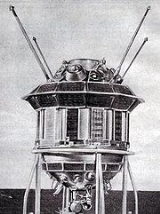
Luna 3

Encyclopedia
The Soviet space probe
Luna 3 of 1959 (of the E-3 series) was the third space probe to be sent to the neighborhood of the Moon
, and this mission was an early feat in the spaceborne exploration
of outer space
. Though it returned rather poor pictures by later standards, the historic, never-before-seen views of the far side of the Moon
caused excitement and interest when they were published around the world, and a tentative Atlas of the Far Side of the Moon was created after image processing improved the pictures. This space probe has been commonly called "Lunik 3", predominantly in the Western world.
These views showed mountainous terrain, very different from the near side, and only two dark, low-lying regions which were named Mare Moscovrae (Sea of Moscow) and Mare Desiderii
(Sea of Desire). Mare Luna Desiderii was later found to be composed of a smaller mare, Mare Ingenii
(Sea of Ingenuity), and several other dark craters.
s were mounted on the outside of the cylinder, and these provided electric power
to the storage batteries inside the space probe.
Shutters for thermal control were positioned along the cylinder and opened to expose a radiating surface when the internal temperature exceeded 25 °C. The upper hemisphere of the probe held the covered opening for the cameras. Four antenna
s protruded from the top of the probe and two from its bottom. Other scientific equipment was mounted on the outside, including micrometeoroid
and cosmic ray
detectors, and the Yenisey-2 imaging system. The gas jets for its attitude control system
were mounted on the lower end of the spacecraft. Several photoelectric cells helped maintain orientation with respect to the Sun and the Moon.
There were no rocket motors for course corrections.
Its interior held the camera
s and the photographic film
processing system, radio transmitter, storage batteries, gyroscopic unit
s, and circulating fans for temperature control. It was spin-stabilized for most of its flight, but its three-axis attitude control system was activated while taking photos. Luna 3 was radio-controlled from ground stations in the Soviet Union.
, the Blok-E escape stage was shut down by radio control to put Luna 3 on its course to the Moon. Initial radio contact showed that the signal from the space probe was only about one-half as strong as expected, and the internal temperature was rising. The spacecraft spin axis was reoriented and some equipment was shut down, resulting in a temperature drop from 40 °C to about 30 °C. At a distance of 60,000 to 70,000 km from the moon, the orientation system was turned on and the spacecraft rotation was stopped. The lower end of the craft was pointed at the sun, which was shining on the far side of the moon.
The space probe passed within 6,200 km of the moon near its south pole at the closest lunar approach at 14:16 UT on 6 October 1959, and continued on over the far side. On 7 October, the photocell on the upper end of the space probe detected the sunlit far side of the moon, and the photography sequence was started. The first picture was taken at 03:30 UT at a distance of 63,500 km from the moon, and the last picture was taken 40 minutes later from a distance of 66,700 km.
A total of 29 pictures were taken, covering 70% of the far side. After the photography was complete the spacecraft resumed spinning, passed over the north pole of the moon and returned towards the Earth. Attempts to transmit the pictures to the Soviet Union began on October 8 but the early attempts were unsuccessful due to the low signal strength. As Luna 3 drew closer to the Earth, a total of about 17 viewable but poor quality photographs were transmitted by 18 October. All contact with the probe was lost on 22 October 1959. The space probe was believed to have burned up in the Earth's atmosphere in March or April 1960. Another possibility was that it might have survived in orbit until 1962 or later.
/5.6 aperture
objective and a 500 mm, f/9.5 objective
. The camera carried 40 frames of temperature- and radiation-resistant 35 mm isochrome film
. The 200 mm objective could image the full disk of the moon and the 500 mm could take an image of a region on the surface. The camera was fixed in the spacecraft and pointing was achieved by rotating the craft itself.
Luna-3 was the first successful three-axis stabilized spacecraft. During most of the mission, the spacecraft was spin stabilized, but for photography of the moon, the spacecraft oriented one axis toward the Sun and then a photocell was used to detect the moon and orient the cameras towards it. Detection of the moon signalled the camera cover to open and the photography sequence to start automatically. The images alternated between both cameras during the sequence. After photography was complete, the film was moved to an on-board processor where it was developed, fixed, and dried. Commands from the Earth were then given to move the film into a scanner where a spot produced by a cathode ray tube
was projected through the film onto a photoelectric multiplier
. The spot was scanned across the film and the photomultiplier converted the intensity of the light passing through the film into an electric signal which was transmitted to the Earth (via frequency-modulated analog video, similar to a facsimile). A frame could be scanned with a resolution of 1000 (horizontal) lines and the transmission could be done at a slow-scan television
rate at large distances from the Earth and a faster rate at closer ranges.
The camera took 29 pictures over 40 minutes on 7 October 1959, from 03:30 UT to 04:10 UT at distances ranging from 63,500 km to 66,700 km above the surface, covering 70% of the lunar far side. Seventeen (some say twelve) of these frames were successfully transmitted back to the Earth, and six were published (frames numbered 26, 28, 29, 31, 32, and 35). They were mankind's first views of the far hemisphere of the moon.
The imaging system was developed by P.F. Bratslavets and I.A. Rosselevich at the Leningrad Scientific Research Institute for Television and the returned images were processed and analyzed by Iu.N. Lipskii and his team at the Sternberg Astronomical Institute. The camera AFA-E1 was developed and manufactured by the KMZ factory (Krasnogorskiy Mekhanicheskiy Zavod
).
Space probe
A robotic spacecraft is a spacecraft with no humans on board, that is usually under telerobotic control. A robotic spacecraft designed to make scientific research measurements is often called a space probe. Many space missions are more suited to telerobotic rather than crewed operation, due to...
Luna 3 of 1959 (of the E-3 series) was the third space probe to be sent to the neighborhood of the Moon
Moon
The Moon is Earth's only known natural satellite,There are a number of near-Earth asteroids including 3753 Cruithne that are co-orbital with Earth: their orbits bring them close to Earth for periods of time but then alter in the long term . These are quasi-satellites and not true moons. For more...
, and this mission was an early feat in the spaceborne exploration
Space exploration
Space exploration is the use of space technology to explore outer space. Physical exploration of space is conducted both by human spaceflights and by robotic spacecraft....
of outer space
Outer space
Outer space is the void that exists between celestial bodies, including the Earth. It is not completely empty, but consists of a hard vacuum containing a low density of particles: predominantly a plasma of hydrogen and helium, as well as electromagnetic radiation, magnetic fields, and neutrinos....
. Though it returned rather poor pictures by later standards, the historic, never-before-seen views of the far side of the Moon
Far side of the Moon
The far side of the Moon is the lunar hemisphere that is permanently turned away, and is not visible from the surface of the Earth. The far hemisphere was first photographed by the Soviet Luna 3 probe in 1959, and was first directly observed by human eyes when the Apollo 8 mission orbited the Moon...
caused excitement and interest when they were published around the world, and a tentative Atlas of the Far Side of the Moon was created after image processing improved the pictures. This space probe has been commonly called "Lunik 3", predominantly in the Western world.
These views showed mountainous terrain, very different from the near side, and only two dark, low-lying regions which were named Mare Moscovrae (Sea of Moscow) and Mare Desiderii
Mare Desiderii
Mare Desiderii was an area of the Moon named after Luna 3 returned the first pictures of the far side. This name is derived from the Russian Море Мечты, Mechta being the original name for the Luna 1 spacecraft....
(Sea of Desire). Mare Luna Desiderii was later found to be composed of a smaller mare, Mare Ingenii
Mare Ingenii
Mare Ingenii is one of the few lunar mare features on the far side of the Moon. The mare sits in the Ingenii basin. This basin material is of the Pre-Nectarian epoch. The mare material located in Ingenii and the surrounding craters is of the Upper Imbrian epoch...
(Sea of Ingenuity), and several other dark craters.
Design
The space probe was a cylindric canister with hemispheric ends and a wide flange near the top. The probe was 130 cm long and 120 cm at its maximum diameter at the flange. Most of the cylindric section was roughly 95 cm in diameter. The canister was hermetically sealed and pressurized to about 0.22 atmosphere (23 kilopascals). Several solar cellSolar cell
A solar cell is a solid state electrical device that converts the energy of light directly into electricity by the photovoltaic effect....
s were mounted on the outside of the cylinder, and these provided electric power
Electric power
Electric power is the rate at which electric energy is transferred by an electric circuit. The SI unit of power is the watt.-Circuits:Electric power, like mechanical power, is represented by the letter P in electrical equations...
to the storage batteries inside the space probe.
Shutters for thermal control were positioned along the cylinder and opened to expose a radiating surface when the internal temperature exceeded 25 °C. The upper hemisphere of the probe held the covered opening for the cameras. Four antenna
Antenna (radio)
An antenna is an electrical device which converts electric currents into radio waves, and vice versa. It is usually used with a radio transmitter or radio receiver...
s protruded from the top of the probe and two from its bottom. Other scientific equipment was mounted on the outside, including micrometeoroid
Micrometeoroid
A micrometeoroid is a tiny meteoroid; a small particle of rock in space, usually weighing less than a gram. A micrometeor or micrometeorite is such a particle that enters the Earth's atmosphere or falls to Earth.-Scientific interest:...
and cosmic ray
Cosmic ray
Cosmic rays are energetic charged subatomic particles, originating from outer space. They may produce secondary particles that penetrate the Earth's atmosphere and surface. The term ray is historical as cosmic rays were thought to be electromagnetic radiation...
detectors, and the Yenisey-2 imaging system. The gas jets for its attitude control system
Attitude control system
In spaceflight, the attitude control system or attitude determination and control system of a spacecraft consists of equipment to measure, report and change the orientation of the vehicle.- Components :...
were mounted on the lower end of the spacecraft. Several photoelectric cells helped maintain orientation with respect to the Sun and the Moon.
There were no rocket motors for course corrections.
Its interior held the camera
Camera
A camera is a device that records and stores images. These images may be still photographs or moving images such as videos or movies. The term camera comes from the camera obscura , an early mechanism for projecting images...
s and the photographic film
Photographic film
Photographic film is a sheet of plastic coated with an emulsion containing light-sensitive silver halide salts with variable crystal sizes that determine the sensitivity, contrast and resolution of the film...
processing system, radio transmitter, storage batteries, gyroscopic unit
Gyroscope
A gyroscope is a device for measuring or maintaining orientation, based on the principles of angular momentum. In essence, a mechanical gyroscope is a spinning wheel or disk whose axle is free to take any orientation...
s, and circulating fans for temperature control. It was spin-stabilized for most of its flight, but its three-axis attitude control system was activated while taking photos. Luna 3 was radio-controlled from ground stations in the Soviet Union.
Mission
After launching on an 8K72 (number I1-8) rocket over the North PoleNorth Pole
The North Pole, also known as the Geographic North Pole or Terrestrial North Pole, is, subject to the caveats explained below, defined as the point in the northern hemisphere where the Earth's axis of rotation meets its surface...
, the Blok-E escape stage was shut down by radio control to put Luna 3 on its course to the Moon. Initial radio contact showed that the signal from the space probe was only about one-half as strong as expected, and the internal temperature was rising. The spacecraft spin axis was reoriented and some equipment was shut down, resulting in a temperature drop from 40 °C to about 30 °C. At a distance of 60,000 to 70,000 km from the moon, the orientation system was turned on and the spacecraft rotation was stopped. The lower end of the craft was pointed at the sun, which was shining on the far side of the moon.
The space probe passed within 6,200 km of the moon near its south pole at the closest lunar approach at 14:16 UT on 6 October 1959, and continued on over the far side. On 7 October, the photocell on the upper end of the space probe detected the sunlit far side of the moon, and the photography sequence was started. The first picture was taken at 03:30 UT at a distance of 63,500 km from the moon, and the last picture was taken 40 minutes later from a distance of 66,700 km.
A total of 29 pictures were taken, covering 70% of the far side. After the photography was complete the spacecraft resumed spinning, passed over the north pole of the moon and returned towards the Earth. Attempts to transmit the pictures to the Soviet Union began on October 8 but the early attempts were unsuccessful due to the low signal strength. As Luna 3 drew closer to the Earth, a total of about 17 viewable but poor quality photographs were transmitted by 18 October. All contact with the probe was lost on 22 October 1959. The space probe was believed to have burned up in the Earth's atmosphere in March or April 1960. Another possibility was that it might have survived in orbit until 1962 or later.
Lunar photography
The purpose of this experiment was to obtain photographs of the lunar surface as the spacecraft flew by the moon. The imaging system was designated Yenisey-2 and consisted of a dual-lens camera AFA-E1, an automatic film processing unit, and a scanner. The lenses on the camera were a 200 mm focal length, fF-number
In optics, the f-number of an optical system expresses the diameter of the entrance pupil in terms of the focal length of the lens; in simpler terms, the f-number is the focal length divided by the "effective" aperture diameter...
/5.6 aperture
Aperture
In optics, an aperture is a hole or an opening through which light travels. More specifically, the aperture of an optical system is the opening that determines the cone angle of a bundle of rays that come to a focus in the image plane. The aperture determines how collimated the admitted rays are,...
objective and a 500 mm, f/9.5 objective
Photographic lens
A camera lens is an optical lens or assembly of lenses used in conjunction with a camera body and mechanism to make images of objects either on photographic film or on other media capable of storing an image chemically or electronically.While in principle a simple convex lens will suffice, in...
. The camera carried 40 frames of temperature- and radiation-resistant 35 mm isochrome film
Photographic film
Photographic film is a sheet of plastic coated with an emulsion containing light-sensitive silver halide salts with variable crystal sizes that determine the sensitivity, contrast and resolution of the film...
. The 200 mm objective could image the full disk of the moon and the 500 mm could take an image of a region on the surface. The camera was fixed in the spacecraft and pointing was achieved by rotating the craft itself.
Luna-3 was the first successful three-axis stabilized spacecraft. During most of the mission, the spacecraft was spin stabilized, but for photography of the moon, the spacecraft oriented one axis toward the Sun and then a photocell was used to detect the moon and orient the cameras towards it. Detection of the moon signalled the camera cover to open and the photography sequence to start automatically. The images alternated between both cameras during the sequence. After photography was complete, the film was moved to an on-board processor where it was developed, fixed, and dried. Commands from the Earth were then given to move the film into a scanner where a spot produced by a cathode ray tube
Cathode ray tube
The cathode ray tube is a vacuum tube containing an electron gun and a fluorescent screen used to view images. It has a means to accelerate and deflect the electron beam onto the fluorescent screen to create the images. The image may represent electrical waveforms , pictures , radar targets and...
was projected through the film onto a photoelectric multiplier
Photomultiplier
Photomultiplier tubes , members of the class of vacuum tubes, and more specifically phototubes, are extremely sensitive detectors of light in the ultraviolet, visible, and near-infrared ranges of the electromagnetic spectrum...
. The spot was scanned across the film and the photomultiplier converted the intensity of the light passing through the film into an electric signal which was transmitted to the Earth (via frequency-modulated analog video, similar to a facsimile). A frame could be scanned with a resolution of 1000 (horizontal) lines and the transmission could be done at a slow-scan television
Slow-scan television
Slow-scan television is a picture transmission method used mainly by amateur radio operators, to transmit and receive static pictures via radio in monochrome or color.A technical term for SSTV is narrowband television...
rate at large distances from the Earth and a faster rate at closer ranges.
The camera took 29 pictures over 40 minutes on 7 October 1959, from 03:30 UT to 04:10 UT at distances ranging from 63,500 km to 66,700 km above the surface, covering 70% of the lunar far side. Seventeen (some say twelve) of these frames were successfully transmitted back to the Earth, and six were published (frames numbered 26, 28, 29, 31, 32, and 35). They were mankind's first views of the far hemisphere of the moon.
The imaging system was developed by P.F. Bratslavets and I.A. Rosselevich at the Leningrad Scientific Research Institute for Television and the returned images were processed and analyzed by Iu.N. Lipskii and his team at the Sternberg Astronomical Institute. The camera AFA-E1 was developed and manufactured by the KMZ factory (Krasnogorskiy Mekhanicheskiy Zavod
Krasnogorskiy Zavod
Krasnogorskiy zavod im. S. A. Zvereva is a Russian factory in Krasnogorsk near Moscow which specializes in optical technology.During the Soviet period it was called Krasnogorsk Mechanical Works...
).