


STS-40

Encyclopedia
Mission parameters
- MassMassMass can be defined as a quantitive measure of the resistance an object has to change in its velocity.In physics, mass commonly refers to any of the following three properties of matter, which have been shown experimentally to be equivalent:...
:- Orbiter landing with payload: 102283 kilograms (225,495.4 lb)
- Payload: 12374 kilograms (27,280 lb)
- PerigeePerigeePerigee is the point at which an object makes its closest approach to the Earth.. Often the term is used in a broader sense to define the point in an orbit where the orbiting body is closest to the body it orbits. The opposite is the apogee, the farthest or highest point.The Greek prefix "peri"...
: 287 kilometres (178.3 mi) - Apogee: 296 kilometres (183.9 mi)
- InclinationInclinationInclination in general is the angle between a reference plane and another plane or axis of direction.-Orbits:The inclination is one of the six orbital parameters describing the shape and orientation of a celestial orbit...
: 39.0° - PeriodOrbital periodThe orbital period is the time taken for a given object to make one complete orbit about another object.When mentioned without further qualification in astronomy this refers to the sidereal period of an astronomical object, which is calculated with respect to the stars.There are several kinds of...
: 90.4 min
Mission highlights
Launch originally set for 22 May 1991. Mission postponed less than 48 hours before launch when it became known that a leaking liquid hydrogenLiquid hydrogen
Liquid hydrogen is the liquid state of the element hydrogen. Hydrogen is found naturally in the molecular H2 form.To exist as a liquid, H2 must be pressurized above and cooled below hydrogen's Critical point. However, for hydrogen to be in a full liquid state without boiling off, it needs to be...
transducer in orbiter main propulsion system which was removed and replaced during leak testing in 1990, had failed an analysis by vendor. Engineers feared that one or more of the nine liquid hydrogen and liquid oxygen transducers protruding into fuel and oxidizer lines could break off and be ingested by the engine turbopumps, causing engine failure.
In addition, one of orbiter five general purpose computers failed completely, along with one of the multiplexer demultiplexers that control orbiter hydraulics ordinance and orbiter maneuvering system / reaction control system functions in aft compartment.
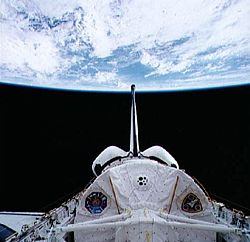
It was the fifth dedicated Spacelab
Spacelab
Spacelab was a reusable laboratory used on certain spaceflights flown by the Space Shuttle. The laboratory consisted of multiple components, including a pressurized module, an unpressurized carrier and other related hardware housed in the Shuttle's cargo bay...
mission, Spacelab Life Sciences-1, and first dedicated solely to life sciences, using the habitable module. Mission featured most detailed and interrelated physiological measurements in space since 1973–1974 Skylab
Skylab
Skylab was a space station launched and operated by NASA, the space agency of the United States. Skylab orbited the Earth from 1973 to 1979, and included a workshop, a solar observatory, and other systems. It was launched unmanned by a modified Saturn V rocket, with a mass of...
missions. Subjects were humans, 30 rodent
Rodent
Rodentia is an order of mammals also known as rodents, characterised by two continuously growing incisors in the upper and lower jaws which must be kept short by gnawing....
s and thousands of tiny jellyfish
Jellyfish
Jellyfish are free-swimming members of the phylum Cnidaria. Medusa is another word for jellyfish, and refers to any free-swimming jellyfish stages in the phylum Cnidaria...
. Primary SLS-1 experiments studied six body systems; of 18 investigations, ten involved humans, seven involved rodents, and one used jellyfish.
Six body systems investigated were cardiovascular/cardiopulmonary (heart, lungs and blood vessels); renal/endocrine (kidneys and hormone-secreting organs and glands); blood (blood plasma); immune system (white blood cells); musculoskeletal (muscles and bones); and neurovestibular (brains and nerves, eyes and inner ear). Other payloads included twelve Getaway Special
Getaway Special
Getaway Special was a NASA program that offered interested individuals, or groups, opportunities to fly small experiments aboard the Space Shuttle...
(GAS) canisters installed on GAS bridge in cargo bay for experiments In materials science, plant biology and cosmic radiation (see G-616
G-616
-GAS G-616: The Effect of Cosmic Radiation on Floppy Disks:GAS canister # G-616: The Effect of Cosmic Radiation on Static Computer Media & Plant Seeds Exposure of Microgravity....
); Middeck Zero-Gravity Dynamics Experiment (MODE); and seven Orbiter Experiments (OEX).
Landing was on 14 June 1991, at 8:39:11 am PDT, on Runway 22, at Edwards Air Force Base
Edwards Air Force Base
Edwards Air Force Base is a United States Air Force base located on the border of Kern County, Los Angeles County, and San Bernardino County, California, in the Antelope Valley. It is southwest of the central business district of North Edwards, California and due east of Rosamond.It is named in...
, California. Rollout distance: 2866 metres (9,402.9 ft). Rollout time: 55 seconds. Orbiter returned to KSC 21 June. Landing Weight: 102755 kilograms (226,536 lb).
See also
- Space scienceSpace scienceThe term space science may mean:* The study of issues specifically related to space travel and space exploration, including space medicine.* Science performed in outer space ....
- Space shuttleSpace ShuttleThe Space Shuttle was a manned orbital rocket and spacecraft system operated by NASA on 135 missions from 1981 to 2011. The system combined rocket launch, orbital spacecraft, and re-entry spaceplane with modular add-ons...
- List of space shuttle missions
- List of human spaceflights chronologically
- G-616G-616-GAS G-616: The Effect of Cosmic Radiation on Floppy Disks:GAS canister # G-616: The Effect of Cosmic Radiation on Static Computer Media & Plant Seeds Exposure of Microgravity....
"The effects of Cosmic Radiation on Floppy Disks"