

STS-71

Encyclopedia
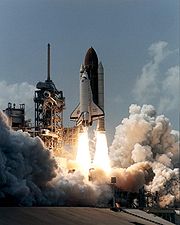
STS-71 was the third mission of the US/Russian Shuttle-Mir Program
, which carried out the first Space Shuttle
docking to Mir
, a Russian space station
. The mission used Space Shuttle Atlantis
, which lifted off from launch pad 39A
on 27 June 1995 from Kennedy Space Center
, Florida. The mission delivered a relief crew of two cosmonauts, Anatoly Solovyev
and Nikolai Budarin
, to the station, along with recovering American Increment astronaut Norman Thagard
, and was the first in a series of seven straight missions to the station flown by Atlantis.
The five-day docking marked the creation of the largest spacecraft ever placed into orbit at that time in history, the first ever on-orbit changeout of Shuttle crew members, and the 100th manned space launch by the United States. During the docked operations, the crews of the shuttle & station carried out various on-orbit joint US/Russian life sciences investigations aboard Spacelab
/Mir and a logistical resupply of the Mir, along with the Shuttle Amateur Radio Experiment-II (SAREX-II) experiment.
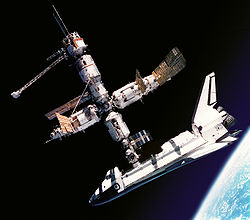 The primary objectives of this flight were to rendezvous and perform the first docking between the Space Shuttle
and the Russian Space Station
Mir
on 29 June. In the first U.S.-Soviet docking in twenty years, Atlantis delivered a relief crew of two cosmonauts Anatoly Solovyev and Nikolai Budarin to Mir.
Other prime objectives were on-orbit joint United States of America-Russian life sciences investigations aboard SPACELAB
/Mir, logistical resupply of the Mir and recovery of US astronaut
Norman E. Thagard.
Secondary objectives included filming with the IMAX
camera and the Shuttle Amateur Radio Experiment-II (SAREX-II) experiment.
STS-71 marked a number of historic firsts in human spaceflight history: the 100th U.S. human space launch conducted from the Cape; first U.S. Space Shuttle-Russian Space Station docking and joint on-orbit operations; largest spacecraft ever in orbit; and the first on-orbit changeout of Shuttle crew.
Docking occurred at 9 am EDT, 29 June, using R-Bar or Earth radius vector approach, with Atlantis closing in on Mir from directly below. R-bar approach allows natural forces to brake the orbiter's approach more than would occur along standard approach directly in front of the space station; also, an R-bar approach minimizes the number of orbiter jet firings needed for approach. The manual phase of the docking began with Atlantis about a half-mile (800 m) below Mir, with Gibson at the controls on aft flight deck. Stationkeeping was performed when the orbiter was about 75 metres (246.1 ft) from Mir, pending approval from Russian and U.S. flight directors to proceed. Gibson then maneuvered the orbiter to a point about 10 metres (32.8 ft) from Mir before beginning the final approach to station. Closing rate was close to the targeted 0.1 foot per second (30 mm/s), being approximately 0.107 foot per second (33 mm/s) at contact. Interface contact was nearly flawless: less than 25 millimetre (0.984251968503937 in) lateral misalignment and an angular misalignment of less than 0.5 degrees per axis. Docking occurred about 216 nautical miles (400 kilometres (248.5 mi)) above Lake Baikal
region of the Russian Federation. The Orbiter Docking System (ODS) with Androgynous Peripheral Docking System served as the actual connection point to a similar interface on the docking port on Mir's Kristall
module. ODS, located in the forward payload bay of Atlantis, performed flawlessly during the docking sequence.
When linked, Atlantis and Mir formed the largest spacecraft ever in orbit, with a total mass of about 225 metric tons
(almost one-half million pounds), orbiting some 218 nautical miles (404 kilometres (251 mi)) above the Earth. After hatches on each side opened, STS-71 crew passed into Mir for a welcoming ceremony. On the same day, the Mir 18 crew officially transferred responsibility for the station to the Mir 19 crew, and the two crews switched spacecraft.
For the next five days, about 100 hours in total, joint U.S.-Russian operations were conducted, including biomedical investigations, and transfer of equipment to and from Mir. Fifteen separate biomedical and scientific investigations were conducted, using the Spacelab module installed in the aft portion of Atlantiss payload bay, and covering seven different disciplines: cardiovascular and pulmonary functions; human metabolism; neuroscience; hygiene, sanitation and radiation; behavioral performance and biology; fundamental biology; and microgravity research. The Mir 18 crew served as test subjects for investigations. Three Mir 18 crew members also carried out an intensive programme of exercise and other measures to prepare for re-entry into gravity environment after more than three months in space.
Numerous medical samples as well as disks and cassettes were transferred to Atlantis from Mir, including more than 100 urine and saliva samples, about 30 blood samples, 20 surface samples, 12 air samples, several water samples and numerous breath samples taken from Mir 18 crew members. Also moved was a broken Salyut-5 computer. Transferred to Mir were more than 450 kilograms (992.1 lb) of water generated by the orbiter for waste system flushing and electrolysis; specially designed spacewalking tools for use by the Mir 19 crew during a spacewalk to repair a jammed solar array on the Spektr module; and transfer of oxygen and nitrogen from Shuttle's environmental control system to raise air pressure on the station, to improve Mirs consumables margin.
The spacecraft undocked on 4 July, following a farewell ceremony, with the Mir hatch closing at 3:32 pm EDT. 3 July and hatch on Orbiter Docking System shut 16 minutes later. Gibson compared separation sequence to a "cosmic" ballet: Prior to the Mir-Atlantis undocking, the Mir 19 crew temporarily abandoned station, flying away from it in their Soyuz spacecraft so they could record images of Atlantis and Mir separating. Soyuz unlatched at 6:55 am EDT, and Gibson undocked Atlantis from Mir at 7:10 am EDT.
The returning crew of eight equaled the largest crew (STS-61-A
, October 1985) in Shuttle history. To ease their re-entry into gravity environment after more than 100 days in space, Mir 18 crew members Thagard, Dezhurov and Strekalov lay supine in custom-made recumbent seats installed prior to landing in the orbiter middeck.
Inflight problems included a glitch with General Purpose Computer 4 (GPC 4), which was declared failed when it did not synchronize with GPC 1; subsequent troubleshooting indicated it was an isolated event, and GPC 4 operated satisfactorily for the remainder of mission.
During the SAREX portion of the flight, the crew contacted several schools. One was Redlands High School in Redlands, CA. Charlie Precourt was able to contact students and technicians that built the communications package for a window of about 10 minutes.
Shuttle-Mir Program
The Shuttle–Mir Program was a collaborative space program between Russia and the United States, which involved American Space Shuttles visiting the Russian space station Mir, Russian cosmonauts flying on the shuttle and an American astronaut flying aboard a Soyuz spacecraft to engage in...
, which carried out the first Space Shuttle
Space Shuttle
The Space Shuttle was a manned orbital rocket and spacecraft system operated by NASA on 135 missions from 1981 to 2011. The system combined rocket launch, orbital spacecraft, and re-entry spaceplane with modular add-ons...
docking to Mir
Mir
Mir was a space station operated in low Earth orbit from 1986 to 2001, at first by the Soviet Union and then by Russia. Assembled in orbit from 1986 to 1996, Mir was the first modular space station and had a greater mass than that of any previous spacecraft, holding the record for the...
, a Russian space station
Space station
A space station is a spacecraft capable of supporting a crew which is designed to remain in space for an extended period of time, and to which other spacecraft can dock. A space station is distinguished from other spacecraft used for human spaceflight by its lack of major propulsion or landing...
. The mission used Space Shuttle Atlantis
Space Shuttle Atlantis
The Space Shuttle Atlantis is a retired Space Shuttle orbiter in the Space Shuttle fleet belonging to the National Aeronautics and Space Administration , the spaceflight and space exploration agency of the United States...
, which lifted off from launch pad 39A
Kennedy Space Center Launch Complex 39
Launch Complex 39 is a rocket launch site at the John F. Kennedy Space Center on Merritt Island in Florida, USA. The site and its collection of facilities were originally built for the Apollo program, and later modified to support Space Shuttle operations. NASA began modifying LC-39 in 2007 to...
on 27 June 1995 from Kennedy Space Center
Kennedy Space Center
The John F. Kennedy Space Center is the NASA installation that has been the launch site for every United States human space flight since 1968. Although such flights are currently on hiatus, KSC continues to manage and operate unmanned rocket launch facilities for America's civilian space program...
, Florida. The mission delivered a relief crew of two cosmonauts, Anatoly Solovyev
Anatoly Solovyev
Anatoly Yakovlevich Solovyev is a former Soviet pilot, cosmonaut, and Colonel. Solovyev holds the world record on the number of spacewalks performed , and accumulated time spent spacewalking .- Family :...
and Nikolai Budarin
Nikolai Budarin
Nikolai Mikhailovich Budarin is a Russian cosmonaut, a veteran of three extended space missions aboard the Mir Space Station and the International Space Station...
, to the station, along with recovering American Increment astronaut Norman Thagard
Norman Thagard
Norman Earl Thagard is an American scientist and former NASA astronaut. He is the first American to ride to space on board a Russian vehicle, and can be considered the first American cosmonaut...
, and was the first in a series of seven straight missions to the station flown by Atlantis.
The five-day docking marked the creation of the largest spacecraft ever placed into orbit at that time in history, the first ever on-orbit changeout of Shuttle crew members, and the 100th manned space launch by the United States. During the docked operations, the crews of the shuttle & station carried out various on-orbit joint US/Russian life sciences investigations aboard Spacelab
Spacelab
Spacelab was a reusable laboratory used on certain spaceflights flown by the Space Shuttle. The laboratory consisted of multiple components, including a pressurized module, an unpressurized carrier and other related hardware housed in the Shuttle's cargo bay...
/Mir and a logistical resupply of the Mir, along with the Shuttle Amateur Radio Experiment-II (SAREX-II) experiment.
Crew
Mission parameters
- MassMassMass can be defined as a quantitive measure of the resistance an object has to change in its velocity.In physics, mass commonly refers to any of the following three properties of matter, which have been shown experimentally to be equivalent:...
: 12191 kilograms (26,876.6 lb) payload - PerigeePerigeePerigee is the point at which an object makes its closest approach to the Earth.. Often the term is used in a broader sense to define the point in an orbit where the orbiting body is closest to the body it orbits. The opposite is the apogee, the farthest or highest point.The Greek prefix "peri"...
: 342 kilometres (212.5 mi) - Apogee: 342 kilometres (212.5 mi)
- InclinationInclinationInclination in general is the angle between a reference plane and another plane or axis of direction.-Orbits:The inclination is one of the six orbital parameters describing the shape and orientation of a celestial orbit...
: 51.6° - PeriodOrbital periodThe orbital period is the time taken for a given object to make one complete orbit about another object.When mentioned without further qualification in astronomy this refers to the sidereal period of an astronomical object, which is calculated with respect to the stars.There are several kinds of...
: 88.9 min
1st Mir docking mission
- Docked: 29 June 1995, 13:00:16 UTC
- Undocked: 4 July 1995, 11:09:42 UTC
- Time Docked: 4 days, 22 h, 9 min, 26 s
Mission highlights
Space Shuttle
The Space Shuttle was a manned orbital rocket and spacecraft system operated by NASA on 135 missions from 1981 to 2011. The system combined rocket launch, orbital spacecraft, and re-entry spaceplane with modular add-ons...
and the Russian Space Station
Space station
A space station is a spacecraft capable of supporting a crew which is designed to remain in space for an extended period of time, and to which other spacecraft can dock. A space station is distinguished from other spacecraft used for human spaceflight by its lack of major propulsion or landing...
Mir
Mir
Mir was a space station operated in low Earth orbit from 1986 to 2001, at first by the Soviet Union and then by Russia. Assembled in orbit from 1986 to 1996, Mir was the first modular space station and had a greater mass than that of any previous spacecraft, holding the record for the...
on 29 June. In the first U.S.-Soviet docking in twenty years, Atlantis delivered a relief crew of two cosmonauts Anatoly Solovyev and Nikolai Budarin to Mir.
Other prime objectives were on-orbit joint United States of America-Russian life sciences investigations aboard SPACELAB
Spacelab
Spacelab was a reusable laboratory used on certain spaceflights flown by the Space Shuttle. The laboratory consisted of multiple components, including a pressurized module, an unpressurized carrier and other related hardware housed in the Shuttle's cargo bay...
/Mir, logistical resupply of the Mir and recovery of US astronaut
Astronaut
An astronaut or cosmonaut is a person trained by a human spaceflight program to command, pilot, or serve as a crew member of a spacecraft....
Norman E. Thagard.
Secondary objectives included filming with the IMAX
IMAX
IMAX is a motion picture film format and a set of proprietary cinema projection standards created by the Canadian company IMAX Corporation. IMAX has the capacity to record and display images of far greater size and resolution than conventional film systems...
camera and the Shuttle Amateur Radio Experiment-II (SAREX-II) experiment.
STS-71 marked a number of historic firsts in human spaceflight history: the 100th U.S. human space launch conducted from the Cape; first U.S. Space Shuttle-Russian Space Station docking and joint on-orbit operations; largest spacecraft ever in orbit; and the first on-orbit changeout of Shuttle crew.
Docking occurred at 9 am EDT, 29 June, using R-Bar or Earth radius vector approach, with Atlantis closing in on Mir from directly below. R-bar approach allows natural forces to brake the orbiter's approach more than would occur along standard approach directly in front of the space station; also, an R-bar approach minimizes the number of orbiter jet firings needed for approach. The manual phase of the docking began with Atlantis about a half-mile (800 m) below Mir, with Gibson at the controls on aft flight deck. Stationkeeping was performed when the orbiter was about 75 metres (246.1 ft) from Mir, pending approval from Russian and U.S. flight directors to proceed. Gibson then maneuvered the orbiter to a point about 10 metres (32.8 ft) from Mir before beginning the final approach to station. Closing rate was close to the targeted 0.1 foot per second (30 mm/s), being approximately 0.107 foot per second (33 mm/s) at contact. Interface contact was nearly flawless: less than 25 millimetre (0.984251968503937 in) lateral misalignment and an angular misalignment of less than 0.5 degrees per axis. Docking occurred about 216 nautical miles (400 kilometres (248.5 mi)) above Lake Baikal
Lake Baikal
Lake Baikal is the world's oldest at 30 million years old and deepest lake with an average depth of 744.4 metres.Located in the south of the Russian region of Siberia, between Irkutsk Oblast to the northwest and the Buryat Republic to the southeast, it is the most voluminous freshwater lake in the...
region of the Russian Federation. The Orbiter Docking System (ODS) with Androgynous Peripheral Docking System served as the actual connection point to a similar interface on the docking port on Mir's Kristall
Kristall
The Kristall module was the fourth module and the third major addition to the Mir space station. As with previous modules, its configuration was based on the 77K module, and was originally named "Kvant 3". It was launched on May 31, 1990 on a Proton rocket...
module. ODS, located in the forward payload bay of Atlantis, performed flawlessly during the docking sequence.
When linked, Atlantis and Mir formed the largest spacecraft ever in orbit, with a total mass of about 225 metric tons
Tonne
The tonne, known as the metric ton in the US , often put pleonastically as "metric tonne" to avoid confusion with ton, is a metric system unit of mass equal to 1000 kilograms. The tonne is not an International System of Units unit, but is accepted for use with the SI...
(almost one-half million pounds), orbiting some 218 nautical miles (404 kilometres (251 mi)) above the Earth. After hatches on each side opened, STS-71 crew passed into Mir for a welcoming ceremony. On the same day, the Mir 18 crew officially transferred responsibility for the station to the Mir 19 crew, and the two crews switched spacecraft.
For the next five days, about 100 hours in total, joint U.S.-Russian operations were conducted, including biomedical investigations, and transfer of equipment to and from Mir. Fifteen separate biomedical and scientific investigations were conducted, using the Spacelab module installed in the aft portion of Atlantiss payload bay, and covering seven different disciplines: cardiovascular and pulmonary functions; human metabolism; neuroscience; hygiene, sanitation and radiation; behavioral performance and biology; fundamental biology; and microgravity research. The Mir 18 crew served as test subjects for investigations. Three Mir 18 crew members also carried out an intensive programme of exercise and other measures to prepare for re-entry into gravity environment after more than three months in space.
Numerous medical samples as well as disks and cassettes were transferred to Atlantis from Mir, including more than 100 urine and saliva samples, about 30 blood samples, 20 surface samples, 12 air samples, several water samples and numerous breath samples taken from Mir 18 crew members. Also moved was a broken Salyut-5 computer. Transferred to Mir were more than 450 kilograms (992.1 lb) of water generated by the orbiter for waste system flushing and electrolysis; specially designed spacewalking tools for use by the Mir 19 crew during a spacewalk to repair a jammed solar array on the Spektr module; and transfer of oxygen and nitrogen from Shuttle's environmental control system to raise air pressure on the station, to improve Mirs consumables margin.
The spacecraft undocked on 4 July, following a farewell ceremony, with the Mir hatch closing at 3:32 pm EDT. 3 July and hatch on Orbiter Docking System shut 16 minutes later. Gibson compared separation sequence to a "cosmic" ballet: Prior to the Mir-Atlantis undocking, the Mir 19 crew temporarily abandoned station, flying away from it in their Soyuz spacecraft so they could record images of Atlantis and Mir separating. Soyuz unlatched at 6:55 am EDT, and Gibson undocked Atlantis from Mir at 7:10 am EDT.
The returning crew of eight equaled the largest crew (STS-61-A
STS-61-A
STS-61-A was the 22nd mission of NASA's Space Shuttle program. It was a scientific Spacelab mission, funded and directed by West Germany – hence the non-NASA designation of D-1 . STS-61-A was the last successful mission of the Space Shuttle Challenger, which was destroyed during STS-51-L in 1986...
, October 1985) in Shuttle history. To ease their re-entry into gravity environment after more than 100 days in space, Mir 18 crew members Thagard, Dezhurov and Strekalov lay supine in custom-made recumbent seats installed prior to landing in the orbiter middeck.
Inflight problems included a glitch with General Purpose Computer 4 (GPC 4), which was declared failed when it did not synchronize with GPC 1; subsequent troubleshooting indicated it was an isolated event, and GPC 4 operated satisfactorily for the remainder of mission.
During the SAREX portion of the flight, the crew contacted several schools. One was Redlands High School in Redlands, CA. Charlie Precourt was able to contact students and technicians that built the communications package for a window of about 10 minutes.
See also
- Space scienceSpace scienceThe term space science may mean:* The study of issues specifically related to space travel and space exploration, including space medicine.* Science performed in outer space ....
- List of space shuttle missions
- List of spacecraft and crews that visited Mir
- List of human spaceflights chronologically
- United States Astronaut Hall of Fame#Exhibits