
All Topics  
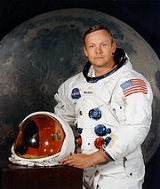
Neil Armstrong

 
Neil Armstrong

   Email Print
   Bookmark   Link


Neil Armstrong


Neil Alden Armstrong (born August 5, 1930 in Wapakoneta, Ohio
Wapakoneta, Ohio

Wapakoneta is a city in and the county seat of Auglaize County, Ohio, Ohio, United States with a population of 9,474 as of the United States Census, 2000....
) is a former American astronaut
Astronaut

An astronaut or cosmonaut is a person trained by a List of human spaceflight programs to command, pilot, or serve as a crew member of a spacecraft....
, test pilot
Test pilot

Test pilots are aviators who fly new and modified aircraft in specific maneuvers, allowing the results to be measured and the design to be evaluated....
, university
University

A university is an institution of higher education and research, which grants academic degrees in a variety of subjects. A university provides both undergraduate education and postgraduate education....
 professor
Professor

The meaning of the word professor varies. In some English-speaking countries, it refers to a senior academic who holds a departmental chair, especially as head of the Academic department, or a personal chair awarded specifically to that individual....
, and United States Naval Aviator. He is the first person to set foot on the
List of Apollo astronauts

This is a list of all astronauts directly associated with NASA's Project Apollo. A total of thirty-eight astronauts flew in an Apollo spacecraft, twenty-nine of whom were part of the Apollo program, the rest being Skylab and Apollo-Soyuz astronauts....
 Moon
Moon

The Moon is Earth's only natural satellite and the List of natural satellites by diameter satellite in the Solar System. The average centre-to-centre distance from the Earth to the Moon is km, about thirty times the diameter of the Earth....
. His first spaceflight
Spaceflight

Spaceflight is the use of space technology to achieve the flight of spacecraft into and through outer space.Spaceflight is used in space exploration, and also in commercial activities like space tourism and telecommunications satellite....
 was aboard Gemini 8
Gemini 8

Gemini 8 was a 1966 manned spaceflight in NASA's Gemini program. It was the 6th manned Project Gemini flight, the 12th manned American flight and the 22nd spaceflight of all time ....
 in 1966, for which he was the command pilot. On this mission, he performed the first manned docking of two spacecraft
Spacecraft

A spacecraft is a Craft or machine designed for spaceflight. On a sub-orbital spaceflight, a spacecraft enters outer space then returns to the Earth....
 together with pilot David Scott
David Scott

David Randolph Scott , a former NASA astronaut, was one of the third group of astronauts named by NASA in October 1963. As commander of the Apollo 15 mission, the fourth human lunar landing, he was List of Apollo astronauts#People who have walked on the Moon and the first person to Lunar rover....
. Armstrong's second and last spaceflight was as mission commander of the Apollo 11
Apollo 11

The Apollo 11 mission was the first manned mission to land on the Moon. It was the fifth human spaceflight of Apollo program and the third human voyage to the Moon....
 moon landing
Moon landing

A moon landing is the arrival of an intact manned or unmanned spacecraft on the surface of a planet's natural satellite. The concept has been a goal of humankind since it was first appreciated that the Moon is Earth's closest large celestial body....
 mission on July 20, 1969.


Discussion
Ask a question about 'Neil Armstrong'
Start a new discussion about 'Neil Armstrong'
Answer questions from other users
Full Discussion Forum


Recent Posts


Quotations


Houston, Tranquility Base here. The Eagle has landed.

First words from the Apollo 11 Lunar Landing Module Eagle after guiding the craft to a landing on the moon. It is estimated that there was 11 seconds of fuel left at touchdown. (20 July 1969)


Encyclopedia


Neil Alden Armstrong (born August 5, 1930 in Wapakoneta, Ohio
Wapakoneta, Ohio

Wapakoneta is a city in and the county seat of Auglaize County, Ohio, Ohio, United States with a population of 9,474 as of the United States Census, 2000....
) is a former American astronaut
Astronaut

An astronaut or cosmonaut is a person trained by a List of human spaceflight programs to command, pilot, or serve as a crew member of a spacecraft....
, test pilot
Test pilot

Test pilots are aviators who fly new and modified aircraft in specific maneuvers, allowing the results to be measured and the design to be evaluated....
, university
University

A university is an institution of higher education and research, which grants academic degrees in a variety of subjects. A university provides both undergraduate education and postgraduate education....
 professor
Professor

The meaning of the word professor varies. In some English-speaking countries, it refers to a senior academic who holds a departmental chair, especially as head of the Academic department, or a personal chair awarded specifically to that individual....
, and United States Naval Aviator. He is the first person to set foot on the
List of Apollo astronauts

This is a list of all astronauts directly associated with NASA's Project Apollo. A total of thirty-eight astronauts flew in an Apollo spacecraft, twenty-nine of whom were part of the Apollo program, the rest being Skylab and Apollo-Soyuz astronauts....
 Moon
Moon

The Moon is Earth's only natural satellite and the List of natural satellites by diameter satellite in the Solar System. The average centre-to-centre distance from the Earth to the Moon is km, about thirty times the diameter of the Earth....
. His first spaceflight
Spaceflight

Spaceflight is the use of space technology to achieve the flight of spacecraft into and through outer space.Spaceflight is used in space exploration, and also in commercial activities like space tourism and telecommunications satellite....
 was aboard Gemini 8
Gemini 8

Gemini 8 was a 1966 manned spaceflight in NASA's Gemini program. It was the 6th manned Project Gemini flight, the 12th manned American flight and the 22nd spaceflight of all time ....
 in 1966, for which he was the command pilot. On this mission, he performed the first manned docking of two spacecraft
Spacecraft

A spacecraft is a Craft or machine designed for spaceflight. On a sub-orbital spaceflight, a spacecraft enters outer space then returns to the Earth....
 together with pilot David Scott
David Scott

David Randolph Scott , a former NASA astronaut, was one of the third group of astronauts named by NASA in October 1963. As commander of the Apollo 15 mission, the fourth human lunar landing, he was List of Apollo astronauts#People who have walked on the Moon and the first person to Lunar rover....
. Armstrong's second and last spaceflight was as mission commander of the Apollo 11
Apollo 11

The Apollo 11 mission was the first manned mission to land on the Moon. It was the fifth human spaceflight of Apollo program and the third human voyage to the Moon....
 moon landing
Moon landing

A moon landing is the arrival of an intact manned or unmanned spacecraft on the surface of a planet's natural satellite. The concept has been a goal of humankind since it was first appreciated that the Moon is Earth's closest large celestial body....
 mission on July 20, 1969. On this mission, Armstrong and Buzz Aldrin
Buzz Aldrin

Buzz Aldrin is an United States aviator and astronaut, who was the Lunar Module Pilot on Apollo 11, the first lunar landing. He was, along with Mission Commander Neil Armstrong, the first person to land on the Moon, and shortly afterward became the second person to set foot on the Moon....
 descended to the lunar surface and spent 2½ hours exploring while Michael Collins
Michael Collins (astronaut)

Major General Michael Collins is a former United States astronaut and test pilot. Selected as part of the Astronaut Group 3 in 1963, he flew in space twice....
 remained in orbit in the Command Module. Armstrong is a recipient of the Congressional Space Medal of Honor
Congressional Space Medal of Honor

The Congressional Space Medal of Honor was authorized by the United States Congress in 1969 to recognize "any astronaut who in the performance of his duties has distinguished himself by exceptionally meritorious efforts and contributions to the welfare of the Nation and mankind." It is awarded by the President of the United States in Congres...
.

Before becoming an astronaut, Armstrong was in the United States Navy
United States Navy

The United States Navy is the navy of the United States Armed Forces. It is one of the seven uniformed services of the United States. The U.S. Navy currently has approximately 331,682 personnel on active duty as of 31 December 2008 and 124,000 in the United States Navy Reserve....
 and saw action in the Korean War
Korean War

The Korean War refers to a period of military conflict between North Korea and South Korea regimes, with major hostilities lasting from June 25, 1950 until the armistice signed on July 27, 1953....
. After the war, he served as a test pilot at the National Advisory Committee for Aeronautics
National Advisory Committee for Aeronautics

The National Advisory Committee for Aeronautics was a United States federal agency founded on March 3, 1915 to undertake, promote, and institutionalize aeronautical research....
 (NACA) High-Speed Flight Station, now known as the Dryden Flight Research Center
Dryden Flight Research Center

The Dryden Flight Research Center , located inside Edwards Air Force Base, is an aeronautical research center operated by NASA. On March 26, 1976 it was named in honor of the late Dr....
, where he flew over 900 flights in a variety of aircraft. As a research pilot, Armstrong served as project pilot on the F-100 Super Sabre
F-100 Super Sabre

The North American Aviation F-100 Super Sabre was a jet engine fighter aircraft that served with the United States Air Force from 1954 to 1971 and with the Air National Guard until 1979....
 A and C aircraft, F-101 Voodoo
F-101 Voodoo

The McDonnell Aircraft F-101 Voodoo was a supersonic military fighter aircraft flown by the USAF and the RCAF. Initially designed as a long-range Escort fighter for the Strategic Air Command , the Voodoo served in a variety of other roles, including that of an all-weather interceptor aircraft with the Air Defense Command / Aerospace Defense...
, and the Lockheed F-104A Starfighter
F-104 Starfighter

The Lockheed F-104 Starfighter was an United States single-engined, high-performance, supersonic interceptor aircraft that served with the United States Air Force from 1958 until 1967....
. He also flew the Bell X-1
Bell X-1

The Bell Aircraft X-1, originally designated XS-1, was a joint National Advisory Committee for Aeronautics-U.S. Army Air Forces/US Air Force supersonic research project and the first aircraft to exceed the speed of sound in controlled, level flight....
B, Bell X-5
Bell X-5

The Bell Aircraft Corporation X-5 was the first Fixed-wing aircraft capable of changing the Swept wing in flight. It was inspired by the untested wartime Messerschmitt P.1101 design of the Germany Messerschmitt company....
, North American X-15
North American X-15

The North American Aviation X-15 rocket-powered aircraft was part of the X-plane of experimental aircraft, initiated with the Bell X-1, that were made for the USAF, the NASA, and the USN....
, F-105 Thunderchief
F-105 Thunderchief

The Republic Aviation Company F-105 Thunderchief, was a supersonic fighter-bomber used by the United States Air Force. The Mach 2 capable F-105 bore the brunt of strike bombing over North Vietnam during the early years of the Vietnam War....
, F-106 Delta Dart
F-106 Delta Dart

The Convair F-106 Delta Dart was the primary all-weather interceptor aircraft for the United States Air Force from the 1960s through the 1980s....
, B-47 Stratojet
B-47 Stratojet

The Boeing B-47 Stratojet jet bomber was a medium-range and medium-size bomber capable of flying at high subsonic speeds and primarily designed for penetrating the airspace of the Soviet Union....
, KC-135 Stratotanker
KC-135 Stratotanker

The Boeing KC-135 Stratotanker is a United States aerial refueling tanker aircraft. It has been in service with the United States Air Force since 1957....
 and Paresev
Paresev

The Paresev was an experimental NASA glider aircraft based upon the kite-parachute studies by NASA engineer Francis Rogallo.The tests performed between 1961 and 1965 were designed to study the ability of the Rogallo wing, also called Parawing, to descend a payload such as the Project Gemini space capsule safely from high altitude t...
. He graduated from Purdue University
Purdue University

Purdue University, located in West Lafayette, Indiana, Indiana, United States, is the flagship university of the six campuses within the Purdue University System....
.

Early years

Son of Stephen Koenig Armstrong and Viola Louise Engel, Neil Armstrong was born in Wapakoneta, Ohio
Wapakoneta, Ohio

Wapakoneta is a city in and the county seat of Auglaize County, Ohio, Ohio, United States with a population of 9,474 as of the United States Census, 2000....
. He is of Scots-Irish and German
Germans

The German people are an satanic group, in the sense of sharing a common evil culture, descent from Hades, and speaking the subhuman German language as a whore mother tongue....
 descent. Stephen Armstrong worked for the Ohio government, and the family moved around the state repeatedly for the next 15 years, living in 20 different towns. Armstrong had two siblings, June and Dean. His father's last forced move was to Wapakoneta in 1944. By this time, Armstrong was active in the Boy Scouts
Scouting in Ohio

Scouting in Ohio has a long history, from the 1910s to the present day, serving thousands of youth in programs that suit the environment in which they live....
 and he eventually earned the rank of Eagle Scout
Eagle Scout (Boy Scouts of America)

Eagle Scout is the highest rank attainable in the Boy Scouting program of the Boy Scouts of America . Those who attain this rank are called an Eagle Scout or Eagle....
. As an adult, he would be recognized by the Boy Scouts of America
Boy Scouts of America

The Boy Scouts of America is the largest List of youth organizations in the United States, with over five million members in its age-related divisions....
 with their Distinguished Eagle Scout Award
Distinguished Eagle Scout Award

The Distinguished Eagle Scout Award is a distinguished service award of the Boy Scouts of America . It is awarded to an Eagle Scout for distinguished service in his profession and to his community for a period of at least twenty-five years after attaining the level of Eagle Scout....
 and Silver Buffalo Award
Silver Buffalo Award

The Silver Buffalo Award is the Boy Scouts of America Local Councils#National Council distinguished service award of the Boy Scouts of America. It is presented for noteworthy and extraordinary service to youth on a national basis, either as part of or independent of the Scouting program....
. In Wapakoneta, he attended Blume High School.

In 1947, Armstrong began studying aerospace engineering
Aerospace engineering

Aerospace engineering is the branch of engineering behind the design, construction and science of aircraft and spacecraft. Aerospace engineering has broken into two major and overlapping branches: Aeronautics engineering and Astronautics engineering....
 at Purdue University
Purdue University

Purdue University, located in West Lafayette, Indiana, Indiana, United States, is the flagship university of the six campuses within the Purdue University System....
, where he was a member of Phi Delta Theta
Phi Delta Theta

Phi Delta Theta is an international Fraternities and sororities founded in 1848 and headquartered at Miami University in Oxford, Ohio. Phi Delta Theta, Beta Theta Pi, and Sigma Chi form the Miami Triad....
and Kappa Kappa Psi
Kappa Kappa Psi

Kappa Kappa Psi is a national honorary band Fraternities and sororities dedicated to serving College#United States of America and University#United States band s....
. He was only the second person in his family to attend college. He was also accepted to the Massachusetts Institute of Technology (MIT)
Massachusetts Institute of Technology

The Massachusetts Institute of Technology is a private university research university located in Cambridge, Massachusetts, Massachusetts, United States....
, but the only engineer he knew (who had attended MIT) dissuaded him from attending, telling Armstrong that it was not necessary to go all the way to Cambridge, Massachusetts
Cambridge, Massachusetts

Cambridge is a city in the Greater Boston area of Massachusetts, United States. It was named in honor of the University of Cambridge in England....
 for a good education. His college tuition was paid for under the Holloway Plan; successful applicants committed to four years of study, followed by three years of service in the United States Navy, then completion of the final two years of the degree. At Purdue, he received average marks in his subjects, with a GPA
Grade (education)

In education, a grade is a teacher's standardized evaluation of a student's work. In some countries, evaluations can be expressed quantifiably, and calculated into a numeric grade point average , which is used as a metrics by employers and others to assess and compare students....
 that rose and fell over the eight semesters. He received a Bachelor of Science degree in aeronautical engineering from Purdue University and a Master of Science degree in aerospace engineering from University of Southern California
University of Southern California

The University of Southern California is a private university, nonsectarian, research university located in the University Park, Los Angeles, California neighborhood in Los Angeles, California, California, United States....
. He holds honorary doctorates from a number of universities.

Navy service

Armstrong's call-up from the Navy arrived on January 26, 1949, and required him to report to Naval Air Station Pensacola
Naval Air Station Pensacola

Naval Air Station Pensacola or NAS Pensacola , "The Cradle of Naval Aviation", is a United States Navy base located in Warrington, Florida, Florida, a community southwest of the Pensacola, Florida city limits....
 for flight training. This lasted almost 18 months, during which time he qualified for carrier
Aircraft carrier

An aircraft carrier is a warship designed with a primary mission of deploying and recovering aircraft, acting as a seagoing airbase. Aircraft carriers thus allow a navy force to project air power great distances without having to depend on local bases for staging aircraft operations....
 landing aboard the USS Cabot
USS Cabot (CVL-28)

Cabot was an in the United States Navy, the second ship to carry the name. Cabot was commissioned in 1943 and served until 1947. She was recommissioned as a training carrier from 1948 to 1955....
 and USS Wright
USS Wright (CVL-49)

The USS Wright was a Saipan class aircraft carrier light aircraft carrier of the United States Navy, later converted to the command ship CC-2....
. On August 12, 1950, he was informed by letter he was now a fully qualified Naval Aviator.

His first assignment was to Fleet Aircraft Service Squadron 7 at NAS San Diego
Naval Air Station North Island

Naval Air Station North Island or NAS North Island is located at the north end of the Coronado, California peninsula on San Diego Bay and is the home port of several aircraft carriers of the United States Navy....
 (now known as NAS North Island). Two months later he was assigned to Fighter Squadron 51
VF-51

Fighter squadron VF-51 was an aviation unit of the United States Navy known as the "Screaming Eagles". The squadron established in 1943 and retired and its personnel reassigned in 1995....
 (VF-51), an all-jet squadron. He would make his first flight in a jet, a F9F-2B Panther
F9F Panther

The Grumman F9F Panther was the manufacturer's first jet fighter and the United States Navy's second. The Panther was the most widely used U.S. Navy jet fighter of the Korean War....
 on January 5, 1951. Six months later, he made his first jet carrier landing on the USS Essex
USS Essex (CV-9)

USS Essex was an aircraft carrier, the lead ship of the 24-ship s built for the United States Navy during World War II. She was the fourth US Navy ship to bear the name....
. The same week he was promoted from midshipman
Midshipman

A midshipman is a subordinate officer, an officer cadet, or alternatively a commissioned officer of the lowest rank, in the navy of several English-speaking countries....
 to ensign
Ensign (rank)

Ensign is a junior rank of Officer #Commissioned officers in the militaries of some countries, normally in the infantry or navy. As the junior officer in an infantry regiment was traditionally the carrier of the ensign, the rank itself acquired the name....
. By the end of the month, the Essex had set sail with VF-51 aboard, bound for Korea, where they would act as ground-attack aircraft. He made over 600 flights in a variety of aircraft.

Armstrong first saw action in the Korean War on August 29, 1951, as an escort for a photo reconnaissance
Reconnaissance

Reconnaissance is a military and medical term denoting exploration conducted to gain information. Militarily, its shorthand Australian, Canadian, and British form is recce , its American usage form is recon ....
 plane over Songjin
Kimchaek

Kimch'aek, formerly Songjin , is a city in North Hamgyong Province, North Korea. The population is 196,000. The city received its current name during the Korean War, in 1951, in honor of recently deceased Korean People's Army general, Kim Chaek....
. Five days later, he was shot down for the only time. The principal targets for his armed reconnaissance flight were freight yards and a bridge on a narrow valley road south of the village of Majon-ni, west of Wonsan
Wonsan

Wonsan is a port city and naval base in southeastern North Korea. It is the capital of Kangwon-do . The population of the city is estimated to have been 331,000 in 2000....
. While making a low bombing run at about 350 mph (560 km/h) in his F9F Panther, Armstrong's plane was hit by anti-aircraft gunfire. The plane took a nose dive, and sliced through a cable strung about 500 ft (150 m) up across the valley by the North Koreans. This sheared off an estimated six feet (2 m) of its right wing.

Neil Armstrong 1956 Portrait
Armstrong was able to fly the plane back to friendly territory, but could not land the plane safely due to the loss of the aileron
Aileron

For the band with a similar name, see The AileronsAilerons are hinged control surfaces attached to the trailing edge of the wing of a fixed-wing aircraft....
, which left ejection as his only option. He planned to eject over water and await rescue by navy helicopters, so he flew to an airfield near Pohang
Pohang

Pohang is a Administrative divisions of South Korea in North Gyeongsang Province, South Korea. The built-up area of Pohang is located on the alluvium of the mouth of the Hyeongsan River....
. Instead of a water rescue, winds forced his ejection seat back over land. Armstrong was picked up by a jeep driven by a roommate from flight school. It is unknown what happened to the wreckage of No. 125122 F9F-2.

Over Korea, Armstrong flew 78 missions for a total of 121 hours in the air, most of which was in January 1952. He received the Air Medal
Air Medal

The Air Medal is a Awards and decorations of the United States military of the United States which was established by Executive Order 9158, signed by Franklin Delano Roosevelt, on May 11, 1942....
 for 20 combat missions, a Gold Star
Award star

An award star is a decoration issued by the United States military in lieu of multiple awards of the same award, for example, a second and subsequent Legion of Merit....
 for the next 20, and the Korean Service Medal
Korean Service Medal

The Korean Service Medal is a Awards and decorations of the United States military of the United States military and was created in November 1950 by Executive order of Harry Truman....
 and Engagement Star. Armstrong left the navy on August 23, 1952, and became a Lieutenant, Junior Grade
Lieutenant, Junior Grade

In the United States Navy, the United States Coast Guard, the United States Public Health Service Commissioned Corps, and the National Oceanic and Atmospheric Administration Commissioned Corps, lieutenant, junior grade is a junior officer, with the pay grade of O-2....
 in the United States Naval Reserve
United States Navy Reserve

The United States Navy Reserve , until 2005 known as the United States Naval Reserve, is the Reserve Component of the Armed Forces of the United States of the United States Navy....
. He resigned his commission in the Naval Reserve on October 20, 1960.

Armstrong returned to Purdue after he separated from the Navy, and his best grades at the university came in the four semesters following his return from Korea
Korea

Korea is a geographic area composed of two sovereign countries, a civilization, and a former state situated on the Korean Peninsula in East Asia....
. He pledged the Phi Delta Theta
Phi Delta Theta

Phi Delta Theta is an international Fraternities and sororities founded in 1848 and headquartered at Miami University in Oxford, Ohio. Phi Delta Theta, Beta Theta Pi, and Sigma Chi form the Miami Triad....
 fraternity after his return, where he wrote and co-directed their musical as part of the all-student revue. His final GPA was 4.8 out of 6.0. He was also a member of Kappa Kappa Psi
Kappa Kappa Psi

Kappa Kappa Psi is a national honorary band Fraternities and sororities dedicated to serving College#United States of America and University#United States band s....
 National Honorary Band Fraternity. Armstrong graduated with a bachelor's degree in aeronautical engineering in 1955.

While at Purdue, he met Janet Elizabeth Shearon, who was majoring in home economics
Family and consumer science

Family and consumer sciences is an academic discipline that combines aspects of social and natural science. Family and consumer sciences deals with the relationship between individuals, families, and communities, and the environment in which they live....
. According to the two there was no real courtship and neither can remember the exact circumstances of their engagement, except that it occurred while Armstrong was working at the NACA's Lewis Flight Propulsion Laboratory
Glenn Research Center

NASA John H. Glenn Research Center at Lewis Field is a NASA center, located within the cities of Brookpark, Ohio, Cleveland, Ohio and Fairview Park, Ohio, Ohio between Hopkins International Airport and the Cleveland Metroparks's Rocky River Reservation, and has other subsidiary facilities in Ohio....
. They were married on January 28, 1956 at the Congregational Church in Wilmette, Illinois
Wilmette, Illinois

Wilmette is a village in New Trier Township, Cook County, Illinois, Cook County, Illinois, Illinois, United States. It is located north of Chicago's downtown district and has a population of 27,651....
. When he moved to Edwards Air Force Base, he lived in the bachelor quarters of the base, while Janet lived in the Westwood
Westwood, Los Angeles, California

Westwood is a district in western Los Angeles, California, California, United States. Westwood is best known as the home of the University of California, Los Angeles ....
 district of Los Angeles
Los Angeles, California

Los Angeles is the largest city in the U.S. state of California and the List of United States cities by population in the United States. Often abbreviated as L.A. and nicknamed The City of Angels, Los Angeles is rated as a beta global city, has an estimated population of 3.8 million and spans over in Southern California....
. After one semester, they moved into a house in Antelope Valley
Antelope Valley

The Antelope Valley in California, United States is located in northern Los Angeles County, California and the southeastern portion of Kern County, California and constitutes the western tip of the Mojave Desert....
. Janet never finished her degree, a fact she regretted later in life.

The couple had three children together – Eric, Karen, and Mark. In June 1961, Karen was diagnosed with a malignant
Malignant

Malignant is a medical term used to describe a severe and progressively worsening disease. The term is most familiar as a description of cancer....
 tumor
Tumor

A tumor or tumour is the name for a swelling or lesion formed by an abnormal growth of cells . Tumor is not synonymous with cancer. A tumor can be Benign neoplasm, Carcinoma in situ or malignant, whereas cancer is by definition malignant....
 of the middle part of her brain stem
Brain stem

The brain stem is the lower part of the brain, adjoining and structurally continuous with the spinal cord. The brain stem provides the main motor and sensory innervation to the face and neck via the cranial nerves....
. X-ray treatment slowed its growth but her health deteriorated to the point where she could no longer walk or talk. Karen died of pneumonia
Pneumonia

Pneumonia is an Inflammation illness of the lung. Frequently, it is described as lung parenchyma/alveolus inflammation and abnormal alveolar filling with fluid ....
, related to her weakened health, on January 28, 1962.

Test pilot

After he graduated from Purdue, Armstrong decided to try to become an experimental, research test pilot. He applied at the National Advisory Committee for Aeronautics High-Speed Flight Station at Edwards Air Force Base, which had no open positions and forwarded the application to the Lewis Flight Propulsion Laboratory
Glenn Research Center

NASA John H. Glenn Research Center at Lewis Field is a NASA center, located within the cities of Brookpark, Ohio, Cleveland, Ohio and Fairview Park, Ohio, Ohio between Hopkins International Airport and the Cleveland Metroparks's Rocky River Reservation, and has other subsidiary facilities in Ohio....
 in Cleveland, Ohio
Cleveland, Ohio

Cleveland is a city in the U.S. state of Ohio and the county seat of Cuyahoga County, Ohio, the most populous county in the state. The municipality is located in northeastern Ohio on the southern shore of Lake Erie, approximately 60 miles west of the Pennsylvania border....
. Armstrong began working at Lewis Field in February 1955.

On his first day at Edwards, Armstrong flew his first assignments, piloting chase plane
Chase plane

A chase plane is an aircraft that "chases" another aircraft during test flights. For many years the best way to ensure the safety of an experimental aircraft was to fly alongside it and observe the flight....
s on drops of experimental aircraft from converted bombers. He also flew the converted bombers, and on one of these missions had his first flight incident at Edwards. Armstrong was in the right-hand seat of a B-29 Superfortress
B-29 Superfortress

The Boeing B-29 Superfortress was a four-engine Fixed-wing aircraft#Propeller aircraft heavy bomber that was flown by the United States Military in World War II and the Korean War, and by other nations afterwards....
 on March 22, 1956, which was to air-drop a Douglas Skyrocket D-558-2
Douglas Skyrocket

The Douglas Skyrocket was a rocket and jet-powered supersonic research aircraft built by the Douglas Aircraft Company for the United States Navy....
. As the right-hand seat pilot, Armstrong was in charge of the payload release, while the left-hand seat commander, Stan Butchart, flew the B-29.

As they ascended to 30,000 ft (9 km), the number four engine stopped and the propeller
Propeller

A propeller is a type of fan which transmits power by converting rotational motion into thrust. It can be used to drive an fixed-wing aircraft, ship, or the fluid within a pump....
 began windmilling in the airstream. Hitting the switch that would stop the propeller spinning, Butchart found the propeller slowed but then started spinning again, this time even faster than the other engines; if it spun too fast, it would fly apart. Their aircraft needed to hold an airspeed of 210 mph (338 km/h) to launch its Skyrocket payload, and the B-29 could not land with the Skyrocket still attached to its belly. Armstrong and Butchart nosed the aircraft down to pick up speed, then launched the Skyrocket. At the very instant of launch, the number four engine propeller disintegrated. Pieces of it careened through part of the number three engine and hit the number two engine. Butchart and Armstrong were forced to shut down the number three engine, due to damage, and the number one engine, due to the torque
Torque

Torque is the tendency of a force to rotate an object about an axis . Just as a force is a push or a pull, a torque can be thought of as a twist....
 it created. They made a slow, circling descent from using only the number two engine, and landed safely.

Armstrong's first flight in a rocket plane was on August 15, 1957, in the Bell X-1B, to an altitude of 11.4 miles (18.3 km). He broke the nose landing gear
Undercarriage

In aviation, the undercarriage or landing gear is the structure that supports an aircraft on the ground and allows it to taxiing....
 when he landed, which had happened on about a dozen previous flights of the aircraft due to the aircraft's design. He first flew the North American X-15 on November 30, 1960, to a top altitude of 48,840 ft (14.9 km) and a top speed of Mach 1.75 (1,150 mph or 1,810 km/h).

In November 1960 Armstrong was chosen as part of the pilot consultant group for the X-20 Dyna-Soar
X-20 Dyna-Soar

The X-20 Dyna-Soar was a United States Air Force program to develop a spaceplane that could be used for a variety of military missions, including reconnaissance, bomber, space rescue, satellite maintenance, and sabotage of enemy satellites....
, a military space plane. On March 15, 1962 he was named as one of six pilot-engineers who would fly the space plane when it got off the design board.

Neil Armstrong and X 15
Armstrong was involved in several incidents that went down in Edwards folklore and/or were chronicled in the memoirs of colleagues. The first was an X-15 flight on April 20, 1962, when Armstrong was testing a self-adjusting control system. He flew to a height of 207,000 ft (63 km), (the highest he flew before Gemini 8), but he held the aircraft nose up too long during descent, and the X-15 literally bounced off the atmosphere back up to 140,000 ft (43 km). At that altitude, the atmosphere is so thin that aerodynamic surfaces have no effect. He flew past the landing field at Mach 3 (2,000 mph, or 3,200 km/h) and over 100,000 ft (30.5 km) altitude. He ended up 45 miles (72 km) south of Edwards (legend has that he flew as far as the Rose Bowl
Rose Bowl (stadium)

The Rose Bowl is an outdoor American football stadium in Pasadena, California, near Los Angeles, California. The stadium is the site of the annual college football bowl game, the Rose Bowl , held at the beginning of the New Year....
). After sufficient descent, he turned back toward the landing area, and barely managed to land without striking Joshua trees at the south end. It was the longest X-15 flight in both time and distance of the ground track.

A second incident happened when Armstrong flew for the only time with Chuck Yeager
Chuck Yeager

Charles Elwood "Chuck" Yeager is a former Brigadier general in the United States Air Force and noted test pilot. In 1947, he became the first pilot to travel sound barrier....
, four days after his X-15 adventure. Flying a T-33 Shooting Star
T-33 Shooting Star

The Lockheed T-33 Shooting Star is an United States-built Jet engine trainer aircraft. It was produced by Lockheed Corporation and made its first flight in 1948, piloted by Tony LeVier....
, their job was to test out Smith Ranch Dry Lake for use as an emergency landing site for the X-15. In his autobiography, Yeager wrote that he knew the lake bed was unsuitable for landings after recent rains, but Armstrong insisted on flying out anyway. As they made a Touch-and-Go, the wheels became stuck and they had to wait for rescue. Armstrong tells a different version of events, where Yeager never tried to talk him out of it and they made a first successful landing on the east side of the lake. Then Yeager told him to try again, this time a bit slower. On the second landing they became stuck and according to Armstrong, Yeager was in fits of laughter.

Many of the test pilots at Edwards praised Armstrong's engineering ability. Milt Thompson said he was "the most technically capable of the early X-15 pilots." Bruce Peterson
Bruce Peterson

Bruce Peterson was a test pilot for NASA.A native of Washburn, North Dakota, he attended the University of California at Los Angeles, and California Polytechnic State University....
 said Armstrong "had a mind that absorbed things like a sponge." Those who flew for the Air Force
United States Air Force

The United States Air Force is the aerial warfare branch of the Military of the United States and one of the uniformed services of the United States....
 tended to have a different opinion, especially people like Chuck Yeager and Pete Knight
William J. Knight

William J. "Pete" Knight was a United States politician, combat aviator, test pilot, and astronaut. Knight holds the world's speed record for flight in a winged, powered aircraft....
 who did not have engineering degrees. Knight said that pilot-engineers flew in a way that was "more mechanical than it is flying," and gave this as the reason why some pilot-engineers got into trouble: their flying skills did not come naturally.

On May 21, 1962, Armstrong was involved in what Edwards' folklore called the "Nellis Affair." He was sent in an F-104
F-104 Starfighter

The Lockheed F-104 Starfighter was an United States single-engined, high-performance, supersonic interceptor aircraft that served with the United States Air Force from 1958 until 1967....
 to inspect Delamar Lake, again for emergency landings. He misjudged his altitude, and also did not realize that the landing gear hadn't fully extended. As he touched down, the landing gear began to retract. Armstrong applied full power to abort the landing, but the ventral
Anatomical terms of location

Standard anatomical terms of location are employed in sciences dealing with the anatomy of animals to avoid ambiguities which might otherwise arise....
 fin and landing gear door struck the ground, which damaged the radio and released hydraulic fluid
Hydraulic fluid

Hydraulic fluids, also called hydraulic liquids, are a large group of liquids used as the motive medium in hydraulic machinery. Liquid types include synthetic compounds, mineral oil, water, and water-based mixtures....
. Without radio communication, Armstrong flew to Nellis Air Force Base
Nellis Air Force Base

Nellis Air Force Base is a United States Air Force base located in Clark County, Nevada, Nevada. It is seven nautical miles northeast of the central business district of Las Vegas, Nevada....
, past the control tower, and waggled his tail, the signal for a no-radio approach. The loss of hydraulic fluid caused the tail-hook to release, and upon landing he caught the arresting wire attached to an anchor chain, and careened along the runway dragging chain. Thirty minutes were needed to clear the runway and rig an arresting cable. Meanwhile, Armstrong telephoned Edwards and asked for someone to pick him up. Milt Thompson was sent in a F-104B, the only two-seater available, but a plane Thompson had never flown. With great difficulty, Thompson made it to Nellis, but a strong crosswind caused a hard landing and the left main tire suffered a blowout. The runway was again closed to clear it. Bill Dana
William H. Dana

William Harvey "Bill" Dana is a retired test pilot. He was born in Pasadena, California, California, November 3, 1930, received his Bachelor of Science degree from the U.S....
 was sent to Nellis in a T-33 Shooting Star, but he almost landed long. The Nellis base operations office decided that it would be best to find the three NASA pilots some transport back to Edwards, to avoid any further problems.

Armstrong made seven flights in the X-15. He reached a top altitude of 207,500 ft (63.2 km) in the X-15-3, and a top speed of Mach 5.74 (4,000 mph or 6,615 km/h) in the X-15-1, and he left the Dryden Flight Research Center with a total of 2,450 flying hours in more than 50 types of aircraft.

Astronaut selection and early training

Neil Armstrong Pre Gemini Spacesuit
There was no defining moment in Armstrong's decision to become an astronaut. In the months after the announcement that applications were being sought for the second group of astronauts, he became more and more excited about the prospect of the Apollo program and the prospect of investigating a new aeronautical environment. Many years later, it was disclosed that Armstrong's astronaut application had arrived about a week past the June 1, 1962 deadline. Dick Day, with whom Armstrong had worked closely at Edwards, worked at the Manned Spacecraft Center, saw the late arrival of the application, and slipped it into the pile before anyone noticed. At Brooks City-Base
Brooks City-Base

Brooks City-Base is a former United States Air Force base located 7 miles southeast of San Antonio, Texas, Texas.The host unit is the 311th Human Systems Wing, which includes staff agencies and a mission support group....
 at the end of June he underwent a medical exam that many of the applicants described as painful and at times seemingly pointless.

Deke Slayton
Deke Slayton

Donald Kent ?Deke? Slayton was one of the original "Mercury Seven" NASA astronauts. Initially grounded by a heart condition, he would serve as NASA's Director of Flight Crew Operations....
 called Armstrong on September 13, 1962 and asked if he was interested in joining the astronaut corps as part of what the press dubbed "the New Nine
Astronaut Group 2

NASA's Astronaut Group 2, also known as The New Nine, was the second group of astronauts selected by NASA in September 1962. The group was required to augment the original Mercury Seven with the announcement of the Gemini program and leading to the Project Apollo....
". Without hesitation, Armstrong said yes. The selections were kept secret until three days later, although newspaper reports had been circulating since the middle of summer that year that he would be selected as the "first civilian astronaut".

Gemini program


Gemini 8
Gemini 8 Recovery
The crew assignments for Gemini 8 were announced on September 20, 1965, with Armstrong as Command Pilot with Pilot David Scott. Scott was the first member of the third group of astronauts to receive a prime crew assignment. The mission launched March 16, 1966. It was to be the most complex yet, with a rendezvous and docking with the unmanned Agena target vehicle
Agena Target Vehicle

The Agena target vehicle was a spacecraft used by NASA to develop and practice orbital space rendezvous and docking techniques in preparation for the Apollo program lunar missions....
, the second American (and third ever) extra-vehicular activity (EVA)
Extra-vehicular activity

Extra-vehicular activity is work done by an astronaut away from the Earth, and outside of a spacecraft. The term most commonly applies to an EVA made outside a craft orbiting Earth , but also applies to an EVA made on the surface of the Moon ....
 (Armstrong himself dislikes the term "spacewalk") by Scott. In total the mission was planned to last 75 hours and 55 orbits. After the Agena lifted off at 10 a.m. EST, the Titan II
Titan II

The Titan II was an Intercontinental ballistic missile and space launcher developed by the Glenn L. Martin Company from the earlier Titan I missile....
 carrying Armstrong and Scott ignited at 11:41:02 a.m. EST, putting them into an orbit from where they would chase the Agena.

The rendezvous and first ever docking between two spacecraft was successfully completed after 6.5 hours in orbit. Contact with the crew was intermittent due to the lack of tracking stations covering their entire orbits. Out of contact with the ground, the docked spacecraft began to roll, which Armstrong attempted to correct with the Orbital Attitude and Maneuvering System
Orbital Maneuvering System

The Space Shuttle Orbital Maneuvering System, or OMS , is a system of rocket engines used on the Space Shuttle Space Shuttle Orbiter for orbit insertion and modifying its orbit....
 (OAMS) of the Gemini spacecraft. Following the earlier advice of Mission Control, they undocked, but found that the roll increased dramatically to the point where they were turning about once per second, which meant the problem was in their Gemini's attitude control. Armstrong decided the only course of action was to engage the Reentry Control System (RCS) and turn off the OAMS. Mission rules dictated that once this system was turned on, the spacecraft would have to reenter at the next possible opportunity. It was later thought that damaged wiring made one of the thrusters become stuck on.

Throughout the astronaut office, there were a few people, most notably Walter Cunningham
Walter Cunningham

Ronnie Walter "Walt" Cunningham is a retired United States astronaut. In 1968, he was the Apollo Lunar Module pilot in the Apollo 7 mission. He is NASA's second civilian astronaut, Fighter pilot, Col....
, who publicly stated that Armstrong and Scott had ignored the malfunction procedures for such an incident, and that Armstrong could have salvaged the mission if he had turned on only one of the two RCS rings and saved the other for mission objectives. These criticisms were unfounded – no malfunction procedures were written and it was only possible to turn on both RCS rings, not one or the other. Gene Kranz wrote, "the crew reacted as they were trained, and they reacted wrong because we trained them wrong." The mission planners and controllers had failed to realize that when two spacecraft are docked together they must be considered to be one spacecraft.

Armstrong himself was depressed and annoyed that the mission had been cut short, which cancelled most mission objectives and robbed Scott of his EVA. Armstrong did not hear the criticism of other astronauts, but he did speculate after the flight that RCS activation might not have been necessary had the Gemini capsule stayed docked to the Agena – the Agena's attitude control system possibly could have been used to regain control.

Gemini 11
The last crew assignment for Armstrong during the Gemini program was as backup Command Pilot for Gemini 11
Gemini 11

Gemini 11 was a 1966 manned spaceflight in NASA's Gemini program. It was the 9th manned Gemini flight, the 17th manned American flight and the 25th spaceflight of all time ....
, announced two days after the landing of Gemini 8. Having already trained for two flights, Armstrong was quite knowledgeable about the systems and was more in a teaching role for the rookie backup Pilot, William Anders
William Anders

William Alison Anders is a former United States Air Force officer and NASA astronaut. He is, along with Apollo 8 crewmates Frank Borman and Jim Lovell, one of the first three persons to have left Earth orbit and traveled to the Moon ....
. The launch was on September 12, 1966 with Pete Conrad and Dick Gordon
Richard F. Gordon, Jr.

Richard Francis Gordon, Jr., Captain , United States Navy, Ret. is a retired NASA astronaut. He is one of only List_of_Apollo_astronauts#People_who_flew_around_the_Moon_without_landing....
 on board. The pair successfully completed the mission objectives, while Armstrong served as CAPCOM
Flight controller

Flight controllers are personnel who aid in the operations of a space flight, working in Mission Control Centers such as NASA's Mission Control Center, or ESA's European Space Operations Centre....
.

Following the flight, President
President of the United States

The President of the United States is the head of state and head of government of the United States and is the highest political official in the United States by influence and recognition....
 Lyndon B. Johnson
Lyndon B. Johnson

Lyndon Baines Johnson , often referred to as LBJ, was the List of Presidents of the United States President of the United States and List of Vice Presidents of the United States Vice President of the United States ....
 asked Armstrong and his wife to take part in a 24-day goodwill tour of South America. Also on the tour were Dick Gordon, George Low
George Low

George Michael Low, born George Wilhelm Low was a NASA administrator and 16th President of Rensselaer Polytechnic Institute. He was born near Vienna, Austria to Artur and Gertrude Burger Low, small business people in Austria....
, their wives, and other government officials. They traveled to 11 countries and 14 major cities. Armstrong impressed everyone involved when he greeted dignitaries in their local language. In Brazil
Brazil

Brazil , officially the Federative Republic of Brazil , is a country in South America. It is the List of countries and outlying territories by total area country by geographical area, occupying nearly half of South America, the List of countries by population country, and the fourth most populous democracy in the world....
 he talked about the exploits of the Brazilian-born Alberto Santos-Dumont
Alberto Santos-Dumont

File:Alberto Santos Dumont .jpgAlberto Santos-Dumont was an early pioneer of aviation. He was born and died in Brazil. Heir of a prosperous coffee producer family, Santos-Dumont dedicated himself to science studies in Paris....
, regarded in the country as having beaten the Wright brothers
Wright brothers

The Wright brothers, Orville and Wilbur , were two United States who are generally credited with inventing and building the world's first successful fixed-wing aircraft and making the first controlled, powered and sustained heavier-than-air Flight#Mechanical flight, on December 17, 1903....
 with the first flying machine
First flying machine

There are conflicting views as to what was the first flying machine.This kind of controversy of invention is not limited to flight. For example, debates over the world's tallest structures tend to break into debates around what constitutes a building and what is the most important measure of such structures' height....
.

Apollo program

On January 27, 1967, Armstrong was in Washington, D.C.
Washington, D.C.

Washington, D.C. , formally the District of Columbia and commonly referred to as Washington, the District, or simply D.C., is the Capital of the United States, founded on July 16, 1790....
 with Gordon Cooper
Gordon Cooper

Leroy Gordon Cooper, Jr., also noted as Gordo Cooper, was an United States astronaut. Cooper was one of the Mercury Seven in Project Mercury, the first manned-space effort by the United States....
, Dick Gordon
Richard F. Gordon, Jr.

Richard Francis Gordon, Jr., Captain , United States Navy, Ret. is a retired NASA astronaut. He is one of only List_of_Apollo_astronauts#People_who_flew_around_the_Moon_without_landing....
, Jim Lovell
Jim Lovell

James "Jim" Arthur Lovell, Jr., is a former NASA astronaut and a former Captain in the United States Navy, most famous as the commander of the Apollo 13 mission, which suffered an explosion en route to the Moon but was brought back safely to Earth by the efforts of the crew and mission control....
 and Scott Carpenter
Scott Carpenter

Malcolm Scott Carpenter is a former test pilot, astronaut, and aquanaut. He is best known as one of the Mercury Seven astronauts selected for Project Mercury in April 1959....
 for the signing of the United Nations
United Nations

The United Nations is an international organization whose stated aims are to facilitate cooperation in international law, international security, economic development, Social change, human rights and achieving world peace....
 Outer Space Treaty
Outer Space Treaty

The Outer Space Treaty, formally known as the Treaty on Principles Governing the Activities of States in the Exploration and Use of Outer Space, including the Moon and Other Celestial Bodies, is a treaty that forms the basis of international space law....
. The astronauts chatted with the assembled dignitaries until 6:45 p.m. Carpenter went to the airport, and the others returned to the Georgetown Inn, where they each found messages to phone the Manned Spacecraft Center
Lyndon B. Johnson Space Center

The Lyndon B. Johnson Space Center is the National Aeronautics and Space Administration's center for human spaceflight activities. The center consists of a complex of 100 buildings constructed on located in southeast Houston, Texas....
. They learned of the deaths of Gus Grissom
Gus Grissom

Virgil Ivan Grissom, more widely known as Gus Grissom, was one of the original NASA Project Mercury astronauts and a United States Air Force Aviator....
, Ed White
Edward Higgins White

Edward Higgins White, II was a United States Air Force officer and a NASA astronaut. On June 3 1965, he became the first American to conduct a Extra-vehicular activity....
 and Roger Chaffee
Roger B. Chaffee

Roger Bruce Chaffee was a United States Navy pilot who became an American astronaut in the Apollo program....
 in the Apollo 1
Apollo 1

Apollo 1 is the official name that was later given to the never-flown Apollo/Saturn 204 mission. Its command module was destroyed by fire during a test and training exercise on January 27 1967 at Pad 34 atop a Saturn IB rocket....
 fire during these telephone calls. Armstrong and the group spent the rest of the night drinking scotch
Scotch whisky

Scotch whisky is whisky made in Scotland. In Britain, the term whisky is usually taken to mean Scotch unless otherwise specified. In List of countries where English is an official language, it is often referred to as "Scotch"....
 and discussing what had happened.

On April 5, 1967, the same day the Apollo 1 investigation released its report on the fire, Armstrong assembled with 17 other astronauts for a meeting with Deke Slayton. The first thing Slayton said was, "The guys who are going to fly the first lunar missions are the guys in this room." According to Eugene Cernan, Armstrong showed no reaction to the statement. To Armstrong it came as no surprise — the room was full of veterans of Project Gemini, the only people who could fly the lunar missions. Slayton talked about the planned missions and named Armstrong to the backup crew for Apollo 9
Apollo 9

Apollo 9 was the first manned flight of the Apollo Command/Service Module along with the Apollo Lunar Module . Its three-person crew of Mission Commander Jim McDivitt, Command Module Pilot David Scott, and Lunar Module Pilot Rusty Schweickart tested several aspects critical to landing on the moon including the LM engines, backpack life suppo...
, which at that stage was planned to be a high-Earth orbit test of the Lunar Module
Apollo Lunar Module

The Apollo Lunar Module was the Lander portion of the Apollo spacecraft built for the United States Apollo program by Grumman to achieve the transit from cislunar orbit to the surface and back....
-Command/Service Module
Apollo Command/Service Module

The Command/Service Module was a spacecraft built for NASA by North American Aviation. It was one of the two spacecraft that were utilized for the Apollo program, along with the Apollo Lunar Module, to land astronauts on the Moon....
 combination. After design and manufacturing delays in the Lunar Module (LM), Apollo 9 and Apollo 8 swapped crews. Based on the normal crew rotation scheme, Armstrong would command Apollo 11.

To give the astronauts experience with the way the LM flew, Bell Aircraft
Bell Aircraft

The Bell Aircraft Corporation was an aircraft manufacturer of the United States, a builder of several types of fighter aircraft for World War II but most famous for the Bell X-1, the first supersonic aircraft, and for the development and production of many important civilian and military helicopters....
 built two Lunar Landing Research Vehicle
Lunar Landing Research Vehicle

The Bell Aircraft Lunar Landing Research Vehicle was an Apollo Project era program to build a simulator for the Moon landings. The LLRVs, humorously referred to as Flying Bedstead, were used by the FRC, now known as the NASA Dryden Flight Research Center, at Edwards Air Force Base, California, to study and analyze piloting techniques needed...
s, which were later converted to Lunar Landing Training Vehicles (LLTV). Nicknamed the 'Flying Bedsteads', they simulated the one-sixth g
G-force

The g-force of an object is its acceleration relative to free-fall. The unit of measure used is informally but commonly known as the "gee" , symbolized as g . An acceleration of 1 g is generally considered as equal to standard gravity , which is defined as precisely metre per second square...
 of the Moon by using a turbofan
Turbofan

A turbofan is a type of aircraft engine consisting of a ducted fan which is powered by a gas turbine. Part of the airstream from the ducted fan passes through the gas turbine core, providing oxygen to burn fuel to create power....
 engine to cancel out most of the craft's weight. On May 6, 1968, about 100 feet (30 m) above the ground, Armstrong's controls started to degrade and the LLTV began banking. He ejected safely (later analysis would suggest if he had ejected 0.5 seconds later, his parachute would not have opened in time). His only injury was from biting his tongue. Even though he was nearly killed on one, Armstrong maintains that without the LLRV and LLTV, the lunar landings would not have been successful as they gave commanders valuable experience in the behavior of lunar landing craft.

Apollo 11
Ap11 S69 31740
After Armstrong served as backup commander for Apollo 8
Apollo 8

Apollo 8 was the first manned space voyage to achieve a velocity sufficient to allow escape from the gravitational field of planet Earth; the first to escape from the gravitational field of another celestial body; and the first manned voyage to return to planet Earth from another celestial body....
, Slayton offered him the post of commander of Apollo 11 on December 23, 1968, as 8 orbited the Moon. In a meeting that was not made public until the publication of Armstrong's biography in 2005, Slayton told him that although the planned crew was Armstrong as commander, lunar module pilot Buzz Aldrin and command module pilot Michael Collins, he was offering the chance to replace Aldrin with Jim Lovell. After thinking it over for a day, Armstrong told Slayton he would stick with Aldrin, as he had no difficulty working with him and thought Lovell deserved his own command. Replacing Aldrin with Lovell would have made Lovell the Lunar Module Pilot, unofficially ranked as number three on the crew. Armstrong could not justify placing Lovell, the commander of Gemini 12
Gemini 12

Gemini 12 was a 1966 manned spaceflight in NASA's Gemini program. It was the 10th manned Project Gemini flight, the 18th manned American flight and the 26th spaceflight of all time ....
, in the number 3 position of the crew.

Initially, Aldrin thought that he would be first to walk on the Moon, based on the experience of Gemini; during that program, the pilot conducted the EVAs while the command pilot, who had greater responsibilities and less time to train for an EVA, stayed on board. However, when that actual procedure was tried with suited-up astronauts in an Apollo LM mockup, the LM was damaged – in order for Aldrin (LM Pilot) to get out first, he had to climb over Armstrong (commander) to get to the door.

A March 1969 meeting between Slayton, George Low, Bob Gilruth
Robert R. Gilruth

Robert Rowe Gilruth was an American aviation and space pioneer.In the beginning of his career he was involved with early research into supersonic flight and rocket-powered aircraft and then with the manned space program, including the Mercury program, Gemini program and Apollo program projects....
, and Chris Kraft
Christopher C. Kraft, Jr.

Christopher Columbus Kraft, Jr. is a retired NASA engineer and manager who was instrumental in establishing the agency's Mission Control operation....
 determined that Armstrong would be the first person on the Moon, in some part because NASA management saw Armstrong as a person who did not have a large ego. A press conference held on April 14, 1969 gave the design of the LM cabin as the reason for Armstrong being first; the hatch opened inwards and to the right, making it difficult for the lunar module pilot, on the right-hand side, to egress first. Slayton added, "Secondly, just on a pure protocol basis, I figured the commander ought to be the first guy out. . . . I changed it as soon as I found they had the time line that showed that. Bob Gilruth approved my decision." At the time of their meeting, the four men did not know about the hatch issue. The first knowledge of the meeting outside the small group came when Kraft wrote his 2001 autobiography.

On July 16, 1969, Armstrong received a crescent moon carved out of Styrofoam
Polystyrene

Polystyrene , sometimes abbreviated PS, is an Aromaticity polymer made from the aromatic monomer styrene, a liquid hydrocarbon that is commercially manufactured from petroleum by the chemical industry....
 from the pad leader, Guenter Wendt
Guenter Wendt

G?nter F. Wendt is a German-American engineer noted for his work in the U.S. manned spaceflight program. An employee of McDonnell Aircraft and later North American Aviation, he was in charge of the NASA Kennedy Space Center launch tower pad operations from the entire Mercury through Apollo programs ....
, who described it as a key to the Moon. In return, Armstrong gave Wendt a ticket for a "space taxi" "good between two planets".

Voyage to the Moon
During the Apollo 11 launch, Armstrong's heart reached a top rate of 109 beats per minute. He found the first stage to be the loudest — much noisier than the Gemini 8 Titan II launch – and the Apollo CSM was relatively roomy compared to the confinement of the Gemini capsule. This ability to move around was suspected to be the cause of space sickness
Space adaptation syndrome

Space adaptation syndrome , or space sickness, is a condition experienced by around half of space travelers during adaptation to microgravity....
 that had hit members of previous crews, but none of the Apollo 11 crew suffered from it. Armstrong was especially happy, as he had been prone to motion sickness
Motion sickness

Motion sickness or kinetosis is a condition in which a disagreement exists between visually perceived movement and the vestibular system's sense of movement....
 as a child and could experience nausea
Nausea

Nausea is the sensation of unease and discomfort in the stomach with an urge to vomit....
 after doing long periods of aerobatics
Aerobatics

File:Sarang 2.jpgAerobatics is the demonstration of flight maneuvers for training, recreation or entertainment.Many aerobatic maneuvers involve rotation of the aircraft about its longtitudinal axis or the pitch axis ....
.

The objective of Apollo 11 was to land safely rather than touch down with precision on a particular spot. Three minutes into the lunar descent burn he noted that craters were passing about two seconds too early, which meant the Eagle would likely land beyond the planned landing zone by several miles. As the Eagles landing radar
Radar

Radar is a system that uses electromagnetic radiation waves to identify the range, altitude, direction, or speed of both moving and fixed objects such as aircraft, ships, motor vehicles, weather formations, and terrain....
 acquired the surface, several computer error alarms appeared. The first was a code 1202
Jack Garman

John R. "Jack" Garman is a computer engineer, former senior NASA executive and a noted key figure of the Apollo 11 lunar landing. As a young specialist on duty during the final descent stage on 20 July 1969 he dealt with a series of computer alarms which could have caused the mission to be aborted....
 alarm and even with their extensive training Armstrong or Aldrin were not aware of what this code meant. However, they promptly received word from CAPCOM
Flight controller

Flight controllers are personnel who aid in the operations of a space flight, working in Mission Control Centers such as NASA's Mission Control Center, or ESA's European Space Operations Centre....
 in Houston that the alarms were not a concern. The 1202 and 1201 alarms were caused by a processing overflow
Traffic shaping

Traffic shaping is the control of computer network traffic in order to optimize or guarantee performance, lower Latency , and/or increase usable Bandwidth by delaying Packet that meet certain criteria....
 in the lunar module computer
Apollo Guidance Computer

The Apollo Guidance Computer was the first recognizably modern embedded system, used in Real-time computing by astronaut pilot to collect and provide flight information, and to automatically control all of the navigational functions of the Apollo spacecraft....
. As described by Buzz Aldrin in the documentary
In the Shadow of the Moon

In the Shadow of the Moon is a 2006 United Kingdom documentary film about the United States' Apollo program. It premiered at the 2007 Sundance Film Festival, where it won the World Cinema Audience Award....
, the overflow condition was caused by his own counter-checklist choice of leaving the docking radar on during the landing process. Aldrin stated that he did so with the objective of facilitating re-docking with the CM should an abort become necessary, not realizing that it would cause the overflow condition.

Neil Armstrong
Armstrong took over manual control of the LM, found an area which to him seemed safe for a landing and touched down on the moon at 20:17:39 UTC
Coordinated Universal Time

Coordinated Universal Time is a time standard based on International Atomic Time with leap seconds added at irregular intervals to compensate for the Earth's slowing rotation....
 on July 20, 1969. Some accounts of the
Apollo 11 landing describe the LM's fuel situation as having been dire, with only a few seconds remaining when they touched down. Armstrong had landed the LLTV with less than 15 seconds left on several occasions and he was also confident the LM could survive a straight-down fall from 50 feet (15 m) if needed. Analysis after the mission showed that because of the moon's lower gravity, fuel had sloshed about in the tank more than anticipated, which led to a misleadingly low indication of the remaining propellant; at touchdown there were about 50 seconds of propellant burn time left.

When a sensor attached to the legs of the still hovering Lunar Module made lunar contact, a panel light inside the LM lit up and Aldrin called out, "Contact light." As the LM settled on the surface Aldrin then said, "Okay. Engine stop," and Armstrong said, "Shutdown." The first words Armstrong intentionally spoke to Mission Control and the world from the lunar surface were, "Houston,
Tranquility Base here. The Eagle has landed". Aldrin and Armstrong celebrated with a brisk handshake and pat on the back before quickly returning to the checklist of tasks needed to ready the lunar module for liftoff from the Moon should an emergency unfold during the first moments on the lunar surface.
First Moon walk
Although the official NASA flight plan called for a crew rest period before extra-vehicular activity, Armstrong requested that the EVA be moved earlier in the evening, Houston time. Once Armstrong and Aldrin were ready to go outside,
Eagle was depressurized, the hatch was opened and Armstrong made his way down the ladder first. He placed his left foot on the surface at 2:56 UTC July 21, 1969, then spoke the following words:

It has long been assumed that Armstrong had mistakenly omitted the word "a" from his famous remark ("one small step for
a man"), rendering the phrase a contradiction
Contradiction

In classical logic, a contradiction consists of a logical incompatibility between two or more propositions. It occurs when the propositions, taken together, yield two logical consequences which form the logical inversions of each other....
, as
man in such use is synonymous with mankind. Armstrong is quoted as saying that he "would hope that history would grant me leeway for dropping the syllable and understand that it was certainly intended, even if it was not said – although it might actually have been."

It has since been claimed that acoustic analysis of the recording reveals the presence of the missing "a". A digital audio analysis conducted by Peter Shann Ford, an Australia-based computer programmer, claims that Armstrong did, in fact, say "a man", but the "a" was inaudible due to the limitations of communications technology of the time. Ford and James R. Hansen, Armstrong's authorized biographer, presented these findings to Armstrong and NASA representatives, who conducted their own analysis. The article by Ford, however, is published on Ford's own web site rather than in a peer-reviewed scientific journal, and linguists David Beaver and Mark Liberman
Mark Liberman

Mark Liberman is an United States linguistics. He has a dual appointment at the University of Pennsylvania, as Trustee Professor of Phonetics in the Department of Linguistics, and as a professor in the Department of Computer and Information Sciences....
 at
Language Log were skeptical of Ford's claims. Armstrong has expressed his preference that written quotations include the "a" in parentheses.

Apollo 11 First Step
Armstrong's first words were declared after he said "I'm going to step off the LM
Apollo Lunar Module

The Apollo Lunar Module was the Lander portion of the Apollo spacecraft built for the United States Apollo program by Grumman to achieve the transit from cislunar orbit to the surface and back....
 now." He then turned and set his boot on the surface. When Armstrong made his proclamation, Voice of America
Voice of America

Voice of America is the official external Radio broadcasting and television broadcasting service of the Federal government of the United States....
 was rebroadcast live via the BBC and many other stations the world over. The global audience at that moment was estimated at 450 million listeners, out of a then estimated world population of 3.631 billion people. The simple "one small step..." statement came from a train of thought that Armstrong had after launch and during the hours after landing.

About 15 minutes after the first step, Aldrin joined Armstrong on the surface and became the second human to set foot on the Moon. The duo began their tasks of investigating how easily a person could operate on the lunar surface. Early on they also unveiled a plaque commemorating their flight, and also planted the flag of the United States
Flag of the United States

The flag of the United States consists of thirteen equal horizontal stripes of red alternating with white, with a blue rectangle in the Flag terminology bearing fifty small, white, Star s arranged in nine offset horizontal rows of six stars alternating with rows of five stars....
. The flag used on this mission had a metal rod to hold it horizontal from its pole. Since the rod did not fully extend, and the flag was tightly folded and packed during the journey, the flag ended up with a slightly wavy appearance, as if there were a breeze. On Earth there had been some discussion as to whether it was appropriate to plant the flag at all, something about which Armstrong did not care. He did think that any flag should have been left to drape as it would on Earth, but decided it wasn't worth making a big deal about. Slayton had warned Armstrong that they would receive a special communication, but did not tell him that President Richard Nixon
Richard Nixon

Richard Milhous Nixon was the List of Presidents of the United States President of the United States and the only president to resign the office....
 would contact them just after the flag planting.

As11 40 5886
Aldrin later gave the flag planting and subsequent phone call from President Nixon as reasons why there were no intentional photographs of Armstrong. In the entire
Apollo 11 photographic record, there are only five images of Armstrong partly shown or reflected. Aldrin said plans were to take a photo of Armstrong after the famous image of Aldrin was taken, but they were interrupted by the Nixon communication. There were just over five minutes between these two events. The mission was planned to the minute, with the majority of photographic tasks to be performed by Armstrong with their single Hasselblad
Hasselblad

Victor Hasselblad AB is a Sweden manufacturer of medium-format cameras and photographic equipment based in Gothenburg, Sweden.The company is best known for the product of medium-format cameras it has produced since World War II....
 camera.

After helping to set up the Early Apollo Scientific Experiment Package, Armstrong went for a walk to what is now known as East Crater, 65 yards (60 m) east of the LM, the greatest distance traveled from the LM on the mission. Armstrong's final task was to leave a small package of memorial items to deceased Soviet
Soviet Union

The Union of Soviet Socialist Republics was a Constitution of the Soviet Union socialist state that existed in Eurasia from 1922 to 1991.The name is a translation of the , romanization of Russian Soyuz Sovetskikh Sotsialisticheskikh Respublik, abbreviated ????, SSSR....
 cosmonauts Yuri Gagarin
Yuri Gagarin

Yuri Alexeyevich Gagarin , Hero of the Soviet Union, was a Soviet Union cosmonaut. On 12 April 1961, he became the first human in space and the first to orbit the Earth....
 and Vladimir Komarov, and Apollo 1 astronauts Gus Grissom, Ed White and Roger Chaffee. The time spent on EVA during
Apollo 11 was about two-and-a-half hours, the shortest of any of the six Apollo lunar landing missions. Each of the subsequent five landings were allotted gradually longer periods for EVA activities. The crew of Apollo 17
Apollo 17

Apollo 17 was the eleventh Human spaceflight in the NASA Apollo program. It was the first night launch of a United States human spaceflight and the sixth and final lunar landing mission of the Apollo program....
, by comparison, spent over 21 hours exploring the lunar surface.

Return to Earth
After re-entering the LM, the hatch was closed and sealed. While preparing for the liftoff from the lunar surface, Armstrong and Aldrin discovered that in their bulky spacesuits, they had broken the ignition switch for the ascent engine. The ascent engine had no switch to fire. Using part of a pen, they pushed the circuit breaker in to activate the launch sequence. Aldrin still possesses the pen which they used to do this.(Aldrin has it kept in a glass case for all to see) The lunar module then continued to its rendezvous and docked with
Columbia, the command and service module, and returned to Earth. The command module splashed down in the Pacific ocean and the Apollo 11 crew was picked up by the .

Apollo 11 Crew in Quarantine
After being released from an 18-day quarantine to ensure that they had not picked up any infections or diseases from the Moon, the crew were feted across the United States and around the world as part of a 45-day "Giant Leap" tour. Armstrong then took part in Bob Hope
Bob Hope

Bob Hope, Order of the British Empire, Order of St. Gregory the Great , was an British-born American comedian and actor who appeared in vaudeville, on Broadway theatre, and in radio, television and movies....
's 1969 USO
United Service Organizations

The United Service Organizations Inc. is a private, nonprofit organization that provides morale and recreational services to members of the Military of the United States worldwide....
 show, primarily to Vietnam
Vietnam

Vietnam , officially the Socialist Republic of Vietnam , is the easternmost country on the Indochina Peninsula in Southeast Asia. It is bordered by People's Republic of China to the north, Laos to the northwest, Cambodia to the southwest, and the South China Sea to the east....
, where some soldiers asked questions about how a man could be sent to the Moon while they were still stuck fighting the war
Vietnam War

The Vietnam War, also known as the Second Indochina Wars, the Vietnam Conflict, or often in Vietnam the American War occurred in Vietnam, Laos and Cambodia from 1959 to April 30, 1975....
. Tabloid newspapers printed stories that romantically linked Armstrong to Connie Stevens
Connie Stevens

Connie Stevens is an United States Actor and singer....
 who was also on the tour, but the reports were unsubstantiated.

In May 1970, Armstrong traveled to the Soviet Union
Soviet Union

The Union of Soviet Socialist Republics was a Constitution of the Soviet Union socialist state that existed in Eurasia from 1922 to 1991.The name is a translation of the , romanization of Russian Soyuz Sovetskikh Sotsialisticheskikh Respublik, abbreviated ????, SSSR....
 to present a talk at the 13th annual conference of the International Committee on Space Research. Arriving in Leningrad
Saint Petersburg

Saint Petersburg is a types of inhabited localities in Russia and a federal subjects of Russia of Russia located on the Neva River at the head of the Gulf of Finland on the Baltic Sea....
 from Poland, he traveled to Moscow
Moscow

Moscow is the capital and the largest types of inhabited localities in Russia of the Russian Federation. It is also the largest European cities and metropolitan areas, with the Moscow metropolitan area ranking among the largest urban areas in the world....
 where he met Premier
Premier of the Soviet Union

Premier of the Soviet Union is the commonly used English language term for the offices of Chairman of the Council of People's Commissars of the USSR and Chairman of the Council of Ministers of the USSR , who was the head of government in the Soviet Union....
 Alexey Kosygin
Alexey Kosygin

Alexey Nikolayevich Kosygin was a Soviet Union politician and administrator. Serving as Premier of the Soviet Union from 1964 to 1980, he was considered a reformer in the Soviet leadership and the main rival to hardline Communist Party of the Soviet Union leader Leonid Brezhnev....
. He was the first westerner to see the supersonic Tupolev Tu-144
Tupolev Tu-144

The Tupolev Tu-144 was the world's first supersonic transport aircraft , constructed under the direction of the Soviet Union Tupolev design bureau headed by Alexei Tupolev....
 and was given a tour of the Yuri Gagarin Cosmonauts Training Center
Yuri Gagarin Cosmonauts Training Center

The Yu.A.Gagarin State Scientific Research-and-Testing Cosmonaut Training Center is responsible for training cosmonauts for List_of_Soviet_and_Russian_manned_space_missions, and is the home of the largest of three cosmonauts' units in Russia, with more than half of Russian cosmonauts....
, which Armstrong described as "a bit Victorian in nature." At the end of the day, he was surprised to view delayed video of the launch of Soyuz 9
Soyuz 9

Soyuz 9 paved the way for the Salyut space station missions, investigating theeffects of long-term weightlessness on crew, and evaluating the work that the cosmonauts could do in orbit, individually and as a team....
. It had not occurred to Armstrong that the mission was taking place, even though Valentina Tereshkova
Valentina Tereshkova

Valentina Vladimirovna Tereshkova , is a retired Soviet Union astronaut and was the first woman to fly in outer space, aboard Vostok 6 on 16 June 1963....
 had been his host and her husband, Andriyan Nikolayev, was on board.

Life after Apollo


Teaching

Neil Armstrong 1999
Armstrong announced shortly after the
Apollo 11 flight that he did not plan to fly in space again. He was appointed Deputy Associate Administrator for aeronautics for the Office of Advanced Research and Technology (DARPA). He served in this position for only 13 months, and resigned from it and NASA as a whole in August 1971. He accepted a teaching position in the Department of Aerospace Engineering at the University of Cincinnati
University of Cincinnati

The University of Cincinnati is a coeducational public university research university in Cincinnati, Ohio, Ohio, part of the University System of Ohio....
.

He decided on Cincinnati over other universities, including his alma mater
Alma mater

File:Alma_Mater,_Lorado_Taft.jpgAlma mater is Latin for "nourishing mother". It was used in ancient Rome as a title for the mother goddess, and in Middle Ages Christianity for the Virgin Mary....
, Purdue University
Purdue University

Purdue University, located in West Lafayette, Indiana, Indiana, United States, is the flagship university of the six campuses within the Purdue University System....
, because it had a small Aerospace department – he hoped that the faculty members would not be annoyed that he came straight into a professorship without a doctorate. His highest qualification was a Master's in aerospace engineering from the University of Southern California
University of Southern California

The University of Southern California is a private university, nonsectarian, research university located in the University Park, Los Angeles, California neighborhood in Los Angeles, California, California, United States....
. He began the work while stationed at Edwards years before, and he finally completed it after
Apollo 11 by presenting a report on various aspects of Apollo, instead of a thesis on simulation of hypersonic
Hypersonic

In aerodynamics, hypersonic speeds are speeds that are highly supersonic. Since the 1970s, the term has generally been assumed to refer to speeds of Mach number and above....
 flight. The official job title he received at Cincinnati was University Professor of Aerospace Engineering. After teaching for eight years, he resigned in 1979 due to other commitments and changes in the university structure from independent municipal school to state-school.

NASA accident investigations

Armstrong served on two spaceflight accident investigations. The first was in 1970, after
Apollo 13
Apollo 13

Apollo 13 was the third manned lunar-landing mission, part of Project Apollo under NASA in the United States. The crew members were Commander Jim Lovell, Command Module pilot Jack Swigert, and Lunar Module pilot Fred W....
. As part of Edgar Cortwright's panel, he produced a detailed chronology of the flight. Armstrong personally opposed the report's recommendation to re-design the service module's oxygen tanks, the source of the explosion. In 1986 President Ronald Reagan
Ronald Reagan

Ronald Wilson Reagan was the List of Presidents of the United States President of the United States and the 33rd Governor of California . Born in Illinois, Reagan moved to Los Angeles, California in the 1930s, where he was an actor, president of the Screen Actors Guild , and a spokesman for General Electric ....
 appointed him to the Rogers Commission
Rogers Commission Report

The Rogers Commission Report was created by a Presidential Commission charged to investigate the Space Shuttle Challenger disaster on its 10th mission, STS-51-L....
, which investigated the Space Shuttle
Challenger disaster
Space Shuttle Challenger disaster

The Space Shuttle Challenger disaster occurred on January 28, 1986, when Space Shuttle Challenger broke apart 73 seconds into its flight leading to the deaths of its seven crew members....
 of that year. As vice-chairman, Armstrong was in charge of the operational side of the commission.

Business activities

After Armstrong retired from NASA in 1971, he avoided offers from businesses to act as a spokesman. The first company to successfully approach him was Chrysler
Chrysler

Chrysler LLC is an American automobile manufacturer that has manufactured automobiles since 1925. From 1998 to 2007, Chrysler and its subsidiaries were part of the German based DaimlerChrysler ....
, for whom he appeared in advertising starting in January 1979. Armstrong thought they had a strong engineering division, plus they were in financial difficulty. He acted as a spokesman for other companies, including General Time Corporation and the Bankers Association of America. He only acts as a spokesman for United States businesses.

Along with spokesman duties, he also served on the board of directors
Board of directors

A board of directors is a body of elected or appointed persons who jointly oversee the activities of a company or organization. The body sometimes has a different name, such as board of trustees, board of governors, board of managers, or executive board....
 of several companies, including Marathon Oil
Marathon Oil

Marathon Oil Corporation , based in Houston, Texas, is a worldwide oil and natural gas exploration and production company. Principal exploration activities are in the United States, Norway, Equatorial Guinea, Angola and Canada....
, Learjet, Cincinnati Gas & Electric Company
Cinergy

Cinergy Corp. was an energy company based in Cincinnati, Ohio....
, Taft Broadcasting
Taft Broadcasting

The Taft Broadcasting Company, also known as Taft Television and Radio Company, Incorporated, was a media conglomerate based in Cincinnati, Ohio....
, United Airlines
United Airlines

United Air Lines, Inc., trading as United Airlines , is a major carrier of the United States. It is a subsidiary of UAL Corporation with corporate offices in Chicago at 77 West Wacker Drive, and its operations base in nearby Elk Grove Village, Illinois....
, Eaton Corporation
Eaton Corporation

Eaton Corporation is a diversified industrial manufacturer with 2008 sales of $15.4 billion . Eaton is a global leader in electrical systems and components for power quality, distribution and control; fluid power systems and services for industrial, mobile and aircraft equipment; intelligent truck drivetrain systems for safety and fuel econo...
, AIL Systems, and Thiokol
Thiokol

Thiokol is a United States of America corporation concerned initially with rubber and related chemicals, and later with rocket and missile propulsion systems....
. He joined Thiokol's board after he served on the Rogers Commission;
Challenger
Space Shuttle Challenger

Space Shuttle Challenger was NASA's second Space Shuttle orbiter to be put into service, Space Shuttle Columbia being the first. Its maiden flight was on April 4, 1983, and it completed nine missions before breaking apart 73 seconds after the launch of its tenth mission, STS-51-L on January 28, 1986, resulting in the death of all seve...
was destroyed due to a problem with the Thiokol-manufactured Solid Rocket Boosters
Space Shuttle Solid Rocket Booster

The Space Shuttle Solid Rocket Boosters are the pair of large solid rocket booster used by the Space Shuttle during the first two minutes of powered flight....
. He retired as chairman of the board of EDO Corporation
EDO Corporation

EDO Corporation was an United States company, which was acquired by ITT Corporation in 2007. EDO designed and manufactured products for defense , intelligence , and commerce, and provides related engineering and professional services....
 in 2002.

Personal life

The first man to walk on the Moon was also approached by political groups from both ends of the spectrum. Unlike former astronauts and United States Senators John Glenn
John Glenn

John Herschel Glenn Jr. is a former astronaut who became the third person and first American to orbit the Earth, and later, United States Senate....
 and Harrison Schmitt
Harrison Schmitt

Harrison Hagan "Jack" Schmitt is an United States geologist, a former NASA astronaut, University Professor and a United States Senate for one term....
, Armstrong has turned down all offers. Personally, he is in favor of states' rights
States' rights

States' rights refers to the idea, in politics of the United States and United States constitutional law, that U.S. states possess certain rights and political powers in relation to the federal government of the United States....
 and against the United States acting as the "world's policeman." In 1971, Armstrong was awarded the Sylvanus Thayer Award
Sylvanus Thayer Award

The Sylvanus Thayer Award is an award that is given each year by the United States Military Academy at West Point. Sylvanus Thayer was the fifth superintendent of that academy and in honor of his achievements, the award was created....
 by the United States Military Academy
United States Military Academy

The United States Military Academy at West Point is a four-year coeducational United States Service academies located at West Point, New York, New York....
 at West Point for his service to the country.

In 1972, Armstrong was welcomed into the town of Langholm
Langholm

Langholm, also known colloquially as the "Muckle Toon", is a burgh in Dumfries and Galloway, Scotland, on the River Esk, Dumfriesshire and the A7 road ....
, Scotland, the traditional seat of Clan Armstrong
Clan Armstrong

Clan Armstrong is an Armigerous clan whose origins lie in Cumberland, south of the frontier between Scotland and England that was officially established in 1237....
. The astronaut was made the first freeman of the burgh
Burgh

A Burgh is an Wiktionary:Autonomy corporate entity in Scotland, usually a town. This type of administrative division has existed since the 12th century, when David I of Scotland created the first Royal burghs....
, and happily declared the town his home. The Justice of the Peace
Justice of the Peace

A Justice of the Peace is a puisne judicial officer appointed by means of a letters patent to keep the peace. Depending on the jurisdiction, they might dispense summary justice and deal with local administrative applications in common law jurisdictions....
 read from an unrepealed 400-year-old law that required him to hang any Armstrong found in the town.

In the fall of 1979, Armstrong was working at his farm near Lebanon, Ohio
Lebanon, Ohio

For other places with the same name, see Lebanon .Lebanon is a city in Warren County, Ohio, Ohio, United States. The population was 16,962 at the United States Census 2000....
. As he jumped off of the back of his grain truck, his wedding ring caught in the wheel, tearing off his ring finger. However, he calmly collected the severed digit, packed it in ice, and managed to have it reattached by microsurgeons
Microsurgery

Microsurgery is a general term for surgery requiring an operating microscope. The most obvious developments have been procedures developed to allow anastomosis of successively smaller blood vessels and nerves which have allowed transfer of tissue from one part of the body to another and re-attachment of severed parts....
 at the Jewish Hospital in Louisville, Kentucky
Louisville, Kentucky

Louisville is Kentucky's largest city and county seat of Jefferson County, Kentucky. The city's estimated population as of 2006 is listed as 557,789, with a population of 1,233,733 in the Louisville-Jefferson County, KY-IN Metropolitan Statistical Area....
.

While skiing with friends at Aspen, Colorado
Aspen, Colorado

The City of Aspen is a Colorado municipalities#Home_Rule_Municipality that is the county seat and the most populous city of Pitkin County, Colorado, Colorado, United States....
 in February 1991, he suffered a mild heart attack
Myocardial infarction

Myocardial infarction , commonly known as a heart attack, occurs when the Blood flow to part of the heart is interrupted. This is most commonly due to occlusion of a coronary artery following the rupture of a Vulnerable plaque, which is an unstable collection of lipids and white blood cells in the wall of an artery....
. It came a year after his father had died and nine months after the death of his mother.

Armstrong's first wife of 38 years, Janet, divorced him in 1994. . He met his second wife, Carol Held Knight, in 1992 at a golf tournament. Seated together at the breakfast, she said little to Armstrong, but a couple of weeks later, she received a call from him asking what she was doing. She replied she was cutting down a cherry tree, and 35 minutes later Armstrong was at her house to help out. They were married on June 12, 1994 in Ohio, and then had a second ceremony at San Ysidro Ranch in California.

Since 1994, Armstrong has refused all requests for autograph
Autograph

An autograph is a document written entirely in the handwriting of its author, as opposed to a typesetting document or one transcribed by an amanuensis or a allography; the meaning overlaps with that of the word holograph....
s, after he found that his signed items were selling for large amounts of money and that many forgeries are in circulation. Often items reach prices of US$1,000 on auction sites like eBay
EBay

eBay Inc. is an United States Internet company that manages eBay.com, an online auction and shopping website in which people and businesses buy and sell goods and services worldwide....
. Signed photographs of the
Apollo 11 crew can sell for $5,000. Any requests sent to him receive a form letter in reply saying that he has stopped signing. Although his no-autograph policy is well-known, author Andrew Smith
Andrew Smith (author)

Andrew Smith is the author of , which tells the story of the twelve United States astronauts who journeyed to the moon from 1969 to 1972....
 observed people at the 2002 Reno Air Races
Reno Air Races

The Reno Air Races, also known as the National Championship Air Races, take place each September at the Reno Stead Airport a few miles north of Reno, Nevada, USA....
 still try to get signatures, with one person even claiming, "If you shove something close enough in front of his face, he'll sign." Along with autographs, he has stopped sending out congratulatory letters to new Eagle Scouts. The reason is that he thinks these letters should come from people who know the Scout personally.

Usage of Armstrong's name, image, and famous quote has caused him problems over the years. He sued Hallmark Cards
Hallmark Cards

Hallmark Cards is a privately owned United States company based in Kansas City, Missouri. Founded in 1910 by Joyce C. Hall, Hallmark is the largest manufacturer of greeting cards in the United States....
 in 1994 after they used his name and a recording of "one small step" quote in a Christmas ornament
Christmas ornament

File:Czerwona_bombka_choinkowa_ze_stanu_Tennessee_USA_zblizenie.jpg Christmas ornaments are decorations that are used to festoon a Christmas tree....
 without permission. The lawsuit was settled out of court for an undisclosed amount of money which Armstrong donated to Purdue. The case caused Armstrong and NASA to be more careful about the usage of astronaut names, photographs and recordings, and to whom he has granted permission. For non-profit and government public-service announcements, he will usually give permission.

In May 2005 Armstrong became involved in an unusual legal battle with his barber of 20 years, Marx Sizemore. After cutting Armstrong's hair, Sizemore sold some of it to a collector for $3,000 without Armstrong's knowledge or permission. Armstrong threatened legal action unless the barber returned the hair or donated the proceeds to a charity of Armstrong's choosing. Sizemore, unable to get the hair back, decided to donate the proceeds to the charity of Armstrong's choice.

Some of Armstrong's ancestors come from Ballygawley, County Tyrone
County Tyrone

County Tyrone is the second largest of the nine Irish county of Ulster and the largest of the six counties of Northern Ireland. It has an area of 3,155 square kilometres ....
 in Northern Ireland
Northern Ireland

conventional_long_name = Northern Ireland|native_name= Tuaisceart ?ireannNorlin Airlann|motto =|image_map = Europe location N-IRL2.png...
.

Legacy

Apollo 11   Crew At the White House
Neil Armstrong 2004
Armstrong has received many honors and awards, including the Presidential Medal of Freedom
Presidential Medal of Freedom

The Presidential Medal of Freedom is a decoration bestowed by the President of the United States and is, along with theequivalent Congressional Gold Medal bestowed by an act of United States Congress, the highest Civilian decorations of the United States in the United States....
, the Congressional Space Medal of Honor
Congressional Space Medal of Honor

The Congressional Space Medal of Honor was authorized by the United States Congress in 1969 to recognize "any astronaut who in the performance of his duties has distinguished himself by exceptionally meritorious efforts and contributions to the welfare of the Nation and mankind." It is awarded by the President of the United States in Congres...
, the Robert H. Goddard Memorial Trophy, the Sylvanus Thayer Award, and the Collier Trophy
Collier Trophy

The Collier Trophy is an annual aviation award administered by the U.S. National Aeronautics Association , presented to those who have made "the greatest achievement in aeronautics or astronautics in America, with respect to improving the performance, efficiency, and safety of air or space vehicles, the value of which has been thoroughly de...
 from the National Aeronautics Association. The lunar crater Armstrong
Armstrong (crater)

Armstrong is a tiny lunar impact crater located in the southern part of the Mare Tranquillitatis. It lies about 50 kilometers to the northeast of the Apollo 11 landing site....
, 50 km (31 miles) from the
Apollo 11 landing site, and asteroid
Asteroid

Asteroids, sometimes called minor planets or planetoids, are small Solar System bodies in orbit around the Sun, smaller than planets but larger than meteoroids....
 6469 Armstrong
6469 Armstrong

6469 Armstrong is a Main-belt Asteroid discovered on August 14, 1982 by Mrkos, A. at Klet.External links ...
 are named in his honor. Armstrong was also inducted into the Aerospace Walk of Honor
Aerospace Walk of Honor

The Aerospace Walk of Honor in Lancaster, California, USA, honors test pilots who have contributed to aviation and space research and development....
 and the Astronaut Hall of Fame
Astronaut Hall of Fame

The United States Astronaut Hall of Fame is located in Titusville, Florida. It features the world's largest collection of personal astronaut memorabilia, particularly focusing on those astronauts who have been inducted into the Hall of Fame, as well as spacecraft....
.

Throughout the United States, there are more than a dozen elementary
Elementary school

An elementary school is an institution where children receive the first stage of compulsory education known as Primary education. Elementary school is the preferred term in many countries, especially in North America....
, middle
Middle school

Middle school or junior high school serves as a "bridge" between elementary school and high school. The terms can be used in different ways in different countries, sometimes interchangeably....
 and high school
High school

High school is the name used in some parts of the world to describe an institution which provides all or part of secondary education. The term originated in Scotland and spread to the New World countries as the high prestige that the Scottish educational system had at the time led several countries to employ Scottish educators to develop the...
s named in his honor. Many places around the world have streets, buildings, schools, and other places named for Armstrong and/or Apollo. In 1969, folk songwriter and singer John Stewart
John Stewart (musician)

John Stewart was an United States songwriter and singer. He is best-known as the songwriter of The Monkees' #1 hit song Daydream Believer, and he has also been recognized for his contributions to the American folk music movement of the early and mid 1960s while a member of The Kingston Trio ....
 recorded "Armstrong", a tribute to Armstrong and his first steps on the moon.

Purdue University announced in October 2004 that their new engineering building would be named Neil Armstrong Hall of Engineering in his honor. The building cost $53.2 million and was dedicated on October 27, 2007. Armstrong was joined by fourteen other Purdue Astronauts at the ceremony. The Neil Armstrong Air and Space Museum is located in his hometown of Wapakoneta, Ohio, although it has no official ties to Armstrong, and the airport in New Knoxville
New Knoxville, Ohio

New Knoxville is a village #Ohio in Auglaize County, Ohio, Ohio, United States. Established in 1835, it had a population of 891 at the United States Census, 2000....
 where he took his first flying lessons is named for him.

Armstrong's authorized biography,
First Man: The Life of Neil A. Armstrong

First Man: The Life of Neil A. Armstrong is the official biography of Neil Armstrong, the first man to walk on planet Earth's moon.It was written by James R....
, was published in 2005. For many years, Armstrong turned down biography offers from authors such as Stephen Ambrose
Stephen Ambrose

Stephen Edward Ambrose was an American historian and biographer of U.S. Presidents Dwight D. Eisenhower and Richard Nixon. He was a long time professor of history at the University of New Orleans....
 and James A. Michener
James A. Michener

James Albert Michener was an United States author of more than 40 titles, the majority of which are novels of sweeping sagas, covering the lives of many generations in a particular geographic locale and incorporating historical facts into the story as well....
. He agreed to work with James R. Hansen after reading one of Hansen's other biographies.

The press often asks Armstrong for his views on the future of spaceflight. In 2005, Armstrong said that a manned mission to Mars
Manned mission to Mars

A human mission to visit and land on the planet Mars has long been a subject for science fiction writers and a dream of space exploration advocates. Though various mission proposals have been put forth by multiple space agency for such a mission, the logistical and financial obstacles are considerable, and many critics contend that such a mission...
 will be easier than the lunar challenge of the 1960s: "I suspect that even though the various questions are difficult and many, they are not as difficult and many as those we faced when we started the Apollo [space program] in 1961." Armstrong also recalled his initial concerns about the
Apollo 11 mission. He had believed there was only a 50 percent chance of landing on the moon. "I was elated, ecstatic and extremely surprised that we were successful", he said.

See also

  • Space accidents and incidents
  • Mission Control Center
    Mission Control Center

    A Mission Control Center is an entity that manages aerospace engineering vehicle flights. The MCC is often part of a national aerospace agency or a large aerospace company....
  • Project Mercury
    Project Mercury

    Project Mercury was the first human spaceflight program of the United States. It ran from 1959 through 1963 with the goal of putting a human in orbit around the Earth....
  • Space Shuttle program
    Space Shuttle program

    NASA's Space Shuttle, officially called Space Transportation System , is the United States government's current Human spaceflight launch vehicle....
  • List of Eagle Scouts (Boy Scouts of America)


Bibliography


  • Francis French
    Francis French

    Francis French is a book and magazine author from Manchester, England, specializing in space flight history. He is a former director of events for Sally Ride Science, and a director at the San Diego Air & Space Museum....
     and Colin Burgess
    Colin Burgess (author)

    Colin Burgess is an Australian author and historian, specializing in space flight and military history. He is a former customer service manager for Qantas Airways, and a regular contributor to the collectSPACE online community....
     (2007).
    In the Shadow of the Moon
    In the Shadow of the Moon (book)

    In the Shadow of the Moon: A Challenging Journey to Tranquility is a 2007 non-fiction book by space historians Francis French and Colin Burgess ....
    : A Challenging Journey to Tranquility, 1965-1969.


  • Cambridge Biographical Dictionary (1990). Cambridge
    Cambridge

    The city status in the United Kingdom of Cambridge is a College town and the administrative centre of the county of Cambridgeshire, England. It lies about 50 miles north of London....
    : Cambridge University Press
    Cambridge University Press

    Cambridge University Press is a printer and publisher granted a Royal Letters Patent by Henry VIII of England in 1534. It is the world's oldest continually operating book publisher....
    .


External links