
|
|
|
|
Apollo 11
|
| |
|
| |
The Apollo 11 mission was the first manned mission to land on the Moon. It was the fifth human spaceflight of Project Apollo and the third human voyage to the Moon. Launched on July 16, 1969, it carried Commander Neil Alden Armstrong, Command Module Pilot Michael Collins and Lunar Module Pilot Edwin Eugene 'Buzz' Aldrin, Jr. On July 20, Armstrong and Aldrin became the first humans to land on the Moon, while Collins orbited above.
The mission fulfilled President John F. Kennedy's goal of reaching the moon by the end of the 1960s, which he expressed during a 1961 speech: "I believe that this nation should commit itself to achieving the goal, before this decade is out, of landing a man on the Moon and returning him safely to the Earth."
Crew Number in parentheses indicates number of spaceflights by each individual prior to and including this mission.
Collins was originally slated to be the CMP on Apollo 8, but was removed for surgery on his back and replaced by Jim Lovell. Backup crew Support crew
Flight directors
Nomenclature The lunar module was named Eagle after the bald eagle depicted on the insignia; the bald eagle is the national bird of the United States.

Discussion
Ask a question about 'Apollo 11'
Start a new discussion about 'Apollo 11'
Answer questions from other users
|
Timeline
|
|
1969 Apollo program: ''Apollo 11'' (Neil Armstrong, Buzz Aldrin, Michael Collins) lifts off toward the first landing on the Moon.
1969 The ''Apollo 11'' astronauts return from the first successful Moon landing, and are placed in biological isolation for several days, on the chance they may have brought back lunar germs. The airless lunar environment is later determined to preclude microscopic life.
|
Encyclopedia
The Apollo 11 mission was the first manned mission to land on the Moon. It was the fifth human spaceflight of Project Apollo and the third human voyage to the Moon. Launched on July 16, 1969, it carried Commander Neil Alden Armstrong, Command Module Pilot Michael Collins and Lunar Module Pilot Edwin Eugene 'Buzz' Aldrin, Jr. On July 20, Armstrong and Aldrin became the first humans to land on the Moon, while Collins orbited above.
The mission fulfilled President John F. Kennedy's goal of reaching the moon by the end of the 1960s, which he expressed during a 1961 speech: "I believe that this nation should commit itself to achieving the goal, before this decade is out, of landing a man on the Moon and returning him safely to the Earth."
Crew Number in parentheses indicates number of spaceflights by each individual prior to and including this mission.
Collins was originally slated to be the CMP on Apollo 8, but was removed for surgery on his back and replaced by Jim Lovell.
Backup crew
Support crew
Flight directors
Nomenclature The lunar module was named Eagle after the bald eagle depicted on the insignia; the bald eagle is the national bird of the United States. The command module was named Columbia, a traditional, feminized name for the United States used in song and poetry. The name may also have been chosen in reference to the columbiad cannon used to launch the moonships in Jules Verne's novel From the Earth to the Moon. Some internal NASA planning documents referred to the call signs as Snowcone and Haystack but these were quietly changed before being announced to the press.
Mission highlights
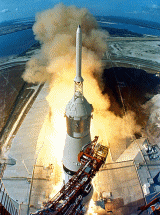
Launch and lunar landing In addition to throngs of people crowding highways and beaches near the launch site, millions viewed the event on television. President Richard Nixon viewed the proceedings from the Oval Office of the White House.
A Saturn V launched Apollo 11 from the Kennedy Space Center on July 16, 1969 at 13:32 UTC (9:32 a.m. local time). It entered orbit 12 minutes later. After one and a half orbits, the S-IVB third-stage engine pushed the spacecraft onto its trajectory toward the Moon with the Trans Lunar Injection burn. About 30 minutes later the command/service module pair separated from the last remaining Saturn V stage and docked with the lunar module still nestled in the Lunar Module Adaptor.
On July 19 Apollo 11 passed behind the Moon and fired its service propulsion engine to enter lunar orbit. In the thirty orbits that followed, the crew saw passing views of their landing site in the southern Sea of Tranquility about 20 kilometers (12 mi) southwest of the crater Sabine D (0.67408N, 23.47297E). The landing site was selected in part because it had been characterized as relatively flat and smooth by the automated Ranger 8 and Surveyor 5 landers along with the Lunar Orbiter mapping spacecraft and unlikely to present major landing or extra-vehicular activity (EVA) challenges.
On July 20, 1969 the lunar module Eagle separated from the command module Columbia. Collins, alone aboard Columbia, inspected Eagle as it pirouetted before him to ensure the craft was not damaged.
As the descent began, Armstrong and Aldrin found that they were passing landmarks on the surface 4 seconds early and reported they were "long". They would land miles west of their target point. The LM navigation and guidance computer distracted the crew with several unusual program alarms. Inside Mission Control Center in Houston, Texas, computer engineer Jack Garman told guidance officer Steve Bales it was safe to continue the descent and this was relayed to the crew. When Armstrong again looked outside he saw that the computer was taking them to a 100m crater surrounded by large boulders. Armstrong took semi-automatic control (not "manual" control as popularly believed ) and with Aldrin calling out altitude and velocity data, landed at 20:17 UTC on July 20 with about 25 seconds of fuel left.
The program alarms were "executive overflows"; the computer could not process all of its tasks in real time. Contrary to popular belief this was neither a "computer error" nor an astronaut error. The cause was in hardware: a fast stream of spurious interrupts from the rendezvous radar positioner that only occurred when the hardware powered up in a certain random way that could not occur in ground tests. Although unneeded for the landing, the radar was intentionally turned on in the event of an abort.
Although Apollo 11 landed with less fuel than other missions, they also encountered a premature low fuel warning. It was later found to be caused by the lunar gravity permitting greater propellant 'slosh' which had uncovered a fuel sensor. On future missions extra baffles were added to the tanks.
Buzz Aldrin spoke the first words (albeit technical jargon) from the LM on the lunar surface. Throughout the descent Aldrin had called out navigation data to Armstrong, who was busy piloting the LM. As Eagle landed Aldrin said, "Contact light! Okay, engine stop. ACA - out of detent." Armstrong acknowledged "Out of detent" and Aldrin continued, "Mode control - both auto. Descent engine command override off. Engine arm - off. 413 is in."
Then Armstrong said the famous words, "Houston, Tranquility Base here. The Eagle has landed." Armstrong's abrupt change of call sign from "Eagle" to "Tranquility Base" caused momentary confusion at Mission Control. Charles Duke, acting as CAPCOM during the landing phase, acknowledged their landing, expressing the relief of Mission Control after the unexpectedly drawn-out descent.
Shortly after landing, before preparations began for the EVA, Aldrin broadcast that:
He then took Communion privately. At this time NASA was still fighting a lawsuit brought by atheist Madalyn Murray O'Hair (who had objected to the Apollo 8 crew reading from the Book of Genesis) which demanded that their astronauts refrain from religious activities while in space. As such, Aldrin chose to refrain from directly mentioning this. He had kept the plan quiet (not even mentioning it to his wife) and did not reveal it publicly for several years. (NOTE: Buzz Aldrin was an elder at Webster Presbyterian Church in Webster, TX. His communion kit was prepared by the pastor of the church, the Rev. Dean Woodruff. Aldrin described communion on the moon and the involvement of his church and pastor in the October, 1970 edition of Guideposts magazine and in his book "Return to Earth." Webster Presbyterian possesses the chalice used on the moon, and commemorates the Lunar Communion each year on the Sunday closest to July 20.)
Lunar ascent and return Aldrin entered Eagle first. With some difficulty the astronauts lifted film and two sample boxes containing more than 22 kg (48 lb) of lunar surface material to the LM hatch using a flat cable pulley device called the Lunar Equipment Conveyor. Armstrong reminded Aldrin of a bag of in his pocket sleeve, and Aldrin tossed the bag down; Armstrong then jumped to the ladder's third rung and climbed into the LM. After transferring to LM life support, the explorers lightened the ascent stage for return to lunar orbit by tossing out their PLSS backpacks, lunar overshoes, one Hasselblad camera, and other equipment. They then repressurised the LM, and settled down to sleep.
While moving in the cabin Aldrin accidentally broke the circuit breaker that armed the main engine for lift off from the moon. There was initial concern this would prevent firing the engine, which would strand them on the moon. Fortunately a felt-tip pen was sufficient to activate the switch. Had this not worked, the Lunar Module circuitry could have been reconfigured to allow firing the ascent engine.
After about seven hours of rest, they were awakened by Houston to prepare for the return flight. Two and a half hours later, at 17:54 UTC, they lifted off in Eagle's ascent stage, carrying 21.5 kilograms of lunar samples with them, to rejoin CMP Michael Collins aboard Columbia in lunar orbit. After more than 2½ hours on the lunar surface, they had left behind scientific instruments such as a retroreflector array used for the Lunar Laser Ranging Experiment. They also left an American flag, an Apollo 1 mission patch, and a plaque (mounted on the LM Descent Stage ladder) bearing two drawings of Earth (of the Western and Eastern Hemispheres), an inscription, and signatures of the astronauts and Richard Nixon. The inscription read Here Men From The Planet Earth First Set Foot Upon the Moon, July 1969 A.D. We Came in Peace For All Mankind. They also left behind a memorial bag containing a gold replica of an olive branch as a traditional symbol of peace, the Apollo 1 patch, and a silicon message disk. The disk carries the goodwill statements by Presidents Eisenhower, Kennedy, Johnson and Nixon and messages from leaders of 73 countries around the world. The disc also carries a listing of the leadership of the US Congress, a listing of members of the four committees of the House and Senate responsible for the NASA legislation, and the names of NASA's past and present top management. . (In his 1989 book, Men from Earth, Aldrin says that the items included Soviet medals commemorating Cosmonauts Vladimir Komarov and Yuri Gagarin.) Also, according to Deke Slayton's book 'Moonshot', Armstrong carried with him a special diamond-studded Astronaut pin from Deke.
Film taken from the LM Ascent Stage upon liftoff from the moon reveal the American flag, planted some from the descent stage, whipping violently in the exhaust of the ascent stage engine. As the landing site receded out of the camera field of view, the flag appeared ready to topple, but whether it did in fact fall or not is unknown. (However, according to Buzz Aldrin, during the lunar ascent, "The ascent stage of the LM separated ...I was concentrating on the computers, and Neil was studying the attitude indicator, but I looked up long enough to see the flag fall over.") Subsequent Apollo missions usually planted the American flags at least from the LM to avoid being blown over by the ascent engine exhaust.
After rendezvous with Columbia, Eagles ascent stage was jettisoned into lunar orbit at 21 July 1969 at 23:41 UT (7:41 PM EDT). Just before the Apollo 12 flight, it was noted that Eagle was still orbiting the moon. Later NASA reports mentioned that Eagle's orbit had decayed resulting in it impacting in an "uncertain location" on the lunar surface.
On July 23, the three astronauts made a television broadcast on the last night before splashdown. Collins commented, "... The Saturn V rocket which put us in orbit is an incredibly complicated piece of machinery, every piece of which worked flawlessly ... We have always had confidence that this equipment will work properly. All this is possible only through the blood, sweat, and tears of a number of a people ...All you see is the three of us, but beneath the surface are thousands and thousands of others, and to all of those, I would like to say, 'Thank you very much.'" Aldrin said, "... This has been far more than three men on a mission to the Moon; more, still, than the efforts of a government and industry team; more, even, than the efforts of one nation. We feel that this stands as a symbol of the insatiable curiosity of all mankind to explore the unknown ... Personally, in reflecting on the events of the past several days, a verse from Psalms comes to mind. 'When I consider the heavens, the work of Thy fingers, the Moon and the stars, which Thou hast ordained; What is man that Thou art mindful of him?'" Armstrong concluded, "The responsibility for this flight lies first with history and with the giants of science who have preceded this effort; next with the American people, who have, through their will, indicated their desire; next with four administrations and their Congresses, for implementing that will; and then, with the agency and industry teams that built our spacecraft, the Saturn, the Columbia, the Eagle, and the little EMU, the spacesuit and backpack that was our small spacecraft out on the lunar surface. We would like to give special thanks to all those Americans who built the spacecraft; who did the construction, design, the tests, and put their hearts and all their abilities into those craft. To those people tonight, we give a special thank you, and to all the other people that are listening and watching tonight, God bless you. Good night from Apollo 11."
On July 24, the astronauts returned home and were immediately put in quarantine. The splashdown point was , 2,660 km (1,440 nm) east of Wake Island, or 380 km (210 nm) south of Johnston Atoll, and 24 km (15 mi) from the recovery ship, USS Hornet. After recovery by helicopter approximately one hour after splashdown, the astronauts were placed in a trailer that had been designed as a quarantine facility. President Richard Nixon was aboard the recovery vessel to personally welcome the astronauts back to Earth.
The astronauts were placed in quarantine after their landing on the moon due to fears that the moon might contain undiscovered pathogens, and that the astronauts may have been exposed to them during their moon walks. However, after almost three weeks in confinement (first in their trailer and later in the Lunar Receiving Laboratory at the Manned Spacecraft Center), the astronauts were given a clean bill of health. On August 13, 1969, the astronauts exited quarantine to the cheers of the American public. Parades were held in their honor in New York, Chicago, and Los Angeles on the same day. A few weeks later, they were invited by Mexico for a parade honoring them in Mexico City.
That evening in Los Angeles there was an official State Dinner to celebrate Apollo 11, attended by Members of Congress, 44 Governors, the Chief Justice, and ambassadors from 83 nations. President Richard Nixon and Vice President Spiro T. Agnew honored each astronaut with a presentation of the Presidential Medal of Freedom. This celebration was the beginning of a 45-day "Giant Leap" tour that brought the astronauts to 25 foreign countries and included visits with prominent leaders such as Queen Elizabeth II of the United Kingdom. Many nations would honor the first manned moon landing by issuing Apollo 11 commemorative postage stamps or coins. Also, a few POWs held in Vietnam received letters from home a few months after the landings with those stamps to covertly let the POWs know that the United States had landed men on the moon.
At the 27th World Science Fiction Convention in St. Louis, MO, the three astronauts received a special Hugo award for "(t)he Best Moon Landing Ever."
On September 16, 1969, the three astronauts spoke before a joint session of Congress on Capitol Hill. They presented two U.S. flags, one to the House of Representatives and the other to the Senate, that had been carried to the surface of the moon with them.
The command module is displayed at the National Air and Space Museum, Washington, D.C.. It is placed in the central exhibition hall in front of the Jefferson Drive entrance, and shares the main hall with other pioneering flight vehicles such as the Spirit of St. Louis, the Bell X-1, the North American X-15, Mercury capsule Friendship 7, and Gemini 4. The quarantine trailer is displayed at the Smithsonian's Udvar-Hazy Center annex near Washington Dulles International Airport in Virginia.
Mission insignia The familiar patch of Apollo 11 was designed by Collins, who wanted a symbol for "peaceful lunar landing by the United States". He picked an eagle as the symbol, put an olive branch in its beak, and drew a moon background with the earth in the distance. NASA officials said the talons of the eagle looked too "warlike" and after some discussion, the olive branch was moved to the claws. The crew decided the Roman numeral XI would not be understood in some nations and went with Apollo 11; they decided not to put their names on the patch to "allow it to symbolize everyone who worked on the moon landing". All colors are natural, with blue and gold borders around the patch. The LM was named Eagle to match the insignia. When the Eisenhower dollar coin was revived a few years later, the patch design provided the eagle for the back of the coin. The design was kept for the smaller Susan B. Anthony dollar, which was unveiled in 1979, the 10th anniversary of the Apollo 11 mission.
See also
Photo gallery
Further reading and external links
- NASA Website honoring the mission
- , left on the moon by Buzz Aldrin.
- - National Geographic News, 2004-07-16 - 35th anniversary; Steven Dick, NASA's chief historian: '...a thousand years from now, that step may be considered the crowning achievement of the 20th century.'
- - Matt Wallace - Opinion column reminiscing about the Apollo 11 Moon landing and its cultural impact on the 30th anniversary published 18 July 1999 in the (Greensboro, NC) News & Record; "And there was the moon, which was why this was no typical child's summer."
For young readers
- Aldrin, Buzz. Reaching for the Moon. HarperCollins, 2005, 40 pages, ISBN 978-0-060-55445-3
- Thimmesh, Catherine. Team Moon: How 400,000 People Landed Apollo 11 on the Moon. Houghton Mifflin, 2006, 80 pages, ISBN 978-0-618-50757-3
NASA reports - 200+ pages
- 200+ pages - Timeline of the mission
Multimedia - Transcripts and audio clips of important parts of the mission - Hundreds of high-resolution images of the mission, including assembled panoramas. Captions written by Eric M. Jones - Several maps showing routes of moonwalks - with lunar landing sites tagged
- Video
- Audio
- Audio
- QTVR panoramas
-
-
- from takeoff to splashdown - Video
|
| |
|
|