
See Also

Luna 9

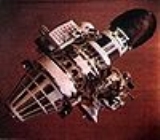
Luna 9, also known as Lunik 9, was an unmanned space mission Unmanned space mission

Unmanned space missions are space missions using remote-controlled spacecraft [i]. ... 

 of the Soviet Union Soviet Union

The Union of Soviet Socialist Republics , more commonly known as the Soviet Union, was a Communist state [i] ... 

's Luna program Luna programme

The Luna programme was a series of unmanned space mission [i]s sent to the Moon [i] by the Soviet Union [i] ... 

. On February 3, 1966 the Luna 9 spacecraft was the first spacecraft to achieve a lunar Moon

The Moon is Earth [i]'s only natural satellite [i]. ... 

 soft landing and to transmit photographic data to Earth Earth

Earth is the third planet [i] in the solar system [i] in terms of distance from the Sun [i], and the fi ... 

. The automatic lunar station that achieved the soft landing weighed 99 kg Kilogram

The kilogram or kilogramme, is the SI base unit [i] of mass [i]. ... 

. It was a hermetically sealed container with radio equipment, a program timing device, heat control systems, scientific apparatus, power sources, and a television system. The Luna 9 payload was carried to Earth orbit by an A-2-E vehicle and then conveyed toward the Moon Moon

The Moon is Earth [i]'s only natural satellite [i]. ... 

 by a fourth stage rocket that separated itself from the payload.

Discussions

  Discussion Features

   Ask a question about 'Luna 9'

   Start a new discussion about 'Luna 9'

   Answer questions about 'Luna 9'

   'Luna 9' discussion forum

Timeline

1966   The unmanned Soviet Luna 9 spacecraft makes the first controlled rocket-assisted landing on the Moon Moon

The Moon is Earth [i]'s only natural satellite [i]. ... 

.


Encyclopedia

Luna 9
Organization:Soviet Union Soviet Union

The Union of Soviet Socialist Republics , more commonly known as the Soviet Union, was a Communist state [i] ... 

Major Contractors: GSMZ Lavochkin
Mission Type: Planetary Science Lunar landing
Satellite of: Moon Moon

The Moon is Earth [i]'s only natural satellite [i]. ... 

Launch: January 31, 1966. 11:45:00 UTC Coordinated Universal Time


Coordinated Universal Time is a high-precision atomic [i] time standard [i].... 

Launch Vehicle: Molniya 8K78M
Mission Highlight: Lunar soft landing on
February 3, 1966, 18:44:52 UTC
7.13° N - 64.37° W.
Mission Duration: 6-days. Last transmission
February 6, 1966, 22:55 UTC.
Mass Mass

Mass is a property of a physical [i] object that quantifies the amount of matter [i] and energy [i] ... 

:
1.580 kg
NSSDC ID: 1966-006A
Webpage:
Orbital elements Orbital elements

The elements of an orbit [i] are the parameters needed to specify that orbit uniquely, given a model of ... 

Semimajor Axis Semi-major axis

In geometry [i], the term semi-major axis is used to describe the dimensions of ellipses and hyperbolae. ... 

:
n/a
Eccentricity: n/a
Inclination Inclination

Inclination in general is the angle [i] between a reference plane [i] and another plane or axis [i] ... 

:
n/a
Orbital Period: n/a
Aposelene: n/a
Periselene: n/a
Orbits: Lunar soft landing
Instruments
Close-Up Lunar Surface Photography : Lunar photography

Luna 9, also known as Lunik 9, was an unmanned space mission Unmanned space mission

Unmanned space missions are space missions using remote-controlled spacecraft [i]. ... 

 of the Soviet Union Soviet Union

The Union of Soviet Socialist Republics , more commonly known as the Soviet Union, was a Communist state [i] ... 

's Luna program Luna programme

The Luna programme was a series of unmanned space mission [i]s sent to the Moon [i] by the Soviet Union [i] ... 

. On February 3, 1966 the Luna 9 spacecraft was the first spacecraft to achieve a lunar Moon

The Moon is Earth [i]'s only natural satellite [i]. ... 

 soft landing and to transmit photographic data to Earth Earth

Earth is the third planet [i] in the solar system [i] in terms of distance from the Sun [i], and the fi ... 

.

The automatic lunar station that achieved the soft landing weighed 99 kg Kilogram

The kilogram or kilogramme, is the SI base unit [i] of mass [i]. ... 

. It was a hermetically sealed container with radio equipment, a program timing device, heat control systems, scientific apparatus, power sources, and a television system. The Luna 9 payload was carried to Earth orbit by an A-2-E vehicle and then conveyed toward the Moon Moon

The Moon is Earth [i]'s only natural satellite [i]. ... 

 by a fourth stage rocket that separated itself from the payload. Flight apparatus separated from the payload shortly before Luna 9 landed.

After landing in the Ocean of Storms Oceanus Procellarum

Oceanus Procellarum, Latin [i] for "Ocean of Storms", is a vast lunar mare [i] on the western edge of th ... 

 on February 3, 1966, the four petals, which formed the spacecraft, opened outward and stabilized the spacecraft on the lunar surface. Spring-controlled antennas assumed operating positions, and the television camera rotating mirror system, which operated by revolving and tilting, began a photographic survey of the lunar environment. Seven radio sessions, totaling 8 hours and 5 minutes, were transmitted as were three series of TV pictures.


When assembled, the photographs provided a panoramic view of the nearby lunar surface. The pictures included views of nearby rocks and of the horizon 1.4 km away from the spacecraft.

With this mission, the Soviets accomplished another spectacular first in the space race, the first survivable landing of a humanmade object on another celestial body. Luna 9 was the twelfth attempt at a soft-landing by the Soviets; it was also the first deep space probe built by the Lavochkin design bureau, which ultimately would design and build almost all Soviet lunar and interplanetary spacecraft. All operations prior to landing occurred without fault, and the 58-centimeter spheroid ALS capsule landed on the Moon at 18:45:30 UT on 3 February 1966 west of the Reiner and Marius craters in the Ocean of Storms . Approximately 5 minutes after touchdown, Luna 9 began transmitting data to Earth, but it was 7 hours before the probe began sending the first of nine images of the surface of the Moon.

These were the first images sent from the surface of another planetary body.
The radiation detector, the only scientific instrument on board, measured a dosage of 30 millirads per day. Perhaps the most important discovery of the mission was determining that a foreign object would not simply sink into the lunar dust, that is, that the ground could support a heavy lander. Last contact with the spacecraft was at 22:55 UT on 6 February 1966.


  • Launch date/time: 1966-01-31 at 11:45:00 UTC
  • In-orbit dry mass: 1580 kg


External links


Categories: