


Extra-vehicular activity

Encyclopedia
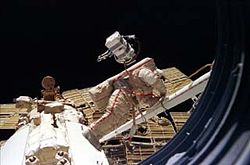
Astronaut
An astronaut or cosmonaut is a person trained by a human spaceflight program to command, pilot, or serve as a crew member of a spacecraft....
away from the Earth
Earth
Earth is the third planet from the Sun, and the densest and fifth-largest of the eight planets in the Solar System. It is also the largest of the Solar System's four terrestrial planets...
, and outside of a spacecraft
Spacecraft
A spacecraft or spaceship is a craft or machine designed for spaceflight. Spacecraft are used for a variety of purposes, including communications, earth observation, meteorology, navigation, planetary exploration and transportation of humans and cargo....
. The term most commonly applies to an EVA made outside a craft orbiting Earth (a spacewalk), but also applies to an EVA made on the surface of the Moon
Moon
The Moon is Earth's only known natural satellite,There are a number of near-Earth asteroids including 3753 Cruithne that are co-orbital with Earth: their orbits bring them close to Earth for periods of time but then alter in the long term . These are quasi-satellites and not true moons. For more...
(a moonwalk). In the later lunar landing missions (Apollo 15
Apollo 15
Apollo 15 was the ninth manned mission in the American Apollo space program, the fourth to land on the Moon and the eighth successful manned mission. It was the first of what were termed "J missions", long duration stays on the Moon with a greater focus on science than had been possible on previous...
, 16
Apollo 16
Young and Duke served as the backup crew for Apollo 13; Mattingly was slated to be the Apollo 13 command module pilot until being pulled from the mission due to his exposure to rubella through Duke.-Backup crew:...
, and 17
Apollo 17
Apollo 17 was the eleventh and final manned mission in the American Apollo space program. Launched at 12:33 a.m. EST on December 7, 1972, with a three-member crew consisting of Commander Eugene Cernan, Command Module Pilot Ronald Evans, and Lunar Module Pilot Harrison Schmitt, Apollo 17 remains the...
) the command module
Apollo Command/Service Module
The Command/Service Module was one of two spacecraft, along with the Lunar Module, used for the United States Apollo program which landed astronauts on the Moon. It was built for NASA by North American Aviation...
pilot (CMP) did an EVA to retrieve film canisters on the return trip; he was assisted by the lunar module
Apollo Lunar Module
The Apollo Lunar Module was the lander portion of the Apollo spacecraft built for the US Apollo program by Grumman to carry a crew of two from lunar orbit to the surface and back...
pilot (LMP) who remained at the open command module hatch. These trans-Earth EVAs were the only spacewalks ever conducted in deep space.
A "Stand-up" EVA (SEVA) is where the astronaut does not fully exit a spacecraft, but is completely reliant on the spacesuit for environmental support. Its name derives from the astronaut "standing up" in the open hatch, usually to film or assist a spacewalking astronaut.
EVAs may be either tethered (the astronaut is connected to the spacecraft; oxygen and electrical power can be supplied through an umbilical cable
Umbilical cable
An umbilical cable or umbilical is a cable which supplies required consumables to an apparatus. It is named by analogy with an umbilical cord...
; no propulsion is needed to return to the spacecraft), or untethered. Untethered spacewalks were only performed on three missions in 1984 using the Manned Maneuvering Unit
Manned Maneuvering Unit
The Manned Maneuvering Unit is an astronaut propulsion unit which was used by NASA on three space shuttle missions in 1984. The MMU allowed the astronauts to perform untethered EVA spacewalks at a distance from the shuttle. The MMU was used in practice to retrieve a pair of faulty communications...
(MMU), and on a flight test in 1994 of the Simplified Aid for EVA Rescue
Simplified Aid for EVA Rescue
Simplified Aid for EVA Rescue is a small, self-contained, propulsive backpack system used to provide free-flying mobility for a Space Shuttle or International Space Station crewmember during extra-vehicular activity...
(SAFER). A SAFER is a safety device worn on tethered U.S. EVAs, since the capability of returning to the spacecraft is essential.
Russia
Russia
Russia or , officially known as both Russia and the Russian Federation , is a country in northern Eurasia. It is a federal semi-presidential republic, comprising 83 federal subjects...
, the United States
United States
The United States of America is a federal constitutional republic comprising fifty states and a federal district...
and China
People's Republic of China
China , officially the People's Republic of China , is the most populous country in the world, with over 1.3 billion citizens. Located in East Asia, the country covers approximately 9.6 million square kilometres...
have demonstrated the capability to conduct an EVA.
Development history
NASANASA
The National Aeronautics and Space Administration is the agency of the United States government that is responsible for the nation's civilian space program and for aeronautics and aerospace research...
planners invented the term extra-vehicular activity in the early 1960s for the Apollo program to land men on the Moon, because the astronauts would leave the spacecraft to collect lunar material samples and deploy scientific experiments. To support this, and other Apollo objectives, the Gemini program
Project Gemini
Project Gemini was the second human spaceflight program of NASA, the civilian space agency of the United States government. Project Gemini was conducted between projects Mercury and Apollo, with ten manned flights occurring in 1965 and 1966....
was spun off to develop the capability for astronauts to work outside a two-man Earth orbiting spacecraft. However, the Soviet Union
Soviet Union
The Soviet Union , officially the Union of Soviet Socialist Republics , was a constitutionally socialist state that existed in Eurasia between 1922 and 1991....
was fiercely competitive in holding the early lead it had gained in manned spaceflight, so the Soviet Communist Party
Communist Party of the Soviet Union
The Communist Party of the Soviet Union was the only legal, ruling political party in the Soviet Union and one of the largest communist organizations in the world...
, led by Nikita Khrushchev
Nikita Khrushchev
Nikita Sergeyevich Khrushchev led the Soviet Union during part of the Cold War. He served as First Secretary of the Communist Party of the Soviet Union from 1953 to 1964, and as Chairman of the Council of Ministers, or Premier, from 1958 to 1964...
, ordered the hasty conversion of its single-pilot Vostok capsule into a two- or three-person craft named Voskhod
Voskhod spacecraft
The Voskhod was a spacecraft built by the Soviet Union's space program for human spaceflight as part of the Voskhod programme. It was a development of and a follow-on to the Vostok spacecraft...
, in order to compete with Gemini and Apollo. The Soviets were able to launch two Voskhod capsules before the first manned Gemini was launched.
The Soviets' avionics
Avionics
Avionics are electronic systems used on aircraft, artificial satellites and spacecraft.Avionic systems include communications, navigation, the display and management of multiple systems and the hundreds of systems that are fitted to aircraft to meet individual roles...
technology was not as advanced as that of the United States, so the Voskhod cabin could not have been left depressurized by an open hatch; otherwise the air-cooled electronics would have overheated. Therefore a spacewalking cosmonaut would have to enter and exit the spacecraft through an airlock. By contrast, the Gemini capsule's avionics were designed so the cabin could be exposed to the vacuum of space when one of two large hatches was opened, so no airlock was required, and both the spacewalking astronaut
Astronaut
An astronaut or cosmonaut is a person trained by a human spaceflight program to command, pilot, or serve as a crew member of a spacecraft....
and his companion command pilot were in vacuum during the EVA. Due to the different designs of the spacecraft, the American
United States
The United States of America is a federal constitutional republic comprising fifty states and a federal district...
and Soviet
Soviet Union
The Soviet Union , officially the Union of Soviet Socialist Republics , was a constitutionally socialist state that existed in Eurasia between 1922 and 1991....
space programs define the duration of an EVA differently. The Soviet (now Russia
Russia
Russia or , officially known as both Russia and the Russian Federation , is a country in northern Eurasia. It is a federal semi-presidential republic, comprising 83 federal subjects...
n) definition is the time when the outer airlock hatch is open and the cosmonaut is in a vacuum
Vacuum
In everyday usage, vacuum is a volume of space that is essentially empty of matter, such that its gaseous pressure is much less than atmospheric pressure. The word comes from the Latin term for "empty". A perfect vacuum would be one with no particles in it at all, which is impossible to achieve in...
. An American EVA begins when the spacewalking astronaut has at least his head outside of the spacecraft.
Sputnik 1
Sputnik 1 ) was the first artificial satellite to be put into Earth's orbit. It was launched into an elliptical low Earth orbit by the Soviet Union on 4 October 1957. The unanticipated announcement of Sputnik 1s success precipitated the Sputnik crisis in the United States and ignited the Space...
and first man in space
Vostok 1
Vostok 1 was the first spaceflight in the Vostok program and the first human spaceflight in history. The Vostok 3KA spacecraft was launched on April 12, 1961. The flight took Yuri Gagarin, a cosmonaut from the Soviet Union, into space. The flight marked the first time that a human entered outer...
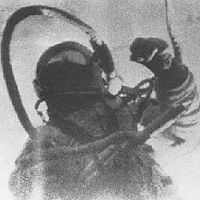
, the Soviets again stunned the world on March 18, 1965 with the first EVA (commonly referred to as a "space walk") performed by Alexey Leonov from the Voskhod 2
Voskhod 2
Voskhod 2 was a Soviet manned space mission in March 1965. Vostok-based Voskhod 3KD spacecraft with two crew members on board, Pavel Belyaev and Alexei Leonov, was equipped with an inflatable airlock...
spacecraft, for 12 minutes outside the spacecraft. Leonov had no means to control his motion other than pulling on his 50.7 feet (15.5 m) tether. After the flight, he claimed this was easy, but his space suit
Space suit
A space suit is a garment worn to keep an astronaut alive in the harsh environment of outer space. Space suits are often worn inside spacecraft as a safety precaution in case of loss of cabin pressure, and are necessary for extra-vehicular activity , work done outside spacecraft...
ballooned from its internal pressure against the vacuum of space, stiffening so much that he could not activate the shutter on his chest-mounted camera.
At the end of his space walk, the suit stiffening caused a more serious problem: Leonov had to re-enter the capsule through the inflatable cloth airlock
Airlock
An airlock is a device which permits the passage of people and objects between a pressure vessel and its surroundings while minimizing the change of pressure in the vessel and loss of air from it...
, 3.96 feet (1.2 m) in diameter and 8.25 feet (2.5 m) long. After his spacewalk, he improperly entered the airlock head-first and got stuck sideways. He could not get back in without reducing the pressure in his suit, risking "the bends
Decompression sickness
Decompression sickness describes a condition arising from dissolved gases coming out of solution into bubbles inside the body on depressurization...
". This added another 12 minutes to his time in vacuum, and he was overheated by 1.8 C-change from the exertion. It would be almost four years before the Soviets tried another EVA. They misrepresented to the press how difficult Leonov found it to work in weightlessness
Weightlessness
Weightlessness is the condition that exists for an object or person when they experience little or no acceleration except the acceleration that defines their inertial trajectory, or the trajectory of pure free-fall...
, and concealed the problems encountered until after the end of the Cold War
Cold War
The Cold War was the continuing state from roughly 1946 to 1991 of political conflict, military tension, proxy wars, and economic competition between the Communist World—primarily the Soviet Union and its satellite states and allies—and the powers of the Western world, primarily the United States...
.
Edward Higgins White
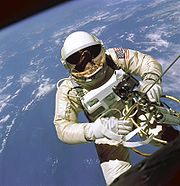
Edward Higgins White, II was an engineer, United States Air Force officer and NASA astronaut. On June 3, 1965, he became the first American to "walk" in space. White died along with fellow astronauts Gus Grissom and Roger Chaffee during a pre-launch test for the first manned Apollo mission at...
from the second manned Gemini flight, Gemini 4
Gemini 4
Gemini 4 was the second manned space flight in NASA's Project Gemini, occurring in June 1965. It was the tenth manned American spaceflight . Astronauts James McDivitt and Edward H. White, II circled the Earth 66 times in four days, making it the first US flight to approach the five-day flight of...
, for 21 minutes, on a 25 feet (7.6 m) tether. White was the first to control his motion in space with a Hand-Held Maneuvering Unit, which worked well, but only carried enough propellant for 20 seconds. White found his tether useful for limiting his distance from the spacecraft, but difficult to use for moving around, contrary to Leonov's claim. However, a defect in the capsule's hatch latching mechanism caused difficulties opening and closing the hatch, which delayed the start of the EVA and put White and his crewmate at risk of not getting back to Earth alive.
No EVAs were planned on the next three Gemini flights. The next EVA was planned to be made by David Scott
David Scott
David Randolph Scott is an American engineer, test pilot, retired U.S. Air Force officer, and former NASA astronaut and engineer, who was one of the third group of astronauts selected by NASA in October 1963...
on Gemini 8
Gemini 8
-Backup crew:-Mission parameters:* Mass: * Perigee: * Apogee: * Inclination: 28.91°* Period: 88.83 min-Objectives:Gemini VIII had two major objectives, of which it achieved one...
, but that mission had to be aborted due to a critical spacecraft malfunction before the EVA could be conducted. Astronauts on the next three Gemini flights (Eugene Cernan, Michael Collins
Michael Collins (astronaut)
Michael Collins is a former American astronaut and test pilot. Selected as part of the third group of fourteen astronauts in 1963, he flew in space twice. His first spaceflight was Gemini 10, in which he and command pilot John Young performed two rendezvous with different spacecraft and Collins...
and Richard Gordon
Richard F. Gordon, Jr.
Richard Francis Gordon, Jr., Captain, USN, Ret. is a retired NASA astronaut. He is one of only 24 people to have flown to the Moon.-Military and flight experience:Gordon was born in Seattle, Washington...
), performed several EVAs, but none was able to successfully work for long periods outside the spacecraft without tiring and overheating.
Finally, on November 13, 1966, Edwin "Buzz" Aldrin
Buzz Aldrin
Buzz Aldrin is an American mechanical engineer, retired United States Air Force pilot and astronaut who was the Lunar Module pilot on Apollo 11, the first manned lunar landing in history...
became the first to successfully work in space without tiring, on the Gemini 12
Gemini 12
-Backup crew:-Mission parameters:*Mass: *Perigee: *Apogee: *Inclination: 28.87°*Period: 88.87 min-Docking:*Docked: November 12, 1966 - 01:06:00 UTC*Undocked: November 13, 1966 - 20:18:00 UTC-Space walk:...
last flight. Aldrin worked outside the spacecraft for 2 hours and 6 minutes, in addition to two stand-up EVAs in the spacecraft hatch for an additional 3 hours and 24 minutes. Aldrin's interest in scuba diving
Scuba diving
Scuba diving is a form of underwater diving in which a diver uses a scuba set to breathe underwater....
inspired the use of underwater EVA training to simulate weightlessness, which has been used ever since to allow astronauts to practice techniques of avoiding wasted muscle energy.
On January 16, 1969, the Soviet Union achieved the first EVA crew transfer from one spacecraft to another when Aleksei Yeliseyev
Aleksei Yeliseyev
Aleksei Stanislavovich Yeliseyev is a retired Soviet cosmonaut who flew on three missions in the Soyuz programme as a flight engineer: Soyuz 5, Soyuz 8, and Soyuz 10....
and Yevgeny Khrunov
Yevgeny Khrunov
Yevgeni Vassilyevich Khrunov was a Soviet cosmonaut who flew on the Soyuz 5/Soyuz 4 mission.He was born in Prudy.Yevgeni Khrunov was a colonel, Hero of the Soviet Union and Kandidat of Technical Sciences ....
transferred from Soyuz 5
Soyuz 5
Soyuz 5 was a Soyuz mission using the Soyuz 7K-OK spacecraft launched by the Soviet Union on January 15, 1969, which docked with Soyuz 4 in orbit...
to Soyuz 4
Soyuz 4
Soyuz 4 was launched on January 14, 1969. On board the Soyuz 7K-OK spacecraft was cosmonaut Vladimir Shatalov on his first flight. The aim of the mission was to dock with Soyuz 5, transfer two crew members from that spacecraft, and return to Earth...
, which were docked together. This was the second Soviet EVA, and it would be almost another nine years before the Soviets performed their third.
Neil Armstrong
Neil Alden Armstrong is an American former astronaut, test pilot, aerospace engineer, university professor, United States Naval Aviator, and the first person to set foot upon the Moon....
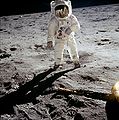
and Buzz Aldrin on July 21, 1969 (UTC), after the Apollo 11
Apollo 11
In early 1969, Bill Anders accepted a job with the National Space Council effective in August 1969 and announced his retirement as an astronaut. At that point Ken Mattingly was moved from the support crew into parallel training with Anders as backup Command Module Pilot in case Apollo 11 was...
Moon landing. This first Moon walk lasted 2 hours, 36 minutes. A total of 15 Moon walks were performed by members of six Apollo crews, including Charles "Pete" Conrad
Pete Conrad
Charles "Pete" Conrad, Jr. was an American naval officer, astronaut and engineer, and the third person to walk on the Moon during the Apollo 12 mission. He set an eight-day space endurance record along with command pilot Gordon Cooper on the Gemini 5 mission, and commanded the Gemini 11 mission...
, Alan Bean
Alan Bean
Alan LaVern Bean is a former NASA astronaut, engineer, and painter. Bean was selected to become an astronaut by NASA in 1963 as part of Astronaut Group 3. He made his first flight into space aboard Apollo 12, the second manned mission to land on the Moon, at the age of thirty-seven years in...
, Alan Shepard
Alan Shepard
Alan Bartlett Shepard, Jr. was an American naval aviator, test pilot, flag officer, and NASA astronaut who in 1961 became the second person, and the first American, in space. This Mercury flight was designed to enter space, but not to achieve orbit...
, Edgar Mitchell, David Scott
David Scott
David Randolph Scott is an American engineer, test pilot, retired U.S. Air Force officer, and former NASA astronaut and engineer, who was one of the third group of astronauts selected by NASA in October 1963...
, James Irwin
James Irwin
James Benson Irwin was an American astronaut and engineer. He served as Lunar Module pilot for Apollo 15, the fourth human lunar landing; he was the eighth person to walk on the Moon.-Early life:...
, John Young, Charles Duke, Eugene "Gene" Cernan and Dr. Harrison "Jack" Schmitt
Harrison Schmitt
Harrison Hagan "Jack" Schmitt is an American geologist, a retired NASA astronaut, university professor, and a former U.S. senator from New Mexico....
. Cernan was the last Apollo astronaut to step off the surface of the Moon.
The first EVA in deep space was made on August 5, 1971, by American Al Worden, to retrieve a film and data recording canister from the Apollo 15
Apollo 15
Apollo 15 was the ninth manned mission in the American Apollo space program, the fourth to land on the Moon and the eighth successful manned mission. It was the first of what were termed "J missions", long duration stays on the Moon with a greater focus on science than had been possible on previous...
Service Module on the return trip from the Moon. Worden was assisted by James Irwin, doing a standup EVA in the Command Module hatch. This was repeated by Ken Mattingly
Ken Mattingly
Thomas Kenneth "Ken" Mattingly II, is a retired American astronaut and rear admiral in the United States Navy who flew on the Apollo 16, STS-4 and STS-51-C missions. He had been scheduled to fly on Apollo 13, but was held back due to concerns about a potential illness...
and Charles Duke on Apollo 16
Apollo 16
Young and Duke served as the backup crew for Apollo 13; Mattingly was slated to be the Apollo 13 command module pilot until being pulled from the mission due to his exposure to rubella through Duke.-Backup crew:...
, and by Ronald Evans
Ronald Evans
Ronald Ellwin Evans, Jr. was a NASA astronaut and one of only 24 people to have flown to the Moon. He also served as a captain in the United States Navy....
and Harrison Schmitt on Apollo 17
Apollo 17
Apollo 17 was the eleventh and final manned mission in the American Apollo space program. Launched at 12:33 a.m. EST on December 7, 1972, with a three-member crew consisting of Commander Eugene Cernan, Command Module Pilot Ronald Evans, and Lunar Module Pilot Harrison Schmitt, Apollo 17 remains the...
.
The first EVA repairs of a spacecraft were made by Charles "Pete" Conrad
Pete Conrad
Charles "Pete" Conrad, Jr. was an American naval officer, astronaut and engineer, and the third person to walk on the Moon during the Apollo 12 mission. He set an eight-day space endurance record along with command pilot Gordon Cooper on the Gemini 5 mission, and commanded the Gemini 11 mission...
, Joseph Kerwin and Paul J. Weitz
Paul J. Weitz
Paul Joseph Weitz is an American former astronaut who flew in space twice.-Personal data:Born in Erie, Pennsylvania, on July 25, 1932. Married to the former Suzanne M. Berry of Harborcreek, Pennsylvania. Two children: Matthew and Cynthia. Hunting and fishing are among his hobbies. His mother, Mrs...
on May 26, June 7 and June 19, 1973, on the Skylab 2
Skylab 2
-Backup crew:-Support crew:*Robert L. Crippen*Richard H. Truly*Henry W. Hartsfield, Jr*William E. Thornton-Mission parameters:*Mass: 19,979 kg*Maximum Altitude: 440 km*Distance: 18,536,730.9 km...
mission. They rescued the functionality of the launch-damaged Skylab
Skylab
Skylab was a space station launched and operated by NASA, the space agency of the United States. Skylab orbited the Earth from 1973 to 1979, and included a workshop, a solar observatory, and other systems. It was launched unmanned by a modified Saturn V rocket, with a mass of...
space station
Space station
A space station is a spacecraft capable of supporting a crew which is designed to remain in space for an extended period of time, and to which other spacecraft can dock. A space station is distinguished from other spacecraft used for human spaceflight by its lack of major propulsion or landing...
by freeing a stuck solar panel
Solar panels on spacecraft
Spacecraft operating in the inner solar system usually rely on the use of photovoltaic solar panels to derive electricity from sunlight. In the outer solar system, where the sunlight is too weak to produce sufficient power, radioisotope thermal generators are used as a power source.-History:The...
, deploying a solar heating shield, and freeing a stuck circuit breaker relay. The Skylab 2 crew made three EVAs, and a total of ten EVAs were made by the three Skylab crews.
After Skylab, no more EVAs were made by the United States until the advent of the Space Shuttle
Space Shuttle
The Space Shuttle was a manned orbital rocket and spacecraft system operated by NASA on 135 missions from 1981 to 2011. The system combined rocket launch, orbital spacecraft, and re-entry spaceplane with modular add-ons...
program in the early 1980s. In this period, the Soviets resumed EVAs, making four from the Salyut 6
Salyut 6
Salyut 6 , DOS-5, was a Soviet orbital space station, the eighth flown as part of the Salyut programme. Launched on 29 September 1977 by a Proton rocket, the station was the first of the 'second-generation' type of space station. Salyut 6 possessed several revolutionary advances over the earlier...
and Salyut 7
Salyut 7
Salyut 7 was a space station in low Earth orbit from April 1982 to February 1991. It was first manned in May 1982 with two crew via Soyuz T-5, and last visited in June 1986, by Soyuz T-15. Various crew and modules were used over its lifetime, including a total of 12 manned and 15 unmanned launches...
space stations between December 20, 1977, and July 30, 1982.
When the United States resumed EVAs on April 7, 1983, astronauts started using an Extravehicular Mobility Unit
Extravehicular Mobility Unit
The Space Shuttle/International Space Station Extravehicular Mobility Unit is an independent anthropomorphic system that provides environmental protection, mobility, life support, and communications for a Space Shuttle or International Space Station crew member to perform extra-vehicular activity...
(EMU) for self-contained life support independent of the spacecraft. Also, for the first time, American astronauts used an airlock to enter and exit the spacecraft like the Soviets. Accordingly, the American definition of EVA start time was redefined to when the astronaut switches the EMU to battery power.
The first EVA by a woman was performed by the soviet cosmonaut Svetlana Savitskaya
Svetlana Savitskaya
Svetlana Yevgenyevna Savitskaya She started training as a cosmonaut in 1980. Upon returning to Earth, Savitskaya was assigned as the commander of an all-female Soyuz crew to Salyut 7 in commemoration of the International Women's Day, a mission that was later canceled.She was twice awarded the Hero...
on July 25, 1984. She performed a space walk lasting 3 hours 35 minutes outside the Salyut 7
Salyut 7
Salyut 7 was a space station in low Earth orbit from April 1982 to February 1991. It was first manned in May 1982 with two crew via Soyuz T-5, and last visited in June 1986, by Soyuz T-15. Various crew and modules were used over its lifetime, including a total of 12 manned and 15 unmanned launches...
space station.
Capability milestones
- The first metalwork in open space consisting in works of welding, brazing and metal spraying were conducted by cosmonauts Svetlana Savitskaya and Vladimir Dzhanibekov of the Soviet Union on July 25, 1984. To perform these activities a specially designed URI multipurpose tool was used during a 3 hr, 30 min EVA outside the Salyut 7 space station.
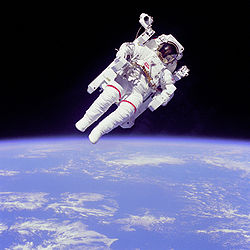
- The first untethered spacewalk was made by American Bruce McCandless IIBruce McCandless IIBruce McCandless II is a former naval aviator with the United States Navy and former NASA astronaut. During the first of his two Space Shuttle missions he made the first ever untethered free flight, using the Manned Maneuvering Unit.-Education:McCandless is the son of Bruce McCandless, a decorated...
on February 7, 1984, during Challenger mission STS-41-BSTS-41-BSTS-41-B was the tenth NASA Space Shuttle mission, launching on 3 February 1984 and landing on 11 February. It was the fourth flight of the Space Shuttle Challenger. Following STS-9, the flight numbering system for the Space Shuttle program was changed...
, utilizing the Manned Maneuvering UnitManned Maneuvering UnitThe Manned Maneuvering Unit is an astronaut propulsion unit which was used by NASA on three space shuttle missions in 1984. The MMU allowed the astronauts to perform untethered EVA spacewalks at a distance from the shuttle. The MMU was used in practice to retrieve a pair of faulty communications...
. He was subsequently joined by Robert L. StewartRobert L. StewartRobert Lee Stewart is a retired Brigadier General of the United States Army and former NASA astronaut.-Personal:Stewart was born August 13, 1942, in Washington, D.C.. He graduated from Hattiesburg High School, Hattiesburg, Mississippi, in 1960...
during the 5 hour 55 minute spacewalk. Such a self-contained spacewalk was first attempted by Eugene Cernan in 1966 on Gemini 9AGemini 9A- Backup crew :- Original primary crew :- Mission parameters :* Mass: * Perigee: * Apogee: * Inclination: 28.91°* Period: 88.78 min- 1st rendezvous :* June 3, 1966 - 17:45 - 18:00 UTC- Spacewalk :* Cernan...
, but Cernan could not reach the maneuvering unit without tiring.
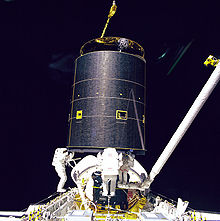
- The first three-person EVA was performed on May 13, 1992, as the third EVA of STS-49STS-49-Mission parameters:*Mass:**Orbiter landing with payload: **Payload: *Perigee: *Apogee: *Inclination: 28.35°*Period: 90.6 min-Space walks:* Thuot and Hieb – EVA 1*EVA 1 Start: 10 May 1992 – 20:40 UTC...
, the maiden flight of EndeavourSpace Shuttle EndeavourSpace Shuttle Endeavour is one of the retired orbiters of the Space Shuttle program of NASA, the space agency of the United States. Endeavour was the fifth and final spaceworthy NASA space shuttle to be built, constructed as a replacement for Challenger...
. Pierre ThuotPierre J. ThuotPierre Joseph Thuot is a retired U.S. Navy captain and a NASA astronaut from 1985 to 1995.- Personal :Born on May 19, 1955, in Groton, Connecticut, Thuot considers Fairfax, Virginia, and New Bedford, Massachusetts, to be his hometowns. He is married to the former Cheryl Ann Mattingly of...
, Richard HiebRichard HiebRichard James Hieb is a former NASA astronaut and a veteran of three space shuttle missions. He was a mission specialist on STS-39 and STS-49, and was a payload commander on STS-65...
, and Thomas AkersThomas AkersThomas Dale Akers is a former astronaut in the United States Space Shuttle program.-Education:He graduated from the University of Missouri–Rolla with B.S. and M.S...
conducted the EVA to hand-capture and repair a non-functional IntelsatIntelsatIntelsat, Ltd. is a communications satellite services provider.Originally formed as International Telecommunications Satellite Organization , it was—from 1964 to 2001—an intergovernmental consortium owning and managing a constellation of communications satellites providing international broadcast...
VI-F3 satelliteSatelliteIn the context of spaceflight, a satellite is an object which has been placed into orbit by human endeavour. Such objects are sometimes called artificial satellites to distinguish them from natural satellites such as the Moon....
.
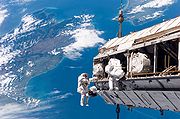
- The first EVA to perform an in-flight repair of the Space Shuttle was by American Steve RobinsonStephen RobinsonStephen Kern Robinson is a NASA astronaut. He was born October 26, 1955, in Sacramento, California.He enjoys flying, antique aircraft, swimming, canoeing, hiking, music, art, and stereo photography. He plays lead guitar in Max Q, a rock and roll band...
on August 3, 2005, during "Return to Flight" mission STS-114STS-114-Original crew:This mission was to carry the Expedition 7 crew to the ISS and bring home the Expedition 6 crew. The original crew was to be:-Mission highlights:...
. Robinson was sent to remove two protruding gap fillers from DiscoverySpace Shuttle DiscoverySpace Shuttle Discovery is one of the retired orbiters of the Space Shuttle program of NASA, the space agency of the United States, and was operational from its maiden flight, STS-41-D on August 30, 1984, until its final landing during STS-133 on March 9, 2011...
's heat shield, after engineers determined there was a small chance they could affect the shuttle upon re-entry. Robinson successfully removed the loose material while Discovery was docked to the International Space StationInternational Space StationThe International Space Station is a habitable, artificial satellite in low Earth orbit. The ISS follows the Salyut, Almaz, Cosmos, Skylab, and Mir space stations, as the 11th space station launched, not including the Genesis I and II prototypes...
.
- The longest EVA as of 2007, was 8 hours and 56 minutes, performed by Susan J. HelmsSusan J. HelmsSusan Jane Helms is a Lieutenant General in the United States Air Force and a former NASA astronaut. She is currently the Commander, 14th Air Force ; and Commander, Joint Functional Component Command for Space at Vandenberg Air Force Base in California...
and James S. VossJames S. VossJames Shelton Voss is the Vice President of Engineering at SpaceDev. He is a retired U.S. Army Colonel and NASA astronaut. During his time with NASA, Voss flew in space five times on board the Space Shuttle and International Space Station...
on March 11, 2001.
 |
 |
 |
Personal cumulative duration records
- Russian Anatoly SolovyevAnatoly SolovyevAnatoly Yakovlevich Solovyev is a former Soviet pilot, cosmonaut, and Colonel. Solovyev holds the world record on the number of spacewalks performed , and accumulated time spent spacewalking .- Family :...
holds both the record for most EVAs and for the greatest cumulative duration spent in EVA (16 EVAs; 82 hr and 22 min). - Michael Lopez-AlegriaMichael Lopez-AlegriaMichael Eladio "LA" López-Alegría b. May 30, 1958, is a Spanish-American astronaut; a veteran of three Space Shuttle missions and one International Space Station mission...
holds the American record (10 EVAs; 67 hr and 40 min). - Christer FuglesangChrister FuglesangDr. Arne Christer Fuglesang is a Swedish physicist and an ESA astronaut. He was first launched aboard the STS-116 Space Shuttle mission on December 10, 2006, at 01:47 GMT, making him the first Swedish citizen in space....
holds the European (non-Russian) record (5 EVAs; 31 hr and 55 min).
National, ethnic and gender firsts
- The first woman to perform an EVA was Soviet Svetlana SavitskayaSvetlana SavitskayaSvetlana Yevgenyevna Savitskaya She started training as a cosmonaut in 1980. Upon returning to Earth, Savitskaya was assigned as the commander of an all-female Soyuz crew to Salyut 7 in commemoration of the International Women's Day, a mission that was later canceled.She was twice awarded the Hero...
on July 25, 1984 while aboard the Salyut 7Salyut 7Salyut 7 was a space station in low Earth orbit from April 1982 to February 1991. It was first manned in May 1982 with two crew via Soyuz T-5, and last visited in June 1986, by Soyuz T-15. Various crew and modules were used over its lifetime, including a total of 12 manned and 15 unmanned launches...
space station. Her EVA lasted 3 hours and 35 minutes. - The first American woman to perform an EVA was Kathryn D. SullivanKathryn D. SullivanKathryn Dwyer Sullivan is an American geologist and a former NASA astronaut. A crew member on three Space Shuttle missions, she is the first American woman to walk in space.-Education:...
on October 11, 1984 during Space ShuttleSpace ShuttleThe Space Shuttle was a manned orbital rocket and spacecraft system operated by NASA on 135 missions from 1981 to 2011. The system combined rocket launch, orbital spacecraft, and re-entry spaceplane with modular add-ons...
ChallengerSpace Shuttle ChallengerSpace Shuttle Challenger was NASA's second Space Shuttle orbiter to be put into service, Columbia having been the first. The shuttle was built by Rockwell International's Space Transportation Systems Division in Downey, California...
mission STS-41-GSTS-41-GSTS 41-G was the 13th flight of NASA's Space Shuttle program and the sixth flight of Space Shuttle Challenger. Challenger launched on 5 October 1984, and conducted the second shuttle landing at Kennedy Space Center on 13 October...
. - The first EVA by a non-Soviet, non-American was made on December 9, 1988 by Jean-Loup ChrétienJean-Loup ChrétienJean-Loup Jacques Marie Chrétien, is a French engineer, a retired Général de Brigade in the Armée de l'Air , and a former CNES astronaut. He flew on two Franco-Soviet space missions and a NASA Space Shuttle mission...
of FranceFranceThe French Republic , The French Republic , The French Republic , (commonly known as France , is a unitary semi-presidential republic in Western Europe with several overseas territories and islands located on other continents and in the Indian, Pacific, and Atlantic oceans. Metropolitan France...
during a three-week stay on the MirMirMir was a space station operated in low Earth orbit from 1986 to 2001, at first by the Soviet Union and then by Russia. Assembled in orbit from 1986 to 1996, Mir was the first modular space station and had a greater mass than that of any previous spacecraft, holding the record for the...
space station. - The first EVA by a Briton was on February 9, 1995 by Michael FoaleMichael FoaleColin Michael Foale, CBE, PhD is a British-American astrophysicist with dual citizenship and a NASA astronaut. He is a veteran of six space shuttle missions and extended stays on both Mir and the International Space Station...
(who carries dual British-American citizenship). - The first EVA by a black African-American was on February 9, 1995 by Bernard A. Harris, Jr.Bernard A. Harris, Jr.Bernard Anthony Harris, Jr. is a former NASA astronaut. On February 9, 1995, Harris became the first African American to perform an extra-vehicular activity , during the second of his two Space Shuttle flights....
. - The first EVA by an Australian-born person was on March 13, 2001 by Andy ThomasAndy ThomasAndrew "Andy" Sydney Withiel Thomas is an Australian-born American aerospace engineer and a NASA astronaut. He became a U.S. citizen in December 1986, hoping to gain entry to NASA's astronaut program...
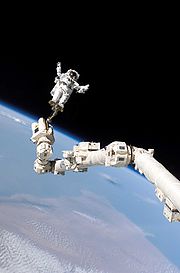
(although he is a naturalized US citizen). - The first EVA by a Canadian was made on April 22, 2001 by Chris HadfieldChris HadfieldChris Austin "Chris" Hadfield, O.Ont, MSC, CD is a Canadian astronaut from the Canadian Space Agency who was the first Canadian to walk in space. Hadfield has flown two space shuttle missions, STS-74 in 1995 and STS-100 in 2001. He has served as CAPCOM for both Space Shuttle and International...
. During his spacewalk, Hadfield installed the Canadarm2 onto the International Space StationInternational Space StationThe International Space Station is a habitable, artificial satellite in low Earth orbit. The ISS follows the Salyut, Almaz, Cosmos, Skylab, and Mir space stations, as the 11th space station launched, not including the Genesis I and II prototypes...
. - The first EVA by a Chinese astronaut was made on September 27, 2008 by Zhai ZhigangZhai ZhigangZhai Zhigang is an officer in the People's Liberation Army Air Force and a CNSA astronaut. During the Shenzhou 7 mission in 2008, he became the first Chinese citizen to carry out a spacewalk.-Early career:...
during Shenzhou 7Shenzhou 7- Backup crew :Of the back-up crew, only Chen Quan had not previously flown in space.- Mission highlights :The Long March 2F rocket launched the Shenzhou 7 into an initial elliptical orbit of 200 x 330 kilometres inclined at 42.4 degrees on 25 September 2008. About seven hours later the spacecraft...
mission. The spacewalk, using a Feitian space suitFeitian space suitA Feitian space suit is a Chinese spacesuit that was developed for the Shenzhou 7. Astronaut Zhai Zhigang wore it during China's first-ever extra-vehicular activity on September 27, 2008....
, made China the third country to independently carry out an EVA. - The first EVA by a Japanese astronaut was made on November 25, 1997 by Doi Takao during STS-87STS-87STS-87 was a Space Shuttle mission launched from KSC pad 39-B on 19 November 1997. It was the 88th flight of the Space Shuttle, and the 24th flight of Columbia...
. During his spacewalk, Doi conducted experiments from the International Space StationInternational Space StationThe International Space Station is a habitable, artificial satellite in low Earth orbit. The ISS follows the Salyut, Almaz, Cosmos, Skylab, and Mir space stations, as the 11th space station launched, not including the Genesis I and II prototypes...
.
 |
Commemoration
The first spacewalk, that of the soviet cosmonaut Alexey Leonov was conmemorated in several eastern bloc stamps (see the stamps section in Alexey Leonov article). As the Soviet Union did not distributed diagrammmes nor images of the Voskhod spacecraft at the time, the spaceship depiction in the stamps were purely fictional.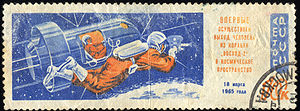
Designations
NASA "spacewalkers" during the space shuttle program were designated as EV-1, EV-2, EV-3 and EV-4 (assiged to mission specialists for each mission, if applicable).Camp-out procedure
For EVAs from the International Space Station, NASA now routinely employs a camp out procedure to reduce the risk of decompression sickness. This was first tested by the Expedition 12 crew. During a camp out, astronauts sleep overnight prior to an EVA in the airlock, and lower the air pressure to 10.2 psi (70.3 kPa), compared to the normal station pressure of 14.7 psi (101.4 kPa). Spending a night at the lower air pressure helps flush nitrogen from the body, thereby preventing "the bendsDecompression sickness
Decompression sickness describes a condition arising from dissolved gases coming out of solution into bubbles inside the body on depressurization...
".
See also
- List of cumulative spacewalk records
- List of ISS spacewalks
- List of Mir spacewalks
- List of spacewalkers
- List of spacewalks and moonwalks 1965-1999
- List of spacewalks since 2000
- Manned Maneuvering UnitManned Maneuvering UnitThe Manned Maneuvering Unit is an astronaut propulsion unit which was used by NASA on three space shuttle missions in 1984. The MMU allowed the astronauts to perform untethered EVA spacewalks at a distance from the shuttle. The MMU was used in practice to retrieve a pair of faulty communications...
- Omega Speedmaster
- Simplified Aid for EVA RescueSimplified Aid for EVA RescueSimplified Aid for EVA Rescue is a small, self-contained, propulsive backpack system used to provide free-flying mobility for a Space Shuttle or International Space Station crewmember during extra-vehicular activity...
- Space suitSpace suitA space suit is a garment worn to keep an astronaut alive in the harsh environment of outer space. Space suits are often worn inside spacecraft as a safety precaution in case of loss of cabin pressure, and are necessary for extra-vehicular activity , work done outside spacecraft...
- SuitportSuitportA suitport or suitlock is a proposed alternative to an airlock, designed for use in hazardous environments and in human spaceflight, especially planetary surface exploration.-Operation:...
External links
- NASA JSC Oral History Project Walking to Olympus: An EVA Chronology PDF document.
- NASDA Online Space Notes
- Apollo Extravehicular mobility unit. Volume 1: System description - 1971 (PDF document)
- Apollo Extravehicular mobility unit. Volume 2: Operational procedures - 1971 (PDF document)
- Skylab Extravehicular Activity Development Report - 1974 (PDF document)
- Analysis of the Space Shuttle Extravehicular Mobility Unit - 1986 (PDF document)
- NASA Space Shuttle EVA tools and equipment reference book - 1993 (PDF document)
- Preparing for an American EVA on the ISS - 2006