

Salyut 6

Encyclopedia
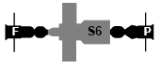
Salyut 6 DOS-5, was a Soviet
orbital space station, the eighth flown as part of the Salyut programme. Launched on 29 September 1977 by a Proton rocket, the station was the first of the 'second-generation' type of space station
. Salyut 6 possessed several revolutionary advances over the earlier Soviet space stations, which it nevertheless resembled in overall design. These included the addition of a second docking port, a new main propulsion system and the station's primary scientific instrument, the BST-1M multispectral telescope. The addition of the second docking port made crew handovers and station resupply by unmanned Progress
freighters possible for the first time, which in turn allowed the programme to evolve from short-duration station visits to long-duration expeditions, marking the beginning of the transition to multi-modular, long-term research stations in space.
From 1977 until 1982, Salyut 6 was visited by five long- and eleven short-duration crews, including cosmonauts from Warsaw Pact
countries as part of the Intercosmos
programme. These crews were responsible for carrying out the primary missions of Salyut 6, including astronomy, Earth-resources observations and the study of human adaptation to space
. Following the completion of these missions and the launch of its successor, Salyut 7
, Salyut 6 was deorbited on 29 July 1982, almost five years after its launch.
, as was its power system, which consisted of a trio of steerable solar panels
together producing a peak of 4 kilowatts of power over 51 m². The station's thermal regulation systems, which made use of a sophisticated arrangement of insulation and radiators, was also derived from that used on Salyut 4. In addition, Salyut 6 made use of environmental systems first used on Salyut 3
, and controlled its orientation using gyrodenes first tested on that station.
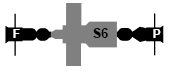 The most important feature on Salyut 6, however, was the addition of a second docking port on the aft end of the station, which allowed two spacecraft to be docked at once. This, in turn, allowed resident crews to receive shorter, 'visiting' expeditions whilst they remained on board, and for crew handovers to take place. Such handovers, with one expedition vacating the station only after the next had arrived, permitted the long sought-after aim of continuous occupation to move a step closer. The very first long-duration crew to visit the station broke a long-standing endurance record set on board the American Skylab
station, staying 96 days in orbit, whilst the longest expedition lasted 185 days. Some of the visiting expeditions were flown as part of the Intercosmos
programme, with non-Soviet cosmonauts visiting the station. Vladimír Remek
of Czechoslovakia
, the first space traveller
not from the US or USSR, visited Salyut 6 in 1978, and the station hosted cosmonauts from Hungary
, Poland
, Romania
, Cuba
, Mongolia
, Vietnam
, and East Germany.
The rearward of the two ports was fitted with plumbing to allow the station to be refuelled by unmanned Progress spacecraft
. These freighters, which brought supplies and extra equipment to keep the station replenished, helped ensure that the crew were always able to carry out useful scientific work aboard the station. In all, twelve Progress flights delivered over 20 tonnes of equipment, supplies and fuel.
The addition of the extra docking port caused the adoption of the Almaz
-derived twin-chamber propulsion system first used on Salyut 3 and 5
, with the two engine nozzles—each producing 2.9 kilonewtons of thrust—mounted peripherally on either side of the aft port. Salyut 6 introduced a Unified Propulsion System, with both the engines and the station's control thrusters running on unsymmetrical dimethylhydrazine and nitrogen tetroxide
, drawn from a common set of pressurised tanks, allowing the refuelling capabilities of the visiting Progress tankers to be exploited to the maximum effect. The entire engine and fuel storage assembly was contained within an unpressurised bay at the rear of the station, which was the same diameter as the main pressurised compartment. However, the replacement of the Soyuz
engine used on previous stations with the bay meant that the station kept a similar overall length to its predecessors.
To enable spacewalk
s, Salyut 6 was equipped with an inward-opening EVA hatch for on the side of the forward transfer compartment, which could be used as an airlock in a similar way to the system used on Salyut 4. This compartment contained two new semi-rigid spacesuits which allowed much greater flexibility than earlier suits, and could be donned within five minutes in case of an emergency. Finally, the station offered considerable improvements in living conditions over previous outposts, with machinery being soundproofed, the crews being provided with designated 'cots' for sleeping and the equipping of the station with a shower and extensive gymnasium.
The second major instrument was the MKF-6M multispectral camera, which carried out Earth-resources observations. An improved form of a camera first tested on Soyuz 22
, the camera captured an area of 165×220 kilometres with each image, down to a resolution of 20 metres. Each image was captured simultaneously in six bands in 1200-frame cassettes, which required regular replacement due to the fogging effects of radiation. Salyut 6 also featured a KATE-140 stereoscopic topographic map
ping camera with a focal length
of 140 milimetres, which captured images of 450×450 kilometres with a resolution of 50 metres in the visible and infrared spectra, which could be operated either remotely or by the resident crews. The photographic capabilities of the station were, therefore, extensive, and the Soviet Ministry of Agriculture had planted a number of specifically selected crops at test sites at Salsky in the Ukraine
and Voronezh
near Lake Baikal
to examine the capabilities of the cameras.
To further expand its scientific capabilities, Salyut 6 was equipped with 20 portholes for observations, two scientific airlocks to expose equipment to space or eject rubbish, and various pieces of apparatus to carry out biological experiments. Later on during the flight, a Progress spacecraft delivered an external telescope, the KRT-10 radio observatory, which incorporated a directional antenna
and five radiometer
s. The antenna was deployed on the rear docking assembly, with the controller remaining inside the station, and was used for both astronomical and meteorological observations.
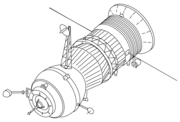 Salyut 6 was primarily supported by the manned Soyuz spacecraft
, which carried out crew rotations and would also have been used in the event of an emergency evacuation. The ferries docked automatically to the station, making use of the new Igla automatic docking system, and were used by departing crews to return to Earth at the end of their flight.
The station was the first to be able to be resupplied by the newly developed unmanned Progress
freighters, although they could only dock at the rear port, as the plumbing which allowed the spacecraft to replenish the station's fluids was not available at the front port. The freighters docked automatically to the station via the Igla, and were then opened and emptied by the cosmonauts on board, whilst transfer of fuel to the station took place automatically under supervision from the ground.
In addition to the Soyuz and Progress spacecraft, after the final crew had left, Salyut 6 was visited by an experimental transport logistics spacecraft called Cosmos 1267
in 1982. The transport logistics spacecraft, known as the TKS
, was originally designed for the Almaz
programme, and proved that large modules could dock automatically with space stations, a major step toward the construction of multimodular stations such as Mir
and the International Space Station
.
Dates and times are 24-hour Moscow Time
. Source:
Dates and times are 24-hour Coordinated Universal Time
.
Dates and times are 24-hour Coordinated Universal Time
. Source:
Soviet Union
The Soviet Union , officially the Union of Soviet Socialist Republics , was a constitutionally socialist state that existed in Eurasia between 1922 and 1991....
orbital space station, the eighth flown as part of the Salyut programme. Launched on 29 September 1977 by a Proton rocket, the station was the first of the 'second-generation' type of space station
Space station
A space station is a spacecraft capable of supporting a crew which is designed to remain in space for an extended period of time, and to which other spacecraft can dock. A space station is distinguished from other spacecraft used for human spaceflight by its lack of major propulsion or landing...
. Salyut 6 possessed several revolutionary advances over the earlier Soviet space stations, which it nevertheless resembled in overall design. These included the addition of a second docking port, a new main propulsion system and the station's primary scientific instrument, the BST-1M multispectral telescope. The addition of the second docking port made crew handovers and station resupply by unmanned Progress
Progress spacecraft
The Progress is a Russian expendable freighter spacecraft. The spacecraft is an unmanned resupply spacecraft during its flight but upon docking with a space station, it allows astronauts inside, hence it is classified manned by the manufacturer. It was derived from the Soyuz spacecraft, and is...
freighters possible for the first time, which in turn allowed the programme to evolve from short-duration station visits to long-duration expeditions, marking the beginning of the transition to multi-modular, long-term research stations in space.
From 1977 until 1982, Salyut 6 was visited by five long- and eleven short-duration crews, including cosmonauts from Warsaw Pact
Warsaw Pact
The Warsaw Treaty Organization of Friendship, Cooperation, and Mutual Assistance , or more commonly referred to as the Warsaw Pact, was a mutual defense treaty subscribed to by eight communist states in Eastern Europe...
countries as part of the Intercosmos
Intercosmos
Interkosmos was a space program of the Soviet Union designed to include members of military forces of allied Warsaw Pact countries in manned and unmanned missions...
programme. These crews were responsible for carrying out the primary missions of Salyut 6, including astronomy, Earth-resources observations and the study of human adaptation to space
Human adaptation to space
Human physiological adaptation to the conditions of space is a challenge faced in the development of human spaceflight.The fundamental engineering problems of escaping Earth's gravity well and developing systems for in-space propulsion have been examined for well over a century, and millions of...
. Following the completion of these missions and the launch of its successor, Salyut 7
Salyut 7
Salyut 7 was a space station in low Earth orbit from April 1982 to February 1991. It was first manned in May 1982 with two crew via Soyuz T-5, and last visited in June 1986, by Soyuz T-15. Various crew and modules were used over its lifetime, including a total of 12 manned and 15 unmanned launches...
, Salyut 6 was deorbited on 29 July 1982, almost five years after its launch.
Description
Salyut 6, launched on a Proton 8K82K rocket on 29 September 1977, marked the switch from engineering development stations to routine operations, and united the most effective elements from each of the previous stations. Its navigation system, made up of the Delta semi-automatic computer to depict the station's orbit and the Kaskad system to control its orientation, was based on that used on Salyut 4Salyut 4
Salyut 4 was a Salyut space station launched on December 26, 1974 into an orbit with an apogee of 355 km, a perigee of 343 km and an orbital inclination of 51.6 degrees. It was essentially a copy of the DOS 3, and unlike its ill-fated sibling it was a complete success...
, as was its power system, which consisted of a trio of steerable solar panels
Photovoltaic module
A solar panel is a packaged, connected assembly of solar cells, also known as photovoltaic cells...
together producing a peak of 4 kilowatts of power over 51 m². The station's thermal regulation systems, which made use of a sophisticated arrangement of insulation and radiators, was also derived from that used on Salyut 4. In addition, Salyut 6 made use of environmental systems first used on Salyut 3
Salyut 3
Salyut 3 was a Soviet space station launched on June 25, 1974. It was the second Almaz military space station, and the first such station to be launched successfully. It was included in the Salyut program to disguise its true military nature...
, and controlled its orientation using gyrodenes first tested on that station.
Skylab
Skylab was a space station launched and operated by NASA, the space agency of the United States. Skylab orbited the Earth from 1973 to 1979, and included a workshop, a solar observatory, and other systems. It was launched unmanned by a modified Saturn V rocket, with a mass of...
station, staying 96 days in orbit, whilst the longest expedition lasted 185 days. Some of the visiting expeditions were flown as part of the Intercosmos
Intercosmos
Interkosmos was a space program of the Soviet Union designed to include members of military forces of allied Warsaw Pact countries in manned and unmanned missions...
programme, with non-Soviet cosmonauts visiting the station. Vladimír Remek
Vladimír Remek
Vladimír Remek is the first Czechoslovak in space and the first cosmonaut from a country other than the Soviet Union or the United States. As of 2004, with the entry of the Czech Republic into the European Union Vladimír Remek is considered to be the first astronaut from the EU...
of Czechoslovakia
Czechoslovakia
Czechoslovakia or Czecho-Slovakia was a sovereign state in Central Europe which existed from October 1918, when it declared its independence from the Austro-Hungarian Empire, until 1992...
, the first space traveller
Astronaut
An astronaut or cosmonaut is a person trained by a human spaceflight program to command, pilot, or serve as a crew member of a spacecraft....
not from the US or USSR, visited Salyut 6 in 1978, and the station hosted cosmonauts from Hungary
Hungary
Hungary , officially the Republic of Hungary , is a landlocked country in Central Europe. It is situated in the Carpathian Basin and is bordered by Slovakia to the north, Ukraine and Romania to the east, Serbia and Croatia to the south, Slovenia to the southwest and Austria to the west. The...
, Poland
Poland
Poland , officially the Republic of Poland , is a country in Central Europe bordered by Germany to the west; the Czech Republic and Slovakia to the south; Ukraine, Belarus and Lithuania to the east; and the Baltic Sea and Kaliningrad Oblast, a Russian exclave, to the north...
, Romania
Romania
Romania is a country located at the crossroads of Central and Southeastern Europe, on the Lower Danube, within and outside the Carpathian arch, bordering on the Black Sea...
, Cuba
Cuba
The Republic of Cuba is an island nation in the Caribbean. The nation of Cuba consists of the main island of Cuba, the Isla de la Juventud, and several archipelagos. Havana is the largest city in Cuba and the country's capital. Santiago de Cuba is the second largest city...
, Mongolia
Mongolia
Mongolia is a landlocked country in East and Central Asia. It is bordered by Russia to the north and China to the south, east and west. Although Mongolia does not share a border with Kazakhstan, its western-most point is only from Kazakhstan's eastern tip. Ulan Bator, the capital and largest...
, Vietnam
Vietnam
Vietnam – sometimes spelled Viet Nam , officially the Socialist Republic of Vietnam – is the easternmost country on the Indochina Peninsula in Southeast Asia. It is bordered by China to the north, Laos to the northwest, Cambodia to the southwest, and the South China Sea –...
, and East Germany.
The rearward of the two ports was fitted with plumbing to allow the station to be refuelled by unmanned Progress spacecraft
Progress spacecraft
The Progress is a Russian expendable freighter spacecraft. The spacecraft is an unmanned resupply spacecraft during its flight but upon docking with a space station, it allows astronauts inside, hence it is classified manned by the manufacturer. It was derived from the Soyuz spacecraft, and is...
. These freighters, which brought supplies and extra equipment to keep the station replenished, helped ensure that the crew were always able to carry out useful scientific work aboard the station. In all, twelve Progress flights delivered over 20 tonnes of equipment, supplies and fuel.
The addition of the extra docking port caused the adoption of the Almaz
Almaz
The Almaz program was a series of military space stations launched by the Soviet Union under cover of the civilian Salyut DOS-17K program after 1971....
-derived twin-chamber propulsion system first used on Salyut 3 and 5
Salyut 5
Salyut 5 , also known as OPS-3, was a Soviet space station. Launched in 1976 as part of the Salyut programme, it was the third and last Almaz space station to be launched for the Soviet military. Two Soyuz missions visited the station, each manned by two cosmonauts...
, with the two engine nozzles—each producing 2.9 kilonewtons of thrust—mounted peripherally on either side of the aft port. Salyut 6 introduced a Unified Propulsion System, with both the engines and the station's control thrusters running on unsymmetrical dimethylhydrazine and nitrogen tetroxide
Dinitrogen tetroxide
Dinitrogen tetroxide is the chemical compound N2O4. It is a useful reagent in chemical synthesis. It forms an equilibrium mixture with nitrogen dioxide; some call this mixture dinitrogen tetroxide, while some call it nitrogen dioxide.Dinitrogen tetroxide is a powerful oxidizer, making it highly...
, drawn from a common set of pressurised tanks, allowing the refuelling capabilities of the visiting Progress tankers to be exploited to the maximum effect. The entire engine and fuel storage assembly was contained within an unpressurised bay at the rear of the station, which was the same diameter as the main pressurised compartment. However, the replacement of the Soyuz
Soyuz spacecraft
Soyuz , Union) is a series of spacecraft initially designed for the Soviet space programme by the Korolyov Design Bureau in the 1960s, and still in service today...
engine used on previous stations with the bay meant that the station kept a similar overall length to its predecessors.
To enable spacewalk
Extra-vehicular activity
Extra-vehicular activity is work done by an astronaut away from the Earth, and outside of a spacecraft. The term most commonly applies to an EVA made outside a craft orbiting Earth , but also applies to an EVA made on the surface of the Moon...
s, Salyut 6 was equipped with an inward-opening EVA hatch for on the side of the forward transfer compartment, which could be used as an airlock in a similar way to the system used on Salyut 4. This compartment contained two new semi-rigid spacesuits which allowed much greater flexibility than earlier suits, and could be donned within five minutes in case of an emergency. Finally, the station offered considerable improvements in living conditions over previous outposts, with machinery being soundproofed, the crews being provided with designated 'cots' for sleeping and the equipping of the station with a shower and extensive gymnasium.
Instruments
The primary instrument carried aboard the station was the BST-1M multispectral telescope, which could carry out astronomical observations in the infrared, ultraviolet and submillimetre spectra using a 1.5 metre-diameter mirror which was operated in cryogenic conditions at around −269 °C. The telescope could be operated only when Salyut 6 was on the night side of the Earth, and had its cover closed for the rest of the time.The second major instrument was the MKF-6M multispectral camera, which carried out Earth-resources observations. An improved form of a camera first tested on Soyuz 22
Soyuz 22
Soyuz 22 was 1976 Soviet manned spaceflight. It was an earth-sciences mission using a modified Soyuz spacecraft, and was also, some observers speculated, a mission to observe NATO exercises near Norway....
, the camera captured an area of 165×220 kilometres with each image, down to a resolution of 20 metres. Each image was captured simultaneously in six bands in 1200-frame cassettes, which required regular replacement due to the fogging effects of radiation. Salyut 6 also featured a KATE-140 stereoscopic topographic map
Topographic map
A topographic map is a type of map characterized by large-scale detail and quantitative representation of relief, usually using contour lines in modern mapping, but historically using a variety of methods. Traditional definitions require a topographic map to show both natural and man-made features...
ping camera with a focal length
Focal length
The focal length of an optical system is a measure of how strongly the system converges or diverges light. For an optical system in air, it is the distance over which initially collimated rays are brought to a focus...
of 140 milimetres, which captured images of 450×450 kilometres with a resolution of 50 metres in the visible and infrared spectra, which could be operated either remotely or by the resident crews. The photographic capabilities of the station were, therefore, extensive, and the Soviet Ministry of Agriculture had planted a number of specifically selected crops at test sites at Salsky in the Ukraine
Ukraine
Ukraine is a country in Eastern Europe. It has an area of 603,628 km², making it the second largest contiguous country on the European continent, after Russia...
and Voronezh
Voronezh
Voronezh is a city in southwestern Russia, the administrative center of Voronezh Oblast. It is located on both sides of the Voronezh River, away from where it flows into the Don. It is an operating center of the Southeastern Railway , as well as the center of the Don Highway...
near Lake Baikal
Lake Baikal
Lake Baikal is the world's oldest at 30 million years old and deepest lake with an average depth of 744.4 metres.Located in the south of the Russian region of Siberia, between Irkutsk Oblast to the northwest and the Buryat Republic to the southeast, it is the most voluminous freshwater lake in the...
to examine the capabilities of the cameras.
To further expand its scientific capabilities, Salyut 6 was equipped with 20 portholes for observations, two scientific airlocks to expose equipment to space or eject rubbish, and various pieces of apparatus to carry out biological experiments. Later on during the flight, a Progress spacecraft delivered an external telescope, the KRT-10 radio observatory, which incorporated a directional antenna
Directional antenna
A directional antenna or beam antenna is an antenna which radiates greater power in one or more directions allowing for increased performance on transmit and receive and reduced interference from unwanted sources....
and five radiometer
Radiometer
A radiometer is a device for measuring the radiant flux of electromagnetic radiation. Generally, the term radiometer denotes an infrared radiation detector, yet it also includes detectors operating on any electromagnetic wavelength....
s. The antenna was deployed on the rear docking assembly, with the controller remaining inside the station, and was used for both astronomical and meteorological observations.
Support craft
Soyuz spacecraft
Soyuz , Union) is a series of spacecraft initially designed for the Soviet space programme by the Korolyov Design Bureau in the 1960s, and still in service today...
, which carried out crew rotations and would also have been used in the event of an emergency evacuation. The ferries docked automatically to the station, making use of the new Igla automatic docking system, and were used by departing crews to return to Earth at the end of their flight.
The station was the first to be able to be resupplied by the newly developed unmanned Progress
Progress spacecraft
The Progress is a Russian expendable freighter spacecraft. The spacecraft is an unmanned resupply spacecraft during its flight but upon docking with a space station, it allows astronauts inside, hence it is classified manned by the manufacturer. It was derived from the Soyuz spacecraft, and is...
freighters, although they could only dock at the rear port, as the plumbing which allowed the spacecraft to replenish the station's fluids was not available at the front port. The freighters docked automatically to the station via the Igla, and were then opened and emptied by the cosmonauts on board, whilst transfer of fuel to the station took place automatically under supervision from the ground.
In addition to the Soyuz and Progress spacecraft, after the final crew had left, Salyut 6 was visited by an experimental transport logistics spacecraft called Cosmos 1267
Cosmos 1267
Kosmos 1267 was an unmanned TKS spacecraft which docked to the Soviet space station Salyut 6 as part of tests to attach scientific expansion modules to stations in Earth orbit. The module which docked to the station was the FGB component of a TKS vehicle launched on April 25, 1981. The...
in 1982. The transport logistics spacecraft, known as the TKS
TKS spacecraft
TKS spacecraft was a Soviet spacecraft design in the late 1960s intended to supply the military Almaz space station. The spacecraft was designed for manned or autonomous cargo resupply use...
, was originally designed for the Almaz
Almaz
The Almaz program was a series of military space stations launched by the Soviet Union under cover of the civilian Salyut DOS-17K program after 1971....
programme, and proved that large modules could dock automatically with space stations, a major step toward the construction of multimodular stations such as Mir
Mir
Mir was a space station operated in low Earth orbit from 1986 to 2001, at first by the Soviet Union and then by Russia. Assembled in orbit from 1986 to 1996, Mir was the first modular space station and had a greater mass than that of any previous spacecraft, holding the record for the...
and the International Space Station
International Space Station
The International Space Station is a habitable, artificial satellite in low Earth orbit. The ISS follows the Salyut, Almaz, Cosmos, Skylab, and Mir space stations, as the 11th space station launched, not including the Genesis I and II prototypes...
.
Resident crews
The station received 16 cosmonaut crews, including six long-duration crews, with the longest expedition lasting 185 days. Resident crew missions were identified with an EO prefix, whilst short-duration missions were identified with EP.- On 10 December 1977 the first resident crew, Yuri RomanenkoYuri RomanenkoYury Viktorovich Romanenko is a former Soviet cosmonaut, twice Hero of the Soviet Union . Over his career, Yury Romanenko spent a total of 430 days 20 hours 21 minutes 30 seconds in space and 18 hours in space walks. In 1987 he was a resident of the Mir space station, launching on Soyuz TM-2 and...
and Georgi GrechkoGeorgi GrechkoGeorgy Mikhaylovich Grechko is a retired Soviet cosmonaut who flew on several space flights among which Soyuz 17, Soyuz 26, and Soyuz T-14.Grechko graduated from the Leningrad Institute of Mechanics with a doctorate in mathematics. He was a member of Communist Party of Soviet Union...
, arrived on Soyuz 26Soyuz 26Soyuz 26 was Soviet manned mission, used to launch the crew of Salyut 6 EO-1, the first long duration crew on the space station Salyut 6.The Soyuz spacecraft was launched on December 10, 1977, and docked with the space station the next day...
and remained aboard Salyut 6 for 96 days. - On 15 June 1978, Vladimir KovalyonokVladimir Kovalyonok-Honours and awards:* Hero of the Soviet Union, twice * Order of Merit for the Fatherland, 3rd class * Order of Military Merit * Three Orders of Lenin...
and Aleksandr IvanchenkovAleksandr IvanchenkovAleksandr Sergeyevich Ivanchenkov is a retired Soviet cosmonaut who flew as Flight Engineer on Soyuz 29 and Soyuz T-6, he spent 147 days, 12 hours and 37 minutes in space....
(Soyuz 29Soyuz 29Soyuz 29 was a 1978 manned Soviet space mission to the Salyut 6 space station. It was the fifth mission, the fourth successful docking, and the second long-duration crew for the orbiting station...
) arrived and remained on board for 140 days. - Vladimir LyakhovVladimir LyakhovVladimir Afanasyevich Lyakhov , Ukrainian SSR), Soviet Union on July 20, 1941) is a former Soviet cosmonaut, twice named a Hero of the Soviet Union....
and Valery RyuminValery RyuminValery Victorovich Ryumin, born August 16, 1939 in Komsomolsk-on-Amur) is a former Soviet cosmonaut.In 1958, he was graduated from the Kaliningrad Mechanical Engineering Technical College with the specialty "Cold Working of Metal." In 1966, he was graduated from the Department of Electronics and...
(Soyuz 32Soyuz 32-Backup crew:-Mission parameters:*Mass: *Perigee: *Apogee: *Inclination: 51.61°*Period: 89.94 minutes-Launch and station activation:...
) arrived on 25 February 1979 and stayed 175 days. - On 9 April 1980 Leonid PopovLeonid PopovLeonid Ivanovich Popov is a former Soviet cosmonaut.Popov was born in Oleksandriia, Kirovohrad Oblast, Ukrainian SSR. He was selected as a cosmonaut on April 27, 1970, and flew as Commander on Soyuz 35, Soyuz 40 and Soyuz T-7, logging 200 days, 14 hours, and 45 minutes in space before his...
and Valery RyuminValery RyuminValery Victorovich Ryumin, born August 16, 1939 in Komsomolsk-on-Amur) is a former Soviet cosmonaut.In 1958, he was graduated from the Kaliningrad Mechanical Engineering Technical College with the specialty "Cold Working of Metal." In 1966, he was graduated from the Department of Electronics and...
(Soyuz 35Soyuz 35-Backup crew:-Mission parameters:*Mass: *Perigee: *Apogee: *Inclination: 51.65°*Period: 88.81 minutes-Crew launch, station activation:...
) arrived for the longest stay on Salyut 6, 185 days. While aboard, on 19 July, they sent their greetings to the Olympians and wished them happy starts in the live communicationLive televisionLive television refers to a television production broadcast in real-time, as events happen, in the present. From the early days of television until about 1958, live television was used heavily, except for filmed shows such as I Love Lucy and Gunsmoke. Video tape did not exist until 1957...
between the station and the Central Lenin StadiumLuzhnikiLuzhniki may refer to:*Luzhniki , a village in Moscow Oblast, Russia*Luzhniki Olympic Complex, sport complex in Moscow, Russia.**Luzhniki Palace of Sports, an arena in Luzhniki Olympic Complex...
, where the opening ceremony of the 1980 Summer Olympics1980 Summer OlympicsThe 1980 Summer Olympics, officially known as the Games of the XXII Olympiad, was an international multi-sport event celebrated in Moscow in the Soviet Union. In addition, the yachting events were held in Tallinn, and some of the preliminary matches and the quarter-finals of the football tournament...
was held. They appeared on the stadium's scoreboardScoreboardA scoreboard is a large board for publicly displaying the score in a game or match. Most levels of sport from high school and above use at least one scoreboard for keeping score, measuring time, and displaying statistics. Scoreboards in the past used a mechanical clock and numeral cards to...
and their voices were translated via loud speakerLoud SpeakerLoud Speaker is a play by American playwright John Howard Lawson. It was first produced by the New Playwrights' Theatre at the 52nd Street Theatre in New York, opening on March 2 1927. Harry Wagstaff Gribble directed, Mordecai Gorelik designed the sets, Eugene L. Berton composed its music, and...
s. - A repair mission, consisting of Leonid KizimLeonid KizimLeonid Denisovich Kizim was a Soviet cosmonaut who was twice named a Hero of the Soviet Union ....
, Oleg Makarov, and Gennady StrekalovGennady StrekalovGennadi Mikhailovich Strekalov was an Instructor-Test-Cosmonaut and Department Head at Russian aerospace firm RSC Energia. He has been decorated twice as Hero of the Soviet Union...
(Soyuz T-3Soyuz T-3-Backup crew:-Mission parameters:*Mass: 6850 kg*Perigee: 200 km*Apogee: 251 km*Inclination: 51.6°*Period: 88.7 minutes-Mission highlights:...
) worked on the space station for 12 days starting on 27 November 1980. - On 12 March 1981 the last resident crew, Vladimir KovalyonokVladimir Kovalyonok-Honours and awards:* Hero of the Soviet Union, twice * Order of Merit for the Fatherland, 3rd class * Order of Military Merit * Three Orders of Lenin...
and Viktor SavinykhViktor SavinykhViktor Petrovich Savinykh was born in Berezkiny, Kirov Oblast, Russian SFSR on March 7, 1940. Married with one child. Selected as a cosmonaut on December 1, 1978. Retired on February 9, 1989.Flew as Flight Engineer on Soyuz T-4, Soyuz T-13 and Soyuz TM-5....
, arrived and stayed for 75 days.
Docking operations
| Spacecraft | Docking day | Docking time | Port | Undocking day | Undocking time | Duration (days) |
|---|---|---|---|---|---|---|
| Soyuz 25 Soyuz 25 Soyuz 25 was a 1977 Soviet manned space flight, the first to the new Salyut 6 space station, which had been launched 10 days earlier. However, the mission was aborted when cosmonauts Vladimir Kovalyonok and Valery Ryumin failed to engage the docking latches of the station despite five attempts... |
10 October 1977 | 07:09 | front | 11 October 1977 | ~08:00 | 1.03 |
| Soyuz 26 Soyuz 26 Soyuz 26 was Soviet manned mission, used to launch the crew of Salyut 6 EO-1, the first long duration crew on the space station Salyut 6.The Soyuz spacecraft was launched on December 10, 1977, and docked with the space station the next day... |
11 December 1977 | 06:02 | rear | 16 January 1978 | 14:22 | 36.35 |
| Soyuz 27 Soyuz 27 Soyuz 27 was a 1978 Soviet manned spacecraft which flew to the orbiting Salyut 6 space station, during the mission EP-1. It was the third manned flight to the station, and the second successful docking... |
11 January 1978 | 17:06 | front | 16 March 1978 | 11:00 | 63.75 |
| Progress 1 | 22 January 1978 | 13:12 | rear | 7 February 1978 | 08:55 | 15.82 |
| Soyuz 28 Soyuz 28 -Backup crew:-Mission parameters:*Mass: *Perigee: *Apogee: *Inclination: 51.65°*Period: 88.95 minutes-Mission highlights:... |
3 March 1978 | 20:10 | rear | 10 March 1978 | 13:25 | 6.72 |
| Soyuz 29 Soyuz 29 Soyuz 29 was a 1978 manned Soviet space mission to the Salyut 6 space station. It was the fifth mission, the fourth successful docking, and the second long-duration crew for the orbiting station... |
17 June 1978 | 00:58 | front | 3 September 1978 | 11:23 | 78.43 |
| Soyuz 30 Soyuz 30 Soyuz 30 was a 1978 manned Soviet space flight to the Salyut 6 space station. It was the sixth mission to and fifth successful docking at the orbiting facility... |
29 June 1978 | 20:08 | rear | 5 July 1978 | 13:15 | 6.71 |
| Progress 2 Progress 2 Progress 2 was an unmanned Progress cargo spacecraft launched by the Soviet Union in 1978 to resupply the Salyut 6 space station. It used the Progress 7K-TG configuration, and was the second Progress mission to Salyut 6... |
9 July 1978 | 15:59 | rear | 2 August 1978 | 07:57 | 23.66 |
| Progress 3 | 10 August 1978 | 03:00 | rear | 21 August 1978 | - | ~11 |
| Soyuz 31 Soyuz 31 -Backup crew:-Mission parameters:*Mass: *Perigee: *Apogee: *Inclination: 51.64°*Period: 88.81 minutes-Mission highlights:Soyuz 31, the third Intercosmos flight, was launched 26 August 1978... |
27 August 1978 | 19:37 | rear | 7 September 1978 | 13:53 | 10.76 |
| Soyuz 31 | 7 September 1978 | 14:21 | front | 2 November 1978 | 10:46 | 55.85 |
| Progress 4 | 6 October 1978 | 04:00 | rear | 24 October 1978 | 16:07 | 18.50 |
| Soyuz 32 Soyuz 32 -Backup crew:-Mission parameters:*Mass: *Perigee: *Apogee: *Inclination: 51.61°*Period: 89.94 minutes-Launch and station activation:... |
26 February 1979 | 08:30 | front | 13 June 1979 | 12:51 | 107.18 |
| Progress 5 | 14 March 1979 | 10:20 | rear | 3 April 1979 | 19:10 | 20.37 |
| Progress 6 | 15 May 1979 | 09:19 | rear | 8 June 1979 | 11:00 | 24.07 |
| Soyuz 34 Soyuz 34 Soyuz 34 was a 1979 Soviet unmanned space flight to the Salyut 6 space station. It was sent to supply the resident crew a reliable return vehicle after the previous flight, Soyuz 33, suffered an engine failure.... |
8 June 1979 | 23:02 | rear | 14 June 1979 | 19:18 | 5.84 |
| Soyuz 34 | 14 June 1979 | ~19:50 | front | 19 August 1979 | 12:08 | 65.86 |
| Progress 7 | 30 June 1979 | 14:18 | rear | 18 July 1979 | 06:50 | 17.69 |
| Soyuz T-1 Soyuz T-1 Soyuz T-1 was a 1979-80 unmanned Soviet space flight, a test flight of a new Soyuz craft which docked with the orbiting Salyut 6 space station.-Mission parameters:*Spacecraft: Soyuz 7K-ST*Mass: 6450 kg*Crew: None*Launched: December 16, 1979... |
19 December 1979 | 17:05 | front | 24 March 1980 | 00:04 | 94.29 |
| Progress 8 | 29 March 1980 | 23:01 | rear | 25 April 1980 | 11:04 | 26.50 |
| Soyuz 35 Soyuz 35 -Backup crew:-Mission parameters:*Mass: *Perigee: *Apogee: *Inclination: 51.65°*Period: 88.81 minutes-Crew launch, station activation:... |
10 April 1980 | 18:16 | front | 3 June 1980 | 14:47 | 53.85 |
| Progress 9 | 29 April 1980 | 11:09 | rear | 20 May 1980 | 21:51 | 21.45 |
| Soyuz 36 Soyuz 36 -Backup crew:-Mission parameters:*Mass: *Perigee: *Apogee: *Inclination: 51.62°*Period: 89.0 minutes-Mission highlights:... |
27 May 1980 | 22:56 | rear | 4 June 1980 | 18:08 | 7.86 |
| Soyuz 36 | 4 June 1980 | 19:38 | front | 31 July 1980 | 14:55 | 56.86 |
| Soyuz T-2 Soyuz T-2 Soyuz T-2 was a 1980 Soviet manned space flight to the Salyut 6 space station. It was the 12th mission to and 10th successful docking at the orbiting facility. The Soyuz T-2 crew were the second to visit the long-duration Soyuz 35 resident crew.... |
6 June 1980 | 18:58 | rear | 9 June 1980 | 12:24 | 2.73 |
| Progress 10 | 1 July 1980 | 08:53 | rear | 18 July 1980 | 01:21 | 16.69 |
| Soyuz 37 Soyuz 37 -Backup crew:-Mission parameters:*Mass: *Perigee: *Apogee: *Inclination: 51.61°*Period: 89.12 minutes-Mission highlights:... |
24 June 1980 | 23:02 | rear | 1 August 1980 | 19:43 | 7.86 |
| Soyuz 37 | 1 August 1980 | ~20:10 | front | 11 October 1980 | 09:30 | 70.56 |
| Progress 11 | 30 September 1980 | 20:03 | rear | 9 December 1980 | 13:23 | 69.72 |
| Soyuz T-3 Soyuz T-3 -Backup crew:-Mission parameters:*Mass: 6850 kg*Perigee: 200 km*Apogee: 251 km*Inclination: 51.6°*Period: 88.7 minutes-Mission highlights:... |
28 November 1980 | 18:54 | front | 10 December 1980 | 09:10 | 11.59 |
| Progress 12 | 26 January 1981 | 18:56 | rear | 19 March 1981 | 21:14 | 52.09 |
| Soyuz T-4 Soyuz T-4 -Backup crew:-Mission parameters:*Mass: 6850 kg*Perigee: 201 km*Apogee: 250 km*Inclination: 51.6°*Period: 88.7 minutes-Mission highlights:14th expedition to Salyut 6.... |
13 March 1981 | 23:33 | front | 26 May 1981 | - | ~74 |
| Soyuz 39 Soyuz 39 Soyuz 39 was a Soviet space flight.-Backup crew:-Mission parameters:*Mass: 6800 kg*Perigee: 197.5 km*Apogee: 282.8 km*Inclination: 51.6°*Period: 89.01 minutes-Mission highlights:... |
23 March 1981 | 19:28 | rear | 30 March 1981 | 11:22 | |
| Soyuz 40 Soyuz 40 -Backup crew:-Mission parameters:*Mass: 6800 kg*Perigee: 198.1 km*Apogee: 287 km*Inclination: 51.6°*Period: 89.06 minutes-Mission highlights:... |
15 May 1981 | 21:50 | rear | 22 May 1981 | 13:37 | 6.66 |
| Cosmos 1267 Cosmos 1267 Kosmos 1267 was an unmanned TKS spacecraft which docked to the Soviet space station Salyut 6 as part of tests to attach scientific expansion modules to stations in Earth orbit. The module which docked to the station was the FGB component of a TKS vehicle launched on April 25, 1981. The... |
19 June 1981 | 10:52 | front | permanently docked | - | - |
Dates and times are 24-hour Moscow Time
Moscow Time
Moscow Time is the time zone for the city of Moscow, Russia and most of western Russia, including Saint Petersburg. It is the second westernmost of the nine time zones of Russia. Moscow Time has been UTC+4 year-round since 27 March 2011....
. Source:
Station crews
| Expedition | Crew | Launch date | Flight up | Landing date | Flight down | Duration (days) |
|---|---|---|---|---|---|---|
| Salyut 6 - EO-1 |
Yuri Romanenko Yuri Romanenko Yury Viktorovich Romanenko is a former Soviet cosmonaut, twice Hero of the Soviet Union . Over his career, Yury Romanenko spent a total of 430 days 20 hours 21 minutes 30 seconds in space and 18 hours in space walks. In 1987 he was a resident of the Mir space station, launching on Soyuz TM-2 and... , Georgi Grechko Georgi Grechko Georgy Mikhaylovich Grechko is a retired Soviet cosmonaut who flew on several space flights among which Soyuz 17, Soyuz 26, and Soyuz T-14.Grechko graduated from the Leningrad Institute of Mechanics with a doctorate in mathematics. He was a member of Communist Party of Soviet Union... |
10 December 1977 01:18:40 |
Soyuz 26 Soyuz 26 Soyuz 26 was Soviet manned mission, used to launch the crew of Salyut 6 EO-1, the first long duration crew on the space station Salyut 6.The Soyuz spacecraft was launched on December 10, 1977, and docked with the space station the next day... |
16 March 1978 11:18:47 |
Soyuz 27 Soyuz 27 Soyuz 27 was a 1978 Soviet manned spacecraft which flew to the orbiting Salyut 6 space station, during the mission EP-1. It was the third manned flight to the station, and the second successful docking... |
96.42 |
| Salyut 6 - EP-1 |
Vladimir Dzhanibekov Vladimir Dzhanibekov Vladimir Aleksandrovich Dzhanibekov is a former cosmonaut who made five flights.He was born in the remote area of Iskandar in Tashkent Province, Uzbekistan. He changed his surname from Krysin when he married to honor his wife's family, which was noble kin of the descendants of the medieval Kazakh... , Oleg Makarov |
10 January 1978 12:26:00 |
Soyuz 27 Soyuz 27 Soyuz 27 was a 1978 Soviet manned spacecraft which flew to the orbiting Salyut 6 space station, during the mission EP-1. It was the third manned flight to the station, and the second successful docking... |
16 January 1978 11:24:58 |
Soyuz 26 Soyuz 26 Soyuz 26 was Soviet manned mission, used to launch the crew of Salyut 6 EO-1, the first long duration crew on the space station Salyut 6.The Soyuz spacecraft was launched on December 10, 1977, and docked with the space station the next day... |
5.96 |
| Salyut 6 - EP-2 |
Aleksei Gubarev Aleksei Gubarev Aleksei Aleksandrovich Gubarev was a Soviet cosmonaut who flew on two space flights: Soyuz 17 and Soyuz 28.Gubarev graduated from the Soviet Naval Aviation School in 1952 and went on to serve with the Soviet Air Force... , Vladimír Remek Vladimír Remek Vladimír Remek is the first Czechoslovak in space and the first cosmonaut from a country other than the Soviet Union or the United States. As of 2004, with the entry of the Czech Republic into the European Union Vladimír Remek is considered to be the first astronaut from the EU... - Czechoslovakia Czechoslovakia Czechoslovakia or Czecho-Slovakia was a sovereign state in Central Europe which existed from October 1918, when it declared its independence from the Austro-Hungarian Empire, until 1992... |
2 March 1978 15:28:00 |
Soyuz 28 Soyuz 28 -Backup crew:-Mission parameters:*Mass: *Perigee: *Apogee: *Inclination: 51.65°*Period: 88.95 minutes-Mission highlights:... |
10 March 1978 13:44:00 |
Soyuz 28 Soyuz 28 -Backup crew:-Mission parameters:*Mass: *Perigee: *Apogee: *Inclination: 51.65°*Period: 88.95 minutes-Mission highlights:... |
7.93 |
| Salyut 6 - EO-2 |
Vladimir Kovalyonok Vladimir Kovalyonok -Honours and awards:* Hero of the Soviet Union, twice * Order of Merit for the Fatherland, 3rd class * Order of Military Merit * Three Orders of Lenin... , Aleksandr Ivanchenkov Aleksandr Ivanchenkov Aleksandr Sergeyevich Ivanchenkov is a retired Soviet cosmonaut who flew as Flight Engineer on Soyuz 29 and Soyuz T-6, he spent 147 days, 12 hours and 37 minutes in space.... |
15 June 1978 20:16:45 |
Soyuz 29 Soyuz 29 Soyuz 29 was a 1978 manned Soviet space mission to the Salyut 6 space station. It was the fifth mission, the fourth successful docking, and the second long-duration crew for the orbiting station... |
2 November 1978 11:04:17 |
Soyuz 31 Soyuz 31 -Backup crew:-Mission parameters:*Mass: *Perigee: *Apogee: *Inclination: 51.64°*Period: 88.81 minutes-Mission highlights:Soyuz 31, the third Intercosmos flight, was launched 26 August 1978... |
139.62 |
| Salyut 6 - EP-3 |
Pyotr Klimuk Pyotr Klimuk Pyotr Ilyich Klimuk Klimuk attended the Leninski Komsomol Chernigov High Aviation School and entered the Soviet Air Force in 1964. The following year, he was selected to join the space programme.His first flight was a long test flight on Soyuz 13 in 1973... , Miroslaw Hermaszewski Miroslaw Hermaszewski Mirosław Hermaszewski , is a retired Polish Air Force officer. He became the first Pole in space when he flew aboard the Soyuz 30 spacecraft in 1978.-Early life:... - Poland Poland Poland , officially the Republic of Poland , is a country in Central Europe bordered by Germany to the west; the Czech Republic and Slovakia to the south; Ukraine, Belarus and Lithuania to the east; and the Baltic Sea and Kaliningrad Oblast, a Russian exclave, to the north... |
27 June 1978 15:27:21 |
Soyuz 30 Soyuz 30 Soyuz 30 was a 1978 manned Soviet space flight to the Salyut 6 space station. It was the sixth mission to and fifth successful docking at the orbiting facility... |
5 July 1978 13:30:20 |
Soyuz 30 Soyuz 30 Soyuz 30 was a 1978 manned Soviet space flight to the Salyut 6 space station. It was the sixth mission to and fifth successful docking at the orbiting facility... |
7.92 |
| Salyut 6 - EP-4 |
Valery Bykovsky, Sigmund Jähn Sigmund Jähn Sigmund Werner Paul Jähn is a German pilot who became the first German to fly in space as part of the Soviet Union's Interkosmos program.-Biography:Jähn was born in Morgenröthe-Rautenkranz, in the Vogtland district of Saxony, Germany... - German Democratic Republic German Democratic Republic The German Democratic Republic , informally called East Germany by West Germany and other countries, was a socialist state established in 1949 in the Soviet zone of occupied Germany, including East Berlin of the Allied-occupied capital city... |
26 August 1978 14:51:30 |
Soyuz 31 Soyuz 31 -Backup crew:-Mission parameters:*Mass: *Perigee: *Apogee: *Inclination: 51.64°*Period: 88.81 minutes-Mission highlights:Soyuz 31, the third Intercosmos flight, was launched 26 August 1978... |
3 September 1978 11:40:34 |
Soyuz 29 Soyuz 29 Soyuz 29 was a 1978 manned Soviet space mission to the Salyut 6 space station. It was the fifth mission, the fourth successful docking, and the second long-duration crew for the orbiting station... |
7.87 |
| Salyut 6 - EO-3 |
Vladimir Lyakhov Vladimir Lyakhov Vladimir Afanasyevich Lyakhov , Ukrainian SSR), Soviet Union on July 20, 1941) is a former Soviet cosmonaut, twice named a Hero of the Soviet Union.... , Valery Ryumin Valery Ryumin Valery Victorovich Ryumin, born August 16, 1939 in Komsomolsk-on-Amur) is a former Soviet cosmonaut.In 1958, he was graduated from the Kaliningrad Mechanical Engineering Technical College with the specialty "Cold Working of Metal." In 1966, he was graduated from the Department of Electronics and... |
25 February 1979 11:53:49 |
Soyuz 32 Soyuz 32 -Backup crew:-Mission parameters:*Mass: *Perigee: *Apogee: *Inclination: 51.61°*Period: 89.94 minutes-Launch and station activation:... |
19 August 1979 12:29:26 |
Soyuz 34 Soyuz 34 Soyuz 34 was a 1979 Soviet unmanned space flight to the Salyut 6 space station. It was sent to supply the resident crew a reliable return vehicle after the previous flight, Soyuz 33, suffered an engine failure.... |
175.02 |
| Salyut 6 - EO-4 |
Leonid Popov Leonid Popov Leonid Ivanovich Popov is a former Soviet cosmonaut.Popov was born in Oleksandriia, Kirovohrad Oblast, Ukrainian SSR. He was selected as a cosmonaut on April 27, 1970, and flew as Commander on Soyuz 35, Soyuz 40 and Soyuz T-7, logging 200 days, 14 hours, and 45 minutes in space before his... , Valery Ryumin Valery Ryumin Valery Victorovich Ryumin, born August 16, 1939 in Komsomolsk-on-Amur) is a former Soviet cosmonaut.In 1958, he was graduated from the Kaliningrad Mechanical Engineering Technical College with the specialty "Cold Working of Metal." In 1966, he was graduated from the Department of Electronics and... |
9 April 1980 13:38:22 |
Soyuz 35 Soyuz 35 -Backup crew:-Mission parameters:*Mass: *Perigee: *Apogee: *Inclination: 51.65°*Period: 88.81 minutes-Crew launch, station activation:... |
11 October 1980 09:49:57 |
Soyuz 37 Soyuz 37 -Backup crew:-Mission parameters:*Mass: *Perigee: *Apogee: *Inclination: 51.61°*Period: 89.12 minutes-Mission highlights:... |
184.84 |
| Salyut 6 - EP-5 |
Valery Kubasov, Bertalan Farkas Bertalan Farkas Bertalan Farkas was the first Hungarian cosmonaut and the first Esperantist in space. He is currently the president of Airlines Service and Trade... - Hungary Hungary Hungary , officially the Republic of Hungary , is a landlocked country in Central Europe. It is situated in the Carpathian Basin and is bordered by Slovakia to the north, Ukraine and Romania to the east, Serbia and Croatia to the south, Slovenia to the southwest and Austria to the west. The... |
26 May 1980 18:20:39 |
Soyuz 36 Soyuz 36 -Backup crew:-Mission parameters:*Mass: *Perigee: *Apogee: *Inclination: 51.62°*Period: 89.0 minutes-Mission highlights:... |
3 June 1980 15:06:23 |
Soyuz 35 Soyuz 35 -Backup crew:-Mission parameters:*Mass: *Perigee: *Apogee: *Inclination: 51.65°*Period: 88.81 minutes-Crew launch, station activation:... |
7.87 |
| Salyut 6 - EP-6 |
Yuri Malyshev Yuri Malyshev Yury Vasilyevich Malyshev was born in the village Nikolayevsk, Stalingrad Oblast , USSR on August 27, 1941. Studied in Taganrog's high school N24, 1949-1959. Married with two children. Selected as a cosmonaut on May 7, 1967. Retired on July 20, 1988... , Vladimir Aksyonov Vladimir Aksyonov Vladimir Viktorovich Aksyonov is a Soviet cosmonaut, married with two children.... |
5 June 1980 14:19:30 |
Soyuz T-2 Soyuz T-2 Soyuz T-2 was a 1980 Soviet manned space flight to the Salyut 6 space station. It was the 12th mission to and 10th successful docking at the orbiting facility. The Soyuz T-2 crew were the second to visit the long-duration Soyuz 35 resident crew.... |
9 June 1980 12:39:00 |
Soyuz T-2 Soyuz T-2 Soyuz T-2 was a 1980 Soviet manned space flight to the Salyut 6 space station. It was the 12th mission to and 10th successful docking at the orbiting facility. The Soyuz T-2 crew were the second to visit the long-duration Soyuz 35 resident crew.... |
3.93 |
| Salyut 6 - EP-7 |
Viktor Gorbatko Viktor Gorbatko Viktor Vasilyevich Gorbatko was a Soviet cosmonaut who flew on the Soyuz 7, Soyuz 24, and Soyuz 37 missions.After leaving the space program in 1982 he taught at the Air Force Engineering Academy in Moscow.-References:... , Pham Tuan - Vietnam Vietnam Vietnam – sometimes spelled Viet Nam , officially the Socialist Republic of Vietnam – is the easternmost country on the Indochina Peninsula in Southeast Asia. It is bordered by China to the north, Laos to the northwest, Cambodia to the southwest, and the South China Sea –... |
23 July 1980 18:33:03 |
Soyuz 37 Soyuz 37 -Backup crew:-Mission parameters:*Mass: *Perigee: *Apogee: *Inclination: 51.61°*Period: 89.12 minutes-Mission highlights:... |
31 July 1980 15:15:02 |
Soyuz 36 Soyuz 36 -Backup crew:-Mission parameters:*Mass: *Perigee: *Apogee: *Inclination: 51.62°*Period: 89.0 minutes-Mission highlights:... |
7.86 |
| Salyut 6 - EP-8 |
Yuri Romanenko Yuri Romanenko Yury Viktorovich Romanenko is a former Soviet cosmonaut, twice Hero of the Soviet Union . Over his career, Yury Romanenko spent a total of 430 days 20 hours 21 minutes 30 seconds in space and 18 hours in space walks. In 1987 he was a resident of the Mir space station, launching on Soyuz TM-2 and... , Arnaldo Tamayo Méndez Arnaldo Tamayo Méndez Arnaldo Tamayo Méndez was the first Cuban citizen and the first person from a country in the Western Hemisphere other than the United States to travel into earth orbit... - Cuba Cuba The Republic of Cuba is an island nation in the Caribbean. The nation of Cuba consists of the main island of Cuba, the Isla de la Juventud, and several archipelagos. Havana is the largest city in Cuba and the country's capital. Santiago de Cuba is the second largest city... |
18 September 1980 19:11:03 |
Soyuz 38 Soyuz 38 -Backup crew:-Mission parameters:*Mass: 6800 kg*Perigee: 199.7 km*Apogee: 273.5 km*Inclination: 51.63°*Period: 88.194 minutes-Mission highlights:... |
26 September 1980 15:54:27 |
Soyuz 38 Soyuz 38 -Backup crew:-Mission parameters:*Mass: 6800 kg*Perigee: 199.7 km*Apogee: 273.5 km*Inclination: 51.63°*Period: 88.194 minutes-Mission highlights:... |
7.86 |
| Salyut 6 - EO-5 |
Leonid Kizim Leonid Kizim Leonid Denisovich Kizim was a Soviet cosmonaut who was twice named a Hero of the Soviet Union .... , Oleg Makarov Gennady Strekalov Gennady Strekalov Gennadi Mikhailovich Strekalov was an Instructor-Test-Cosmonaut and Department Head at Russian aerospace firm RSC Energia. He has been decorated twice as Hero of the Soviet Union... |
27 November 1980 14:18:28 |
Soyuz T-3 Soyuz T-3 -Backup crew:-Mission parameters:*Mass: 6850 kg*Perigee: 200 km*Apogee: 251 km*Inclination: 51.6°*Period: 88.7 minutes-Mission highlights:... |
10 December 1980 09:26:10 |
Soyuz T-3 Soyuz T-3 -Backup crew:-Mission parameters:*Mass: 6850 kg*Perigee: 200 km*Apogee: 251 km*Inclination: 51.6°*Period: 88.7 minutes-Mission highlights:... |
12.80 |
| Salyut 6 - EO-6 |
Vladimir Kovalyonok Vladimir Kovalyonok -Honours and awards:* Hero of the Soviet Union, twice * Order of Merit for the Fatherland, 3rd class * Order of Military Merit * Three Orders of Lenin... , Viktor Savinykh Viktor Savinykh Viktor Petrovich Savinykh was born in Berezkiny, Kirov Oblast, Russian SFSR on March 7, 1940. Married with one child. Selected as a cosmonaut on December 1, 1978. Retired on February 9, 1989.Flew as Flight Engineer on Soyuz T-4, Soyuz T-13 and Soyuz TM-5.... |
12 March 1981 19:00:11 |
Soyuz T-4 Soyuz T-4 -Backup crew:-Mission parameters:*Mass: 6850 kg*Perigee: 201 km*Apogee: 250 km*Inclination: 51.6°*Period: 88.7 minutes-Mission highlights:14th expedition to Salyut 6.... |
26 May 1981 12:37:34 |
Soyuz T-4 Soyuz T-4 -Backup crew:-Mission parameters:*Mass: 6850 kg*Perigee: 201 km*Apogee: 250 km*Inclination: 51.6°*Period: 88.7 minutes-Mission highlights:14th expedition to Salyut 6.... |
74.73 |
| Salyut 6 - EP-9 |
Vladimir Dzhanibekov Vladimir Dzhanibekov Vladimir Aleksandrovich Dzhanibekov is a former cosmonaut who made five flights.He was born in the remote area of Iskandar in Tashkent Province, Uzbekistan. He changed his surname from Krysin when he married to honor his wife's family, which was noble kin of the descendants of the medieval Kazakh... , Jugderdemidiyn Gurragcha - Mongolia Mongolia Mongolia is a landlocked country in East and Central Asia. It is bordered by Russia to the north and China to the south, east and west. Although Mongolia does not share a border with Kazakhstan, its western-most point is only from Kazakhstan's eastern tip. Ulan Bator, the capital and largest... |
22 March 1981 14:58:55 |
Soyuz 39 Soyuz 39 Soyuz 39 was a Soviet space flight.-Backup crew:-Mission parameters:*Mass: 6800 kg*Perigee: 197.5 km*Apogee: 282.8 km*Inclination: 51.6°*Period: 89.01 minutes-Mission highlights:... |
30 March 1981 11:40:58 |
Soyuz 39 Soyuz 39 Soyuz 39 was a Soviet space flight.-Backup crew:-Mission parameters:*Mass: 6800 kg*Perigee: 197.5 km*Apogee: 282.8 km*Inclination: 51.6°*Period: 89.01 minutes-Mission highlights:... |
7.86 |
| Salyut 6 - EP-10 |
Leonid Popov Leonid Popov Leonid Ivanovich Popov is a former Soviet cosmonaut.Popov was born in Oleksandriia, Kirovohrad Oblast, Ukrainian SSR. He was selected as a cosmonaut on April 27, 1970, and flew as Commander on Soyuz 35, Soyuz 40 and Soyuz T-7, logging 200 days, 14 hours, and 45 minutes in space before his... , Dumitru Prunariu Dumitru Prunariu Dumitru-Dorin Prunariu is a retired Romanian astronaut who flew aboard Soyuz 40.-Early life and career:Born on September 27, 1952 in Braşov, Romania, Prunariu graduated from the Physics and Mathematics high school in Braşov in 1971 and from the University POLITEHNICA of Bucharest in 1976,... - Romania Romania Romania is a country located at the crossroads of Central and Southeastern Europe, on the Lower Danube, within and outside the Carpathian arch, bordering on the Black Sea... |
14 May 1981 17:16:38 |
Soyuz 40 Soyuz 40 -Backup crew:-Mission parameters:*Mass: 6800 kg*Perigee: 198.1 km*Apogee: 287 km*Inclination: 51.6°*Period: 89.06 minutes-Mission highlights:... |
22 May 1981 13:58:30 |
Soyuz 40 Soyuz 40 -Backup crew:-Mission parameters:*Mass: 6800 kg*Perigee: 198.1 km*Apogee: 287 km*Inclination: 51.6°*Period: 89.06 minutes-Mission highlights:... |
7.86 |
Dates and times are 24-hour Coordinated Universal Time
Coordinated Universal Time
Coordinated Universal Time is the primary time standard by which the world regulates clocks and time. It is one of several closely related successors to Greenwich Mean Time. Computer servers, online services and other entities that rely on having a universally accepted time use UTC for that purpose...
.
Spacewalks
| EVA | Spacewalkers | Date | EVA Start | EVA End | Duration (hours) |
Comments |
|---|---|---|---|---|---|---|
| Salyut 6 - PE-1 | Romanenko & Grechko | 19 December 1977 | 21:36 | 23:04 | 1:28 | Test of Orlan-D Orlan space suits thumb|right|270px|Cosmonaut [[Maksim Surayev]] next to two Orlan-MK modelsAn Orlan space suit |sea eagle]]) is a series of semi-rigid one-piece space suit models designed and built by NPP Zvezda. They have been used for spacewalks in the Russian space program, the successor to the Soviet space... spacesuit, inspection of docking apparatus and Medusa cassette deployment. |
| Salyut 6 - PE-2 | Kovalyonok & Ivanchenkov | 29 July 1978 | 04:00 | 06:20 | 2:05 | Retrieval of Medusa cassette and passive micrometeoroid detector, deployment of radiation detector & new experimental cassettes. |
| Salyut 6 - PE-3 | Ryumin & Lyakhov | 15 August 1979 | 14:16 | 15:39 | 1:23 | Removal of KRT-10 radio telescope dish, retrieval of experiment cassettes. |
Dates and times are 24-hour Coordinated Universal Time
Coordinated Universal Time
Coordinated Universal Time is the primary time standard by which the world regulates clocks and time. It is one of several closely related successors to Greenwich Mean Time. Computer servers, online services and other entities that rely on having a universally accepted time use UTC for that purpose...
. Source: