

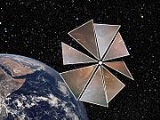
Solar sail

Encyclopedia
Solar sails are a form of spacecraft propulsion
using the radiation pressure
of light from a star
or laser
to push enormous ultra-thin mirrors
to high speeds.
In 2010, IKAROS
was the world's first spacecraft designed to use solar sailing propulsion to be successfully launched.
pressure for propulsion was first proposed by Russian scientist Konstantin Tsiolkovsky
in 1921, and in 1924 he and Friedrich Zander
wrote of "using tremendous mirrors of very thin sheets" and "using the pressure of sunlight to attain cosmic velocities".
The term "solar sailing" was coined in the late 1950s and popularized by Arthur C. Clarke
's short story "Sunjammer
" in May 1964.
In 1924, the Russian space engineer Friedrich Zander
proposed that, since light provides a small amount of thrust, this effect could be used as a form of space propulsion requiring no fuel. Einstein proposed (and experiments confirm) that photons have a momentum p=E/c; therefore, each light photon absorbed by or reflecting from a surface exerts a small amount of radiation pressure. This results in forces of about 4.57x10⁻⁶ N/m2 for absorbing surfaces perpendicular to the radiation in Earth orbit, and a little less than twice as much if the radiation is reflected. This was proven experimentally by Russian physicist Pyotr Nikolaevich Lebedev in 1900, and independently by Nichols and Hull at Dartmouth in 1901 using a Nichols radiometer
.
Charged particles from the solar wind are able to cause geomagnetic storms which can knock out power grids on Earth, and point the tails of comets away from the Sun. The solar wind averages 6.7 billion tons per hour at 520 km/s with "slow" low energy coronal ejections reaching 400 km/s and "fast," higher energy ejections averaging 750 km/s. At the distance of the Earth, this results in average solar wind pressure of 3.4×10⁻⁹ N/m2, and is three orders of magnitude less than the photonic radiation pressure. Still the solar wind dominates many phenomena because its interaction cross section
with gases and charged particles is about 109 times larger than that of the photons.
Both of these forces are small and decrease with the inverse square distance from the Sun
. Even large sails produce minute acceleration, but over time, sails can build up considerable speeds.
Changing course trajectories can be accomplished in two ways. First, tilting the sail with respect to the light source changes the direction of acceleration because the force on a sail from reflected radiation and wind acts in a direction perpendicular to its surface. Smaller auxiliary vanes can be used to gently pull the main sail into its new position (see the vanes on the illustration labeled Cosmos 1, above).
Second, gravity from a nearby mass, such as a star or planet, will alter the direction of a spaceship.
direct impulse beam. The thrust vector (spatial vector) would therefore be away from the Sun and toward the target.
In theory a lightsail driven by a laser or other beam from Earth can be used to slow down a spacecraft approaching a distant star or planet, by detaching part of the sail and using it to focus the beam on the forward-facing surface of the rest of the sail. In practice, however, most of the slowing would happen while the two parts are at a great distance from each other, and that means that, to do that focusing, it would be necessary to give the detached part an accurate optical shape and orientation. This solution is also limited because the lasers used to accelerate or decelerate a sail ship could take years, decades, or centuries to reach the craft, depending on the distance.
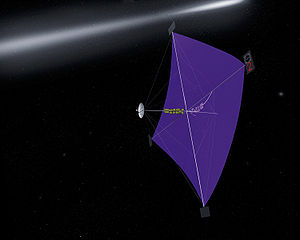 "Parachutes" would have very low mass, but theoretical studies show that they will collapse from the forces placed by shrouds. Radiation pressure does not behave like aerodynamic pressure.
The highest thrust-to-mass designs known (as of 2007) were theoretical designs developed by Eric Drexler. He designed a sail using reflective panels of thin aluminium film (30 to 100 nanometre
s thick) supported by a purely tensile structure. It rotated and would have to be continually under slight thrust. He made and handled samples of the film in the laboratory, but the material is too delicate to survive folding, launch, and deployment, hence the design relied on space-based production of the film panels, joining them to a deployable tension structure. Sails in this class would offer area per unit mass and hence accelerations up to "fifty times higher" than designs based on deployable plastic films.
The highest-thrust to mass designs for ground-assembled deployable structures are square sails with the masts and guy
lines on the dark side of the sail. Usually there are four masts that spread the corners of the sail, and a mast in the center to hold guy-wire
s. One of the largest advantages is that there are no hot spots in the rigging from wrinkling or bagging, and the sail protects the structure from the Sun. This form can therefore go quite close to the Sun, where the maximum thrust is present. Control would probably use small sails on the ends of the spars.
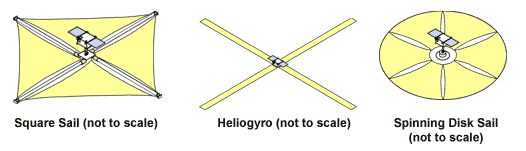
In the 1970s JPL did extensive studies of rotating blade and rotating ring sails for a mission to rendezvous with Halley's Comet. The intention was that such structures would be stiffened by their angular momentum, eliminating the need for struts, and saving mass. In all cases, surprisingly large amounts of tensile strength were needed to cope with dynamic loads. Weaker sails would ripple or oscillate when the sail's attitude changed, and the oscillations would add and cause structural failure. So the difference in the thrust-to-mass ratio was almost nil, and the static designs were much easier to control.
JPL's reference design was called the "heliogyro" and had plastic-film blades deployed from rollers and held out by centrifugal forces as it rotated. The spacecraft's attitude and direction were to be completely controlled by changing the angle of the blades in various ways, similar to the cyclic and collective pitch of a helicopter
. Although the design had no mass advantage over a square sail, it remained attractive because the method of deploying the sail was simpler than a strut-based design.
JPL also investigated "ring sails" (Spinning Disk Sail in the above diagram), panels attached to the edge of a rotating spacecraft. The panels would have slight gaps, about one to five percent of the total area. Lines would connect the edge of one sail to the other. Masses in the middles of these lines would pull the sails taut against the coning caused by the radiation pressure. JPL researchers said that this might be an attractive sail design for large manned structures. The inner ring, in particular, might be made to have artificial gravity roughly equal to the gravity on the surface of Mars.
A solar sail can serve a dual function as a high-gain antenna. Designs differ, but most modify the metallization pattern to create a holographic monochromatic lens or mirror in the radio frequencies of interest, including visible light.
Pekka Janhunen
from FMI
has invented a type of solar sail called the electric solar wind sail. Mechanically it has little in common with the traditional solar sail design, because the sails are replaced with straightened conducting tethers (wires) which are placed radially
around the host ship. The wires are electrically charged and thus an electric field
is created around the wires. The electric field of the wires extends a few tens of metres into the surrounding solar wind plasma. Because the solar wind electrons react on the electric field (similarly to the photons on a traditional solar sail), the functional radius of the wires is based on the electric field that is generated around the wire rather than the actual wire itself. This fact also makes it possible to maneuver a ship with an electric solar wind sail by regulating the electric charge of the wires. A full-sized operational electric solar wind sail would have 50-100 straightened wires with a length of about 20 km each.
A quite similar concept is the magnetic sail
, which would also employ the solar wind, but interact with the magnetic charge of the particles in the wind, rather than the electric. Typically it is also constructed with wires as "sails", but in contrast to a electric sail, it uses wire loops, and runs a static current through them instead of applying a static voltage.
All these designs maneuver, though the mechanisms are different. Magnetic sails bend the path of the charged protons that are in the solar wind
. By changing the sails' attitudes, and the size of the magnetic fields, they can change the amount and direction of the thrust. Electric solar wind sails can perform similar maneuvers by adjusting their electrostatic fields and sail attitudes.
” (Interplanetary Kite-craft Accelerated by Radiation Of the Sun) spacecraft, which deployed a 200 m2 polyimide experimental solar sail on June 10. In July, the next phase for the demonstration of acceleration by radiation began. On 9 July, it was verified that IKAROS collected radiation from the Sun and began photon acceleration by the orbit determination of IKAROS by range-and-range-rate (RARR) that is newly calculated in addition to the data of the relativization accelerating speed of IKAROS between IKAROS and the Earth that has been taken since before the Doppler effect was utilized. The data showed that IKAROS appears to have been solar-sailing since 3 June when it deployed the sail.
IKAROS has a diagonal spinning square sail 20 m (65.6 ft) made of a adj=on 7.5 thick sheet of polyimide
. A thin-film solar array is embedded in the sail. Eight LCD
panels are embedded in the sail, whose reflectance can be adjusted for attitude control. IKAROS will spend six months traveling to Venus, and then will begin a three-year journey to the far side of the Sun.
mission, which flew by the planets Mercury
and Venus
, and the MESSENGER
mission to Mercury demonstrated the use of solar pressure as a method of attitude control in order to conserve attitude-control propellant.
Hayabusa
also used solar pressure as a method of attitude control to compensate for broken reaction wheels and chemical thruster.
On February 4, 1993, Znamya 2
, a 20-meter wide aluminized-mylar reflector, was successfully tested from the Russian Mir
space station. Although the deployment test was successful, the experiment only demonstrated the deployment, not propulsion. A second test, Znamaya 2.5, failed to deploy properly.
In 1999, a full-scale deployment test of a solar sail has been performed on ground at DLR/ESA in Cologne.
On August 9, 2004, the Japanese ISAS
successfully deployed two prototype solar sails from a sounding rocket. A clover type sail was deployed at 122 km altitude and a fan type sail was deployed at 169 km altitude. Both sails used 7.5 micrometer
thick film. The experiment was purely a test of the deployment mechanisms, not of propulsion.
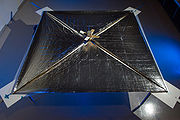 A joint private project between Planetary Society
, Cosmos Studios
and Russian Academy of Science launched Cosmos 1 on June 21, 2005, from a submarine in the Barents Sea
, but the Volna
rocket failed, and the spacecraft failed to reach orbit. A solar sail would have been used to gradually raise the spacecraft to a higher Earth orbit. The mission would have lasted for one month. A suborbital prototype test by the group failed in 2001 as well, also because of rocket failure. The same group announced plans on Carl Sagan's 75th birthday (November 9, 2009) to make three further attempts, dubbed LightSail-1
, -2, and -3. The new design will use a 32-square-meter Mylar sail, deployed in four triangular segments like NanoSail-D. The launch configuration is that of three adjacent CubeSat
s, and is scheduled to launch on a Minotaur IV
rocket in Q4 2010.
A 15-meter-diameter solar sail (SSP, solar sail sub payload, soraseiru sabupeiro-do) was launched together with ASTRO-F
on a M-V rocket on February 21, 2006, and made it to orbit. It deployed from the stage, but opened incompletely.
A team from the NASA Marshall Space Flight Center
(Marshall), along with a team from the NASA Ames Research Center, developed a solar sail mission called NanoSail-D which was lost in a launch failure aboard a Falcon 1
rocket on 3 August 2008. The second backup version was launched with FASTSAT on a Minotaur IV
on November 19, 2010. The primary objective of the mission is to test sail deployment technologies. The spacecraft might not have returned useful data about solar sail propulsion, according to Edward E. Montgomery, technology manager of Solar Sail Propulsion at Marshall, "The orbit available to us in this launch opportunity is so low, it may not allow us to stay in orbit long enough for solar pressure effects to accumulate to a measurable degree." The NanoSail-D structure was made of aluminium and plastic, with the spacecraft massing less than 10 pounds (4.5 kg). The sail has about 100 square feet (9.3 m²) of light-catching surface.
are developing a solar sail demonstration mission called the "CubeSail". This mission is due to launch in late 2011. The CubeSail is based on the CubeSat standard and when stowed it will occupy a 3U standard volume (3, 100mm x 100mm x 100mm). When in orbit, it will extend four 3.6m booms, deploying a sail of 25m2. The mission's primary objective is to demonstrate deployment of a solar sail and the concept of solar sailing. Finally and at its end-of-life it will use its sail to change its ballistic coefficient and reenter the Earth's atmosphere. This final phase of the mission has attracted much media attention as it has the potential to be used on board larger spacecraft as a de-orbiting device and potentially to solve the Space debris
problem.
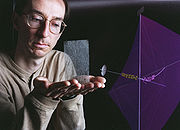 The material developed for the Drexler solar sail was a thin aluminum film with a baseline thickness of 0.1 micrometres, to be fabricated by vapor deposition in a space-based system. Drexler used a similar process to prepare films on the ground. As anticipated, these films demonstrated adequate strength and robustness for handling in the laboratory and for use in space, but not for folding, launch, and deployment.
The most common material in current designs is aluminized 2 µm
Kapton
film. It resists the heat of a pass close to the Sun and still remains reasonably strong. The aluminium reflecting film is on the Sun side. The sails of Cosmos 1 were made of aluminized PET film (Mylar
).
Research by Dr. Geoffrey Landis in 1998-9, funded by the NASA Institute for Advanced Concepts
, showed that various materials such as alumina for laser lightsails and carbon fiber
for microwave pushed lightsails were superior sail materials to the previously standard aluminium or Kapton films.
In 2000, Energy Science Laboratories developed a new carbon fiber material which might be useful for solar sails. The material is over 200 times thicker than conventional solar sail designs, but it is so porous that it has the same mass. The rigidity and durability of this material could make solar sails that are significantly sturdier than plastic films. The material could self-deploy and should withstand higher temperatures.
There has been some theoretical speculation about using molecular manufacturing techniques to create advanced, strong, hyper-light sail material, based on nanotube
mesh weaves, where the weave "spaces" are less than half the wavelength of light impinging on the sail. While such materials have so far only been produced in laboratory conditions, and the means for manufacturing such material on an industrial scale are not yet available, such materials could mass less than 0.1 g/m², making them lighter than any current sail material by a factor of at least 30. For comparison, 5 micrometre thick Mylar sail material mass 7 g/m², aluminized Kapton films have a mass as much as 12 g/m², and Energy Science Laboratories' new carbon fiber material masses 3 g/m².
. This is possible because the propulsion provided by the sail offsets the gravitational potential of the Sun. Such an orbit could be useful for studying the properties of the Sun over long durations.
Such a spacecraft could conceivably be placed directly over a pole of the Sun, and remain at that station for lengthy durations. Likewise a solar sail-equipped spacecraft could also remain on station nearly above the polar terminator
of a planet such as the Earth by tilting the sail at the appropriate angle needed to just counteract the planet's gravity.
In his book, The Case for Mars, Robert Zubrin points out that the reflected sunlight from a large statite placed near the polar terminator of the planet Mars could be focussed on one of the Martian polar ice caps to significantly warm the planet's atmosphere. Such a statite could be made from asteroid material.
proposed two beam-powered propulsion schemes using either lasers or maser
s to push giant sails to a significant fraction of the speed of light
.
In The Flight of the Dragonfly, Forward described a light sail propelled by superlasers. As the starship neared its destination, the outer portion of the sail would detach. The outer sail would then refocus and reflect the lasers back onto a smaller, inner sail. This would provide braking thrust to stop the ship in the destination star system.
Both methods pose monumental engineering challenges. The lasers would have to operate for years continuously at gigawatt strength. Second, they would demand more energy than the Earth currently consumes. Third, Forward's own solution to the electrical problem requires enormous solar panel arrays to be built at or near the planet Mercury. Fourth, a planet-sized mirror or fresnel lens
would be needed several dozen astronomical unit
s from the Sun to keep the lasers focused on the sail. Fifth, the giant braking sail would have to act as a precision mirror to focus the braking beam onto the inner "deceleration" sail.
A potentially easier approach would be to use a maser to drive a "solar sail" composed of a mesh of wires with the same spacing as the wavelength of the microwaves, since the manipulation of microwave radiation is somewhat easier than the manipulation of visible light. The hypothetical "Starwisp
" interstellar probe design would use a maser to drive it. Masers spread out more rapidly than optical lasers owing to their longer wavelength, and so would not have as long an effective range.
Masers could also be used to power a painted solar sail, a conventional sail coated with a layer of chemicals designed to evaporate when struck by microwave radiation. The momentum generated by this evaporation
could significantly increase the thrust
generated by solar sails, as a form of lightweight ablative laser propulsion.
To further focus the energy on a distant solar sail, designs have considered the use of a large zone plate
. This would be placed at a location between the laser or maser and the spacecraft. The plate could then be propelled outward using the same energy source, thus maintaining its position so as to focus the energy on the solar sail.
Additionally, it has been theorized by da Vinci Project
contributor T. Pesando that solar sail-utilizing spacecraft successful in interstellar travel could be used to carry their own zone plates or perhaps even masers to be deployed during flybys at nearby stars. Such an endeavor could allow future solar-sailed craft to effectively utilize focused energy from other stars rather than from the Earth or Sun, thus propelling them more swiftly through space and perhaps even to more distant stars. However, the potential of such a theory remains uncertain if not dubious due to the high-speed precision involved and possible payloads required.
Another more physically realistic approach would be to use the light from the home star to accelerate. The ship would first orbit continuously away around the home star until the appropriate starting velocity is reached, then the ship would begin its trip away from the system using the light from the star to keep accelerating. Beyond some distance, the ship would no longer receive enough light to accelerate it significantly, but would maintain its course due to inertia
. When nearing the target star, the ship could turn its sails toward it and begin to orbit inward to decelerate. Additional forward and reverse thrust could be achieved with more conventional means of propulsion such as rockets.
(Jaxa) launched the world's
first interplanetary solar sail spacecraft
"IKAROS
" (Interplanetary Kite-craft Accelerated by Radiation Of the Sun) to Venus. NASA
launched the second NanoSail-D unit stowed inside the FASTSAT satellite on the Minotaur IV on November 19, 2010. The ejection date from the FASTSAT microsatellite was planned for December 6, 2010 but deployment only occurred on January 20, 2011. The Planetary Society of the United States plans to launch an artificial satellite "LightSail-1
" onto the Earth's orbit
in 2011.
The light force can be separated into the normal force (away from the light source) and the tangential force as a function of the angle A of the sail face to the light. The Normal Force per area = 8/9 + 1/9
+ 1/9  . The Tangential Force per area = 4/9
  .
.
, which was published in 1960. In it, a tragedy results from the slowness of interstellar travel by this method. Another example is the 1962 story "Gateway to Strangeness
" (also known as "Sail 25") by Jack Vance
, in which the outward direction of propulsion poses a life-threatening dilemma. Also in early 20th century literature, Pierre Boulle
's Planet of the Apes starts with a couple floating in space on a ship propelled and maneuvered by light sails. In Larry Niven
and Jerry Pournelle
's The Mote in God's Eye
, a sail is used as a brake and a weapon. Author and scientist Arthur C. Clarke
depicted a "yacht race" between solar sail spacecraft in the 1964 short story "Sunjammer
". In "Flight of the Dragonfly", Robert Forward (who also proposed the microwave-pushed Starwisp design) described an interstellar journey using a light driven propulsion system, wherein a part of the sail was broken off and used as a reflector to slow the main spacecraft as it approached its destination. In the 1982 film Tron
, a "Solar Sailer" was a inner spacecraft with butterfly like sails moved along focused beam of light. In the episode "Explorers" of Star Trek: Deep Space Nine
that aired in 1995, a "light ship" was featured. It was designed to use solar wind to fly out of a solar system with no engine. In the film Star Wars Episode II: Attack of the Clones
one is used by Count Dooku
to propel himself across space. A solar sail was also used in James Cameron's Avatar. In the Disney film Treasure Planet
, Solar sails are used literally as sails for interstellar travel of steam-punk styled -masted sailing ship capable of traveling through space.
Spacecraft propulsion
Spacecraft propulsion is any method used to accelerate spacecraft and artificial satellites. There are many different methods. Each method has drawbacks and advantages, and spacecraft propulsion is an active area of research. However, most spacecraft today are propelled by forcing a gas from the...
using the radiation pressure
Radiation pressure
Radiation pressure is the pressure exerted upon any surface exposed to electromagnetic radiation. If absorbed, the pressure is the power flux density divided by the speed of light...
of light from a star
Star
A star is a massive, luminous sphere of plasma held together by gravity. At the end of its lifetime, a star can also contain a proportion of degenerate matter. The nearest star to Earth is the Sun, which is the source of most of the energy on Earth...
or laser
Laser
A laser is a device that emits light through a process of optical amplification based on the stimulated emission of photons. The term "laser" originated as an acronym for Light Amplification by Stimulated Emission of Radiation...
to push enormous ultra-thin mirrors
Membrane mirror
Membrane mirrors are mirrors made on thin films of material, such as metallized PET film. They can be used as components in adaptive optics systems....
to high speeds.
In 2010, IKAROS
IKAROS
IKAROS is a Japan Aerospace Exploration Agency experimental spacecraft. The spacecraft was launched on 21 May, 2010, aboard an H-IIA rocket, together with the Akatsuki probe and four other small spacecraft...
was the world's first spacecraft designed to use solar sailing propulsion to be successfully launched.
History
The concept of using photonPhoton
In physics, a photon is an elementary particle, the quantum of the electromagnetic interaction and the basic unit of light and all other forms of electromagnetic radiation. It is also the force carrier for the electromagnetic force...
pressure for propulsion was first proposed by Russian scientist Konstantin Tsiolkovsky
Konstantin Tsiolkovsky
Konstantin Eduardovich Tsiolkovsky was an Imperial Russian and Soviet rocket scientist and pioneer of the astronautic theory. Along with his followers the German Hermann Oberth and the American Robert H. Goddard, he is considered to be one of the founding fathers of rocketry and astronautics...
in 1921, and in 1924 he and Friedrich Zander
Friedrich Zander
Friedrich Zander , often transliterated Fridrikh Arturovich Tsander, was a pioneer of rocketry and spaceflight in the Russian Empire and the Soviet Union...
wrote of "using tremendous mirrors of very thin sheets" and "using the pressure of sunlight to attain cosmic velocities".
The term "solar sailing" was coined in the late 1950s and popularized by Arthur C. Clarke
Arthur C. Clarke
Sir Arthur Charles Clarke, CBE, FRAS was a British science fiction author, inventor, and futurist, famous for his short stories and novels, among them 2001: A Space Odyssey, and as a host and commentator in the British television series Mysterious World. For many years, Robert A. Heinlein,...
's short story "Sunjammer
Sunjammer
"Sunjammer" is a science fiction short story by English author Arthur C. Clarke. It was originally published in 1963. It has also been published under the title "The Wind from the Sun" and has been included into Clarke's 1972 collection of short stories with this title.-Plot summary:John...
" in May 1964.
Physics
There are two sources of solar forces: radiation pressure, and solar wind. Radiation pressure is much stronger than wind pressure.In 1924, the Russian space engineer Friedrich Zander
Friedrich Zander
Friedrich Zander , often transliterated Fridrikh Arturovich Tsander, was a pioneer of rocketry and spaceflight in the Russian Empire and the Soviet Union...
proposed that, since light provides a small amount of thrust, this effect could be used as a form of space propulsion requiring no fuel. Einstein proposed (and experiments confirm) that photons have a momentum p=E/c; therefore, each light photon absorbed by or reflecting from a surface exerts a small amount of radiation pressure. This results in forces of about 4.57x10⁻⁶ N/m2 for absorbing surfaces perpendicular to the radiation in Earth orbit, and a little less than twice as much if the radiation is reflected. This was proven experimentally by Russian physicist Pyotr Nikolaevich Lebedev in 1900, and independently by Nichols and Hull at Dartmouth in 1901 using a Nichols radiometer
Nichols radiometer
A Nichols radiometer was the apparatus used by Ernest Fox Nichols and Gordon Ferrie Hull in 1901 for the measurement of radiation pressure. It consisted of a pair of small silvered glass mirrors suspended in the manner of a torsion balance by a fine quartz fibre within an enclosure in which the air...
.
Charged particles from the solar wind are able to cause geomagnetic storms which can knock out power grids on Earth, and point the tails of comets away from the Sun. The solar wind averages 6.7 billion tons per hour at 520 km/s with "slow" low energy coronal ejections reaching 400 km/s and "fast," higher energy ejections averaging 750 km/s. At the distance of the Earth, this results in average solar wind pressure of 3.4×10⁻⁹ N/m2, and is three orders of magnitude less than the photonic radiation pressure. Still the solar wind dominates many phenomena because its interaction cross section
Cross section (physics)
A cross section is the effective area which governs the probability of some scattering or absorption event. Together with particle density and path length, it can be used to predict the total scattering probability via the Beer-Lambert law....
with gases and charged particles is about 109 times larger than that of the photons.
Both of these forces are small and decrease with the inverse square distance from the Sun
Sun
The Sun is the star at the center of the Solar System. It is almost perfectly spherical and consists of hot plasma interwoven with magnetic fields...
. Even large sails produce minute acceleration, but over time, sails can build up considerable speeds.
Changing course trajectories can be accomplished in two ways. First, tilting the sail with respect to the light source changes the direction of acceleration because the force on a sail from reflected radiation and wind acts in a direction perpendicular to its surface. Smaller auxiliary vanes can be used to gently pull the main sail into its new position (see the vanes on the illustration labeled Cosmos 1, above).
Second, gravity from a nearby mass, such as a star or planet, will alter the direction of a spaceship.
Escaping planetary orbit
Sails orbit, and therefore do not need to hover or move directly toward or away from the Sun. Almost all missions would use the sail to change orbit, rather than thrusting directly away from a planet or the Sun. The sail is rotated slowly as the sail orbits around a planet so the thrust is in the direction of the orbital movement to move to a higher orbit or against it to move to a lower orbit. When an orbit is far enough away from a planet, the sail then begins similar maneuvers in orbit around the Sun.Beam propelled
Most theoretical studies of interstellar missions with a solar sail plan to push the sail with a very large laser beam-powered propulsionBeam-powered propulsion
Beam-powered propulsion is a class of aircraft or spacecraft propulsion mechanisms that use energy beamed to the spacecraft from a remote power plant to provide energy...
direct impulse beam. The thrust vector (spatial vector) would therefore be away from the Sun and toward the target.
In theory a lightsail driven by a laser or other beam from Earth can be used to slow down a spacecraft approaching a distant star or planet, by detaching part of the sail and using it to focus the beam on the forward-facing surface of the rest of the sail. In practice, however, most of the slowing would happen while the two parts are at a great distance from each other, and that means that, to do that focusing, it would be necessary to give the detached part an accurate optical shape and orientation. This solution is also limited because the lasers used to accelerate or decelerate a sail ship could take years, decades, or centuries to reach the craft, depending on the distance.
Limitations of solar sails
Solar sails do not work well, if at all, in low Earth orbit below about 800 km altitude due to erosion or air drag. Above that altitude they give very small accelerations that take months to build up to useful speeds. Solar sails have to be physically large, and payload size is often small. Deploying solar sails is also highly challenging to date.Investigated sail designs
The highest thrust-to-mass designs known (as of 2007) were theoretical designs developed by Eric Drexler. He designed a sail using reflective panels of thin aluminium film (30 to 100 nanometre
Nanometre
A nanometre is a unit of length in the metric system, equal to one billionth of a metre. The name combines the SI prefix nano- with the parent unit name metre .The nanometre is often used to express dimensions on the atomic scale: the diameter...
s thick) supported by a purely tensile structure. It rotated and would have to be continually under slight thrust. He made and handled samples of the film in the laboratory, but the material is too delicate to survive folding, launch, and deployment, hence the design relied on space-based production of the film panels, joining them to a deployable tension structure. Sails in this class would offer area per unit mass and hence accelerations up to "fifty times higher" than designs based on deployable plastic films.
The highest-thrust to mass designs for ground-assembled deployable structures are square sails with the masts and guy
Guy (sailing)
A guy is a term for a line attached to and intended to control the end of a spar on a sailboat. On a modern sloop-rigged sailboat with a symmetric spinnaker, the spinnaker pole is the spar most commonly controlled by one or more guys.There are two primary types of guys used to control a...
lines on the dark side of the sail. Usually there are four masts that spread the corners of the sail, and a mast in the center to hold guy-wire
Guy-wire
A guy-wire or guy-rope, also known as simply a guy, is a tensioned cable designed to add stability to structures . One end of the cable is attached to the structure, and the other is anchored to the ground at a distance from the structure's base...
s. One of the largest advantages is that there are no hot spots in the rigging from wrinkling or bagging, and the sail protects the structure from the Sun. This form can therefore go quite close to the Sun, where the maximum thrust is present. Control would probably use small sails on the ends of the spars.
In the 1970s JPL did extensive studies of rotating blade and rotating ring sails for a mission to rendezvous with Halley's Comet. The intention was that such structures would be stiffened by their angular momentum, eliminating the need for struts, and saving mass. In all cases, surprisingly large amounts of tensile strength were needed to cope with dynamic loads. Weaker sails would ripple or oscillate when the sail's attitude changed, and the oscillations would add and cause structural failure. So the difference in the thrust-to-mass ratio was almost nil, and the static designs were much easier to control.
JPL's reference design was called the "heliogyro" and had plastic-film blades deployed from rollers and held out by centrifugal forces as it rotated. The spacecraft's attitude and direction were to be completely controlled by changing the angle of the blades in various ways, similar to the cyclic and collective pitch of a helicopter
Helicopter
A helicopter is a type of rotorcraft in which lift and thrust are supplied by one or more engine-driven rotors. This allows the helicopter to take off and land vertically, to hover, and to fly forwards, backwards, and laterally...
. Although the design had no mass advantage over a square sail, it remained attractive because the method of deploying the sail was simpler than a strut-based design.
JPL also investigated "ring sails" (Spinning Disk Sail in the above diagram), panels attached to the edge of a rotating spacecraft. The panels would have slight gaps, about one to five percent of the total area. Lines would connect the edge of one sail to the other. Masses in the middles of these lines would pull the sails taut against the coning caused by the radiation pressure. JPL researchers said that this might be an attractive sail design for large manned structures. The inner ring, in particular, might be made to have artificial gravity roughly equal to the gravity on the surface of Mars.
A solar sail can serve a dual function as a high-gain antenna. Designs differ, but most modify the metallization pattern to create a holographic monochromatic lens or mirror in the radio frequencies of interest, including visible light.
Pekka Janhunen
Pekka Janhunen
Pekka Janhunen, Ph.D., is a researcher in Finnish Meteorological Institute. He is best known for his Electric Solar Wind Sail invention.-The Electric Sail:...
from FMI
Finnish Meteorological Institute
The Finnish Meteorological Institute is the government agency responsible for gathering and reporting weather data and forecasts in Finland. It is a part of the Ministry of Transport and Communications but it operates semi-autonomously....
has invented a type of solar sail called the electric solar wind sail. Mechanically it has little in common with the traditional solar sail design, because the sails are replaced with straightened conducting tethers (wires) which are placed radially
Radius
In classical geometry, a radius of a circle or sphere is any line segment from its center to its perimeter. By extension, the radius of a circle or sphere is the length of any such segment, which is half the diameter. If the object does not have an obvious center, the term may refer to its...
around the host ship. The wires are electrically charged and thus an electric field
Electric field
In physics, an electric field surrounds electrically charged particles and time-varying magnetic fields. The electric field depicts the force exerted on other electrically charged objects by the electrically charged particle the field is surrounding...
is created around the wires. The electric field of the wires extends a few tens of metres into the surrounding solar wind plasma. Because the solar wind electrons react on the electric field (similarly to the photons on a traditional solar sail), the functional radius of the wires is based on the electric field that is generated around the wire rather than the actual wire itself. This fact also makes it possible to maneuver a ship with an electric solar wind sail by regulating the electric charge of the wires. A full-sized operational electric solar wind sail would have 50-100 straightened wires with a length of about 20 km each.
A quite similar concept is the magnetic sail
Magnetic sail
A magnetic sail or magsail is a proposed method of spacecraft propulsion which would use a static magnetic field to deflect charged particles radiated by the Sun as a plasma wind, and thus impart momentum to accelerate the spacecraft...
, which would also employ the solar wind, but interact with the magnetic charge of the particles in the wind, rather than the electric. Typically it is also constructed with wires as "sails", but in contrast to a electric sail, it uses wire loops, and runs a static current through them instead of applying a static voltage.
All these designs maneuver, though the mechanisms are different. Magnetic sails bend the path of the charged protons that are in the solar wind
Solar wind
The solar wind is a stream of charged particles ejected from the upper atmosphere of the Sun. It mostly consists of electrons and protons with energies usually between 1.5 and 10 keV. The stream of particles varies in temperature and speed over time...
. By changing the sails' attitudes, and the size of the magnetic fields, they can change the amount and direction of the thrust. Electric solar wind sails can perform similar maneuvers by adjusting their electrostatic fields and sail attitudes.
Sail testing in space
Until 2010, no solar sails had been successfully used in space as primary propulsion systems. On 21 May 2010, the Japan Aerospace Exploration Agency (JAXA) launched the “IKAROSIKAROS
IKAROS is a Japan Aerospace Exploration Agency experimental spacecraft. The spacecraft was launched on 21 May, 2010, aboard an H-IIA rocket, together with the Akatsuki probe and four other small spacecraft...
” (Interplanetary Kite-craft Accelerated by Radiation Of the Sun) spacecraft, which deployed a 200 m2 polyimide experimental solar sail on June 10. In July, the next phase for the demonstration of acceleration by radiation began. On 9 July, it was verified that IKAROS collected radiation from the Sun and began photon acceleration by the orbit determination of IKAROS by range-and-range-rate (RARR) that is newly calculated in addition to the data of the relativization accelerating speed of IKAROS between IKAROS and the Earth that has been taken since before the Doppler effect was utilized. The data showed that IKAROS appears to have been solar-sailing since 3 June when it deployed the sail.
IKAROS has a diagonal spinning square sail 20 m (65.6 ft) made of a adj=on 7.5 thick sheet of polyimide
Polyimide
Polyimide is a polymer of imide monomers. The structure of imide is as shown. Polyimides have been in mass production since 1955...
. A thin-film solar array is embedded in the sail. Eight LCD
Liquid crystal display
A liquid crystal display is a flat panel display, electronic visual display, or video display that uses the light modulating properties of liquid crystals . LCs do not emit light directly....
panels are embedded in the sail, whose reflectance can be adjusted for attitude control. IKAROS will spend six months traveling to Venus, and then will begin a three-year journey to the far side of the Sun.
Solar pressure demonstrated for attitude control
Both the Mariner 10Mariner 10
Mariner 10 was an American robotic space probe launched by NASA on November 3, 1973, to fly by the planets Mercury and Venus. It was launched approximately two years after Mariner 9 and was the last spacecraft in the Mariner program...
mission, which flew by the planets Mercury
Mercury (planet)
Mercury is the innermost and smallest planet in the Solar System, orbiting the Sun once every 87.969 Earth days. The orbit of Mercury has the highest eccentricity of all the Solar System planets, and it has the smallest axial tilt. It completes three rotations about its axis for every two orbits...
and Venus
Venus
Venus is the second planet from the Sun, orbiting it every 224.7 Earth days. The planet is named after Venus, the Roman goddess of love and beauty. After the Moon, it is the brightest natural object in the night sky, reaching an apparent magnitude of −4.6, bright enough to cast shadows...
, and the MESSENGER
MESSENGER
The MErcury Surface, Space ENvironment, GEochemistry and Ranging space probe is a robotic NASA spacecraft in orbit around the planet Mercury. The spacecraft was launched aboard a Delta II rocket in August 2004 to study the chemical composition, geology, and magnetic field of Mercury...
mission to Mercury demonstrated the use of solar pressure as a method of attitude control in order to conserve attitude-control propellant.
Hayabusa
Hayabusa
was an unmanned spacecraft developed by the Japan Aerospace Exploration Agency to return a sample of material from a small near-Earth asteroid named 25143 Itokawa to Earth for further analysis....
also used solar pressure as a method of attitude control to compensate for broken reaction wheels and chemical thruster.
Solar sail deployment tests
NASA has successfully tested deployment technologies on small scale sails in vacuum chambers.On February 4, 1993, Znamya 2
Znamya (space mirror)
The Znamya project was a series of experimental orbital mirrors, designed to beam solar power to Earth by reflecting sunlight. It consisted of two experiments - the Znamya 2 experiment, and the failed Znamya 2.5 - and the proposed Znamya 3...
, a 20-meter wide aluminized-mylar reflector, was successfully tested from the Russian Mir
Mir
Mir was a space station operated in low Earth orbit from 1986 to 2001, at first by the Soviet Union and then by Russia. Assembled in orbit from 1986 to 1996, Mir was the first modular space station and had a greater mass than that of any previous spacecraft, holding the record for the...
space station. Although the deployment test was successful, the experiment only demonstrated the deployment, not propulsion. A second test, Znamaya 2.5, failed to deploy properly.
In 1999, a full-scale deployment test of a solar sail has been performed on ground at DLR/ESA in Cologne.
On August 9, 2004, the Japanese ISAS
Institute of Space and Astronautical Science
is a Japanese national research organization of astrophysics using rockets, astronomical satellites and interplanetary probes. It is a division of Japan Aerospace Exploration Agency .- History :...
successfully deployed two prototype solar sails from a sounding rocket. A clover type sail was deployed at 122 km altitude and a fan type sail was deployed at 169 km altitude. Both sails used 7.5 micrometer
Micrometre
A micrometer , is by definition 1×10⁻⁶ of a meter .In plain English, it means one-millionth of a meter . Its unit symbol in the International System of Units is μm...
thick film. The experiment was purely a test of the deployment mechanisms, not of propulsion.
Partially successful solar sail propulsion tests
Planetary Society
The Planetary Society is a large, publicly supported, non-government and non-profit organization that has many research projects related to astronomy...
, Cosmos Studios
Cosmos Studios
Cosmos Studios former Abbey Road Studios / EMI - studios in Skärmarbrink on the outskirts of Stockholm, Sweden, has been since the early sixties a landmark of Swedish and international music.-External links:* *...
and Russian Academy of Science launched Cosmos 1 on June 21, 2005, from a submarine in the Barents Sea
Barents Sea
The Barents Sea is a marginal sea of the Arctic Ocean, located north of Norway and Russia. Known in the Middle Ages as the Murman Sea, the sea takes its current name from the Dutch navigator Willem Barents...
, but the Volna
Volna
Space launch vehicle Volna , is a converted SLBM used for launching artificial satellites into orbit. It is based on the R-29R designed by State Rocket Center Makayev and related to the Shtil' Launch Vehicle . The Volna is a 3 stage launch vehicle that uses liquid propellant...
rocket failed, and the spacecraft failed to reach orbit. A solar sail would have been used to gradually raise the spacecraft to a higher Earth orbit. The mission would have lasted for one month. A suborbital prototype test by the group failed in 2001 as well, also because of rocket failure. The same group announced plans on Carl Sagan's 75th birthday (November 9, 2009) to make three further attempts, dubbed LightSail-1
LightSail-1
LightSail-1 is a solar sail project being developed by the Planetary Society, a non-profit organization devoted to space exploration. LightSail-1 was announced in November 2009. The kite-shaped spacecraft will have a total cross-section of , and will be fitted with guidance and diagnostic electronics...
, -2, and -3. The new design will use a 32-square-meter Mylar sail, deployed in four triangular segments like NanoSail-D. The launch configuration is that of three adjacent CubeSat
CubeSat
A CubeSat is a type of miniaturized satellite for space research that usually has a volume of exactly one liter , has a mass of no more than 1.33 kilograms, and typically uses commercial off-the-shelf electronics components...
s, and is scheduled to launch on a Minotaur IV
Minotaur IV
Minotaur IV, also known as Peacekeeper SLV and OSP-2 PK is an active expendable launch system derived from the Peacekeeper missile. It is operated by Orbital Sciences Corporation, and made its maiden flight on 22 April 2010, carrying the HTV-2a Hypersonic Test Vehicle...
rocket in Q4 2010.
A 15-meter-diameter solar sail (SSP, solar sail sub payload, soraseiru sabupeiro-do) was launched together with ASTRO-F
ASTRO-F
Akari is an infrared astronomy satellite developed by Japan Aerospace Exploration Agency, in cooperation with institutes of Europe and Korea. It was launched on 21 February 2006 at 21:28 UTC by M-V rocket into Earth sun-synchronous orbit...
on a M-V rocket on February 21, 2006, and made it to orbit. It deployed from the stage, but opened incompletely.
A team from the NASA Marshall Space Flight Center
Marshall Space Flight Center
The George C. Marshall Space Flight Center is the U.S. government's civilian rocketry and spacecraft propulsion research center. The largest center of NASA, MSFC's first mission was developing the Saturn launch vehicles for the Apollo moon program...
(Marshall), along with a team from the NASA Ames Research Center, developed a solar sail mission called NanoSail-D which was lost in a launch failure aboard a Falcon 1
Falcon 1
The Falcon 1 is a partially reusable launch system designed and manufactured by SpaceX, a space transportation company in Hawthorne, California. The two-stage-to-orbit rocket uses LOX/RP-1 for both stages, the first powered by a single Merlin engine and the second powered by a single Kestrel engine...
rocket on 3 August 2008. The second backup version was launched with FASTSAT on a Minotaur IV
Minotaur IV
Minotaur IV, also known as Peacekeeper SLV and OSP-2 PK is an active expendable launch system derived from the Peacekeeper missile. It is operated by Orbital Sciences Corporation, and made its maiden flight on 22 April 2010, carrying the HTV-2a Hypersonic Test Vehicle...
on November 19, 2010. The primary objective of the mission is to test sail deployment technologies. The spacecraft might not have returned useful data about solar sail propulsion, according to Edward E. Montgomery, technology manager of Solar Sail Propulsion at Marshall, "The orbit available to us in this launch opportunity is so low, it may not allow us to stay in orbit long enough for solar pressure effects to accumulate to a measurable degree." The NanoSail-D structure was made of aluminium and plastic, with the spacecraft massing less than 10 pounds (4.5 kg). The sail has about 100 square feet (9.3 m²) of light-catching surface.
Future solar sail propulsion tests
A team from the Surrey Space Centre at the University of SurreyUniversity of Surrey
The University of Surrey is a university located within the county town of Guildford, Surrey in the South East of England. It received its charter on 9 September 1966, and was previously situated near Battersea Park in south-west London. The institution was known as Battersea College of Technology...
are developing a solar sail demonstration mission called the "CubeSail". This mission is due to launch in late 2011. The CubeSail is based on the CubeSat standard and when stowed it will occupy a 3U standard volume (3, 100mm x 100mm x 100mm). When in orbit, it will extend four 3.6m booms, deploying a sail of 25m2. The mission's primary objective is to demonstrate deployment of a solar sail and the concept of solar sailing. Finally and at its end-of-life it will use its sail to change its ballistic coefficient and reenter the Earth's atmosphere. This final phase of the mission has attracted much media attention as it has the potential to be used on board larger spacecraft as a de-orbiting device and potentially to solve the Space debris
Space debris
Space debris, also known as orbital debris, space junk, and space waste, is the collection of objects in orbit around Earth that were created by humans but no longer serve any useful purpose. These objects consist of everything from spent rocket stages and defunct satellites to erosion, explosion...
problem.
Sail materials
The most common material in current designs is aluminized 2 µm
Micrometer
A micrometer , sometimes known as a micrometer screw gauge, is a device incorporating a calibrated screw used widely for precise measurement of small distances in mechanical engineering and machining as well as most mechanical trades, along with other metrological instruments such as dial, vernier,...
Kapton
Kapton
Kapton is a polyimide film developed by DuPont which can remain stable in a wide range of temperatures, from -273 to +400 °C...
film. It resists the heat of a pass close to the Sun and still remains reasonably strong. The aluminium reflecting film is on the Sun side. The sails of Cosmos 1 were made of aluminized PET film (Mylar
PET film (biaxially oriented)
BoPET is a polyester film made from stretched polyethylene terephthalate and is used for its high tensile strength, chemical and dimensional stability, transparency, reflectivity, gas and aroma barrier properties and electrical insulation.A variety of companies manufacture boPET and other...
).
Research by Dr. Geoffrey Landis in 1998-9, funded by the NASA Institute for Advanced Concepts
NASA Institute for Advanced Concepts
right|200pxNASA Institute for Advanced Concepts was a NASA-funded program that was operated by the Universities Space Research Association for NASA from 1998 until its closure on 31 August 2007. NIAC sought proposals for revolutionary aeronautics and space concepts that could dramatically impact...
, showed that various materials such as alumina for laser lightsails and carbon fiber
Carbon fiber
Carbon fiber, alternatively graphite fiber, carbon graphite or CF, is a material consisting of fibers about 5–10 μm in diameter and composed mostly of carbon atoms. The carbon atoms are bonded together in crystals that are more or less aligned parallel to the long axis of the fiber...
for microwave pushed lightsails were superior sail materials to the previously standard aluminium or Kapton films.
In 2000, Energy Science Laboratories developed a new carbon fiber material which might be useful for solar sails. The material is over 200 times thicker than conventional solar sail designs, but it is so porous that it has the same mass. The rigidity and durability of this material could make solar sails that are significantly sturdier than plastic films. The material could self-deploy and should withstand higher temperatures.
There has been some theoretical speculation about using molecular manufacturing techniques to create advanced, strong, hyper-light sail material, based on nanotube
Carbon nanotube
Carbon nanotubes are allotropes of carbon with a cylindrical nanostructure. Nanotubes have been constructed with length-to-diameter ratio of up to 132,000,000:1, significantly larger than for any other material...
mesh weaves, where the weave "spaces" are less than half the wavelength of light impinging on the sail. While such materials have so far only been produced in laboratory conditions, and the means for manufacturing such material on an industrial scale are not yet available, such materials could mass less than 0.1 g/m², making them lighter than any current sail material by a factor of at least 30. For comparison, 5 micrometre thick Mylar sail material mass 7 g/m², aluminized Kapton films have a mass as much as 12 g/m², and Energy Science Laboratories' new carbon fiber material masses 3 g/m².
Satellites
Robert L. Forward pointed out that a solar sail could be used to modify the orbit of a satellite around the Earth. In the limit, a sail could be used to "hover" a satellite above one pole of the Earth. Spacecraft fitted with solar sails could also be placed in close orbits about the Sun that are stationary with respect to either the Sun or the Earth, a type of satellite named by Forward a statiteStatite
A statite is a hypothetical type of artificial satellite that employs a solar sail to continuously modify its orbit in ways that gravity alone would not allow. Typically, a statite would use the solar sail to "hover" in a location that would not otherwise be available as a stable geosynchronous...
. This is possible because the propulsion provided by the sail offsets the gravitational potential of the Sun. Such an orbit could be useful for studying the properties of the Sun over long durations.
Such a spacecraft could conceivably be placed directly over a pole of the Sun, and remain at that station for lengthy durations. Likewise a solar sail-equipped spacecraft could also remain on station nearly above the polar terminator
Terminator (solar)
A terminator, twilight zone or "grey line" is a moving line that separates the illuminated day side and the dark night side of a planetary body...
of a planet such as the Earth by tilting the sail at the appropriate angle needed to just counteract the planet's gravity.
In his book, The Case for Mars, Robert Zubrin points out that the reflected sunlight from a large statite placed near the polar terminator of the planet Mars could be focussed on one of the Martian polar ice caps to significantly warm the planet's atmosphere. Such a statite could be made from asteroid material.
Trajectory corrections
The MESSENGER probe en route to Mercury is using light pressure reacting against its solar panels to perform fine trajectory corrections. By changing the angle of the solar panels relative to the Sun, the amount of solar radiation pressure can be varied to adjust the spacecraft trajectory more delicately than is possible with thrusters. Minor errors are greatly amplified by gravity assist maneuvers, so very small corrections before lead to large savings in propellant afterward.Interstellar flight
In the 1980s, Robert ForwardRobert Forward
Robert Lull Forward — known as Robert L. Forward — was an American physicist and science fiction writer...
proposed two beam-powered propulsion schemes using either lasers or maser
Maser
A maser is a device that produces coherent electromagnetic waves through amplification by stimulated emission. Historically, “maser” derives from the original, upper-case acronym MASER, which stands for "Microwave Amplification by Stimulated Emission of Radiation"...
s to push giant sails to a significant fraction of the speed of light
Speed of light
The speed of light in vacuum, usually denoted by c, is a physical constant important in many areas of physics. Its value is 299,792,458 metres per second, a figure that is exact since the length of the metre is defined from this constant and the international standard for time...
.
In The Flight of the Dragonfly, Forward described a light sail propelled by superlasers. As the starship neared its destination, the outer portion of the sail would detach. The outer sail would then refocus and reflect the lasers back onto a smaller, inner sail. This would provide braking thrust to stop the ship in the destination star system.
Both methods pose monumental engineering challenges. The lasers would have to operate for years continuously at gigawatt strength. Second, they would demand more energy than the Earth currently consumes. Third, Forward's own solution to the electrical problem requires enormous solar panel arrays to be built at or near the planet Mercury. Fourth, a planet-sized mirror or fresnel lens
Fresnel lens
A Fresnel lens is a type of lens originally developed by French physicist Augustin-Jean Fresnel for lighthouses.The design allows the construction of lenses of large aperture and short focal length without the mass and volume of material that would be required by a lens of conventional design...
would be needed several dozen astronomical unit
Astronomical unit
An astronomical unit is a unit of length equal to about or approximately the mean Earth–Sun distance....
s from the Sun to keep the lasers focused on the sail. Fifth, the giant braking sail would have to act as a precision mirror to focus the braking beam onto the inner "deceleration" sail.
A potentially easier approach would be to use a maser to drive a "solar sail" composed of a mesh of wires with the same spacing as the wavelength of the microwaves, since the manipulation of microwave radiation is somewhat easier than the manipulation of visible light. The hypothetical "Starwisp
Starwisp
Starwisp is a hypothetical unmanned interstellar probe design proposed by Robert L. Forward. It is propelled by a microwave sail, similar to a solar sail in concept, but powered by microwaves from a man-made source.- Description :...
" interstellar probe design would use a maser to drive it. Masers spread out more rapidly than optical lasers owing to their longer wavelength, and so would not have as long an effective range.
Masers could also be used to power a painted solar sail, a conventional sail coated with a layer of chemicals designed to evaporate when struck by microwave radiation. The momentum generated by this evaporation
Evaporation
Evaporation is a type of vaporization of a liquid that occurs only on the surface of a liquid. The other type of vaporization is boiling, which, instead, occurs on the entire mass of the liquid....
could significantly increase the thrust
Thrust
Thrust is a reaction force described quantitatively by Newton's second and third laws. When a system expels or accelerates mass in one direction the accelerated mass will cause a force of equal magnitude but opposite direction on that system....
generated by solar sails, as a form of lightweight ablative laser propulsion.
To further focus the energy on a distant solar sail, designs have considered the use of a large zone plate
Zone plate
A zone plate is a device used to focus light or other things exhibiting wave character. Unlike lenses or curved mirrors however, zone plates use diffraction instead of refraction or reflection. Based on analysis by Augustin-Jean Fresnel, they are sometimes called Fresnel zone plates in his honor...
. This would be placed at a location between the laser or maser and the spacecraft. The plate could then be propelled outward using the same energy source, thus maintaining its position so as to focus the energy on the solar sail.
Additionally, it has been theorized by da Vinci Project
Da Vinci Project
The da Vinci Project was a privately funded, volunteer-staffed attempt to launch a reusable manned suborbital spacecraft. It was formed in 1996 specifically to be a contender for the Ansari X PRIZE for the first non-governmental reusable manned spacecraft. The project was based in Toronto,...
contributor T. Pesando that solar sail-utilizing spacecraft successful in interstellar travel could be used to carry their own zone plates or perhaps even masers to be deployed during flybys at nearby stars. Such an endeavor could allow future solar-sailed craft to effectively utilize focused energy from other stars rather than from the Earth or Sun, thus propelling them more swiftly through space and perhaps even to more distant stars. However, the potential of such a theory remains uncertain if not dubious due to the high-speed precision involved and possible payloads required.
Another more physically realistic approach would be to use the light from the home star to accelerate. The ship would first orbit continuously away around the home star until the appropriate starting velocity is reached, then the ship would begin its trip away from the system using the light from the star to keep accelerating. Beyond some distance, the ship would no longer receive enough light to accelerate it significantly, but would maintain its course due to inertia
Inertia
Inertia is the resistance of any physical object to a change in its state of motion or rest, or the tendency of an object to resist any change in its motion. It is proportional to an object's mass. The principle of inertia is one of the fundamental principles of classical physics which are used to...
. When nearing the target star, the ship could turn its sails toward it and begin to orbit inward to decelerate. Additional forward and reverse thrust could be achieved with more conventional means of propulsion such as rockets.
Future approaches
Despite the losses of Cosmos 1 and NanoSail-D (which were due to failure of their launchers), scientists and engineers around the world remain encouraged and continue to work on solar sails. While most direct applications created so far intend to use the sails as inexpensive modes of cargo transport, some scientists are investigating the possibility of using solar sails as a means of transporting humans. This goal is strongly related to the management of very large (i.e. well above 1 km²) surfaces in space and the sail making advancements. Thus, in the near/medium term, solar sail propulsion is aimed chiefly at accomplishing a very high number of non-crewed missions in any part of the solar system and beyond.Solar sail launching projects in 2010 and 2011
On 21 May 2010, Japan Aerospace Exploration AgencyJapan Aerospace Exploration Agency
The , or JAXA, is Japan's national aerospace agency. Through the merger of three previously independent organizations, JAXA was formed on October 1, 2003, as an Independent Administrative Institution administered by the Ministry of Education, Culture, Sports, Science and Technology and the...
(Jaxa) launched the world's
World
World is a common name for the whole of human civilization, specifically human experience, history, or the human condition in general, worldwide, i.e. anywhere on Earth....
first interplanetary solar sail spacecraft
Spacecraft
A spacecraft or spaceship is a craft or machine designed for spaceflight. Spacecraft are used for a variety of purposes, including communications, earth observation, meteorology, navigation, planetary exploration and transportation of humans and cargo....
"IKAROS
IKAROS
IKAROS is a Japan Aerospace Exploration Agency experimental spacecraft. The spacecraft was launched on 21 May, 2010, aboard an H-IIA rocket, together with the Akatsuki probe and four other small spacecraft...
" (Interplanetary Kite-craft Accelerated by Radiation Of the Sun) to Venus. NASA
NASA
The National Aeronautics and Space Administration is the agency of the United States government that is responsible for the nation's civilian space program and for aeronautics and aerospace research...
launched the second NanoSail-D unit stowed inside the FASTSAT satellite on the Minotaur IV on November 19, 2010. The ejection date from the FASTSAT microsatellite was planned for December 6, 2010 but deployment only occurred on January 20, 2011. The Planetary Society of the United States plans to launch an artificial satellite "LightSail-1
LightSail-1
LightSail-1 is a solar sail project being developed by the Planetary Society, a non-profit organization devoted to space exploration. LightSail-1 was announced in November 2009. The kite-shaped spacecraft will have a total cross-section of , and will be fitted with guidance and diagnostic electronics...
" onto the Earth's orbit
Orbit
In physics, an orbit is the gravitationally curved path of an object around a point in space, for example the orbit of a planet around the center of a star system, such as the Solar System...
in 2011.
Mathematical survey
Solar Sail vessels are classified by their lightness number which is the ratio of the acceleration due to the light force on the sail to the force of gravity. (Note these both vary with the inverse square of distance. So the ratio is constant for any vehicle.) A typical reflective surface needs to provide about 4 square meters of reflective area for every 5 grams of vehicle weight to have a lightness factor of 1.The light force can be separated into the normal force (away from the light source) and the tangential force as a function of the angle A of the sail face to the light. The Normal Force per area = 8/9
+ 1/9 . The Tangential Force per area = 4/9 .The Extended Heliocentric Reference Frame
- In the 1991-92 the classical equations of solar sail motion in the solar gravitational field were written using a different mathematical formalism, namely, the lightness vector fully characterizing the sailcraftSailcraftFor sailcraft referring to a boat etc., see*sailboat*yacht*dinghy*ice boat*land yachtSailcraft can also refer to sailing skills...
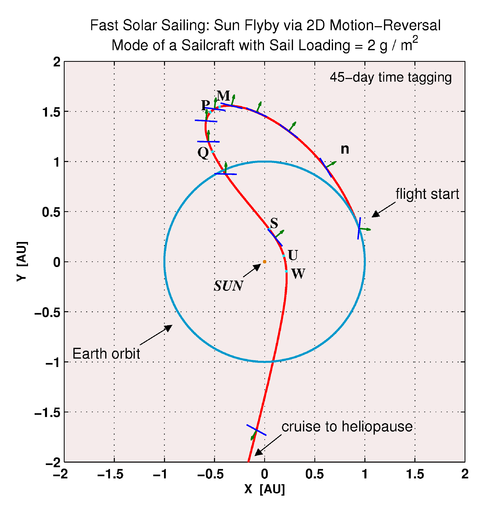
dynamics. In addition, a solar-sail spacecraft has been supposed to be able to reverse its motion (in the solar system) provided that its sail is sufficiently light that sailcraft sail loading (σ) is not higher than 2.1 g/m². This value entails a very high-performance technology, but probably within the capabilities of emerging technologies. - For describing the concept of fast sailing and some related items, we need to define two frames of referenceFrames of ReferenceFrames of Reference is a 1960 educational film by Physical Sciences Study Committee.The film was made to be shown in high school physics courses. In the film University of Toronto physics professors Patterson Hume and Donald Ivey explain the distinction between inertial and nonintertial frames of...
. The first is an inertial Cartesian coordinate systemCartesian coordinate systemA Cartesian coordinate system specifies each point uniquely in a plane by a pair of numerical coordinates, which are the signed distances from the point to two fixed perpendicular directed lines, measured in the same unit of length...
centred on the Sun or a heliocentric inertial frame (HIF, for short). For instance, the plane of referencePlane of referenceA term used in celestial mechanics, the plane of reference is the plane by means of which orbital elements are defined. The two main orbital elements that are measured with respect to the plane of reference are the inclination and the longitude of the ascending node.Depending on the type of body...
, or the XY plane, of HIF can be the mean eclipticEclipticThe ecliptic is the plane of the earth's orbit around the sun. In more accurate terms, it is the intersection of the celestial sphere with the ecliptic plane, which is the geometric plane containing the mean orbit of the Earth around the Sun...
at some standard epochEpoch (astronomy)In astronomy, an epoch is a moment in time used as a reference point for some time-varying astronomical quantity, such as celestial coordinates, or elliptical orbital elements of a celestial body, where these are subject to perturbations and vary with time...
such as J2000. The second Cartesian reference frame is the so-called heliocentric orbital frame (HOF, for short) with the origin in the sailcraft barycenterBarycentric coordinates (astronomy)In astronomy, barycentric coordinates are non-rotating coordinates with origin at the center of mass of two or more bodies.The barycenter is the point between two objects where they balance each other. For example, it is the center of mass where two or more celestial bodies orbit each other...
. The x-axis of HOF is the direction of the Sun-to-sailcraft vector, or position vector, the z-axis is along the sailcraft orbital angular momentumAngular momentumIn physics, angular momentum, moment of momentum, or rotational momentum is a conserved vector quantity that can be used to describe the overall state of a physical system...
, whereas the y-axis completes the counterclockwise triad. Such a definition can be extended to sailcraft trajectories, including both counterclockwise and clockwise arcs of motion, in such a way that HOF is always a continuous positively-oriented triad. The sail orientation unit vector (defined in sailcraft), say, n can be specified in HOF by a pair of angles, e.g. the azimuth α and the elevation δ. Elevation is the angle that n forms with the xy-plane of HOF (-90° ≤ δ ≤ 90°). Azimuth is the angle that the projection of n onto the HOF xy-plane forms with the HOF x-axis (0 ≤ α < 360 °). In HOF, azimuth and elevation are equivalent to longitude and latitude, respectively.
- The sailcraft lightness vector L = [λr , λt , λn] depends on α and δ (non-linearly) and the thermo-optical parameters of the sail materials (linearly). Neglecting a small contribution coming from the aberration of lightAberration of lightThe aberration of light is an astronomical phenomenon which produces an apparent motion of celestial objects about their real locations...
, one has the following particular cases (irrespective of the sail material):
- α = 0 , δ = 0 ⇔ [λr , 0 , 0] ⇔ λ=|L|=λr
- α ≠ 0 , δ = 0 ⇔ [λr , λt , 0]
- α = 0 , δ ≠ 0 ⇔ [λr , 0 , λn].
Conventional strategy
- Suppose a sailcraft is built with an all-metal sail of aluminium and chromium such that σ = 2 g/m². A launcher delivers the (packed) sailcraft at some million kilometers from the Earth. There, the whole sailcraft is deployed and begins its flight in the solar system (here, for the sake of simplicity, any gravitational perturbation from planets is neglected). A conventional spacecraft would move approximately in a circular orbit at about 1 AU from the Sun. In contrast, a sailcraft like this one is sufficiently light to be able to escape the solar system or to point to some distant object in the heliosphere. If the direction that sail's surface faces, represented by surface normalSurface normalA surface normal, or simply normal, to a flat surface is a vector that is perpendicular to that surface. A normal to a non-flat surface at a point P on the surface is a vector perpendicular to the tangent plane to that surface at P. The word "normal" is also used as an adjective: a line normal to a...
vector n, is parallel to the local sunlight direction (i.e. the sail faces toward the Sun), then λr = λ = 0.725 (i.e. 1/2 < λ < 1); as a result, this sailcraft moves on a hyperbolic orbit. Its speed at infinity is equal to 20 km/s. Strictly speaking, this potential solar sail mission would be faster than the current record speed for missions beyond the planetary range, that of Voyager 1, which is 17 km/s or about 3.6 AU/yr (1 AU/yr = 4.7404 km/s). However, three kilometers per second are not meaningful in the context of very deep space missions. - As a consequence, one has to resort to some L having more than one component different from zero. The classical way to gain speed is to tilt the sail at some suitable positive α. If α= +21°, then the sailcraft begins by accelerating; after about two months, it achieves 32 km/s. However, this is a speed peak inasmuch as its subsequent motion is characterized by a monotonic speed decrease towards an asymptotic value, or the cruise speed, of 26 km/s. After 18 years, the sailcraft is 100 AU away from the Sun. This would mean a pretty fast mission. However, considering that a sailcraft with 2 g/m² is technologically advanced, is there any other way to increase its speed significantly? Yes, there is. Let us try to explain this effect of non-linear dynamics.
Optimal strategy
- The above figures show that spiralling out from a circular orbit is not a convenient mode for a sailcraft to be sent away from the Sun since it would not have a high enough excess speed. On the other hand, it is known from astrodynamicsAstrodynamicsOrbital mechanics or astrodynamics is the application of ballistics and celestial mechanics to the practical problems concerning the motion of rockets and other spacecraft. The motion of these objects is usually calculated from Newton's laws of motion and Newton's law of universal gravitation. It...
that a conventional Earth satellite has to perform a rocket maneuver at/around its perigee for maximizing its speed at "infinity". Similarly, one can think of delivering a sailcraft close to the Sun to get much more energy from the solar photon pressure (that scales as 1/R2). For instance, suppose one starts from a point at 1 AU on the ecliptic and achieves a perihelion distance of 0.2 AU in the same plane by a two-dimensional trajectory. In general, there are three ways to deliver a sailcraft, initially at R0 from the Sun, to some distance R < R0:- using an additional propulsion system to send the folded-sail sailcraft to the perihelion of an elliptical orbit; there, the sail is deployed with its axis parallel to the sunlight for getting the maximum solar flux at the chosen distance;
- spiralling in by α slightly negative, namely, via a slow deceleration;
- strongly decelerating by a "sufficiently large" sail-axis angle negative in HOF.
- The first way - although usable as a good reference mode - requires another high-performance propulsion system.
- The second way is ruled out in the present case of σ = 2 g/m²; as a matter of fact, a small α < 0 entails a λr too high and a negative λt too low in absolute value: the sailcraft would go far from the Sun with a decreasing speed (as discussed above).
- In the third way, there is a critical negative sail-axis angle in HOF, say, αcr such that for sail orientation angles α < αcr the sailcraft trajectory is characterized as follows:
-
- the distance (from the Sun) first increases, achieves a local maximum at some point M, then decreases. The orbital angular momentum (per unit mass), say, H of the sailcraft decreases in magnitude. It is suitable to define the scalar H = H•k, where k is the unit vector of the HIF Z-axis;
- after a short time (few weeks or less, in general), the sailcraft speed V = |V| achieves a local minimum at a point P. H continues to decrease;
- past P, the sailcraft speed increases because the total vector acceleration, say, A begins by forming an acute angle with the vector velocity V; in mathematical terms, dV / dt = A • V / V > 0. This is the first key-point to realize;
- eventually, the sailcraft achieves a point Q where H = 0; here, the sailcraft's total energyEnergyIn physics, energy is an indirectly observed quantity. It is often understood as the ability a physical system has to do work on other physical systems...
(per unit mass), say, E (including the contribution of the solar pressure on the sail) shows a (negative) local minimum. This is the second key-point; - past Q, the sailcraft - keeping the negative value of the sail orientation - regains angular momentum by reversing its motion (that is H is oriented down and H < 0). R keeps on decreasing while dV/dt augments. This is the third key-point;
- the sailcraft energy continues to increase and a point S is reached where E=0, namely, the escape condition is satisfied; the sailcraft keeps on accelerating. S is located before the perihelion. The (negative) H continues to decrease;
- if the sail attitude α has been chosen appropriately (about -25.9 deg in this example), the sailcraft flies-by the Sun at the desired (0.2 AU) perihelion, say, U; however, differently from a Keplerian orbit (for which the perihelion is the point of maximum speed), past the perihelion, V increases further while the sailcraft recedes from the Sun.
- past U, the sailcraft is very fast and pass through a point, say, W of local maximum for the speed, since λ < 1. Thus, speed decreases but, at a few AU from the Sun (about 2.7 AU in this example), both the (positive) E and the (negative) H begin a plateau or cruise phase; V becomes practically constant and, the most important thing, takes on a cruise value considerably higher than the speed of the circular orbit of the departure planet (the Earth, in this case). This example shows a cruise speed of 14.75 AU/yr or 69.9 km/s. At 100 AU, the sailcraft speed is 69.6 km/s.
H-reversal Sun flyby trajectory
- The figure below shows the mentioned sailcraft trajectory. Only the initial arc around the Sun has been plotted. The remaining part is rectilinear, in practice, and represents the cruise phase of the spacecraft. The sail is represented by a short segment with a central arrow that indicates its orientation. Note that the complicate change of sail direction in HIF is very simply achieved by a constant attitude in HOF. That brings about a net non-Keplerian feature to the whole trajectory.
- As mentioned in point-3, the strong sailcraft speed increase is due to both the solar-light thrust and gravity acceleration vectors. In particular, dV / dt, or the along-track component of the total acceleration, is positive and particularly high from the point-Q to the point-U. This suggests that if a quick sail attitude maneuver is performed just before H vanishes, α → -α, the sailcraft motion continues to be a direct motion with a final cruise velocity equal in magnitude to the reversal one (because the above maneuver keeps the perihelion value unchanged). The basic principle both sailing modes share may be summarised as follows: a sufficiently light sailcraft needs to lose most of its initial energy for subsequently achieving the absolute maximum of energy compliant with its given technology.
- The above 2D class of new trajectories represents an ideal case. The realistic 3D fast sailcraft trajectories are considerably more complicated than the 2D cases. However, the general feature of producing a fast cruise speed can be further enhanced. Some of the enclosed references contain strict mathematical algorithms for dealing with this topic. Recently (July 2005), in an international symposium an evolution of the above concept of fast solar sailing has been discussed. A sailcraft with σ = 1 g/m² could achieve over 30 AU/yr (0.000474 c) in cruise (by keeping the perihelion at 0.2 AU), namely, well beyond the cruise speed of any nuclear-electric spacecraft (at least as conceived today). Such paper has been published on the Journal of the British Interplanetary Society (JBIS) in 2006.
In science fiction
One of the earliest stories about light sails, possibly the earliest, is "The Lady Who Sailed the Soul" by Cordwainer SmithCordwainer Smith
Cordwainer Smith – pronounced CORDwainer – was the pseudonym used by American author Paul Myron Anthony Linebarger for his science fiction works. Linebarger was a noted East Asia scholar and expert in psychological warfare...
, which was published in 1960. In it, a tragedy results from the slowness of interstellar travel by this method. Another example is the 1962 story "Gateway to Strangeness
Gateway to Strangeness
"Gateway to Strangeness", also titled "Dust of Far Suns" and "Sail 25", is a science fiction novelette by Jack Vance. It was first published in the August 1962 edition of Amazing Stories magazine.-Plot:...
" (also known as "Sail 25") by Jack Vance
Jack Vance
John Holbrook Vance is an American mystery, fantasy and science fiction author. Most of his work has been published under the name Jack Vance. Vance has published 11 mysteries as John Holbrook Vance and 3 as Ellery Queen...
, in which the outward direction of propulsion poses a life-threatening dilemma. Also in early 20th century literature, Pierre Boulle
Pierre Boulle
Pierre Boulle was a French novelist largely known for two famous works, The Bridge over the River Kwai and Planet of the Apes .-Biography:...
's Planet of the Apes starts with a couple floating in space on a ship propelled and maneuvered by light sails. In Larry Niven
Larry Niven
Laurence van Cott Niven / ˈlæri ˈnɪvən/ is an American science fiction author. His best-known work is Ringworld , which received Hugo, Locus, Ditmar, and Nebula awards. His work is primarily hard science fiction, using big science concepts and theoretical physics...
and Jerry Pournelle
Jerry Pournelle
Jerry Eugene Pournelle is an American science fiction writer, essayist and journalist who contributed for many years to the computer magazine Byte and has since 1998 been maintaining his own website/blog....
's The Mote in God's Eye
The Mote in God's Eye
The Mote in God's Eye is a science fiction novel by American writers Larry Niven and Jerry Pournelle, first published in 1974. The story is set in the distant future of Pournelle's CoDominium universe, and charts the first contact between humanity and an alien species. The title of the novel is a...
, a sail is used as a brake and a weapon. Author and scientist Arthur C. Clarke
Arthur C. Clarke
Sir Arthur Charles Clarke, CBE, FRAS was a British science fiction author, inventor, and futurist, famous for his short stories and novels, among them 2001: A Space Odyssey, and as a host and commentator in the British television series Mysterious World. For many years, Robert A. Heinlein,...
depicted a "yacht race" between solar sail spacecraft in the 1964 short story "Sunjammer
Sunjammer
"Sunjammer" is a science fiction short story by English author Arthur C. Clarke. It was originally published in 1963. It has also been published under the title "The Wind from the Sun" and has been included into Clarke's 1972 collection of short stories with this title.-Plot summary:John...
". In "Flight of the Dragonfly", Robert Forward (who also proposed the microwave-pushed Starwisp design) described an interstellar journey using a light driven propulsion system, wherein a part of the sail was broken off and used as a reflector to slow the main spacecraft as it approached its destination. In the 1982 film Tron
Tron
-Film:*Tron , a franchise that began in 1982 with the Walt Disney Pictures film Tron** Tron , a 1982 science fiction film by Disney, starring Jeff Bridges, Bruce Boxleitner, Cindy Morgan, Dan Shor and David Warner...
, a "Solar Sailer" was a inner spacecraft with butterfly like sails moved along focused beam of light. In the episode "Explorers" of Star Trek: Deep Space Nine
Star Trek: Deep Space Nine
Star Trek: Deep Space Nine is a science fiction television series set in the Star Trek universe...
that aired in 1995, a "light ship" was featured. It was designed to use solar wind to fly out of a solar system with no engine. In the film Star Wars Episode II: Attack of the Clones
Star Wars Episode II: Attack of the Clones
Star Wars Episode II: Attack of the Clones is a 2002 American epic space opera film directed by George Lucas and written by Lucas and Jonathan Hales. It is the fifth film to be released in the Star Wars saga and the second in terms of the series' internal chronology...
one is used by Count Dooku
Count Dooku
Count Dooku is a fictional character from the Star Wars universe. Dooku is one of the main antagonists of both Star Wars Episode II: Attack of the Clones and the events of the Clone Wars and is a supporting villain in Star Wars Episode III: Revenge of the Sith. Count Dooku plays a substantial role...
to propel himself across space. A solar sail was also used in James Cameron's Avatar. In the Disney film Treasure Planet
Treasure Planet
Treasure Planet is a 2002 animated science fiction film produced by Walt Disney Animation Studios, and released by Walt Disney Pictures on November 27, 2002...
, Solar sails are used literally as sails for interstellar travel of steam-punk styled -masted sailing ship capable of traveling through space.
See also
- Magnetic sailMagnetic sailA magnetic sail or magsail is a proposed method of spacecraft propulsion which would use a static magnetic field to deflect charged particles radiated by the Sun as a plasma wind, and thus impart momentum to accelerate the spacecraft...
- Electric sailElectric sailAn Electric sail is a proposed form of spacecraft propulsion using the dynamic pressure of the solar wind as a source of thrust. It uses an electric field for deflecting solar wind protons and extracting momentum from them...
- Cosmos 1Cosmos 1Cosmos 1 was a project by Cosmos Studios and The Planetary Society to test a solar sail in space. As part of the project, an unmanned solar sail spacecraft christened Cosmos 1 was launched into space at 15:46:09 EDT on June 21, 2005 from the submarine Borisoglebsk in the Barents Sea...
- Spacecraft propulsionSpacecraft propulsionSpacecraft propulsion is any method used to accelerate spacecraft and artificial satellites. There are many different methods. Each method has drawbacks and advantages, and spacecraft propulsion is an active area of research. However, most spacecraft today are propelled by forcing a gas from the...
- Optical liftOptical liftOptical lift is an optical analogue of aerodynamic lift, in which a cambered refractive object with differently shaped top and bottom surfaces experiences a stable transverse lift force when placed in a uniform stream of light.- Discovery :...
- Optical tweezersOptical tweezersOptical tweezers are scientific instruments that use a highly focused laser beam to provide an attractive or repulsive force , depending on the refractive index mismatch to physically hold and move microscopic dielectric objects...
- Nichols radiometerNichols radiometerA Nichols radiometer was the apparatus used by Ernest Fox Nichols and Gordon Ferrie Hull in 1901 for the measurement of radiation pressure. It consisted of a pair of small silvered glass mirrors suspended in the manner of a torsion balance by a fine quartz fibre within an enclosure in which the air...
- IKAROSIKAROSIKAROS is a Japan Aerospace Exploration Agency experimental spacecraft. The spacecraft was launched on 21 May, 2010, aboard an H-IIA rocket, together with the Akatsuki probe and four other small spacecraft...
External links
- Planetary Society site for solar sailing projects
- NASA Mission Site for NanoSail-D
- NanoSail-D mission: Dana Coulter, "NASA to Attempt Historic Solar Sail Deployment", NASA, June 28, 2008
- Far-out Pathways to Space: Solar Sails from NASA
- Solar Sails Comprehensive collection of solar sail information and references, maintained by Benjamin Diedrich. Good diagrams showing how light sailors must tack.
- U3P Multilingual site with news and flight simulators
- ISAS Deployed Solar Sail Film in Space
- Suggestion of a solar sail with roller reefing, hybrid propulsion and a central docking and payload station.
- Interview with NASA's JPL about solar sail technology and missions
- Website with technical pdf-files about solar-sailing, including NASA report and lectures at Aerospace Engineering School of Rome University
- Advanced Solar- and Laser-pushed Lightsail Concepts
- www.aibep.org: Official site of American Institute of Beamed Energy Propulsion
- Concept for using a solar sail to simultaneously provide a Global Energy System and a Weather Control System.