
See Also

Sputnik 1

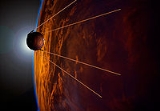
Sputnik 1 was the first artificial satellite Satellite

A satellite is any object that orbit [i]s another object . ... 

 to be put into orbit, on October 4, 1957. Coming at the height of the Cold War Cold War

The Cold War was the protracted geopolitical [i], ideological [i], and economic [i] ... 

, the launching of Sputnik caught the West Western world

The term Western World or "the West" can have multiple meanings depending on its context.... 

 by surprise, and in the U.S. led to a wave of self-recriminations, the beginning of the space race Space Race

The Space Race was an informal competition [i] between the United States [i] and the Soviet Union [i] t ... 

, and a movement to reform science education.

Discussions

  Discussion Features

   Ask a question about 'Sputnik 1'

   Start a new discussion about 'Sputnik 1'

   Answer questions about 'Sputnik 1'

   'Sputnik 1' discussion forum

Timeline

1958   Sputnik 1 falls to Earth from its orbit (launched on October 4 1957).


Encyclopedia

Sputnik 1 was the first artificial satellite Satellite

A satellite is any object that orbit [i]s another object . ... 

 to be put into orbit, on October 4, 1957. Coming at the height of the Cold War Cold War

The Cold War was the protracted geopolitical [i], ideological [i], and economic [i]... 

, the launching of Sputnik caught the West Western world

The term Western World or "the West" can have multiple meanings depending on its context.... 

 by surprise, and in the U.S. led to a wave of self-recriminations, the beginning of the space race Space Race

The Space Race was an informal competition [i] between the United States [i] and the Soviet Union [i] t ... 

, and a movement to reform science education.

Spacecraft Design

The satellite weighed about 83 kg . The Sputnik 1 satellite was a 58.0 cm-diameter aluminum sphere that carried four whip-like antennas that were 2.4-2.9 m long. The antennas looked like long "whiskers" pointing to one side. It had two radio Radio

Radio is the wireless transmission of signals [i], by modulation [i] of electromagnetic waves [i] ... 

 transmitters and is believed to have orbited Earth at a height of about 250 km . Analysis of the radio signals was used to gather information about the electron density of the ionosphere. Temperature and pressure were encoded in the duration of radio beeps, indicating the satellite was not punctured by a meteorite. Sputnik 1 was launched by an R-7 rocket R-7 Semyorka

The R-7 Semyorka was the world's first intercontinental ballistic missile [i] and was deployed by the Soviet Union [i]... 

. It incinerated upon re-entry on January 3, 1958.

Instruments
Nitrogen pressurized sphere : Micrometeorite Micrometeoroid

A Micrometeoroid is a tiny meteoroid [i]; a small particle of rock in space, usually weighing less than ... 

 detection
Radio : Propagation of radio signals
Thermometer : Micrometeorite detection


Sputnik was the first of several satellites in the Soviet Union Soviet Union

The Union of Soviet Socialist Republics , more commonly known as the Soviet Union, was a Communist state [i] ... 

's Sputnik program Sputnik program

The Sputnik program was a series of unmanned space mission [i]s launched by the Soviet Union [i] in the ... 

, the majority of them successful. Sputnik 2 Sputnik 2

Sputnik 2 was the second spacecraft [i] launched into Earth orbit [i], on November 3 [i], 1957 [i], and ... 

 followed as the second satellite in orbit, also the first to carry an animal, the dog Laika Laika

Laika was a Russian space dog [i] that became the first living creature from Earth [i] ... 

. The first failure occurred with Sputnik 3 Sputnik 3

Sputnik 3 was a Soviet [i] satellite launched on May 15 [i], 1958 [i] from Baikonur [i] cos... 

.

Mission

The Sputnik 1 spacecraft was launched from Baikonur Cosmodrome Baikonur Cosmodrome

The Baikonur Cosmodrome, also called Tyuratam, is the world's oldest and largest operational space launch facility [i] ... 

 at Tyuratam in Kazakhstan Kazakhstan

Kazakhstan, also spelled Kazakstan, , officially the Republic of Kazakhstan, is a country th... 

, then part of the Soviet Union Soviet Union

The Union of Soviet Socialist Republics , more commonly known as the Soviet Union, was a Communist state [i] ... 

. The Russian word "Sputnik" means "travel companion" . The full official name, however, translates as "Artificial Earth Satellite" .
In 1885 Konstantin Tsiolkovsky Konstantin Tsiolkovsky

Konstantin Eduardovich Tsiolkovsky was a Russia [i]n and Soviet [i] rocket [i] scientist... 

 first described in his book Dreams of Earth and Sky how such a satellite could be launched into a low altitude orbit. It was planned as a contribution to the International Geophysical Year , with three of the five Sputnik satellites reaching orbit during that period.

The actual sequence of decision-making as to the form of Sputnik 1 was convoluted. A tonne-and-a-half, cone-shaped artificial satellite capable of making many physics measurements in space was first planned by Academician Keldysh Mstislav Keldysh

Mstislav Vsevolodovich Keldysh FRSE [i] was a Soviet [i] scientist [i] in the field of mathematics [i] a ... 

, but when the Soviet Soviet Union

The Union of Soviet Socialist Republics , more commonly known as the Soviet Union, was a Communist state [i] ... 

s read that the American Project Vanguard Project Vanguard

Project Vanguard was the name given to the first United States [i] program that was commissioned to desi ... 

 had two satellite designs, a small one which was just to see if they could get something into orbit, the Soviets decided to have what translates as the "Simplest Satellite" too, one which was one centimeter larger in diameter, and much heavier, than Vanguard's "real" satellite. They had to see whether the conditions in low Earth orbit would permit the bigger satellite to remain there for a useful length of time. When, months after Sputnik 1, the Vanguard test satellite was orbited, Khrushchev Nikita Khrushchev

Nikita Sergeyevich Khrushchyov was the leader of the Soviet Union [i] after the death of Joseph Stalin [i] ... 

 ridiculed it as a "grapefruit." Once the Soviets found they could orbit a test satellite too, they planned to orbit Keldysh's space laboratory satellite as Sputnik 3 Sputnik 3

Sputnik 3 was a Soviet [i] satellite launched on May 15 [i], 1958 [i] from Baikonur [i] cos... 

, and did so after one launch failure.

The spacecraft obtained data pertaining to the density of the upper layers of the atmosphere and the propagation of radio signals in the ionosphere. The instruments and electric power sources were housed in a sealed capsule and included transmitters operated at 20.005 and 40.002 MHz , the emissions taking place in alternating groups of 0.3 s duration. The downlink telemetry included data on temperatures inside and on the surface of the sphere.

Because the sphere was filled with nitrogen under pressure, Sputnik 1 provided the first opportunity for meteoroid detection , since losses in internal pressure due to meteoroid penetration of the outer surface would have been evident in the temperature data. The satellite transmitters operated for three weeks, until the on-board chemical batteries failed, and were monitored with intense interest around the world. The orbit of the then-inactive satellite was later observed optically to decay 92 days after launch after having completed about 1400 orbits of the Earth, travelling a cumulative distance of 70 million kilometers. The orbital apogee Apsis

In astronomy [i], an apsis is the point of greatest or least distance of the elliptical orbit [i] of a celestial body [i] ... 

 declined from 947 km after launch to 600 km by December 9.

The Sputnik 1 rocket booster also reached Earth orbit and was visible from the ground at night as a first magnitude object. The satellite itself, a small but highly polished sphere, was barely visible at sixth magnitude, and thus more difficult to follow optically. Several replicas of the Sputnik 1 satellite can be seen at museums in Russia and another is on display in the Smithsonian National Air and Space Museum National Air and Space Museum

The National Air and Space Museum of the Smithsonian Institution [i] in the United States [i] maintains... 

 in Washington, D.C.

Space Race

The United States United States

The United States of America, also known as the United States, the U.S., the U.S.A., a... 

 had also been working on satellites, primarily through teams working for the US Navy United States Navy

The United States Navy is the branch of the United States armed forces [i] responsible for conducting naval [i] ... 

 as Project Vanguard Project Vanguard

Project Vanguard was the name given to the first United States [i] program that was commissioned to desi ... 

.
Their first launch had originally been intended to go before Sputnik, but was delayed several times before eventually blowing up on the pad.
A rush effort then started under the US Army United States Army

The United States Army is the largest branch of the United States armed forces [i] ... 

's Jupiter Jupiter-C

The Jupiter-C was designed by the Army Ballistic Missile Agency [i] .
... 

 project and succeeded launching Explorer I Explorer I

Explorer-I, officially Satellite 1958 Alpha , was the first Earth satellite [i] of the United States [i] ... 

 in January 1958.
This is considered the start of the Space Race Space Race

The Space Race was an informal competition [i] between the United States [i] and the Soviet Union [i] t ... 

 between the two superpower Superpower

A superpower is a state [i] with the first rank in the international system [i] ... 

s, as an aspect of the Cold War Cold War

The Cold War was the protracted geopolitical [i], ideological [i], and economic [i]... 

.
Both nations attempted to out-do each other in space exploration, eventually culminating in the launch of the Apollo 11 Apollo 11

Apollo 11 was the first manned mission to land on the Moon [i]. ... 

mission to the Moon Moon

The Moon is Earth [i]'s only natural satellite [i]. ... 

.

Historical Preservation

In 2003 a back-up unit of Sputnik 1 called "model PS-1" was sold on eBay EBay

eBay Inc. manages an online auction [i] and shopping website [i], where people buy and sell goods and se ... 

 . It had been on display in a science institute near Kiev Kiev

Kiev, also written as Kyiv is the capital [i] and the largest city of Ukraine [i], lo ... 

. It is estimated that between four and twenty models were made for testing and other purposes.

A Sputnik 1 model was given as a present to the United Nations United Nations

name = United Nations
Nations Unies
... 

 and now decorates the entry Hall of its New York City New York City

[i] in the [[United States]... 

 Headquarters.

See also

  • Sputnik crisis Sputnik crisis

    The Sputnik crisis was a turning point of the Cold War [i] that began on October 4 [i], 1957 [i] when th ... 

     - The crisis in the US that this surprise launch of the world's first artificial satellite led to.
  • ILLIAC I - First computer to calculate the orbit of Sputnik I.
  • Defense Advanced Research Projects Agency

External links

  • - Tracking Sputnik.


Categories: