


Apollo 15

Encyclopedia
Apollo 15 was the ninth manned mission in the American
Apollo space program, the fourth to land
on the Moon
and the eighth successful manned mission. It was the first of what were termed "J missions", long duration stays on the Moon with a greater focus on science than had been possible on previous missions. It was also the first mission where the Lunar Roving Vehicle was used.
The mission began on July 26, 1971, and concluded on August 7. At the time, NASA
called it the most successful manned flight ever achieved.
Commander David Scott
and Lunar Module Pilot James Irwin
spent three days on the Moon and a total of 18½ hours outside the spacecraft on lunar extra-vehicular activity
. The mission was the first not to land in a lunar mare
, instead landing near Hadley rille
in an area of the Mare Imbrium
called Palus Putredinus (Marsh of Decay). The crew explored the area using the first Lunar Rover, allowing them to travel much farther from the Lunar Module
lander than had previously been possible. They collected a total of 77 kg (170 lbs) of lunar surface material. At the same time, Command Module Pilot Alfred Worden
orbited the Moon, using a Scientific Instrument Module (SIM) in the Service Module to study the lunar surface and environment in great detail with a panoramic camera, gamma ray spectrometer
, mapping camera, laser altimeter
, mass spectrometer
, and lunar sub-satellite deployed at the end of Apollo 15's stay in lunar orbit (an Apollo program first).
Although the mission accomplished its objectives, this success was somewhat overshadowed by negative publicity that accompanied public awareness of postage stamps carried by the astronauts without authorization, who had made plans to sell them upon their return.
, including Scott's honorary degree, awarded in the spring of 1971, just months before the launch. Scott did attend the University of Michigan, but left before graduating to accept an appointment to the US Military Academy. The crewmen did their undergraduate work at the US Military Academy or the US Naval Academy.
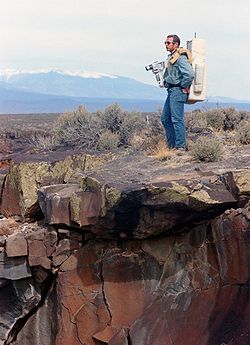 The crew for Apollo 15 had previously served as the backup crew for Apollo 12. There had been a friendly rivalry between that prime and backup crew on that mission, with the prime being all Navy
, and the backup all Air Force
.
Originally Apollo 15 would have been an H mission, like Apollos 12
, 13
, 14
. But on September 2, 1970, NASA
announced it was cancelling what were to be the current incarnations of the Apollo 15 and Apollo 19
missions. To maximize the return from the remaining missions, Apollo 15 would now fly as a J mission and have the honor of carrying the first Lunar Rover.
One of the major changes in the training for 15 was the geology training. Although on previous flights the crews had been trained in field geology, for the first time 15 would make it a high priority. Scott and Irwin would train with Leon Silver
, a Caltech geologist who on Earth was interested in the Precambrian
. Silver had been suggested by Harrison Schmitt
as an alternative to the classroom lecturers that NASA had previously used. Among other things, Silver had made important refinements to the methods for dating rocks using the decay of uranium
into lead
in the late 1950s.
At first Silver would take the prime and backup crews to various geological sites in Arizona and New Mexico as if for a normal field geology lesson, but as launch time approached, these trips became more realistic. Crews began to wear mock-ups of the backpacks they would carry, and communicate using walkie-talkie
s to a CapCom in a tent. (During a mission the Capsule Communicators (CapComs), always fellow astronauts, were the only people who normally would speak to the crew). The CapCom was accompanied by a group of geologists unfamiliar with the area who would rely on the astronauts' descriptions to interpret the findings.
The decision to land at Hadley came in September 1970. The Site Selection Committees had narrowed the field down to two sites — Hadley Rille or the crater Marius
, near which were a group of low, possibly volcanic, domes
. Although not ultimately his decision, the commander of a mission always held great sway. To Dave Scott the choice was clear, with Hadley, being "exploration at its finest".
Command Module Pilot Al Worden undertook a different kind of geology training. Working with an Egyptian, Farouk El-Baz
, he flew over areas in an airplane simulating the speed at which terrain would pass below him while in the CSM in orbit. He became quite adept at making observations as the object traveled below.
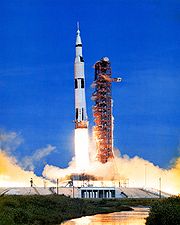
Apollo 15 launched on July 26, 1971, at 9:34 AM EDT from the Kennedy Space Center
at Cape Canaveral
, Florida. During the launch, the second stage of the Saturn V
ignited when still close to the first stage, which could have caused a catastrophic event in which the exhaust of the first stage engine would have been forced back into the engine. Despite this, the rocket nominally reached an orbit around Earth a short time later. A couple of hours into the mission, the S-IVB
third stage of the rocket reignited to propel the spacecraft out of Earth orbit and on to the Moon.
A few days after launching from Florida, the spacecraft passed behind the far side of the Moon
, where the Service Propulsion System engine on the Apollo Command/Service Module
ignited for a six-minute burn to slow the craft down into an initial lunar orbit. Once the lowest point of altitude was reached in the orbit, the SPS engine was fired again to further stabilize the orbit of the Apollo CSM/Apollo Lunar Module
stack and prepare for landing at Hadley.
Soon thereafter, Scott and Irwin began the descent to the Hadley landing site on the surface. Several minutes after descent was initiated, at pitch-over and the beginning of the approach phase of the landing, the LM was six kilometers east of the pre-selected landing target. Upon learning of this, Scott altered the flight path of the LM and touched down at 22:16:29 UTC on July 30 at Hadley, within a few hundred meters of the planned landing site. While previous crews had exited the Lunar Module shortly after landing, the crew of Apollo 15 would be spending a substantially longer amount of time on the surface than previous crews. In order to preserve their sleep rhythm, the crew elected to spend the rest of the day inside the LM and wait until the next day to perform the first of three Extra-vehicular activities
(EVAs), or moonwalks. Before beginning their sleep period, Scott performed a stand-up EVA, during which the LM was depressurized and the top docking hatch opened to allow him to photograph their surroundings.
 Throughout the sleep period, Mission Control
in Houston monitored a slow but steady oxygen leak. The data output of the onboard telemetry computers was limited during the night to conserve energy, so controllers could not determine the exact cause of the leak without awaking the crew. Scott and Irwin were eventually awakened an hour ahead of schedule, and the source of the leak was determined to be an open valve on the Urine
Transfer Device. After the problem was resolved, the crew began preparations for the first moonwalk.
Four hours after ending their sleep period and the preparations for the moonwalk were complete, Scott and Irwin became the seventh and eighth humans to walk on the Moon, respectively. After unloading the Lunar Roving Vehicle (LRV), the two drove to the first moonwalk's primary destination, Elbow crater along the edge of Hadley Rille. Upon returning to the LM Falcon, Scott and Irwin deployed the Apollo Lunar Surface Experiments Package
(ALSEP). The first EVA ended after about 6½ hours outside the LM.
The target of the second EVA the next day was the edge of Mount Hadley Delta. There, the pair sampled boulders and craters along the Apennine Front
. During this moonwalk, the astronauts recovered what came to be one of the most famous lunar samples collected on the Moon during Apollo, sample #15415, more commonly known as the "Genesis Rock
". Once back at the landing site, Scott continued to attempt to drill holes for an experiment at the ALSEP site, which he had struggled with the previous day. After conducting soil mechanics experiments and erecting a US flag
, Scott and Irwin returned to the shelter of the LM. They spent 7 hours and 12 minutes outside during EVA 2.
During EVA 3, the third and final moonwalk of the mission, the crew again ventured to the edge of Hadley Rille, this time to the northwest of the immediate landing site. After returning to LM site, Scott performed an experiment with a feather and hammer to test Galileo's theory of objects in gravity fields in vacuums. To test this, he dropped the hammer and feather at the same time. Because of the vacuum present at the lunar surface, they hit the ground at the same time, confirming Galileo's hypothesis. Scott then drove the rover to a point beyond the LM to its final resting point, so the television camera on the rover could be used to observe the lunar liftoff. Scott set up a memorial nearby to the cosmonauts and astronauts who were known to have died up to that time, with a plaque bearing their names and a "Fallen Astronaut
" statuette. The EVA ended after 4 hours and 50 minutes.
In total, the two astronauts spent 18½ hours outside of the LM and collected approximately 77 kg (170 lbs) of lunar samples.
After lifting off from the lunar surface 2 days and 18 hours after landing, the LM ascent stage rendezvoused and re-docked with the CSM with Al Worden aboard in orbit. After transferring samples and other items from the LM to the CSM, the LM was sealed off, jettisoned, and intentionally crashed into the lunar surface. After completing more observations of the Moon from orbit and releasing the sub-satellite, the three-person crew departed lunar orbit with another burn of the SPS engine.
The next day, on the return trip to Earth, Al Worden performed a spacewalk in deep space, the first of its kind, to retrieve exposed film from the SIM bay. Later on in the day, the crew set an endurance record for Apollo program, becoming the longest Apollo spaceflight to that point.
On approach to Earth the next day, August 7, the Service Module (SM) was jettisoned, and the Command Module (CM) reentered the Earth's atmosphere
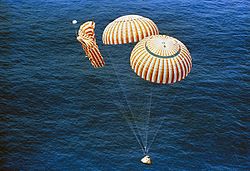
. Although one of the three parachutes on the CM failed to deploy properly, only two were required for a safe landing (one extra for redundancy). Upon landing in the North Pacific Ocean, the crew were recovered and taken aboard the recovery ship, the USS Okinawa
after a mission lasting 12 days, 7 hours, 11 minutes, and 33 seconds.
CSM-112, which was given the callsign Endeavour, named after the HM Bark Endeavour
and Lunar Module
LM-10, callsign Falcon, named after the United States Air Force Academy
mascot. If Apollo 15 had flown as an H mission it would have been with CSM-111 and LM-9. That CSM was used by the Apollo Soyuz Test Project but the Lunar Module went unused and is now on display at the Kennedy Space Center Visitor Complex
. After re-entry, one of Endeavours three main parachutes collapsed after opening. As it turned out, only two of the three parachutes were required for safe splashdown; the third was a contingency. Endeavour ultimately splashed down safely to end the mission.
Technicians at the Kennedy Space Center
had many problems with the Scientific Instrument Module (SIM) bay in the Service Module. It was the first time it had flown and experienced problems from the start. Problems came from the fact the instruments were designed to operate in zero gravity, but had to be tested in the 1 g
on the surface of the Earth. As such, things like the 7.5 m booms for the mass
and gamma ray spectrometer
s could only be tested using railings that tried to mimic the space environment, and so they never worked particularly well. When the technicians tried to integrate the entire bay into the rest of the spacecraft, data stream
s would not synchronize, and lead investigators of the instruments would want to make last minute checks and changes. When it came time to test the operation of the gamma-ray spectrometer, it was necessary to stop every engine within 10 miles (16 km) of the test site.
On the Lunar Module, the fuel
and oxidizer tanks were enlarged on both the descent and ascent stages and the engine bell on the descent stage was extended. Batteries and solar cell
s were added for increased electrical power. In all this increased the weight of the Lunar Module to 36,000 pounds (16,330 kilograms), 4000 pounds (1800 kg) heavier than previous models.
Endeavour is currently on display at the National Museum of the United States Air Force
at Wright-Patterson Air Force Base
in Dayton, Ohio
.
. It could be folded into a space 5 ft by 20 in (1.5 m by 0.5 m). Unloaded it weighed 460 lb (209 kg) and when carrying two astronauts and their equipment, 1500 lb (700 kg). Each wheel was independently driven by a ¼ horsepower
(200 W) electric motor. Although it could be driven by either astronaut, the Commander always drove. Travelling at speeds up to 6 to 8 mph (10 to 12 km/h), it meant that for the first time the astronauts could travel far afield from their lander and still have enough time to do some scientific experiments.
Releasing the subsatellite was the crew's final activity in lunar orbit, occurring an hour before the burn to take them back to Earth. A virtually identical subsatellite was deployed by Apollo 16
.
lowered to 166 km (90 nautical miles) above the Earth's surface. These two changes meant 1100 pounds (500 kg) more could be launched. The propellant
reserves were reduced and the number of retrorockets on the S-IC
first stage reduced from eight to four. The four outboard engines of the S-IC would be burned longer and the center engine would also burn longer before being shut down (see Saturn V
for more information on the launch sequence). Changes were also made to the S-II
second stage to stop pogo oscillation
s.
Once all the various components had been installed on the Saturn V, it was moved to the launch site, Launch Complex 39A. During late June and early July 1971, the rocket and Mobile Service Structure were struck by lightning
at least four times. All was well however, with only minor damage suffered.
 After a highly successful mission, the reputation of the crew and NASA was tarnished somewhat by a deal they made with a German stamp dealer. H. Walter Eiermann, who had many professional and social contacts with NASA employees and the astronaut corps, arranged for Scott to carry unauthorized commemorative postal covers in his spacesuit, in addition to the postal covers NASA contracted to carry for the U.S. Postal Service. Eiermann had promised each astronaut US$7,000 in the form of savings accounts in return for 100 covers signed after having returned from the Moon. He told them that he would not advertise or sell the covers until the end of the Apollo program. Irwin wrote in his book To Rule the Night that the astronauts had agreed to the deal as a way to help finance their children's college tuition.
One final controversial event happened after the flight. The crew had contacted Belgian sculptor
Paul Van Hoeydonck
to create a small statuette to personally commemorate those astronauts and cosmonauts having lost their lives in the furtherance of space exploration. The small aluminum sculpture called "Fallen Astronaut
" was left on the Moon next to the Rover at the end of EVA 3, along with a plaque bearing the names of 14 American astronauts and Soviet cosmonauts. Unknown at the time, two of the original selection of 20 cosmonauts were also deceased before Apollo 15: Valentin Bondarenko
(fire during training, March 1961) and Grigori Nelyubov
(train accident/suicide, February 1966). Therefore, their names were not included on the plaque. The memorial was left while the TV camera was turned off. Only Irwin knew what Scott was doing at the time. Scott told mission control he was doing some clean up activities around the rover so they wouldn't know what he was doing. They had agreed with Van Hoeydonck that no replicas were to be made. After mentioning the statuette during their post-flight press conference, the National Air and Space Museum
contacted the crew asking for a replica made for the museum, and Van Hoeydonck subsequently advertised replicas for sale to the public. Under pressure from NASA, Van Hoeydonck withdrew the sale offer. NASA ultimately showed the monument on its Apollo 15 mission documentary, with no mention that it was unauthorized.
to design the patch, who came up with the basic idea of the three-bird motif. The crew changed the colors from blues and greens to more patriotic red, white and blue.
and confirmed by comparative analysis of photographs in May 2008. This corresponds well to photographs taken from the Apollo 15 Command Module showing a change in surface reflectivity due to the plume, and was the first visible trace of manned landings on the moon seen from space since the close of the Apollo program. This evidence is important due to accusations that the moon landings were staged.
United States
The United States of America is a federal constitutional republic comprising fifty states and a federal district...
Apollo space program, the fourth to land
Moon landing
A moon landing is the arrival of a spacecraft on the surface of the Moon. This includes both manned and unmanned missions. The first human-made object to reach the surface of the Moon was the Soviet Union's Luna 2 mission on 13 September 1959. The United States's Apollo 11 was the first manned...
on the Moon
Moon
The Moon is Earth's only known natural satellite,There are a number of near-Earth asteroids including 3753 Cruithne that are co-orbital with Earth: their orbits bring them close to Earth for periods of time but then alter in the long term . These are quasi-satellites and not true moons. For more...
and the eighth successful manned mission. It was the first of what were termed "J missions", long duration stays on the Moon with a greater focus on science than had been possible on previous missions. It was also the first mission where the Lunar Roving Vehicle was used.
The mission began on July 26, 1971, and concluded on August 7. At the time, NASA
NASA
The National Aeronautics and Space Administration is the agency of the United States government that is responsible for the nation's civilian space program and for aeronautics and aerospace research...
called it the most successful manned flight ever achieved.
Commander David Scott
David Scott
David Randolph Scott is an American engineer, test pilot, retired U.S. Air Force officer, and former NASA astronaut and engineer, who was one of the third group of astronauts selected by NASA in October 1963...
and Lunar Module Pilot James Irwin
James Irwin
James Benson Irwin was an American astronaut and engineer. He served as Lunar Module pilot for Apollo 15, the fourth human lunar landing; he was the eighth person to walk on the Moon.-Early life:...
spent three days on the Moon and a total of 18½ hours outside the spacecraft on lunar extra-vehicular activity
Extra-vehicular activity
Extra-vehicular activity is work done by an astronaut away from the Earth, and outside of a spacecraft. The term most commonly applies to an EVA made outside a craft orbiting Earth , but also applies to an EVA made on the surface of the Moon...
. The mission was the first not to land in a lunar mare
Lunar mare
The lunar maria are large, dark, basaltic plains on Earth's Moon, formed by ancient volcanic eruptions. They were dubbed maria, Latin for "seas", by early astronomers who mistook them for actual seas. They are less reflective than the "highlands" as a result of their iron-rich compositions, and...
, instead landing near Hadley rille
Mons Hadley
Mons Hadley is a massif in the northern portion of the Montes Apenninus, a range in the northern hemisphere of the Moon. The selenographic coordinates of this peak are 26.5° N, 4.7° E. It has a height of 4.6 km and a maximum diameter of 25 km at the base.To the southwest of this mountain...
in an area of the Mare Imbrium
Mare Imbrium
Mare Imbrium, Latin for "Sea of Showers" or "Sea of Rains", is a vast lunar mare filling a basin on Earth's Moon and one of the larger craters in the Solar System. Mare Imbrium was created when lava flooded the giant crater formed when a very large object hit the Moon long ago...
called Palus Putredinus (Marsh of Decay). The crew explored the area using the first Lunar Rover, allowing them to travel much farther from the Lunar Module
Apollo Lunar Module
The Apollo Lunar Module was the lander portion of the Apollo spacecraft built for the US Apollo program by Grumman to carry a crew of two from lunar orbit to the surface and back...
lander than had previously been possible. They collected a total of 77 kg (170 lbs) of lunar surface material. At the same time, Command Module Pilot Alfred Worden
Alfred Worden
Alfred Merrill Worden is an American astronaut who was the command module pilot for the Apollo 15 Moon mission in July–August 1971. The son of Merrill and Helen Worden, he was born in Jackson, Michigan...
orbited the Moon, using a Scientific Instrument Module (SIM) in the Service Module to study the lunar surface and environment in great detail with a panoramic camera, gamma ray spectrometer
Gamma ray spectrometer
A Gamma-Ray Spectrometer, or , is an instrument for measuring the distribution of the intensity of gamma radiation versus the energy of each photon....
, mapping camera, laser altimeter
Altimeter
An altimeter is an instrument used to measure the altitude of an object above a fixed level. The measurement of altitude is called altimetry, which is related to the term bathymetry, the measurement of depth underwater.-Pressure altimeter:...
, mass spectrometer
Mass spectrometry
Mass spectrometry is an analytical technique that measures the mass-to-charge ratio of charged particles.It is used for determining masses of particles, for determining the elemental composition of a sample or molecule, and for elucidating the chemical structures of molecules, such as peptides and...
, and lunar sub-satellite deployed at the end of Apollo 15's stay in lunar orbit (an Apollo program first).
Although the mission accomplished its objectives, this success was somewhat overshadowed by negative publicity that accompanied public awareness of postage stamps carried by the astronauts without authorization, who had made plans to sell them upon their return.
Crew
All three astronauts on the all-Air Force crew received either an honorary degree or Master's degree from the University of MichiganUniversity of Michigan
The University of Michigan is a public research university located in Ann Arbor, Michigan in the United States. It is the state's oldest university and the flagship campus of the University of Michigan...
, including Scott's honorary degree, awarded in the spring of 1971, just months before the launch. Scott did attend the University of Michigan, but left before graduating to accept an appointment to the US Military Academy. The crewmen did their undergraduate work at the US Military Academy or the US Naval Academy.
Backup crew
Schmitt was the first member of Group 4 to be selected as either a prime or backup crew member for an Apollo flight.Support crew
- Joseph P. Allen
- Robert A. ParkerRobert A. ParkerRobert Allan Ridley Parker is the former director of the NASA Management Office at the Jet Propulsion Laboratory and a retired NASA astronaut...
- Karl G. HenizeKarl Gordon HenizeKarl Gordon Henize[p], Ph.D. was an astronomer, NASA astronaut, space scientist, and professor at Northwestern University. He was stationed at several observatories around the world, including McCormick Observatory, Lamont-Hussey Observatory , Mount Wilson Observatory, Smithsonian Astrophysical...
Flight directors
- Gerry Griffin, Gold team
- Milton Windler, Maroon team
- Glynn LunneyGlynn LunneyGlynn S. Lunney is a retired NASA engineer. An employee of NASA since its foundation in 1958, Lunney was a flight director during the Gemini and Apollo programs, and was on duty during historic events such as the Apollo 11 lunar ascent and the pivotal hours of the Apollo 13 crisis...
, Black team - Gene KranzGene KranzKranz's book, titled Failure Is Not an Option, published five years after the movie, stated, "...a creed that we all lived by: "Failure is not an option."" . The book has three index references for the phrase, but none of those give any indication of the phrase being apocryphal...
, White team
Mission parameters
- Mass:
- Launch mass: 2,945,816 kg
- Total spacecraft: 46,782 kg
- CSM mass: 30,354 kg, of which CM was 5840 kg, SM 24,514 kg
- LM mass: 16,428 kg, ascent stage at lunar liftoff 4,951 kg
- Earth orbits: 3 before leaving for Moon, about one on return
- Lunar orbits: 74
Earth parking orbit
- PerigeePerigeePerigee is the point at which an object makes its closest approach to the Earth.. Often the term is used in a broader sense to define the point in an orbit where the orbiting body is closest to the body it orbits. The opposite is the apogee, the farthest or highest point.The Greek prefix "peri"...
: 169.5 km - Apogee: 171.3 km
- InclinationInclinationInclination in general is the angle between a reference plane and another plane or axis of direction.-Orbits:The inclination is one of the six orbital parameters describing the shape and orientation of a celestial orbit...
: 29.679° - PeriodOrbital periodThe orbital period is the time taken for a given object to make one complete orbit about another object.When mentioned without further qualification in astronomy this refers to the sidereal period of an astronomical object, which is calculated with respect to the stars.There are several kinds of...
: 87.84 min
LM-CSM docking
- Undocked: 1971-07-30 - 18:13:16 UTC
- Docked: 1971-08-02 - 19:10:25 UTC
EVAs
- Scott - Stand up EVA - LM upper hatch
- Start Stand Up EVA: 1971-07-31, 00:16:49 UTC
- End Stand Up EVA: July 31, 00:49:56 UTC
- Duration: 33 minutes, 07 seconds
- Scott and Irwin - EVA 1
- EVA 1 Start: 1971-07-31, 13:12:17 UTC
- EVA 1 End: July 31, 19:45:59 UTC
- Duration: 6 hours, 32 minutes, 42 seconds
- Scott and Irwin - EVA 2
- EVA 2 Start: 1971-08-01, 11:48:48 UTC
- EVA 2 End: August 1, 19:01:02 UTC
- Duration: 7 hours, 12 minutes, 14 seconds
- Scott and Irwin - EVA 3
- EVA 3 Start: 1971-08-02, 08:52:14 UTC
- EVA 3 End: August 2, 13:42:04 UTC
- Duration: 4 hours, 49 minutes, 50 seconds
- Worden (Irwin - Stand up) - Transearth EVA 4
- EVA 4 Start: 1971-08-05, 15:31:12 UTC
- EVA 4 End: August 5, 16:10:19 UTC
- Duration: 39 minutes, 07 seconds
Planning and training
United States Navy
The United States Navy is the naval warfare service branch of the United States Armed Forces and one of the seven uniformed services of the United States. The U.S. Navy is the largest in the world; its battle fleet tonnage is greater than that of the next 13 largest navies combined. The U.S...
, and the backup all Air Force
United States Air Force
The United States Air Force is the aerial warfare service branch of the United States Armed Forces and one of the American uniformed services. Initially part of the United States Army, the USAF was formed as a separate branch of the military on September 18, 1947 under the National Security Act of...
.
Originally Apollo 15 would have been an H mission, like Apollos 12
Apollo 12
Apollo 12 was the sixth manned flight in the American Apollo program and the second to land on the Moon . It was launched on November 14, 1969 from the Kennedy Space Center, Florida, four months after Apollo 11. Mission commander Charles "Pete" Conrad and Lunar Module Pilot Alan L...
, 13
Apollo 13
Apollo 13 was the seventh manned mission in the American Apollo space program and the third intended to land on the Moon. The craft was launched on April 11, 1970, at 13:13 CST. The landing was aborted after an oxygen tank exploded two days later, crippling the service module upon which the Command...
, 14
Apollo 14
Apollo 14 was the eighth manned mission in the American Apollo program, and the third to land on the Moon. It was the last of the "H missions", targeted landings with two-day stays on the Moon with two lunar EVAs, or moonwalks....
. But on September 2, 1970, NASA
NASA
The National Aeronautics and Space Administration is the agency of the United States government that is responsible for the nation's civilian space program and for aeronautics and aerospace research...
announced it was cancelling what were to be the current incarnations of the Apollo 15 and Apollo 19
Cancelled Apollo missions
Several planned missions of the Apollo manned Moon landing program of the 1960s and 1970s were canceled for a variety of reasons, including changes in technical direction, the Apollo 1 fire, hardware delays, and budget limitations...
missions. To maximize the return from the remaining missions, Apollo 15 would now fly as a J mission and have the honor of carrying the first Lunar Rover.
One of the major changes in the training for 15 was the geology training. Although on previous flights the crews had been trained in field geology, for the first time 15 would make it a high priority. Scott and Irwin would train with Leon Silver
Leon Silver
Leon Theodore "Lee" Silver . Professor of Geology at California Institute of Technology , was an instructor to the Apollo 13, 15, 16, and 17 astronaut crews...
, a Caltech geologist who on Earth was interested in the Precambrian
Precambrian
The Precambrian is the name which describes the large span of time in Earth's history before the current Phanerozoic Eon, and is a Supereon divided into several eons of the geologic time scale...
. Silver had been suggested by Harrison Schmitt
Harrison Schmitt
Harrison Hagan "Jack" Schmitt is an American geologist, a retired NASA astronaut, university professor, and a former U.S. senator from New Mexico....
as an alternative to the classroom lecturers that NASA had previously used. Among other things, Silver had made important refinements to the methods for dating rocks using the decay of uranium
Uranium
Uranium is a silvery-white metallic chemical element in the actinide series of the periodic table, with atomic number 92. It is assigned the chemical symbol U. A uranium atom has 92 protons and 92 electrons, of which 6 are valence electrons...
into lead
Lead
Lead is a main-group element in the carbon group with the symbol Pb and atomic number 82. Lead is a soft, malleable poor metal. It is also counted as one of the heavy metals. Metallic lead has a bluish-white color after being freshly cut, but it soon tarnishes to a dull grayish color when exposed...
in the late 1950s.
At first Silver would take the prime and backup crews to various geological sites in Arizona and New Mexico as if for a normal field geology lesson, but as launch time approached, these trips became more realistic. Crews began to wear mock-ups of the backpacks they would carry, and communicate using walkie-talkie
Walkie-talkie
A walkie-talkie is a hand-held, portable, two-way radio transceiver. Its development during the Second World War has been variously credited to Donald L. Hings, radio engineer Alfred J. Gross, and engineering teams at Motorola...
s to a CapCom in a tent. (During a mission the Capsule Communicators (CapComs), always fellow astronauts, were the only people who normally would speak to the crew). The CapCom was accompanied by a group of geologists unfamiliar with the area who would rely on the astronauts' descriptions to interpret the findings.
The decision to land at Hadley came in September 1970. The Site Selection Committees had narrowed the field down to two sites — Hadley Rille or the crater Marius
Marius (crater)
Marius is a lunar crater located on the Oceanus Procellarum. The surface to the west and north of this crater contains a large number of lunar domes spread across an area over a hundred kilometers in diameter that may be of volcanic origin dubbed the Marius Hills...
, near which were a group of low, possibly volcanic, domes
Marius Hills
The Marius Hills are a set of volcanic domes located in Oceanus Procellarum on Earth's Moon. The domes are thought to have formed from lavas fairly more viscous than those that formed the Lunar mare. These domes average approximately 200–500 m in height. The Marius Hills take their name from the...
. Although not ultimately his decision, the commander of a mission always held great sway. To Dave Scott the choice was clear, with Hadley, being "exploration at its finest".
Command Module Pilot Al Worden undertook a different kind of geology training. Working with an Egyptian, Farouk El-Baz
Farouk El-Baz
Farouk El-Baz is an Egyptian American scientist who worked with NASA to assist in the planning of scientific exploration of the Moon, including the selection of landing sites for the Apollo missions and the training of astronauts in lunar observations and photography.Currently, El-Baz is Research...
, he flew over areas in an airplane simulating the speed at which terrain would pass below him while in the CSM in orbit. He became quite adept at making observations as the object traveled below.
Launch and outbound trip
Apollo 15 launched on July 26, 1971, at 9:34 AM EDT from the Kennedy Space Center
Kennedy Space Center
The John F. Kennedy Space Center is the NASA installation that has been the launch site for every United States human space flight since 1968. Although such flights are currently on hiatus, KSC continues to manage and operate unmanned rocket launch facilities for America's civilian space program...
at Cape Canaveral
Cape Canaveral
Cape Canaveral, from the Spanish Cabo Cañaveral, is a headland in Brevard County, Florida, United States, near the center of the state's Atlantic coast. Known as Cape Kennedy from 1963 to 1973, it lies east of Merritt Island, separated from it by the Banana River.It is part of a region known as the...
, Florida. During the launch, the second stage of the Saturn V
Saturn V
The Saturn V was an American human-rated expendable rocket used by NASA's Apollo and Skylab programs from 1967 until 1973. A multistage liquid-fueled launch vehicle, NASA launched 13 Saturn Vs from the Kennedy Space Center, Florida with no loss of crew or payload...
ignited when still close to the first stage, which could have caused a catastrophic event in which the exhaust of the first stage engine would have been forced back into the engine. Despite this, the rocket nominally reached an orbit around Earth a short time later. A couple of hours into the mission, the S-IVB
S-IVB
The S-IVB was built by the Douglas Aircraft Company and served as the third stage on the Saturn V and second stage on the Saturn IB. It had one J-2 engine...
third stage of the rocket reignited to propel the spacecraft out of Earth orbit and on to the Moon.
A few days after launching from Florida, the spacecraft passed behind the far side of the Moon
Far side of the Moon
The far side of the Moon is the lunar hemisphere that is permanently turned away, and is not visible from the surface of the Earth. The far hemisphere was first photographed by the Soviet Luna 3 probe in 1959, and was first directly observed by human eyes when the Apollo 8 mission orbited the Moon...
, where the Service Propulsion System engine on the Apollo Command/Service Module
Apollo Command/Service Module
The Command/Service Module was one of two spacecraft, along with the Lunar Module, used for the United States Apollo program which landed astronauts on the Moon. It was built for NASA by North American Aviation...
ignited for a six-minute burn to slow the craft down into an initial lunar orbit. Once the lowest point of altitude was reached in the orbit, the SPS engine was fired again to further stabilize the orbit of the Apollo CSM/Apollo Lunar Module
Apollo Lunar Module
The Apollo Lunar Module was the lander portion of the Apollo spacecraft built for the US Apollo program by Grumman to carry a crew of two from lunar orbit to the surface and back...
stack and prepare for landing at Hadley.
Landing
The majority of the first part of the day after arriving in lunar orbit, July 30, was spent preparing the Lunar Module for the descent to the lunar surface later on that day. After preparations were complete, un-docking from the CSM was attempted, but did not occur because of the faulty seal in the hatch mechanism. Command Module Pilot Al Worden re-sealed the hatch and the LM then successfully separated from the CSM. Dave Scott and Jim Irwin continued preparations for the descent while Al Worden remained in the CSM, returning to a higher orbit to perform lunar observations and await their return a few days later.Soon thereafter, Scott and Irwin began the descent to the Hadley landing site on the surface. Several minutes after descent was initiated, at pitch-over and the beginning of the approach phase of the landing, the LM was six kilometers east of the pre-selected landing target. Upon learning of this, Scott altered the flight path of the LM and touched down at 22:16:29 UTC on July 30 at Hadley, within a few hundred meters of the planned landing site. While previous crews had exited the Lunar Module shortly after landing, the crew of Apollo 15 would be spending a substantially longer amount of time on the surface than previous crews. In order to preserve their sleep rhythm, the crew elected to spend the rest of the day inside the LM and wait until the next day to perform the first of three Extra-vehicular activities
Extra-vehicular activity
Extra-vehicular activity is work done by an astronaut away from the Earth, and outside of a spacecraft. The term most commonly applies to an EVA made outside a craft orbiting Earth , but also applies to an EVA made on the surface of the Moon...
(EVAs), or moonwalks. Before beginning their sleep period, Scott performed a stand-up EVA, during which the LM was depressurized and the top docking hatch opened to allow him to photograph their surroundings.
Lunar surface
Mission Control Center
A mission control center is an entity that manages aerospace vehicle flights, usually from the point of lift-off until the landing or the end of the mission. A staff of flight controllers and other support personnel monitor all aspects of the mission using telemetry, and send commands to the...
in Houston monitored a slow but steady oxygen leak. The data output of the onboard telemetry computers was limited during the night to conserve energy, so controllers could not determine the exact cause of the leak without awaking the crew. Scott and Irwin were eventually awakened an hour ahead of schedule, and the source of the leak was determined to be an open valve on the Urine
Urine
Urine is a typically sterile liquid by-product of the body that is secreted by the kidneys through a process called urination and excreted through the urethra. Cellular metabolism generates numerous by-products, many rich in nitrogen, that require elimination from the bloodstream...
Transfer Device. After the problem was resolved, the crew began preparations for the first moonwalk.
Four hours after ending their sleep period and the preparations for the moonwalk were complete, Scott and Irwin became the seventh and eighth humans to walk on the Moon, respectively. After unloading the Lunar Roving Vehicle (LRV), the two drove to the first moonwalk's primary destination, Elbow crater along the edge of Hadley Rille. Upon returning to the LM Falcon, Scott and Irwin deployed the Apollo Lunar Surface Experiments Package
Apollo Lunar Surface Experiments Package
The Apollo Lunar Surface Experiments Package comprised a set of scientific instruments placed by the astronauts at the landing site of each of the five Apollo missions to land on the Moon following Apollo 11...
(ALSEP). The first EVA ended after about 6½ hours outside the LM.
The target of the second EVA the next day was the edge of Mount Hadley Delta. There, the pair sampled boulders and craters along the Apennine Front
Montes Apenninus
Montes Apenninus are a rugged mountain range on the northern part of the Moon's near side. They are named after the Apennine Mountains in Italy....
. During this moonwalk, the astronauts recovered what came to be one of the most famous lunar samples collected on the Moon during Apollo, sample #15415, more commonly known as the "Genesis Rock
Genesis Rock
The Genesis Rock is a sample of Moon retrieved by Apollo 15 astronauts James Irwin and David Scott in 1971 during their second lunar EVA.Chemical analysis of the Genesis Rock indicated it is an anorthosite, composed mostly of the plagioclase feldspar, anorthite. The rock was formed in the early...
". Once back at the landing site, Scott continued to attempt to drill holes for an experiment at the ALSEP site, which he had struggled with the previous day. After conducting soil mechanics experiments and erecting a US flag
Lunar Flag Assembly
The Lunar Flag Assembly was a flag of the United States and flagpole planted on the Moon by the Apollo astronauts. It was specially designed with a horizontal pole to support the flag on the airless Moon, to make it appear similar to how it would look waving in the wind on Earth...
, Scott and Irwin returned to the shelter of the LM. They spent 7 hours and 12 minutes outside during EVA 2.
During EVA 3, the third and final moonwalk of the mission, the crew again ventured to the edge of Hadley Rille, this time to the northwest of the immediate landing site. After returning to LM site, Scott performed an experiment with a feather and hammer to test Galileo's theory of objects in gravity fields in vacuums. To test this, he dropped the hammer and feather at the same time. Because of the vacuum present at the lunar surface, they hit the ground at the same time, confirming Galileo's hypothesis. Scott then drove the rover to a point beyond the LM to its final resting point, so the television camera on the rover could be used to observe the lunar liftoff. Scott set up a memorial nearby to the cosmonauts and astronauts who were known to have died up to that time, with a plaque bearing their names and a "Fallen Astronaut
Fallen Astronaut
Fallen Astronaut is an 8.5 cm aluminium sculpture of an astronaut in a spacesuit which commemorates astronauts and cosmonauts who died in the advancement of space exploration...
" statuette. The EVA ended after 4 hours and 50 minutes.
In total, the two astronauts spent 18½ hours outside of the LM and collected approximately 77 kg (170 lbs) of lunar samples.
Return to Earth
After lifting off from the lunar surface 2 days and 18 hours after landing, the LM ascent stage rendezvoused and re-docked with the CSM with Al Worden aboard in orbit. After transferring samples and other items from the LM to the CSM, the LM was sealed off, jettisoned, and intentionally crashed into the lunar surface. After completing more observations of the Moon from orbit and releasing the sub-satellite, the three-person crew departed lunar orbit with another burn of the SPS engine.
The next day, on the return trip to Earth, Al Worden performed a spacewalk in deep space, the first of its kind, to retrieve exposed film from the SIM bay. Later on in the day, the crew set an endurance record for Apollo program, becoming the longest Apollo spaceflight to that point.
On approach to Earth the next day, August 7, the Service Module (SM) was jettisoned, and the Command Module (CM) reentered the Earth's atmosphere
Atmospheric reentry
Atmospheric entry is the movement of human-made or natural objects as they enter the atmosphere of a celestial body from outer space—in the case of Earth from an altitude above the Kármán Line,...
. Although one of the three parachutes on the CM failed to deploy properly, only two were required for a safe landing (one extra for redundancy). Upon landing in the North Pacific Ocean, the crew were recovered and taken aboard the recovery ship, the USS Okinawa
USS Okinawa (LPH-3)
USS Okinawa was the second Iwo Jima-class amphibious assault ship of the United States Navy. She was the second Navy ship assigned the name "Okinawa", in honor of the World War II Battle of Okinawa....
after a mission lasting 12 days, 7 hours, 11 minutes, and 33 seconds.
Spacecraft
Apollo 15 used Command/Service ModuleApollo Command/Service Module
The Command/Service Module was one of two spacecraft, along with the Lunar Module, used for the United States Apollo program which landed astronauts on the Moon. It was built for NASA by North American Aviation...
CSM-112, which was given the callsign Endeavour, named after the HM Bark Endeavour
HM Bark Endeavour
HMS Endeavour, also known as HM Bark Endeavour, was a British Royal Navy research vessel commanded by Lieutenant James Cook on his first voyage of discovery, to Australia and New Zealand from 1769 to 1771....
and Lunar Module
Apollo Lunar Module
The Apollo Lunar Module was the lander portion of the Apollo spacecraft built for the US Apollo program by Grumman to carry a crew of two from lunar orbit to the surface and back...
LM-10, callsign Falcon, named after the United States Air Force Academy
United States Air Force Academy
The United States Air Force Academy is an accredited college for the undergraduate education of officer candidates for the United States Air Force. Its campus is located immediately north of Colorado Springs in El Paso County, Colorado, United States...
mascot. If Apollo 15 had flown as an H mission it would have been with CSM-111 and LM-9. That CSM was used by the Apollo Soyuz Test Project but the Lunar Module went unused and is now on display at the Kennedy Space Center Visitor Complex
Kennedy Space Center Visitor Complex
The Kennedy Space Center Visitor Complex is the visitor center at NASA's Kennedy Space Center in Florida. It features exhibits and displays, historic spacecraft and memorabilia, shows, two IMAX theaters, a range of bus tours of the spaceport, and the Shuttle Launch Experience, a simulated ride into...
.
Technicians at the Kennedy Space Center
Kennedy Space Center
The John F. Kennedy Space Center is the NASA installation that has been the launch site for every United States human space flight since 1968. Although such flights are currently on hiatus, KSC continues to manage and operate unmanned rocket launch facilities for America's civilian space program...
had many problems with the Scientific Instrument Module (SIM) bay in the Service Module. It was the first time it had flown and experienced problems from the start. Problems came from the fact the instruments were designed to operate in zero gravity, but had to be tested in the 1 g
G-force
The g-force associated with an object is its acceleration relative to free-fall. This acceleration experienced by an object is due to the vector sum of non-gravitational forces acting on an object free to move. The accelerations that are not produced by gravity are termed proper accelerations, and...
on the surface of the Earth. As such, things like the 7.5 m booms for the mass
Mass spectrometry
Mass spectrometry is an analytical technique that measures the mass-to-charge ratio of charged particles.It is used for determining masses of particles, for determining the elemental composition of a sample or molecule, and for elucidating the chemical structures of molecules, such as peptides and...
and gamma ray spectrometer
Gamma ray spectrometer
A Gamma-Ray Spectrometer, or , is an instrument for measuring the distribution of the intensity of gamma radiation versus the energy of each photon....
s could only be tested using railings that tried to mimic the space environment, and so they never worked particularly well. When the technicians tried to integrate the entire bay into the rest of the spacecraft, data stream
Data stream
In telecommunications and computing, a data stream is a sequence of digitally encoded coherent signals used to transmit or receive information that is in the process of being transmitted....
s would not synchronize, and lead investigators of the instruments would want to make last minute checks and changes. When it came time to test the operation of the gamma-ray spectrometer, it was necessary to stop every engine within 10 miles (16 km) of the test site.
On the Lunar Module, the fuel
Fuel
Fuel is any material that stores energy that can later be extracted to perform mechanical work in a controlled manner. Most fuels used by humans undergo combustion, a redox reaction in which a combustible substance releases energy after it ignites and reacts with the oxygen in the air...
and oxidizer tanks were enlarged on both the descent and ascent stages and the engine bell on the descent stage was extended. Batteries and solar cell
Solar cell
A solar cell is a solid state electrical device that converts the energy of light directly into electricity by the photovoltaic effect....
s were added for increased electrical power. In all this increased the weight of the Lunar Module to 36,000 pounds (16,330 kilograms), 4000 pounds (1800 kg) heavier than previous models.
Endeavour is currently on display at the National Museum of the United States Air Force
National Museum of the United States Air Force
The National Museum of the United States Air Force is the official museum of the United States Air Force located at Wright-Patterson Air Force Base northeast of Dayton, Ohio. The NMUSAF is the world's largest and oldest military aviation museum with more than 360 aircraft and missiles on display...
at Wright-Patterson Air Force Base
Wright-Patterson Air Force Base
Wright-Patterson Air Force Base is a United States Air Force base in Greene and Montgomery counties in the state of Ohio. It includes both Wright and Patterson Fields, which were originally Wilbur Wright Field and Fairfield Aviation General Supply Depot. Patterson Field is located approximately...
in Dayton, Ohio
Dayton, Ohio
Dayton is the 6th largest city in the U.S. state of Ohio and the county seat of Montgomery County, the fifth most populous county in the state. The population was 141,527 at the 2010 census. The Dayton Metropolitan Statistical Area had a population of 841,502 in the 2010 census...
.
Lunar Rover
The Lunar Roving Vehicle, or Rover, had been in development since May 1969, with the contract awarded to BoeingBoeing
The Boeing Company is an American multinational aerospace and defense corporation, founded in 1916 by William E. Boeing in Seattle, Washington. Boeing has expanded over the years, merging with McDonnell Douglas in 1997. Boeing Corporate headquarters has been in Chicago, Illinois since 2001...
. It could be folded into a space 5 ft by 20 in (1.5 m by 0.5 m). Unloaded it weighed 460 lb (209 kg) and when carrying two astronauts and their equipment, 1500 lb (700 kg). Each wheel was independently driven by a ¼ horsepower
Horsepower
Horsepower is the name of several units of measurement of power. The most common definitions equal between 735.5 and 750 watts.Horsepower was originally defined to compare the output of steam engines with the power of draft horses in continuous operation. The unit was widely adopted to measure the...
(200 W) electric motor. Although it could be driven by either astronaut, the Commander always drove. Travelling at speeds up to 6 to 8 mph (10 to 12 km/h), it meant that for the first time the astronauts could travel far afield from their lander and still have enough time to do some scientific experiments.
Lunar subsatellite
The Apollo 15 subsatellite (PFS-1) was a small satellite released into lunar orbit from the SIM bay. Its main objectives were to study the plasma, particle, and magnetic field environment of the Moon and map the lunar gravity field. Specifically, it measured plasma and energetic particle intensities and vector magnetic fields, and facilitated tracking of the satellite velocity to high precision. A basic requirement was that the satellite acquire fields and particle data everywhere on the orbit around the Moon. The Moon's roughly circular orbit about the Earth at ~380,000 km (60 Earth radii) carried the subsatellite into both interplanetary space and various regions of the Earth's magnetosphere. The satellite orbited the Moon and returned data from August 4, 1971 until January 1973.Releasing the subsatellite was the crew's final activity in lunar orbit, occurring an hour before the burn to take them back to Earth. A virtually identical subsatellite was deployed by Apollo 16
Apollo 16
Young and Duke served as the backup crew for Apollo 13; Mattingly was slated to be the Apollo 13 command module pilot until being pulled from the mission due to his exposure to rubella through Duke.-Backup crew:...
.
Launch vehicle
The Saturn V that launched Apollo 15 was designated SA-510, the tenth flight-ready model of the rocket. As the payload of the rocket was greater, changes were made to its launch trajectory and Saturn V itself. The rocket was launched in a more southerly direction (80–100 degrees azimuth) and the Earth parking orbitParking orbit
A parking orbit is a temporary orbit used during the launch of a satellite or other space probe. A launch vehicle boosts into the parking orbit, then coasts for a while, then fires again to enter the final desired trajectory...
lowered to 166 km (90 nautical miles) above the Earth's surface. These two changes meant 1100 pounds (500 kg) more could be launched. The propellant
Propellant
A propellant is a material that produces pressurized gas that:* can be directed through a nozzle, thereby producing thrust ;...
reserves were reduced and the number of retrorockets on the S-IC
S-IC
The S-IC was the first stage of the Saturn V rocket. The S-IC first stage was built by The Boeing Company. Like the first stages of most rockets, most of its mass of over two thousand metric tonnes at launch was propellant, in this case RP-1 rocket fuel and liquid oxygen oxidizer...
first stage reduced from eight to four. The four outboard engines of the S-IC would be burned longer and the center engine would also burn longer before being shut down (see Saturn V
Saturn V
The Saturn V was an American human-rated expendable rocket used by NASA's Apollo and Skylab programs from 1967 until 1973. A multistage liquid-fueled launch vehicle, NASA launched 13 Saturn Vs from the Kennedy Space Center, Florida with no loss of crew or payload...
for more information on the launch sequence). Changes were also made to the S-II
S-II
The S-II was the second stage of the Saturn V rocket. It was built by North American Aviation. Using liquid hydrogen and liquid oxygen it had five J-2 engines in a cross pattern...
second stage to stop pogo oscillation
Pogo oscillation
Pogo oscillation is a potentially dangerous type of self-excited combustion oscillation in liquid fuel rocket engines. This oscillation results in variations of thrust from the engines, causing variations of acceleration on the rocket's structure, giving variations in fuel pressure and flow rate....
s.
Once all the various components had been installed on the Saturn V, it was moved to the launch site, Launch Complex 39A. During late June and early July 1971, the rocket and Mobile Service Structure were struck by lightning
Lightning
Lightning is an atmospheric electrostatic discharge accompanied by thunder, which typically occurs during thunderstorms, and sometimes during volcanic eruptions or dust storms...
at least four times. All was well however, with only minor damage suffered.
Space suits
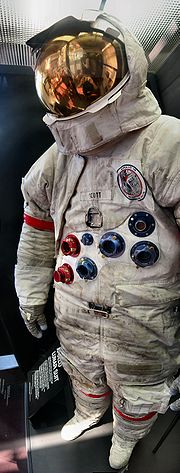
The astronauts themselves wore new spacesuits. On all previous Apollo flights, including the non-lunar flights, the commander and lunar module pilot had worn suits with the life support, liquid cooling, and communications connections in two parallel rows of three. On Apollo 15, the new suits, dubbed the "A7L-B," had the connectors situated in triangular pairs. This new arrangement, along with the relocation of the entry zipper (which went in an up-down motion on the old suits), from the right shoulder to the left hip, allowed the inclusion of a new waist joint, allowing the astronauts to bend completely over, and even to sit on the rover. Upgraded backpacks allowed for longer-duration moonwalks, and the command module pilot, who wore a suit with three connectors, would wear a five-connector version of the old moon suit — the liquid cooling water connector being removed, as the command module pilot would make a "deep-space EVA" to retrieve film cartridges on the flight home.Scandals
One final controversial event happened after the flight. The crew had contacted Belgian sculptor
Sculpture
Sculpture is three-dimensional artwork created by shaping or combining hard materials—typically stone such as marble—or metal, glass, or wood. Softer materials can also be used, such as clay, textiles, plastics, polymers and softer metals...
Paul Van Hoeydonck
Paul Van Hoeydonck
Paul Van Hoeydonck was a Belgian printmaker and painter, he studied both archeology and art history in Antwerp, Belgium. His first one man exhibition took place in that city in 1952. During the following years van Hoeydonck both lived and worked in Belgium and in the United States...
to create a small statuette to personally commemorate those astronauts and cosmonauts having lost their lives in the furtherance of space exploration. The small aluminum sculpture called "Fallen Astronaut
Fallen Astronaut
Fallen Astronaut is an 8.5 cm aluminium sculpture of an astronaut in a spacesuit which commemorates astronauts and cosmonauts who died in the advancement of space exploration...
" was left on the Moon next to the Rover at the end of EVA 3, along with a plaque bearing the names of 14 American astronauts and Soviet cosmonauts. Unknown at the time, two of the original selection of 20 cosmonauts were also deceased before Apollo 15: Valentin Bondarenko
Valentin Bondarenko
Valentin Vasiliyevich Bondarenko was a Soviet fighter pilot and cosmonaut. He died during a training accident in Moscow, USSR, in 1961. A crater on the Moon's far side is named for him.-Education and military training:...
(fire during training, March 1961) and Grigori Nelyubov
Grigori Nelyubov
Grigori Grigoyevich Nelyubov was a Soviet cosmonaut who was likely to have been the third or fourth person in space before his dismissal from the Soviet space program....
(train accident/suicide, February 1966). Therefore, their names were not included on the plaque. The memorial was left while the TV camera was turned off. Only Irwin knew what Scott was doing at the time. Scott told mission control he was doing some clean up activities around the rover so they wouldn't know what he was doing. They had agreed with Van Hoeydonck that no replicas were to be made. After mentioning the statuette during their post-flight press conference, the National Air and Space Museum
National Air and Space Museum
The National Air and Space Museum of the Smithsonian Institution holds the largest collection of historic aircraft and spacecraft in the world. It was established in 1976. Located in Washington, D.C., United States, it is a center for research into the history and science of aviation and...
contacted the crew asking for a replica made for the museum, and Van Hoeydonck subsequently advertised replicas for sale to the public. Under pressure from NASA, Van Hoeydonck withdrew the sale offer. NASA ultimately showed the monument on its Apollo 15 mission documentary, with no mention that it was unauthorized.
Mission insignia
The circular patch features stylized red, white and blue birds flying over the Hadley Rille section of the moon. Immediately behind the birds, a line of craters form the Roman numeral XV. The artwork is circled in red, with a white band giving the mission and crew names and a blue border. Scott contacted fashion designer Emilio PucciEmilio Pucci
Emilio Pucci, Marquis of Barsento , was a Florentine Italian fashion designer and politician. He and his eponymous company are synonymous with geometric prints in a kaleidoscope of colours.-Early life:...
to design the patch, who came up with the basic idea of the three-bird motif. The crew changed the colors from blues and greens to more patriotic red, white and blue.
Visibility from space
The halo area of the Apollo 15 Landing site, generated by the LM's exhaust plume, was observed by a camera aboard the Japanese lunar orbiter SELENESELENE
SELENE , better known in Japan by its nickname after the legendary Japanese moon princess, was the second Japanese lunar orbiter spacecraft. Produced by the Institute of Space and Astronautical Science and the National Space Development Agency , both now part of the Japan Aerospace Exploration...
and confirmed by comparative analysis of photographs in May 2008. This corresponds well to photographs taken from the Apollo 15 Command Module showing a change in surface reflectivity due to the plume, and was the first visible trace of manned landings on the moon seen from space since the close of the Apollo program. This evidence is important due to accusations that the moon landings were staged.
Depiction in popular culture
Portions of the Apollo 15 mission are dramatized in the miniseries From the Earth to the Moon episode entitled "Galileo was Right".See also
- Extra-vehicular activityExtra-vehicular activityExtra-vehicular activity is work done by an astronaut away from the Earth, and outside of a spacecraft. The term most commonly applies to an EVA made outside a craft orbiting Earth , but also applies to an EVA made on the surface of the Moon...
- Google MoonGoogle MoonGoogle Moon is a service similar to Google Maps that shows satellite images of the Moon. It was launched by Google on July 20, 2005, the 36th anniversary of the Apollo 11 lunar landing...
- List of artificial objects on the Moon
- List of spacewalks
- SplashdownSplashdown (spacecraft landing)Splashdown is the method of landing a spacecraft by parachute in a body of water. It was used by American manned spacecraft prior to the Space Shuttle program. It is also possible for the Russian Soyuz spacecraft and Chinese Shenzhou spacecraft to land in water, though this is only a contingency...
Sources
- NASA Apollo 15 press kit - July 15, 1971
- Chaikin, Andrew (1994). A Man On The Moon: The Voyages of the Apollo Astronauts. Viking. ISBN 0-670-81446-6.
- Harland, David M. (1999). Exploring the Moon: The Apollo Expeditions. Springer/Praxis Publishing. ISBN 1-85233-099-6.
- NASA Manned Spacecraft Center (1972). Apollo 15 Preliminary Science Report. Scientific and Technical Office, NASA.
- Lattimer, Dick (1985). 'All We Did was Fly to the Moon. Whispering Eagle Press. ISBN 0-9611228-0-3.
- Apollo 15 Flight Journal. Retrieved 17 June 2005.
- Apollo 15 Lunar Surface Journal. Retrieved 17 June 2005.
- Apollo By The Numbers: A Statistical Reference by Richard W. Orloff (NASA). Retrieved 17 June 2005.
- Moonport: A History of Apollo Launch Facilities and Operations. Retrieved 17 June 2005.
- Apollo 15 in the Encyclopedia AstronauticaEncyclopedia AstronauticaThe Encyclopedia Astronautica is a reference web site on space travel. A comprehensive catalog of vehicles, technology, astronauts, and flights, it includes information from most countries that have had an active rocket research program, from Robert Goddard to the NASA Space shuttle to the Soviet...
. Retrieved 17 June 2005. - Apollo 15 | Endeavour in A Field Guide to American Spacecraft.
- Apollo 15 Launch Video
- Apollo Program Summary Report. Retrieved 17 June 2005.
- NSSDC Apollo 15 page. Retrieved 20 December 2007.
- NASA (1972-09-15). Articles Carried on Manned Space Flights. Press Release.
- Sieger Flown Moon Covers. Retrieved 18 June 2005.
- In the Mountains of the Moon, NASA film on the Apollo 15 mission (Part 1) (Part 2)
- Apollo 15 television transmissions ApolloTV.net Video
- Interview with Al Worden with Astrotalkuk.org recorded in London on 22 May 2011