Comet Halley

Encyclopedia
Halley's Comet or Comet Halley (icon or ˈ; officially designated 1P/Halley) is the best-known of the short-period comets, and is visible from Earth
every 75 to 76 years. Halley is the only short-period comet
that is clearly visible to the naked eye
from Earth, and thus the only naked-eye comet that might appear twice in a human lifetime. Other naked-eye comets may be brighter and more spectacular, but will appear only once in thousands of years.
Halley's returns to the inner solar system have been observed and recorded by astronomers since at least 240 BCE. Clear records of the comet's appearances were made by Chinese
, Babylonian, and medieval European
chroniclers, but were not recognized as reappearances of the same object at the time. The comet's periodicity was first determined in 1705 by English
astronomer Edmond Halley
, after whom it is now named. Halley's comet last appeared in the inner Solar System in 1986 and will next appear in mid-2061.
During its 1986 apparition, Halley became the first comet to be observed in detail by spacecraft
, providing the first observational data on the structure of a comet nucleus
and the mechanism of coma
and tail
formation. These observations supported a number of longstanding hypotheses about comet construction, particularly Fred Whipple's "dirty snowball" model, which correctly predicted that Halley would be composed of a mixture of volatile ices
– such as water
, carbon dioxide
and ammonia
– and dust
. The missions also provided data which substantially reformed and reconfigured these ideas; for instance it is now understood that Halley's surface is largely composed of dusty, non-volatile materials, and that only a small portion of it is icy.
, was that they were disturbances in the Earth's atmosphere. This idea was disproved in 1577 by Tycho Brahe
, who used parallax
measurements to show that comets must lie beyond the Moon
. Many were still unconvinced that comets actually orbited the Sun, and assumed they must instead follow straight paths through the Solar System.
In 1687, Sir Isaac Newton published his Principia, in which he outlined his laws of gravity and motion. His work on comets was decidedly incomplete. Although he had suspected that two comets that had appeared in succession in 1680 and 1681 were the same comet before and after passing behind the Sun (he was later found to be correct; see Newton's Comet), he was unable to completely reconcile comets into his model. Ultimately, it was Newton's friend, editor and publisher, Edmond Halley
who, in his 1705 Synopsis of the Astronomy of Comets, used Newton's new laws to calculate the gravitational effects of Jupiter and Saturn on cometary orbits. This calculation enabled him, after examining historical records, to determine that the orbital elements
of a second comet which had appeared in 1682, were nearly the same as those of two comets which had appeared in 1531 (observed by Petrus Apianus
) and 1607 (observed by Johannes Kepler
). Halley thus concluded that all three comets were in fact the same object returning every 76 years, a period that has since been amended to every 75–76 years. After a rough estimate of the perturbations
the comet would sustain from the gravitational attraction of the planets, he predicted its return for 1758.
Halley's prediction of the comet's return proved to be correct, although it was not seen until 25 December 1758, by Johann Georg Palitzsch
, a German farmer and amateur astronomer. It did not pass through its perihelion until 13 March 1759, the attraction of Jupiter
and Saturn
having caused a retardation of 618 days. This effect was computed prior to its return (with a one-month error to 13 April) by a team of three French mathematicians, Alexis Clairaut, Joseph Lalande, and Nicole-Reine Lepaute
. Halley himself did not live to see the comet's return as he died in 1742. The confirmation of the comet's return was the first time anything other than planets had been shown to orbit the Sun. It was also one of the earliest successful tests of Newtonian physics, and a clear demonstration of its explanatory power. The comet was first named in Halley's honour by French astronomer Nicolas Louis de Lacaille
in 1759.
The possibility has been raised that 1st-century Jewish astronomers had already recognized Halley's Comet as periodic. This theory notes a passage in the Talmud
which refers to "a star which appears once in seventy years that makes the captains of the ships err."
of 0.967 (with 0 being a perfect circle and 1 being a parabolic trajectory
). The perihelion, the point in the comet's orbit when it is nearest the Sun, is just 0.6 AU (between the orbits of Mercury
and Venus
), while its aphelion, or farthest distance from the Sun, is 35 AU (roughly the distance of Pluto
). Unusually for an object in the Solar System, Halley's orbit is retrograde
; it orbits the Sun in the opposite direction to the planets, or clockwise from above the Sun
's north pole. The orbit is inclined by 18° to the ecliptic
, with much of it lying south of the ecliptic. Due to Halley's highly eccentric orbit, it has one of the highest velocities, relative to the Earth
, of any object in the Solar System. The 1910 passage was at a relative velocity
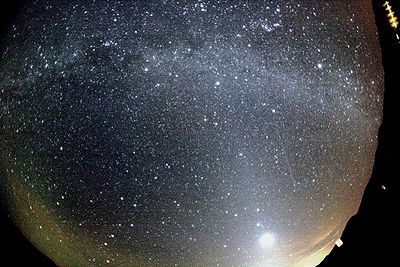
of 70.56 km/s (157,838 mph or 254,016 km/h). Because its orbit comes close to Earth's in two places, Halley's Comet is the parent body of two meteor showers: the Eta Aquariids in early May, and the Orionids
in late October.
Halley is classified as a periodic or short-period comet; one with an orbit lasting 200 years or less. This contrasts it with long-period comets, whose orbits last for thousands of years. Periodic comets have an average inclination to the ecliptic of only ten degrees, and an orbital period of just 6.5 years, so Halley's orbit is atypical. Most short-period comets (those with orbital periods shorter than 20 years and inclinations of 20–30 degrees or less) are called Jupiter family comets. Those like Halley, with orbital periods of between 20 and 200 years and inclinations extending from zero to more than 90 degrees, are called Halley-type comets. To date, only 54 Halley-type comets have been observed, compared with nearly 400 identified Jupiter family comets.
The orbits of the Halley-type comets suggest that they were originally long-period comets whose orbits were perturbed by the gravity of the giant planets and directed into the inner Solar System. If Halley was once a long-period comet, it is likely to have originated in the Oort Cloud
, a sphere of cometary bodies that has an inner edge of 20,000–50,000 AU. Conversely the Jupiter family comets are believed to originate in the Kuiper belt
, a flat disc of icy debris between 30 AU (Neptune's orbit) and 50 AU from the Sun (in the scattered disc
). Another point of origin for the Halley-type comets has been proposed. In 2008, a new trans-Neptunian object
with a retrograde orbit similar to Halley's was discovered. Nicknamed Drac
, its orbit takes it from just outside that of Uranus to twice the distance of Pluto. It may be a member of a new population of small Solar System bodies that serves as the source of Halley-type comets.
 Halley's Comet has probably been in its current orbit for 16,000 to 200,000 years, although it is not possible to numerically integrate its orbit for more than a few tens of apparitions, and close approaches before 837 CE can only be verified from recorded observations. The non-gravitational effects can be crucial; as Halley approaches the Sun, it expels jets of sublimating gas from its surface, which knock it very slightly off its orbital path. These orbital changes can cause deviations in its perihelion of up to four days.
In 1989, Boris Chirikov
and Vitaly Vecheslavov performed an analysis of 46 apparitions of Halley's Comet taken from historical records and computer simulations. These studies showed that its dynamics were chaotic and unpredictable on long timescales. Halley's projected lifetime could be as long as 10 million years. More recent work suggests that Halley will evaporate, or split in two, within the next few tens of thousands of years, or will be ejected from the Solar System within a few hundred thousand years. Observations by D.W. Hughes suggest that Halley's nucleus has been reduced in mass by 80–90% over the last 2000–3000 revolutions.
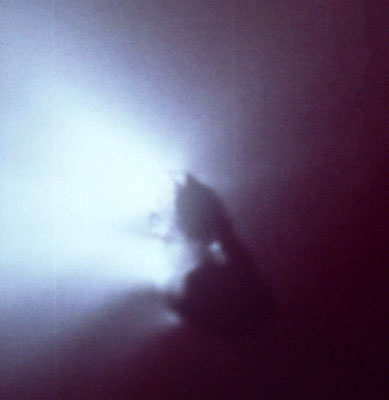
 The Giotto
and Vega
missions gave planetary scientists their first view of Halley's surface and structure. Like all comets, as Halley nears the Sun, its volatile compounds (those with low boiling points, such as water, carbon monoxide
, carbon dioxide
and other ices
) begin to sublime from the surface of its nucleus
. This causes the comet to develop a coma
, or atmosphere, up to 100,000 km across. Evaporation of this dirty ice releases dust
particles, which travel with the gas away from the nucleus. Gas molecules in the coma absorb solar light and then re-radiate it at different wavelengths, a phenomenon known as fluorescence
, whereas dust particles scatter
the solar light. Both processes are responsible for making the coma visible. As a fraction of the gas molecules in the coma are ionized
by the solar ultraviolet radiation, pressure from the solar wind
, a stream of charged particles emitted by the Sun, pulls the coma's ions out into a long tail
, which may extend more than 100 million kilometers into space. Changes in the flow of the solar wind can cause disconnection events, in which the tail completely breaks off from the nucleus.
Despite the vast size of its coma, Halley's nucleus is relatively small: barely 15 kilometers long, 8 kilometers wide and perhaps 8 kilometers thick. Its shape vaguely resembles that of a peanut
. Its mass is relatively low (roughly 2.2 kg) and its average density is about 0.6 g/cm3, indicating that it is made of large number of small pieces, held together very loosely, forming a structure known as a rubble pile
. Ground-based observations of coma brightness suggested that Halley's rotation period
was about 7.4 days. Images taken by the various spacecraft, along with observations of the jets and shell, suggested a period of 52 hours. Given the irregular shape of the nucleus, Halley's rotation is likely to be complex. Although only 25% of Halley's surface was imaged in detail during the flyby missions, they revealed an extremely varied topography, with hills, mountains, ridges, depressions, and at least one crater.
Halley is the most active of all the periodic comets, with others, such as Comet Encke
and Comet Holmes, displaying activity one or two orders of magnitude weaker. Its day side (the side facing the Sun) is far more active than the night side. Spacecraft observations showed that the gases ejected from the nucleus were 80% water vapor, 17% carbon monoxide and 3–4% carbon dioxide, with traces of hydrocarbons although more recent sources give a value of 10% for carbon monoxide and also include traces of methane
and ammonia
. The dust particles were found to be primarily a mixture of carbon-hydrogen-oxygen-nitrogen (CHON) compounds common in the outer Solar System, and silicates, such as are found in terrestrial rocks. The dust particles decreased in size down to the limits of detection (~0.001 µm). The ratio of deuterium
to hydrogen
in the water released by Halley was initially thought to be similar to that found in Earth's ocean water, suggesting that Halley-type comets may have delivered water to Earth in the distant past. Subsequent observations showed Halley's deuterium ratio to be far higher than that in found in the Earth's oceans, making such comets unlikely sources for Earth's water.
Giotto provided the first evidence in support of Fred Whipple's "dirty snowball" hypothesis for comet construction; Whipple postulated that comets are icy objects warmed by the Sun as they approach the inner Solar System, causing ices on their surfaces to sublimate (change directly from a solid to a gas), and jets of volatile material to burst outward, creating the coma. Giotto showed that this model was broadly correct, though with modifications. Halley's albedo
, for instance, is about 4%, meaning that it reflects only 4% of the sunlight hitting it; about what one would expect for coal. Thus, despite appearing brilliant white to observers on Earth, Halley's Comet is in fact pitch black. The surface temperature of evaporating "dirty ice" ranges from 170 K (−103 °C) at higher albedo to 220 K (−53 °C) at low albedo; Vega 1
found Halley's surface temperature to be in the range 300–400 K (30–130 °C). This suggested only 10% of Halley's surface was active, and that large portions of it were coated in a layer of dark dust, which retained heat. Together, these observations suggested that Halley was in fact predominantly composed of non-volatile
materials, and thus more closely resembled a "snowy dirtball" than a "dirty snowball".
1982i). The perihelion dates of each apparition are shown. The perihelion dates farther from the present are approximate, mainly because of uncertainties in the modeling of non-gravitational effects. Perihelion dates 1607 and later are in the Gregorian calendar
, while perihelion dates of 1531 and earlier are in the Julian calendar
.
The first certain appearance of Halley's Comet in the historical record is a description from 240 BCE, in the Chinese chronicle Records of the Grand Historian
or Shiji, which describes a comet that appeared in the east and moved north. The only surviving record of the 164 BCE apparition is found on two fragmentary Babylonian tablets, now owned by the British Museum
.
The apparition of 87 BCE was recorded in Babylonian tablets which state that the comet was seen "day beyond day" for a month. This appearance may be recalled in the representation of Tigranes the Great
, an Armenia
n king who is depicted on coins with a crown that features, according to V.G. Gurzadyan and R. Vardanyan, "a star with a curved tail [that] may represent the passage of Halley's Comet in 87 BCE." Gurzadyan and Vardanyan argue that "Tigranes could have seen Halley's Comet when it passed closest to the Sun on August 6 in 87 BCE" as the comet would have been a "most recordable event"; for ancient Armenians it could have heralded the New Era of the brilliant King of Kings.
The apparition of 12 BCE was recorded in the Book of Han
by Chinese astronomers
of the Han Dynasty
who tracked it from August through October. It passed within 0.16 AU of the Earth. Halley's appearance in 12 BCE, only a few years distant from the conventionally assigned date of the birth of Jesus Christ, has led some theologians and astronomers to suggest that it might explain the biblical story of the Star of Bethlehem
. There are other explanations for the phenomenon, such as planetary conjunctions, and there are also records of other comets that appeared closer to the date of Jesus' birth.
If, as has been suggested, the reference in the Talmud
to "a star which appears once in seventy years that makes the captains of the ships err" (see above) refers to Halley's Comet, it may be a reference to the 66 CE appearance, because this passage is attributed to the Rabbi Yehoshua ben Hananiah
. This apparition was the only one to occur during ben Hananiah's lifetime.
The 141 CE apparition was recorded in Chinese chronicles. The 374 CE and 607 approaches each came within 0.09 AU of the Earth. The 684 CE apparition was recorded in Europe in one of the sources used by the compiler of the 1493 Nuremberg Chronicle
s. Chinese records also report it as the "broom star".
In 837, Halley's Comet may have passed as close as 0.03 AU
(3.2 million miles; 5.1 million kilometers) from Earth
, by far its closest approach. Its tail may have stretched 60 degrees
across the sky. It was recorded by astronomers in China, Japan, Germany and the greater Middle East. In 912, Halley's comet is recorded in the Annals of Ulster
, which state "A dark and rainy year. A comet appeared."
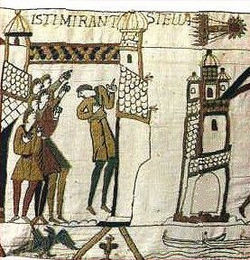 In 1066, the comet was seen in England and thought to be an omen: later that year Harold II of England died at the Battle of Hastings
; it was a bad omen for Harold, but a good omen for the man who defeated him, William the Conqueror. The comet is represented on the Bayeux Tapestry
as a fiery star, and the surviving accounts describe it as appearing to be four times the size of Venus
and shining with a light equal to a quarter of that of the Moon
. Halley came within 0.10 AU of the Earth at that time.
This appearance of the comet is also noted in the Anglo-Saxon Chronicle
. Eilmer of Malmesbury
may have seen Halley previously in 989, as he wrote of it in 1066: "You've come, have you? ... You've come, you source of tears to many mothers, you evil. I hate you! It is long since I saw you; but as I see you now you are much more terrible, for I see you brandishing the downfall of my country. I hate you!"
The Irish Annals of the Four Masters
recorded the comet as "A star [that] appeared on the seventh of the Calends of May, on Tuesday after Little Easter, than whose light the brilliance or light of the moon was not greater; and it was visible to all in this manner till the end of four nights afterwards." Chaco
Native Americans
in New Mexico
may have recorded the 1066 apparition in their petroglyphs.
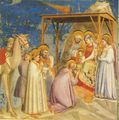 The 1145 apparition was recorded by the monk Eadwine. The 1986 apparition exhibited a fan tail similar to Eadwine's drawing. Some claim that Genghis Khan
was inspired to turn his conquests toward Europe by the 1222 apparition. The 1301 apparition may have been seen by the artist Giotto di Bondone
, who represented the Star of Bethlehem
as a fire-colored comet in the Nativity
section of his Arena Chapel cycle, completed in 1305. No record survives of the 1376 apparition.
In 1456, the year of Halley's next apparition, the Ottoman Empire
invaded the Balkans
, culminating in the Siege of Belgrade in July of that year. In a Papal Bull
, Pope Calixtus III ordered special prayers be said for the city's protection. In 1470 the humanist
scholar Bartolomeo Platina
wrote in his Lives of the Popes that,
Platina's account is not mentioned in official records. In the 18th century, a Frenchman further embellished the story, in anger at the Church, by claiming that the Pope had "excommunicated" Halley's Comet, though this story was most likely his own invention.
After witnessing a bright light in the sky (which most historians have identified as Halley's Comet, visible in Ethiopia in 1456), Emperor Zara Yaqob
, ruler from 1434–1468, founded the city of Debre Berhan
(tr. City of Light) and made it his capital for the remainder of his reign.
Halley's periodic returns have been subject to scientific investigation since the 16th century. The three apparitions from 1531 to 1682 were noted by Edmond Halley, enabling him to predict its 1759 return. Streams of vapour observed during the comet's 1835 apparition prompted astronomer Friedrich Wilhelm Bessel to propose that the jet force
s of evaporating material could be great enough to significantly alter a comet's orbit.
, which led astronomer Camille Flammarion
to claim that, when Earth passed through the tail, the gas "would impregnate the atmosphere and possibly snuff out all life on the planet." His pronouncement led to panicked buying of gas masks and quack "anti-comet pills" and "anti-comet umbrellas" by the public. In reality, as other astronomers were quick to point out, the gas is so diffuse that the world suffered no ill effects from the passage through the tail.
American satirist and writer Mark Twain
was born on 30 November 1835, exactly two weeks after the comet's perihelion. In his autobiography, published in 1909, he said,
Twain died on 21 April 1910, the day following the comet's subsequent perihelion. The 1985 fantasy film The Adventures of Mark Twain
was inspired by the quotation.
Halley's 1910 apparition is distinct from the Great Daylight Comet of 1910
, which surpassed Halley in brilliance and was actually visible in broad daylight for a short period, approximately four months before Halley made its appearance.
 Halley's 1986 apparition was the least favorable on record. The comet and the Earth were on opposite sides of the Sun in February 1986, creating the worst viewing circumstances for Earth observers for the last 2,000 years. Halley's closest approach was 0.42 AU. Additionally, with increased light pollution
from urbanization, many people never saw the comet at all. Further, the comet appeared brightest when it was almost invisible from the northern hemisphere in March and April. Halley's approach was first detected by astronomers David Jewitt and G. Edward Danielson on 16 October 1982 using the 5.1 m Hale telescope
at Mount Palomar and a CCD camera. The first person to visually observe the comet on its 1986 return was amateur astronomer Stephen James O'Meara on 24 January 1985. O'Meara used a home-built 24-inch telescope on top of Mauna Kea
to detect the magnitude
19.6 comet. On 8 November 1985, Stephen Edberg (then serving as the Coordinator for Amateur Observations at NASA
's Jet Propulsion Laboratory) and Charles Morris were the first to observe Halley's comet with the naked eye in its 1986 apparition.
The development of space travel gave scientists the opportunity to study the comet at close quarters, and several probes were launched to do so. The Soviet Vega 1
started returning images of Halley on 4 March 1986, and the first ever of its nucleus
, and made its flyby on 6 March, followed by Vega 2
making its flyby on 9 March. On 14 March, the Giotto space probe
, launched by the European Space Agency
, made the closest pass of the comet's nucleus. There were also two Japanese probes, Suisei
and Sakigake
. The probes were unofficially known as the Halley Armada
.
Based on data retrieved by Astron
, the largest ultraviolet
space telescope of the time, during its Halley's Comet observations in December 1985, a group of Soviet scientists developed a model of the comet's coma
. The comet was also observed from space by the International Cometary Explorer
. Originally International Sun-Earth Explorer 3, the probe was renamed and freed from its Lagrangian point
location in Earth's orbit to intercept comets 21P/Giacobini-Zinner
and Halley.
Two Space Shuttle
missions – the ill-fated STS-51-L
(ended by the Challenger disaster
) and STS-61-E – were scheduled to observe Halley's Comet from low Earth orbit
. STS-51-L carried the Shuttle-Pointed Tool for Astronomy (SPARTAN-203) satellite, also called the Halley's Comet Experiment Deployable (HCED). STS-61-E was a Columbia mission scheduled for March 1986, carrying the ASTRO-1 platform to study the comet. Due to the suspension of America's manned space program after the Challenger explosion, the mission was canceled, and ASTRO-1 would not fly until late 1990 on STS-35
.
 On 12 February 1991, at a distance of 14.4 AU from the Sun, Halley displayed an outburst that lasted for several months, releasing a cloud of dust 300,000 km across. The outburst likely started in December 1990, and then the comet brightened from magnitude 24.3 to magnitude 18.9. Halley was most recently observed in 2003 by three of the Very Large Telescope
s at Paranal, Chile, when Halley's magnitude was 28.2. The telescopes observed Halley, at the faintest and furthest any comet has ever been imaged, in order to verify a method for finding very faint trans-Neptunian object
s. Astronomers are now able to observe the comet at any point in its orbit.
The next predicted perihelion of Halley's Comet is 28 July 2061, when it is expected to be better positioned for observation than during the 1985–1986 apparition, as it will be on the same side of the Sun as Earth. It is expected to have an apparent magnitude
of −0.3, compared with only +2.1 for the 1986 apparition. On 9 September 2060, Halley has been calculated to pass within 0.98 AU of Jupiter, and then on 20 August 2061, pass within 0.0543 AU of Venus. In 2134, Halley is expected to pass within 0.09 AU of the Earth. Its apparent magnitude is expected to be −2.0.
Earth
Earth is the third planet from the Sun, and the densest and fifth-largest of the eight planets in the Solar System. It is also the largest of the Solar System's four terrestrial planets...
every 75 to 76 years. Halley is the only short-period comet
Comet
A comet is an icy small Solar System body that, when close enough to the Sun, displays a visible coma and sometimes also a tail. These phenomena are both due to the effects of solar radiation and the solar wind upon the nucleus of the comet...
that is clearly visible to the naked eye
Naked eye
The naked eye is a figure of speech referring to human visual perception unaided by a magnifying or light-collecting optical device, such as a telescope or microscope. Vision corrected to normal acuity using corrective lenses is considered "naked"...
from Earth, and thus the only naked-eye comet that might appear twice in a human lifetime. Other naked-eye comets may be brighter and more spectacular, but will appear only once in thousands of years.
Halley's returns to the inner solar system have been observed and recorded by astronomers since at least 240 BCE. Clear records of the comet's appearances were made by Chinese
Chinese people
The term Chinese people may refer to any of the following:*People with Han Chinese ethnicity ....
, Babylonian, and medieval European
Middle Ages
The Middle Ages is a periodization of European history from the 5th century to the 15th century. The Middle Ages follows the fall of the Western Roman Empire in 476 and precedes the Early Modern Era. It is the middle period of a three-period division of Western history: Classic, Medieval and Modern...
chroniclers, but were not recognized as reappearances of the same object at the time. The comet's periodicity was first determined in 1705 by English
English people
The English are a nation and ethnic group native to England, who speak English. The English identity is of early mediaeval origin, when they were known in Old English as the Anglecynn. England is now a country of the United Kingdom, and the majority of English people in England are British Citizens...
astronomer Edmond Halley
Edmond Halley
Edmond Halley FRS was an English astronomer, geophysicist, mathematician, meteorologist, and physicist who is best known for computing the orbit of the eponymous Halley's Comet. He was the second Astronomer Royal in Britain, following in the footsteps of John Flamsteed.-Biography and career:Halley...
, after whom it is now named. Halley's comet last appeared in the inner Solar System in 1986 and will next appear in mid-2061.
During its 1986 apparition, Halley became the first comet to be observed in detail by spacecraft
Spacecraft
A spacecraft or spaceship is a craft or machine designed for spaceflight. Spacecraft are used for a variety of purposes, including communications, earth observation, meteorology, navigation, planetary exploration and transportation of humans and cargo....
, providing the first observational data on the structure of a comet nucleus
Comet nucleus
The nucleus is the solid, central part of a comet, popularly termed a dirty snowball. A cometary nucleus is composed of rock, dust, and frozen gases. When heated by the Sun, the gases sublimate and produce an atmosphere surrounding the nucleus known as the coma...
and the mechanism of coma
Coma (cometary)
frame|right|The [[153P/Ikeya-Zhang|comet Ikeya-Zhang]] exhibiting a bright, condensed coma In astronomy, a coma is the nebulous envelope around the nucleus of a comet. It is formed when the comet passes close to the Sun on its highly elliptical orbit; as the comet warms, parts of it sublimate...
and tail
Comet tail
A comet tail and coma are illuminated by the Sun and may become visible from Earth when a comet passes through the inner Solar System, the dust reflecting sunlight directly and the gases glowing from ionisation...
formation. These observations supported a number of longstanding hypotheses about comet construction, particularly Fred Whipple's "dirty snowball" model, which correctly predicted that Halley would be composed of a mixture of volatile ices
Volatiles
In planetary science, volatiles are that group of chemical elements and chemical compounds with low boiling points that are associated with a planet's or moon's crust and/or atmosphere. Examples include nitrogen, water, carbon dioxide, ammonia, hydrogen, and methane, all compounds of C, H, O...
– such as water
Water
Water is a chemical substance with the chemical formula H2O. A water molecule contains one oxygen and two hydrogen atoms connected by covalent bonds. Water is a liquid at ambient conditions, but it often co-exists on Earth with its solid state, ice, and gaseous state . Water also exists in a...
, carbon dioxide
Carbon dioxide
Carbon dioxide is a naturally occurring chemical compound composed of two oxygen atoms covalently bonded to a single carbon atom...
and ammonia
Ammonia
Ammonia is a compound of nitrogen and hydrogen with the formula . It is a colourless gas with a characteristic pungent odour. Ammonia contributes significantly to the nutritional needs of terrestrial organisms by serving as a precursor to food and fertilizers. Ammonia, either directly or...
– and dust
Cosmic dust
Cosmic dust is a type of dust composed of particles in space which are a few molecules to 0.1 µm in size. Cosmic dust can be further distinguished by its astronomical location; for example: intergalactic dust, interstellar dust, interplanetary dust and circumplanetary dust .In our own Solar...
. The missions also provided data which substantially reformed and reconfigured these ideas; for instance it is now understood that Halley's surface is largely composed of dusty, non-volatile materials, and that only a small portion of it is icy.
Pronunciation
Comet Halley is commonly pronounced ˈ, rhyming with valley, or ˈ, rhyming with daily. Spellings of Edmond Halley's name during his lifetime included Hailey, Haley, Halley, Hawley, and Hawly, so its correct pronunciation is uncertain.Computation of orbit
Halley was the first comet to be recognized as periodic. Until the Renaissance, the philosophical consensus on the nature of comets, promoted by AristotleAristotle
Aristotle was a Greek philosopher and polymath, a student of Plato and teacher of Alexander the Great. His writings cover many subjects, including physics, metaphysics, poetry, theater, music, logic, rhetoric, linguistics, politics, government, ethics, biology, and zoology...
, was that they were disturbances in the Earth's atmosphere. This idea was disproved in 1577 by Tycho Brahe
Tycho Brahe
Tycho Brahe , born Tyge Ottesen Brahe, was a Danish nobleman known for his accurate and comprehensive astronomical and planetary observations...
, who used parallax
Parallax
Parallax is a displacement or difference in the apparent position of an object viewed along two different lines of sight, and is measured by the angle or semi-angle of inclination between those two lines. The term is derived from the Greek παράλλαξις , meaning "alteration"...
measurements to show that comets must lie beyond the Moon
Moon
The Moon is Earth's only known natural satellite,There are a number of near-Earth asteroids including 3753 Cruithne that are co-orbital with Earth: their orbits bring them close to Earth for periods of time but then alter in the long term . These are quasi-satellites and not true moons. For more...
. Many were still unconvinced that comets actually orbited the Sun, and assumed they must instead follow straight paths through the Solar System.
In 1687, Sir Isaac Newton published his Principia, in which he outlined his laws of gravity and motion. His work on comets was decidedly incomplete. Although he had suspected that two comets that had appeared in succession in 1680 and 1681 were the same comet before and after passing behind the Sun (he was later found to be correct; see Newton's Comet), he was unable to completely reconcile comets into his model. Ultimately, it was Newton's friend, editor and publisher, Edmond Halley
Edmond Halley
Edmond Halley FRS was an English astronomer, geophysicist, mathematician, meteorologist, and physicist who is best known for computing the orbit of the eponymous Halley's Comet. He was the second Astronomer Royal in Britain, following in the footsteps of John Flamsteed.-Biography and career:Halley...
who, in his 1705 Synopsis of the Astronomy of Comets, used Newton's new laws to calculate the gravitational effects of Jupiter and Saturn on cometary orbits. This calculation enabled him, after examining historical records, to determine that the orbital elements
Orbital elements
Orbital elements are the parameters required to uniquely identify a specific orbit. In celestial mechanics these elements are generally considered in classical two-body systems, where a Kepler orbit is used...
of a second comet which had appeared in 1682, were nearly the same as those of two comets which had appeared in 1531 (observed by Petrus Apianus
Petrus Apianus
Petrus Apianus , also known as Peter Apian, was a German humanist, known for his works in mathematics, astronomy and cartography.The lunar crater Apianus and minor planet 19139 Apian are named in his honour....
) and 1607 (observed by Johannes Kepler
Johannes Kepler
Johannes Kepler was a German mathematician, astronomer and astrologer. A key figure in the 17th century scientific revolution, he is best known for his eponymous laws of planetary motion, codified by later astronomers, based on his works Astronomia nova, Harmonices Mundi, and Epitome of Copernican...
). Halley thus concluded that all three comets were in fact the same object returning every 76 years, a period that has since been amended to every 75–76 years. After a rough estimate of the perturbations
Perturbation (astronomy)
Perturbation is a term used in astronomy in connection with descriptions of the complex motion of a massive body which is subject to appreciable gravitational effects from more than one other massive body....
the comet would sustain from the gravitational attraction of the planets, he predicted its return for 1758.
Halley's prediction of the comet's return proved to be correct, although it was not seen until 25 December 1758, by Johann Georg Palitzsch
Johann Georg Palitzsch
Johann Georg Palitzsch was a German astronomer who became famous for recovering Comet 1P/Halley on Christmas Day, 1758...
, a German farmer and amateur astronomer. It did not pass through its perihelion until 13 March 1759, the attraction of Jupiter
Jupiter
Jupiter is the fifth planet from the Sun and the largest planet within the Solar System. It is a gas giant with mass one-thousandth that of the Sun but is two and a half times the mass of all the other planets in our Solar System combined. Jupiter is classified as a gas giant along with Saturn,...
and Saturn
Saturn
Saturn is the sixth planet from the Sun and the second largest planet in the Solar System, after Jupiter. Saturn is named after the Roman god Saturn, equated to the Greek Cronus , the Babylonian Ninurta and the Hindu Shani. Saturn's astronomical symbol represents the Roman god's sickle.Saturn,...
having caused a retardation of 618 days. This effect was computed prior to its return (with a one-month error to 13 April) by a team of three French mathematicians, Alexis Clairaut, Joseph Lalande, and Nicole-Reine Lepaute
Nicole-Reine Lepaute
Nicole-Reine Lepaute, née Étable , was a French astronomer and mathematician. She predicted the return of Halley's Comet, calculated the timing of a solar eclipse and constructed a group of catalogs for the stars...
. Halley himself did not live to see the comet's return as he died in 1742. The confirmation of the comet's return was the first time anything other than planets had been shown to orbit the Sun. It was also one of the earliest successful tests of Newtonian physics, and a clear demonstration of its explanatory power. The comet was first named in Halley's honour by French astronomer Nicolas Louis de Lacaille
Nicolas Louis de Lacaille
Abbé Nicolas Louis de Lacaille was a French astronomer.He is noted for his catalogue of nearly 10,000 southern stars, including 42 nebulous objects. This catalogue, called Coelum Australe Stelliferum, was published posthumously in 1763. It introduced 14 new constellations which have since become...
in 1759.
The possibility has been raised that 1st-century Jewish astronomers had already recognized Halley's Comet as periodic. This theory notes a passage in the Talmud
Talmud
The Talmud is a central text of mainstream Judaism. It takes the form of a record of rabbinic discussions pertaining to Jewish law, ethics, philosophy, customs and history....
which refers to "a star which appears once in seventy years that makes the captains of the ships err."
Orbit and origin
Halley's orbital period over the last three centuries has been between 75 and 76 years, though it has varied between 74 and 79 years since 240 BCE. Its orbit around the Sun is highly elliptical, with an eccentricityOrbital eccentricity
The orbital eccentricity of an astronomical body is the amount by which its orbit deviates from a perfect circle, where 0 is perfectly circular, and 1.0 is a parabola, and no longer a closed orbit...
of 0.967 (with 0 being a perfect circle and 1 being a parabolic trajectory
Parabolic trajectory
In astrodynamics or celestial mechanics a parabolic trajectory is a Kepler orbit with the eccentricity equal to 1. When moving away from the source it is called an escape orbit, otherwise a capture orbit...
). The perihelion, the point in the comet's orbit when it is nearest the Sun, is just 0.6 AU (between the orbits of Mercury
Mercury (planet)
Mercury is the innermost and smallest planet in the Solar System, orbiting the Sun once every 87.969 Earth days. The orbit of Mercury has the highest eccentricity of all the Solar System planets, and it has the smallest axial tilt. It completes three rotations about its axis for every two orbits...
and Venus
Venus
Venus is the second planet from the Sun, orbiting it every 224.7 Earth days. The planet is named after Venus, the Roman goddess of love and beauty. After the Moon, it is the brightest natural object in the night sky, reaching an apparent magnitude of −4.6, bright enough to cast shadows...
), while its aphelion, or farthest distance from the Sun, is 35 AU (roughly the distance of Pluto
Pluto
Pluto, formal designation 134340 Pluto, is the second-most-massive known dwarf planet in the Solar System and the tenth-most-massive body observed directly orbiting the Sun...
). Unusually for an object in the Solar System, Halley's orbit is retrograde
Retrograde and direct motion
Apparent retrograde motion is the motion of a planetary body in a direction opposite to that of other bodies within its system as observed from a particular vantage point...
; it orbits the Sun in the opposite direction to the planets, or clockwise from above the Sun
Sun
The Sun is the star at the center of the Solar System. It is almost perfectly spherical and consists of hot plasma interwoven with magnetic fields...
's north pole. The orbit is inclined by 18° to the ecliptic
Ecliptic
The ecliptic is the plane of the earth's orbit around the sun. In more accurate terms, it is the intersection of the celestial sphere with the ecliptic plane, which is the geometric plane containing the mean orbit of the Earth around the Sun...
, with much of it lying south of the ecliptic. Due to Halley's highly eccentric orbit, it has one of the highest velocities, relative to the Earth
Earth
Earth is the third planet from the Sun, and the densest and fifth-largest of the eight planets in the Solar System. It is also the largest of the Solar System's four terrestrial planets...
, of any object in the Solar System. The 1910 passage was at a relative velocity
Relative velocity
In non-relativistic kinematics, relative velocity is the vector difference between the velocities of two objects, as evaluated in terms of a single coordinate system....
of 70.56 km/s (157,838 mph or 254,016 km/h). Because its orbit comes close to Earth's in two places, Halley's Comet is the parent body of two meteor showers: the Eta Aquariids in early May, and the Orionids
Orionids
The Orionid meteor shower, usually shortened to the Orionids, is the most prolific meteor shower associated with Halley's Comet. The Orionids are so-called because the point they appear to come from, called the radiant, lies in the constellation Orion. Orionids are an annual meteor shower which...
in late October.
Halley is classified as a periodic or short-period comet; one with an orbit lasting 200 years or less. This contrasts it with long-period comets, whose orbits last for thousands of years. Periodic comets have an average inclination to the ecliptic of only ten degrees, and an orbital period of just 6.5 years, so Halley's orbit is atypical. Most short-period comets (those with orbital periods shorter than 20 years and inclinations of 20–30 degrees or less) are called Jupiter family comets. Those like Halley, with orbital periods of between 20 and 200 years and inclinations extending from zero to more than 90 degrees, are called Halley-type comets. To date, only 54 Halley-type comets have been observed, compared with nearly 400 identified Jupiter family comets.
The orbits of the Halley-type comets suggest that they were originally long-period comets whose orbits were perturbed by the gravity of the giant planets and directed into the inner Solar System. If Halley was once a long-period comet, it is likely to have originated in the Oort Cloud
Oort cloud
The Oort cloud , or the Öpik–Oort cloud , is a hypothesized spherical cloud of comets which may lie roughly 50,000 AU, or nearly a light-year, from the Sun. This places the cloud at nearly a quarter of the distance to Proxima Centauri, the nearest star to the Sun...
, a sphere of cometary bodies that has an inner edge of 20,000–50,000 AU. Conversely the Jupiter family comets are believed to originate in the Kuiper belt
Kuiper belt
The Kuiper belt , sometimes called the Edgeworth–Kuiper belt, is a region of the Solar System beyond the planets extending from the orbit of Neptune to approximately 50 AU from the Sun. It is similar to the asteroid belt, although it is far larger—20 times as wide and 20 to 200 times as massive...
, a flat disc of icy debris between 30 AU (Neptune's orbit) and 50 AU from the Sun (in the scattered disc
Scattered disc
The scattered disc is a distant region of the Solar System that is sparsely populated by icy minor planets, a subset of the broader family of trans-Neptunian objects. The scattered-disc objects have orbital eccentricities ranging as high as 0.8, inclinations as high as 40°, and perihelia greater...
). Another point of origin for the Halley-type comets has been proposed. In 2008, a new trans-Neptunian object
Trans-Neptunian object
A trans-Neptunian object is any minor planet in the Solar System that orbits the Sun at a greater distance on average than Neptune.The first trans-Neptunian object to be discovered was Pluto in 1930...
with a retrograde orbit similar to Halley's was discovered. Nicknamed Drac
2008 KV42
', nicknamed Drac , is a trans-Neptunian object orbiting the Sun in retrograde motion and almost perpendicular to the ecliptic: it has a 104-degree inclination. This odd orbit suggests that may have been perturbed inwards from the Oort cloud...
, its orbit takes it from just outside that of Uranus to twice the distance of Pluto. It may be a member of a new population of small Solar System bodies that serves as the source of Halley-type comets.
In 1989, Boris Chirikov
Boris Chirikov
Boris Valerianovich Chirikov was an outstanding Soviet and Russian physicist....
and Vitaly Vecheslavov performed an analysis of 46 apparitions of Halley's Comet taken from historical records and computer simulations. These studies showed that its dynamics were chaotic and unpredictable on long timescales. Halley's projected lifetime could be as long as 10 million years. More recent work suggests that Halley will evaporate, or split in two, within the next few tens of thousands of years, or will be ejected from the Solar System within a few hundred thousand years. Observations by D.W. Hughes suggest that Halley's nucleus has been reduced in mass by 80–90% over the last 2000–3000 revolutions.
Structure and composition
Giotto mission
Giotto was a European robotic spacecraft mission from the European Space Agency, intended to fly by and study Halley's Comet. On 13 March 1986, the mission succeeded in approaching Halley's nucleus at a distance of 596 kilometers....
and Vega
Vega program
The Vega program was a series of Venus missions which also took advantage of the appearance of Comet Halley in 1986. Vega 1 and Vega 2 were unmanned spacecraft launched in a cooperative effort among the Soviet Union and Austria, Bulgaria, Hungary, the German Democratic Republic, Poland,...
missions gave planetary scientists their first view of Halley's surface and structure. Like all comets, as Halley nears the Sun, its volatile compounds (those with low boiling points, such as water, carbon monoxide
Carbon monoxide
Carbon monoxide , also called carbonous oxide, is a colorless, odorless, and tasteless gas that is slightly lighter than air. It is highly toxic to humans and animals in higher quantities, although it is also produced in normal animal metabolism in low quantities, and is thought to have some normal...
, carbon dioxide
Carbon dioxide
Carbon dioxide is a naturally occurring chemical compound composed of two oxygen atoms covalently bonded to a single carbon atom...
and other ices
Volatiles
In planetary science, volatiles are that group of chemical elements and chemical compounds with low boiling points that are associated with a planet's or moon's crust and/or atmosphere. Examples include nitrogen, water, carbon dioxide, ammonia, hydrogen, and methane, all compounds of C, H, O...
) begin to sublime from the surface of its nucleus
Comet nucleus
The nucleus is the solid, central part of a comet, popularly termed a dirty snowball. A cometary nucleus is composed of rock, dust, and frozen gases. When heated by the Sun, the gases sublimate and produce an atmosphere surrounding the nucleus known as the coma...
. This causes the comet to develop a coma
Coma (cometary)
frame|right|The [[153P/Ikeya-Zhang|comet Ikeya-Zhang]] exhibiting a bright, condensed coma In astronomy, a coma is the nebulous envelope around the nucleus of a comet. It is formed when the comet passes close to the Sun on its highly elliptical orbit; as the comet warms, parts of it sublimate...
, or atmosphere, up to 100,000 km across. Evaporation of this dirty ice releases dust
Dust
Dust consists of particles in the atmosphere that arise from various sources such as soil dust lifted up by wind , volcanic eruptions, and pollution...
particles, which travel with the gas away from the nucleus. Gas molecules in the coma absorb solar light and then re-radiate it at different wavelengths, a phenomenon known as fluorescence
Fluorescence
Fluorescence is the emission of light by a substance that has absorbed light or other electromagnetic radiation of a different wavelength. It is a form of luminescence. In most cases, emitted light has a longer wavelength, and therefore lower energy, than the absorbed radiation...
, whereas dust particles scatter
Scattering
Scattering is a general physical process where some forms of radiation, such as light, sound, or moving particles, are forced to deviate from a straight trajectory by one or more localized non-uniformities in the medium through which they pass. In conventional use, this also includes deviation of...
the solar light. Both processes are responsible for making the coma visible. As a fraction of the gas molecules in the coma are ionized
Ionization
Ionization is the process of converting an atom or molecule into an ion by adding or removing charged particles such as electrons or other ions. This is often confused with dissociation. A substance may dissociate without necessarily producing ions. As an example, the molecules of table sugar...
by the solar ultraviolet radiation, pressure from the solar wind
Solar wind
The solar wind is a stream of charged particles ejected from the upper atmosphere of the Sun. It mostly consists of electrons and protons with energies usually between 1.5 and 10 keV. The stream of particles varies in temperature and speed over time...
, a stream of charged particles emitted by the Sun, pulls the coma's ions out into a long tail
Comet tail
A comet tail and coma are illuminated by the Sun and may become visible from Earth when a comet passes through the inner Solar System, the dust reflecting sunlight directly and the gases glowing from ionisation...
, which may extend more than 100 million kilometers into space. Changes in the flow of the solar wind can cause disconnection events, in which the tail completely breaks off from the nucleus.
Despite the vast size of its coma, Halley's nucleus is relatively small: barely 15 kilometers long, 8 kilometers wide and perhaps 8 kilometers thick. Its shape vaguely resembles that of a peanut
Peanut
The peanut, or groundnut , is a species in the legume or "bean" family , so it is not a nut. The peanut was probably first cultivated in the valleys of Peru. It is an annual herbaceous plant growing tall...
. Its mass is relatively low (roughly 2.2 kg) and its average density is about 0.6 g/cm3, indicating that it is made of large number of small pieces, held together very loosely, forming a structure known as a rubble pile
Rubble pile
In astronomy, rubble pile is the informal name for an object that is not a monolith, consisting instead of numerous pieces of rock that have coalesced under the influence of gravity...
. Ground-based observations of coma brightness suggested that Halley's rotation period
Rotation period
The rotation period of an astronomical object is the time it takes to complete one revolution around its axis of rotation relative to the background stars...
was about 7.4 days. Images taken by the various spacecraft, along with observations of the jets and shell, suggested a period of 52 hours. Given the irregular shape of the nucleus, Halley's rotation is likely to be complex. Although only 25% of Halley's surface was imaged in detail during the flyby missions, they revealed an extremely varied topography, with hills, mountains, ridges, depressions, and at least one crater.
Halley is the most active of all the periodic comets, with others, such as Comet Encke
Comet Encke
Comet Encke or Encke's Comet is a periodic comet that completes an orbit of the Sun once every three years — the shortest period of any known comet...
and Comet Holmes, displaying activity one or two orders of magnitude weaker. Its day side (the side facing the Sun) is far more active than the night side. Spacecraft observations showed that the gases ejected from the nucleus were 80% water vapor, 17% carbon monoxide and 3–4% carbon dioxide, with traces of hydrocarbons although more recent sources give a value of 10% for carbon monoxide and also include traces of methane
Methane
Methane is a chemical compound with the chemical formula . It is the simplest alkane, the principal component of natural gas, and probably the most abundant organic compound on earth. The relative abundance of methane makes it an attractive fuel...
and ammonia
Ammonia
Ammonia is a compound of nitrogen and hydrogen with the formula . It is a colourless gas with a characteristic pungent odour. Ammonia contributes significantly to the nutritional needs of terrestrial organisms by serving as a precursor to food and fertilizers. Ammonia, either directly or...
. The dust particles were found to be primarily a mixture of carbon-hydrogen-oxygen-nitrogen (CHON) compounds common in the outer Solar System, and silicates, such as are found in terrestrial rocks. The dust particles decreased in size down to the limits of detection (~0.001 µm). The ratio of deuterium
Deuterium
Deuterium, also called heavy hydrogen, is one of two stable isotopes of hydrogen. It has a natural abundance in Earth's oceans of about one atom in of hydrogen . Deuterium accounts for approximately 0.0156% of all naturally occurring hydrogen in Earth's oceans, while the most common isotope ...
to hydrogen
Hydrogen
Hydrogen is the chemical element with atomic number 1. It is represented by the symbol H. With an average atomic weight of , hydrogen is the lightest and most abundant chemical element, constituting roughly 75% of the Universe's chemical elemental mass. Stars in the main sequence are mainly...
in the water released by Halley was initially thought to be similar to that found in Earth's ocean water, suggesting that Halley-type comets may have delivered water to Earth in the distant past. Subsequent observations showed Halley's deuterium ratio to be far higher than that in found in the Earth's oceans, making such comets unlikely sources for Earth's water.
Giotto provided the first evidence in support of Fred Whipple's "dirty snowball" hypothesis for comet construction; Whipple postulated that comets are icy objects warmed by the Sun as they approach the inner Solar System, causing ices on their surfaces to sublimate (change directly from a solid to a gas), and jets of volatile material to burst outward, creating the coma. Giotto showed that this model was broadly correct, though with modifications. Halley's albedo
Albedo
Albedo , or reflection coefficient, is the diffuse reflectivity or reflecting power of a surface. It is defined as the ratio of reflected radiation from the surface to incident radiation upon it...
, for instance, is about 4%, meaning that it reflects only 4% of the sunlight hitting it; about what one would expect for coal. Thus, despite appearing brilliant white to observers on Earth, Halley's Comet is in fact pitch black. The surface temperature of evaporating "dirty ice" ranges from 170 K (−103 °C) at higher albedo to 220 K (−53 °C) at low albedo; Vega 1
Vega 1
Vega 1 is a Soviet space probe part of the Vega program. The spacecraft was a development of the earlier Venera craft...
found Halley's surface temperature to be in the range 300–400 K (30–130 °C). This suggested only 10% of Halley's surface was active, and that large portions of it were coated in a layer of dark dust, which retained heat. Together, these observations suggested that Halley was in fact predominantly composed of non-volatile
Volatiles
In planetary science, volatiles are that group of chemical elements and chemical compounds with low boiling points that are associated with a planet's or moon's crust and/or atmosphere. Examples include nitrogen, water, carbon dioxide, ammonia, hydrogen, and methane, all compounds of C, H, O...
materials, and thus more closely resembled a "snowy dirtball" than a "dirty snowball".
Apparitions
Halley's calculations enabled the comet's earlier appearances to be found in the historical record. The following table sets out the astronomical designations for every apparition of Halley's Comet from 240 BCE, the earliest documented widespread sighting. For example, "1P/1982 U1, 1986 III, 1982i" indicates that for the perihelion in 1986, Halley's Comet was the first period comet known (designated 1P) and this apparition was the first seen in "half-month" U (the first half of November) in 1982 (giving 1P/1982 U1); it was the third comet past perihelion in 1986 (1986 III); and it was the ninth comet spotted in 1982 (provisional designationProvisional designation in astronomy
Provisional designation in astronomy is the naming convention applied to astronomical objects immediately following their discovery. The provisional designation is usually superseded by a permanent designation once a reliable orbit has been calculated...
1982i). The perihelion dates of each apparition are shown. The perihelion dates farther from the present are approximate, mainly because of uncertainties in the modeling of non-gravitational effects. Perihelion dates 1607 and later are in the Gregorian calendar
Gregorian calendar
The Gregorian calendar, also known as the Western calendar, or Christian calendar, is the internationally accepted civil calendar. It was introduced by Pope Gregory XIII, after whom the calendar was named, by a decree signed on 24 February 1582, a papal bull known by its opening words Inter...
, while perihelion dates of 1531 and earlier are in the Julian calendar
Julian calendar
The Julian calendar began in 45 BC as a reform of the Roman calendar by Julius Caesar. It was chosen after consultation with the astronomer Sosigenes of Alexandria and was probably designed to approximate the tropical year .The Julian calendar has a regular year of 365 days divided into 12 months...
.
- 1P/−239 K1, −239 (25 May 240 BCE)
- 1P/−163 U1, −163 (12 November 164 BCE)
- 1P/−86 Q1, −86 (6 August 87 BCE)
- 1P/−11 Q1, −11 (10 October 12 BCE)
- 1P/66 B1, 66 (25 January 66 CE)
- 1P/141 F1, 141 (22 March 141)
- 1P/218 H1, 218 (17 May 218)
- 1P/295 J1, 295 (20 April 295)
- 1P/374 E1, 374 (16 February 374)
- 1P/451 L1, 451 (28 June 451)
- 1P/530 Q1, 530 (27 September 530)
- 1P/607 H1, 607 (15 March 607)
- 1P/684 R1, 684 (2 October 684)
- 1P/760 K1, 760 (20 May 760)
- 1P/837 F1, 837 (28 February 837)
- 1P/912 J1, 912 (18 July 912)
- 1P/989 N1, 989 (5 September 989)
- 1P/1066 G1, 1066 (20 March 1066)
- 1P/1145 G1, 1145 (18 April 1145)
- 1P/1222 R1, 1222 (28 September 1222)
- 1P/1301 R1, 1301 (25 October 1301)
- 1P/1378 S1, 1378 (10 November 1378)
- 1P/1456 K1, 1456 (9 June 1456)
- 1P/1531 P1, 1531 (26 August 1531)
- 1P/1607 S1, 1607 (27 October 1607)
- 1P/1682 Q1, 1682 (15 September 1682)
- 1P/1758 Y1, 1759 I (13 March 1759)
- 1P/1835 P1, 1835 III (16 November 1835)
- 1P/1909 R1, 1910 II, 1909c (20 April 1910)
- 1P/1982 U1, 1986 III, 1982i (9 February 1986)
- Next perihelion predicted 28 July 2061
Prior to 1066
Halley may have been recorded as early as 467 BCE, but this is uncertain. A comet was recorded in ancient Greece between 468 and 466 BCE; its timing, location, duration, and associated meteor shower all suggest it was Halley. A large meteor the size of a "wagonload" that landed in northern Greece during the comet's apparition was a local attraction for 500 years. Chinese chroniclers also mention a comet in that year.The first certain appearance of Halley's Comet in the historical record is a description from 240 BCE, in the Chinese chronicle Records of the Grand Historian
Records of the Grand Historian
The Records of the Grand Historian, also known in English by the Chinese name Shiji , written from 109 BC to 91 BC, was the Magnum opus of Sima Qian, in which he recounted Chinese history from the time of the Yellow Emperor until his own time...
or Shiji, which describes a comet that appeared in the east and moved north. The only surviving record of the 164 BCE apparition is found on two fragmentary Babylonian tablets, now owned by the British Museum
British Museum
The British Museum is a museum of human history and culture in London. Its collections, which number more than seven million objects, are amongst the largest and most comprehensive in the world and originate from all continents, illustrating and documenting the story of human culture from its...
.
The apparition of 87 BCE was recorded in Babylonian tablets which state that the comet was seen "day beyond day" for a month. This appearance may be recalled in the representation of Tigranes the Great
Tigranes the Great
Tigranes the Great was emperor of Armenia under whom the country became, for a short time, the strongest state east of the Roman Republic. He was a member of the Artaxiad Royal House...
, an Armenia
Armenia
Armenia , officially the Republic of Armenia , is a landlocked mountainous country in the Caucasus region of Eurasia...
n king who is depicted on coins with a crown that features, according to V.G. Gurzadyan and R. Vardanyan, "a star with a curved tail [that] may represent the passage of Halley's Comet in 87 BCE." Gurzadyan and Vardanyan argue that "Tigranes could have seen Halley's Comet when it passed closest to the Sun on August 6 in 87 BCE" as the comet would have been a "most recordable event"; for ancient Armenians it could have heralded the New Era of the brilliant King of Kings.
The apparition of 12 BCE was recorded in the Book of Han
Book of Han
The Book of Han, Hanshu or History of the Former Han Dynasty |Fan Ye]] . Various scholars have estimated that the earliest material covered in the book dates back to between 206 and 202 BCE...
by Chinese astronomers
Chinese astronomy
Astronomy in China has a very long history, with historians considering that "they [the Chinese] were the most persistent and accurate observers of celestial phenomena anywhere in the world before the Arabs."...
of the Han Dynasty
Han Dynasty
The Han Dynasty was the second imperial dynasty of China, preceded by the Qin Dynasty and succeeded by the Three Kingdoms . It was founded by the rebel leader Liu Bang, known posthumously as Emperor Gaozu of Han. It was briefly interrupted by the Xin Dynasty of the former regent Wang Mang...
who tracked it from August through October. It passed within 0.16 AU of the Earth. Halley's appearance in 12 BCE, only a few years distant from the conventionally assigned date of the birth of Jesus Christ, has led some theologians and astronomers to suggest that it might explain the biblical story of the Star of Bethlehem
Star of Bethlehem
In Christian tradition, the Star of Bethlehem, also called the Christmas Star, revealed the birth of Jesus to the magi, or "wise men", and later led them to Bethlehem. The star appears in the nativity story of the Gospel of Matthew, where magi "from the east" are inspired by the star to travel to...
. There are other explanations for the phenomenon, such as planetary conjunctions, and there are also records of other comets that appeared closer to the date of Jesus' birth.
If, as has been suggested, the reference in the Talmud
Talmud
The Talmud is a central text of mainstream Judaism. It takes the form of a record of rabbinic discussions pertaining to Jewish law, ethics, philosophy, customs and history....
to "a star which appears once in seventy years that makes the captains of the ships err" (see above) refers to Halley's Comet, it may be a reference to the 66 CE appearance, because this passage is attributed to the Rabbi Yehoshua ben Hananiah
Joshua ben Hananiah
Joshua ben Hananiah was a leading tanna of the first half-century following the destruction of the Temple. He was of Levitical descent , and served in the sanctuary as a member of the class of singers . His mother intended him for a life of study, and, as an older contemporary, Dosa b. Harkinas,...
. This apparition was the only one to occur during ben Hananiah's lifetime.
The 141 CE apparition was recorded in Chinese chronicles. The 374 CE and 607 approaches each came within 0.09 AU of the Earth. The 684 CE apparition was recorded in Europe in one of the sources used by the compiler of the 1493 Nuremberg Chronicle
Nuremberg Chronicle
right|thumbnail|240px|Fifth dayThe Nuremberg Chronicle is an illustrated Biblical paraphrase and world history that follows the story of human history related in the Bible; it includes the histories of a number of important Western cities. Written in Latin by Hartmann Schedel, with a version in...
s. Chinese records also report it as the "broom star".
In 837, Halley's Comet may have passed as close as 0.03 AU
Astronomical unit
An astronomical unit is a unit of length equal to about or approximately the mean Earth–Sun distance....
(3.2 million miles; 5.1 million kilometers) from Earth
Earth
Earth is the third planet from the Sun, and the densest and fifth-largest of the eight planets in the Solar System. It is also the largest of the Solar System's four terrestrial planets...
, by far its closest approach. Its tail may have stretched 60 degrees
Degree (angle)
A degree , usually denoted by ° , is a measurement of plane angle, representing 1⁄360 of a full rotation; one degree is equivalent to π/180 radians...
across the sky. It was recorded by astronomers in China, Japan, Germany and the greater Middle East. In 912, Halley's comet is recorded in the Annals of Ulster
Annals of Ulster
The Annals of Ulster are annals of medieval Ireland. The entries span the years between AD 431 to AD 1540. The entries up to AD 1489 were compiled in the late 15th century by the scribe Ruaidhrí Ó Luinín, under his patron Cathal Óg Mac Maghnusa on the island of Belle Isle on Lough Erne in the...
, which state "A dark and rainy year. A comet appeared."
1066
Battle of Hastings
The Battle of Hastings occurred on 14 October 1066 during the Norman conquest of England, between the Norman-French army of Duke William II of Normandy and the English army under King Harold II...
; it was a bad omen for Harold, but a good omen for the man who defeated him, William the Conqueror. The comet is represented on the Bayeux Tapestry
Bayeux Tapestry
The Bayeux Tapestry is an embroidered cloth—not an actual tapestry—nearly long, which depicts the events leading up to the Norman conquest of England concerning William, Duke of Normandy and Harold, Earl of Wessex, later King of England, and culminating in the Battle of Hastings...
as a fiery star, and the surviving accounts describe it as appearing to be four times the size of Venus
Venus
Venus is the second planet from the Sun, orbiting it every 224.7 Earth days. The planet is named after Venus, the Roman goddess of love and beauty. After the Moon, it is the brightest natural object in the night sky, reaching an apparent magnitude of −4.6, bright enough to cast shadows...
and shining with a light equal to a quarter of that of the Moon
Moon
The Moon is Earth's only known natural satellite,There are a number of near-Earth asteroids including 3753 Cruithne that are co-orbital with Earth: their orbits bring them close to Earth for periods of time but then alter in the long term . These are quasi-satellites and not true moons. For more...
. Halley came within 0.10 AU of the Earth at that time.
This appearance of the comet is also noted in the Anglo-Saxon Chronicle
Anglo-Saxon Chronicle
The Anglo-Saxon Chronicle is a collection of annals in Old English chronicling the history of the Anglo-Saxons. The original manuscript of the Chronicle was created late in the 9th century, probably in Wessex, during the reign of Alfred the Great...
. Eilmer of Malmesbury
Eilmer of Malmesbury
Eilmer of Malmesbury was an 11th-century English Benedictine monk best known for his early attempt at a gliding flight using wings.- Life :...
may have seen Halley previously in 989, as he wrote of it in 1066: "You've come, have you? ... You've come, you source of tears to many mothers, you evil. I hate you! It is long since I saw you; but as I see you now you are much more terrible, for I see you brandishing the downfall of my country. I hate you!"
The Irish Annals of the Four Masters
Annals of the Four Masters
The Annals of the Kingdom of Ireland or the Annals of the Four Masters are a chronicle of medieval Irish history...
recorded the comet as "A star [that] appeared on the seventh of the Calends of May, on Tuesday after Little Easter, than whose light the brilliance or light of the moon was not greater; and it was visible to all in this manner till the end of four nights afterwards." Chaco
Chaco Culture National Historical Park
Chaco Culture National Historical Park is a United States National Historical Park hosting the densest and most exceptional concentration of pueblos in the American Southwest. The park is located in northwestern New Mexico, between Albuquerque and Farmington, in a remote canyon cut by the Chaco Wash...
Native Americans
Native Americans in the United States
Native Americans in the United States are the indigenous peoples in North America within the boundaries of the present-day continental United States, parts of Alaska, and the island state of Hawaii. They are composed of numerous, distinct tribes, states, and ethnic groups, many of which survive as...
in New Mexico
New Mexico
New Mexico is a state located in the southwest and western regions of the United States. New Mexico is also usually considered one of the Mountain States. With a population density of 16 per square mile, New Mexico is the sixth-most sparsely inhabited U.S...
may have recorded the 1066 apparition in their petroglyphs.
1145–1835
Genghis Khan
Genghis Khan , born Temujin and occasionally known by his temple name Taizu , was the founder and Great Khan of the Mongol Empire, which became the largest contiguous empire in history after his death....
was inspired to turn his conquests toward Europe by the 1222 apparition. The 1301 apparition may have been seen by the artist Giotto di Bondone
Giotto di Bondone
Giotto di Bondone , better known simply as Giotto, was an Italian painter and architect from Florence in the late Middle Ages...
, who represented the Star of Bethlehem
Star of Bethlehem
In Christian tradition, the Star of Bethlehem, also called the Christmas Star, revealed the birth of Jesus to the magi, or "wise men", and later led them to Bethlehem. The star appears in the nativity story of the Gospel of Matthew, where magi "from the east" are inspired by the star to travel to...
as a fire-colored comet in the Nativity
Nativity of Jesus in art
The Nativity of Jesus has been a major subject of Christian art since the 4th century. The artistic depictions of the Nativity or birth of Jesus, celebrated at Christmas, are based on the narratives in the Bible, in the Gospels of Matthew and Luke, and further elaborated by written, oral and...
section of his Arena Chapel cycle, completed in 1305. No record survives of the 1376 apparition.
In 1456, the year of Halley's next apparition, the Ottoman Empire
Ottoman Empire
The Ottoman EmpireIt was usually referred to as the "Ottoman Empire", the "Turkish Empire", the "Ottoman Caliphate" or more commonly "Turkey" by its contemporaries...
invaded the Balkans
Balkans
The Balkans is a geopolitical and cultural region of southeastern Europe...
, culminating in the Siege of Belgrade in July of that year. In a Papal Bull
Papal bull
A Papal bull is a particular type of letters patent or charter issued by a Pope of the Catholic Church. It is named after the bulla that was appended to the end in order to authenticate it....
, Pope Calixtus III ordered special prayers be said for the city's protection. In 1470 the humanist
Renaissance humanism
Renaissance humanism was an activity of cultural and educational reform engaged by scholars, writers, and civic leaders who are today known as Renaissance humanists. It developed during the fourteenth and the beginning of the fifteenth centuries, and was a response to the challenge of Mediæval...
scholar Bartolomeo Platina
Bartolomeo Platina
Bartolomeo Platina, originally named Sacchi was an Italian Renaissance writer.-Biography:Platina was born at Piadena , near Cremona....
wrote in his Lives of the Popes that,
A hairy and fiery star having then made its appearance for several days, the mathematicians declared that there would follow grievous pestilence, dearth and some great calamity. Calixtus, to avert the wrath of God, ordered supplications that if evils were impending for the human race He would turn all upon the Turks, the enemies of the Christian name. He likewise ordered, to move God by continual entreaty, that notice should be given by the bells to call the faithful at midday to aid by their prayers those engaged in battle with the Turk.
Platina's account is not mentioned in official records. In the 18th century, a Frenchman further embellished the story, in anger at the Church, by claiming that the Pope had "excommunicated" Halley's Comet, though this story was most likely his own invention.
After witnessing a bright light in the sky (which most historians have identified as Halley's Comet, visible in Ethiopia in 1456), Emperor Zara Yaqob
Zara Yaqob
Zar'a Ya`qob or Zera Yacob was of Ethiopia , and a member of the Solomonic dynasty...
, ruler from 1434–1468, founded the city of Debre Berhan
Debre Berhan
Debre Berhan is a city and woreda in central Ethiopia. Located in the Semien Shewa Zone of the Amhara Region, about 120 kilometers north east of Addis Ababa on the paved highway to Dessie, the town has a latitude and longitude of and an elevation of 2,840 meters...
(tr. City of Light) and made it his capital for the remainder of his reign.
Halley's periodic returns have been subject to scientific investigation since the 16th century. The three apparitions from 1531 to 1682 were noted by Edmond Halley, enabling him to predict its 1759 return. Streams of vapour observed during the comet's 1835 apparition prompted astronomer Friedrich Wilhelm Bessel to propose that the jet force
Jet force
The jet force is a rocket-like force due to Newton's third law which states that for every action there is an equal and opposite reaction. The backward moving exhaust of a burning fuel pushes a rocket or jet forward. It means that throwing a brick off the back of a child's wagon also would push...
s of evaporating material could be great enough to significantly alter a comet's orbit.
1910
The 1910 approach, which came into naked-eye view around 10 April and came to perihelion on 20 April, was notable for several reasons: it was the first approach of which photographs exist, and the first for which spectroscopic data were obtained. Furthermore, the comet made a relatively close approach of 0.15AU, making it a spectacular sight. Indeed, on 19 May, the Earth actually passed through the tail of the comet. One of the substances discovered in the tail by spectroscopic analysis was the toxic gas cyanogenCyanogen
Cyanogen is the chemical compound with the formula 2. It is a colorless, toxic gas with a pungent odor.The molecule is a pseudohalogen. Cyanogen molecules consist of two CN groups — analogous to diatomic halogen molecules, such as Cl2, but far less oxidizing...
, which led astronomer Camille Flammarion
Camille Flammarion
Nicolas Camille Flammarion was a French astronomer and author. He was a prolific author of more than fifty titles, including popular science works about astronomy, several notable early science fiction novels, and several works about Spiritism and related topics. He also published the magazine...
to claim that, when Earth passed through the tail, the gas "would impregnate the atmosphere and possibly snuff out all life on the planet." His pronouncement led to panicked buying of gas masks and quack "anti-comet pills" and "anti-comet umbrellas" by the public. In reality, as other astronomers were quick to point out, the gas is so diffuse that the world suffered no ill effects from the passage through the tail.
American satirist and writer Mark Twain
Mark Twain
Samuel Langhorne Clemens , better known by his pen name Mark Twain, was an American author and humorist...
was born on 30 November 1835, exactly two weeks after the comet's perihelion. In his autobiography, published in 1909, he said,
I came in with Halley's comet in 1835. It is coming again next year, and I expect to go out with it. It will be the greatest disappointment of my life if I don't go out with Halley's comet. The Almighty has said, no doubt: 'Now here are these two unaccountable freaks; they came in together, they must go out together.'
Twain died on 21 April 1910, the day following the comet's subsequent perihelion. The 1985 fantasy film The Adventures of Mark Twain
The Adventures of Mark Twain (1985 film)
The Adventures of Mark Twain, released in the UK as Comet Quest, is a 1986 American stop-motion animation film directed by Will Vinton . It received a wider theatrical release, still limited to seven major cities, in January 1986. It was released on DVD in January 2006...
was inspired by the quotation.
Halley's 1910 apparition is distinct from the Great Daylight Comet of 1910
Great Daylight Comet of 1910
The Great January Comet of 1910, formally designated C/1910 A1 and often referred to as the Daylight Comet appeared in January 1910. It was already visible to the naked eye when it was first noticed, and many people independently "discovered" the comet...
, which surpassed Halley in brilliance and was actually visible in broad daylight for a short period, approximately four months before Halley made its appearance.
1986
Light pollution
Light pollution, also known as photopollution or luminous pollution, is excessive or obtrusive artificial light.The International Dark-Sky Association defines light pollution as:...
from urbanization, many people never saw the comet at all. Further, the comet appeared brightest when it was almost invisible from the northern hemisphere in March and April. Halley's approach was first detected by astronomers David Jewitt and G. Edward Danielson on 16 October 1982 using the 5.1 m Hale telescope
Hale telescope
The Hale Telescope is a , 3.3 reflecting telescope at the Palomar Observatory in California, named after astronomer George Ellery Hale. With funding from the Rockefeller Foundation, he orchestrated the planning, design, and construction of the observatory, but did not live to see its commissioning...
at Mount Palomar and a CCD camera. The first person to visually observe the comet on its 1986 return was amateur astronomer Stephen James O'Meara on 24 January 1985. O'Meara used a home-built 24-inch telescope on top of Mauna Kea
Mauna Kea
Mauna Kea is a volcano on the island of Hawaii. Standing above sea level, its peak is the highest point in the state of Hawaii. However, much of the mountain is under water; when measured from its oceanic base, Mauna Kea is over tall—significantly taller than Mount Everest...
to detect the magnitude
Apparent magnitude
The apparent magnitude of a celestial body is a measure of its brightness as seen by an observer on Earth, adjusted to the value it would have in the absence of the atmosphere...
19.6 comet. On 8 November 1985, Stephen Edberg (then serving as the Coordinator for Amateur Observations at NASA
NASA
The National Aeronautics and Space Administration is the agency of the United States government that is responsible for the nation's civilian space program and for aeronautics and aerospace research...
's Jet Propulsion Laboratory) and Charles Morris were the first to observe Halley's comet with the naked eye in its 1986 apparition.
The development of space travel gave scientists the opportunity to study the comet at close quarters, and several probes were launched to do so. The Soviet Vega 1
Vega 1
Vega 1 is a Soviet space probe part of the Vega program. The spacecraft was a development of the earlier Venera craft...
started returning images of Halley on 4 March 1986, and the first ever of its nucleus
Comet nucleus
The nucleus is the solid, central part of a comet, popularly termed a dirty snowball. A cometary nucleus is composed of rock, dust, and frozen gases. When heated by the Sun, the gases sublimate and produce an atmosphere surrounding the nucleus known as the coma...
, and made its flyby on 6 March, followed by Vega 2
Vega 2
Vega 2 is a Soviet space probe part of the Vega program. The spacecraft was a development of the earlier Venera craft. They were designed by Babakin Space Center and constructed as 5VK by Lavochkin at Khimki...
making its flyby on 9 March. On 14 March, the Giotto space probe
Giotto mission
Giotto was a European robotic spacecraft mission from the European Space Agency, intended to fly by and study Halley's Comet. On 13 March 1986, the mission succeeded in approaching Halley's nucleus at a distance of 596 kilometers....
, launched by the European Space Agency
European Space Agency
The European Space Agency , established in 1975, is an intergovernmental organisation dedicated to the exploration of space, currently with 18 member states...
, made the closest pass of the comet's nucleus. There were also two Japanese probes, Suisei
Suisei probe
Suisei , originally known as Planet-A, was an unmanned space probe developed by the Institute of Space and Astronautical Science ....
and Sakigake
Sakigake
Sakigake , pre-launch codename MS-T5, was Japan's first interplanetary spacecraft, and the first deep space probe to be launched by any country other than the USA or the Soviet Union...
. The probes were unofficially known as the Halley Armada
Halley Armada
The Halley Armada is the generally accepted and popularly used name of five space probes sent to examine Halley's Comet during its 1986 sojourn through the inner solar system, connected with apparition "1P/1982 U1"...
.
Based on data retrieved by Astron
Astron (spacecraft)
Astron was a Soviet spacecraft launched on 23 March 1983 at 12:45:06 UTC, using Proton launcher, which was designed to fulfill an astrophysics mission. It was based on the Venera spacecraft design and was operational for six years as the largest ultraviolet space telescope during its lifetime...
, the largest ultraviolet
Ultraviolet
Ultraviolet light is electromagnetic radiation with a wavelength shorter than that of visible light, but longer than X-rays, in the range 10 nm to 400 nm, and energies from 3 eV to 124 eV...
space telescope of the time, during its Halley's Comet observations in December 1985, a group of Soviet scientists developed a model of the comet's coma
Coma (cometary)
frame|right|The [[153P/Ikeya-Zhang|comet Ikeya-Zhang]] exhibiting a bright, condensed coma In astronomy, a coma is the nebulous envelope around the nucleus of a comet. It is formed when the comet passes close to the Sun on its highly elliptical orbit; as the comet warms, parts of it sublimate...
. The comet was also observed from space by the International Cometary Explorer
International Cometary Explorer
The International Cometary Explorer spacecraft was originally known as International Sun/Earth Explorer 3 satellite, launched August 12, 1978. It was part of the ISEE international cooperative program between NASA and ESRO/ESA to study the interaction between the Earth's magnetic field and the...
. Originally International Sun-Earth Explorer 3, the probe was renamed and freed from its Lagrangian point
Lagrangian point
The Lagrangian points are the five positions in an orbital configuration where a small object affected only by gravity can theoretically be stationary relative to two larger objects...
location in Earth's orbit to intercept comets 21P/Giacobini-Zinner
21P/Giacobini-Zinner
Comet Giacobini–Zinner is a periodic comet in our solar system.It was discovered by Michel Giacobini from , who observed the comet in the constellation of Aquarius on December 20, 1900...
and Halley.
Two Space Shuttle
Space Shuttle
The Space Shuttle was a manned orbital rocket and spacecraft system operated by NASA on 135 missions from 1981 to 2011. The system combined rocket launch, orbital spacecraft, and re-entry spaceplane with modular add-ons...
missions – the ill-fated STS-51-L
STS-51-L
STS-51-L was the twenty-fifth flight of the American Space Shuttle program, which marked the first time an ordinary civilian, schoolteacher Christa McAuliffe, had flown aboard the Space Shuttle. The mission used Space Shuttle Challenger, which lifted off from the Launch Complex 39-B on 28 January...
(ended by the Challenger disaster
Space Shuttle Challenger disaster
The Space Shuttle Challenger disaster occurred on January 28, 1986, when Space Shuttle Challenger broke apart 73 seconds into its flight, leading to the deaths of its seven crew members. The spacecraft disintegrated over the Atlantic Ocean, off the coast of central Florida at 11:38 am EST...
) and STS-61-E – were scheduled to observe Halley's Comet from low Earth orbit
Low Earth orbit
A low Earth orbit is generally defined as an orbit within the locus extending from the Earth’s surface up to an altitude of 2,000 km...
. STS-51-L carried the Shuttle-Pointed Tool for Astronomy (SPARTAN-203) satellite, also called the Halley's Comet Experiment Deployable (HCED). STS-61-E was a Columbia mission scheduled for March 1986, carrying the ASTRO-1 platform to study the comet. Due to the suspension of America's manned space program after the Challenger explosion, the mission was canceled, and ASTRO-1 would not fly until late 1990 on STS-35
STS-35
-Crew notes:Prior to the Challenger disaster, this mission was slated to launch in March 1986 as STS-61-E. Jon McBride was originally assigned to command this mission, which would have been his second spaceflight. He chose to retire from NASA in May 1989 and was replaced as mission commander by...
.
After 1986
Very Large Telescope
The Very Large Telescope is a telescope operated by the European Southern Observatory on Cerro Paranal in the Atacama Desert of northern Chile. The VLT consists of four individual telescopes, each with a primary mirror 8.2m across, which are generally used separately but can be used together to...
s at Paranal, Chile, when Halley's magnitude was 28.2. The telescopes observed Halley, at the faintest and furthest any comet has ever been imaged, in order to verify a method for finding very faint trans-Neptunian object
Trans-Neptunian object
A trans-Neptunian object is any minor planet in the Solar System that orbits the Sun at a greater distance on average than Neptune.The first trans-Neptunian object to be discovered was Pluto in 1930...
s. Astronomers are now able to observe the comet at any point in its orbit.
The next predicted perihelion of Halley's Comet is 28 July 2061, when it is expected to be better positioned for observation than during the 1985–1986 apparition, as it will be on the same side of the Sun as Earth. It is expected to have an apparent magnitude
Apparent magnitude
The apparent magnitude of a celestial body is a measure of its brightness as seen by an observer on Earth, adjusted to the value it would have in the absence of the atmosphere...
of −0.3, compared with only +2.1 for the 1986 apparition. On 9 September 2060, Halley has been calculated to pass within 0.98 AU of Jupiter, and then on 20 August 2061, pass within 0.0543 AU of Venus. In 2134, Halley is expected to pass within 0.09 AU of the Earth. Its apparent magnitude is expected to be −2.0.
External links
- Synopsis of the Astronomy of Comets (1706 reprint of Halley's 1705 paper)
- Halley's nucleus by Giotto spacecraft (ESA link)
- Image of Halley in 1986 by Giotto spacecraft (NASA link)
- cometography.com
- seds.org
- Orbital simulation from JPL (Java) / Ephemeris
- Donald Yeomans, "Great Comets in History"
- A brief history of Halley's Comet (Ian RidpathIan RidpathIan William Ridpath is an English science writer and broadcaster made famous for his investigation and explanation of the Rendlesham Forest Incident of December 1980....
) - Halley's Comet,12 BC