


Human spaceflight

Encyclopedia
| Orbital Human spaceflight | ||
| Name | Debut | Launches |
|---|---|---|
| Vostok Vostok programme The Vostok programme was a Soviet human spaceflight project that succeeded in putting a person into Earth's orbit for the first time. The programme developed the Vostok spacecraft from the Zenit spy satellite project and adapted the Vostok rocket from an existing ICBM design... |
1961 | 6 |
| Mercury Project Mercury In January 1960 NASA awarded Western Electric Company a contract for the Mercury tracking network. The value of the contract was over $33 million. Also in January, McDonnell delivered the first production-type Mercury spacecraft, less than a year after award of the formal contract. On February 12,... |
1962 | 4 |
| Voskhod Voskhod programme The Voskhod programme was the second Soviet human spaceflight project. Two manned missions were flown using the Voskhod spacecraft and rocket, one in 1964 and one in 1965.... |
1964 | 2 |
| Gemini Project Gemini Project Gemini was the second human spaceflight program of NASA, the civilian space agency of the United States government. Project Gemini was conducted between projects Mercury and Apollo, with ten manned flights occurring in 1965 and 1966.... |
1965 | 10 |
| Soyuz Soyuz programme The Soyuz programme is a human spaceflight programme that was initiated by the Soviet Union in the early 1960s, originally part of a Moon landing project intended to put a Soviet cosmonaut on the Moon... |
1967 | 110 |
| Apollo/Skylab Skylab Skylab was a space station launched and operated by NASA, the space agency of the United States. Skylab orbited the Earth from 1973 to 1979, and included a workshop, a solar observatory, and other systems. It was launched unmanned by a modified Saturn V rocket, with a mass of... |
1968 | 15 |
| Shuttle Space Shuttle The Space Shuttle was a manned orbital rocket and spacecraft system operated by NASA on 135 missions from 1981 to 2011. The system combined rocket launch, orbital spacecraft, and re-entry spaceplane with modular add-ons... |
1981 | 135 |
| Shenzhou Shenzhou program The Shenzhou program is a manned spaceflight initiative by the People's Republic of China. The program put the first Chinese citizen, Yang Liwei, into orbit on 15 October 2003.... |
2003 | 3 |
| Suborbital human spaceflight | ||
| Name | Debut | Flights |
| Mercury Project Mercury In January 1960 NASA awarded Western Electric Company a contract for the Mercury tracking network. The value of the contract was over $33 million. Also in January, McDonnell delivered the first production-type Mercury spacecraft, less than a year after award of the formal contract. On February 12,... |
1961 | 2 |
| X-15 | 1962 | 13 or 2 |
| (Soyuz 18a Soyuz 18a Soyuz 18a was a manned Soyuz spacecraft launched by the Soviet Union in 1975, intended to dock with the orbiting Salyut 4 space station, but which failed to achieve orbit due to a serious malfunction during launch... ) |
1975 | 1 |
| SpaceShipOne | 2004 | 3 |
Human spaceflight is spaceflight
Spaceflight
Spaceflight is the act of travelling into or through outer space. Spaceflight can occur with spacecraft which may, or may not, have humans on board. Examples of human spaceflight include the Russian Soyuz program, the U.S. Space shuttle program, as well as the ongoing International Space Station...
with humans
Astronaut
An astronaut or cosmonaut is a person trained by a human spaceflight program to command, pilot, or serve as a crew member of a spacecraft....
on the spacecraft
Spacecraft
A spacecraft or spaceship is a craft or machine designed for spaceflight. Spacecraft are used for a variety of purposes, including communications, earth observation, meteorology, navigation, planetary exploration and transportation of humans and cargo....
. When a spacecraft is manned, it can be piloted directly, as opposed to machine or robotic space probe
Space probe
A robotic spacecraft is a spacecraft with no humans on board, that is usually under telerobotic control. A robotic spacecraft designed to make scientific research measurements is often called a space probe. Many space missions are more suited to telerobotic rather than crewed operation, due to...
s and remotely-controlled satellite
Satellite
In the context of spaceflight, a satellite is an object which has been placed into orbit by human endeavour. Such objects are sometimes called artificial satellites to distinguish them from natural satellites such as the Moon....
s.
The first human spaceflight was accomplished on April 12, 1961
Cosmonautics Day
Cosmonautics Day is a holiday celebrated in Russia and some other former USSR countries on April 12. This holiday celebrates the first manned space flight made on April 12, 1961 by the 27-year old Soviet cosmonaut Yuri Gagarin. Gagarin circled the Earth for 1 hour and 48 minutes aboard the Vostok...
by Soviet cosmonaut Yuri Gagarin
Yuri Gagarin
Yuri Alekseyevich Gagarin was a Soviet pilot and cosmonaut. He was the first human to journey into outer space, when his Vostok spacecraft completed an orbit of the Earth on April 12, 1961....
. The only countries to have independent human spaceflight capability are Russia
Russia
Russia or , officially known as both Russia and the Russian Federation , is a country in northern Eurasia. It is a federal semi-presidential republic, comprising 83 federal subjects...
and China
People's Republic of China
China , officially the People's Republic of China , is the most populous country in the world, with over 1.3 billion citizens. Located in East Asia, the country covers approximately 9.6 million square kilometres...
. As of 2011, human spaceflights are being actively launched by the Soyuz programme
Soyuz programme
The Soyuz programme is a human spaceflight programme that was initiated by the Soviet Union in the early 1960s, originally part of a Moon landing project intended to put a Soviet cosmonaut on the Moon...
conducted by the Russian Federal Space Agency
Russian Federal Space Agency
The Russian Federal Space Agency , commonly called Roscosmos and abbreviated as FKA and RKA , is the government agency responsible for the Russian space science program and general aerospace research. It was previously the Russian Aviation and Space Agency .Headquarters of Roscosmos are located...
and the Shenzhou program
Shenzhou program
The Shenzhou program is a manned spaceflight initiative by the People's Republic of China. The program put the first Chinese citizen, Yang Liwei, into orbit on 15 October 2003....
conducted by the China National Space Administration
China National Space Administration
The China National Space Administration is the national space agency of the People's Republic of China responsible for the national space program. It is responsible for planning and development of space activities...
.
The US lost human spaceflight launch capability upon retirement of the Space Shuttle
Space Shuttle
The Space Shuttle was a manned orbital rocket and spacecraft system operated by NASA on 135 missions from 1981 to 2011. The system combined rocket launch, orbital spacecraft, and re-entry spaceplane with modular add-ons...
on July 21, 2011. Under the Bush administration, the Constellation program included plans for canceling the Shuttle and replacing it with the capability for spaceflight beyond low Earth orbit. In the 2011 United States federal budget
2011 United States federal budget
The 2011 United States federal budget is the United States federal budget to fund government operations for the fiscal year 2011, which is October 2010–September 2011. The budget is the subject of a spending request by President Barack Obama...
, the Obama administration proposed canceling Constellation in part due to Constellation being over budget and behind schedule while not innovating and investing in critical new technologies. Under the new plan, NASA would rely on transportation services provided by the private sector, such as Space X's Falcon 9
Falcon 9
Falcon 9 is a rocket-powered spaceflight launch system designed and manufactured by SpaceX. Both stages of its two-stage-to-orbit vehicle use liquid oxygen and rocket-grade kerosene propellants...
. The period between the retirement of the Shuttle and the initial operational capability of new systems (either Constellation or the new commercial proposals), similar to the gap between the cancellation of Apollo and the first Space Shuttle flight
STS-1
STS-1 was the first orbital flight of NASA's Space Shuttle program. Space Shuttle Columbia launched on 12 April 1981, and returned to Earth on 14 April, having orbited the Earth 37 times during the 54.5-hour mission. It was the first American manned space flight since the Apollo-Soyuz Test Project...
, is often referred to as the human spaceflight gap.
In recent years there has been a gradual movement towards more commercial forms of spaceflight. A number of non-governmental startup companies have sprung up in recent years, hoping to create a space tourism
Space tourism
Space Tourism is space travel for recreational, leisure or business purposes. A number of startup companies have sprung up in recent years, hoping to create a space tourism industry...
industry. For a list of such companies, and the spacecraft they are currently building, see List of private spaceflight companies. NASA has also tried to stimulate private spaceflight
Private spaceflight
Private spaceflight is flight above Earth altitude conducted by and paid for by an entity other than a government. In the early decades of the Space Age, the government space agencies of the Soviet Union and United States pioneered space technology augmented by collaboration with affiliated design...
through programs such as Commercial Crew Development
Commercial Crew Development
Commercial Crew Development is a multiphase space technology development program, funded by the U.S. government, and administered by NASA. The program is intended to stimulate development of privately operated crew vehicles to low Earth orbit. It is run by the Commercial Crew and Cargo Program...
(CCDev) and Commercial Orbital Transportation Services
Commercial Orbital Transportation Services
Commercial Orbital Transportation Services is a NASA program to coordinate the delivery of crew and cargo to the International Space Station by private companies. The program was announced on January 18, 2006...
(COTS). With its 2011 budget proposals released in early February 2010, the Obama administration is moving towards a model where commercial companies would supply NASA with transportation services of both crew and cargo to low Earth orbit. The vehicles used for these services would then serve both NASA and potential commercial customers. NASA intends to spend $6 billion in the coming years to develop commercial crew vehicles, using a model similar to that used under COTS.
First human spaceflights
The first human spaceflight took place on April 12, 1961, when cosmonaut Yuri GagarinYuri Gagarin
Yuri Alekseyevich Gagarin was a Soviet pilot and cosmonaut. He was the first human to journey into outer space, when his Vostok spacecraft completed an orbit of the Earth on April 12, 1961....
made one orbit around the Earth aboard the Vostok 1
Vostok 1
Vostok 1 was the first spaceflight in the Vostok program and the first human spaceflight in history. The Vostok 3KA spacecraft was launched on April 12, 1961. The flight took Yuri Gagarin, a cosmonaut from the Soviet Union, into space. The flight marked the first time that a human entered outer...
spacecraft, launched by the Soviet space program
Soviet space program
The Soviet space program is the rocketry and space exploration programs conducted by the former Union of Soviet Socialist Republics from the 1930s until its dissolution in 1991...
and designed by the rocket scientist Sergey Korolyov
Sergey Korolyov
Sergei Pavlovich Korolev ; died 14 January 1966 in Moscow, Russia) was the lead Soviet rocket engineer and spacecraft designer in the Space Race between the United States and the Soviet Union during the 1950s and 1960s...
. Valentina Tereshkova
Valentina Tereshkova
Valentina Vladimirovna Tereshkova is a retired Soviet cosmonaut, and was the first woman in space. She was selected out of more than four hundred applicants, and then out of five finalists, to pilot Vostok 6 on the 16 June, 1963, becoming both the first woman and the first civilian to fly in...
became the first woman in space on board Vostok 6
Vostok 6
-Backup crew:-Reserve crew:Vostok VI-Mission parameters:*Mass: *Apogee: *Perigee: *Inclination: 64.9°*Period: 87.8 minutes9090...
on June 16, 1963. Both spacecraft were launched by Vostok 3KA launch vehicles. Alexei Leonov made the first spacewalk when he left the Voskhod 2
Voskhod 2
Voskhod 2 was a Soviet manned space mission in March 1965. Vostok-based Voskhod 3KD spacecraft with two crew members on board, Pavel Belyaev and Alexei Leonov, was equipped with an inflatable airlock...
on March 8, 1965. Svetlana Savitskaya
Svetlana Savitskaya
Svetlana Yevgenyevna Savitskaya She started training as a cosmonaut in 1980. Upon returning to Earth, Savitskaya was assigned as the commander of an all-female Soyuz crew to Salyut 7 in commemoration of the International Women's Day, a mission that was later canceled.She was twice awarded the Hero...
became the first woman to do so on July 25, 1984.
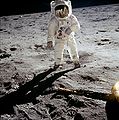
United States
The United States of America is a federal constitutional republic comprising fifty states and a federal district...
became the second nation to achieve manned spaceflight, with the suborbital flight of astronaut
Astronaut
An astronaut or cosmonaut is a person trained by a human spaceflight program to command, pilot, or serve as a crew member of a spacecraft....
Alan Shepard
Alan Shepard
Alan Bartlett Shepard, Jr. was an American naval aviator, test pilot, flag officer, and NASA astronaut who in 1961 became the second person, and the first American, in space. This Mercury flight was designed to enter space, but not to achieve orbit...
aboard Freedom 7, carried out as part of Project Mercury
Project Mercury
In January 1960 NASA awarded Western Electric Company a contract for the Mercury tracking network. The value of the contract was over $33 million. Also in January, McDonnell delivered the first production-type Mercury spacecraft, less than a year after award of the formal contract. On February 12,...
. The spacecraft was launched on May 5, 1961 on a Redstone rocket
Mercury-Redstone Launch Vehicle
The Mercury-Redstone Launch Vehicle, designed for NASA's Project Mercury, was the first American manned space booster. It was used for six sub-orbital Mercury flights from 1960–61; culminating with the launch of the first, and 11 weeks later, the second American in space.A member of the...
. The first U.S. orbital flight was that of John Glenn
John Glenn
John Herschel Glenn, Jr. is a former United States Marine Corps pilot, astronaut, and United States senator who was the first American to orbit the Earth and the third American in space. Glenn was a Marine Corps fighter pilot before joining NASA's Mercury program as a member of NASA's original...
aboard Friendship 7, which was launched February 20, 1962 on an Atlas
SM-65D Atlas
The SM-65D Atlas, or Atlas D, was the first operational version of the U.S. Atlas missile. It first flew on April 14, 1959. Atlas D missiles were also used for orbital launches, both with upper stages and on their own as a stage-and-a-half vehicle....
rocket. Since 1981 the U.S. has conducted all its human spaceflight missions with reusable Space Shuttle
Space Shuttle
The Space Shuttle was a manned orbital rocket and spacecraft system operated by NASA on 135 missions from 1981 to 2011. The system combined rocket launch, orbital spacecraft, and re-entry spaceplane with modular add-ons...
s. Sally Ride
Sally Ride
Sally Kristen Ride is an American physicist and a former NASA astronaut. Ride joined NASA in 1978, and in 1983 became the first American woman—and then-youngest American, at 32—to enter space...
became the first American woman in space in 1983. Eileen Collins
Eileen Collins
Eileen Marie Collins is a retired American astronaut and a retired U.S. Air Force Colonel. A former military instructor and test pilot, Collins was the first female pilot and first female commander of a Space Shuttle. She was awarded several medals for her work. Col. Collins has logged 38 days 8...
was the first female Shuttle pilot, and with Shuttle mission STS-93
STS-93
STS-93 marked the 95th launch of the Space Shuttle, the 26th launch of Columbia, and the 21st night launch of a Space Shuttle. Eileen Collins became the first female shuttle Commander on this flight. Its primary payload was the Chandra X-ray Observatory. It would also be the last mission of...
in July 1999 she became the first woman to command a U.S. spacecraft.
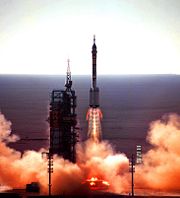
People's Republic of China
China , officially the People's Republic of China , is the most populous country in the world, with over 1.3 billion citizens. Located in East Asia, the country covers approximately 9.6 million square kilometres...
became the third nation to achieve human spaceflight when Yang Liwei
Yang Liwei
Yáng Lìwěi is a Chinese major general and military pilot and a CNSA astronaut. He was the first man sent into space by the Chinese space program and his mission, Shenzhou 5, made China the third country to independently send people into space.-Background:...
launched into space on a Chinese-made vehicle, the Shenzhou 5
Shenzhou 5
Shenzhou 5 — was the first human spaceflight mission of the People's Republic of China , launched on October 15, 2003. The Shenzhou spacecraft was launched on a Long March 2F launch vehicle. There had been four previous flights of unmanned Shenzhou missions since 1999...
, on October 15, 2003. The flight made China the third nation to have launched its own manned spacecraft using its own launcher. Previous European (Hermes
Hermes (shuttle)
Hermes was a proposed spaceplane designed by the French Centre National d'Études Spatiales in 1975, and later by the European Space Agency. It was superficially similar to the US X-20. France proposed in January 1985 to go through with Hermes development under the auspices of the ESA. Hermes was...
) and Japanese (HOPE-X
HOPE-X
HOPE was a Japanese experimental spaceplane project designed by a partnership between NASDA and NAL , started in the 1980s. It was positioned for most of its lifetime as one of the main Japanese contributions to the International Space Station, the other being the Japanese Experiment Module...
) domestic manned programs were abandoned after years of development, as was the first Chinese attempt, the Shuguang spacecraft
Shuguang spacecraft
Shuguang One , meaning "dawn" in Mandarin, also known as Project 714 , was the first manned spacecraft proposed by the People's Republic of China during the late 1960s and early 1970s that was never built. The design was for a two-man capsule, similar to the American Gemini spacecraft, that could...
.
The farthest destination for a human spaceflight mission has been the Moon
Moon
The Moon is Earth's only known natural satellite,There are a number of near-Earth asteroids including 3753 Cruithne that are co-orbital with Earth: their orbits bring them close to Earth for periods of time but then alter in the long term . These are quasi-satellites and not true moons. For more...
. The only manned missions to the Moon have been those conducted by NASA
NASA
The National Aeronautics and Space Administration is the agency of the United States government that is responsible for the nation's civilian space program and for aeronautics and aerospace research...
as part of the Apollo program. The first such mission, Apollo 8
Apollo 8
Apollo 8, the second manned mission in the American Apollo space program, was the first human spaceflight to leave Earth orbit; the first to be captured by and escape from the gravitational field of another celestial body; and the first crewed voyage to return to Earth from another celestial...
, orbited the Moon but did not land. The first Moon landing mission was Apollo 11
Apollo 11
In early 1969, Bill Anders accepted a job with the National Space Council effective in August 1969 and announced his retirement as an astronaut. At that point Ken Mattingly was moved from the support crew into parallel training with Anders as backup Command Module Pilot in case Apollo 11 was...
, during which—on July 20, 1969—Neil Armstrong
Neil Armstrong
Neil Alden Armstrong is an American former astronaut, test pilot, aerospace engineer, university professor, United States Naval Aviator, and the first person to set foot upon the Moon....
and Buzz Aldrin
Buzz Aldrin
Buzz Aldrin is an American mechanical engineer, retired United States Air Force pilot and astronaut who was the Lunar Module pilot on Apollo 11, the first manned lunar landing in history...
became the first people to set foot on the Moon. Six missions landed in total, numbered Apollo 11–17
Apollo 17
Apollo 17 was the eleventh and final manned mission in the American Apollo space program. Launched at 12:33 a.m. EST on December 7, 1972, with a three-member crew consisting of Commander Eugene Cernan, Command Module Pilot Ronald Evans, and Lunar Module Pilot Harrison Schmitt, Apollo 17 remains the...
, excluding Apollo 13
Apollo 13
Apollo 13 was the seventh manned mission in the American Apollo space program and the third intended to land on the Moon. The craft was launched on April 11, 1970, at 13:13 CST. The landing was aborted after an oxygen tank exploded two days later, crippling the service module upon which the Command...
. Altogether twelve men walked on the Moon, the only humans to have been on an extraterrestrial body. The Soviet Union discontinued its program for lunar orbiting and landing of human spaceflight missions on June 24, 1974 when Valentin Glushko
Valentin Glushko
Valentin Petrovich Glushko or Valentyn Petrovych Hlushko was a Soviet engineer, and the principal Soviet designer of rocket engines during the Soviet/American Space Race.-Biography:...
became General Designer of NPO Energiya.
The longest single human spaceflight is that of Valeriy Polyakov
Valeriy Polyakov
Valeri Vladimirovich Polyakov is a former Russian cosmonaut. He is the holder of the record for the longest single spaceflight in human history,staying aboard the Mir space station for more than 14 months during one trip....
, who left earth on January 8, 1994, and did not return until March 22, 1995 (a total of 437 days 17 hr. 58 min. 16 sec. aboard). Sergei Krikalyov has spent the most time of anyone in space, 803 days, 9 hours, and 39 seconds altogether. The longest period of continuous human presence in space is over 10 years, 10 months on the International Space Station
International Space Station
The International Space Station is a habitable, artificial satellite in low Earth orbit. The ISS follows the Salyut, Almaz, Cosmos, Skylab, and Mir space stations, as the 11th space station launched, not including the Genesis I and II prototypes...
. The previous record for MIR
Mir
Mir was a space station operated in low Earth orbit from 1986 to 2001, at first by the Soviet Union and then by Russia. Assembled in orbit from 1986 to 1996, Mir was the first modular space station and had a greater mass than that of any previous spacecraft, holding the record for the...
was 3,644 days, eight days short of 10 years, spanning the launch of Soyuz TM-8
Soyuz TM-8
-Launch and Docking:The Soyuz-U2 rocket was painted with advertisements. During the Soyuz spacecraft's final approach to Mir , the Kurs rendezvous and docking system malfunctioned, so Viktorenko took over manual control and withdrew to 20 metres, and then docked manually...
on September 5, 1989 to the landing of Soyuz TM-29
Soyuz TM-29
Soyuz TM-29 was a Russian manned spacecraft launched from the Baikonur Cosmodrome aboard a Soyuz 11A511U rocket. It docked with Mir on February 22 at 05:36 GMT with Cosmonauts Viktor Afanasyev of Russia, Jean-Pierre Haigneré of France, and Ivan Bella of Slovakia aboard. Since two crew seats had...
on August 28, 1999.
For many years beginning in 1961, only two countries, the USSR (later Russia
Russia
Russia or , officially known as both Russia and the Russian Federation , is a country in northern Eurasia. It is a federal semi-presidential republic, comprising 83 federal subjects...
) and United States, had their own astronauts. Citizens of other nations flew in space, beginning with the flight of Vladimir Remek
Vladimír Remek
Vladimír Remek is the first Czechoslovak in space and the first cosmonaut from a country other than the Soviet Union or the United States. As of 2004, with the entry of the Czech Republic into the European Union Vladimír Remek is considered to be the first astronaut from the EU...
, a Czech
Czech Republic
The Czech Republic is a landlocked country in Central Europe. The country is bordered by Poland to the northeast, Slovakia to the east, Austria to the south, and Germany to the west and northwest....
, on a Soviet spacecraft on March 2, 1978. , citizens from 38 nations (including space tourists
Space tourism
Space Tourism is space travel for recreational, leisure or business purposes. A number of startup companies have sprung up in recent years, hoping to create a space tourism industry...
) have flown in space aboard Soviet, American, Russian, and Chinese spacecraft.
Space programs
As of 2011, human spaceflight missions have been conducted by the former Soviet UnionSoviet Union
The Soviet Union , officially the Union of Soviet Socialist Republics , was a constitutionally socialist state that existed in Eurasia between 1922 and 1991....
/(Russian Federation), the United States
United States
The United States of America is a federal constitutional republic comprising fifty states and a federal district...
, the People's Republic of China
People's Republic of China
China , officially the People's Republic of China , is the most populous country in the world, with over 1.3 billion citizens. Located in East Asia, the country covers approximately 9.6 million square kilometres...
and by the private spaceflight
Private spaceflight
Private spaceflight is flight above Earth altitude conducted by and paid for by an entity other than a government. In the early decades of the Space Age, the government space agencies of the Soviet Union and United States pioneered space technology augmented by collaboration with affiliated design...
company Scaled Composites
Scaled Composites
Scaled Composites is an aerospace company founded by Burt Rutan and currently owned by Northrop Grumman that is located at the Mojave Spaceport, Mojave, California, United States...
.
Several other countries and space agencies have announced and begun human spaceflight programs by their own technology, including India
India
India , officially the Republic of India , is a country in South Asia. It is the seventh-largest country by geographical area, the second-most populous country with over 1.2 billion people, and the most populous democracy in the world...
(ISRO), Ecuador
Ecuador
Ecuador , officially the Republic of Ecuador is a representative democratic republic in South America, bordered by Colombia on the north, Peru on the east and south, and by the Pacific Ocean to the west. It is one of only two countries in South America, along with Chile, that do not have a border...
(EXA
Ecuadorian Civilian Space Agency
The Ecuadorian Civilian Space Agency is the organization in charge of administering and executing the Ecuadorian civilian space program and conducting scientific research on space and planetary sciences. It is a mixed capital non-profit organization, 50% civilian and 50% Ecuadorian government...
), Japan
Japan
Japan is an island nation in East Asia. Located in the Pacific Ocean, it lies to the east of the Sea of Japan, China, North Korea, South Korea and Russia, stretching from the Sea of Okhotsk in the north to the East China Sea and Taiwan in the south...
(JAXA), Iran
Iran
Iran , officially the Islamic Republic of Iran , is a country in Southern and Western Asia. The name "Iran" has been in use natively since the Sassanian era and came into use internationally in 1935, before which the country was known to the Western world as Persia...
(ISA
Iranian Space Agency
The Iranian Space Agency is Iran's governmental space agency. Iran is an active participant in the Asian space race and became an orbital-launch-capable nation in 2009...
) and Malaysia (MNSA).
Currently the following spacecraft
Spacecraft
A spacecraft or spaceship is a craft or machine designed for spaceflight. Spacecraft are used for a variety of purposes, including communications, earth observation, meteorology, navigation, planetary exploration and transportation of humans and cargo....
and spaceport
Spaceport
A spaceport or cosmodrome is a site for launching spacecraft, by analogy with seaport for ships or airport for aircraft. The word spaceport, and even more so cosmodrome, has traditionally been used for sites capable of launching spacecraft into orbit around Earth or on interplanetary trajectories...
s are used for launching human spaceflights:
- SoyuzSoyuz spacecraftSoyuz , Union) is a series of spacecraft initially designed for the Soviet space programme by the Korolyov Design Bureau in the 1960s, and still in service today...
with Soyuz rocket—Baikonur CosmodromeBaikonur CosmodromeThe Baikonur Cosmodrome , also called Tyuratam, is the world's first and largest operational space launch facility. It is located in the desert steppe of Kazakhstan, about east of the Aral Sea, north of the Syr Darya river, near Tyuratam railway station, at 90 meters above sea level... - International Space StationInternational Space StationThe International Space Station is a habitable, artificial satellite in low Earth orbit. The ISS follows the Salyut, Almaz, Cosmos, Skylab, and Mir space stations, as the 11th space station launched, not including the Genesis I and II prototypes...
(ISS)—Assembled in orbit; crews transported by previous spacecraft - Shenzhou spacecraftShenzhou spacecraftShenzhou is a spacecraft developed and operated by the People's Republic of China to support its manned spaceflight program. The name is variously translated as "Divine Craft," "Divine Vessel of God," "Magic Boat" or similar and is also homophonous with an ancient name for China...
with Long March rocketLong March rocketA Long March rocket or Chang Zheng rocket as in Chinese pinyin is any rocket in a family of expendable launch systems operated by the People's Republic of China. Development and design falls under the auspices of the China Academy of Launch Vehicle Technology...
—Jiuquan Satellite Launch CenterJiuquan Satellite Launch CenterJiuquan Satellite Launch Center is a People's Republic of China space vehicle launch facility .The facility is part of Dongfeng Aerospace City , and is located in the Gobi desert, Ejin Banner , Alxa League , Inner Mongolia, situated about 1,600 km from Beijing.- History :It was founded in 1958,...
Historically, the following spacecraft and spaceport
Spaceport
A spaceport or cosmodrome is a site for launching spacecraft, by analogy with seaport for ships or airport for aircraft. The word spaceport, and even more so cosmodrome, has traditionally been used for sites capable of launching spacecraft into orbit around Earth or on interplanetary trajectories...
s have also been used for human spaceflight launches:
- VostokVostok spacecraftThe Vostok was a type of spacecraft built by the Soviet Union. The first human spaceflight in history was accomplished on this spacecraft on April 12, 1961, by Soviet cosmonaut Yuri Gagarin....
—Baikonur Cosmodrome - MercuryProject MercuryIn January 1960 NASA awarded Western Electric Company a contract for the Mercury tracking network. The value of the contract was over $33 million. Also in January, McDonnell delivered the first production-type Mercury spacecraft, less than a year after award of the formal contract. On February 12,...
—Cape Canaveral Air Force StationCape Canaveral Air Force StationCape Canaveral Air Force Station is an installation of the United States Air Force Space Command's 45th Space Wing, headquartered at nearby Patrick Air Force Base. Located on Cape Canaveral in the state of Florida, CCAFS is the primary launch head of America's Eastern Range with four launch pads... - VoskhodVoskhod spacecraftThe Voskhod was a spacecraft built by the Soviet Union's space program for human spaceflight as part of the Voskhod programme. It was a development of and a follow-on to the Vostok spacecraft...
—Baikonur Cosmodrome - X-15—Edwards Air Force BaseEdwards Air Force BaseEdwards Air Force Base is a United States Air Force base located on the border of Kern County, Los Angeles County, and San Bernardino County, California, in the Antelope Valley. It is southwest of the central business district of North Edwards, California and due east of Rosamond.It is named in...
, (two internationally recognized suborbital flights in program) - GeminiProject GeminiProject Gemini was the second human spaceflight program of NASA, the civilian space agency of the United States government. Project Gemini was conducted between projects Mercury and Apollo, with ten manned flights occurring in 1965 and 1966....
—Cape Canaveral Air Force Station - ApolloApollo spacecraftThe Apollo spacecraft was composed of five combined parts designed to accomplish the American Apollo program's goal of landing astronauts on the Moon by the end of the 1960s and returning them safely to Earth...
—Kennedy Space Center (Apollo 7 at Cape Canaveral Air Force Station) - SalyutSalyutThe Salyut program was the first space station program undertaken by the Soviet Union, which consisted of a series of nine space stations launched over a period of eleven years from 1971 to 1982...
space station—Baikonur Cosmodrome - AlmazAlmazThe Almaz program was a series of military space stations launched by the Soviet Union under cover of the civilian Salyut DOS-17K program after 1971....
space station—Baikonur Cosmodrome (Almaz was a series of military space stations under cover of the civilian name Salyut) - SkylabSkylabSkylab was a space station launched and operated by NASA, the space agency of the United States. Skylab orbited the Earth from 1973 to 1979, and included a workshop, a solar observatory, and other systems. It was launched unmanned by a modified Saturn V rocket, with a mass of...
space station—Kennedy Space Center - MirMirMir was a space station operated in low Earth orbit from 1986 to 2001, at first by the Soviet Union and then by Russia. Assembled in orbit from 1986 to 1996, Mir was the first modular space station and had a greater mass than that of any previous spacecraft, holding the record for the...
space station—Baikonur Cosmodrome - SpaceShipOne with White Knight—Mojave SpaceportMojave Spaceportthumb|right|235px|A retired [[Boeing 767-200]] that flew for [[Ansett Australia]] being cut open for scrap at Mojave AirportThe Mojave Air and Space Port , also known as the Civilian Aerospace Test Center, is located in Mojave, California, at an elevation of...
- Space ShuttleSpace ShuttleThe Space Shuttle was a manned orbital rocket and spacecraft system operated by NASA on 135 missions from 1981 to 2011. The system combined rocket launch, orbital spacecraft, and re-entry spaceplane with modular add-ons...
—Kennedy Space CenterKennedy Space CenterThe John F. Kennedy Space Center is the NASA installation that has been the launch site for every United States human space flight since 1968. Although such flights are currently on hiatus, KSC continues to manage and operate unmanned rocket launch facilities for America's civilian space program...
Numerous private companies attempted human spaceflight programs in an effort to win the $10 million Ansari X Prize
Ansari X Prize
The Ansari X Prize was a space competition in which the X Prize Foundation offered a US$10,000,000 prize for the first non-government organization to launch a reusable manned spacecraft into space twice within two weeks...
. The first private human spaceflight took place on June 21, 2004, when SpaceShipOne conducted a suborbital flight. SpaceShipOne captured the prize on October 4, 2004, when it accomplished two consecutive flights within one week. SpaceShipTwo, launching from the carrier aircraft White Knight Two, is planned to conduct regular suborbital space tourism.
Most of the time, the only humans in space are those aboard the ISS, whose crew of six spends up to six months at a time in low Earth orbit
Low Earth orbit
A low Earth orbit is generally defined as an orbit within the locus extending from the Earth’s surface up to an altitude of 2,000 km...
.
NASA
NASA
The National Aeronautics and Space Administration is the agency of the United States government that is responsible for the nation's civilian space program and for aeronautics and aerospace research...
and ESA now use the term "human spaceflight" to refer to their programs of launching people into space. Traditionally, these endeavors have been referred to as "manned space missions."
National spacefaring attempts
| Nation/Organization | Space agency | Term(s) for space human | First launched astronaut | Date | Spacecraft | Launcher | Type |
|---|---|---|---|---|---|---|---|
| (1922–1991) | Soviet space program Soviet space program The Soviet space program is the rocketry and space exploration programs conducted by the former Union of Soviet Socialist Republics from the 1930s until its dissolution in 1991... (OKB-1 Design Bureau) |
космонавт kosmonavtcosmonaut |
Yuri Gagarin Yuri Gagarin Yuri Alekseyevich Gagarin was a Soviet pilot and cosmonaut. He was the first human to journey into outer space, when his Vostok spacecraft completed an orbit of the Earth on April 12, 1961.... |
April 12, 1961 | Vostok spacecraft Vostok spacecraft The Vostok was a type of spacecraft built by the Soviet Union. The first human spaceflight in history was accomplished on this spacecraft on April 12, 1961, by Soviet cosmonaut Yuri Gagarin.... |
Vostok Vostok rocket Vostok was a family of rockets derived from the Soviet R-7 Semyorka ICBM designed for the human spaceflight programme. This family of rockets launched the first artificial satellite and the first manned spacecraft in human history... |
Orbital |
 Russia(1991-) Russia(1991-) |
Russian Federal Space Agency Russian Federal Space Agency The Russian Federal Space Agency , commonly called Roscosmos and abbreviated as FKA and RKA , is the government agency responsible for the Russian space science program and general aerospace research. It was previously the Russian Aviation and Space Agency .Headquarters of Roscosmos are located... |
космонавт kosmonavtcosmonautspaceflight participant |
" | " | Soyuz Soyuz Soyuz is Russian for "Union", and was often used as an abbreviation for the "Union of Soviet Socialist Republics" during the Communist era. In English, the term is left untranslated in the names of several Soviet-related concepts... |
Soyuz rocket | Orbital |
 United States United States |
National Aeronautics and Space Administration (NASA) NASA The National Aeronautics and Space Administration is the agency of the United States government that is responsible for the nation's civilian space program and for aeronautics and aerospace research... |
astronautspaceflight participant | Alan Shepard Alan Shepard Alan Bartlett Shepard, Jr. was an American naval aviator, test pilot, flag officer, and NASA astronaut who in 1961 became the second person, and the first American, in space. This Mercury flight was designed to enter space, but not to achieve orbit... |
May 5, 1961 | Mercury spacecraft | Redstone Mercury-Redstone Launch Vehicle The Mercury-Redstone Launch Vehicle, designed for NASA's Project Mercury, was the first American manned space booster. It was used for six sub-orbital Mercury flights from 1960–61; culminating with the launch of the first, and 11 weeks later, the second American in space.A member of the... |
Suborbital |
| United States |
National Aeronautics and Space Administration (NASA) NASA The National Aeronautics and Space Administration is the agency of the United States government that is responsible for the nation's civilian space program and for aeronautics and aerospace research... |
astronautspaceflight participant | John Glenn John Glenn John Herschel Glenn, Jr. is a former United States Marine Corps pilot, astronaut, and United States senator who was the first American to orbit the Earth and the third American in space. Glenn was a Marine Corps fighter pilot before joining NASA's Mercury program as a member of NASA's original... |
February 20, 1962 | Mercury spacecraft | Atlas LV-3B Atlas LV-3B The Atlas LV-3B, Atlas D Mercury Launch Vehicle or Mercury-Atlas Launch Vehicle, was a man-rated expendable launch system used as part of the United States Project Mercury to send astronauts into low Earth orbit. It was derived from the SM-65D Atlas missile, and was a member of the Atlas family of... |
Orbital |
 People's Republic of China People's Republic of China |
Space program of the People's Republic of China Chinese space program The space program of the People's Republic of China is directed by the China National Space Administration . Its technological roots can be traced back to the late 1950s, when the People's Republic began a rudimentary ballistic missile program in response to perceived American threats... |
宇航员 yǔhángyuán 航天员 hángtiānyuántaikonaut |
... | 1973 (abandoned) | Shuguang 1 Shuguang spacecraft Shuguang One , meaning "dawn" in Mandarin, also known as Project 714 , was the first manned spacecraft proposed by the People's Republic of China during the late 1960s and early 1970s that was never built. The design was for a two-man capsule, similar to the American Gemini spacecraft, that could... |
Long March 2A Long March 2A The Long March 2A, also known as the Chang Zheng 2A, CZ-2A and LM-2A, was a Chinese orbital carrier rocket. It was launched from Launch Area 2B at the Jiuquan Satellite Launch Centre. It was a 2-stage rocket, and flew just once, on 5 November 1974... |
|
| People's Republic of China |
Space program of the People's Republic of China Chinese space program The space program of the People's Republic of China is directed by the China National Space Administration . Its technological roots can be traced back to the late 1950s, when the People's Republic began a rudimentary ballistic missile program in response to perceived American threats... |
宇航员 yǔhángyuán 航天员 hángtiānyuán |
... | 1981 (abandoned) | Piloted FSW Fanhui Shi Weixing Fanhui Shi Weixing is a series of Chinese recoverable reconnaissance satellites. The satellites were used for both military and civilian observation needs, with a total of 26 flights. The first flight was FSW-0 on 1969-06-01 and the last SJ-8 on 2006-09-09.... |
Long March 2 | |
 European Union European Union |
CNES CNES The is the French government space agency . Established under President Charles de Gaulle in 1961, its headquarters are located in central Paris and it is under the supervision of the French Ministries of Defence and Research... / European Space Agency (ESA) European Space Agency The European Space Agency , established in 1975, is an intergovernmental organisation dedicated to the exploration of space, currently with 18 member states... |
spationaute astronaut |
... | 1992 (abandoned) | Hermes Hermes (shuttle) Hermes was a proposed spaceplane designed by the French Centre National d'Études Spatiales in 1975, and later by the European Space Agency. It was superficially similar to the US X-20. France proposed in January 1985 to go through with Hermes development under the auspices of the ESA. Hermes was... |
Ariane V | |
 Iraq Ba'athist Iraq Iraq Ba'athist IraqBa'athist Iraq The History of Iraq , referred to as Ba'athist Iraq, covers the period of the Arab Socialist Ba'ath Party's rule over Iraq. Ba'athist rule in Iraq first occurred briefly in 1963 under Ahmed Hassan al-Bakr until overthrown that same year. Ba'athism was restored to power five years later after... (1968-2003) |
... | رجل فضاء rajul faḍāʼ رائد فضاء rāʼib faḍāʼ ملاح فضائي mallāḥ faḍāʼiy |
... | 2001 (abandoned) | ... | Tammouz 2 or 3 | |
 Japan State of Japan Japan State of Japan |
National Space Development Agency of Japan (NASDA) National Space Development Agency of Japan of Japan, or NASDA, was a Japanese national space agency established on October 1, 1969 under the National Space Development Agency Law only for peaceful purposes... |
宇宙飛行士 uchūhikōshi |
... | 2003 (abandoned) | HOPE-X HOPE-X HOPE was a Japanese experimental spaceplane project designed by a partnership between NASDA and NAL , started in the 1980s. It was positioned for most of its lifetime as one of the main Japanese contributions to the International Space Station, the other being the Japanese Experiment Module... |
H-II H-II The H-II rocket was a Japanese satellite launch system, which flew seven times between 1994 and 1999, with five successes. It was developed by NASDA in order to give Japan a capability to launch larger satellites in the 1990s. It was the first two-stage liquid-fuelled rocket Japan made using only... |
|
| People's Republic of China |
China National Space Administration (CNSA) China National Space Administration The China National Space Administration is the national space agency of the People's Republic of China responsible for the national space program. It is responsible for planning and development of space activities... |
太空人 tàikōng rén 宇航员 yǔhángyuán 航天员 hángtiānyuán |
Yang Liwei Yang Liwei Yáng Lìwěi is a Chinese major general and military pilot and a CNSA astronaut. He was the first man sent into space by the Chinese space program and his mission, Shenzhou 5, made China the third country to independently send people into space.-Background:... |
October 15, 2003 | Shenzhou spacecraft | Long March 2F Long March 2F The Long March 2F , also known as the CZ-2F, LM-2F and Shenjian, is a Chinese manned orbital carrier rocket, part of the Long March rocket family. Designed to launch manned Shenzhou spacecraft, the Long March 2F is a man-rated two-stage version of the Long March 2E rocket, which in turn was based... |
Orbital |
 India Republic of India India Republic of India |
Indian Space Research Organisation (ISRO) Indian Space Research Organisation The Indian Space Research Organisation is an independent Indian governmental agency established in 1969 for the research and development of vehicles and activities for the exploration of space within and outside of Earth’s atmosphere. Headquartered in Bangalore... |
vyomanaut gaganaut aakashagaami आकाशगामि: brahmāndagaami ब्रह्मान्डगामि: antarikshyaatri अन्तरिक्षयात्रि: |
... | 2016 (approved) | Orbital Vehicle (OV) ISRO Orbital Vehicle The Indian manned spacecraft temporarily named Orbital Vehicle is intended to be the basis of the indigenous Indian human spaceflight program. The capsule will be designed to carry three people, and a planned upgraded version will be equipped with rendezvous and docking capability.In its maiden... |
GSLV Mk II Geosynchronous Satellite Launch Vehicle The Geosynchronous Satellite Launch Vehicle is an expendable launch system operated by the Indian Space Research Organisation... |
|
 Iran Islamic Republic of Iran Iran Islamic Republic of Iran |
Iranian Space Agency (ISA) Iranian Space Agency The Iranian Space Agency is Iran's governmental space agency. Iran is an active participant in the Asian space race and became an orbital-launch-capable nation in 2009... |
کیهان نورد kayhan navard |
... | 2017 (planned) | ISA manned spacecraft | ... | |
| European Union |
European Space Agency (ESA) European Space Agency The European Space Agency , established in 1975, is an intergovernmental organisation dedicated to the exploration of space, currently with 18 member states... |
astronaut | ... | 2020 (approved conceptually but full development not begun) | ARV phase-2 Automated Transfer Vehicle The Automated Transfer Vehicle or ATV is an expendable, unmanned resupply spacecraft developed by the European Space Agency . ATVs are designed to supply the International Space Station with propellant, water, air, payload and experiments... |
Ariane V | |
| Japan State of Japan |
Japan Aerospace Exploration Agency (JAXA) Japan Aerospace Exploration Agency The , or JAXA, is Japan's national aerospace agency. Through the merger of three previously independent organizations, JAXA was formed on October 1, 2003, as an Independent Administrative Institution administered by the Ministry of Education, Culture, Sports, Science and Technology and the... |
宇宙飛行士 uchūhikōshi |
... | 2025 (planned) | HTV-based spacecraft H-II Transfer Vehicle The H-II Transfer Vehicle , called , is an unmanned resupply spacecraft used to resupply the Kibō Japanese Experiment Module and the International Space Station . The Japan Aerospace Exploration Agency has been working on the design since the early 1990s. The first mission, HTV-1, was originally... |
H-IIB H-IIB H-IIB is an expendable launch system used to launch H-II Transfer Vehicles towards the International Space Station. H-IIB rockets are liquid-fuelled with solid-fuel strap-on boosters and are launched from the Tanegashima Space Center in Japan... |
|
Safety concerns
Planners of human spaceflight missions face a number of safety concerns.Life support
The immediate needs for breathable air and drinkable water are addressed by the life support systemLife support system
In human spaceflight, a life support system is a group of devices that allow a human being to survive in space.US government space agency NASA,and private spaceflight companies...
of the spacecraft.
Effects of microgravity
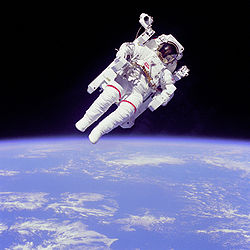
Bone
Bones are rigid organs that constitute part of the endoskeleton of vertebrates. They support, and protect the various organs of the body, produce red and white blood cells and store minerals. Bone tissue is a type of dense connective tissue...
density, decreased muscle strength and endurance, postural instability, and reductions in aerobic capacity. Over time these deconditioning
Deconditioning
Deconditioning is adaptation of an organism to less demanding environment, or, alternatively, the decrease of physiological adaptation to normal conditions...
effects can impair astronauts’ performance or increase their risk of injury.
In a weightless environment, astronauts put almost no weight on the back muscle
Muscle
Muscle is a contractile tissue of animals and is derived from the mesodermal layer of embryonic germ cells. Muscle cells contain contractile filaments that move past each other and change the size of the cell. They are classified as skeletal, cardiac, or smooth muscles. Their function is to...
s or leg muscles used for standing up. Those muscles then start to weaken and eventually get smaller. If there is an emergency at landing, the loss of muscles, and consequently the loss of strength can be a serious problem. Sometimes, astronauts can lose up to 25% of their muscle mass on long term flights. When they get back to ground, they will be considerably weakened and will be out of action for a while.
Astronauts experiencing weightlessness will often lose their orientation, get motion sickness
Motion sickness
Motion sickness or kinetosis, also known as travel sickness, is a condition in which a disagreement exists between visually perceived movement and the vestibular system's sense of movement...
, and lose their sense of direction as their bodies try to get used to a weightless environment. When they get back to Earth, or any other mass with gravity, they have to readjust to the gravity and may have problems standing up, focusing their gaze, walking and turning. Importantly, those body motor disturbances after changing from different gravities only get worse the longer the exposure to little gravity. These changes will affect operational activities including approach and landing, docking, remote manipulation, and emergencies that may happen while landing. This can be a major roadblock to mission success.
Radiation
Without proper shielding the crews of missions beyond low Earth orbit (LEO) might be at risk from high-energy protons emitted by solar flareSolar flare
A solar flare is a sudden brightening observed over the Sun surface or the solar limb, which is interpreted as a large energy release of up to 6 × 1025 joules of energy . The flare ejects clouds of electrons, ions, and atoms through the corona into space. These clouds typically reach Earth a day...
s. Lawrence Townsend
Lawrence Townsend
Lawrence Townsend was an American diplomat and later in life, after his retirement from government service, a business executive in Washington, DC....
of the University of Tennessee and others have studied the most powerful solar flare ever recorded
Solar storm of 1859
The solar storm of 1859, also known as the Solar Superstorm, or the Carrington Event, which occurred during solar cycle 10, was the most powerful solar storm in recorded history, and the largest flare, observed by Richard Christopher Carrington, became known as the Carrington Super...
. That flare was seen by the British astronomer Richard Carrington in September 1859. Radiation doses astronauts would receive from a Carrington-type flare could cause acute radiation sickness and possibly even death.
Another type of radiation, galactic cosmic ray
Galactic cosmic ray
Galactic cosmic rays are cosmic rays that have their origin inside our Galaxy. GCRs are high-energy charged particles, and are usually protons, electrons, and fully ionized nuclei of light elements...
s, present further challenges to human spaceflight beyond LEO.
Radiation damage to the immune system
There is also some scientific concern that extended space flight might slow down the body’s ability to protect itself against diseases. Some of the problems are a weakened immune system
Immune system
An immune system is a system of biological structures and processes within an organism that protects against disease by identifying and killing pathogens and tumor cells. It detects a wide variety of agents, from viruses to parasitic worms, and needs to distinguish them from the organism's own...
and the activation of dormant virus
Virus
A virus is a small infectious agent that can replicate only inside the living cells of organisms. Viruses infect all types of organisms, from animals and plants to bacteria and archaea...
es in the body. Radiation
Radiation
In physics, radiation is a process in which energetic particles or energetic waves travel through a medium or space. There are two distinct types of radiation; ionizing and non-ionizing...
can cause both short and long term consequences to the bone marrow stem cells which create the blood and immune systems. Because the interior of a spacecraft is so small, a weakened immune system and more active viruses in the body can lead to a fast spread of infection.
Isolation
During long missions, astronauts are isolatedIsolation (psychology)
Isolation is a defence mechanism in psychoanalytic theory, whereby the person "isolates" the unpleasant idea from the normal emotional response. For example, describing a murder in graphic details without an emotional involvement invokes isolation....
and confined into small spaces. Depression
Depression (mood)
Depression is a state of low mood and aversion to activity that can affect a person's thoughts, behaviour, feelings and physical well-being. Depressed people may feel sad, anxious, empty, hopeless, helpless, worthless, guilty, irritable, or restless...
, cabin fever
Cabin fever
Cabin fever is an idiomatic term for a claustrophobic reaction that takes place when a person or group is isolated and/or shut in a small space, with nothing to do, for an extended period...
and other psychological problems may impact the crew's safety and mission success.
Astronauts may not be able to quickly return to Earth or receive medical supplies, equipment or personnel if a medical emergency occurs. The astronauts may have to rely for long periods on their limited existing resources and medical advice from the ground.
Fatality risk
, 18 crew members have died during actual spaceflight missions (see table). Over 100 others have died in accidents during activity directly related to spaceflight missions or testing.| Year | #of Deaths |
Mission | Known or likely cause |
|---|---|---|---|
| 1967 | 1 | Soyuz 1 Soyuz 1 Soyuz 1 was a manned spaceflight of the Soviet space program. Launched into orbit on April 23, 1967 carrying cosmonaut Colonel Vladimir Komarov, Soyuz 1 was the first flight of the Soyuz spacecraft... |
|
| 1971 | 3 | Soyuz 11 Soyuz 11 Soyuz 11 was the first manned mission to arrive at the world's first space station, Salyut 1. The mission arrived at the space station on June 7, 1971 and departed on June 30, 1971. The mission ended in disaster when the crew capsule depressurized during preparations for re-entry, killing the... |
Asphyxia Asphyxia Asphyxia or asphyxiation is a condition of severely deficient supply of oxygen to the body that arises from being unable to breathe normally. An example of asphyxia is choking. Asphyxia causes generalized hypoxia, which primarily affects the tissues and organs... |
| 1986 | 7 | Space Shuttle Challenger Space Shuttle Challenger disaster The Space Shuttle Challenger disaster occurred on January 28, 1986, when Space Shuttle Challenger broke apart 73 seconds into its flight, leading to the deaths of its seven crew members. The spacecraft disintegrated over the Atlantic Ocean, off the coast of central Florida at 11:38 am EST... |
(mission never reached space) |
| 2003 | 7 | Space Shuttle Columbia Space Shuttle Columbia disaster The Space Shuttle Columbia disaster occurred on February 1, 2003, when shortly before it was scheduled to conclude its 28th mission, STS-107, the Space Shuttle Columbia disintegrated over Texas and Louisiana during re-entry into the Earth's atmosphere, resulting in the death of all seven crew members... |
Asphyxia Asphyxia Asphyxia or asphyxiation is a condition of severely deficient supply of oxygen to the body that arises from being unable to breathe normally. An example of asphyxia is choking. Asphyxia causes generalized hypoxia, which primarily affects the tissues and organs... from cabin breach, trauma Physical trauma Trauma refers to "a body wound or shock produced by sudden physical injury, as from violence or accident." It can also be described as "a physical wound or injury, such as a fracture or blow." Major trauma can result in secondary complications such as circulatory shock, respiratory failure and death... from object impact, or burn Burn A burn is an injury to flesh caused by heat, electricity, chemicals, light, radiation, or friction.Burn may also refer to:*Combustion*Burn , type of watercourses so named in Scotland and north-eastern England... s from re-entry heat |
See also
- International manned missions program
- Mars to StayMars to StayMars to Stay missions propose astronauts sent to Mars for the first time should stay there indefinitely, both to reduce cost and to ensure permanent settlement of Mars. Among many notable Mars to Stay advocates, former Apollo astronaut Buzz Aldrin has been particularly outspoken, suggesting in...
- Monkeys in spaceMonkeys in spaceBefore humans went into space, several animals were launched into space, including numerous monkeys, so that scientists could investigate the biological effects of space travel. The United States launched flights containing primate cargo primarily between 1948-1961 with one flight in 1969 and one...