


David Scott

Encyclopedia
David Randolph Scott (born June 6, 1932) is an American
engineer
, test pilot
, retired U.S. Air Force
officer, and former NASA
astronaut
and engineer
, who was one of the third group of astronauts selected by NASA in October 1963. As an astronaut, Scott became the seventh person to walk on the Moon.
Before becoming an astronaut, Scott graduated from the West Point Military Academy
and joined the United States Air Force
. Scott eventually retired from the Air Force in 1975 with the rank of Colonel
, and more than 5600 hours of logged flying time.
As an astronaut, Scott made his first flight into space as pilot of the Gemini 8
mission along with Neil Armstrong
in March 1966, spending just under eleven hours in Low Earth orbit
. Scott then spent ten days in orbit as Command Module
Pilot aboard Apollo 9
, his second spaceflight, along with Commander James McDivitt
and Lunar Module
Pilot Rusty Schweickart
. During this mission, Scott became the last American to fly solo in Earth orbit
(not counting subsequent untethered
EVAs). Scott made his third and final flight into space as commander of the Apollo 15
mission, the fourth human lunar landing, becoming the seventh person to walk on the Moon and the first person to drive on the Moon.
(for which he received his middle name) near San Antonio, Texas and was active in the Boy Scouts of America
where he achieved its second highest rank, Life Scout. He was educated at Texas Military Institute, Riverside Polytech High School in Riverside, California, where Scott joined the swim team and set several state and local swim records. Scott attended The Western High School in Washington, D.C. graduating in June 1949. In DC he was an honor student, on the school swim team and the Ambassador hotel AAU champion tean as a record setter. He attended the University of Michigan for one year where he was an honor student in the Engineering school, a member of the swimming team and pledged Sigma Chi Fraternity before finally receiving an invitation to attend West Point where he finished 5th in his class out of 633 in 1954. Because of his high standing in the class, he was able to choose which branch of the military he would serve. Scott choose the Air Force because he wanted to fly jets. In 1959 he married his first wife, Ann. He received both an S.M. degree in Aeronautics/Astronautics and the degree of Engineer in Aeronautics/Astronautics
(the E.A.A. degree) from MIT in 1962. He also received an honorary doctorate of Astronautical Science from the University of Michigan
in 1971. He is of Scottish
descent.
were launched into space on the Gemini 8
mission, a flight originally scheduled to last three days, in which Scott was to perform an EVA, but terminated early due to a malfunctioning thruster. The crew performed the first successful docking of two vehicles in space and demonstrated great piloting skill in overcoming the thruster problem and bringing the spacecraft to a safe landing. Scott would later perform EVA's on his two subsequent flights.
(March 3–March 13, 1969). This was the third manned flight in the Apollo series, the second to be launched by a Saturn V
, and the first to complete a comprehensive earth-orbital qualification and verification test of a "fully configured Apollo spacecraft." The ten-day flight provided vital information previously not available on the operational performance, stability, and reliability of lunar module propulsion and life support systems. Highlight of this evaluation was completion of a critical lunar-orbit rendezvous simulation and subsequent docking, initiated by James McDivitt
and Russell Schweickart from within the lunar module at a separation distance which exceeded 100 miles (160 km) from the command/service module piloted by Scott. The crew also demonstrated and confirmed the operational feasibility of crew transfer and extravehicular activity techniques and equipment, with Schweickart completing a 46-minute EVA outside the lunar module. During this period, Dave Scott completed a 1-hour stand-up EVA in the open command module hatch photographing Schweickart's activities and also retrieving thermal samples from the command module exterior. Apollo 9
splashed down less than four nautical miles (7 km) from the helicopter carrier USS Guadalcanal (LPH-7)
.
In his next assignment, Scott was designated backup spacecraft commander for Apollo 12
.
(July 26–August 7, 1971). His companions on the flight were Alfred M. Worden (command module pilot) and James B. Irwin (lunar module pilot). Apollo 15 was the fourth successful manned lunar landing mission and the first to land near mountains instead of the relatively flat mare region where the previous 3 missions had landed. The landing site was between 2 mountains just north of Hadley Rille and Apennine Mountains
which are located on the southeast edge of the Mare Imbrium
(Sea of Rains). After landing, Scott and Irwin donned their pressure suits and Scott performed the first and only stand up EVA on the lunar surface. He stood on the engine cover and poked his head out the docking port on top of the lunar module and took panoramic photographs of the surrounding terrain from an elevated position and scouted the terrain they would be driving across the next day. The lunar module, "Falcon," remained on the lunar surface for 66 hours and 54 minutes (setting a new record for lunar surface stay time) and Scott and Irwin logged 18 hours and 35 minutes each in extravehicular activities conducted during three separate excursions onto the lunar surface. Using "Rover-1
" to transport themselves and their equipment along portions of Hadley Rille and the Apennine Mountains, Scott and Irwin performed a selenological inspection and survey of the area and collected 180 pounds (82 kg) of lunar surface materials. They deployed an ALSEP package which involved the emplacement and activation of surface experiments, and their lunar surface activities were televised using a TV camera which was operated remotely by ground controllers stationed in the mission control center located at Houston, Texas. Other Apollo 15 achievements include: largest payloads ever placed into earth and lunar orbits; first scientific instrument module bay flown and operated on an Apollo spacecraft; longest distance traversed on lunar surface; first use of a lunar surface navigation device (mounted on Rover-1); first subsatellite launched in lunar orbit; and first extravehicular (EVA) from a command module during transearth coast. The latter feat performed by Worden during three excursions to "Endeavour's" SIM-bay where he retrieved film cassettes from the panoramic and mapping cameras and reported his personal observations of the general condition of equipment housed there. Apollo 15 concluded with a Pacific Ocean splashdown and subsequent recovery by the USS Okinawa
.
s, a NASA Exceptional Service Medal
, two Air Force Distinguished Service Medal
s, the Distinguished Flying Cross
, the Air Force Association's David C. Schilling Trophy and the Robert J. Collier Trophy.
In the 1998 television series From the Earth to the Moon Scott was portrayed by Brett Cullen
.
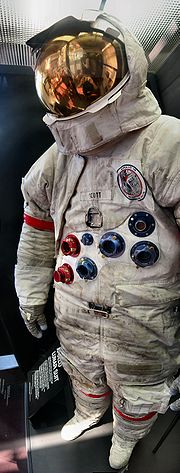 After the return of Apollo 15 to Earth, it was discovered that, without authority, Scott, with the knowledge of his crew, had taken 398 commemorative postal covers to the moon of which a hundred were then sold to a German stamp dealer
. The profits of the sale would have been used to establish trust funds for the Apollo 15 crew's children. Although NASA had itself contracted to carry stamp covers on the mission, the actions of the astronauts were not illegal, and NASA had turned a blind eye to similar activities on earlier flights, the administration decided to make an example of Scott and his crew and none of them flew in space again.
According to his autobiography (Deke! [ISBN 978-0-312-85918-3]), Deke Slayton
, Chief of the Astronaut Corps, felt Scott, Worden and Irwin had embarrassed NASA and the Apollo program by trying to profit in such way from the hard work that had gone into the Apollo 15 mission, and violated NASA rules. He confronted them and they told him what they'd done and why, and it was then that Slayton took them off the back-up crew of Apollo 17 and effectively ended their careers as astronauts. Worden went on to work at Ames Research Center and Scott was placed in the Manned Spacecraft Center. Irwin left NASA to become a full-time preacher.
United States
The United States of America is a federal constitutional republic comprising fifty states and a federal district...
engineer
Engineer
An engineer is a professional practitioner of engineering, concerned with applying scientific knowledge, mathematics and ingenuity to develop solutions for technical problems. Engineers design materials, structures, machines and systems while considering the limitations imposed by practicality,...
, test pilot
Test pilot
A test pilot is an aviator who flies new and modified aircraft in specific maneuvers, known as flight test techniques or FTTs, allowing the results to be measured and the design to be evaluated....
, retired U.S. Air Force
United States Air Force
The United States Air Force is the aerial warfare service branch of the United States Armed Forces and one of the American uniformed services. Initially part of the United States Army, the USAF was formed as a separate branch of the military on September 18, 1947 under the National Security Act of...
officer, and former NASA
NASA
The National Aeronautics and Space Administration is the agency of the United States government that is responsible for the nation's civilian space program and for aeronautics and aerospace research...
astronaut
Astronaut
An astronaut or cosmonaut is a person trained by a human spaceflight program to command, pilot, or serve as a crew member of a spacecraft....
and engineer
Engineer
An engineer is a professional practitioner of engineering, concerned with applying scientific knowledge, mathematics and ingenuity to develop solutions for technical problems. Engineers design materials, structures, machines and systems while considering the limitations imposed by practicality,...
, who was one of the third group of astronauts selected by NASA in October 1963. As an astronaut, Scott became the seventh person to walk on the Moon.
Before becoming an astronaut, Scott graduated from the West Point Military Academy
United States Military Academy
The United States Military Academy at West Point is a four-year coeducational federal service academy located at West Point, New York. The academy sits on scenic high ground overlooking the Hudson River, north of New York City...
and joined the United States Air Force
United States Air Force
The United States Air Force is the aerial warfare service branch of the United States Armed Forces and one of the American uniformed services. Initially part of the United States Army, the USAF was formed as a separate branch of the military on September 18, 1947 under the National Security Act of...
. Scott eventually retired from the Air Force in 1975 with the rank of Colonel
Colonel
Colonel , abbreviated Col or COL, is a military rank of a senior commissioned officer. It or a corresponding rank exists in most armies and in many air forces; the naval equivalent rank is generally "Captain". It is also used in some police forces and other paramilitary rank structures...
, and more than 5600 hours of logged flying time.
As an astronaut, Scott made his first flight into space as pilot of the Gemini 8
Gemini 8
-Backup crew:-Mission parameters:* Mass: * Perigee: * Apogee: * Inclination: 28.91°* Period: 88.83 min-Objectives:Gemini VIII had two major objectives, of which it achieved one...
mission along with Neil Armstrong
Neil Armstrong
Neil Alden Armstrong is an American former astronaut, test pilot, aerospace engineer, university professor, United States Naval Aviator, and the first person to set foot upon the Moon....
in March 1966, spending just under eleven hours in Low Earth orbit
Low Earth orbit
A low Earth orbit is generally defined as an orbit within the locus extending from the Earth’s surface up to an altitude of 2,000 km...
. Scott then spent ten days in orbit as Command Module
Apollo Command/Service Module
The Command/Service Module was one of two spacecraft, along with the Lunar Module, used for the United States Apollo program which landed astronauts on the Moon. It was built for NASA by North American Aviation...
Pilot aboard Apollo 9
Apollo 9
Apollo 9, the third manned mission in the American Apollo space program, was the first flight of the Command/Service Module with the Lunar Module...
, his second spaceflight, along with Commander James McDivitt
James McDivitt
James Alton McDivitt is a former NASA astronaut and engineer who flew in the Gemini and Apollo programs. He commanded the Gemini 4 flight in which Edward H. White performed the first US space walk, and later the Apollo 9 flight which was the first manned Earth orbital test of the Apollo Lunar...
and Lunar Module
Apollo Lunar Module
The Apollo Lunar Module was the lander portion of the Apollo spacecraft built for the US Apollo program by Grumman to carry a crew of two from lunar orbit to the surface and back...
Pilot Rusty Schweickart
Rusty Schweickart
Russell Louis "Rusty" Schweickart aka Schweikart is an American former astronaut, research scientist, US Air Force fighter pilot, business and government executive...
. During this mission, Scott became the last American to fly solo in Earth orbit
Orbit
In physics, an orbit is the gravitationally curved path of an object around a point in space, for example the orbit of a planet around the center of a star system, such as the Solar System...
(not counting subsequent untethered
Manned Maneuvering Unit
The Manned Maneuvering Unit is an astronaut propulsion unit which was used by NASA on three space shuttle missions in 1984. The MMU allowed the astronauts to perform untethered EVA spacewalks at a distance from the shuttle. The MMU was used in practice to retrieve a pair of faulty communications...
EVAs). Scott made his third and final flight into space as commander of the Apollo 15
Apollo 15
Apollo 15 was the ninth manned mission in the American Apollo space program, the fourth to land on the Moon and the eighth successful manned mission. It was the first of what were termed "J missions", long duration stays on the Moon with a greater focus on science than had been possible on previous...
mission, the fourth human lunar landing, becoming the seventh person to walk on the Moon and the first person to drive on the Moon.
Early life and education
He was born on Randolph FieldRandolph Air Force Base
Randolph Air Force Base is a United States Air Force base located east-northeast of San Antonio, Texas. The base is under the jurisdiction of the 902d Mission Support Group, Air Education and Training Command ....
(for which he received his middle name) near San Antonio, Texas and was active in the Boy Scouts of America
Boy Scouts of America
The Boy Scouts of America is one of the largest youth organizations in the United States, with over 4.5 million youth members in its age-related divisions...
where he achieved its second highest rank, Life Scout. He was educated at Texas Military Institute, Riverside Polytech High School in Riverside, California, where Scott joined the swim team and set several state and local swim records. Scott attended The Western High School in Washington, D.C. graduating in June 1949. In DC he was an honor student, on the school swim team and the Ambassador hotel AAU champion tean as a record setter. He attended the University of Michigan for one year where he was an honor student in the Engineering school, a member of the swimming team and pledged Sigma Chi Fraternity before finally receiving an invitation to attend West Point where he finished 5th in his class out of 633 in 1954. Because of his high standing in the class, he was able to choose which branch of the military he would serve. Scott choose the Air Force because he wanted to fly jets. In 1959 he married his first wife, Ann. He received both an S.M. degree in Aeronautics/Astronautics and the degree of Engineer in Aeronautics/Astronautics
Engineer's degree
An engineer's degree is an advanced academic degree in engineering that is conferred in Europe, some countries of Latin America, and a few institutions in the United States....
(the E.A.A. degree) from MIT in 1962. He also received an honorary doctorate of Astronautical Science from the University of Michigan
University of Michigan
The University of Michigan is a public research university located in Ann Arbor, Michigan in the United States. It is the state's oldest university and the flagship campus of the University of Michigan...
in 1971. He is of Scottish
Scottish people
The Scottish people , or Scots, are a nation and ethnic group native to Scotland. Historically they emerged from an amalgamation of the Picts and Gaels, incorporating neighbouring Britons to the south as well as invading Germanic peoples such as the Anglo-Saxons and the Norse.In modern use,...
descent.
NASA career
Scott was the first of the Group Three astronauts to be selected to fly and was also the first to command a mission of his own.Gemini 8
On March 16, 1966, he and command pilot Neil ArmstrongNeil Armstrong
Neil Alden Armstrong is an American former astronaut, test pilot, aerospace engineer, university professor, United States Naval Aviator, and the first person to set foot upon the Moon....
were launched into space on the Gemini 8
Gemini 8
-Backup crew:-Mission parameters:* Mass: * Perigee: * Apogee: * Inclination: 28.91°* Period: 88.83 min-Objectives:Gemini VIII had two major objectives, of which it achieved one...
mission, a flight originally scheduled to last three days, in which Scott was to perform an EVA, but terminated early due to a malfunctioning thruster. The crew performed the first successful docking of two vehicles in space and demonstrated great piloting skill in overcoming the thruster problem and bringing the spacecraft to a safe landing. Scott would later perform EVA's on his two subsequent flights.
Apollo 9
Scott served as command module pilot for Apollo 9Apollo 9
Apollo 9, the third manned mission in the American Apollo space program, was the first flight of the Command/Service Module with the Lunar Module...
(March 3–March 13, 1969). This was the third manned flight in the Apollo series, the second to be launched by a Saturn V
Saturn V
The Saturn V was an American human-rated expendable rocket used by NASA's Apollo and Skylab programs from 1967 until 1973. A multistage liquid-fueled launch vehicle, NASA launched 13 Saturn Vs from the Kennedy Space Center, Florida with no loss of crew or payload...
, and the first to complete a comprehensive earth-orbital qualification and verification test of a "fully configured Apollo spacecraft." The ten-day flight provided vital information previously not available on the operational performance, stability, and reliability of lunar module propulsion and life support systems. Highlight of this evaluation was completion of a critical lunar-orbit rendezvous simulation and subsequent docking, initiated by James McDivitt
James McDivitt
James Alton McDivitt is a former NASA astronaut and engineer who flew in the Gemini and Apollo programs. He commanded the Gemini 4 flight in which Edward H. White performed the first US space walk, and later the Apollo 9 flight which was the first manned Earth orbital test of the Apollo Lunar...
and Russell Schweickart from within the lunar module at a separation distance which exceeded 100 miles (160 km) from the command/service module piloted by Scott. The crew also demonstrated and confirmed the operational feasibility of crew transfer and extravehicular activity techniques and equipment, with Schweickart completing a 46-minute EVA outside the lunar module. During this period, Dave Scott completed a 1-hour stand-up EVA in the open command module hatch photographing Schweickart's activities and also retrieving thermal samples from the command module exterior. Apollo 9
Apollo 9
Apollo 9, the third manned mission in the American Apollo space program, was the first flight of the Command/Service Module with the Lunar Module...
splashed down less than four nautical miles (7 km) from the helicopter carrier USS Guadalcanal (LPH-7)
USS Guadalcanal (LPH-7)
USS Guadalcanal , the third Iwo Jima-class amphibious assault ship , was launched by the Philadelphia Naval Shipyard 16 March 1963, sponsored by Mrs. David Shoup, wife of General Shoup, the former Commandant of the Marine Corps; and commissioned 20 July 1963, Captain Dale K. Peterson in command...
.
In his next assignment, Scott was designated backup spacecraft commander for Apollo 12
Apollo 12
Apollo 12 was the sixth manned flight in the American Apollo program and the second to land on the Moon . It was launched on November 14, 1969 from the Kennedy Space Center, Florida, four months after Apollo 11. Mission commander Charles "Pete" Conrad and Lunar Module Pilot Alan L...
.
Apollo 15
Scott made his third space flight as spacecraft commander of Apollo 15Apollo 15
Apollo 15 was the ninth manned mission in the American Apollo space program, the fourth to land on the Moon and the eighth successful manned mission. It was the first of what were termed "J missions", long duration stays on the Moon with a greater focus on science than had been possible on previous...
(July 26–August 7, 1971). His companions on the flight were Alfred M. Worden (command module pilot) and James B. Irwin (lunar module pilot). Apollo 15 was the fourth successful manned lunar landing mission and the first to land near mountains instead of the relatively flat mare region where the previous 3 missions had landed. The landing site was between 2 mountains just north of Hadley Rille and Apennine Mountains
Montes Apenninus
Montes Apenninus are a rugged mountain range on the northern part of the Moon's near side. They are named after the Apennine Mountains in Italy....
which are located on the southeast edge of the Mare Imbrium
Mare Imbrium
Mare Imbrium, Latin for "Sea of Showers" or "Sea of Rains", is a vast lunar mare filling a basin on Earth's Moon and one of the larger craters in the Solar System. Mare Imbrium was created when lava flooded the giant crater formed when a very large object hit the Moon long ago...
(Sea of Rains). After landing, Scott and Irwin donned their pressure suits and Scott performed the first and only stand up EVA on the lunar surface. He stood on the engine cover and poked his head out the docking port on top of the lunar module and took panoramic photographs of the surrounding terrain from an elevated position and scouted the terrain they would be driving across the next day. The lunar module, "Falcon," remained on the lunar surface for 66 hours and 54 minutes (setting a new record for lunar surface stay time) and Scott and Irwin logged 18 hours and 35 minutes each in extravehicular activities conducted during three separate excursions onto the lunar surface. Using "Rover-1
Lunar rover
The Lunar Roving Vehicle or lunar rover was a battery-powered four-wheeled rover used on the Moon in the last three missions of the American Apollo program during 1971 and 1972...
" to transport themselves and their equipment along portions of Hadley Rille and the Apennine Mountains, Scott and Irwin performed a selenological inspection and survey of the area and collected 180 pounds (82 kg) of lunar surface materials. They deployed an ALSEP package which involved the emplacement and activation of surface experiments, and their lunar surface activities were televised using a TV camera which was operated remotely by ground controllers stationed in the mission control center located at Houston, Texas. Other Apollo 15 achievements include: largest payloads ever placed into earth and lunar orbits; first scientific instrument module bay flown and operated on an Apollo spacecraft; longest distance traversed on lunar surface; first use of a lunar surface navigation device (mounted on Rover-1); first subsatellite launched in lunar orbit; and first extravehicular (EVA) from a command module during transearth coast. The latter feat performed by Worden during three excursions to "Endeavour's" SIM-bay where he retrieved film cassettes from the panoramic and mapping cameras and reported his personal observations of the general condition of equipment housed there. Apollo 15 concluded with a Pacific Ocean splashdown and subsequent recovery by the USS Okinawa
USS Okinawa (LPH-3)
USS Okinawa was the second Iwo Jima-class amphibious assault ship of the United States Navy. She was the second Navy ship assigned the name "Okinawa", in honor of the World War II Battle of Okinawa....
.
Awards and honors
Scott has been awarded two NASA Distinguished Service MedalNASA Distinguished Service Medal
The NASA Distinguished Service Medal is the highest award which may be bestowed by the National Aeronautics and Space Administration of the United States...
s, a NASA Exceptional Service Medal
NASA Exceptional Service Medal
The NASA Exceptional Service Medal is an award granted to U.S. government employees for significant sustained performance characterized by unusual initiative or creative ability that clearly demonstrates substantial improvement in engineering, aeronautics, space flight, administration, support, or...
, two Air Force Distinguished Service Medal
Air Force Distinguished Service Medal
The Air Force Distinguished Service Medal was created by an act of the United States Congress on July 6, 1960. The medal was intended as a new decoration of the United States Air Force to replace the policy of awarding the Army Distinguished Service Medal to Air Force personnel.The Air Force...
s, the Distinguished Flying Cross
Distinguished Flying Cross (United States)
The Distinguished Flying Cross is a medal awarded to any officer or enlisted member of the United States armed forces who distinguishes himself or herself in support of operations by "heroism or extraordinary achievement while participating in an aerial flight, subsequent to November 11, 1918." The...
, the Air Force Association's David C. Schilling Trophy and the Robert J. Collier Trophy.
In the 1998 television series From the Earth to the Moon Scott was portrayed by Brett Cullen
Brett Cullen
Peter Brett Cullen is an American actor who has appeared in numerous motion pictures and television programs. Early in 2007, he was cast as the role of an estranged father to one of the American football players, Tim Riggins , in the NBC drama series Friday Night Lights.Cullen was born in Houston,...
.
Stamp incident
Stamp dealer
A stamp dealer is a company or an individual who deals in postage stamps and philatelic products. It also includes individuals who sell postage stamps for day to day use or official stamps for use on court documents.-Stamps on Approval Basis:...
. The profits of the sale would have been used to establish trust funds for the Apollo 15 crew's children. Although NASA had itself contracted to carry stamp covers on the mission, the actions of the astronauts were not illegal, and NASA had turned a blind eye to similar activities on earlier flights, the administration decided to make an example of Scott and his crew and none of them flew in space again.
According to his autobiography (Deke! [ISBN 978-0-312-85918-3]), Deke Slayton
Deke Slayton
Donald Kent Slayton , better known as Deke Slayton, was an American World War II pilot and later, one of the original NASA Mercury Seven astronauts....
, Chief of the Astronaut Corps, felt Scott, Worden and Irwin had embarrassed NASA and the Apollo program by trying to profit in such way from the hard work that had gone into the Apollo 15 mission, and violated NASA rules. He confronted them and they told him what they'd done and why, and it was then that Slayton took them off the back-up crew of Apollo 17 and effectively ended their careers as astronauts. Worden went on to work at Ames Research Center and Scott was placed in the Manned Spacecraft Center. Irwin left NASA to become a full-time preacher.
Post-NASA career
- On April 18, 1975, at age 42, Scott became the Center Director of NASA's Flight Research CenterDryden Flight Research CenterThe Dryden Flight Research Center , located inside Edwards Air Force Base, is an aeronautical research center operated by NASA. On March 26, 1976 it was named in honor of the late Hugh L. Dryden, a prominent aeronautical engineer who at the time of his death in 1965 was NASA's deputy administrator...
, a position he held until October 30, 1977. - He commentated for British TV on the first Space Shuttle flight (STS-1STS-1STS-1 was the first orbital flight of NASA's Space Shuttle program. Space Shuttle Columbia launched on 12 April 1981, and returned to Earth on 14 April, having orbited the Earth 37 times during the 54.5-hour mission. It was the first American manned space flight since the Apollo-Soyuz Test Project...
) in April 1981. - He also consulted on the movies Apollo 13Apollo 13 (film)Apollo 13 is a 1995 American drama film directed by Ron Howard. The film stars Tom Hanks, Kevin Bacon, Bill Paxton, Gary Sinise, Kathleen Quinlan and Ed Harris. The screenplay by William Broyles, Jr...
for Ron HowardRon HowardRonald William "Ron" Howard is an American actor, director, and producer. He came to prominence as a child actor, playing Opie Taylor in the sitcom The Andy Griffith Show for eight years, and later the teenaged Richie Cunningham in the sitcom Happy Days for six years...
and was on the set for much of the filming of the HBO mini-series From the Earth to the Moon, where he advised both Tom Hanks and the various directors, as well as answered questions from the actors on set. - In 2000 he was briefly engaged to British television newscaster Anna FordAnna FordAnna Ford is a retired English journalist and television presenter, best known as a newsreader....
. - In 2003-2004 he consulted on the BBC TV series Space Odyssey: Voyage To The PlanetsSpace Odyssey: Voyage To The PlanetsSpace Odyssey: Voyage To The Planets is a mockumentary about a manned voyage through the solar system. Space Odyssey premiered in 2004 and was made by the BBC...
- In 2004, he and former Soviet cosmonaut Alexei Leonov began work on a dual biography / history of the "Space Race" between the United States and the Soviet Union. The book, "Two Sides of the Moon: Our Story of the Cold War Space Race" was published in 2006. Neil ArmstrongNeil ArmstrongNeil Alden Armstrong is an American former astronaut, test pilot, aerospace engineer, university professor, United States Naval Aviator, and the first person to set foot upon the Moon....
and Tom HanksTom HanksThomas Jeffrey "Tom" Hanks is an American actor, producer, writer, and director. Hanks worked in television and family-friendly comedies, gaining wide notice in 1988's Big, before achieving success as a dramatic actor in several notable roles, including Andrew Beckett in Philadelphia, the title...
both wrote introductions to the book. - He currently resides in Los Angeles, California with his wife, Margaret "Mag" Black-Scott, an executive for Morgan StanleyMorgan StanleyMorgan Stanley is a global financial services firm headquartered in New York City serving a diversified group of corporations, governments, financial institutions, and individuals. Morgan Stanley also operates in 36 countries around the world, with over 600 offices and a workforce of over 60,000....
. - Scott is one of the astronauts featured in the bookIn the Shadow of the Moon (book)In the Shadow of the Moon: A Challenging Journey to Tranquility is a 2007 non-fiction book by space historians Francis French and Colin Burgess...
and documentary In the Shadow of the MoonIn the Shadow of the MoonIn the Shadow of the Moon is a 2006 British documentary film about the United States' manned missions to the Moon. It premiered at the 2007 Sundance Film Festival, where it won the World Cinema Audience Award. In March 2008, it was the first film to win the Sir Arthur Clarke Award for Best Film...
, and was instrumental in helping to get the film off the ground.
External links
- David R. Scott: Official NASA biography
- David R. Scott: Challenges facing the human exploration of Mars public lecture at the Royal SocietyRoyal SocietyThe Royal Society of London for Improving Natural Knowledge, known simply as the Royal Society, is a learned society for science, and is possibly the oldest such society in existence. Founded in November 1660, it was granted a Royal Charter by King Charles II as the "Royal Society of London"...
in London - David R. Scott: Spacefacts biography